

Page 1
D-121
Safety Data Sheet
Revision Number: 007.0
Issue Date: 04/20/2015
The Dial Corporation, a Henkel Company; 7201 E. Henkel Way; Scottsdale, AZ 85255-9672
Hard Surface Cleaner
Page 1 of 6
HAZARD CLASS
HAZARD CATEGORY
SKIN CORROSION
1A
SERIOUS EYE DAMAGE
1
SPECIFIC TARGET ORGAN TOXICITY - REPEATED EXPOSURE
1
ACUTE HAZARDS TO THE AQUATIC ENVIRONMENT
2
The hazards described in this OSHA Globally Harmonized System Safety Data Sheet (SDS) are not intended for consumers, and does
not address consumer use of the product. For information regarding consumer applications of this product, refer to the product label.
1. IDENTIFICATION OF THE SUBSTANCE OR MIXTURE AND OF THE SUPPLIER
Product identifier used on the label: Soft Scrub® with Bleach Cleanser
Soft Scrub® with Bleach Disinfectant Cleanser
Commercial Soft Scrub® with Bleach Disinfectant Cleanser
Other means of identification: 1388321, 1432932, 1550861 (SS w/Bleach Disinfectant Cleanser)
Recommended use of the chemical and restrictions on use: Cleansing Cream, Do not mix with other products.
Name, address and telephone number of the chemical manufacturer:
Emergency telephone number: Medical Emergencies: 1-888-689-9082
The Dial Corporation, a Henkel Company
7201 E. Henkel Way
Scottsdale, AZ 85255-9672 USA
CHEMTREC: 1-800-424-9300 (24 hours daily)
Internet: www.henkelna.com
2. HAZARD IDENTIFICATION
Classification of the substance or mixture in accordance with paragraph (d) of §1910.1200
Signal word, hazard statement(s), symbol(s) and precautionary statement(s) in accordance with paragraph (f) of §1910.1200
Signal word: DANGER
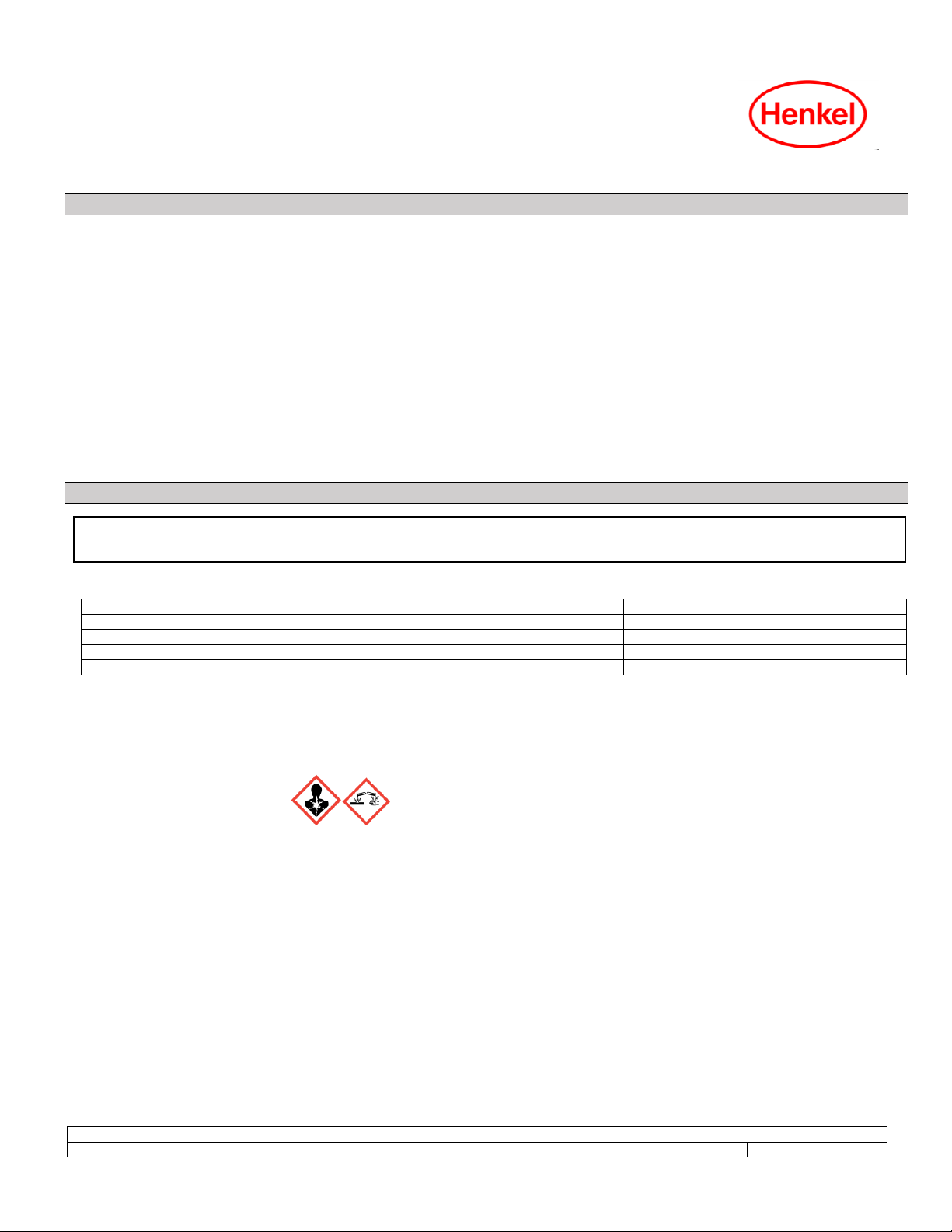
Hazard Statement(s): Causes severe skin burns and eye damage.
Causes damage to organs through prolonged or repeated exposure.
Toxic to aquatic life.
Symbol(s):
Precautionary Statements:
Prevention: Do not breathe vapors, mist, or spray.
Wash thoroughly after handling.
Do not eat, drink or smoke when using this product.
Avoid release to the environment.
Wear protective gloves, eye protection, and face protection.
Response: IF SWALLOWED: Rinse mouth. Do NOT induce vomiting.
IF ON SKIN (or hair): Take off immediately all contaminated clothing. Rinse skin with water/shower.
IF INHALED: Remove victim to fresh air and keep at rest in a position comfortable for breathing.
Immediately call a POISON CENTER or physician.
IF IN EYES: Rinse cautiously with water for several minutes. Remove contact lenses, if present and easy to
remove. Continue rinsing.
IF exposed or concerned: Get medical attention.
Wash contaminated clothing before reuse.
Storage: Not prescribed.
Disposal: Dispose of contents and/or container according to Federal, State/Provincial and local governmental regulations.
Page 2
The Dial Corporation, a Henkel Company; 7201 E. Henkel Way; Scottsdale, AZ 85255-9672
Hard Surface Cleaner
Page 2 of 6
Hazards not otherwise classified: Not available.
Chemical Name*
CAS Number (Unique Identifier)
Concentration
Limestone
1317-65-3
30 - 60 %
Boehmite (Al(OH)O)
1318-23-6
1 - 5%
Sulfonic acids, C13-17-sec-alkane, sodium salts
85711-69-9
1 - 5 %
Sodium hypochlorite
7681-52-9
1 - 5%
Classification complies with OSHA Hazard Communication Standard (29 CFR 1910.1200) and is consistent with the provisions of the United
Nations Globally Harmonized System of Classification and Labeling of Chemicals (GHS).
See Section 11 for additional toxicological information.
3. COMPOSITION / INFORMATION ON INGREDIENTS
The following chemicals are classified as health hazards in accordance with paragraph (d) of § 1910.1200.
*The specific chemical identity and/or exact percentage (concentration) of composition has been withheld because a trade secret is claimed in
accordance with paragraph (i) of §1910.1200.
4. FIRST AID MEASURES
Description of necessary measures
Most important symptoms and effects, both acute and delayed
Indication of any immediate medical attention and special treatment needed
Inhalation: Keep affected person warm and at rest. Remove from exposure area to fresh air immediately Treat symptomatically and
supportively. Contact physician or local poison control center
Skin contact: Take off contaminated clothing. Rinse affected area with large amounts of water until no evidence of product remains. Contact
physician or local poison control center.
Eye contact: Rinse eyes immediately with plenty of water, occasionally lifting upper and lower lids, until no evidence of product remains. Get
medical attention if pain or irritation develops.
Ingestion: Treat symptomatically and supportively. Maintain airway and respiration. Do not induce vomiting. Dilution by rinsing the mouth and
giving water or milk to drink is generally recommended. Contact physician or local poison control center.
After eye contact: Corrosive, may cause permanent damage to the eyes (impairment of vision). After skin contact: Moderate to strong irritation
of the skin (redness, swelling, burning), severe burns also possible. After Ingestion: Ingestion may cause pain, burning, swelling and redness
in the mouth and throat. Nausea and vomiting may occur. After inhalation: Irritation of the respiratory tract, coughing. Inhalation of larger
amounts may cause laryngospasm with shortness of breath.
After eye contact: Rinse eyes immediately with plenty of water, occasionally lifting upper and lower lids, until no evidence of product remains.
After skin contact: Rinse affected area with large amounts of water until no evidence of product remains. After ingestion: Do not induce
vomiting. Dilution by rinsing the mouth and giving a glass of water to drink is generally recommended. After inhalation: Remove from exposure
area to fresh air.
5. FIRE FIGHTING MEASURES
Suitable (and unsuitable) extinguishing media
Specific hazards arising from the chemical
Oxides of carbon and oxides of nitrogen.
Special protective equipment and precautions for fire-fighters
In case of fire, wear a full-face positive-pressure self-contained breathing apparatus and protective suit. Move containers from fire area if you can do it
without risk. Apply cooling water to sides of containers that are exposed to flames until well after fire is out. Avoid breathing hazardous vapors, keep
upwind. Isolate area. Keep unnecessary personnel away.
Suitable extinguishing media: Dry chemical, carbon dioxide, water spray or regular foam.
Unsuitable extinguishing media: None known
6. ACCIDENTAL RELEASE MEASURES
Personal precautions, protective equipment and emergency procedures
Wear skin, eye and respiratory protection as recommended in Section 8. Stop leak if you can do it without risk. Spills present a slipping hazard. Keep
unnecessary personnel away. Ventilate spill area if possible. Make sure area is slip-free before re-opening to traffic.
Environmental Precautions
This product is toxic to fish and aquatic invertebrates. This product should not be directly discharged into lakes, streams, ponds, estuaries, oceans,
public water supplies, or other waters.
Methods and materials for containment and cleaning up
Page 3
The Dial Corporation, a Henkel Company; 7201 E. Henkel Way; Scottsdale, AZ 85255-9672
Hard Surface Cleaner
Page 3 of 6
SMALL SPILLS: Contain and absorb with sand or other absorbent material and place into clean, dry containers for later disposal. Wash site of spillage
Hazardous Component(s)
ACGIH
OSHA PEL
AIHA WEEL
OTHER
Limestone
10 mg/m3 TWA Total dust.
5 mg/m3 PEL Respirable fraction.
15 mg/m3 PEL Total dust.
None
None
Boehmite (Al(OH)O)
1 mg/m3 TWA Respirable
fraction.
None
None
None
Sodium hypochlorite
None
None
2 mg/m3 STEL
None
thoroughly with water. LARGE SPILLS: Dike far ahead of spill to prevent further movement. Recover by pumping or by using a suitable absorbent
material and place into containers for later disposal. Dispose in suitable waste container.
7. HANDLING AND STORAGE
Precautions for safe handling
Do not get in eyes, on skin, on clothing. Do not take internally. Use with adequate ventilation. Keep the containers closed when not in use. Have
emergency equipment (for fires, spills, leaks, etc.) readily available.
Conditions for safe storage, including any incompatibilities
Store in a cool, dry, ventilated area out of reach of children and away from sources of heat, moisture, and incompatible substances. Storage areas for
large quantities (warehouse) should be well ventilated. Keep the containers tightly closed when not in use.
8. EXPOSURE CONTROLS / PERSONAL PROTECTION
OSHA permissible exposure limit (PEL), American Conference of Governmental Industrial Hygienists (ACGIH) Threshold Limit Value (TLV),
and any other exposure limit used or recommended by the chemical manufacturer, importer, or employer preparing the safety data sheet,
where available.
Appropriate engineering controls
Provide local exhaust or general dilution ventilation to keep exposure to airborne contaminants below the permissible exposure limits where mists or
vapors may be generated. Any self-contained breathing apparatus that has a full facepiece and is operated in a pressure-demand or other positivepressure mode.
Individual protection measures
Respiratory: Air contamination monitoring should be carried out where mists or vapors are likely to be generated, to assure that the
employees are not exposed to airborne contaminants above the permissible exposure limits.
Eye: Splash-proof safety glasses are required to prevent eye contact where splashing of product may occur.
Hand/Body: Protective gloves are required where repeated or prolonged skin contact may occur.
Protective clothing is required where repeated or prolonged skin contact may occur.
9. PHYSICAL AND CHEMICAL PROPERTIES
Appearance: cream, white
Odor: characteristic
Odor threshold: Not available.
pH: 12.7 (25 °C)
Melting point/ range: Not available.
Boiling point/range: Not available.
Flash point: > 93.3 °C (> 199.94 °F)
Evaporation rate: Not available.
Flammable/Explosive limits - lower: Not available.
Flammable/Explosive limits - upper: Not available.
Vapor pressure: Not available.
Vapor density: Not available.
Solubility in water: Not available.
Partition coefficient (n-octanol/water): Not available.
Autoignition temperature: Not available.
Decomposition temperature: Not available.
Viscosity: 5,000 - 12,000 mPa.s
VOC content: Not available.
Specific gravity: 1.3 (25°C, 77°F)
10. STABILITY AND REACTIVITY
Reactivity: This product reacts with acids.
Chemical stability: Stable under normal ambient temperature (70°F, 21°C) and pressure (1 atm).
Possibility of hazardous reactions: Hazardous polymerization has not been reported to occur under normal temperatures and pressures.
Page 4
The Dial Corporation, a Henkel Company; 7201 E. Henkel Way; Scottsdale, AZ 85255-9672
Hard Surface Cleaner
Page 4 of 6
Conditions to avoid: Avoid storing in direct sunlight and avoid extremes of temperature.
Hazardous Component(s)
LD50s and LC50s
Immediate and Delayed Health Effects
Limestone
None
Nuisance dust
Boehmite (Al(OH)O)
None
Respiratory, Lung, Corrosive, Irritant
Sulfonic acids, C13-17-sec-alkane, sodium salts
None
No data
Sodium hypochlorite
Oral LD50 (RAT) = 8.91 g/kg
Irritant, Corrosive, Skin
Hazardous Component(s)
NTP Carcinogen
IARC Carcinogen
OSHA Carcinogen
Limestone
No
No
No
Boehmite (Al(OH)O)
No
No
No
Sulfonic acids, C13-17-sec-alkane, sodium salts
No
No
No
Sodium hypochlorite
No
No
No
Hazardous substances
Value type
Value
Acute toxicity
study
Exposure
time
Species
Method
Calcium carbonate
LC50
> 10,000 mg/l
Fish
96 h OECD 203
Boehmite (Al(OH)O)
LC50
> 100 mg/l
Fish
96 h
Oncorhynchus
mykiss
OECD 203
Sulfonic acids, C13-17-sec-alkane,
sodium salts
LC50
4.1 mg/l
Fish
48 h
Leuciscus idus
DIN 38412-15
Sodium hypochlorite
LC50
10 – 100 mg/l
Fish
OECD 203
Hazardous substances
Value type
Value
Acute toxicity
study
Exposure
time
Species
Method
Calcium carbonate
EC50
> 1,000mg/l
Daphnia
48 h
Daphnia magna
OECD 202
Boehmite (Al(OH)O)
EC50
> 100 mg/l
Daphnia
48 h
Daphnia magna
OECD 202
Sulfonic acids, C13-17-sec-alkane,
sodium salts
EC50
7.5 mg/l
Daphnia
24 h
Daphnia magna
Sodium hypochlorite
EC50
10 – 100 mg/l
Daphnia
Daphnia magna
OECD 202
Incompatible materials: Strong oxidizers, acids. Reacts with other household chemicals such as acid toilet bowl cleaners, rust
removers, acids, vinegar, and ammonia-containing products to produce hazardous gases, such as chlorine and
other chlorinated compounds
Hazardous decomposition products: Thermal decomposition may produce irritating smoke, oxides of carbon and chlorine.
11. TOXICOLOGICAL INFORMATION
Likely routes of exposure including symptoms related to characteristics
Other relevant toxicity information:
This product is a household product. The use of this product by consumers is safe under normal and reasonable foreseen use.
Numerical measures of toxicity, including delayed and immediate effect
Carcinogenicity information
Inhalation: Irritating, in high concentration, to the respiratory tract (nose, throat, and lungs). Direct contact with mucous membranes may
result in corrosive damage.
Skin contact: May cause severe irritation, pain and possibly chemical burns.
Eye contact: May cause moderate to severe irritation, with possibility of corneal injury if not removed promptly.
Ingestion: Ingestion may cause severe irritation or burns to esophagus, mouth, and stomach with nausea, vomiting and diarrhea.
Physical/Chemical: The product is alkaline. The product is corrosive.
Carcinogenicity None of the ingredients in this product are listed as carcinogens by the International Agency for Research on Cancer
(IARC), the National Toxicology Program (NTP) or the Occupational Safety and Health Administration (OSHA)..
Mutagenicity None of the ingredients in this product are known to cause mutagenicity.
Toxicity to reproduction None of the ingredients in this product are known as reproductive, fetal, or developmental hazards.
12. ECOLOGICAL INFORMATION
Aquatic Toxicity:
This product is anticipated to be safe for the environment at concentrations predicted in household settings under normal use conditions. The following
toxicity information is available for the hazardous ingredient(s) when used as technical grade and is provided as reference for the occupational settings.
Toxicity to fish:
Toxicity to aquatic invertebrates:
Page 5
The Dial Corporation, a Henkel Company; 7201 E. Henkel Way; Scottsdale, AZ 85255-9672
Hard Surface Cleaner
Page 5 of 6
Toxicity to algae:
Hazardous substances
Value type
Value
Acute toxicity
study
Exposure
time
Species
Method
Calcium carbonate
EC50
> 200 mg/l
Algae
72 h OECD 201
Sulfonic acids, C13-17-sec-alkane,
sodium salts
EC50
95.5 mg/l
Algae
72 h
Desmodesmus
subspicatus
OECD 201
Sodium hypochlorite
EC50
0.4 mg/l
Algae
24 h
Dunaliella sp.
OECD 201
Hazardous substances
Result Value
Route of
application
Species
Method
Sulfonic acids, C13-17-sec-alkane,
sodium salts
readily biodegradable
aerobic
71 %
EU Method C.4-E (closed
bottle)
Persistence and Degradability:
Bioaccumulation Potential: The bioaccumulation potential of this product has not been determined.
Mobility: The mobility of this product (in soil and water) has not been determined.
13. DISPOSAL CONSIDERATIONS
Waste Number and Description: D002 (Corrosivity)
Disposal Considerations:
Disposal of products: This product is a RCRA characteristic hazardous waste (corrosive) and must be disposed of in a RCRA Subtitle
C landfill. If these wastes cannot be disposed of by use according to label instructions, contact your State
Pesticide or Environmental Control Agency, or the hazardous waste representative at the nearest EPA Regional
Office for guidance
Disposal of packages: Do not reuse this container. Dispose of container and unused contents in accordance with federal, state and
local requirements.
Additional information: Observe all federal, state and local regulations when storing or disposing of this substance
14. TRANSPORT INFORMATION
The transport information provided in this section only applies to the material/formulation itself, and is not specific to any
package/configuration.
U.S. Department of Transportation Ground (49 CFR)
Proper shipping name: Not regulated
Hazard class or division: None
Identification number: None
Packing group: None
International Air Transportation (ICAO/IATA)
Proper shipping name: Not regulated
Hazard class or division: None
Identification number: None
Packing group: None
Water Transportation (IMO/IMDG)
Proper shipping name: Not regulated
Hazard class or division: None
Identification number: None
Packing group: None
15. REGULATORY INFORMATION
Occupational safety and health act: Hazard Communication Standard, 29 CFR 1910.1200(g) Appendix D: The Occupational Safety and Health
Administration (OSHA) require that the Safety Data Sheets (SDSs) are readily accessible to employees for all hazardous chemicals in the workplace.
Since the use pattern and exposure in the workplace are generally not consistent with those experienced by consumers, this SDS may contain health
hazard information not relevant to consumer use.
United States Regulatory Information:
TSCA 8 (b) Inventory Status: All components are listed or are exempt from listing on the Toxic Substances Control Act Inventory.
TSCA 12 (b) Export Notification: None above reporting de minimis
CERCLA/SARA Section 302: None above reporting de minimis
CERCLA/SARA Section 311/312: Not available.
CERCLA/SARA Section 313: None above reporting de minimis
California Proposition 65: No California Proposition 65 listed chemicals are known to be present.
Page 6

The Dial Corporation, a Henkel Company; 7201 E. Henkel Way; Scottsdale, AZ 85255-9672
Hard Surface Cleaner
Page 6 of 6
Export Restrictions: This is a pesticide product registered by the US Environmental Protection Agency and is subject to certain labeling requirements
Canada Regulatory Information:
CEPA DSL/NDSL Status: One or more components are not listed on, and are not exempt from listing on either the Domestic Substances List or the
Non-Domestic Substances List.
under federal pesticide law. These requirements differ from the classification criteria and hazard information required for safety data
sheets (SDS), and for workplace labels of non-pesticide chemicals. Refer to the pesticide label for specific hazard information. The
pesticide label also includes other important information, including directions for use.
16. OTHER INFORMATION
DISCLAIMER: The data contained herein are furnished for information only and are believed to be reliable. However, Henkel Corporation and its
affiliates (“Henkel”) does not assume responsibility for any results obtained by persons over whose methods Henkel has no control. It is the user’s
responsibility to determine the suitability of Henkel’s products or any production methods mentioned herein for a particular purpose, and to adopt such
precautions as may be advisable for the protection of property and persons against any hazards that may be involved in the handling and use of any
Henkel’s products. In light of the foregoing, Henkel specifically disclaims all warranties, express or implied, including warranties of merchantability and
fitness for a particular purpose, arising from sale or use of Henkel’s products. Henkel further disclaims any liability for consequential or incidental
damages of any kind, including lost profits.
This safety data sheet contains changes from the previous version in sections: 2, 3, 11
Prepared by: R&D Support Services
Issue date: 04/20/2015 Supercedes: Rev. 6, 08/11/2014
 Loading...