

Page 1
Risk phrases
No label element(s) required
l
l
l
l
l
l
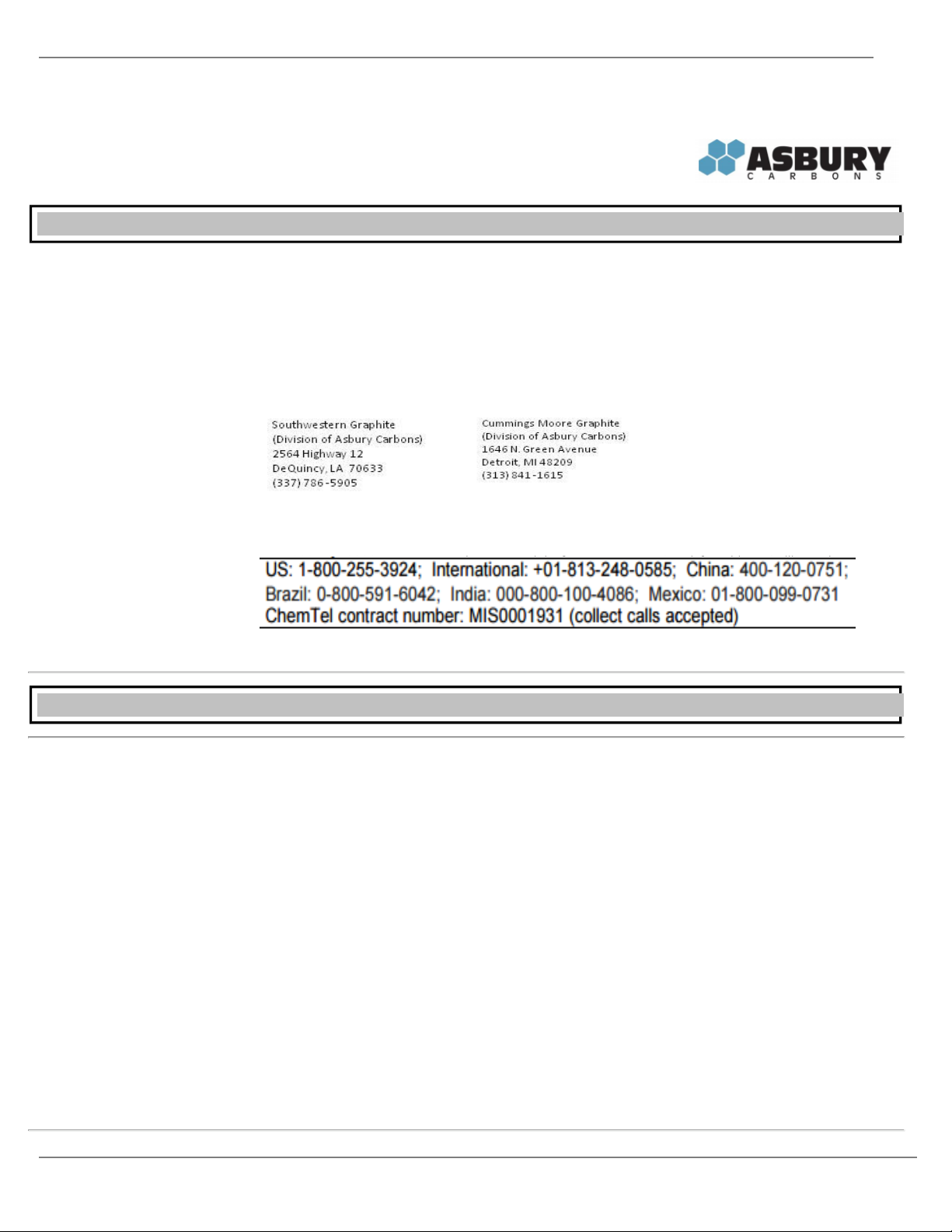
Fire, Exposure, or Accident Call CHEMTREC Day or Night
Seed Slik Graphite
Safety Data Sheet
Section 1: Identification of the Substance/Mixture and of the Company/Undertaking
1.1 Product identifier
Product Name
Seed Slik Graphite
1.2 Relevant identified uses of the substance or mixture and uses advised against
Relevant identified use(s)
1.3 Details of the supplier of the safety data sheet
Manufacturer
1.4 Emergency telephone number
Manufacturer
Manufacturer
Seed Lubricants,
Superior Graphite
10 S. Riverside Plaza
Chicago, IL 60606
United States
l
1-800-424-9300 - For Hazardous Materials [or Dangerous Goods] Incident Spill, Leak,
+1 703-527-3887 - Outside USA and Canada (collect calls accepted)
Section 2: Hazards Identification
EU/EEC
According to: Regulation (EC) No 1272/2008 (CLP)/REACH 1907/2006 [amended by 453/2010]
According to: EU Directive 67/548/EEC (DSD) or 1999/45/EC (DPD)
2.1 Classification of the substance or mixture
CLP
2.2 Label Elements
CLP
Hazard statements
DSD/DPD
2.3 Other Hazards
CLP
DSD/DPD
Preparation Date: 08/May/2015
Revision Date: 06/22/17
Not classified
l
No label element(s) required
l
May form combustible dust concentrations in air.
l
hazardous.
May form combustible dust concentrations in air.
l
This product is not considered dangerous under the European Directive 67/548/EEC
According to Regulation (EC) No. 1272/2008 (CLP) this material is not considered
Format: EU CLP/REACH Language: English (US)
Page 1 of 11
WHMIS, EU CLP, EU DSD/DPD, OSHA HCS 2012
Page 2
l
l l
l
No 1272/2008.
Seed Slik Graphite
United States (US)
According to: OSHA 29 CFR 1910.1200 HCS
2.1 Classification of the substance or mixture
OSHA HCS 2012
2.2 Label elements
OSHA HCS 2012
Combustible Dust
WARNING
Hazard statements
2.3 Other hazards
OSHA HCS 2012
Canada
According to: WHMIS
l
May form combustible dust concentrations in air.
Under United States Regulations (29 CFR 1910.1200 - Hazard Communication
l
Standard), this product is considered hazardous.
2.1 Classification of the substance or mixture
WHMIS
2.2 Label elements
WHMIS
Not classified
No label element(s) required.
2.3 Other hazards
WHMIS
May form combustible dust concentrations in air.
l
In Canada, the product mentioned above is not considered hazardous under the
Workplace Hazardous Materials Information System (WHMIS).
Section 3 - Composition/Information on Ingredients
3.1 Substances
3.2 Mixtures
Chemical
Name
Graphite
Quartz
Preparation Date: 08/May/2015
Revision Date: 06/22/17
Identifiers
CAS:
7782-42-5
EC Number:
3
CAS:
14808-60-7
EC Number:
4
231-955-
238-878-
Material does not meet the criteria of a substance in accordance with Regulation (EC)
Composition
%
LD50/LC50
>= 60%
2% TO
12%
NDA
NDA
Classifications According to
Regulation/Directive
EU DSD/DPD:
EU CLP:
OSHA HCS 2012:
EU DSD/DPD:
EU CLP:
H350
OSHA HCS 2012:
Page 2 of 11
Not Classified
Not Classified
Not Classified
T R48/20; Carc. 1, R49
STOT RE 1 (Lungs, Inhl), H372; Carc. 1A,
STOT RE 1 (Lungs, Inhl); Carc. 1A
Format: EU CLP/REACH Language: English (US)
WHMIS, EU CLP, EU DSD/DPD, OSHA HCS 2012
Comments
NDA
<0.1%
respirable
Page 3
l
l
Graphite
Suitable Extinguishing Media
LARGE FIRE: Water spray, fog or regular foam.
l
will
burn, giving off
and
unconscious person. Get medical attention.
l
potentially carbon monoxide.
Seed Slik Graphite
See Section 16 for full text of H-statements and R-phrases.
Section 4 - First Aid Measures
4.1 Description of first aid measures
Inhalation
Skin
Eye
Ingestion
Move victim to fresh air. Give artificial respiration if victim is not breathing. Administer
l
oxygen if breathing is difficult. If breathing is difficult get medical attention.
IF ON SKIN: Wash with plenty of soap and water. Take off contaminated clothing and
l
wash before reuse. If irritation develops and persists, get medical attention.
In case of contact with substance, immediately flush eyes with running water for at
l
least 20 minutes. Get medical attention.
Do NOT induce vomiting. Rinse mouth. Do not give anything by mouth to an
4.2 Most important symptoms and effects, both acute and delayed
Refer to Section 11 - Toxicological Information.
l
4.3 Indication of any immediate medical attention and special treatment needed
Notes to Physician
4.4 Other information
All treatments should be based on observed signs and symptoms of distress in the
l
patient. Consideration should be given to the possibility that overexposure to materials
other than this product may have occurred.
Call 911 or emergency medical service. Ensure that medical personnel are aware of
l
the material(s) involved, take precautions to protect themselves and prevent spread of
contamination.
Section 5 - Firefighting Measures
5.1 Extinguishing media
Unsuitable Extinguishing
Media
5.2 Special hazards arising from the substance or mixture
Unusual Fire and Explosion
Hazards
Hazardous Combustion
l
SMALL FIRES: Dry chemical, CO2, water spray or regular foam.
No data available.
Dust dispersed in air in sufficient concentrations and in the presence if an ignition
l
source is an explosion hazard.
l
carbon dioxide
Products
5.3 Advice for firefighters
Wear positive pressure self-contained breathing apparatus (SCBA).
l
Structural firefighters' protective clothing will only provide limited protection.
LARGE FIRES: Move containers from fire area if you can do it without risk.
LARGE FIRES: Do not scatter spilled material with high pressure water streams.
LARGE FIRES: Dike fire-control water for later disposal.
Section 6 - Accidental Release Measures
6.1 Personal precautions, protective equipment and emergency procedures
Personal Precautions
Emergency Procedures
Do not touch or walk through spilled material.
Use normal clean up procedures.
6.2 Environmental precautions
l
Preparation Date: 08/May/2015
Revision Date: 06/22/17
LARGE SPILLS: Prevent entry into waterways, sewers, basements or confined areas.
Format: EU CLP/REACH Language: English (US)
Page 3 of 11
WHMIS, EU CLP, EU DSD/DPD, OSHA HCS 2012
Page 4
l
l
l
l
l l l
Wear protective eyewear (goggles, face shield, or safety glasses). Eye wash station
For
Adequate ventilation systems as needed to control concentrations of airborne
Avoid accumulation of dust. Good housekeeping practices should be in place to
Avoid dispersal of dust
limited exposure use an N95 dust
in the
mask.
air.
Seed Slik Graphite
6.3 Methods and material for containment and cleaning up
Containment/Clean-up
Measures
SMALL SPILLS: Use clean non-sparking tools to collect material and place it into
loosely covered plastic containers for later disposal.
Wash floor with soap and water.
LARGE SPILLS: Cover powder spill with plastic sheet or tarp to minimize spreading.
6.4 Reference to other sections
Refer to Section 8 - Exposure Controls/Personal Protection and Section 13 - Disposal
l
Considerations.
Section 7 - Handling and Storage
7.1 Precautions for safe handling
Handling
prevent accumulation of dusts on surfaces. Do not use in areas without adequate
ventilation. Graphite is conductive and can cause short circuits and other electrical
malfunctions. Graphite causes slippery conditions. Wash thoroughly with soap and
water after handling and before eating, drinking, or using tobacco.
7.2 Conditions for safe storage, including any incompatibilities
Storage
7.3 Specific end use(s)
Ventilate enclosed areas. Keep container closed.
l
Refer to Section 1.2 - Relevant identified uses.
Section 8 - Exposure Controls/Personal Protection
8.1 Control parameters
Result
Graphite as
Particulates not
otherwise
classified (PNOC)
TWAs
Exposure Limits Supplemental
OSHA
•
Graphite (7782-42-5):
Mineral Dusts:
8.2 Exposure controls
Engineering
Measures/Controls
Personal Protective Equipment
Respiratory
Eye/Face
Hands
Skin/Body
Preparation Date: 08/May/2015
Revision Date: 06/22/17
Exposure Limits/Guidelines
ACGIH
2 mg/m3 TWA (all forms except
graphite fibers, respirable fraction)
(15 mppcf TWA (natural))
contaminants below applicable threshold limit values. All dust control equipment
should contain explosion relief vents or an explosion supression system or an oxygendeficient environment. Make sure that dust handling systems are designed to prevent
escape of dust into the work area and that they do not leak.
purifying respirator with high efficiency particulate air (HEPA) filters. Follow the OSHA
respirator regulations found in 29 CFR 1910.134 or European Standard EN 149. Use a
NIOSH/MSHA or European Standard EN 149 approved respirator if exposure limits are
exceeded or symptoms are experienced.
should be available.
Wear protective gloves - cotton gloves.
Wear long sleeves and/or protective coveralls.
l
2.5 mg/m3 TWA (natural, respirable
dust)
Page 4 of 11
NIOSH
OSHA
15 mg/m3 TWA (synthetic, total
dust); 5 mg/m3 TWA (synthetic,
respirable fraction)
For prolonged exposure use an air-
Format:
WHMIS, EU CLP, EU DSD/DPD, OSHA HCS 2012
EU CLP/REACH Language:
English
(US)
Page 5
l
Data lacking
UEL
Data lacking
Flash Point
Data lacking
Vapor Pressure
Data lacking
Melting Point
Data lacking
Boiling Point
Black colored solid with no odor.
Appearance/Description
Solid Physical Form
l
Controls should be engineered to prevent release to the environment, including
Seed Slik Graphite
Environmental Exposure
Controls
procedures to prevent spills, atmospheric release and release to waterways. Follow
best practice for site management and disposal of waste.
Key to abbreviations
ACGIH = American Conference of Governmental Industrial Hygiene
NIOSH = National Institute of Occupational Safety and Health
OSHA = Occupational Safety and Health Administration
TWA = Time-Weighted Averages are based on 8h/day, 40h/week exposures
Section 9 - Physical and Chemical Properties
9.1 Information on Physical and Chemical Properties
Material Description
Color
Odor Threshold
General Properties
Decomposition Temperature
Specific Gravity/Relative Density
Water Solubility
Explosive Properties
Volatility
Evaporation Rate
Flammability
LEL
Flammability (solid, gas)
Environmental
Octanol/Water Partition coefficient Data lacking
Silver, gray to black.
Data lacking
Data lacking
= 2.25
Data lacking
Data lacking
Data lacking
Data lacking
Data lacking
Odor
pH
Density
Viscosity
Oxidizing Properties:
Vapor Density
Autoignition
No odor.
Data lacking
18.7763 lbs/gal
Data lacking
Data lacking
Data lacking
Data lacking
9.2 Other Information
No additional physical and chemical parameters noted.
l
Section 10: Stability and Reactivity
10.1 Reactivity
10.2 Chemical stability
10.3 Possibility of hazardous reactions
10.4 Conditions to avoid
10.5 Incompatible materials
Preparation Date: 08/May/2015
Revision Date: 06/22/17
No dangerous reaction known under conditions of normal use.
l
Stable under normal temperatures and pressures.
l
Will not occur.
Accumulation of dusts - mixtures of graphite dust and air are explosive when ignited.
l
Page 5 of 11
Format: EU CLP/REACH Language: English (US)
WHMIS, EU CLP, EU DSD/DPD, OSHA HCS 2012
Page 6
l
l
Seed Slik Graphite
Strong oxidizing agents, acids, and alkalis
l
10.6 Hazardous decomposition products
Hazardous decomposition may occur on burning, generating carbon dioxide and
l
carbon monoxide, .
Section 11 - Toxicological Information
11.1 Information on toxicological effects
Quartz (2%
TO 12%)
GHS Properties
Acute toxicity
Aspiration Hazard
Carcinogenicity
Germ Cell Mutagenicity
Skin corrosion/Irritation
Skin sensitization
STOT-RE
STOT-SE
Toxicity for Reproduction
Respiratory sensitization
Serious eye damage/Irritation
1480860-7
Multi-dose Toxicity:
Respiration:Fibrosis (interstitial)
Inhalation-Hamster TCLo • 3 mg/m³ 6 Hour(s) 78 Week(s)-Intermittent; Lungs, Thorax, or
Classification
Components
;
Lungs, Thorax, or Respiration:Changes in lung weight
EU/CLP • Data lacking
OSHA HCS 2012 • Data lacking
EU/CLP • Data lacking
OSHA HCS 2012 • Data lacking
EU/CLP • Data lacking
OSHA HCS 2012 • Data lacking
EU/CLP • Data lacking
OSHA HCS 2012 • Data lacking
EU/CLP • Data lacking
OSHA HCS 2012 • Data lacking
EU/CLP • Data lacking
OSHA HCS 2012 • Data lacking
EU/CLP • Data lacking
OSHA HCS 2012 • Data lacking
EU/CLP • Data lacking
OSHA HCS 2012 • Data lacking
EU/CLP • Data lacking
OSHA HCS 2012 • Data lacking
EU/CLP • Data lacking
OSHA HCS 2012 • Data lacking
EU/CLP • Data lacking
OSHA HCS 2012 • Data lacking
Potential Health Effects
Inhalation
Acute (Immediate)
Chronic (Delayed)
Skin
Acute (Immediate)
Chronic (Delayed)
Eye
Acute (Immediate)
Preparation Date: 08/May/2015
Revision Date: 06/22/17
Exposure to dust may cause irritation.
l
No data available
Exposure to dust may cause mechanical irritation.
l
No data available.
Exposure to dust may cause mechanical irritation. Excessive concentrations of
l
Page 6 of 11
Format: EU CLP/REACH Language: English (US)
WHMIS, EU CLP, EU DSD/DPD, OSHA HCS 2012
Page 7
l
l
l l
l
l
l
Seed Slik Graphite
nuisance dust in the workplace may reduce visibility and may cause unpleasant
deposits in eyes.
Chronic (Delayed)
Ingestion
Acute (Immediate)
Chronic (Delayed)
Carcinogenic Effects
Quartz
CAS IARC
14808-60-7
No data available.
Excessive concentrations of nuisance dust in the workplace may cause mechanical
l
irritation to mucous membranes.
No data available.
This material contains Quartz which is considered a carcinogen, however this material
l
as a whole is not classified as a carcinogen.
Group 1-Carcinogenic
Key to abbreviations
T C = Toxic Concentration
Section 12 - Ecological Information
12.1 Toxicity
Carcinogenic Effects
NTP
Known
Human
Carcinogen
Material data lacking.
12.2 Persistence and degradability
Material data lacking.
12.3 Bioaccumulative potential
Material data lacking.
12.4 Mobility in Soil
Material data lacking.
12.5 Results of PBT and vPvB assessment
No PBT and vPvB assessment has been conducted.
l
12.6 Other adverse effects
No studies have been found.
Section 13 - Disposal Considerations
13.1 Waste treatment methods
Product waste
Packaging waste
Dispose of content and/or container in accordance with local, regional, national, and/or
l
international regulations.
Dispose of content and/or container in accordance with local, regional, national, and/or
l
international regulations.
Section 14 - Transport Information
14.1 UN
number
DOT NDA
Preparation Date: 08/May/2015
Revision Date: 06/22/17
14.2 UN proper
shipping name
Not regulated
NDA NDA NDA
14.3 Transport hazard
class(es)
Page 7 of 11
14.4 Packing
group
Format: EU CLP/REACH Language: English (US)
WHMIS, EU CLP, EU DSD/DPD, OSHA HCS 2012
14.5 Environmental
hazards
Page 8
user
None known.
Not relevant.
; Listed
Seed Slik Graphite
TDG
NDA
Not Regulated
NDA
NDA
NDA
IMO/IMDG
IATA/ICAO
14.6 Special precautions for
14.7 Transport in bulk
according to Annex II of
MARPOL 73/78 and the IBC
Code
NDA
NDA
Not regulated
Not regulated
l
NDA NDA NDA
NDA NDA NDA
l
Section 15 - Regulatory Information
15.1 Safety, health and environmental regulations/legislation specific for the substance or
mixture
SARA Hazard Classifications
Graphite
Quartz
Component
CAS
7782-42-5
14808-60-7
Pressure(Sudden Release of)
l
Inventory
Canada DSL
Yes No Yes No
Yes No Yes No
Canada
NDSL
EU EINECS
EU ELNICS
Canada
Labor
Canada - WHMIS - Classifications of Substances
• Quartz
• Graphite
Canada - WHMIS - Ingredient Disclosure List
• Quartz
• Graphite
Environment
Canada - CEPA - Priority Substances List
• Quartz
• Graphite
14808-60-7
7782-42-5
14808-60-7
7782-42-5
14808-60-7
7782-42-5
D2A (In certain cases, this
classification does not apply.
For more information, consult
the section Substance Specific
Issues - Silica, crystalline,
encapsulated on Health
Canada's WHMIS Division
website.)
D2A
(natural)
1 %
Not
Not Listed
Not Listed
D2B
(synthetic)
Europe
Other
EU - Hazardous Substances Restricted or Prohibited in Electrical Equipment (2011/65/EU) (RoHS)
• Quartz
• Graphite
Japan
Preparation Date: 08/May/2015
Revision Date: 06/22/17
14808-60-7
7782-42-5
Not Listed
Not Listed
Page 8 of 11
Format: EU CLP/REACH Language: English (US)
WHMIS, EU CLP, EU DSD/DPD, OSHA HCS 2012
Page 9

Not
Seed Slik Graphite
Environment
Inventory - Japan - Industrial Safety and Health Law Substances (ISHL)
• Quartz
• Graphite
Other
Japan - Chemical Substance Control Law (CSCL) - Monitoring Chemical Substances
• Quartz
• Graphite
Japan - Poisonous and Deleterious Substances - Substances Not Considered Deleterious
• Quartz
• Graphite
Japan - Poisonous and Deleterious Substances - Substances Not Considered Poisonous
• Quartz
• Graphite
14808-60-7
7782-42-5
14808-60-7
7782-42-5
14808-60-7
7782-42-5
14808-60-7
7782-42-5
Not Listed
Not Listed
Not Listed
Not Listed
Not Listed
Not Listed
Not Listed
Not Listed
United States
Labor
U.S. - OSHA - Process Safety Management - Highly Hazardous Chemicals
• Quartz
• Graphite
U.S. - OSHA - Specifically Regulated Chemicals
• Quartz
• Graphite
Environment
U.S. - CAA (Clean Air Act) - 1990 Hazardous Air Pollutants
• Quartz
• Graphite
U.S. - CERCLA/SARA - Hazardous Substances and their Reportable Quantities
• Quartz
• Graphite
U.S. - CERCLA/SARA - Radionuclides and Their Reportable Quantities
• Quartz
• Graphite
U.S. - CERCLA/SARA - Section 302 Extremely Hazardous Substances EPCRA RQs
• Quartz
• Graphite
U.S. - CERCLA/SARA - Section 302 Extremely Hazardous Substances TPQs
• Quartz
• Graphite
U.S. - CERCLA/SARA - Section 313 - Emission Reporting
• Quartz
• Graphite
U.S. - CERCLA/SARA - Section 313 - PBT Chemical Listing
Preparation Date: 08/May/2015
Revision Date: 06/22/17
Page 9 of 11
14808-60-7
7782-42-5
14808-60-7
7782-42-5
14808-60-7
7782-42-5
14808-60-7
7782-42-5
14808-60-7
7782-42-5
14808-60-7
7782-42-5
14808-60-7
7782-42-5
14808-60-7
7782-42-5
Not Listed
Not Listed
Not Listed
Not Listed
Not Listed
Not Listed
Not Listed
Not Listed
Not Listed
Listed
Not Listed
Not Listed
Not Listed
Not Listed
Not Listed
Not Listed
Format: EU CLP/REACH Language: English (US)
WHMIS, EU CLP, EU DSD/DPD, OSHA HCS 2012
Page 10
l
l
expressed or implied regarding the accuracy of the data or the results obtained from
the
use thereof.
• Graphite
H372 - Causes damage to organs through prolonged or repeated exposure.
l
Because the information contained herein may be applied under
conditions beyond our control, we assume no responsibility for its use.
Listed
Listed
Seed Slik Graphite
• Quartz
United States - California
Environment
U.S. - California - Proposition 65 - Carcinogens List
• Quartz
• Graphite
U.S. - California - Proposition 65 - Developmental Toxicity
• Quartz
• Graphite
U.S. - California - Proposition 65 - Maximum Allowable Dose Levels (MADL)
• Quartz
• Graphite
U.S. - California - Proposition 65 - No Significant Risk Levels (NSRL)
• Quartz
• Graphite
U.S. - California - Proposition 65 - Reproductive Toxicity - Female
• Quartz
• Graphite
U.S. - California - Proposition 65 - Reproductive Toxicity - Male
• Quartz
• Graphite
15.2 Chemical Safety Assessment
No Chemical Safety Assessment has been carried out.
l
14808-60-7
7782-42-5
14808-60-7
7782-42-5
14808-60-7
7782-42-5
14808-60-7
7782-42-5
14808-60-7
7782-42-5
14808-60-7
7782-42-5
14808-60-7
7782-42-5
Not Listed
Not Listed
carcinogen, initial date 10/1/88
(airborne particles of
respirable size)
Not
Not Listed
Not Listed
Not Listed
Not
Not Listed
Not Listed
Not Listed
Not Listed
Not Listed
Not Listed
15.3 Other Information
WARNING: This product contains a chemical known to the State of California to
l
cause cancer.
Section 16 - Other Information
Relevant Phrases (code & full text)
Last Revision Date
Preparation Date
Disclaimer/Statement of
Liability
Key to abbreviations
Preparation Date: 08/May/2015
Revision Date: 06/22/17
H350 - May cause cancer.
R48/20 - Harmful: danger of serious damage to health by prolonged exposure through
inhalation.
R49 - May cause cancer by inhalation.
08/May/2015
L
06/22/17
The information contained herein is based on data available. However, no warranty is
Page 10 of 11
Format: EU CLP/REACH Language: English (US)
WHMIS, EU CLP, EU DSD/DPD, OSHA HCS 2012
Page 11

Seed Slik Graphite
NDA = No data available
Preparation Date: 08/May/2015
Revision Date: 06/22/17
Page 11 of 11
Format: EU CLP/REACH Language: English (US)
WHMIS, EU CLP, EU DSD/DPD, OSHA HCS 2012
 Loading...