

Page 1
str. 1
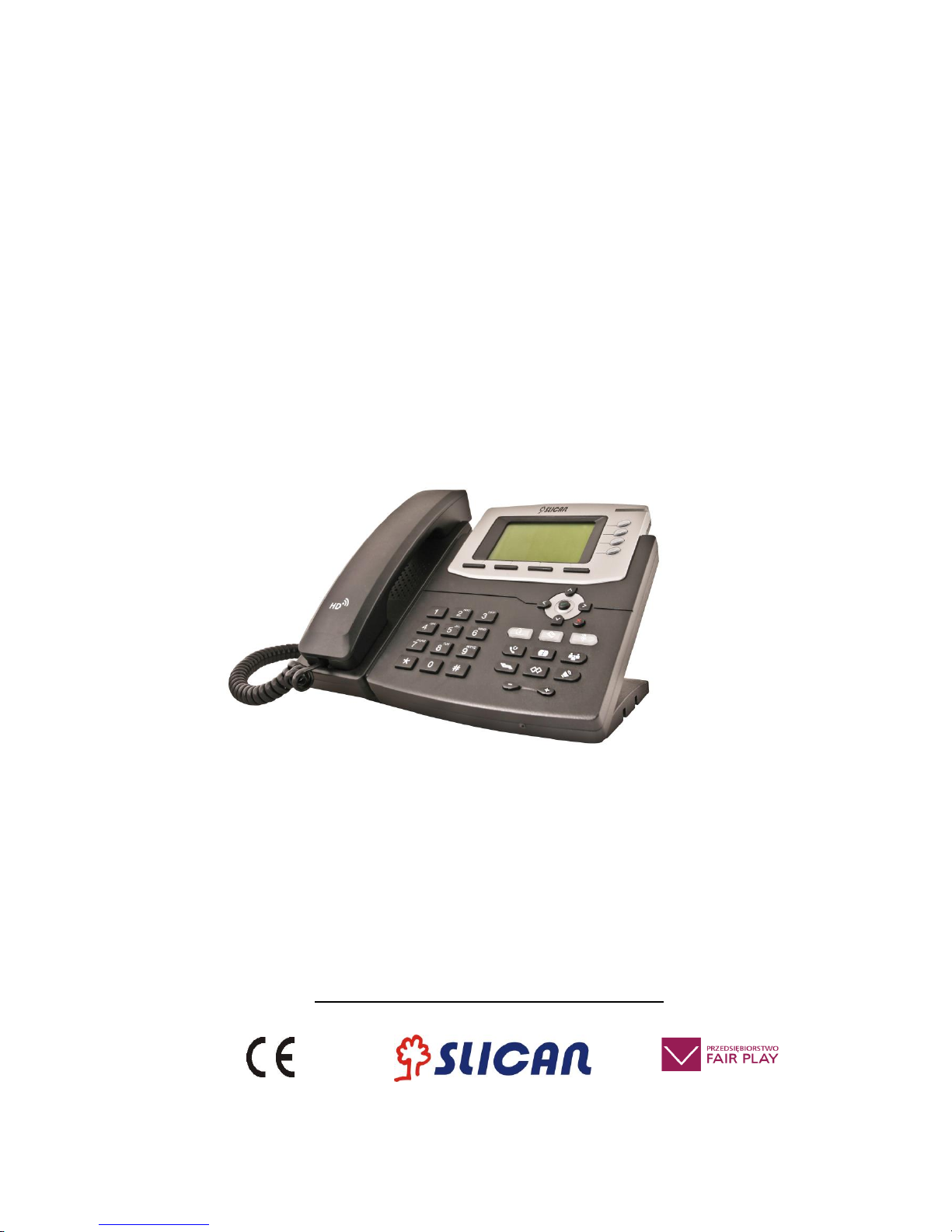
IP Phone
VPS-804P
Instruction Manual
Release 1.00
Date of last modification: 16.02.2015
Page 2

str. 2
Table of Contents:
1. IP Phone VPS-804P ......................................................................................... 5
1.1. Notice Information ................................................................................... 5
1.1. Packing List ............................................................................................... 6
2. Phone Installation .......................................................................................... 8
2.1. Attach the foot stand .............................................................................. 8
2.2. Connect the Handset and optional Headset..………………….………………………8
2.3. Connect the Network and Power ............................................................ 9
2.4. Initialization ............................................................................................. 9
3. Getting Familiar with Your Phone ................................................................ 11
3.1. Hardware Components Preview ........................................................... 11
3.2. Icon Preview ......................................................................................... 14
4. Phone Configuration ................................................................................... 16
4.1. Basic Features Configuration ................................................................ 16
4.2. Web Login ............................................................................................ 16
4.3. Administrator Password ....................................................................... 17
4.4. Language ............................................................................................... 18
4.5. Time and Date ...................................................................................... 18
4.6. Screen Saver ......................................................................................... 20
4.7. Ring Tone ............................................................................................. 21
4.8. Volume ................................................................................................ 22
4.9. Directory – edit contact list .................................................................. 23
4.10. Call history .......................................................................................... 25
4.11. Network configuration........................................................................ 25
5. Configuration VoIP account .......................................................................... 26
5.1. Basic configuration VoIP account ......................................................... 26
Page 3

str. 3
5.2. Advanced configuration VoIP account....................................................27
6. Basic Call Features ........................................................................................ 27
6.1. Place a Call .......................................................................................... 27
6.2. End a Call ............................................................................................ 28
6.3. Receive a Call ...................................................................................... 28
6.4. Redial ................................................................................................. 29
6.5. Auto answer ........................................................................................ 29
6.6. Call Hold .............................................................................................. 29
6.7. Call Transfer ........................................................................................ 30
6.8. Call Conference ................................................................................... 31
6.9. Call Forward ........................................................................................ 32
6.10. Call Return (REDIAL) .......................................................................... 34
6.11. Anonymous Call................................................................................. 34
6.12. Call Mute ........................................................................................... 35
6.13. DND (Do Not Disturb) ....................................................................... 35
6.14. Key as Send ....................................................................................... 35
6.15. No Key Entry Timeout ...................................................................... 35
6.16. Hot Line ........................................................................................... 36
7. Advanced Features ....................................................................................... 37
7.1. Voice Message .................................................................................... 37
7.2. Intercom ........................................................................................... 38
7.3. Speed Dial .......................................................................................... 39
7.4. Direct Pickup ...................................................................................... 39
7.5. Group Pickup ...................................................................................... 39
7.6. BLF(Busy Lamp Field) .......................................................................... 40
7.7. Shared Line……………………………………………………………………………………… 41
Page 4

str. 4
7.8. Call Park ……………………………………………………………………………………….….42
7.9. Paging……………………………………………………………………………………………….42
7.10. DTMF ............................................................................................... 43
7.11. Prefix ............................................................................................... 43
7.12. Action URL ........................................................................................ 44
7.13. Keybord Layout ................................................................................ 44
7.14. Keypad Lock ..................................................................................... 44
8. Management and Upgrade .......................................................................... 45
8.1. Start ................................................................................................... 45
8.2. Factory Reset ..................................................................................... 45
8.3. Software update ................................................................................. 46
8.4. Remote Phonebook ............................................................................ 47
8.5. System Log ......................................................................................... 48
8.6. TLS Certyficates ................................................................................. 48
9. Troubleshooting ........................................................................................... 49
9.1. Why is the phone LCD screen blank? .................................................. 49
9.2. Why does the phone display "Network Unavailable"? ....................... 49
9.3. Why can’t I get a dial tone? ................................................................ 49
10. Annex ......................................................................................................... 50
10.1. Technical Specification ...................................................................... 50
10.2. Voice Parameters .............................................................................. 50
10.3. Network Parameters ......................................................................... 50
Page 5
str. 5
1. IP Phone VPS-804P
Thank you for purchasing the VPS-804P. It is a fully functional mobile web enables voice
communication over the network. This device works like a traditional phone: You can make and
receive calls and use other functions specific to a regular phone.
This phone has other features data services that are unavailable in traditional phones.
This manual contains information on the features and services available on the device.
1.1. Notice Information
Before you connect and start using your phone, please read the following information.
They are important, the unit will operate in a safe and reliable.
Safety cautions
1. To use the power adapter that delivered with the phone. Other power adapters may damage the
phone.
2. The phone is only for indoor use. And also avoid in high humidity, water and some other liquids.
3. Do not use the phone during thunderstorms.
Disposal of the phone
This symbol indicates that the product is classified as electrical or electronic
equipment and should not be disposed of with other commercial or household
waste at the end of its working life.
Cleaning
To clean the device, use an anti-static cloth. Please avoid cleaning liquids as they might damage the
surface or internal electronics of the phone.
„The manufacturer reserves the right to make changes to the product
without prior notice.”
www.slican.pl
e-mail: office@slican.pl
Page 6
str. 6
1.2 Packing List
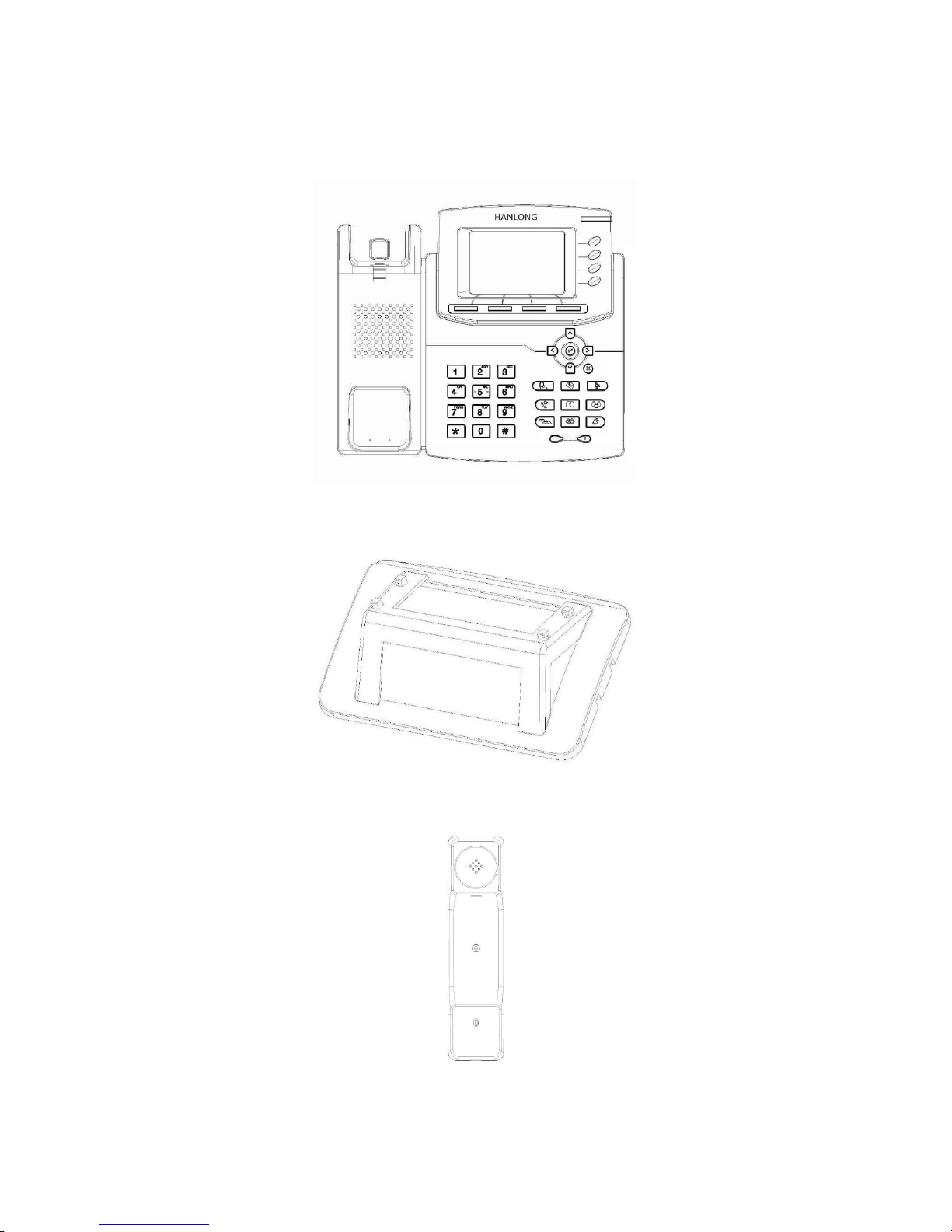
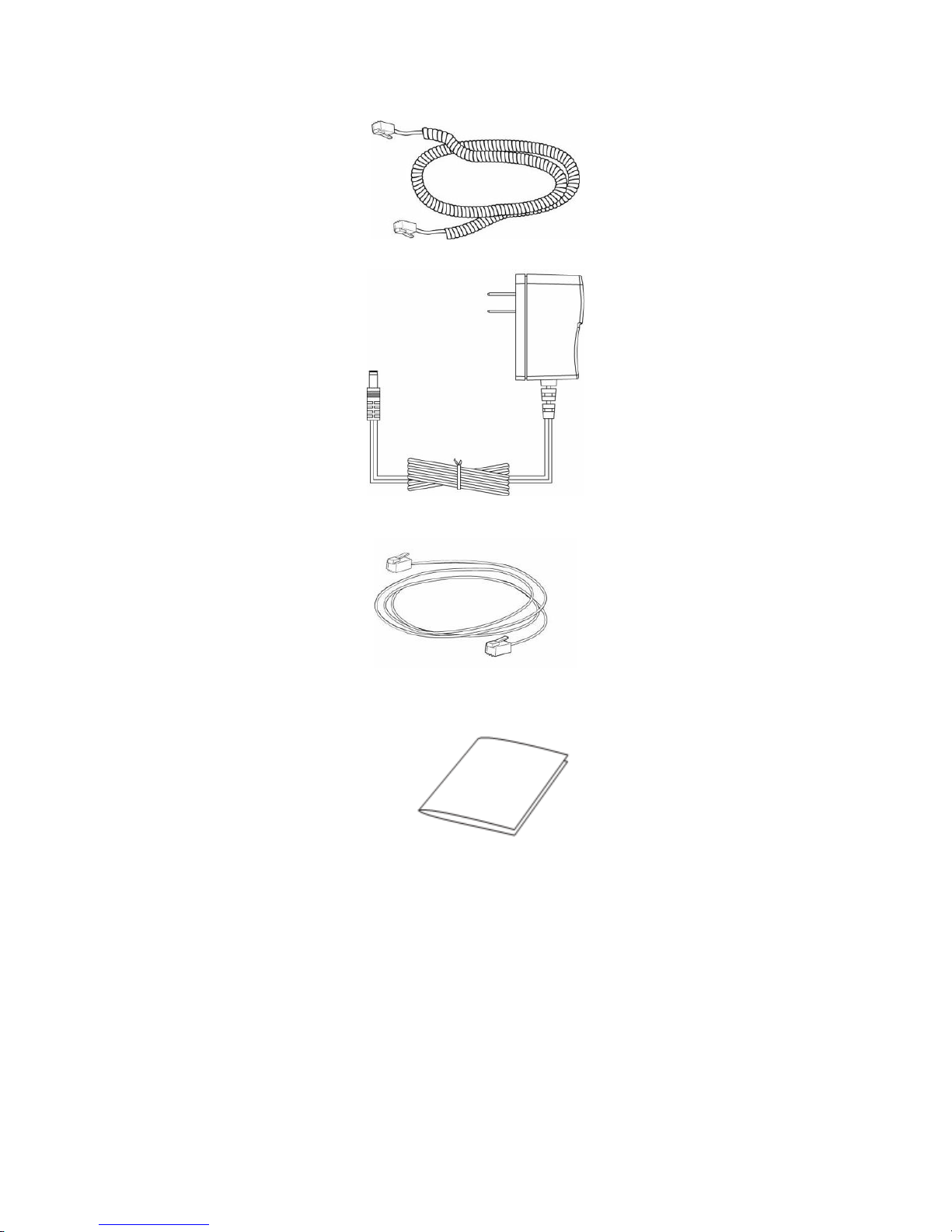
The package contains the following parts, please check if all the items are not missed:
PHONE
THE FOOTSTAND
HANDSET
Page 7
str. 7
HANDSET CORD
POWER ADAPTER
ETHERNET CABLE
QUICK INSTALLATION REFERENCE
Page 8
str. 8
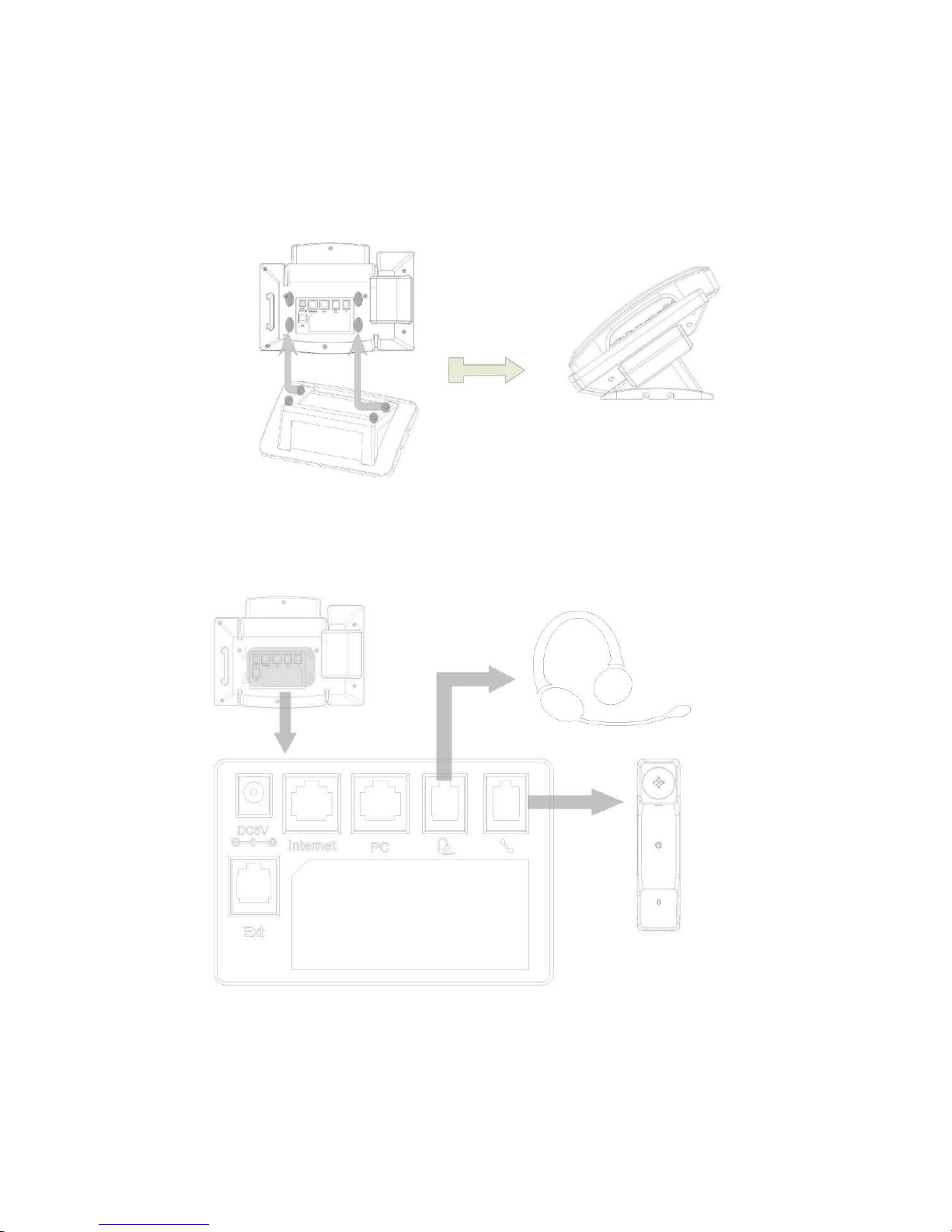
2. Phone Installation
2.1. Attach the Foot stand
2.2. Connect the Handset and optional Headset.
Page 9
str. 9
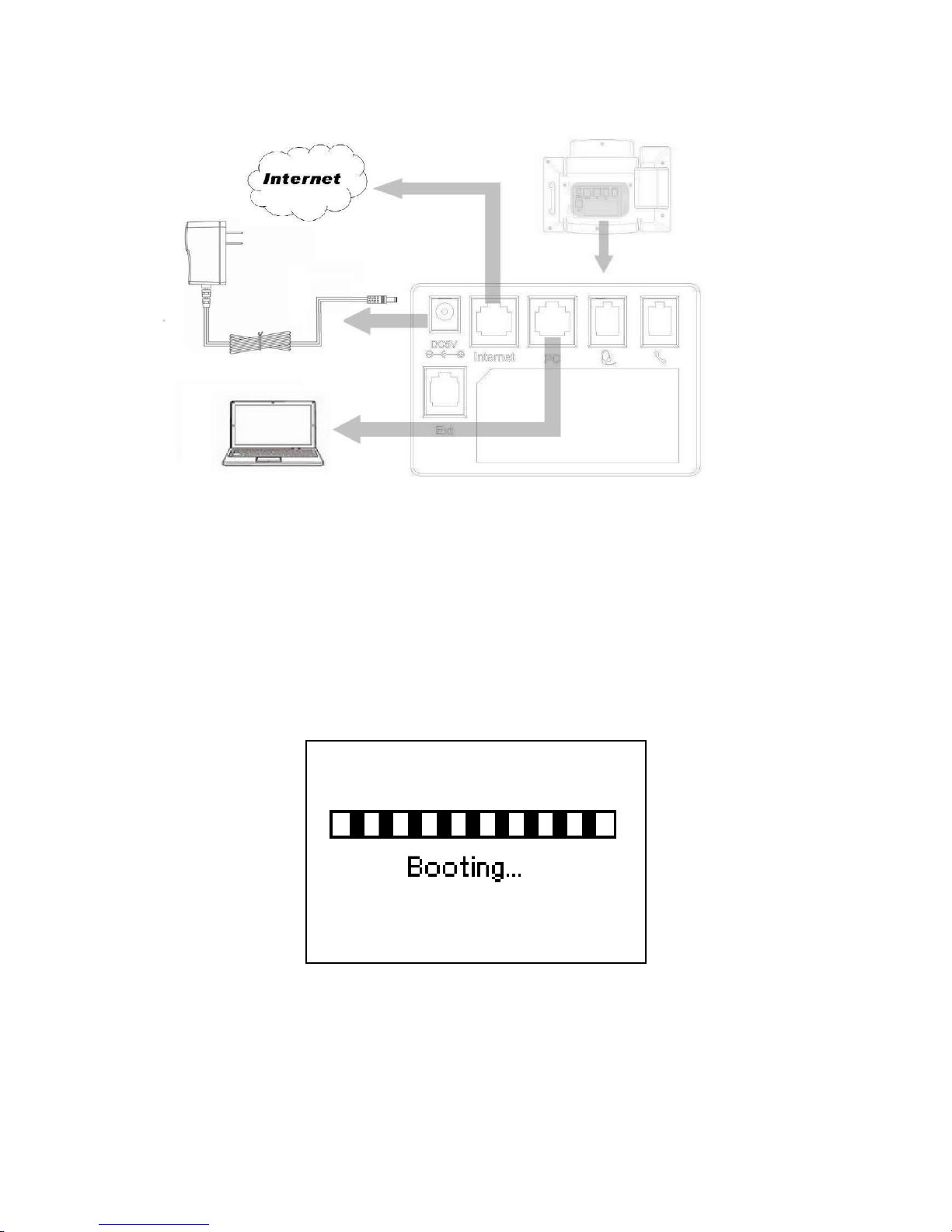
2.3. Connect the Network and Power
2.4.Initialization
After your phone has been powered up, the system boots up and performs the following steps:
- automatic phone initialization
The phone finishes the initialization process by loading the saved configuration. The phone LCD
screen will display "Booting":
- and then show “Initializing “during the initialization process.
Page 10

str. 10
By default the phone attempts to contact a DHCP server in your network in order to obtain its
valid network settings, e.g. IP address, subnet mask, default gateway, DNS server.
Page 11
str. 11
3. Getting Familiar with Your Phone
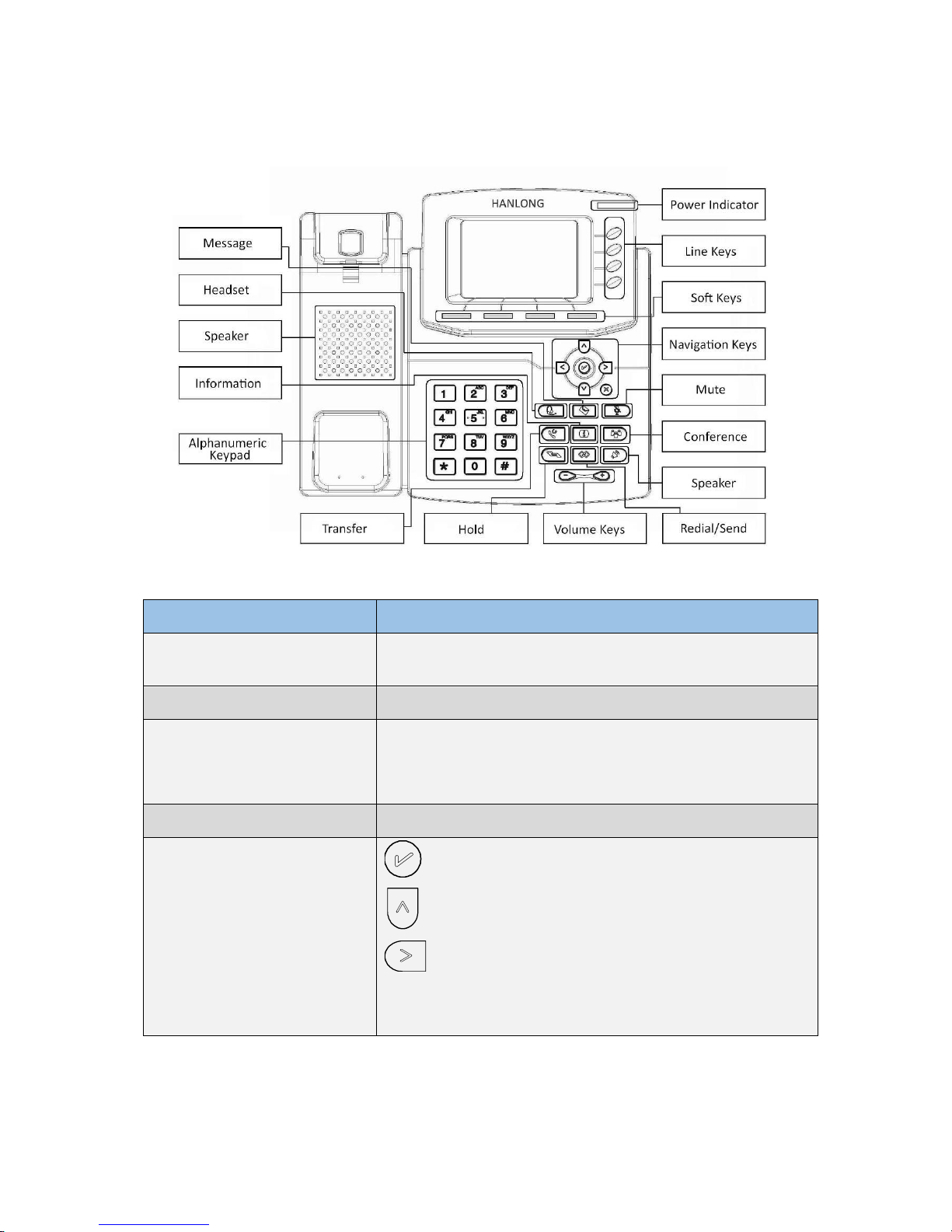
3.1. Hardware Components Preview
Element
Opis
LCD screen
To Presentation all information about the date& time, accounts,
soft keys, messages, calls and other some information.
Power Indicator LED
To indicate the power status
Line keys
The phone supported up to 2 accounts
Steady green: idle interface, during a call.
Blink red: a call incoming
Soft keys
Labels automatically to identity their context-sensitive features.
Navigation keys
OK
Up arrow key: to move up of the selection shows on the
screen.
Right arrow key: to move right of the selection
shows on the screen.
Page 12
str. 12
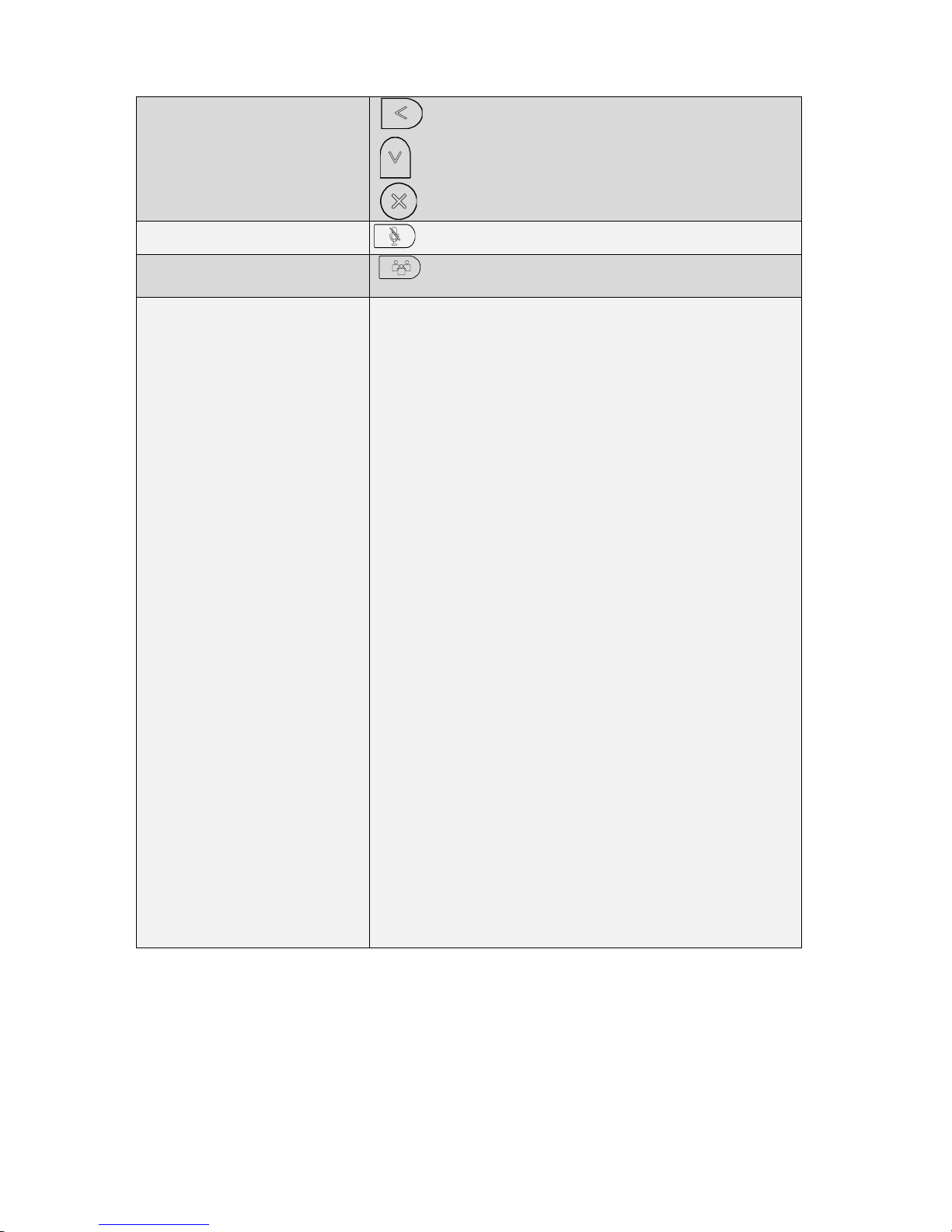
Left arrow key: To move left of the selection shows on
the screen.
Down arrow key: To move down of the selection
shows on the screen.
1. To return to idle screen.
2. To cancel the information or call on the screen.
Mute key
Mute the voice during the call (green light).
Conference
To place a conference call
Memory Keys
To be configured as different function as:
1. Line
2. Speed Dial
3. BLF
4. BLF List
5. Voice mail
6. Direct Pickup
7. Group Pickup
8. Call Park
9. Intercom
10. DTMF
11. Prefix
12. Hold
13. Conference
14. DND
15. Redial
16. Transfer
17. SMS
18. Hot -desking
19. Call Return
20. Paging
21. Record
22. Shared Line
The LED lights status when set as Shared line:
1. Stay green: Idle
2. Stay red: Busy
3. Blinked green: Ring Back
4. Blinked red: A call incoming
5. Steady orange: During a call
6. Blinked orange: Public Hold
7. Blinked green: Private Hold
8. Light Drown: Unregistered
Page 13
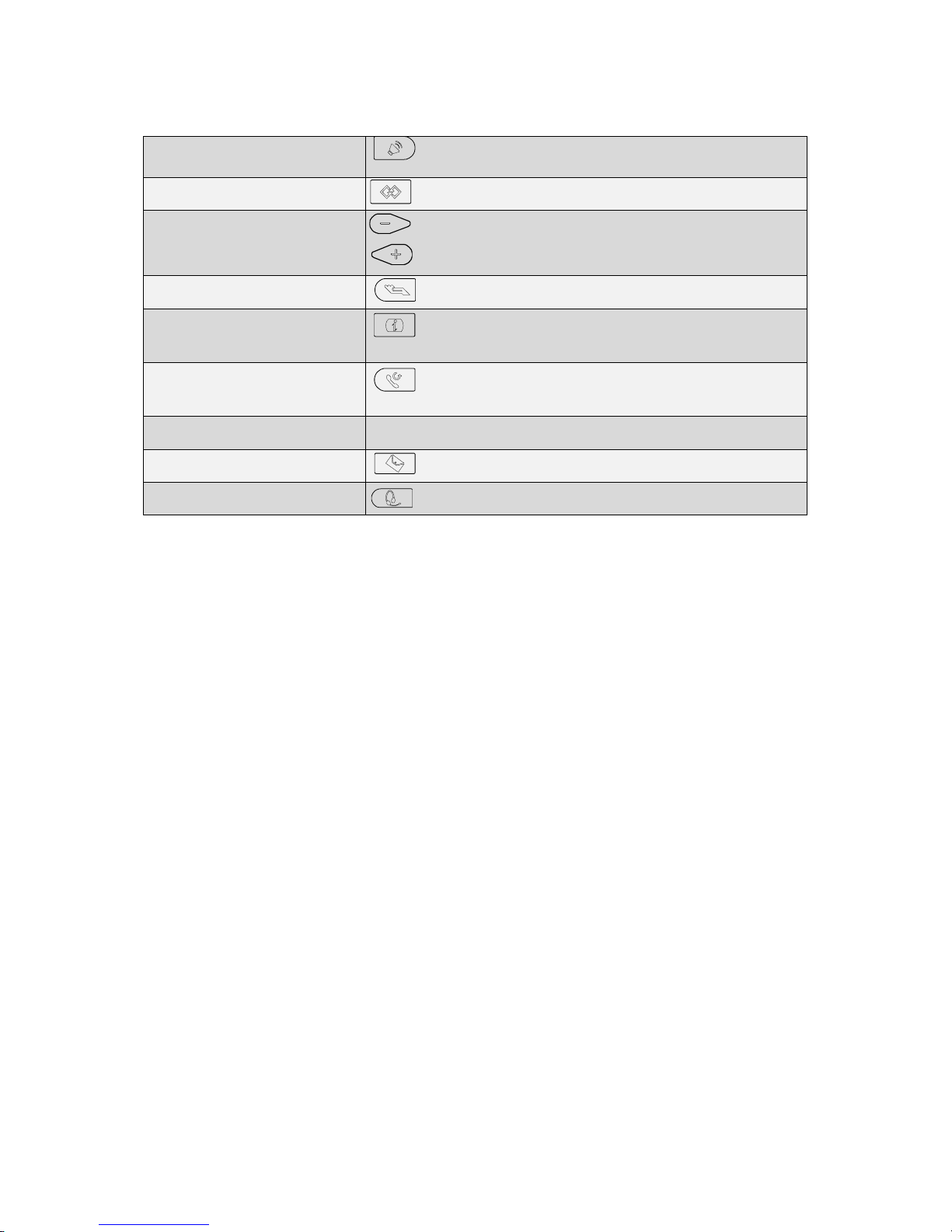
str. 13
Speaker
Press this button to place a call in hands-free mode.
Redial
To dial the previous dialed number. To act as send key.
Volume
To decrease the volume.
To increase the volume.
Hold
To hold or to resume a call during a conversation.
Information
To show the accounts status and some other relevant
information.
Transfer
T o transfer a call to a third party. To enable or disable
Forward feature during the idle page.
Alphanumeric keypad
To enter the phone numbers, letters and so on.
Message
To indicator the New message, and press to read.
Zestaw słuchawkowy
To indicate that the phone is or not in Headset mode.
Page 14
str. 14
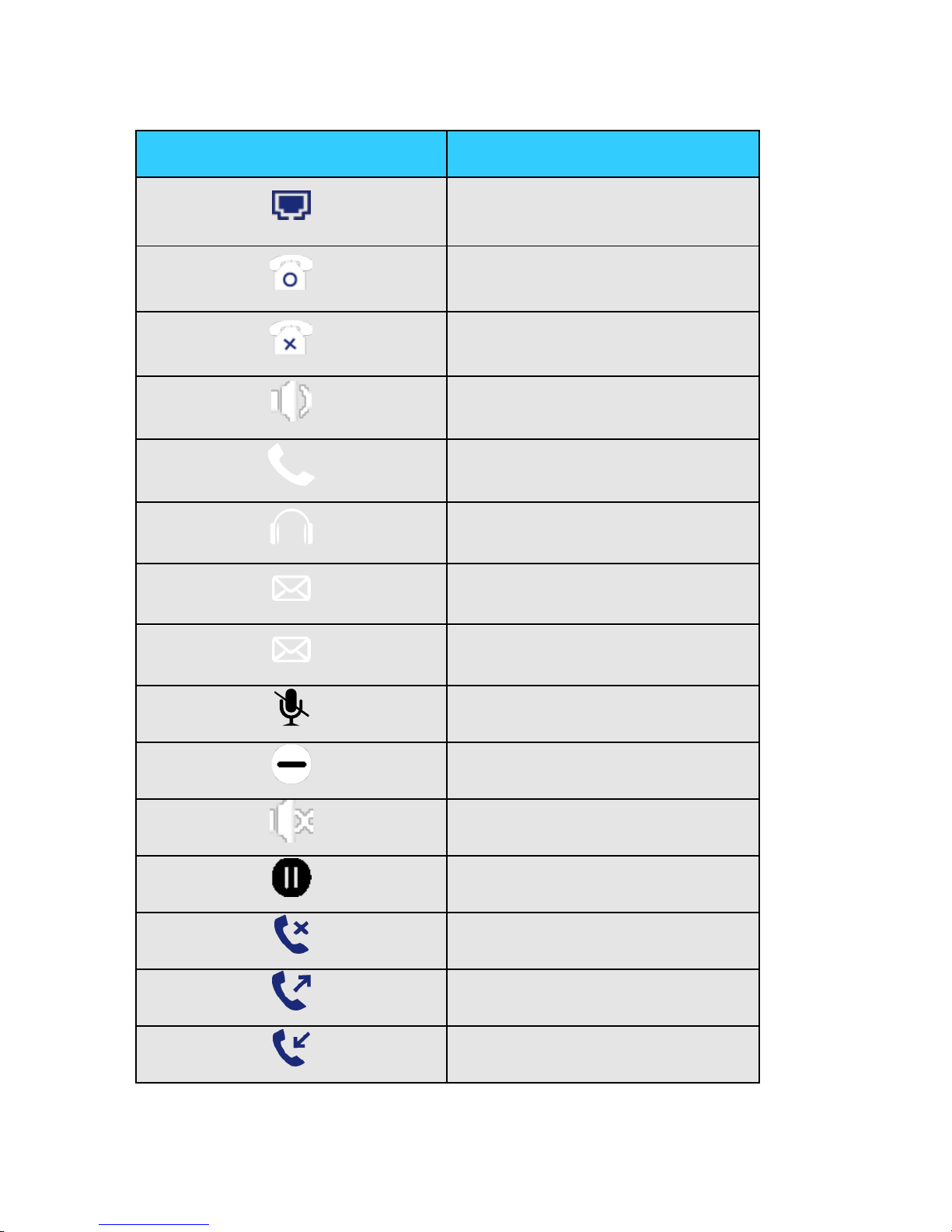
3.2. Icon preview
Icon
Description
Network
Registered succeed
Unregistered
Speakerphone mode
Handset mode
Headset mode
Voice messages
Text message
Mute
Do Not Disturb
Volume Off
Hold
Missed calls
Dialed Calls
Received calls
Page 15
str. 15
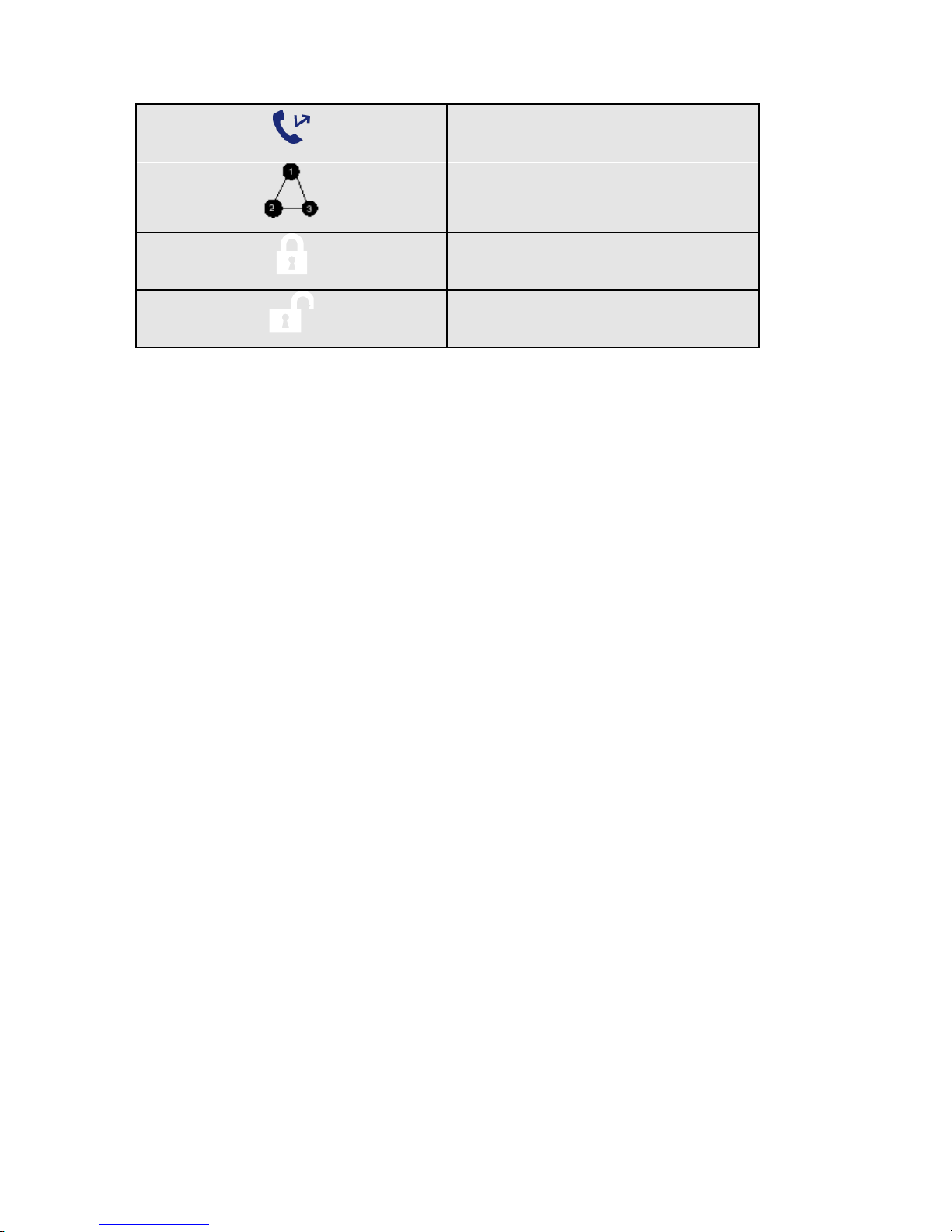
Forward calls
Conference
Keypad locked
Keypad unlocked
Page 16

str. 16
4. Phone Configuration
4.1. Basic Features Configuration
This part will mainly introduce the basic configuration as the Time, Language, and Volume by
the help of the LCD display.
Advanced features require knowing the password for configuration (default: admin)
4.2. Web Login
Get the IP address: Press Menu →Status→ Information (phone defaulted as a DHCP client)
Input the IP Address in the web browser.
Wprowadź nazwę swojego użytkownika (domyślnie admin) oraz hasło (domyślnie admin).
Login successfully.
Page 17

str. 17
4.3. Administrator Password
The password is mainly used for login the web interface or set the advanced settings through phone
interface. And the default password of the administrator is: admin
To change to password via Phone Interface
Press Menu→Setting→Advanced settings→password(default admin)→Phone Setting→Set Password
Enter the current PWD (password), new password and confirm the new password.
Press save soft key or to save the new password.
To change to password via Web Interface
Management → Password
Fill the value: Current password, new password, confirm the password then click Save to save the
configuration.
Page 18

str. 18
4.4. Language
The default Phone interface language is English (both LCD Menu and WEB interface).
To change the language via Phone interface
Press: Menu
→Settings→
Basic Settings→Language.
Press: Save soft key to save the configuration.
To change the language via Web Interface
Select: Setting→Preference→Web Language
Select the necessary one.
Press : Save, to save the configuration.
Note:
Note:
All languages may not be available for selection. The available languages depend on the language
packs currently loaded to the IP phone.
4.5. Time and Date
The time and date show on the idle page, and it can be set and change by SNTP server automatically
or manual setting.
To configure the time and Date by SNTP setting
Page 19

str. 19
Press: Menu → Setting → Basic setting → Time & Date → SNTP Settings
Press or , or info soft key to change the Time zone.
- NTP server
Fill the NTP server1, NTP Server2 (default: tempus1.gum.gov.pl ).
- Daylight Saving.
The choice: Auto, Daylight Saving Time on and off.
Press or Save soft key to save the configuration.
To configure time and date manually
To press : Menu → Setting → Basic setting → Time & Date → Manual Settings
Press and or change the right time, or you can input the right time.
Press or Save soft key to save the configuration.
To configure the Time & Date Format
To press: Menu → Setting → Basic setting → Time & Date Format
Press and or press Info to change between 12 Hour or 24 Hour.
Press and or press Info to change among Y-M-D(year-month-day), M-D-Y(month-day-year),
D-M-Y(day-month-year).
Press or Save soft key to save the configuration.
To configure the DHCP time
To press: Menu → Setting → Basic setting → DHCP time
Press and or press Info to change between Disable and Enable.
Press or Save soft key to save the configuration.
To configure the Time and Date by web interface
Select: Network
→
Advanced →NTP Server
Page 20

str. 20
Set IP address NTP server (default: tempus1.gum.gov.pl ).
To change the Time Zone and Date Display Format via web interface
Select: Setting → Preference →Time Zone
Select the necessary one. Press Save to save the configuration.
Note:
If the IP Phone cannot obtain the time and date from the Simple Network Time Protocol (SNTP)
server, please contact your system administrator for more information.
4.6. Screen Saver
There are two types of screen saver:Backlight off, Time & Logo .
To enable screen saver via Phone
Page 21

str. 21
To press: Menu → Display → Screensaver...
Press and or press Switch soft key to Choose the Time-out as 1 min or 2/5/10/30 minute.
Enter the Screensaver Type to choose one of the type: Backlight off, Time & Logo.
Press or Save soft key to save the selected configuration.
To disable screen saver via Phone
To press: Menu → Display → Screensaver...
Press and or press Switch soft key to Choose the Time-out as off.
Press or Save soft key to save the selected configuration.
To Enable screen saver via Webpage
Select: Setting → Preference
To choose the Time-out as 1 min or 2/5/10/30 minute.
To select the screen Type as Backlight off or Time & Logo.
Click Saveset to save the configuration.
To Disable screen saver via Webpage
Select: Setting → Preference
To choose the Time-out as Off
Click Saveset to save the configuration.
4.7. Ring Tone
You can adjust the type and volume of the ring tone.
Change the ringing tone via phone interface
To press : Press Menu → Setting → Basic Settings → Ring Tone.
Press and to select the aimed one.
Press or Save soft key to save the configuration.
Page 22

str. 22
Change the ringing tone via WEB interface
Selekt: Account → Advanced → Account Ring Tone
Make Your choice
Click to Saveset to save the configuration..
Assign a ring tone to a contact on your phone
Press Directory.
Select the target contact.
Press Detail soft key to edit the contact.
Press and to select the wanted Ring Tone for the contact
Press Save soft key to save the contact.
4.8. Volume
You can adjust the volume for the phone by the volume keys: and .
To adjust the Ring tone volume
Option 1: To press and on the idle page
Page 23

str. 23
Option 2: To press and during the call is ringing.
To adjust the handset volume
To press and during a call in handset mode.
To press and during a call in speaker mode.
To adjust the headset volume
To press and during a call in headset mode.
4.9. Directory – edit contact list
In the directory, you can add or delete your friends, business partner or anyone others’ phone No. so
you will not forget their number. Or put some anonymous phone No. in the blacklist to prevent from
being disturbed.
To add contacts manually
Press: Menu→ DIR
Press: Add soft key
Page 24

str. 24
Enter the necessary information as Name, Phone number…
Press save soft key or to add the contacts successfully.
To add contacts from Call Log
Press: History soft key or press Menu → Logs → Local history
Press and to select the targeted one. (Press and switched among the All calls, Dialed
calls, Received calls, Missed Calls and Forward Calls).
Edit the necessary information as Name, Phone number…
Press save soft key or to add the contacts successfully.
To add contacts via WEB interface
Click Directory.
Enter the name, number and some other information.
Press Add and next Save button.
To add blacklist manually
Press: Menu → Directory → Blacklist
Enter the necessary information as Name, Phone number…
Press save soft key or to add the contacts successfully.
Page 25

str. 25
4.10. Call Log
Displays the call history broken down into: received, missed, dialed numbers and forwarded.
From your phone, press : History.
Icon in the record indicates to us the type of call: incoming, outgoing, etc.
From WEB interface select: Directory→Call log→ Dialed numbers, Received
4.11. Network Configuration
The phone is configured as a DHCP client and after connect to network automatically get the IP
address assigned by a DHCP server.
To check IP address from phone interface press: Menu→Status→Informtion
In the absence of a DHCP server, you must configure a static IP address, subnet mask, gateway, and
DNS server. After the above information, please contact the network administrator.
From phone LCD menu:
Press: Menu→Settings→Advanced→Network→WAN Port→Static mode.
From WEB interface:
Select: Network→Basic→Staic address.
You can also get the IP address logging phone to the network using PPPoE protocol.
In this case, enter your account name (login) and password you received from your network
administrator.
From phone LCD menu:
Press: Menu→Settings→Advanced→Network→WAN Port→PPPoE mode.
From WEB interface:
Select: Network→Basic→PPPoE.
Page 26

str. 26
5. Configuration VoIP Account
For the realization of voice calls, it is necessary to configure the SIP accounts. After all the data for
account setup, ask your network administrator or service provider VoIP.
To properly configure the SIP account as follows:
set VoIP server address
backup SIP server (optional)
username (User ID)
register name (Authenticate ID)
password
account name (on LCD display)
5.1. Basic Configuration VoIP Account
Basic configuration VoIP account requires knowledge of VoIP account login details, such as: SIP server
address, user name, service, service user password.
From LCD menu:
Press: Menu→Settings→Advanced→Account.
Fill SIP server name, username, password, register name.
From WEB interface:
Select: Account→Basic
Fill SIP server name, username, password, register name.
Note:
After data for your VoIP account login, please contact your service provider or network
administrator.
Page 27

str. 27
5.2. Advanced Configuration VoIP Account
From the web interface you can configure advanced settings for SIP account:
Outband proxy: Proxy SIP sever address provided that the VoIP service requires its settings.
Active account: enable/disable the account registration.
SIP Transport: type of transport protocol - UDP(default), TCP, TLS.
Type DNS: DNS Server search service.
Empire of registration: expiration time of registration to the SIP server, if the register expire time of
the phone is different from the time required by the server, it will automatically changed for the time
recommended by the server and register again.
Outgoing call without registering:: permit or prohibit making calls without registration to the SIP
server.
Local SIP port: port for VoIP call signaling process - the default 5060.
Local RTP port: port for used to transfer audio frames - 5004 by default.
Codecs: settings for compression codecs in order to use of acoustic signals negotiated in the call
signaling.
DTMF mode: specifies how to send DTMF
DTMF in the band
DTMF SIP INFO
DTMF RFC 2833
SRTP mode: activation of RTP voice encryption frames.
VAD(Voice Activity Detection): detection of silence during a call.
Ringing tone for an account: assign one of 8 ringtones for your account.
Ring time: phone ringing time settings for incoming calls.
Sign # as a send: use the # key as a sign of the end of the dial.
Subscribe for MWI message: MWI settings for sending messages informing about the new voice
message.
Anonymous calls: reservation number for outgoing calls CLIP.
Anonymous Call Rejection: enable anonymous call rejection.
Auto answer: allows to automatically answer incoming calls.
Rejection of the return code: reject code defines a call in the SIP signaling.
Direct interception code: service code interception defined by the administrator of the SIP server.
Interception group code: service code interception in the group defined by the administrator of the
SIP server.
NOTE:
These data are dependent on the specific VoIP server settings. Their parameters are set by
the service provider or network administrator.
6. Basic Call Features
6.1. Place a Call
There are three ways to dialing a call: Handset, Headset and Hands-free speakerphone.
To place a call by Handset
Pick up the handset, or press a line key and dial the necessary number.
Press or press the send softkey, then the call is sending.
Page 28

str. 28
To place a call by Headset:
Press the ( light is Green),
Enter the desired number.
Press or press the Send softkey, then the call is sending.
Placing a call by hands-free speakerphone
Press the , or press the Line key, then you can hear the dial tone.
Enter the number.
Press or press the Send soft key, then the call is sending.
To place a call by call history or Directory
Press the History soft key or Menu → History /Directory
Press and to select the targeted one.
Press or Send soft key to make the call.
NOTE:
The key is set to be a send key. You can set the * key as send key or set some other to be as
send keys. For more information, refer to the Key as Send on page
During the call, you can also change among Headset, Handset or Free-speaker mode.
6.2. End a Call
There are three ways to end a call:
To end a call by Handset
Naciśnij przycisk „Anuluj” lub odłóż słuchawkę.
To end a call under Headset Mode
Press Cancel soft key or press .
To end a call under hands-free Speakerphone Mode
Press the Cancel soft key or press .
NOTE:
During the conference, to end the call is same as mentioned above.
6.3. Receive a Call
There are three ways to receive a call when the phone is ringing:
To receive a call by handset
Pick up the handset the conversation is built.
Page 29

str. 29
To receive a call by headset
Press and now the conversation is built.
To receive a call by hands-free speaker
Option 1: Press directly.
Option 2: Press Answer soft key.
Option 3: Press the Line key (flashes red).
Moreover, some other action can be done by soft key when the call is coming.
To press the Reject soft key to reject the call. Or press to reject the current call.
To press Forward to forward to another phone.
To press Silence soft key, and then the call will keep silent, no ring tone display.
6.4. Redial a Call
To redial the last placed call from the IP Phone
Press directly when LCD is on the idle interface.
6.5. Auto answer
Enable auto answer feature, you will answer all incoming call automatically.
To enable Auto Answer via Webpage
To Click: Account → Advanced
To choose Yes for the Auto Answer.
To click Saveset to save the configuration.
6.6. Call Hold
When use hold feature, the Hold icon will show on the display.
To make a call on hold during three modes:
To hold a call under handset mode:
Press Hold soft key to hold the current call.
Press Resume soft key to resume the call on hold.
Page 30

str. 30
To hold a call under headset mode:
Press Hold soft key or to hold the current call.
Press Resume soft key or to resume the call on hold.
To hold a call during the speaker mode:
Press Hold soft key or to hold the current call.
Press Resume soft key or to resume the call on hold.
6.7. Call Transfer
This phone supports blind, attended and Semi-Attended Transfer.
Blind Transfer
Press Transfer soft key or during the conversation, the call is on hold now.
Enter the number that transfers to.
Press Transfer soft key or , and now the blind transfer completed.
NOTE:
The “Enable Call Feature” must be configured to “Yes” to enable this feature.
Attended Transfer
When you use this feature, you can:
Press Transfer soft key or during the conversation, the call is on hold now.
Enter the number that transfer to, and press the send soft key or
Start the second conversation, press the Transfer or soft key, then, transfer completed.
NOTE:
To transfer calls across SIP domains, SIP service providers must support transfer across SIP
domains. Blind transfer will usually use the primary account SIP profile. To use this function,
should at least one line key set as Auto.
Semi-Attended Transfer
Press the Transfer soft key or during the conversation, the call is on hold now.
Enter the number transfer to, and then press , then you can here the ring tone.
Press the Transfer soft key or , and now the Semi-attended transfer completed.
BLF Transfer
Set a Programmable Key or line key is set as BLF. For how to set BLF, please refer to BLF
Press the Transfer soft key or during the conversation, the call is on hold now.
Page 31

str. 31
Press BLF key then realize blind, attended and Semi-Attended Transfer. (Webpage--Setting--Features)
6.8. Call Conference
This IP Phone supports up to 5-way conference.
To set Conference
Assuming that call party A and B are in conversation. A wants to bring C, D and E in a conference:
1. A press line 2 key, the call is placed on hold.
2. A enter the number of C and then press send soft key or .
3. C answering the call.
4. A press Conference soft key or , then A, B and C are now in a conference (and now this is
3-way conference).
5 A press line 3 key, the current 3-way conference is placed on hold.
6 A enter the number of D and then press send soft key or .
7 D answering the call.
8 A press the conference soft key, then A, B, C and D are now in a conference.(and now this is
4-way conference)
9 A press line 4 key, the call is placed on hold.
10 A enter the number of E and then press send soft key or .
11 E answering the call.
12 A press the Conference soft key or , then A, B, C, D and E are now the 5-way conference
is built.
13 A end the call, the conference is finished.
Page 32

str. 32
6.9. Call Forward
This phone supports static forward (always forward, busy forward and no answer forward) and
dynamic forward
To configure always forward
With this feature, all incoming calls will forward immediately to configured number.
Press: Menu → Features → Call forward →Always Forward.
Press and or press info soft key to select the enable choice.
Enter the forward to number and on code (optional), off code (optional).
Press or Save soft key to save the configuration.
NOTE:
1. If C does not answer the call, A can back to continue the conversation with B;
2. Once A hangs up the call, the conference is ended, while if B or C drops the call, A&C or A&B
conversation continues.
3. The conference feature is not available on all servers. For more information, contact your system
administrator.
4. To realize the 5 way conference, the line should be all available.
5. Press to get all parties information.
Page 33

str. 33
To configure busy forward
With this feature, the incoming calls are immediately forwarded if the phone is busy.
Press: Menu →Features → Call forward →Busy forward.
Press and or press info soft key to select the enable choice.
Enter the forward to number and on code (optional), off code (optional).
Press or Save soft key to save the configuration.
To configure no answer forward
No Answer Forward: Incoming calls are forwarded if not answered after some time.
Press: Menu →Features → Call forward →No answer forward.
Press and or press info soft key to select the enable choice.
Enter the forward to number and on code (optional), off code (optional).
Press or Save soft key to save the configuration.
When the Forward feature is enabled, the Forward Icon will display on Top of the LCD.
To configure Forward via Web Interface
Select :Setting → Features→Forward.
Click on for the Always/Busy/No Answer.
Fill the Forward to Number.
Click SaveSet to save the configuration
Forward an incoming call during the ringing.
When the phone is ringing, press Forward soft key.
Enter the forward number.
Press or press the send soft key, then the call is forwarded.
Page 34

str. 34
NOTE:
If the Programmable Key or line key is set as BLF, when an incoming call ringing, press this
BLF key directly to realize the dynamic forward.
6.10. Call Return - REDIAL
This feature allows you to dial the last phone call you received.
To configure the Call Return via phone interface
Press: Menu →Features →Function Keys→Line or Memory keys as Function Keys → Memory
key1(for example)
Select the wanted Line or Memory key.
Press and or press key to select the Key Event in the type field.
Press and or press key to select the Call Return.
Press or Save soft key to save the configuration.
To configure the Call Return via Web interface
Select: Function keys → Line or Memory key.
Select the desired Line or Memory key and select Call Return in the Type.
Click the SaveSet to save the configuration.
6.11. Anonymous Call
Just enable the anonymous call feature, you can set your ID do not appear on the other phone that
you called.
To configure anonymous call
Press: Menu →Features →Anonymous Call
Press and or press key to change the Line ID
Press and or press key to select the enable choice in Anonymous Call filed.
Enter the call on code (optional), call off code (optional).
Press or Save soft key to save the configuration.
Reject anonymous call
If you do not want to be disturb by anonymous calls, you can set the reject anonymous call features,
so you will not hear the unknown calls
Press: Menu →Features →Anonymous Call
Press and or press key to change the Line ID.
Press and or press key to select the enable choice in Rejection filed.
Press or Save soft key to save the configuration.
Page 35

str. 35
6.12. Call Mute
When you use the Mute feature, the other parties will not hear your voice while you can hear their
voice. Call mute applies to all modes (handset, headset, and speakerphone).
Press the mute key , then the mute key glows green, and the LCD display Mute Icon.
To disable the mute function, press again.
6.13. Do Not Disturb DND
When you use the DND feature, the phone is to reject all incoming calls automatically and you can
see the DND icon shown on the Top of the LCD on idle page.
To enable DND feature
Press the DND soft key when the phone is idle, and then DND iconshown on the LCD.
To disable DND feature
Press the DND soft key again, and then there is no DND icon on the LCD.
6.14. Key as Send
To speed up the process of dialing can be attribute to the end of dialing key (default #).
To configure Key as Send
Press: Menu →Features → Key as Send.
Press and or press key to select the enable choice.
Press or Save soft key to save the configuration
6.15. No Key Entry Timeout
No Key Entry Timeout means that when you entry the number, it will dial out automatically after
some time when you stop enter the number.
To configure No Key Entry Timeout
From WEB interface select: Setting → Preference→NO Key Entry Timeout(seconds)
Fill the blank of No Key Entry Timeout: for example 5(seconds).(0 means never timeout, you should
press the send key the dial out the number.
Page 36

str. 36
Click the SaveSet to save the configuration.
6.16. Hot Line
The hot line gives us the opportunity to direct dialing immediately after hook off programmed number
with which you want to connect to.
To configure Hot Line
Press: Menu →Features → Hot Line
Enter the number and delay time (as present, we support off hook auto dial).
Press or Save soft key to save the configuration.
To configure Hotline auto dial via Web Interface
Select: Setting → Features.
Fill the number in the Hotline Number and Hotline Time-out.
Click SaveSet to save the configuration.
Delete the number and save the configuration, and then now the Hotline auto dial is cancelled.
Page 37

str. 37
7. Advanced Features
7.1. Voice Message
This phone supports Voicemail, and when there is message, the message will will light green.
Moreover, when pick up the handset, or press speaker key, you will hear some quick busy tone.
To configure the Voice mail feature
Press: Menu→Messages→Voice Mail→Set Voice Mail.
Enter the Account 1/2/3 NO.
Press or Save soft key to save the configuration.
NOTE:
This feature is not available on all servers. For more information, contact your system
administrator.
Page 38

str. 38
7.2. Intercom
When use the intercom feature, you can quickly get access connect to the configured one.
To configure intercom feature via phone interface
Press: Menu →Features →Function Keys→Line or Memory keys as Function Keys → Memory
key1(for example)
Press and or press key to select the intercom in the type field.
Enter the targeted Number.
Press or Save soft key to save the configuration
Then the selected Line or Memory key will work as intercom.
To configure Intercom feature via Web Interface
Select: Function keys → Line or Memory key.
Select the wanted Line or Memory key.
Enter the desired phone number in the Value field.
Select the Account ID
Click the SaveSet to save the configuration.
NOTE:
This feature is not available on all servers. For more information, contact your system
administrator.
Page 39

str. 39
7.3. Speed Dial
With this feature, you can dial one directory by press the definite key.
To configure Speed Dial feature via phone interface
Press: Menu →Features →Function Keys→Line or Memory keys as Function Keys → Memory
key1(for example)
Press and or press key to select the Speed Dial in the type field.
Enter the targeted Number.
Press or Save soft key to save the configuration
Then the selected Line or Memory key will work as Speed Dial.
To configure Speed Dial feature via Web Interface
From WEB interface select: Function keys → Line or Memory key.
Select the wanted Line or Memory key and set as Speed Dial.
Enter the desired phone number in the Value field.
Select the Account ID
Click the SaveSet to save the configuration.
7.4. Direct Pickup
With this feature, you can pick up the set line when it ringing.
To configure Direct Pickup feature via phone interface
Press: Menu→Features→Function Keys→Line or Memory keys as Function Keys → Memory key1
(for example)
Press and or press key to select the Speed Dial in the type field.
Enter the value.
Press or Save soft key to save the configuration
Then the selected Line or Memory key will work as Direct Pickup.
To configure Direct Pickup feature via Web Interface
From WEB interface select: Function keys → Line or Memory key.
Select the wanted Line or Memory key and set as Direct Pickup.
Enter the pickup code and followed the desired phone number in the Value field.
Select the Account ID.
Click the SaveSet to save the configuration.
7.5. Group Pickup
With this feature, you can pick up the specified group that you want incoming calls.
To configure the Pick up via phone interface
Press: Menu→Features→Function Keys→Line or Memory keys as Function Keys → Memory key1
(for example)
Select the wanted Line or Memory key.
Press and or press key to select the Group Pickup in the type field.
Enter pickup code and followed the desired group numer.
Page 40

str. 40
Press or Save soft key to save the configuration
Konfiguracja odbierania grupy poprzez interfejs webowy
From WEB interface select: Function Keys → Line Key1→Key1.
Select the wanted Line or Memory key.
Enter pickup code and followed the desired group numer.
Click the SaveSet to save the configuration.
7.6. BLF(Busy Lamp Field)
You can use the BLF (Busy Lamp Field) feature to monitor a specific numer whether its phone is busy
or free.
When the monitored line is idle, the LED is solid green. When the monitored line is ringing, the light
is blinking red, press the BLF key to pick the phone up directly. When the monitored line is calling or
in a conversation, the light is steady red.
Optionally, this function gives us the ability to intercept calls to the monitored number with code
capture.
To configure a BLF key by phone
Press: Menu →Features →Function Keys→Line or Memory keys as Function Keys → Memory
key1(for example).
Select the targeted Line or Memory key.
Press and or press key to select the BLF in the type field.
Enter the targeted Value Number.
Press and or press key to select the BLF in the type field.
Enter the Pickup Code.
Press or Save soft key to save the configuration
To configure a BLF key by web
Select: Function keys → Line or Memory key.
Select the desired Line or Memory key and select BLF in the Type.
Enter the monitored phone number in the Value field.
Select the Account ID.
Filled the Pickup code.
Click the SaveSet to save the configuration and then restart.
Page 41

str. 41
NOTE:
This feature is not available on all servers. For more information, contact your system administrator.
7.7. Shared Line
This feature allows subscribers to share SIP lines. Moreover it also provides status monitoring of the
shared line.
To configure the line key as shared line via phone interface
Press: Menu→Features→Function Keys→Line or Memory keys as Function Keys → Memory key1
(for example)
Select the wanted Line or Memory key.
Press and or press key to select the Shared Line in the type field.
Press and or press key to select the Account ID.
Enter the Label.
Enter the Value.
Press or Save soft key to save the configuration.
To configure the line key as shared line via Web Interface
From WEB interface select: Function keys → Line Key or Memory key.
Select the desired Line or Memory key and select Shared Line in the Type.
Enter the Value.
Enter the Label.
Select the Account ID
Click the SaveSet to save the configuration and then restart.
Page 42

str. 42
NOTE:
This feature is not available on all servers. For more information, contact your system
administrator.
7.8. Call Park
With this feature, you can put a call on hold and continue the conversation from another phone.
To configure the Call Park via phone interface
Press : Menu→Features→Function Keys→Line or Memory keys as Function Keys→Memory key1
(for example)
Select the wanted Line or Memory key.
Press and or press Switch soft key to select the Key Event in the type field.
Press and or press Switch soft key to select the Call Park.
Press or Save soft key to save the configuration.
To configure the Call Park via Web interface
From WEB interface select: Function key → Line or Memory key.
Select the desired Line or Memory key and select Direct Pickup in the Type.
Click the SaveSet to save the configuration.
7.9. Paging
With this feature, you can call a phone directly.
To configure the paging via phone interface
Press: Menu→Features →Function Keys→Line or Memory keys as Function Keys→Memory key1
(for example)
Select the wanted Line or Memory key.
Press and or press key to select the Key Event in the type field.
Press and or press key to select the Paging.
Page 43

str. 43
Press or Save soft key to save the configuration
To configure the Paging via Web interface
Select: Function keys → Line or Memory key.
Select the desired Line or Memory key and select Paging in the Type.
Click the SaveSet to save the configuration.
7.10. DTMF
This feature allows you to send directly to the DMTF signaling lines during an ongoing call.
To configure the DTMF via Phone Interface
Press: Menu→Features→Function Keys→Line or Memory keys as Function Keys→Memory key1
(for example)
Select the wanted Line or Memory key.
Press and or press key to select the DTMF in the type field.
Enter the value.
Press or Save soft key to save the configuration
To configure the DTMF via Web interface
Click Function keys → Line or Memory key.
Select the desired Line or Memory key and select DTMF in the Type.
Fill the value.
Click the SaveSet to save the configuration.
7.11. Prefix
This feature allows us to define any prefix added before the dialed number.
To configure the Prefix via Phone Interface
Press: Menu→Features→Function Keys→Line or Memory keys as Function Keys→ Memory key1
(for example)
Select the wanted Line or Memory key.
Press and or press key to select the Prefix in the type field.
Enter the value.
Press or Save soft key to save the configuration.
To configure the Prefix via Web interface
Select: Function key → Line or Memory key.
Select the desired Line or Memory key and select Prefix in the Type.
Fill the value.
Click the SaveSet to save the configuration.
Then when you press this key, the set value is input directly.
Page 44

str. 44
7.12. Action URL
This feature allows us to send useful information from the phone to the server and vice versa in order
to initiate certain actions on the phone.
This gives us the opportunity to observe phone status or sending such requests:
- login / logout phone
- hook on/hook off handset
- make a call
- turn on DND service
An example of the syntax of the call from the phone by account number 1 to number 523 251 111:
http://admin:password@
IP-Address/Phone_ActionURL&Command=1&Number=523251111&Account=1
7.13. Keyboard Layout
Ta opcja pozwala na definiowanie stanu wyświetlania klawiszy podczas danej akcji np. wybieranie
lub rozmowa. Definiujemy wówczas jakie funkcje ma dany klawisz wykonać.
7.14. Keypad Lock
Phone lock feature allows us to completely block the function or the function keys.
To enable Keypad Lock via Phone
Press: Menu→Settings→Advanced Setting→Phone Setting→Lock
Press: or Switch to change choose lock type:All Keys Menu Key Function Key Lock & Answer
Press Save or OK key to save the configuration.
To disable Keypad Lock via Phone
Press: Menu→Settings→Advanced Setting→Phone Setting→Lock.
Press: Info or Switch to change choose Off.
Press Save or OK key to save the configuration.
To enable Keypad Lock via Webpage
From WEB interface: Setting → Preference.
To choose the Lock keys.
To fill the unlock PIN and auto lock time
Fill the Emergence Number, when the phone is Lock, only Emergency Number can be sent.
To click Saveset to save the configuration..
Page 45

str. 45
8. Management – Upgrade
8.1. Start
Login window startup web interface gives us a phone the most important status such as:
product model
firmware Version
account status
network status: address IP, DNS, MAC address
memory free
system up time
8.2. Factory Reset
It enables us to reset all phone settings to default factory settings.
To set Factory Reset by phone interface
Press: Menu→Setting→ Advanced Setting( default password: admin)→Phone Setting→Factory Reset
Press OK soft key in the warning page.
To set Factory Reset via web interface
Select: Management → Upgrade→ Reset To Factory.
Page 46

str. 46
8.3. Software update
The software update can be done in several ways:
- via TFTP server(specify the path).
- through auto-provisioning server HTTP / HTTPS
- by selecting the firmware image file from the specified location (local or network drive)
Configuring the TFTP/HTTP Server
It is recommended to set the TFTP server address in either a public IP address or on the same LAN
with the phone.
To configure the TFTP server via the Web configuration interface
Press: Menu →Setting→ Advanced setting(default password: admin)→
Phone setting→Auto Provision→Upgrade Mode(TFTP/HTTP).
Then enter the address of the TFTP server / HTTP for that purpose field. After entering the
TFTP/HTTP configuration reset the phone.
To configure the TFTP server via the Web configuration interface
Select: Management →Auto Provision→Upgrade Mode(TFTP/HTTP)→ Firmware Server Path.
TFTP process may take as long as 1 to 2 minutes over the Internet or just 20+ seconds if it is
performed on a LAN. Users are recommended to conduct TFTP upgrade in a controlled LAN
environment if possible.Katalog konfiguracji lokalnego TFTP.
Directory to configure local TFTP/HTTP
Unzip the file and put all of them under the root directory of the TFTP server.
The PC running the TFTP server and the VPS PHONE should be in the same LAN segment
Select: Management →Auto Provision→Upgrade Mode(TFTP/HTTP)→ Firmware Server Path.
Configure the path to the update server by entering the IP address and the destination folder.
Update the change and reboot the unit.
Page 47

str. 47
Autoprovisioning HTTP/HTTPS
Automatic update method configuration functionality is available as a server.
The system administrator knowing the specific data of the phone, ie.: MAC address, prepares the
server level preconfiguration file that is downloaded on the phone while its initialization (reboot).
To upgrade manually via the Web configuration interface
This option gives us the opportunity to update manually the phone software from the image file.
From WEB interface: Management
→
Upgrade
→
Img Firmware Upgrade
→
Upgrade.
Downloading device configuration
This functionality allows you to import the current configuration of the phone in two formats:
- as a BIN(binary) file
- with an extension of XML
From WEB interface: Management →Configuration → Download Device BIN/XML Configuration.
You can also restore the configuration using the following options:
Select: Zarządzanie →Konfiguracja → Retore Configuration XML/BIN.
8.4. Remote Phonebook
Phone support ability download remote phonebook.
From WEB interface: Management →Auto Provision → Phonebook XML Download
In this case, you must specify the access path to the resource phonebook on the server (IP address /
domain directory).
There is two method:
- manually (specify server path)
Page 48

str. 48
From WEB interface: Management →Auto Provision →Phonebook XML server path
- vai auto-provisioning
From WEB interface: Management →Auto Provision → Phonebook Download Enable (HTTP/HTTPS)
8.5. System Log
The aim diagnose problems with your phone can download the system log as a text file or define the
server on which the logs are to be sent.
We set the levels collecting logs as a: DEBUG, INFO, WARNING, ERROR.
The phone also allows network log collection as a "pcap" file.
This is usefull functionality for system administrator to analyze network problems.
From WEB interface: Management →Upgrade→PCAP Feature.
8.6. TLS Certyficates
Certificate authentication for connections to a trusted server.
Page 49

str. 49
9. Troubleshooting
9.1. Why is the phone LCD screen blank?
Ensure your phone is properly plugged into a functional AC outlet.
Ensure that the phone isn’t plugged into a plug controlled by a switch that is off.
If the phone is plugged into a power strip, try plugging it directly into a wall outlet instead.
If your phone is powered from PoE, ensure you use a PoE compliant switch or hub, or contact your
system administrator for more information.
Check that the power LED is on to ensure the phone is powered on.
Otherwise, contact your system administrator.
9.2. Why does the phone display "Network Unavailable"?
Ensure that the Ethernet cable is plugged into the Internet port on the phone and the Ethernet cable
is not loose.
Ensure that the switch or hub in your network is operational.
Otherwise, contact your system administrator.
9.3. Why can’t I get a dial tone?
Check for any loose connections and that the phone has been installed properly. For the Installation
instructions, refer to HU Phone InstallationUH.
Check whether dial tone is present on one of the audio modes.
Switch between the Handset, Headset (if present) or Hands-Free Speakerphone to check whether
dial tone is present for one of the audio modes.
If the dial tone exists on another audio mode, connect a different handset or headset to isolate the
problem.
Otherwise, contact your system administrator.
Page 50

str. 50
10. Annex
10.1. Technical Specifications
COMPONENT
SPECIFICATION
Power Adapter
Input: 100-240V AC 50-60Hz
Output: 5V/1.2A DC
Network ports
Internet: 10/100 Base-T RJ-45(WAN/LAN)
PC: 10/100 Base-T RJ-45 (LAN)
Power over Ethernet(PoE) IEEE 802.3af
Additional socket
Headset: RJ-9(4P4C)
LCD Display
128 × 96 mm, Pixel matrix LCD
Operating temperature
-10~50ºC
Humidity
10 ~ 95%
Weight
0,48kg
10.2. Voice Parameters
- Volume control
- Ring tone selection/Import/Delete
- MIC gain
- Voice Activity Detection(VAD),
- G.722. HD Codec, HD speaker, HD handset
- Full-duplex speakerphone with AEC
- Comfort Noise Insertion CNI
- Acoustic Echo Cancelation(AEC),
- DTMF(In-Band, RFC2833, SIP Info)
10.3. Network Parameters
- WAN/LAN: obsługa trybu Bridge i Router
- Obsługa NAT i NAPT
- Static/DHCP/PPPoE
- VLAN QoS (802.1pq)
- TCP, UDP, ICMP, RARP, ARP, DNS, NTP,SNTP
- VPN (L2TP, UDP)
- TFTP/DHCP/PPPoE client
- Layer 3 (ToS, DiffServ, MPLS) QoS
 Loading...