

Page 1
EN
PRO
GUIDE
ARAK
Page 2
ARAK
TABLE OF CONTENT
1 Introduction 3
2 Description 4
3 Technical Data 5
4 Line System 5
5 Acceleration System 6
6 Flight Techniques and Characteristics 7
7 Descent Techniques 7
EN
8 Materials 8
9 Homologation 9
1
0 Closing Words
11 Line Schematic
12 Line Length
13 Risers
14 Overview Glider
15 Test Protocoll
2 Table of content
10
11
11
12
13
30
1 INTRODUCTION
Welcome to skywalk!
Congratulations on the purchase of your new ARAK and thank you for your trust in us
and in our products. In this manual you will find product-specific information that will help
you quickly get to know your new paraglider to ensure your fun for a long time.
General information about the most important safety-relevant points for handling your
paraglider can be found in the attached „BASIC GUIDE“.
We are always open for questions, comments or critique and are happy to provide you at
any time with further information!
Your skywalk Team
PURE PASSION FOR FLYING
The latest version of the manual can be found on
Edition1 / 10_18
www.skywalk.info
Introduction 3
Page 3
ARAK
EN
2 DESCRI
Have you always wanted to fly a paraglider that fulfills your every need? ARAK is
your first choice!
Our third model in the intermediate class cuts through traditional categories and
combines everything you want from a paraglider. The ARAK stands for easy handling,
rich performance and, above all: lots of fun.
These features make the ARAK a true all-rounder and the perfect companion for your
next adventure!
PILOT REQUIREMENTS
The ARAK´s high level of performance and its forgiving handling make it suitable from
occasional pilots to ambitious thermal flyers and XC pilots.
SCOPE OF DELIVERY
The ARAK comes standard with inner bag, compression strap, glider backpack, riser bag
and “BASIC GUIDE”.
PTION
3 TECHNICAL DATA
Size XXS* XS S M L
Cell number 57 57 57 57 57
Area flat (m²) 21,40 23,30 24,80 26,40 28,60
Wingspan flat (m) 10,75 11,22 11,58 11,94 12,42
Aspect ratio flat 5,40 5,40 5,40 5,40 5,40
Area projected (m²) 18,30 20,00 21,30 22,60 24,50
Wingspan projected (m) 8,60 8,98 9,26 9,55 9,93
Aspect ratio projected 4,03 4,03 4,03 4,03 4,03
min. profile depth (cm) 58 61 63 65 67
max. profile depth (cm) 242 253 261 269 280
Middle line length without risers (m) 6,28 6,56 6,77 6,98 7,26
Line consumption (m) 242 253 261 269 280
Weight (kg)
Take-off weight from - to (kg) -* 65-85 70-95 85-105 95-120
Extended weight range (kg)
Winch certified yes yes yes yes yes
JET FL AP Technology yes yes yes yes yes
Paramotor homologation no no no no no
Accelerator yes yes yes yes yes
Maximum speed bar travel (mm) 150 150 170 170 170
Brake line travel max. (cm) 60 62 64 66 69
Trimmers no no no no no
Number of seats 1 1 1 1 1
-* 4,3 4,5 4,7 5,0
-* 85-90 95-100 105-110
120-125
4 Description
*Homologation for size XXS still in progress.
Data not completely final.
4 LINE SYSTEM
The layout of the suspension points is designed for optimal load distribution and a long
lifespan. With all considerations and calculations however, our focus is always on safety.
The mix of materials used on the lines of the ARAK is an ideal combination of durability,
low stretch and low drag.
The skywalk ARAK has 3 A-, 3 B-, 3 C-, and 1 stabilo line. The main-stabilo is connected
with the B-riser. The brake lines are not load-bearing and lead from the trailing edge over
the main brake lines through the brake pulleys on the C-risers to the brake handles.
A marking on the main brake line indicates the position of the handle attachment.
This setting should not be lengthened, for example, to provide more brake travel in extreme
flight situations or during landing, nor shortened such that the glider is flown constantly
with some brake on.
Technical data 5
Page 4
ARAK
EN
To provide a better overview and to make sorting easier, the lines
have different colors:
> the AI, AII, AIII-lines and the A-risers are red.
> the BI, BII, BIII-lines and the B-risers are yellow
> the CI, CII, CIII-lines are blue.
> the stabilo lines are orange.
> the brake lines are orange.
The lines are attached with loops to oval shackles and secured with plastic inserts.
The skywalk ARAK has 4 risers per side:
> the two inner A-mainlines lead to the inner A-riser, the outer A-line leads to the
outer A-riser.
> the B-lines as well as the stabilo lines lead to the B-riser
> the C-lines lead to the C-riser
A schematic drawing of the risers can be found at the back of the manual.
5 ACCELERATION SYSTEM
The skywalk ARAK can be equipped with a foot-operated acceleration system.
The acceleration system effects the
WITHOUT trimmers. Exact lengths of the accelerated risers can be found at the end
of the instruction.
A1, A2 and B-risers. Both risers are equipped
6 FLIGHT TECHNIQUES AND CHARACTERISTICS
WINCHTOWING
The skywalk ARAK is well suited for winch towing. Make sure that you only use
certified winches and that you climb from the ground at a flat angle.
The pilot must have had proper towing instruction and must ensure that the winch
operator has had proper training that includes paragliders. When launching on a winch,
always fly with a lot of feeling and don’t brake too much as your glider will already have
an increased angle of attack. We recommend the use of a towing adapter.
FLYING WITH A MOTOR
Currently, the ARAK has no certification for flying with a motor. You can find out the current
status of motor certification at any dealer or importer, or by asking skywalk directly.
You can find further information on practices and characteristics of flying in the enclosed „BASIC GUIDE“.
7 DESCENT TECHNIQUES
BIG EARS
In contrast to the spiral dive, with big ears your forward speed is higher than your sink
speed.
This descent method is used to quickly leave dangerous areas in a desired horizontal direction. The danger of canopy disturbances in turbulent air is greatly reduced with big ears.
Proceed as follows:
> Hold the outer A-lines, which are suspended on separate A-risers, below the line
shackles and pull down on the lines or risers.
> Keep the brake handles and the outer A-lines in your hands during the maneuver.
The glider remains controllable with weight shifting.
> To increase both sink rate and forward speed, you can also optimize this maneuver with
the speed bar.
> To recover from the maneuver, release the A-lines and the glider normally will open
by itself.
> To speed up the opening, pull on the brakes lightly. It is better to first open one side and
then the other to minimize the risk of a possible stall.
6 Acceleration System
Flight Techniques and Characteristics | Descent Techniques 7
Page 5
ARAK
EN
Examples:
> If the pilot is surprised near a summit with little ground clearance by strong wind or a
thundercloud, neither a B-stall nor a spiral dive can help.
> If the pilot is stuck in very strong lift, it is advisable to exit the lift band with the use of
big ears and to find sinking air in which to lose altitude.
B-LINE STALL
The B-lines are pulled down symmetrically 15-20cm. Keep the brake handles in the respective hands. The airflow on top of the profile largely detaches and the paraglider descends without flying forward. Pulling hard on the B-risers allows you to decrease the area
of the wing and increase your sink rate, but this also increases the risk of the wing forming a rosette to the front. If this happens, recovery from the B-stall immediately!
You can exit the stall by quick and symmetric release of the B-lines. The paraglider will
pitch forward and pick up speed. At no time you may use the brakes in this case! If the
wing doesn’t reopen you may speed up the opening process by gently braking.
You can find further information about descent techniques in the enclosed “BASIC GUIDE”.
8 MATERIALS
The skywalk ARAK is manufactured from the highest quality materials. skywalk
has selected the best possible combination of materials with regard to resilience,
performance and longevity. We are aware that the durability of the glider is a deciding
factor in the pilot’s satisfaction.
9 HOMOLOGATION
The ARAK is certified to LTF 09 and EN926-1, EN926-2 in the category B.
The ARAK is defined as a lightweight sport aircraft with an empty weight of less than
120kg in the paraglider category. The many homologation tests are the last hurdle in
the development of a skywalk paraglider. The homologation test flights only take place
when the test team is completely happy with the glider development.
We remark that the certification results will differ during flight in thermals or turbulent air.
The homologation informs solely regarding the paraglider performance during extremeflight- manoeuvres performed in stable air conditions. These extreme-flight-manoeuvres during the homologation process should thus not be over-valued.
Remember that certification maneuvers were carried out with a harness in the group
GH with a carabiner distance (middle to middle) of 42-46 cm. If another harness is used,
the glider may display flight characteristics that differ from those in the description.
WINGS AND RIBS
Upper sail: Porcher Skytex 38g / Dominico Dokdo 32g
Lower sail: Dominico Dokdo 32g
Ribs: Dominico Dokdo 32g hard
LINES
A, B, C Main lines: Liros PPSLS 180/125
A, B, C Middle lines: Liros PPSLS 125
A, B, C Top lines: Liros DC 60
Brake lines: Liros DFLP 200/32, PPSLS 125/65, DC 60
RISERS
The risers are made of 12mm webbing. Stretching values, strength and stability of this
material is among the highest of all webbing products available.
8 Descent techniques | Materials
Homologation 9
Page 6
ARAK
Loopcover
A1 (AII, AI) A2 (AIII) B (BI, BII, BIII, S) C (CI, CII, CIII) brmain
brmain
CI
br2
br1
br4
br3
br6
br5
br8
br7
br10
br9
br12
br11
BR1
BR2
BR3
BR4
BR5
BR6
BRIII
BRII
BRI
CM1
CM2
CM3
CM4
c2
c1
c4
c5
d5
d6
d7
d8
c9
c12
s1
s4
s2
s5
s3
s6
s7
c10
c11
c6
c7
c8
c3
C1C2D1
D2
C3
C4
C5
C6
C7
C8
d2
d1
d4
d3
CII
CIII
SM1
S2
S3
S1
S
b2
b1
a1
a2
a3
a4
a5
a6
b3
b4
b5
b6
b7
b8
b9
b10
b11
b12
B2
B1
B3
B4
B5
B6
A6
A5
a7
A2
A1
AI
AII
AIII
A3
A4
BI
BIII
BII
a8
a9
a10
a11
a12
EN
10 CLOSING WORDS
The skywalk ARAK is at the pinnacle of paraglider development in the market for
intermediate gliders and shows what is possible regarding performance, safety and innovation. It cost us a lot of time to develop this glider, but it was also a lot of fun. In this
development we recognize the challenge of making the right product for every area and
individual taste. We are pleased if you notice this during your first flight and if you feel
a certain unity with your glider from the very beginning.
The ARAK will provide you with plenty of joy over many years if you treat it and care
for it properly. Respect for the demands and dangers of our sport are essential for successful and beautiful flights.
Even the safest paraglider can be dangerous due to misjudgments of meteorological
conditions or pilot error. Always remember that flying sports are potentially risky and that
you are responsible for your own safety. We advise you to fly carefully and to respect laws
in the interest of our sport, because every pilot always flies at his or her own risk!
WE WISH YOU A LOT OF FUN WITH YOUR NEW GLIDER AND ALWAYS
HAPPY LANDINGS!!
Your skywalk Team
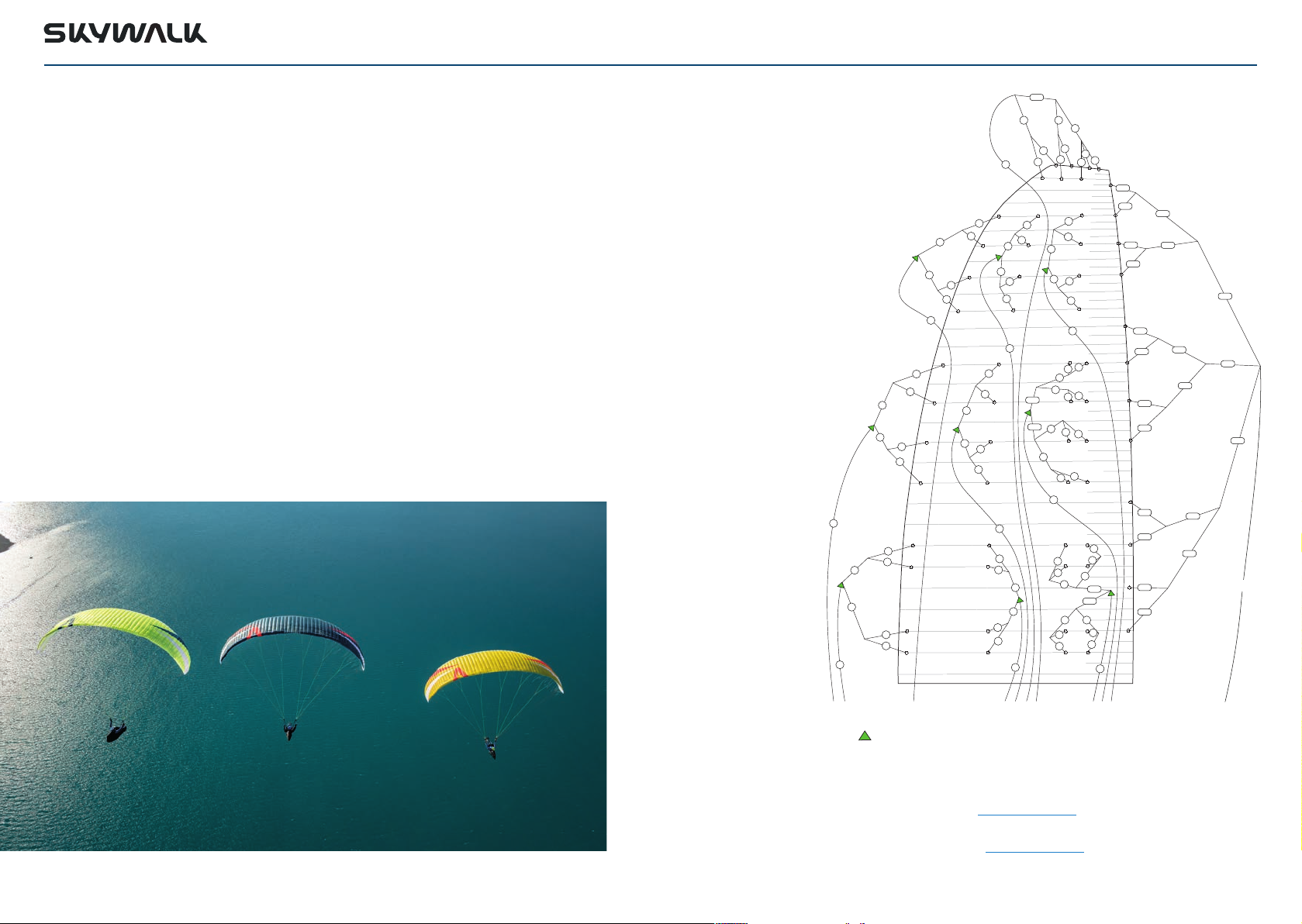
11 LINE SCHEMATIC
This line schematic is only for
illustration purposes.
12 LINE LENGTH
Total line length ARAK size: XXS, XS, S, M, and L: www.skywalk.info
Single line length ARAK size: XXS, XS, S, M, and L: www.skywalk.info
10 Closing words
Line schematic | Line length 11
Page 7
ARAK
TRAGEGURT
Chili 4 Riser 2016
C
A1 A2
B
TRAGEGURT
Chili 4 Riser 2016
C
A1 A2
B
EN
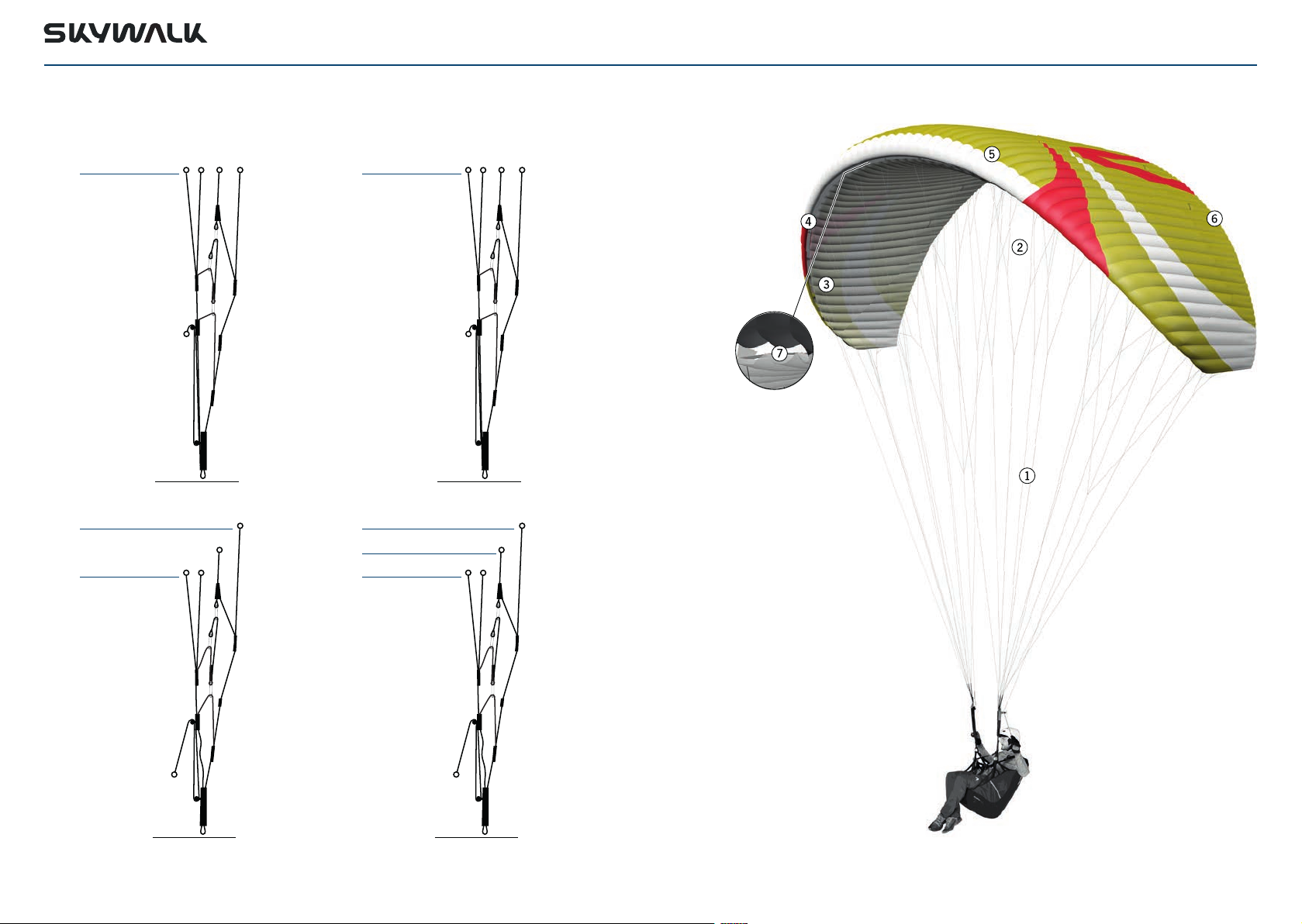
13 RISERS
ARAK - XXS + XS
ARAK - S + M + L
B
C
Trimspeed
C
A1 A2 B
525mm 545mm
Trimspeed
C – 525mm C – 545mm
B – 431mm B – 439mm
A1 A2
A1 + A2 – 375 mm A1 + A2 – 375mm
A1 A2 B
A1 A2
14 OVERVIEW GLIDER
C
C
B
1 Main lines
2 Top lines
3 Bottom sail
4 Cell openings
5 Top sail
6 Trailing edge
7 Nameplate
Accelerated flight
Accelerated flight
12 Risers Overview Glider 13
Page 8
ARAK
EN
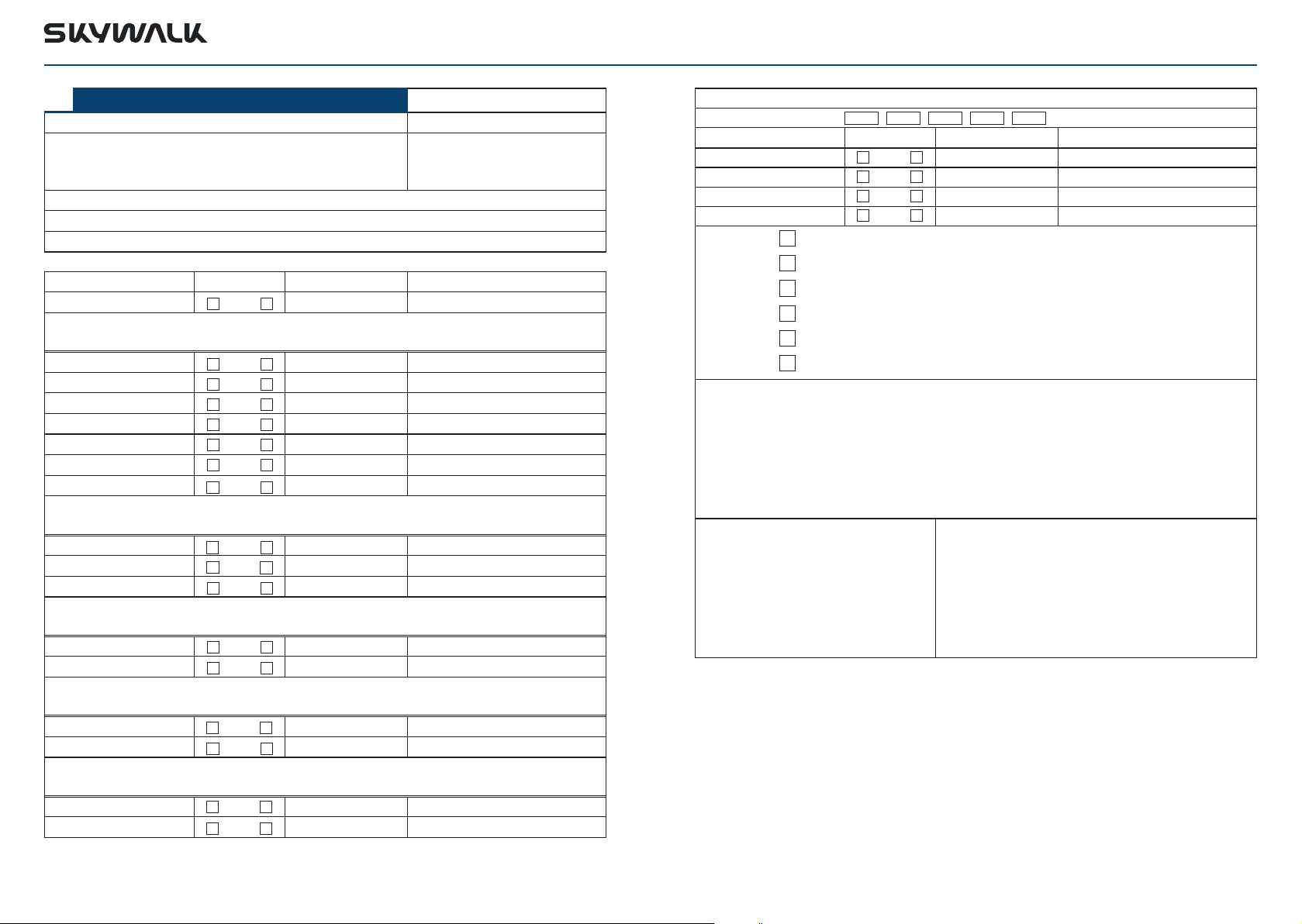
15
TEST PROTOCOL
Date:
Customer, Name:
Adress: Phone:
Glider: Size: Serial number:
Type certificate number: Date of last check:
Date of first flight: Year of construction:
Accomplished checking: Results [+/–]: Description of failure: Suggested repairs:
Identification:
+
-
Visual check of canopy:
Upper surface:
Lower surface:
Profiles:
Line flares:
Leading edge:
Trailing edge:
Crossports:
+
+
+
+
+
+
+
-
-
-
-
-
-
-
Visual check of lines:
Seams:
Abrasion spots:
Core withdrawals:
+
+
+
-
-
-
Examinations of the lines:
Firmness of main lines: daN
Results [+/–]: Description of failure: Suggested repairs:
Visual check of trimming:
Checkflight necessary?
Type certificate patch?
Identification plate?
Condition: New
Very good condition
Good condition
Well used
Heavily used, but within homologation standards, frequent checks required
No longer airworthy, outside of the limit values.
Repairs made?:
Signature of tester: Date:
+
+
+
+
-
-
-
-
Visual check of connectionparts:
Suspension line screw locks:
Risers:
+
+
Length measurement:
Risers:
Lines:
+
+
Examinations of the canopy:
Firmness of canopy:
Porosity:
+
+
14 Test Protocol
-
-
-
-
-
-
Name of tester: Firm stamp:
Test Protocol 15
Page 9
ARAK
Skywalk GmbH & Co. KG
Windeckstr. 4 | 83250 Marquartstein
+49 (0) 8641/69 48 40
[email protected] | www.skywalk.info
 Loading...