

Page 1
Metalúrgica Skymsen Ltda.
Rodovia Ivo Silveira 9525
Volta Grande
88355-202 Brusque/SC/Brasil
www.skymsen.com - Fone: +55 47 3211 6000
CNPJ: 82.983.032/0001-19 - IE 250.064.537
54968.1 - INGLES
Data de Correção: 16/06/2015
BREAD MILL
- BEYOND THESE EQUIPMENT, WE MANUFACTURE A COMPLETE EQUIPMENT LINE. CONSULT YOUR DEALER.
- DUE TO THE CONSTANT EVOLUTION OF OUR PRODUCTS, THE INFORMATION CONTAINED HEREIN MAY BE MODIFIED WITHOUT
PREVIOUS NOTICE.
MODEL
MPAL
Page 2

SUMMARY
1. Introducon ......................................................................................3
1.1 Security ................................................................................................................. 3
1.2 Main Components ................................................................................................. 5
1.3 Specificaons ......................................................................................................... 6
2.Installaon and Pre-Operaon ............................................................6
2.1 Installaon ............................................................................................................ 6
2.2 Pre-Operaon ........................................................................................................ 7
3.Operaon ...........................................................................................9
3.1 Drive ...................................................................................................................... 9
3.2 Operang Procedure .............................................................................................. 9
3.3 Cleaning and hygiene ............................................................................................. 9
3.4 Cauons with Stainless Steel: ..............................................................................10
4. General Safety Pracces ..................................................................11
4.1 Basic Operaon Procedures ..................................................................................11
4.2 Safety Procedures and Notes before Switching the Machine ON ...........................12
4.3 Roune Inspecon ................................................................................................12
4.4 Operaon .............................................................................................................13
4.5 Aer Finishing The Work .......................................................................................13
4.6 Maintenance ........................................................................................................13
4.7 Warning ................................................................................................................13
5. PROBLEMS ANALYSIS and SOLUTIONS .............................................14
5.1 Problems, Causes and Soluons ............................................................................14
6. MAINTENANCE .............................................................................. 15
7. Electric Diagram ............................................................................... 16
Page 3

1. Introducon
1.1 Security
This equipment is suitable for milling (grinding) various types of dry bread to turn into
flour, and is potenally DANGEROUS when used incorrectly. It is necessary to perform
maintenance, cleaning and / or any service by a qualified and with the equipment
disconnected from the mains person.
The following instrucons must be followed to avoid accidents:
1.1.1 Read all instrucons.
1.1.2 To avoid electric shock and equipment damage, never use the same with: Wet clothes
or feet and / or in moist or wet surface, do not immerse in water or any other liquid and do
not use water jet directly on the device .
1.1.3 It should always be supervised using any equipment, especially when it is being used
near children.
1.1.4 Disconnect the device from the mains when: not in use, before cleaning it, removing
accessories, introducon of accessories, maintenance and any other type of service.
1.1.5 Do not use the equipment if it is with a damaged cord or plug. Ensure that the power
cord does not remain at the edge of the table / counter or touch hot surfaces.
1.1.6 When the machine has been dropped, is damaged in some way or not it is necessary
to work takes him to a local dealer for review, repair, mechanical or electrical adjustment.
1.1.7 The use of non-recommended by the manufacturer may cause injury.
1.1.8 Keep hands and any utensil away from the machine’s moving parts while it is running
to avoid injury or damage to equipment.
1.1.9 Never use clothes with long sleeves, especially wrists during operaon.
1.1.10 Ensure that the voltage of the equipment and the mains are the same, and that the
equipment is properly connected to the grounding network.
1.1.11 This product was developed for use in commercial kitchens. It is used, for example,
in restaurants, canteens, hospitals, bakeries, butchers and the like.
Use of this equipment is not recommended if:
- The producon process is connuously on an industrial scale;
- The workplace is an environment with corrosive atmosphere, explosive, contaminated
with vapor, dust or gas.
Page 4

IMPORTANT
Make sure that the power cord is in perfect condion of use. If it is not, replace the
damaged cable with one that meets the technical and safety specificaons.
This replacement should be performed by a qualified professional and must meet
local safety regulaons.
IMPORTANT
This appliance is not intended for use by persons (including children) with
physical, sensory or mental capacies reduced, or persons lacking experience and
knowledge, unless they received instrucons regarding the use of the device or
under the supervision of a person responsible for their safety.
IMPORTANT
It is recommended that children be supervised to ensure that they are not playing
with the device.
IMPORTANT
In case of emergency remove the plug from the electrical outlet.
IMPORTANT
Never throw water directly on the equipment.
Page 5
7. Electric Diagram
1.2 Main Components
All components that incorporate the equipment are made with carefully selected materials
for each funcon within the standards of tesng and Skymsen experience.
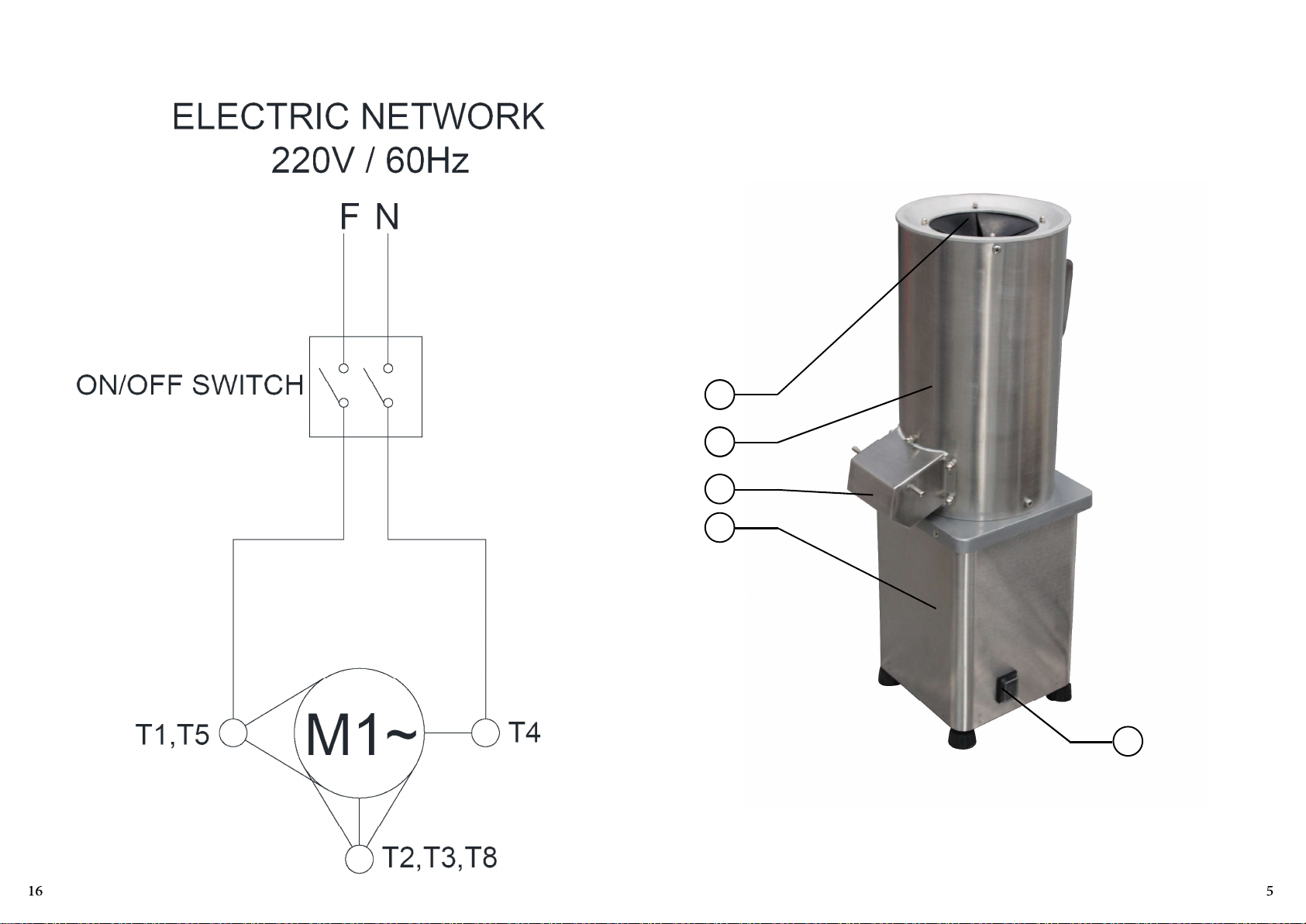
PICTURE 01
01
02
03
04
01 - Entry nozzle
02 - Full Cup
03 - Output Nozzle
05
04 - Office
05 - On / off switch
Page 6
1.3 Specificaons
6. MAINTENANCE
TABLE 01
CHARACTERISTICS UNIT MPAL
Average Producon kg/h 30
Tension V 220
Frequency Hz 60
Power CV 0,5
Height mm 760
Width mm 305
Depth mm 315
Net Weight kg 13,5
Gross Weight kg 15
2.Installaon and Pre-Operaon
2.1 Installaon
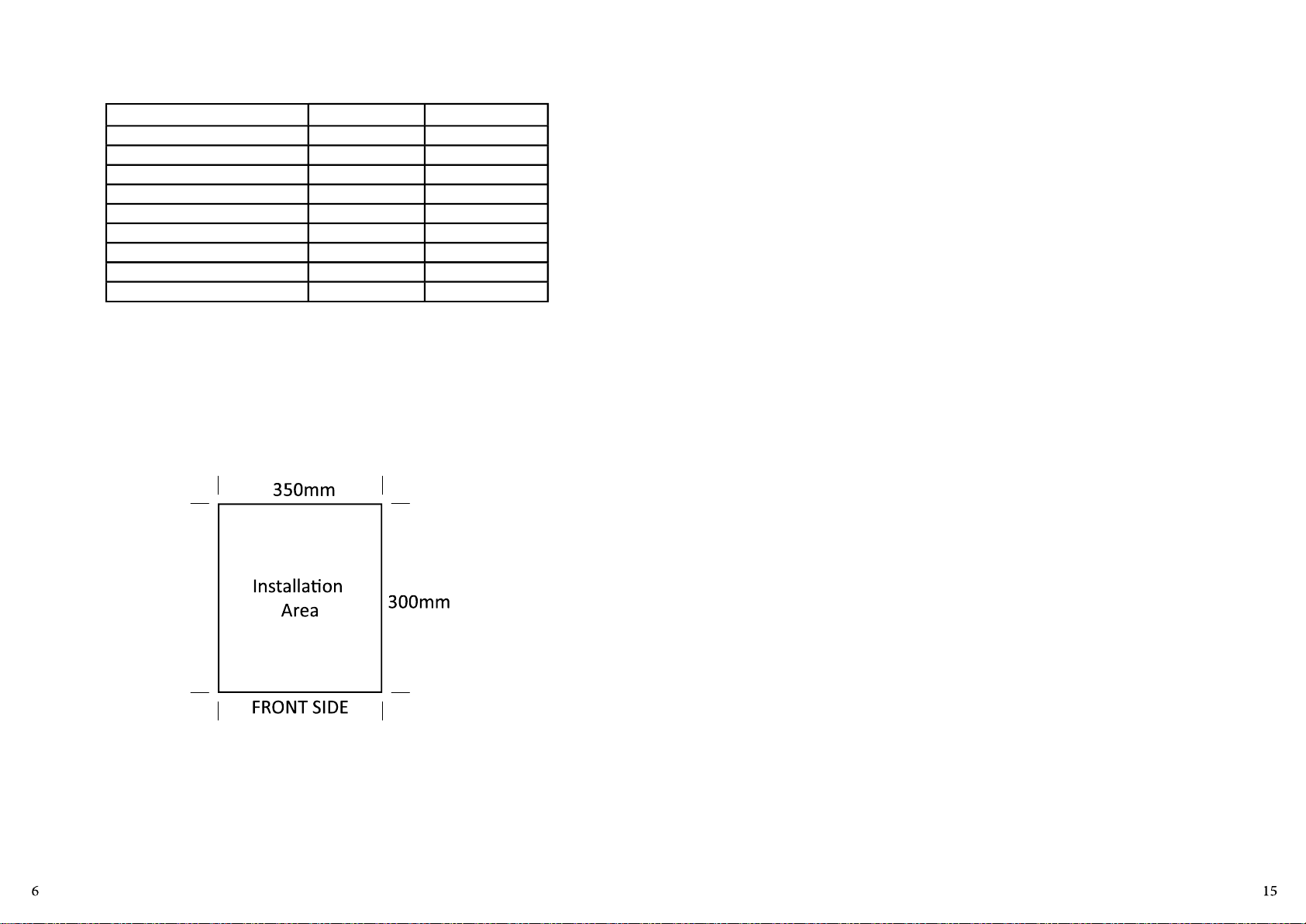
2.1.1 Posioning
Your equipment must be posioned flush on a dry, firm surface.
Maintenance must be considered a set of procedures with the purpose to keep the
equipment best operang condions , therefore increasing the equipment life and safety.
* Cleaning – check item 3.3 Cleaning
* Wiring - Check all wires regarding deteriorate condions as well as all electric contacts
(terminals) regarding ghtening and corrosion .
*Contacts – ON/OFF switch, emergency buon, reset buon , electronic circuits etc ,
check the equipment in order to assure that all components are correctly working and the
equipment operaon is normal .
* Installaon – make sure the installaon followed item 2.1 instrucons.
* Useful life of the product : 2 years, for a normal working shi.
1 – Each month check :
- Check the electrical installaon
- Measure the voltage at the socket
- Measure the working current and match it with the nominal current
- Check the ghtening of all electric terminals to avoid bad contacts
- Check electric motor sha for possible looseness.
- Check the wiring for overheang , insulaon failures and mechanical damages .
2.1.2 Electrical Installaon
This equipment is designed for 220 volts (60Hz). Upon receiving the equipment check the
voltage recorded on the label on the cord.
The power cord has 3 blades with the center pin the ground pin (ground pin - Ground
Pin). It is mandatory that the three points are properly connected before operang the
equipment.
2 - Each three month checks :
- Check electrical components such as ON/OFF switch, emergency buon , reset buon,
electronic electric circuits , overeang, insulaon failings, or mechanical damages
- Check cung units and bearings for possible looseness.
- Check retainers, O’rings, V’rings and other seals.
- Check that all screws and nuts are ght to avoid possible damage to the equipment.
Page 7
5. PROBLEMS ANALYSIS and SOLUTIONS
5.1 Problems, Causes and Soluons
This equipment has been designed to require minimum maintenance. However, some
performance failures may happen due to natural wearing caused by the use of the
equipment.
IMPORTANT
Make sure the mains voltage where the equipment will be installed is compable
with the voltage on the label on the cord.
2.2 Pre-Operaon
If any problem arises check the table below, where there are some detailed and
recommended possible soluons.
TABLE 02
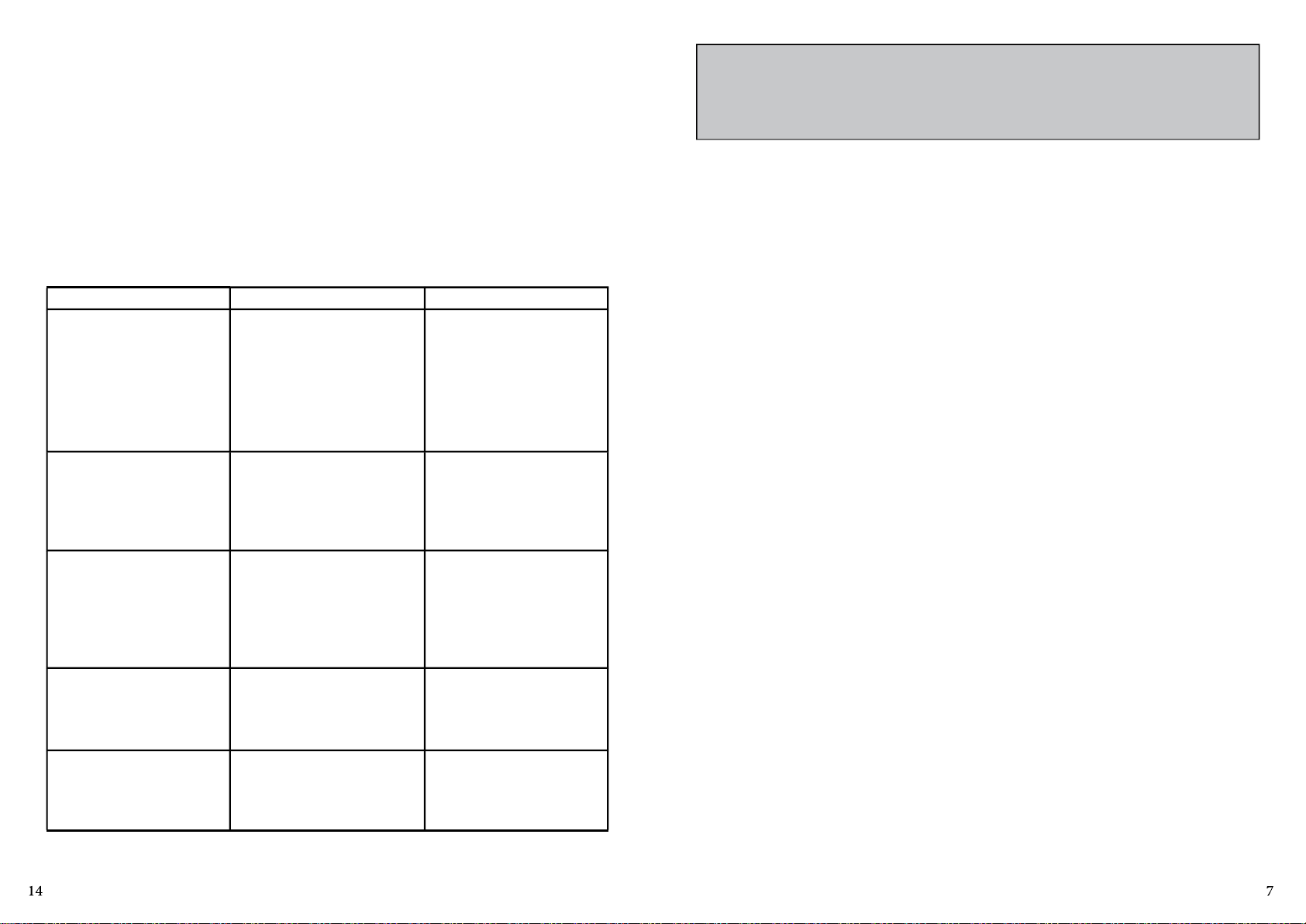
PROBLEMS CAUSES SOLUTIONS
- The equipment does not
turn on.
- Burnt smell and / or smoke.
- The equipment connects, but
when the product is placed on
the equipment, the same or to
rotate at low speed.
- Problem in the internal or
external electrical circuit
equipment.
- Lack of electricity.
- Problem in the internal or
external electrical circuit
equipment.
- Problems with Electric Motor.
- Call technical assistance
(ATA);
- Check for Electricity.
- Call technical assistance
(ATA).
- Call technical assistance
(ATA).
Before using your equipment should be washed all parts that come into contact with the
product being processed with water and mild soap (read item 3.4 Cleaning).
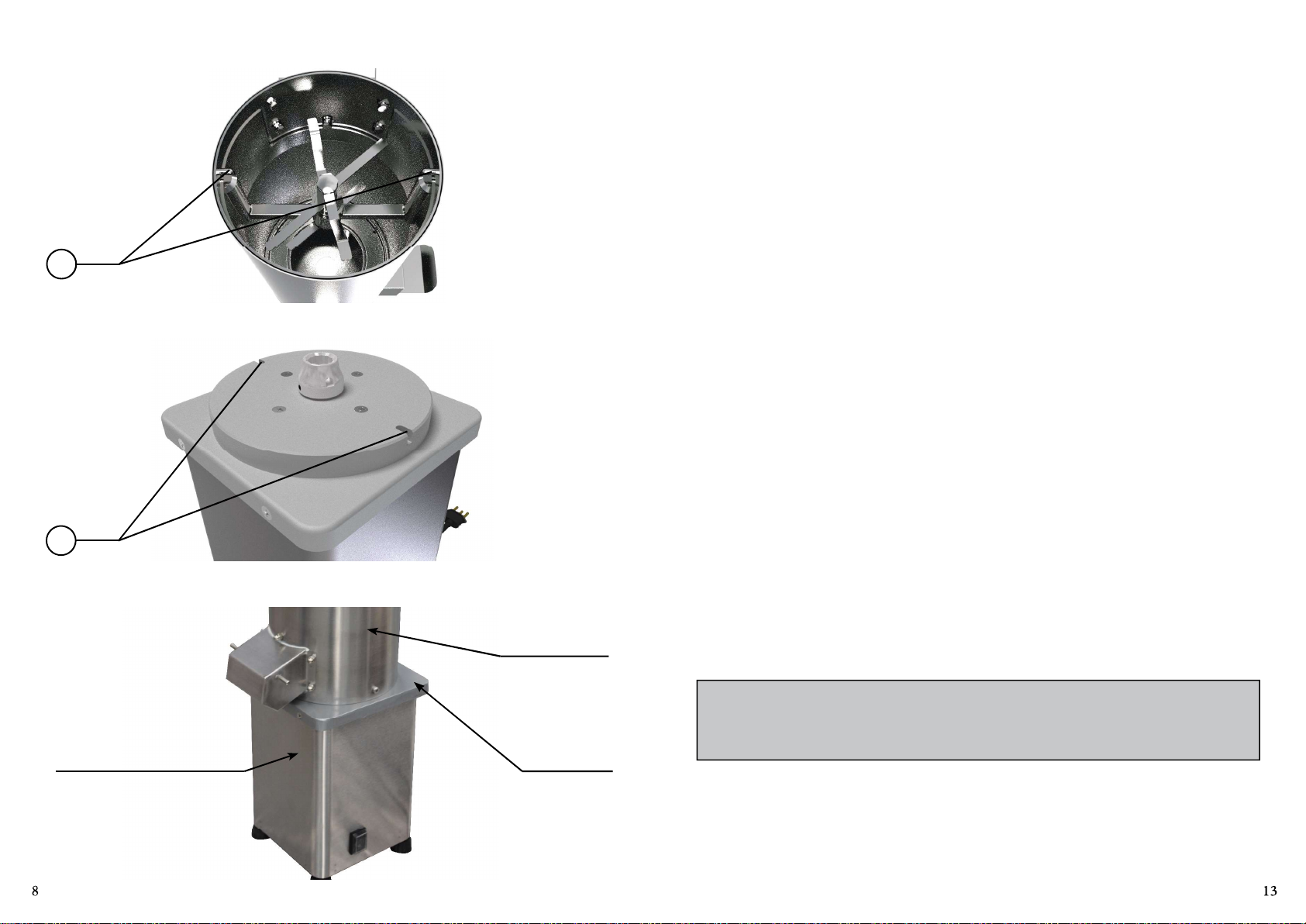
Lot full glass on the base.
The glass has pins to engage as No. 01 (Fig.02).
At the base there are slots No. 01 (Fig.03) that hold the pins of the glass.
Place the pins on the glass at the base of the slot unl the glass sit perfectly on the base,
as shown in Fig. 04.
The outlet nozzle should always be mounted to the front of the machine frame as shown
in Fig. 04.
Make sure the equipment is firm in his workplace.
- AC power cord damaged.
- Unusual noises
- Failure to transport the
product.
- Defecve bearings
- Call technical assistance
(ATA).
- Call technical assistance
(ATA).
Page 8
01
01
PICTURE 02
PICTURE 03
4.3.2 Precauons
Check the motor and sliding or turning parts of the machine in case of abnormal noises.
Check the tension of the belts and chains and replace the set when belts or chains show
signs of wearing.
When checking the tension of belts or chains DO NOT insert your fingers between belts
and pulleys, nor between the chains and gears.
Check protecons and safety devices to make sure they are working properly.
4.4 Operaon
4.4.1 Warnings
Do not use the machine with long hair that could touch any part of the machine. This might
lead to a serious accident. Tie your hair up well and/or cover it with a scarf.
Only trained or skilled personnel shall operate this machine.
Never touch turning parts with your hands or any other way ,
NEVER operate the machine without any original safety devices under perfect condions.
4.5 Aer Finishing The Work
4.5.1 Precauons
Always TURN THE MACHINE OFF before cleaning by removing the plug from the socket.
Never clean the machine unless it has come to a complete stop.
Put all the components back to their funconal posions before turning the machine ON
again.
Check the level of liquids.
Do NOT insert your fingers in between belts and pulleys nor chains and gears.
PICTURE 04
FULL CUP
FRONT OF THE EQUIPMENT BASE
4.6 Maintenance
4.6.1 Danger
Any maintenance with the machine in working situaon is dangerous. TURN IT OFF BY
PULLING THE PLUG OFF THE SOCKET DURING MAINTENANCE.
IMPORTANT
Always remove the plug from the socket in any emergency situaon.
4.7 Warning
Electrical or mechanical maintenance has to be undertaken by qualified personnel.
The person in charge of maintenance has to be sure that the machine is under TOTAL
SAFETY condions when working.
Page 9

* Use recommended or equivalent lubricants, oils or greases.
* Avoid mechanical shocks, once they may cause damages or bad funconing.
* Avoid water, dirt or dust contact to the mechanical and electrical components of the
machine.
* DO NOT change the standard characteriscs of the machine.
* DO NOT remove, tear off or maculate any safety or idenficaon labels stuck on the
machine. If any labels have been removed or are no longer legible, contact your nearest
dealer for replacement.
4.2 Safety Procedures and Notes before Switching the Machine ON
IMPORTANT
Carefully read ALL INSTRUCTIONS of this manual before turning the machine ON.
Be sure to well understand all the informaon contained in this manual. If you
have any queson contact your supervisor or your nearest Dealer.
3.Operaon
3.1 Drive
To connect the equipment proceed as described:
- Connect the equipment to the power grid.
- Operate the On / off switch No. 05 (Fig 01.) That aached on the side of the machine
frame, posioning it in I (ON).
3.2 Operang Procedure
The bread mills are machines working at high speed and both require that the power is
equally fast.
To feed them, put the bread by the entrance nozzle No. 01 (Fig.01) and lead them by hand
only unl the entry (hole) on the same.
The MPAL has a producon capacity of 30 kg / h.
4.2.1 Danger
An electric cable or electric wire with damaged jacket or bad insulaon might cause
electrical shocks as well as electrical leak. Before use, check the condions of all wires
and cables.
4.2.2 Advices
Be sure to well understand all the informaon contained in this manual. Every operaon
funcon or procedure has to be thoroughly clear.
Before using any commands (switch, buons, lever), be sure it is the correct one. In case
of doubt, consult this manual.
4.2.3 Precauons
The electric cable has to be compable with the power required by the machine.
Cables touching the floor or close to the machine need to be protected against short
circuits.
4.3 Roune Inspecon
4.3.1 Advice
When checking the tension of the belts or chains, DO NOT insert your fingers between the
belts and the pulleys and nor between the chain and the gears.
The ground product is removed automacally by the machine spout 03 ° C (Fig. 01) located
in front of the machine.
3.3 Cleaning and hygiene
IMPORTANT
Remove the plug before beginning the cleaning process.
The equipment must be thoroughly cleaned and sanized:
- Before being first used;
- Aer the operaon of each day;
- Where it is not used for an extended period;
- Before pung it into operaon aer a prolonged downme.
- Can be removed for cleaning:
- Full Cup
To do a good cleaning equipment, follow these instrucons:
1. Pass a damp cloth on the outside of the equipment.
2. Remove the full cup and wash it completely under running water.
Wash all parts with water and mild soap.
To mount the Full cup proceed as Item 2.2.
IMPORTANT
Do not use water jet directly on the equipment.
Page 10

3.4 Cauons with Stainless Steel:
4. GENERAL SAFETY PRACTICES
The Stainless Steel may present rust signs, which ARE ALWAYS CAUSED BY EXTERNAL
AGENTS, especially when the cleaning or sanizaon is not constant and appropriate.
The Stainless Steel resistance towards corrosion is mainly due to the presence of
chrome, which in contact with oxygen allows the formaon of a very thin protecve coat.
This protecve coat is formed through the whole surface of the steel, blocking the acon
of external corrosive agents.
When the protecve coat is broken, the corrosion process begins, being possible to
avoid it by means of constant and adequate cleaning.
Cleaning must always be done immediately aer using the equipment. For such
end, use water, neutral soap or detergent, and clean the equipment with a so cloth or a
nylon sponge. Then rinse it with plain running water, and dry immediately with a so cloth,
this way avoiding humidity on surfaces and especially on gaps.
The rinsing and drying processes are extremely important to prevent stains and
corrosion from arising.
IMPORTANT
Acid soluons, salty soluons, disinfectants and some sterilizing soluons
(hypochlorites, tetravalent ammonia salts, iodine compounds, nitric acid and
others), must be AVOIDED, once it cannot remain for long in contact with the
stainless steel:
These substances aack the stainless steel due to the CHLORINE on its composion, causing
corrosion spots (ping).
Even detergents used in domesc cleaning must not remain in contact with the stainless
steel longer than the necessary, being mandatory to remove it with plain water and then dry
the surface completely.
Use of abrasives:
Sponges or steel wool and carbon steel brushes, besides scratching the surface and
compromising the stainless steel protecon, leave parcles that rust and react contaminang
the stainless steel. That is why such products must not be used for cleaning and sanizaon.
Scrapings made with sharp instruments or similar must also be avoided.
Main substances that cause stainless steel corrosion:
Dust, grease, acid soluons such as vinegar, fruit juices, etc., saltern soluons (brine),
blood, detergents (except for the neutral ones), common steel parcles, residue of sponges or
common steel wool, and also other abrasives.
IMPORTANT
If any recommendaon is not applicable to your equipment , please ignore it .
The following safety instrucons are addressed to both the operator of the machine as
well as the person in charge of maintenance.
The machine has to be delivered only in perfect condions of use by the Distributor to the
user. The user shall operate the machine only aer being well acquainted with the safety
procedures described in the present manual. READ THIS MANUAL WITH ATTENTION.
4.1 Basic Operaon Procedures
4.1.1 Dangers
Some areas of the electric device have parts that are connected or have parts connected
to high voltage. These parts when touched may cause severe electrical shocks or even be
lethal.
Never touch manual commands such as switches, buons, turning keys and knobs with
your hands wearing wet clothes and/or wet shoes. By not following these instrucons
operator could be exposed to severe electrical shocks or even to a lethal situaon.
4.1.2 Warnings
* The operator has to be well familiar with the posion of ON/OFF Switch to make sure the
Switch is easy to be reached when necessary.
* Before any kind of maintenance, physically remove plug from the socket.
* Provide space for a comfortable operaon thus avoiding accidents.
* Water or oil spilled on the floor will turn it slippery and dangerous. Make sure the floor
is clean and dry.
* Before using any commands (switch, buons, lever), be sure it is the correct one. In case
of doubt, consult this manual.
* Never touch any manual commands (switch, buons, lever) unadvisedly.
* If any work is to be made by two or more persons, coordinaon signs will have to be
given for each operaon step. Every step of the operaon shall be taken only if a sign has
been made and responded.
4.1.3 Advices
* In case of power shortage, immediately switch the machine off.
 Loading...