

Page 1

103 St C
Page 2

Page 3

CONTENTS
SINN SPEZIALUHREN ZU FRANKFURT AM MAIN
103 St C
INSTRUCTIONS FOR USE
USING THE CHRONOGRAPH TO MEASURE TIME
USING THE PILOT’S BEZEL TO MEASURE TIME
ASSEMBLING AND ADJUSTING OF STRAPS
TECHNICAL DETAILS
ADVICE
SERVICE
8 –13
14 –15
16 –17
18
19
20 – 23
24 – 25
26 – 27
28 – 29
Page 4

DEAR CUSTOMER,
We know from numerous
conversations that the people
who buy our watches do so out of
conviction. This includes people with
a pronounced affinity to technology
who are fascinated, for example,
by the solutions we have devised
for protection from magnetic fields
and scratch resistance. Some of our
customers, such as divers, pilots and
the German GSG 9 special police
unit, rely on their watches in their
respective careers because their lives
depend on it.
They all swear by the performance,
resilience and durability, as well
as the quality and precision of our
watches. That is why the world’s
largest classification society DNV GL
4
(formerly Germanischer Lloyd,
Hamburg) regularly tests and certifies
the water and pressure resistance of
our diving watches.
Page 5

Selected pilot watches are tested and certified by independent institutions
according to the DIN 8330 Horology – Aviator watches in an extensive and
complex type and unit verification process. This ensures that a DIN 8330-compliant
pilot watch is a suitable all-round replacement for the on-board timekeeping
instruments available to pilots. Functionality is our top priority and ultimately
determines the design. Only the technical features that are really needed can
be found on our watches. Because we believe that products have to speak for
themselves.
The basic question that we ask ourselves is: which innovative technologies and
materials can be employed for our craft and provide solutions for rendering
our watches even more practical for everyday use? It is often worth indulging
in a little lateral thinking to see what is going on in other industrial sectors
or fields of science. We repeatedly go to the limits of physical resources to
upgrade our watches – with the aim of making what’s good even better. Most
of our best developments are yet to come!
I am delighted that you have decided to buy a SINN timepiece and hope that
it will continue to give you pleasure for many years to come.
Yours sincerely,
5
Lothar Schmidt
Page 6

GREETING FROM JENS KOCH
Congratulations on purchasing a Sinn 103 St C,
limited to 100 pieces! The C in the model name
stands for the watch magazine Chronos, which is
joining Sinn in celebrating the brand’s classic pilot
watches with this limited-edition model. This watch
is based on models 101 and 102 from the early
1970s, which also provided the basis for today’s
Sinn 103. The Valjoux 7733 and Valjoux 236 handwound calibres used in these watches featured a
beautiful bicompax arrangement, with the small
seconds dial on the left and the minute counter on
the right. The clarity of the dial was ensured by
dispensing with date or weekday displays. Sinn
accentuated the symmetry of some models by
adding silver counters. Our aim was to revive this
part of the Sinn tradition. Fortunately, a movement
was recently developed that allows precisely that:
the automatic calibre SW 510 BH b by Swiss
movement manufacturer Sellita. Sinn agreed to
install the movement for the first time in this special
6
edition. Nothing more could stand in the way of
the traditional bicompax dial design with bright
subdials. To remain faithful to the original, we
opted for high-domed acrylic glass and non-screw
push-pieces. But Sinn is known for its functional and
robust watches, which is why the 103 St C is
Page 7

waterproof up to 20 bar (200 metres deep) and resistant to low pressure –
despite its retro look.
I hope you enjoy this very special watch.
Jens Koch, editor of Chronos
7
Page 8
8
Page 9

SINN SPEZIALUHREN ZU FRANKFURT AM MAIN
It was back in 1961 that pilot and blind-flying instructor Helmut Sinn founded
the company. Since then, we have been committed to producing highspecification mechanical watches. In 1994, the graduate engineer Lothar
Schmidt took over the company. This marked the beginning of a new era
for the SINN brand, because the new owner took a decisive step towards
more innovation. Under his leadership, new technologies and materials were
introduced, thus providing the crucial incentives for our company’s evolution
and gradual emergence as an insider’s tip for lovers of fine watches. Today,
our name stands for technical innovations – much to the delight of both the
trade and our customers alike.
Technical innovations
Take, for example, the absolutely condensation-free, anti-reflective, German
Submarine Steel diving watch – made possible by HYDRO Technology. Other
examples include a chronometer chronograph fashioned from a 22-carat
gold alloy that is as hard as stainless steel and a chronometer with a magnetic
resistance of up to 80,000 A/m. There are also watches with a clockwork
mechanism optimally protected from aging by an inert gas and integrated
dehumidifying capsule. The list would not be complete without mentioning
the development of mission timers (Einsatzzeitmesser or EZM in German) for
firefighters, for special police units and border patrol guards. DIAPAL is one of
our most important technological developments, with oiling no longer needed
for the most important functions in the watch thanks to the materials we select.
This technology was first used in 2001. With the aid of TEGIMENT Technology, we
achieve greatly increased scratch resistance through surface hardening.
9
Page 10

Ongoing advancement in technology and quality
Our top priority has always been to develop watches that offer superior
performance – both in daily and in professional use. Which is why our
engineers are working continually to identify which innovative methods,
materials and technologies are best suited for optimising our watches. Each
new development has to first undergo rigorous practical tests before being
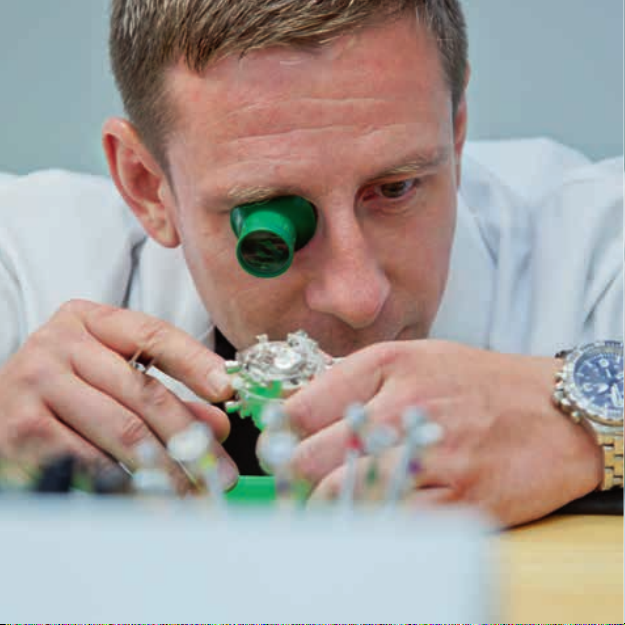
incorporated. And no watch leaves our workshops before it has been subjected
to thorough checking and fine adjustment by our master watchmakers.
Innovations in endurance testing
The world’s largest classification
society for maritime safety DNV GL
(formerly Germanischer Lloyd,
Hamburg), has been testing our
diving watches for pressure and
water resistance since 2005. As part
of DNV GL’s official certification
process, our diving watches have
been treated as part of diving
equipment since 2006 and tested
and certified in accordance
with European diving equipment
standards. This is unparalleled in
10
the watch industry. Selected pilot
watches are tested and certified by
independent institutions according
to the DIN 8330 Horology – Aviator
watches in an extensive and
Page 11

complex type and unit verification process. This ensures that a DIN 8330compliant pilot watch is not only a suitable all-round replacement for the
on-board timekeeping instruments available to pilots, but is also capable of
remaining unaffected by the physical stresses of flight, posing no risk potential
for the crew or aircraft, and demonstrating compatibility with other on-board
instruments.
The Temperature Resistance Technology keeps mechanical watches
performing at temperatures ranging from − 45 °C to +80 °C. This technology
has proven its worth in the EZM 10 TESTAF, for example, used as part of the
official approvals procedure for Airbus Helicopters (formerly Eurocopter)
EC 145 T2 high-performance helicopter. The 303 CRYSTAL is impressive
proof of the functional reliability of our watches under the toughest
climatic conditions. Equipped with Temperature Resistance Technology,
the chronograph passed the acid test at the Yukon Quest, the world’s most
demanding dogsled race. The 203 ARCTIC passed its Arctic endurance test
on the wrist of extreme diver Mario M. Weidner, withstanding all dives in the
freezing cold waters of the Arctic Ocean above 81 degrees latitude. Both
watches were worn on top of protective clothing. The real test was in the
extreme temperature fluctuations between water and land – a test that the
303 CRYSTAL and the 203 ARCTIC passed with flying colours.
Image: All of the technical details of our watches are documented by tests. This system of
assessment has been specially designed for certification of the pressure resistance of our
diving watches by DNV GL (formerly Germanischer Lloyd, Hamburg), the world’s largest
classification society for maritime safety.
11
Page 12

Workshop modifications
From the robust case and the polished crystal to the exquisitely decorated
movement, we make sure that each and every detail in our watches is fit
for purpose. In addition to our technology, the heart of any SINN watch is
the fascinating mechanical movement. That is why we rely only on selected
renowned manufacturers.
“SZ movements” is the name given to our movement modifications. The results
are high-quality calibres characterised by impressive features. An example of
this is the SZ04 with regulateur for the 6100 REGULATEUR series.
The EZM 1.1 and the model series 140 and EZM 10 uses our proprietary
chronograph development, the SZ01. It was modelled on the Lemania 5100
calibre used in the EZM 1. One of the biggest differences between the SZ01
and the Lemania 5100 is the former’s stopwatch minute display. This feature
now makes it even easier and quicker to record stop times more accurately.
This development is based on the Valjoux 7750 calibre. The aim of this
modification was to significantly improve the readability of the chronograph
function.
The SZ calibres 02, 03 and 05 are a modification of the SZ01 movement,
characterized by an off-center 60-minute counter. The 60-minute scale of
the stopwatch minute counter is much simpler and more intuitive to read
12
than the 30-minute scale commonly found in other watches.
Image: SINN Calibre SZ01
Page 13

131415
Page 14

Page 15

103 St C
Black anodised aluminium rotating bezel, high-domed acrylic glass: the
roots of this exclusive special edition for the specialist watch magazine
Chronos run deep into the traditional pilot chronographs of the 1960s.
What immediately catches the eye of any connoisseur is the clearly designed
dial. Reverse panda is the name given to the striking contrast between the matt
silk, black electroplated dial and silver counters, which are modelled on the
iconic panda dials. With their light dials and black counters, the focus of these
mid-last-century classics was entirely on improved readability.
The silver reverse panda counters for the stopwatch minutes and the sweep
second hand on the 103 St C capture this clear readability in their reversed
colours. The pilot’s bezel can also be used to read off stop times of up to one
hour.
By reducing the number of counters to two horizontally arranged bicompax
subdials, the result is a balanced dial design with an additional elaborate detail:
finely grooved counters that have been hollowed out to make them recessed.
The case itself is made of polished stainless steel with a satinised back.
The overall impression of a classic pilot chronograph, whose production we
have limited to 100 pieces in tribute to its history, is perfected by the brown
vintage-style cowhide strap with black decorative stitching.
Page 16
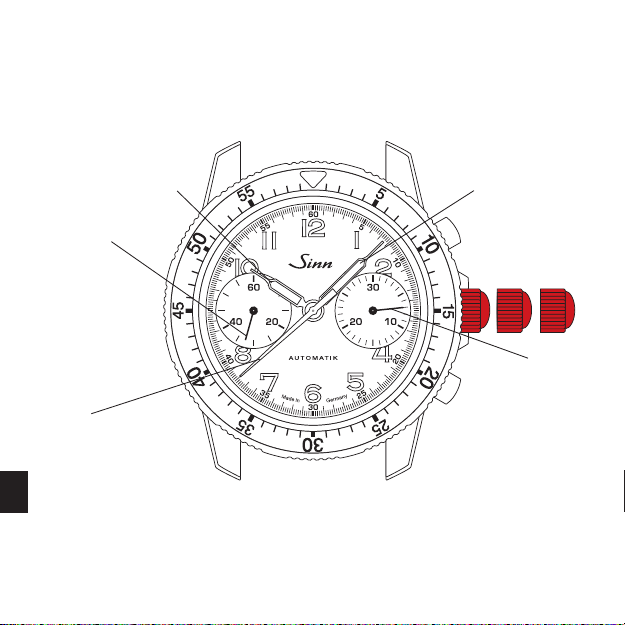
INSTRUCTIONS FOR USE
Second hand
Stopwatch second hand
16
Hour hand
Minute hand
Crown position
0 1 2
Stopwatch minute
hand
Page 17

Winding the watch (crown position 1)
The crown is screwable (crown position 0). To loosen the crown, turn it counterclockwise (crown position 1). The movement is wound by turning the crown
clockwise. About 40 winds of the crown are generally enough to ensure
reliable functionality. Under normal circumstances, simply wearing the watch
every day should suffice to keep the self-winding mechanism wound. The
power reserve allows you to take off your watch overnight without having to
re-wind it.
Time adjustment (crown position 2)
In crown position 2, the motion is paused. This helps you to set the watch
precisely. Please make sure the date changes at midnight and not at
midday. Just move the hands forward until the date changes. Afterwards you
attempt to set the time. We recommend moving the hands past the desired
minute marker and then adjusting it backwards. The movement restarts as
soon as the crown is no longer in position 2.
Please take care to fasten the crown after making adjustments.
17
Page 18
USING THE CHRONOGRAPH TO MEASURE TIME
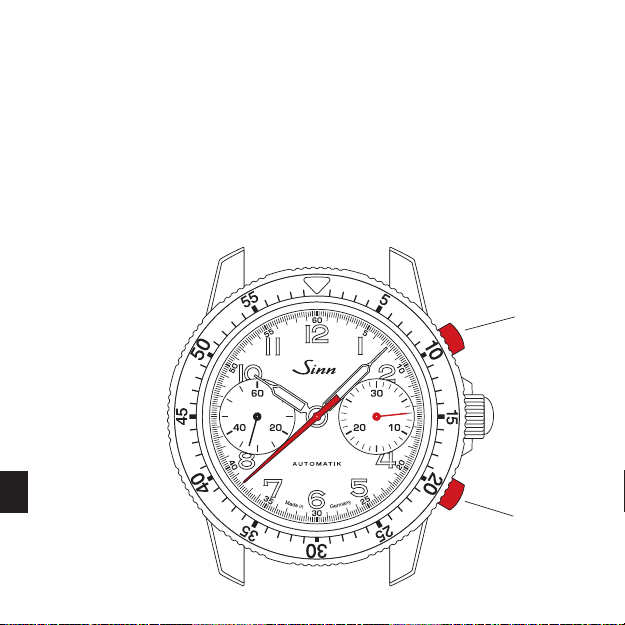
The chronograph is operated by means of buttons A and B. The measurement
starts when button A is pressed once. Pressing this button again stops the
measurement. The measurement is resumed by pressing button A once more.
This allows you to add up and record the cumulative time. Button B resets the
hands of the chronograph to zero.
Push piece A:
start/stop
18
Push piece B:
reset
Page 19

USING THE PILOT’S BEZEL TO MEASURE TIME
The pilot’s bezel can be moved manually in both directions. The triangle
glows in the dark. It can be used in a number of ways, including to measure
important lengths of time. For example, you can set the marking to the
beginning of the time span to be measured, or you can use it to indicate the
end of a given span of time.
19
Page 20

ASSEMBLING AND ADJUSTING OF STRAPS
If you are not sure how to assemble, shorten or lengthen the watch straps,
please contact your specialist SINN retailer directly or one of our watchmakers
in customer service in Frankfurt am Main. We would also be happy to help
you over the telephone.
Adjusting the length of the solid bracelet (optional)
Determine the relative lengths of the two sides before adjusting the length of
the bracelet. To ensure maximum comfort, both sides of the bracelet should
contain the same number of links. If this is not possible, the top bracelet strap
(above the 12 on the clock) should be longer.
It is not necessary to detach the solid bracelet from the watch or the clasp.
1. Loosen the screws on the side of the bracelet link which is to be removed
or added.
2. Remove the superfluous bracelet link or insert a new one.
3. Before screwing tight, add a small drop (no more!) of thread-locker
(AN 302-42 medium-tight) to the thread of the bracelet screw.
20
Page 21

21
Page 22

Adjusting the length of the silicone strap (optional)
1. Release the silicone band from the clasp. To do so, use the pointed end of
the band replacement tool to push the spring bar out of the fastener. The
other side of the spring bar can be removed while the fastener is open,
enabling you to remove the silicone band.
2. Using a knife or scissors, cut the silicone band in the middle between two
metal pins. You should shorten the band symmetrically and little by little,
starting from the clasp, until you have reached the desired length. Test the
length from time to time before proceeding. Shortening both ends by the
length of one metal pin results in a total difference of 10 mm in the length
of the strap; shortening one end reduces the length by 5 mm.
22
3. Remove the first metal pin and replace it with the spring bar. Then
reattach the clasp to the band.
Page 23
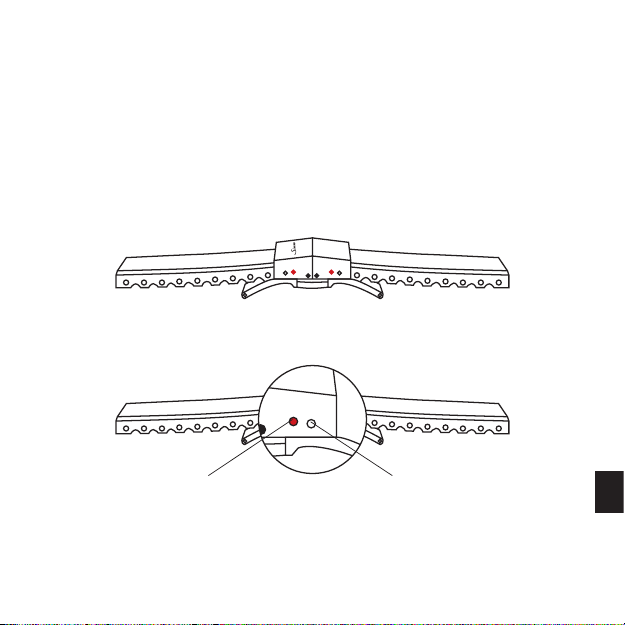
Assembling the butterfly folding clasp as follows (optional)
We recommend first inserting the bar at the red marker, as per the illustration.
If the silicone strap is too tight, use the option shown in the illustration by the
white marker.
Hole for spring bar:
Tight-fitting strap
Hole for spring bar:
Extend strap
If you want to shorten the overall length of the silicone strap, refer to steps 1 to 3
in chapter “Adjusting the length of the silicone strap”.
23
Page 24

24
Luminous
Page 25

TECHNICAL DETAILS
Mechanical Movement
• SW 510
• Self-winding mechanism
• 27 bearing jewels
• Seconds stop function
• 28,800 semi-oscillations per hour
• Shock-resistant as per DIN ISO 1413
• Anti-magnetic as per DIN 8309
Watch Case
• Stainless steel, polished
• Shock-proof acrylic glass on front
• Stainless steel back, screw-fastened
• Crown screwable
• Meet the technical requirements
for waterproofness, as set out in
standard DIN 8310
• Pressure-resistant up to 20 bar
• Resistant to low pressure at
high flight altitudes
• Band lug width 20 mm
• Case diameter 41 mm
Functions
• Hours, minutes, subsidiary seconds
• Chronograph
• Pilot's bezel with luminous key mark
• Hands and numbers coated with
luminescent colour
25
Page 26
26
Page 27

ADVICE
Water resistance
In its original condition, your watch fulfils the technical requirements of water
resistance according to DIN 8310. The static compressive stress of your watch is
given in bar. Each and every one of our watches is tested for water resistance.
However, in everyday use it is important to note that seals can suffer from wear
and ageing over time due to a wide range of factors which arise when wearing
a wristwatch. We therefore recommend having the water resistance checked at
least once a year. To ensure your watch retains its water resistance for as long as
possible, rinse it with tap water if it comes into contact with seawater, chemicals
or the like. Continual mechanical stress in the form of shocks and vibrations
can also not only reduce water resistance, but also increase wear and tear
of the movement. Care should therefore be taken to protect your watch from
unnecessary impacts.
Accuracy
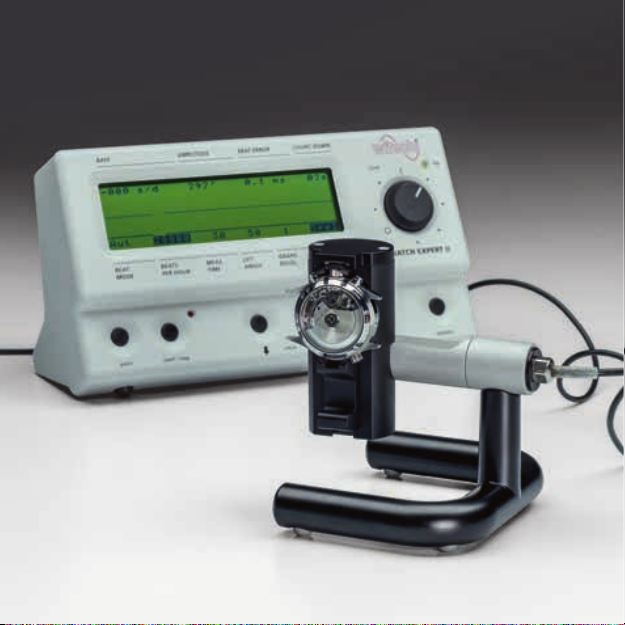
The measured results of the watch’s rate are always “snapshots” taken under
laboratory conditions. For this reason, we also take each owner’s individual
movements into account when making a specific regulator correction. It is
therefore only possible to judge the accuracy of your watch after it has been in
operation for approximately eight weeks. In the event of a deviation, please keep
a daily record of its timekeeping over an extended period, for example one week.
Do you have any questions? Our employees will be pleased to advise you.
Telephone: + 49 (0)69 / 97 84 14 - 400
Telefax: + 49 (0)69 / 97 84 14 - 401
E-mail: [email protected]
27
Page 28
28
Page 29

SERVICE
Does your SINN watch need an inspection, repair, retrofitting or reconditioning?
If possible, please use our service order form. For information about our service
order form, please refer to the section entitled “Customer Service” on our website
www.sinn.de/en and to the section entitled “Servicing and repairs” in our general
terms and conditions at www.sinn.de/en. We would be happy to send you a copy
of the general terms and conditions.
Our international partners generally offer on-site service. However, should they
be unable to provide a certain service, they will organise the safe dispatch and
return of the SINN watch to our manufactory in Germany. Please be aware that our
partners will wait until they have a sufficient number of SINN watches before they
post a shipment, in order to keep transport costs and customs duties to a minimum.
This will increase the processing time.
Alternatively, you can send your SINN watch to us directly. You will be required
to cover the postage costs for the delivery and return shipment, which vary
depending on the country. For insurance reasons, we strongly recommend
sending us any return goods by registered parcel post. We regret that we are
unable to accept deliveries with unpaid postage!
In case you have a chance to drop off your watch directly at our office in Frankfurt
am Main we look forward to your visit. Please make a note of our opening times.
For information about our service, please refer to the section entitled
“Customer Service” on our website www.sinn.de/en or +49 (0)69 / 97 84 14 - 400.
29
Page 30

30
© Sinn Spezialuhren GmbH
1. Auflage / 1st Edition
10 2018
Technische Änderungen vorbehalten.
Technical specifications are subject to changes.
Page 31

 Loading...