

Page 1
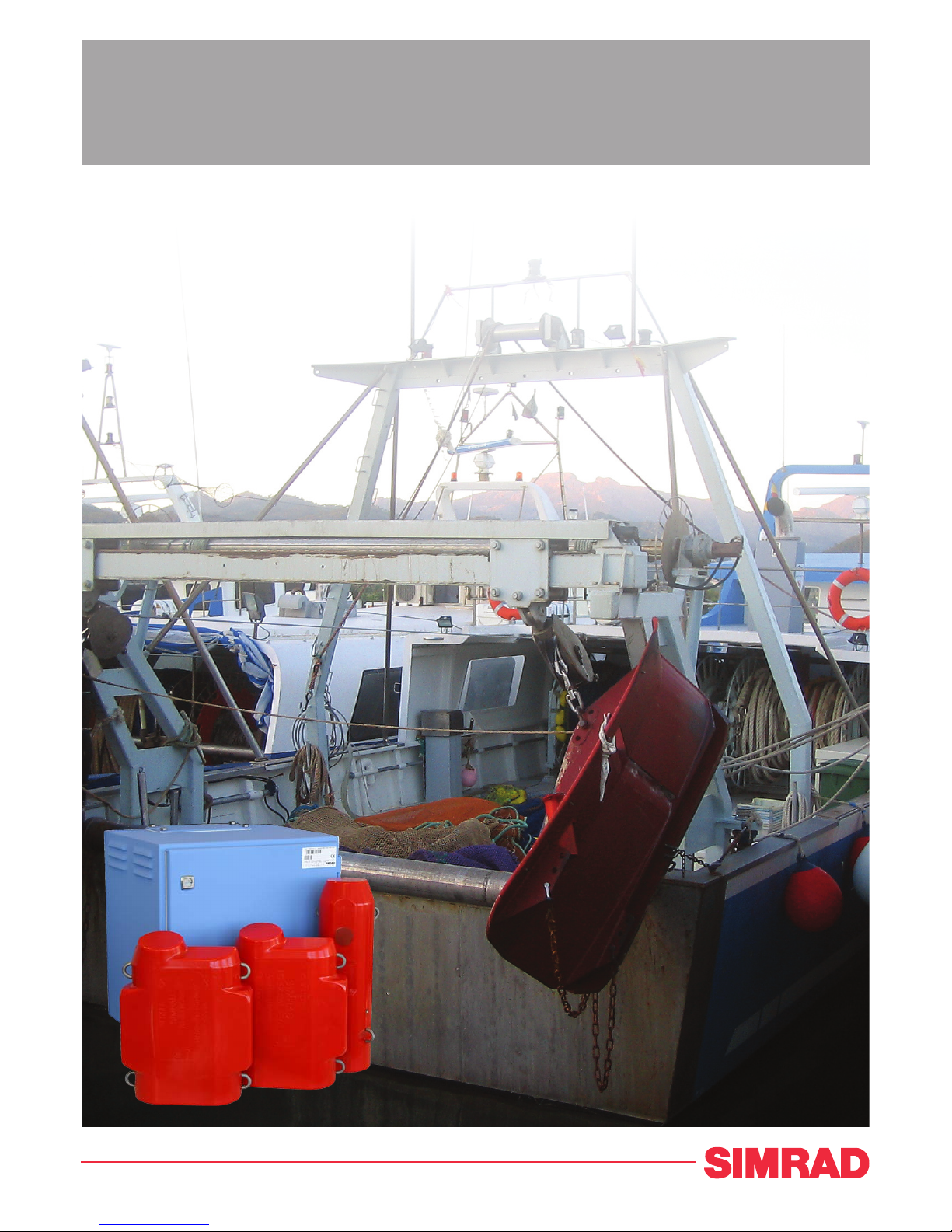
Simrad ITI
Trawl monitoring system
TECHNOLOGY FOR SUSTAINABLE FISHERIES
www.simrad.com
Measures position of signel and twin trawls
Full range of sensors
Split beam transducer technology
Nine display modes of efcient use
Well proven technology
Locate lost gear
Page 2
SIMRAD ITI
Simrad ITI is the ultimate wireless Trawl Positioning and Monitoring System.
Simrad ITI is a complete wireless
trawl positioning and monitoring
system. It is designed to improve
control and efciency in pelagic
and bottom trawling. Small,
robust, battery-powered
sensors mounted on the
trawl, transmit important
information to the vessel on
request.
The Simrad ITI allows you to
monitor the exact position of the gear,
and what is happening in and around
the trawl. This provides crucial
information for effective, protable
and responsible shing.
Adaptable and easy to use
The Simrad ITI is a modular
system. Starting with one sensor, the
Simrad ITI system can be expanded to
a complete and advanced instrument
package.
Data from the trawl mounted
sensors is presented on a colour
monitor with emphasis on ease of
use. Operation is simple and based on
display menus.
Robust, serviceable and
intelligent
The Simrad ITI is designed for
the future, and it is based on the
proven technology. The sensors are
extremely robust with serviceable
and replaceable electronics. By
only responding when interrogated,
prolonged operational life between
charges is achieved.
The Simrad ITI is designed for
interfacing with navigational systems,
sonars and echo sounders.
Position of the trawl
One of the great advantages of the
Simrad ITI system is the ability to
measure the range and bearing to each
sensor.
Knowing the position of the
trawl allows you to avoid wrecks
and obstacles on the seabed. You are
able to target shing grounds more
efcient based on information from
your echo sounder and sonar.
A major benefit of the ITI system is
the trawl positioning feature.
By knowing the trawl´s position you
can avoid wrecks and obstacles on the
seabed.
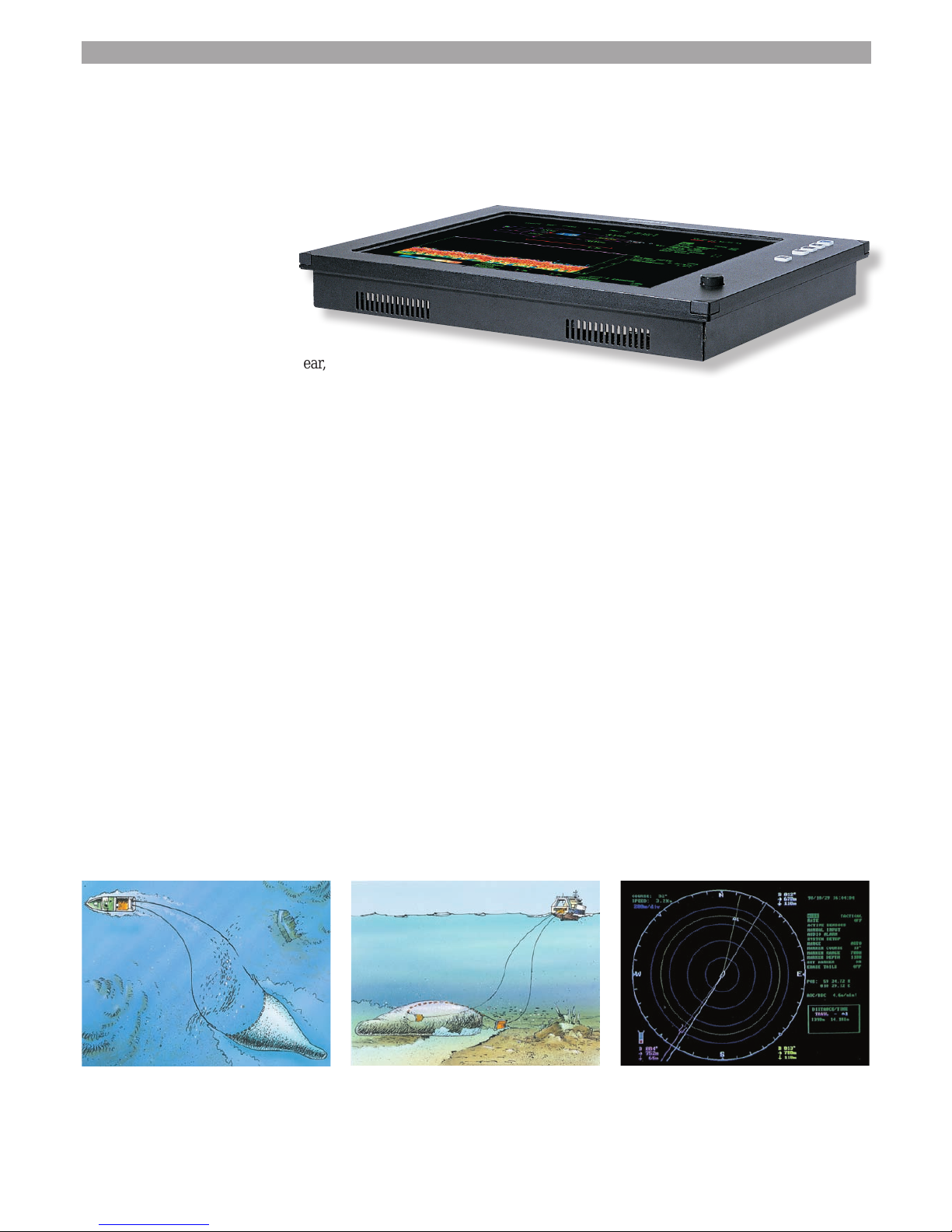
The ITI T actical display shows all
necessary information with regard to
the trawl´s position relative to the
vessel.
Display options
The Simrad ITI System has many
display modes. Logged data from the
sensors and navigational instruments,
stored in real time, provides valuable
information for each tow. The
temperature - depth prole indicates
correct position ing and the grid sensor
shows the angle of the sorting grid.
Simrad was the rst company to develop an entire range of trawl monitoring
systems using LCD monitors.
Page 3
SIMRAD ITI
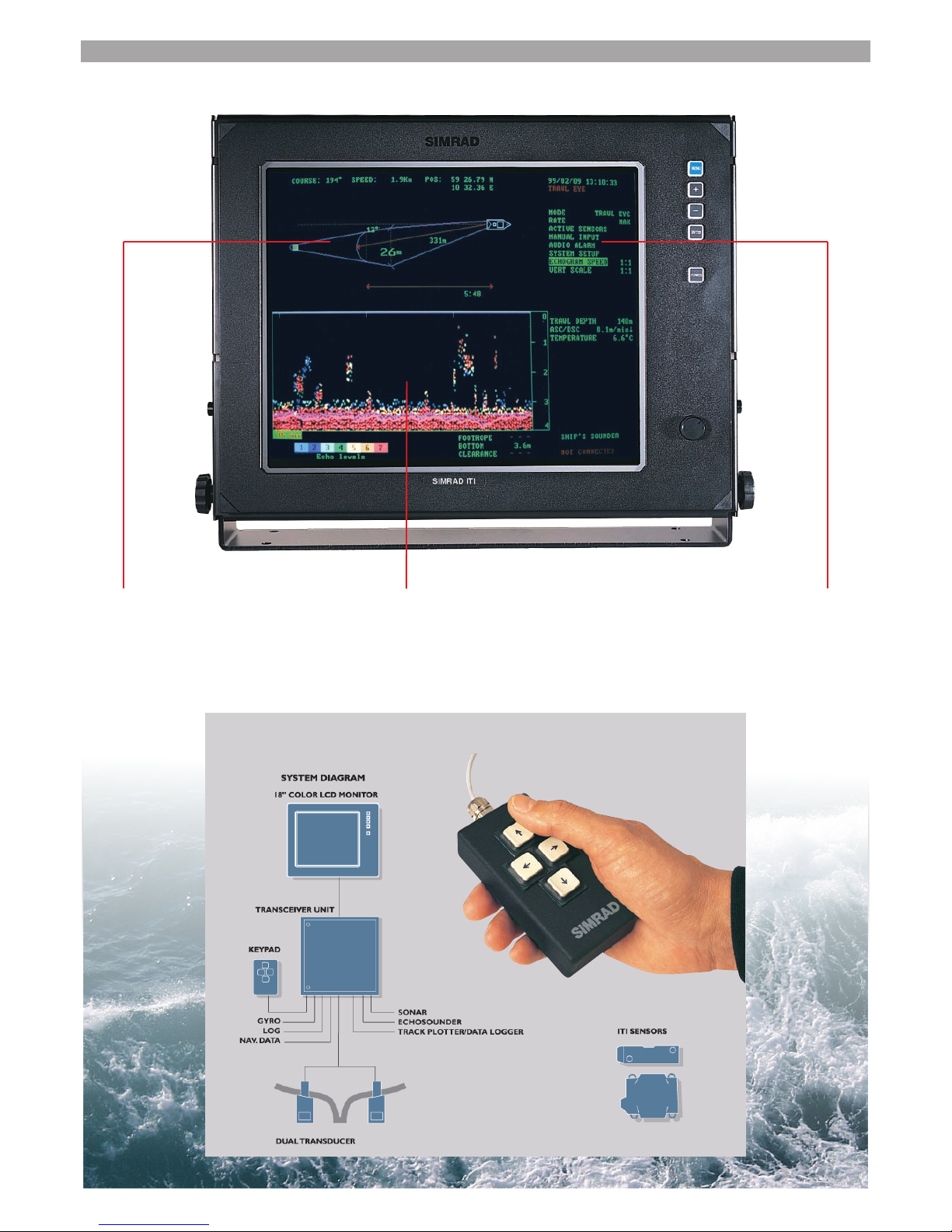
Distance and bearing, trawl geometry
and catch are displayed in the
horizontal projection.
The Trawl Eye echogram shows
position of the trawl relative to the
bottom, sh in the opening and the
height of the trawl.
The Simrad ITI system is operated by
self- explanatory menus. The menu is
available in several languages.
The menu entries can be
selected using the keypad.
Page 4
SIMRAD ITI
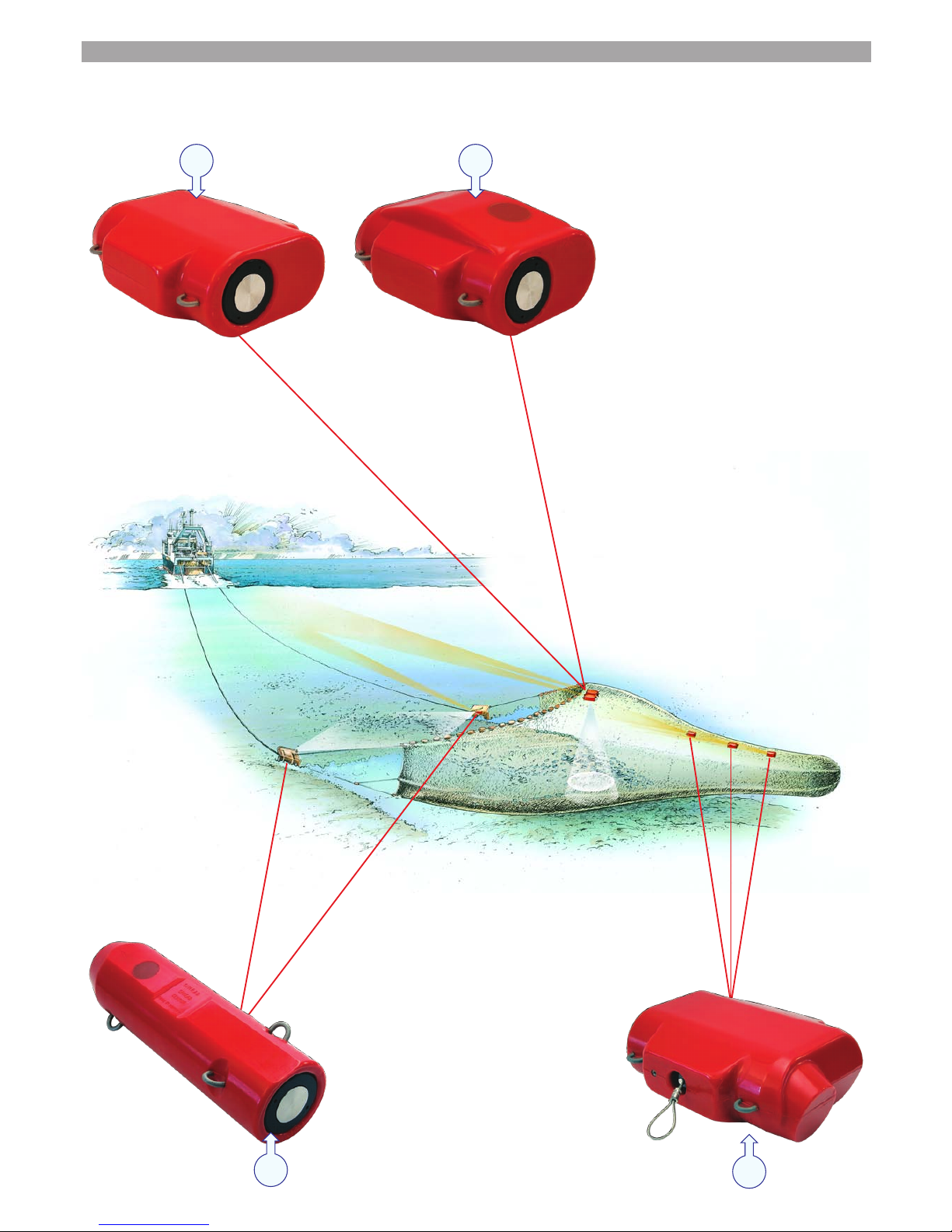
A) Depth/Temperature sensor
This sensor monitors the depth
of the trawl, and the water
temperature.
B) Trawl Eye sensor
The sensor monitors the trawl
opening
C) Distance/Spread sensor
The distance sensors monitor door
or wing spread.
D) Catch sensor
The catch sensors acknowledge
as the cod end lls with sh,
indicated by a green square icon
on the screen turning red when the
sensor is activated.
Trawl monitoring with Simrad ITI
A
B
C
D
Page 5
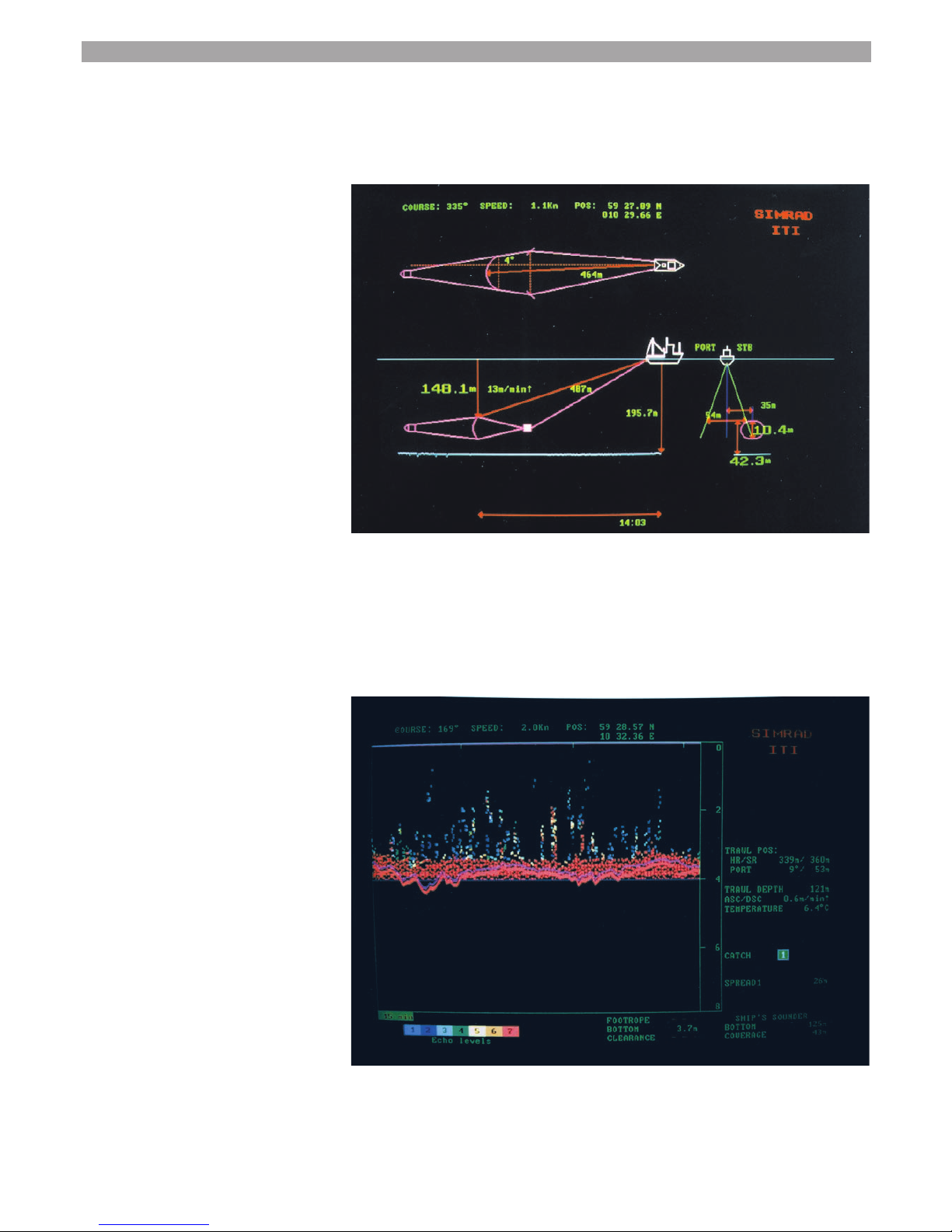
The Normal mode provides you with an overview of
important catch and trawl data.
The Simrad Trawl Eye sensor has
a sophisticated built-in echo sounder
providing information on sh in the
trawl opening, the height of the trawl
and clearance to the bottom.
The amount of sh in the opening
is clearly displayed and the density
of sh is indicated by echo strength.
The footrope and bottom sounding
are constantly monitored giving
information on the trawl opening and
behavior of the trawl when bottom
trawling. Information is displayed as
an easy to understand echosounder
picture. The Trawl Eye is best suited
for bottom and medium size pelagic
trawlers.
The Trawl Eye echogram gives detailed information about the trawl opening,
sh entering the trawl and footrope bottom contact.
SIMRAD ITI
Monitoring of the trawl and catch situation
The Normal mode picture presents you with a complete overview of the trawl and catch situation
on the screen.
The picture is divided into three
sections:
1 Distance and bearing to the trawl,
door or wing spread and the catch
are displayed in the horizontal
section.
2 The vertical section showing
the depth of the trawl, the sea
temperature, the catch, the bottom
contours from the echo sounder
and the time lag between the vessel
and the trawl.
3 The height of the trawl, the
bottom clearance and the trawl
deviation from the ship’s course
line, is displayed in the aft view
section. In addition, the ship’s
echo sounder coverage at the trawl
depth is shown.
The Simrad ITI Trawl Eye - efcient wireless net sounding
The Simrad Trawl Eye monitors the trawl opening.
Page 6
SIMRAD ITI
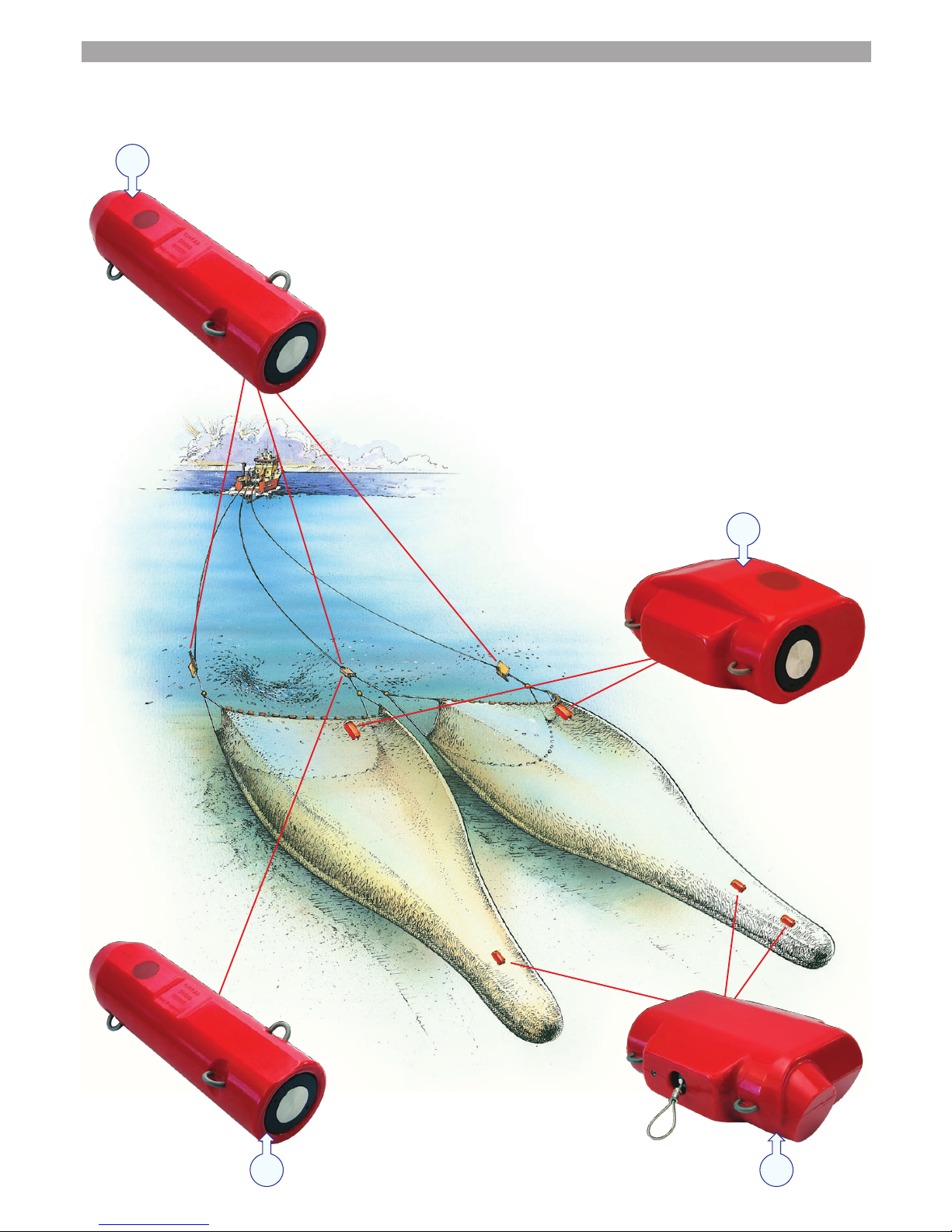
A) Spread Sensor
The spread sensors monitor the
distance between the center weight
and both trawl doors.
B) Trawl Eye/Height Sensor
The Trawl Eye and Height sensor
monitors the trawl opening.
C) Twin Combi sensor
This sensor monitors the depth,
and the ambient water temperature.
D) Catch Sensor
The Catch sensors acknowledge
as the cod end lls up sh. This
is indicated both visually and
audibly.
Twin trawl monitoring with Simrad ITI
A
B
C
D
Page 7
SIMRAD ITI
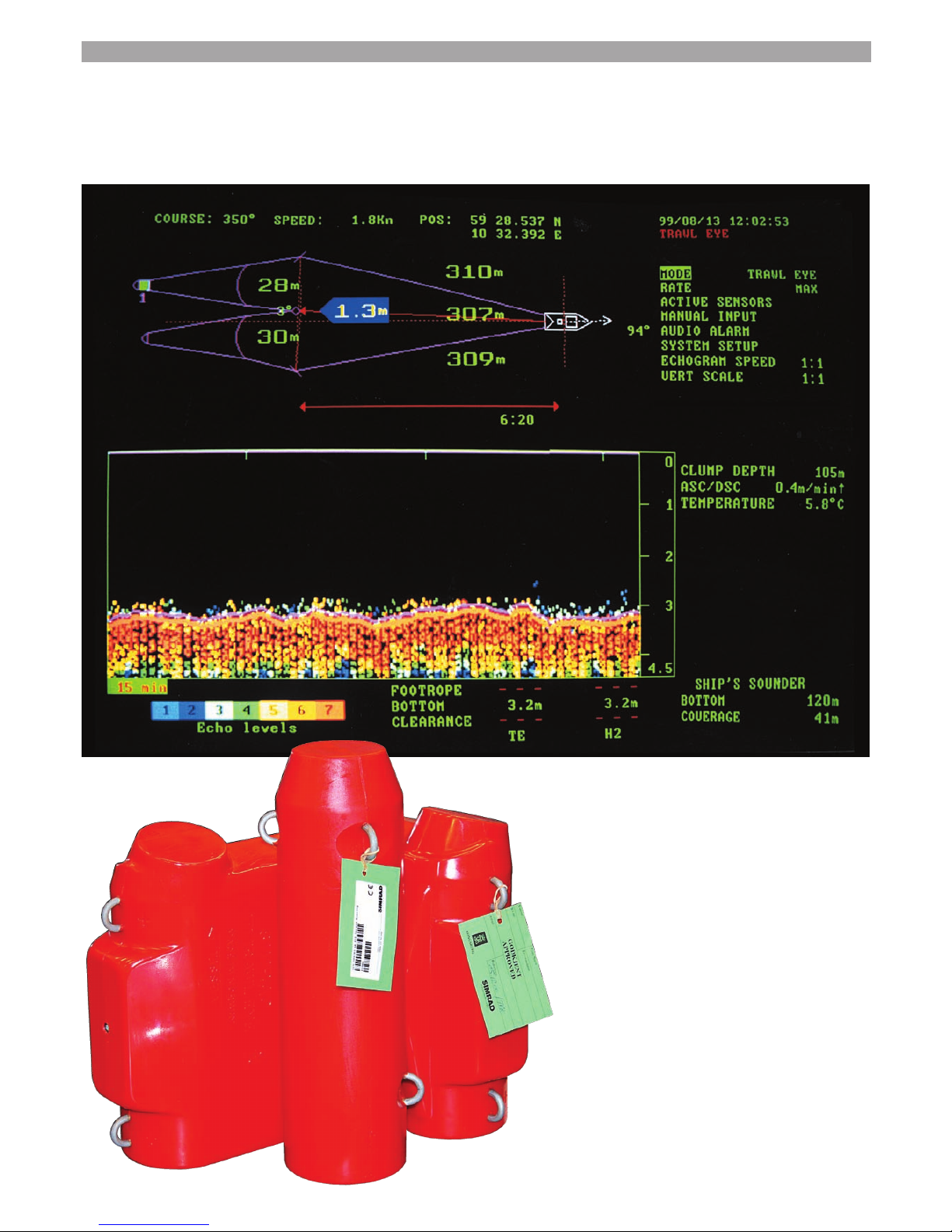
With better than 1 m relative accuracy,
the new Simrad ITI Geometry System
provides measurements for: “Vessel to
starboard and port trawl door and Vessel
to the center weight.”
With this accuracy, the ITI Geometry
System will measure the distances
between the center weight and both trawl
doors.
The ITI system can be expanded
to provide a wide variety of data. The
Twin Combi sensor is located on the
center weight to detect depth and water
temperature. The Trawl Eye sensor and
the Height sensor can be mounted in the
trawl openings to detect trawl heights,
bottom contact and sh entering the
trawl. In addition, Catch sensors can be
mounted on both cod ends to measure the
amount of sh caught.
The wireless Simrad ITI transponder system for Twin Rigging is designed to utilize a minimum of
transponders to achieve full coverage of the trawl geometry and true movement over the bottom.
Simrad ITI Trawl Geometry - full control of Twin Trawl
Page 8

SIMRAD ITI
Kongsberg Maritime AS
Strandpromenaden 50
P. O.Box111
N-3191 Horten,Norway
Simrad
Telephone: +4733034000
Telefax: +4733042987
www.simrad.com
340165 / Rev.A / October 2009
System
The ITI System consists of the
following main units:
• Display monitor (*)
• Transceiver Unit
• Dual or triple split beam transducer
system
• Trawl mounted sensors and Trawl
Eye
(*) The display is not a part of the delivery,
and must be obtained locally. The display must
comply to a standard VGA output. All sizes
can be used, but the ITI has not been prepared
for wide screens (16:9).
Display modes and operation
• Normal mode: Horizontal and
vertical section, athwartships view
• Tactical display: Bird’s eye view
with target and trawl position
• Temp/Depth: Depth/temperature
gradient curve
• Trawl Data Log: Stored trawl data
• Grid: Grid angle
• Status views: System parameter
setting
• Trawl Eye echogram: Side view of
trawl opening
• Trawl Eye, split screen: Side
view of trawl opening, range and
bearing to the trawl
• Test: Sensor communication
protocol
• Operation: Keypad operated
multilingual menu
Range
Selectable scales:
• Max 4000 m. Detection range
depends on transducer installation,
ambient noise level, temperature
gradient and sensor alignment.
• Measuring accuracy:
- Distance: Typical ± 5 m
- Bearing: Typical ± 1°
Data interfaces
• Gyro: Stepper/synchro types
• Speed log: Pulse, analogue, Simrad
NL Doppler Log, or GPS
• Serial lines: Four NMEA0183
serial lines
• Option: Ethernet interface
Power requirements
• Voltage: 220 Vac, ±15%, 50/60 Hz
• Consumption: 90 W
Transducer
Ceramic, split beam transducer type,
supplied with 20 m cable, diameter
12 mm in a dual or triple transducer
configuration.
• Beam width: 40° (-3 dB), circular
• Horizontal coverage: 70° -100°
depending on arrangement (two
single or one triple)
Technical specications
Note that the specications can be altered
without prior warning.
Sensors
Common sensor specications:
• Moulded housing with replaceable
electronics
• Rechargeable batteries
• Operational life between charging:
Approximately 40 hours when
interrogated every 15 seconds
• Max operating depth: 2000 m
• Frequency range: 27 - 33 kHz
• Weight: Approximately 3 kg (in
water).
• Sensor types:
Depth sensor
Temperature sensor
Temperature/Depth combination
Spread sensor
Trawl Eye sensor
Catch sensor
Height sensor
Grid sensor
 Loading...