

Page 1
Printed in U.S.A.
www.shure.com
© 2012 Shure Incorporated
27A14046 (Rev. 2)
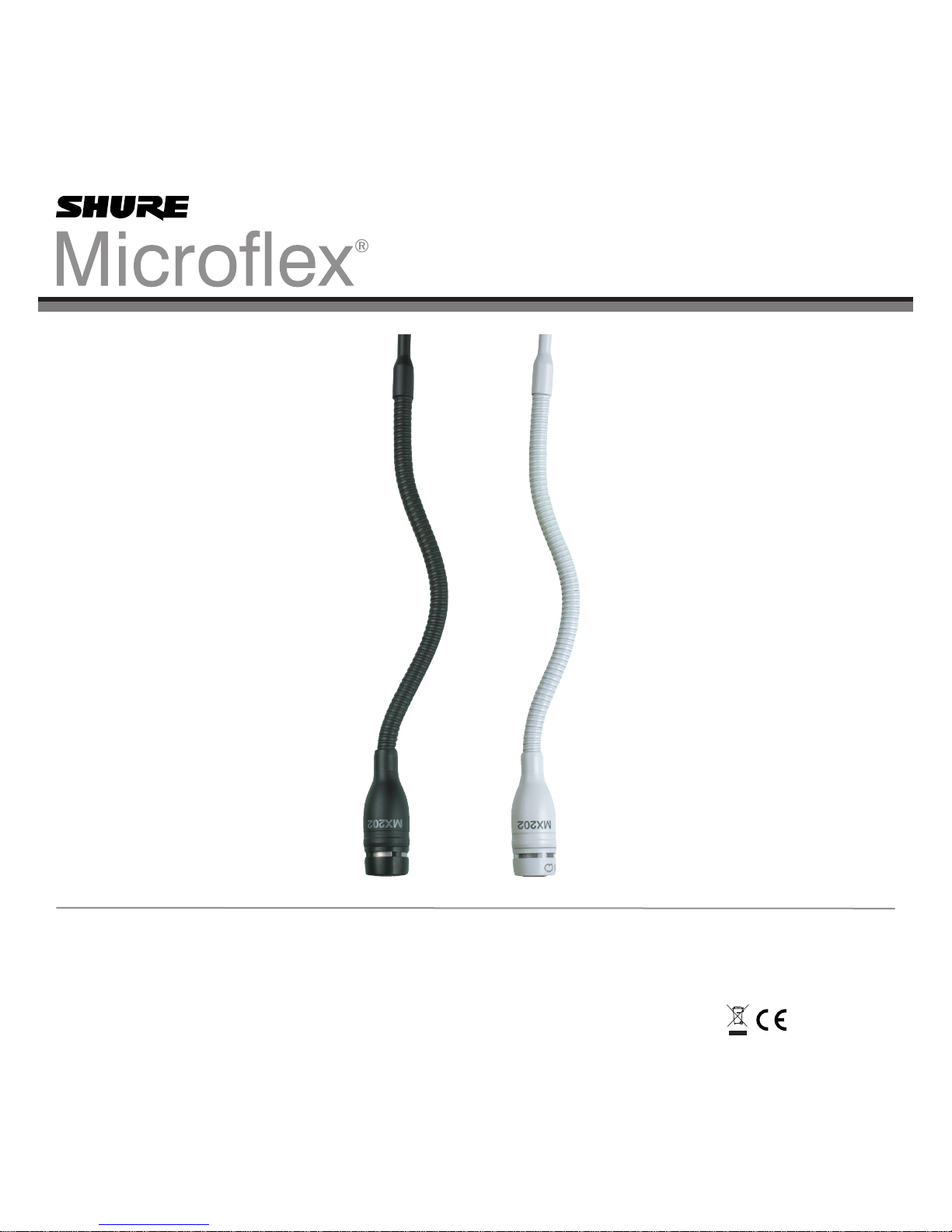
MX200 SERIES
Page 2
• Wide dynamic range and frequency response
for accurate sound reproduction
• Interchangeable cartridges that provide a
choice of polar pattern for each application
• White or black finish that blends unobtrusively
with most surroundings
• RF filtering
Model Variations
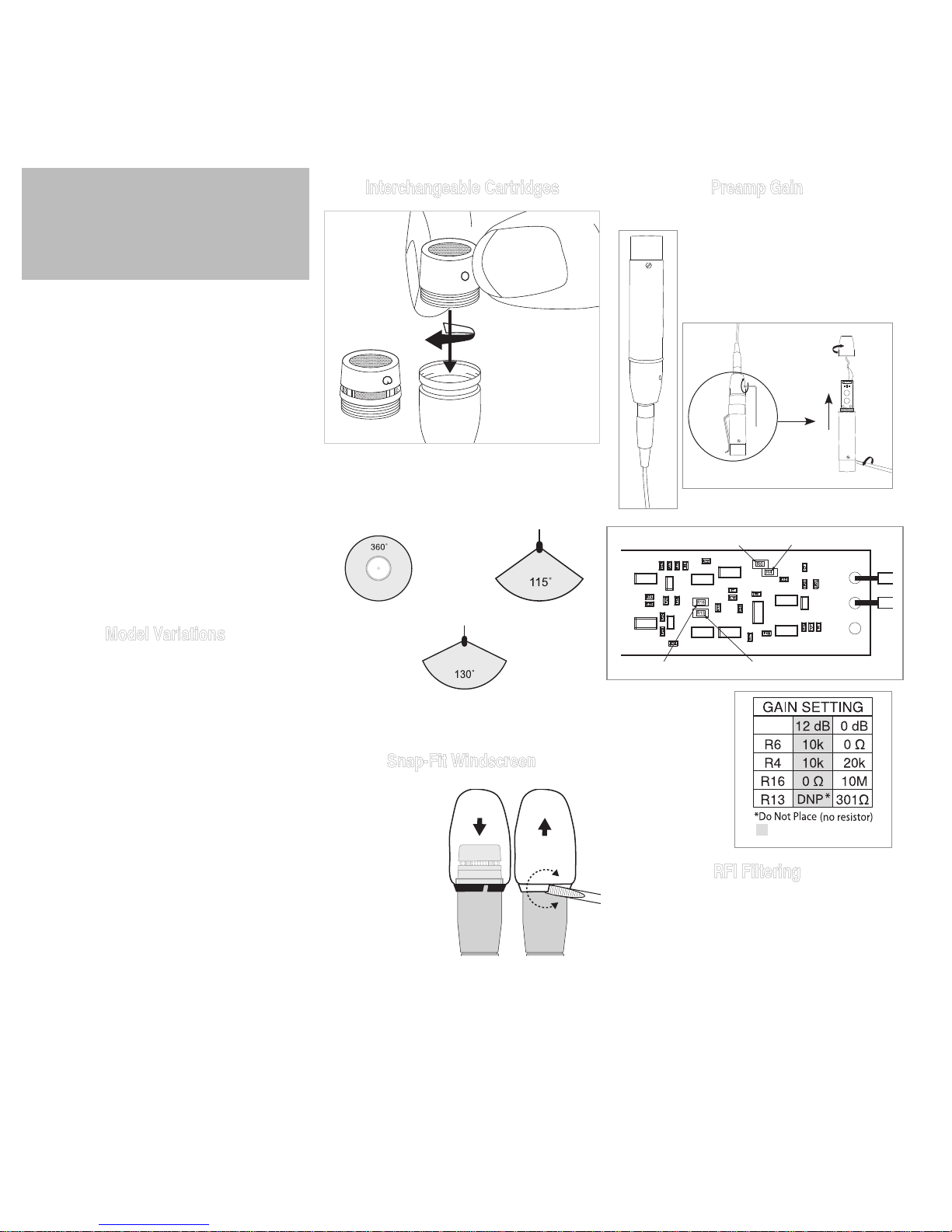
Microflex MX202 microphones are available in
black or white with a choice of in-line preamplifier
or plate-mount preamplifier.
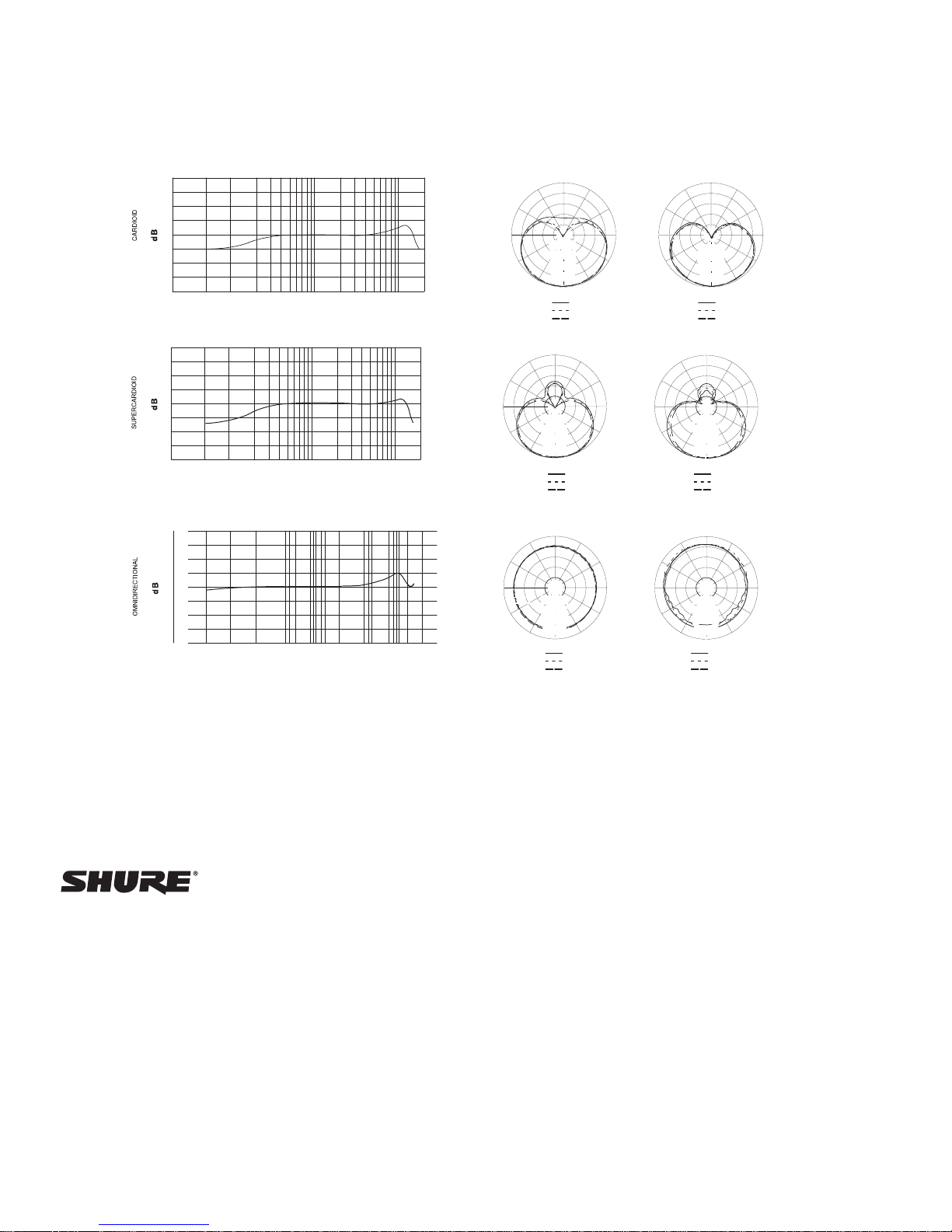
The polar pattern of the included cartridge is indicated by a model number suffix:
/C Cardioid
/S Supercardioid
/O Omnidirectional
/N Cartridge not included
Interchangeable Cartridges
Microflex microphones use interchangeable cartridges that allow you to choose the polar pattern
for different installations.
Snap-Fit Windscreen
• Snap into the
groove below the
cartridge.
• To remove, spread
the gap with a
screwdriver or
thumbnail.
• Provides 30 dB of
"pop" protection.
Preamp Gain
If necessary, the preamplifier gain
can be reduced by 12 dB. Contact
an authorized Shure service center
for information.
RFI Filtering
Important: Microphones must be used with the
RK100PK preamp to optimize RF immunity.
R183
R184
Supercardioid
R185
Overhead
Microphones
MX200
Shure Microflex® MX200 Series microphones are
miniature electret condenser microphones designed for miking choirs and performance groups.
They are typically suspended over the heads of
the performers. Their high sensitivity and wide frequency range make them suitable for recording,
as well as sound reinforcement applications. An
attached 101mm (4 in.) gooseneck allows them to
be easily aimed at the sound source.
Omnidirectional
Cardioid
2
R4
R13R16
Q8
Q9
Q2
Q6
Q1
Q5
Q3
Q4
Q7
C6
C9
C3
R6
RED
BLACK
= Factory Default
Page 3
Microphone Placement
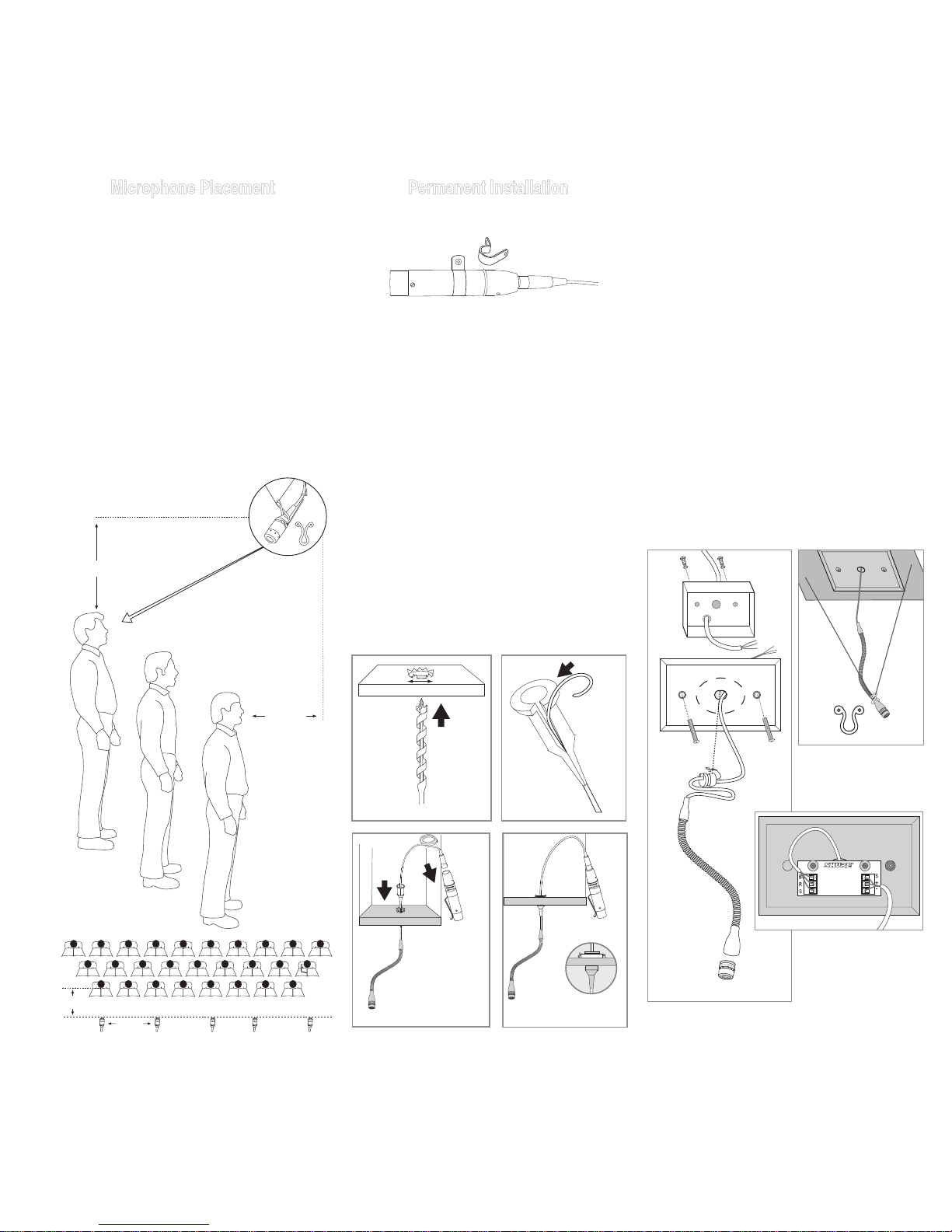
The microphone is most stable when the gooseneck is bent into a "lazy S" shape. Use the supplied hanging clip and heavy thread or monofilament fishing line to suspend the microphone at a
specific location.
• For choir installations, hang a microphone 0.6
to 0.9m (2 to 3 ft.) in front of the first row, and
0.6 to 0.9m (2 to 3 ft.) over the heads of the
singers in the last row. Aim the microphone at
the back row.
• When miking groups that move or vary in size,
use a boom stand and the supplied stand
adapter.
• If four or more microphones will be open at
once, an automatic mixer, such as the Shure
SCM810 or SCM410, is recommended. Set up
the automatic mixer so that all
overhead microphones gate
on simultaneously.
Permanent Installation
Installing the In-Line Preamp
Use the two supplied mounting clamps to hold the
preamp in place on a wall or ceiling.
Ceiling Tile Installation
Remove plate-mount preamp connection.
1. Drill a 1/2 in. hole into the ceiling tile.
CAUTION: To avoid tile damage, use a 1/2 in.
augur bit and drill very slowly.
2. Unplug the mini 4-pin connector from the preamp and feed the cable through the hole.
3. Place the rubber grommet, tip down, over the
cable and position it to suspend the microphone at the appropriate height.
4. Fit the grommet securely into the hole. For 5/8
in. ceiling tile, use the suppled washer.
5. Reconnect the preamp.
Plate Mount Preamp Installation
The plate-mounted preamp allows you to mount
the preamp in an electical box and use conduit to
run cable through ceilings and walls.
1. Remove preamp housing by removing two phillips head screws.
2. Remove knock-out from the hole in the center
of the cover plate (if present).
3. Cut cable to desired hanging length, allowing
for a 76 to 101 mm (3 to 4 in.) service loop.
4. Clamp strain relief around cable and insert
strain relief into hole in plate.
5. Connect cable leads to input terminal block
(B = Black, R = Red, S = Shield).
6. Using professional-quality, two-conductor,
shielded microphone cable, thread output cable
from outside of preamp through hole with black
bushing.
7. Connect cable to output terminal block (Pin
2 = +, Pin 3 = –, Shield = S).
8. Reattach the preamplifier housing.
3
.6 – 1 m
(2 – 3 ft.)
.6 – 1 m
(2 – 3 ft.)
1.8 – 3m
(6 – 9 ft.)
0.6 – 1m
(2-3 ft.)
1/2"
INPUT OUTPUT
Page 4
Specifications
(30.0 ft.)
9.1 m
(5.69 in.)
144.5 mm
(4.84 in.)
123.1 mm
(0.75 in.)
19.0 mm
(0.55 in.)
14.0 mm
(0.23 in.)
5.8 mm
(0.46 in.)
11.7 mm
Note: Yellowing of any plastic material can be
caused from cigarette smoke, ultra violet rays, and
other chemical interactions. Once plastic has yellowed, there typically is no cleaning method that
will restore the whiteness.
Certifications
Meets essential requirements of all applicable
European Directives.
Eligible for CE marking.
The CE Declaration of Conformity can be ob-
tained from Shure Incorporated or any of its
European representatives. For contact information
please visit www.shure.com
The CE Declaration of Conformity can be obtained from: www.shure.com/europe/compliance
Authorized European representative:
Shure Europe GmbH
Headquarters Europe, Middle East & Africa
Department: EMEA Approval
Jakob-Dieffenbacher-Str. 12
75031 Eppingen, Germany
Phone: 49-7262-92 49 0
Fax: 49-7262-92 49 11 4
Email: [email protected]
4
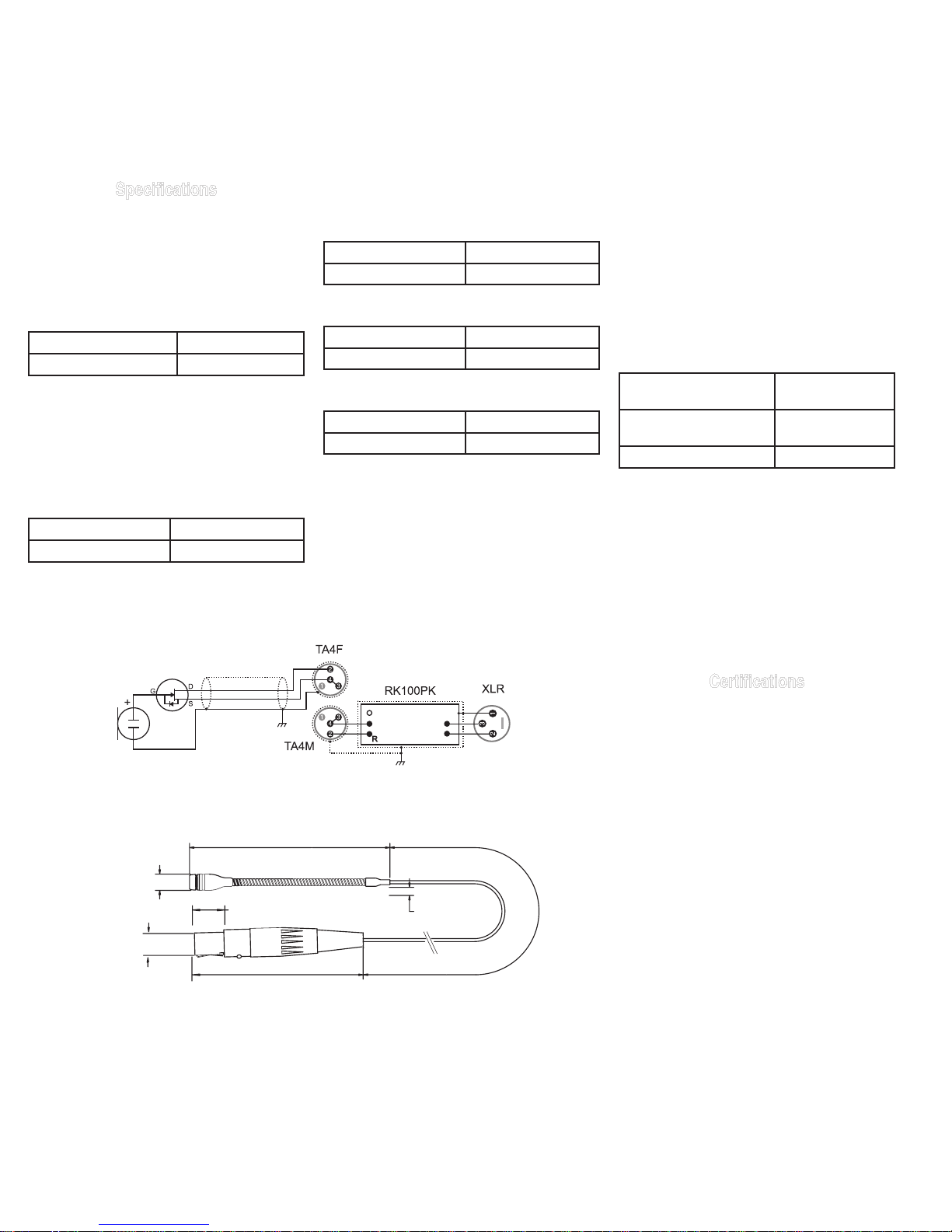
Cartridge Type
Electret Condenser
Frequency Response
50–17000 Hz
Polar Pattern
MX202B/C, MX202W/C: Cardioid
MX202B/S, MX202W/S: Supercardioid
Output Impedance
EIAratedat150Ω(180Ωactual
Output Configuration
Active Balanced
Sensitivity
@ 1 kHz, open circuit voltage
Cardioid –35 dBV/Pa(18 mV)
Supercardioid –34 dBV/Pa(21 mV)
1 Pa=94 dB SPL
Maximum SPL
1kHzat1%THD,1kΩload
Cardioid 124 dB
Supercardioid 123 dB
Equivalent Output Noise
A-weighted
Cardioid 28 dB SPL
Supercardioid 27 dB
Signal-to-Noise Ratio
Ref. 94 dB SPL at 1 kHz
Cardioid 66 dB
Supercardioid 68 dB
Dynamic Range
1kΩload@1kHz
96 dB
Common Mode Rejection
10 Hz to 100 kHz
45 dBminimum
Preamplifier Output Clipping Level
at 1% THD
–6 dBV (0.5 V)
Polarity
Positive sound pressure on diaphragm produces
positive voltage on pin 2 relative to pin 3 of output XLR connector
Environmental Conditions
Operating Temperature –18–57°C
(0–135°F)
Storage Temperature –29–74°C
(–20–165°F)
Relative Humidity 0–95%
Power Requirements
11–52 V DC, 2.0 mA
Page 5
www.shure.com
©2012 Shure Incorporated
Asia, Pacific:
Shure Asia Limited
22/F, 625 King’s Road
North Point, Island East
Hong Kong
Phone: 852-2893-4290
Fax: 852-2893-4055
Email: [email protected]
United States, Canada, Latin
America, Caribbean:
Shure Incorporated
5800 West Touhy Avenue
Niles, IL 60714-4608 USA
Phone: 847-600-2000
Fax: 847-600-1212 (USA)
Fax: 847-600-6446
Email: [email protected]
Europe, Middle East, Africa:
Shure Europe GmbH
Jakob-Dieffenbacher-Str. 12,
75031 Eppingen, Germany
Phone: 49-7262-92490
Fax: 49-7262-9249114
Email: [email protected]
500 1,000 2,000 5,000 10,000
20,000
50 100 20020
0
+10
–10
250 Hz
500 Hz
1000 Hz
2500 Hz
6400 Hz
10000 Hz
150
o
120
o
150
o
120
o
180
o
30
o
60
o
90
o
30
o
60
o
0
90
o
150
o
120
o
150
o
120
o
180
o
30
o
60
o
90
o
30
o
60
o
0
–5 dB
–10 dB
–15 dB
90
o
–20 dB
–5 dB
–10 dB
–15 dB
–20 dB
Hz
150
o
120
o
150
o
120
o
180
o
30
o
60
o
90
o
30
o
60
o
0
150
o
120
o
150
o
120
o
180
o
30
o
60
o
30
o
60
o
–5 dB
0
90
o
–5 dB
–10 dB
–15 dB
90
o 90
o
500 1,000 2,000 5,000 10,000
20,000
50 100 20020
0
+10
–10
500 1,000 2,000 5,000 10,000
20,000
50 100 20020
0
+10
–10
250 Hz
500 Hz
1000 Hz
2500 Hz
6400 Hz
10000 Hz
250 Hz
500 Hz
1000 Hz
2500 Hz
6400 Hz
10000 Hz
150
o
120
o
150
o
120
o
180
o
30
o
60
o
90
o
30
o
60
o
0
90
o
150
o
120
o
150
o
120
o
180
o
30
o
60
o
90
o
30
o
60
o
0
–5 dB
–10 dB
–15 dB
90
o
–20 dB
–5 dB
–10 dB
–15 dB
–20 dB
–20 dB
–20 dB
–15 dB
–10 dB
Hz
Hz
150
o
120
o
150
o
120
o
180
o
30
o
60
o
90
o
30
o
60
o
0
150
o
120
o
150
o
120
o
180
o
30
o
60
o
30
o
60
o
–5 dB
0
90
o
–5 dB
–10 dB
–15 dB
90
o 90
o
500 1,000 2,000 5,000 10,000
20,000
50 100 20020
0
+10
–10
500 1,000 2,000 5,000 10,000
20,000
50 100 20020
0
+10
–10
500 1,000 2,000 5,000 10,00050 100 20020
0
+10
–10
250 Hz
500 Hz
1000 Hz
2500 Hz
6400 Hz
10000 Hz
250 Hz
500 Hz
1000 Hz
2500 Hz
6400 Hz
10000 Hz
250 Hz
500 Hz
1000 Hz
2500 Hz
6400 Hz
10000 Hz
150
o
120
o
150
o
120
o
180
o
30
o
60
o
90
o
30
o
60
o
0
150
o
120
o
150
o
120
o
180
o
30
o
60
o
30
o
60
o
–10 dB
–15 dB
0
90
o
–10 dB
–15 dB
–20 dB
90
o
150
o
120
o
150
o
120
o
180
o
30
o
60
o
90
o
30
o
60
o
0
90
o
150
o
120
o
150
o
120
o
180
o
30
o
60
o
90
o
30
o
60
o
0
–5 dB
–10 dB
–15 dB
90
o
90
o
20,000
–20 dB
–5 dB
–10 dB
–15 dB
–20 dB
–5 dB
–20 dB
–5 dB
–20 dB
–20 dB
–15 dB
–10 dB
Hz
Hz
Hz
 Loading...