

Page 1

REV A2
19" LCD MONITOR
User Manual
19" LCD Monitor
HL1916AMT-L/R
1
Page 2

19" LCD MONITOR
REV A2
1. Application........................................................................................................................................................................3
2. Declarations ......................................................................................................................................................................1
Safety precautions.........................................................................................................................................................4
Medical Equipment.....................................................................................................................错误!未定义书签。
Environmental Requirements......................................................................................................错误!未定义书签。
3. Installation.........................................................................................................................................................................8
4. Start-up..............................................................................................................................................................................9
4.1 Connecting the power and signal cables .................................................................................................................9
4.1.1 Little cover (removing) ..............................................................................................................................10
4.1.2 Cable (attaching) ........................................................................................................................................10
4.1.3 Little cover (attaching)...............................................................................................................................11
4.2 Power up the display ............................................................................................................................................. 11
4.3 Adjusting the image geometry ..............................................................................................................................11
4.4 Adjusting the brightness and contrast ...................................................................................................................12
4.5 Screen saver ..........................................................................................................................................................12
5. Connections.....................................................................................................................................................................13
5.1 Connecting the flat panel display..........................................................................................................................13
5.2 Connection panel...................................................................................................................................................13
5.3 Information on additional serial interface (Service Only).....................................................................................14
5.4 Analog and digital inputs (DVI-D, VGA).............................................................................................................14
5.5 Power supply connection ......................................................................................................................................14
5.6 Serial interface ......................................................................................................................................................14
6. Adjustments.....................................................................................................................................................................15
6.1 Picture adjustment.................................................................................................................................................15
6.2 Optimum picture quality ....................................................................................................................................... 16
6.3 OSD menu.............................................................................................................................................................16
6.3.1 Keys function hints ....................................................................................................................................16
6.3.2Key functions without active OSD menu....................................................................................................17
6.3.3Key functions in the OSD menu .............................................................................................
6.3.4 Submenu calls ............................................................................................................................................17
6.3.5 Locking of OSD menu ...............................................................................................................................17
6.3.6 Keys assignment and operation LED.........................................................................................................18
6.4 Description of the menus ......................................................................................................................................19
7. Fault diagnostics .............................................................................................................................................................22
8. Technical data .................................................................................................................................................................24
8.1 Display ..................................................................................................................................................................24
8.2 Power supply......................................................................................................................................................... 24
8.3 Electronics.............................................................................................................................................................25
8.4 Inputs/outputs........................................................................................................................................................25
8.4.1 Analog signal input ....................................................................................................................................25
8.4.2 Digital signal input.....................................................................................................................................25
8.4.3 Serial interface ...........................................................................................................................................26
8.4.4 Timing Input...............................................................................................................................................26
8.5 Controls and connection elements ........................................................................................................................26
8.6 Mechanical design.................................................................................................................................................27
8.7 Climatic conditions ...............................................................................................................................................27
8.8 Mechanical requirements ......................................................................................................................................28
8.9 Safety specifications .............................................................................................................................................28
8.10 Electromagnetic compatibility ............................................................................................................................29
9. Dimensional drawings.....................................................................................................................................................29
9.1 Front 、Platform and Side view ..........................................................................................................................29
10 Remarks and contact address .........................................................................................................................................30
2
....................17
Page 3

19" LCD MONITOR
REV A2
1. Application
This high-resolution color display is specifically designed to meet the rigorous
performance standards needed for diagnostic, the left one with glass and right one with
Touch screen interventional radiology, and other medical applications. To guarantee image
integrity, features include accurate signal conversion and a wide range of interfacing
options.
Compact design -Low weight and small size with improved performance make the
monochrome flat panel display HL1916AMT preferable to conventional CRT monitors.
Embedded LUT-This monitor is factory calibrated to achieve DICOM part 3.14
compliance and Linear gray level reproduction at the factory set point. 5 different settings
are stored within the display.
Screen resolution- HL1916AMT is equipped with a panel with Super In Plane switching
technology. The optimal picture resolution is 1280 x 1024 pixels. Video signals with other
resolutions typical to medical engineering are optimally zoomed in or out to the screen
size.
Remark -
All relate to the touch screen only applies to HL1916AMT-R.
2. Declarations
Medical Equipment
With respect to electric shock, Fire
and mechanical hazards only in
accordance with
ANSI/AAMI ES60601-1:2005&
CAN/CSAC22.2 No.60601-1:2008
3
Page 4
REV A2
Safety precautions
Regular maintenance and calibration are recommended
Please note that liquid crystal displays such as the HL1916AMTdo not have a
failure rate of zero and image parameters may change over time (e.g.
luminance or discoloration). Please ensure that all measures are taken to
prevent injuries or incorrect diagnoses. Regular maintenance and calibration
are recommended.
Correct and safe operation of the flat panel displays is dependent on proper
transport, storage, installation and assembly, as well as careful operation and
maintenance. The units must only be used for applications for which monitors
are normally used. The information in the Section "Technical data" must be
observed exactly.
For the sake of safety, the following precautions must be observed:
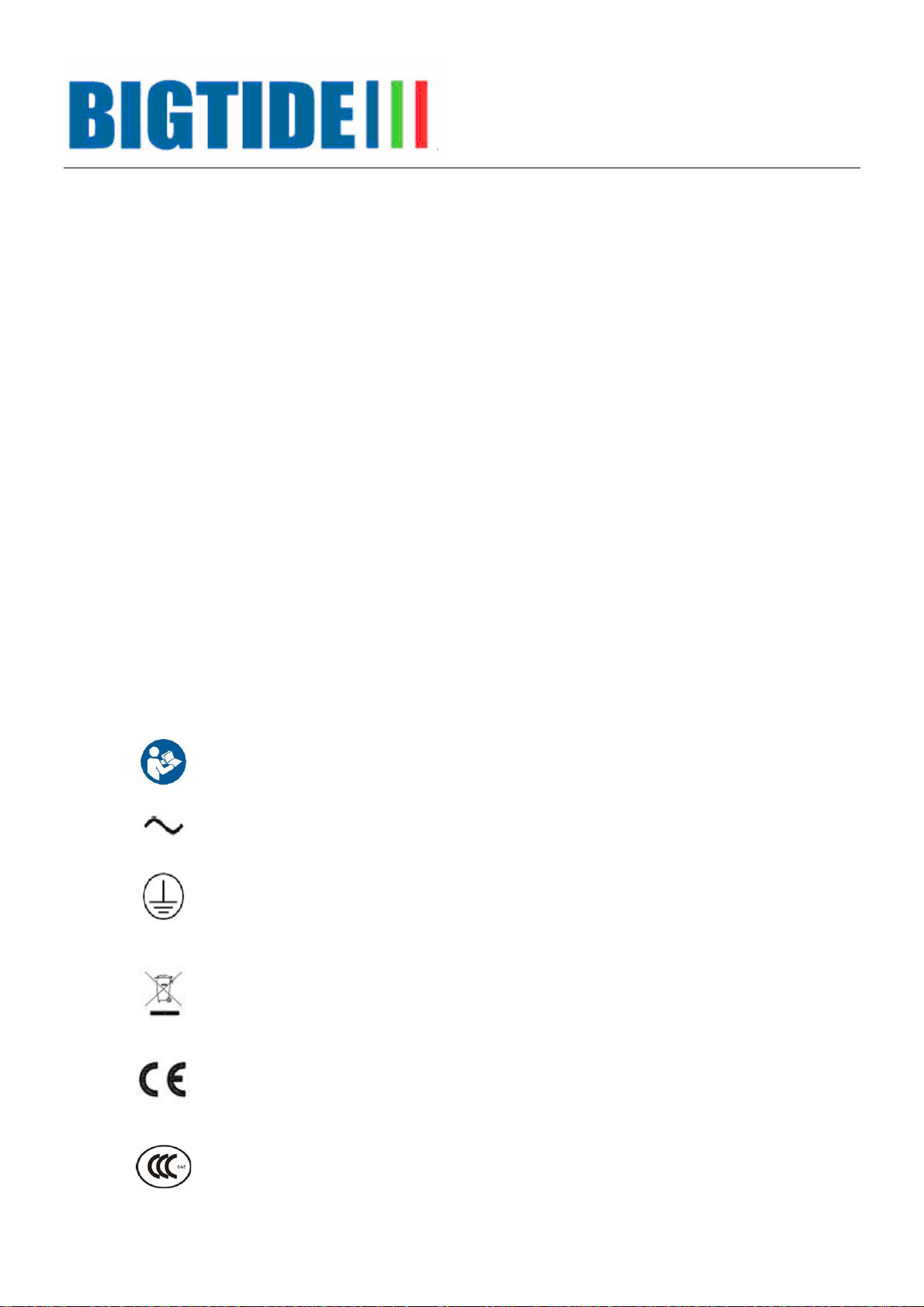
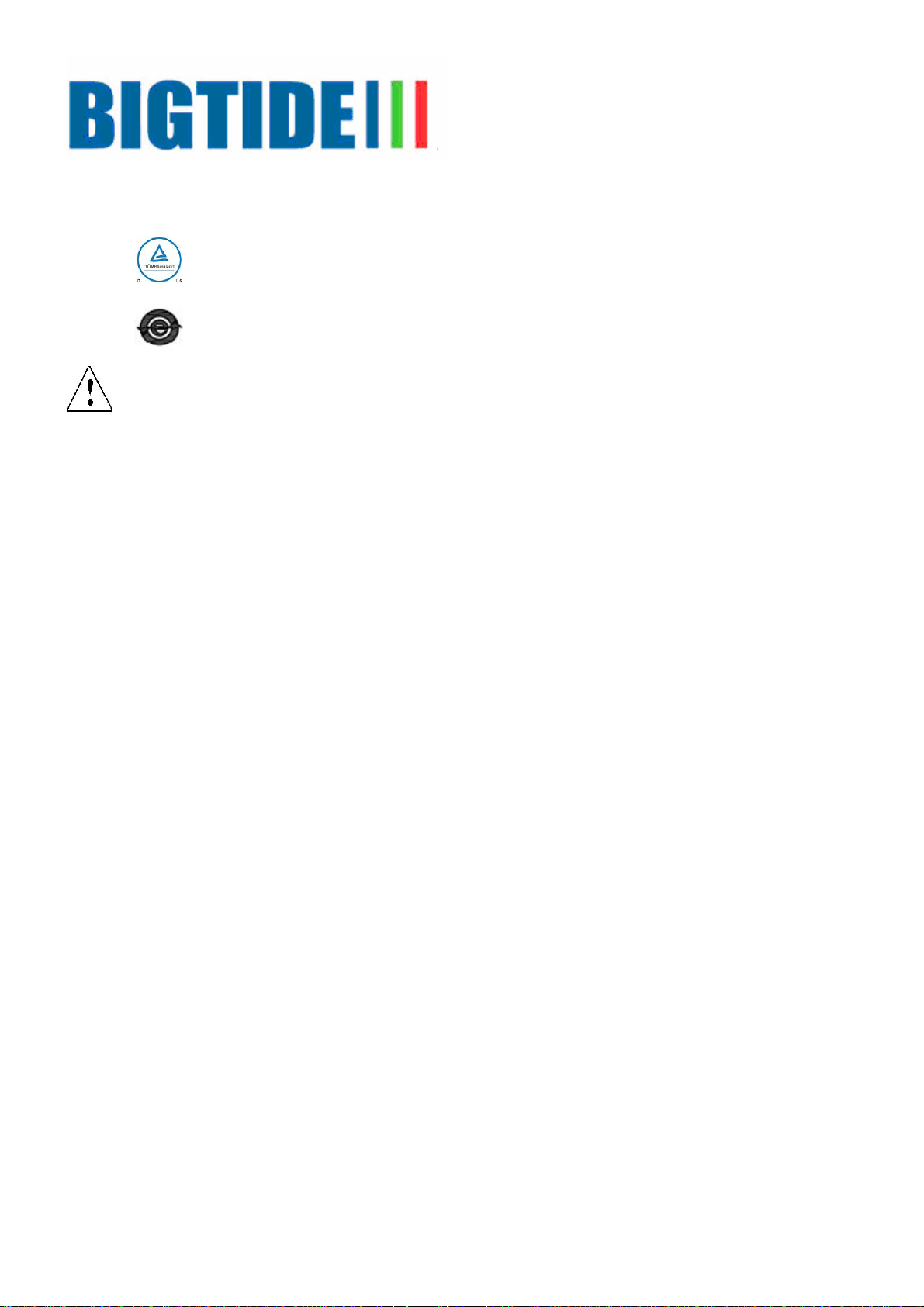
Explanation of the symbols
19" LCD MONITOR
Attention: Consult the accompanying documents
Dispose of in accordance to your countries requirements
European comformity
China Quality Certification
Alternation current (AC)
Protective earth
4
Page 5
REV A2
19" LCD MONITOR
TUV approval mark
China Rohs symbol
Danger: There is a danger to life if the warning information is not
observed. Severe personal injury or damage to property may occur.
Do not open the unit yourself.
Only use a perfect power supply cable
A damaged power supply cable may result in a fire or electric shock. When
disconnecting the power supply cable, always do so by holding the plug.
Do not insert any objects into the housing
Objects inserted into the housing may result in damage to the unit or personal
injury.
Do not place any objects on top of the units
Penetrating liquids may result in a fire or electric shock.
Connection
No contact to a patient must occur when handling the cables.
Caution
Incorrect installation may result in extensive damage to property.
Installation should be carried out by trained personnel
When installing your medical electrical system with our products in an
environment with patients, please observe the safety requirements of EN
60601-1 (IEC60601-1) for "Specifications for the safety of medical electrical
systems" in order to prevent injury to patients and users of your systems.
5
Page 6

REV A2
19" LCD MONITOR
Take appropriate measures to particularly ensure that discharge currents
remain below the required limits: Appropriate measures:
- Disconnecting devices for signal input or output unit
- Use of a safety transformer
- Use of additional PE conductor
Only use the signal cables and interface cables specified by the manufacturer
for the installation.
Use power cables with a PE contact. Only insert into sockets with a PE
contact.
For certain applications, the video earth can be separately connected to the PE
via the additional PE connection in the plug panel (observe IEC 60601-1).
Close the plug panel using the provided cover (meaning the display stand),
and secure using the screws.
Turn switch off and then remove power cord.
Mounting information: The stability of the display must be guaranteed
following mounting of the foot/holder. The immersion depth of the mounting
screws has to be 10 to 12 mm including a 3 mm VESA mounting plate. (See
also table "Mounting screws" on the following). All these requirements are
satisfied when using the original foot. All requirements must be observed
when using customer-specific mounting solutions.
Notice for users: The plug panel closed by the cover (display stand), must not
be opened by users.
Servicing information: If housing components have to be removed for
servicing, this must not be carried out in the presence of patients, the user, or
other persons not involved with servicing.
The following applies to installations in the USA and Canada: Molded power
supply plugs must comply with the requirements for "Hospital Grade
Attachments" UL 498.
Caution
Failure to observe the warnings may result in substantial damage to
property.
6
Page 7
19" LCD MONITOR
REV A2
Provide sufficient heat dissipation
Slots are provided at the rear of the housing. The display must be placed or
secured on a hard, level surface at least 10 cm from the wall and 15 cm away
from other devices. Several displays can be butt-mounted horizontally and
vertically.
The following must be observed when mounting (VESA connection):
Mounting screws
Number 4
Thread M4
Strength 12
Immersion depth Min. 10 mm; Max. 12 mm
Torque Max. 3 Nm
The permissible ambient temperature range (5 °C ... 40 °C) must not be
violated. Do not subject device to unnecessary shocks. Take care when
transporting! Use the original packaging! The panel in particular should be
protected against shocks.
When touching the panel surface, the mechanical contact or an electrical
discharge may cause a brief disturbance in the picture quality.
Care of unit / cleaning agents
− The front panel is extremely sensitive to mechanical damage. Avoid all
scratches, knocks etc.!
− Remove water drops immediately; extended contact with water
dismonochromes the surface.
Clean the front panel when dirty ,using a micro fiber cloth and, if necessary, a
glass cleaning agent*. Only clean housing parts using a cleaning agent for
plastics*.
z Note:
Do not use cleaning agents containing solvent, e.g. petroleum spirit!
7
Page 8

REV A2
3. Installation
Provide adequate ventilation
Ventilation slots are located on the rear of the housing.
Ambient temperature
The permissible ambient temperature range must not be violated.
Minimize reflections
The display should be positioned so that reflections of lights, windows,
furniture with shiny surfaces or light-monochrome walls do not appear on the
screen.
Minimize mirroring
In order to reduce mirroring on the unit, ceiling lighting or reflected light (no
dazzling) should be used. Mirroring can only be eliminated if the screen is
clean and free of grease. Clean the display using a suitable micro fiber cloth.
Change of environment
If the unit is brought into a warm environment from a cold one, water may
condense upon it. The unit should not be switched on until all the condensed
water has evaporated, including that inside the unit. This may take several
hours, depending on the conditions.
19" LCD MONITOR
9
Page 9
REV A2
4. Start-up
Caution
In order to ensure safe operation of the equipment, close attention must be
paid to the information contained in this Instruction Manual as well as the
warnings in Section 2 "Safety precautions".
Caution Information for end customer
None of the settings must be changed on site by the user, otherwise the
guarantee is canceled. This also applies to settings made using the HL1916
AMT keys. These are therefore locked for certain applications. If settings
have to be changed, please contact the responsible servicing department.
The display is designed for individual connection to a graphics card with a
19" LCD MONITOR
power supply of AC100-240V±10%Volt (TN-S system with PE conductor).
If the display is to be used in a sequence of several displays, or if it is not
exactly known whether the graphics card standard can be output by the
display, refer to Section 5.1 "Connection of the flat panel display".
In order to start the unit properly, the following steps should be carried out in
the given sequence.
4.1 Connecting the power and signal cables
Caution
Use a power cable with PE conductor corresponding to the safety
requirements of the respective country of use. Note for North America:
Molded power supply plugs must comply with the requirements for hospitals
with respect to CSA Std. C22.2 No. 21 and UL 498.The power supply and
signal connections are located on the rear of the monochrome flat panel
display.
Note
Note that the cables are not positioned when you receive the display (power
cable and DVI-D cable). The following steps are only necessary if you need
to connect/disconnect the cables of the scope of supply.
10
Page 10
REV A2
19" LCD MONITOR
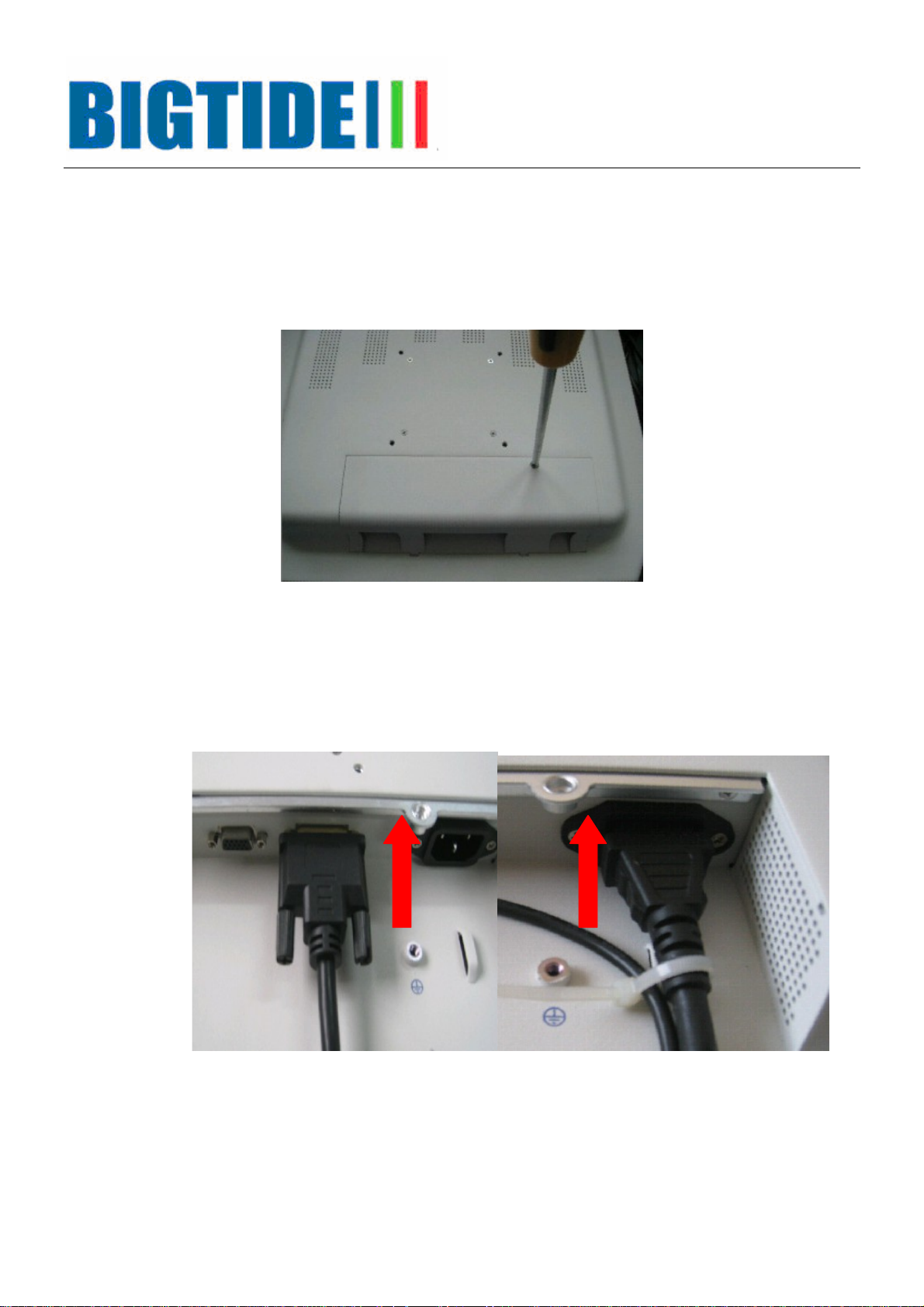
4.1.1 Little cover (removing)
Remove the one screws with an M4 Slot screwdriver (one turn suffices). Open
the little cover and remove it
4.1.2 Cable (attaching)
Connect the cables to the display.
Connect the USB cable .
Connect the power cable .
15-pin Sub-D connector: the flat panel display can be connected to the
11
Page 11

REV A2
19" LCD MONITOR
computer system using the Sub-D connector. The display is adapted using an
OSD menu.
DVI connection: The connection to the computer can also be made via the
digital single link or via the analog channel of the DVI connection. The
picture quality, noise immunity and radiated interference of the complete
system depend on the cable quality and length.
USB connection:you can connect the touch screen via the USB connector to
the computer to control the touch screen.
Serial connection: you can connect the display via the RJ45 connector to the
computer for firmware updating.
4.1.3 Little cover (attaching)
Lead the monitor end of the cables through the little cover’s cable duct.
Connect the little cover to the rear cover.
4.2 Power up the display
Power up the display. The operation LED lights up.
4.3 Adjusting the image geometry
The display automatically recognizes the used standard, and set-up values for
each standard are preprogrammed. However, depending on the graphics card
used, it may still be necessary to align and size the picture for the selected
12
Page 12

19" LCD MONITOR
REV A2
standard (see Section 6.1 "Picture adjustment"). Normally auto adjust will
work.
4.4 Adjusting the brightness and contrast
The brightness and contrast must be adjusted for the respective graphics card
(different output levels) in the system on site.
Note on adjustment
− Use the SMPTE test pattern.
− Adjust the brightness so that image sections with 5% and 0% blackness still
visibly contrast from one another.
− Adjust the contrast so that image sections with 95% and 100% whiteness
still visibly contrast from one another. To adapt the luminosity to the ambient
lighting, adjust the backlight brightness (note: 500 cd/m² factory setting is
then modified).
4.5 Screen saver
A screen saver function should be used in order to reduce "image sticking"
which can occur in TFT displays. It is high risk to display a static graphic
over half an hour. Image sticking is the effect where a faint image of the
previous screen contents can still be seen after the display contents have
changed. By using a screen saver with permanently changing screen contents,
unnecessary effects of the same image are avoided.
If the keyboard is locked, contact the servicing department in order to unlock
it. The guarantee is cancelled if you unlock it yourself!
13
Page 13

19" LCD MONITOR
REV A2
5. Connections
5.1 Connecting the flat panel display
Note
All screening precautions contained in the corresponding EMC guidelines
must be observed. If these guidelines are not observed, interference signals
could penetrate the monitor.
Information on cable installation
Only screened cables are permitted for the signal connections.
All connectors should be of screw or locking types (as far as possible).
Signal and power cables must not be routed in the same duct.
The display must not share a power supply with motors or valves (glitches!).
5.2 Connection panel
A connection panel for the signals and power supply is located at the rear of
the flat panel display underneath the stand and its cover.
6-PIN RJ45 RS232
CONNECTOR
USB CONNECTOR
Digital input (Female):DVI
Analog VGA input(Female):
15pin D-Sub connection
Power supply connection
GND
14
Page 14

19" LCD MONITOR
REV A2
5.3 Information on additional serial interface (Service Only)
Serial connection: you can connect the display via the RJ45 connector to the
computer for firmware updating and monitor test.
5.4 Analog and digital inputs (DVI-D, VGA)
15-pin Sub-D connector
Connect VGA cable with 15-pin Sub-D connector (male) for the analog input
to the 15-pin Sub-D connector (female).
DVI socket
With DVI-D digital signal.
5.5 Power supply connection
Note
Device fuses can not be exchanged outside of the repair centers.
The display power supply is connected using an appliance plug. Only use the
power cable supplied in the delivery, or a cable with PE conductor and
appliance socket to DIN 49 547, IEC 320.
Caution
A power cable with PE conductor must be used which corresponds to the
safety requirements of the respective country of use.
5.6 Serial interface
Caution
No other units may be connected to the service socket. Connection or
disconnection of a unit may only be carried out by servicing personnel or
those trained by them. A Serial Spot Meter or Universal Serial Luminance
Meter must not be connected in the presence of patients.
The display has a serial RJ45 interface sockets to update the SW.
15
Page 15

REV A2
6. Adjustments
6.1 Picture adjustment
This section describes the settings for operation of the flat panel display with
a video source. The most important settings are:
Adjusting the graphics memory of the video source
As with all monitors, the flat panel display also has certain limits, e.g.
maximum resolution and vertical frequency. The graphics adapter must be set
when using the flat panel display such that the limits are observed.
Fine adjustment of the flat panel display
Note
Fine adjustment of the flat panel display can only be carried out via the analog
port 15-pin SUB-D. The digital input (DVI-D) does not require a fine
adjustment since the display signal is always optimum.
RGB picture sources via 15-pin Sub-D connector supply analog signals which
are basically intended for conventional CRT monitors and which are
processed directly by them.
In contrast, the analog signals must be converted for a flat panel display into
digital signals by a video digitizer. Depending on the picture source, cable
length and video mode (e.g. VGA, SVGA, XGA) this conversion may cause
certain deviations which cannot be corrected fully automatically by the flat
panel display. A manual fine adjustment is therefore necessary during which
the flat panel display (or, more precisely, the video digitizer) is matched to the
respective video source. The fine adjustment comprises e.g. setting the
horizontal/vertical picture position and the picture sharpness. This can be
carried out for the color flat panel display HL1916AMT using an OSD menu.
To optimize the display settings for the installed graphic board, and to ensure
all gray levels are distinguishable, we recommend to adjust the brightness and
contrast levels for and only for analog inputs. Note that the calibration (in the
Look Up Table) is not changed by these adjustments (All the monitors are and
remain factory calibrated):
Using a 100% black picture and an appropriate measurement device (a spot
meter recommended), decrease the brightness level using the OSD controls
until the measurement device displays a constant level (i.e. the measured
value no longer changes). Once this is achieved, increase the brightness level
19" LCD MONITOR
16
Page 16

REV A2
19" LCD MONITOR
slightly until the display is just above the absolute lowest black level (one step
is generally sufficient).
Similarly, set the white level using a 100%-white test pattern and the
measurement device. Only the contrast level should be adjusted to ensure that
the black level remains unchanged.
• Control again the black value did not change. In case it did you need to
duplicate the two previous steps until it does not change anymore (cause:
pedestal).
Increase the contrast level until the measurement device no longer detects an
increase in luminance. Once this is achieved, decrease the contrast level
slightly (1 or 2 steps is generally sufficient).
At this point, the display is configured for optimal performance with the
installed graphic board. If one is not yet satisfied with the luminance level, the
black and white levels can be further increased by adjusting the backlight
level in the OSD menu. Please note that higher backlight level settings tend to
reduce the stability of luminance over time.
6.2 Optimum picture quality
In order to achieve an optimum picture quality, the monochrome flat panel
display HL1916AMT should be operated with a graphics resolution of 1280 x
1024 pixels (settings for graphics card in the PC). When adjusting the picture
position and size, ensure that the picture appears exactly on the active surface
of the display and that it is not offset by even one pixel. For example, if the
horizontal position is offset by one step to the right, the right-hand edge of the
picture will disappear, and a black pixel column will appear at the left-hand
edge. And similarly for an offset to the left, top or bottom. If the vertical lines
are still slightly fuzzy, adjust the setting "Frequency/phase" (see Section 6.4
"Description of the menus").
6.3 OSD menu
6.3.1 Keys function hints
A “dynamic help for keypad function” is available for each menu: it explains
the role of each key depending on the OSD menu window, which is currently
17
Page 17

19" LCD MONITOR
REV A2
active.
6.3.2Key functions without active OSD menu
Key Action
Menu Activate OSD
Up Adjust Backlight
Down Analog Input auto balance
* Scenario in case all signal sources is available. If not, the signal from the next available source will be displayed.
6.3.3Key functions in the OSD menu
Key(s) Situation Action
Menu
Up
Always Jump to next line
Slide controller Increase value
Selection point To previous selection
Command "Enter key"
Down
Slide controller Decrease value
Selection point To subsequent selection
Exit
Except "Exit OSD" menu One menu level upwards (settings are
retained)
In "Exit OSD" menu Return to main menu (settings are
retained)
6.3.4 Submenu calls
Press the “Menu” key while the OSD is active, the function icon will jump to
next line. Pressing the “Up” key, the coordinate submenu will be selected.
6.3.5 Locking of OSD menu
18
Page 18

19" LCD MONITOR
REV A2
Key(s) Action
In a sequence
EXIT , Up, Up ,Up
Lock or unlock OSD If the OSD is locked, it is only possible to
switch over the source (see Section 6.3.2).
6.3.6 Keys assignment and operation LED
A “dynamic help for keypad function” is available for each menu: it explains
the role of each key depending on the OSD menu window, which is currently
active.
19
Page 19

REV A2
6.4 Description of the menus
19" LCD MONITOR
Main Menu Function
Contrast 0…255
Brightness 0…255
Brightness
Backlight 0…255
Adjustment
range
Description
Adjustment of contrast
This allows the brighter area to be seen
more distinctly. The center point is in 128
position.
Note: for DVI-D signals the Contrast
setting is optimized. Manual changes are
not recommended.
It is used to adjust the Brightness of the
monitor. The center point is in 255 position.
This allows the darker area to be seen more
distinctly.
Note: for DVI-D signals the brightness
setting is optimized. Manual changes are
not recommended.
Adjustment brightness of LCD backlight to
adapt total brightness for room illumination
Position
Set desired Brightness level:
Three fixed Brightness level are available
The default value is:
Setting1: 500cd/m
Sertting3: 700 cd/m
2
; Setting2: 600cd/m2;
2
SETTINGS
Setting1
Setting2
Setting3
User
While choose setting 1,2,3 state it will
recall factory default Black level, Contrast,
Backlight
H Position 0…100% Shift picture in horizontal direction
V Position 0…100% Shift picture in vertical direction
20
Page 20

REV A2
19" LCD MONITOR
Picture
Source
Frequency
(VGA
only)
Phase
(VGA
Adjust phase of the input signal.
only)
DVI-IN
VGA-IN(A
nalog)
Adjust the frequency and phase of the input
signal.
Select source for main display
When you enter this OSD menu the current
source is highlighted.
Following switch off and on of the display,
the picture sources are searched one after
another.
The auto functions are used to assist the
automatic setting of parameters. The quality
of settings depends on the picture contents
and the type of synchronization.
Corresponding items in the OSD can adjust
all settings finely.
Auto
function
(Analog
input
only)
Language
Auto-
On/Off
Balance
Auto
On/Off
-Config
Execute
Auto adjust
on mode
On/Off
change
English
Chinese
Automatically get input signal match with
the monitor
Automatically adjusts the image position,
H-Size (or V-Size)
The selected auto functions are executed.
Note: The quality of the function depends
on the applied picture contents. To get
better effect it is recommended to apply full
screen and including whiteness contents
picture.
Enable or disable auto-adjust on mode
change
Select the language of OSD menu.
Note: English menu is default state.
21
Page 21

REV A2
19" LCD MONITOR
You can make further settings for the picture source
Others
OSD—Hposition
OSD—Vposition
Hot Key On/Off
Interpolatio
Sharpness
n filter 1 to
7
Adjustment of OSD horizontal position
(Default state is on the bottom right corner
of the screen)
Adjustment of OSD vertical position
(Default state is on the bottom right corner
of the screen)
Enable or disable the Hotkey. The up key is
used for brightness, down key is used for
Auto Adjust.
One of the 7 filters can be selected for the
focus setting to reduce scaling artifacts.
Interpolation filters depend on the input
resolution. A filter is not usually used with
1280X1024 since each pixel is controlled
by its own pulse. The user should
individually adjust the filter depending on
the application. The default interpolation
filter position is 1.
Service
level 2
OSD Lock
Timer 120sec
If there is no action in 2 minutes, the OSD
will be locked automatically. The OSD’s
content will be saved.
Status Current display settings can be called here
in the respective picture mode: Operate
hours of display, firmware version, OSD
version, configuration version, current
source, current temperature, current timing
of input signal, current LUT inside the
monitor.
Settings in this menu must only be carried out by service person*
22
Page 22

REV A2
19" LCD MONITOR
Accept
Quick OSD menu and either save or reject
the changes.
changes
Quit OSD menu
If you have reached this menu
Reject
unintentionally, you can return to the main
changes
menu using the EXIT key.
If this message is displayed, you do not
have the authority to carry out the changes
OSD is locked
in the OSD menu.
Please contact your servicing partner in this
case.
* Service level 2 enter: while the highlight line is on the service level 2 position, press 1 x
Up, and 2 x Down keys, it will enter the following submenu.
LUT select and factory settings recall: Contrast; Brightness;
Service
Backlight; Setting1; OSD position; corresponding LUT
level2
factory recall. (The default state is Gamma2.2LUT)
CIE Select CIE LUT
DICOM Select DICOM LUT
Gamma 1.8 Select Gamma 1.8 LUT
Gamma 2.0 Select Gamma 2.0LUT
Gamma 2.2
Native
FACTORY
RESET
7. Fault diagnostics
Select Gamma 2.2
LUT(default)
Select panel native
characteristics
Load the factory setting
23
Page 23

19" LCD MONITOR
REV A2
Fault Cause Remedy
No picture appears on
the display, operation
Power cable not inserted
or incorrectly inserted
Insert power cable
LED off
No picture appears on
the display, operation
LED green blinking
Fuzzy picture,
interference in
No video signal Check video cable
Video source not
Check video source
supplying a signal
Scanning frequency or
Adjust frequency and phase
phase incorrectly set
vertical lines
Other faults –LED
orange blinking
Loose plugs Plug cables in properly and
secure them
Faulty cable Replace cable
Other faults: “Temp.
High” on screen
Temperature shutdown
value has been reached
Display will be automatically
shut down after a certain time
(and turn on again when the
temperature decreases enough
again)
Other information available from the 2-monochromes LED
LED Display status
LED orange
No error, stand-by has been activated
LED green Video signal has been recognized, no error
24
Page 24

19" LCD MONITOR
REV A2
8. Technical data
All technical data are valid after a warming-up period of 2 hours.
8.1 Display
Type TFT,color active matrix
Display area 376.32 mm x 301.056 mm
Picture diagonal 19" or 48 cm
Native resolution 1280 x 1024 (full-screen format)
Pixel organization 3 vertical sub pixels
Pixel pitch 0.294 mm x 0.294 mm
Contrast ratio Typically 1000:1
Horizontal
viewing angle
Vertical viewing
angle
Backlight 5pcs* LED
Brightness Typically 1300 cd/m² Factory setting: 500 cd/m²
Typically ± 85°
Typically ± 80°
Lifetime of
backlight
50,000 hours typically for LED
(applies to an ambient temperature for the backlight of 25°C )
8.2 Power supply
Input Voltage
Power
Supply
Power Consumption
Input Connector 3P IEC Type
AC100-240V±10%, 50 / 60Hz;
0.9A-0.4A
<40W
25
Page 25

19" LCD MONITOR
REV A2
8.3 Electronics
Multi-standard technology Video modes with resolutions less than 1280 x
1024 can be expanded to the TFT resolution,
and thus utilize the full display area (like
multi-sync CRTs).
In the same way, resolutions higher than 1280
x 1024 can be reduced and then displayed.
(Caution: depending if the timing is frame
buffered or frame sync, image information
might get lost; the gray levels - the color depth
for color images - will also be reduced and
might be visible)
Timing recognition H frequency, V frequency
8.4 Inputs/outputs
8.4.1 Analog signal input
RGB input, H/C Sync
input and V Sync input
Via 15-pin Sub-D connector (female)
Any polarity
Via DVI-D socket (analog pins are
DVI-D input
used)
CVS signal
Video level: 0.5 ... 1.0 Vpp
Sync level: 0.2 ... 0.3 Vpp
8.4.2 Digital signal input
DVI-D input Via DVI socket , single link
DDC Via DVI
26
Page 26

19" LCD MONITOR
REV A2
8.4.3 Serial interface
RS232 Via RJ45 6pin
8.4.4 Timing Input
Analog Digital
Horizontal frequency 31kHz -82kHz 31kHz -82kHz
Vertical frequency
50.0Hz - 75.0 Hz
(Non-Interlaced)
Input
Signals
Video Signal Analog RGB Digital RGB
Separate Sync. (TTL)
Sync. Signal
Composite Sync.
Sync on green
Pixel Clock 25.0MHz -140.0MHz
Input connector Mini D-sub 15Pin DVI-D
8.5 Controls and connection elements
50.0Hz - 75.0
Hz
(Non-Interlaced)
TMDS
25.0MHz
-140.0MHz
27
Page 27

19" LCD MONITOR
REV A2
Left Side Four keys for OSD menu, operation-LED
Rear •Power supply connection
• DVI socket
• 15-contact 3-row Sub-D socket
• RS 232 sockets RJ45 6 pin
•USB-B Connection
8.6 Mechanical design
Housing components Aluminum
Visible screen surface Approx. 376 mm x 301 mm
Ventilation slots In rear panel
Degree of protection (front) IP20 to DIN 40 050
Connection panel At rear, covered
Weight: Without stand
6.5 kg (approximate)
Dimensions (W x H x D) in mm
Without stand
425 ×350×78.5mm
8.7 Climatic conditions
Operation
Ambient temperature
range
Temperature gradient Max. 5 °C/h
Relative Humidity 10-80%, no condensation
+10.. +40 °C
Atmospheric pressure 700hPa to 1060hP a
28
Page 28

REV A2
Transport and storage (packed)
19" LCD MONITOR
Ambient temperature
- 20 ... + 60°C
range
Temperature gradient Max. 5 °C/h
Relative Humidity 10%-85%, no condensation
Atmospheric pressure 500 hPa to 1060hP a
8.8 Mechanical requirements
Operation
Vibration According to EN 60068-2-6 10 ... 58 Hz with ± 0.075 mm deflection
58 ... 500 Hz at 10 m/s²
Shock According to EN 60068-2-27 (single shock) 150 m/s², 6 ms
No permanent shock allowed in operating conditions
Packed unit
Vibration According to EN 60068-2-6 5 ... 9 Hz with ± 3.5 mm deflection 9 ... 500 Hz
at 10 m/s²
Shock According to EN 60068-2-27 (single shock) 250 m/s², 6 ms (in storage
packaging) According to EN 60068-2-29 (permanent shock)
8.9 Safety specifications
IEC 60601-1:2005, ANSI/AAMI ES60601-1:2005&CSA C22.2
Safety standards
Approvals
Protection class Protection class I
Degree of protection to
DIN 40050
Type B/BF/CF applied
part
Category AP/APG
equipment
Conformity CE
No.60601-1:2008,EN60601-1,EN60601-1-2,GB4943.1-2011,
GB9254-2008,GB17625.1-2012,FCC Part15
cTUVus, CB,CCC,FCC
IP 20
No Applied Part
No AP/APG
29
Page 29

REV A2
8.10 Electromagnetic compatibility
IEC60601-1-2
FCC Class-B
9. Dimensional drawings
All dimensions in mm.
9.1 Front 、Platform and Side view
19" LCD MONITOR
30
Page 30

19" LCD MONITOR
REV A1
10 Remarks and contact address
Invalidity of guarantee
All unauthorized electrical or mechanical alterations on or in the unit result in loss of the
guarantee.
Information on the Instruction Manual
For clarity reasons, this Instruction Manual does not contain all detailed information on this
product. Your attention is additionally drawn to the fact that the contents of this Instruction
Manual are not part of a previous or existing agreement, commitment or statutory right and
do not change the latter.
Guarantee
All commitments on the part of customer are contained in the respective sales contract which
also contains the complete and solely applicable warranty conditions. These warranty
conditions in the contract are neither extended nor limited by the contents of this Instruction
Manual.
Repairs
Please contact your distributor from whom you originally purchased the product.
Environmental protection
When disposing of the device, the requirements and laws in the respective country must be
observed.
Name of Manufacture: Shenyang Torch-Bigtide Digital Technology Co., Ltd.
Address: No. 18-6B,Yaoyang Road, Huishan Economic Development Area, Shenbei New
District, Shenyang, China 110164
Person to be contacted: Mr. Chen Baohu
Tel: 8624-88087621
31
Page 31

FCC Statement:
This device complies with part 15 of the FCC Rules. Operation is subject to the following
two conditions: (1) This device may not cause harmful interference, and (2) this device
must accept any interference received, including interference that may cause undesired
operation.
This equipment has been tested and found to comply with the limits for a Class B digital
device, pursuant to part 15 of the FCC Rules. These limits are designed to provide
reasonable protection against harmful interference in a residential installation. This
equipment generates, uses and can radiate radio frequency energy and, if not installed
and used in accordance with the instructions, may cause harmful interference to radio
communications. However, there is no guarantee that interference will not occur in a
particular installation. If this equipment does cause harmful interference to radio or
television reception, which can be determined by turning the equipment off and on, the
user is encouraged to try to correct the interference by one or more of the following
measures:
—Reorient or relocate the receiving antenna.
—Increase the separation between the equipment and receiver.
—Connect the equipment into an outlet on a circuit different from that to which the
receiver is connected.
—Consult the dealer or an experienced radio/TV technician for help.
Caution: Any changes or modifications not expressly approved by the party responsible
for compliance could void the user's authority to operate the equipment.
 Loading...