

Sentry Voyager 12V 60A, Voyager 12V 90A, Voyager 24V 60A, Voyager 24V 100A, Voyager 24V 40A Installation & Operation Manual
Page 1
MARINE BATTERY CHARGERS
Voyager Elite Series
Installation/ Operation
Linear Devices Corporation
dba Sentry
11126 Air Park Rd, Suite G
Ashland, VA 23005
December 2017
www.sentrychargers.com
Phone: 804-368-8428
Fax: 804-368-8438
Page 2

2
Table of Contents
Safety Precautions
3-4
Serial Number
4
Model Number
5
General Instructions
5
Installation Instructions
6
Connection Details
7-9
AC Cables and Circuit Breaker Sizing
10
DC Cables and Fuses
11-12
Setting Charging Curve and Battery Types
12-15
Operation of Battery Temp Sensor
16
LED Display Indicators
17
Mode and Display Operation
18
Fault Indicators and Description
19
Technical Specifications
20-22
Dimensions
23
Warranty
24
Page 3

3
SAFETY PRECAUTIONS
TO PREVENT ANY RISK OF ELECTRIC SHOCK OR FIRE, READ THIS MANUAL
CAREFULLY BEFORE INSTALLING THE EQUIPMENT.
This equipment is not designed for use by people (including children) with diminished
physical, sensory or mental capacities, or people without experience or knowledge of
such equipment, unless they have received prior instruction in the use of the equipment
from a person responsible for their safety or are under the supervision of such a person.
Ensure that children are supervised in order to prevent them playing with the device.
Warning: This equipment contains components that may cause electric arcs or sparks,
when connecting cables. To prevent any risk of fire or explosion, do not install this
equipment close to flammable materials, liquids or gases.
Installation precautions
To prevent any risk of irreversible damage to the equipment, ensure that you comply
with the following recommendations.
• This device must not be installed close to a heat source or any
flammable liquids or gases such as a gas engine room.
• It must not be installed in an airtight or poorly-ventilated
compartment.
• The ventilation inlets must not be obstructed.
• Clearance of at least 4” (10 cm) must be allowed around the housing to
guarantee adequate circulation.
• This device must not be exposed to running water, water spray and dust of any
kind.
• We recommend securing the device in a vertical position, with the cable outlet
pointing downwards.
• You are prohibited from making mechanical alterations to the housing,
including making additional holes, for example.
Connection Precautions
To prevent any risk of electric shock or irreversible damage to the equipment,
you should comply strictly with the following recommendations.
• The installation to which this device is connected must comply with any
applicable regulations such as ABYC.
• This device is designed to be connected to 220-240V 50/60Hz or 100-
120V 60Hz single phase circuits. 115V / 230V selection is automatic.
220-240V only for 24V, 80A, 100A version.
• The main power line must utilize a circuit breaker, to Protect individuals
against electric shocks. Refer to the device’s electrical specifications to select
the size and type of circuit breaker.
Prior to main power connection, the cable gland in the packaging must be assembled and
Page 4

4
correctly attached to the housing (using the nut provided), in the hole designed for this
purpose.
For safety reasons, the device’s EARTH Ground terminal (PE “Protective Earth” terminal),
must be connected to the system’s physical earth ground (yellow & green wire of the
main power). Refer to the wiring diagram for more information.
To prevent wire or terminal heating, ensure that the cable size is correct and the
connectors are properly tightened.
WARNING: This device is not Protected against battery polarity reversals. A battery
connection error automatically causes the battery fuses to blow as well as irreversible
damage to the circuit board.
Operational safety precautions
To prevent any risk of electric shock on activation or during operation, the Protective
cover must be correctly positioned and screwed into the housing.
This device complies with the applicable regulations governing transmitted interference
and immunity from external disturbances (see EMC paragraph in the Technical
specifications section).
When in operation, take particular care that this device is not subjected to conducted or
radiated interference at levels higher than the legal limits otherwise malfunctions may
occur (e.g.: device too close to a powerful transmitter).
This device transmits conducted and radiated interference at levels that comply with the
applicable regulations. Ensure that other sensitive equipment used in the vicinity is
compatible with this device otherwise malfunctions may occur.
Charger serial number
The serial number appears on the data plate label on one side of the device. This
number is aligned vertically and comprises a first number indicating the year of
manufacture (e.g.: 12 for 2012), a letter indicating the month of manufacture (e.g.: C for
the month of March).
Important note about charging curves
It is important to note that the use of an incorrect charging cycle for the
battery type may extensively impair or even damage the battery and/or charger.
This is particularly true for cycles where the charge voltages are higher than the
levels recommended by the battery manufacturers.
Example: A serious risk of overheating the batteries and releasing gases that are harmful
to users’ health or could cause an explosion.
Page 5

5
Curve no. 9 is compatible with a LiFeSo4 battery provided that the battery is equipped
with BMS-type battery Protection (Battery Management System) within the actual
battery. In this case, refer to the battery manufacturer’s recommendations for the
choice of charging cycle.
GENERAL INSTRUCTIONS
Maintenance precautions
To prevent any risk of electric shock during maintenance operations, ensure that the
following recommendations are studied carefully before performing any maintenance
on the device:
• All maintenance operations must only be carried out by a suitably
qualified technician.
• In the event of damage to the main power and/or batteries, these may only be
replaced by a qualified person, to avoid any danger.
• The main power supply must be disconnected (cable or
switch).
• The -DC or -BAT supply on the battery must also be disconnected to prevent
any transfer of power.
• To allow the high voltage capacitors to discharge (on the circuit board), wait
for 5 minutes before carrying out any work inside the housing.
• The fuses must be replaced by fuses with strictly identical characteristics and
performance levels.
Model Number
The model number can be determined by the following code:
SVE = Sentry Voyager Elite series
12 or 24 = DC Voltage Output
20, 40, 60… = DC Amp Output
/3 = 3 battery banks
X = 115/230vac or C = 230vac only
J = 50/60 Hz
CONTENTS OF THE BOX
RECEIPT OF THE PRODUCT
Contents of the packaging
The charger.
The user manual.
The main power cable gland and mounting nut (to be installed
Page 6

6
on the housing prior to connection).
The battery temperature sensor (24V100A version only)
Verify
Verify the Product’s data plate label, attached to one side of the Product, to ensure that
the technical details actually meet your needs (main supply voltage, charger capacity,
etc.).
INSTALLATION INSTRUCTIONS
The charger is attached using 4 x #8 (4mm Ø) screws (not supplied), to a secure
mounting frame or wall.
Ideally, the charger should be in a vertical position, with the cable outlet pointing
downwards. Clearance of at least 4” (10 cm) must be allowed around the device to
guarantee optimum convection, in particular along the sides allowing the air needed
for ventilation to flow in and out.
The circulation and convection direction of the air inside the charger is from right to left,
viewed from the front of the Product.
CONNECTIONS
Ventilation direction
Warm ←←← Cool
CONNECTIONS
To gain access to the charger’s connections, the front cover must be removed. To do
this, simply unscrew the screw on the front cover. The cover is removed by rotating it.
Prior to making connections, the main power cable gland must be positioned and
attached to the housing in the hole designed for this purpose (hole on the left, when
viewed from the front of the charger).
The plastic nut supplied with the cable gland allows it to be attached to the housing.
This nut is positioned on the inside of the housing. Ensure the correct tightening torque
is applied.
Page 7
7
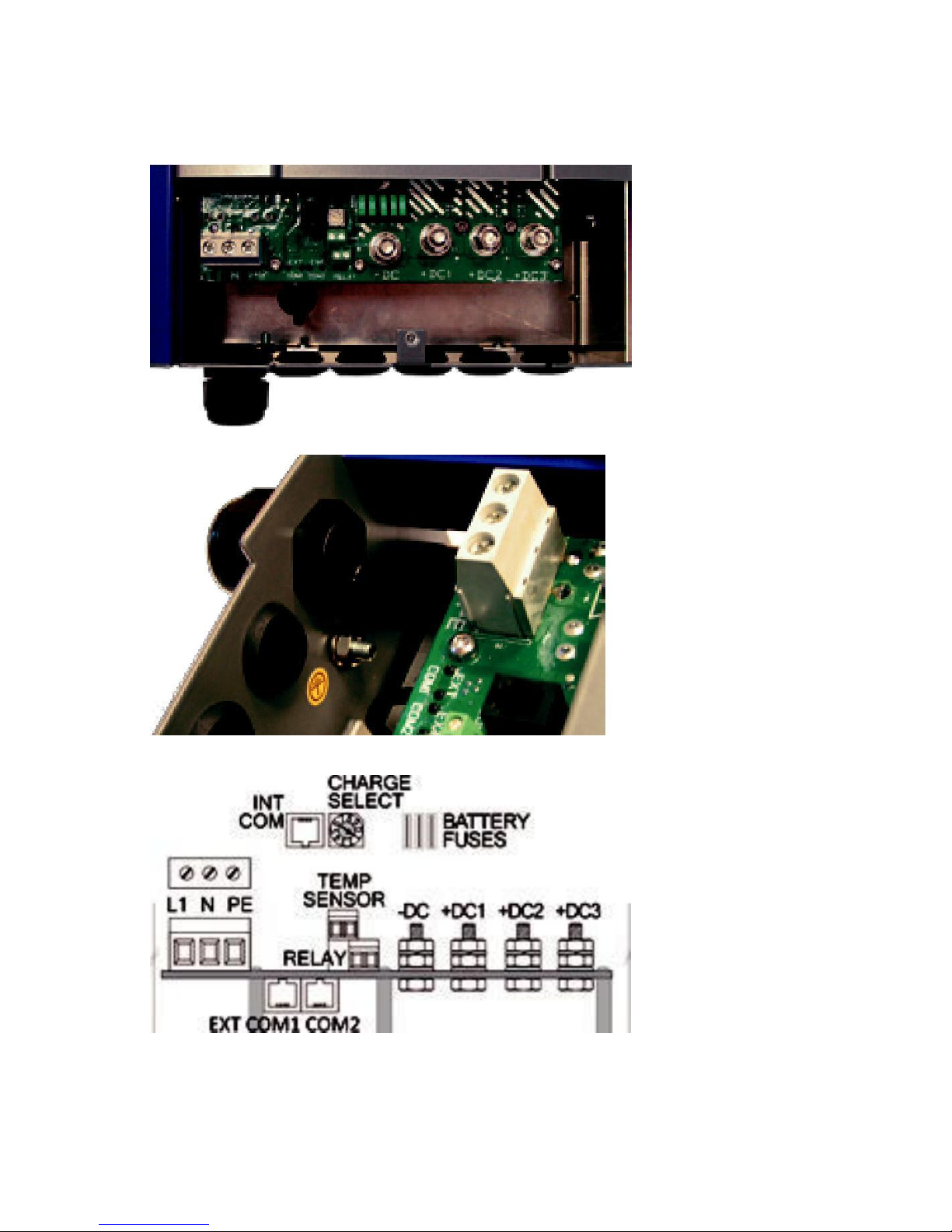
CONNECTION DETAILS
Page 8

8
Marking
Description
L1
AC main, 8 AWG (10mm2) max (wire color code: brown or
black)
N/L2
AC neutral or L2, 8 AWG (10mm2) max (wire color code: blue,
white or red)
PE (Ground)
AC ground, 8 AWG (10mm2) max (wire color code: green &
yellow or green)
-DC
Battery negative (common), pin M8 (wire color code: black)
+ DC1
Main battery positive, pin M8 (wire code: red)
+ DC2
Auxiliary battery 2 positive, pin M8 (wire color code: red)
+ DC3
Auxiliary battery 3 positive, pin M8 (wire color code: red)
CHARGE
SELECT
Charge curve and battery charging mode selector, 10 positions
(from 0 to 9) (refer to curve settings p14)
BATTERY FUSES
Battery Protection fuses (on the –DC supply)
EXT COM 1
External communication bus (CAN bus)
(for an external digital display or communication between
chargers)
EXT COM 2
External communication bus (CAN bus)
(for an external digital display or communication between
chargers)
INT CoM
Communication bus for a digital display built into the charger
TEMP SENSOR
Battery temperature sensor (2 non-polarized wires, no
polarity)
Connect to the positive terminal of the main battery
RELAY
Dry alarm contact
Page 9

9
Example of connection on the basis of 3 distinct sets of
batteries
Important
Check for proper torque and crimp of connections and terminals.
Page 10

10
AC CABLES AND CIRCUIT BREAKER SIZING
AC wiring
Check the quality of connections and proper tightening of connections.
For main power, preferably use a HO7RNF-type industrial cable. Ensure that you
comply with the following recommendations.
Charger
220-240V AC 50/60Hz
100-120V AC 60Hz
capacity
Length < 5m (16ft)
Length < 5m (16ft)
12V
60A
2.5mm2 / AWG12
4mm2 / AWG10
12V
90A
2.5mm2 / AWG12
4mm2 / AWG10
24V
40A
2.5mm2 / AWG12
4mm2 / AWG10
24V
60A
2.5mm2 / AWG12
4mm2 / AWG10
24V
100A
4mm2 / AWG10
6mm2 / AWG8
The AC main power line must feature a cut-off device with differential
protection(GFCI), to specifically Protect individuals against electric shock.
The circuit breaker’s sensitivity must be 30mA. Its current capacities comply with
the charger’s power consumption. Comply with the following
recommendations in this respect.
Main power 220-
Main power 100-
Charger
240V 50/60Hz
120V 60Hz
capacity
12V
60A
8A – 30mA
16A – 30mA
12V
90A
8A – 30mA
16A – 30mA
24V
40A
8A – 30mA
16A – 30mA
24V
60A
10A – 30mA
20A – 20mA
24V
100A
20A – 30mA
-
Note: The charger has an internal Protection fuse on the L1 supply, in the event
of a general fault on the circuit board in particular. Due to the irreversible
nature of this fault, the fuse is not accessible for maintenance of any kind.
Page 11

11
DC CABLES AND FUSES
DC wiring
Check the quality of connections and Proper tightening of connections.
Battery cables must be as direct and short as possible.
Each battery output can Provide the charger’s full amperage and all the cables
must have identical cross-sections. Ensure that you comply with the following
recommended cross-sections.
Charger
Length < 2m (6ft)
Length between 3
capacity
and 5m (10 to 16ft)
12V
60A
25mm2 / AWG3
35mm2 / AWG2
12V
90A
35mm2 / AWG2
50mm2 / AWG0-1
24V
40A
16mm2 / AWG5
20mm2 / AWG4
24V
60A
25mm2 / AWG3
35mm2 / AWG2
24V
100A
35mm2 / AWG2
50mm2 / AWG0-1
These chargers are equipped with airtight grommets with
“automatic” opening.
Simply pressing the center section of the membrane is sufficient to allow
the cable to pass through the grommet.
Page 12

12
DC fuses
When maintaining the charger’s internal fuses, these must be replaced by fuses with
strictly identical characteristics and performance levels. Risks of irreversible damage
to the equipment.
It is essential and highly recommended that you install, as close as possible to each
positive output on the battery, a fuse to Protect connections, specifically in the
event of a short circuit and/or overheating of the battery cables, as the result of
damage to the Protective sleeves, for example.
Internal charger
External battery
Charger
fuse fuse
capacity
(+BAT supply for
(–DC supply)
each battery)
12V
60A
3 x 25A 32V rapid
80A 32V rapid
(mini automotive fuse)
12V
90A
4 x 30A 32V rapid
100A 32V rapid
(mini automotive fuse)
24V
40A
3 x 25A 32V rapid
60A 32V rapid
(mini automotive fuse)
3 x 25A 32V rapid
24V
60A
(mini automotive fuse)
80A 32V rapid
24V
100A
5 x 30A 32V rapid
150A 32V rapid
(mini automotive fuse)
CHARGE CURVE SELECTION
The digital electronics, based on an RSC microcontroller,
monitor the charging process by optimizing, the voltage,
current and recharging time parameters. This is based on
the initial charge level of the batteries, using the
exclusive “scanning charge” function.
Page 13

13
The performance and usable life of batteries are thereby maximized.
By virtue of fully automated charging cycles, the batteries are protected against
surges, providing a permanent connection for the charger.
Selection of the charging Program takes place on installation using the
“CHARGE SELECT” dial on the charger board.
The position of the arrow indicates the number of the Program selected (e.g.:
Program No. 1 in the photograph above). Selection is made using a small flathead screwdriver.
CAUTION
It is important to note that the use of an inappropriate charging cycle for
the battery technology may extensively impair or even damage the
latter.
This is particularly true for cycles where charge voltages are higher than the
levels recommended by the battery manufacturers.
A serious risk of overheating the batteries and releasing gases that are
harmful to users’ health.
Curve no. 9 is compatible with a LiFeSo4 battery, provided that the battery is
equipped with BMS-type battery Protection (Battery Management System)
within the actual battery. In this case, refer to the battery manufacturer’s
recommendations for the choice of charging cycle.
Page 14

14
CHARGER CURVE SETTINGS
CURVE BAT TYPE
PHASE
12V
24V
0
Open
V. BOOST
14.4V
28.8V
Lead
V. FLOAT
13.2V
26.4V
1
Sealed
V. BOOST
14.2V
28.4V
lead
V. FLOAT
13.6V
27.2V
2
Lead
V. BOOST
14.8V
29.6V
calcium
V. FLOAT
13.8V
27.6V
3
«Delphi»
V. BOOST
15.4V
30.8V
type
V. FLOAT
13.8V
27.6V
Charge
curve
«Op-
V. BOOST
14.8V
29.6V
4
tima»
V. MAX
15.5V
31.0V
type
V. FLOAT
13.8V
27.6V
Charge
curve
Winter
5
V. BOOST
14.4V
28.8V
Open
V. FLOAT
13.2V
26.4V
lead
Charge
curve
Page 15

15
Winter
6
V. BOOST
14.2V
28.4V
Sealed
V. FLOAT
13.6V
27.2V
lead
Charge
curve
7
GEL &
V. BOOST
14.4V
28.8V
AGM
V. FLOAT
13.8V
27.6V
Charge
curve
8
Power
V. FLOAT
13.6V
27.2V
supply
Charge
curve
LiFeSo4
9
+ inte-
V. FLOAT
14.4V
28.8V
grated
BMS
Charge
curve
Page 16

16
OPERATION of BATTERY TEMPERATURE SENSOR
The temperature sensor allows the charging voltage to be
automatically adjusted depending on the battery and ambient
temperature.
This function increases battery life, by reducing output voltage and current
due to high ambient and/or battery temperature.
This sensor is screwed onto the main battery’s positive terminal (a
service/house battery as a general rule). The 2 wires are connected to the
“TEMP SENSOR” connector on the charger board (not polarity sensitive).
The compensation level is around
+/-25mV per °C for a 24V battery and between +/-12mV per °C for a 12V
battery (see curves below).
Reference voltage
Battery temperature in °C
The temperature sensor initially simulates a temperature of 77⁰F (25°C). The action of the
battery temperature sensor allows the charge to be adjusted, upwards or downwards,
depending on the battery temperature, i.e.:
+/- 15 mV per °C at 12 V
+/- 30 mV per °C at 24 V
Page 17

17
LED DISPLAY
The Voyager Elite charger is equipped with a local multifunction LED display,
which, among other things, shows the details of the key stages of the battery
charging process.
BOOST phase: The battery is in its recharging phase, reaching a level of charge of
close to 80%. This recharging phase is limited to a period of
6 hours.
ABSORPTION phase: The voltage is maintained and the amperage is reduced
until the battery returns to a level of charge approaching 100%. This phase is
limited to a period between 30 minutes and 4 hours, depending on the
battery’s initial charge level.
FLOAT phase: The voltage and the amperage are reduced to maintain the
battery at 100% full charge. During the Floating phase, the charger only delivers
what the battery requires to prevent overcharging.
Fault Indicators: The Temperature (TEMP), Battery (BAT) and fuse (FUSE) fault
indicators are shown on the LED display.
Screen
Page 18

18
Mode and display operation
MODE
DESCRIPTION
SOLID LED
FLASHING
LED
Charger powered
All LEDs
on and/or Chan-
INITIALIZATION
for 3
-
ge of charging
cycle
seconds
Batteries in
POWER ON
BOOST
charging phase
-
PHASE
(charge from 0 to
BOOST
80%)
Batteries in
POWER ON
charging phase
-
ABSORPTION/
EQUALIZATION
(charge from 80%
ABS
to 100%)
PHASE
End of the equali-
zation cycle within
POWER ON
ABS
a period of 30
minutes
FLOATING
Charging cycle
POWER ON
completed
-
PHASE
(charge at 100%)
FLOAT
Main voltage
fault, excessively
high or abnormally
MAIN
Low voltage
POWER
VOLTAGE
-
Immediate auto-
ON
FAULT
matic restart,
subject to
disappearance of
the fault
Excessive charger
temperature fault
CHARGER
Automatic restart
after a
TEMPERATURE
TEMP
-
min delay
FAULT (TEMP)
for 30 seconds,
subject to
disappearance of
the fault
Page 19

19
MODE
DESCRIPTION
SOLID LED
FLASHING
LED
Excessive battery
temperature fault
BATTERY
Automatic restart
TEMPERATURE
after a min delay
-
TEMP
FAULT
for 30 seconds,
subject to
disappearance of
the fault
External tempera-
ture sensor fault
BATTERY
Automatic restart
TEMP
SENSOR
after a min delay
-
FAULT
for 30 seconds,
BAT
subject to
disappearance of
the fault
Charging voltage
fault, excessively
high or abnormally
low
OUTPUT
VOLTAGE
Automatic restart
BAT
-
FAULT
after a min delay
for 60 seconds,
subject to
disappearance of
the fault
Output fuse fault
OUTPUT
Restart following
FUSES
a main reset,
FUSE
-
FAULT
subject to
disappearance of
the fault
CAN
CAN fault
TEMP
-
BAT
FAULT
secure load
FUSE
Page 20

20
Technical specifications
12V 60A
12V 90A
24V 40A
24V 60A
24V 10 0A
MAIN POWER CHARACTERISTICS
Main
100V-120V 60Hz and/or 220-240V 50/60Hz
220-240V
voltage
(+/-15%)
(+/-15%)
Power
typically 0.9
factor
Output
typically 83%
typically 87%
Inrush
< 60A
< 30A, limited by soft start
< 60A
current
Current
12A/5A
16A/7A
14A/6A
15A/9A
15A
Draw
Active
1200VA
1500VA
1350VA
2000VA
3500VA
power
70% of
Derating
Without derating
Pnom
-
@ 115V
(rated
power
Main
T16A
T20A
T20A
T20A
2xT20A
(6.3x32
(6.3x32
(6.3x32
(6.3x32
(6.3x32
fuse
mm)
mm)
mm)
mm)
mm)
BATTERY CHARGING CHARACTERISTICS
Number
of 3 independent supplies
outputs
Number
10 charging cycles (from 0 to 9), setting
of
by means of a dial
cycles
Charge
In general 3 status, type I.U.Uo
curves
Open
V.BOOST = 14.4V
V.BOOST = 28.8V
lead
V.FLOAT = 13.2V
V.FLOAT = 26.4V
Sealed
V.BOOST = 14.2V
V.BOOST = 28.4V
lead
V.FLOAT = 13.6V
V.FLOAT = 27.2V
Lead
V.BOOST = 14.8V
V.BOOST = 29.6V
calcium
V.FLOAT = 13.8V
V.FLOAT = 27.6V
«Delphi»
V.BOOST = 15.4V
V.BOOST = 30.8V
Type
V.FLOAT = 13.8V
V.FLOAT = 27.6V
«Op-
V.BOOST = 14.8V
V.BOOST = 29.6V then 31.0V
tima»
then15.5V
V.FLOAT = 27.6V
Type
V.FLOAT = 13.8V
Winter
Off Season
V.BOOST = 14.4V
V.BOOST = 28.8V
open
V.FLOAT = 13.2V
V.FLOAT = 26.4V
lead
Page 21

21
12V 60A
12V 90A
24V 40A
24V 60A
24V 10 0A
Winter
Off Season
V.BOOST = 14.2V
V.BOOST = 28.4V
Sealed
V.FLOAT = 13.6V
V.FLOAT = 27.2V
lead
Gel &
V.BOOST = 14.4V
V.BOOST = 28.8V
AGM
V.FLOAT = 13.8V
V.FLOAT = 27.6V
Power
V.FLOAT = 13.6V
V.FLOAT = 27.2V
supply
LifeSo4 +
integra-
V.FLOAT = 14.4V
V.FLOAT = 28.8V
ted
BMS
Tempe-
+/-12mV / °C
+/-25mV / °C
rature
(by an external
(by an external
compen-
sensor)
sensor)
sation
Voltage
tole-
+/-2%
rance
Ripple < 1% (BW < 20MHz)
Maxi-
60A
90A
40A
60A
100A
mum
(+/-5%)
(+/-5%)
(+/-5%)
(+/-5%)
(+/-5%)
current
3 x F30A
4 x F30A
5 x 30A
(minia-
(minia-
3 x F25A
(minia-
Supply
ture
ture
(miniature automo-
ture
fuse -DC
automo-
automo-
tive
automo-
tive
tive
fuse)
tive
fuse)
fuse)
fuse)
PROTECTION
Output
“Current limited” type
surge
Output
“Shutdown” type with automatic restart
short circuit
onc e the fault has disappeared
Excessive output
“Shutdown” type with automatic restart
voltage
onc e the fault has disappeared
Battery
polarity
Output fuse
reversal
Excessive
“Shutdown” type with automatic restart
internal
onc e the fault has disappeared
temperature
Page 22

22
12V 60A - 12V 90A
24V 100A
24V 40A - 24V 60A
HS
“Shutdown” type with automatic restart
temperature
onc e the fault has disappeared
sensor
General
main supply
Main fuse
fault
General
battery supply
Output fuses on –DC supply
fault
Circuit Board
Conformal Coated protection on
circuit board
Operating
14°F to +130°F
(-10°C to +55°C)
temperature
Storage
-4°F to +158°F
(-20°C to +70°C)
temperature
Humidity
10% to 90% (without condensation)
Convection
Forced by thermostat-controlled fan
Housing
Wall-m ounted housing in painte d
aluminium
Protection
IP20
rating
Mounting
Using 4 x #8 (4mm Ø) screws
Overall dimen-
125 x 340 x 360 mm
190x340x 360
sions (Depth x
4.9 x 13.4 x 14.2 inches
7.5x13.4x 14.2
Width x Height)
Weight 13.2lbs (6 Kg)
25.4lbs (11.5
kg)
EMC
EN55014-1
SAFETY
EN60335-2-29
Front LED display
Display
Main
3-point cage terminal for cables with a
connector
cross-section of 6AW G10mm2 max
Battery
M8 pins
connectors
Battery sensor
2-point cage terminal for cables with a
connector
cross-section of 16AWG1.5m m2 max
Alarm relay
2-point cage terminal for cables with a
connector
cross-section of 16AWG1.5m m2 max
External
CAN bus
2 x RJ11 connectors (CAN bus)
connectors
Page 23

23
Dimensions
12V 60A
12V 90A
24V 40A
24V 60A
24V 10 0A
Height A
14.2 inch (360 mm)
Width B
13.4 inch (340 mm)
Depth C
4.9 inch (125 mm)
(190 mm)
7.5 inch
Page 24

24
Warranty
TO PREVENT ANY RISK OF INCORRECT
USE OF THE CHARGER, CAREFULLY READ THE LIST OF POTENTIAL
SCENIROS OR FAULTS NOT COVERED BY THE PRODUCT WARRANTY
This device is not protected against battery polarity reversals. Risk of
irreversible damage to the equipment.
Should the device be dropped, this could cause irreversible distortion of the
housing as well as damaging internal fans and certain electronic components.
Modifications to the housing (additional holes in particular) could result in the
scattering of metal filings onto the circuit board and, consequently,
malfunctions or irreversible damage to the equipment.
Interference with or modifications to the circuit board could result in operating
modes not originally anticipated, and consequently, in malfunctions or
irreversible damage to the equipment.
Powering the device from an unsuitable power source (example: supply voltage
that is too high).
Accidental original main supply surge or lightning strike generally causes
irreversible damage to the equipment.
Replacement of fuses with fuses with different characteristics could
cause irreversible damage to the equipment.
Obvious connection errors causing irreversible damage to the equipment.
Water spray or running water inside the device could result in irreversible
electronic damage.
Precautions for disposal
This device contains electronic components and materials that must be recycled at
the end of the Product’s usable life for environmental reasons.
At the end of the devices usable life, all devices must be returned either to the
local distributor or properly disposed of.
EC compliance
This device complies with the applicable European standards and has a CE
mark. Its certificate of compliance is available on request.
 Loading...