

Page 1
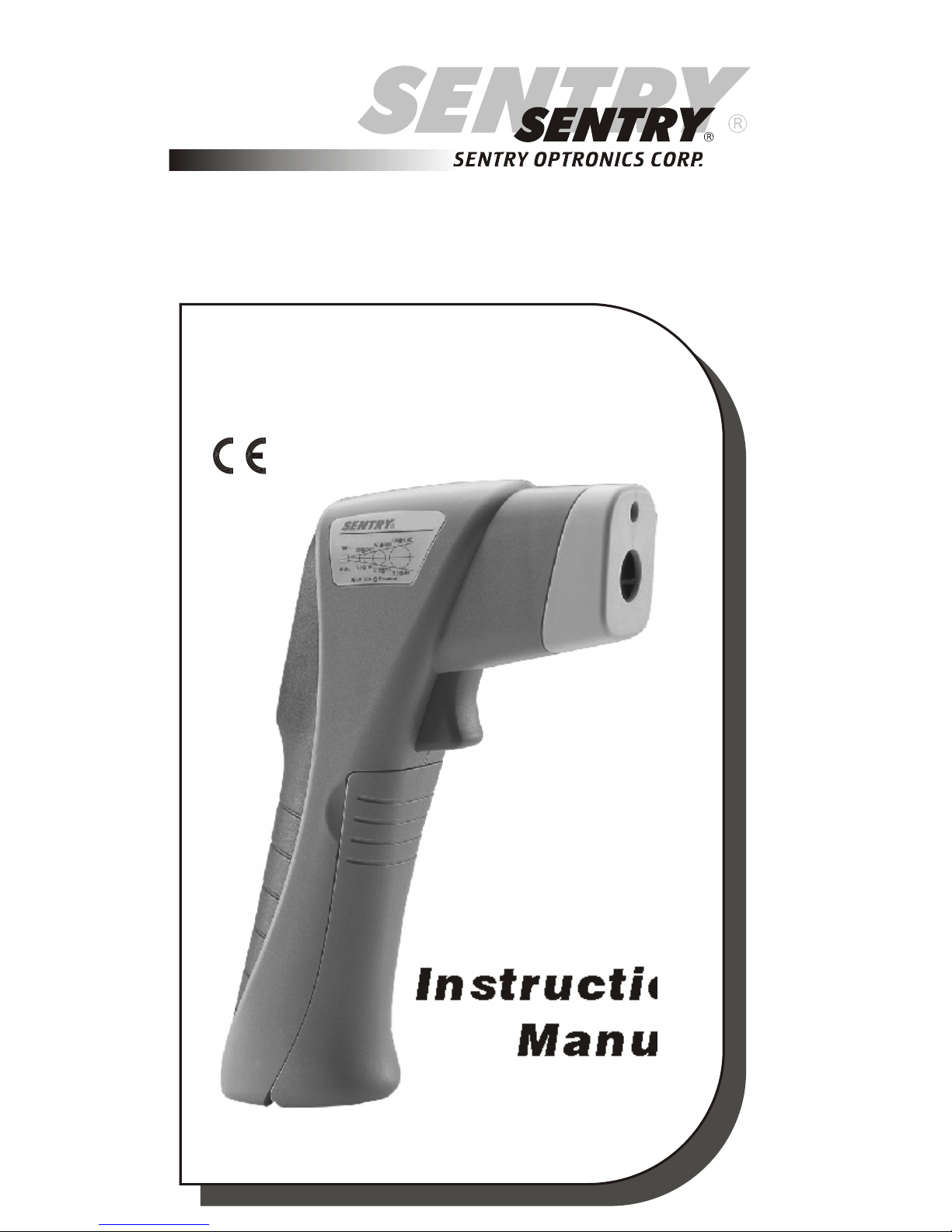
Infrared Thermometer
MODEL: ST 662
Instruction
Manual
Broad Temp.
Page 2

Page 3

Infrared Thermometer
Instruction
Manual
662 Version-0 1 0 5 / A P R .
Broad Temp.
Page 4

1.Product Introduction
1-2 Applications
2.Safety Information
2-2 Safety symbols
3.Specifications
4.Operation Instructions
Unit Diagram
5.Techniques of Infrared Thermometer
6.Maintenance
1-1 Features
2-1 Cautions
4-1 Quick Start
4-2
4-3 °C/ °F and Battery Change
5-1 Field of view(FOV) ratio
5-2 Emissivity
Table Content
1
2
3
4
1
1
2
2
4
4
5
6
7
7
6
Page 5

Broad Temp. Infrared Thermometer 1
Ultra low power consumption in shutdown mode.
Extended long time measuring reliability.
Backlit LCD display.
°C or °F selectable.
Electronic trigger lock.
1-1 Features
Electrical troubleshooting.
Automotive repair and maintenance.
Air conditioner.
Science experiment.
Manufacturing processes of semiconductor
technology.
Test terminals on circuits.
Food safety and processing.
Perform HVAC energy audits.
1-2 Applications
Thank you for purchasing this infrared thermometer.
The Infrared Thermometer is a non-contact infrared
temperature measuring instrument. To measure a
temperature, point the unit at the object unitl the
temperature is read, pull the measuring trigger and
hold. Make sure the target area is larger than the unit's
spot size. For large target objects assure you are within
target distance.
1.Product Introduction
Page 6

Read the following safety information carefully
before attempting to operate or service the meter.
Only qualified personnel should perform repairs or
servicing not covered in this manual.
2.Safety Information
DO NOT submerge the unit in water.
This product is not designed for use in medical
evaluations. The product can only be used to
measure body temperature simply for reference.
They are meant for industrial and scientific
purposes.
2-1 Cautions!
2-2 Safety symbols
Dangerous, refer to this manual before using
the meter.
CE Certification.
This instrument conforms to the following standards:
EN50081-1:1992 Electromagnetic Emissions.
EN50082-1:Electromagnetic Susceptibility.
Test were conducted using a frequency range of 801000MHz with the instrument in three orientations. The
o o
average error for the three orientations is ±C )4.0 F( at
3V/m throughout the spectrum. However, between 300MHz
and 800Mhz at 3V/m, the instrument may not meet its stated
accuracy.
Do not point laser directly at eye . Use
catution a round reflective surfaces. Keep out of
reach of children.
Laser Warning Note!
Page 7

3.Specifications
Distance/Spot Ratio
Temperature Range
Accuracy
Thermopile
Repeatability
Resolution
Response Time
Emissivity
℃/℉ Switchable
Backlight
Auto Power Off
Battery Type
Dimensions
Weight
Accessory
12:1
-50~999℃(-58~1830℉)
±3 C(±5 F)
From -50~-20 C(-58~-4 F)
° °
° °
8~14 mμ
±1 C (±2 F) ° °
1 C (1 F)° °
500 ms.
Fixed at 0.95
Automatically after approx. 6 sec.
9V(006P, IEC6F22, NEDA1604)
187g Approx.
170x133x45mm
(6.69"x5.23"x1.77")
Operation Temp.
0~50 C(32~122 F),10~90%RH° °
YES
(Assumes Operation
Ambient Temperature
of 25 C/77 F) ° °
±2 C(±3 F)
From -20~100 C(-4~212 F)
° °
° °
±2% From
100~999 C(212~1830 F)° °
YES
9V Battery, Instruction manual,
Carrying case.
Battery Life
16 hrs.
Max/Min/Avg/△T
YES
Broad Temp. Infrared Thermometer 3
Supply Voltage
9V
Auto-measuring
10 Point Memory
Laser Sight Switchable
YES
YES
YES
YES
Audio Alarm
Page 8

4.Operation of Instrument
To measure a temperature, point the unit at the
target you want to measure, pull the trigger and
hold. In SCAN mode, the LCD displays the current
temperature in Celsius or Fahrenheit. The unit will
HOLD the last reading for about 6 seconds after
the trigger is released; the word HOLD appears. Be
sure to consider the target area inside the angle of
vision of this instrument. The laser is used for
aiming only. For small targets at short distances
the aim should be adjusted respectively.
4-1 Quick Start
4-2 Unit Diagram
Display Screen
Laser Sighting
Measuring Window
Measuring Trigger
Battery and cover
Page 9

4-3 C/ F and Battery Change° °
The unit is powered by
9V battery and displays
temperatures in either C
or F. The user has to
replace the battery when
the battery voltage drops
below the voltage for
reliable operation and at
the same time the low
battery symbol will
appear.
To change the 9V battery,
pull op en t h e uni t ' s
handle under the trigger.
A f t e r r e p l a c i n g t h e
battery push back and
snap in place.
°
°
LCD Display
Scan/Hold
mode indication
°C/°F unit indication
Temperature indication
c
F
ON
OF
L
A
S
E
R
9V Battery
Laser on/off
°C/° F
Switchable
Low battery
Laser on/off
indication
Broad Temp. Infrared Thermometer 5
Page 10

mm
34@25 0
48@50 0
78@10 00
D:S=12:1
inch
1.4@1 0
1.9@2 0
3.1@4 0
D
S
5.Techniques Of Infrared
Thermometer
The field of view is the angle of vision at which the
instrument operates, and is determined by the
optics of the unit. The FOV is the ratio of the
distance from the target to the target diameter. The
smaller the target, the closer you should be to it.
When the target diameter is small, it is important to
bring the thermometer closer to the target to insure
that only the target is measured.
5-1 Field of view(FOV) ratio
=Distance to diameter (DS) ratio
Page 11

Emissivity is the ability of an object to emit or
absorb energy. Perfect emitters have an emissivity
of 1, emitting 100% of incident energy. An object
with an emissivity of 0.8 will absorb 80% and reflect
20% of the incident energy. Emissivity is defined as
ratio of the energy radiated by an object at given
temperature to the energy emitted by a perfect
radiator at the same temperature. All values of
emissivity fall between 0.1 and 1.0.
5-2 Emissivity
Non-contact temperature sensors measure IR energy
emitted by the target, have fast response, and are
commonly used to measure moving and intermittent
targets, targets in a vacuum, and targets that inaccessible
due to hostile environments, geometry limitations, or
safety hazard. The cost is relatively high, although in
some cases is comparable to contact devices.
6.Maintenance
Cleaning the lens: Blow off loose particles using
clean compressed air. Gently brush remaining
debris away with a camels hair brush. Carefully
wipe the surface with a moist cotton swab. The
swab may be moistened with water.
NOTE:
DO NOT use solvents to clean the lens.
Cleaning the housing:
Use soap and water on a damp sponge or soft cloth.
Broad Temp. Infrared Thermometer 7
Page 12

Page 13

Page 14

Page 15

Page 16

ST 6 6 2 Ve r s i o n - 0 1 0 7 / M A R
3F, No.122, Sec.1, Sanmin Road,
Ban-Ciao, Taipei 220, Taiwan, R.O.C.
TEL:886-2-2956-8198
FAX:886-2-2956-7662
http://www.sentrytek.com.tw
PA05-0000662-01
 Loading...