

Page 1
Bedienungsanleitung
Instructions for use
Notice d‘emploi
Istruzioni per l‘uso
Instrucciones para el uso
Gebruiksaanwijzing
906
Page 2

Bedienungsanleitung..............................................................3
Instructions for use...............................................................11
Notice d’emploi...................................................... ................19
Istruzioni per l’uso.................................................................27
Instrucciones para el uso..................... .................................35
Gebruiksaanwijzing...............................................................43
Page 3

906
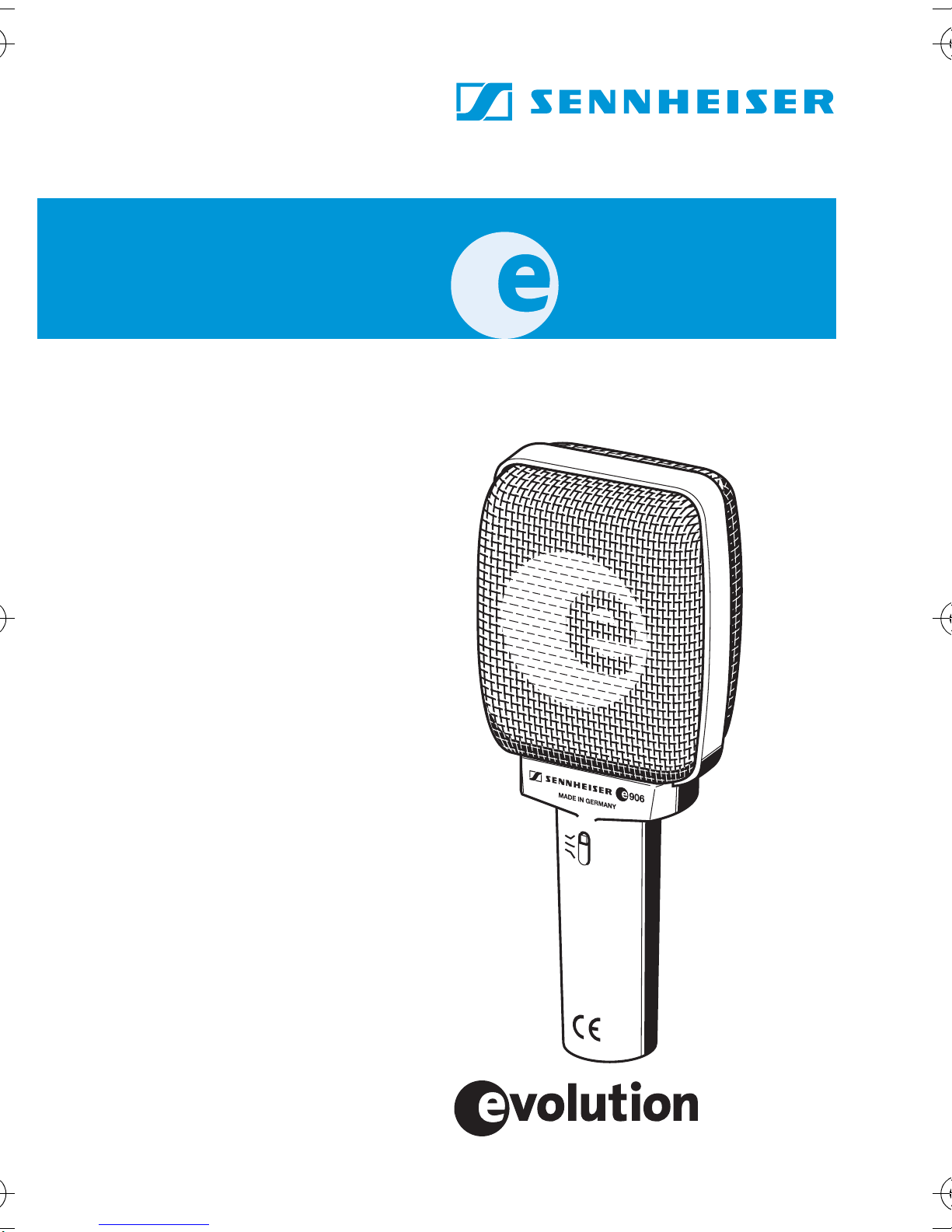
High-quality dynamic microphone with super-cardioid
pick-up pattern, ideal for miking guitar amps, percussion
instruments, snares and toms.
Its laterally mounted capsule has been specially
developed for miking guitars amps face on and and
extremely close to the signal source.
The switchable sound characteristics have been optimally
adapted to the requirements of guitarists.
The super-cardioid pick-up pattern provides good
isolation from other on-stage signals.
Due to its flat design, the 906 is also very suitable for
use with drums, since it can easily be positioned in
cramped space conditions (e.g. below the cymbals).
Features
y Vivid, powerful sound
y Sound can be shaped as needed to fit all styles of
music
y Switchable presence filter
y Humbucking coil protects against electromagnetic
interference
y Shock-mounted capsule
y Extremely rugged for rough stage use
y Gold-plated XLR connector
11
Page 4

Delivery includes
y 906 microphone
y MZQ 100 microphone clamp
y Pouch
y Instructions for use
y Warranty Certificate
Adapting the sound characteristics
The 906 microphone features a switchable presence
filter which allows to adapt the sound characteristics to
the different sound requirements and styles.
The filter is adjusted via the slide switch on the
microphone. To move the slide switch to a different
position, use a pointed too l su ch as a small sc rew driver.
The switch has three positions (see also the frequency
response curve):
Boosts the presence range, the mid frequency is
4.2 kHz, e.g. for aggressive metal rhythm guitars.
Normal position, e.g. for classic rock.
Attenuates the presence range, the mid frequency
is 4 kHz, e.g. for warm and smooth jazz and blues
sounds.
12
Page 5
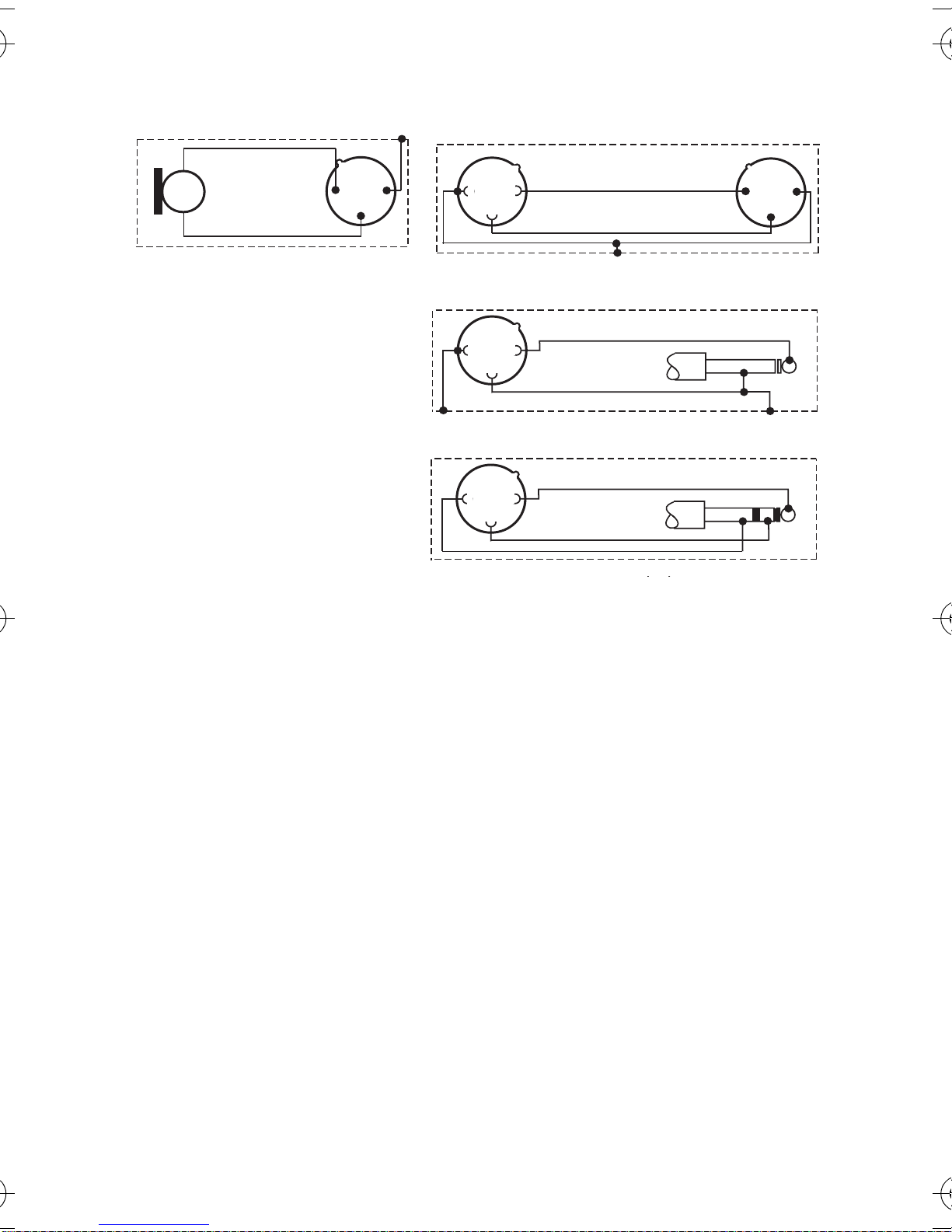
Pin assignment of XLR-3 connector
+
+
12
3
1
+
2
3
+
12
3
XLR
XLR
+
2
1
3
XLR
6,3 mm
+
2
1
3
XLR 6,3 mm
balanced
symmetrisch
XLR
+
+
13
Page 6
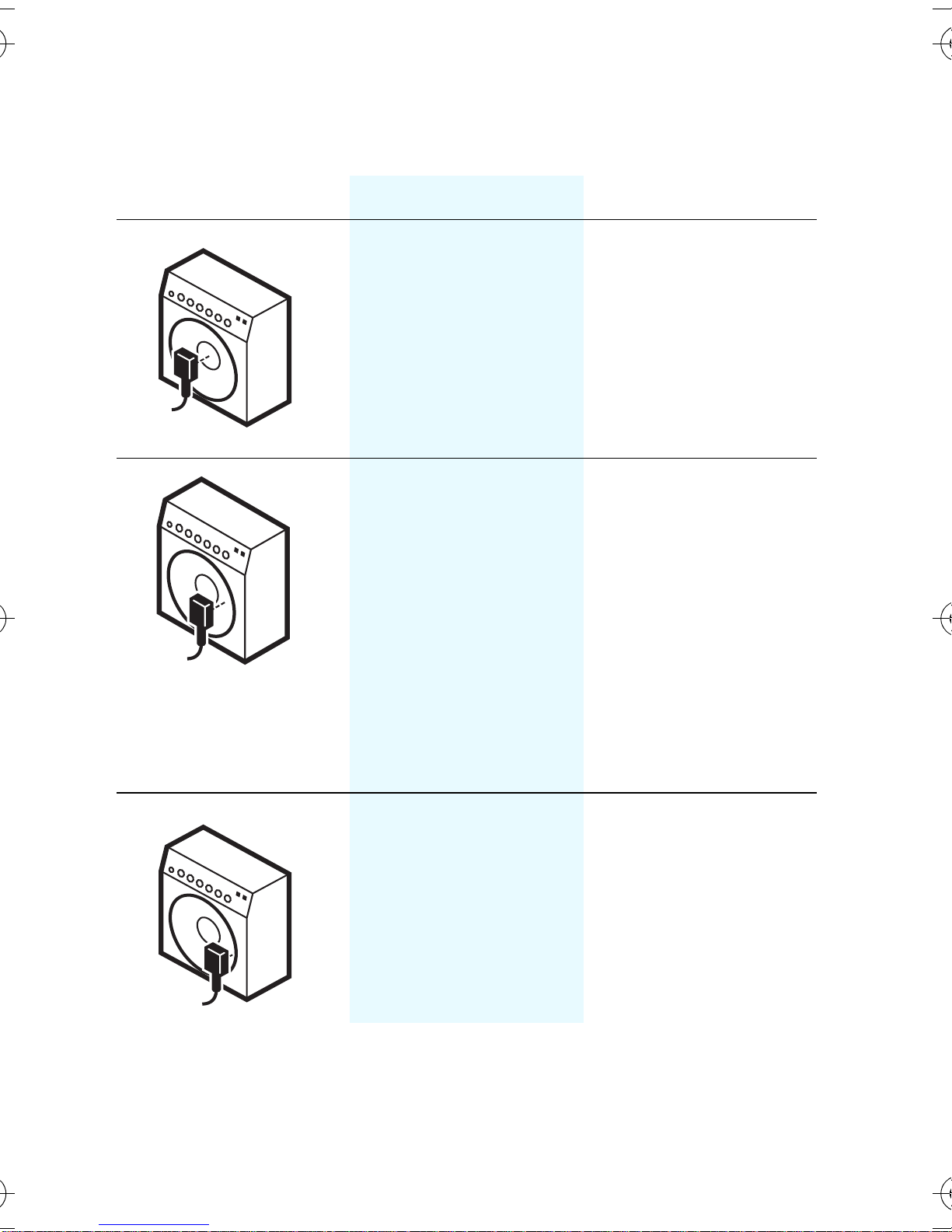
Positioning the microphone
Loudspeaker of a guitar amplifier
Position Resulting sound Commentary
Many trebles,
aggressive sound
Less trebles, more
lower mids,
smoother sound
Balanced, natural
sound
Microphone direct ed
towards the dome
of the loudspeaker.
Good starting
position:
Microphone direct ed
towards the middle
between dome and
surround of the
loudspeaker. If
necessary, turn the
Less trebles, more
lower mids,
smoother sound
microphone by
approx. 30° towards
the surround.
Microphone direct ed
towards the
surround of the
loudspeaker.
14
Page 7
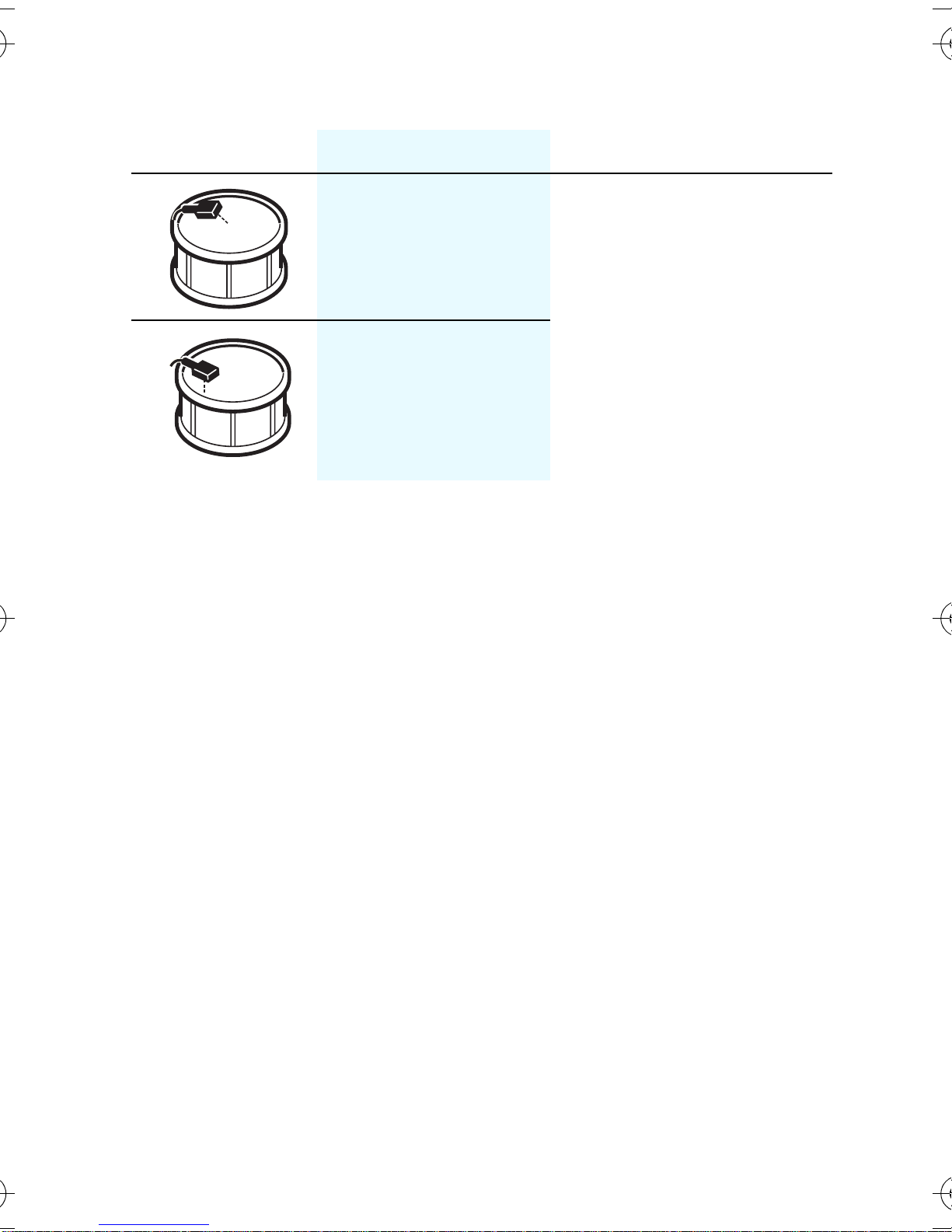
Drums
Position Resulting sound Commentary
More fundamental
tone,
little overtones
Less fundamental
tone,
many overtones
Position on the drum:
3–5 cm above the batter
head, directed towards
the center of the batter
head, the fundamental
tone to overtones ratio
can be adjusted via the
angle. The most balanced
results are obtained at
an angle of 30–60°.
In order to prevent interference due to crosstalk between
adjacent sound sources, try to position the microphone so
that the interfering sound source is located in the angle
area of the highest cancellation of the microphone
(approx. 120°).
15
Page 8
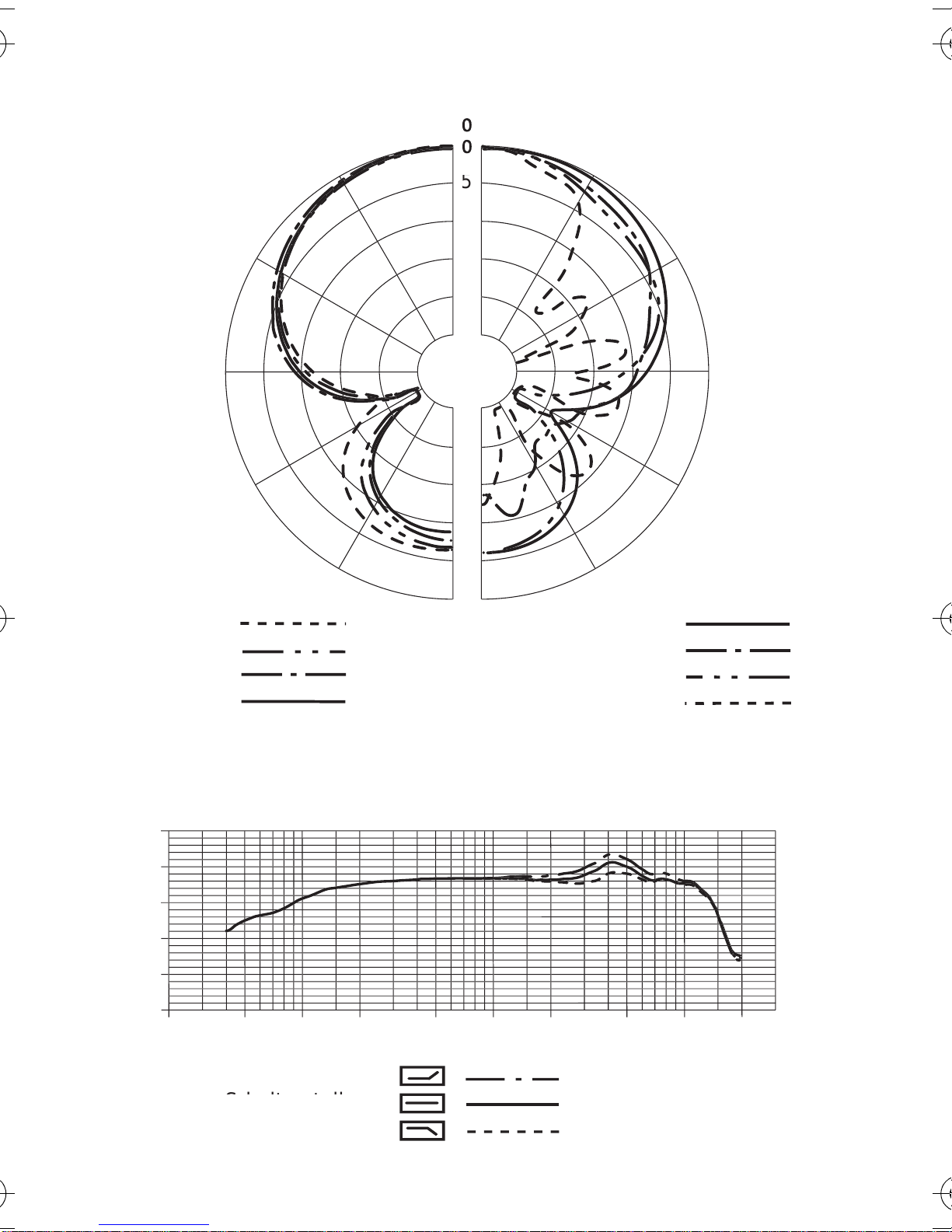
Polar diagram
0
5
5
0
50
80
50
0
000
z
000
z
z
6000
z
z
z
z
z
50
60
0- 80
90
0
00
00
000
000
0000
0000
g
0
v
(0
)
1
1
2
12
1
1
125 H
250 H
H
1000 H
Frequency response curve
B
- 4
-
-
- 7
1
2
4
12
1
H
H
H
H
2
Schalterstellun
Switch position
1
16
2
1
2
1
, 1 m
2
Page 9

Accessories
The following accessories are available for the 906:
MZQ 100 microphone clamp (Cat. No. 021 55 )
Specifications
Transducer principle dynamic
Frequency response 40
−
18,000 Hz
Pick-up pattern super-cardioid
Sensitivity (free field, no load) 2.2 mV/Pa (at 1 kHz)
Nominal impedan ce (at 1 kHz ) 350 Ω
Min. terminating impedance 1 kΩ
Connector XLR-3
Weight 140 g
Dimensions in mm 55 x 34 x 134
17
Page 10

Overview of microphone applications
Variant
Application
Vocals xx
Choir
Studio, acoustic
instruments
Orchestra x
Trumpets,
Trombones
Saxophone x x x
Acoustic guitar x
Acoustic bass x
Guitar amplifiers x
e901
e902
e904
e905
e906
e908B
e908B ew
x x
x x x
e908D
e908T ew
e914
x
e935
e945
Bass amplifiers x
Leslie xxxx
Piano, grand piano x
Kick Drum xx
Snare Drum xxx x
Rack toms xxxx x
Floor toms x xxx x
Congas x xx x
Cymbals x
Percussion xxxx x x
Overhead x
18
Page 11

Konformitätserklärung
Sennheiser electronic GmbH & Co. KG erklären, dass dieses Gerät
die anwendbaren CE-Normen und Vorschriften erfüllt.
Approval
Sennheiser electronic GmbH & Co. KG declare that this device is
in compliance with the applicable CE standards and regulations.
Certification
Sennheiser electronic GmbH & Co. KG déclarons que cet appareil
est en conformité avec les normes CE.
Certificazione
Sennheiser electronic GmbH & Co. KG diachiara che questo apparecchio risponde alle normative e alle prescrizioni CE applica bil i.
Autorizacion
Sennheiser electronic GmbH & Co. KG declara que este aparato
cumple las normas y directrices de la CE aplicab les .
Vergunning
Sennheiser electronic GmbH & Co. KG verklaren, dat dit toestel
voldoet aan de toepasselijke CE-normen en voorschriften.
Page 12

Sennheiser electronic GmbH & Co. KG
30900 Wedemark, Germany
Phone +49 (5130) 600 0
Fax +49 (5130) 600 300
www.sennheiser.com
Printed in Germany Publ. 04/05 94277/A03
 Loading...