

Page 1
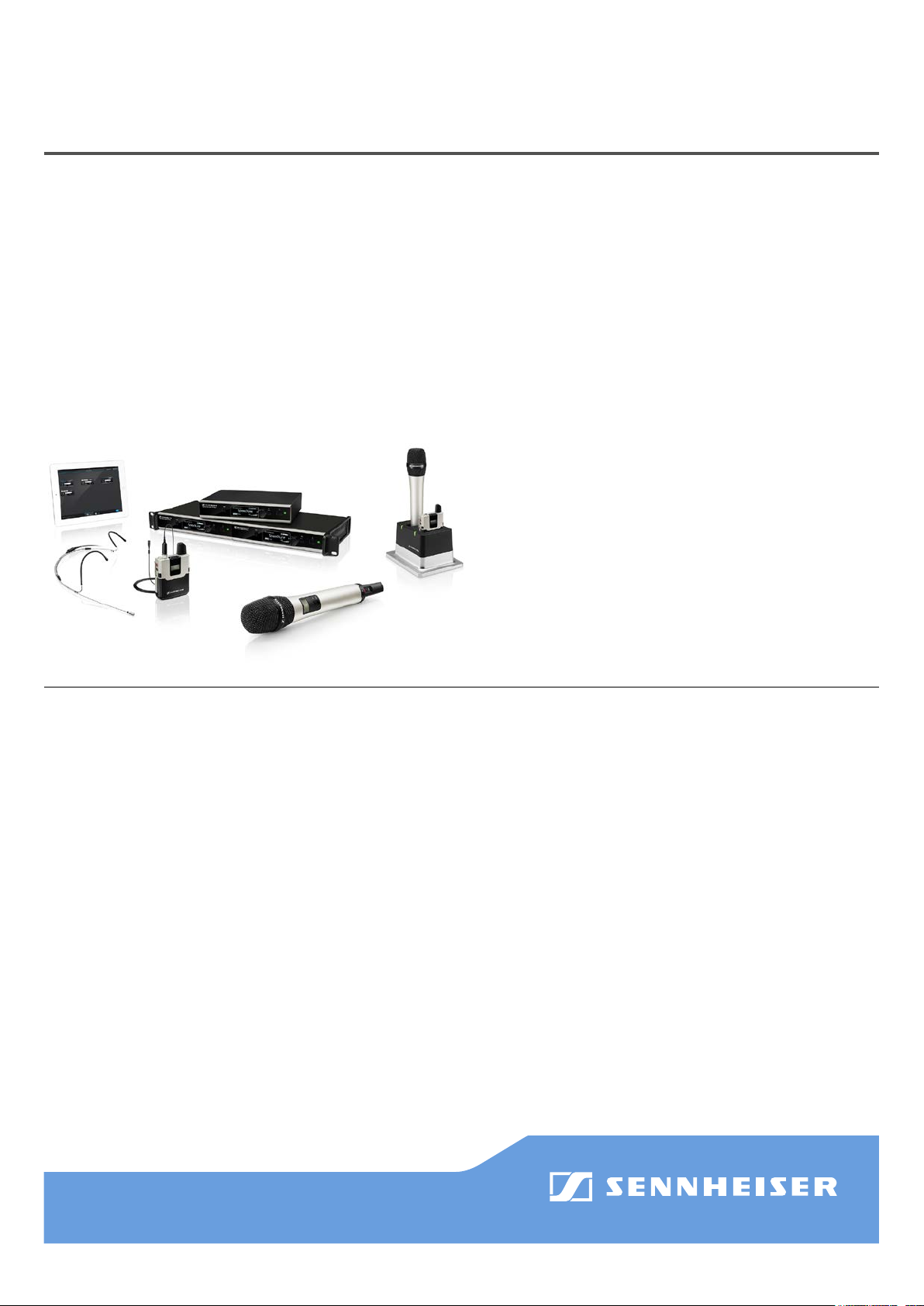
SpeechLine Digital Wireless
SpeechLine DW
FEATURES
• Automatic frequency and interference management
• Speech optimized gain automatics
• License free 1.9 GHz frequency range
• Secure 256 bit AES encryption
• Remote control via Ethernet
• Advanced power management and Li-Ion rechargeables
• Up to 20 channels per range
SpeechLine Digital Wireless is a presentation solution
dedicated to speech. The digital wireless microphone system is a future-proof solution that’s easy to set up, use and manage. A microphone which lets the presenter concentrate on their words, not on
the technology.
SpeechLine Digital Wireless comprises of mobile transmitters (handheld or bodypack) tailored for presentation, speech optimized microphone capsules (condenser capsules, lavalier or headworn microphone) and an easy-to-integrate stationary receiver. For convenience,
the system relies on lithium-ion technology with a battery lifetime of
more than 15 h and flexible charging solutions of multi-device chargers or USB-charging on the fly. Thanks to the Automatic Frequency
Management, the system always finds a free frequency (no frequency planning is necessary anymore). The Automatic Interference Management always maintains a stable connection, which makes the
system very reliable. The Automatic Sensitivity Management makes
the setup even more convenient, no more gain settings are required.
With seamless network integration the system can be controlled via
AMX, Crestron or a dedicated remote control software, which makes
SpeechLine DW easy to monitor and to manage.
For secure communication, SpeechLine Digital Wireless uses the secure advanced 256-bit AES encryption for secure wireless transmission.
System Specification
Due to the 1.9 GHz frequency range SpeechLine DW is the future proof investment and already DD ready. Moreover, the 1.9 GHz is license
free and requires no registration.
ARCHITECT‘S SPECIFICATION
A wireless RF transmission system designed for presentation use and other applications where maximum speech intelligibility is required.
The system shall consist of a stationary receiver, a handheld transmitter with a condenser microphone head and a bodypack transmitter with
a condenser clip-on or headset microphone and shall be available in different sets of receiver/transmitter/microphone combinations. The system shall also feature a Dante™ interface for use with the microphone receivers designed to add analog mic/line inputs to a Dante™ system.
Operating in the license-free 1.9 GHz band (frequency ranges are between 1,880 and 1,930 MHz, depending on country-specific regulations),
the system shall use automatic frequency management to determine the best free available frequency and to automatically start the transmission. Additionally, the system shall incorporate automatic interference management, allowing the transmitter and receiver to move to an
undisturbed, compatible frequency with no audio signal interruption, should interference occur. Furthermore, advanced 256-bit AES encryption shall be used for secure wireless transmission.
To allow optimum use of the 1.9 GHz frequency band, the system shall offer two operating modes: Adaptive Power Mode for up to 20 links
used simultaneously and Multi-Room Mode. In Multi-Room Mode, the transmission power shall be adjustable in steps to adapt the coverage to
the corresponding room size in order to allow a significantly larger number of links. This makes the system the optimum solution for a great
variety of projects with widely differing installation sizes at the same location.
Furthermore, the system shall be compatible with Sennheiser software for network-based remote setup, control and monitoring of large installations with hundreds of devices.
The system’s AF frequency response shall range from 20 – 20,000 Hz. The dynamic range shall be > 120 dB(A). Total harmonic distortion (THD)
at 1 kHz shall be typical 0.1 %. Signal-to-noise ratio shall be > 90 dB(A). Latency shall be 19 ms. Operating temperature shall range from -10 °C
to +55 °C (+14 °F to +131 °F).
1/8
Page 2

SpeechLine Digital Wireless System Specification
Architect's Specification continued
The user interface of the receiver shall be operated by jog dial and OLED display. The receiver shall have dedicated pairing, escape and power
buttons.
The receiver shall feature a low-cut filter as well as speech-optimized sound profiles or custom settings with a 7-band graphic equalizer. The
receiver’s RF sensitivity shall be -90 dBm. RF output power of the receiver’s back channel shall be adaptive and up to 250 mW (country-specific).
The receiver’s audio output shall utilize a balanced XLR-3M socket with a maximum output of +18 dBu along with two unbalanced RCA sockets
with a maximum output of +6 dBu. The receiver shall feature automatic gain optimization. Two reverse SMA sockets shall be provided for
connecting the antennas.
The receiver shall feature RJ-45 network connectivity compatible with IPv4 and IPv6 networks. For remote control the receiver shall have media
control protocol integration.
The receiver shall operate on 12 V DC power supplied from the NT 12-4C power supply unit (100-240 V AC, 50/60 Hz, for use in the USA, the
UK, and Europe) or the NT 2-3 power supply unit (100-240 V AC, 50/60 Hz, for use in countries other than the USA, the UK, and Europe). Power
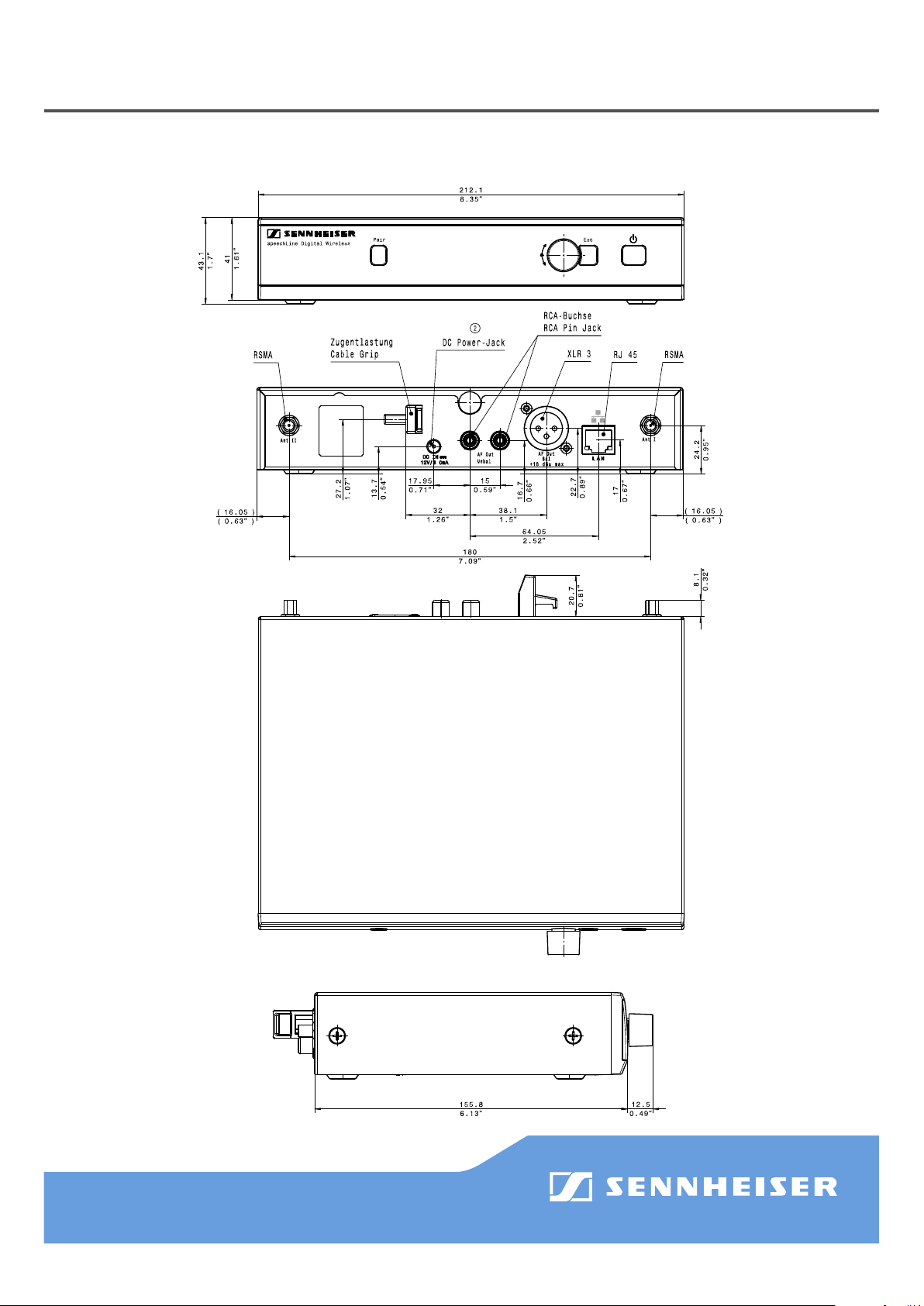
consumption shall be 350 mA. The dimensions shall be approximately 168 x 212 x 43 mm (6.61" x 8.35" x 1.69"). Weight shall be approximately 828 grams (1.83 lbs). The receiver shall be the Sennheiser SL Rack Receiver DW.
The transmitters shall be powered by either one Sennheiser Lithium-Ion rechargeable accupack with a typical operating time of 15 hours or
with an optional battery case for two 1.5V AA size batteries. The accupack can be quickly charged through a wide variety of charging options,
including micro USB. The accupack shall have charging contacts on the outside for charging in the dedicated CHG 2 charger.
The handheld transmitter shall be equipped with a mute switch, which can be deactivated via the user interface. The handheld transmitter’s AF
frequency response shall range from 50 – 20,000 Hz. RF output power shall be adaptive and up to 250 mW (country-specific). The handheld
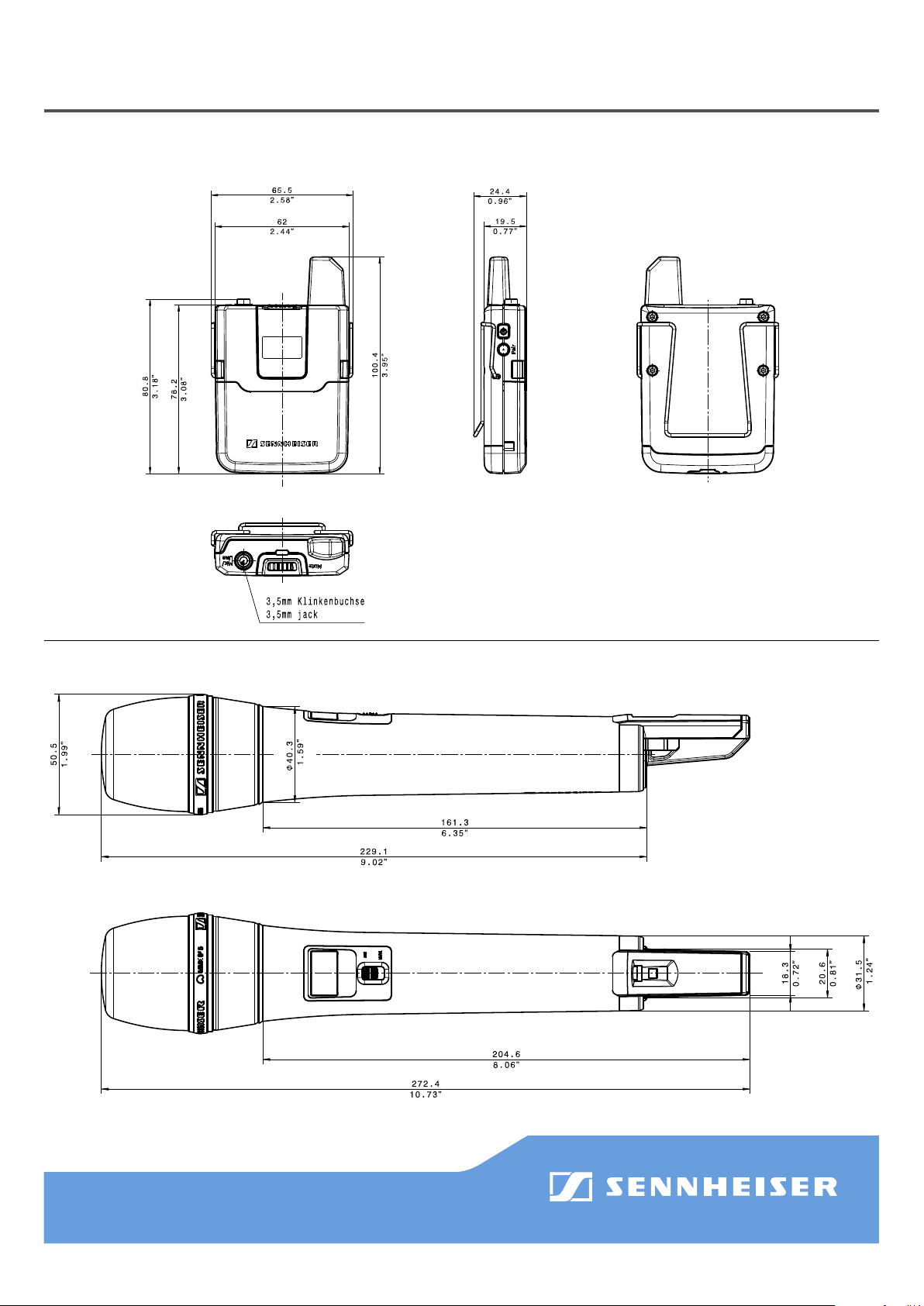
transmitter shall have automatic sensitivity adjustment. Dimensions shall be approximately 215 x 40 mm (8.46" x 1.57"). Weight (with microphone head, without accupack) shall be approximately 262 grams (9.24 oz). The handheld transmitter shall feature an LC display showing
wireless link name, battery status, and reception quality. The handheld transmitter shall be the Sennheiser SL Handheld DW.
The microphone head suitable for use with the handheld transmitter shall be a condenser type with a super-cardioid pick-up pattern and a
sensitivity of 1.6 mV/Pa. Maximum sound pressure level shall be 152 dB SPL. The microphone head shall be the Sennheiser MME 865-1.
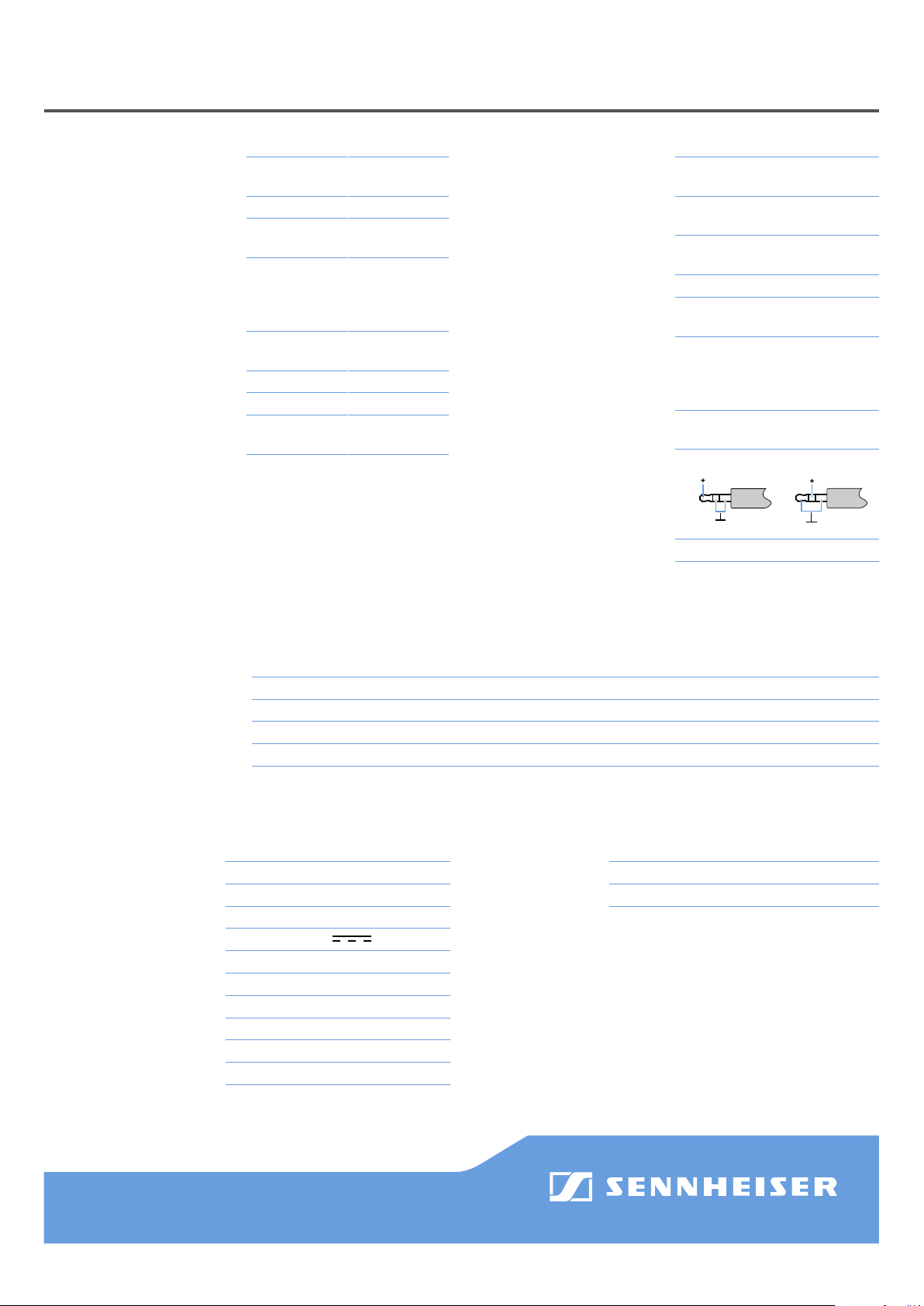
The bodypack transmitter’s microphone/line input shall utilize a lockable 3.5 mm jack socket. The AF frequency response shall range from
50 – 20,000 Hz (mic) and from 20 – 20,000 Hz (line). RF output power shall be adaptive and up to 250 mW (country-specific). The maximum
input level shall be 2.2 Vrms (mic) or 3.3 Vrms (line). Input impedance shall be 1 MΩ (line). The bodypack transmitter shall have automatic
sensitivity adjustment. Dimensions shall be approximately 100 x 65 x 24 mm (3.94" x 2.56" x 0.94"). Weight (without accupack) shall be
approximately 88 grams (3.10 oz). The bodypack transmitter shall feature an LC display showing wireless link name, battery status, and
reception quality. The bodypack transmitter shall be the Sennheiser SL Bodypack DW.
The microphone suitable for use with the bodypack transmitter shall be a condenser type with an omni-directional pick-up pattern and a sensitivity of 5 mV/Pa. Maximum sound pressure level shall be 142 dB SPL. The clip-on microphone shall be the Sennheiser MKE 1 and the headset
microphone shall be the Sennheiser SL Headmic 1.
The Dante™ interface shall feature four balanced and RF filtered mic/line inputs on female XLR-3 connectors and two RJ-45 Ethernet connectors to allow Dante™ daisy chaining (DDC) of multiple units. Audio frequency response shall range from 20 – 20,000 Hz. Input impedance
shall be > 1.8 kΩ at any gain setting. Equivalent input noise shall be -113 dBu. The Dante™ interface shall be powered over the CAT5 Ethernet
cable from an 802.3af PoE compliant network switch or from an external +12 V DC power supply. The unit shall support daisy chaining of two
units when powered via PoE and shall accept daisy chaining of up to three units when powered via an external +12 V DC power supply. Power
consumption shall be 2.7 W (225 mA) @ +12 V DC without phantom power and 5.5 W (460 mA) @ +12 V DC with a 10 mA phantom power
load per input. The Dante™ interface shall have a rugged metal housing with integrated mounting brackets; dimensions (W x H x D) shall be
219 x 38 x 120 mm (8.63" x 1.50" x 4.74"). Weight shall be 0.77 kg (1.7 lbs). Operating temperature shall range from 0 °C to 40 °C (32 °F to
104 °F).
The Dante™ interface shall be the Sennheiser SL DI 4 XLR.
The wireless RF transmission system shall be the Sennheiser SpeechLine Digital Wireless.
2/8
Page 3

SpeechLine Digital Wireless System Specification
Architect's Specification continued
The software shall enable the user to set up, control and monitor all components of a SpeechLine Digital Wireless system via a network. The
browser-based responsive software shall be accessible across all platforms from any device (e.g. tablet, computer) in the network. The software shall provide a complete overview of all network-enabled SpeechLine Digital Wireless devices together with status information such as
link status, battery life information, alerts and notifications. The software shall allow the user to edit settings of one device or multiple devices
at a time. The software shall also feature a room list view, which shows the locations of all devices in the network as well as the number of
devices per room.
The software shall be the Sennheiser Control Cockpit
SPECIFICATIONS
System
AF frequency response 20 to 20,000 Hz
Dynamic range > 120 dB(A)
THD (1 kHz) typ. 0.1 %
Audio sampling 24 bit/48 kHz
Signal-to-noise ratio > 90 dB(A)
Encryption AES 256
RF frequency ranges EU:
USA:
Brazil:
Taiwan:
Japan:
Modulation GFSK with back channel
Transmission method TDMA, space diversity
Latency 19 ms
Relative air humidity max. 95 %
Temperature range* Operation:
Storage:
* The temperature range is influenced by the battery characteristics
1,880 to 1,900 MHz
1,920 to 1,930 MHz
1,910 to 1,920 MHz
1,880 to 1,895 MHz
1,893 to 1,906 MHz
-10 °C to 55 °C
(14 °F to 131 °F)
-20 °C to 70 °C
(-4 °F to 158 °F)
SL Rack Receiver DW
RF sensitivity < -90 dBm
RF output power back channel adaptive, up to 250 mW
(country-specific)
XLR output level, balanced max. +18 dBu
RCA output level, unbalanced max. +6 dBu
Audio effects Low cut:
Equalizer:
Sound profiles:
Display OLED
Network protocol Media Control Protocol,
TCP/IP IPv4 (DHCP, manual)/
IPv6
Power supply 12 V DC
Current consumption 350 mA
AF connection sockets XLR/2 x RCA
Antenna sockets 2 x reverse SMA
Network sockets RJ-45
DC socket for power supply hollow jack
Weight approx. 828 g
-3 dB at
120 Hz
7-band graphic
equalizer with
sound presets
• Female Voice
• Male Voice
• Media
3/8
Page 4
SpeechLine Digital Wireless System Specification
SL Handheld DW
RF output power adaptive, up to 250 mW
(country-specific)
AF frequency response 50 to 20,000 Hz
Input sensitivity automatic sensitivity
adjustment
Power supply Accupack:
Batteries*:
Operating time Accupack:
Batteries*:
Display LCD
Mute switch available
Weight (w/o accupack) approx. 262 g
incl. microphone head
* optional accessory
BA 10
(Li-Ion, 3.6 V)
2 x AA size
battery (1.5 V)
typ. 15 h
typ. 10 h
SL Bodypack DW
RF output power adaptive, up to 250 mW
(country-specific)
AF frequency response Mic:
Line:
Max. input level Mic:
Line:
Line input impedance
Input sensitivity automatic sensitivity
Power supply Accupack:
Operating time Accupack
AF connection socket 3.5 mm jack socket, lockable
Weight (w/o accupack) approx. 88 g
* optional accessory
1 MΩ
adjustment
Batteries*:
Batteries*:
Mic
50 to 20,000 Hz
20 to 20,000 Hz
2.2 V RMS
3.3 V RMS
BA 30
(Li-Ion, 3.7 V)
2 x AA size
battery (1.5 V)
typ. 15 h
typ. 11 h
Line
Microphones
MME 865-1 MKE 1 SL Headmic 1
Microphone type pre-polarized condenser microphone
Sensitivity 1.6 mV/Pa 5 mV/Pa 5 mV/Pa
Pick-up pattern super-cardioid omni-directional omni-directional
Max. SPL 152 dB SPL 142 dB SPL 142 dB SPL
Power supply units (for SL Rack Receiver DW)
NT 12-4C NT 2-3
Nominal input voltage 100 to 240 V–
Power frequency 50 or 60 Hz
Input current max. 120 mA
Nominal output voltage 12 V
Standby power consumption
Energy efficiency level V IV
Operating temperature -10 °C to 55 °C (14 °F to 131 °F)
Storage temperature -20 °C to +70 °C (-4 °F to 158 °F)
Relative air humidity max. 95 %
Weight approx. 100 g approx. 105 g
≤ 0.3 W
Accupacks
BA 10 BA 30
Charging capacity 2200 mAh 2030 mAh
Output voltage 3.6 V 3.7 V
4/8
Page 5
SpeechLine Digital Wireless System Specification
DIMENSIONS
SL Rack Receiver DW
5/8
Page 6
SpeechLine Digital Wireless System Specification
DIMENSIONS
SL Bodypack DW
SL Handheld DW
6/8
Page 7
SpeechLine Digital Wireless System Specification
DIMENSIONS
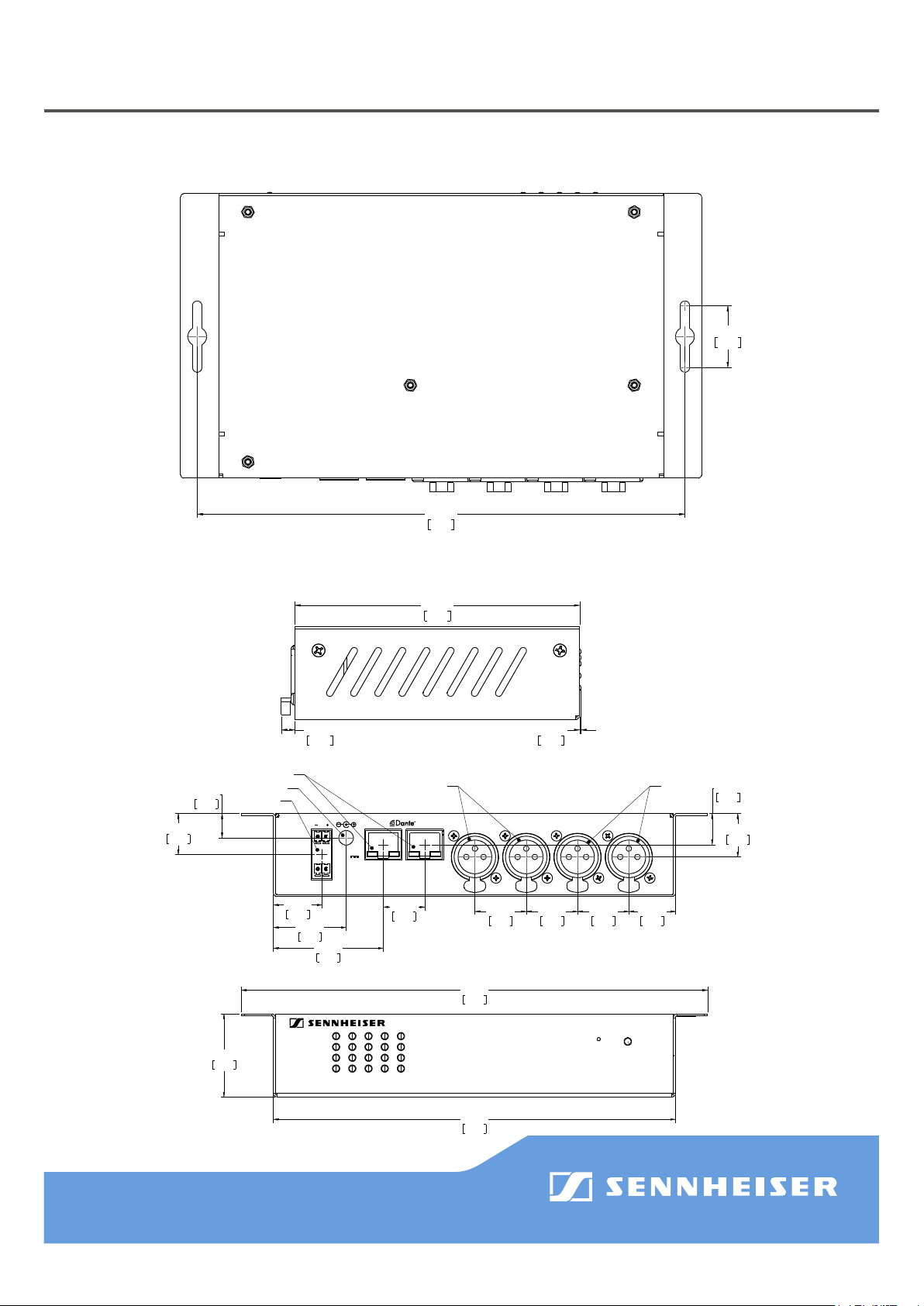
SL DI 4 XLR
26.01
1.024"
205.23
8.080"
19.28
0.759"
11.44
0.450"
DC POWER JACK
POWER LINK
39.01
1.536"
RJ 45
OUT
22.78
0.897"
IN
34.19
1.346"
5.74
0.226"
DC IN
12V
500mA
PWR LINK
51.61
2.032"
P48 +45 +30 +15 PA D
119.81
4.717"
0.56
0.022"
XLR 3 XLR 3
IN 4 IN 3 IN 2 IN 1
POE + DATADATA
19.56
0.770"
24.13
0.950"
219.25
8.632"
IN 4
IN 3
IN 2
IN 1
24.13
0.950"
24.13
0.950"
POWER
21.94
0.864"
SL DI 4 XLR
14.66
0.577"
20.42
0.804"
189.08
7.444"
7/8
Page 8

SpeechLine Digital Wireless System Specification
ACCESSORIES
Product Features Description
AWM 2 • Unobtrusive antenna wall or tripod
mounting
• Robust metal housing
CHG 2 • Two bay charger for SL DW
• Universal charging slots for either
bodypack and handheld
• External DC adaptor
BA 10 / BA 30 • Li-Ion rechargeable battery
• USB charging socket
• Dedicated charging contacts
CL 5/10/20 • Robust, step-proof antenna cable
• Sturdy R-SMA connectors
Sennheiser
Control Cockpit
SL Headmic 1 • Most comfortable-to-use presenter
SL DI 4 XLR • 4 XLR balanced and RF filtered mic/line
• Remote control of SpeechLine Digital
Wireless
• Convenient setup and handling
• Detailed status monitoring
• Flexible browser-based application
microphone
• Outstanding sound quality, omni-
directional
• Sleek and unobtrusive appearance
• Extremely lightweight, but sturdy metal
frame
• Soft-case for convient transport and
storage
• Available in black, silver and beige
inputs
• 802.3af compliant PoE powered to work
with any compliant PoE network switch,
or an external +12 V DC supply
• +48 V phantom power
• Dante™ Daisy Chaining allows multiple
SL DI 4 XLRs to be connected over a single
home-run to the Ethernet switch
With the AWM 2, the antennas can be installed in an optimum
way and nearly invisible, in case the stationary receiver shall be
invisible or needs to be further away. It can be easily mounted on
a mobile microphone tripod or permanently installed on a wall.
The CHG 2 charger makes battery management really easy. The
mobile transmitters, while not in use, are charged in the two
charging bays. Thus, the devices are always ready-to-use when
needed. The bi-color LED indicates the status. For seamless
installation, the external power supply provides the necessary
flexibility.
With the BA 10 / BA 30 the SpeechLine Digital Wireless
transmitters' long operation time is guaranteed. With more than
15 hours of battery life time even an entire day of operation
can be covered. The integrated USB socket allows instantaneous
charging.
With the robust and step-proof CL 5/10/20 antenna cables the
distance between the antenna and the SL Rack Receiver DW can
be covered. This allows flexible integration of SpeechLine Digital
Wireless in various applications.
The dedicated Sennheiser Control Cockpit software allows for an
easy setup and handling of SpeechLine Digital Wireless even in
large installations or events. Monitoring all status information
is very easy. All system and device settings can be adjusted
remotely.
The SL Headmic 1 is an extremely unobtrusive and comfortableto-use headworn microphone. It features the proven omidirectional MKE 1 microphone capsule. The adjustable neck
band makes its use conventient for everyone. The extremely
lightweight (7 g) but robust metal frame makes long-term usage
most convenient. It comes with a sturdy and sleek soft-case, which
can also hold a bodypack transmitter. It is available in black or
beige.
The SL DI 4 XLR four input Dante™ preamp is the ideal interface for
wireless microphone receivers and adding mic/line inputs to a Dante™ system. The small form factor of the SL DI 4 XLR allows them to
be mounted almost anywhere, putting them close to audio sources
and minimizing interference-prone analog wiring.
Sennheiser electronic GmbH & Co. KG
Am Labor 1, 30900 Wedemark, Germany
www.sennheiser.com
SP 1027 v1.4
8/8
 Loading...