

Page 1
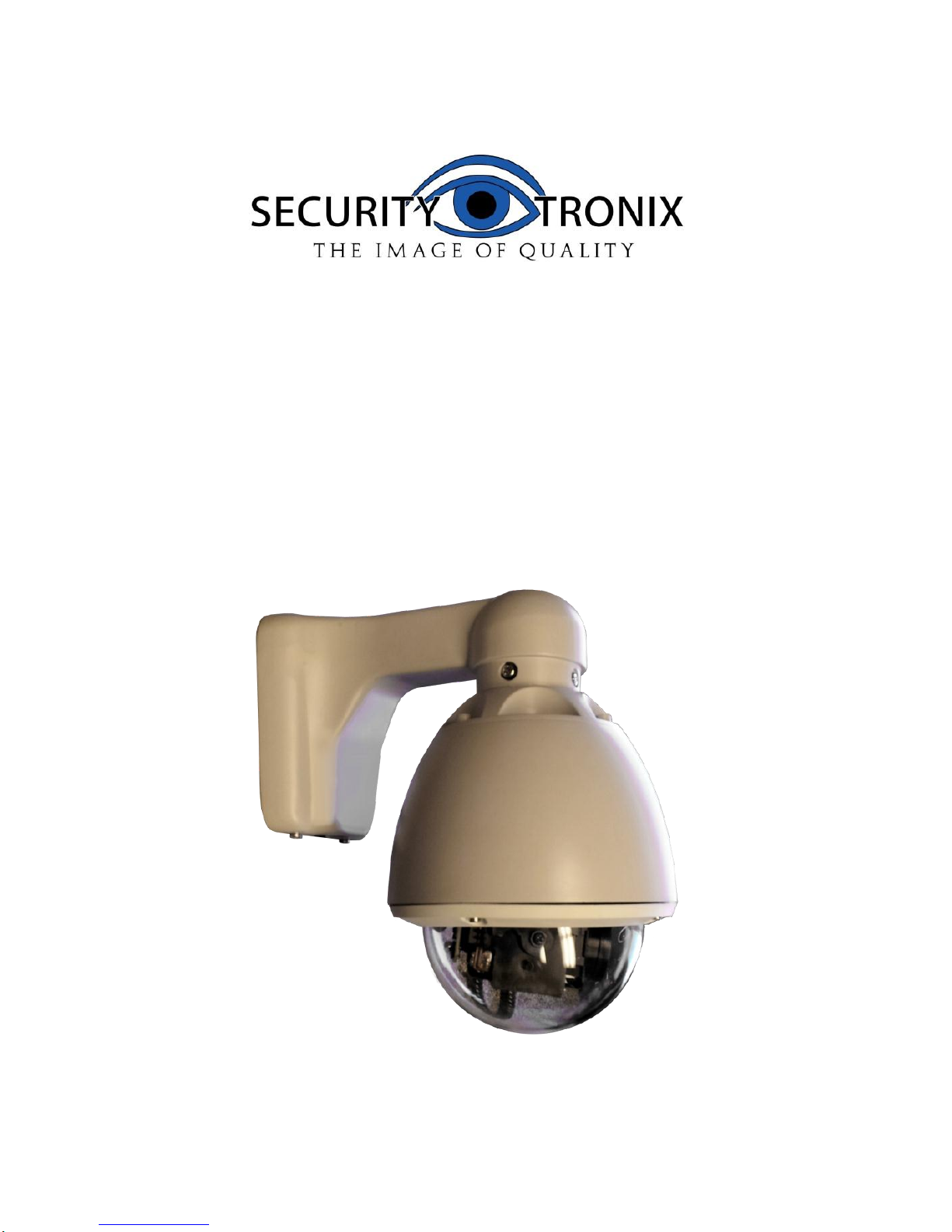
INSTALLATION MANUAL
ST-WD650PTZMINI-12X
High Speed Intelligent Dome PTZ Color Camera
This is a 12 volt DC camera.
Copyright North American Cable Equipment
Page 2

2
PACKAGE CONTENTS
This package contains:
One ST-WD650PTZMINI-12X intelligent dome camera
One Mounting Arm
One installation manual
Note: The ST-WD650PTZMINI-12X requires a minimum 12VDC 1000mA
(1 Amp) power supply such as the ST-PS12VDC1A or ST-PS12VDC2A.
PRODUCT DESCRIPTION
The ST-WD650PTZMINI-12X is a professional grade, IP-66 rated outdoor
dome color camera with pan, tilt and zoom (PTZ) capability. The camera’s
design allows the saving of all settings in non-volatile memory. The
camera features include a 12X optical zoom 5mm – 60mm lens and a
Sony Super HAD II Color CCD with 650TVL color / 700TVL B&W
resolution.
Page 3

3
SPECIFICATIONS
ST-WD650PTZMINI-12X
Specifications (Typical)
1.Image Sensor
1/3" Super HAD II Sony Color CCD
2
Resolution
Color 650TVL, Black 700TVL
3. Lens
5-60mm dynamic varifocal lens
4.
Effective Picture Elements
NTSC:976(H)×494(V)
5.
Minimum Illumination
0.001 Lux
6.
Scanning System
2:1 interlace
7.
Video Output
1Vpp, 75Ω
8. Signal to Noise Ratio
50dB
9.
Synchronous System
Internal, Negative sync.
10.
Auto Electronic Shutter
NTSC: 1/60s~1/100,000s,
11.
Gama Correction
0.45
12.
Gain Control
Auto
13.
White Balance
Auto / Manual
14.
Pan Range
360° continuous
15.
Tilt Range
0° ~ 90°
16.
Pan Speed
60° / second
17. Power
12VDC / 1A
18.
Storage Temperature
-22° F ~ 140° F
19.
Operating Temperature
14° F ~ 113° F
20.
Dimensions
8” x 8.5”
21.
Weight
2.9 lbs
Page 4

4
INSTALLATION AND OPERATION
CAUTION: To reduce the risk of electrical shock do not remove the
cover or back of this unit. No user serviceable parts are inside.
CAUTION: To prevent electric shocks and risk of fire hazards, do
not use other than specified power source.
1. UNPACKING and HANDLING
Each unit is shipped factory tested.
Ensure that all accessories are removed from the container before
discarding packing material
2. MECHANICAL INSPECTION
Inspect the front and rear of the equipment for shipping damage.
Make sure the equipment is clean, and no connectors are broken,
damaged, or loose. If equipment appears to be damaged or
defective please contact your distributor or SecurityTronix at 1-610429-1511 for assistance.
This symbol is intended to alert the user to the presence of
important operating and maintenance (servicing) instructions.
This symbol is intended to alert the user to the presence of un-
insulated “dangerous voltage” within the product’s enclosure that
may be of sufficient magnitude to constitute a risk of electrical
shock.
Page 5

5
3. ASSEMBLY
a. Remove the rear mounting plate, using the supplied allen key
wrench.
b. Guide the camera dome’s wiring harness through the hole in
the end of the mounting arm and out through the base of the
mount, being careful not to kink or scrape the wires.
c. Feed the stub of the camera dome into the hole in the
mounting arm, ensuring that the 3 threaded holes on the
camera tube align with the 3 holes in the mounting arm.
d. Using the 4 supplied Phillips head screws, attach the camera
dome to the mounting arm.
4. SPECIAL ATTENTION
a. The installer must comply with electrical safety standards.
There must be sufficient space between the camera’s power
supply and video line and any high voltage equipment and/or
cables.
b. Do not install the camera in an environment where the
temperature is above 114 F.
c. Do not install the camera near a magnetic field or a high-
power motor.
d. Do not mount the camera near a radiator or heater.
e. The installation site and material must fully support the
weight of the product.
f. Only use a dry cloth to clean the camera. If there is dirt that is
difficult to remove wipe gently with a mild detergent. Never
use strong or abrasive detergents.
g. A 12VDC power supply at 1A or higher must be used. Using
an AC or other incorrect power supply will damage the
camera.
h. Only qualified installers are allowed to install, test and
disassemble the camera.
i. The camera is a low voltage product. If installed outdoors
proper safety and lightning grounding are required.
j. Before installing be sure the grounding, wiring, input power,
voltage, DIP switches, communication protocol and baud rate
are correctly set prior to powering up and using.
Page 6

6
WIRING CONNECTIONS
a. Connect the power supply’s 12VDC plug to the camera’s
power jack.
b. Connect the camera’s BNC connector to a DVR (or monitor)
with a 75Ω coaxial video cable.
c. Connect unshielded twisted pair wire (UTP) between the
camera’s RS485 wires and the PTZ controller. The purple
wire is positive (A, +) and the grey wire is negative (B, -). Be
sure the same polarity is used at each end of the connection.
d. Connect the power supply’s AC plug to a suitable AC wall
outlet.
Page 7

7
5. SETTING CAMERA ADDRESS, PROTOCOL and BAUD RATE
The camera’s address, protocol and baud rate are set using the camera’s
On Screen Display menu.
When the camera powers up, it will display the default protocol, address
and baud rate, which is:
Protocol: Pelco D
Address: 1
Baud rate: 9600
To access the menu, set your PTZ controller to match these default
settings then press “Iris Open” or “Open” on your PTZ controller.
The MAIN MENU will display:
Use the UP and DOWN buttons of your controller to highlight
PROTOCOL SETUP then press OPEN to access the PROTOCOL
SETUP menu.
Page 8
8
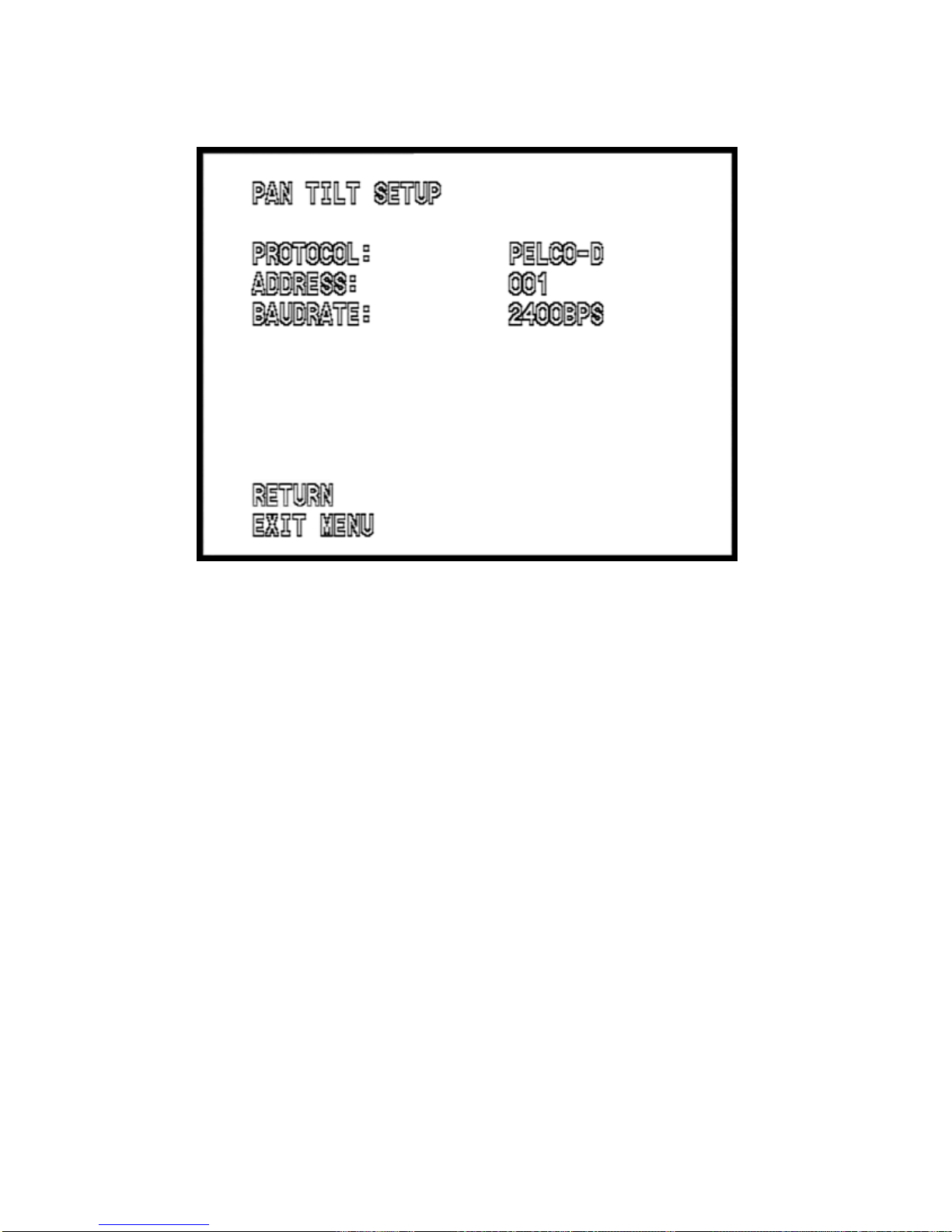
The PROTOCOL SETUP menu will display:
Use the UP & DOWN buttons to select a parameter to change and use
the LEFT & RIGHT buttons to change the value. Then use the DOWN
button to highlight EXIT MENU and press OPEN to exit the menu.
NOTE:
The moment this menu is exited, the new settings will take place
and the PTZ controller will not operate the camera until it is set to
match the new settings of the camera.
NOTE:
9600 baud is only recommended for very short cable runs; 30 ~ 40 ft
or less. For best overall PTZ operation, it is strongly recommended
to use a baud rate of 2400 bps.
Page 9

9
6.0 On Screen Display (OSD) Menus
This camera employs an on screen display system to facilitate
making changes to the camera’s settings.
The OSD is accessed by using the IRIS OPEN button (sometimes
labeled “OPEN” or “IRIS +”) of a Pelco D-compliant PTZ controller
or by using the controller to CALL preset 95.
When the menu appears it will display the MAIN MENU page:
The menu is navigated by using the UP & DOWN PTZ buttons to
move up and down through the menu, the RIGHT & LEFT buttons
to change values and the OPEN button to enter a sub-menu or
select a function such as EXIT MENU.
Page 10
10
6.1 CAMERA SETUP MENU
From the MAIN MENU, use the DOWN button to highlight
CAMERA SETUP and use the OPEN button to access the
CAMERA SETUP menu.
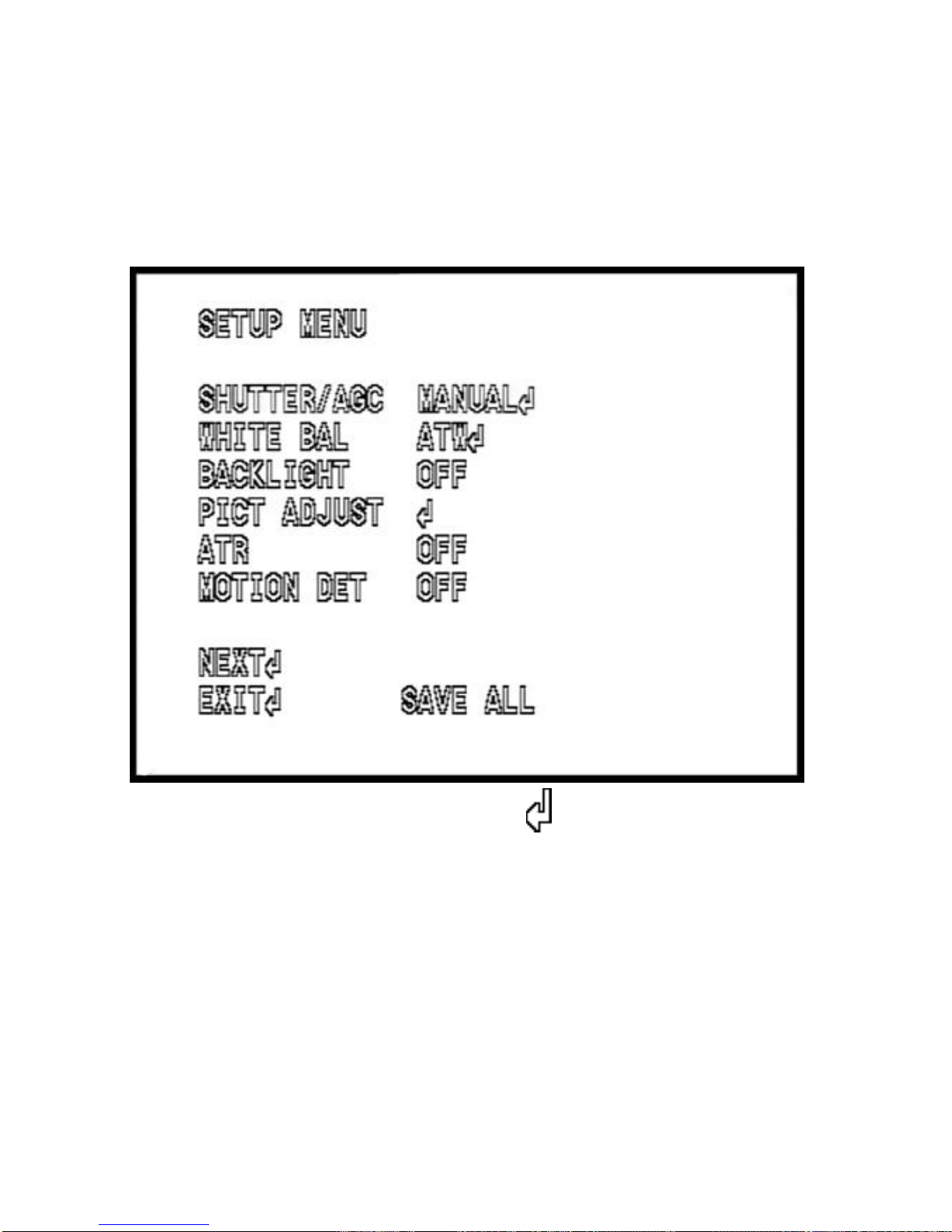
The first page of two CAMERA SETUP menu pages will display:
Some menu options will have an arrow indicating that a submenu is available. To access a sub-menu, highlight the menu item
and press OPEN.
From this page of the CAMERA SETUP MENU, highlight
SHUTTER / AGC to access the SHUTTER and Auto Gain Control
functions, which control how the camera will react to various
lighting conditions. Press OPEN to enter the sub-menu.
There are 2 different sub menus depending on whether this is set
to MANUAL or AUTO.
Page 11
11
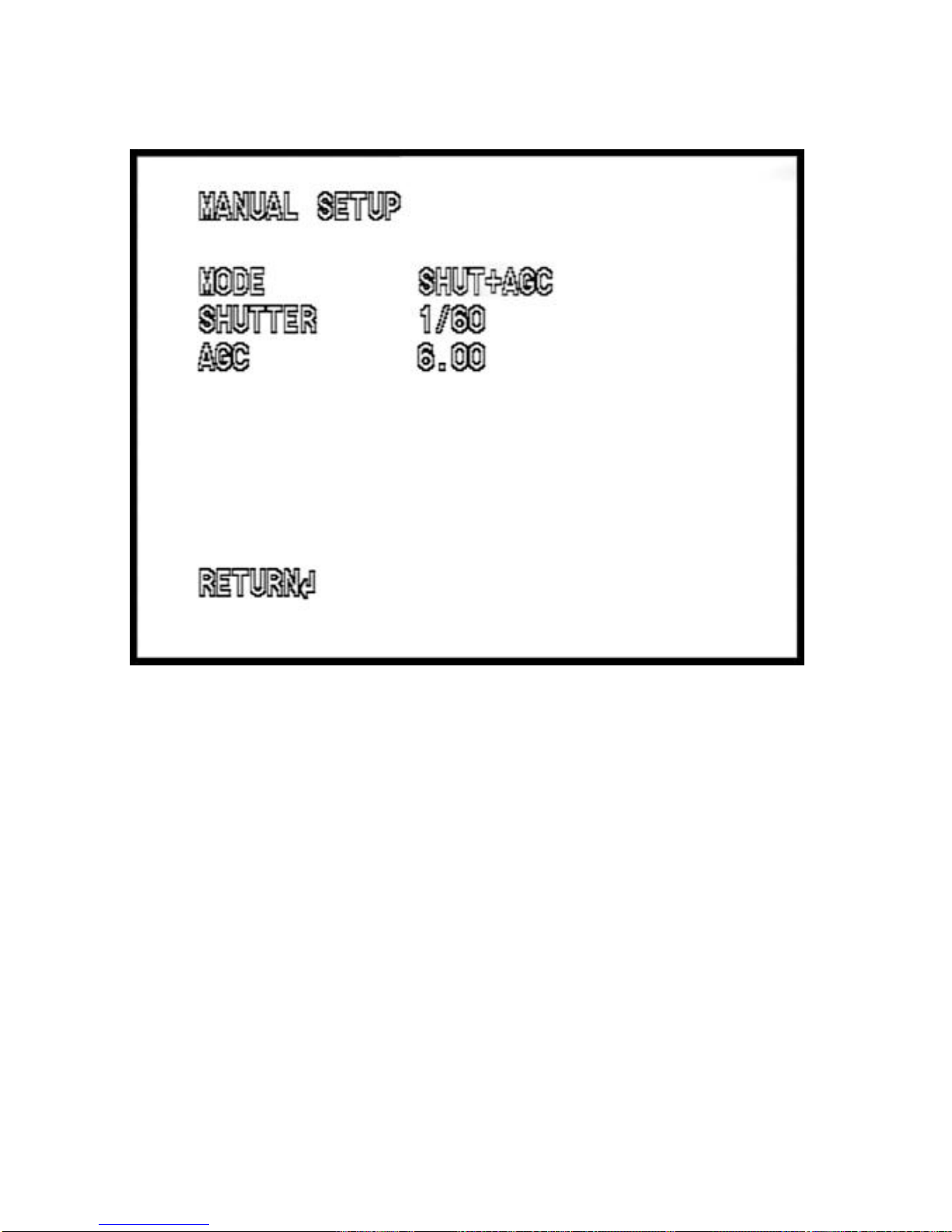
The SHUTTER / AGC MANUAL sub menu will display:
Use the UP, DOWN, LEFT & RIGHT buttons to navigate to the
desired function and change the setting, then navigate to RETURN
and press OPEN to return to page 1 of the CAMERA SETUP
MENU.
NOTE:
Manual setup of the shutter and AGC functions is only
recommended for extremely bright or dark conditions where
the light levels are consistent. In most cases using the AUTO
shutter and AGC settings is preferred.
Page 12

12
To use AUTO shutter settings, change the SHUTTER / AGC
setting to AUTO and press OPEN to enter the AUTO SHUTTER
sub menu:
The SHUTTER / AGC AUTO sub menu will display:
Use the UP, DOWN, LEFT & RIGHT buttons to navigate to the
desired function and change the setting, then navigate to RETURN
and press OPEN to return to page 1 of the CAMERA SETUP
MENU.
Page 13

13
6.2 WHITE BAL (white balance) MENU
From page 1 of the CAMERA SETUP MENU, highlight WHITE
BAL to access the white balance functions, which affects how the
camera will reproduce colors
There are 6 modes of white balance operation and 4 of the 6
choices have sub menus. USER 1 and USER 2 sub menus are
identical in operation:
MANUAL
ATW
USER 1
USER 2
Use the LEFT & RIGHT buttons to select the desired white
balance mode and press OPEN to enter the sub-menu.
WHITE BALANCE MANUAL MODE:
Page 14

14
Use the LEFT & RIGHT buttons to change the WB LEVEL, then
select RETURN and press OPEN to return to the CAMERA
SETUP MENU page 1.
WHITE BALANCE ATW MODE:
Use the LEFT & RIGHT buttons to change the SPEED, DELAY,
ATW FRAME and EBVIRONMENT parameters, then select
RETURN and press OPEN to return to the CAMERA SETUP
MENU page 1.
NOTE:
In most cases using the default values of the ATW settings is
preferred.
Page 15

15
WHITE BALANCE USER 1 & USER 2 MODE:
The USER 1 and USER 2 menus are identical in operation and
provide the same settings as ATW.
Use the LEFT & RIGHT buttons to change the SPEED, DELAY,
ATW FRAME and EBVIRONMENT parameters, then select
RETURN and press OPEN to return to the CAMERA SETUP
MENU page 1.
Page 16

16
6.3 BACKLIGHT
From page 1 of the CAMERA SETUP MENU select BACKLIGHT
and use the LEFT & RIGHT buttons to choose:
OFF – No backlighting compensation is used.
BLC – Backlighting compensation is used. The intensity of
bright areas is reduced and the gain is increased for dark
areas to bring more definition to foreground objects when
there is a bright light present in the background.
HLC – bright areas are “blacked out” to prevent
oversaturation of the camera image.
6.4 PICT (picture) ADJUST
From page 1 of the CAMERA SETUP MENU select PICT ADJUST
and press OPEN to enter the sub menu.
The PICTURE ADJUST MENU will display:
Page 17

17
Use the UP, DOWN, LEFT & RIGHT buttons to select and change
the MIRROR, BRIGHTNESS, CONTRAST, SHARPNESS, HUE
and GAIN parameters, then select RETURN and press OPEN to
return to the CAMERA SETUP MENU page 1.
NOTE:
The MIRROR function flips the camera’s image horizontally to
produce a “mirror image” of the actual camera view.
6.5 ATR (Adaptive Tone Reproduction)
From page 1 of the CAMERA SETUP MENU select ATR. If ATR is
set to ON a sub menu will become available. Press OPEN and the
ATR sub menu will display:
The ATR function provides gradation compensation to improve the
contrast of subjects whose gradation has been lost in cases
Page 18

18
where, for instance, both low-luminance areas and high-luminance
areas exist in the same picture.
Use the UP, DOWN, LEFT & RIGHT buttons to select and change
the LUMINANCE and CONTRAST parameters, then select
RETURN and press OPEN to return to the CAMERA SETUP
MENU page 1.
6.6 MOTION DET (motion detection)
The Motion Detection feature is not implemented on this camera
model.
6.7 CAMERA SETUP MENU PAGE 2
From page 1 of the CAMERA SETUP MENU select NEXT and
CAMERA SETUP MENU page 2 will display:
Page 19

19
6.8 PRIVACY
The PRIVACY feature is not implemented on this camera model.
6.9 DAY / NIGHT
From page 2 of the CAMERA SETUP MENU select DAY / NIGHT.
Use the LEFT & RIGHT buttons to choose one of 3 modes:
COLOR
AUTO
B/W
When set to COLOR, the camera is forced into color mode at all
times, regardless of lighting conditions.
The AUTO and B/W options each have a sub menu.
To use AUTO operation, choose AUTO then press OPEN and the
DAY / NIGHT AUTO sub menu will display:
Page 20

20
NOTE:
In most cases using the default values of the DAY / NIGHT
AUTO settings is preferred.
Use the UP, DOWN, LEFT & RIGHT buttons to select and change
the 4 available parameters, then select RETURN and press OPEN
to return to the CAMERA SETUP MENU page 2.
6.10 DAY / NIGHT
From page 2 of the CAMERA SETUP MENU select
To use B / W operation, choose B / W then press OPEN and the
DAY / NIGHT B / W sub menu will display:
Use the UP, DOWN, LEFT & RIGHT buttons to select either ON or
OFF for the BURST parameter, then select RETURN and press
OPEN to return to the CAMERA SETUP MENU page 2.
Page 21

21
6.11 NR (Noise Reduction)
From page 2 of the CAMERA SETUP MENU select NR and press
OPEN. The NR sub menu will display:
Use the UP, DOWN, LEFT & RIGHT buttons to select either Y, C,
Y&C or OFF for the NR parameter, then Adjust the Y and/or C
levels for the best picture. Select RETURN and press OPEN to
return to the CAMERA SETUP MENU page 2.
Page 22

22
6.12 CAMERA ID
From page 2 of the CAMERA SETUP MENU select CAMERA ID
and select either NO for the camera to not display a name, or ON
to display a name. To ENTER a name, select ON and press OPEN
to display the CAMERA ID sub menu:
position the cursor and select characters. Press OPEN to set each
character in the name, then select RETURN and press OPEN to
return to the CAMERA SETUP MENU page 2.
Page 23

23
6.13 LANGUAGE
From page 2 of the CAMERA SETUP MENU move the cursor to
LANGUAGE and use the LEFT & RIGHT buttons to select a
language for the camera’s OSD. Choices include ENGLISH,
FRENCH, SPANISH, RUSSIAN, etc.
When finished, select RETURN and press OPEN to return to the
CAMERA SETUP MENU page 2.
6.14 CAMERA RESET
This function will reset all CAMERA MODULE functions back to
the factory default settings. This is useful if many parameters have
been changed and the user wishes to get a ‘fresh start’ for minor
adjustments.
This function only resets the camera module, which all functions in
sections 6.1 through 6.12 above. This will NOT reset an tour or
preset information. To reset the movement functions of the
camera, please see section XXXXX below.
To reset the camera module: From page 2 of the CAMERA
SETUP MENU move the cursor to CAMERA RESET. Press OPEN
to begin the reset. This will take several seconds to complete and
the OSD will display the status of the reset.
NOTE:
This function ERASES ALL SETTING MADE BY THE USER TO
THE CAMERA MODULE. All camera settings must be
manually set up again.
Page 24

24
7.0 FOCUS SETUP MENU
From the MAIN MENU, use the DOWN button to highlight FOCUS
SETUP and use the OPEN button to access the FOCUS SETUP
menu.
The FOCUS SETUP menu page will display:
Use the UP & DOWN buttons to select FOCUS TYPE and use the
LEFT & RIGHT buttons to select either AUTO or MANUAL for the
focus mode.
NOTE:
“AUTO” is the factory default and it is the recommended
setting for this parameter. Manual focus would require the
operator to manually focus the lens on each object when the
camera changes positions.
Page 25

25
7.1 AF (Auto Focus) AFTER MOVE
When set to ON, this causes the lens to enact an automatic focus
adjustment each time the camera is moved to a new view or when
the zoom level changes.
When set to OFF, the camera will retain whatever focus setting it
had previous to the move or zoom level change.
7.2 PRESET LOAD ZOOM
When set to ON, recalling a preset on the camera will set the
camera to the PAN position, TILT position and ZOOM level stored
within that preset.
When set to OFF, recalling a preset on the camera will set the
camera to the PAN position and TILT position stored within that
preset, but will ignore the ZOOM level stored in the preset.
7.3 AUTO CHECK FOCUS
When set to ON, the camera will periodically check the focus
status and re-focus if needed. The period of time is set in the
AUTO CHECK TIME parameter (# 7.3 below). In order for this to
work, the focus mode must be set to AUTO (# 7.0 above).
7.4 AUTO CHECK TIME
This is the amount of time, measured in seconds, that the camera
will wait after receiving a command before it will check the focus
status. It is adjustable from 0 thru 255 seconds.
7.5 DISPLAY ZOOM TIMES
When set to ON, the camera will show the zoom multiplication in
the OSD, superimposed over the video; e.g. 1X, 4X etc up to 12X
optical zoom.
Page 26

26
8.0 PAN TILT SETUP
From the MAIN MENU, use the DOWN button to highlight PAN
TILT SETUP and use the OPEN button to access the sub menu.
The PAN TILT SETUP menu page will display:
8.1 PAN TILT PRESET
Use the UP & DOWN buttons to select PAN TILT PRESET and
use the LEFT & RIGHT buttons to select either NORMAL, FAST or
EXACT for the preset mode. NORMAL will cause the camera to
move normally from preset to preset as they are called, either
manually or in a tour (pattern). FAST will cause the camera to
move from preset to preset at the fastest rate it can move, which
may cause it to land slightly off of the preset’s original position.
EXACT will cause the camera to double-check its position once it
arrives at a preset. This gives the most accurate positioning but
takes a second or two longer per preset.
Page 27

27
8.2 TILT LIMIT SET
Tilt limit will set a specific point, beyond which the camera will not
tilt.
To enable a tilt limit, first exit the menu and use the PTZ controller
to set the camera to the vertical height (tilt) to be used as the limit.
Enter the camera menu and use the DOWN button to highlight
PAN TILT SETUP, then TILT LIMIT SET. Press the OPEN button
to set the current tilt position as the tilt limit. To remove the tilt limit,
use the next function described in # 8.2 TILT LIMIT RESET, below.
8.3 TILT LIMIT RESET
This function removes any tilt limit was set in the previous step
above. Use the UP & DOWN buttons to select TILT LIMIT RESET
and press the OPEN button to remove the tilt limit.
8.4 PAN TILT LIMIT SPEED
The number set for this parameter will determine the maximum
speed at which the camera can move (pan or tilt). This can be
useful if the PTZ controller being used does not have the ability to
control the camera at lower speeds. The value ranges from 1 ~ 63,
with 63 being 100% full speed operation.
8.5 ZOOM LIMIT SPEED
The number set for this parameter will determine the maximum
speed at which the camera’s lens can zoom. The value ranges
from 1 ~ 63, with 63 being 100% full speed operation. 63 is the
recommended setting.
Page 28

28
9.0 PATTERN SETUP
From the MAIN MENU, use the DOWN button to highlight
PATTERN SETUP and use the OPEN button to access the sub
menu.
The PATTERN SETUP menu page will display:
9.1 PATTERN TOUR
Use the UP & DOWN buttons to select PATTERN TOUR and use
the LEFT & RIGHT buttons to set it to either START or STOP.
When set to START, upon exiting the menu the camera will begin
its tour, according to the settings of PATTERN POINT NUM and
PATTERN DWELL TIME, #’s 9.2 and 9.3 below.
When set to STOP, the camera will stop running its tour when the
menu is exited.
Page 29

29
9.2 PATTERN POINT NUM
Pattern point number sets the highest preset number which the
tour will include. The tour will only include preset numbers from 1
through 32 which have been stored into the camera.
Example 1: If presets 1, 2 and 3 have bet set and stored in
the camera and the PATTERN POINT NUMBER has been set to
any number equal to “3” or higher, the tour will use preset points 1,
2 and 3. If the PATTERN POINT NUMBER is set to “2”, the tour
will only include presets 1 & 2.
Example 2: If presets 2, 7 and 10 have bet set and stored
in the camera and the PATTERN POINT NUMBER has been set
to any number equal to “10” or higher, the tour will use preset
points 2, 7 and 10 and ignore all other presets from 1 thru 10
which have not been set. If the PATTERN POINT NUMBER is set
to “8”, the tour will only include presets 2 & 7.
Use the UP & DOWN buttons to select PATTERN POINT
NUM and use the LEFT & RIGHT buttons to set it to the desired
preset number.
9.3 PATTERN DWELL TIME
Pattern dwell time sets the amount of time in seconds that the
camera will stay at each preset of the tour before moving on to the
next preset. It is adjustable from 5 to 255.
Use the UP & DOWN buttons to select PATTERN DWELL
TIME and use the LEFT & RIGHT buttons to set it to the desired
dwell time.
Page 30

30
9.4 AUTO RETURN HOME
Use the UP & DOWN buttons to select AUTO RETURN HOME
and use the LEFT & RIGHT buttons to set it to either START or
STOP. When set to START, the camera will be enabled to return
to a user-selected home point after a lack of user input determined
by HOME DWELL TIME described in # 9.5, below.
When set to STOP, the camera will not return to its home point.
9.5 HOME DWELL TIME
This is the amount of time, in seconds, that the camera will wait
after receiving its last PTZ command before returning to the userselected HOME point. The home point is set using # 9.6 HOME
POINT SETUP, below.
Use the UP & DOWN buttons to select HOME DWELL
TIME and use the LEFT & RIGHT buttons to set it to the desired
dwell time.
9.6 HOME POINT SETUP
To set the HOME POINT position for the camera, exit the menu
and use the PTZ controller to direct the camera to view the point
which you would like to be the HOME POINT.
Re-enter the menu, and navigate back to this parameter, then
press OPEN to lock in the current camera view as the HOME
POINT.
Page 31

31
10.0 PROTOCOL SETUP
NOTE: This menu is used instead of DIP switches to set the
communication parameters for the camera. After making a change
and exiting the menu, the controller must be set to match the
camera before PTZ control can be regained.
From the MAIN MENU, use the DOWN button to highlight
PROTOCOL SETUP and use the OPEN button to access the sub
menu.
The PROTOCOL SETUP menu page will display:
9.1 PROTOCOL
Use the DOWN button to select PROTOCOL. Use the LEFT &
RIGHT buttons to select either PELCO-D or PELCO-P. All
SecurityTronix PTZ controllers use the PELCO-D protocol. Check
the owner’s manual of your PTZ controller to determine if it is
compatible with either the PELCO-D or PELCO-P protocols. These
are the only 2 control protocols this camera model supports.
Page 32

32
9.2 ADDRESS
Use the DOWN button to select ADDRESS. Use the LEFT &
RIGHT buttons to select an address for the camera. The range is 1
thru 255.
9.3 BAUDRATE
Use the DOWN button to select BAUDRATE. Use the LEFT &
RIGHT buttons to select a baud rate for the camera. The choices
are:
1200
2400
4800
9600
NOTE: When using lower baud rates, longer cables can be used for
PTZ control, at the expense of slower data throughput. For this
reason, SecurityTronix recommends using a baud rate of 2400 for
most installations.
Page 33

33
11.0 RESET MENU SETUP
NOTE: Using these reset commands will delete all user-entered
settings in the camera and return it to the factory-default settings.
This is useful for getting back to square one with the settings rather
than undo all settings one by one, but it will erase ALL user settings
in one operation. Use caution when resetting the camera back to
factory settings. All user-entered presets, tour and preferences will
be reset.
From the MAIN MENU, use the DOWN button to highlight RESET
MENU SETUP and use the OPEN button to access the sub menu.
The RESET MENU SETUP menu page will display:
11.1 RESET MENU SETUP
This function resets all values of all menus to the factory original
settings. This is useful if the camera is doing something unusual
and it would be too difficult to go through all pages of the menus to
Page 34

34
check and/or reset the settings. This will not erase any presets
which were stored in the camera. Use the DOWN button to select
RESET MENU SETUP. Press OPEN to initialize the reset
procedure. The OSD will prompt that the operation is proceeding
and when it is complete.
11.2 FACTORY DEFAULT SET
This function resets all values of all menus to the factory original
settings AS WELL as erase all presets and tour settings which
were stored in the camera. This is useful if the camera is doing
something unusual and it would be too difficult to go through all
pages of the menus to check and/or reset the settings. Use the
DOWN button to select FACTORY DEFAULT SET. Press OPEN
to initialize the reset procedure. The OSD will prompt that the
operation is proceeding and when it is complete.
SET PRESET POINT NUMBERS
Preset #
Function
1 ~ 32
Set preset points 1 through 32
CALL PRESET POINT NUMBERS
1 ~ 32
Go to Preset Points 1 through 32
CLEAR PRESET POINT NUMBERS
1 ~ 32
Clear preset points 1 through 32
Page 35

35
6. TROUBLESHOOTING
a. No picture after applying power – (i) check all plugs and
cables are connected to the proper connectors: (ii) ensure
your power supply is providing the correct voltage and
enough current.
b. The picture has ripples – (i) Check to see if the power
supply is experiencing AC ripple. If so, a filter may be
required. (ii) Determine if the monitor is faulty. (iii)
Determine if other peripheral equipment is causing the
ripple and if so make the necessary adjustments.
c. The picture background continuously changes color – A
fluorescent lamp’s magnetic field may cause color roll. If
possible, increase the distance between the camera and
any fluorescent lamps in the vicinity.
d. The picture appears smeared – (i) The power supply
voltage level may be unstable. Try another power supply.
(ii) Ensure the cables are correctly connected and of the
right impedance.
e. Other interference may require the use of a SecurityTronix
ground loop isolation filter.
f. Power is on but the controller does not work – (i) Check to
make sure the DIP switches are all set correctly for
address, baud rate and protocol. (ii) Check that the RS485
wires at the camera and controller have correct polarities.
(iii) Check the integrity and continuity of the Unshielded
Twisted Pair (UTP) cable.
Additional troubleshooting assistance can be found online at
www.securitytronix.com or email us at support@securitytronix.com or call
800 688-9282
 Loading...