

Page 1
INSTRUCTIONS FOR: FOLDING ENGINE
CRANE PREMIER 2 TONNE
MODEL No: SPC2000
Thank you for purchasing a Sealey product. Manufactured to a high standard, this product will, if used according to these
instructions, and properly maintained, give you years of trouble free performance.
IMPORTANT: PLEASE READ THESE INSTRUCTIONS CAREFULLY. NOTE THE SAFE OPERATIONAL REQUIREMENTS, WARNINGS & CAUTIONS. USE THE PRODUCT
CORRECTLY AND WITH CARE FOR THE PURPOSE FOR WHICH IT IS INTENDED. FAILURE TO DO SO MAY CAUSE DAMAGE AND/OR PERSONAL INJURY AND WILL
INVALIDATE THE WARRANTY. KEEP THESE INSTRUCTIONS SAFE FOR FUTURE USE.
Refer to
instruction
manual
1. CONTENTS
Section 2. General. ....................................1.
Section 2.1. Identification .................................1.
Section 2.2. Technical Data. ...............................1.
Section 3. Safety / Operational Instructions. .................2.
Section 4. Maintenance / Examination / Inspection. ...........2.
Section 5. Assembly and storage. .........................3.
Section 6. Owner’s & Operator’s Responsibilities .............3.
Section 7. Declaration of Conformity. ......................4.
Section 8. Parts List / Diagram ...........................5.
2. GENERAL
2.1. Identification
Supplier: Sealey Power Products,
Kempson Way,
Suffolk Business Park,
Bury St Edmunds,
Suffolk, IP32 7AR.
Model No: SPC2000
2.2. Technical Data
Rated Capacity
Safe Working Load (SWL) 2tonne (tested to 50% overload).
Working Load Limit (WLL) 2tonne (tested to 50% overload).
Lifting Cap. in Position 1: ..............2000kg
Lifting Cap. in Position 2: ..............1700kg
Lifting Cap. in Position 3: ..............1500kg
Weight ............................ 150kg
a) Design Capability: Test Load 50% overload.
b) For a description of in-service and out-of-service conditions see
section 3 Safety, Section 4 Maintenance and Section 6.
c) The crane is fitted with a bypass valve that will prevent the ram
from over extending.
d) For applications see Section 3 Safety.
e) For control system, see Fig.1 for release valve and pump handle
assy. Usage is explained in Section 3.2 Operation.
f) For ground condition requirements, see Section 3 Safety.
g) For information on parts and materials requiring specialised
repair techniques see Section 4 Maintenance.
Wear
safety
footwear
Wear
protective
gloves
Page No.
fig.1
PUMP HANDLE ASSY.
© Jack Sealey Limited
Original Language Version
Page 1
RELEASE VALVE
SPC2000 Issue: 4 - 06/02/17
Page 2

3. SAFETY/OPERATING INSTRUCTIONS
3.1. SAFETY
3 Keep crane, lifting slings, support and beams in good working order and condition. Follow the inspection requirements as
described in Section 4 page 2 Maintenance. Take immediate action to repair or replace damaged parts by contacting your
supplier. Ensure that all accessory lifting devices are suitable. If crane is damaged, remove from service immediately.
3 Ensure the surface on which the crane is used is level, firm and capable of supporting the weight of the crane with maximum
load - we recommend concrete. Never use the crane on tarmacadam or other soft surfaces.
3 Ensure the crane legs and arms are locked before use.
3 Keep children and unauthorised persons away from the working area.
3 Keep working area clean and tidy, free from unrelated materials and ensure that there is adequate lighting.
3 Ensure that load does not exceed the maximum lifting capacity of the crane. Overloading the crane is dangerous. Where appropriate,
use only the lifting points recommended by the manufacturer of the item to be lifted, e.g. vehicle engine.
3 Before lifting the load ensure that the crane jib is in the lowest practical position, that there are no obstacles which may snag the
load whilst it is being lifted and that the area above the jib is clear.
3 To avoid injury, be fully aware of your own and other persons locations in relation to the lifting, and lowering, of the load.
3 Keep a sound footing and balance, and ensure the floor is not slippery.
3 Ensure jib extension locking bolt and nut are in position before lifting.
3 Ensure the centre of gravity always remains inside the crane base.
7 DO NOT harness the load at an angle or use any attachments not verified as fit for purpose.
7 DO NOT allow the load to swing during lifting.
7 DO NOT allow the load to drop suddenly. Lower load with care, ensuring that you are fully aware of the condition of the surface onto
which the load is to be placed.
7 DO NOT load crane beyond its rated capacity for each specified jib extension position as indicated in Section 2 page 1.
The capacity of the crane reduces as the jib is extended.
7 DO NOT position any part of your body beneath the load.
7 DO NOT use the crane to move or transport a load other than for repositioning (see 3.2.f). The crane is a lifting device only.
7 DO NOT apply any sideways pressure to any part of the crane during lifting or when a load is suspended.
7 DO NOT attempt to adjust the safety valve, which has been set and sealed by the manufacturer.
7 DO NOT use this product to perform a task for which it is not designed.
7 DO NOT use whilst under the influence of drugs, alcohol or intoxicating medication.
7 DO NOT climb on the crane.
3 When not in use fold the crane down and store in a safe, dry, childproof area.
3 This crane is designed for lifting within a garage or workshop environment.
WARNING! Failure to heed safety and warning instructions may result in damage and/or personal injury and will invalidate the warranty.
NOTE: ENSURE YOU HAVE READ AND UNDERSTOOD THE SAFETY INSTRUCTIONS AT THE BEGINNING OF THIS SECTION BEFORE YOU OPERATE THE CRANE.
3.2 OPERATION. (Refer to Section 4.2 (a) regarding inspection before each and every use).
a) Use the pump handle recess to tighten the release valve, turning firmly clockwise. Note the pump can be swivelled through 300° for
ease of use.
b) Place handle into pump socket and pump, the jib will raise. Continue to pump until the jib reaches the height at which the load can be secured.
c) Connect the crane hook to the load using a suitable sling or support beam. Ensure you are aware of the load weight, and check
that it is within the capacity of the crane (at the jib extension you are using) and the sling or support beam. When removing engines
ensure you know the weight. Use only the lifting points recommended by the vehicle manufacturer.
d) Lift only from directly above the load. WARNING! DO NOT LIFT THE LOAD AT AN ANGLE!
e) To lower load, position handle on release valve at base of ram and turn VERY SLOWLY anti-clockwise avoiding any sudden movement.
WARNING! DO NOT allow the load to drop suddenly.
f) The crane is not a transportation device but may be used to reposition the load being worked on. To do so, lower load and jib
with care, to the lowest possible point before attempting to move. DO NOT try to move crane in a sideways direction. The crane is
not designed to support the load indefinitely. When you have repositioned the load, lower the load onto a secure and
appropriate working base, being fully aware of your own and other persons locations in relation to the lowering load.
g) When load has been secured, remove lifting sling, support beam etc. and place crane in a safe location with lifting beam fully lowered.
4. MAINTENANCE / EXAMINATION / INSPECTION
NOTE: The crane MUST be kept clean and dry and must be maintained in accordance with these instructions.
4.1. Lubrication.
a) Oil all working parts monthly.
b) The ram is filled with oil and should only require occasional topping up. For the occasional top up DO NOT use brake fluid, as this will
damage the hydraulic seals. Proceed as follows:
1) Use only good quality hydraulic jack oil available from your supplier.
2) DO NOT OVERFILL as this will cause failure, with ram in lowered position remove rubber bung located on the ram and top up to
just below the filling hole. Replace rubber bung.
3) After filling with hydraulic oil, pump the crane up to full height and pour off any excess oil.
4.2. Inspection and Examination of Crane Before Use.
a) Before each use of the crane you must perform an inspection for leaks, damage, loose or missing parts.
b) The workshop crane must be examined immediately if it has been subject to an abnormal load or shock. It is recommended that such
an examination is made by an authorised service agent.
c) The owner and/or operator must be aware that repair of this equipment will require specialised knowledge and facilities.
It is recommended that an annual examination of the workshop crane is made by an authorised service agent.
d) Unauthorised parts may be dangerous and will invalidate the warranty.
Note! Please see the Definition of ‘inspection’ and ‘examination’ below.
Inspection:
Looking at the crane for defects and checking the operation of the controls, limiting and indicating devices without loading the crane.
This is more than a check but does not normally require any part of the crane to be dismantled other than removal or opening of
covers or housings.
Examination:
Verification that the crane can safely continue in service including a functional test of all safety devices i.e. limiting, indicating
equipment, brakes, clutches, safety valves etc to verify that they operate within the required tolerances. An examination is more
thorough than an inspection.
© Jack Sealey Limited
Original Language Version
Page 2
SPC2000 Issue: 4 - 06/02/17
Page 3

5. ASSEMBLY / STORAGE INSTRUCTIONS
5.1. ASSEMBLY.
Your crane is delivered assembled but in a folded condition. Before using, it is necessary to lay the folded crane on it’s ‘back’ on the floor and
proceed as follows.
Unpack the product and check contents against the parts list in these instructions. Should there be any damaged or missing parts
contact your supplier immediately. We recommend two people assemble the crane as follows:
a) Lower the crane legs and lock them into place with the pins.
b) Rotate the assembled crane onto its wheels. Ensure the pins are fully engaged and turn to lock in place.
c) Bleed the Hydraulic System: Place the pump handle into the pump socket, open the release valve and pump handle10-15 times
through the full stroke, thus bleeding from the hydraulic system, any air which may have entered during transit.
5.2. STORAGE.
a) Always store the crane fully closed so that the jib is in lowest position and the ram is closed.
b) To save space the legs may be folded into the upright position and secured in place using the Lock Pins.
6. OWNER’S & OPERATOR’S RESPONSIBILITIES
The owner and/or operator shall study these instructions and retain them for future use.
a) Understanding instructions and warnings.
The owner and/or operator shall understand the operating instructions and warnings before operating the crane.
Warning information must be emphasised and understood. If the operator is not fluent in English, the product instructions
and warnings must be read to, and discussed with, the operator in the operator’s native language by the owner, making sure the
operator understands the contents.
b) Damaged Cranes.
Any crane which appears to be damaged, badly worn, or operates abnormally MUST BE REMOVED FROM SERVICE!
It is recommended that necessary repairs be made by an authorised service agent.
c) End of service.
Through years of normal wear, the crane will eventually become unserviceable. When this happens ensure the hydraulic oil is drained
off and disposed of in accordance with Local authority regulations.
Recycle unwanted materials instead of disposing of them as waste. All tools, accessories and packaging should be
Environmental Protection
sorted, taken to a recycling centre and disposed of in a manner which is compatible with the environment.
When the product becomes completely unserviceable and requires disposal, drain off any fluids (if applicable)
into approved containers and dispose of the product and the fluids according to local regulations.
NOTE: It is our policy to continually improve products and as such we reserve the right to alter data, specifications and component parts without prior notice.
IMPORTANT: No liability is accepted for incorrect use of this product.
WARRANTY: Guarantee is 12 months from purchase date, proof of which will be required for any claim.
© Jack Sealey Limited
Sole UK Distributor, Sealey Group,
Kempson Way, Suffolk Business Park,
Bury St. Edmunds, Suffolk,
IP32 7AR
Original Language Version
Page 3
01284 757500
01284 703534
www.sealey.co.uk
SPC2000 Issue: 4 - 06/02/17
Page 4

EC DECLARATION
OF CONFORMITY
Description and Function: ........................................................................................................................................................................
Model/Type: .............................................................................................................................................................................................
Manufacturing Date/Serial Number (optional): ........................................................................................................................................
: 2006/42/EC Machinery Directive
2014/35/EU Low Voltage Directive
2014/30/EU EMC Directive
2009/125/EC Ecodesign Requirements
2009/142/EC Gas Appliance Directive
2014/29/EU Simple Pressure Vessels Directive
Manufacturer’s authorised representative within the EC: Jack Sealey Ltd, Kempson Way, Suffolk Business Park, Bury St
Edmunds, Suffolk. IP32 7AR
Conforms to the requirements of the Directives, as indicated.
And the following harmonised standard(s)
......................................................................................................
SPC1000 v1 & SPC2000 v1
Folding Engine Crane 1tonne & 2tonne
2000/14/EC Noise Emission in the Environment Directive
2012/19/EU WEEE Directive
2011/65/EU RoHS Directive
2014/68/EU Pressure Equipment Directive
89/686/EEC PPE Directive
2014/53/EU RTTE Directive
......................................................................................................
......................................................................................................
......................................................................................................
......................................................................................................
......................................................................................................
......................................................................................................
......................................................................................................
Technical le compiled by: Jack Sealey Ltd
Being the responsible person appointed by the manufacturer.
Signed ...........................................................................................
Date ...............................................................................................
Name .............................................................................................
Position .........................................................................................
26 January 2017
Steve Buckle.
Marketing Director.
......................................................................................................
......................................................................................................
......................................................................................................
......................................................................................................
......................................................................................................
Place: Bury St Edmunds
Sealey Power Products Kempson Way, 01284 757500 01284 703534 [email protected] www.sealey.co.uk
Suffolk Business Park, Bury St Edmunds,
Suffolk. IP32 7AR
© Jack Sealey Limited
Original Language Version
Page 4
SPC2000 Issue: 4 - 06/02/17
Page 5
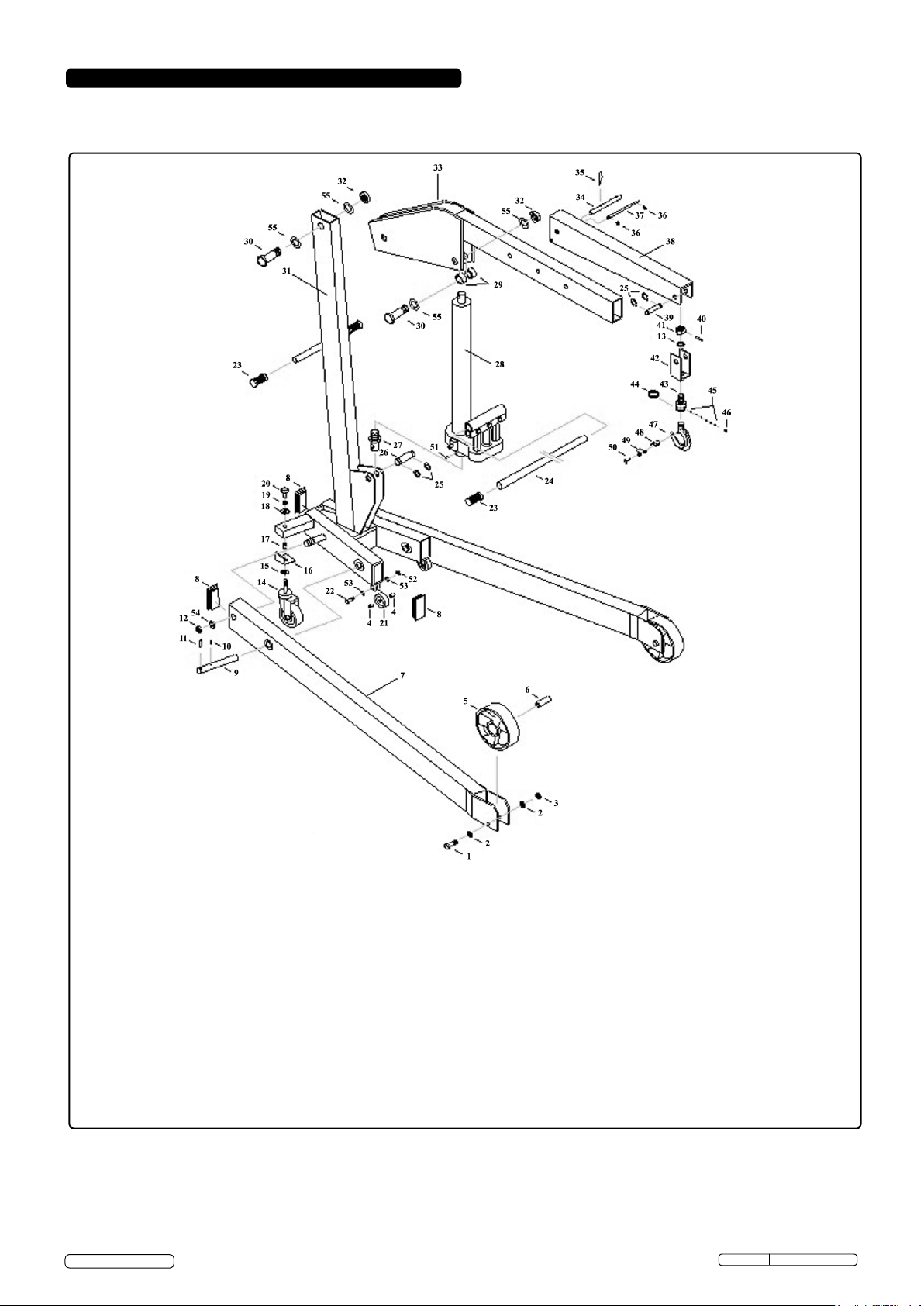
8. PARTS LIST/DIAGRAM
MODEL No: SPC2000
© Jack Sealey Limited
Original Language Version
Page 5
SPC2000 Issue: 4 - 06/02/17
 Loading...