

Page 1
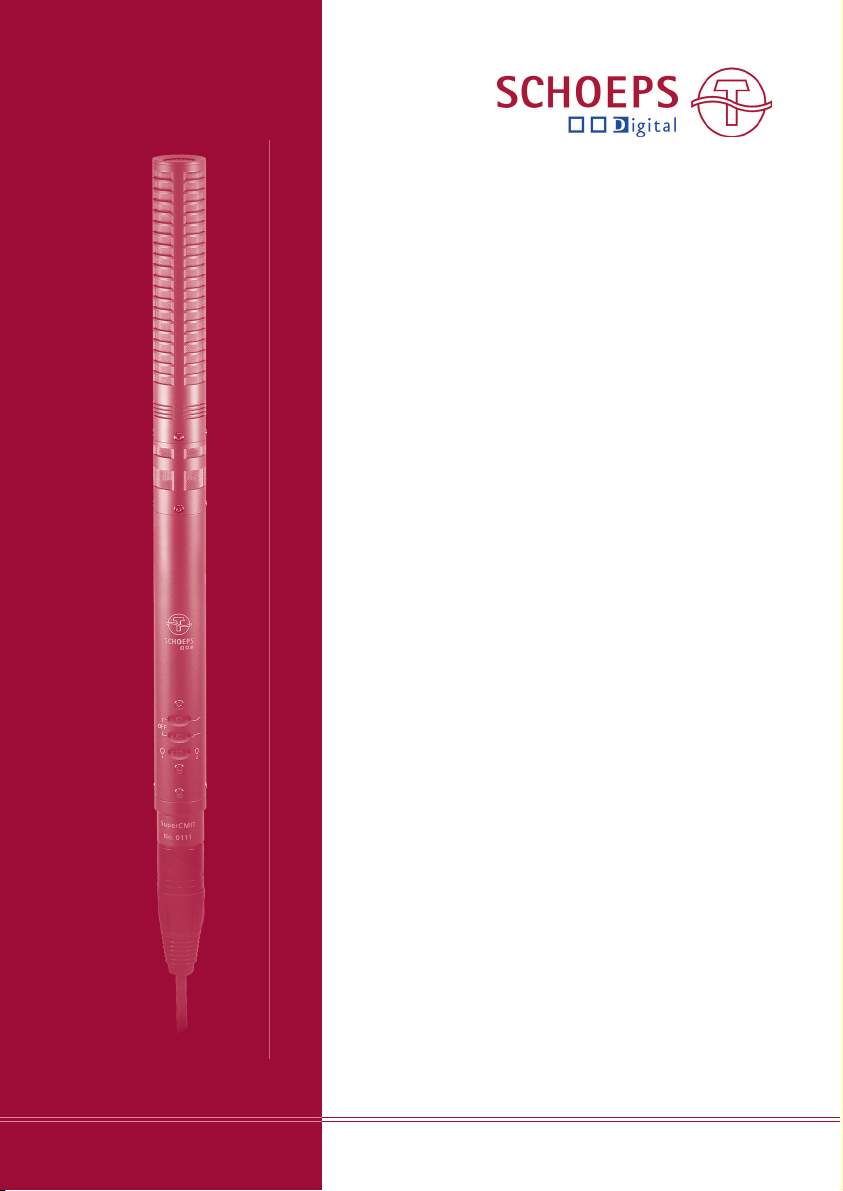
SuperCMIT 2 U
Super-Richtrohr mit DSP
Super Shotgun Microphone with DSP
Bedienungsanleitung
User Guide
- page 11
Inhaltsverzeichnis Seite
Allgemeines 2
Einsatzgebiete 3
Anschließen / Bedienelemente 3
Gain / Limiter 4
Wichtige Hinweise 4
Hinweise zur EMV 5
Pflege und Wartung 5
Technische Daten 6
Firmware-Updates 8
CE-Konformitätserklärung / Garantie 8
Table of Contents page
General 12
Suggested applications 13
Connecting / Operation 13
Gain/ Limiter 14
Important notes 14
EMC 14
Care 15
Technical specifications 16
Firmware-Updates 18
CE conformity / Guarantee 18
Page 2
Sehr geehrter Kunde,
herzlichen Glückwunsch zu Ihrer Entschei dung
für das digitale SuperCMIT 2 U von SCHOEPS,
dem weltweit ersten ”intelligenten” Richtrohr.
Seine Besonderheiten:
– deutlich erhöhte Richt wir kung auch bei
tiefen und mittleren Frequenzen auf der
Grundlage des analogen Modells CMIT 5 U
– außergewöhnlich hohe Unterdrückung von
Diffusschall
– völlig neues Funktionsprinzip auf der Basis
von zwei Schallwandlern (Mikrofonkapseln)
– nutzt zum Patent angemeldete DSP*-Algo -
rith men von ILLUSONIC
– zweikanaliger Ausgang: SuperCMIT auf
Kanal 1 und unbearbeitetes Richtrohr-Signal
auf Kanal 2
– SCHOEPS-Klangqualität: transparenter Klang
trotz hoher Richtwirkung
*digitaler Signalprozessor
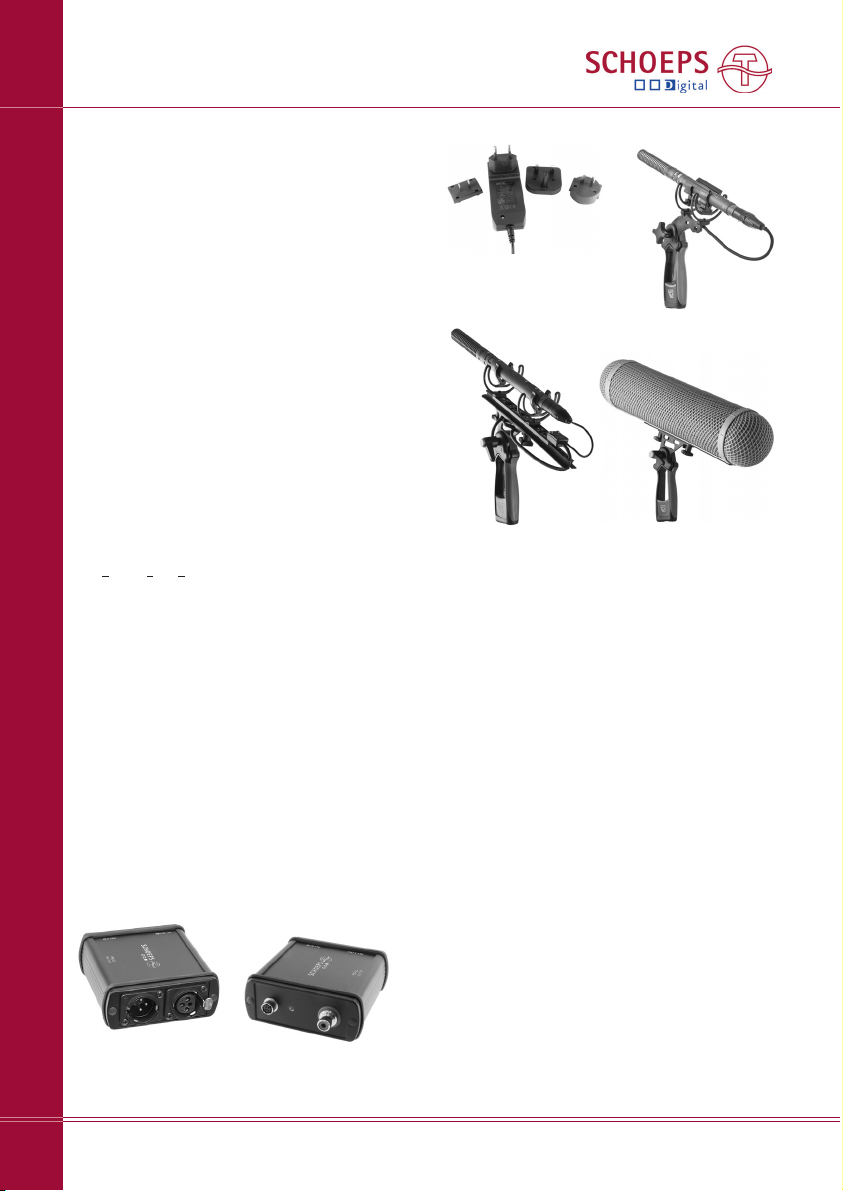
Mitgeliefertes Zubehör:
Holzetui, Stativgelenk SG 20, Schaumstoff wind schutz W 170 (für mäßigen Wind und
Schwenk bewegun gen)
Zusätzlich erhältlich:
PSD 2U: Speisebox für digitale Phantom spei -
sung (DPP, 10V) mit XLR- und Cinch-Aus gängen, inklusive Netzadapter mit 4-PinHirose-Stecker
Mount & Handle: elastische Aufhängung mit
Pistolengriff;
Windschutzkorb WSR CMIT mit Windjammer
(gegen kräftigen Wind)
Die Technik
Das SuperCMIT 2 U besitzt zwei akustische
Wandler (Mikrofonkapseln): einen am Ende des
nach vorne gerichteten Interferenzrohrs und
einen mit Nieren-Charak te ristik in Gegen rich tung. Bei Frequen zen unterhalb von 6kHz
werden die beiden Mikrofon signale mit Hilfe
des eingebauten DSPs und einer exklusiv eingesetzten, zum Patent angemeldeten Techno logie von ILLUSONIC analysiert. Der DSP erkennt
aus verschiedenen Rich tungen eintreffenden
diskreten Schall, die Beständigkeit seiner Rich tung und diffus aus allen Rich tun gen kommenden Schall. Diese Informationen werden dazu
genutzt, diskreten Schall zu fokussieren und
diffusen auszublenden. Bei Frequenzen oberhalb von 6kHz wird ausschließlich das Signal
des Interferenzrohrs verwendet, da dieses hier
bereits optimal wirkt.
Durch diese Technik kann die Reich weite
des Richt rohrs deutlich erhöht werden, und
zwar ohne die typischen Arte fakte in der Klangfarbe. Das SuperCMIT ist daher weltweit das
erste Mikrofon, das eine derartig hohe Richt wir kung mit hoher Klangqualität verbindet.
SCHOEPS GmbH · Spitalstr. 20 · D-76227 Karlsruhe (Durlach) · Tel: +49 721 943 20-0 · Fax: +49 721 943 2050
www.schoeps.de · [email protected]
Allgemeines
2
Deutsch
Netzadapter für
PSD 2 U
Mount & Handle
Windschutzkorb WSR CMIT
PSD 2U
Page 3
SCHOEPS GmbH · Spitalstr. 20 · D-76227 Karlsruhe (Durlach) · Tel: +49 721 943 20-0 · Fax: +49 721 943 2050
www.schoeps.de · [email protected]
Einsatzgebiete / Anschließen / Bedienelemente
3
Deutsch
Das Kabel
Es sollte ein XLR-3-Kabel nach AES3-Norm
mit einer Impedanz von 110Ω verwendet werden. Nur dann ist der Betrieb des Mikrofons
auch bei Längen bis ca. 300m möglich.
Auch übliche analoge XLR-Kabel können
verwendet werden. Ihre Impe danz ist jedoch
nicht definiert. Das Funk tionieren der Übertra gung kann daher – insbesondere bei größe ren
Längen – nicht garantiert werden.
Einschaltverhalten
Unmittelbar nach dem Einschalten ist das
Super CMIT nicht gleich betriebsbereit, d.h. es
nimmt keine Außengeräusche auf. Statt dessen sind typische Eigengeräusche hörbar, die
variieren und unterschiedlich lang anhalten
(bis ca. 15 Sekunden). Diese Einschalt charak teristik ist völlig normal.
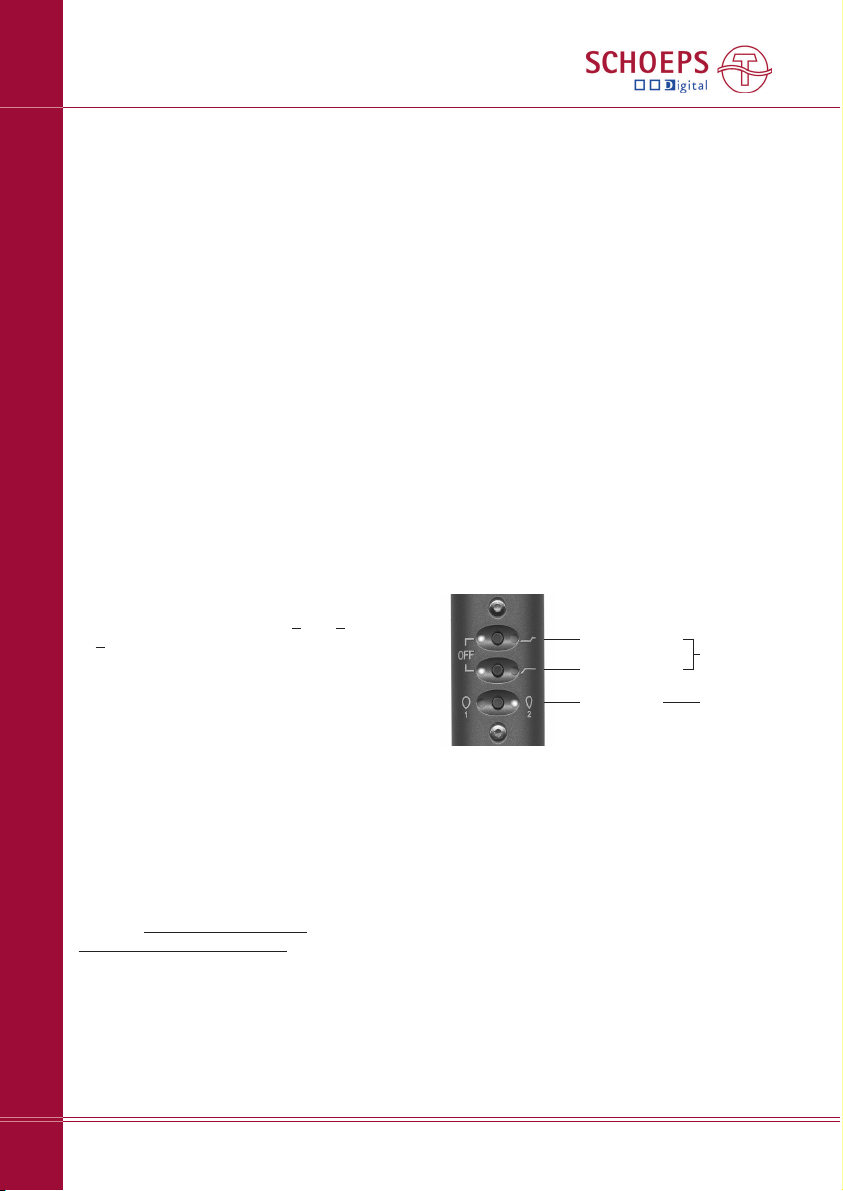
Die Bedienelemente
Das SuperCMIT verfügt über zwei Ausgangs kanäle:
Kanal 1: ”SuperCMIT” (hoch richtend; bear-
beitete Signale der beiden Schallwandler)
Kanal 2: ”CMIT” (normal richtend; unbearbei-
tetes Signal des Interferenzrohrs allein)
Beide Kanäle werden mit den Filter tasten gleichzeitig beeinflusst.
Grüne LED = ”Filter aus”, rote LED = ”Filter ein”
Höhenanhebung: +5dB bei 10kHz – kom pen -
siert die Dämpfung von Wind schut zen.
Steilflankiger Low-Cut: 18dB/Okt. ab 80Hz
– unterdrückt tieffrequente Wind- und Angel -
geräu sche.
Kanäle 1, 2
Kanal 1
Richtwirkung
(Preset)
Höhenanhebung
Low-Cut
Einsatzgebiete
Das SuperCMIT 2 U wird bevorzugt dort eingesetzt, wo diffuse Störgeräusche wie Straßen lärm, Blätterrauschen, Windgeräusche, Zu schauerlärm oder Raum hall bei der Auf nahme
stören. Ohne dass sich von vorne eintreffender
Direktschall in seiner Klangfarbe ändert, wird
der Störschall ausgeblendet, das heißt im
Pegel erheblich abgesenkt – und das bis hin
zu tiefsten Fre quen zen! Deshalb ist das Super CMIT ideal geeignet z.B. für schwierige Film ton aufnahmen oder für Sport anwen dun gen.
Das SuperCMIT erhöht außerdem die Reich -
weite bei Auf nahmen in Innenräumen.
Anschließen des SuperCMIT
Der Eingang / die Speisung
Das SuperCMIT ist ein Mikrofon mit digitalem
Ausgang nach AES42, Mode 1. Das bedeutet:
1. Es muss an einem Ein gang mit digitaler Phantom speisung (10V DPP – von digital phantom
powering) nach AES42 betrieben werden.
Wie bei analogen Mikrofonen wird durch das
angeschlossene Kabel sowohl das Signal als
auch der Speisestrom geführt.
2. Mode 1 bedeutet, dass das Mikrofon mit
seinem eigenen Takt (hier: 48kHz) läuft.
Des halb muss der Eingang zusätzlich zur
Speisung über einen Sample Rate Con ver ter
(SRC) verfügen.
AES42 Mode 1-Schnittstellen sind bei einigen
Geräten vorhanden, so z.B. in dem 8-kana li gen
Interface DMC-842 von RME und dem ebenfalls 8-kana ligen portablen Recorder 788T von
Sound Devices. Weitere Informationen finden
Sie unter www.schoeps.de/digital und
www.haupt mikrofon.de/aes42.
Der Betrieb des SuperCMIT ist auch an AES3-
Eingängen mög lich. Da diese jedoch nicht über
eine Spei sung verfügen, muss zwischen Mikrofon und Ein gang eine Speise box (wie z.B. die
PSD 2 U – siehe Zubehör) eingeschleift werden,
um das Mikro fon mit Strom zu versorgen.
Page 4

Signal/Rausch-Abstands möglich. Die Dynamik
– und damit auch der maximale Schalldruck pegel – verringert sich jedoch um den Betrag
der Verstärkung.
Durch die Pegelanhebung um 30dB würde
der maximale Schalldruckpegel des Super CMITs
auf 95dB reduziert. Zur Vermeidung von Über steuerungen bei darüber liegenden Pegeln
(bis max. 125dB) wird ab Firmware-Version 2.0
bei eingeschaltetem Gain zusätzlich jeweils ein
Limiter aktiviert, und zwar für beide Kanäle
getrennt. Die Limiter arbeiten mit einem festen
Grenzwert von -3dBFS. Hierdurch ist sichergestellt, dass auch bei kurzen Spitzen keine Über steuerung auftritt.
Die Limiter verursachen keine zusätzliche
Latenzzeit.
Wichtige Hinweise
Latenzzeit
Wegen der Latenzzeit (mehr als 2ms) sollte
das Abhören des SuperCMIT über Kopfhörer
vermieden werden, wenn man es selbst
bespricht.
Da die beiden Ausgangs kanäle des Mikro fons (SuperCMIT und CMIT) unterschiedliche
Latenzzeiten haben (siehe technische Daten
auf Seite 7), sollten die beiden Sig nale nicht
zusammengemischt werden.
Schallöffnungen
Um den nach hinten orientierten, zweiten
Schallwandler herum muss das Gehäuse des
SuperCMIT akustisch sehr transparent sein.
Daher befinden sich in der Mitte des Super CMIT acht große Öffnungen. Achten Sie
darauf, dass diese Öffnungen nicht bedeckt
werden – z.B. durch eine Klammer. Wegen
der Größe der Fenster ist Vorsicht geboten um
zu vermeiden, dass die Gaze eingedrückt
wird.
SCHOEPS GmbH · Spitalstr. 20 · D-76227 Karlsruhe (Durlach) · Tel: +49 721 943 20-0 · Fax: +49 721 943 2050
www.schoeps.de · [email protected]
Wichtige Hinweise / EMV / Pflege
4
Deutsch
Mit der Preset-Taste wird die Richtwirkung des
”SuperCMIT” (Kanal 1) gewählt:
– Preset 1 (grüne LED) – Steigerung der Richt -
wirkung durch Dämp fung des Diffusschalls
gegenüber dem CMIT (Kanal 2 bzw. übliche
Richtrohre) um 5dB auf 11dB
– Preset 2 (rote LED) – Dämpfung des Diffus -
schalls von 15dB. Diese Stellung ist für
Spezial an wen dungen vorbehalten – Klang einbußen sind hier möglich.
Gain / Limiter
Ab Firmware-Version 1.33 kann im SuperCMIT
eine digitale Verstärkung von +30dB aktiviert
werden. Dazu müssen die drei Taster am Mikrofon nacheinander jeweils zweimal betätigt wer den. Die Reihenfolge ist dabei beliebig. Durch
eine Wiederholung dieses Vorgangs wird die
Verstärkung wieder deaktiviert. Auch bei einer
Unterbrechung der Strom versorgung wird das
Mikrofon wieder in den Grundzustand (0dB)
versetzt.
A/D-Wandler sind in der Lage, den gesamten Dynamikbereich eines Mikrofons zu übertragen. Deshalb ist bei digitalen Mikrofonen
grundsätzlich keine Aussteuerung mehr nötig,
wie man sie von ihren analogen Gegenstücken
kennt. Dennoch gibt es Fälle, in denen sie eingesetzt wird.
Hierzu zwei Beispiele:
– Bei geringer oder mittlerer Lautstärke einer
Schallquelle ist auch der digitale Ausgangs -
pegel des SuperCMITs niedrig. Dies kann dazu
führen, dass z.B. der Pegel des Kopf hörer -
verstärkers eines angeschlossenen portablen
Recorders nicht ausreicht, um das aufgenom -
mene Signal abzuhören. Dann ist eine digi-
tale Verstärkung des Eingangs signals am
Recorder erforderlich. Sollte er aber nicht
über diese Möglichkeit verfügen, muss und
kann die Pegelanhebung am Mikrofon erfol-
gen.
– Eine Pegelanhebung kann auch vor einer
D/A-Wandlerstufe erforderlich sein, um den
Einfluss von deren Eigenrauschen zu vermin-
dern.
Im Gegensatz zur Analogtechnik ist eine digitale Pegelanhebung ohne Beeinflussung des
Page 5

Hin wei se zur EMV
(Elek tro magne ti sche Ver träg lich keit)
Das SuperCMIT ist un empfindlich gegenüber
magnetischen, elektrischen und elektromag ne tischen Feldern.
Es kann dennoch nicht erwartet werden,
dass das Mikro fon unter allen Umständen völlig frei von Stö run gen ist. Folgende Regeln
können helfen, eventuelle Störun gen zu
beseitigen:
– Meiden Sie die Nähe sowohl des Mikro fons
als auch des Kabels zu Störquellen wie
Moni toren, digitalem Equipment (Rechnern),
Sendern (Handys), Stark stromkabeln, Schalt -
netzteilen hoher Leistung, Dimmern, etc.
– Benutzen Sie hochwertiges 110Ω-Kabel
nach AES3.
– Verwenden Sie möglichst kurze Kabel.
– Verlegen Sie Mikrofonkabel nicht parallel zu
Netzkabeln und kreuzen Sie diese, wenn
unumgänglich, stets senkrecht.
– Der Kabelschirm am Mikrofoneingang sollte
auf kürzestem Wege mit dem Gehäuse ver-
bunden sein – wenn möglich galvanisch,
sonst kapazitiv.
Pfle ge und War tung des SuperCMIT
Sor gen Sie bit te stets da für, dass das Mikro fon
nicht in stau bi ger Um ge bung ein ge setzt wir d,
und dass es nach Ge brauch in ei nem ge schlos se nen Be hält nis (z.B. in dem mitgelie fer ten
Holz etui) auf be wahrt wir d, denn das Ein drin gen von Staub kann seine Funk tion be ein träch ti gen.
Was tun, wenn ...
das Mi kro fon bei er höh ter Feuch tig keit knackt oder
rauscht?
Wenn Kondensatormikrofone bei erhöhter
Luftfeuchtigkeit betrieben werden oder aus
der Kälte in einen war men (und feuchten)
Raum gebracht werden, kann es zur Kon den sa tion von Feuch tig keit und da mit zu Knack oder Prasselge räu schen etc. kom men.
Das SuperCMIT ist hierfür deutlich weniger
anfällig als andere Mikrofone, da es durch die
im Vergleich zu analogen Mikrofonen hohe
Leistungsaufnahme stets etwas warm ist, wo durch eine Kondensatbildung verhindert wird.
Sollte es dennoch einmal zu Knack geräu schen kommen, ge ben Sie dem Mi kro fon einige
Minuten Zeit zur Erwär mung, dann wird es in
der Re gel wie der ein wand frei ar bei ten.
Windgeräusche und Windschutze
Störgeräusche durch Luftströmungen (Wind,
Poppen, Bewe gun gen des Mikrofons an der
Angel oder Luft strömungen durch Heizungsoder Lüftungs systeme) können den Klang
beeinträchtigen.
Bei schwachem Wind hilft der mitgelieferte
einfache Schaumstoff-Windschutz W 170.
Gegen starken Wind gibt es Wind schutzkörbe
von Rycote (siehe Seite 2).
SCHOEPS GmbH · Spitalstr. 20 · D-76227 Karlsruhe (Durlach) · Tel: +49 721 943 20-0 · Fax: +49 721 943 2050
www.schoeps.de · [email protected]
5
Deutsch
Page 6
SCHOEPS GmbH · Spitalstr. 20 · D-76227 Karlsruhe (Durlach) · Tel: +49 721 943 20-0 · Fax: +49 721 943 2050
www.schoeps.de · [email protected]
Technische Daten
6
Deutsch
SuperCMIT, Preset 2
4kHz
8kHz
16kHz
SuperCMIT, Preset 1
0246810121416
dB
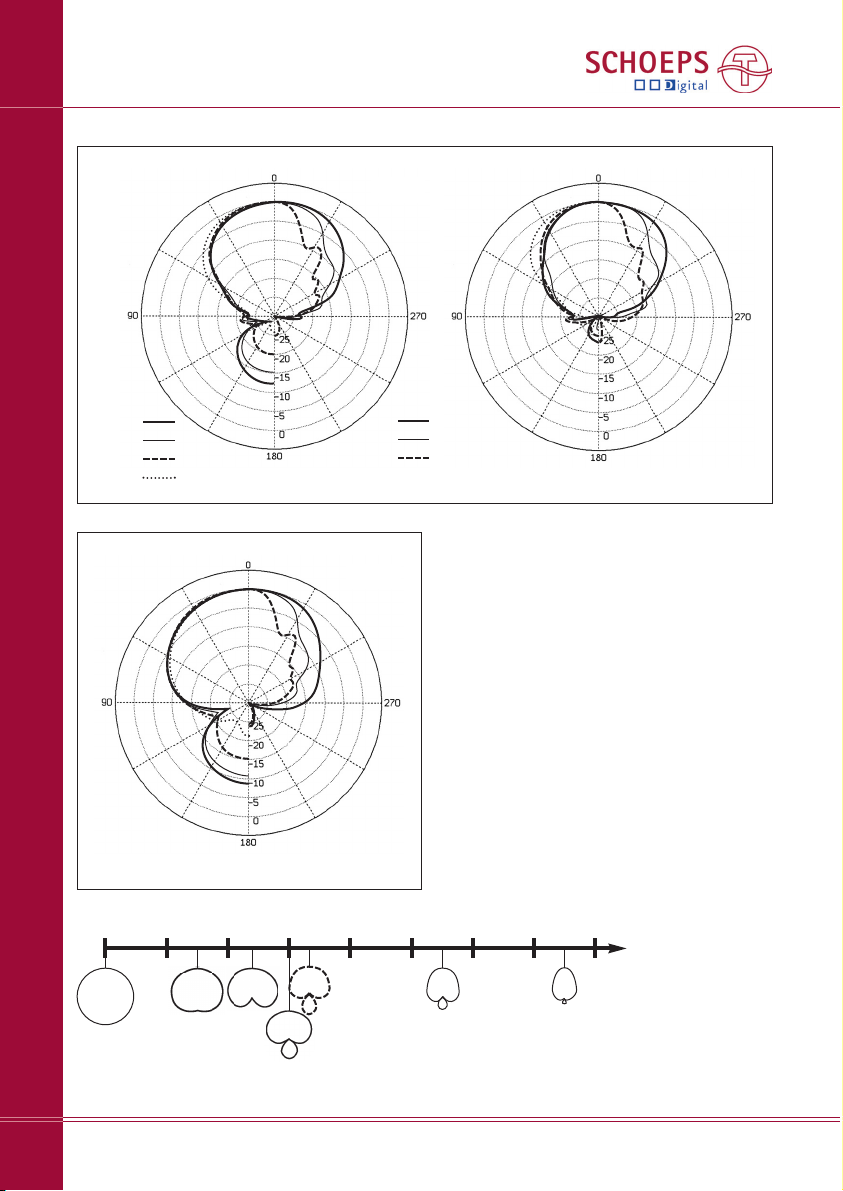
Unterdrückung des Diffusschalls (”Bündelungsmaß”) bei tiefen und mittleren Frequenzen
SuperCMIT
Preset 1
Preset 2
normale
Richtrohre
nicht bearbeitetes Interferenzrohr (”CMIT”)
Kanal 2
Kanal 1
250Hz
500Hz
1kHz
2kHz
Page 7
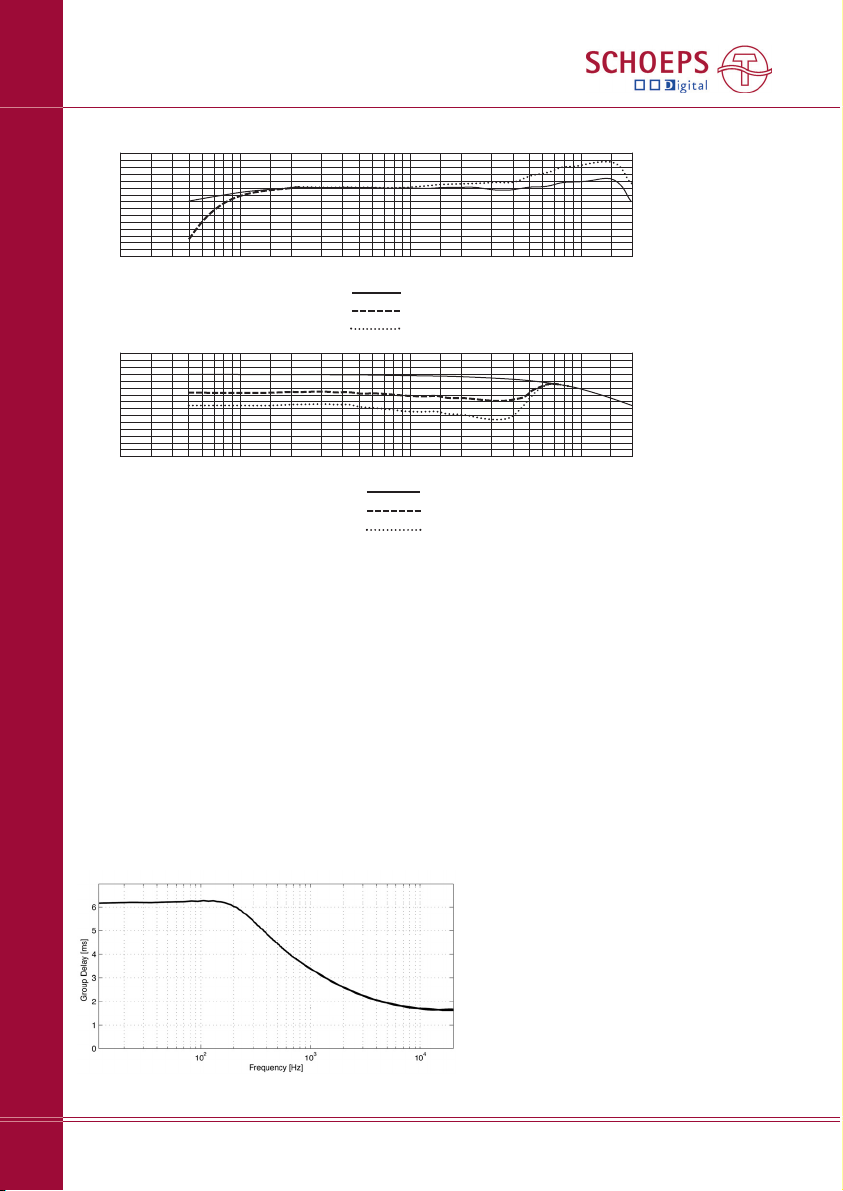
Kanal 1: Latenzzeit in Abhängigkeit von der Frequenz
SCHOEPS GmbH · Spitalstr. 20 · D-76227 Karlsruhe (Durlach) · Tel: +49 721 943 20-0 · Fax: +49 721 943 2050
www.schoeps.de · [email protected]
Technische Daten – Fortsetzung
7
Deutsch
Frequenzgang beider Kanäle bei 0°: ohne Filter
mit Low-Cut
mit Höhenanhebung
20
50
100
200 500
1k 2k 5k 10k 20kHz
+10dB
0dB
-10dB
-20dB
Frequenzgang im diffusen Schallfeld: normales Richtrohr (Kanal 2)
SuperCMIT mit Preset 1
SuperCMIT mit Preset 2
20
50
100
200 500
1k 2k 5k 10k 20kHz
0dB
-10dB
-20dB
-30dB
Empfindlichkeit: . . . . . . . . . . . . . . . . .-31dBFS bei 1 Pa
Ersatzgeräuschpegel (Filter aus): . . . . .Kanal 1: 13dB-A, eff.*, 26dB CCIR**
Kanal 2: 16dB-A, eff.*, 28dB CCIR**
Maximaler Schalldruckpegel: . . . . . . .125dB SPL
Schaltbare Filter: . . . . . . . . . . . . . . . .80Hz mit 18dB/Okt.,
5dB Anhebung bei 10kHz (Shelving)
Speisung: . . . . . . . . . . . . . . . . . . . . . .10V DPP (digitale Phantomspeisung nach AES42-2006)
Stromaufnahme: . . . . . . . . . . . . . . . .170mA
Ausgang: AES42-2006, Mode 1, Abtastrate: 48kHz
Kanal 1: SuperCMIT
Kanal 2: CMIT (nur das Interferenzrohr-Signal)
Latenzzeit: Kanal 1 (SuperCMIT): siehe Darstellung unten;
Kanal 2 (CMIT): 1,6ms
Maximale Kabellänge: . . . . . . . . . . . .300m mit 110Ω-Kabel nach AES3-2009 (IEC 60958-4)
Länge: . . . . . . . . . . . . . . . . . . . . . . . .280mm
Durchmesser: . . . . . . . . . . . . . . . . . . .21mm
Gewicht: . . . . . . . . . . . . . . . . . . . . . .112g
* nach IEC 61672-1
** nach IEC 60268-1
Page 8

Firmware-Updates
Die außergewöhnlichen Eigenschaften des
SuperCMIT basieren wesentlich auf der intern
gespeicherten Software (Firmware). Diese unterliegt Verände run gen. Die Firmware-Version
Ihres SuperCMIT finden Sie auf einem Auf kleber
neben den Stiften des Ausgangssteckers.
Wenn Sie ein Firmware-Update wünschen,
senden Sie Ihr SuperCMIT bitte an ihren Händler
oder direkt an uns.
Unser besonderer Service: Bei jeder großen
Firmware-Änderung, d.h. wenn die erste der
drei Ziffern der Version sich ändert, bietet
SCHOEPS Ihnen ein kostenfreies Update. Sie
über nehmen ledig lich alle Versandkosten.
Hier können Sie sich über den neuesten
Stand der Firmware informieren:
www.schoeps.de/ SuperCMIT.
Firmware-Historie:
2.0 (September 2011): Limiter bei aktiver Gain-
Anhebung, verbessertes Höhenfilter sowie
Optimierung des Beamformers zur Reduktion
von Artefakten
1.33 (September 2010): Anhebung des Aus -
gangspegels um 30dB durch Tasten kombi -
nation möglich
1.29 (Juni 2010): erste Firmware
CE-Konformitätserklärung
Das CE-Kennzeichen besagt, dass die so
gekennzeichneten Produkte allen relevanten
Normen der Europäischen Gemeinschaft entsprechen. Die in dieser Bedienungsanleitung
beschriebenen Produkte genügen diesen
Normen, wenn sie mit Kabeln von SCHOEPS
betrieben werden.
Geltende Richtlinien:
EMV-Richtlinie: 89/336/EEC, ergänzt um
92/31/EEC und 93/68/EEC
Geltende Normen:
EN 55 103-1, -2 und jene, auf die darin Bezug
genommen wird.
Garantie
Wir übernehmen für unsere Produkte eine
Garantie von 24 Monaten. Ausgenommen
sind Batterien. Die Garantiezeit beginnt ab
dem Kaufdatum.
Zum Nachweis der Garantie heben Sie bitte
unbedingt den Kaufbeleg auf. Ohne ihn werden Repa ra turen grundsätzlich kostenpflichtig
ausgeführt.
Die Garantieleistungen bestehen nach unse rer
Wahl in der unentgeltlichen Beseiti gung von
Material- oder Herstellungsfehlern durch
Reparatur, Tausch von Teilen oder des kom plet ten Gerätes.
Von der Garantie ausgenommen sind Män gel
durch unsachgemäßen Gebrauch (z.B. Bedie nungsfehler, mechanische Beschä di gun gen),
Verschleiß oder höhere Gewalt. Der Garan tieanspruch entfällt bei Eingriffen durch nicht
autorisierte Personen oder Werk stätten.
Im Garantiefall senden Sie das Produkt zusammen mit dem Kauf beleg frei Haus an SCHOEPS,
wenn Sie in Deutschland Kunde sind, bzw. an
unsere Vertretung, wenn Sie außerhalb
Deutschlands Kunde sind.
In Ausnahmefällen können Sie es nach vorheriger Rücksprache mit SCHOEPS auch aus dem
Ausland direkt an uns senden. Da der Direkt ver sand an Kunden im Ausland nur gegen
Voraus kasse erfolgt, ist das jedoch der lang samere Weg, insbesondere dann, wenn die
Garan tie bedin gungen nicht erfüllt sind und
deshalb eine Reparatur gegen Berechnung
durchgeführt werden muss.
Gewährleistungsansprüche aus dem Kauf ver trag gegen den Verkäufer werden durch diese
Garantie nicht berührt.
Die Garantie kann uneingeschränkt in allen
Ländern in Anspruch genommen werden.
SCHOEPS GmbH · Spitalstr. 20 · D-76227 Karlsruhe (Durlach) · Tel: +49 721 943 20-0 · Fax: +49 721 943 2050
www.schoeps.de · [email protected]
Firmware-Updates / CE-Konformitätserklärung / Garantie
8
Deutsch
Page 9

SCHOEPS GmbH · Spitalstr. 20 · D-76227 Karlsruhe (Durlach) · Tel: +49 721 943 20-0 · Fax: +49 721 943 2050
www.schoeps.de · [email protected]
9
Page 10

SCHOEPS GmbH · Spitalstr. 20 · D-76227 Karlsruhe (Durlach) · Tel: +49 721 943 20-0 · Fax: +49 721 943 2050
www.schoeps.de · [email protected]
10
Deutsch
Page 11
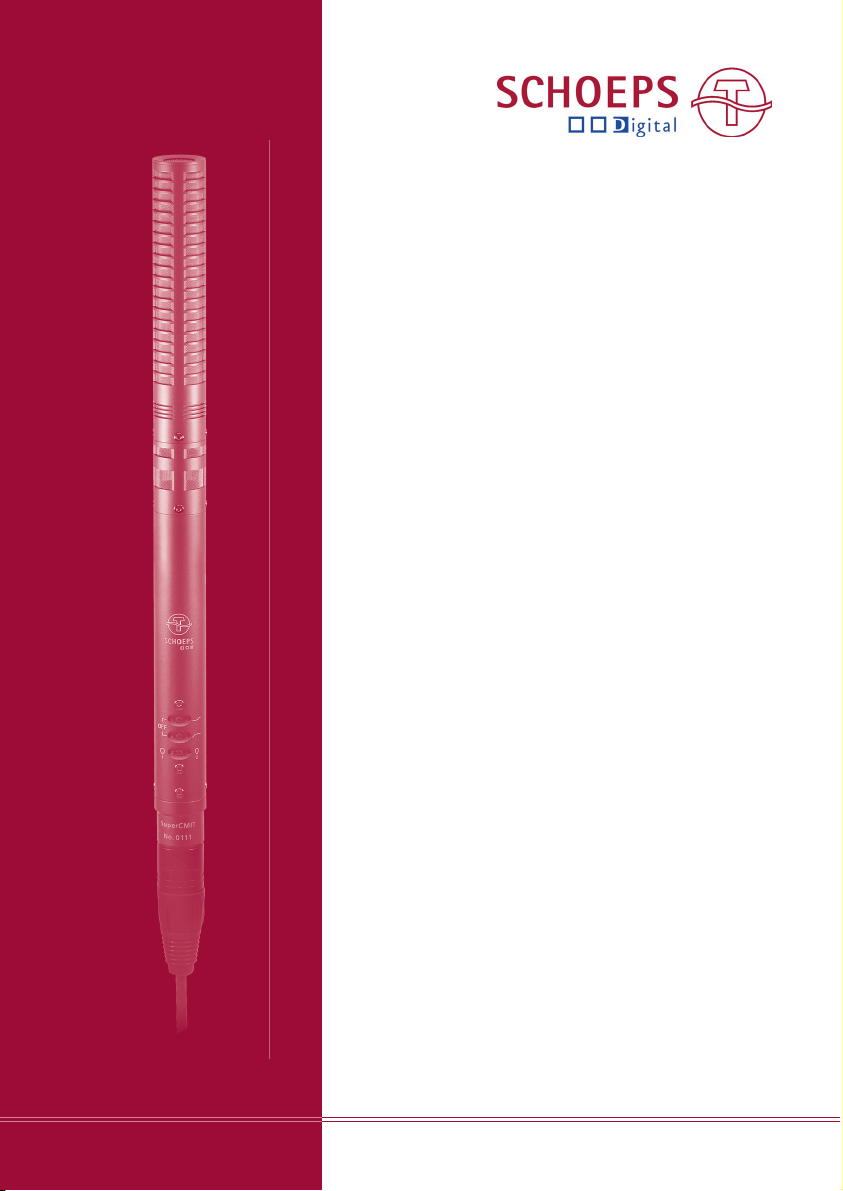
SuperCMIT 2 U
Super Shotgun Microphone with DSP
User Guide
Table of Contents page
General 12
Suggested applications 13
Connecting / Operation 13
Gain / Limiter 14
Important notes 14
EMC 14
Care 15
Technical specifications 16
Firmware-Updates 18
CE conformity / Guarantee 18
Page 12
Dear customer:
Congratulations on choosing the SCHOEPS
digital SuperCMIT 2 U, the world's first ”intelligent” shotgun microphone. Its features
include:
– distinctly increased directivity – even at low
and middle frequencies – on the basis of
the analog model CMIT 5 U
– extraordinary suppression of diffuse sound
– completely new operating principle using
two transducers (capsules)
– uses DSP* algorithms (patent applied for)
by Illusonic
– two-channel output:
SuperCMIT on channel 1 and unprocessed
shotgun microphone signal on channel 2
– SCHOEPS sound quality: transparent, despite
the high directivity
*digital signal processing
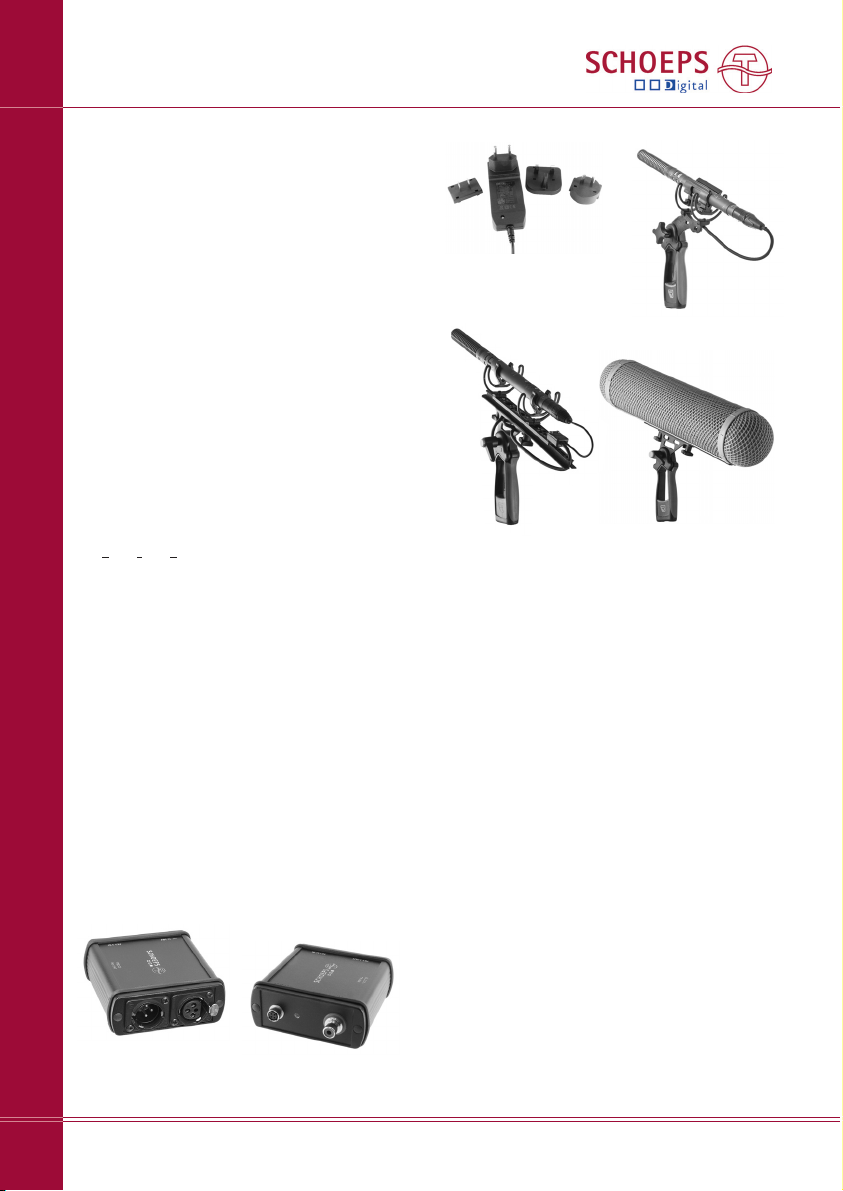
Included accessories:
Wooden case, SG 20 stand adapter, W 170
foam windscreen (for moderate wind and
boom motion)
Also available:
PSD 2U powering box for digital phantom
powering (DPP, 10 V) with XLR and RCA
outputs, including AC adapter with 4-pin
Hirose socket
Mount & Handle: shock mount with pistol grip;
WSR CMIT basket-type windscreen with
”Windjammer” (for stronger wind)
The technology
The SuperCMIT 2 U has one capsule positioned
behind its forward-facing interference tube,
plus a second capsule that is aimed in the
reverse direction. At frequencies below 6 kHz
the signals of these two transducers are analyzed and compared by a digital signal processor using technology from Illusonic (patent
applied for). It can recognize sound energy
arriving from discrete directions, deduce
whether its direction of arrival is persistent or
not, and distinguish such energy from diffuse
arriving sound.
This information is then used to focus on the
discrete sound energy while suppressing the
diffuse sound. Thus the ”reach” of this microphone is greatly increased, without artifacts or
coloration of the sound.
Above 6 kHz the signal from the forwardfacing transducer is used without further processing, since the interference tube's effect is
already optimal in that range.
The SuperCMIT is the first microphone in
the world to offer such high directivity while
maintaining such high quality of sound.
SCHOEPS GmbH · Spitalstr. 20 · D-76227 Karlsruhe (Durlach) · Tel: +49 721 943 20-0 · Fax: +49 721 943 2050
www.schoeps.de · [email protected]
General
12
English
AC adapter for
PSD 2 U
Mount & Handle
WSR CMIT basket-type windscreen
PSD 2U
Page 13
SCHOEPS GmbH · Spitalstr. 20 · D-76227 Karlsruhe (Durlach) · Tel: +49 721 943 20-0 · Fax: +49 721 943 2050
www.schoeps.de · [email protected]
Suggested applications / Connecting / Operation
13
English
at lengths of up to 300 m (nearly 1000') is
possible.
Power-on Behavior
When powered on, the SuperCMIT may
require up to 15 seconds to become ready for
use. Varying amounts of noise may be produced during this time; such behavior is
entirely normal.
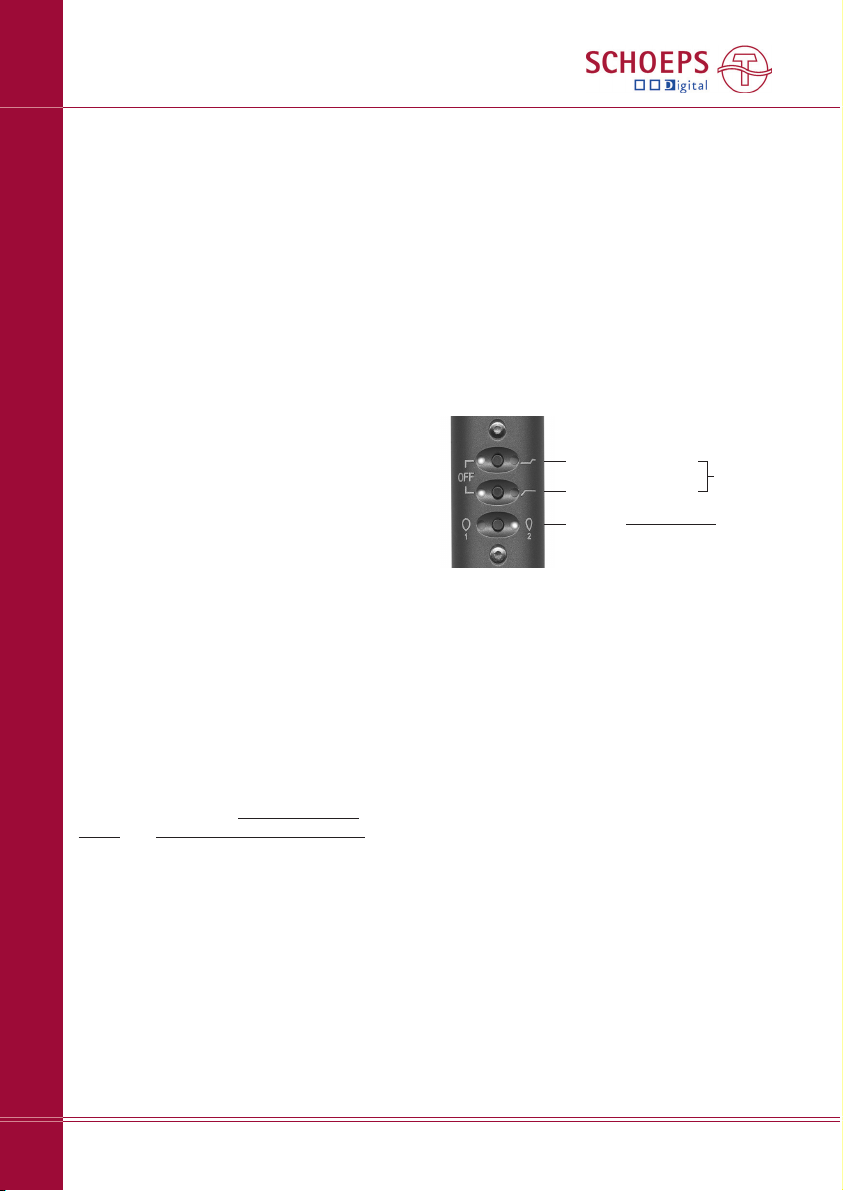
Operation
The SuperCMIT has two output channels:
Channel 1: ”SuperCMIT” (enhanced directivity;
processed signal from both transducers)
Channel 2: ”CMIT” (normal directivity;
unprocessed signal from the front-facing
transducer)
Both channels are affected simultaneously by
the filter switches.
Green LED = ”Filter off”, red LED = ”Filter on”
High-frequency boost: +5 dB at 10 kHz – to
compensate for losses due to windscreens
Steep low-cut: 18 dB/Oct. below 80 Hz – to
suppress wind and boom noise
The Preset button selects the directivity of the
”SuperCMIT” (Channel 1):
– Preset 1 (green LED): Increased directivity;
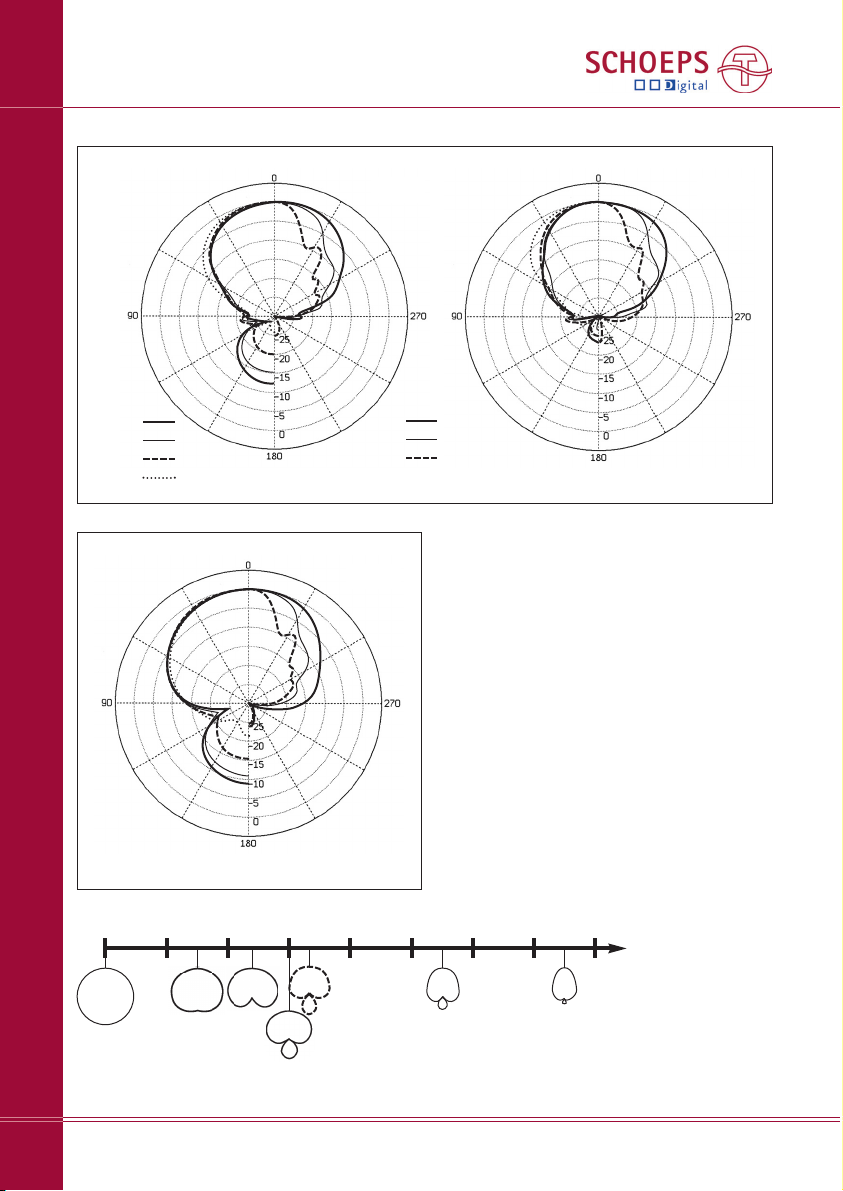
11 dB suppression of diffuse sound, which
is 5 dB greater than CMIT.
– Preset 2 (red LED): 15 dB (extremely high)
suppression of diffuse sound. This setting is
reserved for special applications; some less-
ening of sound quality may occur.
directivity
(Preset)
high-frequency boost
low-cut
Suggested applications
The SuperCMIT 2 U is suggested for use wherever there is interference from diffuse sound
such as street noise, rustling leaves, wind noise,
sound from passers-by or onlookers, or room
reverberation in a recording. The interfering
sound is reduced significantly in level without
affecting the sound color of directly arriving
sound, even down to the lowest frequencies.
This makes the SuperCMIT ideal e.g. for difficult film sound assignments and sports broadcasts.
The SuperCMIT also extends ”reach” for
indoor recordings.
Connecting the SuperCMIT
Input / Powering
The SuperCMIT's output is digital, complying
with AES42, Mode 1. It requires digital phantom powering (10 V), which is supplied via
the signal cable as with analog microphones.
Because it operates in Mode 1, the microphone provides its own clock (48 kHz). Thus
the input of the interface device or recorder
must provide sampling rate conversion if the
microphone is to be operated synchronously
with other equipment.
AES42 Mode 1 inputs are available on certain equipment, e.g. the 8-channel DMC-842
interface from RME and the Sound Devices
788T 8-channel portable recorder. For further
information please see www.schoeps.de/
digital and www.hauptmikrofon.de/aes42.
The SuperCMIT can also be used with AES3
inputs if digital phantom powering is supplied
(e.g. by the PSD 2 U – see ”Accessories”)
between the input and the microphone.
The Cable
Ordinary analog XLR cable can be used, but
its characteristic impedance is undefined; thus
we cannot guarantee reliable operation of the
microphone particularly with long cables. If an
AES3-standard XLR-3 cable with a characteristic
impedance of 110 Ω is used, then operation
channel 1
channels
1 and 2
Page 14

Important notes
Latency
Because of the >2 ms latency, it is not advisable for most people to monitor the output of
the SuperCMIT through headphones while
speaking into the microphone. The two output
channels of the microphone (SuperCMIT and
CMIT) have differing latency times (see specifications on page 17), and their signals should
not be mixed together.
Sound openings
In the area around the second, rear-facing
transducer there are eight sound openings for
the sake of acoustic transparency. Please be
careful not to block these openings, e.g. with
a stand adapter or other mounting device.
The size of these openings also makes it
important to keep their gauze covering from
being pressed inward.
Notes on EMC
(Electromagnetic Compatibility)
The SuperCMIT is insensitive to magnetic,
electrical and electromagnetic fields. But no
microphone can ever be fully immune to all
interference. The following rules can help to
prevent possible interference:
– Avoid placing the microphone or its cable
close to sources of interference such as
video monitors, digital equipment (computers), transmitters (cellular phones or PDAs),
high-voltage lines, high-power AC
adapters, lighting dimmers, etc.
– Use high-quality 110 Ω AES3 cable that is
no longer than necessary.
– Do not run microphone cables parallel to
AC power cables. If it is necessary for them
to cross, they should do so at right angles.
– The cable shield at the input of the receiv-
ing device should connect to the housing
of that device along the shortest possible
path, using DC coupling if possible, or at
least capacitive coupling.
SCHOEPS GmbH · Spitalstr. 20 · D-76227 Karlsruhe (Durlach) · Tel: +49 721 943 20-0 · Fax: +49 721 943 2050
www.schoeps.de · [email protected]
Important notes / EMC / Care
14
English
Gain / Limiter
Beginning with firmware version 1.33, digital
amplification of 30 dB can be activated in the
SuperCMIT by pressing each of the three pushbuttons twice each in turn. The order of the
buttons is unimportant (i.e. 332211 works as
well as 112233), but the two clicks of each
button must be a moment apart so that they
are distinct. The gain boost can be canceled by
repeating the button presses; also, if powering
is removed from the microphone, the amplifier
gain will reset to normal (0 dB).
A/D converters can convey the full dynamic
range of a microphone, which in principle
would make it unnecessary to “set levels” for
a digital microphone recording. But there still
are reasons for setting levels nonetheless. For
example, if a digital microphone is connected
to a portable recorder and the sound levels are
very low, the recorder's headphone amplifier
might be unable to produce enough volume
to allow monitoring the signals. Digital amplification at the input to the recorder could solve
this problem, but if that is unavailable, then
the levels can be raised within the microphone.
It can also be useful to raise levels before
feeding a digital signal to a D/A converter, to
help overcome the self-noise of the converter.
Digital amplification, unlike analog amplification,
need not affect signal-to-noise ratio. Of course,
the upward limit of the dynamic range is reduced
by the same amount as the gain that is applied.
Raising the gain of the SuperCMIT by 30 dB
would also lower its maximum SPL to 95 dB.
Thus, beginning with firmware version 2.0,
if the 30 dB additional gain is switched on,
digital limiters are also engaged to avoid overload on sound pressure levels of up to 125 dB.
These limiters, which are separate for the two
channels, have a fixed threshold of -3 dB,
ensuring that overload will not occur even on
brief peaks. These limiters do not increase the
latency of the signal processing in the microphone.
Page 15

Care of the SuperCMIT
Please make certain that the microphone is
never used in a dusty environment, and that
after use it is kept in a closed container such
as the supplied wooden case, since its functioning can be affected if dust gets into the
microphone.
What to do if ...
the microphone is noisy in high humidity?
If condenser microphones are used in high
humidity or are brought in from the cold to a
warm (and humid) room, condensation can
occur, causing snapping or rattling sounds, etc.
The SuperCMIT is distinctly less subject to
this problem than analog microphones, since
its greater power consumption creates enough
warmth to hinder any moisture condensation.
But if such noises should ever occur, give the
microphone a few minutes to warm up, and
then as a rule it will again give you troublefree operation.
Wind noise and windscreens
Interference caused by air currents (wind, vocal
popping, movement of the microphone on
the boom or airflow through heating or ventilation systems) can impair the sound quality. If
the wind is mild, the simple W 170 foam
windscreen which is supplied as an accessory
can help. For strong wind there are Rycote
basket-type windscreens (see page 12).
SCHOEPS GmbH · Spitalstr. 20 · D-76227 Karlsruhe (Durlach) · Tel: +49 721 943 20-0 · Fax: +49 721 943 2050
www.schoeps.de · [email protected]
15
English
Page 16
SCHOEPS GmbH · Spitalstr. 20 · D-76227 Karlsruhe (Durlach) · Tel: +49 721 943 20-0 · Fax: +49 721 943 2050
www.schoeps.de · [email protected]
Technical specifications
16
English
SuperCMIT, preset 2
4 kHz
8 kHz
16 kHz
SuperCMIT, preset 1
0246810121416
dB
Suppression of diffuse sound (“random energy efficiency factor”) at low and midrange frequencies
SuperCMIT
preset 1
preset 2
standard
shotguns
unprocessed CMIT shotgun microphone
Channel 2
Channel 1
250 Hz
500 Hz
1 kHz
2 kHz
Page 17
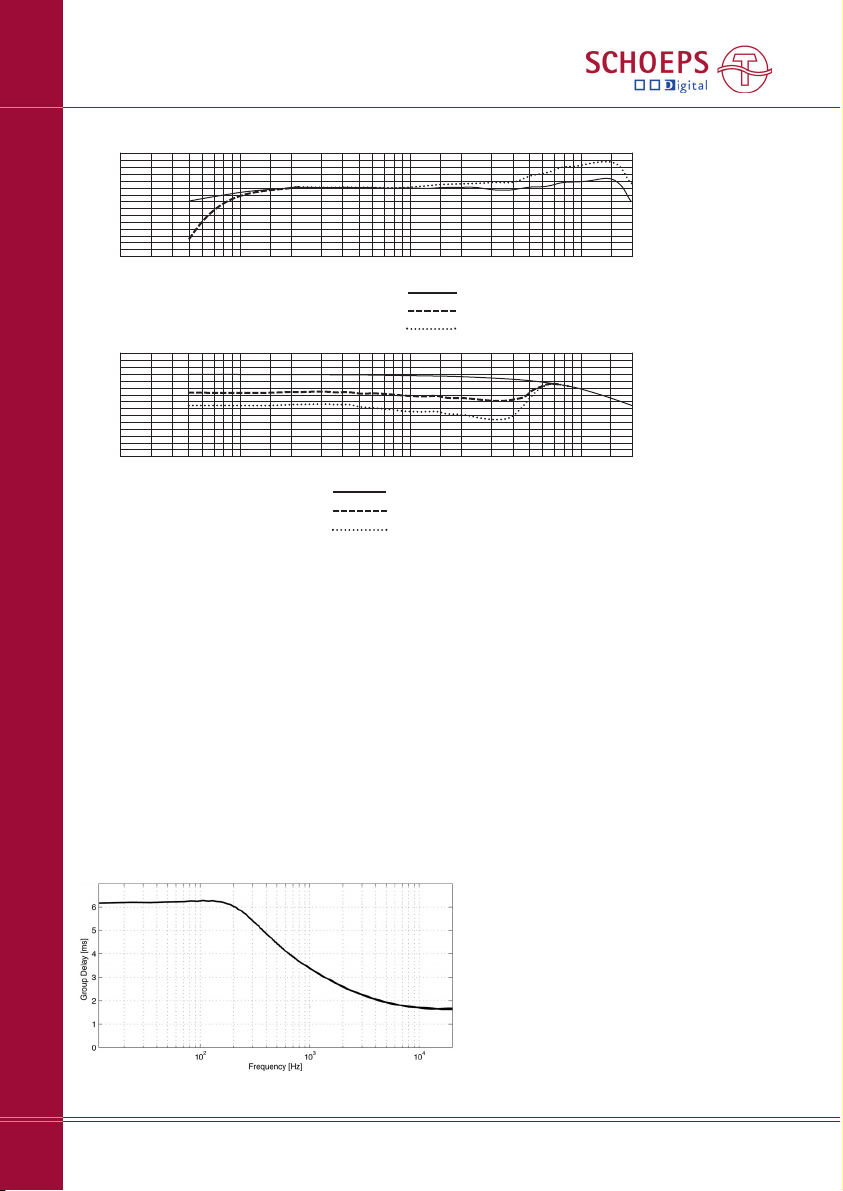
Channel 1: Latency as a function of frequency
SCHOEPS GmbH · Spitalstr. 20 · D-76227 Karlsruhe (Durlach) · Tel: +49 721 943 20-0 · Fax: +49 721 943 2050
www.schoeps.de · [email protected]
Specifications, cont’d.
17
English
0° frequency response of the two channels: with no filters
with low-cut
with high-frequency boost
20
50
100
200 500
1 k 2 k 5 k 10 k 20 kHz
+10 dB
0 dB
-10 dB
-20 dB
Diffuse-field frequency response: front-facing transducer (CMIT) only
SuperCMIT preset 1
SuperCMIT preset 2
20
50
100
200 500
1 k 2 k 5 k 10 k 20 kHz
0 dB
-10 dB
-20 dB
-30 dB
Sensitivity: . . . . . . . . . . . . . . . . . . . . .-31 dBFS at 1 Pa
Equivalent noise (filter off): . . . . . . . .Channel 1: 13 dBA RMS*, 26 dB CCIR**
. . . . . . . . . . . . . . . . . . . . . . . . . . . . .Channel 2: 16 dBA RMS*, 28 dB CCIR**
Maximum sound pressure level: . . . . .125 dB SPL
Switchable filters: . . . . . . . . . . . . . . .80 Hz, 18 dB/oct.,
. . . . . . . . . . . . . . . . . . . . . . . . . . . . .5 dB elevation at 10 kHz (shelving)
Powering: . . . . . . . . . . . . . . . . . . . . .10 V DPP (digital phantom powering, AES42-2006)
Current consumption: . . . . . . . . . . . .170 mA
Output: . . . . . . . . . . . . . . . . . . . . . . .AES42-2006, Mode 1, Sampling rate: 48 kHz
. . . . . . . . . . . . . . . . . . . . . . . . . . . . .Channel 1: SuperCMIT
. . . . . . . . . . . . . . . . . . . . . . . . . . . . .Channel 2: CMIT (unprocessed output of front-facing capsule)
Latency: . . . . . . . . . . . . . . . . . . . . . . .Channel 1 (SuperCMIT): see graph below;
. . . . . . . . . . . . . . . . . . . . . . . . . . . . .Channel 2 (CMIT): 1.6 ms
Maximum cable length: . . . . . . . . . . .300 m with 110 Ω cable as specified in AES3-2009 (IEC 60958-4)
Length: . . . . . . . . . . . . . . . . . . . . . . .280 mm
Diameter: . . . . . . . . . . . . . . . . . . . . . .21 mm
Weight: . . . . . . . . . . . . . . . . . . . . . . .112 g (less than 4 oz.)
* according to IEC 61672-1
** according IEC 60268-1
Page 18

Firmware Updates
The remarkable properties of the SuperCMIT
depend on internally stored software (firmware),
which can undergo revision. The firmware
version of your SuperCMIT appears on a label
beside the pins of the SuperCMIT’s output
connector.
If you wish to have your SuperCMIT updated,
we ask you to send it to your dealer / distributor.
As a special service, for any major firmware
revision (i.e. if the first digit of the version
number changes), SCHOEPS offers you a free
update. You assume only the shipping costs.
You can find out the latest version of the
firmware on www.schoeps.de/SuperCMIT.
Firmware history:
2.0 (September 2011): Limiter on active gain
boost, improved high-pass filter as well as
beam former optimization to reduce artifacts
1.33 (September 2010): Ability to raise output
levels by 30 dB with a combination of but-
ton presses
1.29 (June 2010): First released version of the
firmware
Declaration of CE Conformity
The CE-mark guarantees that all products
conform to relevant standards approved by
the European Community. The products
described in this User Guide comply with current, relevant standards when used with cables
from SCHOEPS.
Regulations currently in force:
EMC regulations: 89/336/EEC, extended by
92/31/EEC and 93/68/EEC
EN 55 103-1, -2 and any others that are
referred to within them.
Guarantee
We guarantee our products for a period of
twenty-four months, except for batteries.
The guarantee period begins on the date of
purchase.
Please provide your bill of sale in all cases as
proof of guarantee; without it, repairs will be
undertaken only at the owner's expense.
We reserve the right to satisfy all warranty
requirements regarding defects of workmanship or materials by means of repair or partial
or complete replacement of the product, at
our sole discretion.
Excluded from this guarantee are defects due
to misuse (e.g. incorrect operation; mechanical
damage), abuse or “Acts of God.” This guarantee is nullified in the event of tampering by
unauthorized persons or agencies.
To secure your rights under this guarantee,
send the product with proof of purchase and
a precise description of the malfunction, at your
expense, either to SCHOEPS (if you are a customer in Germany), or to our representative (if
you are a customer outside of Germany).
Prior to sending your defective product for
repair, please contact your local dealer or distributor for instructions. In exceptional cases
you can, by prior arrangement with SCHOEPS,
send the product directly to us from a foreign
country. However any return shipment must
then be prepaid; this tends to cause delays,
especially for non-warranty service. Full payment must be made before a repaired item
can be returned to the customer.
This guarantee does not affect any contractual
agreements which may exist between the buyer
and seller of the equipment.
This guarantee is world-wide.
SCHOEPS GmbH · Spitalstr. 20 · D-76227 Karlsruhe (Durlach) · Tel: +49 721 943 20-0 · Fax: +49 721 943 2050
www.schoeps.de · [email protected]
Firmware Updates / Declaration of CE Conformity / Guarantee
18
English
Page 19

SCHOEPS GmbH · Spitalstr. 20 · D-76227 Karlsruhe (Durlach) · Tel: +49 721 943 20-0 · Fax: +49 721 943 2050
www.schoeps.de · [email protected]
19
English
Page 20

Änderungen und Irrtümer vorbehalten.
Subject to change without notice.
Not responsible for errors or omissions.
111007
Technik
Schall
SCHOEPS GmbH
Spitalstr. 20
D-76227 Karlsruhe (Durlach)
Tel: +49 721 943 20-0
Fax: +49 721 943 2050
www.schoeps.de
[email protected]
 Loading...