

Page 1
ST-8300M and ST-8300C
High Resolution 8.3 Megapixel
CCD Cameras
The new ST-8300M (monochrome) and ST-8300C (color) cameras are based on Kodak’s
KAF-8300, 8.3 megapixel, full frame CCD. This CCD array has 3326 x 2504 pixels at 5.4
microns making it ideal for both short fast optics in high resolution (unbinned) mode,
and for longer focal lengths it can be binned binned 2x2 or 3x3. The CCD has both
antiblooming and microlens technology to improve the effective Quantum Efciency of the
sensor. As a result it can be used in a wide variety of optical congurations. The camera electronics are USB 2.0 for fast download
rates and rapid focus mode. The small light body accepts both c-mount and standard 35mm Nikon camera lenses. A built-in
mechanical shutter is included for automatic dark frames. In addition to its imaging capabilities, it can also be used as a guider.
or when used at longer focal length scopes such as SchmidtCassegrains, the sensor can be binned 2x2 or 3x3 in full frame
Large High Resolution Imaging CCD
The KAF-8300 CCD
is approximately 18 x
14mm and has a diagonal
measurement of about 22
millimeters. This is about
1.6X the image area of an
ST-10 and nearly the same
area as the STL-4020M. With
its relatively small pixels and
large image area it is ideal for wide eld imaging with short fast
telescopes and camera lenses and at the same time is exible
enough to be used on long focal length Schmidt-Cassegrains.
Partial Frame and Binning Modes
The ST-8300C single-shot-color version of this camera can
be used in high resolution mode (only) for color images, or
binned 2x2 or 3x3 for monochrome imaging. The ST-8300M
monochrome camera can be used with a lter wheel in any
of several binning and partial frame modes for monochrome,
color or narrowband imaging. Binned 2x2 the pixels are 10.8
microns square and binned 3x3 they are 16.2 microns square.
At 2x2 the array is still 2 megapixels and at 3x3 just under
one megapixel. This feature makes it possible to match the
pixel size to your seeing and scope, from a small refractor
to a large SCT. With the ST-8300M monochrome camera
binning will not only help optimize the sensitivity of the CCD
with the user’s optics and seeing conditions, but also speeds
up the download rate. SBIG software drivers allow the user
to combine any of several binning modes and partial frame
in various ways to suit the user’s optics, seeing conditions
and objects of interest. For example, when imaging planets
the sensor can be used in high resolution (5.4 micron pixels)
mode while downloading only a quarter frame to speed up the
data collection process. On nights of less than good seeing,
mode to match the conditions while maintaining the full eld
of view of the CCD. The various frame and binning modes are
shown in the table below. These frame and binning modes,
coupled with the large sensor area and 8.3 megapixel array
make the ST-8300 cameras extremely versatile and adaptable
to a very wide variety of telescopes and conditions. For
these reasons, plus the camera’s small size and breakthrough
price point, we feel the ST-8300 is an ideal camera for those
stepping up to a cooled low noise astronomical CCD camera
from a DSLR and a superb backup camera for even advanced
users.
Resolution, Pixel Size and Transfer Time
ST-8300 Full
Frame
High Res
(unbinned)
Medium Res
(binned 2x2)
Low Res
(binned 3x3)
Ultra
Low Res
(binned 9x9)
3326 x 2504
5.4 microns
7.5 sec
1663 x 1252
10.8 microns
4.0 sec
1109 x 835
16.2 microns
1.8 sec
370 x 278
48.6 microns
0.7 sec
Unbinned Binned
FL mm 5.4u 10.8u 16.2u FL inches
5000 0.22 0.45 0.67 200
4750 0.23 0.47 0.70 190
4500 0.25 0.49 0.74 180
2 x 2
Half
Frame
1663 x 1252
5.4 microns
2.7 sec
832 x 626
10.8 microns
1.8 sec
554 x 417
16.2 microns
0.8 sec
185 x 139
48.6 microns
0.3 sec
Binned
3 x 3
Quarter
Frame
832 x 626
5.4 microns
1.3 sec
416 x 313
10.8 microns
0.9 sec
277 x 209
16.2 microns
0.5 sec
92 x 70
48.6 microns
0.2 sec
continued
Page 2
Unbinned Binned
2 x 2
FL mm 5.4u 10.8u 16.2u FL inches
4250 0.26 0.52 0.79 170
4000 0.28 0.56 0.84 160
3750 0.30 0.59 0.89 150
3500 0.32 0.64 0.95 140
3250 0.34 0.69 1.03 130
3000 0.37 0.74 1.11 120
2750 0.40 0.81 1.21 110
2500 0.45 0.89 1.34 100
2250 0.49 0.99 1.48 90
2000 0.56 1.11 1.67 80
1750 0.64 1.27 1.91 70
1500 0.74 1.48 2.23 60
1250 0.89 1.78 2.67 50
Binned
3 x 3
USB 2.0 Interface
The ST-8300 will download a high resolution, full frame image
in approximately 7.5 seconds, and focus with approximately
1 second update rates in planet mode (a high resolution 20
x 20 pixel box located anywhere on the CCD by the user)
when connected to a high speed USB 2.0 port. Full frame low
resolution, high sensitivity nding and focusing may be done
with ~ 2 second frame updates. The camera is also compatible
with USB 1.1 ports albeit at a slower download rates.
I2C Accessory Port
The 9-pin I2C port allows the use of our lter wheels with
the same interface. The power and commands for the lter
wheel all come from the camera through this port, so there
are no other cables or power supplies needed to operate
the lter wheel. Also, the same software that controls the
camera also controls the lter wheel. SBIG plans to offer two
custom lter wheels for the ST-8300M camera. The rst will
be a 5-position lter wheel that will be thin enough to accept
a Nikon lens adapter for shooting ltered images through any
Nikon 35mm lens. The second lter wheel will hold more than
5 lters and is intended for those wishing to do both LRGB
and tri-color narrowband imaging without having to change
lter wheels. In both cases, automatic exposure sequences
may be set in advance for hands off acquisition, or the user
may control the lter wheel for each exposure if desired.
Standard (ST-4 pin compatible) Autoguider Output Port
The guider port on the ST-8300 is the same as on the other
ST cameras, using a modular telephone type 6-pin jack to
connect the ST-8300 to the user’s mount when using the
camera as an autoguider. The internal relays used in the ST8300 design are opto-isolated, so that no external relay box
is required with any mount if the camera is being used as an
autoguider or if it is being used to control the telescope in
Track & Accumulate mode. Of course, a relay box can still
be used, although not required, for convenience if the user
already has one wired to a mount for another camera.
Solid Machined Construction
Although small and light, the camera is built to last. The front
plate, main body and rear plate are each machined from
solid aluminum block for maximum strength and then hard
anodized over a special bead blasted nished for durability.
Connector labels are laser etched and will never wear off.
12VDC Operation
The ST-8300 comes with
its own universal AC power
supply. This supply will
operate from 100-240VAC
and provides 12VDC at
3.75A to the camera. The
ST-8300 also has a builtin voltage regulator and
can therefore be powered
directly from any unregulated 12V (10 - 14 volts) source
such as a battery for operation in the eld. The universal AC
power supply is relatively small (1.2x2.3x5.2 inches, 30 x 58 x
132mm) and light weight (9 ounces, 254 grams). However in
the event that the user needs to locate this supply more than
6 feet (~2m) from the camera, an 8 foot (~2.4 m) low loss
extension cable with matching locking connectors is available
as an option. SBIG also sells a 12VDC battery cable with
alligator clips and a cigarette lighter adapter plug.
Even-Illumination Shutter
A mechanical shutter is
included to facilitate dark
frames. This is a necessity for
anyone operating remotely,
even if remotely means a few
feet away from the telescope.
Adding a shutter to a camera
design increases the cost and
size of the camera body but
we feel these trade-offs are worth the added convenience
and functionality. Since the early days of the original ST-7
camera, SBIG has been providing even-illumination shutters
in our cameras, something not found in the majority of other
cameras made for astrophotography.
“Even-illumination” means that the shutter mechanism is
designed to open and close in such a manner that it does
not change the proportion of light falling on the sensor due
to the shape or motion of the shutter itself. This is what one
nds for instance with an iris type of shutter that opens-
up starting at the center and closes over the center last. In
the ST-8300 we use a simple and very robust shutter wheel
with a fan-shaped aperture of the same design that we have
employed in the ST series cameras for the
past 15 years. The ST-8300 shutter sweeps
over the CCD without leaving any area of the
sensor exposed for a different period of time
than any other area. Another benet of the
Page 3
rotating disk type of shutter is that it has only one moving
part - the motor. These motors are extremely reliable and
can operate for millions of exposures without failure. In 15
years with thousands of cameras in the eld taking millions
of exposures, this shutter design has proven itself better than
we can describe. Since the ST-8300 can also be used as a
guider, a myth that needs to be addressed here concerns the
use of a shutter in any camera or autoguider design. Interline
CCDs such as the ones used in the ST-2000 and STL-11000
do not require a mechanical shutter to time exposures or
to read out the sensor without smearing. Full frame CCDs
such as the ones used in the ST-8, ST-10 and this ST-8300
cameras do require a mechanical shutter to cover the CCD
to prevent smear during the read out process. But there is
another important reason why we have put shutters in all of
our cameras after the original ST-4, and that is the ability to
automatically take a dark frame. We recently read comments
that having a shutter in an autoguider might be undesirable
due to the reliability factor and the number of exposures it
had to take. We completely disagree, provided of course
that the shutter design is as reliable as the use to which it is
intended. In fact having a shutter for taking darks was one of
the “must have” requirements for any autoguider we made,
and is the reason we built one into the new SG-4 autoguider.
Having a shutter enables the autoguider to take a dark frame
periodically to improve the guider’s sensitivity to faint stars by
reducing noise in the image and by reducing the bright pixels
that can confuse the autoguider. Guiding on bright pixels
appears to be quite accurate, until one sees the resulting
image! Just remember that not all shutters are of the same
design and not all shutters suffer from the same problems.
Our design is proven and reliable.
Dark Current Characteristics
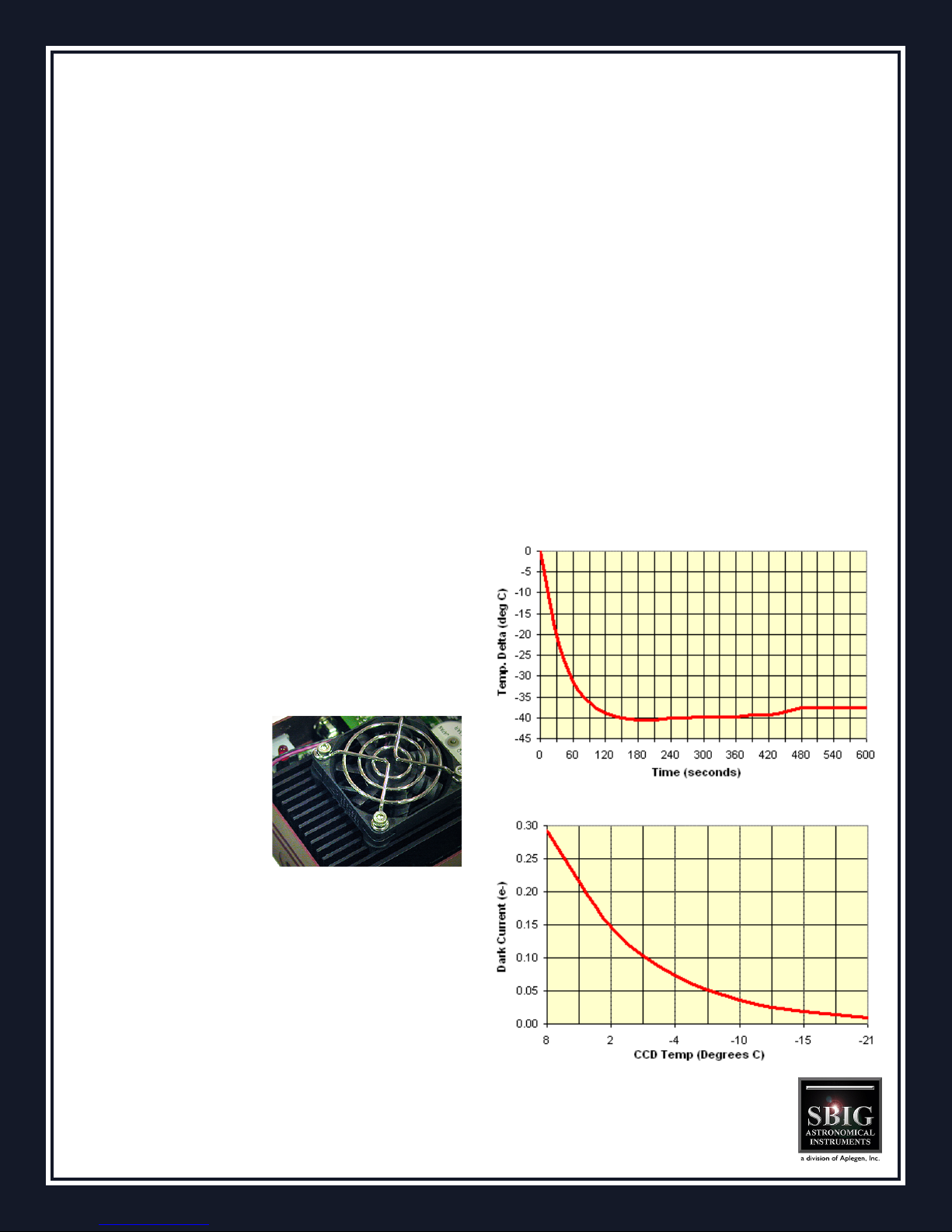
According to Kodak, the dark current of the KAF-8300 is
less than 200e- at 60 degrees C with a dark current doubling
temperature of 5.8 degrees. This means that for approximately
each 5.8 degrees C that one warms the CCD, the dark
current is doubled, and for each 5.8 degrees C one cools the
CCD the dark current is halved. Extrapolating this to -10C
we can calculate the maximum dark current we can expect
to nd at that temperature. In fact, Kodak’s specications are
usually very conservative when it comes to dark current, and
this value can vary from chip to chip by 50% or more and still
remain within the allowed specication. When we measured
the 8300 CCDs we found many to be less than half of Kodak’s
allowed specication. This is also typical of what we have seen
in other Kodak CCDs. In our tests we measured the dark
current in some samples to be as low as 0.01 electrons at
-10C. Again, these are extremely low dark current values for
a full frame CCD. The Dark Current chart on this page has
been updated using the average of the rst production run of
cameras. Even at zero degrees C the typical dark current is
well below 0.2 electrons! At -10C the average of our current
production units is around 0.04 electrons making it the lowest
dark current of any camera currently made by SBIG.
Cooling Delta-T
ST-8300
TE cooling
In our tests of production
samples, the camera reached
a maximum of -40 degrees
C below ambient in a warm
room in less than 3 minutes
after the cooling was
turned on. It was allowed
to stabilize and after a few
more minutes the regulation
was enabled A few degrees were then given up for regulation
with the camera running at only 80% TE cooling power
to maintain -36 degrees C below ambient. Because of this
CCDs extraordinarily low dark current, great temperature
deltas are not required to achieve a dark current low enough
that it becomes relatively insignicant compared to the read
noise and sky background (See dark current data below). For
example, in a test, one 15 minute dark frame taken at -10C
was subtracted from another 15 minute dark frame taken at
the same temperature. The total noise in the remaining image
was ~15 electrons which included both dark current noise
and read noise. This is exceptionally low.
Dark Current
ST-8300
Page 4
Quantum Efciency
In the past, one of the drawbacks in using sensors with small
pixels and antiblooming structure has been the trade-off
of some quantum efciency. However, Kodak’s microlens
technology has largely made this trade-off a thing of the
past. The KAF-8300 uses microlenses to focus more light on
each pixel that would otherwise be lost due to the opaque
antiblooming gate structure of the sensor. As a result, the
KAF-8300 antiblooming protection can handle up to 1000X
the full well saturation and at the same time this CCD has a
quantum efciency comparable to that of a full frame sensor
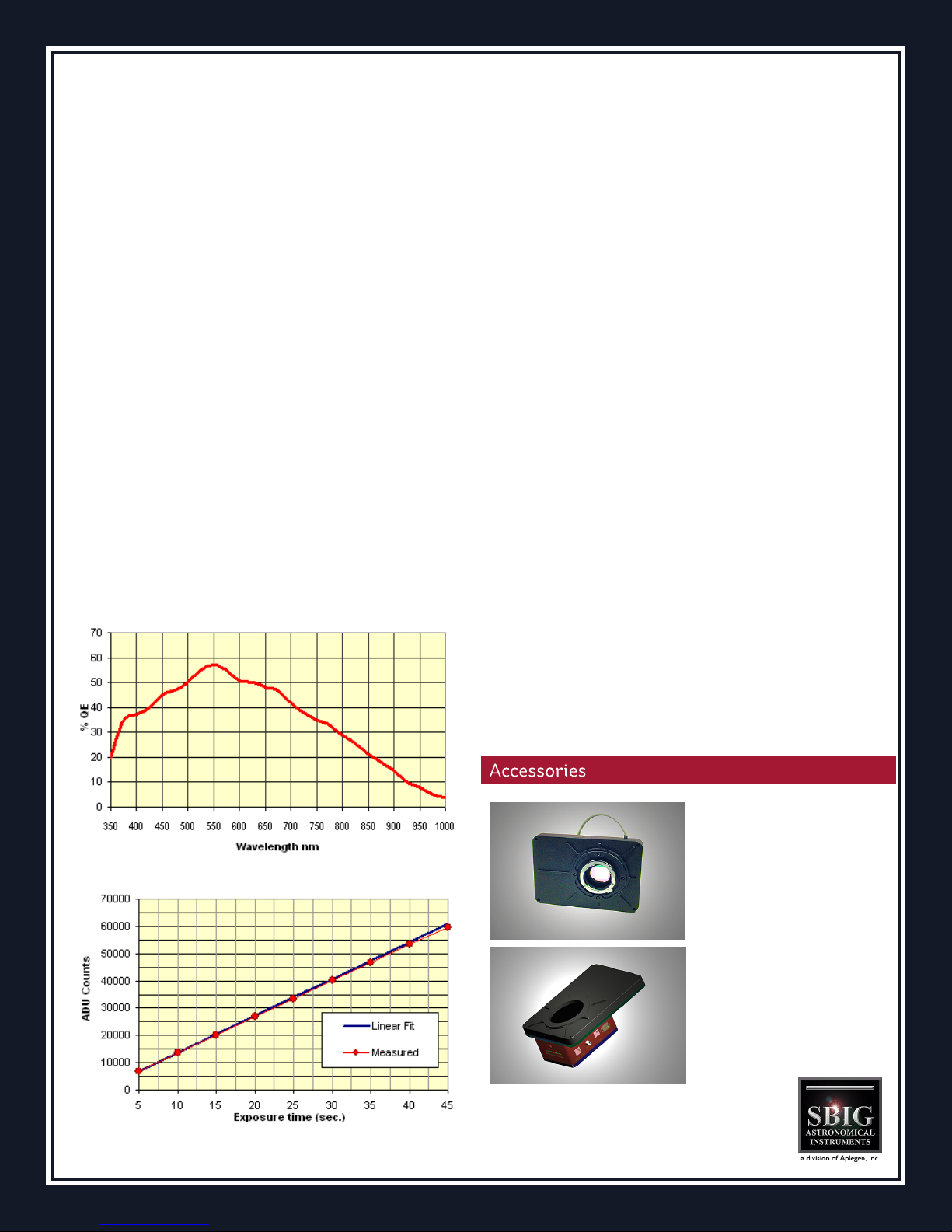
without ABG. Moreover, the QE curve for this full frame
sensor has a peak in the middle of the visual spectrum and
good sensitivity well into the red and near IR. The QE at the
important wavelength of H-alpha is nearly 50%.
Linearity
Linearity is measure of how at the CCD response is to light
with increasing exposure times. For instance, an ideal CCD
will record exactly twice the signal in a 20 second exposure
as it does in a 10 second exposure from a constant light
source. This is particularly important in photometric studies
where the CCD is used as a tool for measuring light at
various wavelengths to determine the temperature of stars.
The sample we measured is about 10X better than Kodak’s
allowed specication, with a response that is within about 1%
of linear (up to approximately 50,000 counts (binned 2x2).
Quantum Efciency
ST-8300
Integrated Filter Wheels
Due to the large size of this CCD, 1.25” lters are just too
small to fully cover the sensor without some vignetting in the
corners. This may be acceptable at f/7 or longer focal lengths,
but at shorter focal lengths the effect becomes greater. Also,
the ST-8300 cameras are ideally suited for use with camera
lenses, and we wanted to make a system available that would
accommodate the back focus requirement for typical 35mm
camera lenses with a lter wheel attached to the camera. For
this reason SBIG designed a new 5-position lter wheeland
a new 8-position lter wheel specically for the ST-8300
cameras that will hold 36mm lters for unvignetted images
at any focal ratio and at the same time accommodate 35mm
camera lenses. These lter wheels plug directly into the I2C
port on the ST-8300 camera and do not require separate
power or control cables. Fully automatic function is controlled
by the same software that controls the camera. Full sets of
36mm LRGB and narrowband lters by Astrodon and Baader
Planetarium are now available and a new set from Custom
Scientic will be available in the near future. We have also
been informed that Astronomik intends to make lters in the
36mm size. So there is a wide variety of lters available. In
addition, for those who may already have 2” lters we have
designed an adapter plate to mate the ST-8300 camera to our
FW8-STL 8-position 2” lter wheel. The FW8-STL holds both
2” lters in threaded cells and 50.8mm round unmounted
lters.
Finally, for those users with slower optical systems, 1.25 inch
lters may be acceptable. In this case both the CFW9 and
CFW10-SA lter wheels will t the ST-8300 camera and these
too will operate automatically by plugging into the I2C port
on the ST-8300 camera. In the sample image gallery below the
narrowband image of the Pacman Nebula was shot with the
ST-8300 using a CFW8A and 1.25” lters.
Linearity
ST-8300
FW5-8300
Five-position,
36mm Filter Wheel
FW8-8300
Eight-position,
36mm Filter Wheel
Page 5
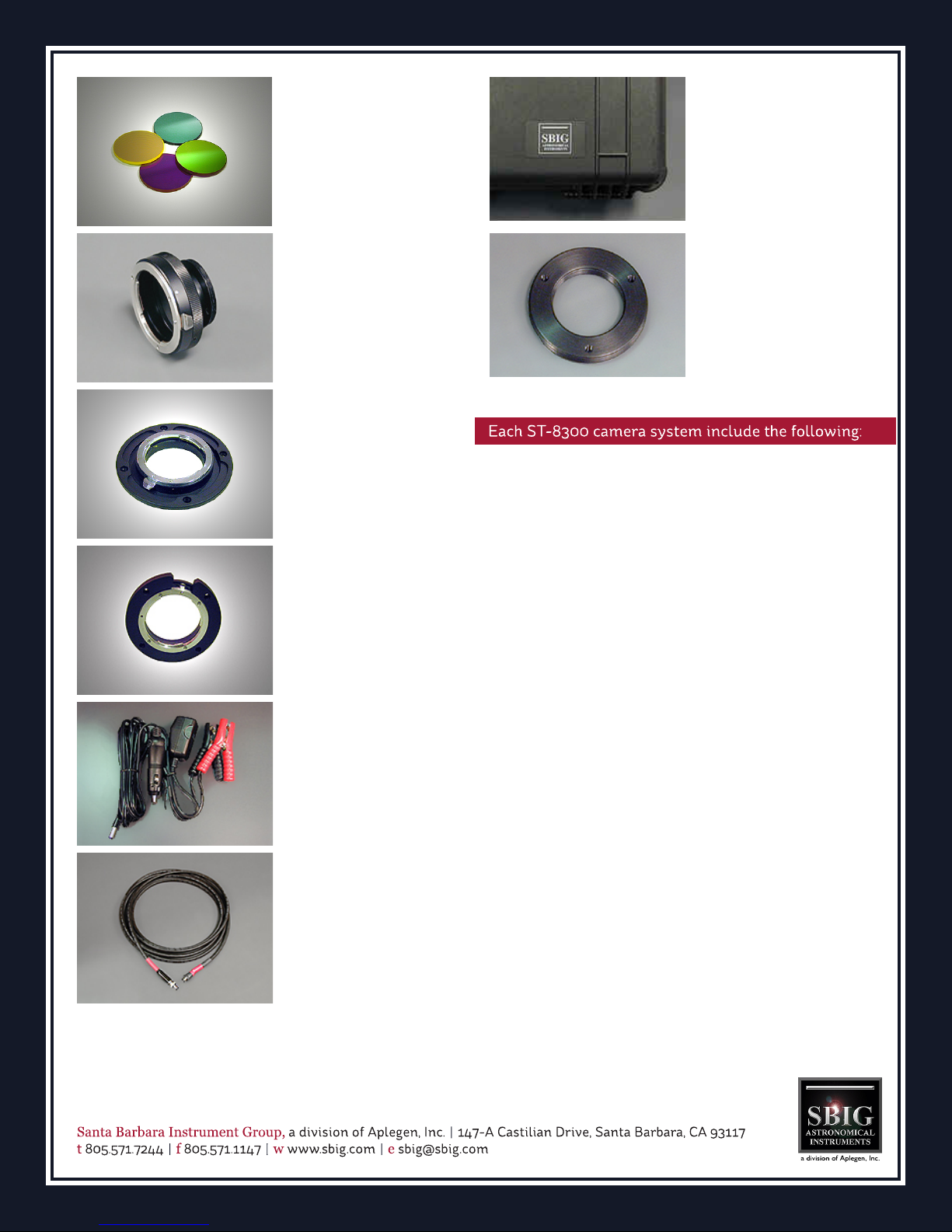
36mm Filters
LRGB and
Narrowband Filters
Pelican Case
Water proof, dust proof,
crush proof, professional
case with custom cut foam
for ST-8300 Camera with
lter wheel attached
CLA7-8300
Nikon Lens Adapter
for use without a lter
wheel
CLA-8300
Nikon Lens Adapter
for use with a lter wheel
(FW5-8300 or FW8-8300)
CLA-EOS-8300
Canon EOS Lens Adapter
for use with or without a
lter wheel (FW5-8300 or
FW8-8300)
12VDC Power Cable
8 foot (2.4 meter) power
cable with cigarette lighter
plug and battery clips
12VDC Extension Cable
8 foot (2.4 meter) Low Loss,
12V Power Extension Cable
with locking connectors
T-to-C Adapter
C-mount lens adapter
• Rugged camera body with rack handles and 2” nosepiece
• New KAF-8300M or KAF-8300C imaging CCD
• High speed USB 2.0 interface
• I2C bi-directional accessory port for integrated lter wheel
control
• Standard guider output port (ST-4 pinout compatible with
internal opto-isolated relays)
• Internal mechanical shutter
• Large Cooling Fan
• Tripod mount 1/4-20 threaded side plate
• 15 foot USB cable (third party USB extenders available)
• Telescope interface cable (for guiding)
• Universal 100-240VAC Power supply
• SBIG’s CCDOPS version 5 camera control software
• Software Bisque’s CCDSoftV5 camera control and image
processing software
• Software Bisque’s TheSky v5, Level II
• Printed Operating Manuals
• Princeton carrying case with pre-cut foam for your camera
and small accessories
• One Year Warranty Parts and Labor on the CCD
• Two Year Warranty Parts and Labor on the camera other
than the CCD
• Demo CD-ROM with sample images and software
© 2011 Aplegen, Inc. All rights reserved. The Aplegen wordmark and logo are trademarks of Aplegen, Inc. All other trademarks, service marks and tradenames
appearing in this brochure are the property of their respective owners.
ST8300.072011
 Loading...