

Page 1
Safe ow n e rship is your re s p o n s i b i l i t y.
Please thoroughly read and understand this
manual before loading your firearm.
INSTRUCTION MANUA L
Keep firearms and ammunition away fro m
c h i l d ren. Lock unloaded firearms and
ammunition securely in separate locations.
Savage Arms recommends the use of good
quality high velocity factory manufactured
ammunition.
w w w. s a va g e a r m s. c o m
Children are attracted to and can operate firearms that can cause severe injury
or death. Prevent child access by always keeping guns locked away and
unloaded when not in use. If you keep a loaded firearm where a child obtains
and improperly uses it, you may be fined or sent to prison.
LEVER ACTION RIMFIRE:
FAVORITE .22 L.R.
FAVORITE .22 W.M.R.
FAVORITE .17 H.M.R.
IMPORTANT! DO NOT ATTEMPT TO LOAD AND SHOOT YOUR RIFLE UNTIL YOU HAVE THOROUGHLY
READ THIS INSTRUCTION MANUAL AND ARE FULLY FAMILIAR WITH ITS CONTENTS
WARNING
758070 (06/02)
ADVERTENCIA
A los niños los atraen las armas de fuego y las pueden hacer funcionar. Ellos
pueden causarses lesiones graves y la muerte. Evite que los niños tengan
acceso a las armas de fuego guardándolas siempre con llave y descargadas
cuando no las esté utilizando. Si usted tiene un arma de fuego cargada en un
lugar en que un niño tiene acceso a ella y la usa indebidamente, le pueden dar
una multa o enviarlo a la carcel.
248 Water Street
100 Springdale Road
Westfield, Massachusetts
USA 01085
w w w. s a va g e a r m s. c o m
P.O. Box 1240
Lakefield, Ontario
CANADA K0L 2H0
Page 2

1
Congratulations on joining the Savage Arms
family of sporting firearms owners. With
reasonable care, your firearm should deliver
years of reliable service and perform to our
“legend of accuracy”.
For your convenience, this INSTRUCTION
MANUALhas been divided into 5 sections:
SECTION 1: 10 Commandments of Shooting Safety
SECTION 2: Basic Functions
SECTION 3: Rings And Bases For Mounting A
Scope
SECTION 4: Statement Of Limited Warranty
SECTION 5: FAVORITEModel 30 Series (Parts List
and Diagram)
SECTI ON 1
10 COMMANDMENTS OF SHOOTING
S A F E T Y
(The following excerpts are from SAAMI bulletin
#081 1MM 7/97 BP. The entire booklet can be
obtained by calling: NATIONALSHOOTING
SPORTS FOUNDATION, 11 MILE HILLROAD,
NEWINGTON, CT 06470; 203-426-4358)
Firearms Safety Depends On You
From the time you pick up a firearm, you become
part of a system over which you have complete
control. You are the only part of the system that
can make a gun safe – or unsafe.
You can help meet this responsibility by enrolling
in hunter safety or shooter safety courses, if you
have not already done so. You must constantly
stress safety when handling firearms, especially
to children and non-shooters. Develop safe
shooting habits and remember firearms safety is
up to you. Make no mistake about it.
ALCOHOL, DRUGS AND GUNS DON’T MIX
1. ALWAYS KEEPTHE MUZZLE POINTED IN A
SAFE DIRECTION
This is the most basic safety rule. If everyone
handled a firearm so carefully that the muzzle
never pointed at something they didn’t intend to
shoot, there would be virtually no firearm
accidents. It’s as simple as that, and it’s up to you.
Never point your gun at anything you do not
intend to shoot. A safe direction means a
direction in which a bullet cannot possibly strike
anyone, taking into account possible ricochets
and the fact that bullets can penetrate walls and
ceilings. Even when “dry firing” with an unloaded
gun, you should never point the gun at an
unintended target.
This is your responsibility, and only you can
control it.
2. FIREARMS SHOULD BE UNLOADED WHEN
NOTACTUALLY IN USE
Firearms should be loaded only when you are
in the field or on the target range or shooting
area, ready to shoot. When not in use, firearms
and ammunition should be secured in a safe
place, separate from each other. It is your
responsibility to prevent children and
inexperienced adults from gaining access to
firearms or ammunition. A loaded gun has no
place in or near a vehicle or building.
Whenever you handle a firearm or hand it to
someone, always open the action immediately,
and visually check the chamber, receiver and
magazine to be certain they do not contain any
ammunition. Never assume a gun is unloaded –
check for yourself! While in the field, there will be
times when common sense and the basic rules of
firearms safety will require you to unload your
gun for maximum safety. When in doubt, unload
your gun!
3. DON’T RELY ON YOUR GUN’S “SAFETY”
Treat every gun as though it can fire at any time,
regardless of pressure on the trigger. The
“safety” on any gun is a mechanical device,
which, like any such device, can become
inoperable at the worst possible time. The safety
serves as a supplement to proper gun handling
but cannot possibly serve as a substitute for
common sense.
Never touch the trigger on a firearm until you
actually intend to shoot.
Your firearm is a precision instrument.
Regardless of the position of the safety, any
bump strong enough to actuate the firing
mechanism of a gun can cause it to fire. The
only time you can be absolutely certain that a gun
cannot fire is when the action is open and it is
completely empty. You and the safe gun handling
procedures you have learned are your gun’s
primary safeties.
4. BE SURE OF YOUR TARGETAND WHAT’S
BEYOND IT
No one can call a bullet back. Don’t shoot
unless you know exactly what your bullet is going
to strike. Be sure that your bullet will not injure
anyone or anything beyond your target. You
should keep in mind how far a bullet will travel if it
misses your intended target or ricochets in
another direction.
Be aware that even a .22 short bullet can
travel over 1
1
/
miles and a high velocity
4
cartridge, such as a 30-06, can project a bullet
more than 3 miles. Shotgun pellets can travel
500 yards, and shotgun slugs have a range of
over a half-mile.
5. USE CORRECT AMMUNITION
You must assume the serious responsibility of
using only the correct ammunition for your
firearm. Read and heed all warnings, including
those that appear in the gun’s instruction manual
and on the ammunition boxes. Using improper or
incorrect ammunition can destroy a gun and
cause serious personal injury. It only takes one
cartridge of improper caliber or gauge to wreck
your gun, and only a second to check each one
as you load it. Be absolutely certain that the
ammunition you are using matches the
specifications that are contained within the gun’s
instruction manual and the manufacturer’s
markings on the firearm barrel.
Hand loaded or reloaded ammunition deviating
from pressures generated by factory loads or
from competent recommendations specified in
reputable hand loading manuals can be
dangerous, and can cause severe damage to
guns and serious injury to the shooter.
Ammunition that has become very wet or has
been submerged in water should be discarded in
a safe manner. Do not spray oil or solvents on
ammunition or place ammunition in excessively
lubricated firearms.
Form the habit of examining every cartridge you
put in your gun. Never use damaged, old or
questionable ammunition – the money you save is
not worth the risk of possible injury or a ruined gun.
WARNING
DISCHARGING FIREARMS IN POORLY
VENTILATED AREAS, CLEANING FIREARMS
OR HANDLING AMMUNITION MAY RESULT IN
EXPOSURE TO LEAD AND OTHER
S U B S TANCES KNOWN TO CAUSE BIRT H
DEFECTS, REPRODUCTIVE HARM A N D
OTHER SERIOUS PHYSICAL INJURY. HAVE
A D E Q U ATE VENTILATION AT A L L T I M E S .
WASH HANDS THOROUGHLY A F T E R
EXPOSURE.
6. IF YOUR GUN FAILS TO FIRE WHEN THE
TRIGGER IS PULLED, HANDLE WITH CARE!
Occasionally, a gun may not fire when the trigger
is pulled. If this occurs, keep the muzzle pointed
in a safe direction. Keep your face away from the
breech. Then, carefully open the action, unload
the firearm and dispose of the cartridge in a safe
way.
Any time there is a cartridge in the chamber, your
gun is loaded and ready to fire – even if you’ve
tried to shoot and it did not go off. It could go off
at any time, so you must always remember
RULE #1 and WATCH THAT MUZZLE!
2
Page 3
3
7. ALWAYS WEAR EYE AND EAR
PROTECTION WHEN SHOOTING
All shooters should wear protective shooting
glasses and some form of hearing protectors
while shooting. Exposure to shooting noise can
damage hearing, and adequate vision protection
is essential. Wearing eye protection when
disassembling and cleaning any gun will also
help prevent the possibility of springs, spring
tensioned parts, solvents or other agents from
contacting your eyes. No target shooter, plinker
or hunter should ever be without them.
8. BE SURE THE BARREL IS CLEAR OF
OBSTRUCTIONS BEFORE SHOOTING
Before you load your firearm, open the action
and be certain that there is no cartridge in the
chamber. Then glance through the barrel to be
sure it is clear of any obstruction. Even a small
piece of mud, snow, excess lubricating oil or
grease in the bore can cause dangerously
increased pressure, causing the barrel to bulge or
even burst when firing, which can cause injury to
the shooter and/or bystanders. Make it a habit to
clean the bore with a cleaning rod and patch to
wipe away anti-rust compounds in the gun each
time immediately before you shoot it. If the noise
or recoil on firing seems weak or doesn’t seem
quite “right”, cease firing immediately and be sure
to check that no obstruction or projectile has
become lodged in the barrel.
9. DON’TALTER OR MODIFY YOUR GUN,
AND HAVE GUNS SERVICED REGULARLY
Firearms are complicated mechanisms, which
are designed by experts to function properly in
their original condition. Any alteration or change
made to a firearm after manufacture can make
the gun dangerous and will usually void any
factory warranties. Do not jeopardize your safety
or the safety of others by altering the trigger,
safety or other mechanism of any firearm or
allowing unqualified persons to repair or modify
a gun.
Your gun is a mechanical device, which will
not last forever and is subject to wear. As such,
it requires periodic inspection, adjustment and
service.
10. LEARN THE MECHANISM AND HANDLING
CHARACTERISTICS OF THE FIREARM
YOU ARE USING
Not all firearms are the same. Consequently,
never handle any firearm without first having
thoroughly familiarized yourself with the particular
type of firearm you are using, the safe gun
handling rules for loading, unloading, carrying
and handling that firearm, and the rules of safe
gun handling in general. Locate the firearm’s
mechanical safety device and get familiar with the
feel and “on/off” positions.
You should always read and refer to the
instruction manual you received with your gun, or
if you have misplaced the manual, simply contact
the manufacturer for a free copy.
Having a gun in your possession is a
full-time job. You cannot guess; you
cannot forget. You must know how to
use, handle and store your firearm
safely. Do not use any firearm without
having a complete understanding of its
particular characteristics and safe use.
There is no such thing as a foolproof gun.
SEC TIO N 2
BASIC FUNCTIONS
PRIOR TO LOADING OR OPERATING,
FAMILIARIZE Y O U R S E L F T H O R O U G H LY
WITH THESE OPERATING INSTRUCTIONS
AND THE MAIN PARTS OFYOUR FIREARM.
FAILURE TO OBEY A SAFETY WARNING MAY
RESULT IN INJURYTO YOU AND/OR OTHERS.
SAVAGE ARMS, (CANADA) INC. DISCLAIMS
ANY RESPONSIBILITY FOR DAMAGE OR
INJURY WHICH RESULTS FROM ANY
MODIFICATIONS OR CHANGES THATARE
NOT A PART OF THE FIREARM AS
DELIVERED FROM THE FACTORY.
SAFETY
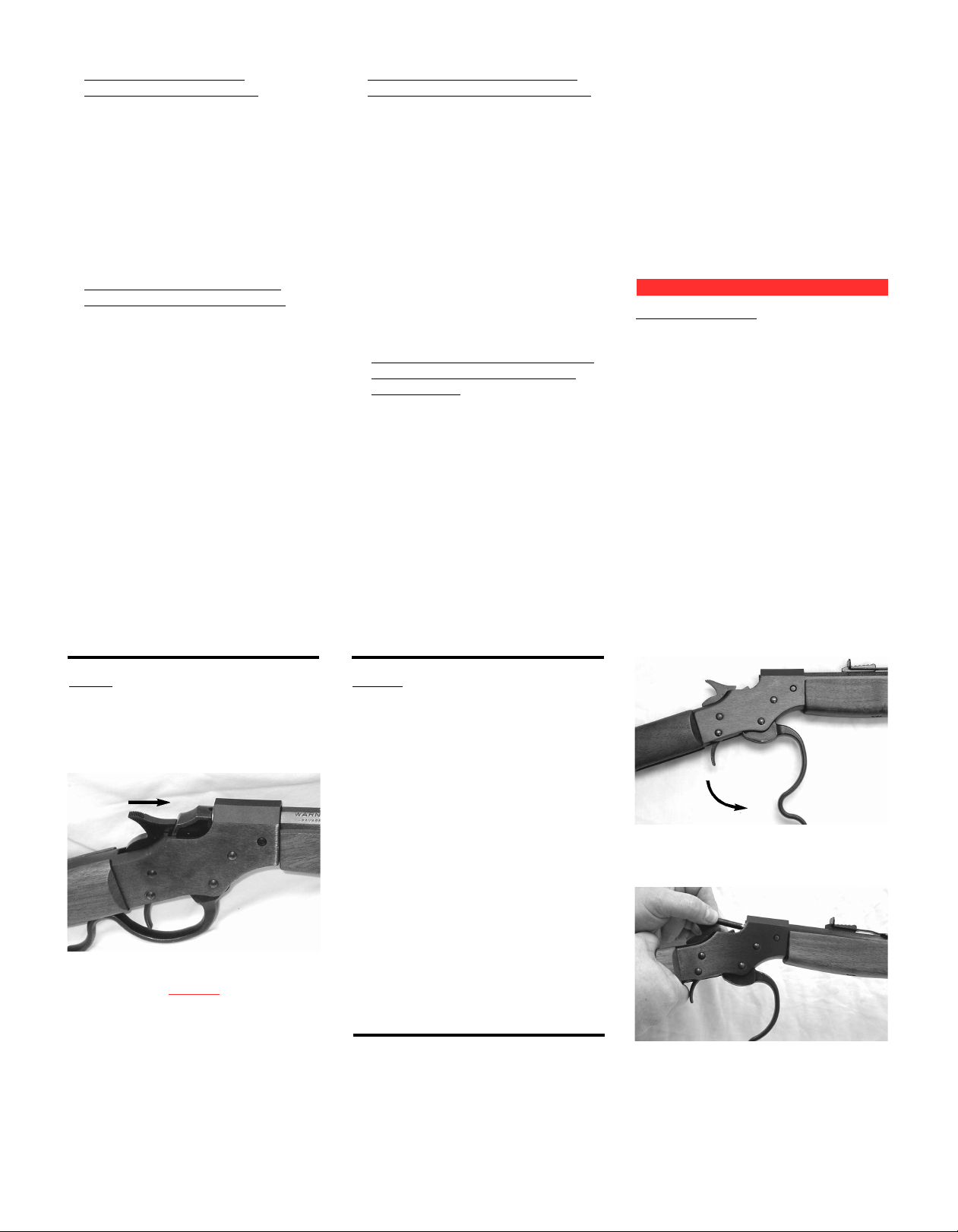
1. To put in the SAFE POSITION, open and close
the lever so that the hammer is in the forward
position resting against the breech block. See
FIGURE 1.
FIGURE 1
CAUTION
THE GUN SHOULD BE CARRIED AT A L L
TIMES WITH THE HAMMER IN THE SAFE
POSITION.
THE ONLY TIME YOU CAN BE ABSOLUTELY
C E RTAIN THAT A GUN CANNOT FIRE IS
WHEN THE ACTION IS OPEN AND IT IS
COMPLETELY EMPTY OFAMMUNITION.
LOADING
FIREARMS SHOULD BE LOADED ONLY WHEN
YOU ARE IN THE FIELD, ON THE TARGET
RANGE, OR AT A SHOOTING AREA READY
TO SHOOT.
ALWAYS KEEP THE MUZZLE POINTED IN A
SAFE DIRECTION.
USE ONLY THE CORRECT AMMUNITION
T H AT IS STAMPED ON THE SIDE OF THE
BARREL.
LOOK THROUGH AND THOROUGHLY CLEAN
THE INSIDE OF THE BARREL AND CHAMBER
TO ASSURE THERE ARE NO POSSIBLE
OBSTRUCTIONS PRIOR TO LOADING.
SAVAGE ARMS, (CANADA) INC. DISCLAIMS
ANYRESPONSIBILITY FOR DAMAGE OR
INJURY WHICH RESULTS FROM THE USE OF
OTHER THAN FACTORYMANUFACTURED
AMMUNITION.
1. With the muzzle of the firearm pointed in a
safe direction, pull the lever down all the way
to open the action. See FIGURE 2. Opening
the lever fully will leave the firearm in a “safe”
position.
FIGURE 2
2. Insert a cartridge into the chamber stopping on
the extractor. See FIGURE 3.
FIGURE 3
3. Close the lever to move the extractor and
cartridge into chamber.
ALWAYS KEEPTHE MUZZLE POINTED IN A
SAFE DIRECTION.
4
Page 4

5
CAUTION
DO NOT FORCE RIM OF C A RTRIDGE
AHEAD OF E X T R A C TOR OR A C C I D E N TA L
DISHARGE WILL OCCUR BEFORE BREECH
IS CLOSED.
TO FIRE
DO NOT COCK HAMMER UNTIL READY TO
FIRE.
1. Keep your finger off the trigger and out of the
trigger guard until you are ready to shoot.
THE ONLY TIME YOU CAN BE ABSOLUTELY
C E RTAIN THAT A GUN CANNOT FIRE IS
WHEN THE ACTION IS OPEN AND IT IS
COMPLETELY EMPTY OFAMMUNITION.
2. Always look carefully around to be sure that no
one will cross in front of you when you are
ready to shoot.
3. With firm thumb pressure on the hammer spur,
draw the hammer fully rearward to the cocked
position.
• The gun will fire when the trigger is pulled.
• A notch in the hammer will stop the
hammer from striking the firing pin if it is
unintentionally released before reaching the
fully cocked position.
NEVER TOUCH THE TRIGGER ON AFIREARM
UNTILYOU ACTUALLYINTEND TO SHOOT.
NEVER POINT YOUR GUN AT ANYTHING YOU
DO NOT INTEND TO SHOOT.
4. Place the firearm in shooting position, take
aim, and place your finger lightly on the trigger.
5. When on target pull the trigger fully to the rear.
NO ONE CAN CALL A BULLET BACK !!!
6. To extract a fired shell, open the lever and the
fired shell will be extracted allowing easy
removal with your fingers.
ALWAYS KEEPTHE MUZZLE POINTED IN A
SAFE DIRECTION.
7. If you do not fire the gun, opening the lever
fully will drop the hammer into a safe position
without the gun firing.
• The action can now be closed safely.
ALWAYS LEAVE THE HAMMER IN THE SAFE
POSITION EXCEPT WHEN FIRING.
UNLOADING
1. With the muzzle pointed in a safe direction,
open the lever fully and remove the cartridge
from the chamber.
• Look and feel to make sure the chamber is
unloaded and close the action.
A LOADED GUN HAS NO PLACE IN OR NEAR A
VEHICLE OR BUILDING.
CAUTION
LOOK AND FEEL! BE SURE THE CHAMBER IS
EMPTY — DO NOT ASSUME!
CLEANING AND CARE OF YOUR FIREARM
YOUR GUN IS A MECHANICAL DEVICE THAT
WILL NOT LAST FOREVER AND IS SUBJECT
TO WEAR.
CLEANING THE BORE
LOOK AND FEEL! BE SURE THE CHAMBER IS
COMPLETELY EMPTY — DO NOT ASSUME!!!
NEVER ATTEMPT TO DISASSEMBLE, CLEAN,
OR OIL A LOADED FIREARM!
BE SURE TO READ AND UNDERSTAND ALL
OF THE CAUTIONS AND WARNINGS ON ALL
SOLVENTS AND CHEMICALS PRIOR TO USE.
FOLLOW THE MANUFACTURER’S
INSTRUCTIONS FOR BEST CLEANING
RESULTS.
1. Prepare an area for cleaning the firearm with a
suitable surface, adequate ventilation, and the
correct caliber cleaning rod, brush, patches,
powder solvent, and oil.
2. With the muzzle pointed in a safe direction,
open the lever fully and remove the cartridge
from breech (if there is one).
3. Look and feel to make sure the chamber is
empty.
A LWAYS STA RTING FROM THE CHAMBER
END, PUSH THE CLEANING ROD THROUGH
THE BORE AND OUT THE MUZZLE END.
4. Using a small amount of powder solvent on the
brush, push the cleaning rod through the barrel
several times.
5. Unscrew the brush from the cleaning rod and
replace it with a patch tip.
6. Push a new patch through the bore starting
from the chamber end and out the muzzle.
7. Repeat step 6 several times.
8. Push a new patch lightly saturated with gun oil
through the bore.
9. Push a new dry patch through the bore to
remove the excess oil.
A VERY THIN FILM OF OIL IS SUFFICIENT
PROTECTION – DO NOT OVER OIL!!!
YOUR GUN IS A MECHANICAL DEVICE THAT
WILL NOT LAST FOREVER AND IS SUBJECT
TO WEAR. CONTACT S AVAGE A R M S
S E RVICE DEPA RTMENT FOR PERIODIC
INSPECTION, ADJUSTMENT AND SERVICE.
PROTECTING METAL SURFACES
1. With a soft cloth, remove any foreign matter
(i.e. mud, twigs, grass).
2. Apply a thin coat of gun oil on all cleaned
metal surfaces. Rubbing may be necessary to
remove any signs of rust.
3. Where accessible, clean and lightly oil interior
metal surfaces.
THIS RIFLE IS FACTORYASSEMBLED. DO
NOT TAKE ACTION APART.
SEC TION 3
RINGS & BASES FOR M O U N T I N G A
S C O P E
The following Companies manufacturer RINGS
and BASES that fit Savage firearms.
The manufacturers listed below should be
contacted for specific part numbers and
information.
WEAVER
P.O. Box 39
Onalaska, WI 54650
800-635-7656
www.weaveroptics.com
KWIK-SITE
5555 Treadwell
Wayne, MI 48184
734-326-1500
B-SQUARE
P.O. Box 11281
Fort Worth, TX 76110
800-433-2909
www.b-square.com
BURRIS
331 East 8thStreet
Greeley, CO 80631
970-356-1670
www.burrisoptics.com
MILLETT
7275 Murdy Circle
Huntington Beach, CA
92647
800-645-5388
www.millettsights.com
LEUPOLD
14400 NW Greenbrier
Parkway
Beaverton, OR 97006
503-526-5196
www.leupold.com
6
Page 5

7
SECTI ON 4
S TATEMENT OF LIMITED
WA R R A N T Y
Please complete the WARRANTY
REGISTRATION CARD and return it to Savage
Arms, Inc. within ten (10) days from the date of
purchase.
Savage Arms, Inc. must be notified within one
(1) year from the date of purchase of any defect
in materials or workmanship encountered during
normal use.
WHO IS COVERED?
The original owner (with proof of purchase).
WHATIS COVERED?
Any defect in materials or workmanship
performed at Savage Arms.
HOW LONG IS THE WARRANTY PERIOD?
One (1) year from the date of purchase.
WHATIS NOT COVERED?
PERSONAL INJURY, PROPERTYDAMAGE,
AND/OR DAMAGE TO THE FIREARM CAUSED
BY:
• Negligence to provide proper care and
maintenance.
• Alterations/modifications performed without
the expressed authorization of Savage
Arms, Inc. Service Department.
• Normal wear; tear; and/or corrosion.
• Accidental discharge, careless handling,
and/or misuse.
• Barrel obstructions.
EXCLUSIONS AND LIMITATIONS:
This WARRANTY and the remedies set forth
herein are exclusive and take the place of all
other expressed or implied WARRANTIES
(including any implied WARRANTY of
merchantability or fitness for any particular
purpose which are disclaimed). No other
representations or claims of any nature shall be
binding on or obligate Savage Arms, Inc.
Savage Arms, Inc. excludes any incidental and
consequential damages under this warranty.
Some states do not allow exclusions or limitations
on how long an implied warranty lasts, so the
above limitations may not apply to you.
This WARRANTY gives you specific legal rights.
You may have other rights, which will vary, from
state to state.
RETURNING A FIREARM:
For WARRANTY claims, proof of purchase must
accompany the firearm.
It is a violation of Federal Law to ship a firearm
with live ammunition either in the box or in the
firearm itself. If received, The Bureau of Alcohol,
Tobacco, and Firearms must be notified!
Savage Arms, Inc. is not responsible for the loss
or damage to any accessories shipped with the
firearm.
If there is a question whether the firearm should
be returned or parts could be purchased, please
call 1-413-568-7001 between 9:00 am and
3:30 p.m. EST and ask for the Service/Warranty
Department.
All firearms are to be sent to Savage Arms, Inc.
at the owner’s expense. Warranty repairs will be
returned to the owner at the expense of Savage
Arms, Inc.
1. Pack the firearm in its original box if possible
(or a similar suitable box), being careful to
include any support pieces.
2. Enclose a brief note including:
• Name, address and phone number of
sender.
• Best time and method to contact sender.
• Serial number of firearm.
• Description of the problem you are having.
• Bullet weight, bullet type, sabot, powder
type and charge you are using.
• Any other information that you feel may be
helpful.
3. Return to:
Savage Arms, Inc.
100 Springdale Road
Westfield, MA01085
Attn: Service Department
Phone: 413-568-7001
Fax: 413-568-8386
4. If there will be a charge involved for the repair,
a quote will be sent within fourteen (14)
working days.
• If there is no response from the quote
within (30) days, the firearm will be returned
COD ($20.00 Shipping/Handling).
• Firearms will be repaired typically 4 weeks
after receipt of payment in the order they
were received.
8
Page 6
9
SEC TI ON 5
FAVORITE Model 30
PARTS MAY BE ORDERED DIRECTLY FROM
SAVAGE ARMS[PHONE 413-568-7001]
BETWEEN THE HOURS OF9:00 AND 3:30
(EASTERN STANDARD TIME). THERE IS A
MINIMUM ORDER AND PLEASE ALLOW 2
WEEKS FOR DELIVERY.
PLEASE BE ADVISED THAT SOME PARTS
MAY REQUIRE FITTING. SAVAGE ARMS
BEARS NO RESPONSIBILITY FOR THE
FUNCTION OR PERFORMANCE OFANY
FIREARM THAT HAS BEEN REPAIRED OR
MODIFIED BYOTHER THAN SAVAGE ARMS
SERVICE DEPARTMENT. AS SUCH, SAVAGE
ARMS ACCEPTS NO RESPONSIBILITY/
LIABILITYFOR ANY DIRECT AND/OR
CONSEQUENTIALDAMAGE AND/OR INJURY
RESULTING FROM THE USE OF A FIREARM
REPAIRED OR MODIFIED BYOTHER THAN
THE SAVAGE ARMS SERVICE DEPARTMENT.
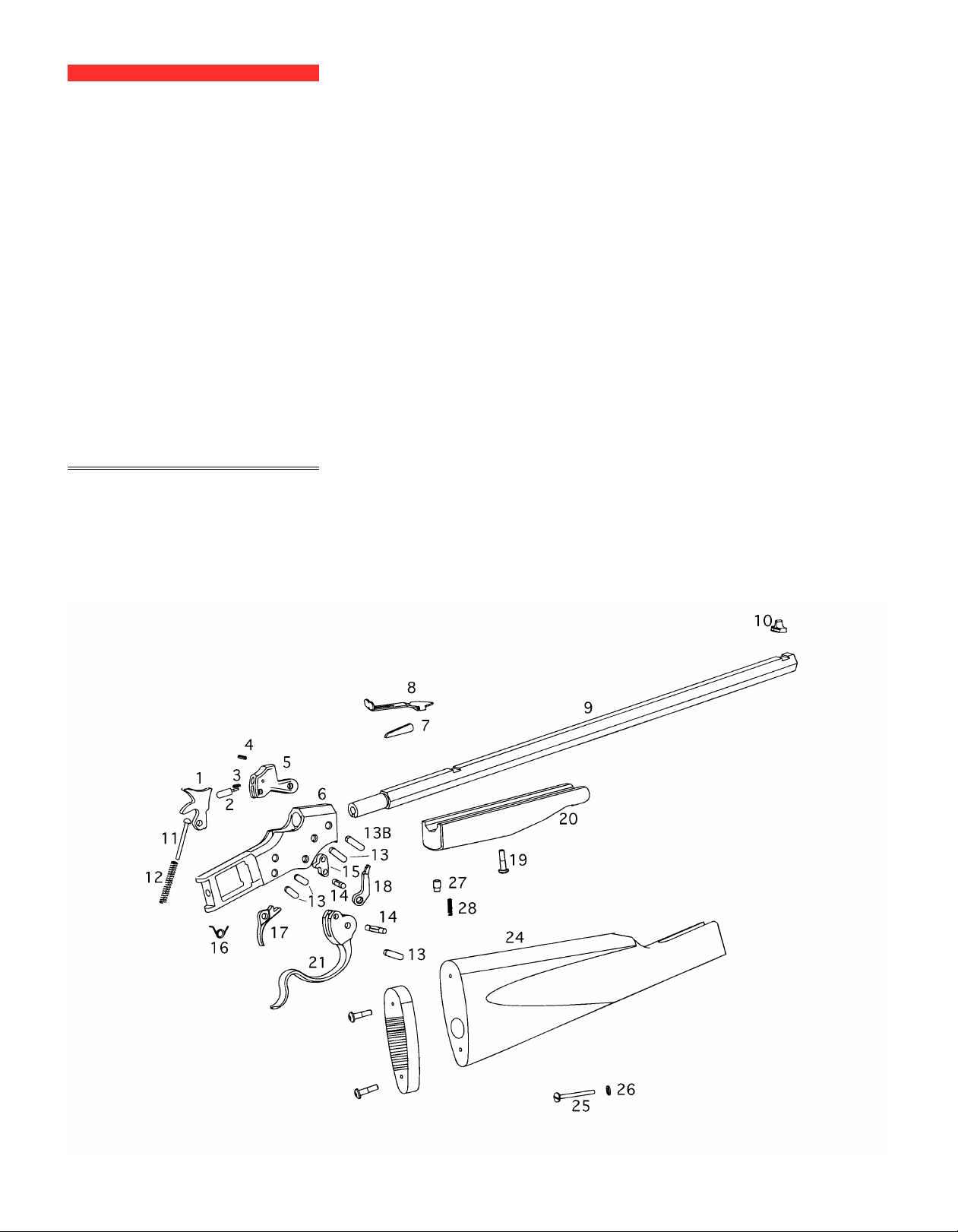
# Description Part #
1 Hammer .22LR 708020
Hammer .22WMR/.17HMR 708044
2 Firing pin 708011
3 Firing pin spring 708012
4 Firing pin retaining pin 708030
5 Breech block .22LR 708010
Breech block .22WMR/.17HMR 708038
6 Frame 708008
7 Universal elevator 104860
8 Rear sight 700414
9 Barrel .22LR 708006
Barrel .22WMR (full octagon) 708128
Barrel .17HMR (full octagon) 708146
10 Front sight 700427
11 Mainspring plunger 708022
12 Mainspring .22LR 708021
Mainspring .22WMR/.17HMR 708048
13 Hammer pin (4 req’d) 708040
13B Barrel pin 708042
14 Link pin (2 req’d) 708035
15 Link 708014
16 Trigger spring 708009
17 Trigger 708019
18 Extractor 708018
19 Forend screw 708032
20 Forend wood 708007
Forend wood camo 708041
21 Lever 708015
24 Buttstock wood 708023
Buttstock wood camo 708051
25 Stock bolt 708045
26 Stock bolt washer 708046
27 Detent plunger 708047
28 Detent plunger spring 708049
FAVORITE Model 30
10
Not To Scale
 Loading...