

Page 1
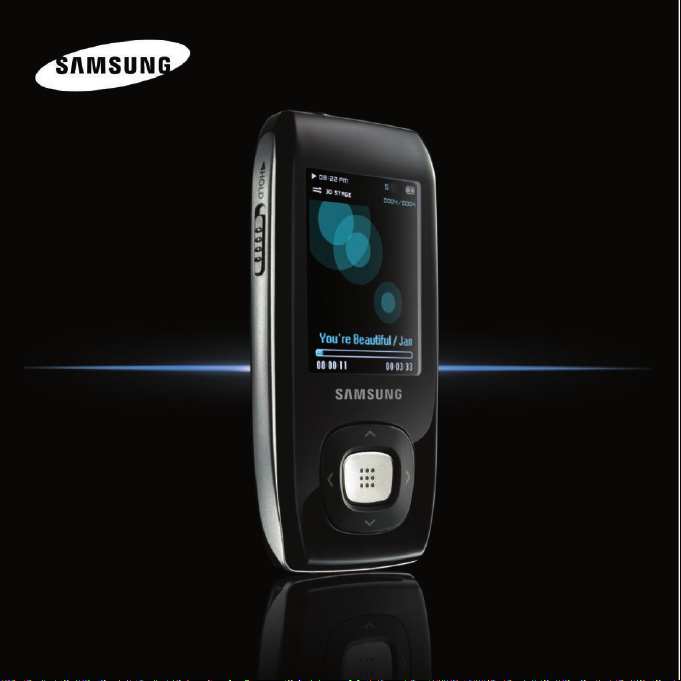
YP-T9J
Page 2
For Your Safety
Read this manual carefully to ensure proper use of the product and
to avoid any danger or physical damage.
2
WARNING
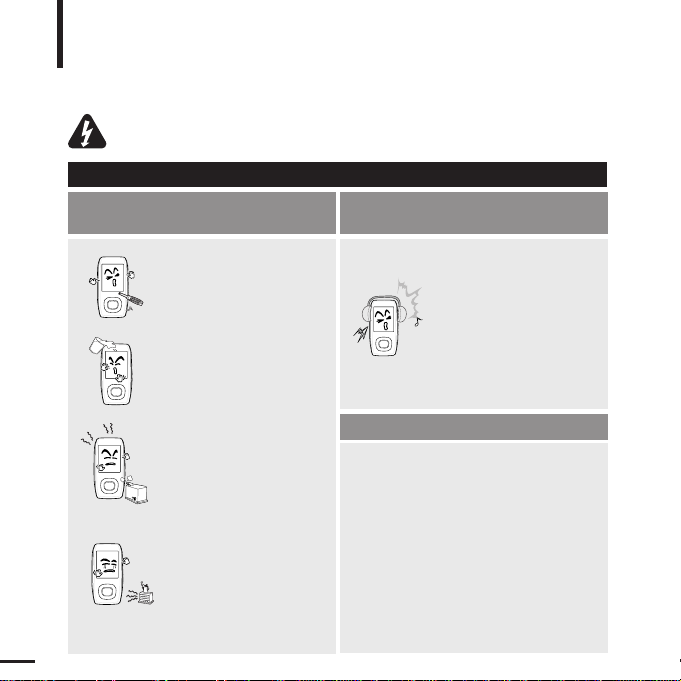
Product Use
Improper use can result in explosion,
fire or electric shock.
To avoid hearing damage
Do not disassemble, repair
or modify this product on
your own.
Do not get the product wet
or drop it in water.
If the product gets wet,
do not switch it on.
Contact a Service Center.
Do not place the product in
damp, dusty or sooty areas,
as it could result in fire or
electric shock.
Avoid using your player at
high volume levels, as it may
result in permanent
hearing damage.
If you experience ringing in
your ears while using the
earphones, remove the
earphones immediately
and/or lower the volume.
To avoid a risk of traffic accident
Do not use the earphones while you are
driving a bicycle, automobile or motorcycle.
It can cause a serious accident and furthermore,
is prohibited by law in some areas.
Using the earphones while walking, in particular,
on a crosswalk, can lead to a serious accident.
Take care not to tangle the earphone cable
around your arms or neighboring objects
while driving, working out or walking, as it
could result in a car accident or other
injuries.
Do not leave the player in
areas above 35°C(95°F)
(such as a sauna or inside
a parked car).
During hot weather, the
temperature inside a car may
rise up to 80°C(176°F).
Failing to heed the product instructions may cause serious injury.
Page 3
Chapter 1. Preparation
3
CAUTION
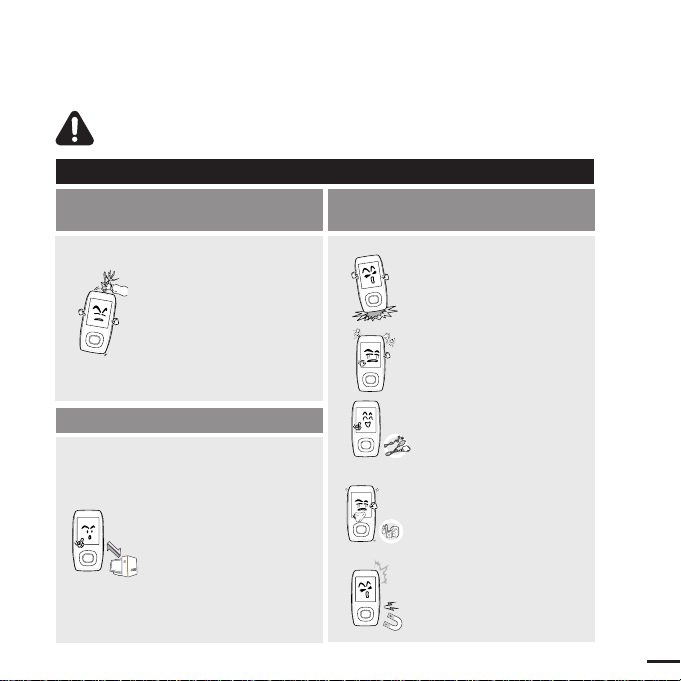
Product Use
Take care to avoid product
malfunction and physical damage.
Backup Important Data
To avoid malfunction
When wearing the product
around your neck, take
care not to exert excessive
force on the neck string.
Be sure to backup
important data.
Please be aware that we
claim no responsibility for
damage from data loss due
to breakdown, repair or other
causes.
Failure to follow all instructions lead to physical injuries or damage to the product.
Do not cause excessive
impact on the product by
dropping it. Do not place
heavy objects on top of the
product.
Prevent any foreign
particles or dust from
entering into the product.
Always use the accessories
provided by or approved by
Samsung.
Do not spray water on the
product. Never clean the
product with chemical
substances such as
benzene or thinner, as it may
cause fire, electric shock or
deteriorate the surface.
Do not place the product
near magnetic objects, as it
may cause a malfunction.
Page 4

Basic Information .......................................6
Components...............................................6
Screen Display Information........................9
Button Functions......................................10
Charging the battery ................................11
Basic Use ...................................................12
Contents
4
Chapter 1. Preparation
Chapter 2.
Loading Your Desired File
Loading Your Desired File ......................16
Installing Samsung Media Studio ............16
Connecting to your PC.............................17
Adding Folders/Files in Samsung
Media Studio............................................18
Transferring Files to the Player
with Samsung Media Studio....................20
Chapter 3. Multimedia function
Listening to Music ....................................22
Listening to Music....................................22
Section Repetition....................................25
Creating Playlists Using
Samsung Media Studio............................26
To Play a Playlist......................................28
Using Music menu ...................................31
Video............................................................34
Video........................................................34
Using Video menu....................................37
Photo Viewing ...........................................38
Photo Viewing..........................................38
Using Photo menu ...................................40
Text Viewing ...............................................42
Text Viewing.............................................42
Using Text menu ......................................43
Listening to FM Radio .............................47
Listening to FM Radio..............................47
Setting a Frequency.................................49
To Delete Presets.....................................51
Using FM Radio menu.............................52
Recording...................................................53
Recording.................................................53
Voice/FM Radio Recording ......................54
Recorded File Names..............................55
Game ...........................................................56
Game .......................................................56
For Your Safety ..........................................2
Contents .......................................................4
Page 5

5
Chapter 4. Setting
Setting ....................................................58
Setting Music.......................................58
Setting Record.....................................60
Setting Time .......................................61
Setting Display ...................................63
Setting Language................................64
Setting System ...................................65
Chapter 5. Troubleshooting
Troubleshooting........................................67
Chapter 6. Appendix
Menu Tree...................................................69
Product Specifications............................70
Page 6
6
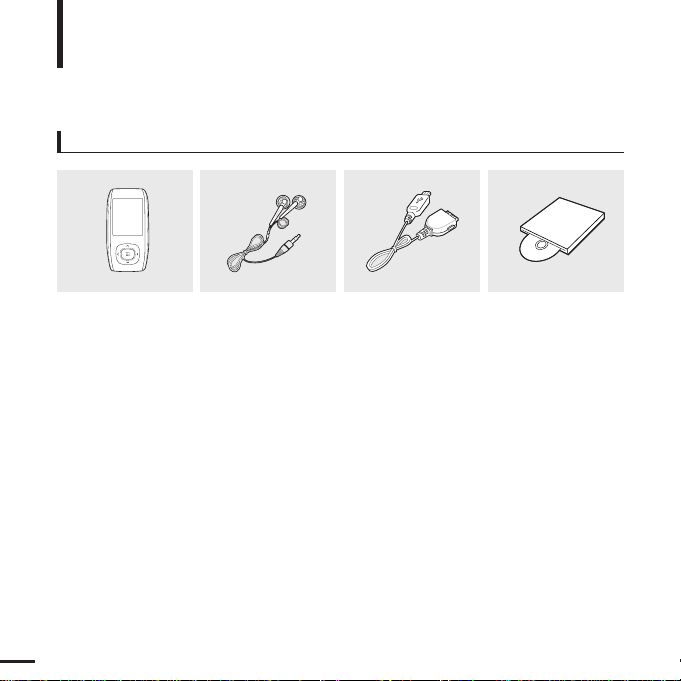
Components
Basic Information
Checking the Accessories
■ Design of accessories is subject to change for the purpose of improvement, without notice.
Player Earphones USB Cable
Installation CD
AH30-00087D AH39-00899A
AH80-00138A
Page 7
Chapter 1. Preparation
Components
7
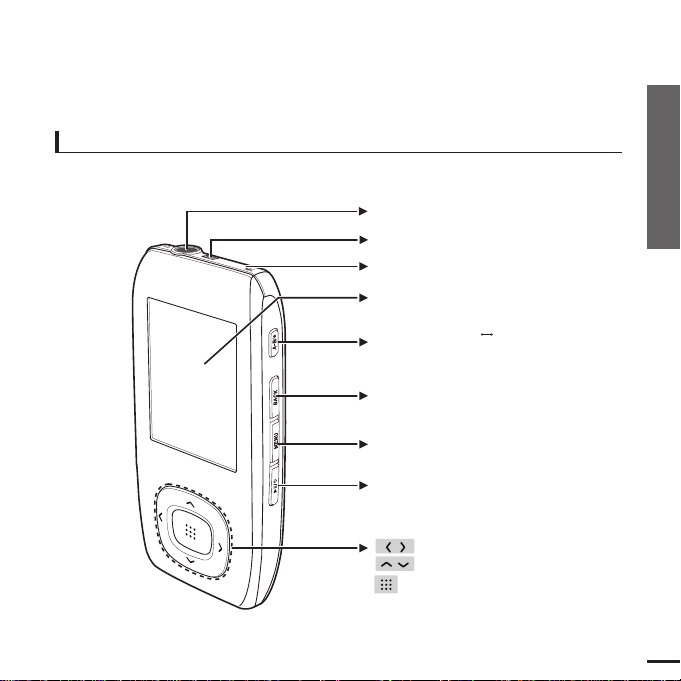
Front, Right Side and Top
Earphone Connection Jack
Neck String Hole
Microphone
Screen Display
Section Repeat(A B)/
Recording Button
Back Button
Move/File Browser Button
Move/Volume Control Button
Select Button
MENU Button
Power & Play/Pause Button
Page 8
8
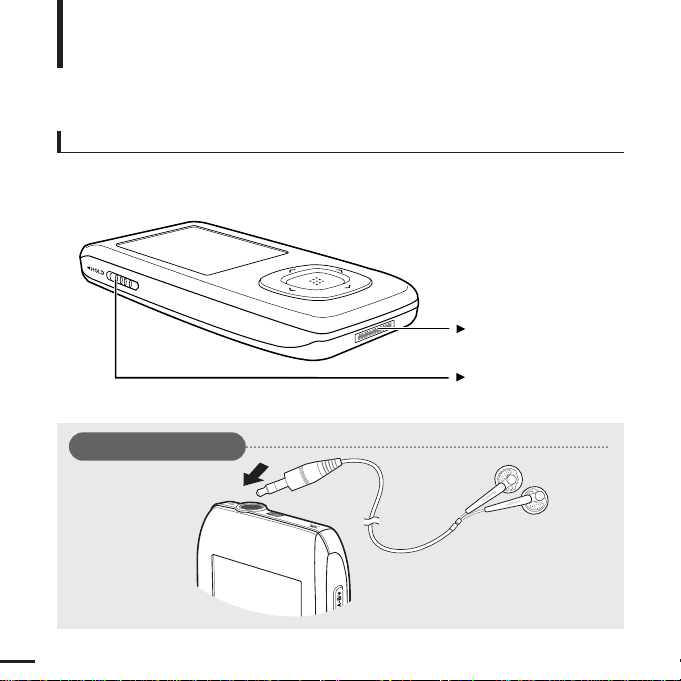
Bottom and Left Side
USB Connection Port
Hold Switch
Components (Continued)
Basic Information
Earphone Connection
√ Top
Earphones
Page 9
Chapter 1. Preparation
Components/Screen Display Information
9
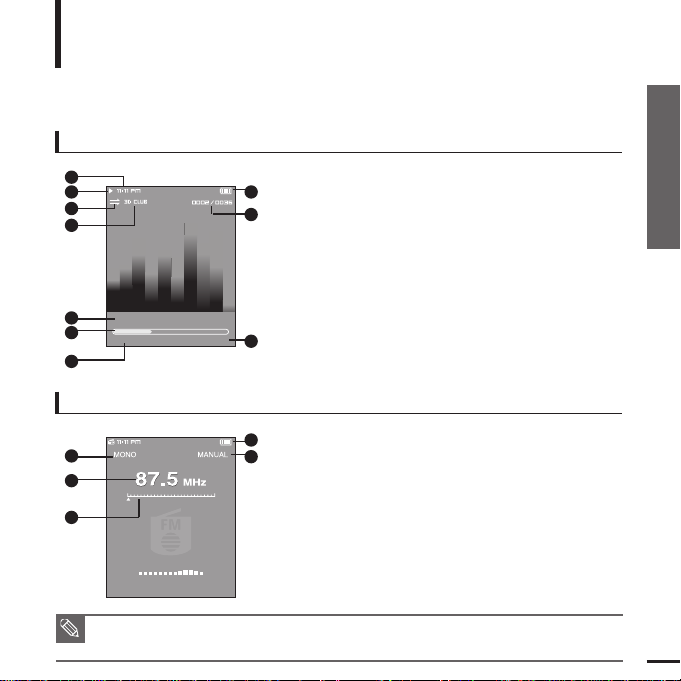
Screen Display Information
Basic Information
NOTE
■ The screen pictures are for illustration purposes only. The actual screen may differ.
1
Current Time Display
3
Play Mode Display
2
Playback Display
4
Sound Mode Display
5
Music Title Display
6
Play Status Bar
7
Play Time Display
8
Battery Status Display
10
Total Play Time Display
9
Current Track Playing/
Total Number of Tracks Display
1
Mono/Stereo Display
3
Frequency Location Display
2
Frequency Display
4
Battery Display
5
Preset/Manual/Add Preset
/Remove Preset Display
Music
FM Radio
Audio Track 1
00:01:42 00:05:06
1
2
3
4
5
6
7
8
9
10
4
5
1
2
3
Page 10
10
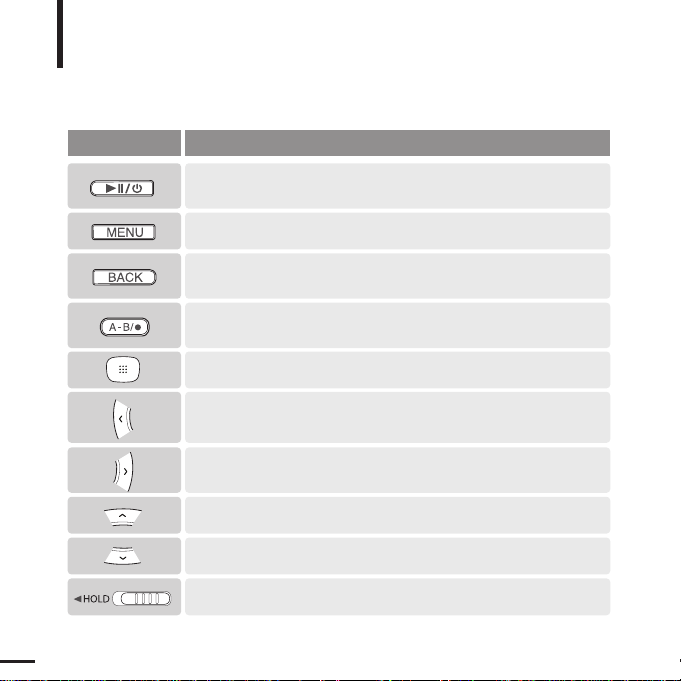
Button Functions
Basic Information
■ Press and hold for power on/off.
■ Press for play/pause.
■ Press and hold to move to the main menu.
■ Press to return to the previous stage.
■
Press and hold to start recording.
■
Press to set section repetition, stop recording and add to/delete from the playlist.
■ Press to move to the selected menu/confirm and save your selection.
■ Press and hold to quickly scan tracks.
■ Press to move to next track.
■ Press to increase the volume or move to an upper item/menu.
■ Press to reduce the volume or move to a lower item/menu.
■ Press to display the menu screen.
Buttons Functions and Use
■ Push in the direction of the arrow to lock the button functions.
■ Press and hold to quickly scan tracks.
■ Press to move to the previous track or play the current track from the
beginning.
Page 11
Chapter 1. Preparation
Button Functions/Charging the battery
11
Charging the battery
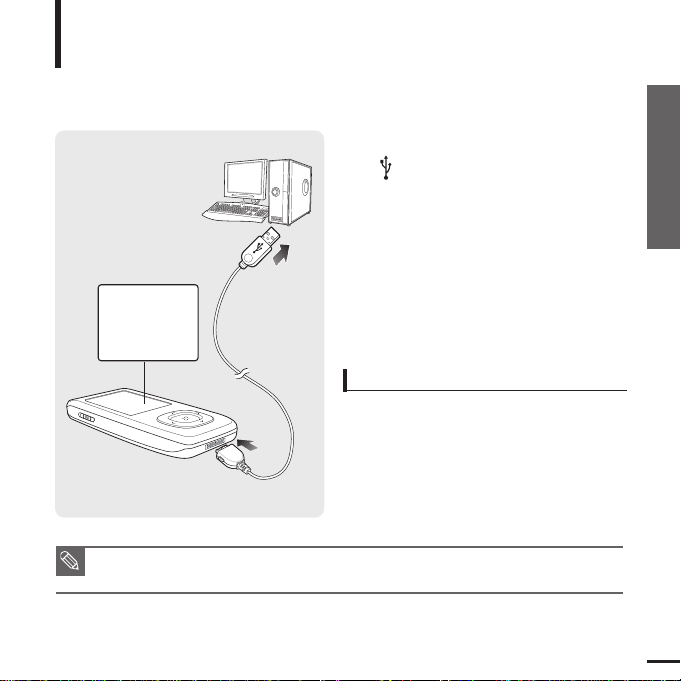
Fully charge the rechargeable battery before using the
player for the first time or when it has not been used for a
while.
1
Connect the USB cable to the USB port
( ) on your PC.
2
Connect the other end of the USB
cable to the USB Connection Port on
the bottom of the player.
■ When connected with the USB cable, it takes
about 4 hours for the player to fully charge
although this may vary depending on your PC
environment.
Battery Use
■
Recharge and store within the temperature range
of 5
°C
~35
°C(40°F
~95°F).
■
Do not overcharge (longer than 12 hours).
Excessive charging or discharging may shorten
the battery’s life.
■
Battery life naturally shortens slowly over time.
NOTE
■ If you are charging the player while it is connected to your Notebook, make sure the Notebook's
battery is also fully charged.
Screen Display
■
Charging...
■
Fully Charged
2
1
Page 12
12
■ Press the [ ] button to move to the sub menu.
■ Press the [BACK] button to move to the previous screen.
Basic Use
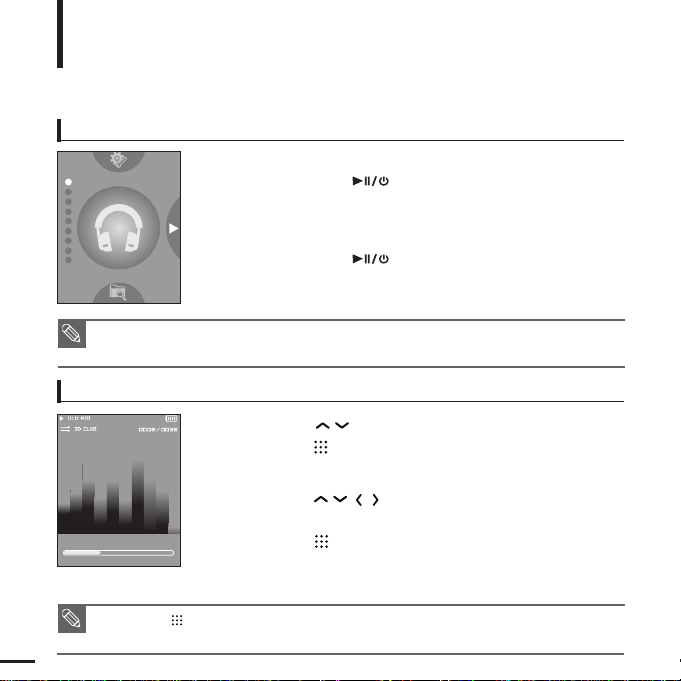
Turning the Power On & Off
Playing Music
Turning the Power On
Press and hold the
[]
button
■
Power is turned on.
Turning the Power Off
Press and hold the
[]
button
■
Power is turned off.
1
Press the [ ] button to select <Music> and then
press the [ ] button.
2
Press the [ ] button to select the desired music file.
3
Press the [ ] button.
■ The music file will begin playing.
NOTE
■ Power is automatically turned off when none of the buttons have been pressed for a preset
period of time (Default: 1 minute) in the pause mode.
√ Page 61
NOTE
Audio Track 1
00:01:42 00:05:06
Page 13
Chapter 1. Preparation
Basic Use
13
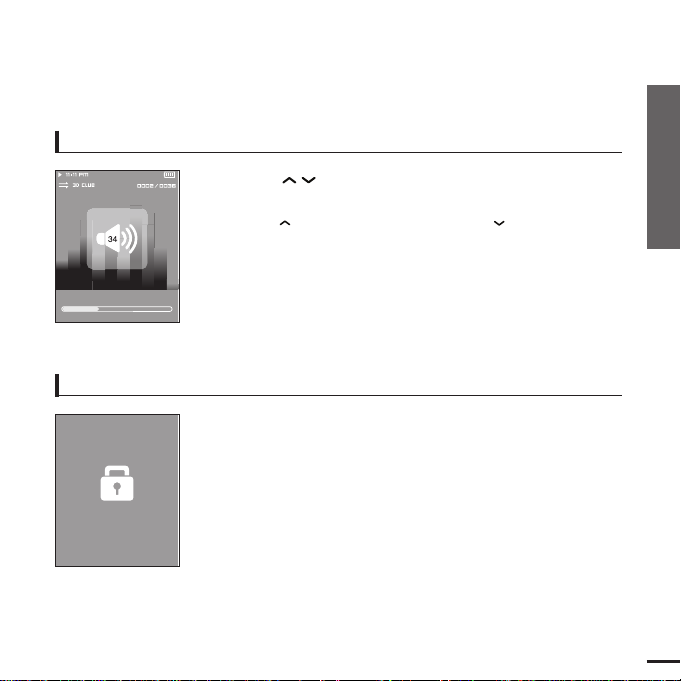
Volume Control
Lock Function
Press the [ ] button.
■ You will see a volume control icon.
■ Press the button to increase the volume or the button to decrease it.
In Hold mode, all buttons are disabled. This function is useful
when you are walking or jogging.
1
Push the [HOLD] switch in the direction of the arrow.
2
Push the [HOLD] switch in the opposite direction of the
arrow to release the Lock function.
Audio Track 1
Hold!
00:01:42 00:05:06
Page 14
14
Basic Use (Continued)
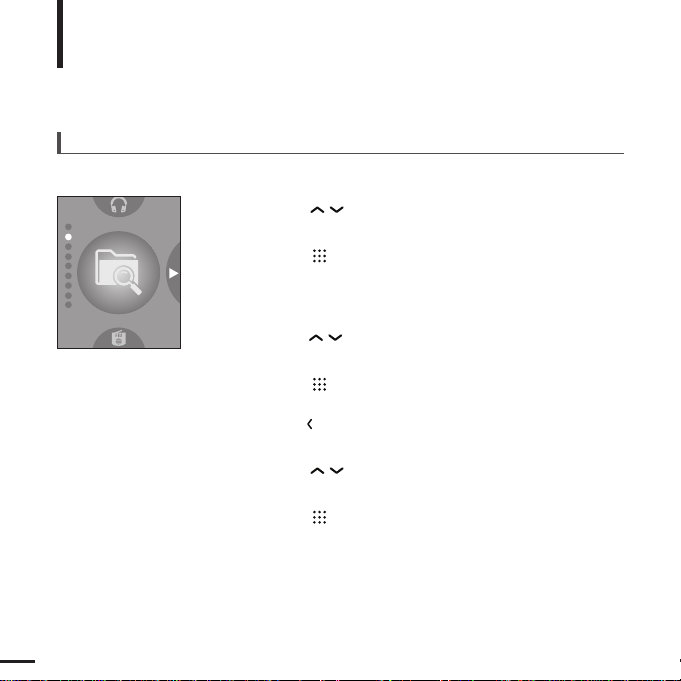
Searching for Files with <File Browser>
Search easily for files using the <File Browser> function.
4
Press the [ ] button to bring up the file list in the
selected folder.
■ Use the [ ] button to return to the previous step.
3
Press the
[]
button to select a folder of your choice.
6
Press the [ ] button.
■
The selected file will start playing.
Press the [ ] button.
■
The <File Browser> folder list containing Music, Text, Pictures and
Video appears.
2
Press the [ ] button to select a file of your choice.
5
1
Press the [ ] button to select <File Browser>.
Page 15
Chapter 1. Preparation
Basic Use
15
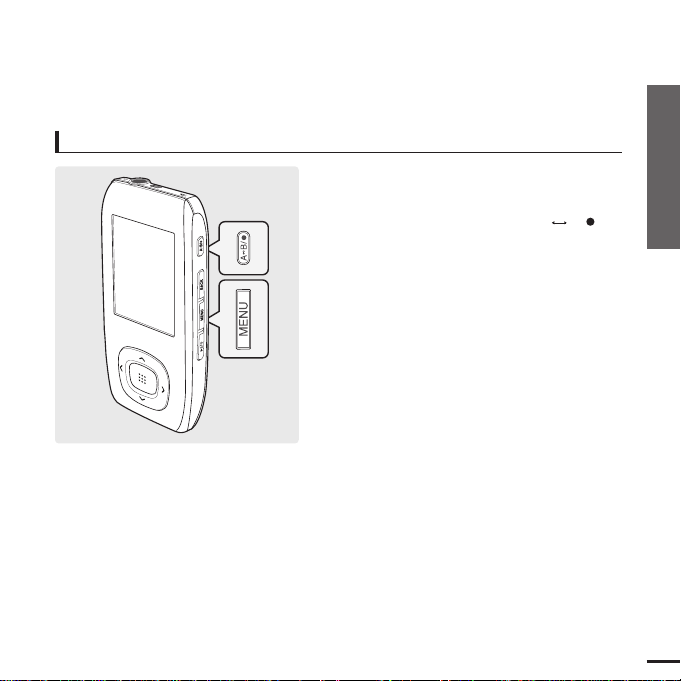
If a product malfunction occurs, you can
re-initialize the system.
Press and hold the [MENU] and [A B/ ]
buttons at the same time.
■
The system will be initialized.
■
Your settings and files will not be affected.
Reset Function
Page 16
16
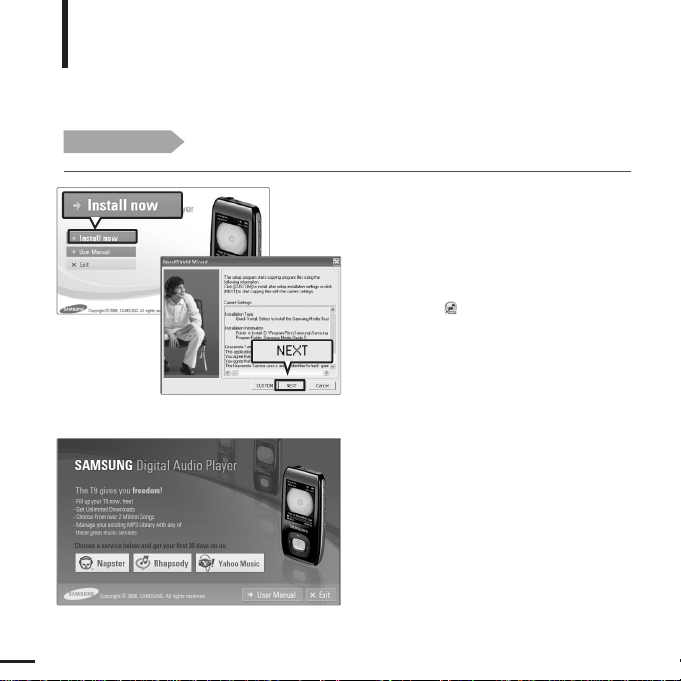
Installing Samsung Media Studio
Use Media Studio to transfer music
files from your PC to the player.
Loading Your Desired File
Before you start!
Insert the installation CD provided with the player into the CD-ROM drive of
your PC.
2
Click <NEXT>.
■ Media Studio installation starts.
■ An icon is created on the desktop after
installation is complete and Media Studio
starts.
The T9 gives you freedom!
- Fill up your T9 now, free!
- Get Unlimited Downloads
- Choose from over 2 Million Songs
- Manage your existing MP3 Library with any of
these great music services
Choose a service and get your first 30
days on us.
1
Click <Install now>.
Page 17
Chapter 2. Loading Your Desired File
Installing Samsung Media Studio/
Connecting to your PC
17
Connecting to your PC
Loading Your Desired File
Before you start!
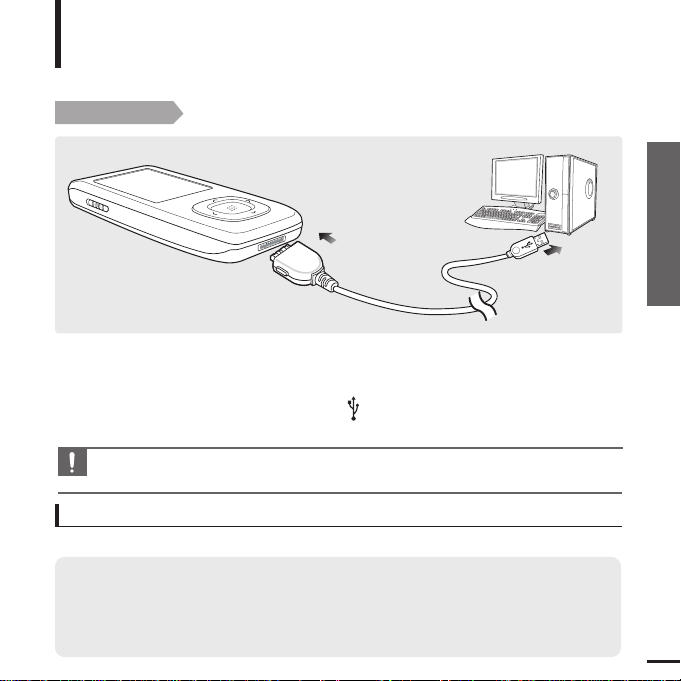
Use the USB Cable provided when connecting the player to your PC.
1
1
Connect the larger end of the USB cable to the USB Connection Port on the bottom
of the player.
2
2
Connect the USB cable to the USB port ( ) on your PC.
■
<USB Connected> appears on the screen display of the player.
CAUTION
■
If you connect the player through a USB hub, the connection may be unstable. Please connect the
player to the computer directly.
For use in conjunction with your PC, the following is required:
■ Pentium 300MHz or higher
■ USB Port 2.0
■ Windows XP Service Pack 2 or higher
■ DirectX 9.0 or higher
■ 100MB of free hard disc space
■ CD Rom Drive (2X or higher)
■
Windows Media Player 10.0 or higher
■
Resolution 1024 X 768 or higher
PC Requirements
Page 18
18
Adding Folders/Files in Samsung Media Studio
Loading Your Desired File
Please refer to Help for more information on how to use Media Studio.
■ Click <MENU> ➝ <Help> ➝ <Help> from the menu on the top of the Media Studio program.
3
3
2
[YP-T9
[YP-T9[MTP]]
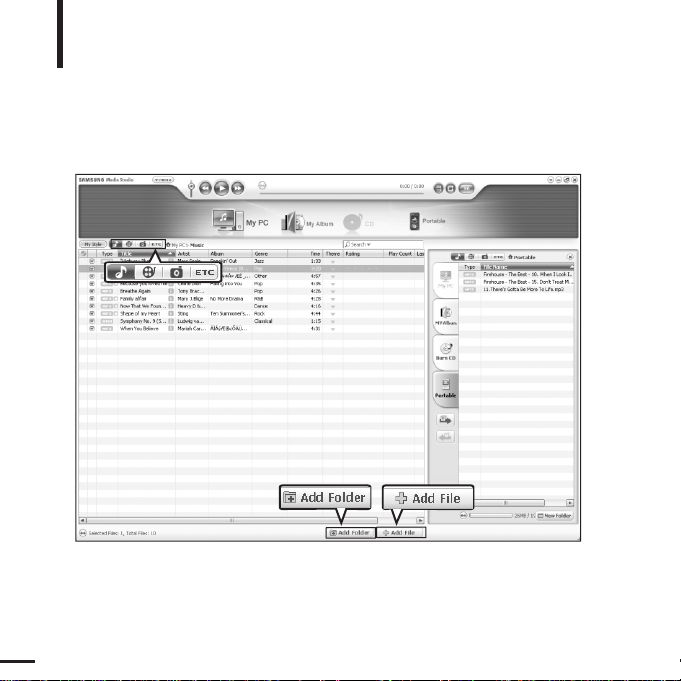
Media Studio enables you to select and organize files and folders in preparation
for transfer to your player.
Page 19
Chapter 2. Loading Your Desired File
Adding Folders/Files in
Samsung Media Studio
19
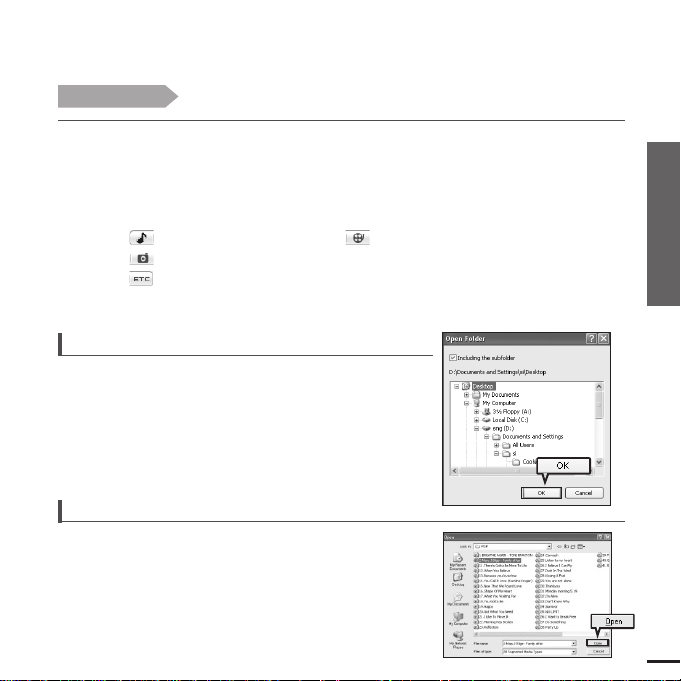
1
Media Studio will automatically start when the player is connected to your PC.
■ If the program does not start automatically, double Click the Media Studio icon on the desktop.
2
Click the desired file icon.
■
Choose the file type you want to transfer by clicking on one of these icons.
■ Click icon to display music list. ■ Click icon to display video list.
■ Click icon to display photo list.
■ Click icon to display etc list. The ETC list includes file types (ex: TXT, XOV, etc) other than
music, photo, and video files.
3
Click <Add Folder> on the bottom of Media Studio.
■ The Open Folder window will appear.
Before you start!
■ Connect the player to your PC.
■ Media Studio must be installed on your PC.
To add folders to Media Studio
3
Click <Add File> on the bottom of Media Studio.
■ The Open window will appear.
4
Select the files from your PC to add and click
<Open>.
■ The selected files are added to the list.
To add files to Media Studio
4
4
4
Select the folder from your PC to add and click <OK>.
■ The selected folder is added to the list on the left side of the
Media Studio Screen.
Page 20
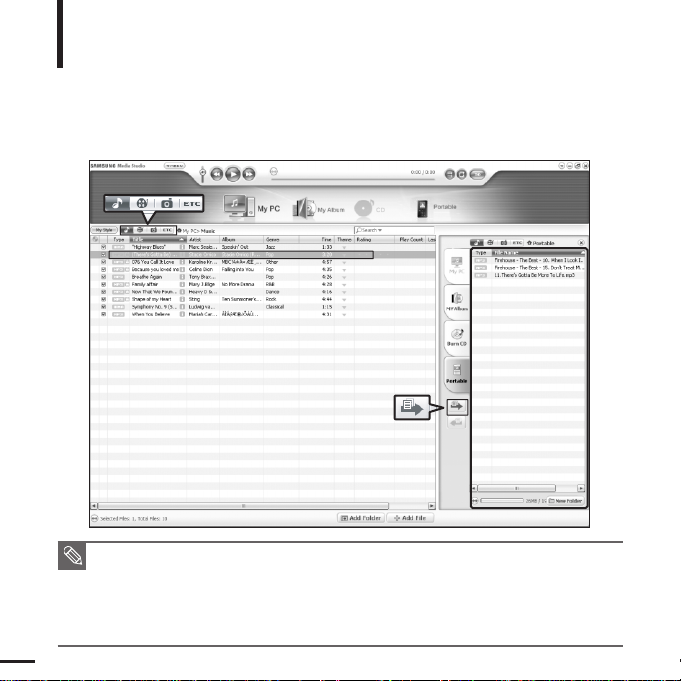
20
Transferring Files to the Player with Samsung Media Studio
Loading Your Desired File
NOTE
■
Music recognition technology and related data are provided by Gracenote and
Gracenote CDDB®Music Recognition ServiceSM.
■
CDDB is a registered trademark of Gracenote. The Gracenote logo and logotype, the Gracenote
CDDB logo and logotype, and the "Powered by Gracenote CDDB" logo are
trademarks of Gracenote. Music Recognition Service and MRS are service marks of Gracenote.
Perform the following steps to transfer files from your PC to the player.
4
3
2
Portable
window
[YP-T9[MTP]]
[YP-T9]
Page 21
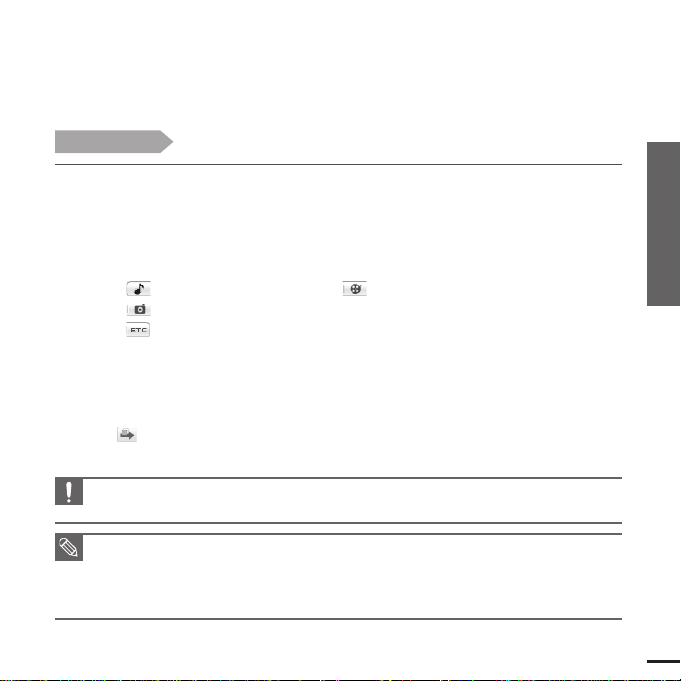
Chapter 2. Loading Your Desired File
Transferring Files to the Player with
Samsung Media Studio
21
1
Media Studio will automatically start when the player is connected to your PC.
■ If the program does not start automatically, double click the Media Studio icon on the desktop.
2
Click the desired file icon.
■
Choose the file type you want to transfer by clicking on one of these icons.
■ Click icon to display music list. ■ Click icon to display video list.
■ Click icon to display photo list.
■ Click icon to display etc list. The ETC list includes file types (ex: TXT, XOV, etc) other than
music, photo, and video files.
3
Select the file to transfer in the left file list.
■
Do not disconnect the USB cable during file transfer. This may cause damage to the
player or your PC.
CAUTION
■ When transferring a photo or video file to the player using <Media Studio>, it is automatically converted
into JPG(photo) or SVI(video) format before transfer. The file size is automatically adjusted, too.
■ You can’t transfer a file on the player to your PC by using Media Studio.
■ If you want to view a text file in the <File Browser>
➝
<Text> folder in your player, select the <Text>
folder from ETC of <Media Studio> and transfer the file into it.
NOTE
4
Click icon.
■ The selected file is transferred to the player.
Before you start!
■ Connect the player to your PC.
■ Media Studio must be installed on your PC.
Page 22
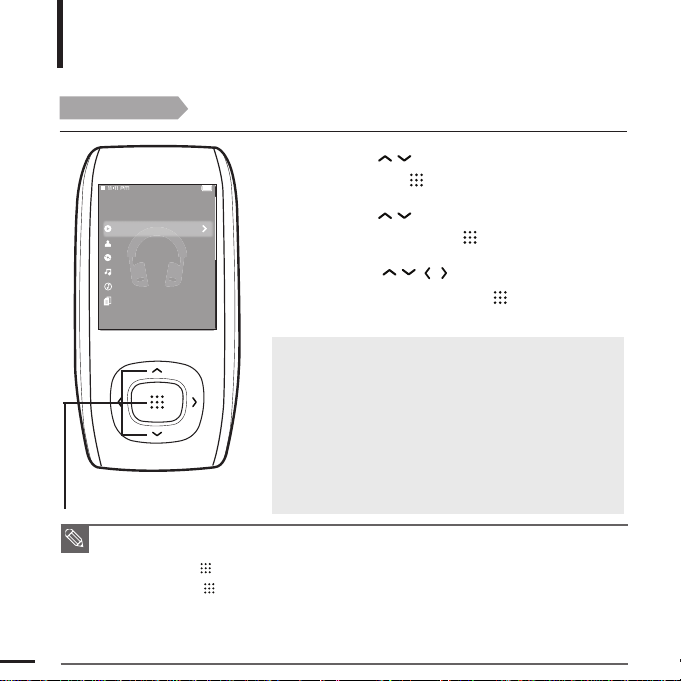
Listening to Music
Listening to Music
Before you start!
Connect the earphones, then turn on the player, and check the battery.
1
Press the [ ] button to select <Music> and
then press the [ ] button.
2
Press the [ ] button to select the desired
list
and then press the [ ] button.
File information including the artist name, album name, music
title and genre will be displayed according to the ID3 tag
information on the appropriate music file. Afile without an
ID3 Tag is displayed as [Unknown].
■ <Now Playing> : The file currently playing
■ <Artists> : To play by artist
■ <Albums> : To play by album
■ <Tracks> : To play in numeric or alphabetical order
■ <Genres> : To play by genre
■ <Playlists> : To play by Playlist
NOTE
■ MP3 and WMAmusic files are compatible with this player.
■ MP1 or MP2 files which have a changed extension to MP3 may not play on the player.
■
If you press the [ ] button in Music mode, the “S” mark appears on the screen and the Street mode is
set to On. Press [ ] again to make the “S” mark disappear and set the Street mode to off. √ Page 59
■
Press and hold the [BACK] button to move to the main menu.
■
What is an ID3-Tag?
This is what is attached to an MP3 to carry information relevant to the file, such as the title, artist, album,
year, genre and a comment field.
22
1,2,3
3
Press the [ ] button to select the
file
to play and then press the [ ] button.
■ The music file starts to play.
Now Playing
Artists
Albums
Tracks
Genres
Playlists
Music
Page 23
Chapter 3. Multimedia Function
Listening to Music
23
To Pause
1
Press the [ ] button while the music is playing.
■
The music playback will be paused.
2
Press the [ ] button again.
■
The music will play from the point where it stopped.
To search within a track
1
Press and hold the [ ] button while the selected track is playing.
■
It searches to the beginning or the end of the track.
2
Release the button at the point you wish to start.
■
It starts playing from the point you release the button.
Page 24
24
To Play from the beginning of the current track
Press the [ ] button after 5 seconds of play.
■
The current track starts playing from the beginning.
To play the previous/next track
Press the [ ] button within 5 seconds of play.
■
The previous track will start playing.
Press the [ ] button.
■
The next track will start playing.
CAUTION
■ When playing VBR files, the previous track may not play even if you press the
[]
button within
5 seconds of the play.
Listening to Music (Continued)
Listening to Music
Page 25
Chapter 3. Multimedia Function
Listening to Music/
Section Repeat
25
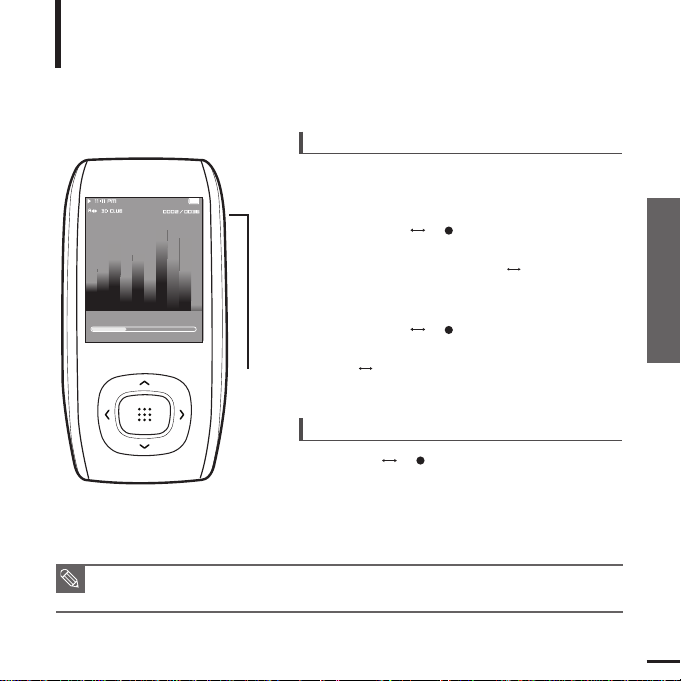
To set a section to repeat
To cancel the section repeat
2,3
Audio Track 1
00:01:42 00:05:06
Section Repeat
This function enables you to listen to specific parts of a track repeatedly.
Recommended for language learning.
Listening to Music
1
Play a file of your choice.
Press the [A B/ ] button again during Section
Repeat.
■ Section Repeat will be canceled.
2
Press the [A B/ ] button at the
beginning of the section you want to repeat.
■ The starting point is set and <A > will appear in
the screen display window.
3
Press the [A B/ ] button again to set the
ending of the section you want to repeat.
■ <A B> will appear on the screen and the specified
section starts to play repeatedly.
■ You can set the start and end points of the section repeat only within a single file.
NOTE
Page 26
26
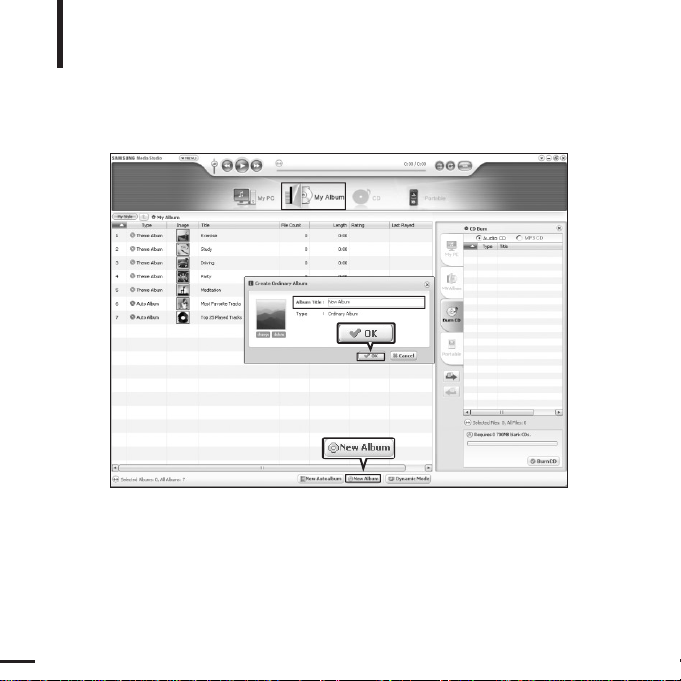
Creating a Playlist Using Samsung Media Studio
Listening to Music
[YP-T9[MTP]]
1
Click <My Album> on the top of Media Studio.
■ The <My Album> window appears.
2
Click <New Album> on the bottom.
■ The Creation window appears.
3
Type in the album title and click <OK>.
■ A new album (playlist) will be created and stored in the My Album section of Media Studio on your
computer.
1
2
3
3
A playlist is a list of your favorite songs.
Page 27
Chapter 3. Multimedia Function
Creating a Playlist Using
Samsung Media Studio
27
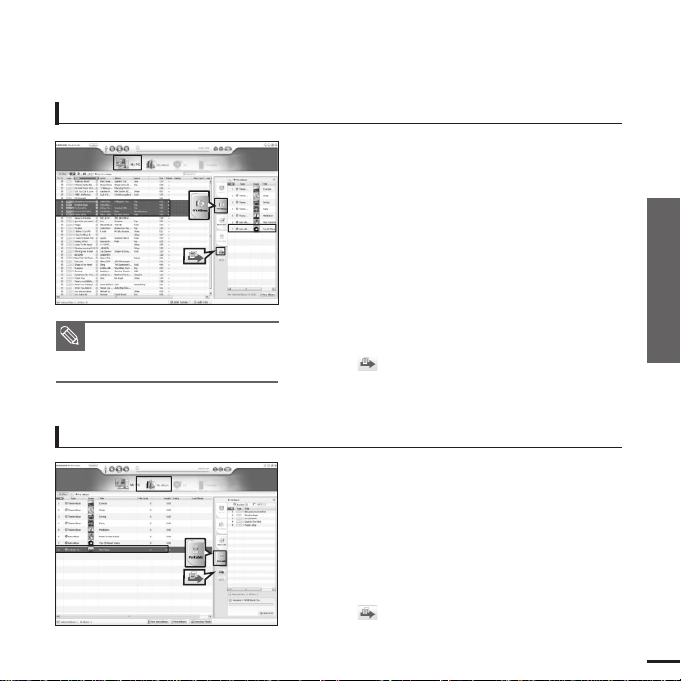
Adding Music files to a Playlist
Exporting a Playlist to your Player Using Media Studio
1
1
Click <My PC> on the top of Media Studio.
■ The My PC window appears. Click on <To Album>
to the right.
2
Click <My Album> in the right corner of the
window.
■ The My Album window appears.
3
Double click on a desired album in the right
window.
4
Select files that you want to transfer in the
<My PC> window.
1
Click <My Album> on the top of Media Studio.
■ The My Album window appears.
2
Click <Portable> in the right corner of the
window.
■ The Portable window appears.
3
Select a desired album in the <My Album> list.
4
Click icon.
■ The selected album will be transferred to the player
and stored in <File Browser>
➝
<Playlists>.
5
Click icon.
■ The selected files will be added to the album (playlist).
1
2
2
3
3
4
5
NOTE
■ Amaximum of 999 playlists
transferred to the player can be
played.
Page 28

28
■ You can add up to 100 music files to <Favorites>.
■ If you want to remove a file from the <Favorites>, select a file marked with and then press the
[A B/ ]
button. Alternately, you can press the [MENU] button to select <Delete from Favorites> and
press the [ ] button.
■ For more information, see pages 26~27 to see how to create and transfer playlists to your player.
To Play a Playlist
You can easily listen to your favorite music by adding it to a Playlist.
Listening to Music
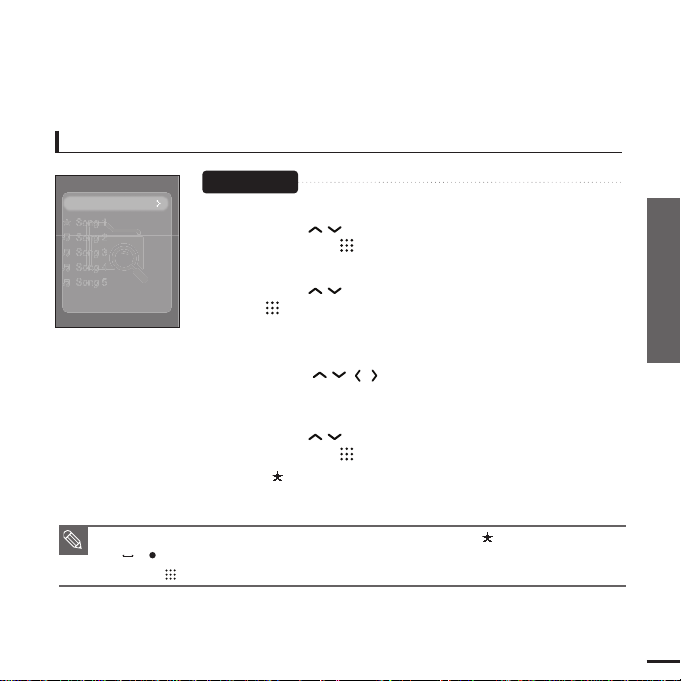
To make your own Playlist
Method 1
Music
Song 1
Song 2
Song 3
Song 4
Song 5
1
Press the [ ] button on your player to select <File
Browser> and then press the [ ] button.
2
Press the [ ] button to select <Music> and then press
the [ ] button.
■
The file list appears.
3
Press the
[]
button to select a file to add to the
playlist and then press the [A B/ ] button.
■
The mark appears next to the selected file, and the file is
included in <File Browser>
→
<Playlists>→<Favorites>.
NOTE
Page 29
Chapter 3. Multimedia Function
To Play a Playlist
29
To make your own Playlist
(Continued)
Method 2
1
Press the [ ] button to select <File Browser> and
then press the [ ] button.
2
Press the [ ] button to select <Music> and then press
the [ ] button.
■
The file list appears.
3
Press the [ ] buttons to select a file to add to
the playlist and then press the [MENU] button.
4
Press the [ ] button to select <Add to Favorites> and
then press the [ ] button.
■
The mark appears next to the selected file, and the file is
included in <File Browser>
→
<Playlists> →<Favorites>.
NOTE
■ If you want to remove a file from the <Favorites>, select a file marked with and then press the
[A B/ ]
button. Alternately, you can press the [MENU] button to select <Delete from Favorites> and
press the [ ] button.
Add to Favorites
Delete
Page 30
30
To Play a Playlist
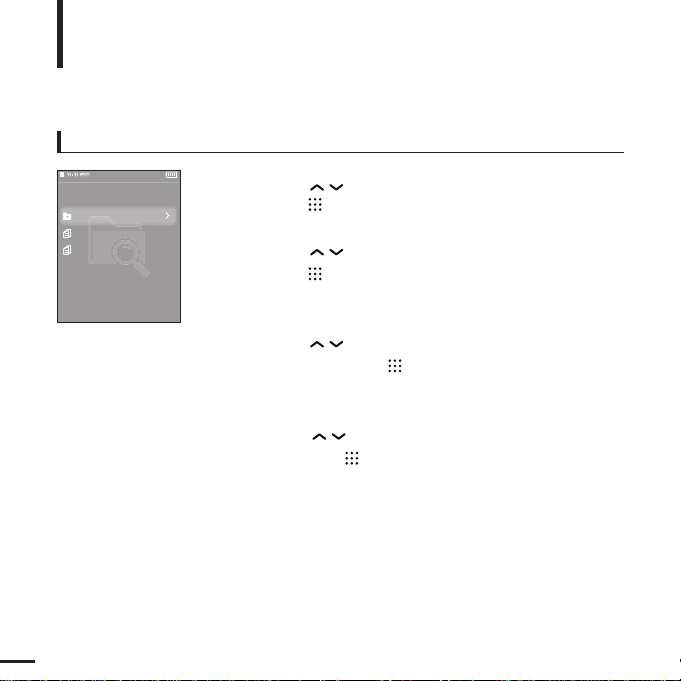
1
Press the [ ] button to select <File Browser> and then
press the [ ] button.
2
Press the [ ] button to select <
Playlists
> and then
press the [ ] button.
■
The Playlist(s) will appear.
3
Press the [ ] button to select the playlist of your
choice, then press the [ ] button.
■
The music files saved in the selected Playlist will appear.
4
Press the [ ] button to select the file to play and
then press the [ ] button.
■
The music file will start playing.
Playlists
Favorites
Ballad
Jazz
To Play a Playlist (Continued)
Listening to Music
Page 31

Chapter 3. Multimedia Function
To Play a Playlist/Using Music menu
31
To select Street mode
This allows you to hear music more clearly outdoors.
To select 3D surround sound (DNSe)
You can listen to the music with 3D surround sound.
1
Press the [MENU] button when you are in the music
playback mode.
2
Press the [ ] button to select <Street Mode> and
then press the [ ] button.
3
Press the [ ] button to select <On> or <Off> and
then press the [ ] button.
■
Select <On>.
1
Press the [MENU] button when you are in the music
playback mode.
2
Press the [ ] button to select <DNSe> and then
press the [ ] button.
3
Press the [ ] button
to select the desired mode and
then press the [ ] button.
■
Select either <3D-User> <3D-Studio> <3D-Stage> <3D-Club>
<Normal> <Rock> <House> <Dance> <Jazz> <Ballad>
<Rhythm & Blues> <Classical> or <User EQ>.
Using Music menu
Listening to Music
Street Mode
DNSe
Play Mode
Music Backgrou..
Play Speed
Skip Interval
Street Mode
DNSe
Play Mode
Music Backgrou..
Play Speed
Skip Interval
To exit the menu,
press the [MENU] button.
00:01:42 00:05:06
00:01:42 00:05:06
NOTE
■ The User EQ cannot be set in this menu. It must be set in the Settings menu. √ Page 59
Page 32

32
To select Play mode (Repeat)
To select a background image for Music mode
You can set a background image for Music mode.
1
Press the [MENU] button when you are in the music
playback mode.
2
Press the [ ] button to select <Play Mode> and then
press the [ ] button.
3
Press the [ ] button
to select the desired mode and
then press the [ ] button.
■
Select either <Normal> <Repeat> <Repeat One> or <Shuffle>.
1
Press the [MENU] button when you are in the music
playback mode.
2
Press the [ ] button to select <Music Background> and
then press the [ ] button.
3
Press the [ ] button to select the desired background
image and then press the [ ] button.
■
Select either <FLASH1> <FLASH2> <FLASH3> <Album Cover>
<Photo> or <Auto>.
■
Selecting <Auto> will play a <FLASH1> to <FLASH3> background
image each time a different file is played.
Using Music menu (Continued)
Listening to Music
Street Mode
DNSe
Play Mode
Music Backgrou..
Play Speed
Skip Interval
Street Mode
DNSe
Play Mode
Music Backgrou..
Play Speed
Skip Interval
NOTE
■ If there is an image contained in the tag information of a music file, it will be displayed as a background image when you
select <Album Cover>. <Album Cover> only supports images less than 200 pixel (horizontal) x 200 pixel(vertical) in size.
■
<Normal> : To play all the tracks in order one time.
■
<Repeat> : To repeat the current folder.
■
<Repeat One> : To repeat one file.
■
<Shuffle> : To play files at random.
00:01:42 00:05:06
00:01:42 00:05:06
Page 33

Chapter 3. Multimedia Function
Using Music menu
33
To select the play speed
You can set the play speed either faster or slower than normal.
To set the skip interval
You can set a playback interval within a track when you press the [ ] button during
playback.
1
Press the [MENU] button when you are in the music
playback mode.
2
Press the [ ] button to select <Play Speed> and then
press the [ ] button.
3
Press the [ ] button to select the
play speed
and
then press the [ ] button.
■
Select either <-3> <-2> <-1> <0>(Normal) <+1> <+2> or <+3>.
■
The larger the number (+), the faster the speed of play.
Negative numbers (-) equal slower play.
1
Press the [MENU] button when you are in the music
playback mode.
2
Press the [ ] button to select <Skip Interval> and
then press the [ ] button.
3
Press the [ ] button to select the desired
skip
interval
and then press the [ ] button.
■
Select either <1track> <3sec> <5sec> <7sec> <10sec> <30sec>
or <1min>.
Street Mode
DNSe
Play Mode
Music Backgrou..
Play Speed
Skip Interval
Street Mode
DNSe
Play Mode
Music Backgrou..
Play Speed
Skip Interval
00:01:42 00:05:06
00:01:42 00:05:06
Page 34

34
Video
Video
Before you start!
Connect the earphones, then turn on the player, and check the battery.
1
Press the [ ] button to select <Video> and
then press the [ ] button.
2
Press the [ ] button to select the
desired
video clip
and then press the [ ] button.
■
The selected video file starts to play.
NOTE
■ When transferring a video file to the player using <Media Studio>, it is automatically converted into
SVI format before transfer. The file size is automatically adjusted, too.
■ Press and hold the [BACK] button to move to the main menu.
1,2
To stop playing the video file
Press the [ ] button in Video mode.
■
Each time you press the [ ] button, the player stops
playing the video file or resumes playback.
Page 35

Chapter 3. Multimedia Function
Video
35
any story 1
Press the
[]
button in Video mode.
■ Information on the current video appears. Press the
[]
button again to make the information
disappear.
Video Information Display
1
Play/Pause Indicator
3
Play Position Indicator
2
File Name
4
Current Play Time Indicator
5
Volume Level Indicator
6
Full play time for the current video
1
2
3
4
5
6
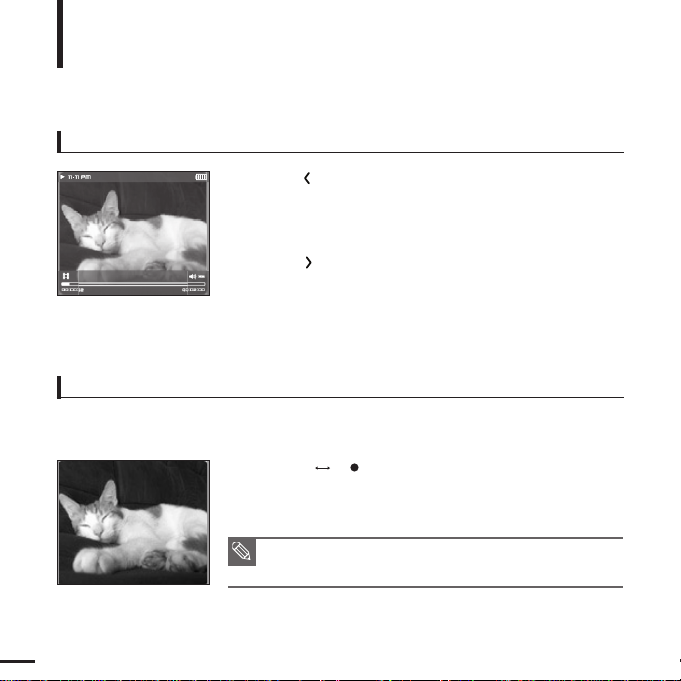
To move to a certain position of the current video file
1
In a horizontal view, press and hold the [ ] button.
■
This enables you to scroll through the current video file.
2
Release the button when you have moved to the desired
position.
■
The video starts playing from the position.
any story 1
Page 36
36
To play the previous/next video file
Press the
[]
button within 5 seconds after the current
video started playing.
■
This will return to the previous video.
Press the
[]
button.
■
This will move to the next video.
Video (Continued)
Video
any story 2
To set a bookmark
Press the
[A B/ ]
button at the desired scene.
■ A bookmark is created at the currently played/stopped point.
Once you bookmark a specific scene that you want to see again, you can enjoy it at
any time you want.
NOTE
■ You can set a maximum of 20 bookmarks.
Page 37

Chapter 3. Multimedia Function
Video/Using Video menu
37
To Move to the bookmark
1
Press the [MENU] button in Video mode.
■
The Bookmark menu appears.
2
Press the
[ ] button.
3
Press the [ ]
button to select <Go to> and press the
[ ] button.
4
Press [ ] to select the desired bookmark and press
the [ ] button.
■
Playback will start from the selected bookmark.
Go to
Delete
To Remove a bookmark
1
Press the [MENU] button in Video mode.
■
The Bookmark menu appears.
2
Press the
[ ] button.
3
Press the [ ]
button to select <Delete> and press the
[ ] button.
4
Press [ ] to select a bookmark to remove and press
the [ ] button.
■
It will remove the selected bookmark.
Go to
Delete
Using Video menu
Video
Page 38

38
Photo Viewing
Photo Viewing
Before you start!
Connect the earphones, then turn on the player, and check the battery.
1
Press the [ ] button to select <Photo> and
then press the [ ] button.
■
The photo preview window appears.
Press the [ ] button while viewing a photo or
press the [ ] button in preview mode to display
the previous or next photo.
Photo Viewing mode Preview mode
2
Press the [ ] button to select the
desired
photo
and then press the [ ] button.
■
The selected photo is displayed.
NOTE
■ When transferring a photo file to the player using <Media Studio>, it is automatically converted into
JPG format before transfer. The file size is automatically adjusted, too.
■ You can also use the <File Browser> to search for a photo file.
√
Page 14
■ You can keep listening to music even if you select <Photo> to view a photo.
■ Press and hold the [BACK] button to move to the main menu.
1,2
To move to the previous/next photo
Photo
test0 1/20
Page 39

Chapter 3. Multimedia Function
Photo Viewing
39
Photo Display Window
1
Preview Pane
3
Thumbnails
2
File Name
4
The current file number/total number of photos
Photo
test0 1/20
1
2
3
4
Slideshow Viewing
To stop the slideshow
1
Press the [MENU] while viewing a photo
2
Press the [ ] button to select <Start Slideshow> and
then press the [ ] button.
■
The slideshow will start.
Press
the [ ] button
in Slideshow mode.
■
This will stop the slideshow.
Start Slideshow
Zoom
As Music Backgr..
Page 40
40
Using Photo menu
Photo Viewing
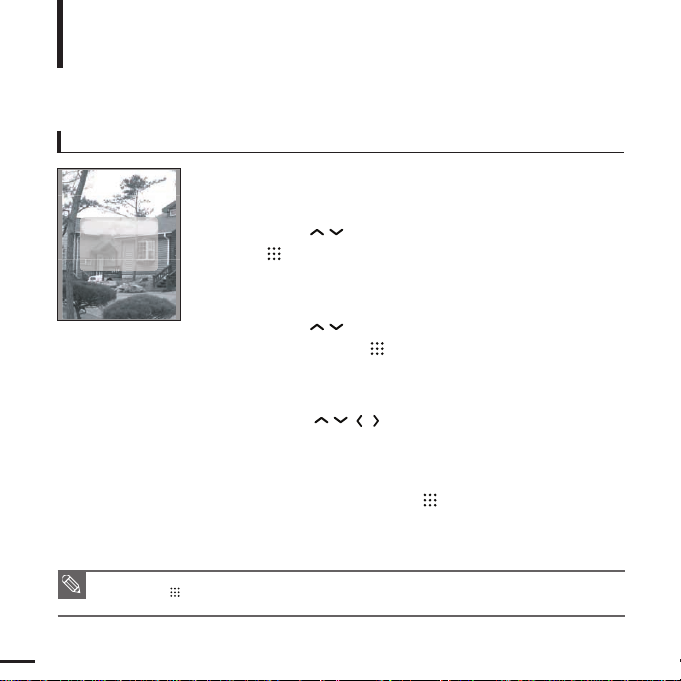
Photo Enlarging
1
Press the [MENU] while viewing a photo
2
Press the [ ] button to select <Zoom> and then press
the [ ] button.
■
The Zoom Setting menu appears.
3
Press the [ ] button to select
the desired scale factor
and then press the [ ] button.
■
You can select either <100%> <200%> or <400%>.
4
Press the [ ] t
o move to the portion of the photo
to magnify.
5
To cancel the magnification, select <100%> from the Zoom
options
and then press the [ ] button.
■
This returns to the original size.
100%
200%
400%
NOTE
■ Press the
[]
button in the Photo Viewing mode to display the Zoom Setting menu.
Page 41

Chapter 3. Multimedia Function
Using Photo menu
41
To set a photo as a music background image
1
Select a photo file to set as a background image.
2
Press the [MENU] while viewing the photo.
3
Press the [ ] button to select <
As Music Background
>
and then press the [ ] button.
■
The Music Background Image Setting menu appears.
4
Press the
[]
button to select <Yes>
and then press the
[ ] button.
■
The selected photo file is set to a background image for music.
NOTE
■ Press the
[A B/ ]
button while viewing a photo to display the Music Background Setting menu.
Audio Track 1
00:01:42 00:05:06
Page 42
42
Text Viewing
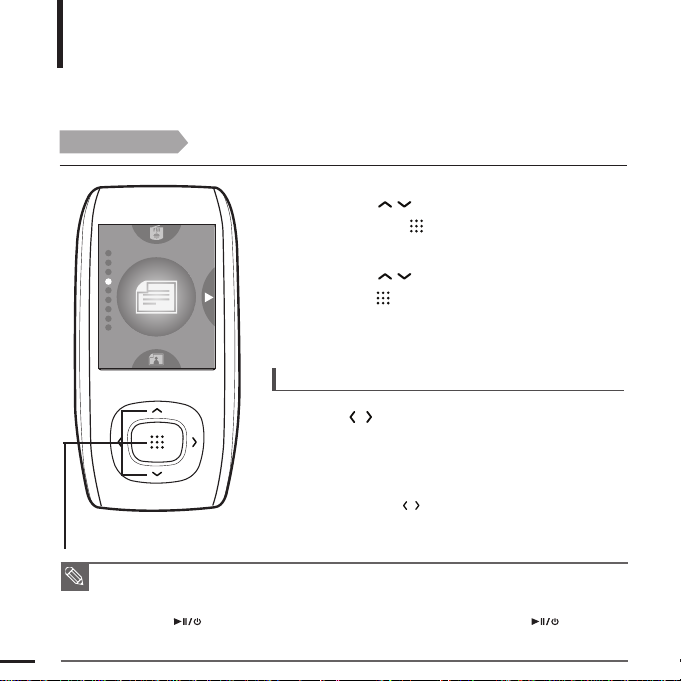
You can read a novel or see the manuscript text of a news story or soap
opera while listening to music.
Text View
Before you start!
For instructions on transferring a text file to the player, refer to pages 18-19.
Turn on the player, and check the battery.
1
Press the [ ] button to select <Text> and
then press the [ ] button.
2
Press the [ ] button to select
Text
and then
press the [ ] button.
■
You will see the text on the screen.
NOTE
■ You can also use the <File Browser> to search for a text file.
√
P
age 14
■ This product supports the TXT file format in Text mode.
■ You can keep listening to music even if you select <Text>.
■ Press the [ ] button if you want to play a music while viewing text. Press the [ ] button
again to stop playing the music.
■ Press and hold the [BACK] button to move to the main menu.
1,2
To scroll the text by the line
Press the
[]
button.
■
Once you set <Scroll By> →<Page> in Text menu, you can
move to the previous / next page of the text file.
√
Page 45
■
Once you set <Scroll By> →<Line> in Text menu, you can
move to the previous / next line of the text file.
√
P
age 45
Press and hold the [ ] button to move up or down faster
through the file.
Page 43

Chapter 3. Multimedia Function
Text Viewing/Using Text menu
43
To set a bookmark
Once you bookmark a specific part of text that you want to read again, you can enjoy it
at any time you want.
Press the
[A B/ ]
button while viewing text.
■
A bookmark is set on the current text screen with the † symbol displayed
on the top left corner.
■
The bookmark can be deleted by pressing the
[A B/ ]
button in the
bookmarked page.
Using Text menu
Text View
NOTE
■ You can set a maximum of 20 bookmarks.
Page 44

44
Using Text menu (Continued)
Text View
To move to the bookmark
1
Press the [MENU] button while viewing text.
2
Press the [ ] button to select <Bookmark> and
then press the [ ] button.
■ The Bookmark menu appears.
3
Press the [ ] button to select <
Go to>
and then
press the [ ] button.
4
Press the [ ] to select the desired bookmark and
press the [ ] button.
■ It will move to the selected bookmark
To remove a bookmark
1
Press the [MENU] button while viewing text.
2
Press the [ ] button to select <Bookmark> and
then press the [ ] button.
■ The Bookmark menu appears.
3
Press the [ ] button to select <
Delete>
and then
press the [ ] button.
4
Press the [ ] to select the removed bookmark and
press the [ ] button.
■ It will remove the selected bookmark.
Go to
Delete
Go to
Delete
Page 45

Chapter 3. Multimedia Function
Using Text menu
45
To move to the first page
1
Press the [MENU] button while viewing a text.
You can see the text file from the beginning.
2
Press the [ ] button to select <
Go to 1st Page
> and
then press the [ ] button.
■
The Confirmation window will appear.
3
Press the
[]
button to select <Yes> and press the
[ ] button.
■
This will move to the first page of the text file.
To set the scroll option
1
Press the [MENU] button while viewing text.
2
Press the [ ] button to select <
Scroll By
> and then
press the [ ] button.
■
The Scroll option menu appears.
3
Press the [ ] button to select the
desired option
and
then press the [ ] button.
■ You can select either <Page> or <Line>.
■ <Page>:
Use the [
]
button to scroll through the file by the page.
■
<Line>: Use the [] button to scroll through the file by the line.
NOTE
■ You can press the
[]
button to change the scroll option in Text View mode.
Go to 1st Page
Bookmark
Scroll By
Text Viewer Type
Text Viewer Color
Go to 1st Page
Bookmark
Scroll By
Text Viewer Type
Text Viewer Color
Page 46
46
Using Text menu (Continued)
Text View
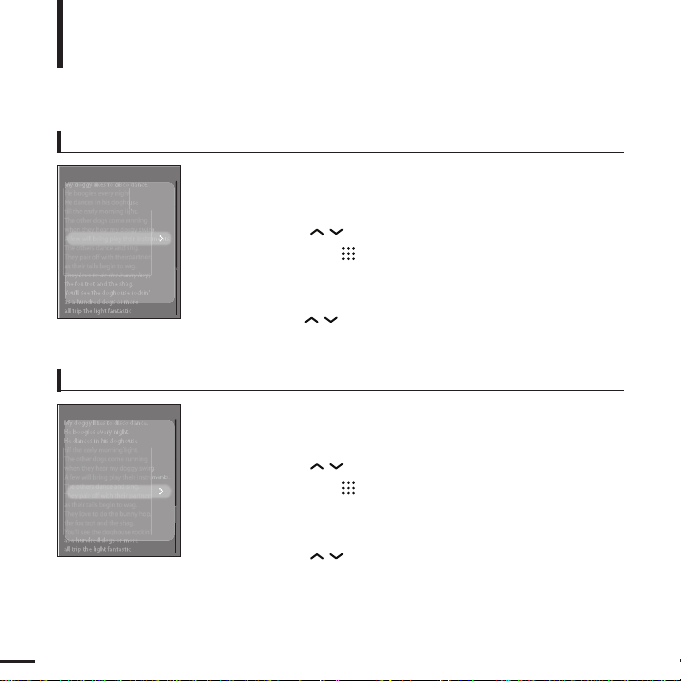
To set the text viewer type
1
Press the [MENU] button while viewing text.
2
Press the [ ] button to select <
Text Viewer Type
> and
then press the [ ] button.
■
The Text Viewer Type menu appears.
3
Press the [ ] button to select the desired text viewer type.
■
You can select either <Vertical> or <Horizontal>.
To set the text viewer color
1
Press the [MENU] button while viewing text.
2
Press the [ ] button to select <
Text Viewer Color
> and
then press the [ ] button.
■
The Text Viewer Color menu appears.
3
Press the [ ] button to select the desired text viewer
color.
■ Select either <Auto> <Blue> <Green> <Orange> <Pink> or <Purple>.
■
Selecting <Auto> will set the viewer color to the same as the main menu.
Go to 1st Page
Bookmark
Scroll By
Text Viewer Type
Text Viewer Color
Go to 1st Page
Bookmark
Scroll By
Text Viewer Type
Text Viewer Color
Page 47
Chapter 3. Multimedia Function
Using Text menu/
Listening to FM Radio
47
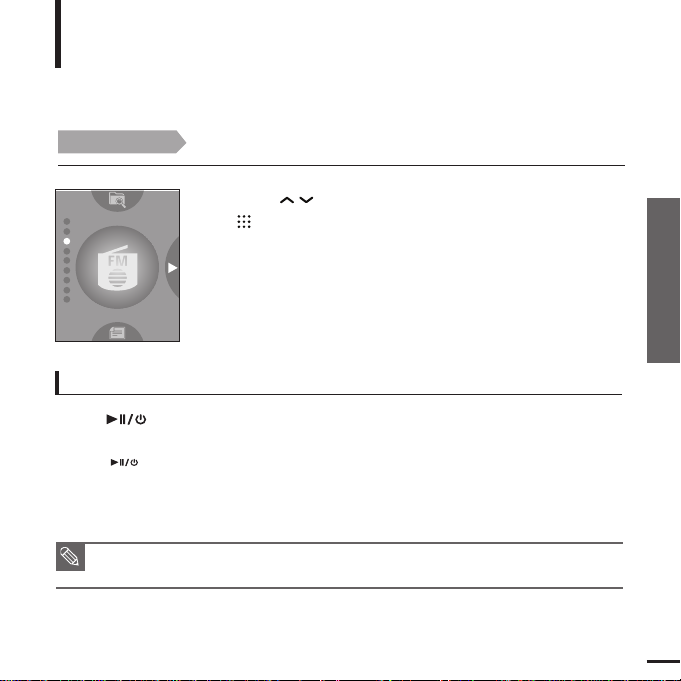
Listening to FM Radio
Listening to FM Radio
Before you start!
Connect the earphones, then turn on the player, and check the battery.
Press the [ ] button to select <
FM Radio
> and then press
the [ ] button.
■
FM radio reception will start.
To use Mute function
Press [ ] button during listening to FM radio.
■
Sound is muted.
■
Press
[]
button once again to sound back.
NOTE
■ Press and hold the [BACK] button to move to the main menu.
Page 48
48
Listening to FM Radio (Continued)
Listening to FM Radio
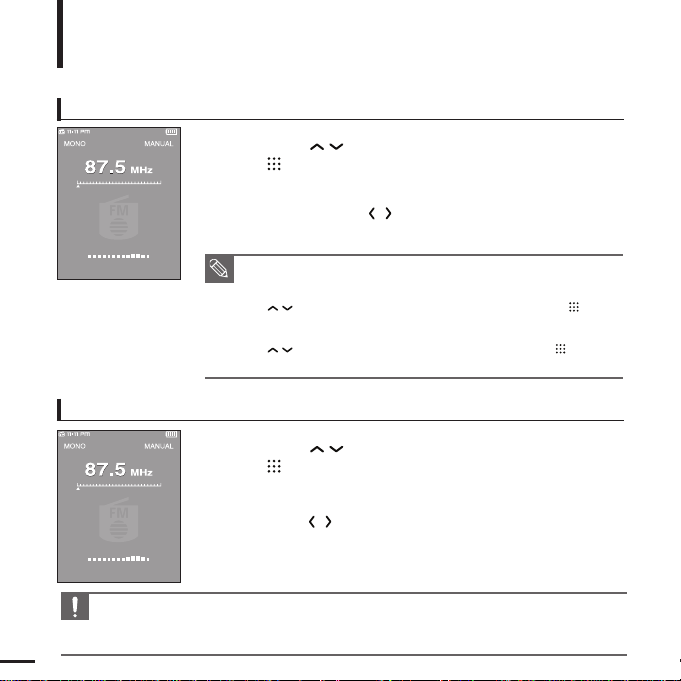
To automatically search for frequencies
1
Press the [ ] button to select <FM Radio>, then press
the [ ] button to select <MANUAL>.
■
You will see <MANUAL> in the top right corner.
2
Press and hold the
[]
button and then release.
■
The frequency nearest from the point the button is released will be searched.
To manually search for frequencies
1
Press the [ ] button to select <FM Radio>, then press
the [ ] button to select <MANUAL>.
■
You will see <MANUAL> in the top right corner.
2
Press the
[]
button.
■
Moves to frequencies whenever the button is pressed.
NOTE
■ To scan for an incoming frequency, select <MANUAL>. To listen to a
memorized frequency, select <PRESET>.
■
To switch from <PRESET> to Manual mode, press [MENU] and use the
[ ] button to select <Go to Manual Mode> and press the [ ] button.
You will switch to <MANUAL> mode.
■
To switch from <MANUAL> mode to Preset mode, press [MENU] and use the
[ ] button to select <Go to Preset Mode> and press the [ ] button.
You will switch to <PRESET> mode.
Auto Searching...
■ Always connect your earphones to the player when searching or setting frequencies.
The earphones are used as antennas to receive FM radio reception.
■ In poor reception areas, the player may not be able to scan any frequencies.
CAUTION
Page 49
Chapter 3. Multimedia Function
Listening to FM Radio/
Setting a Frequency
49
Setting a Frequency
Listening to FM Radio
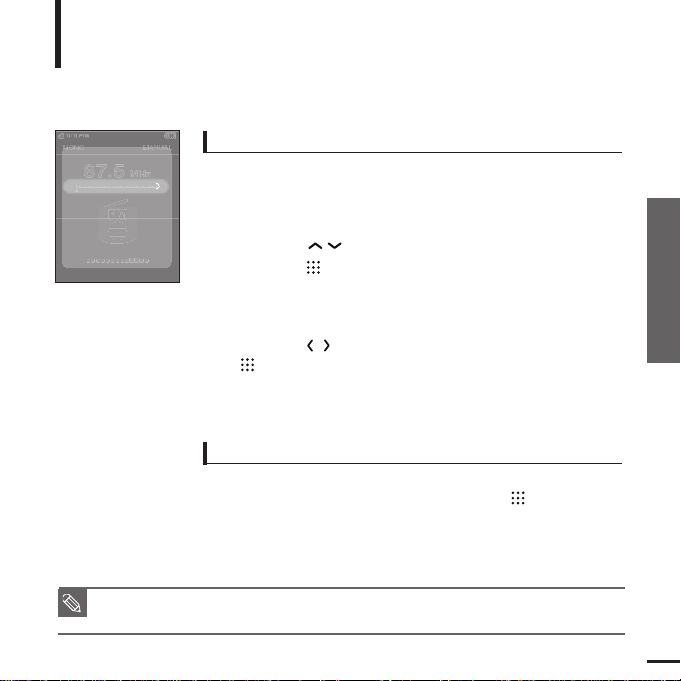
To automatically preset frequencies
1
Press the [MENU] button in FM Radio mode.
To cancel during setting
To cancel the <Auto Preset> setting, press the [ ] button.
■
The auto preset setting is canceled and frequencies set up to then are
stored.
2
Press the [ ] button to select <Auto Preset> and then
press the [ ] button.
■
The Auto Preset Confirm window will appear.
3
Press the
[]
button to select <Yes> and then press the
[ ] button.
■
The <Auto Preset> window will appear and up to 30 frequencies
will be set automatically.
Go to Preset Mo..
Add to Preset
Auto Preset
FM Region
FM Sensitivity
■ If <Auto Preset> is selected after presets have already been made, the existing presets will be deleted.
NOTE
Page 50

50
Setting a Frequency (Continued)
Listening to FM Radio
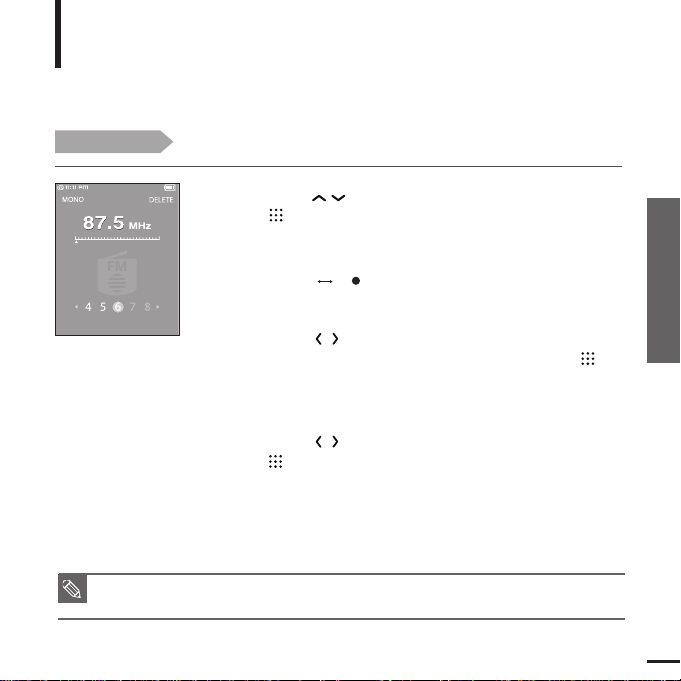
To manually preset frequencies
1
Press the [ ] button to select <FM Radio>, then press
the [ ] button to select <MANUAL>.
■
You will see <MANUAL> in the top right corner.
2
Press the
[]
button to select the desired frequency to
preset.
3
Press the [A B/ ] button.
■
<ADD> blinks before the preset number appears.
4
Press the
[]
button to select the desired preset number
at the bottom of the screen and press the [ ]
button.
■
The selected frequency is set as a preset number.
To search for frequencies in PRESET mode
1
Press the [ ] button to select <FM Radio>, then press
the [ ] button to select <PRESET>.
■
You will see <PRESET> in the top right corner.
Once presets are set, the unit will automatically be in Preset mode when FM Radio
mode is selected.
2
Press the
[]
button.
■
The preset number is selected and you can listen to the stored radio
frequency.
■ You can also set the preset frequency by pressing [MENU] to select <Add to Preset> in <MANUAL> mode.
■ If you set an identical frequency, you will see <Same frequency exists. Save?>. Press the
[]
button
to select <Yes> or <No> and press the
[]
button.
NOTE
■ If no frequencies were preset, <No preset> will appear and you cannot switch to <PRESET> mode.
■
To switch between Manual and Preset modes when listening to the FM Radio, simply press the
[]
button
.
NOTE
Page 51
Chapter 3. Multimedia Function
Setting a Frequency/
To Delete Presets
51
Listening to FM Radio
To Delete Presets
1
Press the [ ] button to select <FM Radio>, then press
the [ ] button to select <PRESET>.
■
You will see <PRESET> in the top right corner.
2
Press the [A B/ ] button.
■
<DELETE> blinks.
3
Press the
[]
button to select the frequency that you
want to remove from the PRESET list and press the
[]
button.
■
The Delete Preset window will appear.
4
Press the
[]
button to select <Yes> and press
the
[]
button.
■ The selected preset number will be deleted.
■
If you don’t want to delete the preset number, select <NO>.
Before you start!
■
Follow the steps below to delete frequencies while listening to FM radio.
■ You can also remove the preset frequency by pressing [MENU] to select <Delete Preset> in <PRESET> mode.
NOTE
Page 52
52
Using FM Radio menu
Listening to FM Radio
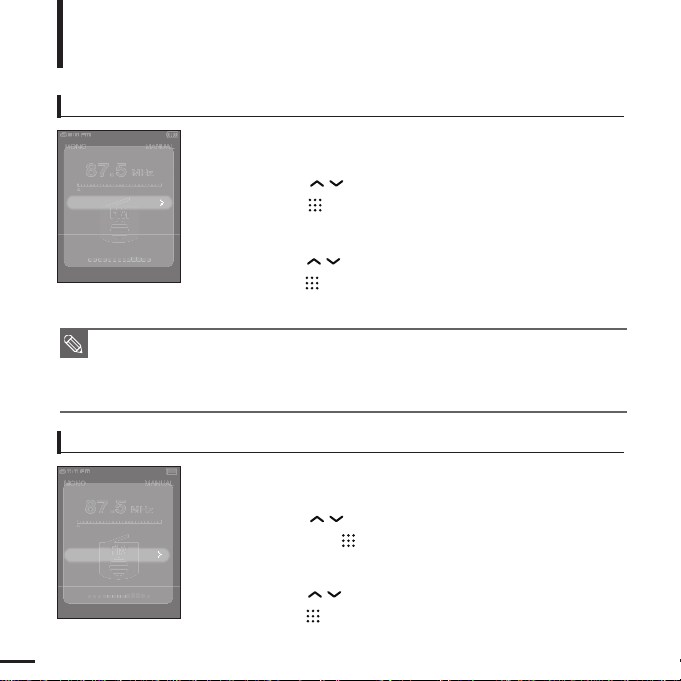
To set FM region
1
Press the [MENU] button in FM Radio mode.
2
Press the [ ] button to select <FM Region> and then
press the [ ] button.
■
The FM Region menu appears.
3
Press the [ ] button to select the FM Region and then
press the [ ] button.
■
You can select from <Korea/US> <Japan> <Other Countries>.
To set FM sensitivity
1
Press the [MENU] button in FM Radio mode.
2
Press the [ ] button to select <FM Sensitivity> and
then press the [ ] button.
■
The FM Sensitivity menu appears.
3
Press the [ ] button to select the search level and then
press the [ ] button.
■
You can select from <High> <Middle> and <Low>.
■
The higher FM Sensitivity is, the more frequencies can be received.
■ Frequency range by region
- Korea/US: Search for FM frequencies in 100 kHz increments between 87.5 MHz~108.0 MHz.
- Japan: Search for FM frequencies in 100 kHz increments between 76.0 MHz~108.0 MHz.
- Other Countries: Search for FM frequencies in 50 kHz increments between 87.50 MHz~108.00 MHz.
■ If you change the FM region, the previously stored radio frequencies are removed.
NOTE
Go to Preset Mo..
Add to Preset
Auto Preset
FM Region
FM Sensitivity
Go to Preset Mo..
Add to Preset
Auto Preset
FM Region
FM Sensitivity
Page 53

Chapter 3. Multimedia Function
Using FM Radio menu/
Recording
53
Recording
Recording
1,2
3
■
<Record Voice>: you can make a voice recording.
■
<Record FM Radio>: you can record the FM radio
broadcast you're currently listening to, or you can use
the [ ] button to select a desired frequency.
■
<Recorded Files>: you can listen to voice recording
and FM radio recording.
1
Press the [ ] button to select <Record>
and then press the [ ] button.
■
Then, press the [MENU] button and use the
[]
and
[]
buttons to set your recording options.
Recordings can be made of your voice or FM broadcasts.
2
Press the
[]
button to select the desired
recording mode and press the
[]
button.
■
The appropriate window appears.
3
Press the [A B/ ] button.
■ Recording starts and the file name is displayed.
To stop recording
1
Press the [A B/ ] button while in recording.
■ You will see a message that prompts you to confirm your choice.
2
Press the
[]
button to select <Yes> or <No> and press the
[]
button.
■
<Yes> will play the just recorded file.
■
<No> will not play the just recorded file.
■
After the recorded file plays back, the 'Save the recording file?' message appears.
3
Press the
[]
button to select <Yes> and press the
[]
button.
■
The recorded file is stored in the <File Browser> →<Recorded>.
■ Press and hold the [BACK] button to move to the main menu.
NOTE
Page 54
54
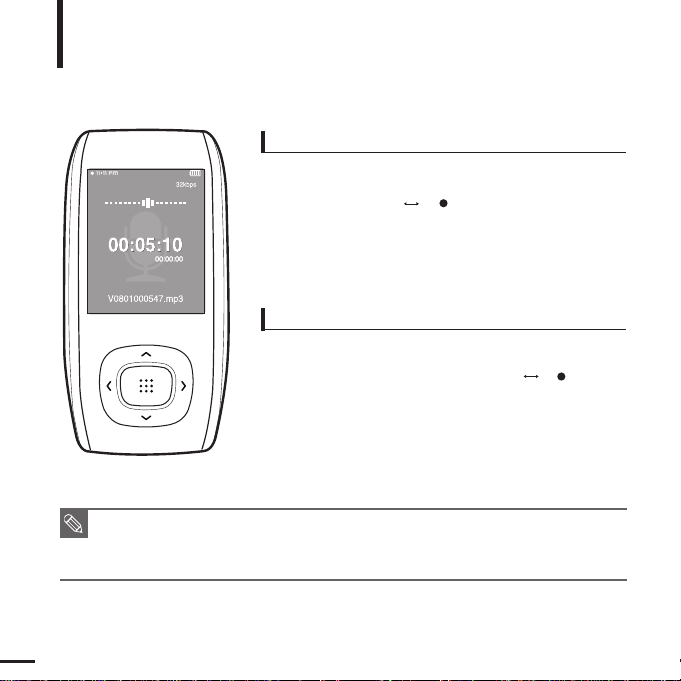
To make a voice recording
Press and hold the [A B/ ] button.
■
Recording is started with displaying the file name to save.
You can make a voice recording at any time.
Below are other ways to make Voice or FM broadcast recordings.
To record FM radio broadcasting
In FM Radio mode, press and hold the [A B/ ] button.
■
An automatically created file name appears and the recording
starts.
You can record FM radio broadcasts.
Recording
Voice/FM Radio Recording
■
Do not place the microphone too close or too far away during recording, as this can affect the recording quality.
■ Voice recording does not perform properly when the battery is low.
■ You can make a voice recording for up to 69 hours (based on 32Kbps, 1GB)
NOTE
Page 55

Chapter 3. Multimedia Function
Voice/FM Radio Recording/
Recorded File Names
55
■ To listen to saved recording files, use the <File Browser> function.
√
Page 14
■ For more information on recording, see the recording setting section on page 60.
■ You can set or store a maximum of 999 files for each of voice and FM radio recording.
NOTE
File names during recording
1
During recording, a recording file name is automatically generated.
The file name contains the type (V or F), month (mm), date (dd), hour (hh),
minutes (mm) and seconds (ss).
2
The recording type is as follows;
■
Voice - V
■
Radio – F (FM)
3
For example, the file name “V0801103020” indicates a voice recording was
made 10 o’clock 30 minutes 20 seconds on August 1st.
Recording
Recorded File Names
Page 56
56
Game
Game
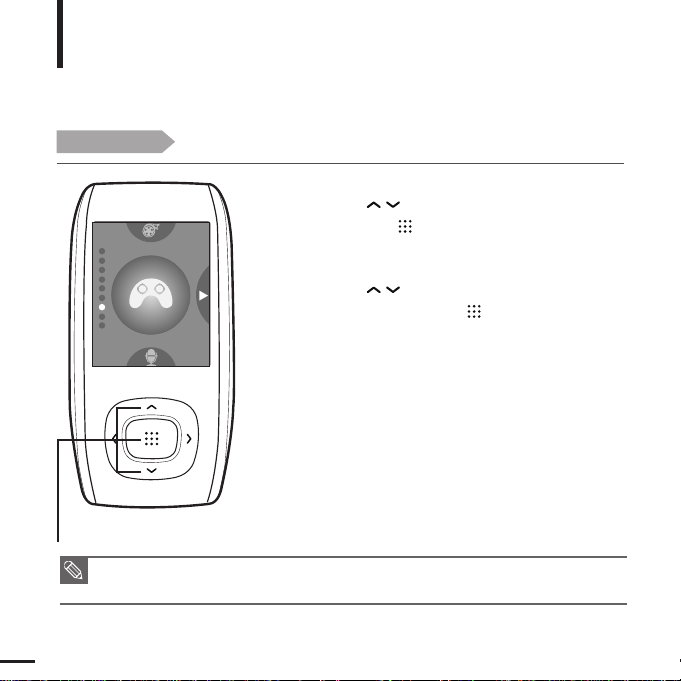
You can enjoy BaseBall and Pizza Delivery games.
Before you start!
■
Connect the earphones, then turn on the player, and check the battery.
1,2
1
Press the [ ] button to select <Game> and
then press the [ ] button.
■
The Game menu appears.
2
Press the [ ] button to select the desired
game and then press the [ ] button.
■ The games bundled with the player may be added or changed without notice.
■ Press and hold the [BACK] button to move to the main menu.
NOTE
Page 57
Chapter 3. Multimedia Function
Game
57
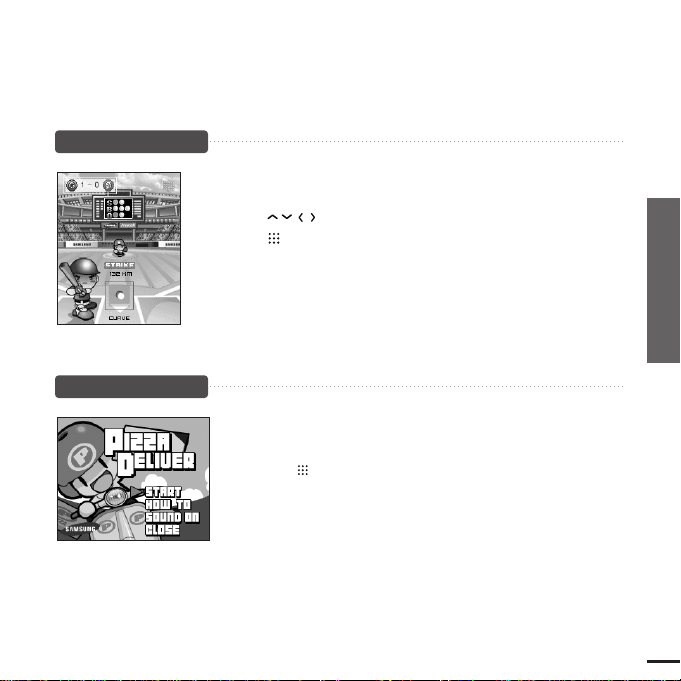
The goal of this game is to deliver pizza on a motor bike
while dodging obstacles on the road.
■
Press the [ ] button to make the motorbike jump to avoid obstacles.
Pizza Deliver
This game provides you with animated players, and simulates
the feel of a baseball stadium.
■
Press the [ ] button to select a menu or function.
■
Press the [ ] button to pitch or hit the ball.
BaseBall
Page 58

58
2
Press the [ ] button to select <Music> and then
press the [ ] button.
■
The Music menu appears.
3
Use the [ ] and [ ] buttons to set the
desired functions
1
Press the [ ] button to select <Settings> and then
press the [ ] button.
■
The Settings menu appears.
Settings
Music
Record
Time
Display
Language
System
■ Button functions to use during setting.
- Press the [ ] button to move to the previous item.
- Press the [ ] button to move to the next item.
- Press the [ ] button to move up or down through the current menu.
- Press the [ ] button to select or save the menu.
■
Press and hold the [BACK] button to move to the main menu.
■ If you do not press any buttons for approximately 1 minute in the Settings screen, settings will be
canceled and the player will return to the last function you were using.
NOTE
Setting Music
You can set detailed settings for music playback.
Settings
Page 59
Chapter 4. Settings
Setting Music
59
■
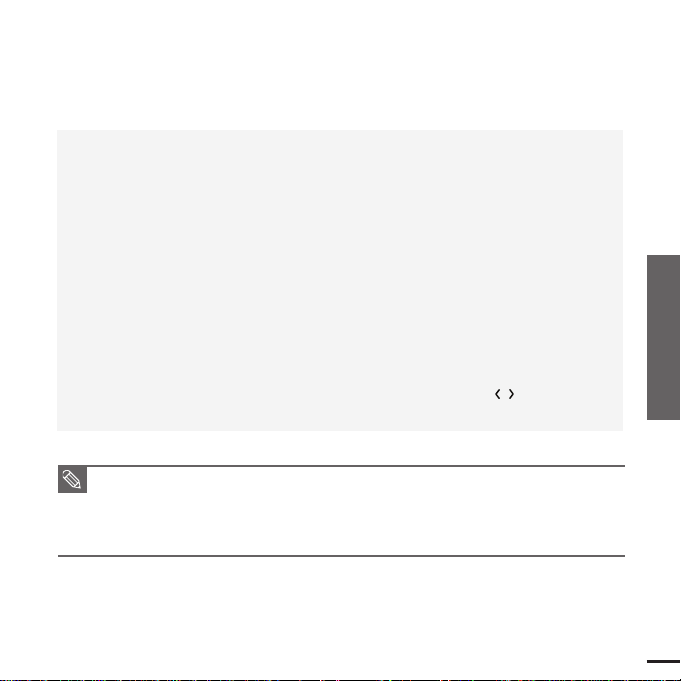
<Street mode>: Allows you to enjoy the music outdoors more clearly.
You can select either <On> or <Off>.
■
<
DNSe> : You can select a suitable sound for each music genre. Select either <3D-User>
<3D-Studio> <3D-Stage> <3D-Club> <Normal> <Rock> <House> <Dance> <Jazz> <Ballad>
<Rhythm & Blues> <Classical> or <User EQ>.
■
<
3D User Set> : Sets 3D sound effect and bass enhancement.
3D can be set between 0~5 levels, and Bass Enhance between 0~3 levels.
After you set <3D User Set>, you can select <3D User> in <DNSe>.
■
<
User EQ Set> : You can directly select a sound frequency to adjust (EQ). After you set
<User EQ Set>, you can select <User EQ> in <DNSe>.
■
<Play Mode> : Select playback mode such as repeat settings.
Select from <Normal> <Repeat > <Repeat One> and <Shuffle>.
■
<Play Speed> : Adjust the playback speed of music/voice recordings.
Select either <-3> <-2> <-1> <0>(Normal) <+1> <+2> <+3>. (The higher the number is, the
faster the playback speed is.)
■
<Skip Interval> : Set the playback interval within a track when you press the [ ] button during
playback. Select either <1 Track> <3 sec> <5 sec> <7 sec> <10 sec> <30 sec> or <1 min>.
■ For a VBR file, the Skip Interval may not be exact.
■
What is DNSe?
DNSe is a sound effect function for MP3 players developed by Samsung and consists of 3D and Street
modes. The 3D adds a stereophonic sound effect to the music and the Street mode
provides an automatic
volume control function that amplifies quiet sounds in noisy street environments.
NOTE
Page 60
60
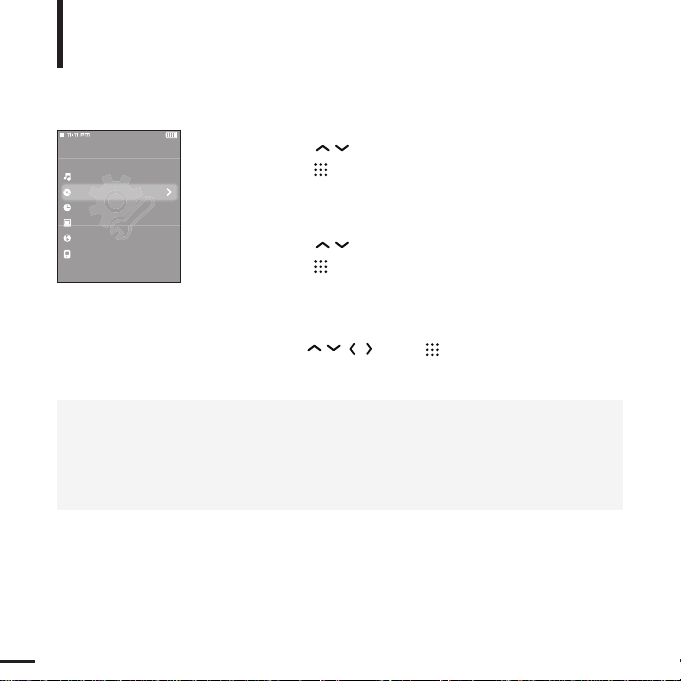
2
Press the [ ] button to select <Record> and then
press the [ ] button.
■
The Record menu appears.
3
Use the [ ] and [ ] buttons to set the
desired functions
1
Press the [ ] button to select <Settings> and then
press the [ ] button.
■
The Settings menu appears.
Settings
Music
Record
Time
Display
Language
System
■ <FM Recording Bit Rate> :
Y
ou can choose the recording quality for FM radio.
Select one from <96kbps> <128kbps> <160kbps> <192kbps>.
(The greater the number is, the better the quality is, but the file size is bigger)
■ <Voice Recording Bit Rate> :
Y
ou can select the voice recording quality. Select one from
<32kbps> <64kbps> <96kbps> <128kbps>. (The greater the number is, the better the quality is,
but the file size is bigger)
Setting Record
You can refine your recording options for FM radio and voice recording.
Settings
Page 61

Chapter 4. Settings
Setting Record/
Setting Time
61
2
Press the [ ] button to select <Time> and then press
the [ ] button.
■
The Time menu appears.
3
Use the [ ] and [ ] buttons to set the
desired functions
1
Press the [ ] button to select <Settings> and then
press the [ ] button.
■
The Settings menu appears.
Settings
Music
Record
Time
Display
Language
System
■ <Date/Time Set> : You can set the current time and date.
√
Page 62
■ <Sleep Timer> : Turns off power automatically after the preset time. Select either <Off> <15 min >
<30 min> <60 min> <90 min> or <120 min>.
■ <LCD Off> : If no button is pressed within the time set shown below, the display screen will
automatically turn off. Select either <15 sec> <30 sec> <1 min> <3 min> <5 min> or <Always On>.
Press any button to turn it back on.
■ <Auto Power Off> : Automatically turns power off when no buttons are pressed after the
preset time in the pause mode. Select either <15 sec> <30 sec> <1 min> <3min> or <5 min>.
■ <Screen Saver> : If no button is pressed within the time set shown below in music mode,
the player will display the screen saver image. Select either <Off> <15 sec> <30 sec> < 1 min >
<3 min > or <5min>.
Setting Time
You can set functions related to the Sleep Timer and Auto Power Off.
Settings
Page 62
62
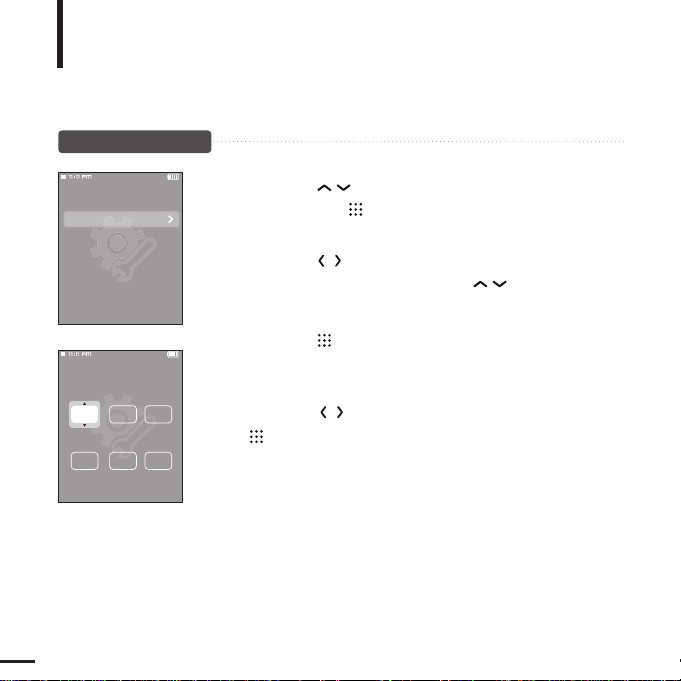
2
Press the
[]
button to move to <AM/PM, Hour, Minute,
Year, Month, Date> and press the [ ] to set it.
3
Press
the [ ] button.
■
The Confirmation window will appear.
4
Press the [ ] button to select <Yes> and
press the
[ ] button.
■
The set time/date will be saved.
■
<No> will cancel the time setting.
1
Press the [ ] button to select <Date/Time Set> and
then press the [ ] button.
Date/Time Setting
Time
Date/Time Set
Sleep
LCD Off
Auto Power Off
Screen Saver
Date/Time Set
AM/PM Hour Min
AM 38
Year Month Date
2006 5 19
Setting Time (Continued)
Settings
Page 63
Chapter 4. Settings
Setting Time/
Setting Display
63
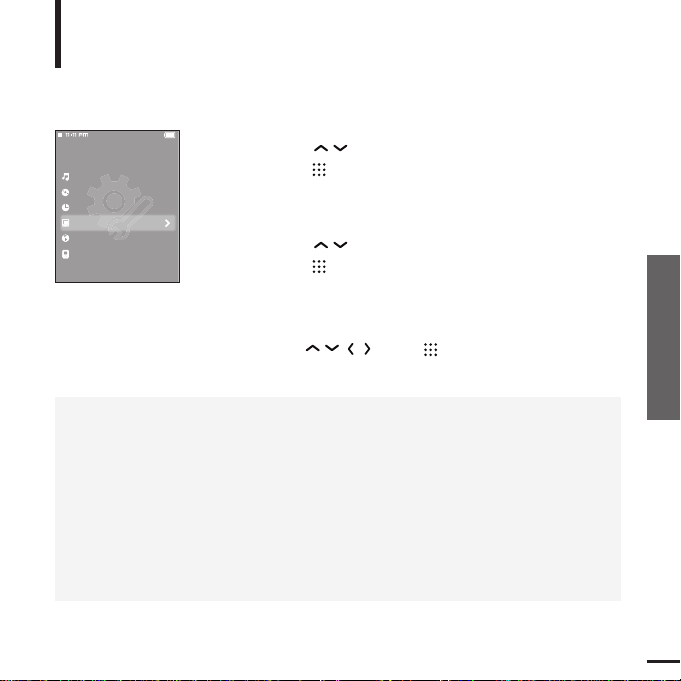
2
Press the [ ] button to select <Display> and then
press the [ ] button.
■
The Display menu appears.
3
Use the [ ] and [ ] buttons to set the
desired functions
1
Press the [ ] button to select <Settings> and then
press the [ ] button.
■
The Settings menu appears.
Settings
Music
Record
Time
Display
Language
System
■
<Color Theme> : You can set the background color for the display screen. Choose one from the
6 color theme options. When <Random> is selected, each time you turn off and turn on the
power, the background color will be changed.
■
<Music Background> : You can select a background image to add to your listening experience.
Select either <FLASH 1> <FLASH 2> <FLASH 3> <Album Cover> <Photo> or <Auto>.
Selecting <Auto> will automatically change the background image between <FLASH1> to
<FLASH3> each time a different file is played.
■
<Text Viewer Color> : You can set the background color for text. Choose one of 6 colors.
■
<Text Viewer Type> : You can choose to view the text either vertically or horizontally.
You can select either <Vertical> or <Horizontal>.
■
<LCD Brightness> : You can adjust the brightness of the display light. Select from <0-10>.
Setting Display
You can set the display options including color theme and the music
background image.
Settings
Page 64
64
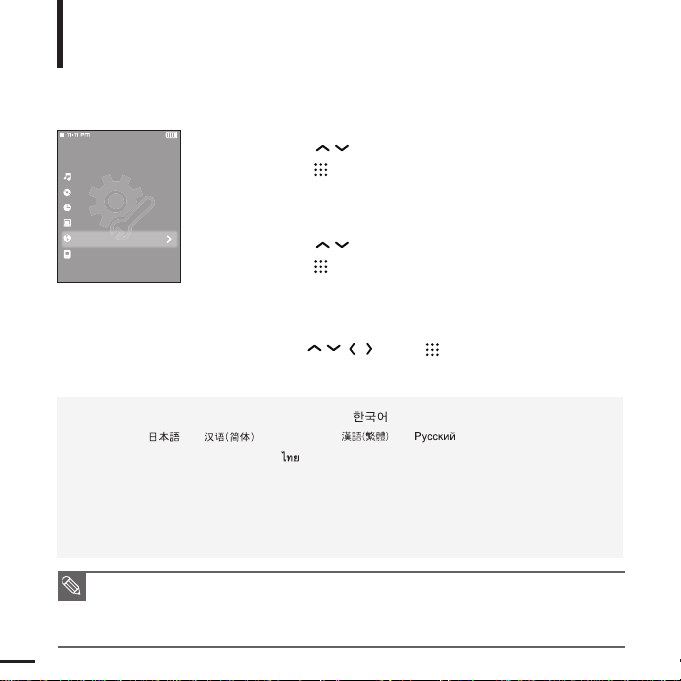
2
Press the [ ] button to select <Language> and then
press the [ ] button.
■
The Language menu appears.
3
Use the [ ] and [ ] buttons to set the
desired functions
1
Press the [ ] button to select <Settings> and then
press the [ ] button.
■
The Settings menu appears.
Settings
Music
Record
Time
Display
Language
System
■
<Menu> : Set the menu language. Select from < > <English> <Français> <Deutsch>
<Italiano> < > < > <Español> < > < > <Magyar> <Nederlands>
<Polski> <Português> <Svenska> < >.
■
<ID3 Tag> : Set the track information language.Select from <Afrikaans> <Basque> <Catalan>
<Chinese(S)> <Chinese(T)> <Czech> <Danish> <Dutch> <English> <Estonian> <Finnish>
<French> <German> <Greek> <Hrvatski> <Hungarian> <Icelandic> <Italian> <Japanese>
<Korean> <Norwegian> <Polish> <Portuguese> <Romany> <Russian> <Slovak> <Slovene>
<Spanish> <Swedish> <Turkish> and <Vietnamese>.
Setting Language
Set the language for the menu and track information (ID3 Tag).
Settings
NOTE
■ The supported languages can be changed or added.
■
What is ID3-Tag?
This is what is attached to an MP3 to carry information relevant to the file, such as the title, artist, album, year,
genre and a comment field.
Page 65

Chapter 4. Settings
Setting Language/
Setting System
65
2
Press the [ ] button to select <System> and then
press the [ ] button.
■
The System menu appears.
3
Use the [ ] and [ ] buttons to set the
desired functions
1
Press the [ ] button to select <Settings> and then
press the [ ] button.
■
The Settings menu appears.
Settings
Music
Record
Time
Display
Language
System
■ <Booting Mode> : You can set the start window after the system reboots. Select either
<Main Menu> or <Last Played>. If you set <Last Played>, the function last used will come up when you
turn the player back on.
■ <Resume> : Specifies the starting point to restart playback after playback is stopped.
If set to <Off>, the last file will play from the beginning. If set to <On>, the last file will play from the point
it was previously stopped.
■ <Button Sound> : Sets the beep sound for button operations to on or off. Select either <On> or <Off>.
■ <Volume Limit> : You can avoid hearing damage by setting the volume limit when using earphones.
<On> will limit the maximum volume level up to 20. The maximum volume level when Volume Limit is
set to <Off> is 40.
■ <Default Set> : Returns all settings to the default value. Select from <Yes> and <No>.
√ Page 66
■ <Memory> : Indicates the remaining memory capacity. <Used> indicates the usage, <Available>
indicates the remaining capacity and <Total> indicates the total memory capacity.
■ <Firmware Version> : Displays the current firmware version.
Setting System
You can set the booting mode, resume and button sound.
Settings
Page 66
66
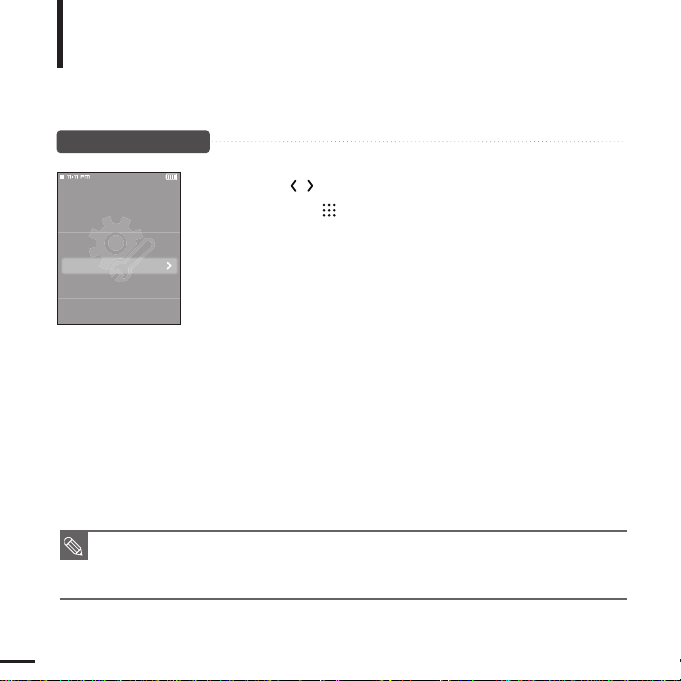
Press the [ ] button to select either <Yes> or <No> and
then press the [ ] button.
■
<Yes> : Initializes all settings to default (original factory settings).
■
<No> : Cancels default settings.
Default Set
System
Booting Mode
Resume
Button Sound
Default Set
Memory
Firmware Version
■ Regarding the Built-In Memory
The actual built-in memory available is slightly less than indicated as the internal firmware uses a portion
of the memory.
NOTE
Setting System (Continued)
Settings
Page 67

Chapter 5. Troubleshooting
Setting System/
Troubleshooting
67
T roubleshooting
If a malfunction is experienced, check the following If the problem persists,
contact 1-800-SAMSUNG for a Samsung Service Center near you.
Power will not turn on.
Buttons do not work.
The screen will not turn
on.
Power is turning off.
Problem
Check points & Troubleshooting
■
Power will not turn on if the battery is fully discharged.
Recharge the battery and turn the power on again.
■
Press and hold the [MENU] and
[A B/ ]
buttons at the same
time to reset the system.
■
Check if the [HOLD] switch is in the direction of the arrow position.
■
Check if you pressed the right button, then press again.
■
Press and hold the [MENU] and
[A B/ ]
buttons at the same
time to reset the system.
■
The screen may not be visible under direct sunlight.
■
When <LCD Off> is selected from <Settings> →<Display>, the
LCD will be turned off. Press any button and see if it turns on.
The power is automatically turned off when the battery is fully
discharged. Recharge the battery.
Battery life differs from
what is stated in the
Manual.
■
The battery time may vary, depending on the sound mode and
display setting.
■
Product life may be shortened when left for extended periods in
low or high temperatures.
Program Malfunction
Connection to your PC is
disabled.
Please check if your PC requirements are met.
Press <Start> on the toolbar of your PC to run Windows Update.
Select Key Updates and Service Packs, then update all.
Reboot your PC and reconnect.
The file transfer rate is
too low.
If you are running multiple programs including Media Studio on
your PC, the file transfer rate will be low. Make sure to exit
unnecessary programs before proceeding.
Page 68
68
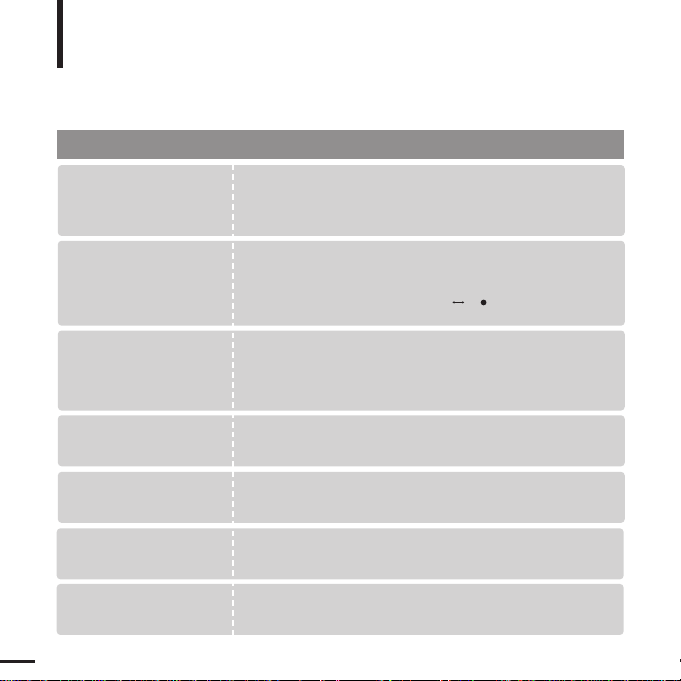
The product is hot.
Heat may be generated during recharging. This has no effect on
the product life or functions.
A downloaded video
does not play and a
message pops up.
Try to download the movie clip through Media Studio again.
Playing is disabled.
File upload is disabled.
Files or Data are Missing.
Abnormal Play Time
Display during Play.
Problem
Check points & Troubleshooting
■
Check if the available file has been saved in the memory.
■
Check if the music file is damaged.
■
Check if there is enough battery power.
■
Check if the USB cable is securely connected.
Reconnect if necessary.
■
Check if the memory is full.
■
Press and hold the [MENU] and
[A B/ ]
buttons at the same
time to reset the system.
Check if the USB cable has been disconnected during file or data
transmission. If this is the case, it may cause serious damage not
only to files/data but also to the product. You have to be extra
cautious as Samsung cannot be held responsible for data loss.
Check if the file is in VBR (Variable Bit Rate) format.
Abnormal Display
of File Name.
Move to <Settings> →<Language> →<ID3 Tag> in the Menu
screen and set an appropriate language.
T roubleshooting
(Continued)
Page 69
69
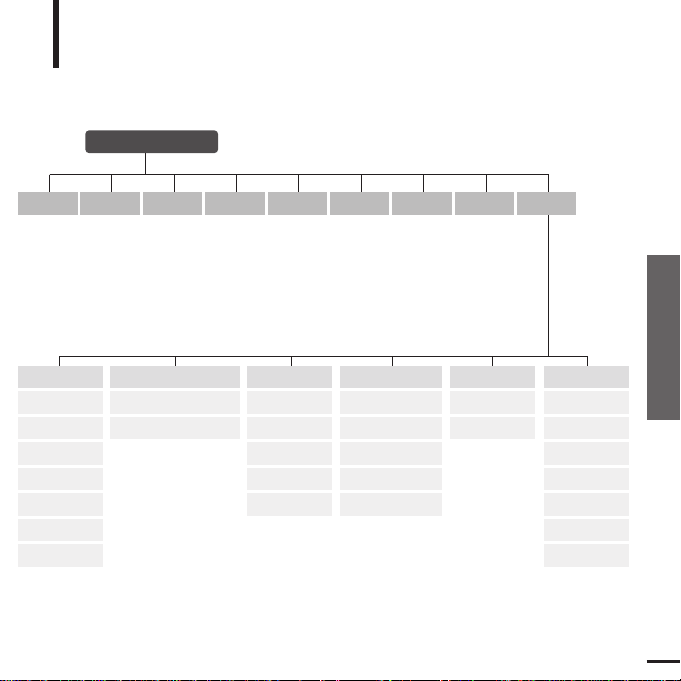
Menu Select Screen
Music
File Browser
FM Radio Text Photo Video Game Record Settings
Music
Street Mode
DNSe
3D User Set
User EQ Set
Play Mode
Play Speed
Skip Interval
Memory
Firmware Version
Time
Date/Time Set
Sleep Timer
LCD Off
Auto Power Off
Screen Saver
Display
Color Theme
Music Background
Text Viewer Color
Text Viewer Type
LCD Brightness
Language
Menu
ID3 Tag
System
Booting Mode
Resume
Button Sound
Volume Limit
Default Set
Record
FM Recording Bit Rate
Voice Recording Bit Rate
Menu Tree
You can quickly view the menu structure.
Chapter 6. Appendix
Troubleshooting/
Menu Tree
Page 70

70
Product Specifications
●
The contents of this Manual are subject to change without prior notice for further
improvement.
Model Name YP-T9
Power 3.7V (Li-Polymer Rechargeable)
Built-in Battery Power 740 mAh
AUDIO: MPEG1/2/2.5 Layer3(8kbps~320kbps, 8kHz~48kHz),
WMA(5kbps~320kbps,8kHz~48kHz)
File Compatibility Video: SVI (Video: MPEG4, Audio: MP3 (44.1kHZ, 128kbps),
Resolution: 208X176, Frame Rate: 15fps)
Image: JPG (Progressive, Sequential Scanning, File Size: less than 3MB)
Supported Number of folders and Files
Folder: Max. 500, File: Max. 5000(Include folder)
Earphone Output 20mW (16Ω)
Output Frequency Range 20Hz~20KHz
Noise Ratio 85 dB with 20kHz LPF(based on 1KHz 0 dB)
Play Time
Maximum of 30 hours for music playback (based on: MP3 128kbps,
Volume: 20, Normal Mode), Maximum of 6 hours for video playback
Temperature Range for Operation -5~35 °C (23~95°F)
Case Plastic
Weight
1.73 oz
Dimension (WxHxD) 1.67 X 3.27 X 0.43
inches
FM
FM Frequency
87.5~108.0MHz
FM T.H.D
1%
Radio
FM Signal to Noise Ratio
55dB
FM Useable Sensitiivity
10dBµ
Page 71

71
License
The product unit accompanying this user manual is licensed under certain intellectual
property rights of certain third parties. In particular, this product is licensed under the
following US patents : 5,991,715, 5,740,317, 4,972,484, 5,214,678, 5,323,396,
5,539,829, 5,606,618, 5,530,655, 5,777,992, 6,289,308, 5,610,985, 5,481,643,
5,544,247, 5,960,037, 6,023,490, 5,878,080, and under US Published Patent Application
No. 2001-44713-A1.
This license is limited to private non-commercial use by end-user consumers for licensed
contents. No rights are granted for commercial use. The license does not cover any
product unit other than this product unit and the license does not extend to any unli-censed
product unit or process conforming to ISO/IEC 11172-3 or ISO/IEC 13818-3 used
or sold in combination with this product unit. The license only covers the use of this
product unit to encode and/or decode audio files conforming to the ISO/IEC 11172-3 or
ISO/IEC 13818-3. No rights are granted under this license for product features or func-tions
that do not conform to the ISO/IEC 11172-3 or ISO/IEC 13818-3.
Page 72
72
Safety Information
If this equipment does cause harmful interference
to radio or television reception, which can be
determined by turning the equipment off and on,
the user is encouraged to try to correct the interference by one or more of the following measures:
◆ Reorient or relocate the receiving antenna.
◆ Increase the separation between the equipment
and receiver.
◆ Connect the equipment to an outlet on a circuit
different from that to which the receiver is
connected.
◆ Consult the dealer or an experienced radio/TV
technician for help.
FCC
This device complies with part 15 of the FCC
Rules. Operation is subject to the following two
conditions:
(1) This device may not cause harmful
interference, and (2) this device must accept any
interference received, including interference that
may cause undesired operation.
Caution: Any changes or modifications in
construction of this device which are not
expressly approved by the party responsible for
compliance could void the user’s authority to
operate the equipment
Note: This equipment has been tested and
found to comply with the limits for a Class B
digital device, pursuant to part 15 of the FCC
Rules. These limits are designed to provide
reasonable protection against harmful
interference in a residential installation.
This equipment generates, uses and can radiate
radio frequency ener-gy and, if not installed and
used in accordance with the instructions, may
cause harmful interference to radio
communications, However, there is no guarantee
that interference will not occur in a particular
installation.
Page 73
73
FCC
Any changes or modifications not expressly
approved by the grantee of this device could
void the user’s authority to operate the device.
Compliance
This product conforms to the following
Council Directive:
◆ Directive 89/336/EEC, 92/31/EEC(EMC)
Declaration of Conformity
Name: Samsung Electronics Co., Ltd
Address: 416, Maetan-3Dong, Yeongtong-Gu,
Suwon City, Kyungki-Do, Korea 442-742
declares under its sole responsibility that the
product
Trade Name: Samsung Electronics Co., Ltd
Model Number: YP-T9
has been tested according to the
FCC/CISPR22/95 requirements for Class B
devices and found compliant with the following
standards
EMI/EMC: FCC Part 15 Subpart B
This device complies with part 15 of the FCC
Rules.
Operation is subject to the following two
conditions:
1.This device may not cause harmful
interference, and
2.This device must accept any interference
received, including interference that may
cause undesirable operation.
Party Responsible for Product Compliance
Samsung Electronics America
QA Lab.
3351 Michelson Dr. Suite #290
Irvine, CA92612
Page 74
Warranty
Samsung warrants this product as free of
defects in material, design and workmanship
for a period of twelve(12) months from the
original date of purchase.
If during the period of warranty this product
proves defective under normal use and service,
you should return the product to the retailer
from whom it was originally purchased.
The liability of Samsung and its appointed
maintenance company is limited to the cost of
repair and/or replacement of the unit under
warranty.
Return of the product for defective reasons
should be to the original purchaser; however,
Samsung Authorized Dealers and Authorized
Service Centers will comply with the warranty
on the terms issued to purchasers in the
country concerned. For further information
relating to the Authorized Service Centers
contact;
1-800-SAMSUNG (1-800-726-7864)
www.samsung.com
WARRANTY CONDITIONS:
1.The warranty is only valid when the warranty card
is properly completed, and upon presentation of the
proof of purchase consisting of original invoice or
sales slip confirmation, indicating the date of
purchase, dealer’s name, model, serial No. and
product number.
Samsung reserves the right to refuse warranty
service if this information has been removed or
changed after the original purchase of the product
from the dealer.
2.Samsung's obligations are to the repair of the
defective part, and at its discretion, replacement of
the product (service exchange unit).
3.Warranty repairs must be carried out by an
Authorized Samsung Dealer/Service Center. No
reimbursement will be made for repairs carried out
by non Samsung Centers, and warranty coverage
will not be valid for any repairs or damage caused by
such repairs.
4.Repair or replacement under the terms of this
warranty does not give right to extension to or a new
starting of the period of warranty. Repair or direct
replacement under the terms of this warranty may be
fulfilled with functionally equivalent service exchange
units.
Page 75

5. The warranty is not applicable in cases other
than defects in material, design and workmanship.
The warranty does not cover the following:
◆ Periodic checks, maintenance, repair and
replacement of parts due to normal wear and tear.
◆ Abuse or misuse, including but not solely limited
to the failure to use this product for its normal
purposed or in accordance with Samsung's
instructions usage and maintenance.
◆ Use of the product in conjunction with
accessories not approved by Samsung for use with
this product.
◆ Failure of the product arising from incorrect
installationor use not consistent with technical or
safety standardsin current force, or failure to
comply with productmanual instructions.
◆ Accidents, Acts of God or any cause beyond the
control of Samsung caused by lightning, water,
fire, public disturbances and improper ventilation.
◆ Unauthorized modifications carried out for the
product to comply with local or national technical
standards in countries for which the Samsung
product was not originally designed.
◆ Repairs performed by non-authorized service
centers such as opening of the product by a
non-authorized person.
◆ The model, serial No. and product number on
the product has been altered, deleted, removed
or made illegible.
6. This warranty does not affect the consumer’s
statutory rights nor the consumers rights against
the dealer from their purchase/sales agreement.
Page 76

THERE ARE NO EXPRESS WARRANTIES
OTHER THAN THOSE LISTED AND
DESCRIBED ABOVE, AND NO WARRANTIES
WHETHER EXPRESS OR IMPLIED, INCLUDING
,
BUT NOT LIMITED TO, ANY
IMPLIED WAR-
RANTIES OF MERCHANTABILITY
OR FITNESS
FOR A PARTICULAR PURPOSE,
SHALLAPPLY AFTER THE EXPRESS WARRANTY
PERIODS STATED ABOVE, AND NO OTHER
EXPRESS WARRANTY OR GUARANTY GIVEN
BY ANY PERSON, FIRM OR
CORPORATION WITH RESPECTTO THIS
PRODUCT
SHALL BE BINDING ON SAMSUNG,
SAMSUNG
SHALL NOT BE LIABLE FOR LOSS
OF REVENUE OR PROFITS,FAILURE
TO
REALIZE SAVINGS OR OTHER BENEFITS,
OR
ANY OTHER SPECIAL, INCIDENTAL OR
CONSEQUENTIAL DAMAGES CAUSED BY THE
USE, MISUSE OR INABILITY TO USE THIS
PRODUCT, REGARDLESS OF THE LEGAL
THEORY ON WHICH THE CLAIM IS BASED,
AND EVEN IF SAMSUNG HAS BEEN ADVISED
OF THE POSSIBILITY OF SUCH DAMAGES.
NOR SHALL RECOVERY OF ANY KIND
AGAINST SAMSUNG BE GREATER IN AMOUNT
THAN THE PURCHASE PRICE OF THE
PRODUCT SOLD BY SAMSUNG AND
CAUSING THE ALLEGED DAMAGE.
WITHOUT LIMITING THE FOREGOING,
PURCHASER
ASSUMES ALL RISK AND LIABILITY FOR LOSS,
DAMAGE OR INJURY TO PURCHASER AND
PURCHASER’S PROPERTY AND TO OTHERS
AND THEIR PROPERTYARISING OUT OF THE
USE, MISUSE OR INABILITY TO USE THIS
PRODUCT SOLD BY SAMSUNG
NOT CAUSED
DIRECTLY BY THE NEGLIGENCE
OF SAMSUNG.
THIS LIMITED WARRANTY SHALL NOT EXTEND
TO ANYONE OTHER THAN THE ORIGINAL
PURCHASER OF THIS PRODUCT, IS
NONTRANSFERABLE AND STATES YOUR
EXCLUSIVE REMEDY.
Some states do not allow limitations on how long an
implied warranty lasts, or the exclusion or limitation
of incidental or consequential damages, so the
above limitations or exclusions may not apply to you.
This warranty gives you specific legal rights, and you
may also have other rights which vary from state to
state. This product is for personal use only, and is
only for use in compliance with the limitations of
copyright and other laws.
To obtain warranty service, please contact SAMSUNG at: Samsung Electronics America, Inc. 400
Valley Road, Suite 201 Mount Arlington, NJ 07856
1-800-SAMSUNG (1-800-726-7864)
www.samsung.com 081299
Warranty
Page 77

REV 0.0
If you have any questions or comments relating to Samsung products,
please contact the SAMSUNG customer care center.
Samsung Electronics America, Inc.
1-800-SAMSUNG (7267864)
www.samsung.com
 Loading...