

Page 1

User Manual
TB-WH
TB-CH
The color and the appearance may differ depending on
the product, and the specifications are subject to
change without prior notice to improve the performance.
BN46-00204A-05
Page 2

Table Of Contents
2
Table Of Contents
BEFORE USING THE
PRODUCT
5 Copyright
5 Icons used in this manual
5 Symbols for safety precautions
6 Safety Precautions
6 Electricity and Safety
7 Installation and Safety
9 Operation and Safety
PREPARATIONS 13 Checking the Contents
13 Removing the Packaging
14 Checking the Components
15 Parts
15 Button
16 Reverse Side
17 Right Side View
18 Installation
18 Reassembly
20 Adjusting the Product Height
21 Anti-theft Lock
USING "WINDOWS
EMBEDDED STANDARD 7"
(TB-WH)
22 What is "Windows Embedded Standard
7" Client?
23 Connection to Use "Windows Embedded
Standard 7"
23 Before Connecting
24 Connection Using the D-SUB Cable (Analogue
Type)
24 Connection Using the DVI Cable
25 Connecting a Microphone
25 Connecting to Headphones or Speakers
26 LAN Connection
26 Connecting USB Devices
27 Connecting the Power
Page 3
Table Of Contents
Table Of Contents
3
28 Using "Windows Embedded Standard 7"
28 Logon
28 "Windows Embedded Standard 7" Desktop
29 Programs
36 Configuring Utilities
37 Recover the System
38 MagicRMS Pro
38 About MagicRMS Pro
USING THE "ZERO
CLIENT" (TB-CH)
39 About "Zero Client"
40 Connection to Use the "Zero Client"
40 Before Connecting
41 Connection Using the D-SUB Cable (Analogue
Type)
41 Connection Using the DVI Cable
42 Connecting a Microphone
42 Connecting to Headphones or Speakers
43 Connecting to a Server (LAN/USB Connection)
44 Connecting the Power
45 Using the "Zero Client"
45 Login
45 Message Box
46 Toolbar
TROUBLESHOOTING
GUIDE
69 Requirements Before Contacting
Samsung Customer Service Center
69 Check the following.
SPECIFICATIONS 70 General
71 Power consumption
APPENDIX 72 Contact SAMSUNG WORLD WIDE
Page 4
Table Of Contents
Table Of Contents
4
78 Correct Disposal
78 Correct Disposal of This Product (Waste
Electrical & Electronic Equipment)
78 Correct disposal of batteries in this product
INDEX
Page 5
5
Before Using the Product
Before Using the Product
Copyright
The contents of this manual are subject to change without notice to improve quality.
© 2012 Samsung Electronics
Samsung Electronics owns the copyright for this manual.
Use or reproduction of this manual in parts or entirety without the authorization of Samsung Electronics is
prohibited.
The SAMSUNG logo is a registered trademark of Samsung Electronics.
Microsoft and Windows are registered trademarks of Microsoft Corporation.
VESA, DPM and DDC are registered trademarks of the Video Electronics Standards Association.
Icons used in this manual
Symbols for safety precautions
An administration fee may be charged if either
(a) an engineer is called out at your request and there is no defect in the product
(i.e. where you have failed to read this user manual).
(b) you bring the unit to a repair centre and there is no defect in the product
(i.e. where you have failed to read this user manual).
The amount of such administration charge will be advised to you before any work or home visit is
carried out.
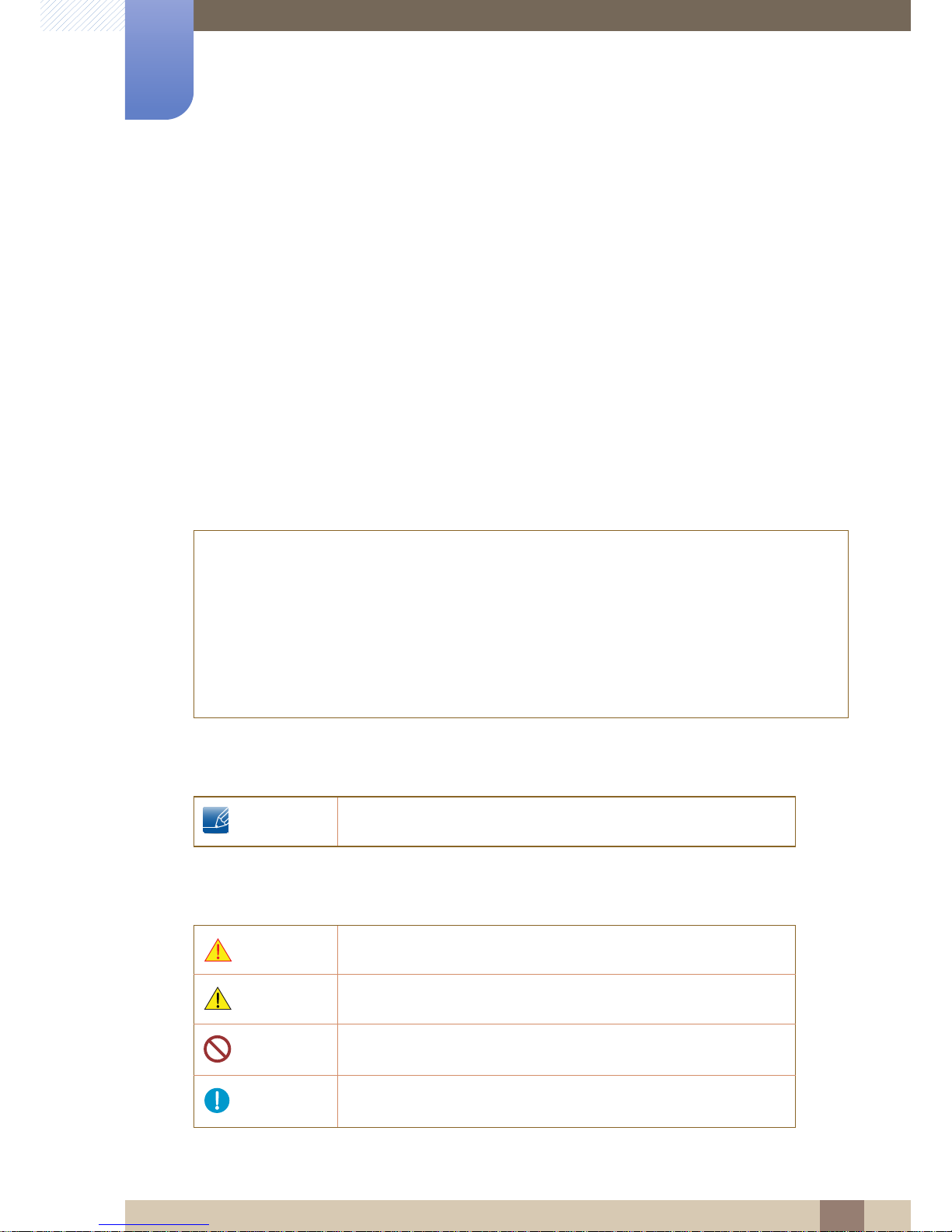
The following images are for reference only. Real-life situations may
differ from what is shown in the images.
Warning
A serious or fatal injury may result if instructions are not followed.
Caution
Personal injury or damage to properties may result if instructions are
not followed.
Activities marked by this symbol are prohibited.
Instructions marked by this symbol must be followed.
Page 6
6
Before Using the Product
Before Using the Product
Safety Precautions
The monitor images in this manual are for reference only. Monitor is sold separately.
Electricity and Safety
Warning
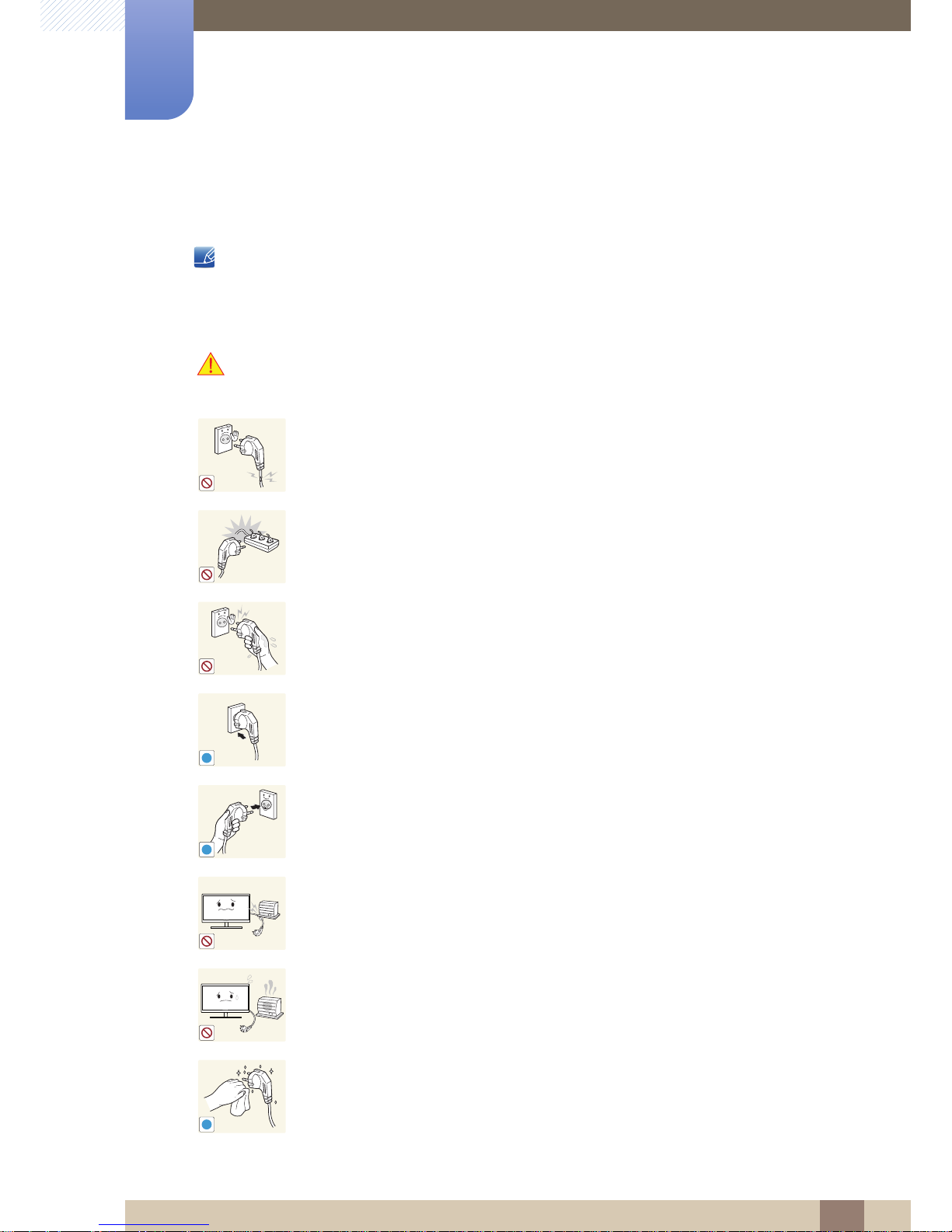
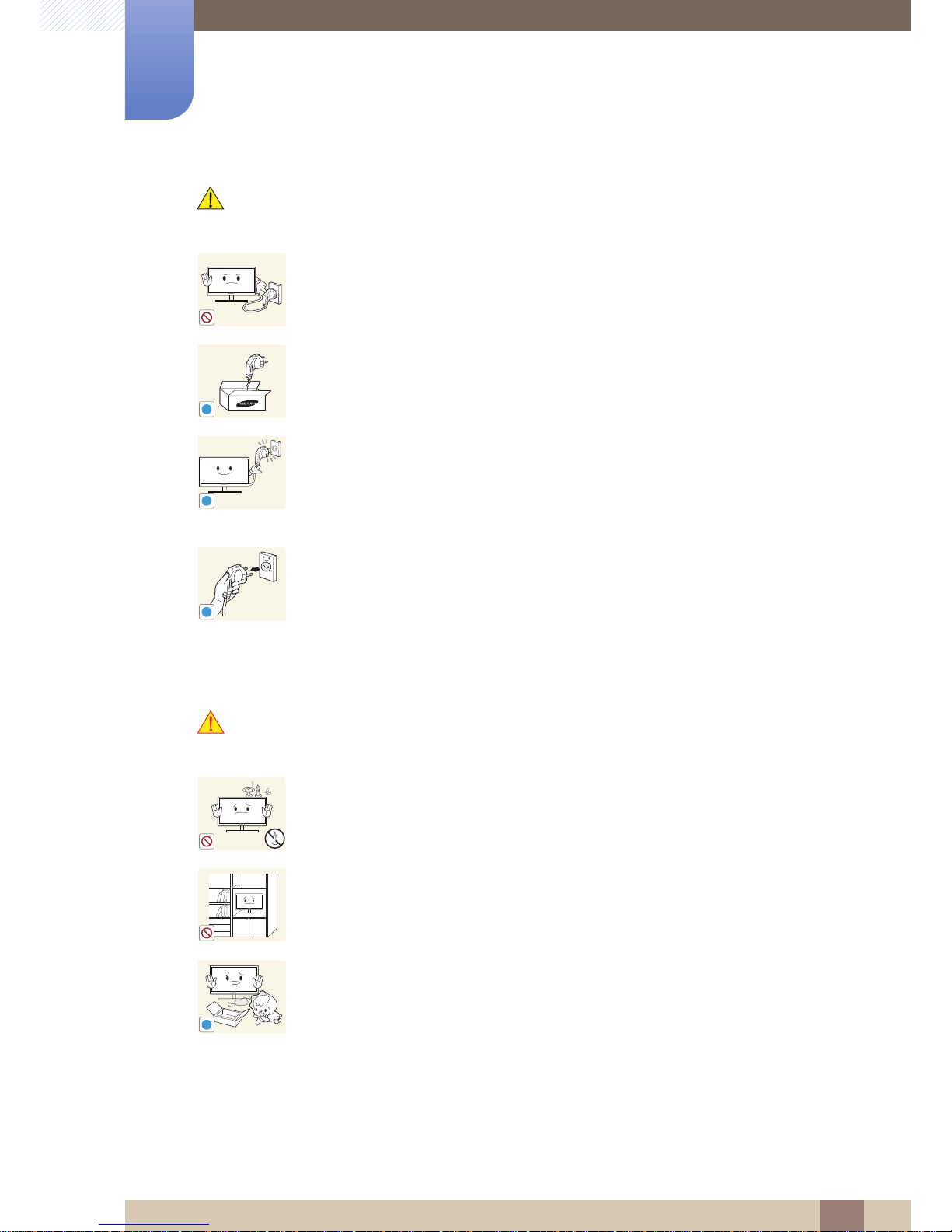
Do not use a damaged power cable or plug, or a loose power socket.
An electric shock or fire may result.
Do not plug many products into the same power socket.
Otherwise, the socket may overheat and cause a fire.
Do not touch the power cable with wet hands.
Otherwise, an electric shock may result.
Insert the power cable all the way in so it is not loose.
An unstable connection may cause a fire.
Ensure you connect the power cable to a grounded power socket. (type 1
insulated devices only).
An electric shock or injury may result.
Do not bend or pull the power cable with force. Do not weigh the power cable
down with a heavy object.
A damaged power cord may cause an electric shock or fire.
Do not place the power cable or product near heat sources.
An electric shock or fire may result.
If the power cable pins or power outlet is covered with a foreign substance (dust,
etc.), wipe it off using a dry cloth.
Otherwise, a fire may result.
!
!
!
Page 7
7
Before Using the Product
Before Using the Product
Caution
Installation and Safety
Warning
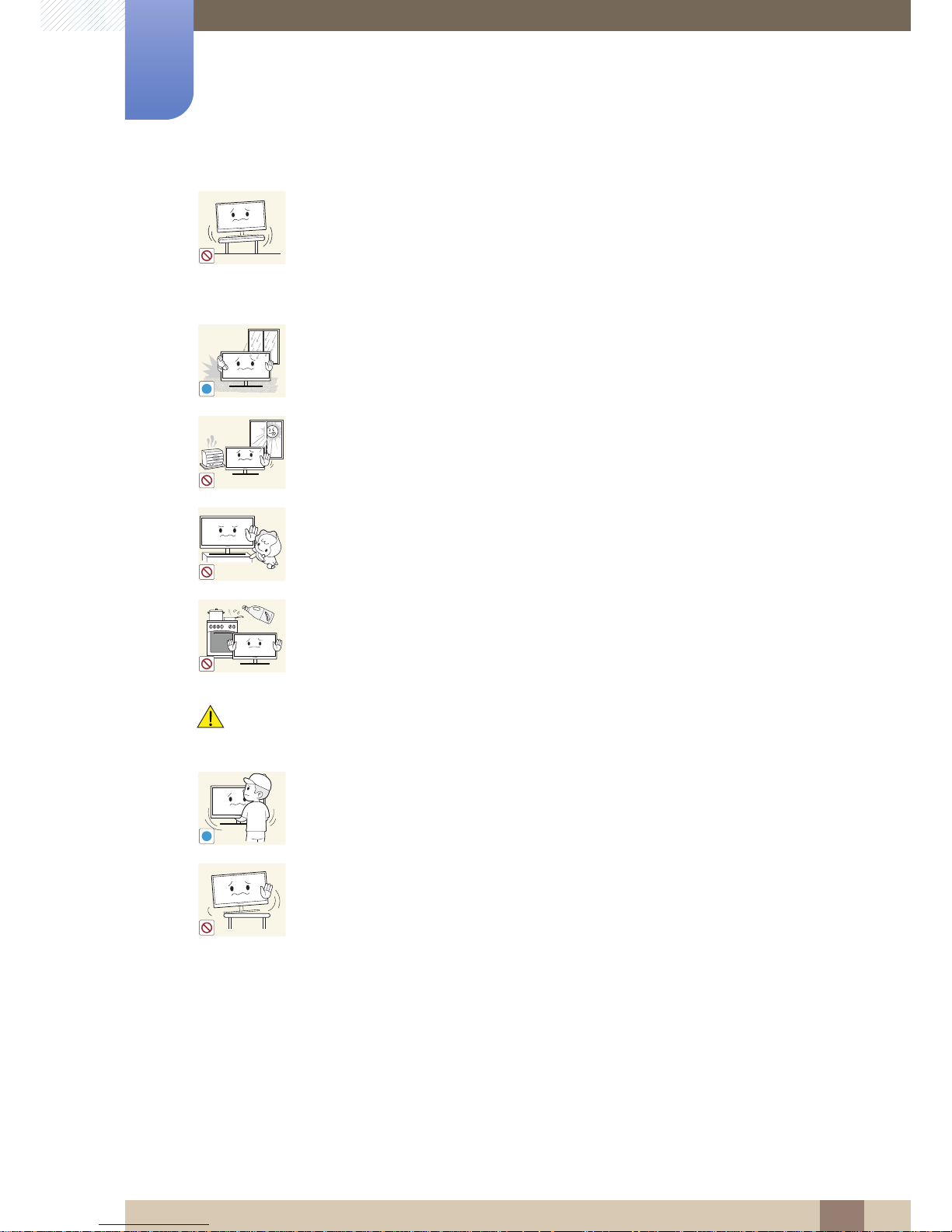
Do not unplug the power cable when the product is in use.
The product may become damaged by an electric shock.
Do not use the power cable for products other than authorized products supplied
by Samsung.
An electric shock or fire may result.
Keep the power socket where the power cable is connected unobstructed.
If any problem occurs in the product, unplug the power cable to completely
cut the power to the product.
Power to the product cannot be completely cut off with the power switch.
Hold the plug when disconnecting the power cable from the power socket.
An electric shock or fire may result.
DO NOT PLACE CANDLES, INSECT REPELLANTS OR CIGARETTES ON TOP
OF THE PRODUCT. DO NOT INSTALL THE PRODUCT NEAR HEAT SOURCES.
Otherwise, a fire may result.
Avoid installing the product in a narrow space with bad ventilation, such as a
bookshelf or wall closet.
Otherwise, a fire may result due to an increased internal temperature.
Keep the plastic packaging bag for the product in a place that cannot be reached
by children.
Children may suffocate.
!
!
!
!
Page 8
8
Before Using the Product
Before Using the Product
Caution
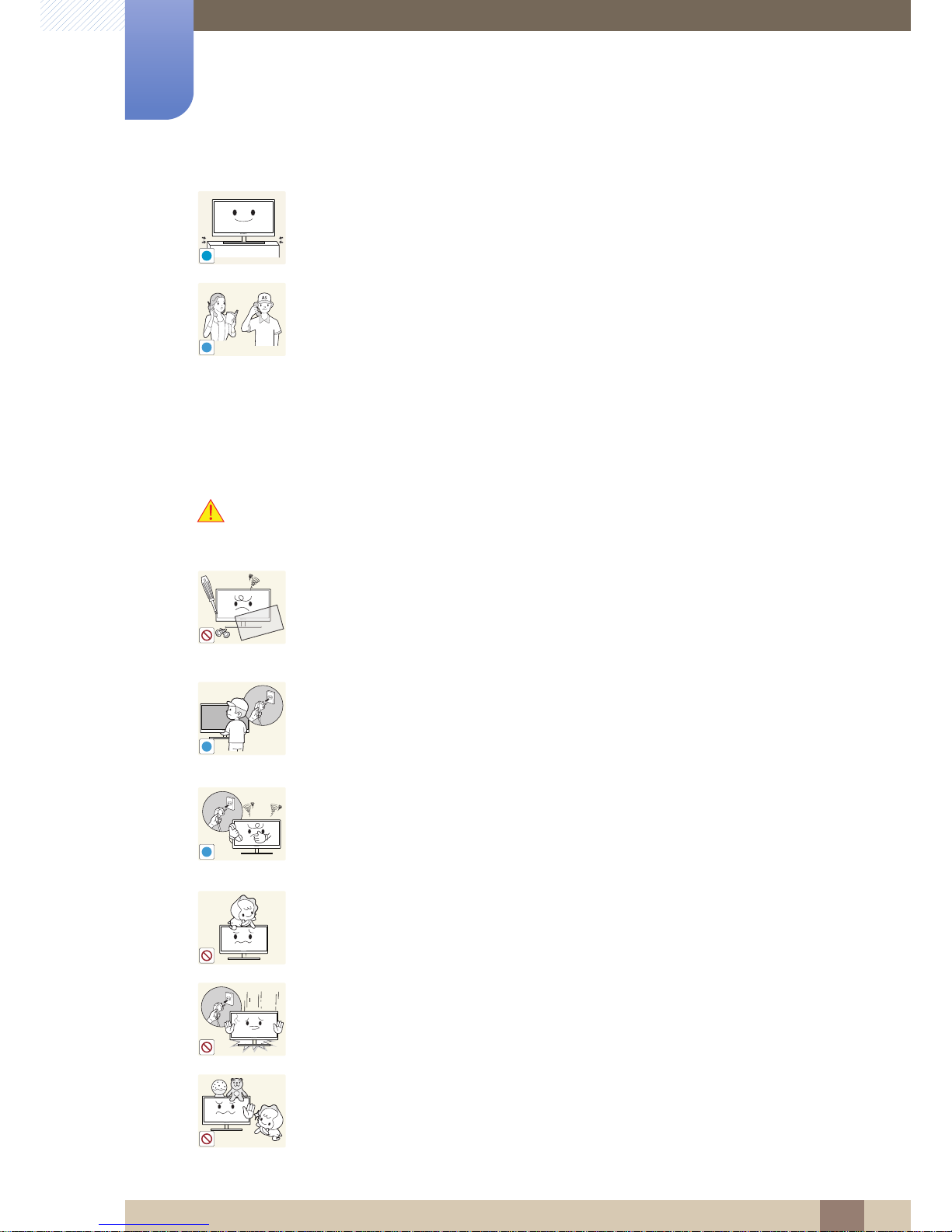
Do not install the product on an unstable or vibrating surface (insecure shelf,
sloped surface, etc.).
The product may fall and break or cause a personal injury.
Using the product in an area with excess vibration may damage the product
or cause a fire.
Do not install the product in a vehicle or a place exposed to dust, moisture (water
drips, etc.), oil, or smoke.
An electric shock or fire may result.
Do not expose the product to direct sunlight, heat, or a hot object such as a
stove.
Otherwise, the product lifespan may be reduced, or a fire may result.
Do not install the product within the reach of young children.
The product may fall and injure children.
Edible oil, such as soybean oil, can damage or deform the product. Do not install
the product in a kitchen or near a kitchen counter.
Take care not to drop the product when moving it.
Otherwise, product failure or personal injury may result.
When installing the product on a cabinet or shelf, make sure that the bottom
edge of the front of the product is not protruding.
The product may fall and break or cause a personal injury.
Install the product only on cabinets or shelves of the right size.
!
!
Page 9
9
Before Using the Product
Before Using the Product
Operation and Safety
Warning
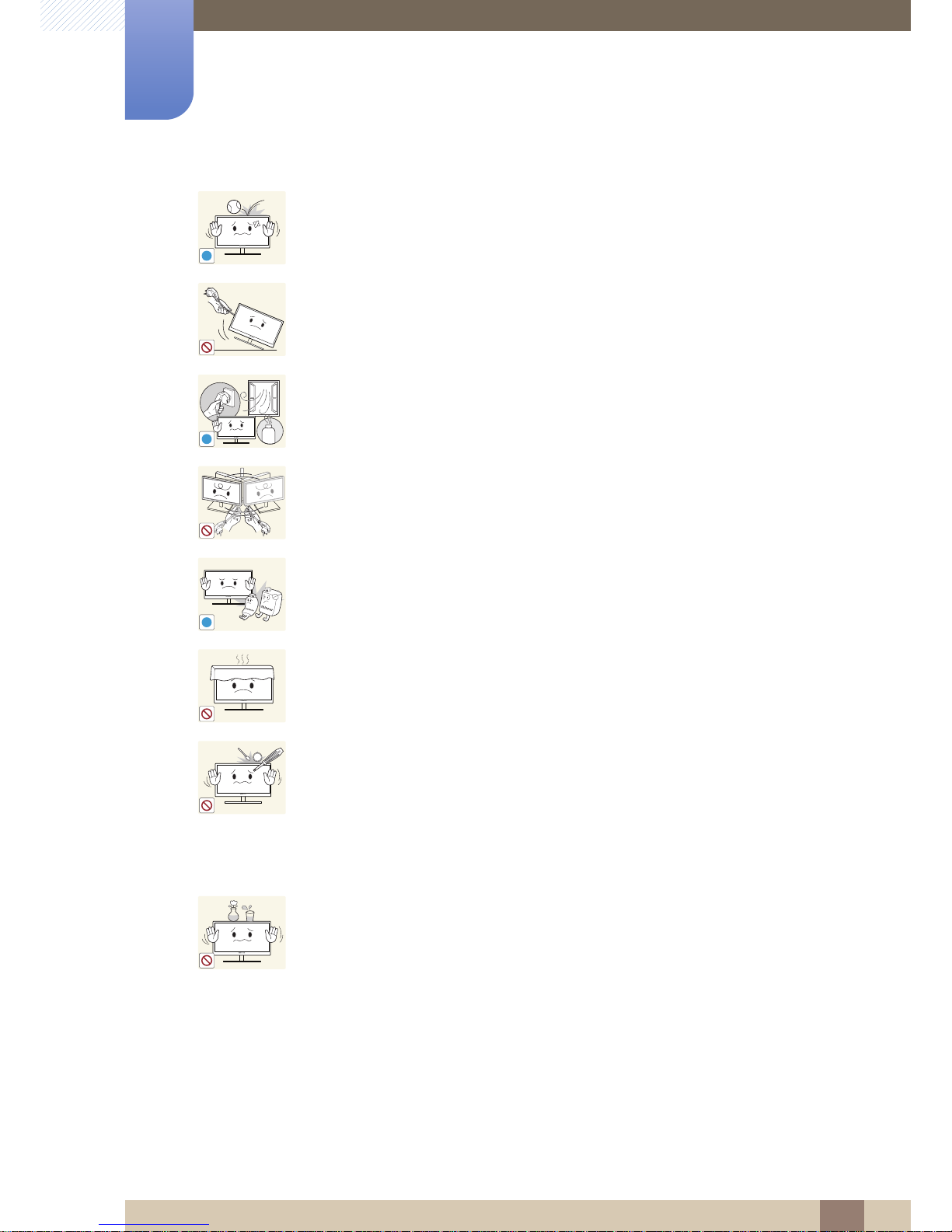
Put down the product carefully.
The product may fall and break or cause a personal injury.
Installing the product in an unusual place (a place exposed to a lot of fine
particles, chemical substances or extreme temperatures, or an airport or train
station where the product should operate continuously for an extended period of
time) may seriously affect its performance.
Be sure to consult Samsung Customer Service Center (page 72) before
installation if you want to install the product at such a place.
High voltage runs through the product. Do not attempt to disassemble, repair, or
modify the product on your own.
An electric shock or fire may result.
Contact Samsung Customer Service Center (page 72) for repair.
Before moving the product, turn off the power switch and disconnect the power
cable and all other connected cables.
Otherwise, the power cord may be damaged and a fire or electric shock may
result.
If the product generates a strange noise, a burning smell, or smoke, remove the
power cable immediately and contact Samsung Customer Service Center (page
72).
An electric shock or fire may result.
Do not let children hang from the product or climb on top of it.
The product may fall, and your child may become injured or seriously
harmed.
If the product falls or the exterior is damaged, power off the product, remove the
power cable, and contact Samsung Customer Service Center (page 72).
Otherwise, an electric shock or fire may result.
Do not put a heavy object, toy, or sweets on top of the product.
The product or heavy objects may fall as children try to reach for the toy or
sweets resulting in a serious injury.
!
SAMSUNG
!
!
!
Page 10
10
Before Using the Product
Before Using the Product
Do not drop objects on the product or apply impact.
An electric shock or fire may result.
Do not move the product by pulling the power cable or any cable.
Otherwise, the cable may be damaged and product failure, an electric shock
or fire may result.
If a gas leakage is found, do not touch the product or power cable. Also, ventilate
the area immediately.
Sparks can cause an explosion or fire.
Do not lift or move the product by pulling the power cable or any cable.
Otherwise, the cable may be damaged and product failure, an electric shock
or fire may result.
Do not use or keep combustible spray or an inflammable substance near the
product.
An explosion or fire may result.
Ensure the vents are not blocked by tablecloths or curtains.
Otherwise, a fire may result from an increased internal temperature.
Do not insert a metallic object (a chopstick, coin, hair pin, etc.) or inflammable
object (paper, match, etc.) into the vent or ports of the product.
If water or any foreign substance enters the product, be sure to power off the
product, remove the power cable, and contact Samsung Customer Service
Center (page 72).
Product failure, an electric shock or fire may result.
Do not place objects containing liquid (vases, pots, bottles, etc) or metallic
objects on top of the product.
If water or any foreign substance enters the product, be sure to power off the
product, remove the power cable, and contact Samsung Customer Service
Center (page 72).
Product failure, an electric shock or fire may result.
!
!
GAS
!
100
Page 11
11
Before Using the Product
Before Using the Product
Caution
Disconnect the power cable from the power socket if you do not plan on using
the product for an extended period of time (vacation, etc.).
Otherwise, a fire may result from accumulated dust, overheating, an electric
shock, or electric leakage.
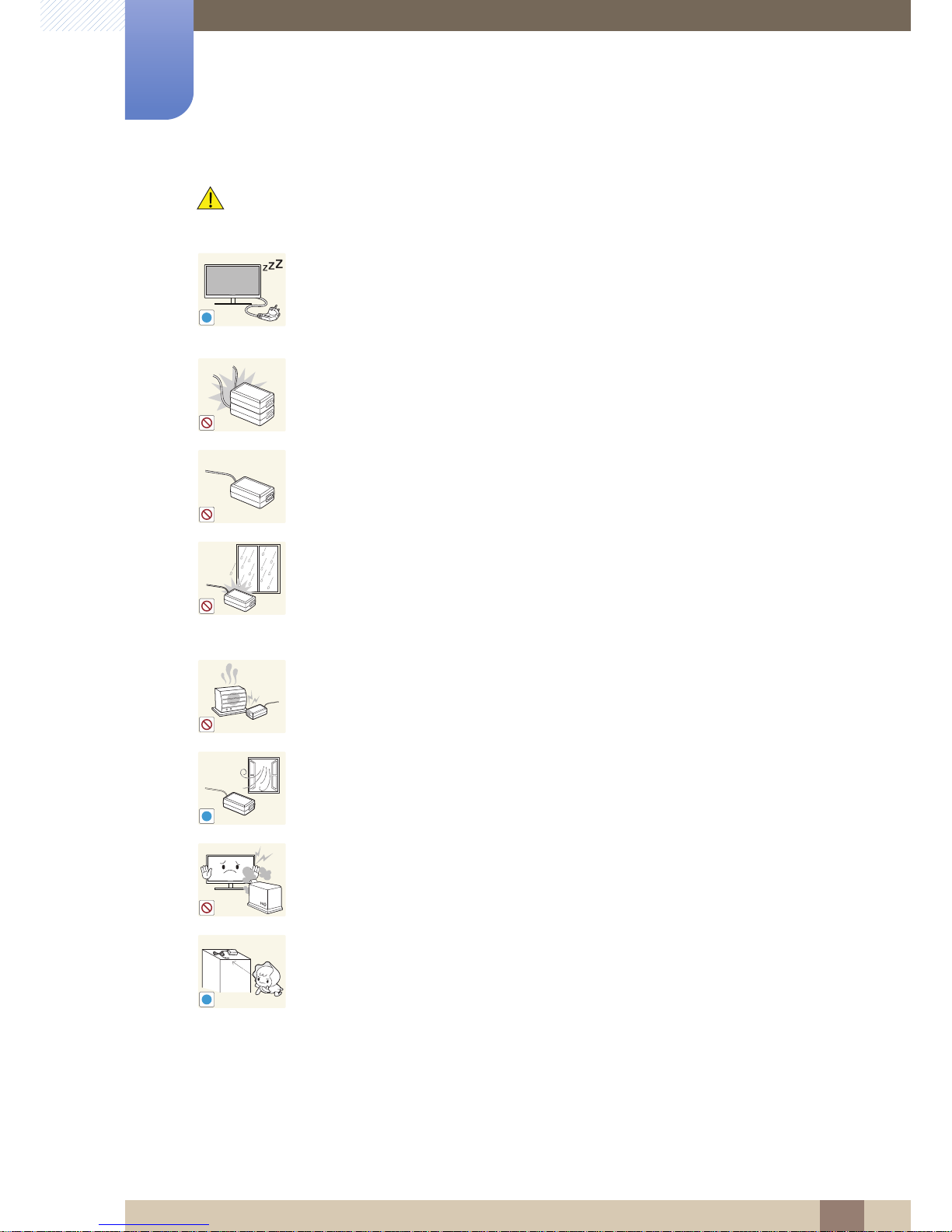
Do not put DC power adapters together.
Otherwise, a fire may result.
Remove the plastic bag from the DC power adapter before you use it.
Otherwise, a fire may result.
Do not let water enter the DC power adapter or get the adapter wet.
An electric shock or fire may result.
Avoid using the product outdoors where it can be exposed to rain or snow.
Be careful not to get the DC power adapter wet when you wash the floor.
Do not put the DC power adapter near to any heating apparatus.
Otherwise, a fire may result.
Keep the DC power adapter in a well-ventilated area.
Do not use humidifiers or stoves around the product.
An electric shock or fire may result.
Store the small accessories used with the product out of reach of children.
-_-
!
!
!
Page 12

12
Before Using the Product
Before Using the Product
Do not place heavy objects on the product.
Product failure or personal injure may result.
Do not increase the volume too high when using headphones (earphones).
Sound particularly at a higher volume could potentially affect long-term
hearing.
Page 13
13
1 Preparations
1
Preparations
1.1 Checking the Contents
1.1.1 Removing the Packaging
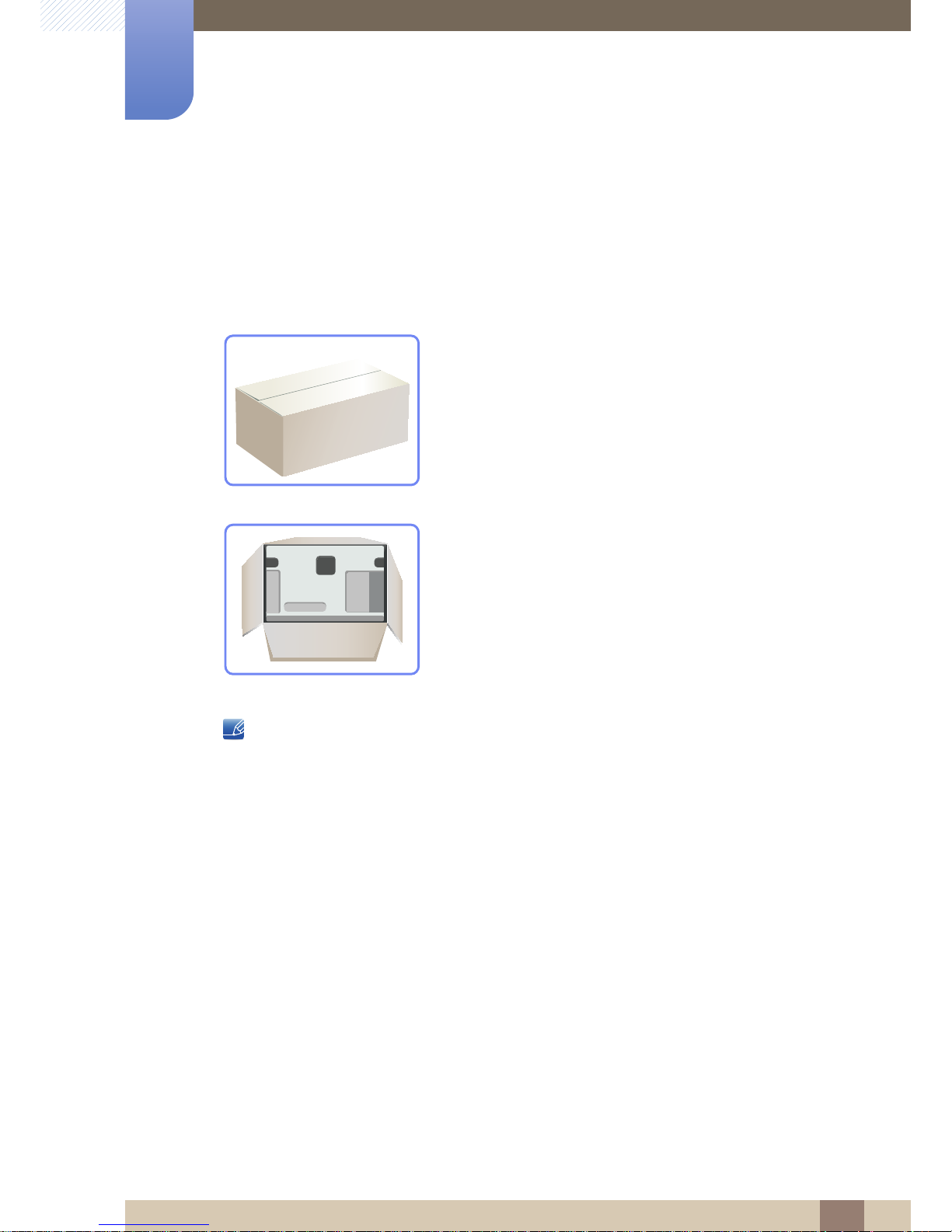
1 Open the packaging box. Be careful not to damage the product when you open the packaging with
a sharp instrument.
2 Remove the styrofoam from the product.
3 Check the components and remove the styrofoam and plastic bag.
The appearance of actual components may differ from the image shown.
This image is for reference only.
4 Store the box in a dry area so that it can be used when moving the product in the future.
Page 14
14
Preparations
1
1 Preparations
1.1.2 Checking the Components
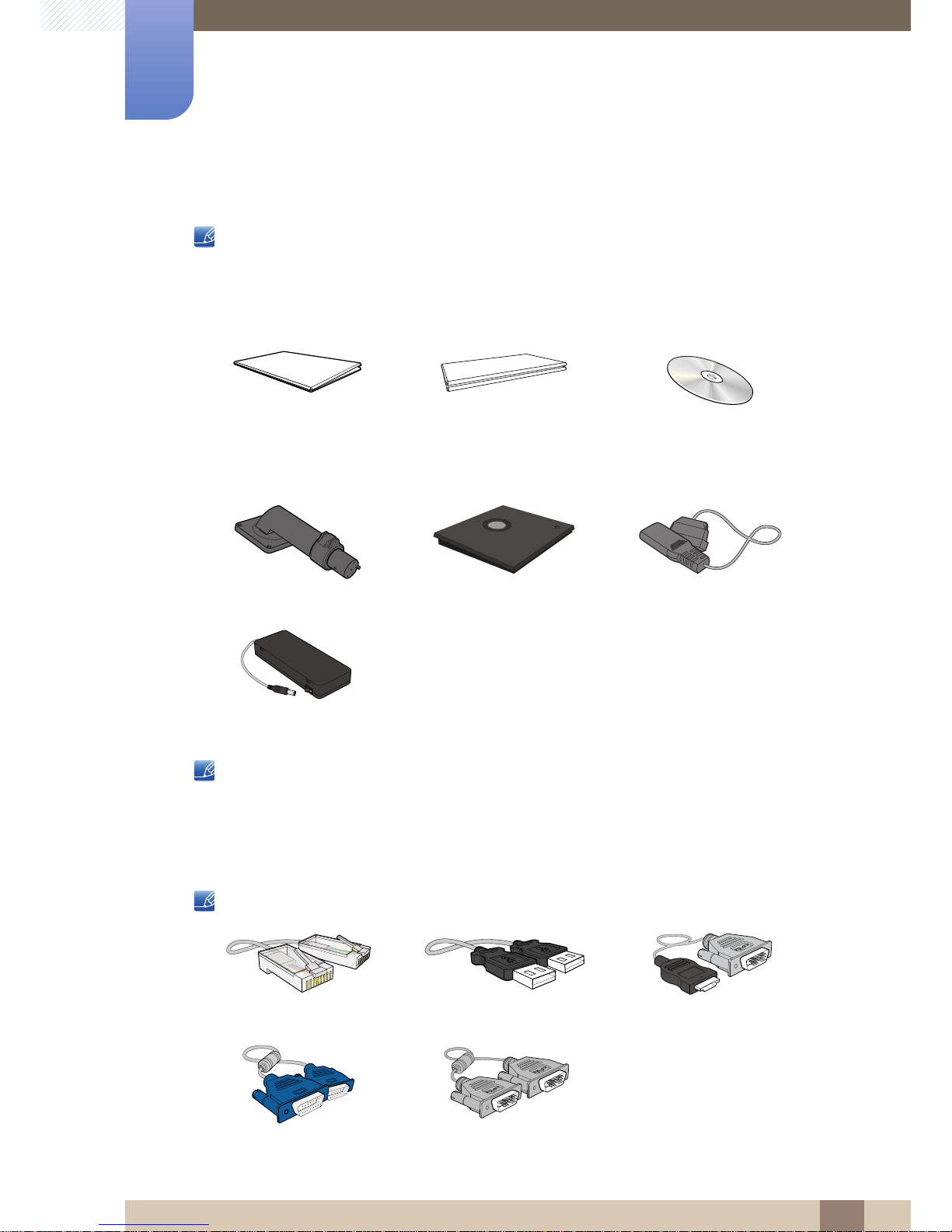
Contact the dealer from whom you purchased the product if any item is missing.
The appearance of the components and items sold separately may differ from the image shown.
Components
Components may vary depending on the country.
The stand base supplied with this product contains a circuit board. Care should be taken when
handling the base.
Items sold separately
The following items can be purchased at your nearest retailer.
Quick setup guide Warranty card
(Not available in some
locations)
User manual
Stand connector Stand base Power cable
DC power adapter
LAN cable USB cable HDMI-DVI cable
D-SUB cable DVI cable
Page 15
15
Preparations
1
1 Preparations
1.2 Parts
1.2.1 Button
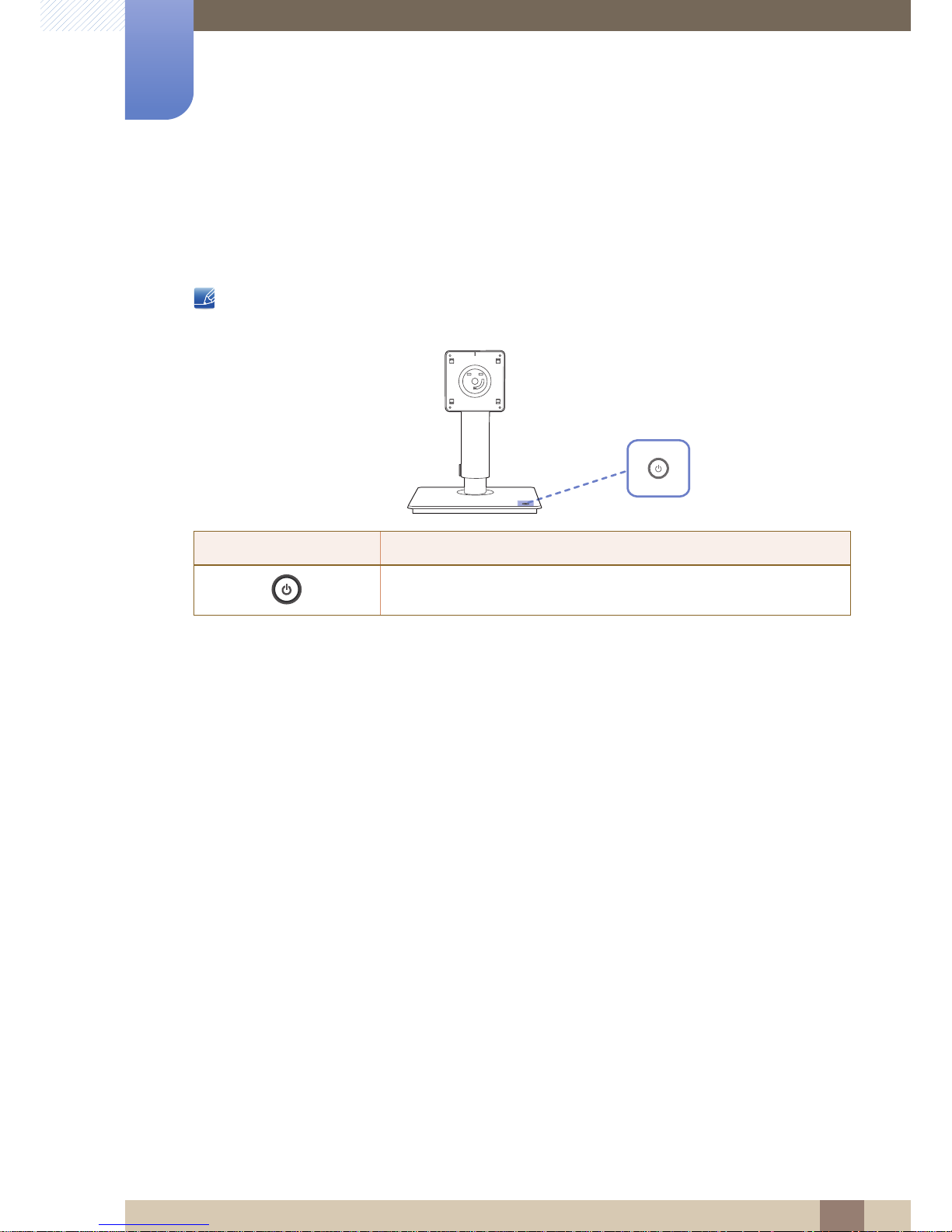
The color and shape of parts may differ from what is shown. Specifications are subject to change
without notice to improve quality.
Icon Description
Power on or off the product.
Page 16
16
Preparations
1
1 Preparations
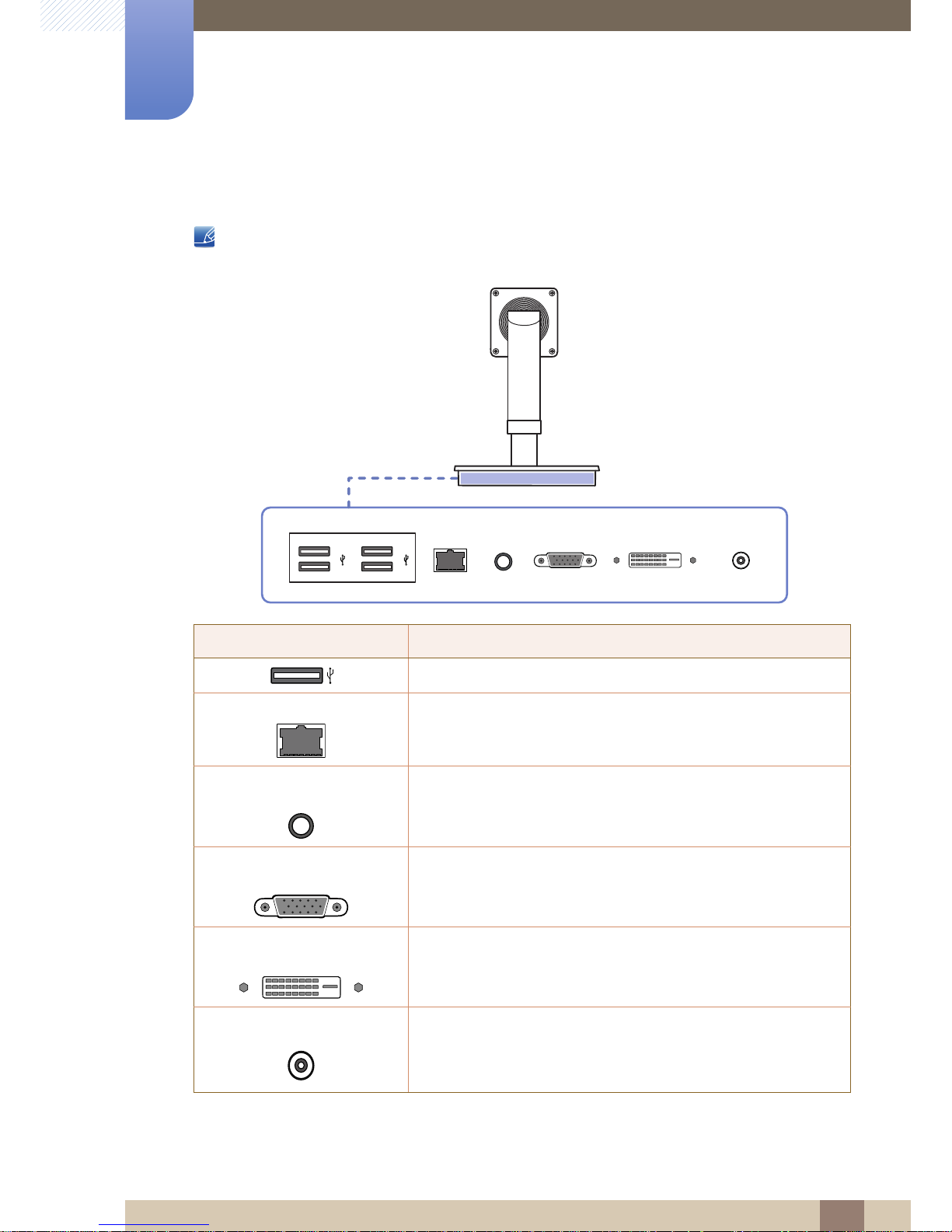
1.2.2 Reverse Side
The color and shape of parts may differ from what is shown. Specifications are subject to change
without notice to improve quality.
Ports Description
Connect to a USB device.
Connect to a network using the LAN cable.
Connect to an audio output device such as headphones.
Connect to the monitor using the D-SUB cable.
Connect to the monitor using the DVI cable.
Connect to the DC power adapter.
DC 14V IN
DVI OUTRGB OUTAUDIO
OUT
LAN
LAN
A
UDIO
OUT
RGB OUT
DVI OUT
DC 14V IN
Page 17
17
Preparations
1
1 Preparations
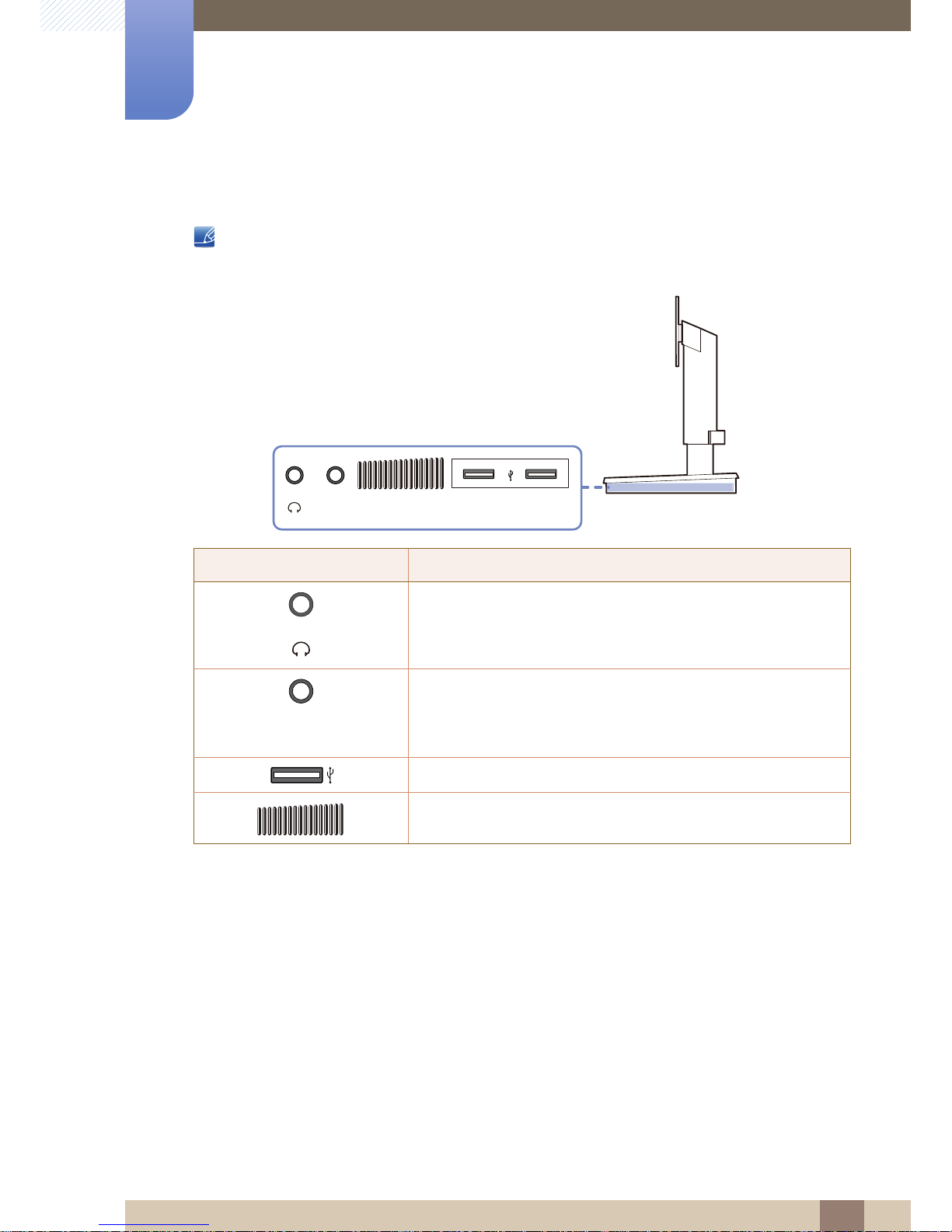
1.2.3 Right Side View
The color and shape of parts may differ from what is shown. Specifications are subject to change
without notice to improve quality.
Ports Description
Connect to an audio output device such as headphones.
Connect to a microphone.
Connect to a USB device.
Speaker (located on both sides).
MIC
MIC
Page 18
18
Preparations
1
1 Preparations
1.3 Installation
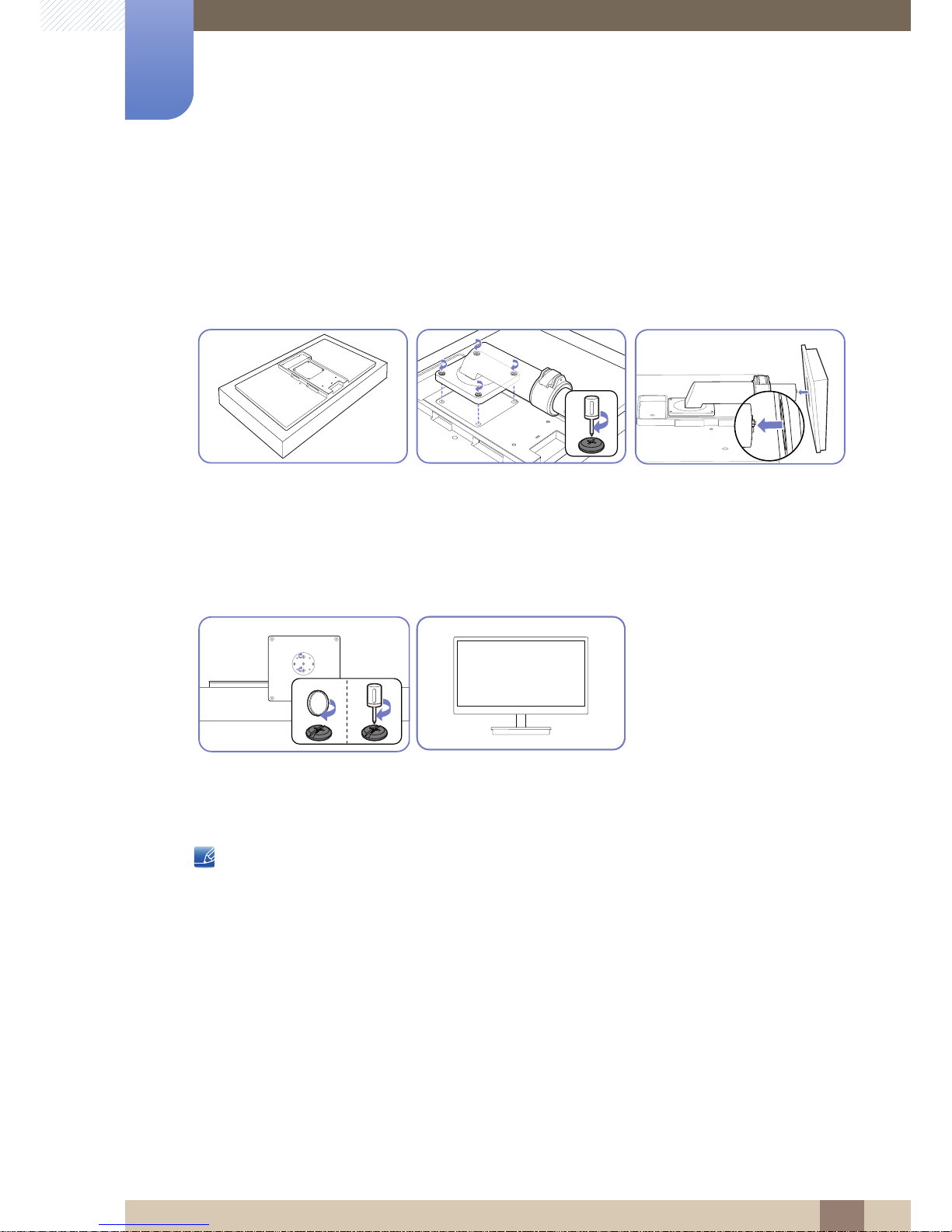
1.3.1 Reassembly
Ensure the monitor that will be connected to the stand complies with VESA standards.
The color and shape of parts may differ from what is shown. Specifications are subject to change
without notice to improve quality.
The monitor images in this manual are for reference only. Monitor is sold separately.
Using screws longer than the supplied screws may cause internal product damage.
Do not use a monitor or screw that does not comply with VESA standards. Also, do not use
excessive force when attaching the stand to the monitor. The product may get damaged or fall and
cause personal injury. Samsung shall not be held liable for any damage or injury caused by using
improper screws or attaching the wall-mount kit or desktop stand using excessive force.
Prepare a monitor that will be
connected to the stand. Put a
protective cloth or cushion on a
flat surface. Next, place the
monitor facing down onto the
cloth or cushion.
Align the grooves on the monitor
to the grooves on the stand
connector. Then, fasten with
screws.
Insert the stand base into the
stand in the direction of the
arrow.
Fasten the screw tightly (using a
screwdriver or coin) into the
bottom of the stand base.
After installing the stand, place
the product upright.
Page 19
19
Preparations
1
1 Preparations
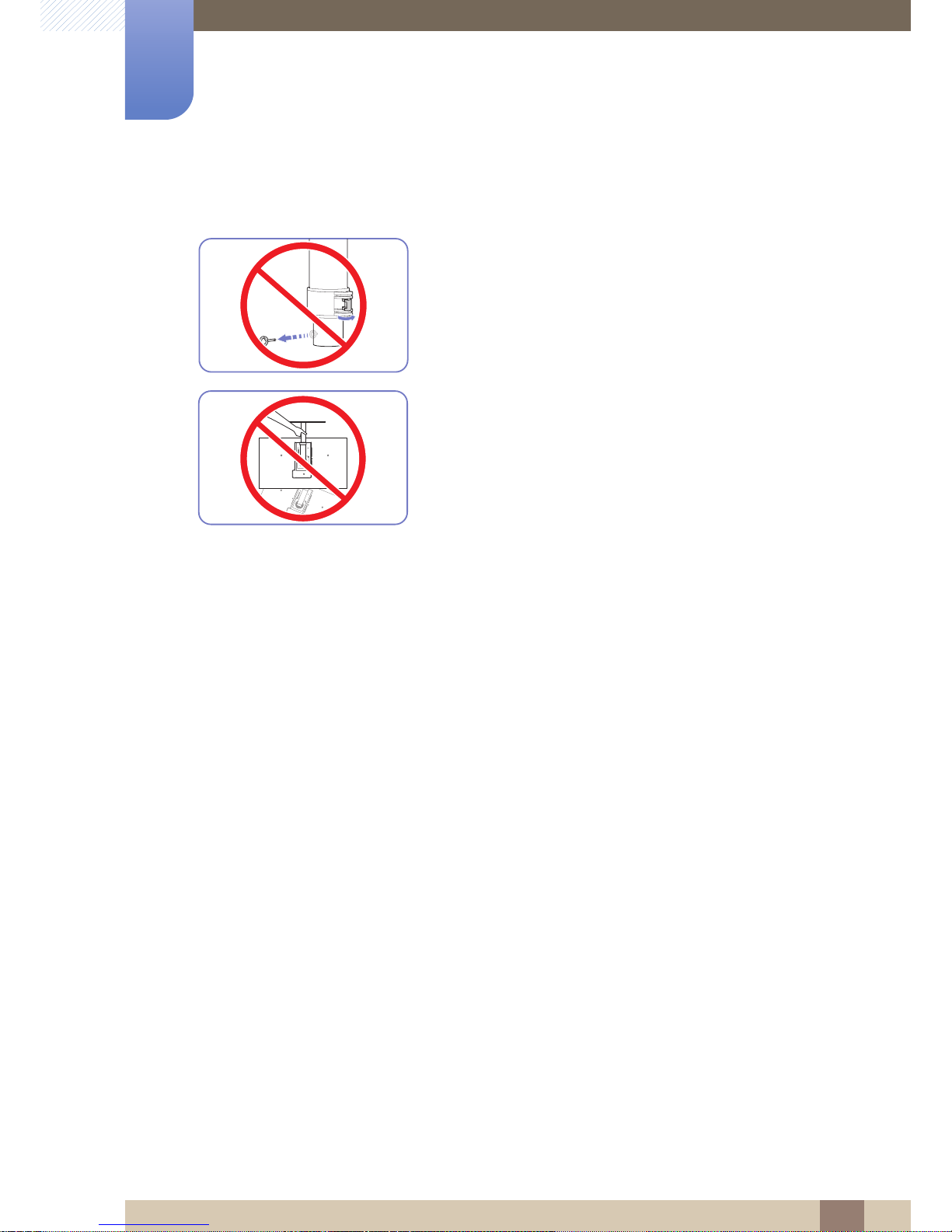
Caution
Do not unfasten the lock or remove the fixing pin on the stand
before attaching the stand base to the stand.
Do not hold the product upside down only by the stand.
Page 20
20
Preparations
1
1 Preparations
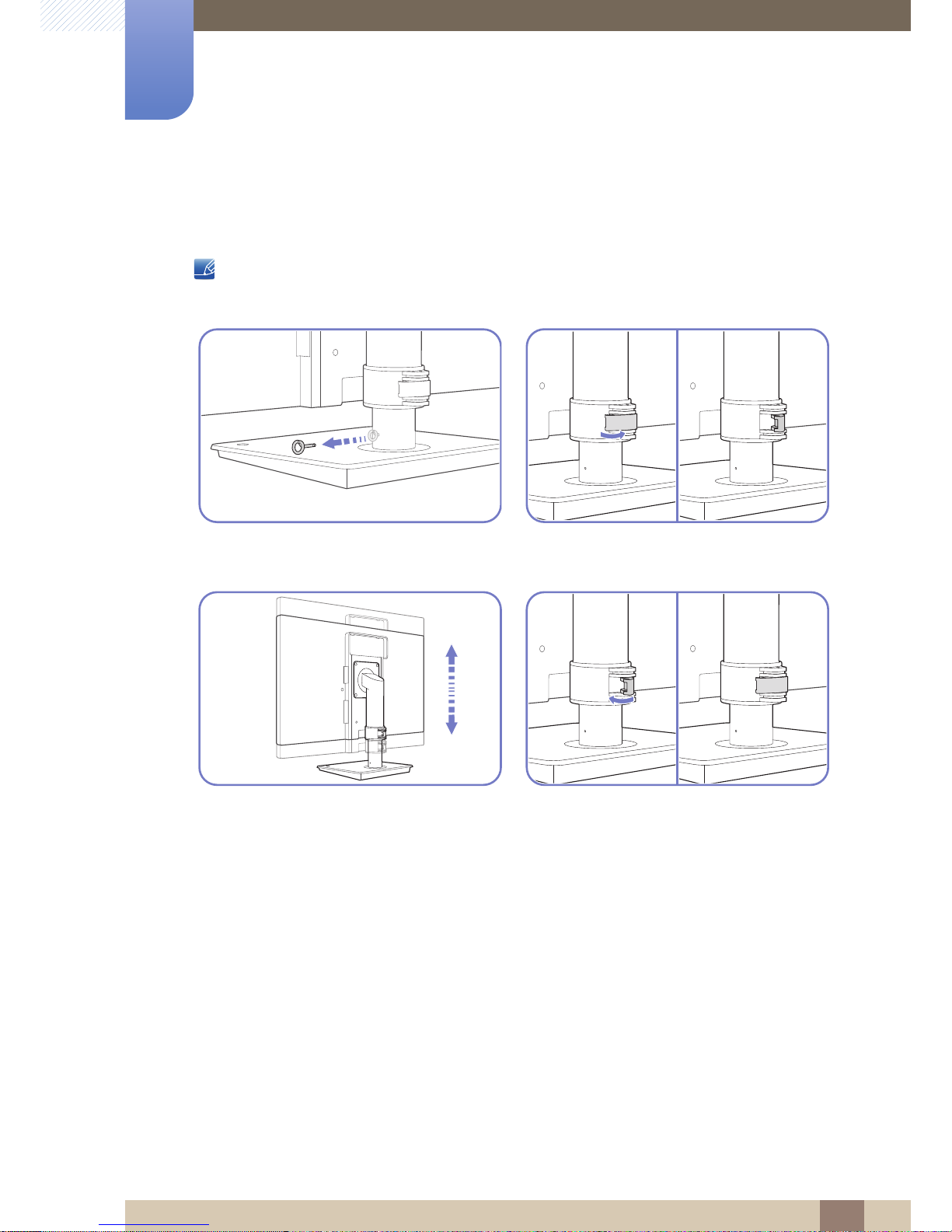
1.3.2 Adjusting the Product Height
Adjust the stand height after attaching the stand to the monitor.
The color and shape of parts may differ from what is shown. Specifications are subject to change
without notice to improve quality.
Hold the top center of the product and adjust the height carefully.
Remove the fixing pin. Unfasten the lock (outward direction) fixing the
stand height.
Adjust the stand height as desired. Fasten the lock (inward direction) on the stand.
Page 21
21
Preparations
1
1 Preparations
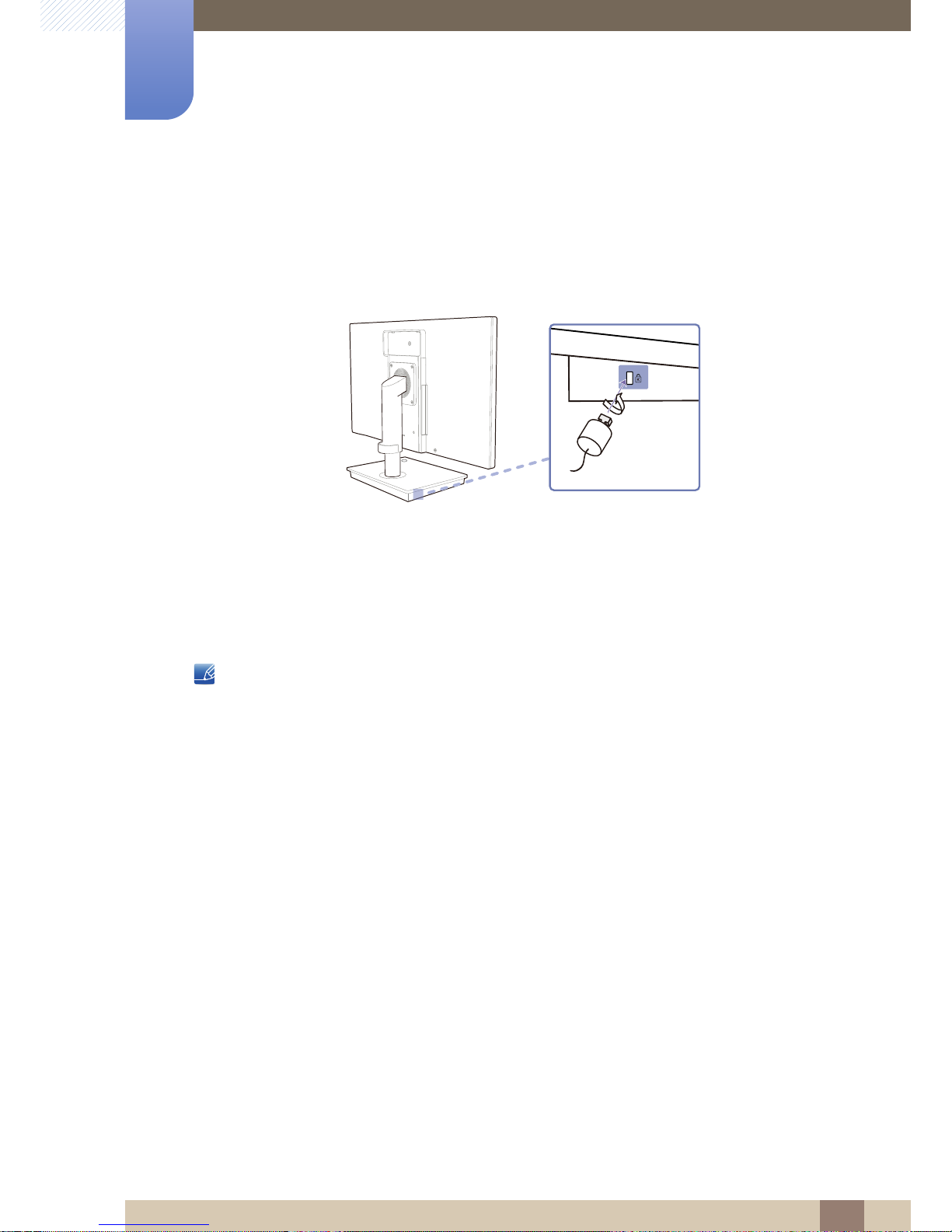
1.3.3 Anti-theft Lock
An anti-theft lock allows you to use the product securely even in public places. The locking device shape
and locking method depend on the manufacturer. Refer to the user guide provided with your anti-theft
locking device for details. The lock device is sold separately.
To lock an anti-theft locking device:
1 Fix the cable of your anti-theft locking device to a heavy object such as a desk.
2 Put one end of the cable through the loop on the other end.
3 Insert the locking device into the anti-theft lock slot at the back of the product.
4 Lock the locking device.
An anti-theft locking device can be purchased separately.
Refer to the user guide provided with your anti-theft locking device for details.
Anti-theft locking devices can be purchased at electronics retailers or online.
The monitor images in this manual are for reference only. Monitor is sold separately.
Page 22

22
2 Using "Windows Embedded Standard 7" (TB-WH)
2
Using "Windows Embedded Standard 7" (TBWH)
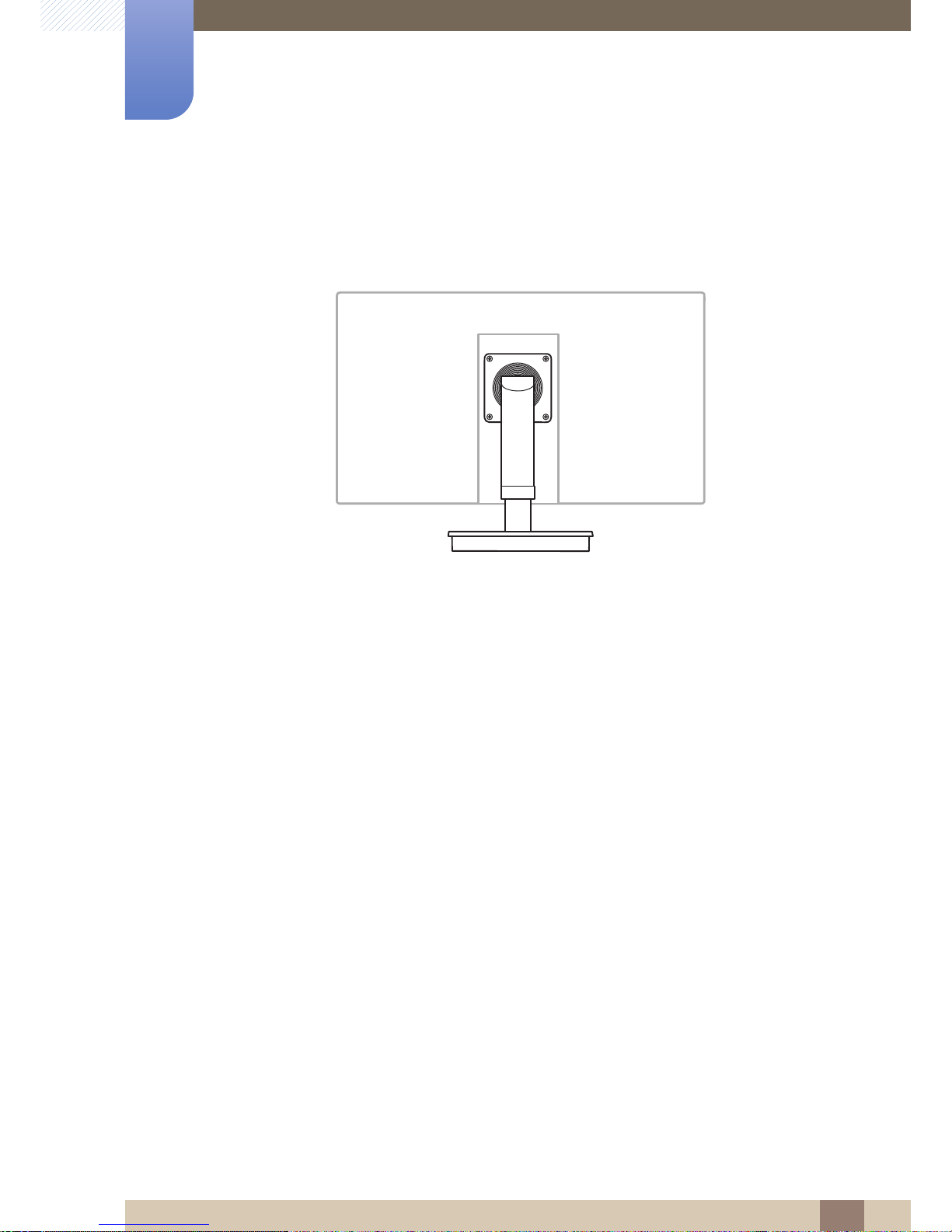
2.1 What is "Windows Embedded Standard 7" Client?
The Microsoft Windows Embedded Standard 7 (WES7) client uses the Microsoft Windows
Embedded Standard 2011 OS. When the WES client is connected to a server where Citrix
XenDesktop, VMWare View Client, or Microsoft Remote Desktop Connection service is available,
the keyboard, mouse, audio/video, and display data will be forwarded to the client through the network
between the client and server.
Connectable Servers
A Citrix XenDesktop Server
Microsoft Windows 2000/2003/2008 Server where the Terminal Service and Citrix
XenServer are installed
A VMWare View Client Server
Microsoft Windows 2000/2003/2008 Server where the Terminal Service and VMWare
Server are installed
A Microsoft RDP (Remote Desktop Protocol) Server
Microsoft Windows 2000/2003/2008 Server where the Terminal Services are installed
Microsoft Windows 7 Professional
This manual describes the functions provided by the WES Client. However, it does not explain general
functionalities of WES. For more general information on Windows 7, refer to Windows 7 Help provided
by Microsoft.
Page 23
23
Using "Windows Embedded Standard 7" (TBWH)
2
2 Using "Windows Embedded Standard 7" (TB-WH)
2.2 Connection to Use "Windows Embedded Standard 7"
2.2.1 Before Connecting
Pre-connection Checkpoints
Before connecting a source device, read the user manual provided with it.
The number and locations of ports on source devices may differ from device to device.
Do not connect the power cable until all connections are completed.
Connecting the power cable during connection may damage the product.
Check the types of ports at the back of the product you want to connect.
The port names may vary depending on the monitor.
For details on how to change the input source for your monitor, refer to the monitor user manual.
The monitor images in this manual are for reference only. Monitor is sold separately.
Page 24
24
Using "Windows Embedded Standard 7" (TBWH)
2
2 Using "Windows Embedded Standard 7" (TB-WH)
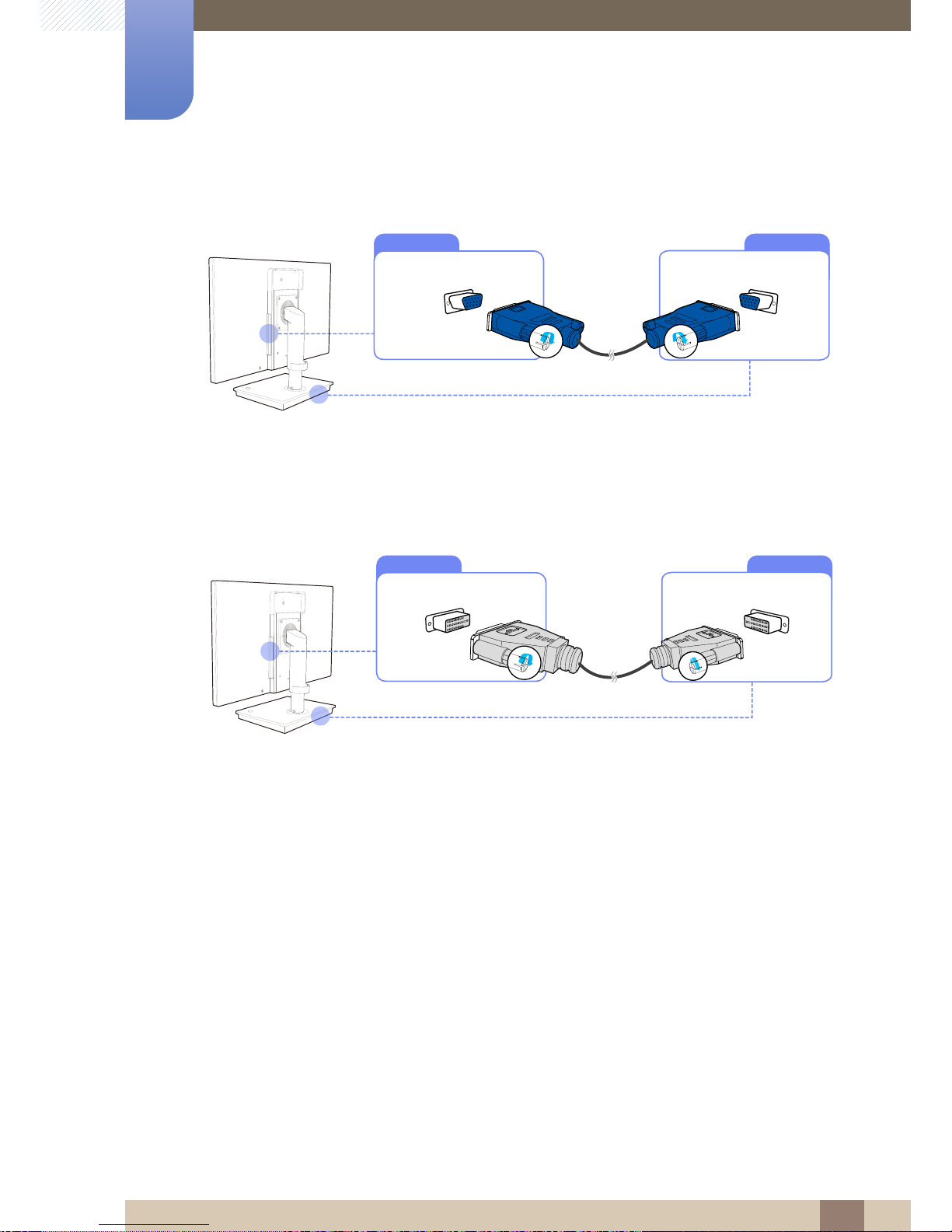
2.2.2 Connection Using the D-SUB Cable (Analogue Type)
1 Connect the D-SUB cable to [RGB IN] on the back of the monitor and [RGB OUT] on the stand
base.
2.2.3 Connection Using the DVI Cable
1 Connect the DVI cable to [DVI IN] on the back of the monitor and [DVI OUT] on the stand base.
RGB OUTRGB IN
DVI OUTDVI IN
Page 25

25
Using "Windows Embedded Standard 7" (TBWH)
2
2 Using "Windows Embedded Standard 7" (TB-WH)
2.2.4 Connecting a Microphone
1 Connect the microphone to [MIC] on the right side of the stand base.
2.2.5 Connecting to Headphones or Speakers
1 Connect an audio output device (headphones or speakers) to [AUDIO OUT] on the back or [ ] on
the right side of the stand base.
MIC
AUDIO OUT
Page 26

26
Using "Windows Embedded Standard 7" (TBWH)
2
2 Using "Windows Embedded Standard 7" (TB-WH)
2.2.6 LAN Connection
1 Connect the LAN cable to [LAN] on the back of the stand base.
It is not supported when the network speed is below or equal to 10Mbps.
Ensure you use the CAT 5 (*STP type) cable.
*Shielded Twist Pair
2.2.7 Connecting USB Devices
1 Connect USB devices (keyboard, mouse, etc.) to [ ] on the back or right side of the stand base.
LAN
Page 27

27
Using "Windows Embedded Standard 7" (TBWH)
2
2 Using "Windows Embedded Standard 7" (TB-WH)
2.2.8 Connecting the Power
The color and shape of parts may differ from what is shown. Specifications are subject to change
without notice to improve quality.
The monitor images in this manual are for reference only. Monitor is sold separately.
For details on how to connect the power cable to the monitor, refer to the monitor user manual.
Connect the power cable to the DC power
adapter. Next, connect the DC power
adapter to [DC 14V IN] on the stand base.
Plug in the power cable to the power socket.
DC 14V IN
Page 28

28
Using "Windows Embedded Standard 7" (TBWH)
2
2 Using "Windows Embedded Standard 7" (TB-WH)
2.3 Using "Windows Embedded Standard 7"
2.3.1 Logon
When the client starts, you can logon to the server by entering your username and password. The default
account IDs are Administrator and User. The corresponding passwords are not set.
2.3.2 "Windows Embedded Standard 7" Desktop
User
When you log in, the User Desktop appears. The default icons that appear on the User Desktop are
Recycle Bin, Computer, Citrix Online Plug in, VMWare View Client, Remote Desktop Connection
and Internet Explorer. You can also run this connection from the Start menu. The audio volume icon
and system time are displayed on the User Taskbar.
When logged on as a user, there are many restrictions that protect the system from incorrect user
actions. You cannot access the system drives and there are restrictions on configuring properties for
them. To configure the client’s advanced and detailed settings, log on as an administrator.
Administrator
If you logon as Administrator, the Administrator Desktop appears. The default icons that appear on the
Administrator Desktop are Recycle Bin, Computer, Citrix Online Plug in, VMWare View Client,
Remote Desktop Connection and Internet Explorer. You can also run the Citrix Online Plug in,
VMWare View Client, Remote Desktop Connection, and Internet Explorer from the Start menu. The
audio volume icon, Enhanced Write Filter status icon, and system time are displayed on the
Administrator Taskbar. The Administrator privilege is required for adding and removing programs.
Log off, Restart, Shut down
To log off the current session, shut down or restart your client, use the Start menu. [Start Shut
down]. The Shut Down Windows dialog box is displayed. To shut down the client immediately,
select [Start Shut down]. To select Log off, Restart, etc., move the mouse over the icon
next to [Shut down]. Alternatively, you can perform Log off or Shut down using the Windows
Security Dialog box by pressing [Ctrl + Alt + Del]. If ‘Force Auto Log on’ is activated, you will be
immediately logged on after each log off.
The Client Log off, Restart and Shut down take effect on the operations of the EWF (Enhanced
Write Filter). To keep the changed system configuration, you must save a cache for the current
system session into flash memory. Failing to do so will cause the changed configuration to be lost
when the client is shut down or restarted. (In the case of logging off, the configuration is
remembered when loggin in again.) For more information on the Enhanced Write Filter, refer to the
Program Help.
▶
Page 29

29
Using "Windows Embedded Standard 7" (TBWH)
2
2 Using "Windows Embedded Standard 7" (TB-WH)
2.3.3 Programs
Remote Desktop Connection
You can control a running terminal server or another computer (Windows 95 or later) remotely through a
remote desktop connection.
Remote Desktop
Windows 7 Professional or Windows 2000/2003/2008 Server must be installed on the
computer to be controlled remotely. This computer is called a host.
A remote computer running on an operating system later than Windows 95 is required. This
remote computer is called
a client. The client software for the remote desktop connection must be
installed on the client.
You must also be connected to the Internet. A broadband Internet connection is good for high
performance. However, because the remote desktop transmits a minimum set of data including
the display data and keyboard data to control the host remotely, a broadband Internet
connection is not required. You can run a remote desktop on a low bandwidth Internet
connection.
When running a remote desktop on Windows 7 Professional, you cannot use the operating
system of your computer.
Enabling Your Computer as the Host
You must enable the Remote Desktop feature to control it from another computer. You must be
logged on as an administrator or a member of the Administrators group to enable Remote
Desktop on your computer. Follow these steps:
1 Open the System folder in the Control Panel.
2 Go to [Start Control Panel System and Security System], and click Remote
settings.
3 If you want to block other PCs from accessing your PC using Remote Desktop or
RemoteApp, select “Don't allow connections to this computer.”
To allow a remote PC to access your PC using any version of Remote Desktop or RemoteApp,
select "Allow connections from computers running any version of Remote Desktop (less
secure)" This option is suitable if you do not know the Remote Desktop Connection version
being used on other PCs. Note that this option is less secure than the next option (option 3).
To allow a remote PC to access your PC using a Remote Desktop or RemoteApp version
requiring a network level authentication, select "Allow connections from computers running any
Page 30

30
Using "Windows Embedded Standard 7" (TBWH)
2
2 Using "Windows Embedded Standard 7" (TB-WH)
version of Remote Desktop (less secure)" to run Remote Desktop using network-level
authentication.
Start a Remote Desktop Session on the Client
Once you have enabled your host computer to allow remote connections and installed the client
software on a Windowsbased client computer, you are ready to start a Remote Desktop session.
You must first establish a virtual private network connection or remote access service connection
from your client computer to your host computer. To connect to another remote desktop, follow the
instructions below.
1 Go to [Start All Programs Accessories Remote Desktop Connection] or double-
click the Remote Desktop Connection icon to open Remote Desktop Connection.
2 Enter the host computer name. You can configure detailed settings by clicking the Options
button.
Page 31

31
Using "Windows Embedded Standard 7" (TBWH)
2
2 Using "Windows Embedded Standard 7" (TB-WH)
3 Options
- General : Enter in the login information for the host computer. To log in automatically, enter in
the user name and password.
- Display : The Remote Desktop Connection sends and receives compressed screen data. If
you set the resolution and color quality to the high option, the speed may become slow.
Page 32

32
Using "Windows Embedded Standard 7" (TBWH)
2
2 Using "Windows Embedded Standard 7" (TB-WH)
- Local Resource : Specify whether to use the hard disks and ports.
- Programs : Select an application and specify the folder where you want to run the application
when a connection is established to the host PC.
Page 33

33
Using "Windows Embedded Standard 7" (TBWH)
2
2 Using "Windows Embedded Standard 7" (TB-WH)
- Experience : Specify the connection speed and the menu items you want to use on the
remote PC connected. The settings specified will be shared with the host PC.
- Advanced : Protect your personal information when a connection is established.
4 Click Connect. The Log On to Windows dialog box appears.
5 In the “Log On to Windows” dialog box, type your username, password, and domain (if
required), and then click OK. The Remote Desktop window will open and you will see the
desktop settings, files, and programs that are on
the host computer.
For more information on Remote Desktop Connections, visit the Microsoft web site.
Page 34

34
Using "Windows Embedded Standard 7" (TBWH)
2
2 Using "Windows Embedded Standard 7" (TB-WH)
Internet Explorer
A WES Client includes Internet Explorer. This program is permitted for all users. Microsoft website.
For more information on Internet Explorer, visit the Microsoft website.
Enhanced Write Filter (EWF)
Enhanced Write Filter (EWF) protects a flash volume from write access and consequently, preserves
the durability of the flash device. EWF provides read and write access through a cache to the client
instead of allowing direct access to a flash volume.
If EWF is activated, data is not stored to the flash. The data stored in the cache is only effective while the
client is operating. The cached data will be lost when restarting or shutting down your client. Therefore, to
store the data written to the registry, favorites and cookie folders, etc., the content stored in the cache
should be transferred to the flash. An error message is displayed when it is not possible to write to the
cache due to a lack of memory. If this message is displayed, you have to deactivate EWF to flush the
EWF cache. The user can double-click the EWF icon on the tray at the bottom right of the screen to call
the EWF Manager. A user can also change the EWF configuration by entering EWF management
commands at the command prompt. This task requires the Administrator privilege.
Enable write filter and restart the system.
If the EWF is disabled, enable it. If this item is selected, the cache is flushed and the EWF is enabled.
After restarting your computer, the configurations and file system information for the client are written
to a cache. You can also perform this operation by entering “ewfmgr.exe c: -enable” at the
command prompt and restarting your computer.
Disable write filter and restart the systems.
This item is activated when the EWF is running. If this item is selected, the current states of the client
(saved in a cache) are saved to a flash volume and the EWF is disabled. After restarting your
computer, the configurations and file system information for the client are written to a flash volume.
Page 35

35
Using "Windows Embedded Standard 7" (TBWH)
2
2 Using "Windows Embedded Standard 7" (TB-WH)
You can also perform this operation by entering “ewfmgr.exe c: -commitanddisable” at the
command prompt and restarting your computer.
Commit changes to disk.
This item is activated when the EWF is running. If this item is selected, the current states of the client
(saved in a cache) are saved to a flash volume. However, the state of EWF will not be changed. You
can also perform this operation by entering “ewfmgr.exe c: -commit” at the command prompt.
You can view the configurations for the protected volumes by entering “ewfmgr.exe c:” at the
command prompt.
File-Based Write Filter (FBWF)
The File-Based Write Filter (FBWF) protects the memory of the client from being overwritten by any
unauthorized user. By restricting excessive writing into the memory, the FBWF allows you to use the
client for a long time. If you request I/O, the FBWF has the client perform its operations using the cache
instead of the memory so that the memory can be protected.
The data saved in the cache is preserved while the client operates normally. It is removed when it is
restarted or exited. To save the changes, you should write the relevant file onto the disk using the commit
command. If you don’t know which file is changed, disable the FBWF, change it, and enable it again.
You can control the FBWF using the various options of the command at a command prompt.
FBWF Configuration
Current FBWF status : Displays the current status of the FBWF (Enabled or Disabled).
Boot command : Displays the FBWF command that will be performed at the next boot-up.
RAM Used by FBEF : Displays the size of the RAM the FBWF is using. If the current status is
set to "Disabled", the used memory is displayed as 0 KB.
Threshold : Displays the maximum size of the RAM that the FBWF can use.
FBWF Command
Enable the FBWF and reboot the system : Enables the disabled FBWF and restarts the
client. If the client is not restarted, only the boot command is changed to BWF_ENABLE and the
current status is not changed.
Disable the FBWF and reboot the system : Disables the enabled FBWF and restarts the
client. If the client is not restarted, only the boot command is changed to FBWF_DISABLE and
the current status is not changed.
Commit files : Even if the disks are protected by the FBWF, you can add or delete the files you
want to save on them. To write the changes onto the disk, click the [Write the changes to the
disk] button.
Session Status
Current session : Displays the volumes being protected by the FBWF and a list of the folders
and files on those
volumes that are excepted from protection by the
FBWF
.
Page 36

36
Using "Windows Embedded Standard 7" (TBWH)
2
2 Using "Windows Embedded Standard 7" (TB-WH)
Next session : Select the volumes that will be protected by the FBWF when the client is
booted up next time. Also, select the folders and files that you want to except from protection
by the FBWF.
Windows Media Player
The WES Client includes Windows Media Player 12. With Windows Media Player, you can play audio
and video files on a website.
2.3.4 Configuring Utilities
Local Drive
C Drive
The C drive is used for the system. The client OS will not operate if space available on the system
drive is not sufficient. Ensure sufficient space is available on the C drive. EWF can help maintain
available space by preventing the C drive being written to directly.
Saving Files
Your client uses a fixed size of flash memory. Therefore, it is better to save files to the server rather
than to your client.
Mapping a Network Drive
The Administrator can map a folder to a network drive. To keep the mapping information after restarting
the client, take note of these directions carefully.
Select the Reconnect at logon checkbox in the Map Network Drive dialog box.
If the EWF or FBWF is enabled, you must disable it before proceeding with installation.
Page 37

37
Using "Windows Embedded Standard 7" (TBWH)
2
2 Using "Windows Embedded Standard 7" (TB-WH)
2.3.5 Recover the System
Overview
The WES Client provides a recovery function which allows you to revert to a backed up system when
encountering a serious problem. You can back up an OS image which is working normally to USB
memory or the PXE server. You can revert to a backed up image when your client has one of these
problems:
When a system file is deleted accidentally or is corrupted
When the client computer is unstable or there is a problem with a device driver
When problems occur, after installing a new program or device
When the client computer is infected with a virus
When Windows Embedded Standard fails to start When a system file is deleted accidentally or is
corrupted
How to Recover the System
Recovery Using USB Memory
By following these steps, you can save all necessary files to USB memory, and boot up with the
backed up system on the USB memory and recover the system.
1 Perform system formatting for your USB memory in order to make it bootable.
2 Save the Windows Embedded Standard image and the Backup/Recovery Utility which will be
recovered later to your USB memory.
3 Boot up with the USB memory.
4 Recover the system using the Windows Embedded Standard image and the Backup/
Recovery Utility in the USB memory.
Recovery Using Network Booting
This method is provided through the PXE (Preboot eXecution Environment) server. The PXE sever
provides a client/server interface based on TCP/IP, DHCP, and TFTP. It allows an administrator at a
remote location to configure and boot the operating system onto a client over a network.
Implement a PXE server.
Save the Windows Embedded Standard image and the Backup/Recovery Utility which will be
recovered later onto the PXE server.
Boot the client via the network.
Recover the system using the Windows Embedded Standard image and the Backup/Recovery
Utility saved on the PXE server via the network.
For more information, refer to the PXE Server User Manual.
Page 38

38
Using "Windows Embedded Standard 7" (TBWH)
2
2 Using "Windows Embedded Standard 7" (TB-WH)
2.4 MagicRMS Pro
2.4.1 About MagicRMS Pro
The MagicRMS Pro program can be used to remotely control a Samsung network monitor. The design
of the user-oriented interface makes it easy and convenient to use.
Using MagicRMS Pro, you can schedule a task to be performed at a specified time on a network
monitor.
Also, you can manage multiple network monitors efficiently by grouping or filtering them according to
specific conditions.
To use the MagicRMS Pro Solution or MagicRMS Pro Agent and to view the user guide, visit
www.samsunglfd.com. Go to Support>Download Center, and search for MagicRMS to download.
Open source license notice
In the case of using open source software, Open Source licenses are available on the MagicRMS
Pro Agent.
Open Source License Notice is written only English.
Page 39

39
3 Using the "Zero Client" (TB-CH)
3
Using the "Zero Client" (TB-CH)
3.1 About "Zero Client"
The "Zero Client" uses a Linux operating system. When the Client connects to a server where the Citrix
XendDesktop/XenApp service is available, information relating to the keyboard, mouse, audio/video and
display data is transmitted from the Client to the server over the network.
HDX MediaStream Flash Redirection is supported only in Citrix Receiver 12.x or later.
Note that the Server is only compatible with Flash Player 11.x or earlier.
HDX MediaStream Flash Redirection
Allows you to download and play Flash content on the Client.
Compatible servers
Citrix XenDesktop/XenApp server
Microsoft Windows 2000/2003/2008 server where the Terminal Service and Citrix XenServer
are installed
Page 40

40
Using the "Zero Client" (TB-CH)
3
3 Using the "Zero Client" (TB-CH)
3.2 Connection to Use the "Zero Client"
3.2.1 Before Connecting
Pre-connection Checkpoints
Before connecting a source device, read the user manual provided with it.
The number and locations of ports on source devices may differ from device to device.
Do not connect the power cable until all connections are completed.
Connecting the power cable during connection may damage the product.
Check the types of ports at the back of the product you want to connect.
The port names may vary depending on the monitor.
For details on how to change the input source for your monitor, refer to the monitor user manual.
The monitor images in this manual are for reference only. Monitor is sold separately.
Page 41

41
Using the "Zero Client" (TB-CH)
3
3 Using the "Zero Client" (TB-CH)
3.2.2 Connection Using the D-SUB Cable (Analogue Type)
1 Connect the D-SUB cable to [RGB IN] on the back of the monitor and [RGB OUT] on the stand
base.
3.2.3 Connection Using the DVI Cable
1 Connect the DVI cable to [DVI IN] on the back of the monitor and [DVI OUT] on the stand base.
RGB OUTRGB IN
DVI OUTDVI IN
Page 42

42
Using the "Zero Client" (TB-CH)
3
3 Using the "Zero Client" (TB-CH)
3.2.4 Connecting a Microphone
1 Connect the microphone to [MIC] on the right side of the stand base.
3.2.5 Connecting to Headphones or Speakers
1 Connect an audio output device (headphones or speakers) to [AUDIO OUT] on the back or [ ] on
the right side of the stand base.
MIC
AUDIO OUT
Page 43

43
Using the "Zero Client" (TB-CH)
3
3 Using the "Zero Client" (TB-CH)
3.2.6 Connecting to a Server (LAN/USB Connection)
1 Connect the [LAN] port on the back of the stand base to the server using the LAN cable.
It is not supported when the network speed is below or equal to 10Mbps.
Ensure you use the CAT 5 (*STP type) cable.
*Shielded Twist Pair
2 Connect USB devices (keyboard, mouse, etc.) to [ ] on the back or right side of the stand base.
(To use the [ ] port, ensure the Client is connected to the server.)
LAN
Page 44

44
Using the "Zero Client" (TB-CH)
3
3 Using the "Zero Client" (TB-CH)
3.2.7 Connecting the Power
The color and shape of parts may differ from what is shown. Specifications are subject to change
without notice to improve quality.
The monitor images in this manual are for reference only. Monitor is sold separately.
For details on how to connect the power cable to the monitor, refer to the monitor user manual.
Connect the power cable to the DC power
adapter. Next, connect the DC power
adapter to [DC 14V IN] on the stand base.
Plug in the power cable to the power socket.
DC 14V IN
Page 45

45
Using the "Zero Client" (TB-CH)
3
3 Using the "Zero Client" (TB-CH)
3.3 Using the "Zero Client"
3.3.1 Login
Username : Enter the user name that will be used to connect to the "Citrix" server.
Password : Enter the password that will be used to connect to the "Citrix" server.
Domain : Enter the domain that will be used to connect to the "Citrix" server.
Ensure Broker Server is enabled under Network.
3.3.2 Message Box
MagicRMS
When the MagicRMS server is on, messages received from the server are displayed on the screen.
Message
The Identity function of MagicRMS allows you to check the host name of the Client.
Page 46

46
Using the "Zero Client" (TB-CH)
3
3 Using the "Zero Client" (TB-CH)
Identity
The Identity function of MagicRMS allows you to check the host name of the Client.
Disconnect Message
If the Client is disconnected from the network, a message will appear indicating the disconnection. In this
case, if you are logged on, the desktops/applications connected will disconnect and log off.
3.3.3 Toolbar
Network
You can view or configure the network and server settings for the Client.
Page 47

47
Using the "Zero Client" (TB-CH)
3
3 Using the "Zero Client" (TB-CH)
Local Network
You can configure the IP to connect the Client to a network.
Link Speed & Duplex : Select a network connection type and speed.
To use a static IP, deselect Enable DHCP and specify the IP.
To use DHCP, select Enable DHCP.
Name Servers
Configure the DNS Domain and DNS Server information on the Client.
Specify the DNS Domain.
Specify the DNS Servers. More than one DNS Server can be entered using “,”. e.g.)
192.168.0.1,192.168.1.1
DHCP Options
Page 48

48
Using the "Zero Client" (TB-CH)
3
3 Using the "Zero Client" (TB-CH)
To automatically configure several settings for the Client all at once using DHCP upon boot up, configure
the DHCP Options IDs.
Ensure the setting is specified between 128 and 254.
If this option is configured, the setting specified will replace the customized setting.
Requirements
Local Network must be set to Enable DHCP.
Information about the Options IDs must be configured on the DHCP server.
Security
Client provides a security function using IEEE802.1x authentication.
Available modes
EAP-PEAP (MSCHAPv2, PEAP version Automatic)
EAP-TLS
To use this function, select Enable IEEE802.1x Authentication and specify the Authentication mode.
1 EAP-PEAP
To use EAP-PEAP mode, set the Authentication mode to EAP-PEAP.
Click Properties, and enter the Username and Password for authentication.
Page 49

49
Using the "Zero Client" (TB-CH)
3
3 Using the "Zero Client" (TB-CH)
2 EAP-TLS
To use EAP-TLS mode, set the Authentication mode to EAP-TLS.
Click Properties, and configure the following settings for authentication. To select a certificate,
ensure you copy the authentication file to the Client using Certification Management.
a. Enter the Identity information.
b. Select a CA certificate file (*.der, *.pem, *.crt, *.cer).
c. Select a Private key file.
d. Enter the Private key password.
3 Certification Management
For you to manage authentication files that are used in EPA-TLS mode, the following menu options
are provided.
a. An option for copying a file using several methods including USB Storage (The file will be
copied to a specific directory on the Client. )
b. An option for deleting a saved file
Broker Server
Enter information to connect to the Citrix server.
Page 50

50
Using the "Zero Client" (TB-CH)
3
3 Using the "Zero Client" (TB-CH)
Enter the IP address of the Citrix server.
Specify the Default Username and Default Domain that will be used to connect to the server.
Remote Management
You can configure the settings for servers that manage the Client, enter information about the servers, or
view the status of the servers.
For details on the MagicRMS function, refer to the MagicRMS user manual.
1 File Server
Configure the FTP server to connect to in order to upgrade the firmware on the Client. The
information configured will be used to upgrade the firmware when the Client boots up.
Address : Enter the IP address of the FTP server.
Path : Enter the Path of the FTP server where the new firmware is saved.
Username : Enter the Username that will be used to connect to the FTP server.
Password : Enter the Password that will be used to connect to the FTP server.
Requirements
Ensure the FTP server is working properly.
The new firmware must be in a compatible file format.
2 MagicRMS Connection
Enter the Connection information to connect to the MagicRMS server.
Page 51

51
Using the "Zero Client" (TB-CH)
3
3 Using the "Zero Client" (TB-CH)
Multicast
Enable this option if you want to automatically connect to the MagicRMS server. Specify the IP
Address and Port number for Multicast. If the MagicRMS server is assigned with the same IP
address and port number as the Client, it will automatically connect to the Client.
Server Assignment
If you know the static IP address and port number of the MagicRMS server, you can manually
enter them to connect to the server.
3 MagicRMS Contact
Enter information to identify the Client on the MagicRMS console.
Page 52

52
Using the "Zero Client" (TB-CH)
3
3 Using the "Zero Client" (TB-CH)
4 MagicRMS Status
You can check the connection status of the MagicRMS server. If there are connection issues, check
the server connection and select Start, Stop, or Restart to start the server.
To view details of the MagicRMS server logs, click View Log.
Page 53

53
Using the "Zero Client" (TB-CH)
3
3 Using the "Zero Client" (TB-CH)
5 Network Tools
Network Tools can be used to check the connection status between the Client and network.
Ping
Using the Ping command, you can check the status of the network connection for the IPs
entered.
Trace Route
Using the Route command, you can check the network connection status for the IPs entered.
Page 54

54
Using the "Zero Client" (TB-CH)
3
3 Using the "Zero Client" (TB-CH)
Terminal Properties
Configure the properties of the Client.
System
1 General
Terminal Name : Change the Client name. The default name is “TS_ + MAC information."
Reset the system setting to factory default : Reset the Client settings by selecting the
checkbox.
Select Yes in the Notice window that appears after selecting the checkbox. The settings will be
reset.
Page 55

55
Using the "Zero Client" (TB-CH)
3
3 Using the "Zero Client" (TB-CH)
2 Power Management
Control the power supply to the Client by changing the Screen Off setting. The Client will
activate Power Management if it is left idle for a specified amount of time.
The following time settings are available to choose from.
Never
5 minutes
10 minutes
30 minutes
1 hour
2 hours
3 Time/Date
Set the clock on the Client.
Time Zone
Enter the Time Zone information to apply to the Client. Click Change, and select the time zone
desired.
To enable DayLight Saving, select the Enable DayLight Saving checkbox and select the
number of hours to apply.
Page 56

56
Using the "Zero Client" (TB-CH)
3
3 Using the "Zero Client" (TB-CH)
Time/Date Format
Time Format / Date Format : Specify the format to display the time and date on the
toolbar.
Time Servers : Enter the Time Server information provided online. The time and date on
the Client will automatically be set.
Display
Configure the settings for display devices connected to the Client.
1 Orientation
Configure the screen orientation of the selected display device.
You can select Horizontal or Vertical.
2 Resolution
Set the resolution of the selected display device.
The resolutions available vary depending on the display device.
3 Multiple Display
When two display devices are connected to the Client, specify how you will use the screens.
Page 57

57
Using the "Zero Client" (TB-CH)
3
3 Using the "Zero Client" (TB-CH)
To display the same desktop on the displays, select Clone. When Clone is selected, the same
Orientation and Resolution will be applied to the displays.
Page 58

58
Using the "Zero Client" (TB-CH)
3
3 Using the "Zero Client" (TB-CH)
To display an extended desktop on the two displays, select Extend.
The display selected as the primary screen will be placed on the left.
To set the selected display as the primary screen, select the Set as the main screen
checkbox.
Page 59

59
Using the "Zero Client" (TB-CH)
3
3 Using the "Zero Client" (TB-CH)
When only one display device is connected, the Multiple Display option is disabled.
Toolbar
Select whether to display the toolbar or enable the shortcut keys on the Client.
Always hide toolbar
Hide the toolbar on the screen: select the checkbox and minimize the toolbar. To unhide the toolbar,
press the corresponding shortcut key.
Disable hotkey(CTRL-ALT-UP) to invoke toolbar
Shrink the toolbar by pressing the corresponding shortcut key (CTRL-ALT-UP). To expand the
toolbar, click the arrow button on the minimized toolbar.
The two options above cannot be enabled at the same time.
Sound
Adjust the sound on the Client.
Volume : Adjust the volume using the scrollbar.
Mute : Mute the sound.
Page 60

60
Using the "Zero Client" (TB-CH)
3
3 Using the "Zero Client" (TB-CH)
Input
1 Keyboard
You can configure the keyboard settings for the Client.
Character Set : Specify the character encoding method to use on the Client.
Keyboard Language : Specify the keyboard language.
Repeat Rate : Specify the keyboard sensitivity.
2 Mouse
You can configure the mouse settings for the Client.
Mouse Speed : Configure the mouse movement sensitivity.
Buttons : Activate the left-handed mouse mode.
Printer
1 LPDs
Configure the LPD-type printer settings.
Page 61

61
Using the "Zero Client" (TB-CH)
3
3 Using the "Zero Client" (TB-CH)
2 SMBs
Configure the SMB-type printer settings.
Information
You can view the Client information.
General
Firmware : View the version of the firmware on the Client.
Checksum : View the checksum of the firmware on the Client.
Citrix Receiver : View the version of the Citrix Receiver used on the Client.
Page 62

62
Using the "Zero Client" (TB-CH)
3
3 Using the "Zero Client" (TB-CH)
Terminal Name : View the Terminal Name of the Client.
Hardware
CPU : View information about the CPU on the Client.
CPU Busy : View the current CPU usage on the Client.
Memory size : View the total amount of memory on the Client.
Free Memory : View the amount of memory currently available on the Client.
Resolution : View the display resolution configured on the Client.
System up Time : View the amount of time the Client has been running.
Network
IP Address : View the IP information configured on the Client.
Subnet Mask : View the subnet mask configured on the Client.
Default Gateway : View the Default Gateway configured on the Client.
DHCP Lease : View the amount of time (in seconds) it takes for an IP address to be assigned when
the Client uses DHCP.
Speed & Duplex : View the speed and duplex information of the link that is used when the Client
connects to a network.
Page 63

63
Using the "Zero Client" (TB-CH)
3
3 Using the "Zero Client" (TB-CH)
Mac Address : View the Mac Address of the network adapter on the Client.
Open Source Notice
You can view details of the Open Source components used on the Client.
Shutdown
You can log off, close, or restart the Client.
Open source license notice
In the case of using open source software, Open Source licenses are available on the product
menu.
Open Source License Notice is written only English.
Page 64

64
Using the "Zero Client" (TB-CH)
3
3 Using the "Zero Client" (TB-CH)
1 Log-off from account “***”
Log off from the Client if you are logged on. This option is enabled only when you are logged on to
the Client. To log off, select Yes in the Notice window.
2 Shutdown the system
You can close the Client. To close the Client, select Yes in the Notice window.
3 Restart the system
You can restart the Client. To restart the Client, select Yes in the Notice window.
Page 65

65
Using the "Zero Client" (TB-CH)
3
3 Using the "Zero Client" (TB-CH)
Remote Desktop
You can view a list of desktops and applications (on the Citrix Server) the Client can connect to when
logged on.
Page 66

66
Using the "Zero Client" (TB-CH)
3
3 Using the "Zero Client" (TB-CH)
Desktop List
1 Connect
You can connect to a desktop or application on the list by clicking the corresponding Connect
button or double-clicking the desktop or application desired.
When a connection to a desktop or application is established, the Connect button for the desktop or
application will be replaced by the Disconnect button in the Desktop List. The corresponding
desktop or application row in the list will be highlighted as shown below.
You can connect to more than one desktop or application. The names of the desktops and
applications connected will be highlighted.
2 Disconnect
The Disconnect button disconnects the corresponding desktop or application connected. When
the desktop or application is disconnected, a list of connected desktops or applications will appear if
there are any.
3 Refresh
To update the Desktop List that contains a list of desktops or applications on the Citrix Server, click
Refresh.
Page 67

67
Using the "Zero Client" (TB-CH)
3
3 Using the "Zero Client" (TB-CH)
4 Reconnect
You can display desktops and applications that are not displayed even though they are connected
to the Client. Double-click the desktop or application desired. The corresponding desktop or
application row in the list will be highlighted.
Double-click Memo. A notepad window will be displayed.
Status Icon
Network icon: Display the current network status using an icon.
1 Not connected to the network.
2 Attempting to connect to the network.
3 Connected to the network.
Page 68

68
Using the "Zero Client" (TB-CH)
3
3 Using the "Zero Client" (TB-CH)
Terminal Lock
This menu locks the Network and Terminal Properties options so that their settings cannot be
changed.
The corresponding shortcut key is [CTRL + ALT + F6].
How to lock the two options
Press and hold the shortcut key for a specified time (about 8 seconds).
When the lock is on, the options locked will be indicated on the toolbar as shown below.
How to unlock the two options
Press and hold the shortcut key for a specified time (about 8 seconds).
Note that you are prompted to enter the password in order to unlock the two options.
Page 69

69
4 Troubleshooting Guide
4
Troubleshooting Guide
4.1 Requirements Before Contacting Samsung Customer
Service Center
4.1.1 Check the following.
Sound issue
There is no sound. Check the connection of the audio cable or adjust
the volume.
Check the volume.
The volume is too low. Adjust the volume.
If the volume is still low after turning it up to the
maximum level, adjust the volume in the audio
settings program.
Page 70

70
5 Specifications
5
Specifications
5.1 General
The above specifications are subject to change without notice to improve quality.
This device is a Class B digital apparatus.
Model Name TB-WH TB-CH
Power Supply This product uses 100 to 240V. Refer to the label at the back of
the product as the standard voltage can vary in different countries.
Monitor connectors RGB OUT (D-Sub) port, DVI OUT port
Server connector LAN
Speaker 1 W x 2
USB USB 2.0 x 6 (Down stream)
Dimensions (W x H x D) /
Weight
244.0 X 340.0 X 227.0 mm / 9.6 X 13.4 X 8.9 inches /
2.3 kg / 5.1 lb
Environmental
considerations
Operating Temperature : 50˚F ~ 122˚F (10˚C ~ 50˚C)
Humidity : 10 % – 90 %, non-condensing
Storage Temperature : -4˚F ~ 113˚F (-20˚C ~ 45˚C)
Humidity : 5 % – 90 %, non-condensing
VESA (V x H) 75 x 75 mm / 100 x 100 mm
(USA only)
Dispose unwanted electronics through an approved recycler.
To find the nearest recycling location, go to our website:
www.samsung.com/recyclingdirect or call, (877) 278 - 0799
CALIFORNIA USA ONLY (Applicable for networking models only.)
This Perchlorate warning applies only to primary CR(Manganese Dioxide) Lithium coin cells in the
product sold or distributed ONLY in California USA
"Perchloate Material - special handling may apply, See www.dtsc.ca.gov/hazardouswaste/
perchlorate."
Page 71

71
Specifications
5
5 Specifications
5.2 Power consumption
The power consumption level can vary in different operating conditions or when settings are
changed.
To reduce the power consumption to 0 watts, turn off the switch on the adapter or disconnect the
power cable. Be sure to disconnect the power cable when you will not be using the product for an
extended period of time. To reduce the power consumption to 0 watts when the power switch is
not available, disconnect the power cable.
PowerSaver
Normal operation mode
Stand by (S3)
Power off
(S5)
(Power
button off)
Power off
(Power
switch off)
Typical Rating
Power lamp On Off Off Off
Power
Consumption
11 W 35 W Less than 2 W Less than 2 W 0 W
Page 72

72
Appendix
Appendix
Contact SAMSUNG WORLD WIDE
If you have any questions or comments relating to Samsung products, please contact the SAMSUNG
customer care center.
NORTH AMERICA
U.S.A 1-800-SAMSUNG (726-7864) http://www.samsung.com
CANADA 1-800-SAMSUNG (726-7864) http://www.samsung.com/ca
(English)
http://www.samsung.com/ca_fr
(French)
MEXICO 01-800-SAMSUNG (726-7864) http://www.samsung.com
LATIN AMERICA
ARGENTINE 0800-333-3733 http://www.samsung.com
BOLIVIA 800-10-7260 http://www.samsung.com
BRAZIL 0800-124-421
4004-0000
http://www.samsung.com
CHILE 800-SAMSUNG (726-7864)
From mobile 02-482 82 00
http://www.samsung.com
COLOMBIA 01-8000112112 http://www.samsung.com
COSTA RICA 0-800-507-7267 http://www.samsung.com/latin
(Spanish)
http://www.samsung.com/latin_en
(English)
DOMINICA 1-800-751-2676 http://www.samsung.com/latin
(Spanish)
http://www.samsung.com/latin_en
(English)
ECUADOR 1-800-10-7267 http://www.samsung.com/latin
(Spanish)
http://www.samsung.com/latin_en
(English)
EL SALVADOR 800-6225 http://www.samsung.com/latin
(Spanish)
http://www.samsung.com/latin_en
(English)
Page 73

73
Appendix
Appendix
GUATEMALA 1-800-299-0013 http://www.samsung.com/latin
(Spanish)
http://www.samsung.com/latin_en
(English)
HONDURAS 800-27919267 http://www.samsung.com/latin
(Spanish)
http://www.samsung.com/latin_en
(English)
JAMAICA 1-800-234-7267 http://www.samsung.com
NICARAGUA 00-1800-5077267 http://www.samsung.com/latin
(Spanish)
http://www.samsung.com/latin_en
(English)
PANAMA 800-7267 http://www.samsung.com/latin
(Spanish)
http://www.samsung.com/latin_en
(English)
PERU 0-800-777-08 http://www.samsung.com
PUERTO RICO 1-800-682-3180 http://www.samsung.com
TRINIDAD & TOBAGO 1-800-SAMSUNG (726-7864) http://www.samsung.com
VENEZUELA 0-800-100-5303 http://www.samsung.com
EUROPE
AUSTRIA 0810 - SAMSUNG
(7267864, € 0.07/min)
http://www.samsung.com
BELGIUM 02-201-24-18 http://www.samsung.com/be
(Dutch)
http://www.samsung.com/be_fr
(French)
BOSNIA 05 133 1999 http://www.samsung.com
BULGARIA 07001 33 11 , normal tariff http://www.samsung.com
CROATIA 062 SAMSUNG (062 726 7864) http://www.samsung.com
CYPRUS 8009 4000 only from landline
(+30) 210 6897691 from mobile
and land line
http://www.samsung.com
LATIN AMERICA
Page 74

74
Appendix
Appendix
CZECH 800 - SAMSUNG (800-726786) http://www.samsung.com
DENMARK 70 70 19 70 http://www.samsung.com
EIRE 0818 717100 http://www.samsung.com
ESTONIA 800-7267 http://www.samsung.com
FINLAND 09 85635050 http://www.samsung.com
FRANCE 01 48 63 00 00 http://www.samsung.com
GERMANY 0180 5 SAMSUNG bzw.
0180 5 7267864* (*0,14 €/Min. aus
dem dt. Festnetz, aus dem
Mobilfunk max. 0,42 €/Min.)
http://www.samsung.com
GREECE 80111-SAMSUNG (80111 726
7864) only from land line
(+30) 210 6897691 from mobile
and land line
http://www.samsung.com
HUNGARY 06-80-SAMSUNG (726-7864) http://www.samsung.com
ITALIA 800-SAMSUNG (726-7864) http://www.samsung.com
LATVIA 8000-7267 http://www.samsung.com
LITHUANIA 8-800-77777 http://www.samsung.com
LUXEMBURG 261 03 710 http://www.samsung.com
MACEDONIA 023 207 777 http://www.samsung.com
MONTENEGRO 020 405 888 http://www.samsung.com
NETHERLANDS 0900 - SAMSUNG
(0900-7267864) (€ 0,10/Min)
http://www.samsung.com
NORWAY 815 56480 http://www.samsung.com
POLAND 0 801-1SAMSUNG (172-678)
+48 22 607-93-33
http://www.samsung.com
PORTUGAL 808 20 - SAMSUNG (808 20 7267) http://www.samsung.com
RUMANIA 08008 SAMSUNG (08008 726
7864)
TOLL FREE No.
http://www.samsung.com
SERBIA 0700 Samsung (0700 726 7864) http://www.samsung.com
SLOVAKIA 0800 - SAMSUNG (0800-726 786) http://www.samsung.com
SPAIN 902 - 1 - SAMSUNG (902 172 678) http://www.samsung.com
EUROPE
Samsung Electronics Czech and Slovak, s.r.o.,
Oasis Florenc, Sokolovská 394/17, 180 00, Praha 8
Page 75

75
Appendix
Appendix
SWEDEN 0771 726 7864 (SAMSUNG) http://www.samsung.com
SWITZERLAND 0848-SAMSUNG
(7267864, CHF 0.08/min)
http://www.samsung.com/ch
(German)
http://www.samsung.com/ch_fr
(French)
U.K 0330 SAMSUNG (7267864) http://www.samsung.com
CIS
ARMENIA 0-800-05-555 http://www.samsung.com
AZERBAIJAN 088-55-55-555 http://www.samsung.com
BELARUS 810-800-500-55-500 http://www.samsung.com
GEORGIA 0-800-555-555 http://www.samsung.com
KAZAKHSTAN 8-10-800-500-55-500
(GSM: 7799)
http://www.samsung.com
KYRGYZSTAN 00-800-500-55-500 http://www.samsung.com
MOLDOVA 0-800-614-40 http://www.samsung.com
MONGOLIA +7-800-555-55-55 http://www.samsung.com
RUSSIA 8-800-555-55-55 http://www.samsung.com
TADJIKISTAN 8-10-800-500-55-500 http://www.samsung.com
UKRAINE 0-800-502-000 http://www.samsung.com/ua
(Ukrainian)
http://www.samsung.com/ua_ru
(Russian)
UZBEKISTAN 8-10-800-500-55-500 http://www.samsung.com
ASIA PACIFIC
AUSTRALIA 1300 362 603 http://www.samsung.com
CHINA 400-810-5858 http://www.samsung.com
HONG KONG (852) 3698 - 4698 http://www.samsung.com/hk
(Chinese)
http://www.samsung.com/hk_en
(English)
EUROPE
Page 76

76
Appendix
Appendix
INDIA 1800 1100 11
3030 8282
1800 3000 8282
1800 266 8282
http://www.samsung.com
INDONESIA 0800-112-8888
021-5699-7777
http://www.samsung.com
JAPAN 0120-327-527 http://www.samsung.com
MALAYSIA 1800-88-9999 http://www.samsung.com
NEW ZEALAND 0800 SAMSUNG (0800 726 786) http://www.samsung.com
PHILIPPINES 1-800-10-SAMSUNG (726-7864)
for PLDT
1-800-3-SAMSUNG (726-7864)
for Digitel
1-800-8-SAMSUNG (726-7864)
for Globe
02-5805777
http://www.samsung.com
SINGAPORE 1800-SAMSUNG (726-7864) http://www.samsung.com
TAIWAN 0800-329-999
0266-026-066
http://www.samsung.com
THAILAND 1800-29-3232
02-689-3232
http://www.samsung.com
VIETNAM 1 800 588 889 http://www.samsung.com
MIDDlE EAST
BAHRAIN 8000-4726 http://www.samsung.com/ae
(English)
http://www.samsung.com/ae_ar
(Arabic)
EGYPT 08000-726786 http://www.samsung.com
IRAN 021-8255 http://www.samsung.com
JORDAN 800-22273
065777444
http://www.samsung.com
KUWAIT 183-2255 http://www.samsung.com/ae
(English)
http://www.samsung.com/ae_ar
(Arabic)
ASIA PACIFIC
Page 77

77
Appendix
Appendix
MOROCCO 080 100 2255 http://www.samsung.com
OMAN 800-SAMSUNG (726-7864) http://www.samsung.com/ae
(English)
http://www.samsung.com/ae_ar
(Arabic)
SAUDI ARABIA 9200-21230 http://www.samsung.com/ae
(English)
http://www.samsung.com/ae_ar
(Arabic)
TURKEY 444 77 11 http://www.samsung.com
U.A.E 800-SAMSUNG (726-7864) http://www.samsung.com
AFRICA
ANGOLA 91-726-7864 http://www.samsung.com
BOTSWANA 0800-726-000 http://www.samsung.com
CAMEROON 7095- 0077 http://www.samsung.com
COTE D’ IVOIRE 8000 0077 http://www.samsung.com
GHANA 0800-10077
0302-200077
http://www.samsung.com
KENYA 0800 724 000 http://www.samsung.com
NAMIBIA 8197267864 http://www.samsung.com
NIGERIA 0800-726-7864 http://www.samsung.com
SENEGAL 800-00-0077 http://www.samsung.com
SOUTH AFRICA 0860-SAMSUNG (726-7864) http://www.samsung.com
TANZANIA 0685 88 99 00 http://www.samsung.com
UGANDA 0800 300 300 http://www.samsung.com
ZAMBIA 211350370 http://www.samsung.com
MIDDlE EAST
Page 78

78
Appendix
Appendix
Correct Disposal
Correct Disposal of This Product (Waste Electrical & Electronic Equipment)
Correct disposal of batteries in this product
(Applicable in countries with separate collection systems)
This marking on the product, accessories or literature indicates that the product and its
electronic accessories (e.g. charger, headset, USB cable) should not be disposed of
with other household waste at the end of their working life. To prevent possible harm to
the environment or human health from uncontrolled waste disposal, please separate
these items from other types of waste and recycle them responsibly to promote the
sustainable reuse of material resources.
Household users should contact either the retailer where they purchased this product,
or their local government office, for details of where and how they can take these items
for environmentally safe recycling.
Business users should contact their supplier and check the terms and conditions of the
purchase contract. This product and its electronic accessories should not be mixed with
other commercial wastes for disposal.
(Applicable in countries with separate collection systems)
The marking on the battery, manual or packaging indicates that the battery in this
product should not be disposed of with other household waste. Where marked, the
chemical symbols Hg, Cd or Pb indicate that the battery contains mercury, cadmium or
lead above the reference levels in EC Directive 2006/66.
The battery incorporated in this product is not user replaceable. For information on its
replacement, please contact your service provider. Do not attempt to remove the
battery or dispose it in a fire. Do not disassemble, crush, or puncture the battery. If you
intend to discard the product, the waste collection site will take the appropriate
measures for the recycling and treatment of the product, including the battery.
Page 79

Index
79
Index
A
About Zero Client 39
C
Checking the Contents 13
Connection to Use the Zero Client 40
Connection to Use Windows Embedded
Standard 7
23
Contact SAMSUNG WORLD WIDE 72
Copyright 5
Correct Disposal 78
G
General 70
I
Installation 18
M
MagicRMS Pro 38
P
Parts 15
Power consumption 71
R
Requirements Before Contacting Samsung
Customer Service Center
69
S
Safety Precautions 6
U
Using the Zero Client 45
W
What is Windows Embedded Standard 7
Client?
22
 Loading...