

Page 1
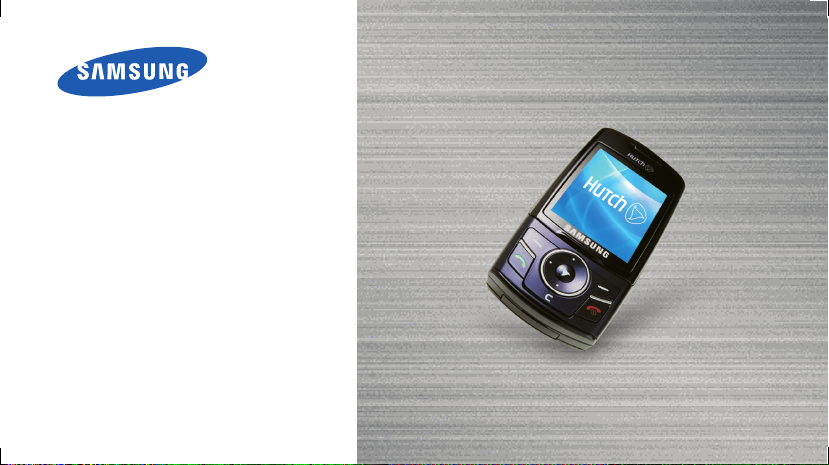
SCH-F679
User’s Guide
Page 2
Important safety
precautions
Failure to comply with the following
precautions may be dangerous or illegal.
Copyright information
Bluetooth® is a registered trademark of the
Bluetooth SIG, Inc. worldwide.
Bluetooth QD ID: B012652
Drive safely at all times
Do not use a hand-held phone while driving. Park
your vehicle first.
Switch off the phone when refuelling
Do not use the phone at a refuelling point (service
station) or near fuels or chemicals.
Switch off in an aircraft
Wireless phones can cause interference. Using
them in an aircraft is both illegal and dangerous.
Switch off the phone near all medical
equipment
Hospitals or health care facilities may be using
equipment that could be sensitive to external radio
frequency energy. Follow any regulations or rules in
force.
Interference
All wireless phones may be subject to interference,
which could affect their performance.
Page 3
Be aware of special regulations
Meet any special regulations in force in any area
and always switch off your phone whenever it is
forbidden to use it, or when it may cause
interference or danger.
Water resistance
Your phone is not water-resistant. Keep it dry.
Sensible use
Use only in the normal position (held to the ear).
Avoid unnecessary contact with the antenna when
the phone is switched on.
Emergency calls
Key in the emergency number for your present
location, then press .
Keep your phone away from small children
Keep the phone and all its parts, including
accessories, out of the reach of small children.
Accessories and batteries
Use only Samsung-approved batteries and
accessories, such as headsets and PC data cables.
Use of any unauthorised accessories could damage
you and your phone and may be dangerous.
• The phone could explode if the battery is
replaced with an incorrect type.
• Dispose of used batteries according to the
manufacturer’s instructions.
At very high volumes, prolonged listening
to a headset can damage your hearing.
Use of authorised software
Use only Samsung-authorised software. The use of
any unauthorised software could damage your
phone.
Qualified service
Only qualified service personnel may repair your
phone.
For more detailed safety information, see "Health
and safety information" on page 31.
1
Page 4
About this Guide
This User’s Guide provides you with condensed
information about how to use your phone.
In this guide, the following instruction icons
appear:
Indicates that you need to pay careful
attention to the subsequent information
regarding safety or phone features.
→
Indicates that you need to press the
Navigation keys to scroll to the specified
option and then select it.
[ ] Indicates a key on the phone.
< > Indicates a soft key, whose function is
2
For example, [ ]
displays on the phone screen. For
example, <
Menu
>
• Camera and camcorder
Special
•MP3 player
•FM radio
Use the camera module on your
phone to take a photo or record
a video.
features of your phone
Play music files using your
phone as an MP3 player.
Listen to your favourite radio
stations anytime, anywhere.
Page 5
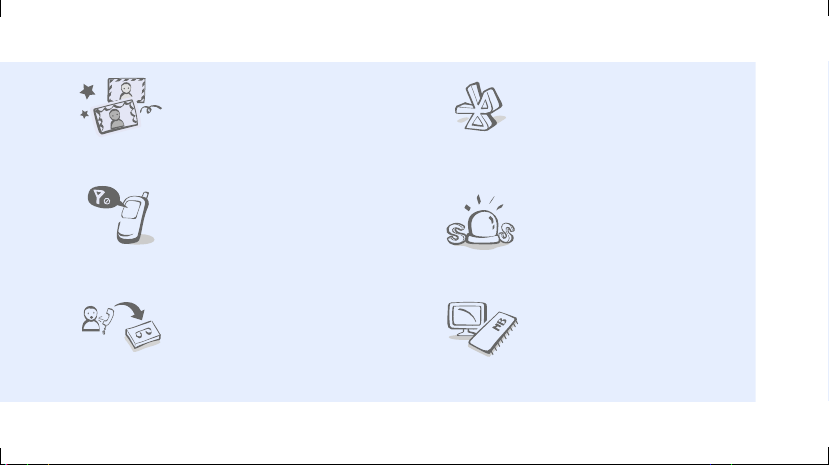
• Photo studio
Add a frame or apply special
effects to decorate your photos.
•Bluetooth
Connect to a headset or handsfree car kit using wireless
Bluetooth technology.
• Flight mode
Switch your phone to Flight
mode to use its non-wireless
functions while on an
aeroplane.
• Answering machine
Record a caller’s message on
your phone when you are
unable to answer an incoming
call.
•SOS message
Send SOS messages to your
family or friends for help in an
emergency.
•Memory disk
Access an external memory
card to copy files directly by
connecting the phone to a PC.
3
Page 6
Contents
Unpack 6
Make sure you have each item
Get started 6
First steps to operating your phone
Assemble and charge the phone ..................... 6
Power on or off.............................................. 7
Phone layout ................................................. 7
Keys and icons .............................................. 8
Access menu functions .................................. 11
Enter text .................................................... 11
Customise your phone................................... 13
Step outside the phone 15
Begin with call functions, camera, music player, web
browser, and other special features
Make or answer calls ..................................... 15
Use the camera ............................................ 16
4
Play music................................................... 17
Listen to the FM radio ................................... 18
Browse the web ........................................... 19
Use Contacts ............................................... 20
Send or view messages ................................. 21
Use Bluetooth .............................................. 21
Menu functions 23
All menu options listed
Health and safety information 31
Quick Reference Card 44
Page 7
Overview of menu functions
To access Menu mode, press <
1 Hutch
2 Display
1 Wallpaper
2 Main menu style
3 Font color
4 Dial number style
5 Backlight
3 Sounds
1 Ringtone
2 Alert tone
3 Others
4 Volume
5 Hourly chime
Menu
4 Messages
1 Write new message
2 Inbox
3 Outbox
4 Draft messages
5 SPAM settings
6 SOS message
7 Memory status
5 Multimedia
1 Camera
2 MP3
3 FM radio
4 Bluetooth
5 Game
6 Voice functions
7 Connect to PC
> in Idle mode.
6 Contacts
1 Search
2 Add
3 Groups
4 Speed dial
5 Business card
6 Call log
7 My number
7 Organizer
1 Wake-up call/Alarms
2 Scheduler
3 Memo
4 Calculator
5 Unit converter
6 World clock
7 Stopwatch
8 Contents box
1 Melodies
2 Images
3 Photo album
4 Memory info
9 Settings
1 Call settings
2 Application settings
3 Shortcut settings
4 Password/Lock settings
5 Input method
6 /Language
7 Domains preset
8 Reset
10
5
Page 8
Unpack
Make sure you have each item
• Phone
•Travel Adapter
•Battery
•User’s Guide
You can obtain various accessories from your
local Samsung dealer.
• The items supplied with your phone and the
accessories available at your Samsung dealer
may vary, depending on your country or
service provider.
• Use the purchased accessories with only
Samsung-authorised devices. The use of
these accessories with other devices could
cause problems and any repair costs would
not be covered by the warranty.
6
Get started
First steps to operating your phone
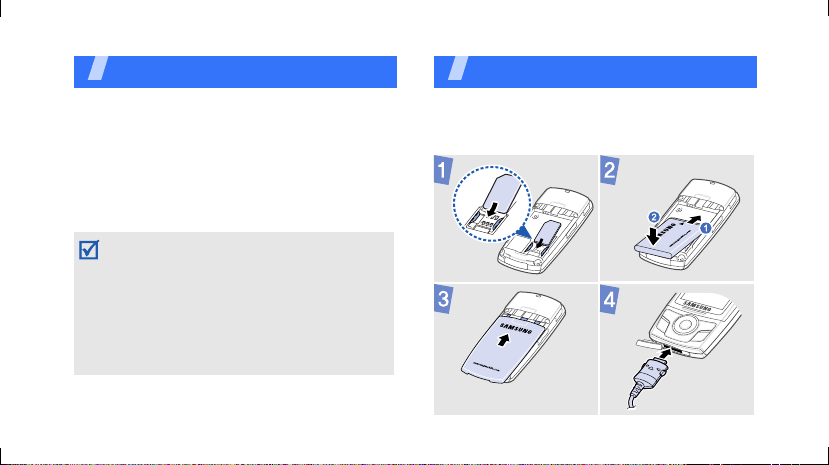
Assemble and charge the phone
Page 9
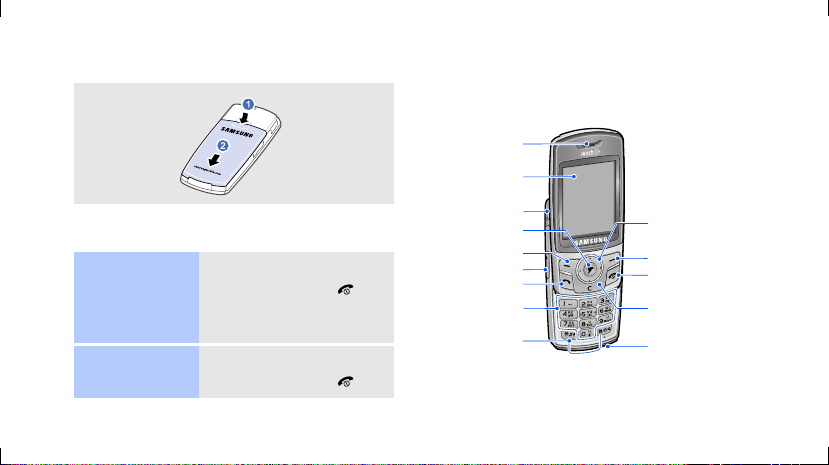
Removing the battery cover
Phone layout
Front view
Earpiece
Display
Power on or off
Switch on
Switch off
1. Open the phone.
2. Press and hold [ ].
3. If necessary, enter the
1. Open the phone.
2. Press and hold [ ].
PIN and press <
Ok
>.
Headset jack
Web access/
Confirm key
Left soft key
Volume keys
Dial key
Alphanumeric
keys
Special
function keys
Navigation keys
(Up/Down/Left/
Right)
Right soft key
Power/
Menu exit key
Delete/
Cancel key
Mouthpiece
7
Page 10
Get started
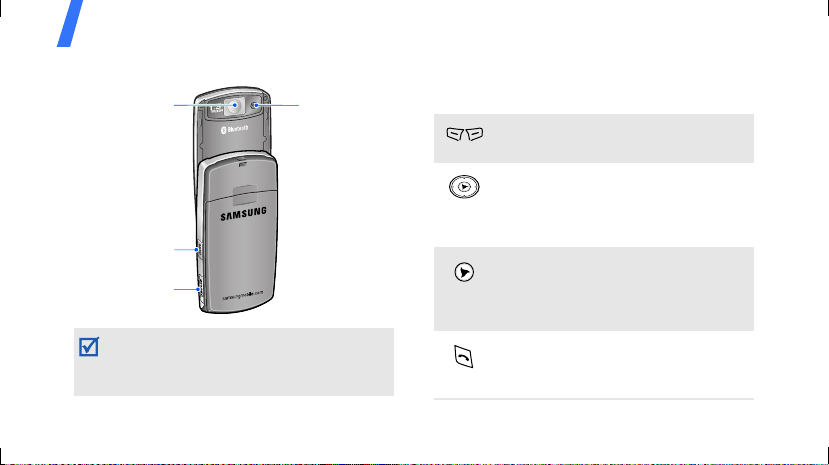
Rear view
Mirror
Camera/Voice
memo key
Memory card
slot
When you close the phone, the keypad lock
feature locks the exposed keys to avoid
accidental key presses. To unlock the keypad,
press and hold any key and then press <
8
Camera lens
Yes
Keys and icons
Keys
Perform the function indicated on the
bottom line of the display.
In Idle mode, access your favourite
menus directly.
In Menu mode, scroll through menu
options.
In Idle mode, access the
HutchHome
In Menu mode, select the highlighted
menu option or confirm input.
Make or answer a call.
In Idle mode, retrieve the numbers
>.
recently dialled, missed, or received.
menu.
Page 11
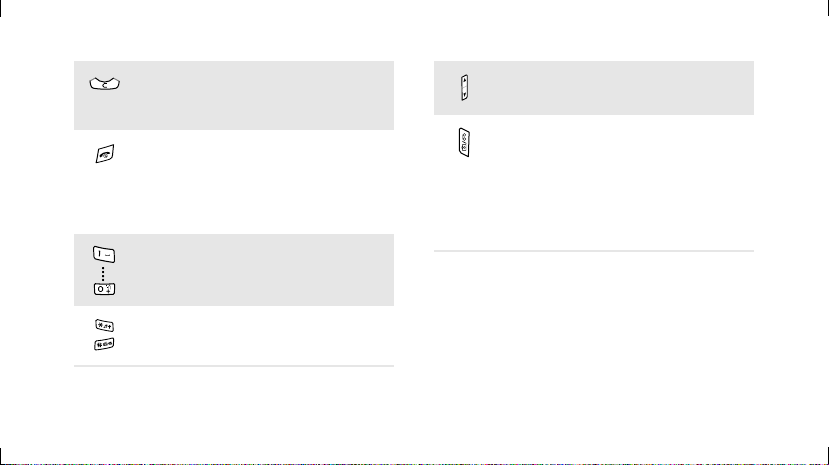
Delete characters from the display.
In Menu mode, return to the
previous menu level.
Press and hold to switch the phone
on or off.
End a call.
In Menu mode, cancel input and
return the phone to Idle mode.
Enter numbers, letters, and some
special characters.
Enter special characters or perform
special functions.
Adjust the phone volume.
In Idle mode, access the
menu; press and hold to turn on the
camera.
In Camera mode, take a photo or
record a video.
During a call, press and hold to
record your conversation.
Camera
9
Page 12
Get started
Icons
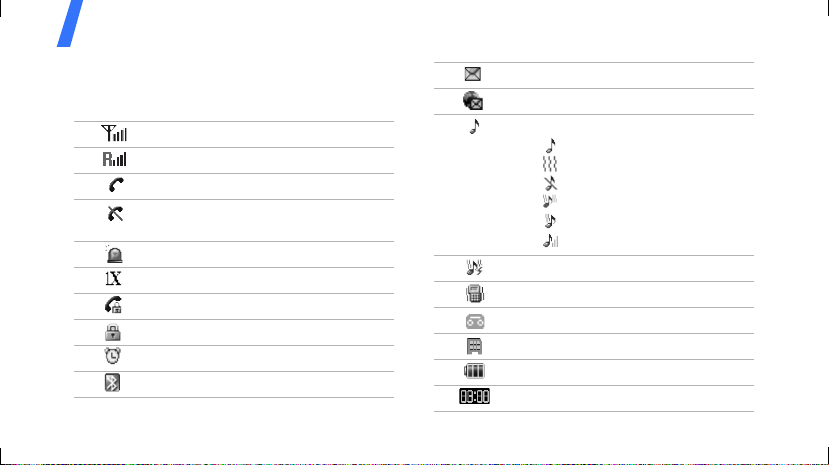
The following icons may appear on the top line
of the screen to indicate your phone’s status.
Signal strength
Roaming networ k
Call in progress
Out of your service area or Flight
mode
SOS message feature active
Transferring data in 1X network
Call restriction on
Lock mode
Alarm set
Bluetooth active
10
New message
Web alert
Ringer type setting
•: Ringer only
•: Vibration
•: Silent
• : Vibrate and ringer
• : Vibrate then ringer
• : Increasing
SSR mode
Silent mode
Answering machine feature active
Memory card inserted
Battery power level
Current time
Page 13

Access menu functions
Select an
option
Use menu
numbers
1. Press a desired soft key.
2. Press the Navigation keys to
move to the next or
previous option.
3. Press <
4. Press [
Press the number key
corresponding to the option
you want.
Select
confirm the function
displayed or option
highlighted.
C
] to move up one
level.
Press [ ] to return to Idle
mode.
> or [ ] to
Enter text
Change the
text input
mode
Matrix
mode
• In the text entry screen,
• Press [ ] to quickly switch
To enter a word:
1. Press a key on the number
2. Press [Up] or [Down] to
3. Press the number key
Mode
press <
the mode you want.
between the input modes.
keypad.
The pop-up window appears
showing the characters
assigned to the keypad.
select alternative pinyins.
corresponding to the
character you want.
> and select
11
Page 14

Get started
12
Thai T9
mode
Thai MT
mode
To enter a word:
1. Press [
2. Enter the whole word before
3. When the word displays
To enter a word:
1. Press the keys corresponding
2
] to [9] to start
entering a word.
editing or deleting
characters.
1
correctly, press [
a space.
Otherwise, press [Up] or
[Down] to display alternative
word choices.
to a character’s component
strokes.
] to insert
ABC mode
English
Word (T9)
mode
2. To enter a phrase, press [1]
to insert the delimeter and
continue entering the next
strokes.
To enter a word:
Press the appropriate key until
the character you want appears
on the display.
To enter a word:
2
1. Press [
2. Enter the whole word before
] to [9] to start
entering a word.
editing or deleting
characters.
Page 15
Number
mode
Symbol
mode
Other
operations
3. When the word displays
correctly, press [
a space.
Otherwise, press [
display alternative word
choices.
Press the keys corresponding to
the digits you want.
Press the corresponding
number key to select a symbol.
• Press and hold [ ] to enter
punctuation marks or special
characters.
• Press [ ] to change case in
ABC and English Word
modes.
1
] to insert
0
] to
• Press the Navigation keys to
move the cursor.
C
• Press [
• Press and hold [
] to delete
characters one by one.
the characters on the left
side of the cursor.
Customise your phone
Display
language
1. In Idle mode, press
Menu
> and select
<
Settings →
Language
2. Select a language.
.
C
] to clear
/
13
Page 16
Get started
Call ringer
melody
Key tone
volume
Idle mode
wallpaper
14
1. In Idle mode, press
Menu
> and select
<
Sounds → Ringtone
2. Select a ringtone category.
3. Select a ringtone.
In Idle mode, press [
adjust the key tone volume.
1. In Idle mode, press
Menu
> and select
<
Display → Wallpaper
Stand-by → Background
image
.
2. Select an image category.
3. Select an image.
.
/
] to
→
Silent mode
Phone lock
You can switch the phone to
Silent mode to avoid disturbing
other people. In Idle mode,
press and hold [ ].
1. In Idle mode, press
Menu
> and select
<
Settings → Password/
Lock settings
2. Enter a new 4- to 8-digit
password and press <
3. Enter the new password
again and press <
4. Select
method
5. Select On.
.
Select lock
.
Ok
>.
Ok
>.
Page 17
Step outside the phone
Begin with call functions, camera, music player,
web browser, and other special features
Make or answer calls
Make a
three-way
call
1. During a call, press [ ]
and make another call.
The first call is put on hold.
2. Press [ ] to begin the
three-way call.
Make a call
Answer a
call
1. In Idle mode, enter an area
code and phone number.
2. Press [ ].
3. Press [ ] to end the call.
1. When the phone rings,
2. Press [ ] to end the call.
/
Press [
volume.
press [ ].
] to adjust the
Record a
conversation
1. During a call, press and
hold [ ].
2. Press [ ] to stop
recording.
3. Press [ ] to end the call.
15
Page 18
Step outside the phone
Use the camera
Take a photo
1. In Idle mode, press and
hold [ ] to turn on the
camera.
2. Aim the lens at the subject
and make any desired
adjustments.
3. Press [ ] or [ ] to
take a photo.
Pres
4.
returns to Capture mode
automatically.
s <
Save
>. The phone
Record a
video
1. In Idle mode, press and
hold [ ] to turn on the
camera.
1
2. Press [
3. Press < > or [ ] to
4. Press < > or [ ] to
5. Press <
] and select
.
cam
start recording.
stop recording.
Save
returns to Camcorder mode
automatically.
Video
>. The phone
16
View a
photo
1. In Idle mode, press [ ]
and select My
gallery
2. Select the photo you want.
.
album →
View a video
1. In Idle mode, press [ ]
and select My
gallery
2. Select the video you want.
album →
.
Page 19
Play music
Copy music
files to the
phone
Create a
playlist
Use these methods:
• Download from the wireless
web.
• Receive via Bluetooth.
• Copy to a memory card and
insert the card into the
phone.
1. In Idle mode, press
Menu
> and select
<
Multimedia →
files
.
2. Select the folder you want.
3. Press <
select
4. Press [ ] to select files
and press <
MP3 →
Options
Add
> and
>.
Add to play list
MP3
.
Play music
files
5. Press <
1. In Idle mode, press
2. Press [ ].
3. During playback, use the
Play
playback.
Menu
<
Multimedia →
player
following keys:
• : pause or resume
playback.
• Left: return to the
previous file.
• Right: skip to the next
file.
• Up: change the repeat
mode.
> to begin
> and select
MP3 →
.
MP3
17
Page 20

Step outside the phone
• Down: open the playlist.
•
A-B
file to play the section
repeatedly.
•
Listen to the FM radio
Listen to the
radio
18
1. Plug the connecter of the
supplied headset into the
headset jack on the phone.
2. In Idle mode, press
Menu>
<
Multimedia
3. Press <
automatic tunning.
Available radio stations are
automatically saved.
: set a section in a
/
: adjust the volume.
and select
→
FM radio
Yes
> to start
Listen to the
radio
Store radio
stations
.
4. Press [Up] or [Down] to
scroll through other radio
stations.
OFF
5. Press <
radio.
1. From the radio screen,
press <
select
2. Press [Left] or [Right] to
select the station you want.
3. Press [Down].
4. Press <
5. Enter the title of the station
and press <
6. When you have finished,
press <
> to turn off the
Options
Edit
Save
>.
Save
>.
> and
>.
Save channel
.
Page 21
Browse the web Use Contacts
Launch the
web
browser
Navigate
the web
In Idle mode, press [ ]. The
homepage of your service
provider opens.
• To scroll through browser
items, press [Up] or
[Down].
• To select an item, press
<> or [].
• To return to the previous
page, press [
• To return to the homepage,
press and hold [
C
].
C
].
Add a
contact
1. In Idle mode, enter a phone
number and press <
2. Select
3. Enter a name and press
4. To add a contact to the
5. Specify contact information.
6. Press
New entry
Next
>.
<
phone’s memory, press
[Left] or [Right] and select
a number type.
<
Save> to save the
contact.
.
Save
>.
19
Page 22

Step outside the phone
Find a
contact
20
1. In Idle mode, press
Search
<
2. Enter the first few letters of
the name you want.
3. Select a contact.
4. Scroll to a number and
press [ ] to dial, or press
[ ] to edit contact
information.
>.
Send or view messages
Send a text
message
1. In Idle mode, press
Menu
> and select
<
Messages → Write new
message
2. Enter the message text and
press <
3. Press <
4. Enter destination numbers
and press <
5. Press <
message.
.
Next
Next
Send
>.
> again.
Select
>.
> to send the
Page 23

View a text
message
1. In Idle mode, press
Menu
> and select
<
Messages →
Text messages
2. Select a message.
Inbox →
.
Use Bluetooth
Your phone is equipped with Bluetooth
technology, enabling you to connect the phone
wirelessly to other Bluetooth devices and talk
hands-free.
Menu
Turn on
Bluetooth
In Idle mode, press <
and select
Bluetooth → Bluetooth on/
off
→ On
.
Multimedia →
>
Search for
and pair
with a
Bluetooth
device
1. In Idle mode, press
Menu
> and select
<
Multimedia → Bluetooth
→ Search new devices
2. Select the device type.
3. Scroll to a device and press
Connect
<
4. Enter a Bluetooth PIN or the
other device’s Bluetooth
PIN, if it has one, and press
Ok
<
>.
>.
.
21
Page 24

Step outside the phone
Send data
22
1. In Idle mode, press
Menu
> and select
<
Multimedia → Bluetooth
→ Data transfer →
category.
2. Select the item you want.
3. Scroll to a device and press
Connect
<
4. If necessary, enter the
Bluetooth PIN and press
<
OK
>.
an item
>.
Receive data
To receive data via Bluetooth,
your phone’s Bluetooth feature
must be active.
1. When a device attempts to
access your phone, enter
the Bluetooth PIN and press
OK
> to permit the
<
connection.
Yes
2. If necessary, press <
to confirm that you are
willing to receive.
>
Page 25
Menu functions
All menu options listed
This section provides brief explanations of
menu functions on your phone.
Hutch
Connect your phone to the network and load
the homepage of the wireless web service
provider. Depending on the UIM card you use,
some submenus may not be supported.
Display
Menu Description
Wallpaper Set up the idle screen and
Main menu style Select the menu display
Font color Select a font colour for the
Dial number
style
select an image to be
displayed for incoming or
outgoing calls, and when
the phone is switched on or
off.
style.
menu.
Select a font size and
colour for the numbers.
You can also select a
display style for the dialling
screen.
23
Page 26
Menu functions
Menu Description
Backlight Customise settings for
backlight of the display.
Sounds
Menu Description
Ringtone Select a ringtone and
Alert tone Set up audible alerts at a
Others Set the phone to sound
24
ringer type for incoming
calls.
specified time to inform
you that certain things
have happened.
when you press a key, turn
it on or off, open/close the
phone, or access Menu
mode.
Menu Description
Volume Adjust the volume for the
Hourly chime Set the phone to sound an
various sounds on the
phone, such as ringtones,
main menu tone, slider
tone, and power on/off
tone.
alert every hour on the
hour.
Messages
Menu Description
Write new
message
Inbox Access messages that you
Create and send text
messages.
have received.
Page 27
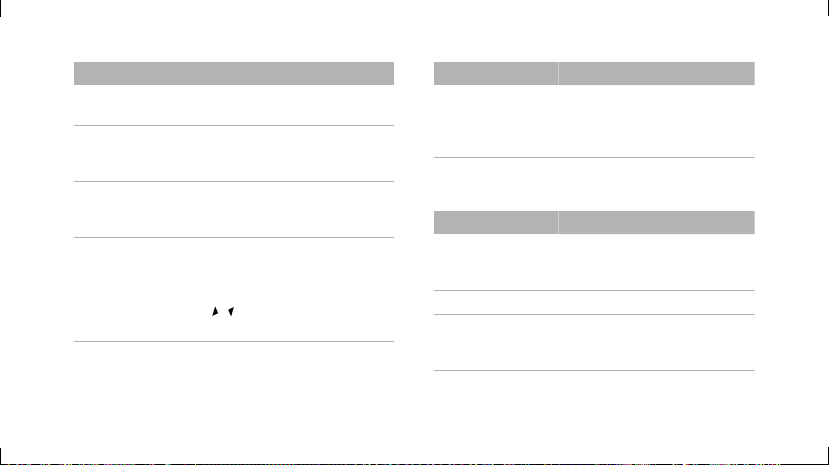
Menu Description
Outbox Access messages that you
Draft messages Access messages that you
have sent or failed to send.
have saved to send at a
later time.
SPAM settings Block unwanted messages
by setting up the SPAM
message filters.
SOS message Specify options for sending
and receiving an SOS
message. You can send an
SOS message by pressing
/
] 4 times in Idle mode,
[
with the phone closed.
Menu Description
Memory status Check the number of
messages you have stored
in the phone’s memory and
on the UIM card.
Multimedia
Menu Description
Camera Use the camera embedded
MP3 Listen to music.
FM radio Listen to music or news via
in your phone to take
photos and record videos.
the FM radio on your
phone.
25
Page 28
Menu functions
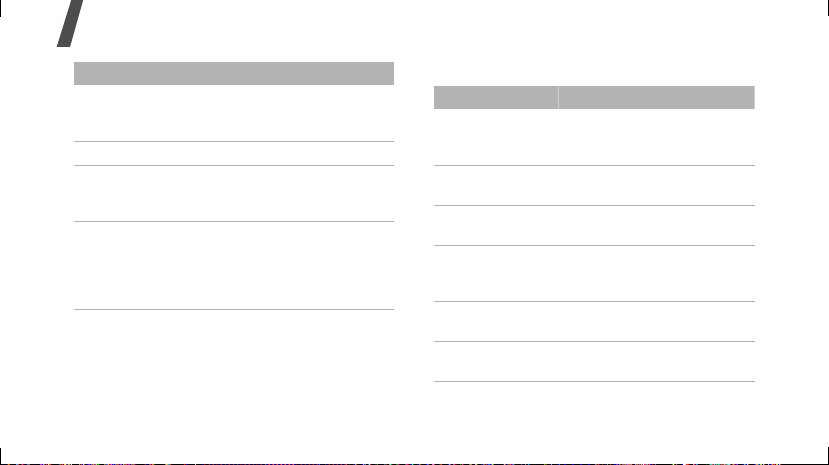
Menu Description
Bluetooth Connect the phone
Game Play game.
Voice functions Use the answering machine
Connect to PC Access a memory card
26
wirelessly to other
Bluetooth devices.
feature or record voice
memos.
from your PC. This menu is
only available when you
insert a memory card into
the phone.
Contacts
Menu Description
Search Search for contact
Add Add a new contact to
Groups Organise your contacts in
Speed dial Assign a speed dial number
Business card Create a name card and
Call log Check the time record for
information stored in
Contacts.
Contacts.
caller groups.
for your most frequently
dialled numbers.
send it to other people.
calls made and received.
Page 29
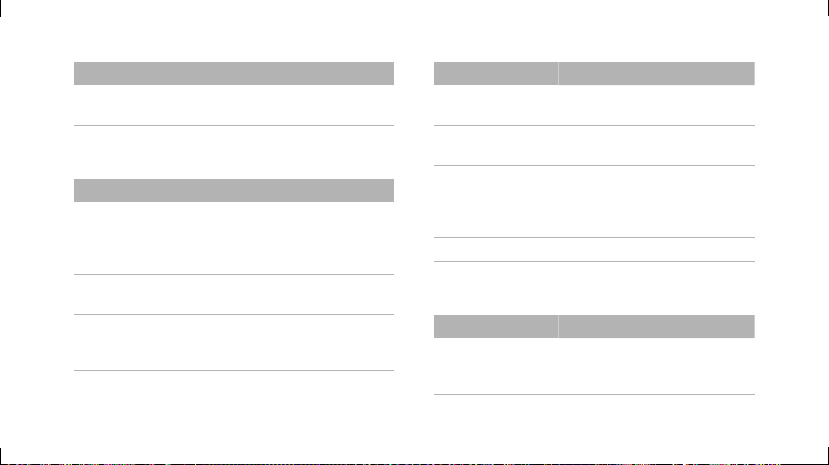
Menu Description
My number View and change your
phone number.
Organizer
Menu Description
Wake-up call /
Alarms
Scheduler Keep track of your
Memo Make memos for things
Set a wake-up call to wake
you up in the morning or
an alarm to alert you to an
event at a specific time.
schedule.
that are important and
manage them.
Menu Description
Calculator Perform arithmetic
Unit converter Do conversions, such as
functions.
length and temperature.
World clock Set your local time zone
and find out the current
time in another part of the
world.
Stopwatch Measure elapsed time.
Contents box
Menu Description
Melodies Access melodies and MP3
files you have downloaded
from the wireless web.
27
Page 30
Menu functions
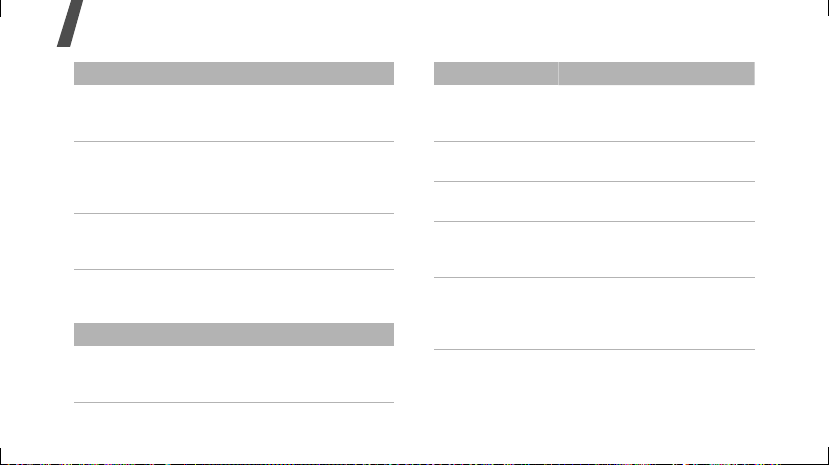
Menu Description
Images Access images you have
Photo album Access photos you have
Memory info View memory information
downloaded from the
wireless web.
taken and video clips you
have recorded in the
phone’s memory.
in the phone’s memory or
on a memory card.
Settings
Menu Description
Call settings →
Receive/E nd
settings
28
Select how to answer an
incoming call, or how to
end a call.
Menu Description
Call settings →
Call reject
Call settings
Int’l call prefix
Call settings
Flight mode
Call settings
Call forwarding
Call settings
Call waiting
Make a list of phone
numbers from which you
do not want to accept calls.
→
Set international call
service numbers.
→
Switch to Flight mode and
change the time setting.
→
Set the phone to reroute
incoming calls to a phone
number that you specify.
→
Set the phone to inform
you when someone is
calling you while on
another call.
Page 31

Menu Description
Call settings →
Area code
Find and retrieve area and
country codes to quickly
and easily dial phone
numbers.
Application
settings
→
Camera settings
Application
→
settings
Message
settings
Application
→
settings
Bluetooth
Settings
Change the default settings
for the options when you
use the camera application.
Customise the settings of
various options for
receiving or sending
messages.
Change the default settings
for the options when using
the Bluetooth feature.
Menu Description
Shortcut
settings
Shortcuts
→
Use the Navigation keys as
shortcuts to access specific
menus directly from Idle
mode.
Shortcut
settings
→
My menu
Password/Lock
→
settings
Change
password
Password/Lock
→
settings
Select lock
method
Set up a menu of your own
using your favorite menu
items.
Change your phone
password.
Lock your phone.
29
Page 32
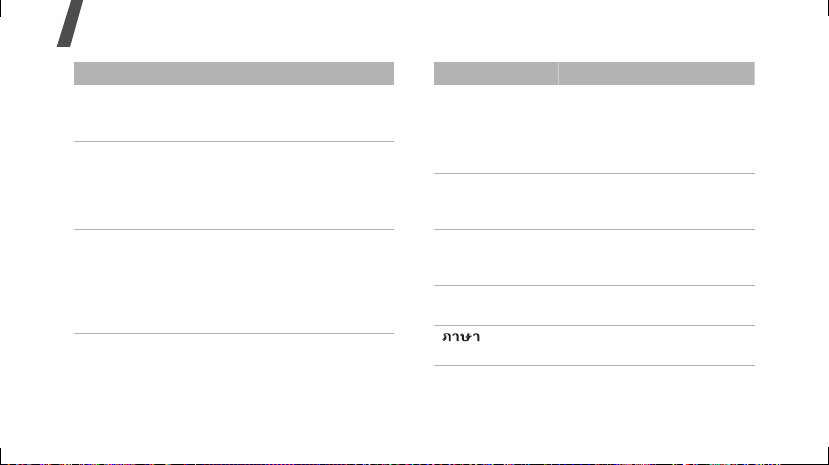
Menu functions
Menu Description
Password/Lock
settings
Lock
Password/Lock
settings
Outgoing
international
restriction
Password/Lock
settings
Emergency
number
30
→
→
→
Restrict all outgoing and
Call
incoming calls.
Restrict outgoing
international calls.
Store three emergency
numbers or edit them. You
can dial these numbers,
even if your phone is
locked or all outgoing calls
are restricted.
Menu Description
Password/Lock
→
settings
privacy
Password/Lock
→
settings
settings
Password/Lock
→
settings
Mobile tracker
Input method Select a default text input
/Language Select a language for the
Use an encrypted high
Voice
security line so that people
cannot eavesdrop on your
conversation, or use a
standard line.
Access the security options
Card
for the UIM card.
Set the phone to send the
preset tracking message to
your family or friends.
mode.
display text.
Page 33
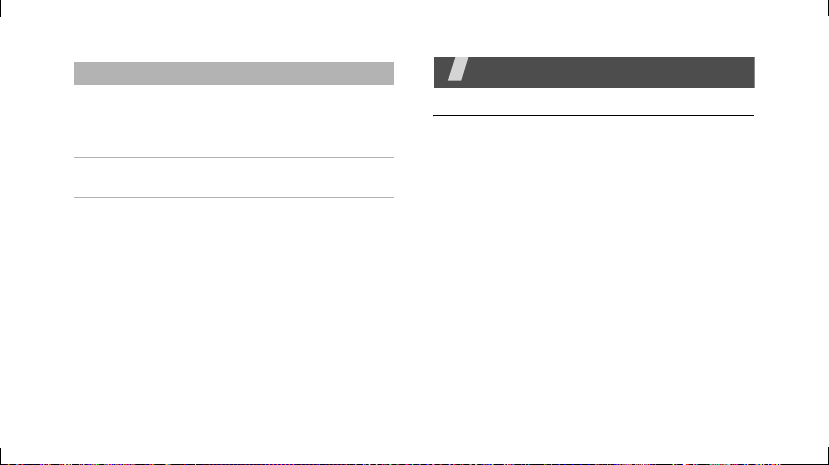
Menu Description
Domains preset Change default domain
Reset Reset the phone’s settings
name extensions and add
new domain name
extensions, if necessary.
you have changed.
Health and safety information
Exposure to radio frequency (RF) signals
Your wireless phone is a radio transmitter and
receiver. It is designed and manufactured not to
exceed the emission limits for exposure to radio
frequency (RF) energy set by the Federal
Communications Commission (FCC) of the U.S.
Government. These limits are part of
comprehensive guidelines and establish
permitted levels of RF energy for the general
population. The guidelines are based on the
safety standards that were developed by
independent scientific organizations through
periodic and through evaluation of scientific
studies.
The standards include a substantial safety
margin designed to assure the safety of all
persons, regardless of age and health.
31
Page 34

Health and safety information
The exposure standard for wireless phones
employs a unit of measurement known as
Specific Absorption Rate (SAR). The SAR limit
recommended by the FCC is 1.6W/kg.
SAR tests are conducted using standard
operating positions specified by the FCC with
the phone transmitting at its highest certified
power level in all tested frequency bands.
Although the SAR is determined at the highest
certified power level, the actual SAR level of the
phone while operating can be well below the
maximum value.
1. In the U.S. and Canada, the SAR limit for mobile
phones used by the public is 1.6 watts/kg (W/kg)
averaged over one gram of tissue. The standard
incorporates a substantial margin of safety to give
additional protection for the public and to account for
any variations in measurements.
32
1
This is because the phone is designed to
operate at multiple power levels so as to use
only the power required to reach the network.
In general, the closer you are to a wireless base
station antenna, the lower the power output of
the phone.
Before a new model phone is available for sale
to the public, it must be tested and certified to
the FCC that it does not exceed the limit
established by the government-adopted
requirement for safe exposure. The tests are
performed in positions and locations (e.g., at
the ear and worn on the body) as required by
the FCC for each model. While there may be
differences between the SAR levels of various
phones and at various positions, they all meet
the government requirement.
The FCC has granted an Equipment
Authorization for this model phone with all
reported SAR levels evaluated as in compliance
with the FCC RF exposure guidelines.
Page 35

SAR information on this model phone is on file
with the FCC and can be found under the
Display Grant section of http://www.fcc.gov/
oet/fccid after searching on FCC ID printed in
the label on the phone.
For body operation
For body worn operation, this model phone has
been tested and meets the FCC RF exposure
guidelines when used with a Samsung-supplied
or approved accessory designated for this
product or when used with and accessory that
contains no metal and that positions the
handset a minimum from the body.
The minimum distance for this model phone is
written in the FCC certification information from
the body. None compliance with the above
conditions may violate FCC RF exposure
guidelines.
For more Information concerning exposure to
radio frequency signals, see the following
websites:
Federal Communications Commission (FCC)
http://www.fcc.gov
Cellular Telecommunications Industry
Association (CTIA): http://www.wow-com.com
U.S.Food and Drug Administration (FDA)
http://www.fda.gov/cdrh/consumer
World Health Organization (WHO)
http://www.who.int/peh-emf/en
Precautions when using batteries
• Never use any charger or battery that is
damaged in any way.
• Use the battery only for its intended
purpose.
33
Page 36

Health and safety information
• If you use the phone near the network’s
base station, it uses less power; talk and
standby time are greatly affected by the
signal strength on the cellular network and
the parameters set by the network operator.
• Battery charging time depends on the
remaining battery charge, the type of
battery and the charger used. The battery
can be charged and discharged hundreds of
times, but it will gradually wear out. When
the operation time (talk time and standby
time) is noticeably shorter than normal, it is
time to buy a new battery.
• If left unused, a fully charged battery will
discharge itself over time.
• Use only Samsung-approved batteries and
recharge your battery only with Samsungapproved chargers. When a charger is not in
use, disconnect it from the power source. Do
not leave the battery connected to a charger
for more than a week, since overcharging
may shorten its life.
34
• Extreme temperatures will affect the
charging capacity of your battery: it may
require cooling or warming first.
• Do not leave the battery in hot or cold
places, such as in a car in summer or winter
conditions, as you will reduce the capacity
and lifetime of the battery. Always try to
keep the battery at room temperature. A
phone with a hot or cold battery may
temporarily not work, even when the battery
is fully charged. Li-ion batteries are
particularly affected by temperatures below
0 °C (32 °F).
• Do not short-circuit the battery. Accidental
short- circuiting can occur when a metallic
object (coin, clip or pen) causes a direct
connection between the + and – terminals of
the battery (metal strips on the battery), for
example when you carry a spare battery in a
pocket or bag. Short-circuiting the terminals
may damage the battery or the object
causing the short-circuiting.
Page 37

• Dispose of used batteries in accordance with
local regulations. Always recycle. Do not
dispose of batteries in a fire.
Road safety
Your wireless phone gives you the powerful
ability to communicate by voice, almost
anywhere, anytime. But an important
responsibility accompanies the benefits of
wireless phones, one that every user must
uphold.
When driving a car, driving is your first
responsibility. When using your wireless phone
behind the wheel of a car, make sure that you
are following the special regulations in a given
area or country.
Operating environment
Remember to follow any special regulations in
force in any area and always switch your phone
off whenever it is forbidden to use it, or when it
may cause interference or danger.
When connecting the phone or any accessory to
another device, read its user’s guide for
detailed safety instructions. Do not connect
incompatible products.
As with other mobile radio transmitting
equipment, users are advised that for the
satisfactory operation of the equipment and for
the safety of personnel, it is recommended that
the equipment should only be used in the
normal operating position (held to your ear with
the antenna pointing over your shoulder).
Electronic devices
Most modern electronic equipment is shielded
from radio frequency (RF) signals. However,
certain electronic equipment may not be
shielded against the RF signals from your
wireless phone. Consult the manufacturer to
discuss alternatives.
35
Page 38

Health and safety information
Pacemakers
Pacemaker manufacturers recommend that a
minimum distance of 15 cm (6 inches) be
maintained between a wireless phone and a
pacemaker to avoid potential interference with
the pacemaker. These recommendations are
consistent with the independent research and
recommendations of Wireless Technology
Research.
Persons with pacemakers:
• should always keep the phone more than 15
cm (6 inches) from their pacemaker when
the phone is switched on
• should not carry the phone in a breast
pocket
• should use the ear opposite the pacemaker
to minimize potential interference
If you have any reason to suspect that
interference is taking place, switch your phone
off immediately.
36
Hearing aids
Some digital wireless phones may interfere with
some hearing aids. In the event of such
interference, you may wish to consult your
hearing aid manufacturer to discuss
alternatives.
Other medical devices
If you use any other personal medical devices,
consult the manufacturer of your device to
determine if it is adequately shielded from
external RF energy. Your physician may be able
to assist you in obtaining this information.
Switch your phone off in health care facilities
when any regulations posted in these areas
instruct you to do so. Hospitals or health care
facilities may be using equipment that could be
sensitive to external RF energy.
Page 39

Vehicles
RF signals may affect improperly installed or
inadequately shielded electronic systems in
motor vehicles. Check with the manufacturer or
its representative regarding your vehicle.
You should also consult the manufacturer of any
equipment that has been added to your vehicle.
Posted facilities
Switch your phone off in any facility where
posted notices require you to do so.
Potentially explosive environments
Switch your phone off when in any area with a
potentially explosive atmosphere and obey all
signs and instructions. Sparks in such areas
could cause an explosion or fire resulting in
bodily injury or even death.
Users are advised to switch the phone off while
at a refueling point (service station). Users are
reminded of the need to observe restrictions on
the use of radio equipment in fuel depots (fuel
storage and distribution areas), chemical plants
or where blasting operations are in progress.
Areas with a potentially explosive atmosphere
are often but not always clearly marked. They
include the areas below deck on boats,
chemical transfer or storage facilities, vehicles
using liquefied petroleum gas (such as propane
or butane), areas where the air contains
chemicals or particles, such as grain, dust or
metal powders, and any other area where you
would normally be advised to turn off your
vehicle engine.
37
Page 40

Health and safety information
Emergency calls
This phone, like any wireless phone, operates
using radio signals, wireless and landline
networks as well as user-programmed
functions, which cannot guarantee connection
in all conditions. Therefore, you should never
rely solely on any wireless phone for essential
communications (medical emergencies, for
example).
Remember, to make or receive any calls the
phone must be switched on and in a service
area with adequate signal strength. Emergency
calls may not be possible on all wireless phone
networks or when certain network services and/
or phone features are in use. Check with local
service providers.
To make an emergency call:
1. If the phone is not on, switch it on.
38
2. Key in the emergency number for your
present location (for example, 191 or other
official emergency number). Emergency
numbers vary by location.
3. Press [ ].
If certain features are in use (call barring, for
example), you may first need to deactivate
those features before you can make an
emergency call. Consult this document and
your local cellular service provider.
When making an emergency call, remember to
give all the necessary information as accurately
as possible. Remember that your phone may be
the only means of communication at the scene
of an accident; do not cut off the call until given
permission to do so.
Page 41

Other important safety information
Only qualified personnel should service the
phone or install the phone in a vehicle. Faulty
installation or service may be dangerous and
may invalidate any warranty applicable to the
device.
Check regularly that all wireless phone
equipment in your vehicle is mounted and
operating properly.
Do not store or carry flammable liquids, gases
or explosive materials in the same
compartment as the phone, its parts or
accessories.
For vehicles equipped with an air bag,
remember that an air bag inflates with great
force. Do not place objects, including both
installed or portable wireless equipment in the
area over the air bag or in the air bag
deployment area. If wireless equipment is
improperly installed and the air bag inflates,
serious injury could result.
Switch your phone off before boarding an
aircraft. The use of wireless phones in aircraft
may be dangerous to the operation of the
aircraft, and is illegal.
Failure to observe these instructions may lead
to the suspension or denial of telephone
services to the offender, or legal action, or both.
Care and maintenance
Your phone is a product of superior design and
craftsmanship and should be treated with care.
The suggestions below will help you fulfill any
warranty obligations and allow you to enjoy this
product for many years.
• Keep your phone and all its parts and
accessories out of the reach of small children
and pets. They may inadvertently damage
these things or choke on small parts.
39
Page 42

Health and safety information
• Keep the phone dry. Precipitation, humidity,
and liquids contain minerals that corrode
electronic circuits.
• Do not use the phone with a wet hand. Doing
so may cause an electric shock to you or
damage to the phone.
• Do not use or store the phone in dusty, dirty
areas, as its moving parts may be damaged.
• Do not store the phone in hot areas. High
temperatures can shorten the life of
electronic devices, damage batteries, and
warp or melt certain plastics.
• Do not store the phone in cold areas. When
the phone warms up to its normal operating
temperature, moisture can form inside the
phone, which may damage the phone’s
electronic circuit boards.
• Do not drop, knock, or shake the phone.
Rough handling can break internal circuit
boards.
40
• Do not use harsh chemicals, cleaning
solvents, or strong detergents to clean the
phone. Wipe it with a soft cloth.
• Do not paint the phone. Paint can clog the
device’s moving parts and prevent proper
operation.
• Do not put the phone in or on heating
devices, such as a microwave oven, stove, or
radiator. The phone may explode when
overheated.
• When the phone or battery gets wet, the
label indicating water damage inside the
phone changes colour. In this case, phone
repairs are no longer guaranteed by the
manufacturer's warranty, even if the
warranty for your phone has not expired.
• If your phone has a flash or light, do not use
it too close to the eyes of people or animals.
This may cause damage to their eyes.
Page 43

• Use only the supplied or an approved
replacement antenna. Unauthorised
antennas or modified accessories may
damage the phone and violate regulations
governing radio devices.
• If the phone, battery, charger, or any
accessory is not working properly, take it to
your nearest qualified service facility. The
personnel there will assist you, and if
necessary, arrange for service.
Acknowledging Special Precautions
and the FCC and Industry Canada Notice
Cautions
Modifications not expressly approved by the
party responsible for compliance could void the
user's authority to operate the equipment.
FCC Compliance information
This device complies with Part 15 of FCC Rules.
Operation is subject to the following two
conditions:
1. This device may not cause harmful
interference, and
2. This device must accept any interference
received.
Including interference that may cause
undesired operation.
Information to user
This equipment has been tested and found to
comply with the limits for a Class B digital
device, pursuant to part 15 of the FCC Rules.
These limits are designed to provide reasonable
protection against harmful interference in a
residential installation.
This equipment generates, uses and can radiate
radio frequency energy and, if not installed and
used in accordance with the instructions, may
cause harmful interference to radio
communications. However, there is no
guarantee that interference will not occur in a
particular installation.
41
Page 44

Health and safety information
If this equipment does cause harmful
interference to radio or television reception,
which can be determined by turning the
equipment off and on, the user is encouraged to
try to correct the interference by one or more of
the following measures:
• Reorient or relocate the receiving antenna.
• Increase the separation between the
equipment and receiver.
• Connect the equipment into an outlet on a
circuit different from that to which the
receiver is connected.
• Consult the dealer or an experienced radio/
TV technician for help.
Appendix A: CERTIFICATION
INFORMATION (SAR)
THIS MODEL PHONE MEETS THE
GOVERNMENT’S REQUIREMENTS FOR
EXPOSURE TO RADIO WAVES.
42
Your wireless phone is a radio transmitter and
receiver. It is designed and manufactured not to
exceed the emission limits for exposure to radio
frequency (RF) energy set by the Federal
Communications Commission of the U.S.
Government. These limits are part of
comprehensive guidelines and establish
permitted levels of RF energy for the general
population.
The guidelines are based on safety standards
that were developed by independent scientific
organizations through periodic and thorough
evaluation of scientific studies. The standards
include a substantial safety margin designed to
assure the safety of all persons, regardless of
age and health.
The exposure standard for wireless mobile
phones employs a unit of measurement known
as the Specific Absorption Rate (SAR). The SAR
limit set by the FCC is 1.6 W/kg.
Page 45

SAR Tests are conducted using standard
operating positions accepted by the FCC with
the phone transmitting at its highest certified
power level in all tested frequency bands.
Although the SAR is determined at the highest
certified power level, the actual SAR level of the
phone while operating can be well below the
maximum value. This is because the phone is
designed to operate at multiple power levels so
as to use only the power required to reach the
network. In general, the closer you are to a
wireless base station antenna, the lower the
power output.
Before a new model phone is available for sale
to the public, it must be tested and certified to
the FCC that it does not exceed the limit
established by the government-adopted
requirement for safe exposure. The tests are
performed in positions and locations (e.g., at
the ear and worn on the body) as required by
the FCC for each model.
The highest SAR values for this model phone as
reported to the FCC are Head: 1.57W/Kg, Bodyworn: 0.347W/Kg. Body-worn operations are
restricted to Samsung-supplied, approved or
none Samsung designated accessories that
have no metal and must provide at least 1.5cm
separation between the device, including its
antenna whether extended or retracted, and
the user’s body.
None compliance to the above restrictions may
violate FCC RF exposure guidelines.
The FCC has granted an Equipment
Authorization for this model phone with all
reported SAR levels evaluated as in compliance
with the FCC RF exposure guidelines. SAR
information on this model phone is on file with
the FCC and can be found under the Display
Grant section of
http://www.fcc.gov/oet/fccid after searching on
FCC ID A3LSCHF679
43
Page 46
Health and safety information
In the United States and Canada, the SAR limit
for mobile phones used by the public is xx
watts/kilogram(W/kg) averaged over one gram
of tissue. The standard incorporates a
substantial margin of safety to give additional
protection for the public and to account for any
variations in measurements.
44
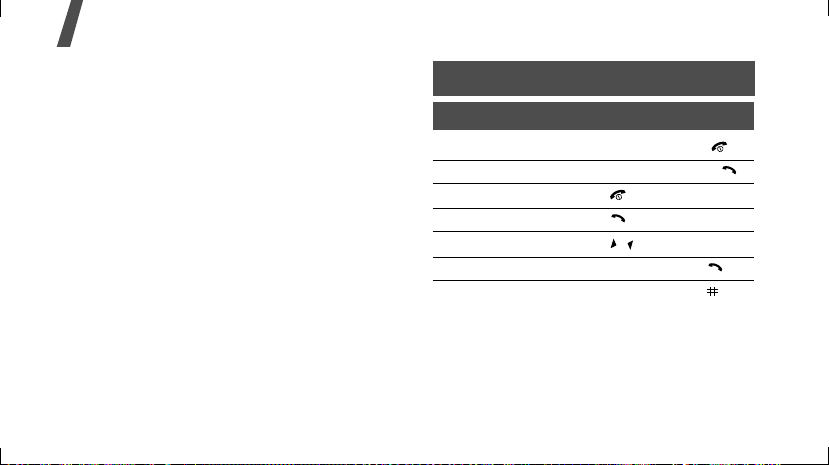
Quick Reference Card
Basic operations
Switch on/off
Make call
End call
Receive call
Adjust earpiece volume
Redial the last call
Switch to Silent mode
Press and hold [ ]
Phone number + [ ]
[]
[]
[/ ]
Press and hold [ ]
Press and hold [ ]
during a call
Page 47
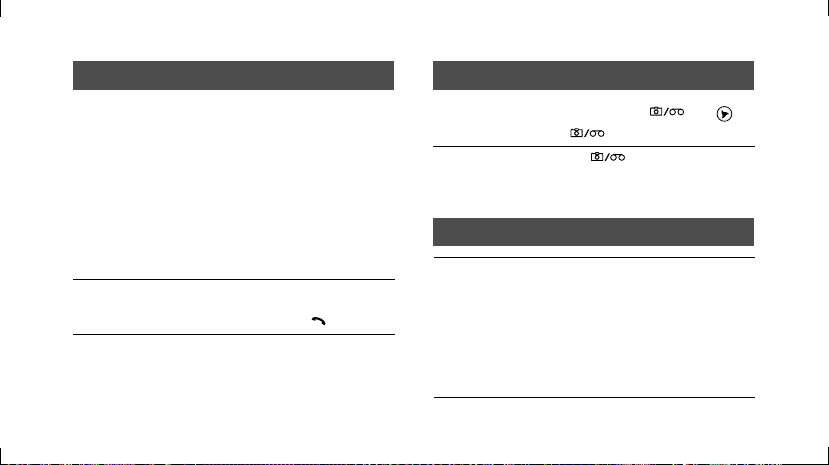
Contacts
Save number
UIM Enter number + <
Phone Enter number + <
Find
entry
Speed
dial
+ Enter name + <
entry
Save
>
<
+ Enter name + <
entry
Phone
(Storage) + Navigation(Type)
+
Select
Birthday/E-mail1,2/URL/ETC/Picture)
+ <
Press <
number, or e-mail address + [Up/
Down] + <
Press the first digit key(s) and hold
the last digit.
+ Up/Down(Group/Ringer/
Save
>
Search
> + Enter name,
Select
Save
> +
Next
Save
> +
Next
> or [ ]
New
> +
New
> +
Take photo
View photo
Listen to radio
Store radio
stations
Camera
Press and hold [ ]+ [ ]
or [ ] + <
Press [ ] +
gallery
<
Expand
Save
My album
+ A photo +
>
>
+
FM radio
Connect a headset to the
phone + Press <
5
] + [3] + <
[
Down]
Press <
Menu
+ [Left/Right] +
Options
<
channel
Yes
> + [5] + [3]
> +
Save
+ <
Save
Menu
> + [Up/
>
> +
45
Page 48
Short message service (SMS)
Create new
messages
View messages
46
Press <
Menu
+ Enter message + <
twice + Enter phone number
Select
+ <
Press <
+ Message box
+ [Up/Down] + <
> + <
Menu
> + [4] + [1]
Next
Send
>
> + [4] + [2]
View
>
Access the menu function
1. Press <
>
2. Press the Navigation keys to reach the menu
3. Press <
4. Press [Up] or [Down] to scroll through menu
5. Press <
Each of the two soft keys ( and )
performs the function indicated by the text above
it, on the bottom line on the display.
you want.
options.
Menu
> in Idle mode.
Select
>.
Select
> or
[]
to confirm.
Page 49

* Depending on the software installed or your service provider or country, some of the descriptions in
this guide may not match your phone exactly.
* Depending on your country, your phone and accessories may appear different from the illustrations in
this guide.
World Wide Web
http://www.samsungmobile.com
Printed in Korea
Code No.:GH68-14434A
English. 05/2007. Rev. 1.0
 Loading...