

Page 1
Refrigerator
user manual
RT29**
RT32**
RT35**
RT38**
Free Standing Appliance
English
imagine the possibilities
Thank you for purchasing a Samsung product.
To receive a more complete service,
please register your product at
www.samsung.com/register
Page 2
safety information
SAFETY INFORMATION
Read technical instruction before installing the •
refrigerator.
Read instruction before starting the refrigerator.•
Use this appliance only for its intended purpose •
as described in this instruction manual.
This appliance is not intended for use by persons
(including children) with reduced physical, sensory
or mental capabilities, or lack of experience
and knowledge, unless they have been given
supervision or instruction concerning use of the
appliance by a person responsible for their safety.
Warnings and Important Safety Instructions in •
this manual do not cover all possible conditions
and situations that may occur.
It is your responsibility to use common sense,
caution, and care when installing, maintaining,
and operating your appliance.
Because these following operating instructions •
cover various models, the characteristics of
your refrigerator may dier slightly from those
described in this manual.
R-600a or R-134a is used as a refrigerant.
Check the compressor label on the rear of
the appliance or the rating label inside the
fridge to see which refrigerant is used for
your refrigerator. When this product contains
fl ammable gas (Refrigerant R-600a), contact
your local authority in regard to safe disposal of
this product.
In order to avoid the creation of a fl ammable •
gas-air mixture if a leak in the refrigerating
circuit occurs, the size of the room in which the
appliance may be sited depends on the amount
of refrigerant used.
Never start up an appliance showing any signs •
of damage.
If in doubt, consult your dealer.
The room must be 1 m³ in size for every 8 g of
R-600a refrigerant inside the appliance.
The amount of refrigerant in your particular
appliance is shown on the identifi cation plate
inside the appliance.
Refrigerant squirting out of the pipes could •
ignite or cause an eye injury. When refrigerant
leaks from the pipe, avoid any naked fl ames
and move anything fl ammable away from the
product and ventilate the room immediately.
Failing to do so may result in fi re or explosion. -
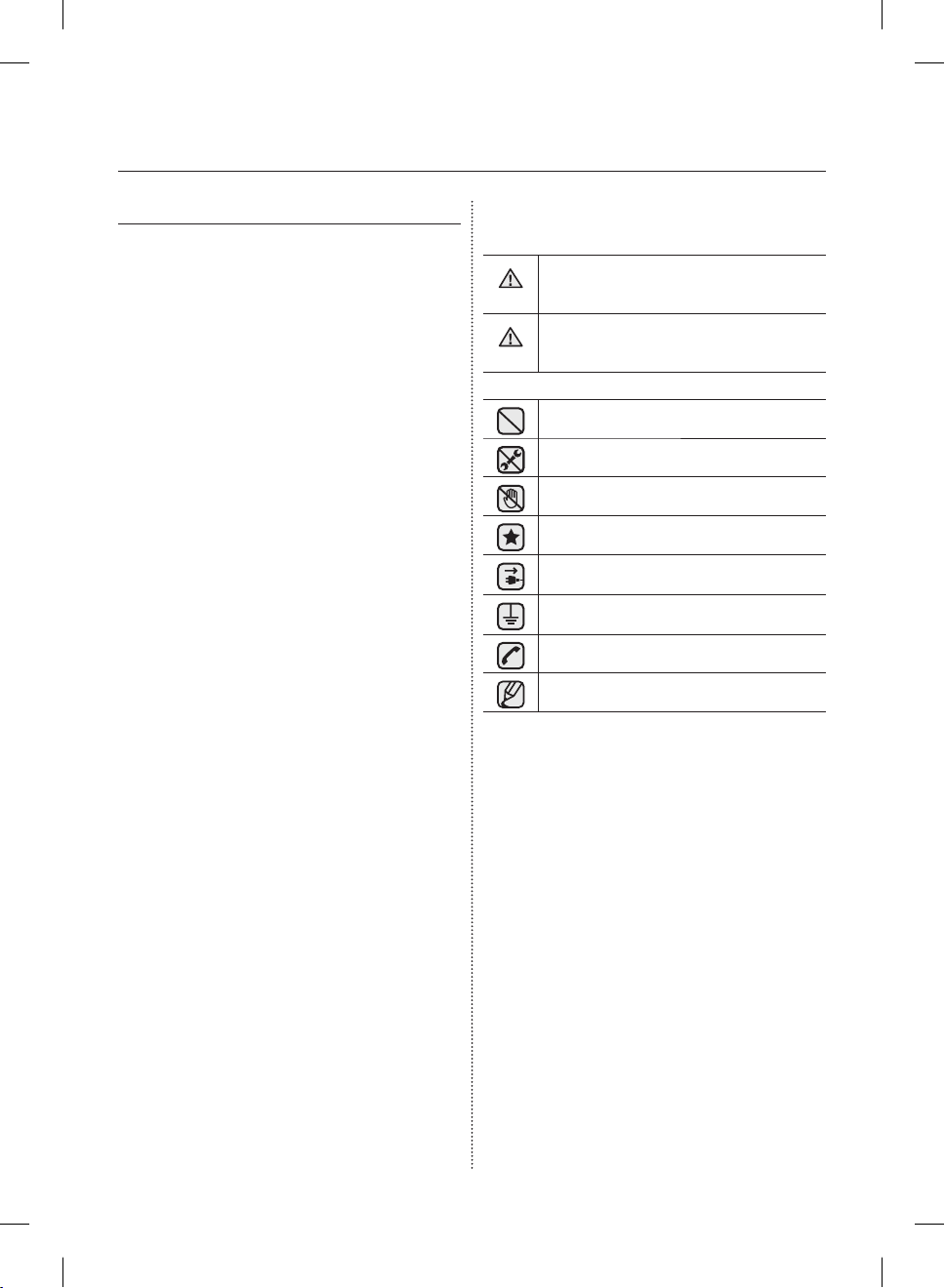
Important safety symbols and
precautions:
Hazards or unsafe practices that may
WARNING
CAUTION
These warning signs are here to prevent injury
to you and others.
Please follow them carefully.
After reading this section, keep it in a safe
place for future reference.
result in severe personal injury or
death.
Hazards or unsafe practices that may
result in minor personal injury or
property damage.
Do NOT attempt.
Do NOT disassemble.
Do NOT touch.
Follow directions carefully.
Unplug the power plug from the wall
socket.
Make sure the machine is grounded to
prevent electric shock.
Call the contact center for help.
Note.
CE Notice
This product has been determined to be in
compliance with the Low Voltage Directive
(2006/95/EC), the Electromagnetic Compatibility
Directive (2004/108/EC), Commission Delegated
Regulation (EU) No 1060/2010 and the Eco-Design
Directive(2009/125/EC) implemented by Regulation
(EC) No 643/2009 of the European Union.
(For products sold in European Countries only)
02_ safety information
Page 3
WARNING
SEVERE WARNING SIGNS
FOR TRANSPORTATION AND
SITE
• When transporting and installing the
appliance,care should be taken to
ensure that no parts of the refrigerating
circuit are damaged.
Refrigerant leaking from the pipe work could ignite or cause an eye injury. If a leak is
detected, avoid any naked fl ames or potential
sources of ignition and air the room in which the
appliance is standing for several minutes.
This appliance contains a small amount of isobutane refrigerant(R-600a), a natural gas
with high environmental compatibility that is,
however, also combustible.
When transporting and installing the appliance,
care should be taken to ensure that no parts of
the refrigerating circuit are damaged.
When transporting and installing the refrigerator, •
do not touch the water hose on the back side
of the refrigerator.
This may damage the refrigerator and as a result the water dispenser can not be used.
WARNING
SEVERE WARNING SIGNS
FOR INSTALLATION
• Deteriorated insulation of electrical
parts may cause an electric shock or
fi r e .
Do not place this refrigerator in direct sunlight or •
expose to the heat from stoves, room heaters
or other appliance.
Do not plug several appliances into the same •
multiple power board.
The refrigerator should always be plugged into
its own individual electrical outlet which has a
voltage rating that matched the rating plate.
This provides the best performance and also prevents overloading house wiring
circuits, which could cause a fi re hazard from
overheated wires.
If the wall socket is loose, do not insert the •
power plug.
There is a risk of electric shock or fi re. Do not use a cord that shows cracks or •
abrasion damage along its length or at either
end.
Do not pull or excessively bend the power cord. •
Do not twist or tie the power cord.•
Do not hook the power cord over a metal •
object, place a heavy object on the power
cord, insert the power cord between objects, or
push the power cord into the space behind the
appliance.
When moving the refrigerator, be careful not to roll over or damage the power cord.
This may result in an electric shock or fi re. Do not use aerosols near the refrigerator.•
Aerosols used near the refrigerator may cause -
an explosion or fi re.
Do not bend the power cord excessively or -
place heavy articles on it.
• This refrigerator must be properly
installed and located in accordance
with the manual before it is used.
Do not install the refrigerator in a damp place or •
place where it may come in contact with water.
Deteriorated insulation of electrical parts may cause an electric shock or fi re.
Connect the power plug in proper position with •
the cord hanging down.
If you connect the power plug upside down, wire can get cut off and cause fi re or an electric
shock.
Make sure that the power plug is not squashed •
or damaged by the back of the refrigerator.
When moving the refrigerator, be careful not to •
roll over or damage the power cord.
This constitutes a fi re hazard. Keep the packing materials out of reach of •
children.
There is a risk of death from suffocation if -
children put them on their head.
This appliance should be positioned in such a •
way that it is accessible to the power plug.
Failing to do so may result in an electric shock -
or fi re due to electric leakage.
Do not install this appliance near a heater, •
infl ammable material.
Do not install this appliance in a humid, oily or •
dusty location, in a location exposed to direct
sunlight and water (rain drops).
Do not install this appliance in a location where •
gas may leak.
This may result in an electric shock or fi re. If any dust or water is in the refrigerator, pull •
out power plug and contact your Samsung
Electronics service center.
Otherwise there is a risk of fi re. Do not stand on top of the appliance or place •
safety information _03
Page 4
objects (such as laundry, lighted candles,
lighted cigarettes, dishes, chemicals, metal
objects, etc.) on the appliance.
This may result in an electric shock, fi re, problems with the product, or injury.
• This appliance must be properly
grounded.
Do not ground the appliance to a gas pipe, •
plastic water pipe, or telephone line.
You must ground the refrigerator to prevent any power leakages or electric shocks caused by
current leakage from the refrigerator.
This may result in an electric shock, fi re, explosion, or problems with the product.
Never plug the power cord into a socket that is not grounded correctly and make sure that it is
in accordance with local and national codes.
• If the power cord is damaged,
have it replaced immediately by the
manufacturer or its service agent.
The fuse on the refrigerator must be changed •
by a qualifi ed technician or service company.
Failing to do so may result in an electric shock or personal injury.
CAUTION SIGNS FOR
CAUTION
INSTALLATION
• Keep ventilation opening in the
appliance enclosure or mounting
structure clear of obstruction.
Allow the appliance to stand for 2 hours after •
installation.
The installation or any service of this appliance •
is recommended by a qualifi ed technician or
service company.
Failing to do so may result in an electric shock, fi re, explosion, problems with the product, or
injury.
WARNING
04_ safety information
SEVERE WARNING SIGNS
FOR USING
• Do not touch the power plug with wet
hands.
This may result in an electric shock. -
Do not store articles on the top of the appliance.•
When you open or close the door, the articles -
may fall and cause a personal injury and/or
material damage.
Do not put items fi lled with water on the •
refrigerator.
If spilled, there is a risk of fi re or electric shock. Do not touch the inside walls of the freezer or •
products stored in the freezer with wet hands.
This may cause frostbite. Do not use or place any substances sensitive •
to temperature such as infl ammable sprays,
infl ammable objects, dry ice, medicine, or
chemicals near the refrigerator.
Do not keep volatile or infl ammable objects or
substances (benzene, thinner, propane gas,
alcohol, ether, LP gas and other such products
etc.) in the refrigerator.
This refrigerator is for storing food only. This may result in a fi re or an explosion. Do not store pharmaceuticals products, •
scientifi c materials or temperature-sensitive
products in the refrigerator.
Products that require strict temperature controls must not be stored in the refrigerator.
Do not place or use electrical appliance inside •
the refrigerator/freezer, unless they are of a type
recommended by the manufacturer.
If you smell pharmaceutical or smoke, pull •
out power plug immediately and contact your
Samsung Electronics service center.
If any dust or water is in Refrigerator, pull •
out power plug and contact your Samsung
Electronics service center.
Otherwise there is a risk of fi re. If gas leak is detected, avoid any naked fl ames •
or potential sources of ignition and air the room
in which the appliance is standing for several
minutes.
Do not use mechanical devices or any other •
means to accelerate the defrosting process,
other than those recommended by the
manufacturer.
Do not damage the refrigerant circuit.•
Do not spray volatile material such as •
insecticide onto the surface of the appliance.
As well as being harmful to humans, it may also -
result in an electric shock, fi re or problems with
the product.
Do not use a hair dryer to dry the inside of the •
refrigerator.
Do not place a lighted candle in the refrigerator
for removing bad odours.
This may result in an electric shock or fi re. Fill the water tank, ice tray and water cubes only •
Page 5
with potable water (mineral water or purifi ed
water).
Do not fi ll the tank with tea, juice or sports drink, this may damage the refrigerator.
Do not let children hang on the door.•
If not, a serious injury may occur.
Risk of children entrapment. Do not let children enter inside the refrigerator.
Do not leave the doors of the refrigerator open •
while the refrigerator is unattended and do not
let children enter inside the refrigerator.
Do not allow babies or children go inside the •
drawer.
It can cause death from suffocation by entrapment or personal injury.
Do not sit on the Freezer door.•
The door may be broken and cause a personal -
injury.
To prevent children entrapment, you must •
reinstall the divider using provided screws after
cleaning or other actions if you removed the
divider from the drawer.
Do not use mechanical devices or any other •
means to accelerate the defrosting process,
other than those recommended by the
manufacturer.
Do not damage the refrigerant circuit.•
Do not put fridge shelf in upside down. Shelf •
stopper could not work.
It may cause a personal injury because of glass -
shelf drop.
Do not put fridge shelf in place for box. If put in •
to force, inside wall or glass could be crashed.
It may cause a personal injury or material -
damage.
• In the event of a gas leak (such as
propane gas, LP gas, etc.), ventilate
immediately without touching the
power plug. Do not touch the appliance
or power cord.
Do not use a ventilating fan. A spark may result in an explosion or fi re. Use only the LED Lamps provided by •
manufacturer or service agent.
Children should be supervised to ensure that •
they do not play with the appliance.
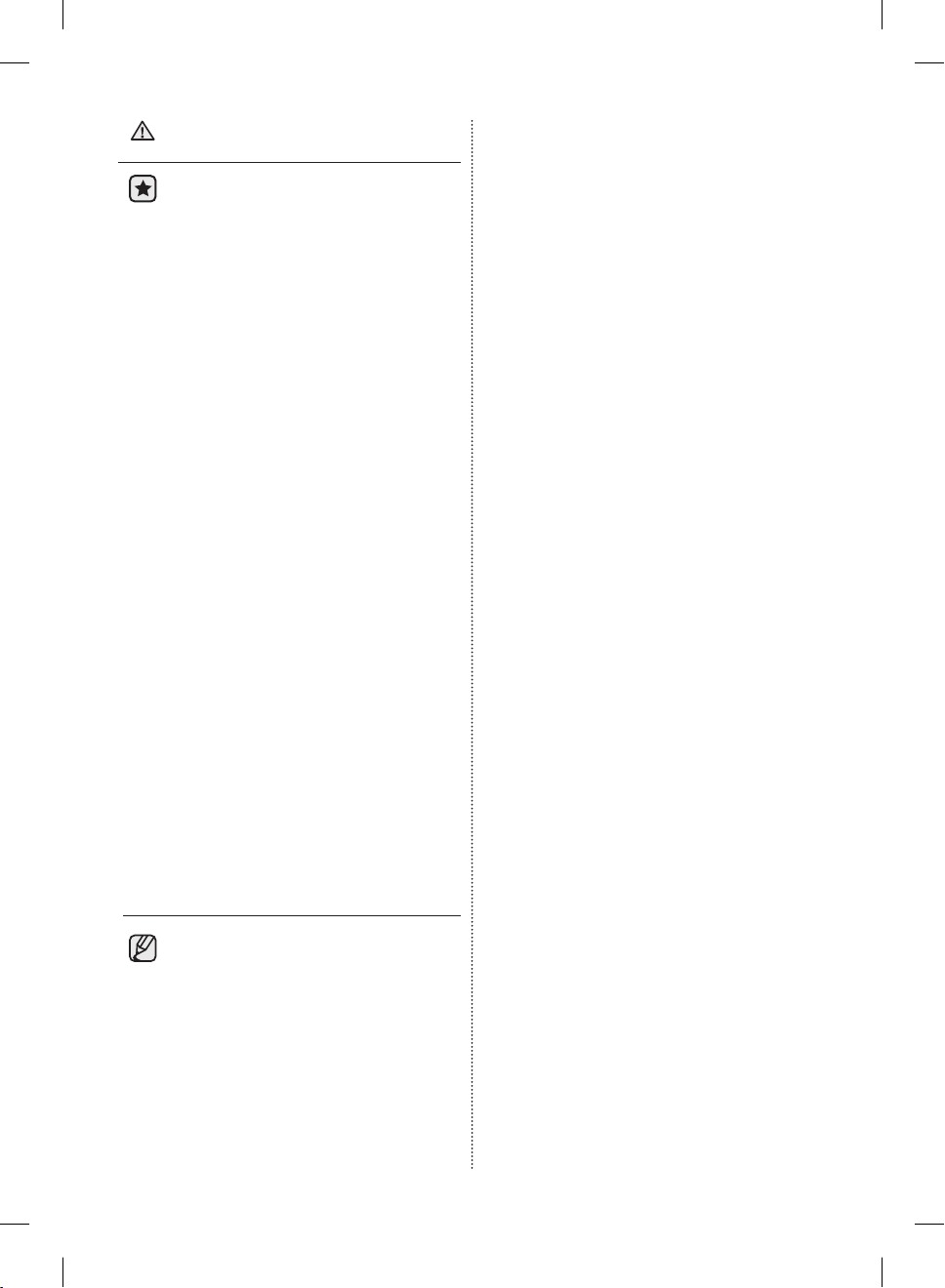
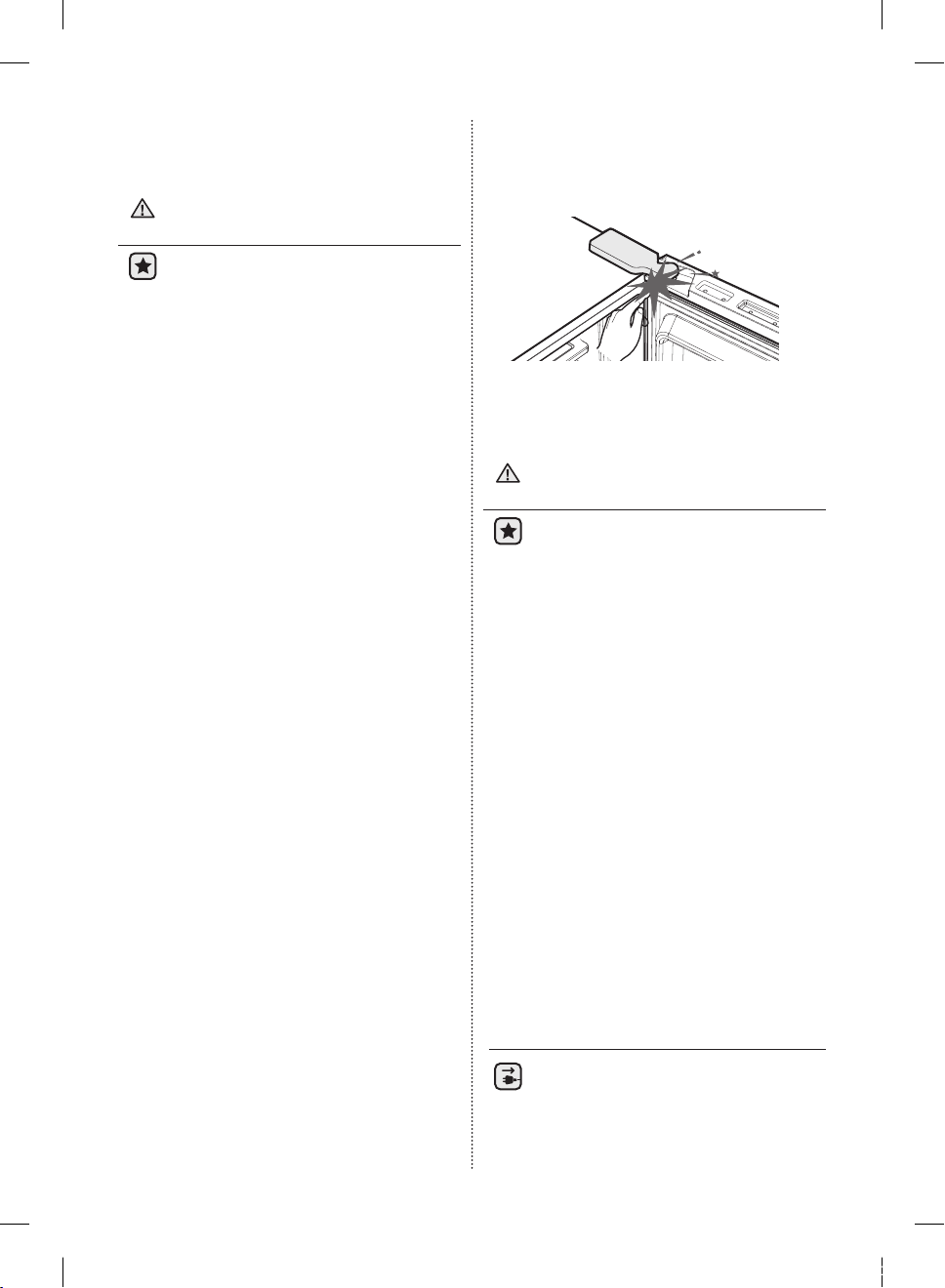
Keep fi ngers out of “pinch point” areas; •
clearances between the doors and cabinet are
necessarily small.
Do not let children hang on the door.•
If not, a serious injury may occur.
There is a Risk of children entrapment.•
Do not let children enter inside the refrigerator.
Bottles should be stored tightly together so that •
they do not fall out.
This product is intended only for the storage of •
food in a domestic environment.
Never put fi ngers or other objects into the •
dispenser hole, and ice maker bucket.
It may cause a personal injury or material damage.
Do not insert hands, feet or metal objects (such •
as chopsticks, etc.) into the bottom or the back
of the refrigerator.
This may result in an electric shock or injury. Any sharp edges may cause a personal injury. -
• Do not attempt to repair, disassemble,
or modify the appliance yourself.
Do not use any fuse(such as cooper, steel wire, etc.) other than the standard fuse.
When repairing or reinstalling the appliance is required, contact your nearest service center.
Failing to do so may result in an electric shock, fi re, problems with the product, or injury.
• If the appliance generates a strange
noise, a burning or smell or smoke,
unplug the power plug immediately and
contact your nearest service center.
Failing to do so may result in an electric or fi re hazards.
Pull the power plug out of the socket before •
changing the interior lamps of the refrigerator
Otherwise, there is a risk of electric shock. If you experience diffi culty when changing the •
light, contact service agent.
If the products is equipped with the LED Lamp, •
do not disassemble the Lamp Cover and LED
Lamp by yourself.
Please contact your service agent. Plug the power plug into the wall socket fi rmly. •
Do not use a damaged power plug, damaged
power cord or loose wall socket.
This may result in an electric shock or fi re. Do not put a container fi lled with water on the •
appliance.
If spilled, there is a risk of fi re or electric shock. Never stare directly at the UV LED lamp for long •
periods of time.
This may result in eye strain due to the -
ultraviolet rays.
safety information _05
Page 6
CAUTION SIGNS FOR USING
CAUTION
• To get best performance from the
- Do not place foods too closely in front of the
- Wrap the food up properly or place it in airtight
- Do not put any newly introduced food for
- The container may freeze and break, and this
- When the contents freeze, the glass may
- Changes or modifi cations may result in a
- If the air holes are blocked, especially with a
- Otherwise, odor and mold may develop.
product,
vents at the rear of the appliance as it can
obstruct free air circulation in the refrigerator
compartment.
containers before putting it into the refrigerator.
freezing near to already existing food.
Do not place glass or bottles or carbonated •
beverages into the freezer.
may result in injury.
Please observe maximum storage times and •
expiry dates of frozen goods.
There is no need to disconnect the refrigerator •
from the power supply if you will be away for
less than three weeks. But, remove all the food
if you are going away for the three weeks or
more. Unplug the refrigerator and clean it, rinse
and dry.
Do not place carbonated or fi zzy drinks in the •
freezer compartment.
Do not put bottles or glass containers in the
freezer.
break and cause personal injury and property
damage.
Do not change or modify the functionality of the •
refrigerator.
personal injury and/or property damage.
Any changes or modifi cations performed by
a 3rd party on this completed appliance are
neither covered under Samsung warranty
service, nor is Samsung responsible for safety
issues and damages that result from 3rd party
modifi cations.
Do not block air holes.•
plastic bag, the refrigerator can be over cooled.
Use only the ice-maker provided with the •
refrigerator.
Wipe excess moisture from the inside and leave •
the doors open.
When the refrigerator got wet by water, pull •
out the power plug and contact your Samsung
Electronics service center.
Be careful that your fi ngers are not caught in.•
• Do not apply strong shock or excessive force
onto the surface of glass.
- Broken glass may result in a personal injury
and/or property damage.
CAUTION SIGNS
CAUTION
FOR CLEANING AND
MAINTENANCE
• Do not spray cleaning products directly
-
- Failing to do so may result in an electric shock
- Unplug the power plug and clean it with a dry
- Failing to do so may result in an electric shock
Do not use benzene, thinner, or Clorox, Chloride
•
for cleaning.
- They may damage the surface of the appliance
- It may cause a personal injury or material
- Failing to do so may result in an electric shock
on the display.
If any foreign substance such as water has •
entered the appliance, unplug the power plug
and contact your nearest service center.
or fi re.
Remove all foreign substances such as dust •
or water from the power plug terminals and
contact points using a dry cloth on a regular
basis.
cloth.
or fi re.
Do not clean the appliance by spraying water •
directly onto it.
and may cause a fi re.
Never put fi ngers or other objects into the •
dispenser hole.
damage.
• Before cleaning or performing
maintenance, unplug the appliance
from the wall socket.
or fi re.
06_ safety information
2012.11.19 11:29:50 AM
Page 7
WARNING
SEVERE WARNING SIGNS
FOR DISPOSAL
• Leave the shelves in place so that
children may not easily climb inside.
Ensure that none of the pipes on the back of •
the appliance are damaged prior to disposal.
R-600a or R-134a is used as a refrigerant. •
Check the compressor label on the rear of
the appliance or the rating label inside the
refrigerator to see which refrigerant is used for
your refrigerator.
When this product contains fl ammable gas
(Refrigerant R-600a), contact your local
authority in regard to safe disposal of this
product. Cyclopentane is used as an insulation
blowing gas.
The gases in insulation material require special
disposal procedure.
Please contact your local authorities in regard
to the environmentally safe disposal of this
product. Ensure that none of the pipes on the
back of the appliances are damaged prior to
disposal. The pipes shall be broken in the open
space.
When disposing of this or other refrigerator/s, •
remove the door/door seals, door latch so that
children or animals cannot become trapped
inside. Children should be supervised to
ensure that they do not enter and play with the
appliance.
If trapped inside, the child may become injury and suffocate to death.
Please dispose of the packaging material for •
this product in an environmentally friendly
manner.
Keep all packaging materials well out of the •
reach of children, as packaging materials can
be dangerous to children.
If a child places a bag over its head, it may result in suffocation.
ADDITIONAL TIPS FOR
PROPER USAGE
In the event of a power failure, call the local •
offi ce of your Electricity Company and ask how
long it is going to last.
Most power failures that are corrected within an hour or two will not affect your refrigerator
temperatures.
However, you should minimize the number of
door openings while the power is off.
But should the power failure last more than 24 -
hours, remove all frozen food.
If keys are provided with the refrigerator, the •
keys should be kept out of the reach of children
and not be in the vicinity of the appliance.
The appliance might not operate consistently •
(possibility of defrosting of contents or
temperature becoming too warm in the frozen
food compartment) when sited for an extended
period of time below the cold end of the range
of temperature for which the refrigerating
appliance is designed.
Do not store food which goes bad easily at low •
temperature, such as bananas, melons.
Your appliance is frost free, which means there •
is no need to manually defrost your appliance,
as this will be carried out automatically.
Temperature rise during defrosting can comply •
with ISO requirements.
But if you want to prevent an undue rise in the
temperature of the frozen food while defrosting
the appliance, please wrap the frozen food up
in several layers of newspaper.
Any increase in temperature of frozen food •
during defrosting can shorten its storage life.
Do not re-freeze frozen foods that have thawed •
completely.
Saving Energy Tips
Install the appliance in a cool, dry room with adequate ventilation.
Ensure that it is not exposed to direct sunlight
and never put it near a direct source of heat
(radiator, for example).
Never block any vents or grilles on the appliance.
Allow warm food to cool down before placing it in the appliance.
Put frozen food in the refrigerator to thaw. You can then use the low temperatures of the
frozen products to cool food in the refrigerator.
Do not keep the door of the appliance open for too long when putting food in or taking food
out. The shorter time for which the door is
open, the less ice will form in the freezer.
Allow clearance to the right, left, back and top when installing.
This will help reduce power consumption and
keep your energy bills lower.
safety information _07
Page 8
contents
SETTING UP YOUR REFRIGERATOR …………………………………………………………………… 08
OPERATING THE SAMSUNG REFRIGERATOR ………………………………………………………… 11
TROUBLESHOOTING ……………………………………………………………………………………… 19
setting up your refrigerator
GETTING READY TO INSTALL
THE REFRIGERATOR
Congratulations on the purchase of your Samsung
Refrigerator.
We hope you will enjoy the many state-of-the-art
features and effi ciencies that this new appliance
Read tec hnica l instr uct i on bef ore
•
WARNING
in stalli ng the refrige rato r.
• This refrigerator must be properly
WARNING
Selecting the best location for the
refrigerator
08_ setting up
installed and located in accordance
with the manual before it is used.
Us e this appliance only for its •
intended purpose as described in this
instruction manual.
We atrongly recommend that any
•
servicing be performed by a qualifi ed
individual.
Please dispose of the packaging
•
material for this product in an
environmentally friendly manner.
Pull the power plug out of the socket
•
before changing the interior light of the
refrigerator.
- Otherwise, there is a risk of elecctric
shock.
Select a location without direct exposure to •
sunlight.
Select a location with level (or nearly level) •
fl ooring.
Select a location with enough space for the •
refrigerator doors to open easily.
Allow suffi cient space to install the refrigerator •
on a fl at surface.
If your refrigerator is not level, the internal cooling system may not work correctly.
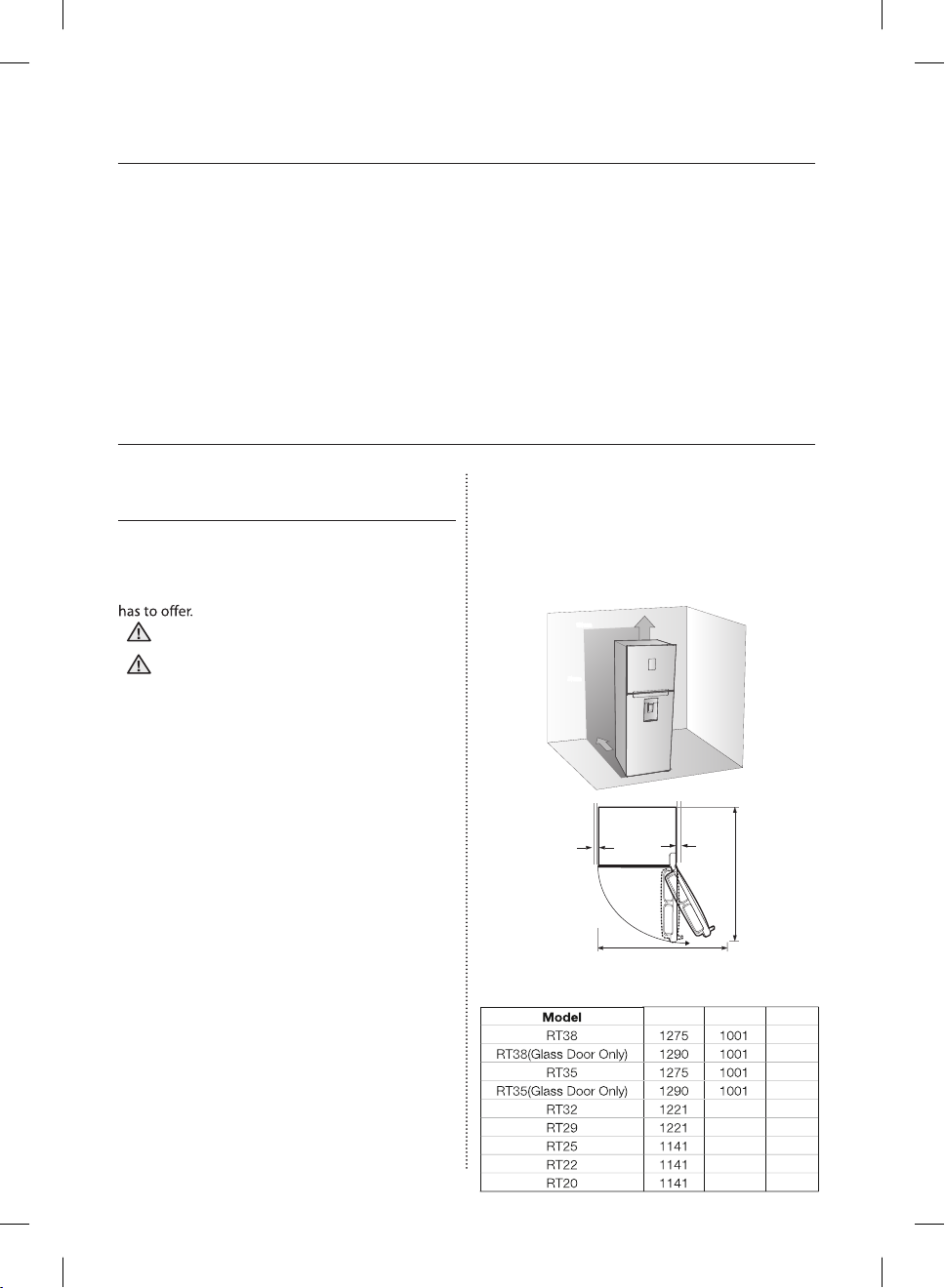
Overall space required in use. Refer to drawing and dimension as below.
100 mm
50 mm
at least
50 mm
115° (C)
1001 mm (A)
The fi gure above shows a RT38*.
at least
50 mm
B
A
1040
1040
)
1275 mm (
B C
964
964
964
115˚
115˚
115˚
115˚
135˚
135˚
135˚
135˚
135˚
Page 9
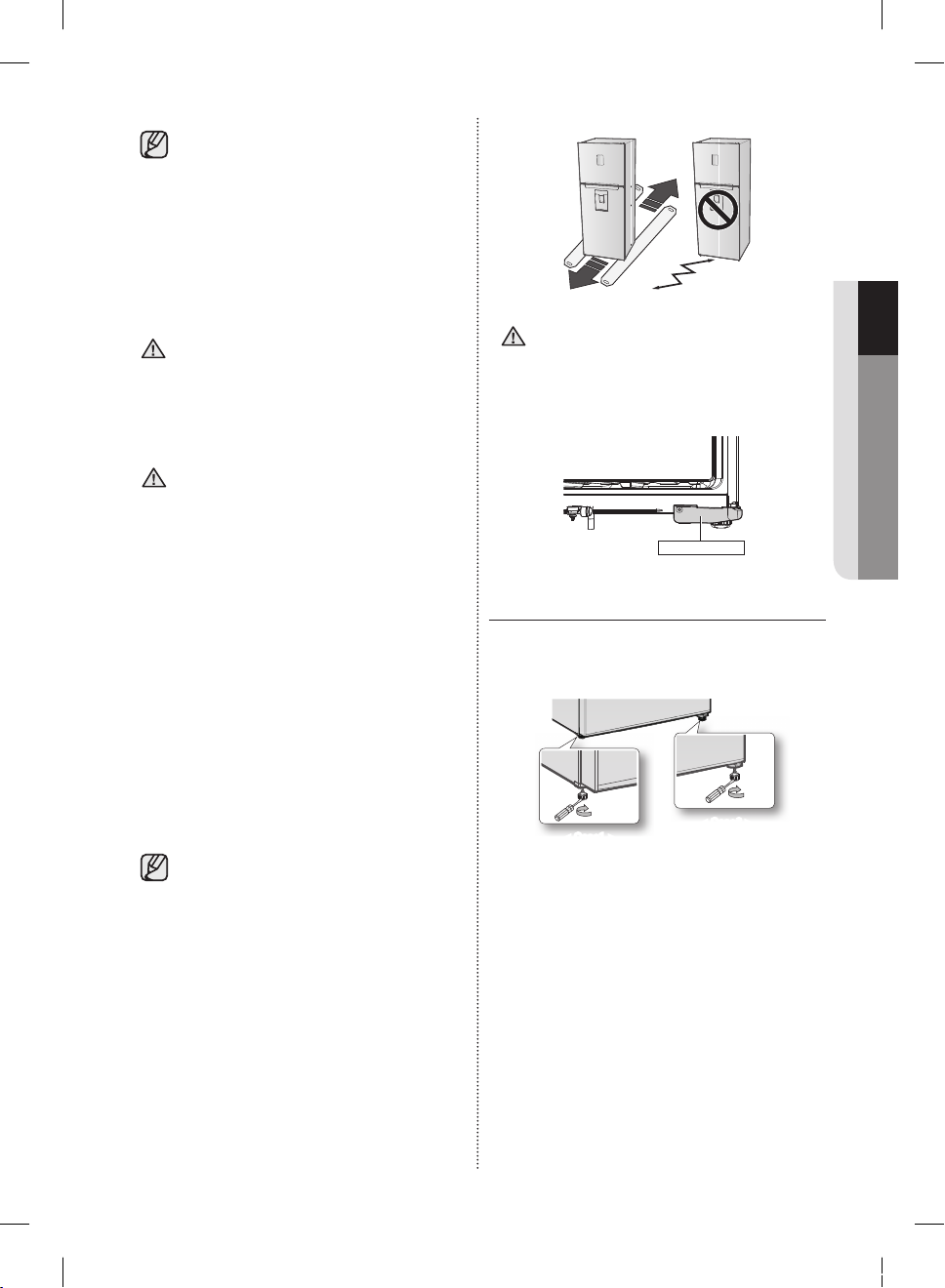
Allow suffi cient space to the right, left,
back and top for air circulation.
This will help reduce power consumption
and keep your energy bills lower.
Do not install the refrigerator where the
temperature will go below 10 °C.
Please ensure that appliance can be
moved freely in the event of maintenance
& service.
01 SETTING UP
When installing, servicing, or cleaning
behind the refrigerator, be sure to pull the
CAUTION
unit straight out and push back in straight
after fi nishing. Also, make sure your fl oor
supports the full-load refrigerator.
Otherwise, it may cause fl oor damage.
Please tie up the extra length of the power
CAUTION
cord at the back of the refrigerator so as
not to be touched on the fl oor preventing
the power cord from being crushed by the
rollers upon relocation.
FLOORING
For proper installation, this refrigerator must be
placed on a level surface of hard material that
has the same height as the rest of the fl ooring.
This surface should be strong enough to support
a fully loaded refrigerator (or approximately 100
kg). To protect the fl oor fi nish, cut a large section
of the cardboard carton and place it under the
refrigerator where you are working.
Pulling or pushing the refrigerator may
damage the fl oor.
Moving the refrigerator after installation
may damage the fl oor.
Be careful : do not damage the cover leg
CAUTION
while moving the refrigerator. The cover
leg protects the wire and hose . If it is
damaged, the refrigerator may also be
damaged.
Cover Leg
LEVELLING THE REFRIGERATOR
If the front of the appliance is slightly higher than
the rear, the door can be opened and closed more
easily.
< Case1 >
Case 1) The appliance tilts down to the left.
Turn the left adjusting leg in the direction of the •
arrow until the appliance is level.
< Case2 >
Case 2) The appliance tilts down to the right.
Turn the right adjusting leg in the direction of •
the arrow until the appliance is level.
setting up _09
DA68-02832A(EN)-0.0.indd 09 2012.11.19 11:29:51 AM
Page 10
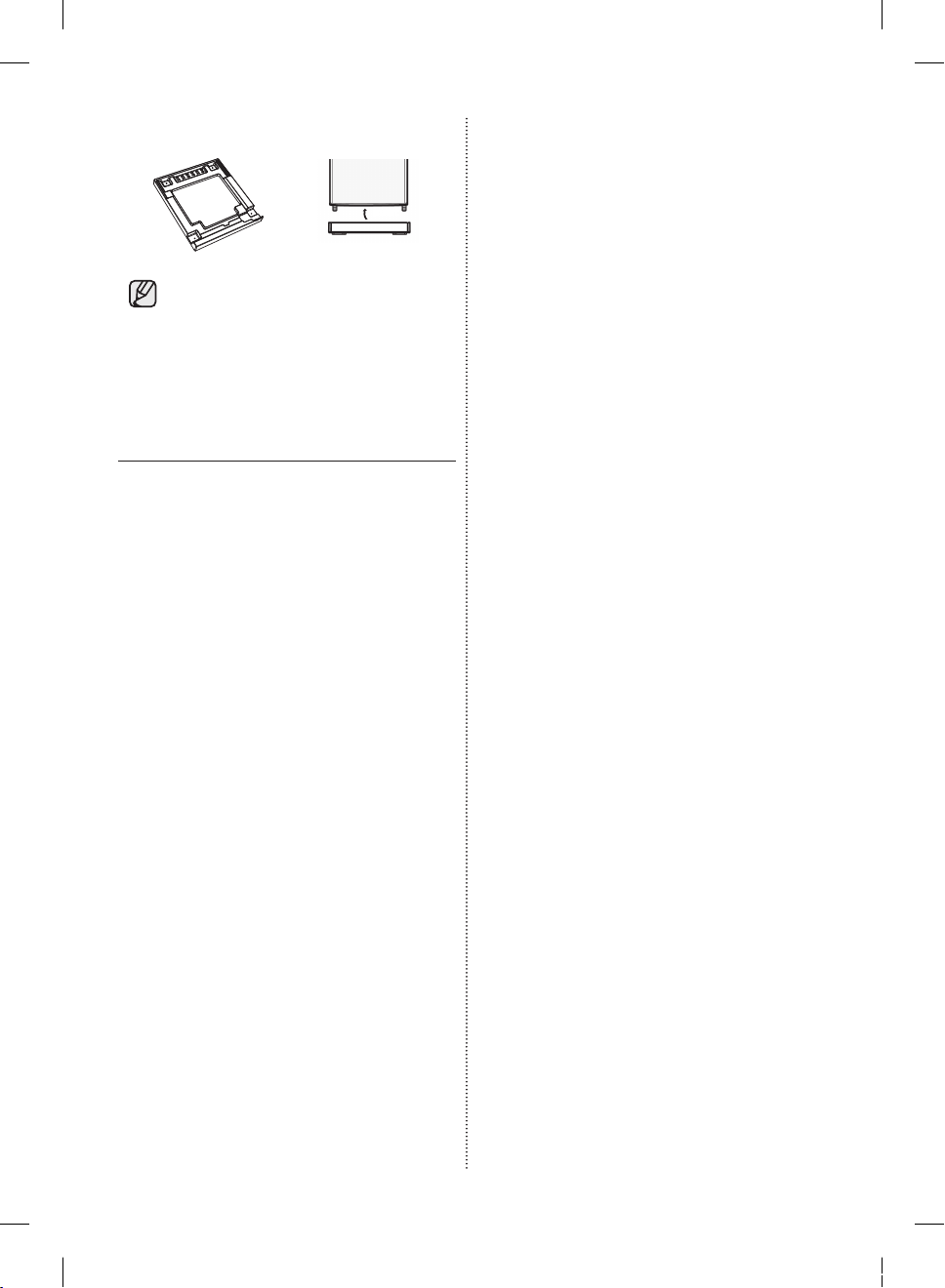
Standtable
Insert
Optional Standtable set base of
refrigerator, when you use it you can not
turn the adjusting leg.
(There is no Standtable according to the
model).
SETTING UP THE
REFRIGERATOR
Now that you have your new refrigerator installed
and in place, you are ready to set up and enjoy
the full features and functions of the appliance.
By completing the following steps, your refrigerator
should be fully operational.
If not, fi rst check the power supply and electricity
source or try the troubleshooting section at the
back of this user guide.
If you have any further questions, contact your
Samsung Electronics service center.
Place the refrigerator in an appropriate location 1.
with reasonable clearance between the wall
and the refrigerator.
Refer to installation instructions in this manual.
Once the refrigerator is plugged in, make sure 2.
the interior light comes on when you open the
doors.
Set the temperature control to the coldest 3.
temperature and wait for an hour.
The freezer should get slightly chilled and the
motor should run smoothly.
After powering the refrigerator, it will take a few 4.
hours to reach the appropriate temperature.
Once the refrigerator temperature is suffi ciently
cool, you can store food and drink in the
refrigerator.
10_ setting up
DA68-02832A(EN)-0.0.indd 10
Page 11
operating the SAMSUNG
refrigerator
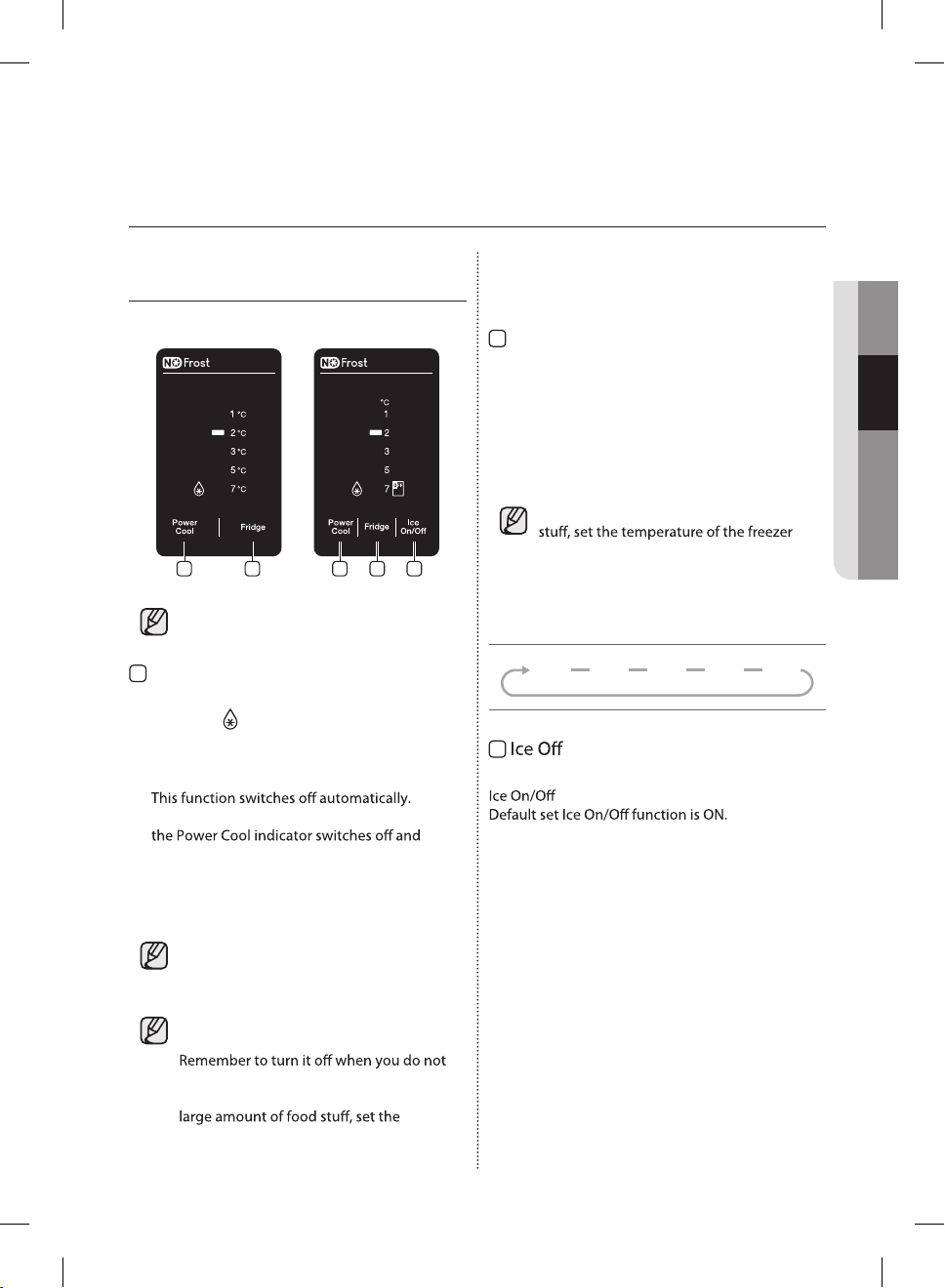
USING THE CONTROL PANEL
(DISPLAY TYPE)
(TYPE A) (TYPE B)
1 2 1 2 3
Each time you press the button, a short
beep will sound.
1
Power Cool
When you press the 1. Power Cool button, the
Indicator (
will speed up the time.
This function will be activated for several hours 2.
and then return to the previous temperature.
3.
When the Power Cool process is completed,
the freezer switches back to the previous
temperature setting.
To deactivate this function, press the Power
Cool button.
When you use the Power Cool function,
the coolong of the refrigerator will be
speeded up for several hours.
) will light up and the refrigerator
the right end and the temperature of
refrigerator to 1~2°C(Display model) or
Optimal ~5(non-Display model) at least
24 hours before.
2
Fridge
Press the Fridge button to set the fridge to
desired temperature from the range 1 °C to
between 1 °C and 7 °C.
Default set temperature is set on 2 °C and each
time you press the Fridge button, temperature
will changing following order and temperature
indicator will display the desired temperature.
If you need to freeze large amount of food
compartment on Freezer max Cold and
the temperature of the refrigerator on
1~2 °C (Display model) or Normal~5 (nonDisplay model) at least 24 hours before.
1 °C 7 °C 5 °C 3 °C 2 °C
3
If you do not want to make more ice, press the
We recommend you stop ice making if the
following occur:
button, and the indicator will light up.
There is enough ice in the ice bucket. You want to save water and energy. The water tank is empty. -
02 OPERATING
When you use this function the energy
consumption of the refrigerator will increase.
need it and return the freezer to your original
temperature setting. If you need to freeze
temperature of the freezer compartment to
operating _11
Page 12

CONTROLLING THE
TEMPERATURE
Temperature Temperature
control knobcontrol knob
FreezerFreezer RefrigeratorRefrigerator
If the room temperature is higher than 35 °C, •
do not set the Freezer Temperature
Controller to the Right.
Otherwise there may be problems with the
refrigerator’s performance.
Adjusting the Fridge Temperature
Optimal
DisplayDisplay
We recommend setting the temperature of the
freezer and the refrigerator to Optimal
a stable performance of the appliance.
If food in the refrigerator is frozen or if you wish
to increase the temperature of the freezer, set
the Freezer Temperature Controller to the Left.
If the room temperature is lower than 10 °C, •
set the Freezer Temperature Controller to the
Right to make ice.
If the room temperature is higher than 35 °C,•
set the Freezer Temperature Controller on
Optimal to make ice.
Adjusting the Temperature of the
Freezer.
If you wish to lower the temperature of the freezer
set the temperature controller of the freezer to the
Right.
If you wish to increase the temperature of the
freezer, set the temperature controller to the Left.
FridgeFridge
(A TYPE ) (B TYPE ) (C TYPE )
If the food in the refrigerator is not as cold as you
would like or if you wish to lower the temperature
of the refrigerator, set the refrigerator’s Temperature
Controller 5~6 or the Temperature on the Display
model to 1. If food in the refrigerator is frozen
or if you wish to increase the temperature
of the freezer, set the refrigerator’s Temperature
Controller to 1~3 or the Temperature of the Display
model to 3~7.
If the room temperature is lower than 10 °C, •
do not set the refrigerator’s Temperature
Controller to 1~2 or the Temperature of the
Display model to 5~7. Otherwise there may
be problems with the refrigerator’s performance.
When the room temperature is higher than •
35 °C, set the Fridge Temperature Controller
on 4~6 or the Temperature of Display model
on 1~2. Otherwise there may be problems
with the refrigerator’s performance.
MAKING ICE (OPTIONAL)
TWIST ICE MAKER
,
Making Ice Cubes
Remove the ice cube tray by pulling it towards
you. Fill the tray with water up to the maximum
water level marked on the rear of the tray.
Slide the tray back into the holder, taking care not
to spill the water.
Wait until the ice cubes are formed.
Removing the Ice Cubes
If the room temperature is lower than 10 °C, •
set the Freezer Temperature Controller to
the Right.
Water Level
Otherwise the performance of the refrigerator
may cause problems.
Make sure that the ice cube storage bin is in place
under the ice cube tray. If not, slide it into place.
12_ operating
DA68-02832E(0.2).indb 12DA68-02832E(0.2).indb 12 2013.1.21 2:18:41 PM2013.1.21 2:18:41 PM
Page 13
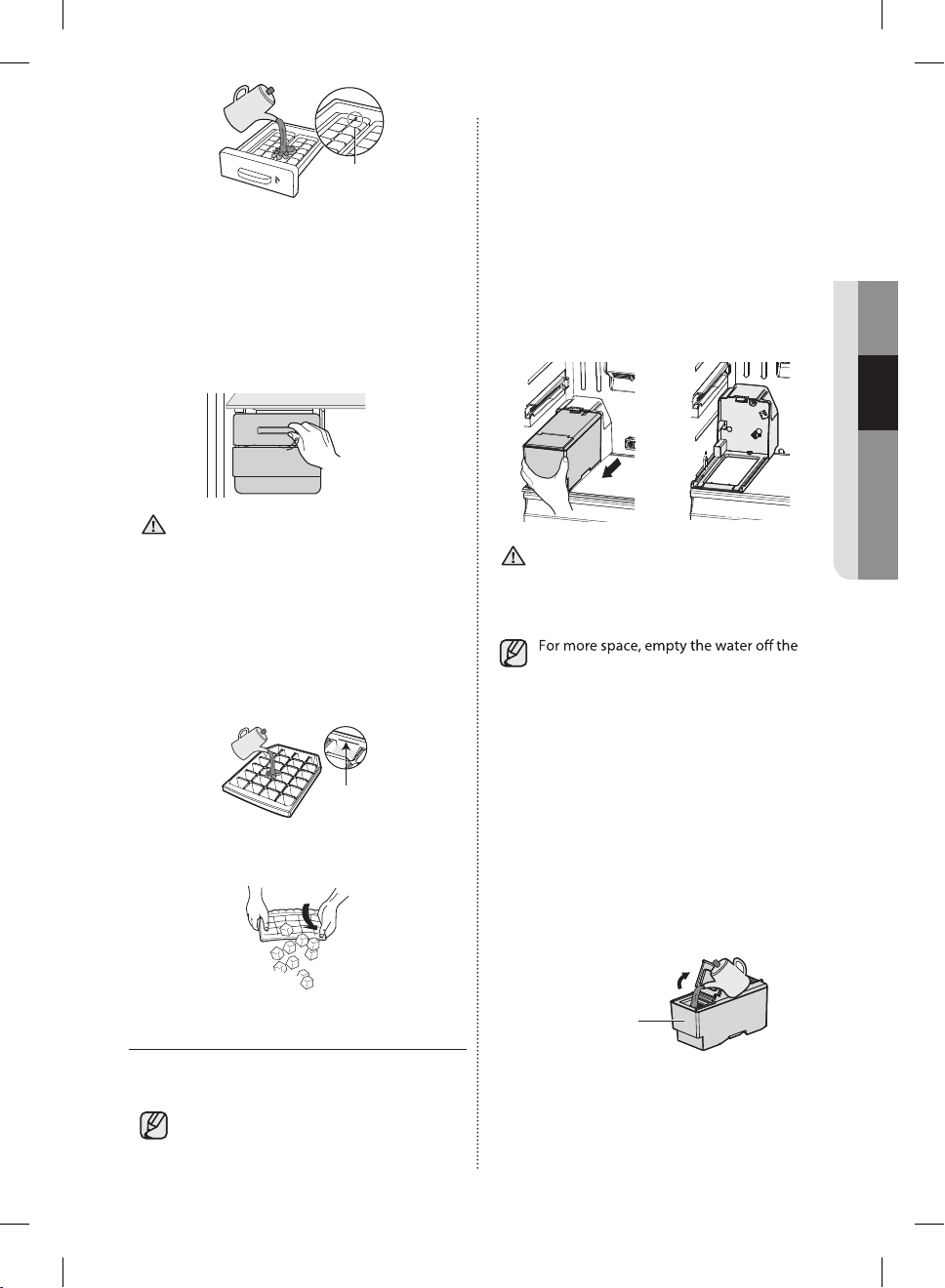
Water Level
Make sure that the ice cube storage bin is in place
under the ice cube tray. If not, slide it into place.
Twist one of the levers fi rmly in the clockwise
direction until the tray twists slightly.
Result : The ice cubes fall into the storage bin.
Repeat Step 2 for the other half of the tray, if
necessary. Remove the storage bin by:
Lifting it slightly•
Pulling it towards you•
again.
The dispenser is designed with an
operating time of about 1 minute and a
capacity of about 1 L at each use.
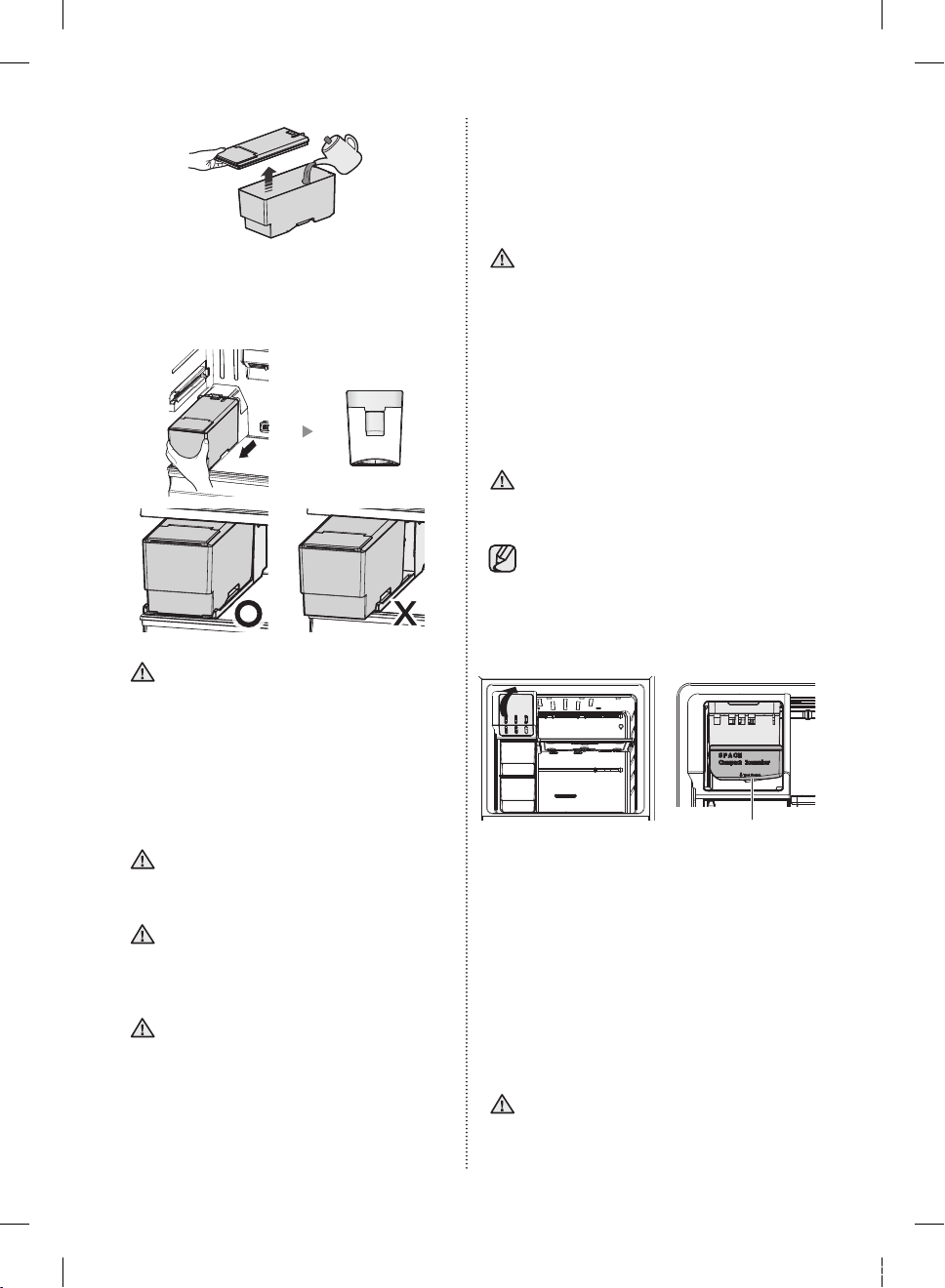
Lift up and pull out the water tank.
Hold the handgrips on both sides to lift out the •
water tank.
Clean the inside of water tank before using it •
for the fi rst time.
After disassembling the water tank, wipe up •
the inside of refrigerator until it is clean and dry.
02 OPERATING
Danger of explosion
CAUTION
•
Glass bottles containg liquids that can
freeze should never be stored in the
freezer as the glass will explode when
the contents freeze.
TRAY TYPE (OPTIONAL)
Making ice cubes
Fill up the ice tray with water and that till it reaches
the maximum level mark on the rear of the tray.
Put the ice tray in the freezer.
Removing the ice cubes
Hold both ends of the ice tray, remove the ice
cubes from the tray by twisting it gently.
USING WATER DISPENSER
(OPTIONAL)
With the water dispenser, you can obtain chilled
water easily without opening the refrigerator door.
If you push continually the dispenser lever
for about 1 minute, the dispenser will stop
to work. To get more water, push the lever
After
After putting back the water tank, do not
CAUTION
disassemble the shelf below the water tank.
It may cause a personal injury or material
damage.
water tank, remove the lid completely,
place the water tank back and use it to
store food.
Fill the water tank with water, ensuring that it is
in a stable position, allowing for the extended
water supply outlet.
Fill with water up to 5 L. If it is fi lled higher than •
this, it may overfl ow when the lid is closed.
It is impossible to fi ll the tank with water while it •
is positioned in the refrigerator.
Method 1.
Fill the water lifting the round lid in the arrow
direction to open.
Water tank
Method 2.
Please fi ll the water after holding and lifting the
large lid to open it.
operating _13
Page 14
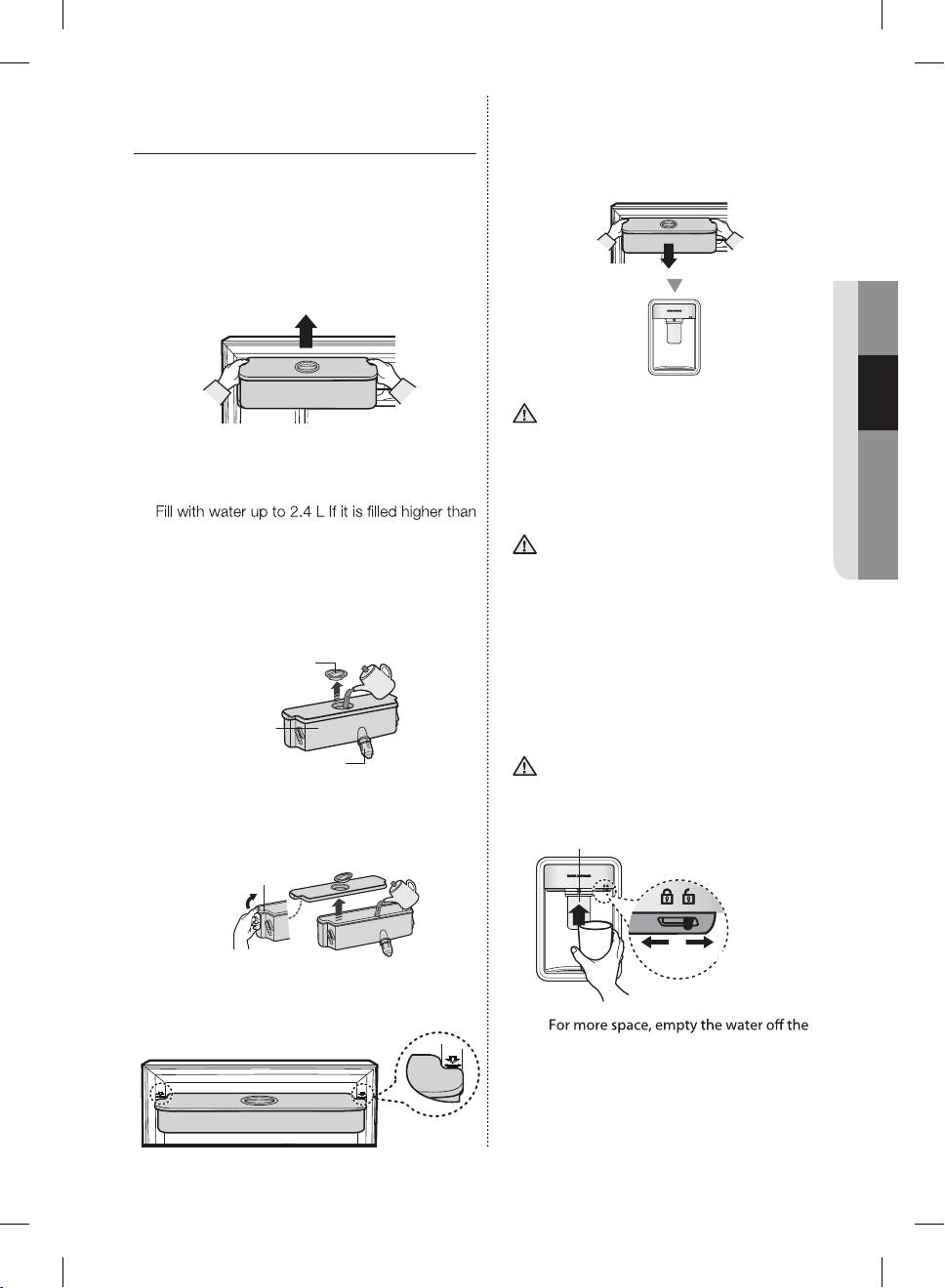
Place a glass underneath the water outlet and
push gently against the dispenser lever with
your glass.
Make sure the glass is in line with the
dispenser to prevent the water from bouncing
out.
Close the refrigerator door after fi tting the
water tank.
Confi rm that the dispenser cock is outside •
after closing the door.
Fix water tank on the shelf inside the
CAUTION
fridge.
If not, water tank may not be operate
correctly.
Do not use the refrigerator without the
water tank.
If not, it may cause an effi ciency problem.
While fi xing the water tank, be careful that
your fi ngers will not be caught.
Only fi ll the tank with water (mineral water
CAUTION
or purifi ed water) and do not use any other
liquid.
Be careful that the tank will not drop while
CAUTION
you are moving the refrigerator because
you may get hurt if the water tank is fi lled
with water.
When you do not use the water dispenser
CAUTION
for 2~3 days (especially during the
summer), the dispensed water may have
a funny smell or taste. If this occurs, we
recommend that you discard the fi rst 1~2
glasses for better tasting water.
If you have just installed the Refrigerator, pour
out the fi rst six glassfuls of water to fl ush out
impurities in the water supply system. Make sure
water fl ows cleanly before drinking.
Make sure that no water is in the water
CAUTION
tank when you are going on a long
vacation or business trip.
Please wait 1 second before removing
the cup after dispensing water to prevent
spills.
Please push the dispenser lever 1~10
seconds when you use it fi rst time due to
air with in the hose.
< Before >
*
option model.
< After >
Test button
When upper Ice Tray full, switch the upper and
lower ice tray.
rekaM ecI otuA eht swohs evoba erug fi ehT
Do not disassemble the internal pump
CAUTION
which is connected to the water tank.
Be careful to not damage the hose and
nozzle of the water tank.
The dispenser can not be operated if it is
disassembled or damaged.
14_ operating
CAUTION
Test button
In case ice does not come out, pull out •
the ice bucket and press test button
located on right side of ice maker.
2012.11.19 11:30:0 AM
Page 15
USING WATER DISPENSER
(OPTIONAL)
With the water dispenser, you can obtain chilled
water easily without opening the refrigerator door.
Lift up and pull out the water tank.
• Hold the handgrips on both sides to lift out the
water tank.
• Clean the inside of water tank before using it for
the first time.
Fill the water tank with water, ensuring that it is
in a stable position, allowing for the extended
water supply outlet.
•
this, it may overflow when the lid is closed.
• Is possible fill the tank with water while it
is positioned in the refrigerator.
Method 1.
Fill the water lifting the round lid in the arrow
direction to open.
Round lid
Water tank
Close the refrigerator door after fitting the
water tank.
• Confirm that the dispenser cock is outside after
closing the door.
Fix water tank to the fridge door tightly.
CAUTION
If not, water tank may not be operate
correctly.
Do not use the refrigerator without the
water tank.
If not, it may cause an efficiency problem.
Do not put anything other than water
CAUTION
in the water tank.
Place a glass underneath the water outlet and
push gently against the dispenser lever with
your glass.
Make sure the glass is in line with the
dispenser to prevent the water from bouncing
out.
02 OPERATING
Dispenser cock
Method 2.
Please fill the water after holding and lifting the
large lid to open it.
Hand-grip
Make sure to assembly the water tank, is below
the reference lines.
Check that the locking device is set to
CAUTION
“unlock”.
Water can only be dispensed on this
setting.
Dispenser Lever
LOCK
UNLOCK
water tank, remove the lid completely,
place the water tank back and use it to
store food.
For water dispenser usage, do not put
anything other than water in the water tank.
operating _15
Page 16
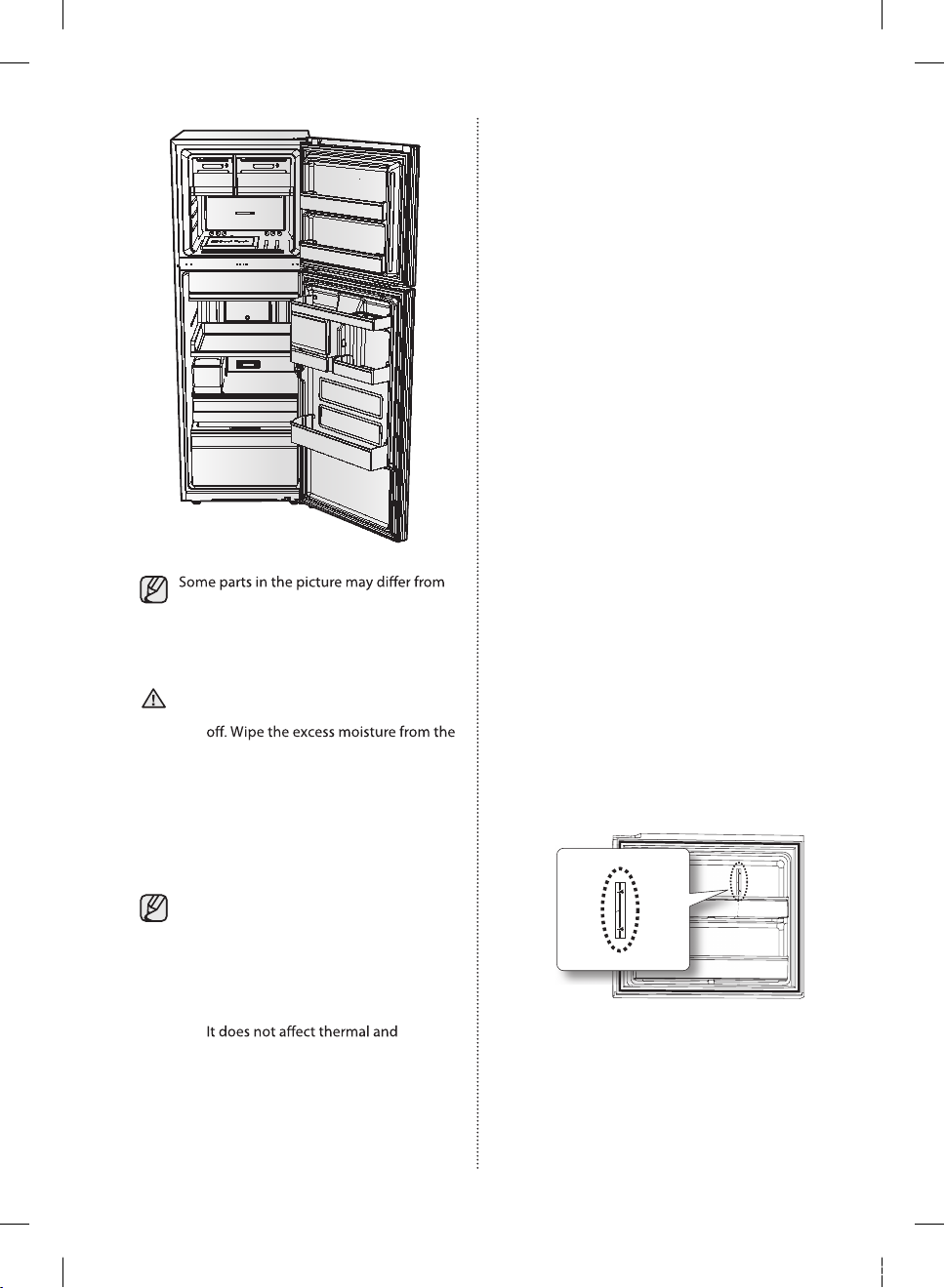
your refrigerator, depending of the model
and option (for example ice tray, auto ice
maker, twice ice maker, cool pack, shelf or
water dispenser).
kits, you have to remove right one fi rst.
(only for ice maker option model)
If you do not want to use water •
dispenser, you can remove water tank.
(only for dispenser model)
To get the best energy effi ciency of •
this product, please leave all selves,
drawers and baskets on their original
position like as 16 page illustration.
The lower guard of the •
freezer compartment is only two star
section. So, the lower guard shall
be placed on the original position
for proper performance.
•
The Alarm function of the display
model works when door of the
fridge is open. Please also check if the
freezer door is closed, because alarm
does not ring when the freezer door is
opened.
In the case of a non-display model,
the alarm does not ring even if the
doors of the fridge and the freezer are
open. Check if the doors are closed.
• If you plan to go away for a signifi cant
WARNING
•
•
16_ Operating
time, empty the refrigerator and turn it
inside of the appliance and leave the
doors open.
This helps keep odour and mold from
developing.
If the refrigerator is not to be used for a •
long period of time, pull out the power
plug.
To get more space in the
freezer compartment, you can
remove applicable fi tting(s) such
as cool pack(s), shelf(s), twist Ice
maker(s), ice storage bin(s) and their
supporter(s) which can be removed
without aid of a tool.
mechanical characteristics.
A declared storage volume of freezer
compartment is calculated with above
things removed.
If you want to remove both ice maker
In particular, there is load limit line at
•
the right side of the freezing upper
Guard compartment. Please do not
put food items on the right side of
the load limit line. (Optional)
2012.11.19 11:30:3 AM
Page 17
REMOVING THE REFRIGERATOR
ACCESSORIES
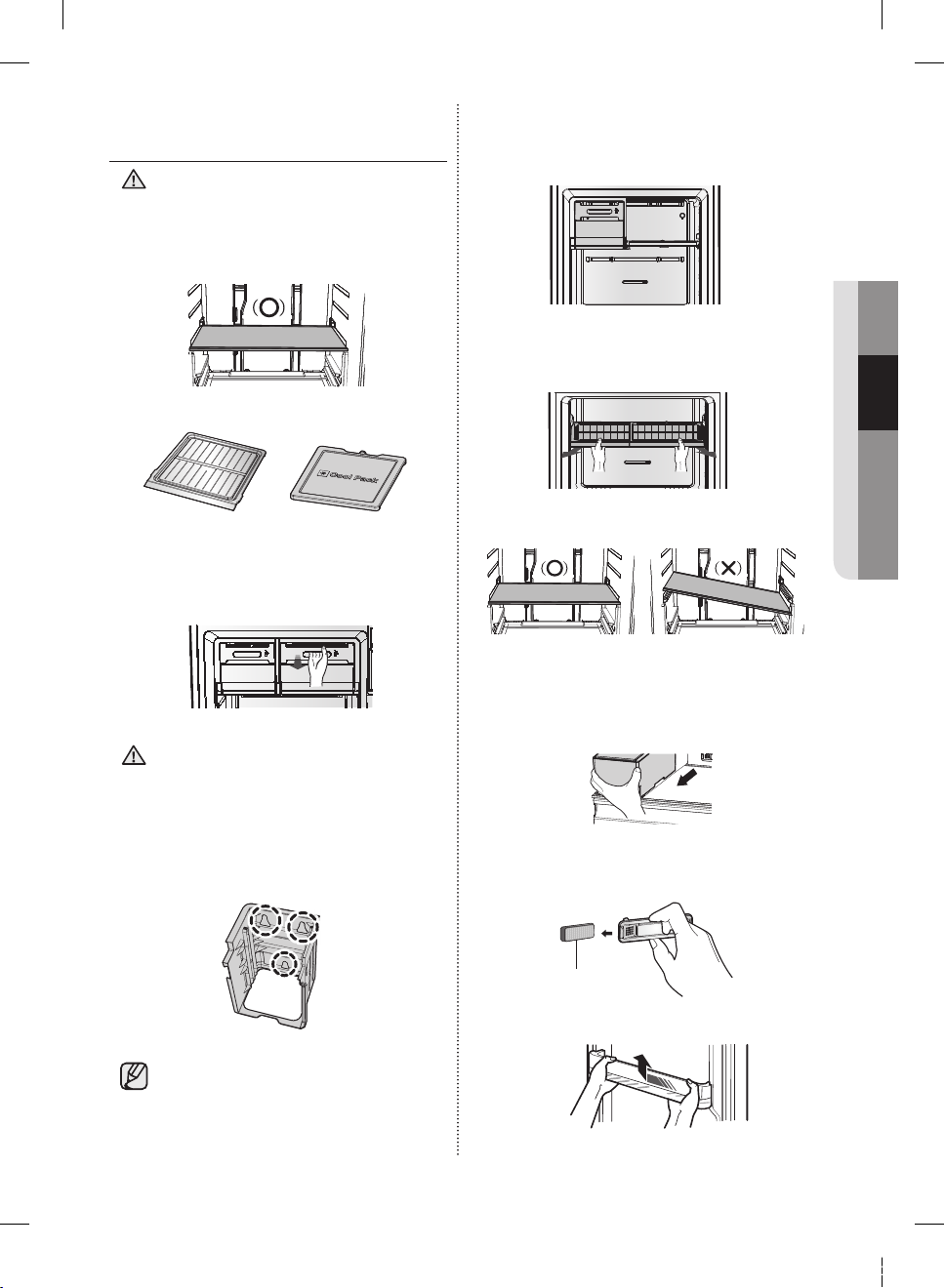
While assembling, put the freezer shelf,
refrigerator shelves and cool pack in the
CAUTION
correct position and do not put them
upside down. It may cause a personal
injury or material damage.
Pull out the ice tray and box and then pull out 1.
the right side of support tray ice. Same steps
to left side. (Only for ice max option model)
Lift up the freezer shelf or cool pack and pull it 2.
forward and then pull out the ice tray and box.
Pull out the support tray ice. (Only for freezer
shelf or cool pack option model)
02 OPERATING
Remove ice tray and then lift up the freezer 3.
shelf, and pull it forward.
(Only for ice tray option model)
Pull the the refrigerator shelves towards you.4.
Lift up the cool pack and pull it forward. 5.
(Only for auto ice maker option model)
Be careful when you pull out the ice tray
CAUTION
support because it will protrude up to you
suddenly.
Be careful when you disassemble and
assemble the ice tray support because the
upper side of it has a sharp edge. It may
occur fi nger injury.
To assemble, place the ice tray support
above the slots with the right side higher.
Hold it underneath in the middle and push
the ice tray support until it snaps into
place.
Pull it out while pressing the end of the sill on 6.
the low temperature catalyzing deodorizer.
catalyzing
Lift up and pull out the door guards.7.
operating _17
Page 18
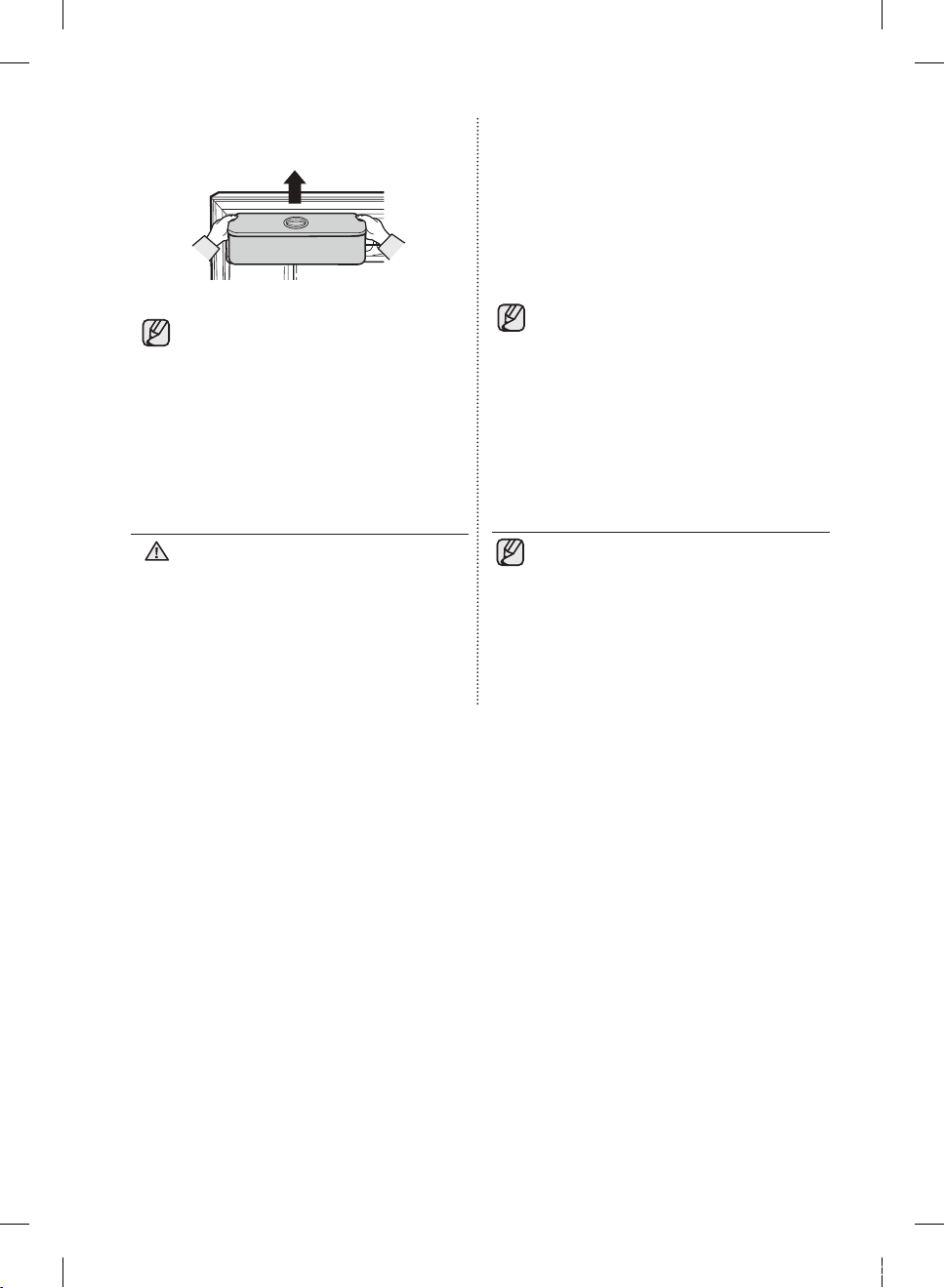
Lift up and pull out the water tank (optional)
8.
as shown in the diagram.
Do not spray the refrigerator with water
while it is plugged in, as it may cause an
electric shock.
Do not clean the refrigerator with benzene,
thinner or car detergent for risk of fi re.
Unplug the power cord of the refrigerator.1.
Slightly dampen a soft lint-free cloth or paper 2.
towel with water.
Before removing any accessories, make
sure that no food is in the way.
When possible, remove the food altogether
to reduce the risk of accidents.
Some models will not allow the drawer
to be removed without removing the door
bin first.
Please remove the door guards first to
reduce the risk material.
CLEANING THE REFRIGERATOR
Do not use Benzene, Thinner or Clorox™
WARNING
for cleaning. They may damage the surface
of the appliance and can create a risk of
fi re.
Do not use any kind of detergent to clean
the refrigerator because that can discolor
or damage the refrigerator.
Wipe the inside and outside of refrigerator until 3.
it is clean and dry.
Plug the power code of the refrigerator.4.
REPLACING THE INTERIOR
LIGHT
For LED lamp, please contact service
engineer to replace it.
18_ operating
2012.11.19 11:30:8 AM
Page 19
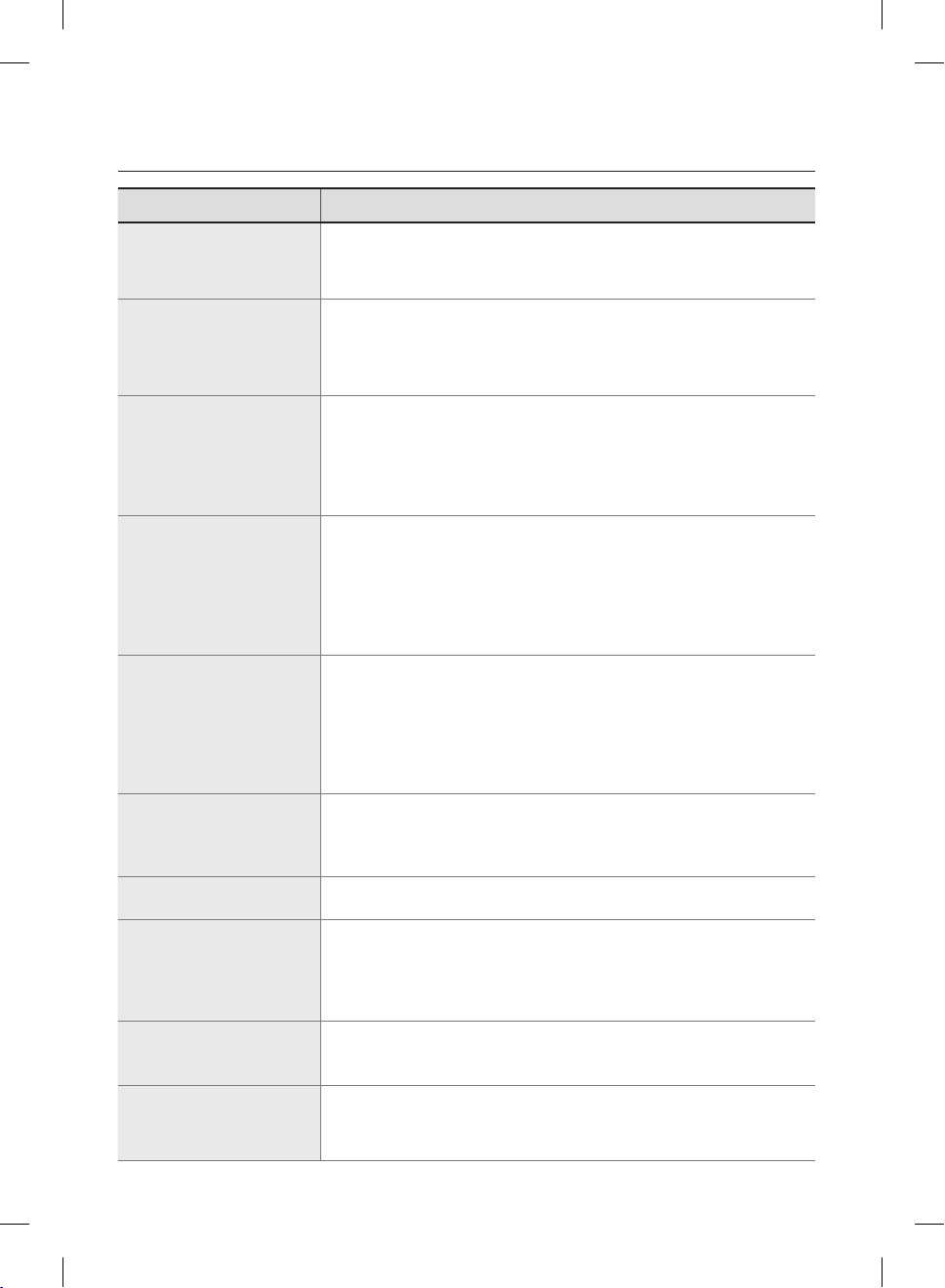
Troubleshooting
PROBLEM SOLUTION
The appliance is not
operating at all or the
temperature is too high.
The food in the refrigerator
is frozen.
There are unusual noises.
The front corners and
sides of the appliance are
warm and condensation
starts to form.
Ice Maker is not producing
ice.
Water dispenser is not
functioning.
You can hear a liquid
bubbling in the appliance.
There is a bad smell inside
the appliance.
There is a layer of frost on
the appliance walls.
Condensation forms on
the inside wall of the
appliance and around
vegetables.
Check that the power plug is correctly connected.•
Is the temperature control on the front panel correctly set?•
Does sun shine on the appliance or are there heat sources nearby?•
Is the back of the appliance too near to the wall?•
Is the temperature control on the front panel set to the coldest •
temperature?
Is the surrounding temperature too low?•
Did you store the food with a high water content in the coldest part •
of the fridge?
Check that the appliance is installed on a stable, level fl oor.•
Is the back of the appliance too near to the wall?•
Have any foreign objects fallen behind or under the appliance?•
Is the noise coming from the compressor in the appliance?•
A ticking sound may be heard inside the appliance; this is normal. •
This sound occurs when the various accessories contract or expand.
Heat-proof pipes are installed in the front corners of the appliance •
to prevent condensation from forming.
When the surrounding temperature rises, this may not always be
effective. However, this is not abnormal.
In very humid weather, condensation may form on the outer •
surface of the appliance when the moisture in the air comes into
contact with the cool surface of the appliance.
Did you wait for 12 hours after installation of the refrigerator before •
making ice?
Did you manually stop the ice making function?•
Is the freezer temperature too warm? Try setting the freezer •
temperature lower.
Did you fi ll the water tank with water?•
Did you check fi tting the water tank correctly ?•
Is the water tank frozen because the fridge temperature is too low?•
Try selecting a warmer setting on the Digital display.
Did you fi ll with water in water tank?•
Did you check fi tting the water tank correctly ?•
This is the refrigerant, which cools the inside of the appliance.•
Has a food item spoiled?•
Make sure that strong smelling food (for example, fi sh) is wrapped •
so that it is airtight.
Clean out your freezer periodically and throw away any spoiled or •
suspect food.
Are the air outlet vents blocked by food stored inside the refrigerator.•
Space the food out as much as possible to improve ventilation.•
Is the door fully closed?•
Food with a high water content is stored uncovered with a high •
humidity level or the door has been left open for a long time.
Store the food with a cover or in sealed containers.•
19_ Troubleshooting
Page 20
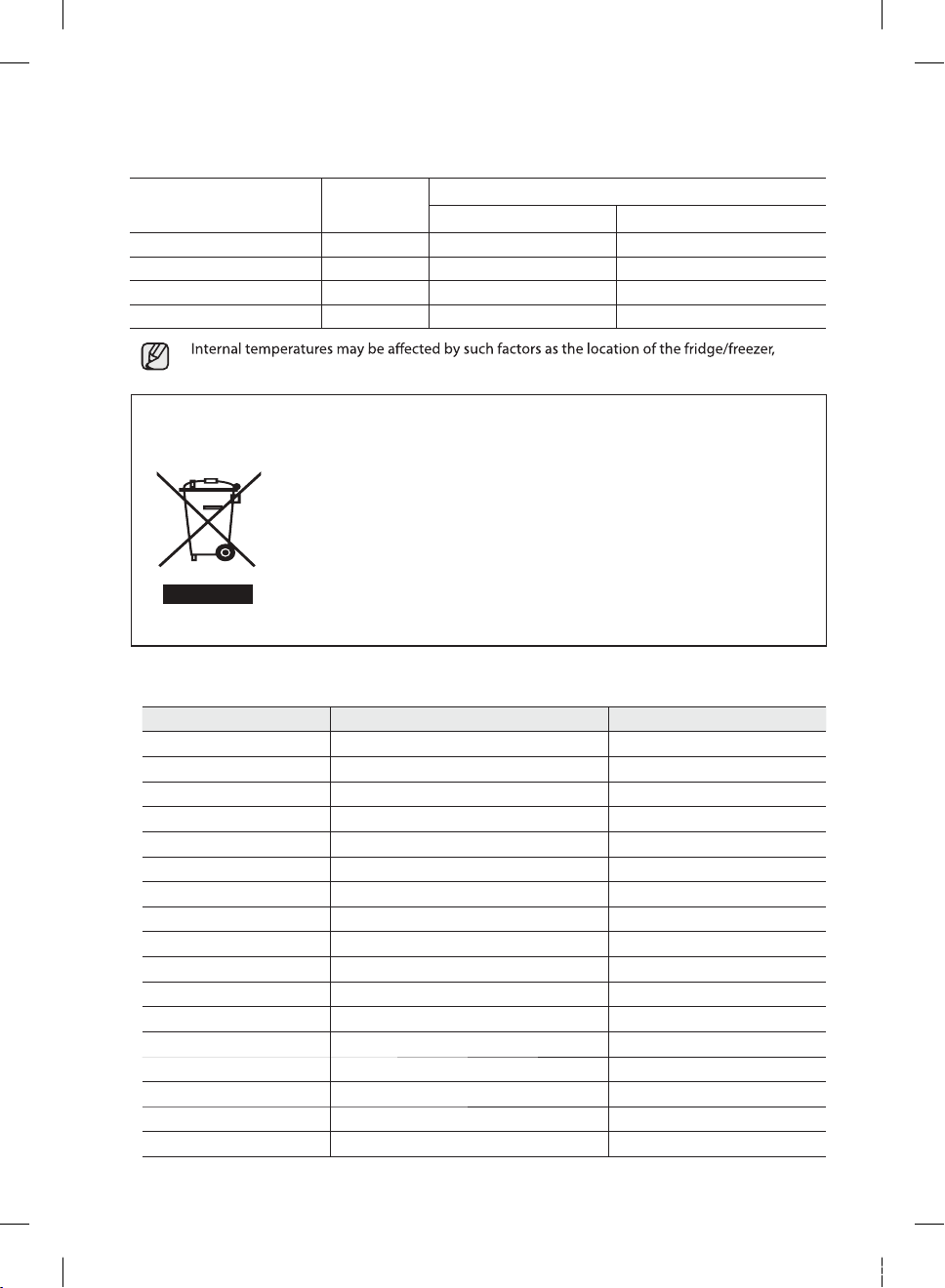
Ambient Room Temperature Limits
This refrigerator is designed to operate in ambient temperatures specifi ed by its temperature class
marked on the rating plate.
Class Symbol
Extended Temperate +10 to +32 +10 to +32
SN
IEC 62552 (ISO 15502)
Temperate N +16 to +32 +16 to +32
Subtropical ST +16 to +38 +18 to +38
Tropical T +16 to +43 +18 to +43
ambient temperature and the frequency with which you open the door.
Adjust the temperature as required to compensate for these factors.
Correct Disposal of This Product
English
(Waste Electrical & Electronic Equipment)
(Applicable in the European Union and other European countries
with separate collection systems)
This marking shown on the product or its literature, indicates that it should not be
disposed with other household wastes at the end of its working life. To prevent
possible harm to the environment or human health from uncontrolled waste disposal,
please separate this from other types of wastes and recycle it responsibly to
promote the sustainable reuse of material resources.
Household users should contact either the retailer where they purchased this product
or their local government office, for details of where and how they can take this
item for environmentally safe recycling.
Business users should contact their supplier and check the terms and conditions
of the purchase contract. This product should not be mixed with other commercial
wastes for disposal.
Contact SAMSUNG WORLD WIDE
If you have any questions or comments relating to Samsung products, please contact the
SAMSUNG customer call center.
COUNTRY Custom Care Center WEBSITE
ARGENTINE 0800-333-3733 www.samsung.com/ar
BRAZIL 0800-124-421 4004-000
CHILE 800-SAMSUNG(726-7864)
MEXICO 01-800-SAMSUNG(726-7864)
NICARAGUA 00-1800-5077267 www.samsung.com/latin
HONDURAS 800-7919267 www.samsung.com/latin
COSTA RICA 0-800-507-7267 www.samsung.com/latin
ECUADOR
EL SALVADOR
GUATEMALA www.samsung.com/latin
JAMAICA
PANAMA
PUERTO RICO www.samsung.com/latin
REP. DOMINICA www.samsung.com/latin
TRINIDAD & TOBAGO
1-800-10-7267
800-6225
01-800-299-0013
1-800-234-7267
800-7267
01-800-682-3180
1-800-751-2676
01-800-SAMSUNG (726-7864)
VENEZUELA 0-800-100-5303 www.samsung.com/latin
COLOMBIA 01-8000112112 www.samsung.com.co
Ambient Temperature range (°C)
ISO 8561 / NTE INEN 2206
www.samsung.com/br
www.samsung.com/cl
www.samsung.com/mx
www.samsung.com/latin
www.samsung.com/latin
www.samsung.com/latin
www.samsung.com/latin
www.samsung.com/latin
2012.11.19 11:30:9 AM
Page 21
Refrigerador
manual de usuario
RT29**
RT32**
RT35**
RT38**
Español
imagine las posibilidades
Gracias por comprar un producto Samsung.
Para recibir un servicio completo, registre su producto en
www.samsung.com/register
Dispositivo independiente
DA68-02832P(ES).indd 1 2012.11.22 9:52:31 AM
Page 22
información de seguridad
INFORMACIÓN DE SEGURIDAD
Leer instruccion técnica antes de instalar el •
artefacto.
•
Leer las instrucciones de uso antes de encender
el artefacto.
Utilice este aparato solo para las funciones •
propias que se describen en este manual de
instrucciones. Este electrodoméstico no está
diseñado para que lo usen personas (incluidos
los niños) con las capacidades físicas,
sensoriales o mentales reducidas, o faltas de
conocimiento y experiencia, sin la supervisión
o las indicaciones de una persona responsable
que garantice un uso seguro del aparato.
Las advertencias y las instrucciones de •
seguridad importantes de este manual no
abarcan todas las situaciones posibles que
puedan surgir. Es su responsabilidad usar
el sentido común y actuar con precaución
y cuidado durante la instalación, el
mantenimiento y el uso del electrodoméstico.
Ya que las siguientes instrucciones de •
funcionamiento se aplican a varios modelos,
las características de su frigorífi co pueden
variar ligeramente de las descritas en
este manual. Se utilizan los refrigerantes
R600a o R134a. Compruebe la etiqueta
del compresor situada en la parte posterior
del electrodoméstico o la etiqueta de
especifi caciones del interior del frigorífi co para
ver cuál es el refrigerante utilizado. Cuando
este producto contenga gases infl amables
(refrigerante R600a), póngase en contacto
con las autoridades locales para eliminar este
aparato de forma segura.
Símbolos y precauciones de
seguridad importantes:
Prácticas peligrosas o inseguras que pueden
ADVERTENCIA
provocar lesiones físicas graves o la muerte.
Prácticas peligrosas o inseguras que pueden
provocar lesiones físicas leves o daños en
PRECAUCIÓN
la propiedad.
NO intentarlo.
NO desmontar.
NO tocar.
Seguir las instrucciones cuidadosamente.
Desconectar el enchufe de la toma mural.
02_ Información de seguridad
Estos símbolos de advertencia tienen la
función de prevenir lesiones personales a
usted y a otras personas.
Debe seguirlos cuidadosamente.
Después de leer esta sección, guárdela para
consultas futuras.
Aviso CE
Se ha establecido que este producto cumple
la Directiva sobre baja tensión (2006/95/CE), la
Directiva sobre compatibilidad electromagnética
(2004/108/CE) y la Directiva sobre diseño ecológico
(2009/125/CE) establecidas por el Reglamento (CE)
N.º 643/2009 de la Unión Europea.
Comprobar que el frigorífi co está conectado a
tierra para prevenir una descarga eléctrica.
Llamar al centro de servicio técnico.
Nota.
SEÑALES DE ADVERTENCIA
ADVERTENCIA
IMPORTANTES SOBRE EL
TRANSPORTE Y LA INSTALACIÓN
• Cuando transporte e instale el
electrodoméstico, tenga cuidado de
no dañar ninguna pieza del circuito de
refrigeración.
Cuando este producto contenga gases •
infl amables (refrigerante R600a).
Una fuga de refrigerante se puede infl amar o causar lesiones oculares. Si detecta una fuga,
evite la presencia de llamas o fuentes capaces
de provocar una ignición y ventile durante
varios minutos la habitación donde está
instalado el frigorífi co.
Para evitar que se mezcle el gas infl amable y el aire en caso de una fuga en el circuito de
refrigeración, el tamaño de la habitación donde
se pueda instalar el electrodoméstico dependerá
de la cantidad de refrigerante utilizado.
Nunca ponga en marcha un electrodoméstico que presente indicios de daños. En caso de
duda, póngase en contacto con el distribuidor.
El tamaño de la habitación donde se instale el
frigorífi co debe ser de 1 m³ por cada 8 g de
refrigerante R600a. La cantidad de refrigerante
de cada electrodoméstico se indica en la
placa de identifi cación que se encuentra en el
interior.
2012.11.22 9:52:32 AM
2012.7.11 8:41:50 PM
Page 23
SEÑALES DE PRECAUCIÓN
ADVERTENCIA
DE MÁXIMA IMPORTANCIA
PARA EL TRANSPORTE Y EL
EMPLAZAMIENTO
• Cuando transporte e instale el aparato,
debe prestar un cuidado especial en
asegurarse de que no resulte dañada
- En caso de que se produzca una fuga de
- Este aparato contiene una pequeña cantidad de
- Podría dañar el refrigerador así como inutilizar el
ADVERTENCIA
ninguna parte del circuito de refrigeración.
refrigerante en las tuberías, podría infl amarse
o provocar lesiones en los ojos. Si detecta una
fuga, evite cualquier tipo de fuego o fuentes
potenciales del mismo y ventile la sala donde
se encuentra el aparato durante varios minutos.
refrigerante isobutano (R600a), un gas natural
de alta compatibilidad ambiental pero aún así es
un combustible. Cuando transporte e instale
el aparato, debe llevar especial cuidado en
asegurarse de que no resulte dañada ninguna
parte del circuito de refrigeración.
Cuando transporte e instale el aparato, no •
toque el conducto de agua de la parte trasera
del refrigerador.
dispensador de agua.
SEÑALES DE ADVERTENCIA
DE MÁXIMA IMPORTANCIA
PARA LA INSTALACIÓN
• El deterioro del aislamiento de los
componentes eléctricos podría provocar
un incendio o una descarga eléctrica.
No sitúe este refrigerador bajo la luz directa del •
sol ni en un lugar donde esté expuesto al calor
de estufas, radiadores u otros aparatos.
No enchufe varios aparatos en la misma toma.•
El refrigerador debe estar siempre enchufado a
su propia toma de corriente individual cuya
tensión se ajuste a la que aparece en la etiqueta
de características.
- De esta forma, obtendrá un mejor rendimiento
y evitará sobrecargar los circuitos eléctricos de
su casa, algo que podría provocar un riesgo de
incendio por el sobrecalentamiento de los cables.
•
Si la toma de corriente está suelta, no conecte
el enchufe.
- Puede haber un riesgo de incendio o de
descargas eléctricas.
No utilice un cable que tenga grietas o muestras de •
desgaste, bien sea a lo largo o en sus extremos.
No tire ni doble dema siado el cable del enchufe•
No retuerza ni ate el cable de corriente.•
No enganche el cable de corriente a un objeto •
metálico, no coloque ningún objeto pesado
sobre el mismo, no lo disponga entre objetos,
ni lo recoja en el espacio detrás del aparato.
- Cuando mueva el refrigerador, tenga cuidado de
no pisar ni dañar el cable de alimentación.
- Podría producirse una descarga eléctrica o un
incendio.
No utilice aerosoles cerca del refrigerador.•
- El uso de aerosoles cerca del refrigerador podría
producir una explosión o un incendio.
- No doble demasiado el cable del enchufe ni
apoye objetos pesados sobre él.
• Este refrigerador debe ser instalado y ubicado
adecuadamente siguiendo las instrucciones
de este manual antes de ser utilizado.
No instale el refrigerador en lugares húmedos o en •
zonas donde pueda mojarse.
- El deterioro del aislamiento de los componentes
eléctricos podría provocar un incendio o una
descarga eléctrica.
Introduzca el enchufe de alimentación de la •
forma adecuada, con el cable hacia abajo.
- Si lo enchufa en el otro sentido, podría cortarse el
cable y causar un incendio o una descarga eléctrica.
Asegúrese de que el enchufe no se aplasta o •
avería por la parte posterior del refrigerador.
Cuando mueva el refrigerador, tenga cuidado de •
no pisar ni dañar el cable de alimentación.
- Esto puede provocar un riesgo de incendio.
Mantenga los elementos de empaque fuera del •
alcance de los niños.
- Existe un riesgo de asfi xia si los niños se los
ponen en la cabeza.
El aparato debe colocarse de forma que se •
pueda acceder al enchufe.
- En caso contrario, podría producirse una descarga
eléctrica o un incendio debido a una fuga eléctrica.
No instale este aparato cerca de un aparato •
calefactor ni de ningún material infl amable.
No instale este aparato en un lugar húmedo, •
grasiento o polvoriento, ni en lugares expuestos a la
luz directa del sol y del agua (salpicaduras de lluvia).
No instale este aparato en un lugar donde •
pueda producirse una fuga de gas.
- Podría producirse una descarga eléctrica o un
incendio.
Si detecta polvo o agua en el refrigerador, •
desenchufe inmediatamente el aparato y
póngase en contacto con el servicio técnico de
Samsung Electronics.
Información de seguridad _03
2012.11.22 9:52:32 AM
Page 24
- De lo contrario, podría existir un riesgo de incendio.
No se suba al aparato ni deje objetos encima •
(como ropa, velas encendidas, cigarrillos
encendidos, platos, productos químicos,
objetos metálicos, etc.).
- Podría producirse una descarga eléctrica, un
incendio, problemas con el producto o lesiones.
• El refrigerador debe disponer de una
toma a tierra.
Para la toma de tierra no use una tubería de •
gas, ni una conducción de agua ni una línea
telefónica.
- Debe conectar el refrigerador a la tierra para evitar
que se produzcan fugas de corriente o descargas
eléctricas provocadas por dichas fugas.
- Podría producirse una descarga eléctrica, un
incendio, una explosión o problemas con el producto.
- No introduzca nunca el enchufe de alimentación
en una toma sin tierra y asegúrese de que
cumple la normativa local y nacional.
• Si el cable de alimentación está
dañado, pida al fabricante o al
servicio técnico que se lo sustituya
inmediatamente.
El fusible del refrigerador debe ser sustituido •
por un electricista califi cado o por servicio
técnico.
- En caso contrario, podría producirse una
descarga eléctrica o lesiones personales.
SEÑALES DE PRECAUCIÓN
PRECAUCIÓN
PARA LA INSTALACIÓN
• Mantenga libres de obstrucción las
aberturas de ventilación del aparato o
de la estructura.
Deje el aparato en posición vertical al menos 2 •
horas después de instalarlo.
Se recomienda realizar la instalación o el •
mantenimiento de este aparato por un técnico
o una empresa de reparaciones califi cados.
- En caso contrario, podría producirse una
descarga eléctrica, un incendio, una explosión,
problemas con el producto o lesiones.
SEÑALES DE ADVERTENCIA
ADVERTENCIA
DE MÁXIMA IMPORTANCIA
PARA EL USO
• No toque el enchufe de alimentación
con las manos húmedas.
- Prodía producirse una descarga eléctrica.
04_ Información de seguridad
No deje objetos encima del aparato.•
- Al abrir o cerrar la puerta, podrían caerse esos
objetos y provocar daños a alguna persona y/o
daños materiales.
No deje recipientes con agua sobre el refrigerador.•
- Si se vierte, existe riesgo de incendio o de
descargas eléctricas.
No toque las paredes interiores del congelador •
ni los productos almacenados en él con las
manos húmedas.
-Podría causarle quemaduras por congelación.
No utilice ni coloque sustancias sensibles a la •
temperatura como aerosoles infl amables, objetos
infl amables, hielo seco, medicamentos o productos
químicos cerca del refrigerador. No guarde sustancias
ni objetos infl amables o volátiles (benceno,
disolventes, gas propano, etc.) en el refrigerador.
- Este refrigerador solamente sirve para almacenar
alimentos.
- Podría producirse un incendio o una explosión.
No almacene en el refrigerador productos •
farmacéuticos, material científi co ni productos
que sean sensibles a la temperatura.
- Los productos que requieran controles estrictos
de temperatura no deben almacenarse en el
refrigerador.
No use electrodomésticos dentro del refrigerador/•
congelador, a menos que sean los del tipo
recomendado por el fabricante.
Si nota algún olor químico o humo, desenchufe •
inmediatamente el aparato y póngase en contacto
con el servicio técnico de Samsung Electronics.
Si detecta polvo o agua en el refrigerador, •
desenchufe inmediatamente el aparato y
póngase en contacto con el servicio técnico de
Samsung Electronics.
- De lo contrario, podría existir un riesgo de incendio.
Si detecta una fuga de gas, evite cualquier tipo •
de fuego o fuentes potenciales del mismo y
ventile la sala donde se encuentra el aparato
durante varios minutos.
No utilice accesorios mecánicos ni ningún otro •
medio para acelerar el proceso de descongelación
que no sean los recomendados por el fabricante.
Evite dañar el circuito del refrigerante.•
No pulverice materiales volátiles como •
insecticida sobre la superfi cie del aparato.
- Además de ser nocivo para las personas,
también puede provocar una descarga eléctrica,
un incendio o problemas con el producto.
No utilice un secador de pelo para secar el interior •
refrigerador
del
dentro del refrigerador para eliminar los malos olores.
. No coloque una vela encendida
2012.11.22 9:52:32 AM
Page 25
- Podría producirse una descarga eléctrica o un
incendio.
Llene el depósito de agua, la bandeja del hielo y•
los cubitos solo con agua potable (agua mineral
o agua purifi cada).
- No llene el depósito con té, zumo o bebidas
energéticas; podría dañar el refrigerador.
No deje que los niños se cuelguen de la puerta.•
Podrían lesionarse gravemente.
- Riesgo de que los niños queden encerrados.
No deje que los niños se metan en el refrigerador.
No deje las puertas del refrigerador abiertas sin •
la presencia de un adulto y no deje que los niños
se metan en el refrigerador.
No deje que los bebés o los niños se metan en •
el cajón.
- Podría causar lesiones personales o la muerte
por asfi xia al quedarse encerrados.
No se siente en la puerta del congelador.•
- Podría romperse y provocar lesiones.
Para evitar que los niños queden atrapados en •
su interior, debe instalar de nuevo las divisiones
con los tornillos incluidos después de limpiar o
realizar cualquier otra acción si ha extraído las
divisiones del cajón.
No utilice accesorios mecánicos ni ningún •
otro medio para acelerar el proceso de
descongelación que no sean los recomendados
por el fabricante.
Evite dañar el circuito del refrigerante.•
No ponga boca abajo los estantes del refrigerador. •
El tope de estante quedaría inoperativo.
- Podría provocar lesiones personales al caerse
el estante de cristal.
No ponga un estante en el lugar del cajón. Si se •
fuerza, la pared interior o el cristal podrían romperse.
- Podría causar lesiones personales o daños materiales.
• En caso de que se produzca una fuga de gas
(Propano, gas LP, etc.), ventile inmediatamente
sin tocar la toma de corriente. No toque el
aparato ni el cable de corriente.
- No utilice un ventilador.
- La presencia de una chispa podría provocar
una explosión o un incendio.
Utilice sólo las luces LED suministradas por el •
fabricante o el servicio técnico.
Se debe tener cuidado de que los niños no •
jueguen con el aparato.
Tenga cuidado de que sus dedos no queden •
atrapados en ciertos puntos; el espacio entre las
puertas y las estructuras tiene que ser reducido.
No deje que los niños se cuelguen de la puerta.•
- Podrían lesionarse gravemente.
Existe un riesgo de que los niños queden encerrados. •
- No deje que los niños se metan en el refrigerador.
Las botellas deben guardarse bien juntas, unas •
con otras, para que no se caigan.
Este producto está destinado solamente al •
almacenamiento de alimentos en ent .socitsémod sonro
Nunca ponga los dedos ni arutreba al ne otejbo orto•
del dispensador ni en el cajón de la cubitera.
- Podría causar lesiones personales o daños materiales.
No introduzca las manos, los pies u objetos •
metálicos (como cuchillos, palillos, etc.) en la
parte inferior o en la parte trasera del refrigerador.
- Podría producirse una descarga eléctrica o
causar lesiones personales.
- Sus bordes afi lados podrían provocarle lesiones.
• No desmonte, ni repare, ni modifi que el
refrigerador por su cuenta.
- No utilice ningún fusible (como cobre, cable de
acero, etc.) que no sea el normalizado.
- Cuando sea necesario reparar o reinstalar el
aparato, póngase en contacto con el servicio
técnico más cercano.
- En caso contrario, podría producirse una
descarga eléctrica, un incendio, problemas con
el producto o lesiones.
Si el refrigerador produce ruido extraño,
•
algún olor químico o humo, desenchufe
inmediatamente el aparato y póngase en
contacto con el servicio técnico más cercano.
- En caso contrario, podrían producirse daños
eléctricos o un incendio.
Retire el enchufe de la toma de corriente antes •
de sustituir las bombillas interiores del refrigerador.
- Si no lo hace, corre el riesgo de sufrir una
descarga eléctrica.
Si tiene algún problema para cambiar la bombilla, •
póngase en contacto con su servicio técnico.
Si el aparato incluye luces LED, no desmonte la •
cubierta de la luz ni los LED por su cuenta.
- Póngase en contacto con su servicio técnico.
Inserte fi rmemente el enchufe de alimentación en la •
toma. Si el enchufe de alimentación o el cable están
dañados o la toma de la pared está suelta, no los utilice.
- Podría producirse una descarga eléctrica o un
incendio.
No deje recipientes con agua sobre el aparato. •
- Si se vierte, existe riesgo de incendio o de
descargas eléctricas.
(propano, ga L, etc.), ventile inmediata etnem
Información de seguridad _05
2012.11.22 9:52:32 AM
Page 26
No mire fi jamente la luz LED UV por mucho tiempo. •
- Esto podría provocar tensión ocular debido a
los rayos ultravioletas.
SEÑALES DE PRECAUCIÓN
PRECAUCIÓN
PARA EL USO
• Para obtener el mayor rendimiento del
producto:
- No coloque alimentos demasiado cerca de los
orifi cios de ventilación al fondo del aparato, ya
que podrían obstruir la circulación de aire en el
compartimento refrigerador.
- Envuelva los alimentos correctamente o
colóquelos en contenedores herméticos antes
de guardarlos en el refrigerador.
- No coloque alimentos nuevos para congelar
cerca de alimentos ya congelados.
No deje botellas ni envases de cristal o bebidas •
carbonatadas en el congelador.
- El contenedor se podría congelar y romper, y
causar lesiones personales.
Respete los plazos máximos de conservación y •
fechas de caducidad de los alimentos congelados.
No necesita desconectar el
refrigerador
de la •
alimentación si va a estar fuera menos de tres
semanas. No obstante, retire todos los alimentos
si va a estar fuera más de tres semanas.
Desconecte el
refrigerador
, límpielo y séquelo.
No coloque bebidas carbonatadas o gaseosas •
en el congelador. No deje botellas ni envases
de cristal en el congelador.
- Al congelarse su contenido, el cristal puede
romperse y provocar lesiones personales y
daños materiales.
No cambie ni modifi que la función del refrigerador.
•
- Los cambios o modifi caciones podrían causar
lesiones personales y/o daños materiales.
Cualquier cambio o modifi cación realizados
por terceros en el aparato acabado no estarán
cubiertos por la garantía de Samsung, ni
implicarán la responsabilidad de Samsung en los
problemas de seguridad y en los daños causados
por las reparaciones realizadas por terceros.
No cubra las rejillas de ventilación.•
- Si se cubren las rejillas de ventilación, en
especial con una bolsa de plástico, el refrigerador
corre el riesgo de enfriarse en exceso.
Utilice únicamente la cubitera automática •
incluida en el refrigerador.
Limpie el exceso de humedad de su interior y •
deje las puertas abiertas.
- De lo contrario, desarrollará moho y mal olor.
Si se moja el
refrigerador
, desenchufe •
inmediatamente el aparato y póngase en contacto
con el servicio técnico de Samsung Electronics.
Tenga cuidado de no atraparse los dedos.•
• No golpe ni aplique una fuerza excesiva sobre
la superficie de vidrio.
- El vidrio roto puede causar lesiones personales
y/o daños materiales.
SEÑALES DE PRECAUCIÓN
PARA LA LIMPIEZA Y EL
PRECAUCIÓN
MANTENIMIENTO
No rocíe la pantalla directamente con
•
productos de limpieza.
- Podrían borrarse las inscripciones de la pantalla.
Si alguna sustancia extraña, como agua, •
se introduce en el aparato, desenchufe
inmediatamente el aparato y póngase en
contacto con el servicio técnico más cercano.
- En caso contrario, podría producirse una
descarga eléctrica o un incendio.
Limpie cualquier sustancia extraña, como el •
polvo o el agua, de los terminales del enchufe
de alimentación y de los puntos de contacto
con un paño seco de forma regular.
- Desconecte el enchufe y límpielo con un paño
seco.
- En caso contrario, podría producirse una
descarga eléctrica o un incendio.
No limpie el aparato pulverizando agua •
directamente sobre el mismo.
No utilice benceno, disolventes ni lejía para la •
limpieza.
- Pueden dañar la superfi cie del aparato y
provocar un incendio.
Nunca ponga los dedos ni otro objeto en la •
abertura del dispensador.
- Podría causar lesiones personales o daños
materiales.
• Antes de cambiar la luz interior o llevar
a cabo un mantenimiento, desenchufe
el refrigerador de la toma de corriente.
- En caso contrario, podría producirse una
descarga eléctrica o un incendio.
06_ Información de seguridad
2012.11.22 9:52:33 AM
Page 27
SEÑALES DE PRECAUCIÓN
ADVERTENCIA
DE MÁXIMA IMPORTANCIA
PARA LA ELIMINACIÓN DEL
APARATO
• Deje los estantes en su sitio para que
los niños tengan difi cultades para entrar.
Asegúrese de que ninguna de las tuberías de •
la parte de atrás está dañada antes de tirar el
aparato.
Se utiliza R-600a o R-134a como refrigerante. •
Compruebe la etiqueta del compresor en la parte
posterior del aparato o la placa de características
en el interior del congelador para ver cuál es el
refrigerante que utiliza. Si el producto contiene un
gas infl amable (Refrigerante R-600a), contacte con
sus autoridades locales para deshacerse de este
producto de forma segura. Se usa ciclopentano
como gas de soplado aislante. Los gases del
material de aislamiento requieren un procedimiento
especial de eliminación. Póngase en contacto con
las autoridades locales para deshacerse de este
producto de forma segura. Asegúrese de que
ninguna de las tuberías de la parte de atrás está
dañada antes de tirar el aparato. Las tuberías se
pueden romper al aire libre.
Cuando tire este u otro refrigerador, retire las •
puertas/sellos o seguros de las puertas de
forma que los niños o animales no puedan
quedar atrapados dentro de él. Se debe tener
cuidado de que los niños no se meten en el
aparato ni juegan con él.
- Si se quedara atrapado, el niño podría
lesionarse y morir por asfi xia.
Por favor, deshágase del material de embalaje •
de este producto de forma que no resulte
nociva para el medio ambiente.
Mantenga los elementos del envoltorio fuera •
del alcance de los niños, ya que pueden ser
peligrosos para ellos.
- Existe un riesgo de asfi xia si los niños se los
ponen en la cabeza.
CONSEJOS ADICIONALES
PARA UN USO ADECUADO
En caso de un fallo de alimentación, llame a la •
ofi cina local de su empresa de electricidad y
trate de averiguar la duración del corte.
- La mayoría de los cortes de alimentación
inferiores a una o dos horas no afectan las
temperaturas del frigorífi co.
No obstante, debe abrir la puerta del refrigerador
lo menos posible durante el corte.
- Si el corte dura más de 24 horas, retire todos
los alimentos congelados.
Si se suministran llaves con el refrigerador, éstas •
deben mantenerse fuera del alcance de los
niños y no deben dejarse cerca del aparato.
Es posible que el aparato no funcione de forma •
regular (posibilidad de descongelación del
contenido o temperatura demasiado alta en el
compartimento de alimentos congelados) cuando
se ajusta durante un periodo de tiempo demasiado
largo por debajo del límite frío del rango de
temperaturas para el cual se ha diseñado.
No guarde alimentos que se echen a perder •
fácilmente a bajas temperaturas, tales como
plátanos o melones.
Su aparato no produce escarcha. Por ello, no •
necesita descongelarlo manualmente, ya que
esta acción se realiza de forma automática.
El aumento de temperatura durante la •
descongelación cumple las normas ISO.
Sin embargo, si desea evitar un aumento de
temperatura de la comida congelada durante la
descongelación del aparato, envuelva la comida
congelada en varias hojas de papel periódico.
Cualquier aumento de temperatura de •
los alimentos congelados durante la
descongelación puede reducir su duración.
No vuelva a congelar alimentos que se hayan •
descongelado completamente.
Consejos para ahorrar energía
- Instale el aparato en una habitación fresca y
seca, y con la ventilación adecuada.
Asegúrese de que no está expuesto a la luz
directa del sol o ubicado cerca de una fuente
de calor (como un radiador).
- No cubra las rejillas de ventilación del refrigerador.
- Deje enfriar la comida caliente antes de meterla
en el aparato.
- Deje los alimentos congelados en el refrigerador
para que se descongelen. Aprovechará la
temperatura de los productos congelados para
enfriar los alimentos del refrigerador.
- No deje la puerta del aparato abierta demasiado
tiempo cuando meta o saque alimentos.
Cuanto menos tiempo esté abierta la puerta,
menos escarcha se formará en el congelador.
- Al instalar el refrigerador, deje espacio libre a la
derecha, a la izquierda, en la parte de atrás y
en la parte superior.
De esta forma reducirá su consumo de energía
y ahorrará dinero.
Información de seguridad _07
2012.11.22 9:52:33 AM
Page 28
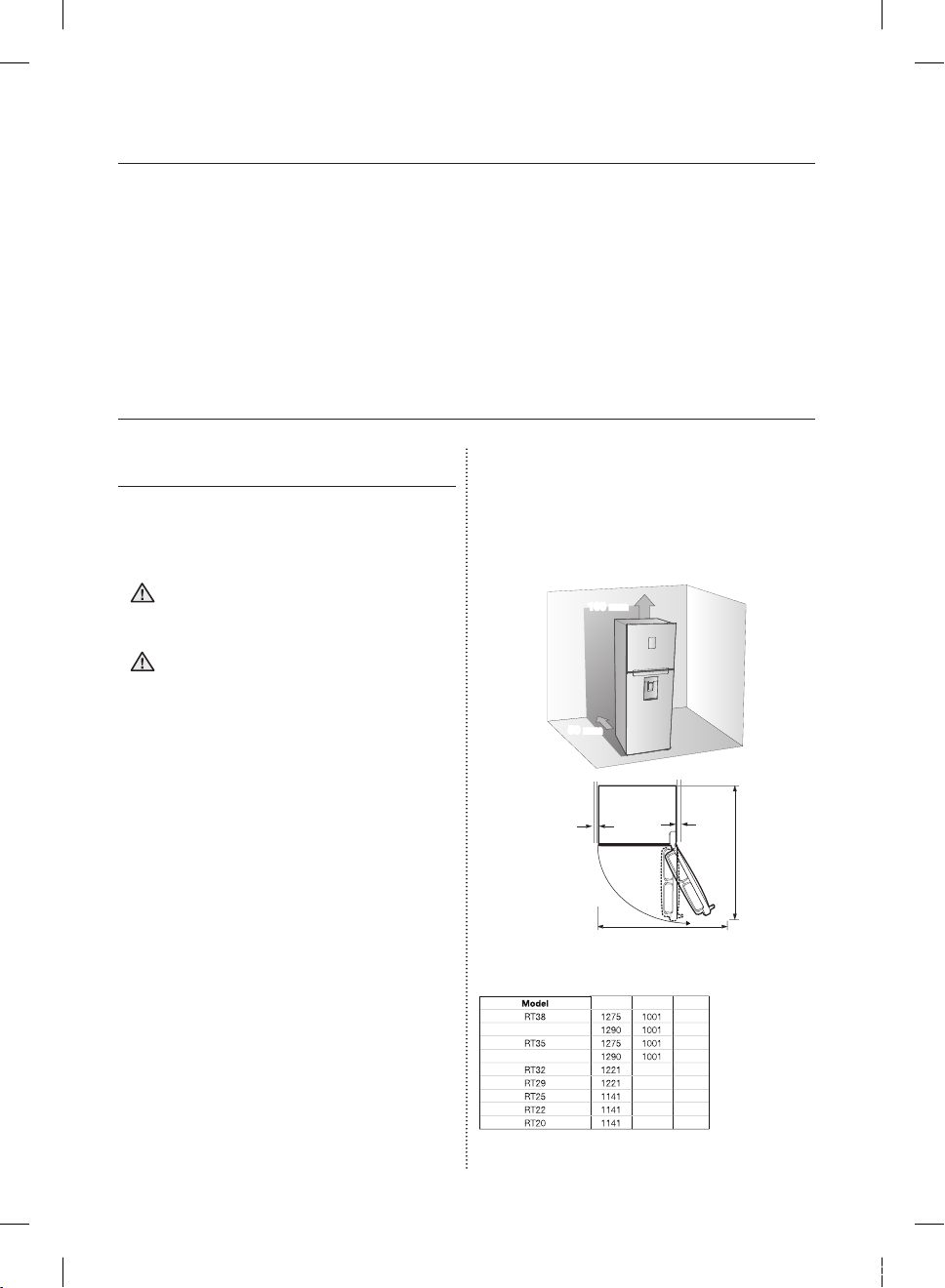
contenido
PREPARACIÓN DEL REFRIGERADOR …………………………………………………………..……… 08
FUNCIONAMIENTO DEL REFRIGERADOR……………………………………………………………… 11
SOLUCIÓN DE PROBLEMAS …………………………………………………………………………… 19
Preparación del refrigerador
PREPARACIÓN DE LA
INSTALACIÓN
Enhorabuena! Le felicitamos por la compra de su
refrigerador Samsung.
Esperamos que goce de la tecnología de punta y
de la efi ciencia que su nuevo aparato le ofrece.
• Este refrigerador debe ser instalado y
ADVERTENCIA
ADVERTENCIA
Selección de la mejor ubicación para
el refrigerador.
08_ preparación
ubicado adecuadamente siguiendo las
instrucciones de este manual antes de
ser utilizado.
• Leer instrucción técnica antes de
instalar el artefacto.
Us e es te aparato únicamente para su •
objetivo, tal como se describe en el
manual de instrucciones.
C ualquier tipo de mantenimiento debe •
ser realizado por personal cualifi cado.
Por favor deshágase del material de
•
embalaje de este producto de forma
que no resulte nociva para el medio
ambiente.
Retire el enchufe de la toma de
•
corriente antes de sustituir la luz
interior del refrigerador.
- Si no lo hace, corre el riesgo de sufrir
una descarga eléctrica.
Seleccione una ubicación que no esté •
expuesta a la luz directa del sol.
Seleccione una ubicación con el suelo nivelado •
(o muy poco desnivelado).
Seleccione una ubicación con sufi ciente •
espacio para abrir las puertas fácilmente.
Prevea espacio sufi ciente para que el refrigera- •
dor pueda instalarse en una superfi cie plana.
- Si el refrigerador no está nivelado, es posible que
el sistema de refrigeración interno no funcione
correctamente.
- Espacio requerido para un funcionamiento
adecuado. Consulte el plano y las dimensiones
más adelante.
100 mm
50 mm
al menos
50 mm
115° (C)
1001 mm (B)
al menos
50 mm
119
1275 mm (A)
La fi gura anterior muestra un RT38*.
A
B C
1040
1040
964
964
964
115˚
115˚
115˚
115˚
135˚
135˚
135˚
135˚
135˚
RT38 (Puerta de cristal)
RT35 (Puerta de cristal)
2012.11.22 9:52:33 AM
Page 29
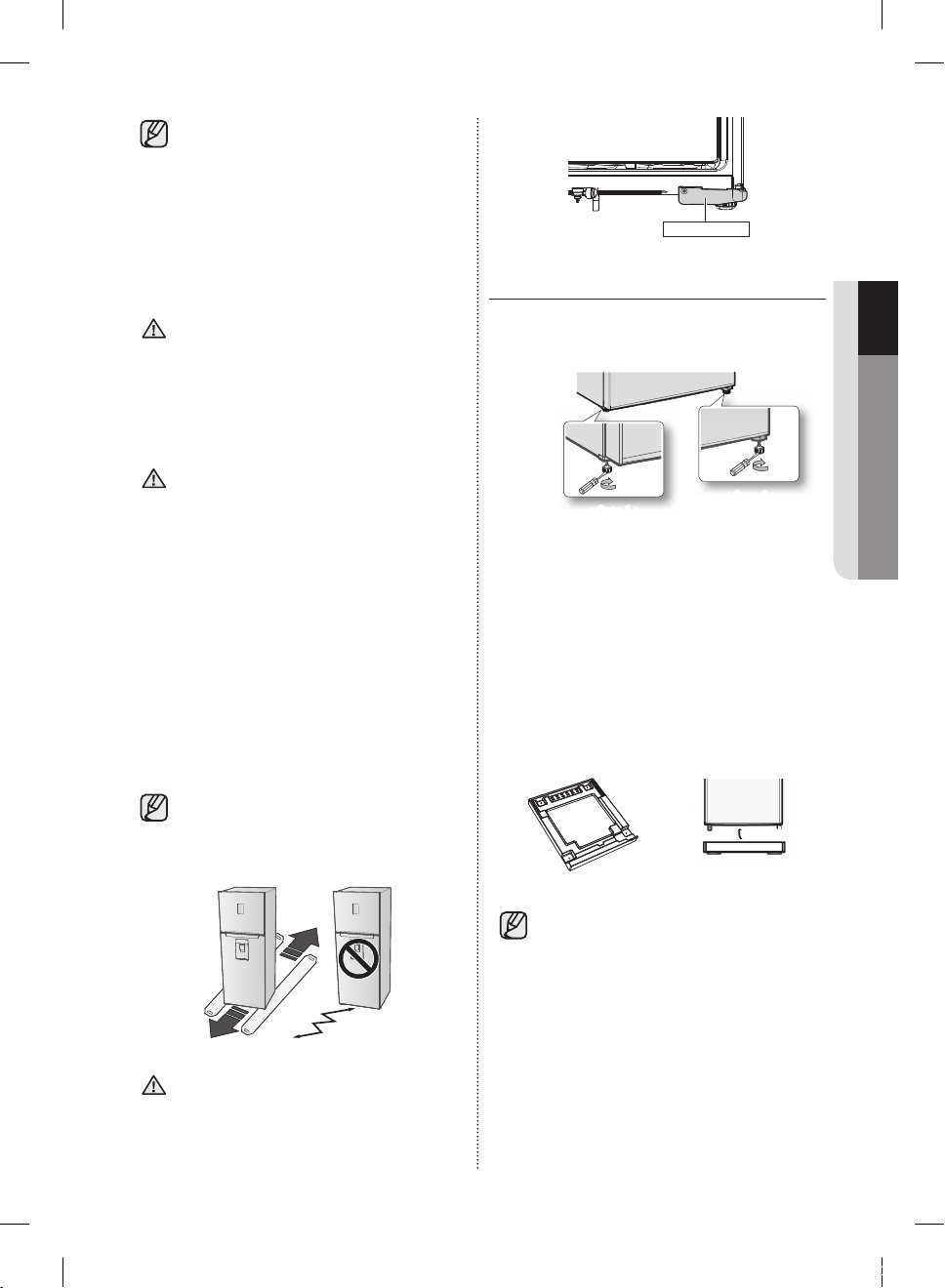
Deje sufi ciente espacio libre a la derecha,
a la izquierda, en la parte de atrás y en la
parte superior para que circule el aire.
De esta forma reducirá su consumo de
energía y ahorrará dinero.
No instale el refrigerador en lugares donde la
temperatura caiga por debajo de 10 °C.
Asegúrese de que el aparato se puede
mover fácilmente para su mantenimiento.
Al instalar el
PRECAUCIÓN
mantenimiento o una limpieza en la parte
refrigerador
, realizar un
trasera del mismo, asegúrese de que el
aparato sale y se vuelve a colocar recto.
Asegúrese de que el suelo puede soportar el
refrigerador
completamente cargado. En caso
contrario, podría causar daños en el suelo.
Recoja el cable sobrante del cable de
PRECAUCIÓN
alimentación en la parte trasera del
refrigerador de forma que no arrastre por el
suelo y así evitar aplastarlo con las ruedas
al desplazarlo.
SUELO
Para una instalación correcta, este refrigerador
debe colocarse en una superfi cie nivelada de un
material duro de la misma altura que el resto del
suelo. Esta superfi cie debe ser sufi cientemente
fuerte para soportar el peso del refrigerador lleno o
aproximadamente 100 Kg. Para proteger el
acabado del suelo, corte una sección grande de
cartón y colóquela bajo el refrigerador cuando vaya
a trabajar con él.
Cubierta frontal
NIVELACIÓN DEL REFRIGERADOR
01 PREPARACIÓN
Si la parte delantera del aparato está un poco
más elevada que la trasera, la puerta se abre y se
cierra con mayor facilidad.
< Caso 1 >
< Caso 2 >
Supuesto 1) El aparato está inclinado hacia la
izquierda.
Gire la pata ajustable izquierda en el sentido de •
la fl echa hasta que el aparato esté nivelado.
Supuesto 2) El aparato está inclinado hacia la
derecha.
Gire la pata ajustable izquierda en el sentido de •
la fl echa hasta que el aparato esté nivelado.
Soporte
Al tirar o empujar el refrigerador, se puede
dañar el suelo.
Al mover el refrigerador después de instalarlo,
se puede dañar el suelo.
Tenga cuidado de: no dañar la cubierta
PRECAUCIÓN
inferior al mover el refrigerador. Esta cubierta
protege el cable y el conducto. Si se
daña, también podría causar un mal
funcionamiento del refrigerador.
Inserción
En algunos países se usa un soporte
como base del refrigerador; en tal caso, no
se puede girar la pata ajustable de este
modelo. (No hay soportes compatibles
con este modelo).
preparación _09
2012.11.22 9:52:33 AM
Page 30
PREPARACIÓN DEL
REFRIGERADOR
Ahora que ha instalado su nuevo refrigerador está
listo para ponerlo en marcha y disfrutar de las
nuevas funciones y características del aparato.
Cuando haya realizado los pasos siguientes, su
refrigerador estará listo para funcionar.
Si hay algún problema, compruebe en primer
lugar la alimentación eléctrica o consulte la
sección de solución de problemas al fi nal de este
manual.
Si tiene alguna duda, póngase en contacto con el
servicio técnico de Samsung Electronics.
Sitúe el refrigerador en un lugar adecuado 1.
dejando un espacio razonable entre la pared y
el aparato
(Consulte las instrucciones de instalación en
este mismo manual).
Si el refrigerador está enchufado, la luz interior 2.
debe encenderse al abrir las puertas.
Ajuste el control a la temperatura más baja y 3.
espere durante una hora.
El congelador deberá empezar a enfriarse y el
motor funcionará suavemente.
Después de conectar el refrigerador, éste 4.
tarda unas horas en alcanzar la temperatura
adecuada.
Cuando el refrigerador alcance una temperatura
sufi cientemente baja, podrá almacenar
alimentos y bebidas en él.
10_ preparación
Page 31
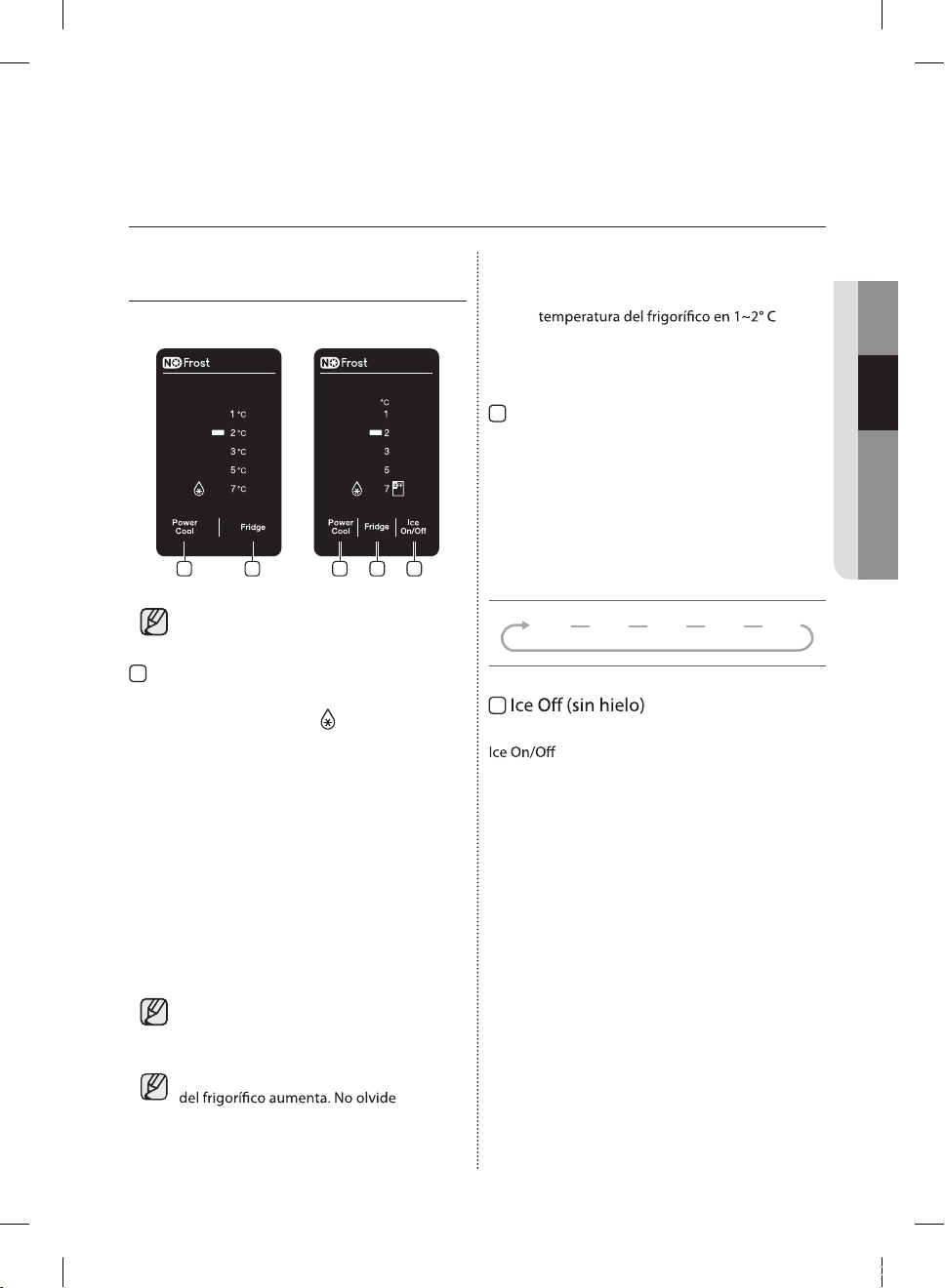
funcionamiento del refrigerador
samsung
UTILIZACIÓN DEL PANEL DE
CONTROL (PANTALLA TIPO B)
(TIPO A) (TIPO B)
1 2 1 2 3
Cada vez que pulse el botón se oirá un
tono.
1
Power Cool
Al pulsar el botón 1. Power Cool (Enfriamiento
acelerado), el indicador (
se reducirá el tiempo necesario para que el
refrigerador enfríe.
Esta función estará activada durante varias 2.
horas y volverá a la temperatura ajustada
previamente.
Esta función se desactivará automáticamente.3.
Cuando se completa el proceso de
enfriamiento acelerado, el indicador
correspondiente se apaga y el congelador
regresa a la anterior confi guración de
temperatura.
Para desactivar esta función, vuelva a pulsar el
botón Power Cool (Enfriamiento acelerado).
) se iluminará y
Si necesita almacenar grandes cantidades
de alimentos, sitúe la temperatura del
congelador en el extremo derecho y la
(modelo con pantalla) o Optimal~5
(modelo sin pantalla) con al menos
24 horas de antelación.
2
Refrigerador
Toque el botón Fridge (Refrigerador) para ajustar
el refrigerador a la temperatura deseada entre 1 °C
y 7 °C.
La temperatura predeterminada es de 2 °C y
cada vez que pulse el botón Fridge (Refrigerador),
la temperatura cambiará de la forma
correspondiente y el indicador de temperatura
mostrará la temperatura deseada.
1 °C 7 °C 5 °C 3 °C 2 °C
3
Si no desea fabricar más hielo, toque el botón
(Hielo/Sin hielo), y el indicador
correspondiente se iluminará.
De forma predeterminada, la función de hielo está
activada.
Recomendamos dejar de fabricar hielo si ocurre lo
siguiente:
- Hay sufi ciente hielo en el depósito de hielo.
- Desea ahorrar agua y energía.
- El tanque de agua está vacío.
02 FUNCIONAMIENTO
Al usar esta función, se acelerará el
enfriamiento del refrigerador durante varias
horas.
Al usar esta función, el consumo de energía
desactivarla cuando no la necesite para que
el congelador vuelva a su ajuste de
temperatura original.
funcionamiento _11
2012.11.22 9:52:35 AM
Page 32
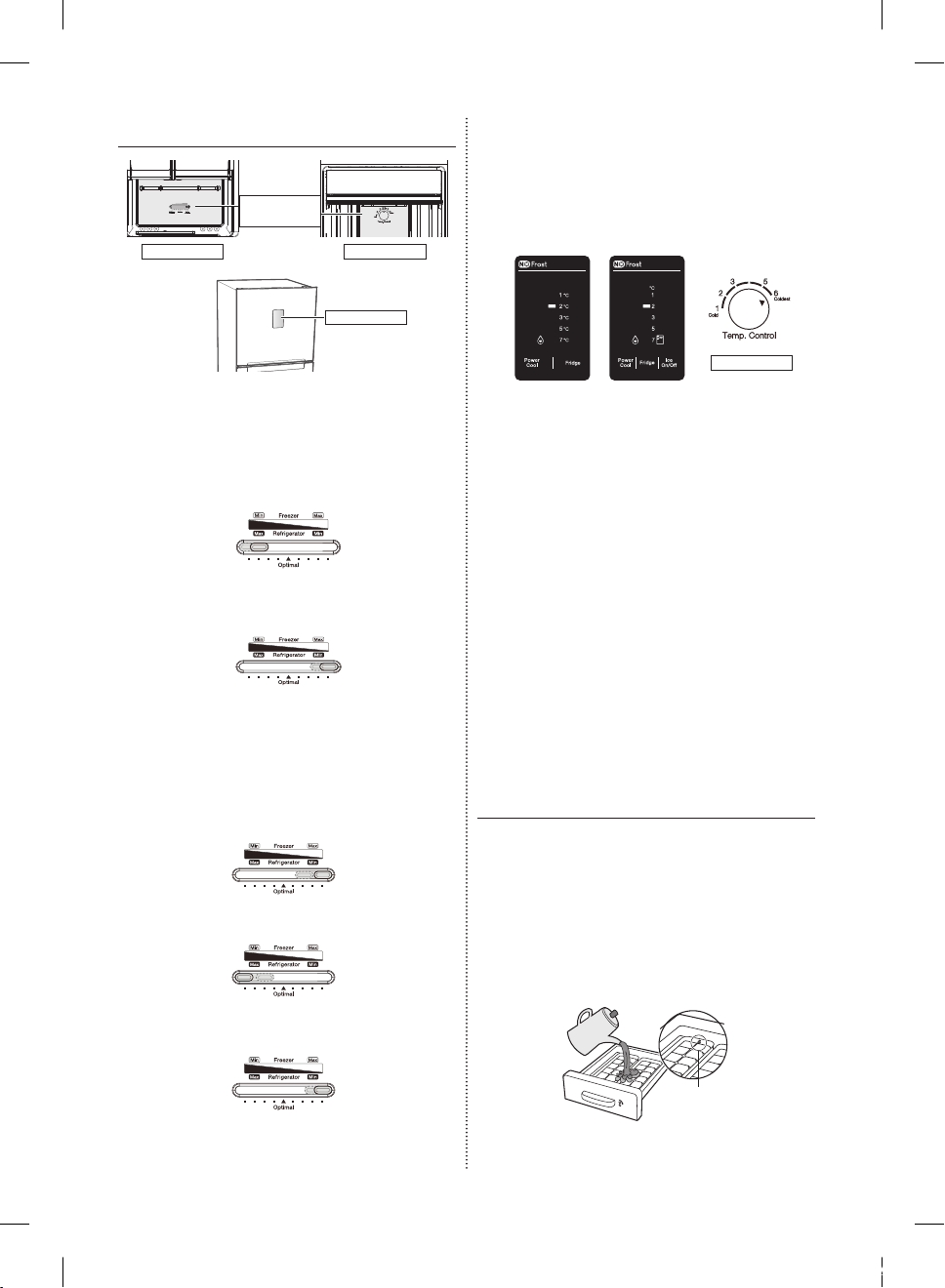
CONTROL DE TEMPERATURA
Control de
temperatura
Congelador Refrigerador
Pantalla
Recomendamos situar el control de temperatura
del refrigerador y del congelador en Óptimo para
garantizar un funcionamiento estable del aparato.
Si los alimentos del refrigerador se han congelado
o si desea aumentar la temperatura del congelador
sitúe el control de temperatura del congelador
hacia la izquierda.
• Cuando la temperatura ambiente sea inferior a
10°C, sitúe el control de temperatura del
congelador hacia la derecha para fabricar hielo.
• Cuando la temperatura ambiente sea inferior a
35°C, sitúe el control de temperatura del congelador en Óptimo para fabricar hielo.
• Cuando la temperatura ambiente sea superior a
35°C, no sitúe el control de temperatura del
congelador hacia la derecha.
Si no, podría causar problemas en el rendimiento
del refrigerador.
Ajuste de la temperatura del refrigerador
Optimal
Refrigerador
(TIPO A) (TIPO B) (TIPO C)
Si los alimentos del refrigerador no están tan frescos
como quisiera o si desea bajar la temperatura del
refrigerador, sitúe el control de temperatura del
refrigerador en 5~6 o bien, en el modelo con pantalla,
en 1. Si los alimentos del refrigerador se han congelado
o si desea aumentar la temperatura del congelador,
sitúe el control de temperatura del refrigerador en
1~3 o bien, en el modelo con pantalla, en 3~7.
• Cuando la temperatura ambiente sea inferior a
10°C, no sitúe el control de temperatura del
refrigerador en 1~2 o bien, en el modelo con
pantalla, en 5~7. Si no, podría causar problemas
en el rendimiento del refrigerador.
• Cuando la temperatura ambiente sea superior a
35°C, sitúe el control de temperatura del refrigerador
en 4~6 o bien, en el modelo con pantalla en 1~2.
Si no, podría causar problemas en el rendimiento
del refrigerador.
Ajuste de la temperatura del congelador
Si desea bajar la temperatura del congelador,
sitúe el control de temperatura del congelador
hacia la deracha.
FABRICACIÓN DE HIELO
(OPCIONAL)
CUBITERA
Hacer cubitos
Extraiga la bandeja de cubitos tirando de la misma.
Si desea aumentar la temperatura del congelador,
sitúe el control de temperatura del congelador
hacia la izquierda.
Llene la bandeja con agua hasta el nivel máximo
marcado en la parte trasera de la misma.
Vuelva a deslizar la bandeja en su soporte con
cuidado de no derramar el agua.
Espere a que se formen los cubitos.
•Cuando la temperatura ambiente sea inferior a
Extracción de los cubitos
10 °C, sitúe el control de temperatura del congelador hacia la derecha.
Nivel de agua
Si no, podría causar problemas en el rendimiento
del frigorífico.
12_ funcionamiento
DA68-02832P(ES)-0.1.indd 12 2013.1.14 3:14:30 PM
Compruebe que el recipiente del hielo se encuentra
debajo de la bandeja de hielo. Si no lo está,
colóquelo en su lugar.
2012.11.22 9:52:36 AM
Page 33
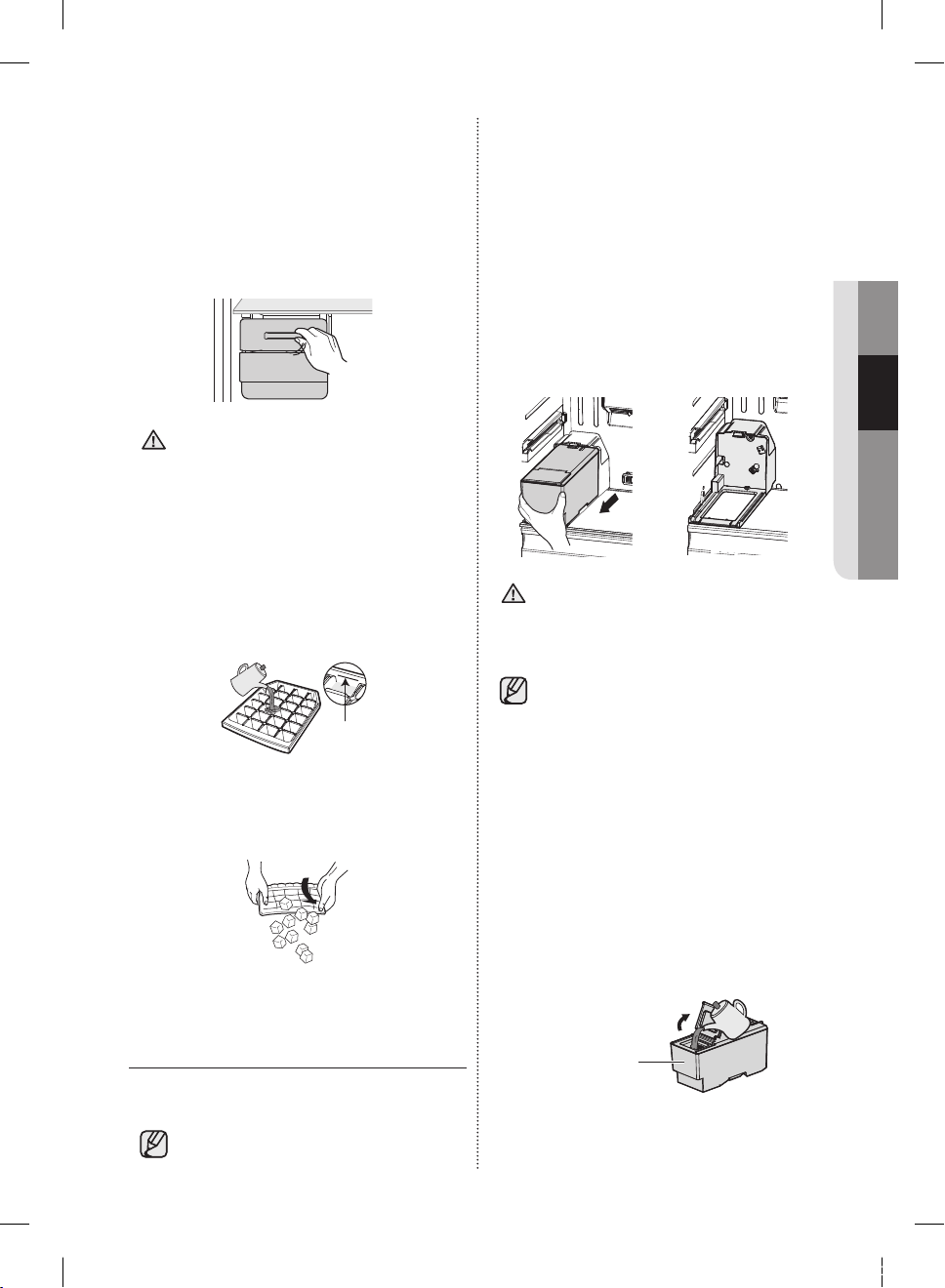
Gire una de las palancas fi rmemente
en el sentido de las agujas del reloj hasta que la
bandeja se incline un poco.
Resultado: Los cubitos caerán en el recipiente
de hielo. Repita el paso 2 para la otra mitad de
la bandeja, si fuera necesario. Para extraer el
recipiente de hielo:
Levántelo ligeramente•
Tire del recipiente•
Peligro de explosión
PRECAUCIÓN
líquidos nunca deberán guardarse en
el congelador ya que el vidrio puede
reventar cuando se congela su contenido.
el dispensador se parará. Para obtener
más agua, vuelva a pulsar la palanca. El
dispensador está diseñado para funcionar
durante un minuto aproximadamente y su
capacidad por cada uso es de 1 L.
Levante el depósito de agua y sáquelo.
Agarre el depósito por las asas laterales para •
sacarlo.
Limpie el interior del depósito de agua antes •
de usarlo por primera vez.
Tras desmontar el depósito de agua, pase un •
paño por el interior del refrigerador hasta que
esté limpio y seco.
nagnetnoc euq oirdiv ed salletob saL •
02 FUNCIONAMIENTO
TIPO DE BANDEJA (OPCIONAL)
Hacer cubitos
Llene la bandeja de hielo con agua hasta el nivel
máximo marcado en la parte trasera de la misma.
Coloque la bandeja de hielo en el congelador.
Extracción de los cubitos
Sujete la bandeja por ambos extremos, extraiga los
cubitos de la bandeja fl exionándola delicadamente.
USO DEL DISPENSADOR DE
AGUA (OPCIONAL)
Con el dispensador, puede obtener agua fría sin
necesidad de abrir la puerta del refrigerador.
Si pulsa la palanca del dispensador de
forma ininterrumpida durante 1 minuto,
Después
Cuando haya vuelto a instalar el depósito
PRECAUCIÓN
de agua, no quite el estante que hay justo
debajo. Podría causar lesiones personales
o daños materiales.
Si desea obtener más espacio, vacíe el
depósito de agua, saque la tapa, vuelva a
colocar el depósito y úselo para guardar
alimentos.
Llene el depósito de agua, asegurándose de
que está estable y teniendo cuidado con el
dispensador de agua.
Llénelo hasta 5 L. Si se llena más, podría •
desbordar al cerrar la tapa.
Es imposible llenar el depósito con agua •
cuando está en su lugar en el refrigerador.
Método 1.
Llene el depósito de agua levantando la tapa en el
sentido de la fl echa para abrirlo.
Depósito de agua
Método 2.
Llene el depósito de agua levantando toda la tapa
para abrirlo.
funcionamiento _13
2012.11.22 9:52:36 AM
Page 34
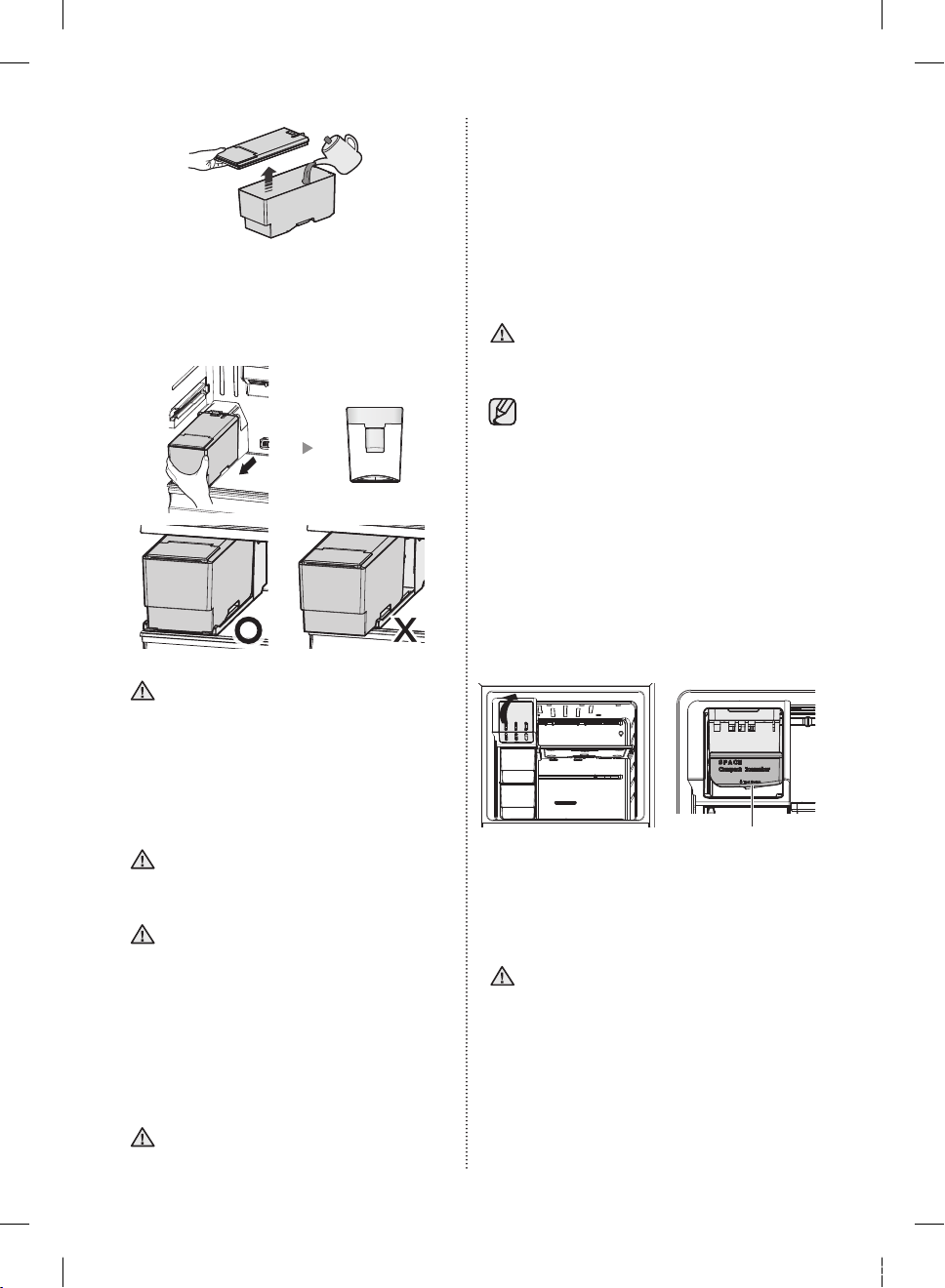
Cierre la puerta del refrigerador después de
volver a colocar el depósito de agua en su
interior.
Compruebe que hay flujo de agua presionando•
la palanca del dispensador tras cerrar la puerta.
en verano), el agua puede presentar un
olor o un sabor extraño. En tal caso,
recomendamos desechar los primeros 2
vasos para mejorar el sabor del agua.
Si acaba de instalar el refrigerador, tire los seis
primeros vasos de agua para deshacerse de las
impurezas del sistema de suministro de agua.
Compruebe que el agua sale clara antes de
beberla.
Compruebe que el depósito de agua está
PRECAUCIÓN
vacío si va a ausentarse durante un tiempo
prolongado.
Espere 1 segundo antes de retirar el vaso
después de servir el agua para evitar
derrames por el líquido sobrante en la
manguera.
Antes del primer uso, presione la palanca
del dispensador de agua unos 10
segundos para sacar el aire del conducto.
Uso del dispensador de agua
funcione un par de días. Durante ese tiempo, tire
las dos primeras tandas de cubitos producidos
para asegurarse de que no quedan impurezas en
el sistema.
ra etibuc al euq ejed ,rodaregirfer le adneicne odnauC
Coloque el depósito de agua en la bandeja
PRECAUCIÓN
interior del refrigerador. En caso contrario,
puede que el depósito no funcione
correctamente. No use el refrigerador sin el
depósito de agua. Esto podría resultar en
un problema de efi ciencia. Al manipular el
depósito de agua, tenga cuidado de no
pillarse los dedos.
Llene el depósito solo con agua (agua
PRECAUCIÓN
mineral o agua purifi cada), no use ningún
otro líquido.
Tenga cuidado de que no se caiga el
PRECAUCIÓN
depósito de agua mientras mueve el
refrigerador porque podría hacerse daño
si el depósito está lleno.
Ponga un vaso bajo el dispensador de
agua y presione ligeramente la palanca del
dispensador de agua con el vaso. Compruebe
que el vaso esté alineado con el dispensador
para evitar que el agua caiga fuera del vaso.
Cuando no haya utilizado el dispensador
PRECAUCIÓN
de agua durante 2~3 días (especialmente
14_ funcionamiento
< Antes >
La fi gura anterior muestra el modelo con
*
cubitera.
< Después >
Botón de prueba
Cuando la bandeja de hielo superior esté llena,
intercámbiela por la inferior.
Botón de prueba
•
PRECAUCIÓN
Si no sale hielo, retire la cubierta del
depósito de hielo y pulse el botón de
prueba situado en el lado derecho de
la cubitera.
2012.11.22 9:52:37 AM
Page 35
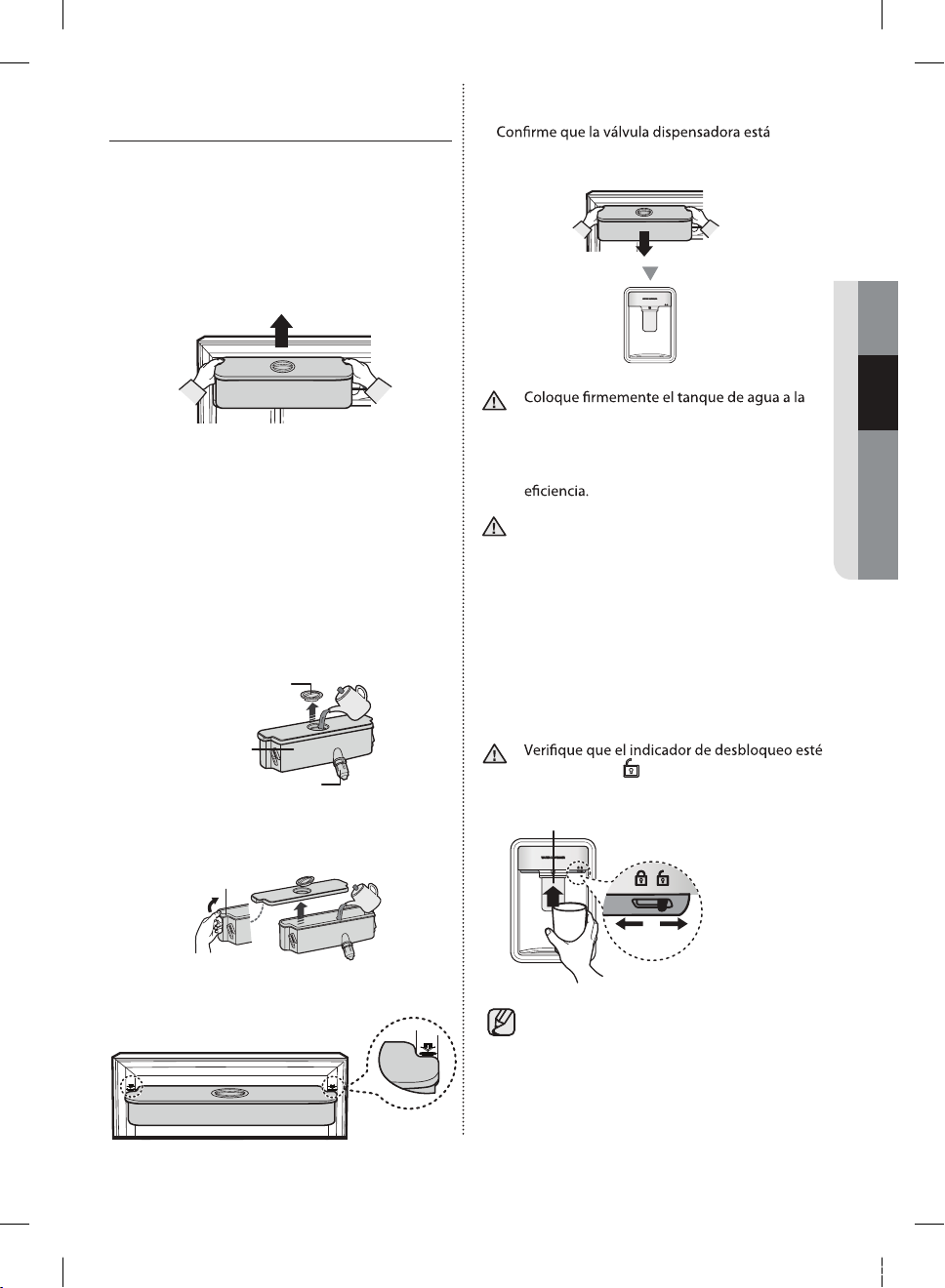
USO DEL DISPENSADOR DE
AGUA (OPCIONAL)
Con el dispensador de agua usted puede obtener
agua fría fácilmente sin abrir la puerta del refrigerador.
Levante y saque el tanque de agua.
• Sostenga las asas de ambos lados para levantar
el tanque de agua.
• Limpie el interior del tanque de agua antes de
usarlo por primera vez.
Cierre la puerta del refrigerador después de
colocar el tanque de agua.
•
afuera después de cerrar la puerta.
02 FUNCIONAMIENTO
Llene el tangue con agua, asegurándose que
está en una posición estable, lo que permite un
suministro de agua uniforme.
•
Llene con agua hasta 2.4 L máximo , si
sobrepasa este límite, el agua se puede
derramar al cerrar la tapa.
Es posible llenar el tanque con agua mientras
•
está colocado en el refrigerador.
Método 1.
Llene el tanque de agua levantando la tapa redonda
en dirección de la flecha como lo muestra la imagen.
Tapa redonda
Tanque de agua
Válvula dispensadora
Método 2.
Favor de llenar el tanque después de sostener y
levantar la tapadera larga.
Asa
PRECAUCION
puerta del refrigerador, si no lo hace así, el
tanque de agua puede operar incorrectamente.
No utilice el refrigerador sin el tanque de agua.
Si no lo coloca, puede causar un problema de
No coloque otro líquido más que agua en el
PRECAUCION
tanque de agua.
Coloque un vaso bajo la salida de agua y
presione generosamente contra la palanca del
dispensador con el vaso.
Asegúrese de que el vaso esté alineado con el
dispenser para evitar que el agua se derrame
fuera de el.
PRECAUCION
colocado en “ ” (desbloqueado).
El agua será despachada solo en esta opción.
Palanca del dispensador.
DESBLOQUEADO
BLOQUEADO
Asegúrese de que al ensamblar el tanque de agua
quede por debajo de las líneas de referencia.
Para obtener más espacio, vacie el agua del
tanque, remueva la tapa completamente,
coloque nuevamente el tanque de agua en la
puerta y uselo como anaquel.
Para utilizar el dispensador de agua, no
coloque nada más que agua en el tanque.
funcionamiento
DA68-02832P(ES).indd 15 2012.11.22 9:52:45 AM
_15
Page 36
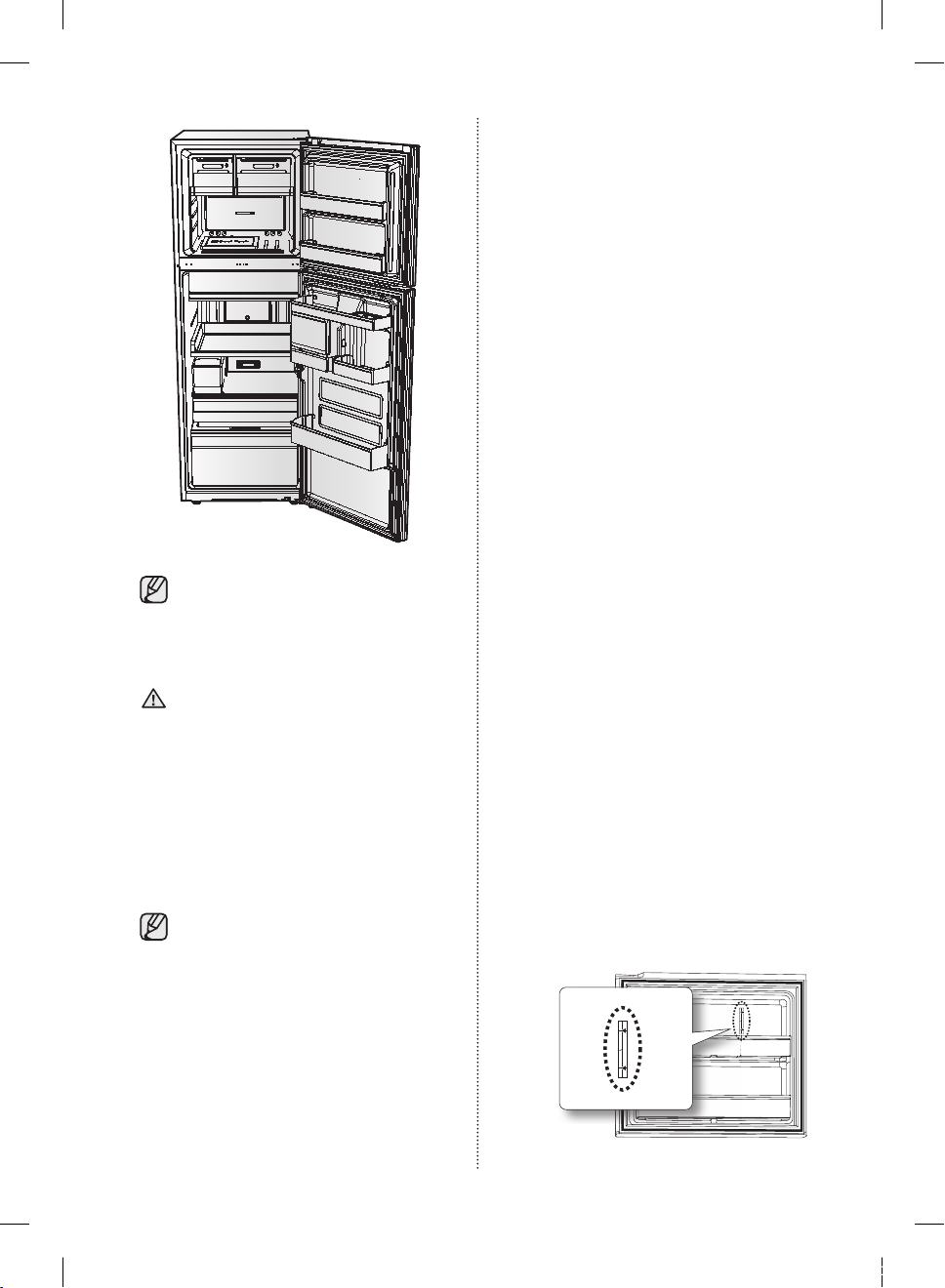
La imagen puede diferir en parte de su
refrigerador en función del modelo y opciones
(por ejemplo: bandeja de hielo, cubitera,
cubitera doble, bloque acumulador de frío,
estante o dispensador de agua).
• Si tiene planeado irse durante un
ADVERTENCIA
largo periodo, vacíe el refrigerador y
desconéctelo. Limpie el exceso de
humedad de su interior y deje las
puertas abiertas.
De lo contrario, se puede producir
moho y mal olor.
•
Si el refrigerador no se va a utilizar
durante un largo período de
tiempo, desconecte el enchufe de
alimentación.
• Si desea crear más espacio en el
compartimento del congelador,
puede retirar componentes extraíbles
los bloques acumuladores de frío,
los estantes, la cubitera doble, los
recipientes de hielo y sus soportes,
que pueden quitarse sin herramientas.
Esto no afectará a las características
térmicas y mecánicas.
El volumen de almacenamiento del
compartimento del congelador se
calcula sin estos elementos extraíbles.
•
Si va a retirar los dos elementos de
hielo, debe extraer primero el de la
derecha. (Solo para el modelo con
cubitera)
Si no desea usar el dispensador •
de agua, puede sacar el depósito
de agua. (Solo para el modelo con
dispensador)
Para conseguir la mejor efi ciencia •
energética de este producto, deje
todos los estantes, los cajones y las
cestas en su posición original, tal y
como se indica en la ilustración (pág.
16).
La sección inferior del compartimento •
del congelador es dos estrellas. Por
consiguiente, la tapa inferior se debe
colocar en su posición original para
que funcione correctamente.
La función de alarma del modelo •
con pantalla suena cuando se deja
la puerta del refrigerador abierta.
Compruebe también que la puerta del
congelador está cerrada, ya que la
alarma no suena cuando la puerta del
congelador está abierta.
En los modelos sin pantalla, la alarma
no suena aunque la puerta del
refrigerador y la del congelador estén
abiertas. As egúrese de que las puertas
están cerradas.
En particular, hay una linea límite de
•
carga de lado superior derecho de la
puerta de la nevera a la altura del
compartimento superior.
Favor de no colocar objetos en el
lado derecho de la línea límite de
carga. (Optional)
16_ funcionamiento
2012.11.22 9:52:39 AM
Page 37
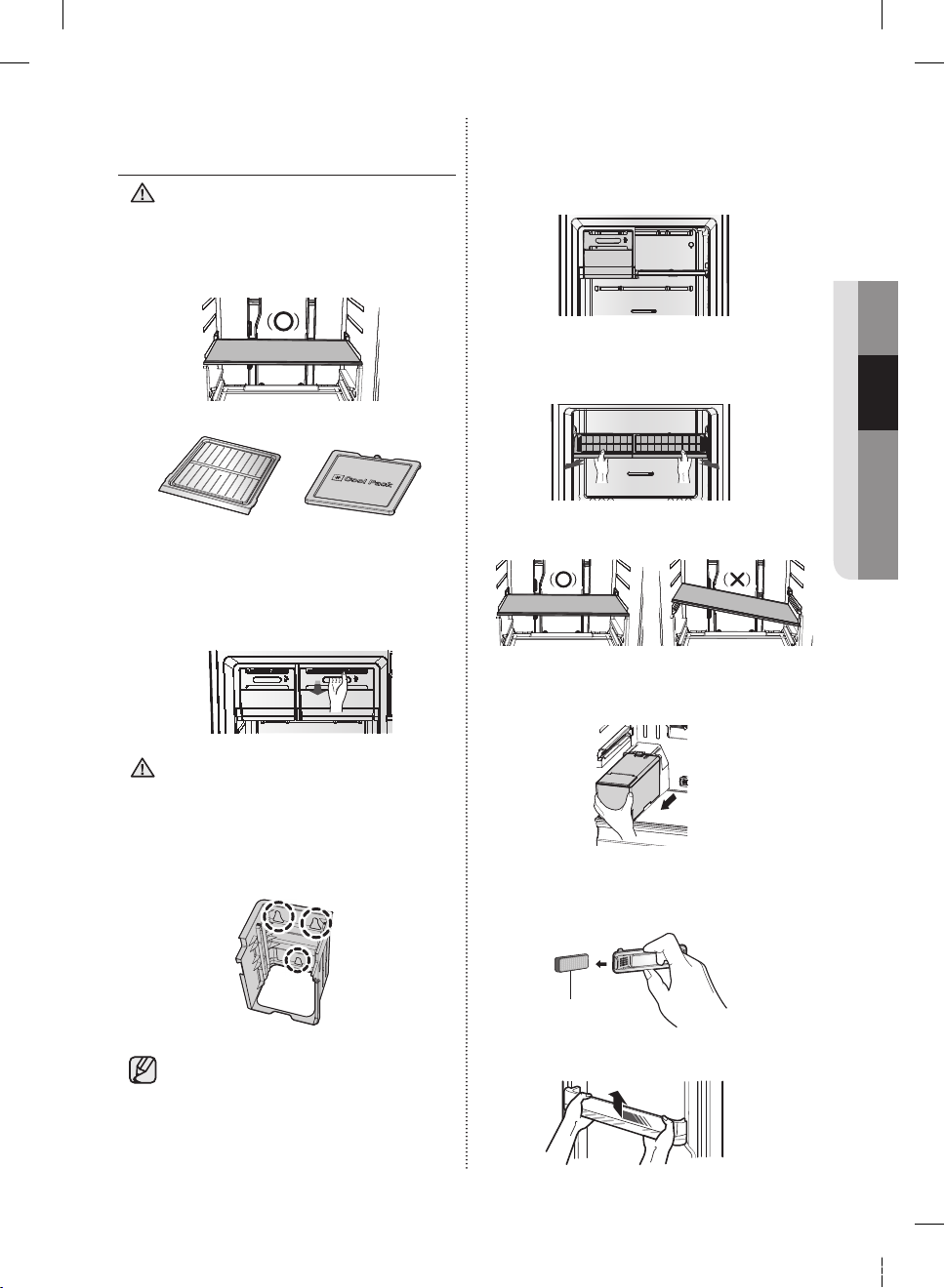
DESMONTAJE DE LOS
ACCESORIOS DEL REFRIGERADOR
En el montaje, coloque el estante del
congelador, los estantes del refrigerador y el
PRECAUCIÓN
bloque acumulador de frío en la posición
correcta (no los ponga boca abajo). Podría
causar lesiones personales o daños
materiales.
Retire primero la bandeja del hielo y el cajón, 1.
y extraiga la bandeja soporte de la derecha.
Repita los pasos para la izquierda. (Solo para
el modelo con cubitera doble)
Levante el estante del congelador o el bloque 2.
acumulador de frío y tire de él; extraiga entonces
la bandeja de hielo y el cajón. Retire la bandeja
de soporte. (Solo para el modelo con estante de
congelador o con bloque acumulador de frío)
02 FUNCIONAMIENTO
Retire la bandeja del hielo, levante el estante 3.
del congelador y extráigalo.
(Solo para el modelo con bandeja de hielo)
Tire de los estantes del refrigerador.4.
Levante el bloque acumulador de frío y 5.
extráigalo. (Solo para el modelo con cubitera)
Tenga cuidado al retirar la bandeja de
PRECAUCIÓN
soporte porque podría impactarle.
Tenga cuidado al colocar o al retirar la
bandeja de soporte del hielo ya que
el borde superior es afi lado. Podría
provocarle algún corte en las manos.
Para montarla, coloque la bandeja de
soporte del hielo sobre las ranuras con la
parte derecha más arriba.
Sujétela por debajo en la parte media
y empuje la bandeja hasta que haya
encajado completamente.
DA68-02832P(ES).indd 16
Sáquelo presionando el reborde del 6.
desodorizante catalizador.
catalizador
Levante las baldas de la puerta y extráigalas.7.
funcionamiento _17
2012.11.22 9:52:40 AM
Page 38
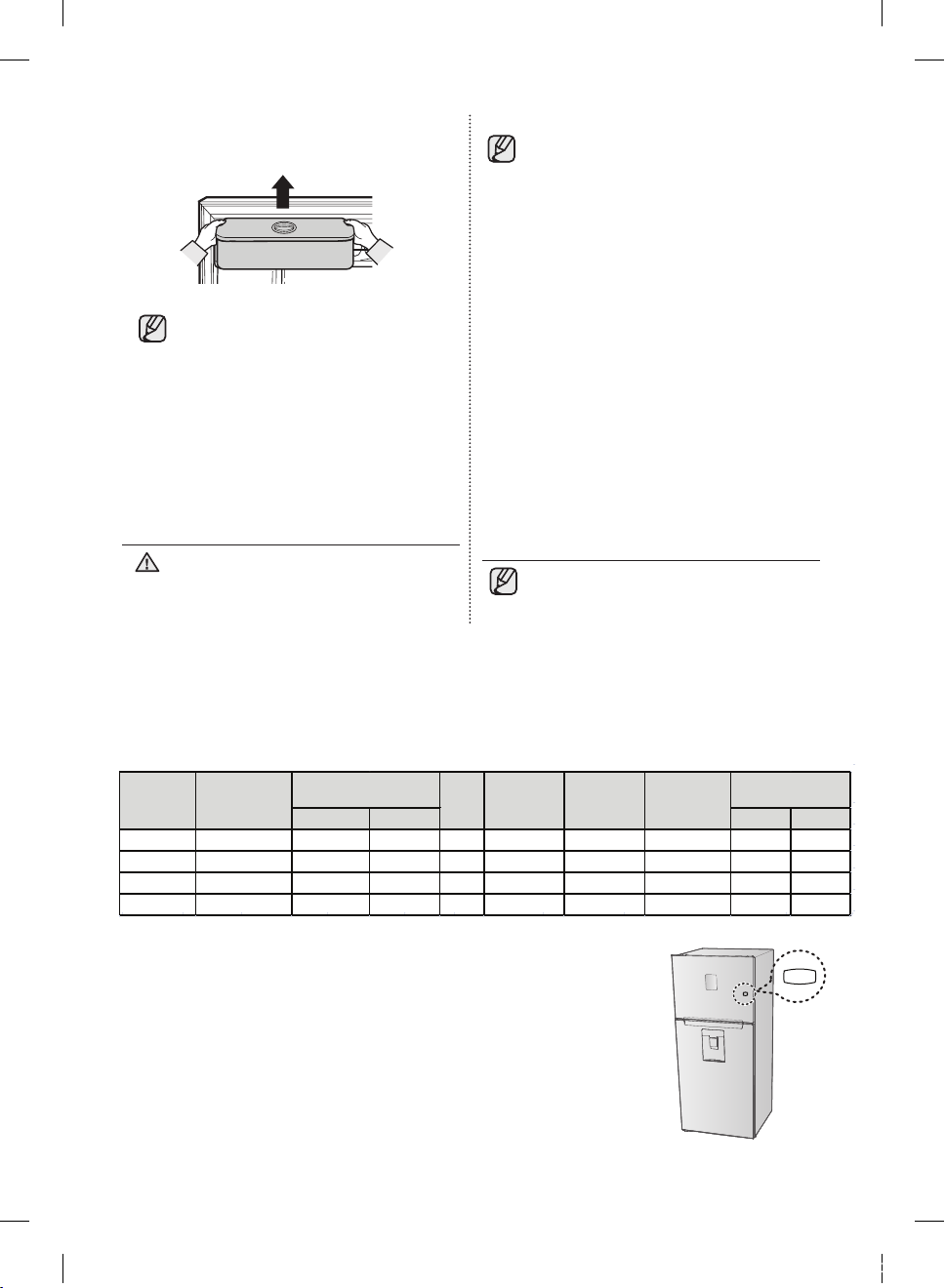
8.
Volumen de
Total
temperatura*
Capacidad
fijada
Consumo de Energía
kW h / 24h
Capacidad de
de hielo
Área de pa rrillas de
almacenamiento dm
Levante y jale el tanque de agua (Opcional)
como lo muestra la imagen.
Antes de retirar cualquier accesorio,
compruebe que los alimentos no
obstruyan el paso.
Si puede, retire todos los alimentos para
reducir el riesgo de accidentes.
En algunos modelos no se puede retirar
el cajón sin desmontar antes el
compartimento de la puerta.
Retire antes los estantes de la puerta para
reducir el riesgo de daños materiales.
LIMPIEZA DEL REFRIGERADOR
No utilice benceno, disolventes ni lejía para
ADVERTENCIA
la limpieza. Pueden dañar la superfi cie del
aparato y crear un riesgo de incendio.
NOTAS APLICABLES SOLO PARA ECUADOR
No pulverice agua sobre el refrigerador
mientras esté conectado. Podría
producirse una descarga eléctrica.
No utilice benceno, disolvente ni
detergente de coches para limpiar el
refrigerador. Existe un riesgo de incendio.
Desenchufe el cable de alimentación del 1.
refrigerador.
Humedezca con un poco de agua un paño sin 2.
pelusas o papel de cocina.
No use ningún tipo de detergente para
limpiar el refrigerador porque podría
desteñirlo o causar algún daño.
Pase el paño por el interior y el exterior del 3.
refrigerador hasta que esté limpio y seco.
Enchufe el cable de alimentación del refrigerador.4.
SUSTITUCIÓN DE LA LUZ
INTERIOR
Para sustituir la bombilla de LED, póngase
en contacto con un técnico autorizado.
Producto fabricado por: SAMSUNG ELECTRONICS DIGITAL APPLIANCES MEXICO, S.A. DE C.V.
- Características del aparato:
Modelo
almacenamiento
Refrigera dor Congelador Anual Por 24 h
RT29 299 L 98.6 24.1 122.7 11 hr 3 Kg 4.5 Kg 264 0.72
RT32 320 L 98.6 24.1 122.7 11 hr 3.5 Kg 4.5 Kg 270 0.73
RT35 359 L 109 26.5 135.5 14 hr 4 Kg 6.5 Kg 296 0.81
RT38 380 L 129 26.5 155.5 30 hr 7 Kg 7.75 Kg 298 0.82
2
dm
ele vación de
2
fabricación
congelación
Tiempo de
TOTAL
- El refrigerante utilizado es: R-600a
- Clase de clima del aparato: ST
*
*
- Condiciones para la detención prolongada del refrigerador (No aplica).
*
- El congelador indica la clase que corresponde a 2 y 3 estrellas.
- Este manual aplica para el modelo RT38FEAJDSL/ED
* Es el tiempo para alcanzar el punto más caliente (-9°C) desde (-18°C)
en el compartimento designado como 3 estrellas.
18_ funcionamiento
2012.11.22 9:52:45 AM
2012.11.22 9:52:35 AM
.
*
*
*
Page 39
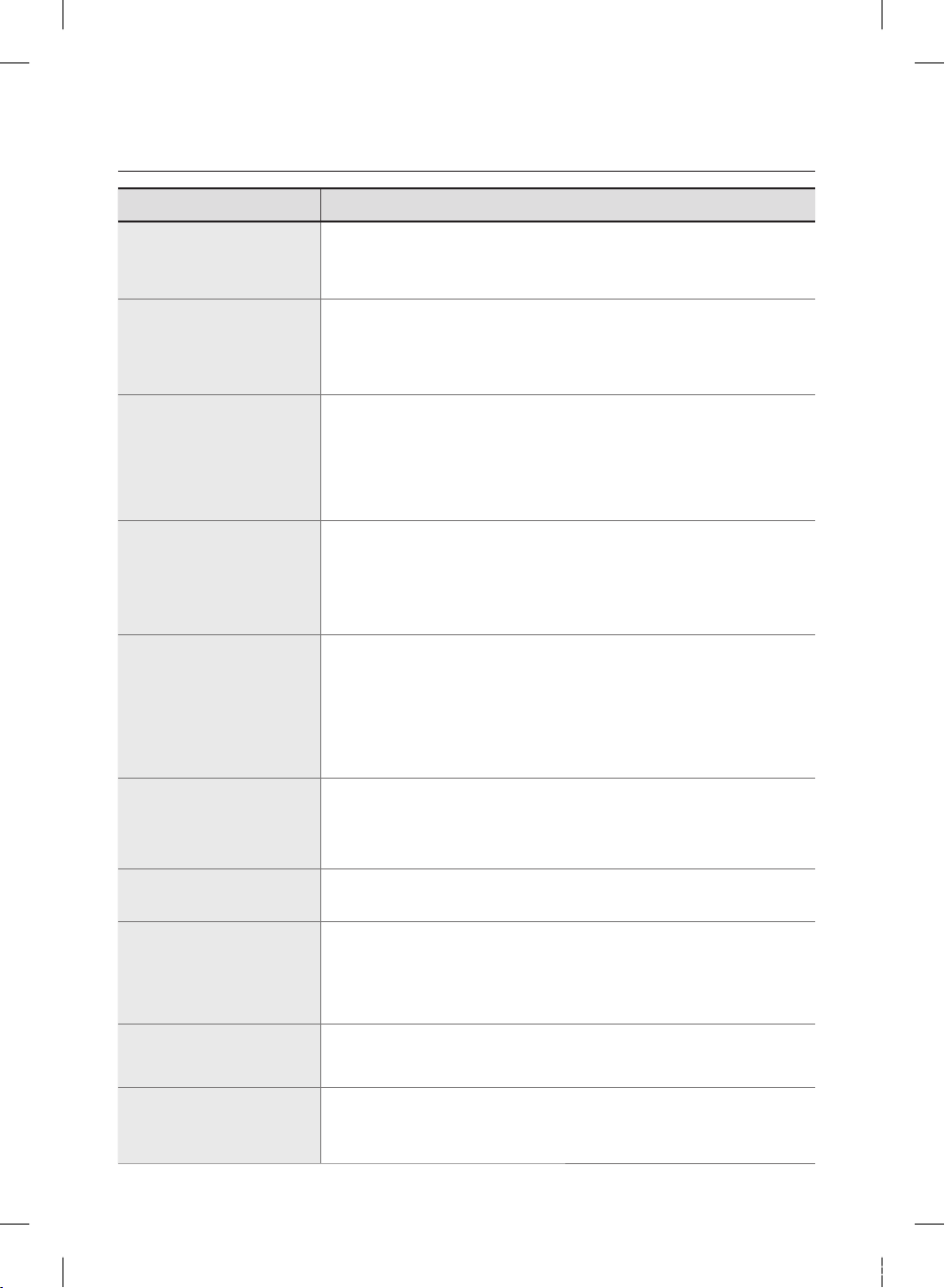
solución de problemas
PROBLEMA SOLUCIÓN
El aparato no funciona en
absoluto o la temperatura
es demasiado alta.
Los alimentos en
el refrigerador están
congelados
Se oyen ruidos extraños. Compruebe que el aparato está instalado en una superfi cie nivelada y •
Las esquinas frontales y
los laterales del aparato
están templados y se
produce condensación.
La cubitera no produce
hielo.
El dispensador de agua no
funciona.
Se oye un ruido en
el aparato, como de
movimiento de agua.
Dentro del aparato se
percibe mal olor.
En las paredes del aparato
se forma escarcha.
En las paredes del aparato
y junto a las verduras se
produce condensación.
Compruebe que el enchufe de alimentación está conectado correctamente.•
¿Se ha ajustado la temperatura correctamente en el panel de control?•
¿Se refl eja el sol en el aparato o hay alguna fuente de calor cerca?•
¿Está la parte trasera del aparato demasiado cerca de la pared?•
¿Se ha ajustado el control de temperatura en el panel frontal en la •
temperatura más fría?
¿Es demasiado baja la temperatura del entorno?•
¿Ha almacenado alimentos con un alto contenido de agua en la parte •
más fría del refrigerador?
estable.
¿Está la parte trasera del aparato demasiado cerca de la pared?•
¿Se ha caído algún objeto extraño detrás o debajo del aparato?•
¿Procede el ruido del compresor del aparato?•
Se oye un ruido como de clic dentro del aparato; esto es normal. •
ocurre cuando algunos accesorios se expanden o contraen.
En las esquinas frontales del aparato hay unos conductos refractarios •
para evitar que se forme condensación. Si la temperatura ambiente
aumenta, esto puede no ser tan efectivo. Sin embargo, es normal.
En condiciones muy húmedas, puede formarse condensación en la •
superfi cie externa del aparato cuando la humedad del aire entra en
contacto con la superfi cie fría del aparato.
¿Ha esperado 12 horas después de instalar el refrigerador antes de •
producir hielo?
¿Ha detenido manualmente la producción de hielo?•
¿Es demasiado alta la temperatura del congelador? Trate de ajustarlo a •
una temperatura más baja.
¿Ha llenado el depósito de agua con agua?•
¿Ha comprobado que el depósito de agua está instalado •
correctamente?
¿Está congelado el depósito de agua porque la temperatura del •
refrigerador es demasiado baja?
Seleccione un valor más elevado en el panel de control.
¿Ha llenado el depósito de agua?•
¿Ha comprobado que el depósito de agua está instalado correctamente?•
Se trata del refrigerante utilizado para enfriar el interior del aparato.•
¿Hay algún alimento podrido?•
Compruebe que los alimentos que despiden olores fuertes (por •
ejemplo, pescado) están envueltos de forma hermética.
Limpie el congelador periódicamente y tire cualquier alimento podrido o •
de mala apariencia.
¿Bloquea algún alimento las rejillas de ventilación del refrigerador?•
Distribuya los alimentos de forma que mejore la ventilación.•
¿Está la puerta bien cerrada?•
Los alimentos con un elevado contenido en agua se han guardado sin •
envoltorio con mucha humedad o la puerta
se ha dejado abierta durante mucho tiempo.
Guarde los alimentos envueltos o en recipientes herméticos.•
Esto
19_ solución de problemas
2012.11.22 9:52:45 AM
Page 40
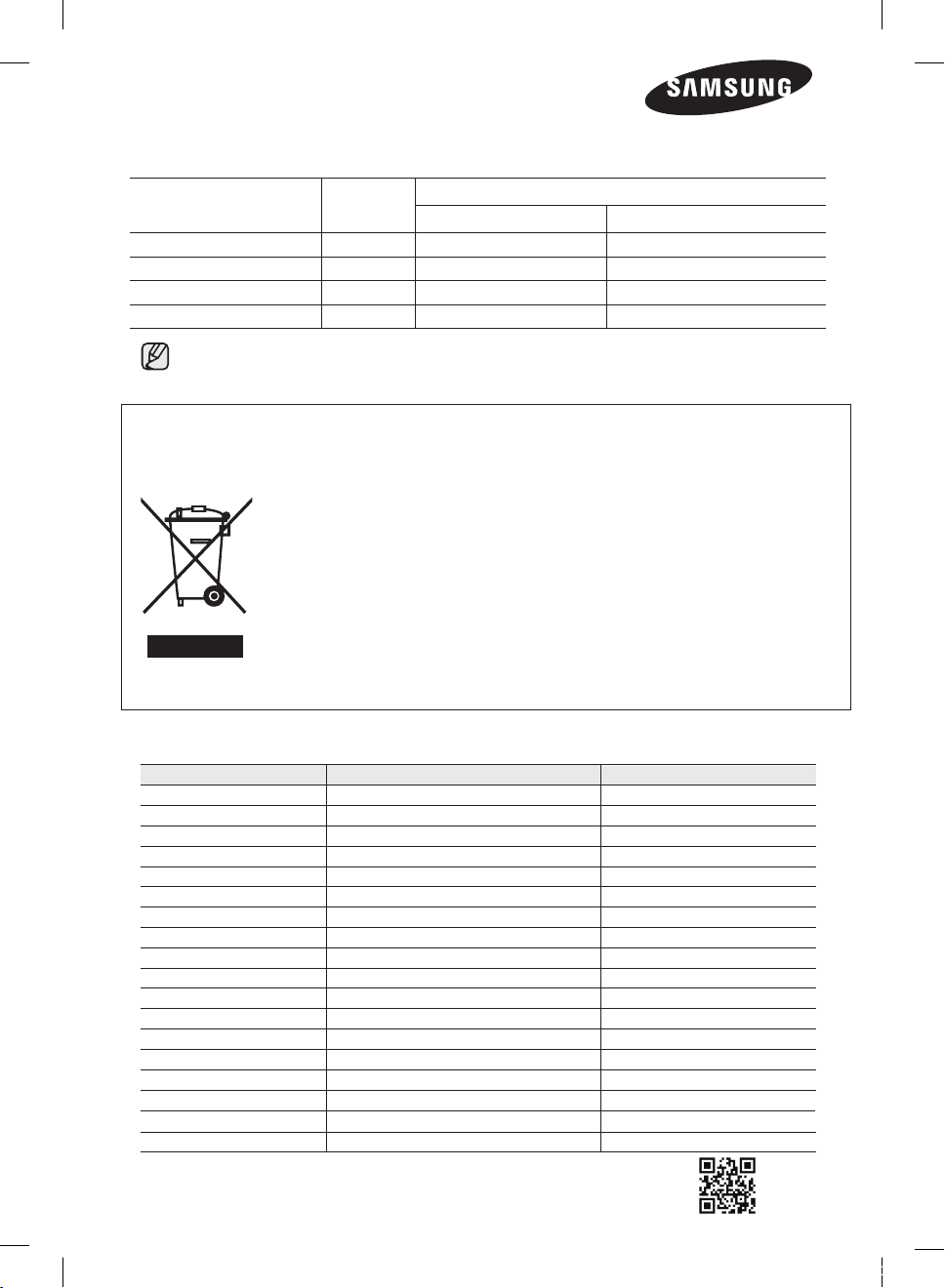
Límites de la temperatura ambiente de la estancia
Este refrigerador/congelador se ha diseñado para funcionar en las temperaturas ambiente defi nidas por
su clase de temperatura indicada en la placa de características.
Clase Símbolo
IEC 62552 (ISO 15502)
Templada extendida SN +10 a +32 +10 a +32
Templada N +16 a +32 +16 a +32
Subtropical ST +16 a +38 +18 a +38
Tropical T +16 a +43 +18 a +43
Las temperaturas internas pueden verse afectadas por factores como la ubicación del
refrigerador/congelador, la temperatura ambiente y la frecuencia con la que se abre la puerta.
Ajuste la temperatura según convenga para compensar estos factores.
Eliminación correcta de este producto (material eléctrico y
electrónico de descarte)
(Aplicable en la Unión Europea y en países europeos con sistemas
de recolección selectiva de residuos)
La presencia de esta marca en el producto o en el material informativo que lo acompaña, indica que al finalizar su vida útil no deberá eliminarse junto con otros residuos
domésticos. Para evitar los posibles daños al medio ambiente o a la salud humana
que representa la eliminación incontrolada de residuos, separe este producto de
otros tipos de residuos y recíclelo correctamente para promover la reutilización
sostenible de recursos materiales. Los usuarios particulares pueden contactar con el
establecimiento donde adquirieron el producto, o con las autoridades locales pertinentes, para informarse sobre cómo y dónde pueden llevarlo para que sea sometido
a un reciclaje ecológico y seguro. Los usuarios comerciales pueden contactar con
su proveedor y consultar las condiciones del contrato de compra. Este producto no
debe eliminarse mezclado con otros residuos comerciales.
Comuníquese con SAMSUNG WORLD WIDE
Si desea formular alguna pregunta o comentario en relación con los productos de Samsung,
comuníquese con el CALL CENTER de SAMSUNG.
CIUDAD CALL CENTER
ARGENTINA 0800-333-3733 www.samsung.com/ar
BRASIL 0800-124-421 4004-0000
CHILE 800-SAMSUNG(726-7864)
MEXICO 01-800-SAMSUNG(726-7864)
NICARAGUA 00-1800-5077267 www.samsung.com/latin
HONDURAS 800-7919267 www.samsung.com/latin
COSTA RICA 0-800-507-7267 www.samsung.com/latin
ECUADOR 1-800-10-7267 www.samsung.com/latin
EL SALVADOR www.samsung.com/latin
GUATEMALA www.samsung.com/latin
JAMAICA 1-800-234-7267 www.samsung.com/latin
PANAMA 800-7267 www.samsung.com/latin
PUERTO RICO www.samsung.com/latin
REP. DOMINICA www.samsung.com/latin
TRINIDAD & TOBAGO
VENEZUELA 0-800-100-5303 www.samsung.com/ve
PERU 0-800-777-08 www.samsung.com/pe
COLOMBIA 01-8000112112 www.samsung.com/co
800-6225
1-800-299-0013
1-800-682-3180
1-800-751-2676
1-800-SAMSUNG(726-7864)
Intervalo de temperatura ambiente (°C)
ISO 8561 / NTE INEN 2206
SITIO WEB
www.samsung.com/br
www.samsung.com/cl
www.samsung.com/mx
www.samsung.com/latin
DA68-02832U-08
2012.11.22 9:52:45 AM
 Loading...