

Page 1
DV457E(G)*
Gas and Electric Dryer
user manual
This manual is made with 100% recycled paper.
imagine the possibilities
Thank you for purchasing this Samsung product.
To receive more complete service or accessory
parts, please register your product at or contact
www.samsung.com/register
1-800-SAMSUNG (726-7864)
DV457E(G)-02836E-03_EN.indd 1DV457E(G)-02836E-03_EN.indd 1 2012-12-04 6:44:292012-12-04 6:44:29
Page 2
Features
Your new dryer will change the way you feel about drying laundry. From its
specialized 8” LCD touch screen, and its innovative Smart Control technology to its
time and energy e ciency, your new Samsung dryer has all the benefi ts to make
drying laundry as easy and pleasant as possible.
• Extra Large Capacity
Ultra drying capabilities at your fi ngertips! Now you can dry extra-large loads. Our ultra large
7.5 cu.ft. capacity dryer circulates more air through your clothes, drying them faster, for a
wrinkle-free result.
• 8” LCD Touch Screen Display
The brilliant 8” Color LCD Touch Screen displays cycle information, settings, options, and
more. The easy-to-use interface allows you to scroll through all the drying cycles with the
slightest touch.
• Smart Control (Elec. Model Only)
Samsung’s innovative Smart Control technology enables you to control your dryer through
personal technology devices such as smart phones. You don’t have to be on standby until
the cycle ends. The Smart Control allows you to monitor the drying process and lets you
know when the cycle is complete.
• Smart Monitor (Gas Model Only)
Samsung’s innovative Smart Monitor technology enables you to monitor your dryer through
personal technologies such as smart phones. You don’t have to be on standby until the cycle
ends. Smart Monitor allows you to monitor the drying process and lets you know when the
cycle is complete.
• Smart Care
Samsung’s Smart Care, an automatic error-monitoring system, detects and diagnoses
problems at an early stage and provides quick and easy solutions through the LCD
navigation. With the innovative Smart Control technology, you can also be alerted via your
smart phone when a problem occurs.
• Steam Cycle
This cycle sprays a small amount of water into the drum of the dryer after several minutes
of tumbling with heat. It reduces bad odors from clothing that are di cult to remove when
washing with water and also reduces wrinkles.
• Sanitize Cycle
This cycle sanitizes garments by infusing high temperature heat deep into the fabric during
the drying cycle and eliminating 99.9% of certain bacteria. Use this cycle for clothing,
bedding, towels, or other items needing sanitization. The Sanitize cycle is certifi ed by NSF
International, an independent third-party testing and certifi cation organization.
NSF Protocol P154
Sanitization Performance of
Residential Clothes Dryers
• Vent Sensor
Your Samsung dryer is equipped with a Vent Sensor which detects and notifi es you when it is
time to clean the ducts. Keep your dryer safe and e cient!
2_ Features
DV457E(G)-02836E-03_EN.indd Sec9:2DV457E(G)-02836E-03_EN.indd Sec9:2 2012-12-04 6:44:372012-12-04 6:44:37
Page 3
• Time Saving
Our cycles are designed with you in mind. All our dryers are designed to dry your clothes
quickly... just 42 minutes! Giving you time for more important things in life.
• Energy Saving
Your Samsung dryer is super energy e cient. You can dry up to 3.31 pounds of laundry with
1 kWh. Also, it saves energy by automatically drying your clothes the most e cient way.
• Easy Reversible Door
Your Samsung dryer will fi t just about anywhere and without a door issues. The direction of
its easy reversible door can be changed quickly and easily.
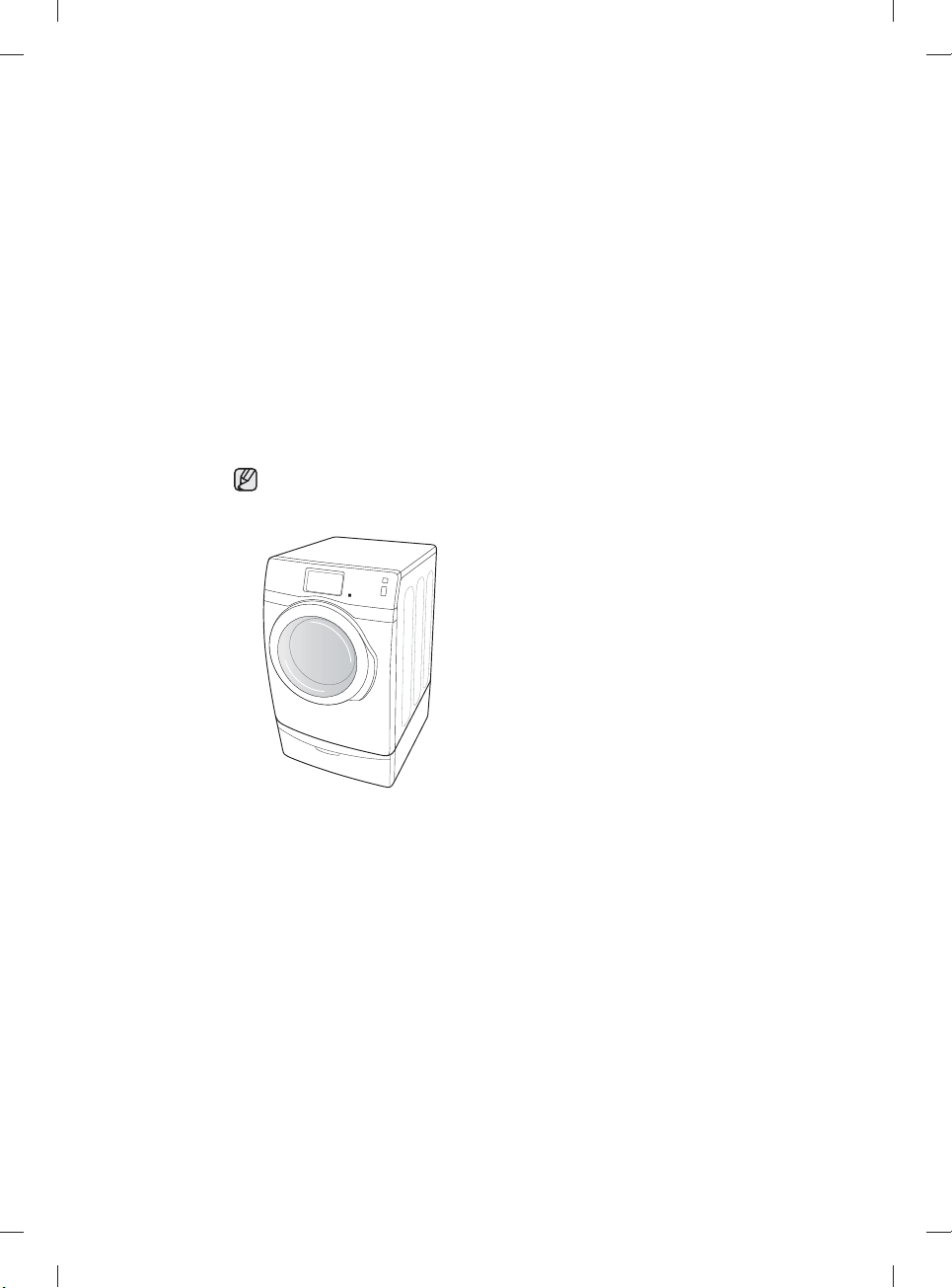
• Pedestal with Storage Drawers
An optional 15” pedestal is available to raise the dryer for easier loading and unloading. It also
o ers a built-in storage drawer that can hold a 100 oz. bottle of detergent.
We strongly recommend that you DO NOT stack Samsung washers and dryers.
It may be hard to view and use the dryer LCD control panel because of the viewing
angle.
<Pedestal with Storage Drawers>
• 4-way Vent (Electric models only: DV457E*)
You can install the exhaust vent in the following four (4) positions: back, either side or at the
bottom.
Features _3
DV457E(G)-02836E-03_EN.indd Sec9:3DV457E(G)-02836E-03_EN.indd Sec9:3 2012-12-04 6:44:372012-12-04 6:44:37
Page 4
Safety instructions
Congratulations on your new Samsung Dryer. This manual contains important
information on the installation, use, and care of your appliance. Please take the
time to read this manual to take full advantage of your dryer’s many benefi ts and
features.
WHAT YOU NEED TO KNOW ABOUT SAFETY INSTRUCTIONS
Please read this manual thoroughly to ensure that you know how to operate the extensive features and
functions of your new appliance safely and e ciently. Retain the manual in a safe place near the appliance
for future reference. Use this appliance only for its intended purpose as described in this instruction manual.
The Warnings and Important Safety Instructions in this manual do not cover all possible conditions and
situations that may occur. It is your responsibility to use common sense, caution, and care when installing,
maintaining, or operating your dryer.
Always contact your manufacturer about problems or conditions you do not understand.
IMPORTANT SAFETY SYMBOLS AND PRECAUTIONS
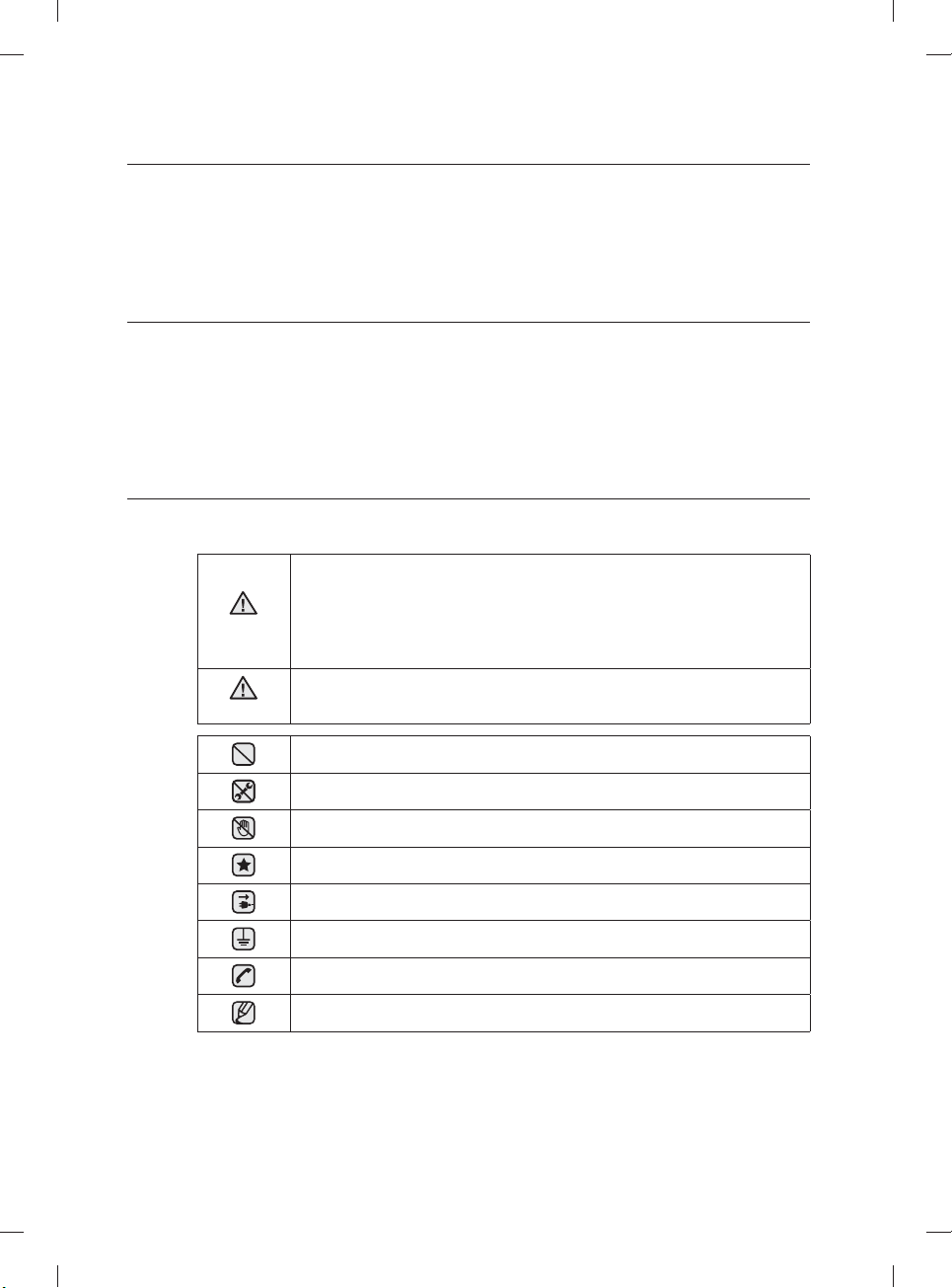
What the icons and signs in this user manual mean:
Hazards or unsafe practices that may result in severe personal injury, death
and/or property damage. Follow the information in this manual to minimize
the risk of fi re or explosion or to prevent property damage, personal injury, or
WARNING
CAUTION
death.
Do not store or use gasoline or other fl ammable vapors and liquids near this or
any other appliance.
Hazards or unsafe practices that may result in personal injury and/or
property damage.
Do NOT attempt.
Do NOT disassemble.
Do NOT touch.
Follow directions explicitly.
Unplug the power plug from the wall socket.
Make sure the machine is grounded to prevent electric shock.
Call the service center for help.
Note
These warning signs are here to prevent injury to you and others.
Please follow them explicitly.
After reading this section, keep it in a safe place for future reference.
SAVE THESE INSTRUCTIONS
4_ Safety instructions
DV457E(G)-02836E-03_EN.indd Sec11:4DV457E(G)-02836E-03_EN.indd Sec11:4 2012-12-04 6:44:372012-12-04 6:44:37
Page 5
WARNING - Risk of Fire
• Clothes dryer installation must be performed by a qualifi ed installer.
• Install the clothes dryer according to the manufacturer’s instructions and local codes.
• Do not install a clothes dryer with fl exible plastic venting materials. If fl exible metal (foil type) duct
is installed, it must be of a specifi c type identifi ed by the appliance manufacturer as suitable for
use with clothes dryers. Flexible venting materials are known to collapse, be easily crushed, and
trap lint. These conditions will obstruct the clothes dryer’s airfl ow and increase the risk of fi re.
• To reduce the risk of severe injury or death, follow all installation instructions.
TO REDUCE THE RISK OF FIRE OR EXPLOSION:
WARNING
• Do not dry items that have been previously cleaned, washed, soaked, or spotted with
gasoline, dry cleaning solvents, or other fl ammable or explosive substances. They emit
vapors that could ignite or explode. Any material that has been in contact with a cleaning
solvent or fl ammable liquids or solids should not be placed in the dryer until all traces of
these fl ammable liquids or solids and their fumes have been removed.
There are many highly fl ammable items used in homes, such as acetone, denatured alcohol,
gasoline, kerosene, some liquid household cleaners, some spot removers, turpentine, waxes,
and wax removers
• Do not dry items containing foam rubber (may be labeled latex foam) or similarly textured
rubber-like materials on a heat setting. Heated foam rubber materials can, under certain
circumstances, produce fi re by spontaneous combustion.
WHAT TO DO IF YOU SMELL GAS:
WARNING
• Do not try to light any appliance.
• Do not turn on the appliance.
• Do not touch any electrical switch.
• Do not use any phone in your building.
• Clear the room, building or area of all occupants.
• Immediately call your gas supplier from a neighbor’s phone. Follow the gas supplier’s
instructions.
• If you cannot reach your gas supplier, call the fi re department.
• Installation and service must be performed by a qualifi ed installer, service agency, or the gas
supplier.
SAVE THESE INSTRUCTIONS
Safety instructions _5
DV457E(G)-02836E-03_EN.indd Sec11:5DV457E(G)-02836E-03_EN.indd Sec11:5 2012-12-04 6:44:382012-12-04 6:44:38
Page 6

Safety instructions
IMPORTANT SAFTY INSTRUCTION
WARNING
WARNING
To reduce the risk of fi re, electric shock, or injury to persons when using your appliance, follow
basic precautions, including the following:
1. Read all instructions before using this appliance.
2. Do not dry articles that have been previously cleaned in, washed in, soaked in, or spotted
with gasoline, dry-cleaning solvents, or other fl ammable or explosive substances, because
they give o vapors that could ignite or explode.
3. Do not use the dryer to dry clothes which have traces of any fl ammable substance, such
as vegetable oil, cooking oil, machine oil, fl ammable chemicals, thinner, etc., or anything
containing wax or chemicals, such as mops and cleaning cloths. Flammable substances may
cause the fabric to catch fi re by itself.
4. Do not store or use gasoline or other fl ammable vapors and liquids near this or any other
appliance.
5. Do not allow children or pets to play on, in, or in front of the appliance. Close supervision is
necessary when the appliance is used near children and pets.
6. Before the appliance is removed from service or discarded, remove the door to the drying
compartment to prevent children or animals from becoming trapped inside.
7. Do not reach into the appliance when the drum is moving.
8. Do not install or store this appliance where it will be exposed to the weather.
9. Do not tamper with the controls.
10. Do not repair or replace any part of the appliance or attempt any servicing unless specifi cally
recommended in the user-maintenance instructions or published in the user-repair
instructions that you understand and have the skills to carry out.
11. Do not use fabric softeners or products to eliminate static unless recommended by the
manufacturer of the fabric softener or product.
12. Clean the lint screen before or after each load.
13. Do not use heat to dry articles containing foam rubber or similarly textured rubber-like
materials.
14. Keep the area around the exhaust opening and surrounding areas free from lint, dust, and
dirt.
15. The interior of the dryer and exhaust duct should be cleaned periodically by qualifi ed service
personnel.
16. Do not place items exposed to cooking oils in your dryer. Items contaminated with cooking
oils may contribute to a chemical reaction that could cause a load to catch fi re.
17. This appliance must be grounded. See “Electrical requirements” and ”Grounding” in the
“Installing your dryer” section.
18. This appliance must be properly grounded. Never plug the power cord into a receptacle
that is not grounded adequately and in accordance with local and national codes. Refer to
installation instructions for grounding this appliance.
SAVE THESE INSTRUCTIONS
6_ Safety instructions
DV457E(G)-02836E-03_EN.indd Sec11:6DV457E(G)-02836E-03_EN.indd Sec11:6 2012-12-04 6:44:382012-12-04 6:44:38
Page 7
19. Ensure pockets are free from small irregularly shaped hard objects and foreign material, i.e.
coins, knives, pins, etc. These objects could damage your dryer.
20. Gas leaks may occur in your system, resulting in a dangerous situation.
21. Gas leaks may not be detected by smell alone.
22. Gas suppliers recommend you purchase and install a UL-approved gas detector.
STATE OF CALIFORNIA PROPOSITION 65 WARNINGS:
WARNING
The California Safe Drinking Water and Toxic Enforcement Act requires the Governor of California
to publish a list of substances known to the State of California to cause cancer, birth defects,
or other reproductive harm, and requires businesses to warn of potential exposure to such
substances.
This product contains a chemical known to the State of California to cause cancer, birth defects,
or other reproductive harm. This appliance can cause low-level exposure to some of the
substances listed, including benzene, formaldehyde, and carbon monoxide.
Gas appliances may cause low-level exposure to some of the substances listed including
benzene, formaldehyde, carbon monoxide, and soot; as a result of possible incomplete
combustion of natural gas or LP fuels. Exposure to these substances can be minimized further
by properly venting the dryer to the outdoors.
CAUTION
CAUTION
1. Do not sit on top of the dryer.
2. Because of continuing product improvements, Samsung reserves the right to change
specifi cations without notice. For complete details, see the Installation Instructions packed
with your product before selecting cabinetry, making cutouts, or beginning installation.
3. Do not wash clothing with large buckles, buttons, or other heavy metal or solid things.
4. Install and use in accordance with the manufacturer’s instructions.
5. Do not place items in your dryer that have been spotted or soaked with vegetable oil or
cooking oil. Even after being washed, these items may contain signifi cant amounts of these
oils.
6. Residual oil on clothing can ignite spontaneously. The potential for spontaneous combustion
increases when items containing vegetable oil or cooking oil are exposed to heat. Heat
sources such as your dryer can warm these items, allowing an oxidation reaction in the oil to
occur. Oxidation creates heat. If this heat cannot escape, the items can become hot enough
to catch fi re. Piling, stacking, or storing these kinds of items may prevent heat from escaping
and can create a fi re hazard.
7. All washed and unwashed fabrics that contain vegetable oil or cooking oil can be dangerous.
Washing these items in hot water with extra detergent will reduce, but not eliminate, the
hazard. Always use the Cool Down cycle for these items to reduce their temperature. Never
remove these items from the dryer hot or interrupt the drying cycle until the items have run
through the Cool Down cycle. Never pile or stack these items when they are hot.
8. Take care that children’s fi ngers are not caught in the door when closing it. This may result in
injury.
SAVE THESE INSTRUCTIONS
Safety instructions _7
DV457E(G)-02836E-03_EN.indd Sec11:7DV457E(G)-02836E-03_EN.indd Sec11:7 2012-12-04 6:44:382012-12-04 6:44:38
Page 8

Safety instructions
REGULATORY NOTICE
1. FCC Notice
FCC CAUTION:
CAUTION
Any changes or modifi cations not expressly approved by the party responsible for compliance
could void the user’s authority to operate the equipment.
This device complies with Part 15 of FCC Rules. Operation is Subject to following two
conditions:
1. This device may not cause harmful interference, and
2. This device must accept any interference received including interference that causes
undesired operation.
For product available in the USA/Canada market, only channel 1~11 can be operated. Selection
of other channels is not possible.
FCC STATEMENT:
This equipment has been tested and found to comply within the limits for a Class B digital
device, pursuant to part 15 of the FCC Rules. These limits are designed to provide reasonable
protection against harmful interference in a residential installation.
This equipment generates, uses, and can radiate radio frequency energy and, if not installed
and used in accordance with the instructions, may cause harmful interference to radio
communications. However, there is no guarantee that interference will not occur in a particular
installation. If this equipment does cause harmful interference to radio or television reception,
which can be determined by turning the equipment o and on, the user is encouraged to try to
correct the interference by one or more of the following measures:
• Reorient or relocate the receiving antenna.
• Increase the separation between the equipment and receiver.
• Connect the equipment to an outlet on a di erent circuit from that of the receiver.
• Consult the dealer or an experienced radio/TV technician for help.
FCC RADIATION EXPOSURE STATEMENT:
This equipment complies with FCC radiation exposure limits set forth for an uncontrolled
environment. This equipment should be installed and operated with a minimum distance of 20cm
between the radiator and your body. This device and its antenna(s) must not be co-located or
operated in conjunction with any other antenna or transmitter.
SAVE THESE INSTRUCTIONS
8_ Safety instructions
DV457E(G)-02836E-03_EN.indd Sec11:8DV457E(G)-02836E-03_EN.indd Sec11:8 2012-12-04 6:44:382012-12-04 6:44:38
Page 9

2. IC Notice
The term “IC” before the radio certifi cation number only signifi es that Industry Canada technical
specifi cations were met. Operation is subject to the following two conditions: (1) this device may
not cause interference, and (2) this device must accept any interference, including interference
that may cause undesired operation of the device.
This Class B digital apparatus complies with Canadian ICES-003.
Cet appareil numérique de la classe B est conforme á la norme NMB-003 du Canada.
For product available in the USA/Canada market, only channels 1~11 can be operated. Selection
of other channels is not possible.
IC RADIATION EXPOSURE STATEMENT:
This equipment complies with IC RSS-102 radiation exposure limits set forth for an uncontrolled
environment. This equipment should be installed and operated with minimum distance of 20cm
between the radiator & your body. This device and its antenna(s) must not be co-located or
operated in conjunction with any other antenna or transmitter.
SAVE THESE INSTRUCTIONS
Safety instructions _9
DV457E(G)-02836E-03_EN.indd Sec11:9DV457E(G)-02836E-03_EN.indd Sec11:9 2012-12-04 6:44:382012-12-04 6:44:38
Page 10

Contents
INSTALLING YOUR DRYER
12
DRYING A LOAD OF LAUNDRY
30
12 Unpacking your dryer
12 The dryer exterior
13 Basic requirements
14 Ducting requirements
15 Important to installer
15 Location considerations
15 Alcove or closet installations
16 Mobile home installations
16 Exhausting
17 Gas requirements
17 Commonwealth of massachusetts
installation instructions
18 Electrical requirements
18 Grounding
19 Electrical connections
20 Connecting the inlet hose
22 Replacement parts and accessories
22 Installation
25 Final installation checklist
25 Dryer exhaust tips
26 Door Reversal
28 Setting up your dryer for the fi rst time
30 Drying for the fi rst time
30 Basic instructions
31 Using the control panel
36 Drying your laundry using the cycle
selection screen
45 Using the Rack Dry
45 Checking the fi lter
46 Vent Sensor
USING YOUR MOBILE PHONE
47
10_ Contents
DV457E(G)-02836E-03_EN.indd Sec2:10DV457E(G)-02836E-03_EN.indd Sec2:10 2012-12-04 6:44:382012-12-04 6:44:38
47 Confi guring your dryer’s network settings
and connecting to your network
48 Turning on the Wi-Fi networking function of
your dryer
49 How to update the software
50 Downloading and running the mobile app,
Samsung Smart Washer/Dryer App
51 Using the Mobile App
55 Overview of wi-fi settings and ap connection
screens
Page 11

CARE AND CLEANING
56
56 Control panel
56 Tumbler
56 Stainless steel tumbler
56 Dryer exterior
56 Dryer exhaust system
SPECIAL LAUNDRY TIPS
57
TROUBLESHOOTING
58
APPENDIX
63
57 Special laundry tips
58 Check these points if your dryer…
59 Information codes
61 Network Setup Q&A
63 Fabric care chart
64 Protecting the environment
64 Declaration of conformity
64 Specifi cations
65 Cycle chart
Contents _11
DV457E(G)-02836E-03_EN.indd Sec2:11DV457E(G)-02836E-03_EN.indd Sec2:11 2012-12-04 6:44:382012-12-04 6:44:38
Page 12
Installing your dryer
UNPACKING YOUR DRYER
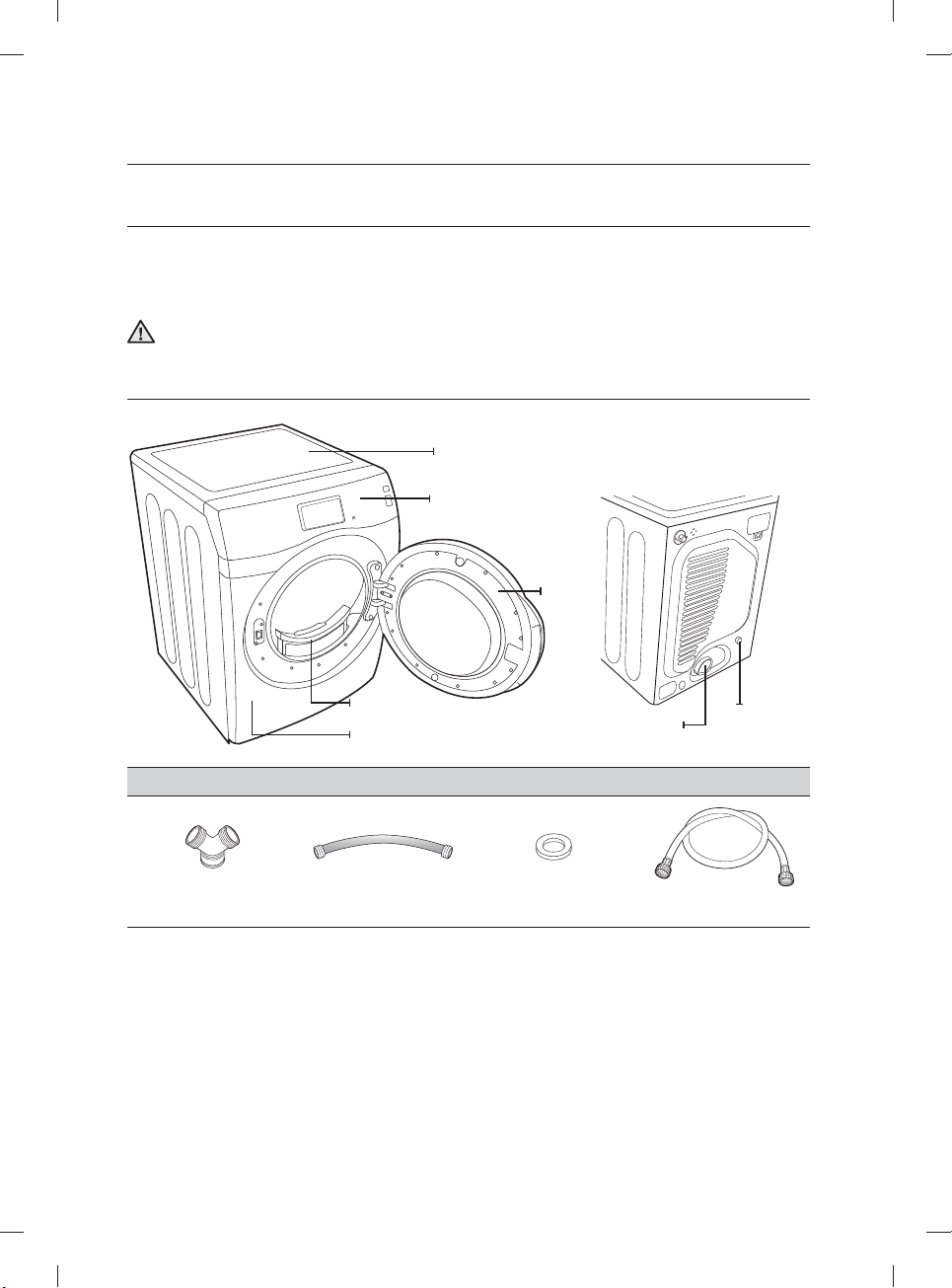
Unpack your Dryer and inspect it for shipping damage. Make sure you have received all the items
shown below. If your Dryer was damaged during shipping, or you do not have all the items, contact
1-800-SAMSUNG (726-7864).
To prevent personal injury or strain, wear protective gloves whenever lifting or carrying the unit.
The packing materials can be dangerous to children. Keep all packaging material (plastic bags,
polystyrene, etc.) well out of the reach of children.
WARNING
THE DRYER EXTERIOR
Top Cover
[ BACK ]
Control panel
Door
Filter
Frame Front
Parts supplied
“Y”-connector Short inlet hose Rubber Washer Long inlet hose
12_ Installing your dryer
Duct Exhaust
Water Inlet
DV457E(G)-02836E-03_EN.indd 12DV457E(G)-02836E-03_EN.indd 12 2012-12-04 6:44:382012-12-04 6:44:38
Page 13

Tools needed
01 INSTALLING YOUR DRYER
Pliers Cutting knife
Level Phillips Screwdriver Duct tape Wrench
Pipe wrench
(gas only)
Nut drivers
BASIC REQUIREMENTS
Make sure you have everything necessary for the proper installation
• A GROUNDED ELECTRICAL OUTLET is required. Refer to the “Electrical requirements” section on
page 18.
• A POWER CORD for electric dryers (except for Canada).
• GAS LINES (if you have a gas dryer) must meet national and local codes.
• The EXHAUST SYSTEM must be rigid metal or fl exible sti -walled metal exhaust ducting.
Installing your dryer _13
DV457E(G)-02836E-03_EN.indd 13DV457E(G)-02836E-03_EN.indd 13 2012-12-04 6:44:382012-12-04 6:44:38
Page 14
Installing your dryer
DUCTING REQUIREMENTS
• Use a 4-inch (10.2 cm) diameter rigid aluminum or rigid galvanized steel duct.
• Do not use a smaller duct.
• Ducts larger than 4 inches (10.2 cm) in diameter can result in increased accumulation of lint.
• Lint should be removed regularly.
• If a fl exible metal duct must be used, use the type with a sti sheet metal wall. Do not use a fl exible duct
with a thin foil wall. A serious blockage can result if the fl exible metal duct is bent too sharply.
• Never install any type of fl exible duct in walls, ceilings, or other concealed spaces.
• Keep the exhaust duct as straight and short as possible.
• Secure joints with duct tape. Do not use screws.
• Do not use plastic fl exible duct. Plastic fl exible duct can kink, sag, be punctured, reduce airfl ow, extend
drying times, and a ect dryer operation.
• Exhaust systems longer than recommended can extend drying times, a ect machine operations, and
collect lint.
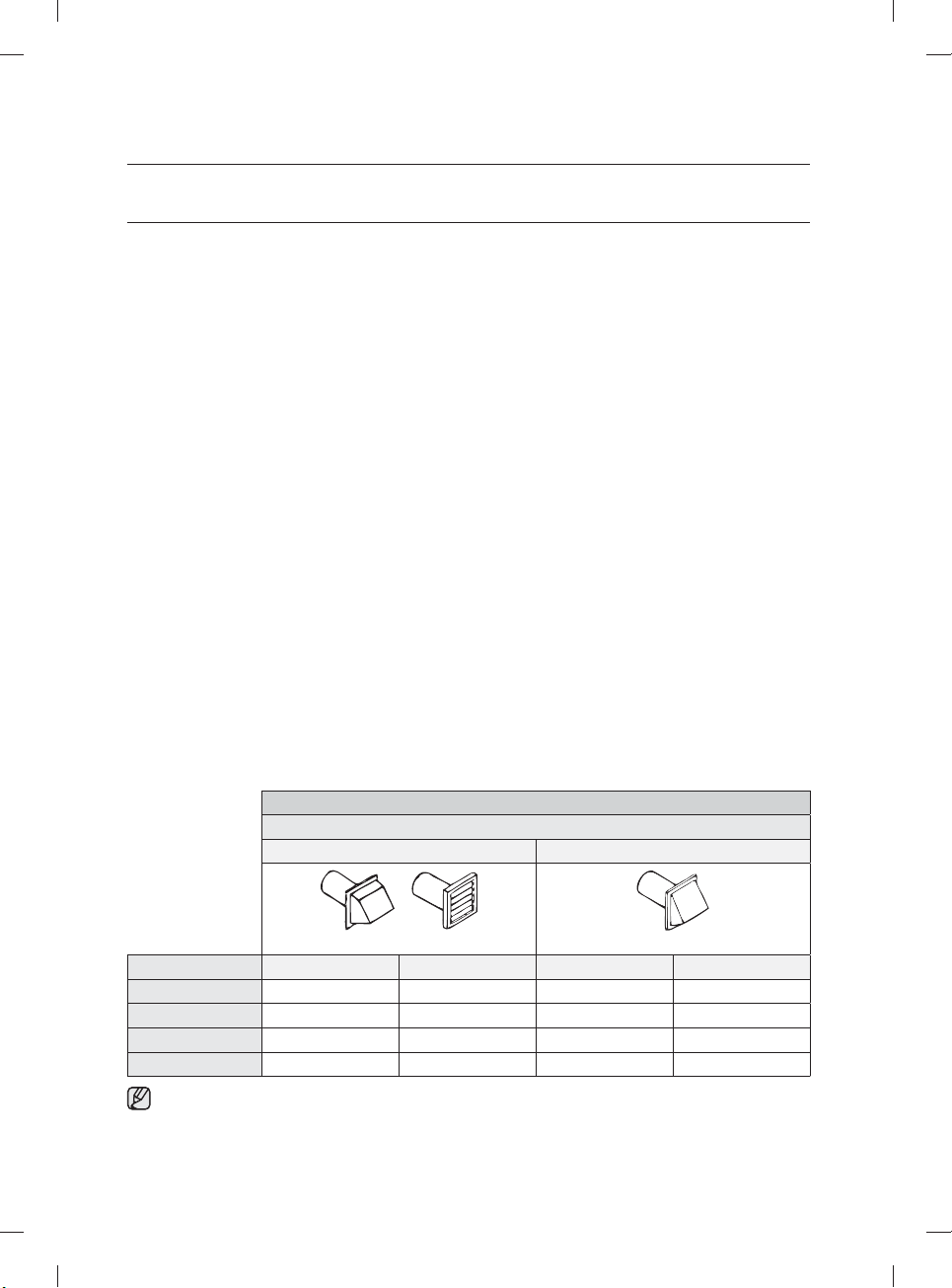
• The exhaust duct should end with an exhaust hood with a swing-out damper to prevent back drafts and
entry of wildlife. Never use an exhaust hood with a magnetic damper.
• The hood should have at least 12 inches (30.5 cm) of clearance between the bottom of the hood and
the ground or other obstruction. The hood opening should point down.
• Never install a screen over the exhaust outlet.
• To avoid lint buildup, do not exhaust the dryer directly into a window well. Do not exhaust under a house
or porch.
• If the exhaust duct must run through an unheated area, the duct should be insulated and slope slightly
down towards the exhaust hood to reduce condensation and lint buildup.
• Inspect and clean the interior of the exhaust system at least once a year. Unplug the power cord before
cleaning.
• Check frequently to make sure the exhaust hood damper opens and closes freely.
• Check once per month, and clean at least once per year. Note: If your clothes are not getting dry, then
check the ducting for obstructions.
• Do not exhaust the dryer into a wall, ceiling, crawl space, or concealed space of a building, gas vent, or
any other common duct or chimney. This could create a fi re hazard from the lint expelled by the dryer.
ELECTRIC AND GAS DRYER
Weather Hood Type
Recommended
Use only for short-run installation
No. of 90° elbows
0
1
2
3
* Do not use non-metallic fl exible ducts.
Rigid Metallic Flexible*
24.4 m (80 ft.) 12.4 m (41 ft.)
20.7 m (68 ft.) 11.2 m (37 ft.)
17.4 m (57 ft.) 10.1 m (33 ft.)
14.3 m (47 ft.) 9.0 m (29 ft.)
4” (10 .16 cm)
22.6 m (74 ft.) 10.1 m (33 ft.)
18.9 m (62 ft.) 8.8 m (29 ft.)
15.5 m (51 ft.) 7.6 m (25 ft.)
12.5 m (41 ft.) 6.5 m (21 ft.)
2.5” (6.35 cm)
Rigid Metallic Flexible*
14_ Installing your dryer
DV457E(G)-02836E-03_EN.indd 14DV457E(G)-02836E-03_EN.indd 14 2012-12-04 6:44:392012-12-04 6:44:39
Page 15
If the new dryer is installed into an existing exhaust system you must make sure:
• The exhaust system meets all local, state, and national codes.
• That a fl exible plastic duct is not used.
• To inspect and clean all lint buildup from inside the existing duct.
• The duct is not dented or crushed.
• The exhaust hood damper opens and closes freely.
The static pressure in any exhaust system must not exceed 0.83 inches of water column, or be less than 0.
This can be measured with the dryer running with a manometer at the point where the exhaust duct
connects to the dryer. A no-heat setting should be used. The dryer tumbler should be empty and the lint
fi lter clean.
IMPORTANT TO INSTALLER
Please read the following instructions carefully before installing the dryer. These instructions should be kept
for future reference.
Remove the door from all discarded appliances to avoid the danger of a child being trapped and
su ocating.
WARNING
LOCATION CONSIDERATIONS
The dryer should be located where there is enough space at the front for loading the dryer, and enough
space behind for the exhaust system. This dryer is factory-ready for the rear exhaust option. To exhaust out
the bottom, right or the left, use the accessory exhaust kit. Instructions are included with the kit. Make sure
the room in which the dryer is located has enough fresh air. The dryer must be located where there are no
air-fl ow obstruction.
For gas dryers, adequate clearance must be maintained as noted on the data plate to ensure adequate air
for combustion and the proper dryer operation.
The dryer must not be installed or stored in an area where it will be exposed to water and/or weather. The
dryer area must be kept clear of combustible materials, gasoline, and other fl ammable vapors and liquids. A
dryer produces combustible lint. The area around the dryer should be kept lint-free.
01 INSTALLING YOUR DRYER
ALCOVE OR CLOSET INSTALLATIONS
The dryer must be exhausted to the outside to reduce the risk of fi re when installed in an alcove or
closet.
WARNING
• No other fuel-burning appliance should be installed in the same closet as the dryer.
• WARNING: To reduce the risk of fi re, this dryer must be exhausted to the outside. Refer to “Exhausting”
section on page 16.
• Minimum clearances between the dryer and adjacent walls or other surfaces are: 2” in front, 17” on top,
1” on either side, and 5” at the back.
• The front of the closet must have two unobstructed air openings for a combined minimum total area
of 72 in² with a minimum clearance of 3” at the top and bottom. A slatted door with equivalent space
clearances is acceptable.
Installing your dryer _15
DV457E(G)-02836E-03_EN.indd 15DV457E(G)-02836E-03_EN.indd 15 2012-12-04 6:44:392012-12-04 6:44:39
Page 16

Installing your dryer
MOBILE HOME INSTALLATIONS
The installation of the dryer in a mobile home must conform to the Manufactured Home Construction and
Safety Standards Title 24 CFR, Part 3280 {formerly the Federal Standards for Mobile Home Construction
and Safety, Title 24, HUD (Part 280), 1975} for the United States) or CSA Standards Z240 (for Canada).
• When installing a dryer in a mobile home, provisions for anchoring the dryer to the fl oor must be made.
• Locate an area with adequate fresh air.
• A minimum unobstructed space of 72 in² (465 cm²) is required.
• Call 1-800-SAMSUNG for information on purchasing the Floor Anchoring Kit as an accessory.
• All mobile home installations must be exhausted to the outside with the exhaust duct termination
securely fastened to the mobile home structure, using materials that will not combust.
• The exhaust duct may not terminate underneath the mobile home.
• Refer to the following “Exhausting” section for more information.
EXHAUSTING
The dryer shall not be exhausted into a chimney, a wall, a ceiling, an attic, a crawl space, or a concealed
space of a building.
Exhausting the dryer to the outside will prevent large amounts of lint and moisture from being blown into the
room.
See “Ducting requirements” in installing your dryer section for the maximum duct length
and number of bends.
• All dryers must be exhausted to the outside.
• The duct must not be assembled with screws or other fastening means that extend into the
duct and catch lint.
• The required exhaust duct is 4 inches (102 mm) in diameter.
• The total length of fl exible metal duct shall not exceed 2.4 m (7.8 ft.).
In the United States:
• Use only those foil-type fl exible ducts, if any, specifi cally identifi ed for use with the appliance
by the manufacturer and that comply with the Outline for Clothes Dryer Transition Ducts,
Subject 2158A, shall be used.
In Canada:
• Use only those foil-type fl exible ducts, if any, specifi cally identifi ed for use with the appliance
by the manufacturer.
Outside the U.S. and Canada:
• Refer to the local codes.
The dryer must be exhausted to the outside to reduce the risk of fi re when installed in an
alcove or closet.
WARNING
NEVER USE A PLASTIC OR NON-METAL FLEXIBLE DUCT.
If your existing ductwork is plastic, non-metal, or combustible, replace it with metal.
WARNING
Use only a metal exhaust duct that is non-fl ammable to ensure containment of the exhaust
air, heat, and lint.
16_ Installing your dryer
DV457E(G)-02836E-03_EN.indd 16DV457E(G)-02836E-03_EN.indd 16 2012-12-04 6:44:392012-12-04 6:44:39
Page 17
GAS REQUIREMENTS
Use only natural or LP (liquid propane) gases.
THE INSTALLATION MUST CONFORM WITH LOCAL CODES, OR IN THE ABSENCE OF LOCAL
CODES, WITH THE NATIONAL FUEL GAS CODE ANSI/Z223.1, LATEST REVISION (FOR THE UNITED
STATES), OR WITH THE CAN/CGA-B149 INSTALLATION CODES (FOR CANADA).
Gas dryers are equipped with a burner vent for use with natural gas. If you plan to use your dryer with LP
(liquid propane) gas, it must be converted for safe and proper performance by a qualifi ed service technician.
A 1/2” (1.27 cm) gas supply line is recommended and must be reduced to connect to the 3/8” (1 cm) gas
line on your dryer. The National Fuel Gas Code requires that an accessible, approved manual gas shut-o
valve be installed within 6” of your dryer.
Gas dryers installed in residential garages must be raised 18 inches (46 cm) above the fl oor.
Additionally, a 1/8” (0.3 cm) N.P.T. (National Pipe Thread) plugged tapping, accessible for test gauge
connection, must be installed immediately upstream of your dryer’s gas supply connection.
Your dryer must be disconnected from the gas supply pipe system during any pressure testing of the
system.
DO NOT reuse old fl exible metal gas lines. Flexible gas lines must be design certifi ed by the American Gas
Association (CGA in Canada).
• Any pipe joint compound used must be resistant to the action of any liquefi ed petroleum gas.
• As a courtesy, most local gas utilities will inspect a gas appliance installation.
GAS IGNITION - Your dryer uses an automatic ignition system to ignite the burner.
There is no constant burning pilot.
COMMONWEALTH OF MASSACHUSETTS INSTALLATION
INSTRUCTIONS
01 INSTALLING YOUR DRYER
Your dryer must be installed by a licensed plumber or gas fi tter. A “T” handle manual gas valve must be
installed in the gas supply line to your dryer. If a fl exible gas connector is used to install your dryer, the
connector may not be longer than 3’ (36”).
• Gas leaks may occur in your system, creating a dangerous situation.
• Gas leaks may not be detected by smell alone.
WARNING
• Gas suppliers recommend that you purchase and install a UL-approved gas detector.
• Install and use it in accordance with the manufacturer’s instructions.
Installing your dryer _17
DV457E(G)-02836E-03_EN.indd 17DV457E(G)-02836E-03_EN.indd 17 2012-12-04 6:44:392012-12-04 6:44:39
Page 18

Installing your dryer
ELECTRICAL REQUIREMENTS
The wiring diagram is located on the plate below the control panel.
• The improper connection of the equipment grounding conductor can result in a risk of electric
shock. Check with a qualifi ed electrician or serviceman if you are in doubt as to whether your dryer
WARNING
is properly grounded. Do not modify the plug provided with your dryer - if it doesn’t fi t the outlet,
have a proper outlet installed by a qualifi ed electrician.
• To prevent unnecessary risk of fi re, electrical shock, or personal injury, all wiring and grounding
must be done in accordance with local codes, or in the absence of local codes, with the National
Electrical Code, ANSI/NFPA No. 70-Latest Revision (for the U.S.) or the Canadian Electrical Code
CSA C22.1 - Latest Revisions and local codes and ordinances. It is your responsibility to provide
adequate electrical services for your dryer.
• All gas installations must be done in accordance with the national Fuel Code ANSI/Z2231 - Latest
Revision (for the U.S.) or CAN/CGA - B149 Installation Codes - Latest Revision (for Canada) and
local codes and ordinances.
GROUNDING
This dryer must be grounded. In the event of a malfunction or breakdown, the grounding the product will
reduce the risk of electrical shock by providing a path of least resistance for the electrical current.
Gas models
WARNING
Your dryer has a cord with an equipment-grounding conductor and a grounding plug.
The plug must be plugged into an appropriate outlet that is properly installed and grounded in
accordance with all local codes and ordinances.
Do not modify the plug provided with your dryer – if it doesn’t fi t the outlet, have a proper outlet
installed by a qualifi ed electrician.
Never connect the ground wire to the plastic plumbing lines, gas lines, or hot water pipes.
Electric models
WARNING
Your dryer has an optional cord with an equipment-grounding conductor and a grounding plug.
The cord is sold separately.
The plug must be plugged into an appropriate outlet that is properly installed and grounded in
accordance with all local codes and ordinances.
Do not modify the plug provided with your dryer – if it doesn’t fi t the outlet, have a proper outlet
installed by a qualifi ed electrician.
If a power cord is not used and the electric dryer is to be permanently wired, the dryer must
be connected to a permanently grounded metal wiring system, or an equipment grounding
conductor must be run with the circuit conductors and connected to the equipment grounding
terminal or lead on the dryer.
18_ Installing your dryer
DV457E(G)-02836E-03_EN.indd 18DV457E(G)-02836E-03_EN.indd 18 2012-12-04 6:44:402012-12-04 6:44:40
Page 19
ELECTRICAL CONNECTIONS
Before operating or testing, follow all grounding instructions in the “Grounding” section on page 18.
An individual branch (or separate) circuit serving only your dryer is recommended. DO NOT USE AN
EXTENSION CORD.
Gas models – U.S. and Canada
A 120 volt, 60 Hz AC approved electrical service, with a 15-ampere fuse or circuit breaker is
required.
Electric models – U.S. only
Most U.S. dryers require a 120/240 volt, 60 Hz AC approved electrical service. Some require
120/208 volt, 60 Hz approved electrical service. The electric service requirements can be found
on the data label located behind the door. A 30-ampere fuse or circuit breaker on both sides of
the line is required.
• If a power cord is used, the cord should be plugged into a 30-ampere receptacle.
• The power cord is NOT provided with U.S. electric model dryers.
RISK OF ELECTRIC SHOCK:
WARNING
When local codes allow, the electrical supply of the dryer may be connected by means of
a new power supply cord kit, marked for use with a dryer, that is U.L. listed and rated at a
minimum of120/240 volts, 30-ampere with three No. 10 copper wire conductors terminated
with closed loop terminals, open-end spade lugs with turned up ends, or with tinned leads.
• Do not reuse a power supply cord from an old dryer. The power cord electric supply
wiring must be retained at the dryer cabinet with a suitable UL-listed strain relief.
• Grounding through the neutral conductor is prohibited for (1) new branch-circuit
installations, (2) mobile homes, (3) recreational vehicles, and (4) areas where local
codes prohibit grounding through the neutral conductor. (Use a 4-prong plug for 4 wire
receptacles, NEMA type 14-30R.)
Electric models – Canada Only
• A 120/240 volt, 60 Hz AC approved electrical service fused through a 30-ampere fuse or
circuit breaker on both sides of the line is required.
• All Canadian models are shipped with the power cord attached. The power cord should be
plugged into a 30-ampere receptacle.
In Canada, you may not convert a dryer to 208 volts.
01 INSTALLING YOUR DRYER
Installing your dryer _19
DV457E(G)-02836E-03_EN.indd 19DV457E(G)-02836E-03_EN.indd 19 2012-12-04 6:44:402012-12-04 6:44:40
Page 20
Installing your dryer
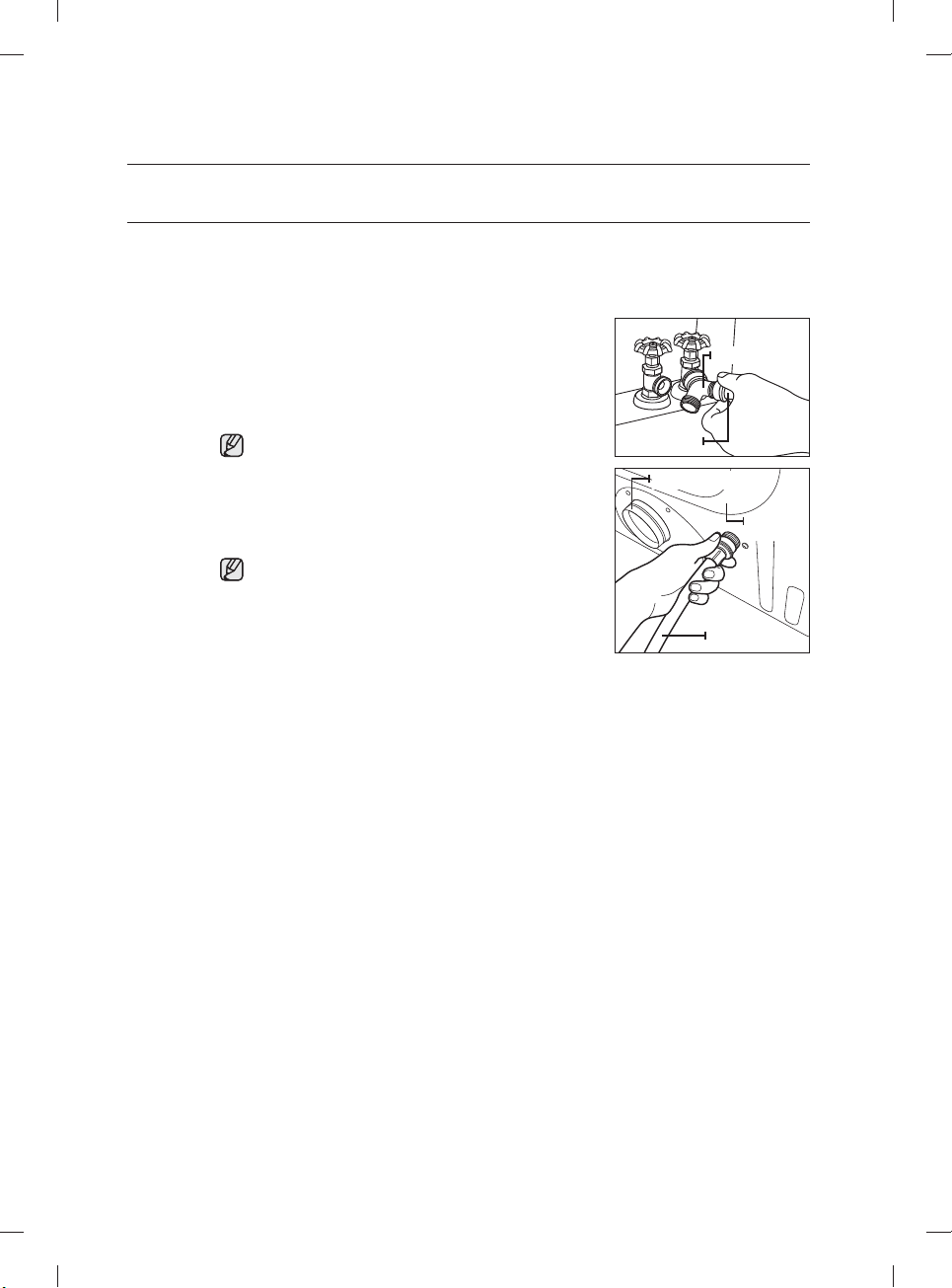
CONNECTING THE INLET HOSE
Method 1
The dryer must be connected to the cold water faucet using the new inlet hoses. Do not use old
hoses.
1. If space permits, attach the brass female end of the “Y”
connector to the cold water faucet.
2. Turn the cold water faucet o .
3. Attach the straight end of long hose to the “Y’ connector.
4. Using pliers, tighten the coupling with an additional two-
thirds turn.
Do not overtighten, as this may damage the coupling.
5. Attach the angled end of long hoses to fi ll the valve at the
bottom of the dryer’s rear frame. Screw on the coupling by
hand until it is seated on the fi ll valve connector.
6. Using the pliers, tighten the coupling with an additional two-
thirds turn.
Do not overtighten, as this may damage the coupling.
7. Check that the water faucets are on.
8. Check for leaks around the “Y” connector, faucets and
hoses.
Water Hose
Duct Exhaust
Y-Connector
Frame
(back)
Water Hose
20_ Installing your dryer
DV457E(G)-02836E-03_EN.indd 20DV457E(G)-02836E-03_EN.indd 20 2012-12-04 6:44:402012-12-04 6:44:40
Page 21
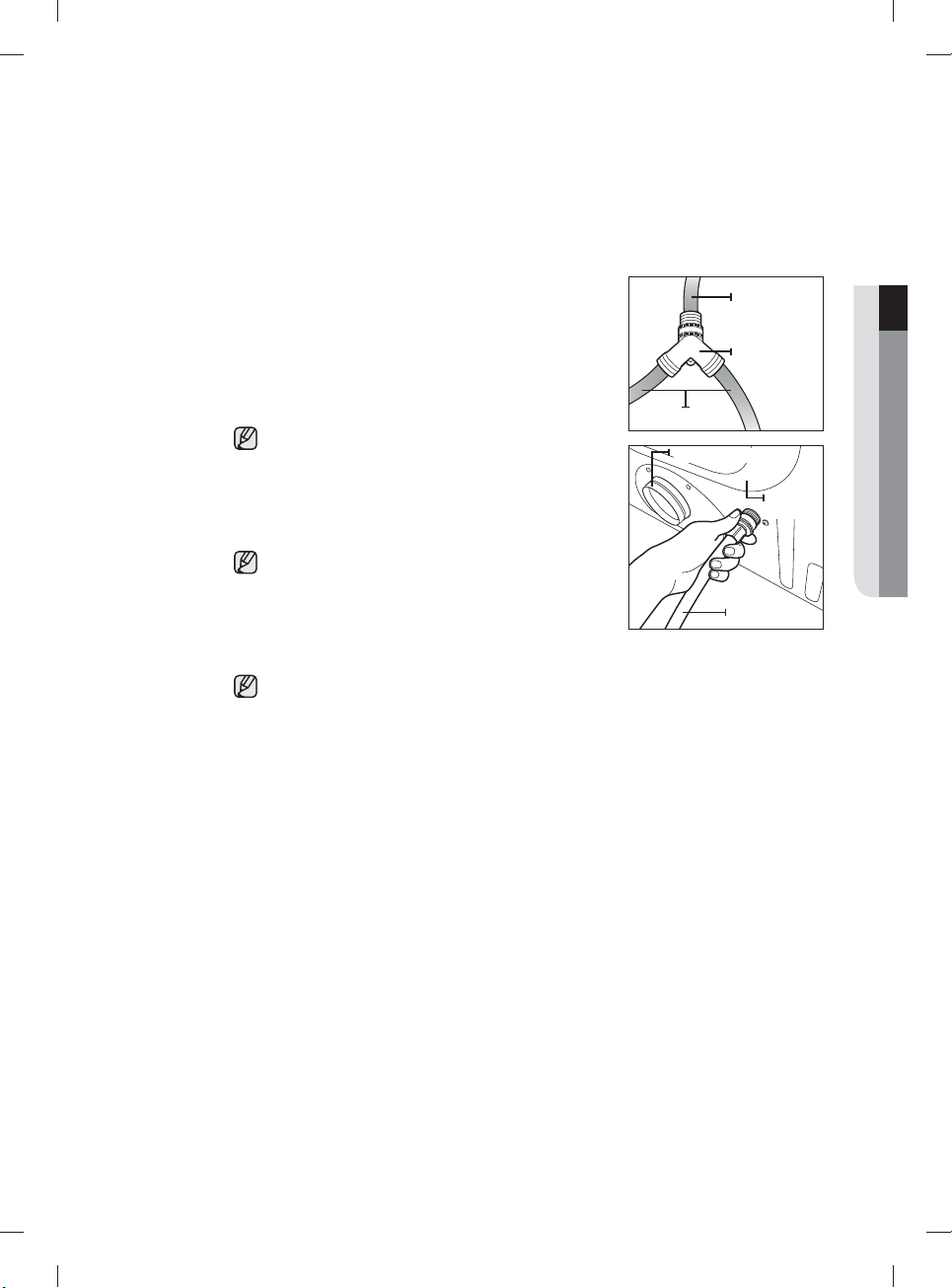
Method 2
The dryer must be connected to the cold water faucet using the new inlet hoses. Do not use old
hoses.
1. If the “Y” connector cannot be attached directly to the cold
water faucet, the short hose must be used.
2. Turn the cold water faucet o .
3. Attach the short inlet hose to the cold water faucet.
Screw on the coupling by hand until it is seated on the
faucet.
4. Using the pliers, tighten the coupling with an additional twothirds turn.
Do not overtighten, as this may damage the coupling.
5. Attach the ‘Y” connector to the brass male end of the small
hose. Screw on the coupling by hand until it is seated on the
connector.
6. Using the pliers, tighten the coupling with an additional twothirds turn.
Do not overtighten, as this may damage the coupling.
7. Attach the angled end of long hoses to the fi ll valve at the
bottom of the dryer rear frame. Screw on the coupling by
hand until it is seated on the fi ll valve connector.
8. Using pliers, tighten the coupling with an additional twothirds turn.
Do not overtighten, as this may damage the coupling.
9. Check that the water faucets are on.
10. Check for leaks around the “Y” connector, faucets and
hoses.
Long hose
Duct Exhaust
Short hose
(Inlet to cold
water)
“Y” connector
Frame
(back)
Water Hose
01 INSTALLING YOUR DRYER
Installing your dryer _21
DV457E(G)-02836E-03_EN.indd 21DV457E(G)-02836E-03_EN.indd 21 2012-12-04 6:44:402012-12-04 6:44:40
Page 22
Installing your dryer
REPLACEMENT PARTS AND ACCESSORIES
If your dryer requires replacement parts or accessories, contact the dealer where you purchased your dryer
or the SAMSUNG customer care center at 1-800-SAMSUNG (726-7864).
INSTALLATION
For the proper installation, we recommend that you hire a qualifi ed installer.
To install
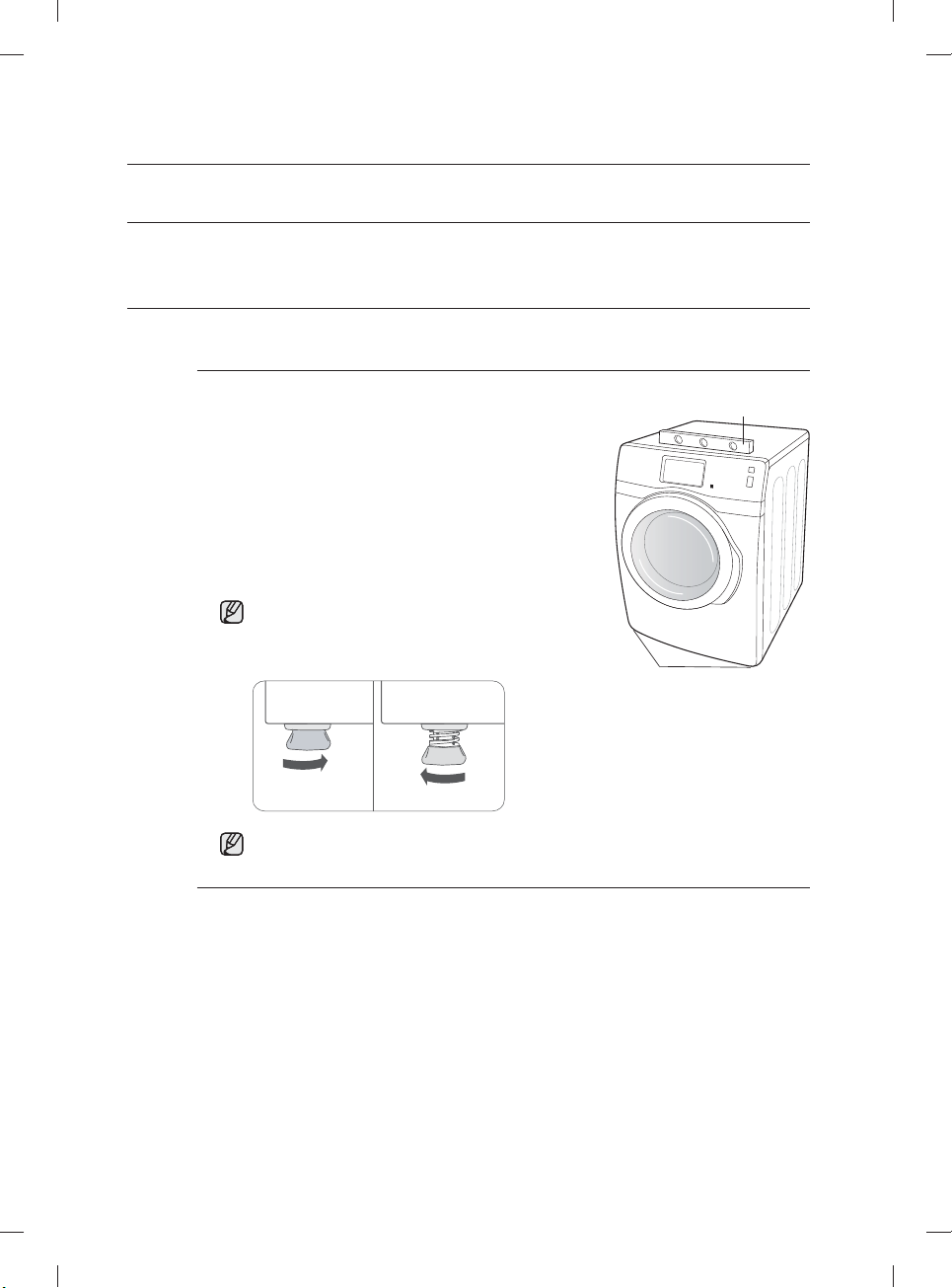
1. Move your dryer to an appropriate location for the
installation. Consider installing the dryer and washer sideby-side, to allow access to the gas, electrical, and exhaust
connections. Place two of the carton cushion-tops on the
fl oor. Tip your dryer on its side so it lies across both cushiontops.
2. Set your dryer back in an upright position.
3. To ensure that the dryer provides the optimal drying
performance, it must be level. To minimize vibrations, noise,
and unwanted movement, the fl oor must be a perfectly level,
solid surface.
To set the dryer to the same height as the washer,
fully retract the leveling feet by turning them
counterclockwise, then loosen the legs by turning them
clockwise.
Retract fully Then loosen
Adjust the leveling feet only as much as necessary to
level the dryer. Extending the leveling feet more than
necessary can cause the dryer to vibrate.
4. Review the “Exhausting” section on page 16 before installing the exhaust system. Install the
ductwork from your dryer to the exhaust hood. The crimped end of the duct sections must
point away from your dryer.
DO NOT use sheet metal screws when assembling the ducting. These joints should be
taped.
Never use plastic fl exible exhaust material.
Tip for tight installations: install a section of the exhaust system onto your dryer before putting
it in place.
Use duct tape to secure this section to your dryer, but do not cover the ventilation slots at
the back of the unit in dryer cabinet.
Leveling feet
Level
22_ Installing your dryer
DV457E(G)-02836E-03_EN.indd 22DV457E(G)-02836E-03_EN.indd 22 2012-12-04 6:44:402012-12-04 6:44:40
Page 23
5. Review the “Electrical requirements” section on page 18.
BEFORE OPERATING OR TESTING, follow the grounding instructions in the “Grounding”
section on page 18.
U.S. MODELS:
RISK OF ELECTRIC SHOCK - All U.S. models are produced for a 3-WIRE SYSTEM
WARNING
CONNECTION.
The dryer frame is grounded to the neutral conductor at the terminal block.
A 4-WIRE SYSTEM CONNECTION is required for new or remodeled construction,
mobile homes, or if local codes do not permit grounding through neutral. If the 4-wire
system is used, the dryer frame cannot be grounded to the neutral conductor at
the terminal block. Refer to the following instructions for 3 and 4-WIRE SYSTEM
CONNECTIONS.
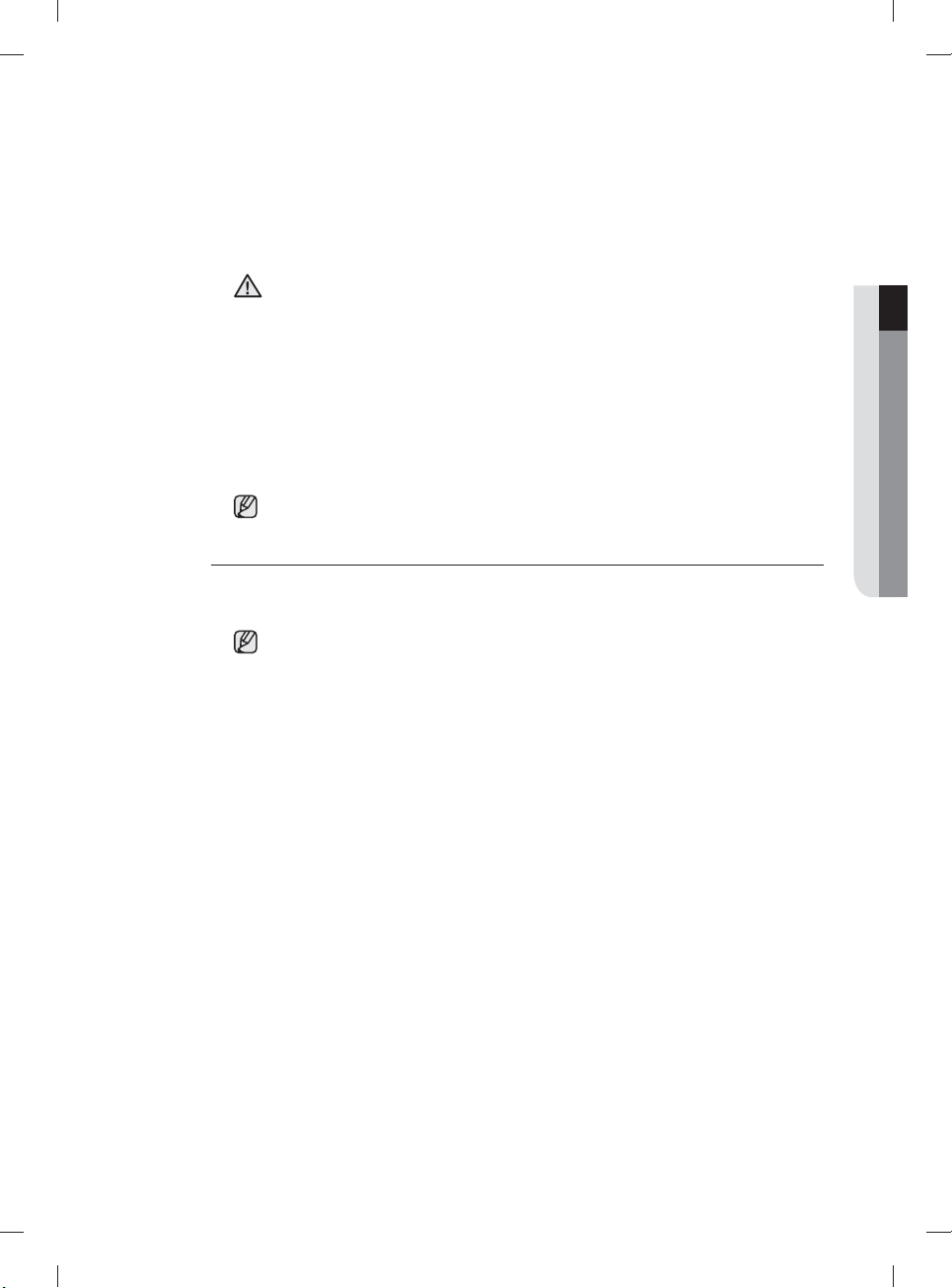
Remove the terminal block cover plate.
Insert the power cord with a UL-listed strain relief through the hole provided in the cabinet
near the terminal block.
A strain relief must be used.
Do not loosen the nuts already installed on the terminal block. Be sure they are tight.
Use a 3/8” (1 cm) deep well socket.
6. Review the “Gas requirements” section on page 17. Remove the pipe thread protective
cap. Apply a pipe joint compound or about 1 1/2 wraps of Tefl on tape over all threaded
connections.
The pipe joint compound must be resistant to the actions of any liquefi ed petroleum
gas.
Connect the gas supply to your dryer. An additional fi tting is required to connect the 3/4” (1.9
cm) female thread end of a fl exible connector to the 3/8” (1 cm) male threaded end on the
dryer.
Securely tighten the gas line fi tting over the threads.
Turn on the gas supply.
Check all gas connections for leaks using a soap solution.
If bubbles appear, tighten the connections and recheck. DO NOT use an open fl ame to
check for gas leaks.
01 INSTALLING YOUR DRYER
Installing your dryer _23
DV457E(G)-02836E-03_EN.indd 23DV457E(G)-02836E-03_EN.indd 23 2012-12-04 6:44:402012-12-04 6:44:40
Page 24

Installing your dryer
3-WIRE system connections
1. Loosen or remove the center terminal block screw.
2. Connect the neutral wire (white or center wire) of the power cord to the center, silver-colored
terminal screw of the terminal block. Tighten the screw.
3. Connect the other wires to the outer terminal block screws. Tighten the screws.
4. Tighten the strain relief screws.
5. Insert the tab of the terminal block cover into your dryer’s rear panel slot.
6. Secure the cover with a hold-down screw.
1 External ground connector
2 Neutral grounding wire (green/yellow)
3 Center silver-colored terminal block screw
4 Neutral wire (white or center wire)
5 3/4” (1.9 cm) UL-listed strain relief
If converting from a 4-wire electrical system to a 3-wire, the ground strap must be
reconnected to the terminal block support to ground the dryer frame to the neutral
WARNING
conductor.
4-WIRE system connections
1. Remove the center terminal block screw.
2. Connect the ground wire (green or unwrapped) of the power cord to the external ground
conductor screw.
3. Connect the neutral wire (white or center wire) of the power cord and the appliance ground
wire (green with yellow stripes) under the central screw of the terminal block.
4. Connect the other wires to the outer terminal block screws. Tighten the screws.
5. Tighten the strain relief screws.
6. Insert the tab of the terminal block cover into your dryer’s rear panel slot.
7. Secure the cover with a hold-down screw.
1 External ground connector
2 Green or bare copper wire of the power cord
3
/4 in. (1.9 cm) UL-listed strain relief
3
4 Center silver-colored terminal block screw
5 Grounding wire (green/yellow)
6 Neutral wire (white or center wire)
8. With a level, check your dryer and make the necessary adjustments to the leveling legs.
9. At this time, make sure all gas connections (on gas models), exhaust and electrical
connections are complete. Plug in your dryer, and check its operation by using the checklist
below.
10. (GAS MODELS ONLY)
The burner may not ignite initially due to air in the gas line. Allowing your dryer to operate on
a heat setting will purge the line. If the gas does not ignite within 5 minutes, turn your dryer
o and wait 5 minutes. Be sure the gas supply to your dryer has been turned on. In order to
confi rm the gas ignition, check the exhaust for heat.
24_ Installing your dryer
DV457E(G)-02836E-03_EN.indd 24DV457E(G)-02836E-03_EN.indd 24 2012-12-04 6:44:402012-12-04 6:44:40
Page 25
FINAL INSTALLATION CHECKLIST
• the dryer is plugged into an electrical outlet and is properly grounded.
• The exhaust ductwork is hooked up and the joints are taped.
• A plastic fl exible duct is NOT used.
• Use rigid or sti -walled fl exible metal vent material.
• The dryer is level and is sitting fi rmly on the fl oor.
• Gas models – the gas is turned on with no gas leaks.
• Start your dryer to confi rm that it runs, heats, and shuts o .
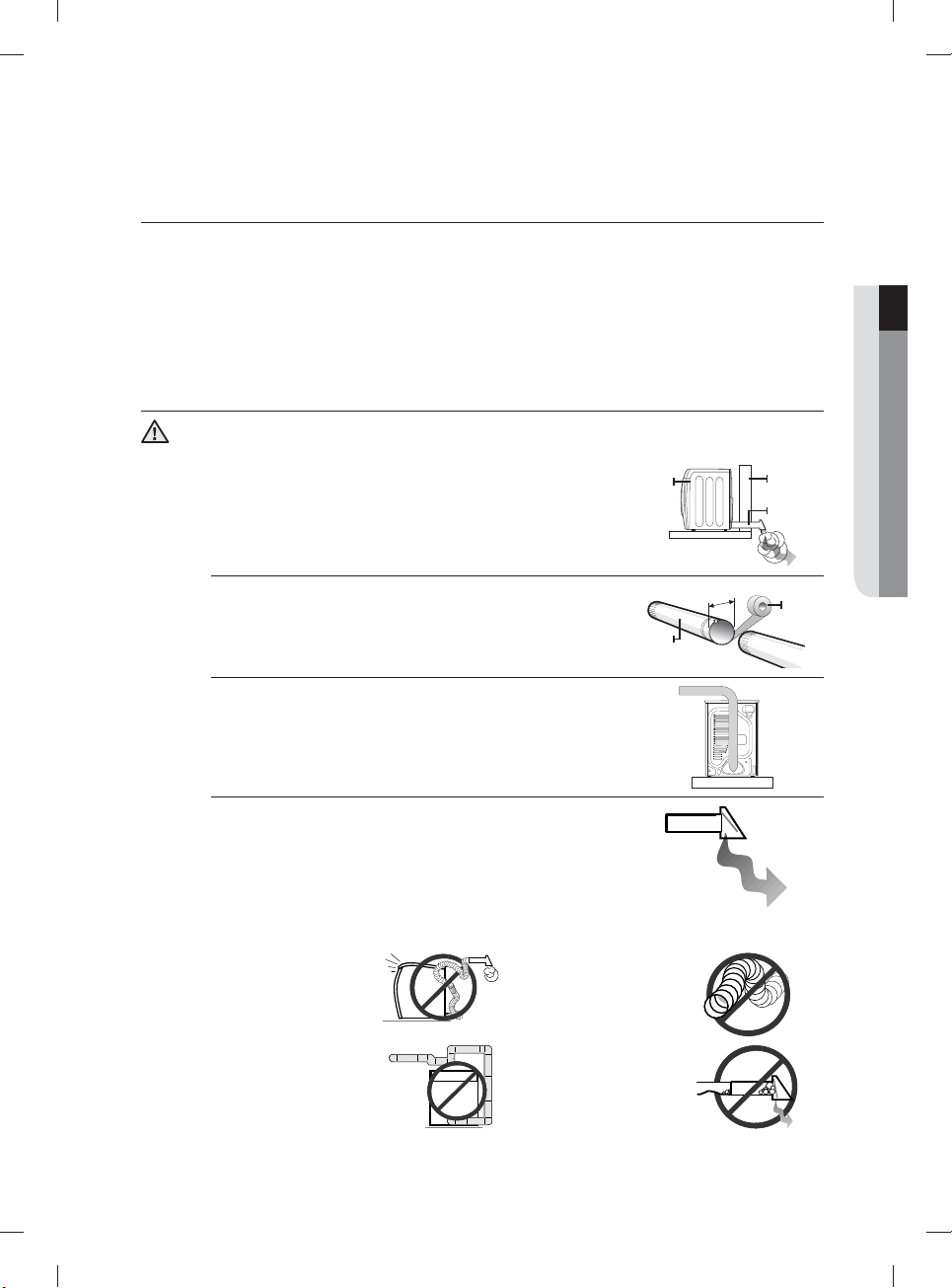
DRYER EXHAUST TIPS
A plastic or non-metal fl exible duct presents a potential fi re hazard.
WARNING
1. Make sure your dryer is installed properly so it exhausts air
easily.
Dryer
Wall
Duct
Exhaust
01 INSTALLING YOUR DRYER
2. Use a 4” diameter rigid metal duct. Tape all joints, including
at the dryer. Never use lint-trapping screws.
3. Keep ducts as straight as possible.
4. Clean all old ducts before installing your new dryer. Be sure
the vent fl ap opens and closes freely. Inspect and clean the
exhaust system annually.
Don’t let a poor exhaust system slow the drying process by:
• Restricting your
dryer with a poor
exhaust system.
• Unnecessarily using
long ducts that have
many elbows.
• Using a plastic, thin
foil, or non-metal
fl exible duct.
• Allowing dented or
clogged ducts and
vent.
Duct
4”
Tape
Installing your dryer _25
DV457E(G)-02836E-03_EN.indd 25DV457E(G)-02836E-03_EN.indd 25 2012-12-04 6:44:402012-12-04 6:44:40
Page 26
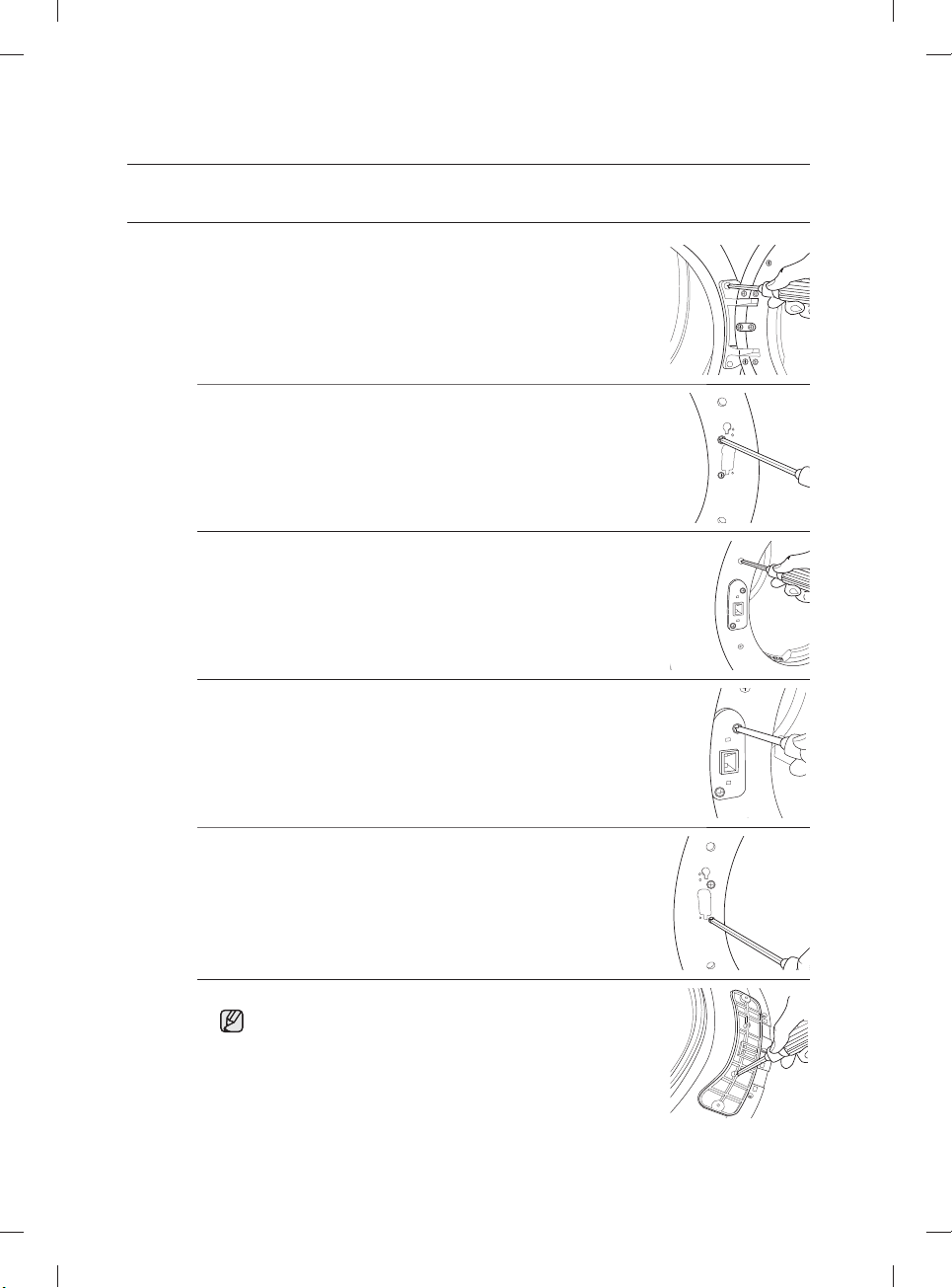
Installing your dryer
DOOR REVERSAL
1. Unplug the power cord.
2. Remove two door hinge screws.
3. Lift the door and remove it.
4. Remove two screws from the frame front.
5. Remove the two screws from the opposite side of the door
hinge.
6. Remove the two screws from the holder lever.
7. Reassemble the two screws on the inside holes.
8. Remove a screw from the door hinge.
The screw is for pre-fi xing the door to the frame front.
26_ Installing your dryer
DV457E(G)-02836E-03_EN.indd 26DV457E(G)-02836E-03_EN.indd 26 2012-12-04 6:44:412012-12-04 6:44:41
Page 27
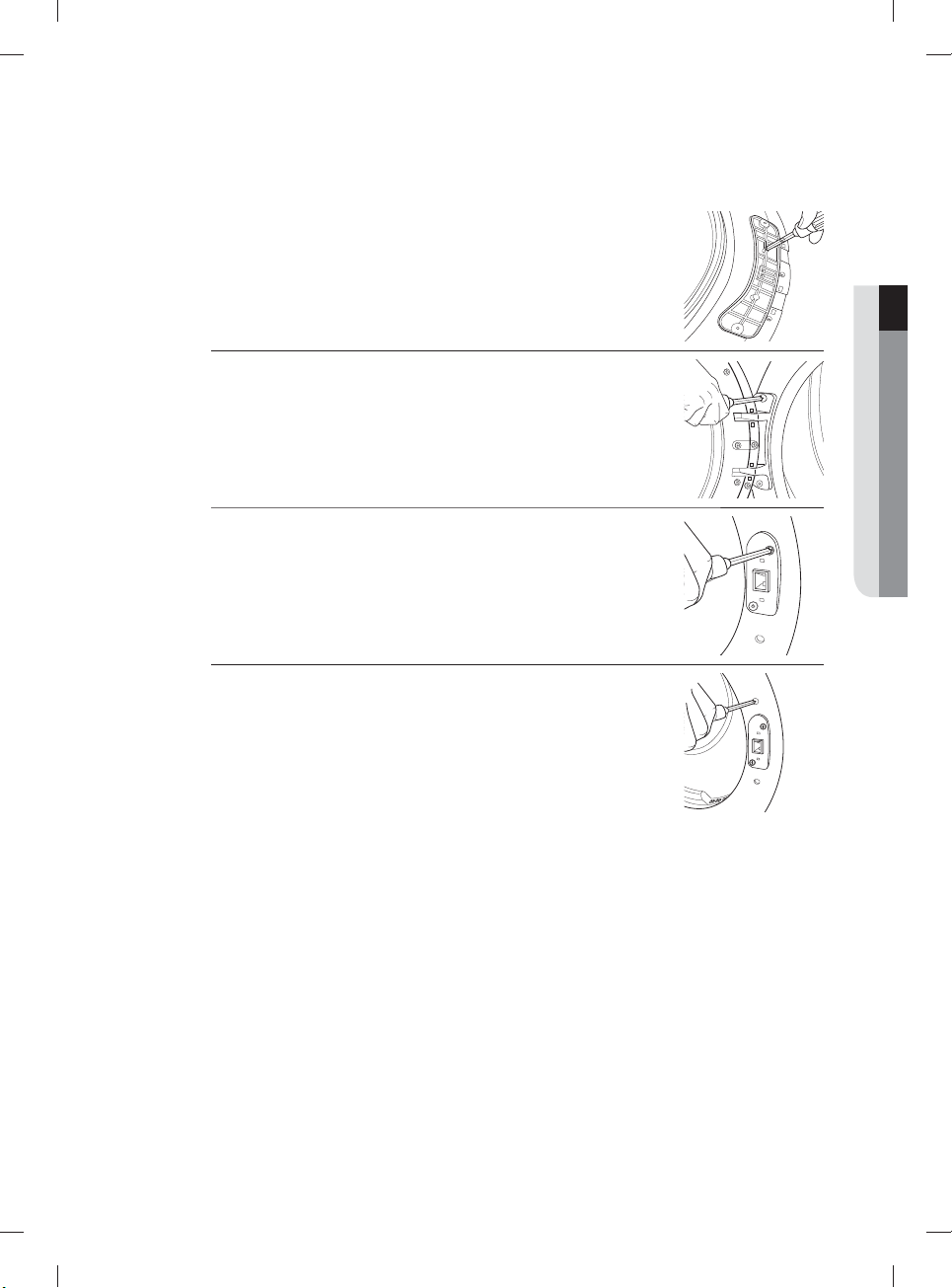
9. Reassemble the screw in the other hole.
10. Place the door on the other side and reattach it to the dryer.
11. Reattach the holder lever.
12. Reattach the screws in the remaining holes.
01 INSTALLING YOUR DRYER
Installing your dryer _27
DV457E(G)-02836E-03_EN.indd 27DV457E(G)-02836E-03_EN.indd 27 2012-12-04 6:44:412012-12-04 6:44:41
Page 28
Installing your dryer
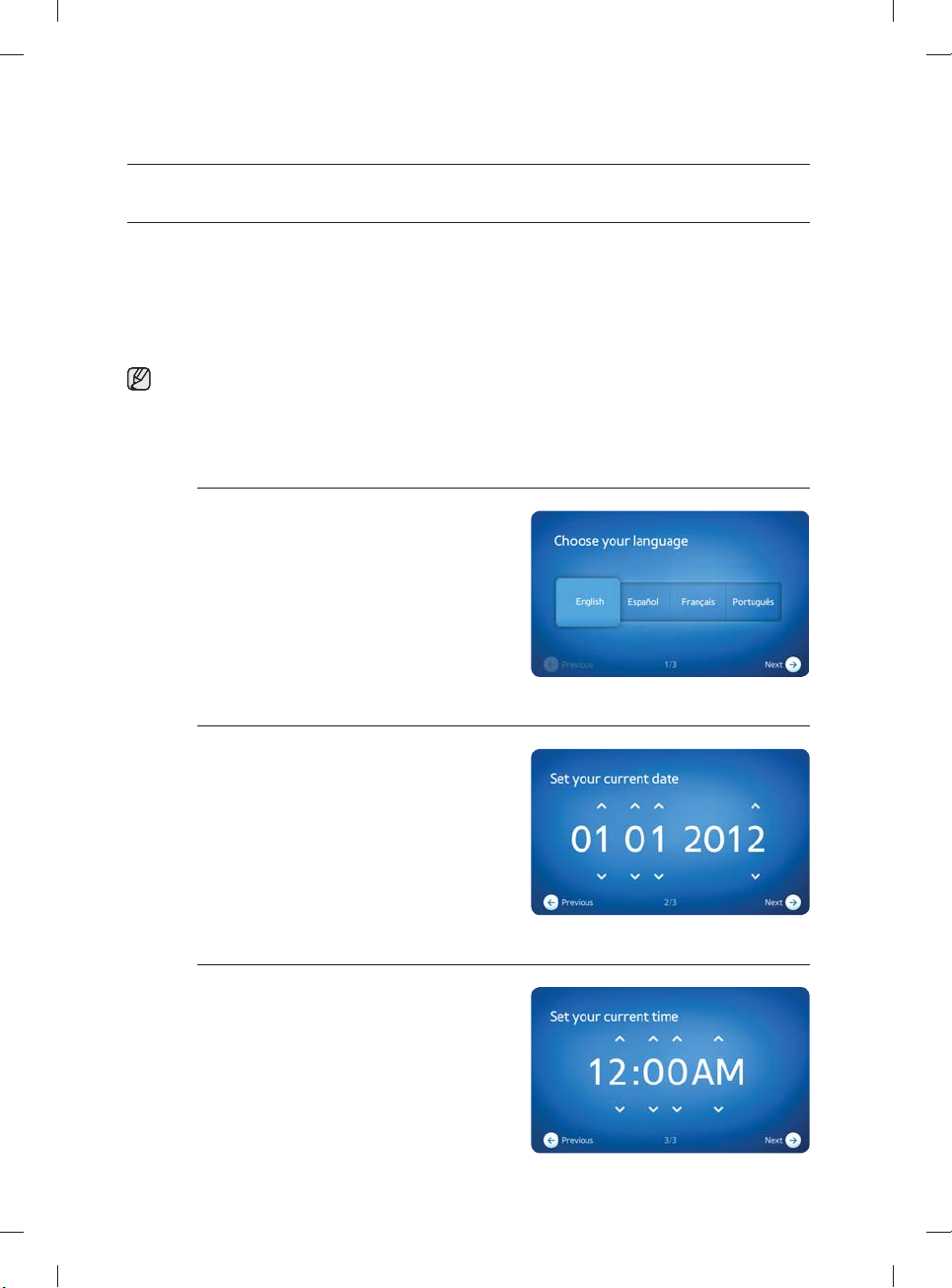
SETTING UP YOUR DRYER FOR THE FIRST TIME
When you turn on your dryer for the fi rst time, the intro animation, which shows the Samsung logo and
plays each time you turn on the dryer, appears on the LCD panel. After the animation plays, you are guided
through the initial setup procedure. The setup procedure lets you set your dryer preferences and consists of
the following 5 steps:
1. Choosing your language
2. Setting the current date
3. Setting the current time
Precautions for using the LCD panel
• If you touch the LCD panel while wearing rubber gloves, it may not operate properly.
• If you touch the LCD panel with wet hands, it may not operate properly or may malfunction.
• If the LCD panel is wet, it may malfunction.
Choosing your language
1. Tap the language you want to use for the
controls, instructions and descriptions shown in
the LCD panel.
There are 4 available languages: English,
Español (Spanish), Français (French) and
Portuguese.
2. Tap the Next button when done.
Setting the current date
1. Tap the up and down arrows to set the date.
Tap the left and right arrows at the bottom of
the screen to move to other calendar months.
2. Tap the Next button when done.
Setting your current time
1. Set the desired time by tapping on the up and
down arrows.
2. Tap the Next button when done.
28_ Installing your dryer
DV457E(G)-02836E-03_EN.indd 28DV457E(G)-02836E-03_EN.indd 28 2012-12-04 6:44:412012-12-04 6:44:41
Page 29
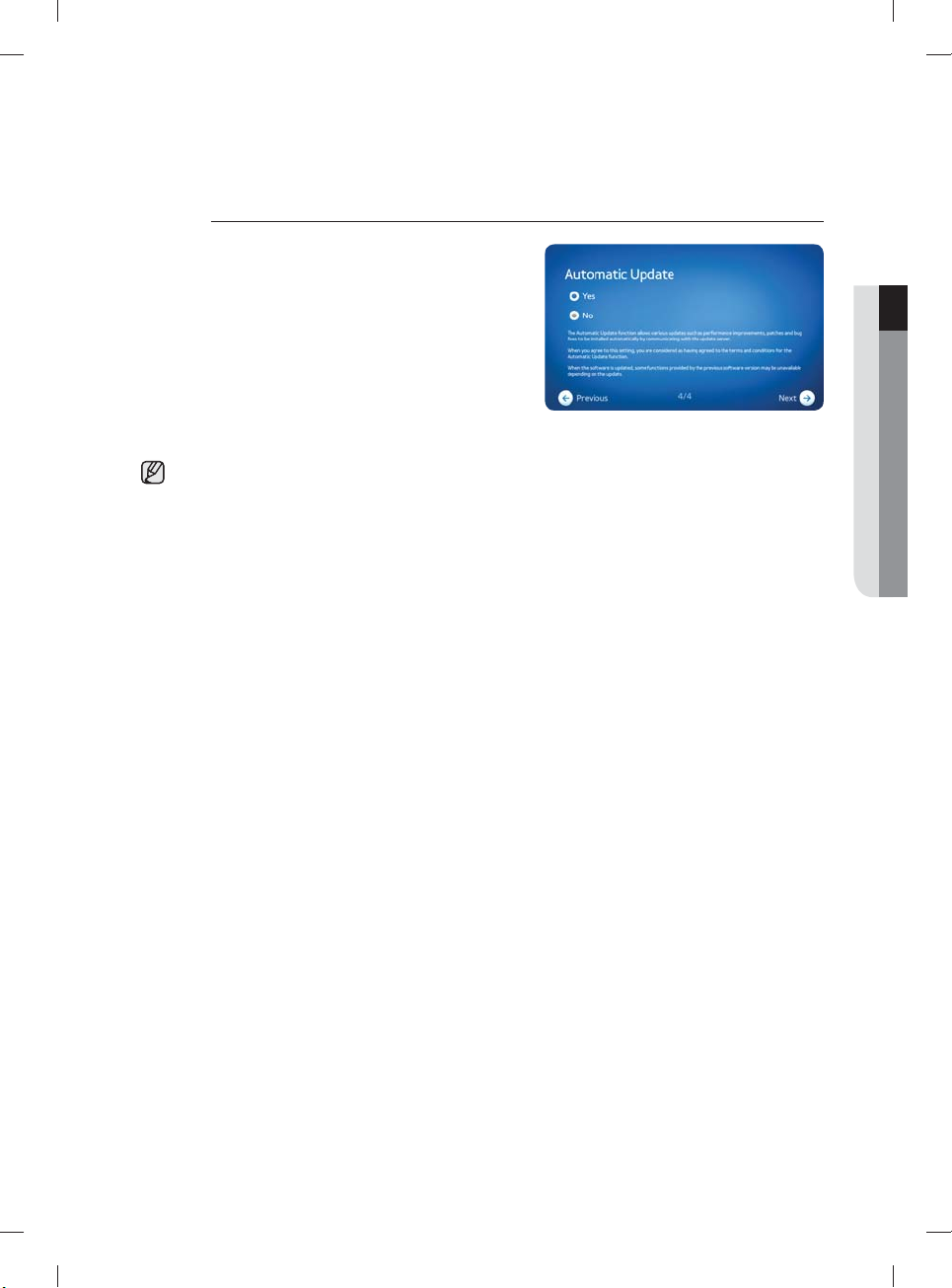
Setting the Automatic Update
1. The Automatic Update function allows various
updates such as performance improvements,
patches and bug fi xes to be installed
automatically by communicating with the
update server.
2. When you agree to this setting, you are
considered as having agreed to the terms and
conditions for the Automatic Update function.
3. When the software is updated, some functions
provided by the previous software version may
be unavailable depending on the update.
After completing the initial setup, you can access each step and change your preferences any time
using the Settings control located at the bottom right of the Cycle Selection screen displayed in the
LCD panel.
For example, If you want to set the time again...
1. Tap the Settings at the bottom right of the Cycle Selection screen.
2. Tap the Time & Language at the Setting screen.
3. Tap the Change button under the Time.
4. Tap the up and down arrows to change to the desired time.
5. Tap the OK button.
You can view and change the settings of the Language and Date through the same steps above.
01 INSTALLING YOUR DRYER
Installing your dryer _29
DV457E(G)-02836E-03_EN.indd 29DV457E(G)-02836E-03_EN.indd 29 2012-12-04 6:44:422012-12-04 6:44:42
Page 30
Drying a load of laundry
With your new Samsung Dryer, the hardest part of doing laundry will be deciding
which load to dry fi rst.
To reduce the risk of fi re, electric shock, or injury to persons,read the IMPORTANT SAFETY
INSTRUCTIONS before operating this appliance.
WARNING
DRYING FOR THE FIRST TIME
Before drying laundry for the fi rst time, you must run a complete empty cycle (i.e. no laundry).
1. Press the Power button.
2. Press the Start/Pause button.
The dryer runs the Normal cycle. This is the factory default cycle the washer will run until you select
another cycle. This fi rst empty cycle removes any water that might be left over in the machine from
the manufacturer’s test run.
BASIC INSTRUCTIONS
1. Load your laundry into the dryer.
Do not overload the dryer.
To determine the load capacity for each type of laundry, refer to the “Cycle chart” section on page
WARNING
65.
Make sure that laundry is not caught in the door.
2. Close the door until it latches.
3. Turn the power on.
4. Select the appropriate cycle and its options in the LCD panel.
5. The selected cycle and its selected options light up and the estimated cycle time appears at the top
right of the LCD panel.
6. Press the Start/Pause button.
Do not touch the door glass while your dryer is running. It may be hot.
30_ Drying a load of laundry
DV457E(G)-02836E-03_EN.indd Sec3:30DV457E(G)-02836E-03_EN.indd Sec3:30 2012-12-04 6:44:422012-12-04 6:44:42
Page 31

USING THE CONTROL PANEL
1
CYCLE PANE
2
OPTION PANE
1 2 3
Select the cycle you want to use for your laundry. The Cycle pane contains a
list of cycles that you can scroll down or up. To view more cycles, drag from
the bottom to the along the Cycle pane.
• For more information on the cycles you can select in the Cycle pane,
refer to the “Available cycles” section on page 32.
• For more information, refer to the “Drying your laundry using the
cycle selection screen” section on page 36.
Displays the currently selected options for the selected cycle and allows you
to change them. There are four options, Dry level, Temperature, Time, and
Extras.
For more information on the options you can select in the Option pane,
refer to the “Available options” section on page 33.
4
5
6
02 DRYING A LOAD OF LAUNDRY
3
STATUS PANE Consists of three sections: Cycle time, Eco bar and Actions.
CYCLE TIME
4
SECTION
ECO BAR
5
SECTION
Displays the estimated amount of time the selected cycle and its selected
options will take to complete.
Displays the energy e ciency of the selected cycle by showing the estimated
environmental friendliness of the selected cycle and its selected options on a
scale.
Provides the following additional controls that allow you to carry out additional
ACTIONS
6
SECTION
actions and view and confi gure other settings: Smart Control, Save as My
Cycles, Delay Start, Child Lock, Light, and Settings.
For more information on the additional controls you can use in the Actions
section, refer to the “Available actions” section on page 34.
Drying a load of laundry _31
DV457E(G)-02836E-03_EN.indd Sec3:31DV457E(G)-02836E-03_EN.indd Sec3:31 2012-12-04 6:44:422012-12-04 6:44:42
Page 32

Drying a load of laundry
Available cycles
The preset cycles listed in the Cycle pane of the Cycle Selection screen can be categorized in
the following three groups.
Sensor Dry cycles Your dryer automatically determines the optimal duration required to
Manual Dry cycles You can manually set the duration, but your dryer automatically
Steam cycles The dryer automatically sets the duration and dry level appropriate for
Sensor Dry cycles
dry your laundry. Because you don’t need to set the the duration, the
duration controls are unavailable on the Control Panel.
determines the necessary dry level (Damp Dry, Less Dry, Normal Dry,
More dry, and Very Dry). Because you don’t need to set the dry level,
the dry level controls are unavailable on the Control Panel.
the laundry you are drying. You can change the time, if necessary.
Eco Normal The eco Normal cycle reduces energy usage by up to 15% compared
Normal The Normal cycle is for most fabrics including cotton, underwear and
Heavy Duty The Heavy Duty cycle provides high temperature for a heavy fabrics
Perm Press The Perm Press cycle is for wrinkle-free cottons, synthetic fabric,
Delicates The Delicates cycle is for heat-sensitive items. This cycle uses a low
Active wear The active Wear cycle is for exercise wear and outdoor wear such
Bedding PLUS The Bedding PLUS cycle is for bulky items such as blankets, sheets and
Sanitize The Sanitize cycle sanitizes garments at high temperatures and keeps
Wool
to the Normal Dry course. It adjusts the cycle time and temperature for
increased e ciency.
linen.
such as jeans, corduroy or work clothes.
knitwear and permanent press fabrics.
drying temperature.
as sports jerseys, training pants, water-repellent jackets and other
performance clothing.
Thick fabrics like a zipper or velcro closure of a jacket, or training socks
may not be completely dried.
comforters.
your bedding and curtains clean.
The Wool cycle is for machine washable and tumble
dryable woolen items only. The load should be under
3 pounds, The wool cycle of this machine has been
approved by Woolmark company for Total-Easy-Care Wool
products, M0913(DV457E*), M1007(DV457G*).
Manual Dry cycles
Time Dry The Time Dry cycle allows you to select a cycle time in minutes.
Quick Dry The Quick Dry cycle provides a 30 minute drying cycle.
Air Flu The Air Flu cycle tumbles the load at room temperature.
32_ Drying a load of laundry
DV457E(G)-02836E-03_EN.indd Sec3:32DV457E(G)-02836E-03_EN.indd Sec3:32 2012-12-04 6:44:432012-12-04 6:44:43
Page 33

Steam cycles
Refresh The Refresh cycle is best for smoothing out wrinkles and reducing odors
in loads of one to four items.
Wrinkle Away The Wrinkle Away cycle removes wrinkles from clothes stored in closets,
etc. It provides wrinkle release via optimized steam care. You can
change the drying time. (Minimum time : 20 minutes)
For best results, load no more than 3 items.
Available options
You can view the currently selected options for the selected cycle and change them in the
Option pane of the Cycle Selection screen. There are four options, Dry level, Temperature,
Time, and Extras.
Dry level
Tap this option to change the currently selected dry level setting. The available dry level settings
are Damp dry, Less dry, Normal dry, More dry, and Very dry. However, depending on the
selected cycle, some of these options will be disabled.
Temperature
Tap this option to change the currently selected temperature setting. The available temperature
settings are Extra Low, Low, Med Low, Medium, and High. However, depending on the
selected cycle, some of these options will be disabled.
Time
Tap this option to change the currently selected time setting. The available time settings are
Automatic, 20 min, 30 min, 40 min, 50 min, and 60 min. The Time option cannot be changed
in the Sensor Dry cycles and Steam cycles. You can set the Time option in the Manual Dry
cycles only.
Extras
Tap this option to add extra cycles to or remove extra cycles from the selected cycle. The
available extra cycles are Rack dry, Wrinkle prevent, and Mixed load bell. However,
depending on the selected cycle, some of these extra cycles will be disabled. Tap each enabled
extra cycle to add it to or remove it from the selected cycle.
Rack Dry - Rack Dry is available in the Time Dry cycle. the temperature is only set to
Extra Low.
RACK DRY is for items, such as washable sweaters and lingerie that should dry
fl at and and also can be used with items such as stu ed toys that should not be
tumbled.
Wrinkle prevent - Wrinkle Prevent provides approximately 180 minutes of
intermittent tumbling in unheated air at the end of the cycle to reduce wrinkling. The
load is dry, and can be removed at any time during the Wrinkle Prevent cycle.
Mixed load bell - The mixed load bell that notifi es you when the average dry level
in a load is damp dry (80 % dried).This lets you take garments that you don’t want
fully dried or that dry quickly out of the dryer early while letting others continue to dry.
You can select this function in all Sensor Dry cycles except Wool, Sanitize, and Active
Wear. The dry level selections are limited to Normal Dry, More Dry, and Very Dry.
02 DRYING A LOAD OF LAUNDRY
Drying a load of laundry _33
DV457E(G)-02836E-03_EN.indd Sec3:33DV457E(G)-02836E-03_EN.indd Sec3:33 2012-12-04 6:44:432012-12-04 6:44:43
Page 34

Drying a load of laundry
Available actions
You can carry out additional actions and view and confi gure other settings using the controls
provided in the Actions section of the Cycle Selection screen. There are six controls, Smart
Control, Save as My Cycles, Delay Start, Child Lock, Light, and Settings.
Smart Control (Elec. Model Only)
Tap this control to turn the Smart Control function on or o . When this function is turned on, you
can control the dryer using your mobile phone.
Turning the Smart Control function on changes the icon from
Any action you perform on your dryer will turn o the Smart Control Function. (Opening the door,
tapping the LCD panel, pushing buttons, etc.)
Smart Monitor (Gas Model Only)
Tap this control to turn the Smart Monitor function on or o . When this function is turned on, you
can monitor the drying process and be notifi ed when the cycle is complete.
Turning the Smart Monitor function on changes the icon from
Save as My Cycles
Tap this control (
lets you save up to 3 of your favorite cycle with their drying and temperature settings and then
recall and run those cycles at the push of button.
For more information, refer to the “Using the My Cycle function” section on page 38.
) to save the currently selected cycle and its options as a My Cycle. My cycle
Delay Start
Tap this control to delay the start of the selected cycle by setting a specifi c start time. If the dryer
recognizes that the Smart Grid is available, the options for turning variable energy use on or o
are accessible. When the Delay Start function is turned on, the icon changes from
For more information, refer to the “Using the Delay Start function” section on page 39.
Child Lock
Activate and deactivate the Child Lock function using this control.
• Tap this control to activate the deactivated Child Lock function (
• Hold down this control for 6 seconds to deactivate the activated Child Lock function (
For detailed information on the Child Lock function, refer to the “Using the Child Lock function”
section on page 40.
to .
to .
to .
).
).
34_ Drying a load of laundry
DV457E(G)-02836E-03_EN.indd Sec3:34DV457E(G)-02836E-03_EN.indd Sec3:34 2012-12-04 6:44:432012-12-04 6:44:43
Page 35

Light
Tap this control to turn the light inside the drum on or o .
Turning the light on changes the icon from
For more information, refer to the “Turning the Light On/O ” section on page 41.
to .
Settings
Tap this control (
according to your preferences.
The Settings screen provides the following options:
Display & Sound Tap this control to change the LCD brightness level and sound
Time & Language Tap this control to change the current date and time of the dryer and
Network Tap this control to confi gure your Wi-Fi network, turn it on or o ,
Open Source License
Notice
Energy E ciency Tap this control to view the current average energy e ciency of your
Smart Grid Tap this control to control and save energy and money by adjusting
) to navigate to the Settings screen where you can confi gure the dryer
volume of the dryer. The LCD brightness has 5 levels from Level 1 to
Level 5. The sound volume has 5 levels from Mute to Level 4.
For more information, refer to the “Controlling the sound
volume” section on page 41 and the “Controlling the brightness
level” section on page 42.
the LCD language.
view the health of your Wi-Fi network connectivity and/or update the
networking software. After your Wi-Fi network is confi gured, while it
is turned on and its status is good, you can control some functions
of your dryer using your mobile phone if the Samsung Smart
Washer/Dryer App is installed on the phone.
This device uses open source software. Open Source Licenses are
available in the product menu.
Tab “Settings > Network > Software Update > Legal
Information” on the device for more details.
dryer, which is determined by your energy usage.
For more information, refer to the “Viewing the Energy
E ciency” section on page 42.
the smart grid settings.
For more information, refer to the “Using the Smart Grid”
section on page 43.
02 DRYING A LOAD OF LAUNDRY
Drying a load of laundry _35
DV457E(G)-02836E-03_EN.indd Sec3:35DV457E(G)-02836E-03_EN.indd Sec3:35 2012-12-04 6:44:432012-12-04 6:44:43
Page 36

Drying a load of laundry
DRYING YOUR LAUNDRY USING THE CYCLE SELECTION SCREEN
Loading the dryer properly
• Place only one load in your dryer at a time.
• Mixed loads of heavy and lightweight fabrics will dry di erently, which may result in
lightweight fabrics being dry while heavy fabrics remaining damp at the end of a drying cycle.
• Add one or more similar items to your dryer when only one or two articles of clothing need
drying. This improves the tumbling action and drying e ciency.
• Overloading restricts the tumbling action, resulting in uneven drying as well as excessive
wrinkling of some fabrics.
Overloading may cause the dryer door to open while drying.
WARNING
Drying your laundry using the Cycle Selection screen
1. Load your dryer loosely - DO NOT overload.
2. Close the door.
3. Press the Power button.
4. In the Cycle Selection screen, select the
appropriate cycle: Eco Normal, Normal, Heavy
Duty, Perm Press, Delicates, Active Wear,
Bedding PLUS, Sanitize, Wool, Time Dry, Quick
Dry, Air Flu , Refresh and Wrinkle Away. Select
the cycle according to the kind of laundry items
you intend to dry.
• Scroll down or up the Cycle pane and tap
a cycle.
• The Option pane shows a description of
the selected cycle and the options of the
currently selected cycle.
36_ Drying a load of laundry
DV457E(G)-02836E-03_EN.indd Sec3:36DV457E(G)-02836E-03_EN.indd Sec3:36 2012-12-04 6:44:432012-12-04 6:44:43
Page 37

5. Tap the appropriate option button to control the
drying level, temperature, time, and extras.
Depending on each cycle group or cycle, some
of the options can be disabled.
• The Dry level option cannot be changed in
the Manual Dry cycles and Steam cycles.
When you tap the Dry level option, the Dry
level buttons are disabled.
• The Time option cannot be changed in the
Sensor Dry cycles and the only Refresh
of Steam cycles. It is automatically set to
Automatic in both cycle groups. When you
tap the Time option, the time buttons are
disabled. See the fi gure above, right.
• You can set the Time option in Manual
Dry cycles (Air Flu , Quick Dry, and Time
Dry) only. Tap a pre-existing time button
or tap the up / down arrows to change the
time from the automatically set times in the
Manual Dry cycles.
• The Extras settings can only be turned On
or O .
02 DRYING A LOAD OF LAUNDRY
Tap the left arrow (
) if you want to
return to the Cycle pane and select a
di erent cycle.
6. Press the Start/Pause button to start the load.
The Cycle Status screen is displayed on the
LCD panel.
Press the Power button to cancel the
cycle and turn o your dryer.
Do not place anything on top of your dryer
while it is running.
WARNING
When the cycle is fi nished:
After the total cycle has fi nished, the Cycle
complete screen is displayed. It shows the cycle
name and a summary review of its phases, and
allows you to start a new load.
1. Open the door.
2. Remove the laundry.
Drying a load of laundry _37
DV457E(G)-02836E-03_EN.indd Sec3:37DV457E(G)-02836E-03_EN.indd Sec3:37 2012-12-04 6:44:442012-12-04 6:44:44
Page 38

Drying a load of laundry
Using the My Cycle function
The My Cycle function lets you to save up to 3 custom drying cycles with their drying level and
temperature settings and then recall and run those cycles with the push of a button.
Saving a My Cycle
Follow the steps below to save your a favorite custom dry cycle as a My Cycle.
1. To begin, we’ll assume that there are no saved
My Cycles. If this is the case, when you tap
the My Cycle button in the Cycle Selection
screen, it will expand and show a list of 3 None
buttons (None1to None3) as shown in the
fi gure, right.
2. Select a cycle with its drying level and
temperature setting.
Refer to the “Cycle chart” section on page
65 for available drying levels and temperature
setting for each cycle.
3. Tap the Save As My Cycles button located at
the right center of the Cycle Selection screen.
4. Select the My Cycle you want to overwrite
with the selected cycle and its options. In this
example, We’ll select My Cycle 1: None. Then
tap the Next button.
5. The Save as new name screen is displayed.
Enter the name you want to give the My Cycle.
In this example, We’ll enter “J’s Wash”. Then
tap the Save button.
6. A summary of the My Cycle that will overwrite
the existing one (None1 in this example) is
displayed, as shown in the fi gure, right. Tap the
OK button.
7. The My Cycle “None1” is changed to “J’s
Wash” in the My Cycle list of the Cycle
Selection screen.
38_ Drying a load of laundry
DV457E(G)-02836E-03_EN.indd Sec3:38DV457E(G)-02836E-03_EN.indd Sec3:38 2012-12-04 6:44:442012-12-04 6:44:44
Page 39

Starting a My Cycle
Follow the steps below to start a My Cycle to dry your laundry.
1. Tap the My Cycle button in the Cycle Selection screen. It will expand and show a list of 3
My Cycle buttons.
2. Tap the desired My Cycle button.
3. Press the Start/Pause button to start the load.
Using the Delay Start function
By activating the Delay Start function, you can set your dryer to start a load automatically at a
later specifi c time.
Activating
Follow the steps below to activate the Delay Start function.
02 DRYING A LOAD OF LAUNDRY
1. Tap the Delay Start O (
at the bottom right of the Cycle Selection
screen. The Delay Start screen is displayed.
2. Tap the up / down arrows to set the time.
3. If the Smart Grid function is available, you can allow your dryer to fi nd the most energy
e cient time (also called the most eco-friendly time) to run your load within the range around
the time you set.
4. Press the Start/Pause button to activate the Delay Start function with the options you set.
Tap the Cancel button to cancel the function.
5. You will be returned to the Cycle Selection screen.
You will see that the Delay Start OFF (
) button.
(
) button located
) button is changed to the Delay Start ON
Deactivating
Follow the steps below to deactivate the Delay Start function.
• Tap the Delay Start ON (
screen.
The Delay Start function is deactivated and the button changes to the Delay Start OFF
) button.
(
) button located at the bottom right of the Cycle Selection
Drying a load of laundry _39
DV457E(G)-02836E-03_EN.indd Sec3:39DV457E(G)-02836E-03_EN.indd Sec3:39 2012-12-04 6:44:452012-12-04 6:44:45
Page 40

Drying a load of laundry
Using the Child Lock function
The Child Lock function allows you to lock the buttons so that the dry cycle you’ve chosen
can’t be changed.
Child Lock is a function to prevent children or the infi rm from accidently operating the dryer
and injuring themselves.
CAUTION
If a child enters the dryer, the child may become trapped and su ocate.
WARNING
Although the Child Lock function is activated, you must keep an eye on children so that
they do not operate your dryer.
CAUTION
Activating
Follow the steps below to activate the Child Lock function.
• Hold down The Child Lock button (
activated with pop-up “Child Lock ON”, and the button changes from (
Deactivating
Follow the steps below to deactivate the Child Lock function.
• Hold down The Child Lock button (
The Child Lock Function is deactivated with pop-up “Child Lock O ”, and the button changes
) to (
from (
When the Child Lock function is activated, only the Child Lock button works. The Child
Lock function remains on even after you turn the power o and back on or disconnect and
then reconnect the power cord.
To add laundry when the Child Lock function is activated, you have to fi rst pause or
deactivate the Child Lock function.
CAUTION
When the Child Lock function is activated, the screen does not change visually (no dimming
or greying out). If you tap a button or any part of the screen, a tooltip reminder that the
Child Lock function is turned on is displayed.
).
) for 3 seconds. Then, The Child Lock Function is
) for 3 seconds.
) to (
).
40_ Drying a load of laundry
DV457E(G)-02836E-03_EN.indd Sec3:40DV457E(G)-02836E-03_EN.indd Sec3:40 2012-12-04 6:44:452012-12-04 6:44:45
Page 41

Turning the Light On/O
You can turn the light on/o at any time.
Turning on
Tap the Light OFF (
Status screen.
The light is turned on immediately and the button changes to the Light ON (
) button located at the bottom right of the Cycle Selection or Cycle
) button.
Turning o
Tap the Light ON (
Light OFF (
) button. The light is turned o immediately and the button changes to the
) button.
Controlling the sound volume
You can control the volume of the sound interactions of your dryer. There are 5 volume levels
from Mute to Level 4. Even if the power is turned on and o repeatedly, the setting is retained.
Follow the steps below to control the volume level.
1. Tap the Settings button in the Cycle
Selection screen.
2. Tap the Display & Sound button in the
Settings screen.
3. Tap the Volume section.
4. Tap the desired volume level button.
5. Tap the OK button to apply the changes.
02 DRYING A LOAD OF LAUNDRY
Drying a load of laundry _41
DV457E(G)-02836E-03_EN.indd Sec3:41DV457E(G)-02836E-03_EN.indd Sec3:41 2012-12-04 6:44:452012-12-04 6:44:45
Page 42

Drying a load of laundry
Controlling the brightness level
You can control the brightness level of the LCD panel. There are 5 brightness levels from Level 1
to Level 5. Even if the power is turned on and o repeatedly, the setting is retained.
Follow the steps below to control the volume level.
1. Tap the Settings button in the Cycle
Selection screen.
2. Tap the Display & Sound button in the
Settings screen.
3. Tap the Brightness section.
4. Tap the desired brightness level button.
5. Tap the OK button to apply the changes.
Viewing the Energy E ciency
You can view the overall energy e ciency of your drying operations or behavior. The energy
e ciency is determined based on energy usage.
Follow the steps below to view the overall energy e ciency.
1. Tap the Settings button in the Cycle
Selection screen.
2. Tap the Energy E ciency button in the
Settings screen.
3. Tap the More... button to view the average
energy use for the last 12 months.
4. Tap the OK or Cancel button to return to the
Settings screen.
42_ Drying a load of laundry
DV457E(G)-02836E-03_EN.indd Sec3:42DV457E(G)-02836E-03_EN.indd Sec3:42 2012-12-04 6:44:462012-12-04 6:44:46
Page 43

Using the Smart Grid
If your energy supplier introduces Smart Grid
which means that consumers be provided with
timely information and options for controlling
energy use, the Smart Grid functions below will be
visible and ready to be used.
You can view the current energy use level of your
neighborhood in the Smart Grid State section of
the Smart Grid screen. There are 5 Smart Grid
energy use states or levels from Level 0 to Level 4.
The higher the level, the closer your neighborhood
is to a blackout.
You can also view and change the Override Time. The Override Time is the amount of time that
your Dryer will ignore Smart Grid signals to temporarily curtail energy use and continue to use
a full complement of energy. This lets you override Smart Grid signals to cut energy use if, for
example, you need to dry a load of wash right away.
When the Smart Grid is available for your neighborhood, the Description, Smart Grid State and
Override sections are displayed in the Smart Grid screen.
Viewing your neighborhood’s current energy level
Follow the steps below to view our neigborhood’s current energy level on the smart grid.
1. Tap the Settings button at the bottom right of the Cycle Selection screen.
The Settings screen is displayed.
2. Tap the Smart Grid button in the Settings screen.
3. Tap the Smart grid state section to view detailed information on the current energy level.
4. Tap the OK or Cancel button to return to the Settings screen.
02 DRYING A LOAD OF LAUNDRY
Drying a load of laundry _43
DV457E(G)-02836E-03_EN.indd Sec3:43DV457E(G)-02836E-03_EN.indd Sec3:43 2012-12-04 6:44:462012-12-04 6:44:46
Page 44

Drying a load of laundry
Viewing and changing the Override Time
Follow the steps below to view and change the override time.
1. Tap the Settings button at the bottom right of
the Cycle Selection screen.
2. The Settings screen is displayed.
3. Tap the Smart Grid button in the Settings
screen.
4. Tap the Override section.
5. Tap the desired override time.
6. Tap the OK button to apply the changes.
7. You are returned to the Settings screen.
• When the Smart Grid is unavailable for your
neighborhood, the description in the fi gure,
right, is displayed in the Smart Grid screen.
• When the Smart Grid function is unavailable
because of a problem with your power utility,
the description as shown in the fi gure, right, is
displayed in the Smart Grid screen.
44_ Drying a load of laundry
DV457E(G)-02836E-03_EN.indd Sec3:44DV457E(G)-02836E-03_EN.indd Sec3:44 2012-12-04 6:44:472012-12-04 6:44:47
Page 45

USING THE RACK DRY
1. Open the dryer door.
2. Position the drying rack in the tumbler, placing
the front lip of the drying rack on the top of the
lint fi lter.
3. Place the rear legs in the two recessed areas
of the dryer’s back wall and push the middle of
the drying rack down to fi x it in place.
4. Place the items to be dried on the rack, leaving
space between them so air can circulate.
5. Close the dryer door.
6. Tap the Time Dry button in the Cycle pane
of the Cycle Selection screen. Note that the
Rack Dry option is only available in the Time
Dry cycle.
7. Tap the Extras section in the Option pane.
8. Tap the Rack Dry button in the Extras section.
9. Select the time according to the moisture and
weight of the item.
10. Tap the OK button to apply the changes.
11. Press the Start/Pause button to start drying.
To dry items made from materials that are vulnerable to heat such as foam rubber, plastic
and rubber, use the Air Flu cycle. If you dry these kinds of items by applying heat, the
WARNING
product may be damaged or a fi re may occur as a result.
Never use the drying rack with any cycle other than the Rack Dry cycle.
WARNING
CHECKING THE FILTER
02 DRYING A LOAD OF LAUNDRY
Checking the fi lter
The fi lter check notifi cation pops up before the
cycle you’ve set begins, reminding you to check
the dryer’s fi lter.
Cleaning the fi lter
Clean the fi lter to shorten drying time and operate the dryer with greater energy e ciency.
Do not operate your dryer without the fi lter in place.
Drying a load of laundry _45
DV457E(G)-02836E-03_EN.indd Sec3:45DV457E(G)-02836E-03_EN.indd Sec3:45 2012-12-04 6:44:472012-12-04 6:44:47
Page 46

Drying a load of laundry
VENT SENSOR
Your Samsung dryer is equipped with a Vent Sensor, which detects and notifi es you when it is time to clean
the ductwork. Keep your dryer safe and e cient by cleaning the ducts when prompted.
The Vent Sensor detects any duct blockages
You can fi gure out whether there is a duct blockage from the message below the process bar.
Level Message Status Solution
0 No message The ductwork is free from
1 Check for vent
blockage after cycle
completes.
2 Vent is blocked.
Do not continue without
checking vent.
1)
In the LEVEL 2 state, this message is displayed for 3 hours after the completion of the cycle. (If
the wrinkle prevention function is activated, this message is displayed for up to 3 hours.)
If the power button is pressed or the door is opened, the power is immediately turned o .
For more information about the duct installation, please refer to the “Ducting requirements”
section on page 14.
• Although the dryer is available even if the blockage message is displayed, the drying time
may be extended.
• If the LEVEL 1 message is displayed the fi rst time the dryer is run after installation, check
the connection and clean the duct. If the LEVEL 1 message appears even after you have
checked and cleaned the ducts, this may indicate that there are some restrictions of the
duct due to the length, condition, etc.. If this occurs, you can use the dryer normally and
no countermeasures need to be taken. However, the drying time may be extended or
the drying performance may be degraded
1)
blockages.
When a part of the duct
or the lint fi lter is blocked
by lint or a foreign object.
When the resistance is
high because the duct is
too long or bent.
When the duct is blocked
by lint or a foreign object.
When the resistance is
very high because the
duct is too long or bent
excessively.
-
Check the duct
connection, shorten the
duct, or straighten it if
necessary.
Check the lint fi lter or
the duct and clean it if
necessary.
Check the duct
connection, shorten the
duct, or straighten it if
necessary.
Check the lint fi lter or the
duct and clean it as soon
as possible.
46_ Drying a load of laundry
DV457E(G)-02836E-03_EN.indd Sec3:46DV457E(G)-02836E-03_EN.indd Sec3:46 2012-12-04 6:44:472012-12-04 6:44:47
Page 47

Using your mobile phone
You can receive notifi cations and control your dryer from your mobile phone. To do
this, you need to do the following.
1. Setup a Wi-Fi network for your dryer
2. Turn on the Wi-Fi networking function of your dryer
3. Download and run the mobile app, Samsung Smart Washer/Dryer App
4. Use the mobile app, Samsung Smart Washer/Dryer App
No wired or wireless router (AP) is provided when you purchase your washer. The washer supports
the Wi-Fi encryption protocols, WEP, TKIP and TKIP AES. It does not support connecting to a wired or
wireless router (AP) that uses a Wi-Fi encryption protocol other than these.
• If a wireless router (or Access Point) is not WPS authenticated, a connection failure might occur.
• If a wireless router that is not WPS authenticated is connected wirelessly to an air conditioner, the
CAUTION
Wi-Fi connections of other previously connected units might be disconnected.
• If this appliance is installed in a building where no wireless router (AP) is installed for that fl oor, the
network connectivity may be degraded.
• If this appliance is installed in a location such as inside a utility closet made from metal or reinforced
concrete, the network connectivity may be degraded.
• If this appliance or the wireless router (AP) is installed near a microwave or drier, the network
connectivity may be degraded due to interference.
• If the wireless router (AP) is a non-certifi ed product, this appliance may not connect to the network.
• This appliance does not support the wireless networking protocols 802.11n and 802.11a.
This product does not contain a wireless router.
CONFIGURING YOUR DRYER’S NETWORK SETTINGS AND
CONNECTING TO YOUR NETWORK
To confi gure your washer’s Wi-Fi settings and connect your washer to your network, follow the procedures
below.
03 USING YOUR MOBILE PHONE
Confi guring the IP address settings
Follow the procedure below to confi gure the IP address settings of your dryer for a Wi-Fi
network.
1. Tap the Settings button in the Cycle
Selection screen.
2. Tap the Network menu in the Settings screen.
3. Tap the Wi-Fi network section.
4. Tap the Confi gure button.
5. Tap the IP Address button next to the network
you want to confi gure.
6. Tap the Automatic button to have your dryer
confi gure the IP address settings automatically,
and then go to Step 11. If you need to
confi gure the IP address and other settings
manually, go to Step 7.
7. Tap the User Confi g button to confi gure the IP address settings manually.
8. Tap the IP address fi eld.
9. Enter an IP address and then tap the OK button.
10. Repeat steps 8 and 9 for the Subnet mask, Gateway, and DNS fi elds.
11. Tap the OK button in the Settings screen.
Using your mobile phone _47
DV457E(G)-02836E-03_EN.indd 47DV457E(G)-02836E-03_EN.indd 47 2012-12-04 6:44:482012-12-04 6:44:48
Page 48

Using your mobile phone
Connecting your dryer to the network
Follow the procedure below to connect your dryer to a Wi-Fi network.
1. Tap the Settings button in the Cycle Selection screen.
2. Tap the Network menu in the Settings screen.
3. Tap the Wi-Fi network section.
4. Tap the Confi gure button.
5. Tap the name of the network to which you want to connect your dryer.
6. Enter your network password and then tap the OK button.
7. The dryer searches for the network. The Connect to Wi-Fi screen is displayed to show the
search progress.
8. If the network is found, the “Connection has been successfully established” message is
displayed for 1 second. Then you are returned to the Network List screen. A check mark
appears to the left of the selected network.
9. If the network is not found, the message “Connection failed” is displayed.
Tap the Retry button to reattempt the connection.
Tap the Cancel or OK button to return to the Network List screen
TURNING ON THE WI-FI NETWORKING FUNCTION OF YOUR DRYER
Follow the procedure below to turn on the Wi-Fi networking function of your dryer.
1. Tap the Settings button in the Cycle
Selection screen.
2. Tap the Network menu in the Settings screen.
3. Tap the Wi-Fi status section.
4. Tap the On button.
5. Tap the left arrow (
Settings screen.
) button to return to the
48_ Using your mobile phone
DV457E(G)-02836E-03_EN.indd 48DV457E(G)-02836E-03_EN.indd 48 2012-12-04 6:44:482012-12-04 6:44:48
Page 49

HOW TO UPDATE THE SOFTWARE
1. Touch settings.
2. Touch Network.
3. If an update is available, the version number will
be displayed under Software update. Touch the
version number.
03 USING YOUR MOBILE PHONE
4. Touch Update.
• To see if an update is available, follow Steps 1 through 3.
• When you run the update function, the LCD displays the update progress bar and
announces that the product will be restarted when the update is completed.
• If the power cord of the product is unplugged, the AP power is cut, the download fails,
or you press the Cancel button while the update fi le is being downloaded, the fi le is
discarded. The version prior to the update is maintained.
• If the download progress of the update fi le does not change for 10 minutes, a
connection error message appears.
• If you run the update function, and the fi le is already up-to-date (if the FIRMWARE CODE
is the same), a message stating this appears.
Using your mobile phone _49
DV457E(G)-02836E-03_EN.indd 49DV457E(G)-02836E-03_EN.indd 49 2012-12-04 6:44:482012-12-04 6:44:48
Page 50

Using your mobile phone
DOWNLOADING AND RUNNING THE MOBILE APP, SAMSUNG
SMART WASHER/DRYER APP
Follow the procedure below to download and run the mobile app, Samsung Smart Washer/Dryer App.
1. Download the Samsung Smart Washer/Dryer App into your mobile phone from the
Android market or Apple App Store. You can skip this step if the app has been already
downloaded into your mobile phone.
2. Tap the Samsung Smart Washer/Dryer App icon on your
mobile phone to run the app.
The initial screen is displayed.
3. The Home screen is displayed. It shows that your mobile
phone is not yet connected to your dryer.
4. Tap the Indoor control or Outdoor control button.
50_ Using your mobile phone
DV457E(G)-02836E-03_EN.indd 50DV457E(G)-02836E-03_EN.indd 50 2012-12-04 6:44:492012-12-04 6:44:49
Page 51

5. Tap the Search button.
The Samsung Smart Washer/Dryer App searches for
your dryer through your Wi-Fi network.
6. The Devices screen is displayed. A list of available dryers is
shown on the screen.
7. The progress screen is displayed while the Samsung Smart
Washer/Dryer App tries to connect to your dryer.
Connecting may take a minute or two.
USING THE MOBILE APP
After you dryer has been connected, you can perform the following operations using the Samsung Smart
Washer/Dryer App.
• Disconnect the connection
• Start a new dry (including receiving notifi cations and controlling your dryer)
Disconnecting the connection
Follow the procedure below to disconnect the connection to your dryer.
• Tap the Disconnect button.
03 USING YOUR MOBILE PHONE
Using your mobile phone _51
DV457E(G)-02836E-03_EN.indd 51DV457E(G)-02836E-03_EN.indd 51 2012-12-04 6:44:492012-12-04 6:44:49
Page 52

Using your mobile phone
Starting a new load
Follow the procedure below to start a new dryer load from your mobile app.
1. Tap the Start New Load button.
The Choose cycle screen is displayed.
On your dryer, you must tap the Smart Control
button to turn on the Smart Control function.
2. Select the cycle you want, and then tap the Start button.
3. The cycle status including cycle progress and estimated
fi nish time are shown on the screen.
If you want to pause the cycle, tap the Pause button.
52_ Using your mobile phone
DV457E(G)-02836E-03_EN.indd 52DV457E(G)-02836E-03_EN.indd 52 2012-12-04 6:44:502012-12-04 6:44:50
Page 53

4. When the cycle is completed, the message “Cycle complete”
and a summary review of all the phases are shown.
5. Tap the Dismiss button to return to the Home screen.
Registering your dryer
1. Access Samsung Smart appliance
website.
(http://www.samsungsmartappliance.com)
2. Enter your User ID and Password to log in.
If you don’t have an account, press
“Create a Samsung account” and
fi ll in the form to become a member.
3. Select “My page” “My page”.
03 USING YOUR MOBILE PHONE
4. Select “Add device”.
Using your mobile phone _53
DV457E(G)-02836E-03_EN.indd 53DV457E(G)-02836E-03_EN.indd 53 2012-12-04 6:44:502012-12-04 6:44:50
Page 54

Using your mobile phone
5. Find the MAC number on your dryer and
enter it into the device page.
On your dryer:
1) Tap “Settings” on Home.
2) Tap “Network”.
3) Tap “Wi-Fi Network”.
4) Tap “Confi gure”.
5) Record the MAC number at the top of
the screen.
On the device page on your PC:
6) Enter the 12 digit MAC address in the
“mac address for the device” fi eld.
6. Click “Certify device”.
7. Tap the Smart Control Button.
8. When certify device checking window
appears click the “Ok”.
If the dryer you are registering is
already registered by other users, a
window appears asking whether you
want to delete the usage authority of
the existing users or not.
9. After the registration of the dryer is
completed, you can check the registered
dryer on the device information list.
54_ Using your mobile phone
DV457E(G)-02836E-03_EN.indd 54DV457E(G)-02836E-03_EN.indd 54 2012-12-04 6:44:502012-12-04 6:44:50
Page 55

OVERVIEW OF WI-FI SETTINGS AND AP CONNECTION SCREENS
03 USING YOUR MOBILE PHONE
The fi rst screen after booting up The fi rst screen after entering the
setup
Select ON Select this to select the AP Select this to search for the AP
Searching for APs Select an AP
(Refer to the MAC address)
Connecting to the AP When the connection with the
AP is established, √ is displayed
Select this to turn the Wi-Fi on
Enter the password for the AP
and select OK
The connection status
information is displayed
The Wi-Fi connection status
information icon is displayed
at the top right of the Home
screen.
Move to the Home screen Home screen
Using your mobile phone _55
DV457E(G)-02836E-03_EN.indd 55DV457E(G)-02836E-03_EN.indd 55 2012-12-04 6:44:502012-12-04 6:44:50
Page 56

Care and cleaning
CONTROL PANEL
Clean with a soft, damp cloth. Do not use abrasive substances.
Do not spray cleaner directly onto the panel.
The control panel fi nish may be damaged by some laundry pre-treatment soil and stain remover products.
Apply such products away from your dryer and wipe up any spills or overspray immediately.
TUMBLER
Remove any stains from the tumbler caused by crayon, ink, fabric dye (from new items such as towels
or jeans) and so on with an all-purpose cleaner.
Tumble old towels or rags to remove any remaining stain or cleaning substance.
Once these steps are followed, stains may still be visible, but should not transfer to subsequent loads.
STAINLESS STEEL TUMBLER
To clean the stainless steel tumbler, use a damp cloth with a mild, non-abrasive cleaner suitable for stainless
steel surfaces.
Remove the cleaner residue and dry with a clean cloth.
DRYER EXTERIOR
Clean with a soft, damp cloth. Do not use abrasive substances.
Protect the surface from sharp objects.
Do not place any heavy or sharp objects or a detergent box on the dryer. Keep them on the purchased
pedestal or in a separate storage box. This may scratch or damage the top cover of the dryer.
Since the entire dryer has a high-gloss fi nish, the surface can be scratched or damaged.
Therefore, avoid scratching or damaging the surface when using the dryer.
DRYER EXHAUST SYSTEM
Should be inspected and cleaned yearly to maintain the optimum performance.
The outside exhaust hood should be cleaned more frequently to ensure proper operation.
56_ Care and cleaning
DV457E(G)-02836E-03_EN.indd Sec5:56DV457E(G)-02836E-03_EN.indd Sec5:56 2012-12-04 6:44:522012-12-04 6:44:52
Page 57

Special laundry tips
SPECIAL LAUNDRY TIPS
Please follow the care label or manufacturer’s instructions for drying special items. If the care label
instructions are not available, use the following information as a guide.
Bedspreads & Comforters • Follow the care label instructions or dry on the bedding.
• Make sure the item is thoroughly dry before using or storing it.
• May require repositioning to ensure that it dries evenly.
Blankets • Use the Normal cycle and dry only one blanket at a time for best
Curtains & Draperies • Use the Perm Press cycle and the Low or Extra Low temperature to
Cloth Diapers • Use the Normal cycle and the High temperature settings for soft,
Down–fi lled Items
(jackets, sleeping bags,
comforters, etc.)
Foam Rubber
(rug backs, stu ed toys,
shoulder pads, etc.)
Pillows • Use the Normal cycle.
Plastics
(shower curtains, outdoor
furniture covers, etc.)
THINGS TO AVOID PUTTING IN THE DRYER:
• Fiberglass items (curtains, draperies, etc.).
• Woolens, unless recommended on the label.
• Vegetable or cooking oil-soaked items.
tumbling action.
• Make sure the item is thoroughly dry before using or storing it.
help minimize wrinkling.
• Dry these in small loads for best results and remove as soon as
possible.
fl u y diapers.
• Use the Normal cycle and the Low or Extra Low temperature setting.
• Adding a couple of dry towels shortens the drying time and absorbs
moisture.
• DO NOT dry on a heat setting. Use the Air Flu cycle (no heat).
• WARNING - Drying a rubber item with heat may damage it or
become a fi re hazard.
• Add a couple of dry towels and a pair of clean sneakers to help the
tumbling action and to fl u the item.
• DO NOT heat dry kapok or foam pillows in the dryer. Use the Air Flu
cycle only.
• Use the Air Flu cycle or the Time Dry cycle and the Low or Extra
Low temperature settings depending on the care label instructions.
05 SPECIAL LAUNDRY TIPS
Special laundry tips _57
DV457E(G)-02836E-03_EN.indd Sec4:57DV457E(G)-02836E-03_EN.indd Sec4:57 2012-12-04 6:44:522012-12-04 6:44:52
Page 58

Troubleshooting
CHECK THESE POINTS IF YOUR DRYER…
PROBLEM SOLUTION
Doesn’t run. • Make sure the door is properly latched.
• Be sure the power cord is plugged into a live electrical outlet.
• Check the home’s circuit breaker and fuses.
• Press the Start/Pause button again if the door is opened during the
cycle.
Doesn’t heat. • Check your home’s circuit breaker and fuses.
• Select a heat setting other than Air Flu .
• On a gas dryer, check that the gas supply is on.
• Clean the lint fi lter and exhaust duct.
• The dryer may have moved into the cool-down phase of the cycle.
Doesn’t dry. • Check all of the above, plus...
• Be sure the exhaust hood outside the home can open and close
freely.
• Check the exhaust system for lint buildup. The ducting should be
inspected and cleaned annually.
• Use a 4” rigid metal exhaust duct.
• Do not overload. 1 wash load = 1 dryer load.
• Sort heavy items from lightweight items.
• Large, bulky items such as blankets or comforters may require
repositioning to ensure that they dry evenly.
• Check that the washer is draining properly to extract adequate water
from the load.
• The load may be too small to tumble properly. Add a few towels.
Is noisy. • Check the load for objects such as coins, loose buttons, nails, etc.
Dries unevenly. • Seams, pockets, and other similarly heavy areas may not be
Has an odor. • Household odors from painting, varnishing, strong cleaners, etc.
Remove immediately.
• It is normal to hear the dryer gas valve or heating element cycle on
and o during the drying cycle.
• Be sure the dryer is properly level as outlined in the installation
instruction.
• It is normal for the dryer to hum due to the high velocity of air moving
through the dryer drum and exhaust system.
completely dry when the rest of the load has reached the selected
dryness level. This is normal. Select the Very Dry setting if necessary.
• If one heavy item is dried with a lightweight load, such as one towel
with several sheets, it is possible that the heavy item will not be
completely dry when the rest of the load has reached the selected
dryness level. Sort heavy items from lightweight items for best drying
results.
may enter the dryer with the surrounding room air. This is normal as
the dryer draws the air from the room, heats it, pulls it through the
tumbler, and exhausts it outside.
• When these odors linger in the air, ventilate the room completely
before using the dryer.
58_ Troubleshooting
DV457E(G)-02836E-03_EN.indd Sec6:58DV457E(G)-02836E-03_EN.indd Sec6:58 2012-12-04 6:44:522012-12-04 6:44:52
Page 59

PROBLEM SOLUTION
Shuts o before the load is
dry
Lint on clothes • Make sure the lint fi lter is cleaned before every load. With some
Garments still wrinkled after
Wrinkle-Care
Odors remain in clothing
after Refresh.
Water drips from the nozzle
when Steam-Care starts
Sprayed water is not visible
during Steam-Care
• The dryer load is too small. Add more items or a few towels and
restart the cycle.
• The dryer load is too large. Remove some items and restart the
dryer.
loads that produce high amounts of lint, it may be necessary to clean
the fi lter during the cycle.
• Some fabrics are lint producers (for example, a fuzzy white cotton
towel) and they should be dried separately from clothes that are lint
trappers(for example, a pair of black linen pants).
• Divide larger loads into smaller loads for drying.
• Check pockets thoroughly before washing and drying clothes.
• Small loads of 1 to 4 items work best.
• Load fewer garments.
• Load similar-type garments.
• Fabrics having strong odors should be washed in a normal cycle.
• This is steam condensation. The dripping water will stop after a short
time.
• Sprayed water is di cult to see when the door is closed.
INFORMATION CODES
Samsung’s Smart Care, an automatic error-monitoring
system, detects and diagnoses problems at an early stage
and provides a quick and easy solution through LCD
navigation.
When your dryer has a problem, the notifi cation screen
will show the information and solution to help you better
understand what is occurring with your dryer and how to
solve the problem.
06 TROUBLESHOOTING
Information codes may be displayed to help you better understand what is occurring with your Dryer.
ERROR DISPLAY TRIGGER ACTION TAKEN
tE
tE3
HE
dE Running the dryer with door open
The thermistor resistance is very
low or high.
The resistance of the thermistor
for the vent blockage detection is
very low or very high.
Invalid heating Temp in running
the dryer
Clean the screen or vent.
If the problem continues, call for service.
Clean the screen or vent
If the problem continues, call for service.
Call for service.
Clean the door and then restart.
If the problem continues, call for service.
Troubleshooting _59
DV457E(G)-02836E-03_EN.indd Sec6:59DV457E(G)-02836E-03_EN.indd Sec6:59 2012-12-04 6:44:522012-12-04 6:44:52
Page 60

Troubleshooting
ERROR DISPLAY TRIGGER ACTION TAKEN
dF
bE2
FE Invalid power source Frequency
2E
AE
Et
AE4
AE3
AE5
For any codes not listed above, call 1-800-726-7864 (1-800-SAMSUNG)
Invalid door state for more than
256 milliseconds.
Invalid state of key circuit short for
30 secs
Electronic Control Problem
(Over Voltage Error)
Electronic Control Problem
(Communication Error)
Invalid state of Eeprom
communication
A communication error between
the Wi-Fi PBA and the MAIN PBA
A communication error between
the DR Modem and the MAIN
PBA
A communication error between
the LCD PBA and the MAIN PBA
Call for service.
Make sure a button is NOT being pressed
continuously. Try restarting the cycle.
If the problem continue, call for service.
Try restarting the cycle.
If the problem continues, call for service.
Call for service.
Call for service.
Call for service.
Call customer service.
Call customer service.
Call customer service.
60_ Troubleshooting
DV457E(G)-02836E-03_EN.indd Sec6:60DV457E(G)-02836E-03_EN.indd Sec6:60 2012-12-04 6:44:532012-12-04 6:44:53
Page 61

NETWORK SETUP Q&A
QUESTION ANSWER
The washer or dryer is not
found in the smartphone app.
The washer or dryer can’t fi nd
the AP (access point).
There are more than one
washer or dryer in the house.
Do I have to install an AP for
each of them?
Which AP is better? • Since the washer or dryer is controlled through the AP from the inside
How can I check if the AP is
out of order?
I do not have a PC. Can I
use the indoor and outdoor
control features?
How many users can control
a washer or dryer?
• Check the power status of the access point (AP).
• Check if the smartphone is connected with Wi-Fi.
• Check if the Wi-Fi function of the washer or dryer is turned on.
• To refresh the screen, press “Confi gure” again.
• If the AP is installed too far away from the washer or dryer, the
strength of the Wi-Fi signal may be weak. In this case, move the AP
closer to the washer or dryer.
• Check the power status of the AP.
• Check if the Wi-Fi function of the washer or dryer is turned on.
• To refresh the screen, press “Confi gure” again.
• If the AP is installed too far away from the washer or dryer, the
strength of the Wi-Fi signal may be weak. In this case, move the
AP closer to the washer or dryer. Ensure that the number of the
displayed antenna bars is at least 3.
• If the strength of the AP is low, the washer or dryer may not fi nd it.
Use a high performance AP if available.
• You can install only one AP.
• I you want to one AP for each of the washer and dryer, select the
corresponding AP for each of the products in the “Smart Washer”
app.
• When both a washer and dryer are installed, they can be controlled
through one AP.
or outside of the house, we recommend a high performance AP.
• Use an AP with Wi-Fi a certifi cation mark.
• Since an AP with 2 or more antennas provides better performance,
we recommend purchasing a wireless AP with 2 or more antennas.
• Connect to the AP on a smartphone and check if you can connect to
the Internet. If you can connect to the Internet, the AP is normal.
• Check if the LEDs on the AP are blinking. If all the LEDs are turned
o , it indicates that the power is turned o .
• If the AP doesn’t seem to be working properly, request after-sales
service.
• If the Internet can be accessed inside of the house, the feature is
available. However, you have to sign up on the Samsung web site
and register the product.
• Multiple users can control the washer or dryer only if the “Smart
Washer” app is authenticated,
06 TROUBLESHOOTING
Troubleshooting _61
DV457E(G)-02836E-03_EN.indd Sec6:61DV457E(G)-02836E-03_EN.indd Sec6:61 2012-12-04 6:44:532012-12-04 6:44:53
Page 62

Troubleshooting
QUESTION ANSWER
Where are the proper place to
install a washer or dryer?
How can I connect the
washer or dryer with a
smartphone stably?
What should I have to
do when the number of
the antenna bars that are
displayed on the LCD of the
washer or dryer is 1?
• Since a washer or dryer is heavy and connected with water, it should
be installed in the proper place. Installing the AP near the washer or
dryer is recommended. You can check the signal strength through
the setup screen of the washer or dryer or a smartphone.
• Since the performance is seriously a ected by a door or steel wall,
install the product in an open place. If there is door in front of the
installed product, open the door when using the product.
• Do not place an object maden with steel or glass in front of the front
LCD of the washer since it blocks the radio signal.
• Note that the radio signal may be weaken or interfered and the
communication with the smartphone may fail when a microwave oven
is used in the house.
• Install the washer or dryer so that the front of the product faces the
AP if available.
• When the signal strenth that is displayed on the LCE of the washer
or dryer is weak, the control may fail. Check the mark as follows or
measure the signal strength.
• At least 3 antenna bars should be displayed on the LCD of the
washer or dryer.
• At least 3 antenna bars for the Wi-Fi connection should be
displayed on the smartphone.
• When the signal strenth is measured with a smartphone app that
shows the Wi-Fi signal strength, the signal strength should be
stronger than -65 dBm. (E.g. -60 dBm and -50 dBm are stronger
than -65 dBm.)
• When the signal strenth that is displayed on the LCE of the washer
or dryer is weak, the control may fail. In this case, take the following
measures for normal operation.
• Move the AP closer to the washer or dryer.
(At least 3 antenna bars should be dislayed in the network setup
of the washer for proper operation.)
• Since old AP may provide lower performance, use new one if
available.
• Stand the antenna of the AP if available so that the radio signal is
more easily propagated.
62_ Troubleshooting
DV457E(G)-02836E-03_EN.indd Sec6:62DV457E(G)-02836E-03_EN.indd Sec6:62 2012-12-04 6:44:532012-12-04 6:44:53
Page 63

Appendix
FABRIC CARE CHART
The following symbols provide garment care directions. The care labels include symbols for washing,
bleaching, drying and ironing, or dry cleaning when necessary. The use of symbols ensures consistency
among garment manufacturers of domestic and imported items. Follow the care label directions to
maximize garment life and reduce laundry problems.
Wash Cycle Special Instructions
Normal Line Dry/ Hang to Dry Do Not Wash
Permanent Press /
Wrinkle Resistant /
Wrinkle Control
Gentle/Delicates Dry Flat Do Not Bleach
Hand Wash Heat Setting Do Not Tumble Dry
Water Temperature*
Hot Medium Do Not Iron
Warm Low Dryclean
Cold Any Heat Dry Clean
Bleach
Any Bleach (when
needed)
Only Non-Chlorine
(color-safe)
Bleach (when needed)
Tumble Dry Cycle Medium Dry Flat
Drip Dry Do Not Wring
High
No Heat/Air Do Not Dry Clean
Iron-Dry or Steam
Temperatures
High Drip Dry
Warning Symbols for
Laundering
No Steam (added to
iron)
Line Dry/ Hang to Dry
07 APPENDIX
Normal
Permanent Press/
Wrinkle Resistant/
Wrinkle Control
Gentle/ Delicates
* Water Temperature: The dot symbols represent the appropriate wash water temperatures for
various items. The temperature range for Hot is 105-125 °F (41-52 °C), for Warm 85-105 °F (29-41 °C)
and for Cold 60-85 °F (16-29 °C). (The wash water temperature must be a minimum of 60 °F (16 °C)
for detergent activation and e ective cleaning.)
Low
Appendix _63
DV457E(G)-02836E-03_EN.indd Sec7:63DV457E(G)-02836E-03_EN.indd Sec7:63 2012-12-04 6:44:532012-12-04 6:44:53
Page 64

Appendix
PROTECTING THE ENVIRONMENT
This appliance is manufactured from recyclable materials. If you decide to dispose of this appliance, please
observe local waste disposal regulations. Cut o the power cord so that the appliance cannot be connected
to a power source. Remove the door so that animals and small children cannot get trapped inside the
appliance.
DECLARATION OF CONFORMITY
This appliance complies with UL2158.
SPECIFICATIONS
C
D
A
B
TYPE FRONT LOADING DRYER
DIMENSIONS A. Height 39” (99.0 cm)
B. Width 27” (68.6 cm)
C. Depth with door open 90° 51.65” (131.2 cm)
D. Depth 32.28” (82.0 cm)
WEIGHT 125.7 lb (57 Kg)
HEATER RATING 5300 W (Elec.)
WATER PRESSURE 20-116 psi (137-800kPa)
22000 BTU/hr (Gas)
64_ Appendix
DV457E(G)-02836E-03_EN.indd Sec7:64DV457E(G)-02836E-03_EN.indd Sec7:64 2012-12-04 6:44:532012-12-04 6:44:53
Page 65

CYCLE CHART
(: factory setting, : selectable )
CYCLE RECOMMENDED ITEMS MAXIMUM AMOUNT
Normal Cottons, Work clothes, Linen, Mixed loads
Heavy Duty Heavy fabrics such as jean, Corduroys, Heavy work clothes
Perm Press Shirts, Synthetic fabrics, Knits, Wrinkle-free cottons, Permanent
Bedding Plus Bulky items such as blankets, Sheets, Comforters, Pillows
Sensor Dry
Manual Dry
Steam
Cycles
Sensor Dry
Manual Dry
Steam Cycles
Load Size Recommendations
Delicates Underwear, Blouses, Lingerie
Sanitize Bedding, Curtains, Children` clothing
+Eco Normal Cottons, Work clothes, Linen
Wool
Active Wear
Air Flu Form, Rubber, Plastic
Quick Dry Small loads
Time Dry Any load
Wrinkle Away Shirts, Trouser, Blouses
Refresh Shirts, Trouser, Comforter, Pillows
CYCLE
Normal Normal dry
Heavy Duty Normal dry
Perm Press Normal dry
Bedding Plus Normal dry
Delicates Normal dry
Sanitize
+Eco Normal
Wool
Active Wear
Air Flu Quick Dry Time Dry Wrinkle Away Refresh -
For machine washable and tumble dryable wool only
(Maximum amount : 3lb)
Water-repellent wear, performance clothes, Sports wear
(Maximum amount : 4lb)
FUNCTIONS OPTIONS
Sensor Dry
Level
Very dry
(No change)
Normal dry
(No change)*
Normal dry
(No change)
Normal dry
(No change)
High Medium
(DV457G)*
Temp. Control
Medium
Low
Time
Extra
Low
Low
* is only Gas model
Large load Fill the drum to about ¾ full. Do not add items over this level as they need to
tumble freely.
Medium load Fill the drum to about ½ full.
Small load Fill the drum with 3~5 items, not more than ¼ full.
For best results, follow the load size recommendations for each drying cycle.
Wrinkle
Prevent
Delay
Start
07 APPENDIX
Appendix _65
DV457E(G)-02836E-03_EN.indd Sec7:65DV457E(G)-02836E-03_EN.indd Sec7:65 2012-12-04 6:44:532012-12-04 6:44:53
Page 66

Warranty (U.S.A)
SAMSUNG DRYER
LIMITED WARRANTY TO ORIGINAL PURCHASER
This SAMSUNG brand product, as supplied and distributed by SAMSUNG ELECTRONICS AMERICA, INC.
(SAMSUNG) and delivered new, in the original carton to the original consumer purchaser, is warranted by
SAMSUNG against manufacturing defects in materials and workmanship for a limited warranty period of:
One (1) Year All Parts and Labor, Two (2) Years Control Board Parts
This limited warranty begins on the original date of purchase, and is valid only on products purchased and
used in the United States.
To receive warranty service, the purchaser must contact SAMSUNG for problem determination and service
procedures.
Warranty service can only be performed by a SAMSUNG authorized service center.
The original dated bill of sale must be presented upon request as proof of purchase to SAMSUNG or
SAMSUNG’s authorized service center.
SAMSUNG will provide in-home service during the warranty period at no charge, subject to availability
within the contiguous United States.
In-home service is not available in all areas.
To receive in-home service, product must be unobstructed and accessible to the service agent.
If service is not available, SAMSUNG may elect to provide transportation of the product to and from an
authorized service center.
SAMSUNG will repair, replace, or refund this product at our option and at no charge as stipulated herein,
with new or reconditioned parts or products if found to be defective during the limited warranty period
specifi ed above.
All replaced parts and products become the property of SAMSUNG and must be returned to SAMSUNG.
Replacement parts and products assume the remaining original warranty, or ninety (90) days, whichever is
longer.
This limited warranty covers manufacturing defects in materials and workmanship encountered in normal,
noncommercial use of this product and shall not apply to the following: damage that occurs in shipment;
delivery and installation; applications and uses for which this product was not intended; altered product or
serial numbers; cosmetic damage or exterior fi nish; accidents, abuse, neglect, fi re, water, lightning, or other
acts of nature or God; use of products, equipment, systems, utilities, services, parts, supplies, accessories,
applications, installations, repairs, external wiring or connectors not supplied or authorized by SAMSUNG
that damage this product or result in service problems; incorrect electrical line voltage, fl uctuations and
surges; customer adjustments and failure to follow operating instructions, maintenance and environmental
instructions that are covered and prescribed in the instruction book; product removal and reinstallation;
problems caused by pest infestations.
This limited warranty does not cover problems resulting from incorrect electric current, voltage or supply,
light bulbs, house fuses, house wiring, cost of a service call for instructions, or fi xing installation errors.
SAMSUNG does not warrant uninterrupted or error-free operation of the product.
66_ Warranty
DV457E(G)-02836E-03_EN.indd 66DV457E(G)-02836E-03_EN.indd 66 2012-12-04 6:44:532012-12-04 6:44:53
Page 67

Except as set forth herein, there are no warranties on this product either express or implied, and samsung
disclaims all warranties including, but not limited to, any implied warranties of merchantability, infringement
or fi tness for a particular purpose.
No warranty or guarantee given by any person, fi rm, or corporation with respect to this product shall be
binding on samsung.
Samsung shall not be liable for loss of revenue or profi ts, failure to realize savings or thter benefi ts, or any
other special, incidental or consequential damages caused by the use, misuse, or inability to use this
product, regardless of the legal theory on which the claim is based, and even if samsung has been advised
of the possibility of such damages.
Nor shall recovery of any kind against samsung be greater in amount than the purchase price of the product
sold by samsung and causing the alleged damage.
Without limiting the foregoing, purchaser assumes all risk and liability for loss, damage, or injury to
purchaser and purchaser’s property and to others and their property arising out of the use, misuse,
or inability to use this product. This limited warranty shall not extend to anyone other than the original
purchaser of this product, is nontransferable and states your exclusive remedy.
Some states do not allow limitations on how long an implied warranty lasts, or the exclusion or limitation
of incidental or consequential damages, so the above limitations or exclusions may not apply to you. This
warranty gives you specifi c rights, and you may also have other rights, which vary from state to state.
To obtain warranty service, please contact SAMSUNG at:
Samsung Electronics America, Inc. 85 Challenger Road Ridgefi eld Park, NJ 07660
1-800-SAMSUNG (726-7864)
www.samsung.com
Visits by a Service Engineer to explain functions, maintenance or installation is not covered by warranty.
Please contact your Samsung call agent for help with any of these issues.
Warranty _67
DV457E(G)-02836E-03_EN.indd 67DV457E(G)-02836E-03_EN.indd 67 2012-12-04 6:44:532012-12-04 6:44:53
Page 68

Warranty (CANADA)
SAMSUNG DRYER
LIMITED WARRANTY TO ORIGINAL PURCHASER
This SAMSUNG brand product, as supplied and distributed by SAMSUNG ELECTRONICS CANADA, INC.
(SAMSUNG) and delivered new, in the original carton to the original consumer purchaser, is warranted by
SAMSUNG against manufacturing defects in materials and workmanship for a limited warranty period of:
One (1) year part and labor
This limited warranty begins on the original date of purchase, and is valid only on products purchased and
used in the Canada.
To receive warranty service, the purchaser must contact SAMSUNG for problem determination and service
procedures.
Warranty service can only be performed by a SAMSUNG authorized service center.
The original dated bill of sale must be presented upon request as proof of purchase to SAMSUNG or
SAMSUNG’s authorized service center.
SAMSUNG will provide in-home service during the warranty period at no charge, subject to availability
within the Canada.
In-home service is not available in all areas.
To receive in-home service, product must be unobstructed and accessible to the service agent.
If service is not available, SAMSUNG may elect to provide transportation of the product to and from an
authorized service center.
SAMSUNG will repair, replace, or refund this product at our option and at no charge as stipulated herein,
with new or reconditioned parts or products if found to be defective during the limited warranty period
specifi ed above.
All replaced parts and products become the property of SAMSUNG and must be returned to SAMSUNG.
Replacement parts and products assume the remaining original warranty, or ninety (90) days, whichever is
longer.
This limited warranty covers manufacturing defects in materials and workmanship encountered in normal,
noncommercial use of this product and shall not apply to the following: damage that occurs in shipment;
delivery and installation; applications and uses for which this product was not intended; altered product or
serial numbers; cosmetic damage or exterior fi nish; accidents, abuse, neglect, fi re, water, lightning, or other
acts of nature or God; use of products, equipment, systems, utilities, services, parts, supplies, accessories,
applications, installations, repairs, external wiring or connectors not supplied or authorized by SAMSUNG
that damage this product or result in service problems; incorrect electrical line voltage, fl uctuations and
surges; customer adjustments and failure to follow operating instructions, maintenance and environmental
instructions that are covered and prescribed in the instruction book; product removal and reinstallation;
problems caused by pest infestations.
This limited warranty does not cover problems resulting from incorrect electric current, voltage or supply,
light bulbs, house fuses, house wiring, cost of a service call for instructions, or fi xing installation errors.
SAMSUNG does not warrant uninterrupted or error-free operation of the product.
68_ Warranty
DV457E(G)-02836E-03_EN.indd 68DV457E(G)-02836E-03_EN.indd 68 2012-12-04 6:44:532012-12-04 6:44:53
Page 69

EXCEPT AS SET FORTH HEREIN, THERE ARE NO WARRANTIES ON THIS PRODUCT EITHER EXPRESS
OR IMPLIED, AND SAMSUNG DISCLAIMS ALL WARRANTIES INCLUDING, BUT NOT LIMITED TO, ANY
IMPLIED WARRANTIES OF MERCHANTABILITY, INFRINGEMENT OR FITNESS FOR A PARTICULAR
PURPOSE.
NO WARRANTY OR GUARANTEE GIVEN BY ANY PERSON, FIRM, OR CORPORATION WITH RESPECT
TO THIS PRODUCT SHALL BE BINDING ON SAMSUNG.
SAMSUNG SHALL NOT BE LIABLE FOR LOSS OF REVENUE OR PROFITS, FAILURE TO REALIZE
SAVINGS OR OTHER BENEFITS, OR ANY OTHER SPECIAL, INCIDENTAL OR CONSEQUENTIAL
DAMAGES CAUSED BY THE USE, MISUSE, OR INABILITY TO USE THIS PRODUCT, REGARDLESS OF
THE LEGAL THEORY ON WHICH THE CLAIM IS BASED, AND EVEN IF SAMSUNG HAS BEEN ADVISED
OF THE POSSIBILITY OF SUCH DAMAGES.
NOR SHALL RECOVERY OF ANY KIND AGAINST SAMSUNG BE GREATER IN AMOUNT THAN THE
PURCHASE PRICE OF THE PRODUCT SOLD BY SAMSUNG AND CAUSING THE ALLEGED DAMAGE.
WITHOUT LIMITING THE FOREGOING, PURCHASER ASSUMES ALL RISK AND LIABILITY FOR LOSS,
DAMAGE, OR INJURY TO PURCHASER AND PURCHASER’S PROPERTY AND TO OTHERS AND THEIR
PROPERTY ARISING OUT OF THE USE, MISUSE, OR INABILITY TO USE THIS PRODUCT.
THIS LIMITED WARRANTY SHALL NOT EXTEND TO ANYONE OTHER THAN THE ORIGINAL
PURCHASER OF THIS PRODUCT, IS NONTRANSFERABLE AND STATES YOUR EXCLUSIVE REMEDY.
Some provinces do not allow limitations on how long an implied warranty lasts, or the exclusion or limitation
of incidental or consequential damages, so the above limitations or exclusions may not apply to you.
This warranty gives you specifi c rights, and you may also have other rights, which vary from province to
province.
To obtain warranty service, please contact SAMSUNG at:
Samsung Electronics Canada Inc.,
Customer Service 55 Standish Court Mississauga, Ontario L5R 4B2 Canada
1-800-SAMSUNG (726-7864)
www.samsung.com/ca (English)
www.samsung.com/ca_fr (French)
Visits by a Service Engineer to explain functions, maintenance or installation is not covered by warranty.
Please contact your Samsung call agent for help with any of these issues.
Warranty _69
DV457E(G)-02836E-03_EN.indd 69DV457E(G)-02836E-03_EN.indd 69 2012-12-04 6:44:532012-12-04 6:44:53
Page 70

Memo
DV457E(G)-02836E-03_EN.indd 70DV457E(G)-02836E-03_EN.indd 70 2012-12-04 6:44:542012-12-04 6:44:54
Page 71

Memo
DV457E(G)-02836E-03_EN.indd 71DV457E(G)-02836E-03_EN.indd 71 2012-12-04 6:44:542012-12-04 6:44:54
Page 72

bit.ly/samsungwashers
QUESTIONS OR COMMENTS?
COUNTRY CALL OR VISIT US ONLINE AT
U.S.A 1-800-SAMSUNG (726-7864) www.samsung.com
MEXICO 01-800-SAMSUNG (726-7864) www.samsung.com
CANADA 1-800-SAMSUNG (726-7864)
Visits by a Service Engineer to explain functions, maintenance or installation is not covered by warranty.
Please contact your Samsung call agent for help with any of these issues.
DV457E(G)-02836E-03_EN.indd 72DV457E(G)-02836E-03_EN.indd 72 2012-12-04 6:44:542012-12-04 6:44:54
www.samsung.com/ca (English)
www.samsung.com/ca_fr (French)
Code No. DC68-02836E-03_EN
Page 73

DV457E(G)*
Sèche-linge à gaz et électrique
manuel d'utilisation
Ce manuel a été imprimé sur du papier 100% recyclé.
Un monde de possibilités
Nous vous remercions d'avoir choisi ce produit
Samsung.
Si vous souhaitez recevoir un service plus complet
ou des accessoires, enregistrez votre produit à
l'adresse ci-dessous ou contactez
www.samsung.com/register
1-800-SAMSUNG (726-7864)
DV457E(G)-02836E-03_CFR.indd 1DV457E(G)-02836E-03_CFR.indd 1 2012-12-04 6:45:082012-12-04 6:45:08
Page 74

Fonctions
Avec ce nouveau sèche-linge, faire sécher la lessive prend un tout autre sens. Avec
son écran tactile LCD spécialisé 8", sa technologie innovante Smart Control et son
rendement énergétique, votre nouveau sèche-linge Samsung possède tous les
avantages pour rendre le séchage de la lessive aussi facile et plaisant que possible.
• Très grande capacité
La très grande capacité de séchage est désormais accessible à tous! Vous pouvez
désormais faire sécher d'importants volumes de linge en une seule fois. D'une capacité plus
qu'exceptionnelle de 7,5 pieds cubes, ce sèche-linge fait circuler plus d'air à travers vos
vêtements les séchant plus vite et en réduisant le froissement.
• Écran d'a chage tactile 8" LCD
L'écran d'a chage tactile couleur 8" lumineux a che les informations du programme, les
réglages, les options et plus encore. L'interface facile à utiliser vous permet de faire défi ler les
programmes de séchage d'un simple e eurement.
• Smart Control (Modèle électrique seulement)
La technologie innovante Smart Control de Samsung vous permet de commander votre
sèche-linge à l'aide de périphériques de technologie personnelle tels que des smartphones.
Vous n'avez pas besoin d'attendre jusqu'à ce que le programme se termine. Le Smart
Control vous permet de surveiller la progression du séchage et vous informe lorsque le
programme est terminé.
• Smart Monitor (Modèle à gaz uniquement)
La technologie innovante Smart Monitor de Samsung vous permet de surveiller votre sèchelinge à l’aide de périphériques de technologie personnelle telles que des smartphones. Vous
n’avez pas besoin d’attendre jusqu’à ce que le programme se termine. Le Smart Monitor
vous permet de surveiller la progression du séchage et vous informe lorsque le programme
est terminé.
• Smart Care (Entretien intelligent).
La fonction Smart Care de Samsung est un système de surveillance automatique des
erreurs, il détecte et diagnostique les problèmes dès qu'ils surviennent et o re des solutions
simples et rapides à l'aide de la navigation LCD. Avec la technologie innovante Smart
Control, vous pouvez également être alerté via votre smartphone lorsqu'un problème
survient.
• Programme Steam (Vapeur)
Ce programme injecte une faible quantité de vapeur dans le tambour du sèche-linge,
quelques minutes après le début du cycle de séchage à chaud. Il réduit les mauvaises
odeurs habituellement di ciles à éliminer lors des lavages à l’eau et garantit également un
e et anti-froissage.
• Programme Sanitize (Stérilisation)
Ce programme haute température permet de stériliser votre linge au cœur du tissu lors du
cycle de séchage et d'éliminer 99,9% des bactéries. Ce programme est recommandé pour
les vêtements, la literie, les serviettes de toilette et autres articles nécessitant une stérilisation.
Ce programme est certifi é par la NSF International, un organisme indépendant d'essais et
d’homologation.
Protocole NSF P154
Performance de stérilisation des
sèche-linge domestiques
2_ Fonctions
DV457E(G)-02836E-03_CFR.indd Sec9:2DV457E(G)-02836E-03_CFR.indd Sec9:2 2012-12-04 6:45:122012-12-04 6:45:12
Page 75

• Capteur de ventilation
Votre sèche-linge Samsung est équipé d'un capteur de ventilation qui détecte et vous
prévient lorsque les conduits doivent être nettoyés. Conservez votre sèche-linge propre et
e cace!
• Gain de temps
Nos programmes ont été conçus pour répondre à tous vos besoins. Tous nos sèche-linge
sont conçus pour sécher vos vêtements rapidement... en seulement 42minutes! Vous
pouvez ainsi profi ter plus librement de votre temps libre!
• Économies d'énergie
Votre sèche-linge Samsung est super économique en énergie. Ainsi, 1kWh su t à sécher
1,5Kg de linge. En outre, il économise l'énergie en séchant automatiquement vos vêtements
selon la manière la plus e cace.
• Hublot facilement réversible
Finis les problèmes d'ouverture de hublot! Votre sèche-linge Samsung s'intègre partout.
Vous pouvez rapidement et facilement changer le sens d'ouverture du hublot.
• Socle avec tiroirs de rangement
Un socle de 15 pouces (env. 40cm) permettant de surélever le sèche-linge est disponible en
option, pour un chargement et un déchargement plus faciles. Un tiroir de rangement pouvant
contenir un baril de lessive de 100oz est aussi intégré.
Nous vous recommandons vivement de NE PAS superposer des lave-linge et des
sèche-linge Samsung.
(Il pourrait s’avérer di cile de visualiser et utiliser le panneau de commande LCD du
sèche-linge en raison de l’angle de vue.)
<Support avec tiroirs de stockage>
• Ventilation 4positions (modèle électrique uniquement):
DV457E*)
Vous pouvez installer l’évacuation d’air dans l'une des quatre (4) positions suivantes: arrière,
côté gauche ou droit, bas.
Fonctions _3
DV457E(G)-02836E-03_CFR.indd Sec9:3DV457E(G)-02836E-03_CFR.indd Sec9:3 2012-12-04 6:45:122012-12-04 6:45:12
Page 76

Mesures de sécurité
Félicitations pour l’achat de votre nouveau sèche-linge Samsung. Ce manuel
contient de précieuses informations concernant l'installation, l'utilisation et l'entretien
de votre appareil. Prenez le temps de le lire pour tirer pleinement profi t de tous les
avantages et de toutes les fonctionnalités de votre sèche-linge.
CE QUE VOUS DEVEZ CONNAÎTRE CONCERNANT LES
INSTRUCTIONS DE SÉCURITÉ
Veuillez lire attentivement ce manuel afi n d'utiliser cet appareil en toute sécurité et de profi ter pleinement de toutes
ses fonctionnalités. Conservez ce manuel dans un endroit sûr situé à proximité du sèche-linge afi n de pouvoir
facilement vous y reporter en cas de besoin. N'utilisez pas cet appareil autrement que pour l'usage auquel il est
destiné, conformément aux consignes du manuel. Les consignes de sécurité et les avertissements décrits dans
ce manuel ne sont pas exhaustifs. Il est de votre responsabilité de faire preuve de bon sens, de prudence et de
discernement lors de l’installation, de l’entretien et de l’utilisation de votre sèche-linge.
Contactez toujours le fabricant en cas de problème ou de situation que vous ne comprenez pas.
SYMBOLES ET PRÉCAUTIONS DE SÉCURITÉ IMPORTANTS
Signifi cation des icônes et signes repris dans ce manuel d'utilisation:
Risques ou pratiques inadaptées susceptibles de causer de graves
blessures ou des dommages matériels. Observez les informations
fournies dans ce manuel pour réduire les risques d’incendie ou d’explosion
AVERTISSEMENT
ATTENTION
et prévenir les dommages matériels, les blessures corporelles et mortelles.
N'entreposez ni n'utilisez jamais d'essence ou d'autres produits
infl ammables à proximité de cet appareil ou de tout autre appareil.
Risques ou pratiques inadaptées susceptibles de causer des blessures
ou des dommages matériels.
NE PAS faire.
NE PAS démonter.
NE PAS toucher.
Suivre attentivement les instructions.
Débrancher la prise murale.
S'assurer que l'appareil est relié à la terre afi n d'éviter tout choc
électrique.
Contacter le service d'assistance technique pour obtenir de l'aide.
Remarque
Ces symboles d'avertissement ont pour but d'éviter tout risque de blessure corporelle.
Respectez-les en toutes circonstances.
Lisez attentivement la section Consignes de sécurité de ce manuel et conservez ce
dernier en lieu sûr afi n de pouvoir le consulter ultérieurement.
CONSERVEZ SOIGNEUSEMENT CES CONSIGNES
4_ Mesures de sécurité
DV457E(G)-02836E-03_CFR.indd Sec11:4DV457E(G)-02836E-03_CFR.indd Sec11:4 2012-12-04 6:45:122012-12-04 6:45:12
Page 77

AVERTISSEMENT - Risque d'incendie
• L'installation du sèche-linge doit être e ectuée par un technicien qualifi é.
• L’installation du sèche-linge doit se faire conformément aux instructions du fabricant et aux
réglementations locales.
• N’équipez jamais un sèche-linge de conduits de ventilation en plastique fl exible. Si vous utilisez
un conduit en métal fl exible (de type aluminium), celui-ci doit être conforme aux spécifi cations
du fabricant et adapté à une utilisation sur sèche-linge. Les matériaux fl exibles utilisés dans les
systèmes d'évacuation de l'air ont tendance à se plier, à s'écraser et à retenir les peluches de
tissu. Ces conditions empêchent une évacuation adéquate de l'air et augmentent les risques
d'incendie.
• Pour réduire les risques de blessure grave ou de décès, observez attentivement les consignes
d'installation.
POUR RÉDUIRE LE RISQUE D'INCENDIE OU D'EXPLOSION:
AVERTISSEMENT
• Ne faites sécher aucun article ayant été précédemment en contact par nettoyage, lavage
ou trempage avec de l’essence, des solvants de nettoyage à sec ou toute autre substance
infl ammable ou explosive. En e et, ceux-ci di usent des vapeurs pouvant s’enfl ammer ou
exploser. Ne placez aucun article ayant été en contact avec un solvant ou des matières
solides ou liquides infl ammables dans le sèche-linge tant que toutes les traces de ces
produits n'ont pas été éliminées.
De nombreux produits infl ammables sont utilisés dans l'environnement domestique comme
l'acétone, l'alcool dénaturé, l'essence, le kérosène, certains nettoyants ménagers sous forme
liquide, certains détachants, la térébenthine, les cires et les produits décapants.
• Ne faites jamais sécher à chaud les articles à base de caoutchouc mousse (également
appelé mousse de latex) ou de matériaux dont la texture ressemble à celle du caoutchouc.
En e et, les matières en caoutchouc mousse peuvent, dans certaines circonstances,
provoquer un incendie par combustion spontanée.
QUE FAIRE EN CAS D’ÉMANATION DE GAZ:
AVERTISSEMENT
• Ne tentez pas d'allumer un appareil électrique.
• Ne mettez pas l’appareil sous tension.
• Ne touchez à aucun interrupteur électrique.
• N’utilisez aucun téléphone dans le bâtiment.
• Faites évacuer tous les occupants de la pièce, du bâtiment ou du secteur.
• Appelez immédiatement votre fournisseur de gaz depuis le téléphone d'un voisin. Suivez les
consignes que vous recevrez.
• Si vous ne pouvez pas joindre votre fournisseur de gaz, appelez les pompiers.
• L’installation et l’entretien doivent être e ectués par un installateur qualifi é, un réparateur
agréé ou votre fournisseur de gaz.
CONSERVEZ SOIGNEUSEMENT CES CONSIGNES
Mesures de sécurité _5
DV457E(G)-02836E-03_CFR.indd Sec11:5DV457E(G)-02836E-03_CFR.indd Sec11:5 2012-12-04 6:45:122012-12-04 6:45:12
Page 78

Mesures de sécurité
CONSIGNES IMPORTANTES DE SÉCURITÉ
AVERTISSEMENT
AVERTISSEMENT
Afi n de réduire les risques d'incendie, d'électrocution ou de blessures physiques lors de l'utilisation de
l'appareil, des précautions de base doivent être prises:
1. Lisez toutes les consignes de sécurité avant d'utiliser l’appareil.
2. Ne faites pas sécher de linge ayant été en contact par nettoyage, lavage ou trempage avec de
l'essence, des solvants de nettoyage à sec ou tout autre substance infl ammable ou explosive; ces
produits dégagent en e et des vapeurs qui risqueraient de s'enfl ammer ou d'exploser.
3. N'utilisez pas le sèche-linge pour faire sécher des vêtements comportant des traces de substances
infl ammables telles que de l'huile végétale, de l'huile de cuisson, de l'huile de machine, des produits
chimiques infl ammables, des solvants, etc. ou des objets comportant des traces de cire ou de produits
chimiques Ils risqueraient de prendre feu.
4. N'entreposez ni n'utilisez jamais d'essence ou d'autres produits infl ammables à proximité de cet
appareil ou de tout autre appareil.
5. Ne laissez ni les enfants ni les animaux domestiques jouer sur, dans ou devant l’appareil. Une
surveillance attentive s’impose lorsque l’appareil est utilisé à proximité d’enfants ou d’animaux
domestiques.
6. Avant de mettre l'appareil au rebut ou hors service, retirez le hublot du compartiment de séchage pour
éviter que des enfants ou des animaux ne se trouvent piégés à l’intérieur.
7. N’ouvrez pas le sèche-linge lorsque le tambour est en mouvement.
8. N'installez et n'entreposez jamais cet appareil dans un endroit exposé aux intempéries.
9. N'utilisez pas les commandes du sèche-linge inutilement.
10. Ne procédez pas à la réparation ou au remplacement des pièces de l'appareil et ne tentez pas non plus
de le réparer vous-même, sauf si le manuel d'entretien ou de réparation contient des recommandations
spécifi ques en la matière que vous comprenez et êtes en mesure d'exécuter.
11. N’utilisez aucun adoucissant ou produit antistatique autre que ceux recommandés par le fabricant du
produit ou de l’appareil.
12. Nettoyez le fi ltre avant ou après chaque utilisation.
13. Ne sélectionnez pas une température élevée pour faire sécher des articles contenant du caoutchouc
mousse ou des matériaux dont la texture est similaire à celle du caoutchouc.
14. Évitez toute accumulation de peluches, poussières et saletés à proximité de l’orifi ce d’évacuation.
15. L’intérieur du sèche-linge et du conduit d’évacuation doit être nettoyé régulièrement, par un technicien
de maintenance qualifi é.
16. Ne faites pas sécher du linge ayant été en contact avec de l'huile de cuisson. Il risquerait de
s'enfl ammer.
17. Cet appareil doit être mis à la terre. Reportez-vous à «Normes électriques» et «Mise à la terre» dans la
section «Installation du sèche-linge».
18. Cet appareil doit être correctement mis à la terre. Ne branchez jamais le cordon d’alimentation sur une
prise qui n’est pas correctement reliée à la terre et qui n’est pas conforme aux réglementations locales
et nationales en vigueur. Consultez les consignes d’installation pour relier cet appareil à la terre.
19. Vérifi ez que les poches sont vides. Les petits objets aux bords irréguliers (pièces de monnaie, canifs,
épingles, etc.) risquent en e et d'endommager votre sèche-linge.
20. Des fuites de gaz dangereuses pourraient survenir dans votre système.
CONSERVEZ SOIGNEUSEMENT CES CONSIGNES
6_ Mesures de sécurité
DV457E(G)-02836E-03_CFR.indd Sec11:6DV457E(G)-02836E-03_CFR.indd Sec11:6 2012-12-04 6:45:122012-12-04 6:45:12
Page 79

21. Une fuite de gaz n’est pas toujours détectable à l’odeur.
22. C’est pourquoi les fournisseurs de gaz vous recommandent d’acheter et d’installer un détecteur de gaz
conforme à la réglementationUL.
AVERTISSEMENTS DE LA PROPOSITION 65 DE L’ÉTAT DE
AVERTISSEMENT
CALIFORNIE:
la loi californienne sur l’eau potable et les substances toxiques (California Safe Drinking Water and Toxic
Enforcement Act) stipule que le gouverneur de Californie est tenu de publier la liste des substances
considérées par l’État de Californie comme étant cancérigènes ou à l’origine de malformations congénitales
ou d’autres troubles de la reproduction et demande aux entreprises qu’elles informent leurs clients des
risques éventuels d’exposition auxdites substances.
Ce produit contient une substance chimique considérée par l’État de Californie comme étant cancérigène
ou à l’origine de malformations congénitales ou d’autres troubles de la reproduction. Cet appareil
peut entraîner une faible exposition à certaines des substances énumérées, y compris le benzène, le
formaldéhyde et le monoxyde de carbone.
Les appareils à gaz peuvent entraîner une faible exposition à certaines des substances énumérées,
y compris le benzène, le formaldéhyde, le monoxyde de carbone et la suie, en raison d’une possible
combustion incomplète du gaz naturel ou des carburants basse pression. Afi n de réduire davantage les
risques d’exposition à ces substances, il convient d’installer un système de ventilation extérieur e cace.
ATTENTION
ATTENTION
1. Ne vous asseyez pas sur le sèche-linge.
2. Dans le cadre de l’amélioration constante de ses produits, Samsung se réserve le droit de modifi er les
spécifi cations sans préavis. Pour plus de détails, consultez les consignes d’installation accompagnant
votre produit avant de sélectionner du mobilier, d’e ectuer des découpes ou de commencer
l’installation.
3. Évitez de laver des vêtements ayant de grandes boucles, des boutons ou d’autres accessoires en
métal lourd ou massif.
4. Installez-le et utilisez-le conformément aux consignes du fabricant.
5. N’introduisez aucun article imprégné ou tâché d’huile végétale ou alimentaire dans votre sèche-linge.
Même une fois lavés, ces articles peuvent encore contenir une quantité non négligeable d’huile.
6. Toute huile résiduelle risque de s’enfl ammer spontanément. Le potentiel de combustion spontanée
augmente lorsque les articles imbibés d’huile végétale ou alimentaire sont exposés à la chaleur. Les
sources de chaleur comme votre sèche-linge peuvent chau er ces articles, engendrant une oxydation
de l’huile Cette oxydation crée elle-même de la chaleur. Si cette chaleur ne se dissipe pas, les articles
deviennent su samment brûlants pour s’enfl ammer. Entasser, empiler ou stocker ce type d’articles
peut empêcher la dissipation de la chaleur et être à l’origine d’un risque d’incendie.
7. Tout le linge imbibé d’huile végétale ou alimentaire, qu’il soit lavé ou non, peut s’avérer dangereux.
Le fait de laver ces articles à l’eau chaude avec une dose supplémentaire de lessive réduit ce risque,
sans pour autant le supprimer. Utilisez toujours le programme de refroidissement Cool Down, afi n
de réduire leur température. Ne retirez jamais ces articles du sèche-linge lorsqu’ils sont chauds; de
même, n’interrompez pas le programme de séchage tant que le cycle Cool Down n’est pas terminé.
N’entassez et n’empilez pas ces articles lorsqu’ils sont chauds.
8. Veillez à ce que les doigts des enfants ne soient pas pris dans le hublot en le fermant. Cela pourrait
entraîner des blessures.
CONSERVEZ SOIGNEUSEMENT CES CONSIGNES
Mesures de sécurité _7
DV457E(G)-02836E-03_CFR.indd Sec11:7DV457E(G)-02836E-03_CFR.indd Sec11:7 2012-12-04 6:45:122012-12-04 6:45:12
Page 80

Mesures de sécurité
AVIS D'APPLICATION DE LA RÉGLEMENTATION
1. Avis concernant la FCC
PRÉCAUTION CONCERNANT LA FCC:
ATTENTION
Tous les changements ou modifi cations non expressément approuvé(e)s par l'autorité
responsable de la conformité à la réglementation peut annuler le droit de l'utilisateur à utiliser cet
appareil.
Cet appareil est conforme aux dispositions de la section 15 du règlement de la FCC. Le
fonctionnement est soumis aux deux conditions suivantes:
1. Cet appareil ne doit pas causer d'interférences nuisibles, et
2. Cet appareil doit accepter toute autre interférence reçue y compris les interférences pouvant
entraîner un fonctionnement non désiré.
Pour le produit disponible sur le marché des USA/du Canada, seuls les canaux 1 à 11 peuvent
être utilisés. La sélection des autres canaux est impossible.
DÉCLARATION DE LA FCC:
Cet équipement a été testé et s'est avéré conforme aux limites d'un dispositif numérique de
la classe B, conformément à la section 15 du règlement de la FCC. Ces limites sont conçues
pour assurer la protection raisonnable contre des interférences nuisibles dans une installation
résidentielle.
Cet appareil génère, utilise, et peut émettre de l'énergie radio électrique et, s'il n'est pas
installé et utilisé conformément aux présentes instructions, peut provoquer des interférences
nuisibles. Cependant, il n'y a aucune garantie que des interférences ne se produiront pas dans
une installation particulière. Si cet appareil cause des interférences nuisibles à la réception
des signaux de radio ou de télévision, ce qui peut être déterminé en allumant et en éteignant
l'appareil, l'utilisateur est encouragé à essayer de corriger l'interférence par une ou plusieurs des
mesures suivantes:
• Réorienter ou déplacer l'antenne de réception.
• Augmenter l'espace entre l'appareil et le récepteur.
• Connecter l’appareil sur un circuit électrique di érent de celui auquel le récepteur est
connecté.
• Consultez le revendeur ou un technicien expérimenté en radio/télévision pour obtenir de
l'aide.
DÉCLARATION DE LA FCC SUR L'EXPOSITION AUX RADIATIONS:
Cet appareil est conforme aux limitations prévues par la FCC pour l'exposition aux irradiations
dans le cadre d'un environnement d'accès libre. Cet appareil doit être installé et utilisé avec une
distance minimale de 20cm entre le radiateur et votre corps. Ce dispositif et son(ses) antenne(s)
ne doivent pas être coimplantés ni utilisés à proximité d'une autre antenne ou émetteur.
CONSERVEZ SOIGNEUSEMENT CES CONSIGNES
8_ Mesures de sécurité
DV457E(G)-02836E-03_CFR.indd Sec11:8DV457E(G)-02836E-03_CFR.indd Sec11:8 2012-12-04 6:45:122012-12-04 6:45:12
Page 81

2. Notifi cation IC
Le terme «IC» précédant le numéro d'homologation radio signifi e uniquement que les
spécifi cations techniques d'Industry Canada
ont été atteintes. Le fonctionnement est soumis aux deux conditions suivantes: (1) cet appareil
ne doit pas causer d'interférences, et (2) cet appareil doit accepter toute autre interférence reçue
y compris les interférences pouvant entraîner un fonctionnement non désiré.
Cet appareil numérique de la classe B est conforme à la norme ICES-003 canadienne.
Pour le produit disponible sur le marché des USA/du Canada, seuls les canaux 1 à 11 peuvent
être utilisés. La sélection des autres canaux est impossible.
DÉCLARATION IC SUR L'EXPOSITION AUX RADIATIONS:
Cet appareil est conforme aux limitations prévues par la norme IC RSS-102 pour l'exposition
aux irradiations dans le cadre d'un environnement d'accès libre. Cet appareil doit être installé
et utilisé avec une distance minimale de 20cm entre le radiateur et votre corps. Ce dispositif et
son(ses) antenne(s) ne doivent pas être coimplantés ni utilisés à proximité d'une autre antenne
ou émetteur.
CONSERVEZ SOIGNEUSEMENT CES CONSIGNES
Mesures de sécurité _9
DV457E(G)-02836E-03_CFR.indd Sec11:9DV457E(G)-02836E-03_CFR.indd Sec11:9 2012-12-04 6:45:132012-12-04 6:45:13
Page 82

Sommaire
INSTALLATION DU SÈCHE-LINGE
12
SÉCHER UNE LESSIVE
30
12 Déballer le sèche-linge
12 L'extérieur du sèche-linge
13 Conditions d'installation de base
14 Conditions requises en matière de conduits
15 Remarque importante pour l’installateur
15 Choix de l'emplacement d'installation
15 Encastrement dans une niche ou installation
dans un placard
16 Installations en mobile home
16 Évacuation
17 Systèmes fonctionnant au gaz
17 Instructions d’installation - Commonwealth
du Massachusetts
18 Normes électriques
18 Mise à la terre
19 Raccordement électrique
20 Raccordement du tuyau d’arrivée d'eau
22 Pièces de rechange et accessoires
22 Installation
25 Liste de contrôle fi nal pour l’installation
25 Conseils pour l’évacuation du sèche-linge
26 Inversion du hublot
28 Première installation de votre sèche-linge
30 Premier séchage
30 Consignes élémentaires
31 Utiliser le panneau de commande
36 Séchage de votre linge en utilisant l'écran
de sélection du programme
45 Utilisation de la Grille de séchage
45 Vérifi cation du fi ltre
46 Capteur de ventilation
UTILISATION DE VOTRE TÉLÉPHONE
MOBILE
47
10_ Sommaire
DV457E(G)-02836E-03_CFR.indd Sec2:10DV457E(G)-02836E-03_CFR.indd Sec2:10 2012-12-04 6:45:132012-12-04 6:45:13
47 Confi guration des réglages du réseau de
votre sèche-linge et connexion à votre
réseau
48 Activez la fonction de mise en réseau Wi-Fi
de votre sèche-linge
49 Comment mettre à jour le logiciel
50 Téléchargement et lancement de
l'application mobile, Samsung Smart
Washer/Dryer App
51 Utilisation de l'application Mobile
55 Vue d’ensemble des réglages wi-fi et des
écrans de connexion AP
Page 83

ENTRETIEN ET NETTOYAGE
56
56 Panneau de commande
56 Tambour
56 Tambour en acier inoxydable
56 Extérieur du sèche-linge
56 Système d'évacuation du sèche-linge
CONSEILS D'ENTRETIEN DU LINGE
57
DÉPANNAGE
58
ANNEXE
63
57 Conseils d'entretien du linge
58 Vérifi ez les points suivants si votre sèche-
linge...
59 Codes d'erreur
61 Questions et Réponses sur la confi guration
du réseau
63 Tableau des symboles textiles
64 Protection de l’environnement
64 Déclaration de conformité
64 Caractéristiques techniques
65 Tableau des programmes
Sommaire _11
DV457E(G)-02836E-03_CFR.indd Sec2:11DV457E(G)-02836E-03_CFR.indd Sec2:11 2012-12-04 6:45:132012-12-04 6:45:13
Page 84

Installation du sèche-linge
DÉBALLER LE SÈCHE-LINGE
Déballez votre sèche-linge et vérifi ez qu'il n'a pas été endommagé pendant le transport. Vérifi ez
que vous disposez de tous les éléments illustrés ci-dessous. Si votre sèche-linge a été endommagé
pendant le transport ou si vous ne disposez pas de tous les éléments, appelez immédiatement le
1-800-SAMSUNG(726-7864).
Afi n de prévenir tout risque de blessures, munissez-vous de gants de protection pour soulever ou porter le
lave-linge.
Les matériaux d’emballage peuvent être dangereux pour les enfants. Maintenez tous les emballages
(sacs en plastique, polystyrène, etc.) hors de portée des enfants.
AVERTISSEMENT
Capot supérieur
[ ARRIÈRE ]
Panneau de
commande
Hublot
Filtre
Panneau avant
L'EXTÉRIEUR DU SÈCHE-LINGE
Pièces fournies
Raccord en Y
12_ Installation du sèche-linge
Tuyau d’arrivée d'eau
court
Conduit d'évacuation
Rondelle de
caoutchouc
Arrivée
d'eau
Tuyau d'arrivée d'eau
long
DV457E(G)-02836E-03_CFR.indd 12DV457E(G)-02836E-03_CFR.indd 12 2012-12-04 6:45:132012-12-04 6:45:13
Page 85

Outils requis
01 INSTALLATION DU SÈCHE-LINGE
Pince Cutter
Niveau Tournevis cruciforme Ruban adhésif Clé anglaise
Pince serre-tube
(modèle au gaz
uniquement)
Tournevis à douille
CONDITIONS D'INSTALLATION DE BASE
Vérifi ez que vous disposez de tous les éléments requis pour installer correctement l’appareil.
• Une PRISE ÉLECTRIQUE AVEC MISE A LA TERRE. Reportez-vous à la «Normes électriques» section
à la page 18
• Un CORDON D’ALIMENTATION pour sèche-linge électrique (à l’exception du Canada).
• Des CONDUITES DE GAZ (s'il s'agit d'un sèche-linge au gaz) conformes aux réglementations locales et
nationales.
• Le SYSTÈME D'ÉVACUATION, en métal rigide ou en métal fl exible avec parois rigides.
Installation du sèche-linge _13
DV457E(G)-02836E-03_CFR.indd 13DV457E(G)-02836E-03_CFR.indd 13 2012-12-04 6:45:132012-12-04 6:45:13
Page 86

Installation du sèche-linge
CONDITIONS REQUISES EN MATIÈRE DE CONDUITS
• Utilisez un conduit en aluminium ou en acier galvanisé rigide d’un diamètre de 4pouces (10,2cm).
• N’utilisez pas de conduit plus petit.
• Les conduits dont le diamètre est supérieur à 4 pouces (10,2cm) peuvent provoquer une trop grande accumulation
de peluches.
• Les peluches doivent être éliminées régulièrement.
• Si vous devez utiliser un conduit métallique fl exible, optez pour un conduit aux parois rigides. N’utilisez pas de
conduit fl exible aux parois fi nes. En e et, un conduit métallique fl exible se boucherait rapidement en cas de torsion
trop forte.
• N’installez aucun conduit fl exible à l’intérieur de murs, de plafonds ou d’autres espaces masqués.
• Faites en sorte que le conduit d’évacuation reste aussi droit et soit aussi court que possible.
• Fixez les joints à l’aide d’un ruban adhésif. N’utilisez pas de vis.
• N'utilisez pas de conduits fl exibles en plastique. Un conduit fl exible en plastique peut s’entortiller, se détendre, être
transpercé, réduire le fl ux d’air, rallonger les temps de séchage et a ecter le fonctionnement du sèche-linge.
• Des systèmes d’évacuation dépassant la longueur recommandée peuvent induire des temps de séchage plus
longs, a ecter le fonctionnement de l’appareil et accumuler les peluches.
• Le conduit d’évacuation doit se terminer par une hotte équipée d’un registre mobile, pour éviter les refoulements et
bloquer l’accès aux petits animaux. N’utilisez jamais de hotte équipée d’un registre magnétique.
• Un espace de 12pouces (30,5cm) minimum doit séparer le bas de la hotte du sol ou de tout autre obstacle.
L’ouverture de la hotte doit se faire vers le bas.
• N’installez jamais de fi ltre sur la sortie d’évacuation.
• Pour éviter les dépôts de peluches, n’installez pas directement l’évacuation du sèche-linge dans une fenêtre.
L’évacuation ne doit pas se faire sous une maison ou un porche.
• Si le conduit d’évacuation doit traverser une zone non chau ée, le conduit doit être isolé et légèrement incliné vers
le bas en direction de la hotte pour réduire la condensation et l’accumulation de peluches.
• Inspectez et nettoyez l’intérieur du système d’évacuation au moins une fois par an. Débranchez le cordon
d’alimentation avant de procéder au nettoyage.
• Vérifi ez fréquemment que le registre de la hotte s’ouvre et se ferme sans problème.
• E ectuez un contrôle une fois par mois et un nettoyage au moins une fois par an. Remarque: Si les vêtements ne
sèchent pas, vérifi ez que les conduits ne sont pas obstrués.
• L'évacuation du sèche-linge ne doit pas se faire dans un mur, le plafond, un vide sanitaire ou un espace caché d'un
bâtiment, un conduit d'évacuation de gaz ou tout autre conduit ou cheminée standard, car les peluches expulsées
par le sèche-linge peuvent présenter un risque d'incendie.
SÈCHE-LINGE ÉLECTRIQUE ET À GAZ
Type de bouche d’évacuation
Recommandé À n’utiliser que pour les installations
temporaires
4" (10,16cm) 2,5” (6,35cm)
N° de coudes à 90° Rigide Métallique fl exible* Rigide Métallique fl exible*
0 24,4m (80pieds) 12,4 m (41pieds) 22,6m (74pieds) 10,1m (33pieds)
1 20,7m (68pieds) 11,2m (37pieds) 18,9m (62pieds) 8,8m (29pieds)
2 17,4m (57pieds) 10,1m (33pieds) 15,5m (51pieds) 7,6m (25pieds)
3 14,3m (47pieds) 9,0m (29pieds) 12,5 m (41pieds) 6,5m (21pieds)
* N’utilisez pas de conduits fl exibles non métalliques.
14_ Installation du sèche-linge
DV457E(G)-02836E-03_CFR.indd 14DV457E(G)-02836E-03_CFR.indd 14 2012-12-04 6:45:132012-12-04 6:45:13
Page 87

Si un nouveau sèche-linge est relié à un système d’évacuation existant, vous devez veiller à ce que:
• Le système d’évacuation soit conforme aux réglementations locales, régionales et nationales.
• Aucun conduit fl exible en plastique ne soit utilisé.
• Le conduit existant doit être contrôlé et les peluches accumulées à l’intérieur retirées.
• Le conduit ne doit être ni bosselé ni écrasé.
• Le registre de la hotte s’ouvre et se ferme sans problème.
La pression statique dans un système d’évacuation doit être inférieure à 0 ou ne doit pas dépasser 0,83
pouce de colonne d'eau (0,0021bar).
Vous pouvez la mesurer lorsque le sèche-linge est en marche à l’aide d’un manomètre, au point de
connexion entre le conduit d’évacuation et le sèche-linge. Vous devez utiliser un réglage à froid. Le tambour
du sèche-linge doit être vide et le fi ltre à peluches propre.
REMARQUE IMPORTANTE POUR L’INSTALLATEUR
Lisez attentivement les instructions suivantes avant d’installer le sèche-linge. Conservez soigneusement ces
consignes afi n de pouvoir vous y reporter ultérieurement.
Retirez le hublot des appareils mis au rebut pour éviter qu'un enfant ne soit enfermé et ne s'étou e à
l'intérieur.
AVERTISSEMENT
CHOIX DE L'EMPLACEMENT D'INSTALLATION
Le sèche-linge doit être installé dans un endroit su samment spacieux, tant à l’avant pour permettre de
charger l’appareil, qu’à l’arrière pour le système d’évacuation. Ce sèche-linge est équipé en usine pour
une évacuation arrière en option. Si vous préférez l’évacuation par le bas, la droite ou la gauche, utilisez le
kit d’évacuation auxiliaire. Les instructions sont fournies avec le kit. Veillez à ce que la pièce dans laquelle
se trouve le sèche-linge soit su samment aérée. Vous devez donc installer le sèche-linge dans une pièce
correctement ventilée.
Pour les sèche-linge à gaz, respectez un dégagement adéquat - comme indiqué sur la plaque signalétique afi n de garantir une aération appropriée pour la combustion et le bon fonctionnement du sèche-linge.
Vous ne devez ni installer ni stocker le sèche-linge dans un endroit ou il pourrait être en contact avec
de l’eau et/ou exposé aux intempéries. Vous devez maintenir le sèche-linge à l’écart de tous matériaux
combustibles, essence et autres vapeurs et liquides infl ammables. Un sèche-linge produit des peluches
combustibles. Évitez donc que des peluches ne s’accumulent autour.
01 INSTALLATION DU SÈCHE-LINGE
ENCASTREMENT DANS UNE NICHE OU INSTALLATION DANS UN
PLACARD
L’évacuation du sèche-linge doit se faire vers l’extérieur afi n de réduire les risques d’incendie si
l'appareil est installé dans une niche ou un placard.
AVERTISSEMENT
• Vous ne devez installer aucun autre appareil fonctionnant au fuel dans le même placard que le sèchelinge.
• AVERTISSEMENT: Afi n de réduire le risque d'incendie, le sèche-linge doit disposer d'une évacuation
vers l'extérieur. Reportez-vous à la «Évacuation» section à la page 16.
• Les dégagements minimum entre le sèche-linge et les murs adjacents ou d'autres surfaces sont: 2" à
l'avant, 17 " sur le dessus, 1" de chaque côté, et 5" à l'arrière.
• Le panneau avant du placard doit être doté de deux ouvertures; assurez-vous d'avoir une surface
totale d'au moins 72 pouces carrés et de laisser un espace minimum de 3pouces en haut et en bas.
Un hublot à lamelles et doté de dégagements équivalents est acceptable.
Installation du sèche-linge _15
DV457E(G)-02836E-03_CFR.indd 15DV457E(G)-02836E-03_CFR.indd 15 2012-12-04 6:45:142012-12-04 6:45:14
Page 88

Installation du sèche-linge
INSTALLATIONS EN MOBILE HOME
Toute installation du sèche-linge dans un mobile home doit se faire conformément à la réglementation sur
les normes de sécurité et de construction de bien manufacturé, titre 24CFR, partie 3280 (ancienne norme
fédérale sur la sécurité et la construction de mobile home, titre 24, HUD (partie280), 1975) pour les ÉtatsUnis ou les normes CSA Z240 pour le Canada.
• Lorsque vous installez le sèche-linge dans un mobile home, il doit être fi xé au sol.
• Installez-le dans un endroit correctement aéré.
• Un espace dégagé minimum de 72po² (465cm²) est requis.
• Appelez le 1-800-SAMSUNG pour plus d’informations sur l’achat du kit de fi xation au sol.
• Toutes les installations en mobile home doivent disposer d’une évacuation vers l’extérieur, l’extrémité du
conduit d’évacuation étant correctement fi xée à la structure du mobile home à l’aide d’accessoires non
combustibles.
• Le conduit d’évacuation ne doit pas déboucher sous le mobile home.
• Reportez-vous à la section suivante «Évacuation» pour plus d'informations.
ÉVACUATION
L'évacuation du sèche-linge ne doit pas être reliée à un conduit de cheminée, un mur, un plafond, un
grenier, un espace mansardé ou exigu d'un bâtiment.
L’évacuation du sèche-linge vers l’extérieur évite le refoulement d’air humide et de peluches dans la pièce.
Consultez les «Conditions requises en matière de conduits» dans la section installation
du sèche-linge pour la longueur maximale de conduit et le nombre de courbures.
• Tous les sèche-linge doivent être dotés d’une évacuation vers l’extérieur.
• Le conduit ne doit pas être assemblé à l’aide de vis ou autres types d’attache pénétrant à
l’intérieur du conduit et pouvant entraîner l’accumulation de peluches.
• Le diamètre du conduit d’évacuation doit être de 4po (102mm).
• La longueur totale du conduit en métal fl exible ne doit pas dépasser 2,4m (7,8 pieds).
Aux États-Unis:
• Utilisez uniquement des conduits fl exibles de type aluminium, tels que spécifi és par le
fabricant, le cas échéant, et conformes à la norme Outline for Clothes Dryer Transition Ducts,
sujet 2158A (norme relative aux conduits d’évacuation des sèche-linge).
Au Canada:
• Utilisez uniquement des conduits fl exibles de type aluminium, tels que spécifi és par le
fabricant, le cas échéant.
Hors des États-Unis et du Canada:
• Référez-vous aux réglementations locales.
L’évacuation du sèche-linge doit se faire vers l’extérieur afi n de réduire les risques
d’incendie si l'appareil est installé dans une niche ou un placard.
AVERTISSEMENT
N'EMPLOYEZ JAMAIS UN CONDUIT FLEXIBLE EN PLASTIQUE OU NON-MÉTALLIQUE.
Si votre canalisation existante est en plastique, non-métallique, ou combustible, la
AVERTISSEMENT
remplacer par une métallique.
Employez uniquement un conduit d'évacuation métallique et non infl ammable pour assurer
le confi nement de l’air d’évacuation, de la chaleur et des peluches.
16_ Installation du sèche-linge
DV457E(G)-02836E-03_CFR.indd 16DV457E(G)-02836E-03_CFR.indd 16 2012-12-04 6:45:142012-12-04 6:45:14
Page 89

SYSTÈMES FONCTIONNANT AU GAZ
Utilisez uniquement du gaz naturel ou du propane liquide (PL).
L’INSTALLATION DOIT ÊTRE CONFORME AUX RÉGLEMENTATIONS LOCALES EN VIGUEUR OU,
EN L’ABSENCE DE DISPOSITIONS SPÉCIFIQUES, À LA RÉGLEMENTATION NATIONALE SUR LE
GAZ COMBUSTIBLE ANSI/Z223.1 (NATIONAL FUEL GAS CODE), DERNIÈRE RÉVISION (POUR LES
ÉTATS-UNIS) OU AUX DISPOSITIONS D’INSTALLATION CAN/CGA-B149 (POUR LE CANADA).
Les sèche-linge à gaz sont équipés d’un système de ventilation des brûleurs à utiliser avec le gaz naturel. Si
vous envisagez d’utiliser votre sèche-linge avec du propane liquide, un technicien de maintenance qualifi é
doit le convertir pour garantir la fi abilité et la sécurité des performances.
Une conduite d’alimentation en gaz de 1/2” (1,27cm) est recommandée; elle doit être réduite pour la
connexion à la conduite de gaz de 3/8” (1cm) de votre sèche-linge. La réglementation nationale sur le gaz
combustible impose qu’un robinet de fermeture manuelle du gaz, accessible et agréé, soit installé à moins
de 6” du sèche-linge.
Les sèche-linge à gaz installés dans des garages résidentiels doivent être surélevés à 18pouces
(46cm) au-dessus du sol.
En outre, une prise enfi chée N.P.T. (National Pipe Thread) de 1/8” (0,3cm), permettant le branchement
d’une jauge de test, doit être installée immédiatement en amont de la connexion d’alimentation en gaz du
sèche-linge.
Votre sèche-linge doit être déconnecté du circuit d’alimentation en gaz à chaque test de pression du
système.
NE réutilisez JAMAIS d’anciennes conduites de gaz métalliques fl exibles. Toute conduite de gaz fl exible
doit être certifi ée par l’American Gas Association - U.S.A. Gas (CGA au Canada).
• Les raccords de conduite utilisés doivent être résistants à l’action de tout gaz de pétrole liquéfi é.
• La plupart des sociétés de gaz locales inspecteront gratuitement votre installation, sur demande.
ALLUMAGE DU GAZ – Votre sèche-linge utilise un système d’allumage automatique pour le brûleur.
Il n’existe pas de pilote de combustion constante.
01 INSTALLATION DU SÈCHE-LINGE
INSTRUCTIONS D’INSTALLATION - COMMONWEALTH DU
MASSACHUSETTS
Votre sèche-linge doit être installé par un plombier ou un installateur de gaz agréé. Un robinet de gaz
manuel à poignée, dit en «T», doit être installé sur la conduite d'alimentation en gaz de votre sèche-linge.
Si vous utilisez un connecteur gaz fl exible pour installer votre sèche-linge, celui-ci doit mesurer au moins
3cm (36”) de long.
• Des fuites de gaz peuvent survenir dans votre système, créant une situation dangereuse.
• Une fuite de gaz n’est pas toujours détectable à l’odeur.
AVERTISSEMENT
• C’est pourquoi les fournisseurs de gaz vous recommandent d’acheter et d’installer un détecteur de
gaz conforme à la réglementationUL.
• Installez-le et utilisez-le conformément aux consignes du fabricant.
Installation du sèche-linge _17
DV457E(G)-02836E-03_CFR.indd 17DV457E(G)-02836E-03_CFR.indd 17 2012-12-04 6:45:142012-12-04 6:45:14
Page 90

Installation du sèche-linge
NORMES ÉLECTRIQUES
Le schéma de câblage fi gure sur une plaque située sous le panneau de commande.
• Un branchement incorrect du conducteur de mise à la terre peut créer un risque d'électrocution.
AVERTISSEMENT
Demandez conseil à un électricien ou un réparateur agréé si vous avez des doutes quant à la mise
à la terre correcte de votre sèche-linge. Ne modifi ez pas la prise fournie avec le sèche-linge; si
celle-ci ne correspond pas à la prise secteur, demandez à un électricien qualifi é d'installer une
prise adéquate.
• Pour prévenir tout risque d’incendie, d’électrocution ou de blessure, l’intégralité du câblage et des
mises à la terre doit être réalisée conformément aux réglementations locales ou, en l’absence de
ces dernières, au code électrique national (National Electrical Code) ANSI/NFPA dernière révision
n°70 (pour les États-Unis) ou aux dispositions canadiennes sur l’électricité CSA C22.1 (dernières
révisions) et aux réglementations locales. Il relève de votre responsabilité de fournir des services
électriques adaptés à votre sèche-linge.
• Toutes les installations au gaz doivent être conformes aux dispositions nationales sur le gaz ANSI/
Z2231, dernière révision (pour les États-Unis), ou aux dispositions d'installation CAN/CGA (B149)
dernière révision (pour le Canada), ainsi qu'aux réglementations et ordonnances locales en vigueur.
MISE À LA TERRE
Ce sèche-linge doit être mis à la terre. En cas de panne ou de défaillance, la mise à la terre réduira le risque
de surtension électrique en fournissant un circuit de fuite au courant électrique.
Modèles au gaz
AVERTISSEMENT
Votre sèche-linge est doté d’un cordon équipé d’un conducteur de mise à la terre et d’une prise
de terre.
La prise doit être branchée sur une prise secteur appropriée, correctement installée et mise à la
terre conformément aux dispositions et aux réglementations en vigueur.
Ne modifi ez pas la prise fournie avec le sèche-linge; si celle-ci ne correspond pas à la prise
secteur, demandez à un électricien qualifi é d'installer une prise adéquate.
Ne reliez jamais un conducteur de terre à une conduite de plomberie en plastique, une conduite
de gaz ou une conduite d'eau chaude.
Modèles électriques
AVERTISSEMENT
Votre sèche-linge est doté d’un cordon en option équipé d’un conducteur de mise à la terre et
d’une prise de terre. Ce cordon est vendu séparément.
La prise doit être branchée sur une prise secteur appropriée, correctement installée et mise à la
terre conformément aux dispositions et aux réglementations en vigueur.
Ne modifi ez pas la prise fournie avec le sèche-linge; si celle-ci ne correspond pas à la prise
secteur, demandez à un électricien qualifi é d'installer une prise adéquate.
Si vous n’utilisez pas de cordon d’alimentation et que le sèche-linge électrique doit être
branché en permanence, reliez-le à une prise de terre métallique permanente ou connectez
un conducteur de mise à la terre aux conducteurs du circuit et à la borne ou au fi l de terre de
l’appareil.
18_ Installation du sèche-linge
DV457E(G)-02836E-03_CFR.indd 18DV457E(G)-02836E-03_CFR.indd 18 2012-12-04 6:45:142012-12-04 6:45:14
Page 91

RACCORDEMENT ÉLECTRIQUE
Avant toute mise en marche ou test, observez les consignes de mise à la terre présentées dans la «Mise à
la terre» section à la page 18.
Nous vous recommandons de relier votre sèche-linge à une dérivation individuelle ou à un circuit distinct.
N’UTILISEZ PAS DE RALLONGE AVEC CET APPAREIL.
Modèles au gaz: États-Unis et Canada
Vous devez utiliser une alimentation électrique de 120V c.a., 60Hz et un disjoncteur ou fusible
de 15A.
Modèles électriques: États-Unis uniquement
Aux États-Unis, la plupart des sèche-linge requièrent une alimentation en 120/240V c.a., 60Hz,
tandis que d’autres requièrent une alimentation en 120/208V c.a., 60Hz. Vous trouverez les
spécifi cations électriques sur l’étiquette située derrière le hublot. Un disjoncteur ou fusible de
30A est requis de chaque côté de la ligne.
• Si vous utilisez un cordon d’alimentation, branchez ce dernier sur une prise 30A.
• Le cordon d’alimentation n'est PAS fourni avec les sèche-linge version électrique aux ÉtatsUnis.
RISQUE D'ELECTROCUTION:
Lorsque les dispositions locales le permettent, vous pouvez brancher le sèche-linge
AVERTISSEMENT
électrique à l’aide d’un kit de cordon d’alimentation neuf, portant une mention de
compatibilité avec les sèche-linge et homologué UL. Ce cordon doit supporter une
alimentation nominale de 120/240V, 30A à partir d’un cordon doté de trois conducteurs
en cuivre N°10 et terminé par des bornes en boucle fermée, des cosses à fourches
ouvertes aux extrémités relevées ou des conducteurs étamés.
• Ne réutilisez pas le cordon d’alimentation d’un sèche-linge usagé. Le câblage électrique
du cordon d’alimentation doit être branché sur le sèche-linge au moyen d’un réducteur
de tension homologuéUL.
• La mise à la terre via le conducteur neutre est interdite pour (1) les nouvelles installations
de circuit, (2) les mobil homes, (3) les véhicules de camping et (4) les zones où les
réglementations locales interdisent ce type de mise à la terre. (Utilisez une fi che
quadripolaire pour une prise 4fi ls, de type NEMA 14-30R.)
Modèles électriques: Canada uniquement
• Vous devez utiliser une alimentation électrique de 120/240V c.a., 60Hz, et un disjoncteur ou
fusible de 30A aux deux extrémités de la ligne.
• Tous les modèles canadiens sont livrés avec un cordon d’alimentation intégré. Vous devez
brancher le cordon d’alimentation sur une prise 30A.
Au Canada, il est possible que vous ne puissiez pas convertir un sèche-linge en 208V.
01 INSTALLATION DU SÈCHE-LINGE
Installation du sèche-linge _19
DV457E(G)-02836E-03_CFR.indd 19DV457E(G)-02836E-03_CFR.indd 19 2012-12-04 6:45:142012-12-04 6:45:14
Page 92

Installation du sèche-linge
RACCORDEMENT DU TUYAU D’ARRIVÉE D'EAU
Méthode 1
Le sèche-linge doit être connecté au robinet d’eau froide à l’aide d’un tuyau d’arrivée neuf.
N’utilisez jamais de tuyaux usagés.
1. Si l’espace libre est su sant, branchez l’extrémité femelle en
laiton du raccord en Y au robinet d’eau froide.
2. Fermez le robinet.
3. Branchez la partie droite du tuyau long sur le raccord en Y.
4. À l’aide d’une pince, serrez le raccord de deux tiers de tour.
Ne serrez pas plus, car cela endommagerait le raccord.
5. Branchez la partie coudée du tuyau long au robinet situé en
bas du panneau arrière du sèche-linge. Vissez le raccord à la
main jusqu’à ce qu’il soit bien fi xé au connecteur du robinet
de remplissage.
6. À l’aide d’une pince, serrez le raccord de deux tiers de tour.
Ne serrez pas plus, car cela endommagerait le raccord.
7. Vérifi ez que les robinets d’eau sont ouverts.
8. Vérifi ez qu’il n’y a aucune fuite au niveau du raccord en Y,
des robinets et des tuyaux.
Tuyau d'eau
Conduit d'évacuation
Raccord en Y
Panneau
(arrière)
Tuyau d'eau
20_ Installation du sèche-linge
DV457E(G)-02836E-03_CFR.indd 20DV457E(G)-02836E-03_CFR.indd 20 2012-12-04 6:45:142012-12-04 6:45:14
Page 93

Méthode 2
Le sèche-linge doit être connecté au robinet d’eau froide à l’aide d’un tuyau d’arrivée neuf.
N’utilisez jamais de tuyaux usagés.
1. Si vous ne pouvez brancher directement le raccord en Y
sur le robinet d’eau froide, vous devez utilisez le tuyau court
fourni avec le sèche-linge.
2. Fermez le robinet.
3. Branchez le tuyau d’arrivée court sur le robinet d’eau froide.
Vissez le raccord à la main jusqu’à ce qu’il soit correctement
fi xé au robinet.
4. À l’aide d’une pince, serrez le raccord de deux tiers de tour.
Ne serrez pas plus, car cela endommagerait le raccord.
5. Branchez le raccord en Y à l’extrémité mâle en laiton du
tuyau court. Vissez le raccord à la main jusqu’à ce qu’il soit
bien fi xé au connecteur.
6. À l’aide d’une pince, serrez le raccord de deux tiers de tour.
Ne serrez pas plus, car cela endommagerait le raccord.
7. Branchez la partie coudée du tuyau long au robinet de
remplissage situé en bas du panneau arrière du sèche-linge.
Vissez le raccord à la main jusqu’à ce qu’il soit bien fi xé au
connecteur du robinet de remplissage.
8. À l’aide d’une pince, serrez le raccord de deux tiers de tour.
Ne serrez pas plus, car cela endommagerait le raccord.
9. Vérifi ez que les robinets d’eau sont ouverts.
10. Vérifi ez qu’il n’y a aucune fuite au niveau du raccord en Y,
des robinets et des tuyaux.
Tuyau long
Conduit d'évacuation
Tuyau court
(arrivée d'eau
froide)
Raccord en Y
Panneau
(arrière)
Tuyau d'eau
01 INSTALLATION DU SÈCHE-LINGE
Installation du sèche-linge _21
DV457E(G)-02836E-03_CFR.indd 21DV457E(G)-02836E-03_CFR.indd 21 2012-12-04 6:45:152012-12-04 6:45:15
Page 94

Installation du sèche-linge
PIÈCES DE RECHANGE ET ACCESSOIRES
Si vous avez besoin de pièces de rechange ou d’accessoires pour votre sèche-linge, contactez votre
revendeur ou le centre d’assistance clientèle de SAMSUNG au 1-800-SAMSUNG (726-7864).
INSTALLATION
Pour une installation optimale, nous vous recommandons de faire appel à un installateur qualifi é.
Installation:
1. Installez votre sèche-linge à l’emplacement approprié.
Envisagez d’installer le sèche-linge et le lave-linge côte à
côte pour faciliter l’accès aux raccords de gaz, électriques et
d’évacuation. Posez deux des plateaux en carton sur le sol.
Inclinez le sèche-linge sur le côté pour le poser sur les deux
plateaux.
2. Remettez le sèche-linge à la verticale.
3. Pour pouvoir o rir des performances optimales, le sèche-
linge doit être parfaitement de niveau. Pour minimiser les
vibrations, le bruit et les mouvements indésirables, le sol
sur lequel le lave-linge est installé doit être parfaitement de
niveau et stable.
Pour positionner le sèche-linge à la même hauteur que
le lave-linge, rétractez entièrement les pieds réglables
en les faisant tourner dans le sens anti-horaire, puis
desserrez les pieds dans le sens horaire.
Rétracter entièrement Puis desserrer
Ajustez les pieds uniquement pour atteindre le niveau
requis. Si vous étendez les pieds plus que nécessaire,
les vibrations seront plus importantes.
4. Consultez la «Évacuation» section à la page 16 avant d’installer le système d’évacuation.
Reliez le sèche-linge et la hotte avec le système de conduites. L’extrémité sertie des
sections du conduit doit être orientée vers l’extérieur.
N’utilisez PAS de vis métallique pour assembler les conduits. Les joints doivent être
maintenus par du ruban adhésif.
N’utilisez jamais de conduit d’évacuation fl exible en plastique.
Conseil pour une installation étanche: installez une section du système d'évacuation sur
votre sèche-linge, avant la mise en place défi nitive.
Servez-vous de ruban adhésif pour maintenir cette section en place sur le sèche-linge, mais
veillez à ne pas couvrir les évents de ventilation situés à l’arrière du sèche-linge.
Pieds réglables
Niveau
22_ Installation du sèche-linge
DV457E(G)-02836E-03_CFR.indd 22DV457E(G)-02836E-03_CFR.indd 22 2012-12-04 6:45:152012-12-04 6:45:15
Page 95

5. Relisez le «Normes électriques» section à la page 18 AVANT TOUTE MISE EN MARCHE
OU TEST, observez les consignes de mise à la terre présentées dans la «Mise à la terre»
section à la page 18.
MODELES POUR LES USA:
RISQUE D'ELECTROCUTION - Tous les modèles pour les USA sont produits pour un
AVERTISSEMENT
SYSTÈME DE CONNEXION À 3 FILS.
Le châssis du sèche-linge est mis à la terre par le conducteur neutre du bornier.
Un SYSTÈME DE CONNEXION À 4 FILSest nécessaire pour les constructions
nouvelles ou rénovées, les camping-cars ou si les règlements locaux n'autorisent pas
la mise à la terre via le neutre. Si vous utilisez un système à 4fi ls, vous ne pouvez pas
mettre le châssis du sèche-linge à la terre via le conducteur neutre au niveau du bornier.
Consultez les instructions suivantes pour plus d’informations sur les BRANCHEMENTS
À 3 et 4FILS.
Retirez le cache du bornier.
Introduisez le cordon d’alimentation équipé d’un réducteur de tension homologuéUL par
l’orifi ce découpé dans le panneau à proximité du bornier.
Vous devez impérativement utiliser un réducteur de tension.
Ne desserrez pas les écrous déjà fi xés au bornier. Assurez-vous qu’ils sont bien serrés.
Utilisez une douille longue de 3/8” (1cm).
6. Reportez-vous à «Systèmes fonctionnant au gaz» section à la page 17. Retirez le capuchon
de protection du fi let au pas du gaz. Appliquez sur tous les raccords fi letés un matériau
de joint d’étanchéité pour canalisation ou une bande de Tefl on sur 1 tour 1/2.
Le matériau de joint d’étanchéité utilisé doit être résistant à l’action des gaz de pétrole
liquéfi é.
Branchez l’alimentation en gaz sur votre sèche-linge. Un raccord supplémentaire est requis
pour relier l’extrémité fi letée femelle 3/4” (1,9cm) du raccord fl exible à l’extrémité fi letée mâle
de 3/8” (1cm) du sèche-linge.
Serrez fermement les raccords de la conduite de gaz.
Ouvrez l’arrivée du gaz.
Confi rmez l’absence de fuite de gaz au niveau des raccords, à l’aide d’une solution
savonneuse.
Si des bulles apparaissent, resserrez les raccords et recommencez le test. N’utilisez JAMAIS
de fl amme nue pour rechercher les fuites de gaz.
01 INSTALLATION DU SÈCHE-LINGE
Installation du sèche-linge _23
DV457E(G)-02836E-03_CFR.indd 23DV457E(G)-02836E-03_CFR.indd 23 2012-12-04 6:45:152012-12-04 6:45:15
Page 96

Installation du sèche-linge
Branchements à 3FILS
1. Desserrez ou retirez la vis centrale du bornier.
2. Reliez le fi l neutre (blanc ou central) du cordon d'alimentation à la borne à vis argentée
centrale du bornier. Serrez la vis.
3. Reliez les autres fi ls aux bornes à vis extérieures. Serrez les vis.
4. Serrez les vis de décharge de tension.
5. Insérez la languette du cache du bornier dans la fente située sur le panneau arrière du sèche-
linge.
6. Fixez le cache à l’aide d’une vis.
1 Connecteur de terre externe
2 Fil de terre neutre (vert/jaune)
3 Vis centrale argentée du bornier
4 Fil neutre (blanc ou central)
5 Réducteur de tension 3/4” (1,9cm) homologuéUL
Lors de la conversion d’un système électrique à 4fi ls en système électrique à 3 fi ls, le
conducteur de terre doit être rebranché sur le support du bornier, pour mettre le châssis du
AVERTISSEMENT
sèche-linge à la terre sur le conducteur neutre.
Branchements à 4FILS
1. Retirez la vis centrale du bornier.
2. Reliez le fi l de terre (vert ou sans habillage) du cordon d’alimentation au conducteur à vis de
terre externe.
3. Branchez le fi l neutre (blanc ou central) du cordon d'alimentation et le fi l de terre de l'appareil
(vert à rayures jaunes) sous la vis centrale du bornier.
4. Reliez les autres fi ls aux bornes à vis extérieures. Serrez les vis.
5. Serrez les vis de décharge de tension.
6. Insérez la languette du cache du bornier dans la fente située sur le panneau arrière du sèche-
linge.
7. Fixez le cache à l’aide d’une vis.
1 Connecteur de terre externe
2 Fil vert ou en cuivre nu du cordon d'alimentation
3 Réducteur de tension 3/4” (1,9cm) homologuéUL
4 Vis centrale argentée du bornier
5 Fil de terre (vert/jaune)
6 Fil neutre (blanc ou central)
8. À l’aide d’un niveau, contrôlez la position du sèche-linge et réglez les pieds si nécessaire.
9. Profi tez-en pour vérifi er que tous les branchements gaz (sur les versions au gaz), évacuation
et électricité ont été correctement e ectués. Branchez le sèche-linge et vérifi ez qu’il
fonctionne correctement en vous servant de la liste de contrôle ci-dessous.
10. (MODELES AU GAZ UNIQUEMENT)
Le brûleur peut ne pas s'allumer si de l'air est présent dans la conduite de gaz. Lancez un
programme de séchage à chaud pour purger la conduite. Si le gaz ne s’allume pas dans un
délai de 5minutes, éteignez le sèche-linge et attendez pendant 5minutes. Assurez-vous que
le robinet d’alimentation en gaz du sèche-linge est ouvert. Pour vérifi er l’allumage du gaz,
contrôlez l’émission de chaleur au niveau de l’évacuation.
24_ Installation du sèche-linge
DV457E(G)-02836E-03_CFR.indd 24DV457E(G)-02836E-03_CFR.indd 24 2012-12-04 6:45:152012-12-04 6:45:15
Page 97

LISTE DE CONTRÔLE FINAL POUR L’INSTALLATION
• Le sèche-linge est branché sur une prise électrique et correctement relié à la terre.
• Les conduites d'évacuation sont installées et les joints maintenus par du ruban adhésif.
• AUCUN conduit fl exible en plastique n'est utilisé.
• Le matériel d’évacuation est en métal rigide ou en métal fl exible avec parois rigides.
• Le sèche-linge est de niveau et ses pieds sont posés au sol de manière stable.
• Modèles au gaz: l'arrivée de gaz est ouverte et aucune fuite de gaz n'est détectée.
• Allumez votre sèche-linge pour vérifi er qu'il fonctionne correctement, puis éteignez-le.
CONSEILS POUR L’ÉVACUATION DU SÈCHE-LINGE
Les conduits en plastique ou non métalliques représentent un danger potentiel d’incendie.
AVERTISSEMENT
1. Assurez-vous que le sèche-linge a été installé de manière à
ce que l’évacuation de l’air se fasse sans problème.
Sèche-
linge
Mur
Conduit
d'évacuation
01 INSTALLATION DU SÈCHE-LINGE
2. Utilisez un conduit d’évacuation métallique rigide de 4”.
Scellez tous les joints à l’aide d’un ruban adhésif, y compris
au niveau du sèche-linge. N'utilisez jamais de vis qui piègent
les peluches.
Conduit
4”
Ruban
d'étanchéité
3. Faites en sorte que les conduits soient aussi droits que
possible.
4. Nettoyez tous les anciens conduits avant d'installer votre
nouveau sèche-linge. Vérifi ez que le clapet d’air s’ouvre et
se ferme sans problème. Inspectez et nettoyez le système
d'évacuation une fois par an.
Ne laissez pas un système d’évacuation de mauvaise qualité ralentir le séchage en:
• Utilisation
d’un système
d’évacuation de
mauvaise qualité.
• Utilisation d’un
conduit fl exible
en plastique, aux
parois fi nes ou non
métallique.
• Utilisation de
conduits inutilement
longs, dotés de
nombreux coudes.
• Utilisation de
conduits et d’évents
bouchés ou
bosselés.
Installation du sèche-linge _25
DV457E(G)-02836E-03_CFR.indd 25DV457E(G)-02836E-03_CFR.indd 25 2012-12-04 6:45:152012-12-04 6:45:15
Page 98

Installation du sèche-linge
INVERSION DU HUBLOT
1. Débranchez le cordon d'alimentation.
2. Retirez les deux vis de la charnière du hublot.
3. Soulevez le hublot et retirez-le du sèche-linge.
4. Retirez les deux vis du panneau avant.
5. Retirez les deux vis sur le côté opposé de la charnière du
hublot.
6. Retirez les deux vis du dispositif de fermeture.
7. Remontez les deux vis dans les trous internes.
8. Retirez une vis de la charnière du hublot.
La vis sert à préfi xer le hublot au panneau avant.
26_ Installation du sèche-linge
DV457E(G)-02836E-03_CFR.indd 26DV457E(G)-02836E-03_CFR.indd 26 2012-12-04 6:45:162012-12-04 6:45:16
Page 99

9. Remontez les vis dans les autres trous.
10. Placez le hublot de l’autre côté et refi xez-le sur le sèche-
linge.
11. Remontez le dispositif de fermeture.
12. Ré-engagez les vis dans les trous restants.
01 INSTALLATION DU SÈCHE-LINGE
Installation du sèche-linge _27
DV457E(G)-02836E-03_CFR.indd 27DV457E(G)-02836E-03_CFR.indd 27 2012-12-04 6:45:162012-12-04 6:45:16
Page 100

Installation du sèche-linge
PREMIÈRE INSTALLATION DE VOTRE SÈCHE-LINGE
Lorsque vous allumez votre sèche-linge pour la première fois, l’animation d’intro, qui montre le logo
Samsung et qui est jouée à chaque fois que vous l’allumez, apparaît sur le panneau LCD. Après cette
animation, vous êtes guidé à travers la procédure de confi guration initiale. La procédure de confi guration
vous permet de régler vos préférences pour le sèche-linge, et est constituée de 5 étapes:
1. Choisissez votre langue
2. Réglage de la date actuelle
3. Réglage de l'heure actuelle
Précautions pour l'utilisation de l'écran LCD
• Si vous touchez l'écran LCD en portant des gants en caoutchouc, il peut ne pas fonctionner
correctement.
• Si vous touchez l'écran LCD avec les mains humides, il peut ne pas fonctionner correctement ou
dysfonctionner.
• Si l'écran LCD est humide il peut connaître un dysfonctionnement.
Choisissez votre langue
1. Appuyez légèrement sur la langue que vous
souhaitez utiliser pour les commandes, les
instructions et les descriptions a chées sur
l'écran LCD.
Il y a 4 langues disponibles: Anglais / Espagnol
/ Français / Portugais.
2. Appuyez légèrement sur le bouton Suivant
lorsque le choix est e ectué.
Réglage de la date actuelle
1. Appuyez légèrement sur les fl èches haut/bas
pour régler la date.
Appuyez légèrement sur les fl èches gauche
et droite au bas de l'écran pour accéder à
d'autres mois du calendrier.
2. Appuyez légèrement sur le bouton Suivant
lorsque le choix est e ectué.
28_ Installation du sèche-linge
DV457E(G)-02836E-03_CFR.indd 28DV457E(G)-02836E-03_CFR.indd 28 2012-12-04 6:45:162012-12-04 6:45:16
 Loading...