

Page 1
Air Conditioner
user manual
imagine the possibilities
Thank you for purchasing this Samsung product.
To receive more complete service, please
register your product at
www.samsung.com/register
Duct Type Series
BIG duct : NDTTTHHTTT
IFSE P
Ne
RGD
HuPo
DB98-33763A(1)
Big Duct type_IB_E_33763-1.indd 20 2011-06-09 오후 12:32:36
Page 2
safety information _03
ENGLISH
safety information
To prevent electric shock, disconnect the power before servicing, cleaning, and installing the air conditioner.
SAFETY INFORMATION
Before using your new air conditioner, please read this manual thoroughly to ensure that you know how to
safely and efficiently operate the extensive features and functions of your new appliance.
Because the following operating instructions cover various models, the characteristics of your air
conditioner may differ slightly from those described in this manual. If you have any questions, call your
nearest contact center or find help and information online at www.samsung.com.
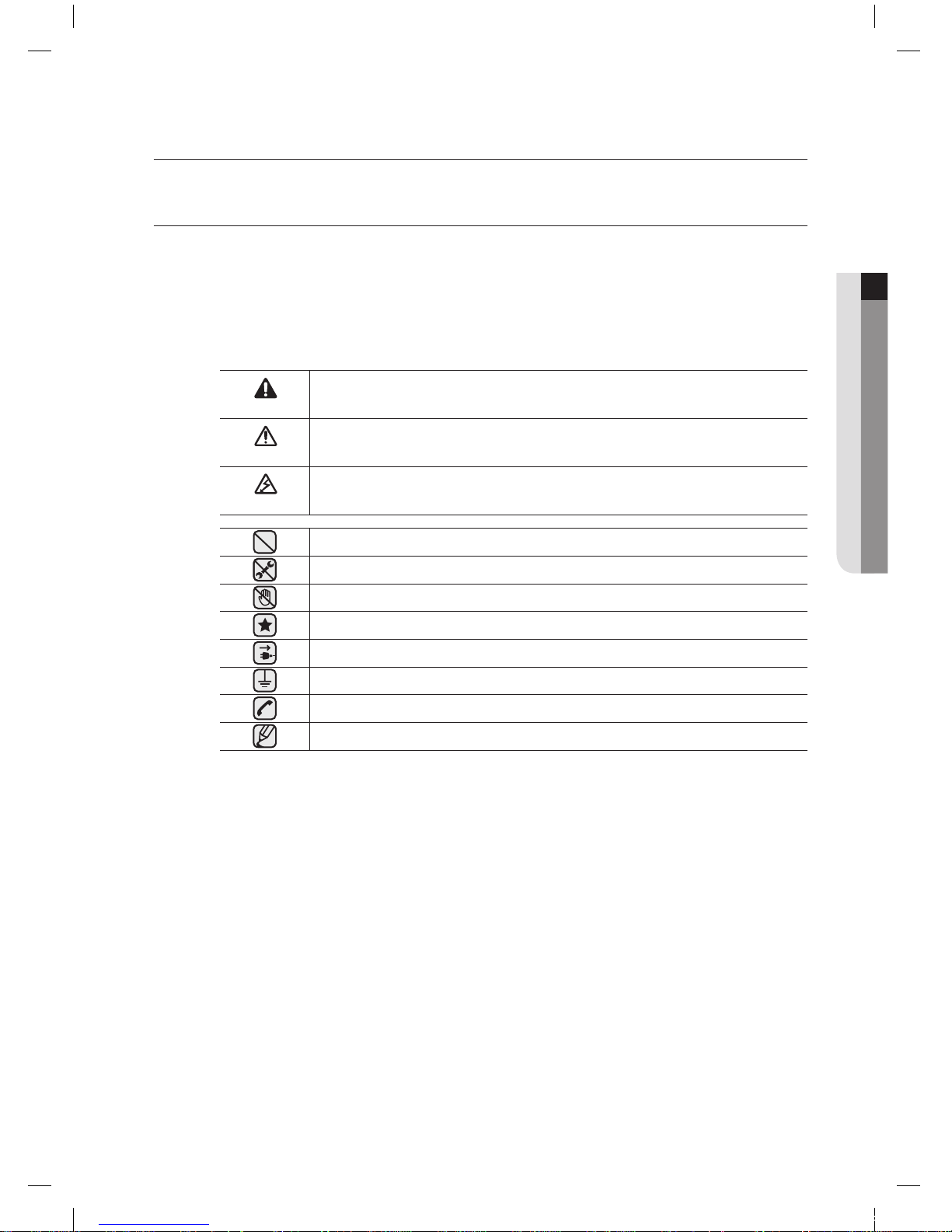
Important safety symbols and precautions:
WARNING
Hazards or unsafe practices that may result in severe personal injury or
death.
CAUTION
Hazards or unsafe practices that may result in minor personal injury or
property damage.
CAUTION
To reduce the risk of fire, explosion, electric shock, or personal injury when
using your air conditioner, follow these basic safety precautions:
Do NOT attempt.
Do NOT disassemble.
Do NOT touch.
Follow directions carefully.
Unplug the power plug from the wall socket.
Make sure the machine is grounded to prevent electric shock.
Call the contact center for help.
Note.
These warning signs are here to prevent injury to you and others.
Please follow them carefully.
After reading this section, keep it in a safe place for future reference.
Big Duct type_IB_E_33763-1.indd 2 2011-06-09 오후 12:32:32
Page 3

04_ safety information
safety information
SEVERE WARNING SIGNS
Do not place the air conditioner near hazardous substances or equipment
that releases free flames to avoid fire, explosions or injuries.
• Potential risk of fire hazard or explosion.
Do not install the outdoor unit at an unstable place or elevated surface where
there is potential risk of falling.
• If the outdoor unit falls, it may cause personal injury or loss of property.
Failure or damage may occur if any changes or modification that is not
stated in the installation manual was performed. In this case, user will be
responsible for the repair expenses.
Install the air conditioner away from direct exposure to sunlight, heating
apparatus, and humid places.
• Hang curtains on windows to boost cooling efficiency and to avoid the risk of electric
shock.
Do not cut the power plug and connect to a different power cable.
Do not yank the power cable and touch the power plug with hands.
• Potential risk of fire or electric shock.
Never use a damaged or dusted power plug, power cable, or loosened power
receptacle.
• Potential risk of fire or electric shock.
Install an exclusive circuit breaker and short-circuit breaker for the air
conditioner.
• Potential risk of electric shock or fire.
Do not insert anything such as fingers or branches into the air conditioner
vents while the air conditioner is running.
• Keep the children away from the air conditioner to prevent them from putting their finger
on the air conditioner. Potential risk of personal injury.
Ensure no water gets into the air conditioner.
• Potential risk or electric shock.
• If the water gets into the air conditioner, stop and unplug the power source immediately.
Turn off the air conditioner using the provided remote control or control
accessory (if provided). Do not unplug to turn off the unit (unless there is an
immediate danger).
Do not run the air conditioner for an extended period of time in a room with
the door closed or with babies, elderly or disabled people.
• Open the door or windows to ventilate your room at least once an hour to prevent oxygen
shortage.
The air conditioner is composed of moving parts. Keep children away from
the unit to avoid physical injury.
WARNING
Big Duct type_IB_E_33763-1.indd 3 2011-06-09 오후 12:32:32
Page 4
safety information _05
ENGLISH
Make sure that children take precautions against access to the air
conditioner and they do not play with the unit.
Do not clean the interior of air conditioner on your own.
• You may damage the parts which can cause electric shock or fire.
• Consult contact center for cleaning the interior of the air conditioner.
Do not connect the air conditioner with heating apparatus or attempt to
disassemble, remodel or repair it yourself.
• Potential risk of malfunction, electric shock or fire. If repairs are needed, consult the
contact center.
Consult the place of purchase or contact center to install, reinstall or
disassemble the air conditioner.
• Improper installation carries a risk of unit malfunction, water leakage, electric shock or fire.
• If installing in specialty areas, such as a factory complex or saline coastal area, consult
the place of purchase or contact center for specific installation details.
• The units must be installed according to distances declared, in order to permit
accessibility from each side, either to guarantee correct operation of maintenance or
repairing products. The unit’s parts must be reachable and removable completely under
safety condition (for people or things).
Consult a dealer regarding the appropriate measures to prevent the allowable
concentration from being exceeded.
• If the refrigerant leaks, and cause the concentration limit to be exceeded, hazards due to
lack of oxygen in the room may result.
If the indoor unit gets wet, turn the power off immediately and call your
nearest contact center.
• Potential risk of fire or electric shock.
Always make sure that the power supply is compliant with current safety
standards. Always install the air conditioner in compliance with current local
safety standards.
Verify that the voltage and frequency of the power supply comply with
the specifications and that the installed power is sufficient to ensure the
operation of any other domestic appliance connected to the same electric
lines.
Use a rated circuit breaker only.
• Never use steel wires or copper wires as a circuit breaker. It may cause fire or unit
malfunctions.
Do not put undue stress or place heavy object on the power cable.
Do not bend the power cable excessively.
• Potential risk of fire or electric shock.
To protect the product from water and possible shock, you should keep the
power cable and the connection cord of the indoor and outdoor units in the
protection tube.
When opening or closing the front panel, use a stable stool and watch your
steps carefully.
Disconnect the air conditioner from power supply before it is repaired or
disassembled.
Clean the air conditioner after the inner fan stops operating.
• Potential risk of injury or electric shock.
Big Duct type_IB_E_33763-1.indd 4 2011-06-09 오후 12:32:32
Page 5
06_ safety information
safety information
SEVERE WARNING SIGNS (CONT’D)
Use a receptacle that has a ground terminal. The receptacle must be used
exclusively for the air conditioner.
• Improper electrical grounding may cause electric shock or fire.
Be sure to ground the unit. Do not connect the ground wire to gas or water
pipes, lighting rods, or telephone grounding lines.
• If the unit is not properly grounded, electric shock may result.
If you smell burning plastic, hear strange sounds, or see smoke coming from
the unit, unplug the air conditioner immediately and call a contact center.
• Potential risk of fire or electric shock.
CAUTION SIGNS
Do not block or place items in front of the air conditioner. Do not step, hang
onto, or place heavy items on the air conditioner.
• Potential risk of personal injury.
If failure or damage occurs on the conditions of improper use not followed by
the installation manual, there will be an extra labor charge for installing and
construction.
• Potential risk of malfunction, electric shock or fire if repairs or installations are attempted
by a non-qualified service technician.
Do not spray flammable gases such as insecticide near the air conditioner.
• Potential risk of electric shock, fire or unit malfunction.
Do not open the front grille during operation.
• Potential risk of electric shock or unit malfunction.
Cool air should not flow directly towards people, pets, and plants.
• It is harmful to your health, pets, and plants.
Do not drink drain water coming out of the air conditioner.
• Potential risk of health hazard.
Do not allow children to climb on the air conditioner.
Do not use the air conditioner as a cooling precision instrument for food,
pets, plants, cosmetics or machinery.
Do not pull or give excessive shock to the air conditioner.
• Potential risk of fire, or unit malfunction and there are risk of personal injury because unit
may fall down.
Do not spray water directly on the air conditioner or use benzene, thinner or
alcohol to clean the surface of the unit.
• Potential risk of electric shock or fire.
• Potential risk of damage to the air conditioner.
Do not place any objects, especially containers with liquid.
WARNING
CAUTION
Big Duct type_IB_E_33763-1.indd 5 2011-06-09 오후 12:32:32
Page 6
safety information _07
ENGLISH
Do not touch the pipe connected to the air conditioner.
Install the indoor unit away from lighting apparatus using the ballast.
• If you use the wireless remote control, reception error may occur due to the ballast of the
lighting apparatus.
Install the outdoor unit where operating noise and vibration will not disturb
your neighbor and in a well-ventilated area with no obstacle.
• Potential risk of malfunction.
• Operating noise may disturb your neighbor.
Make sure that there are no obstacles or covers that block the air conditioner.
Allow sufficient space for air circulation.
• Insufficient ventilation may result in poor performance.
If the power cable is damaged, the manufacturer or a qualified service
technician must replace it.
If a power outage occurs while the air conditioner is working, turn off the
power source immediately.
Max current is measured according to IEC standard for safety and current is
measured according to ISO standard for energy efficiency.
Check for damage on delivery. If damaged, do not install the air conditioner
and call the place of purchase immediately.
Keep indoor temperatures stable and not extremely cold, especially where
there are children, elderly or disabled people.
The packaging material and used batteries of the remote controller (optional)
must be disposed of in accordance with the national standards.
The refrigerant used in the air conditioner must be treated as chemical waste.
Dispose the refrigerant following national standards.
Have a qualified service technician install the air conditioner and perform a
trial operation.
Firmly connect the drain hose to the air conditioner for proper water
drainage.
Check for damages on the outdoor unit installation pad at least once a year.
• Potential risk of personal injury or property loss.
When using a wireless remote control, the distance should not be more than
7 meters from the air conditioner.
If the remote control is not used for a long period of time, remove the
batteries to prevent leakage of electrolyte.
When cleaning the outdoor unit, touch the heat exchanger radiator fins with
extreme care.
• Wearing thick gloves can protect your hands.
Make sure that the condensed water dripping from the drain hose runs out
properly and safely.
The appliance is not intended for use by persons (including children) with
reduced physical, sensory or mental capabilities, or lack of experience
and knowledge, unless they have been given supervision or instruction
concerning use of the appliance by a person responsible for their safety:
Young children should be supervised to ensure that they do not play with the
appliance.
Big Duct type_IB_E_33763-1.indd 6 2011-06-09 오후 12:32:32
Page 7
08_ safety information
safety information
CAUTION SIGNS (CONT’D)
Inspect the condition, electric connections, pipes and external case of the air
conditioner regularly by a qualified service technician.
Do not open doors and windows in the room being cooled during operation
unless necessary.
Do not block the air conditioner vents. If objects block the air flow, it may
cause unit malfunction or poor performance.
Make sure there are no obstacles under the indoor unit.
• Potential risk of fire or loss of property.
The air conditioner should be used only for the applications for which it has
been designed: the indoor unit is not suitable to be installed in areas used for
laundry.
Our units must be installed in compliance with the spaces indicated in the
installation manual to ensure either accessibility from both sides or ability to
perform routine maintenance and repairs. The units’ components must be
accessible and that can be disassembled in conditions of complete safety
either for people or things.
For this reason, where it is not observed as indicated into the Installation
Manual, the cost necessary to reach and repair the unit (in safety, as required
by current regulations in force) with slings, trucks, scaffolding or any other
means of elevation won’t be considered in-warranty and charged to end user.
Ensure the off-on and protection switches are properly installed.
Do not use the air conditioner if damaged. If problems occur, immediately
stop operation and disconnect the plug from the power supply.
If the air conditioner will not be used for an extended period of time (for
example, over several months), unplug the power from the wall.
Call the place of purchase or a contact center if repairs are needed.
• Potential risk of fire or electric shock if disassembly or repairs are attempted by a
non-qualified service technician.
CAUTION
Big Duct type_IB_E_33763-1.indd 7 2011-06-09 오후 12:32:32
Page 8
contents _09
ENGLISH
contents
VIEWING YOUR AIR CONDITIONER
10
10 Big duct type
USING YOUR AIR CONDITIONER
11
11 Tips on using your air conditioner
CLEANING AND MAINTAINING
THE AIR CONDITIONER
12
12 Maintaining your air conditioner
12 Periodical checks
13 Internal protections via the unit control
system
APPENDIX
14
14 Troubleshooting
15 Operation ranges
INSTALLING YOUR
AIR CONDITIONER
16
16 Installation part
Correct Disposal of This Product
(Waste Electrical & Electronic Equipment)
(Applicable in the European Union and other European countries with separate collection systems)
This marking on the product, accessories or literature indicates that the product and its electronic accessories (e.g. charger, headset, USB cable) should not be
disposed of with other household waste at the end of their working life. To prevent possible harm to the environment or human health from uncontrolled waste
disposal, please separate these items from other types of waste and recycle them responsibly to promote the sustainable reuse of material resources.
Household users should contact either the retailer where they purchased this product, or their local government office, for details of where and how they
can take these items for environmentally safe recycling.
Business users should contact their supplier and check the terms and conditions of the purchase contract. This product and its electronic accessories
should not be mixed with other commercial wastes for disposal.
This product has been determined to be in compliance with the Low Voltage Directive (2006/95/EC), and the Electromagnetic
Compatibility Directive (2004/108/EEC) of the European Union.
Big Duct type_IB_E_33763-1.indd 8 2011-06-09 오후 12:32:32
Page 9
10_ viewing your air conditioner
viewing your air conditioner
Congratulations on the purchase of the air conditioner. We hope you enjoy the features of your air
conditioner and stay cool or warm with optimal efficiency.
Please read the user manual to get started and to make the best use of the air conditioner.
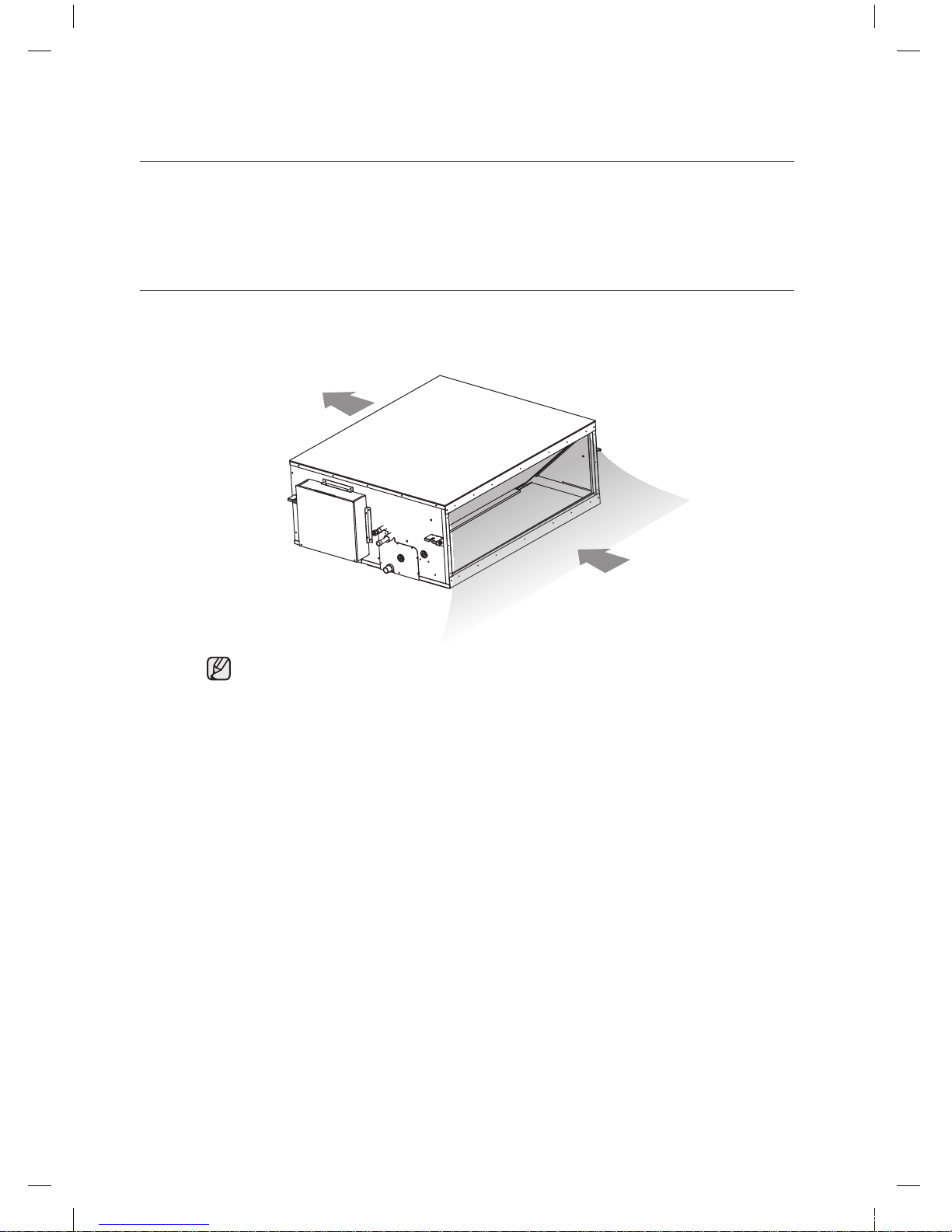
BIG DUCT TYPE
Your air conditioner may look slightly different from the illustration shown above depending
on your model.
Air intake
Air Outlet
Big Duct type_IB_E_33763-1.indd 9 2011-06-09 오후 12:32:32
Page 10
using your air conditioner _11
ENGLISH
using your air conditioner
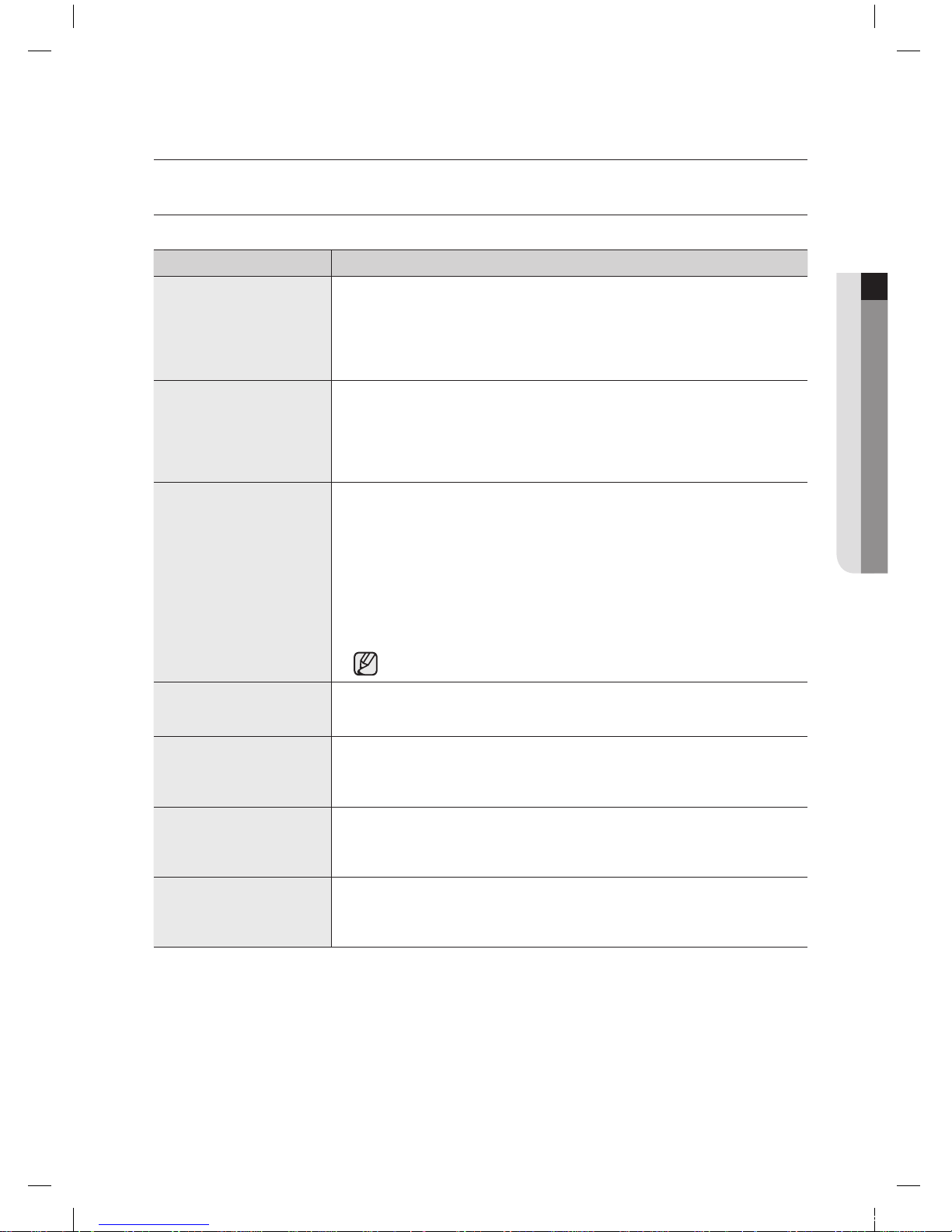
TIPS ON USING YOUR AIR CONDITIONER
Here are some tips that you would follow when using your air conditioner.
TOPIC RECOMMENDATION
Cooling • If current outside temperatures are much higher than the selected indoor
temperature, it may take time to bring the inner temperature to the desired
coolness.
• Avoid drastically turning down the temperature.
Energy is wasted and the room does not cool faster.
Heating • Since the air conditioner heats the room by taking heat energy
from outdoor air, the heating capacity may decrease when outdoor
temperatures are extremely low. If you feel the air conditioner insufficiently
heats, using an additional heating appliance in combination with the air
conditioner is recommended.
Frost & De-ice • When the air conditioner runs in Heat mode, due to temperature difference
between the unit and the outside air, frost will form.
If this happens:
- The air conditioner stops heating.
- The air conditioner will operate automatically in De-ice mode for
10 minutes.
- The steam produced on the outdoor unit in De-ice mode is safe.
No intervention is required; after about 10 minutes, the air conditioner
operates again normally.
The unit will not operate when it starts to de-ice.
Fan • Fan may not operate for about 3~5 minutes at the beginning to prevent
any cold blasts while the air conditioner is warming up.
High indoor/outdoor
temperatures
• If both indoor and outdoor temperatures are high and the air conditioner is
running in Heat mode, the outdoor unit’s fan and compressor may stop at
times. This is normal; wait until the air conditioner turns on again.
Power failure • If a power failure occurs during the operation of the air conditioner, the
operating immediately stops and unit will be off. When power returns, the
air conditioner will run automatically.
Protection mechanism • If the air conditioner has just been turned on after operation stops or being
plugged in, cool/warm air does not come out for 3 minutes to protect the
compressor of the outdoor unit.
Big Duct type_IB_E_33763-1.indd 10 2011-06-09 오후 12:32:32
Page 11
12_ using your air conditioner
cleaning and maintaining the
air conditioner
MAINTAINING YOUR AIR CONDITIONER
If the air conditioner will not be used for an extended period of time, dry the air conditioner to maintain it in
best condition.
1. Dry the air conditioner thoroughly by operating in Fan mode for 3 to 4 hours and disconnect
the power plug. There may be internal damage if moisture is left in components.
2. Before using the air conditioner again, dry the inner components of the air conditioner again
by running in Fan mode for 3 to 4 hours. This helps remove odors which may have generated
from dampness.
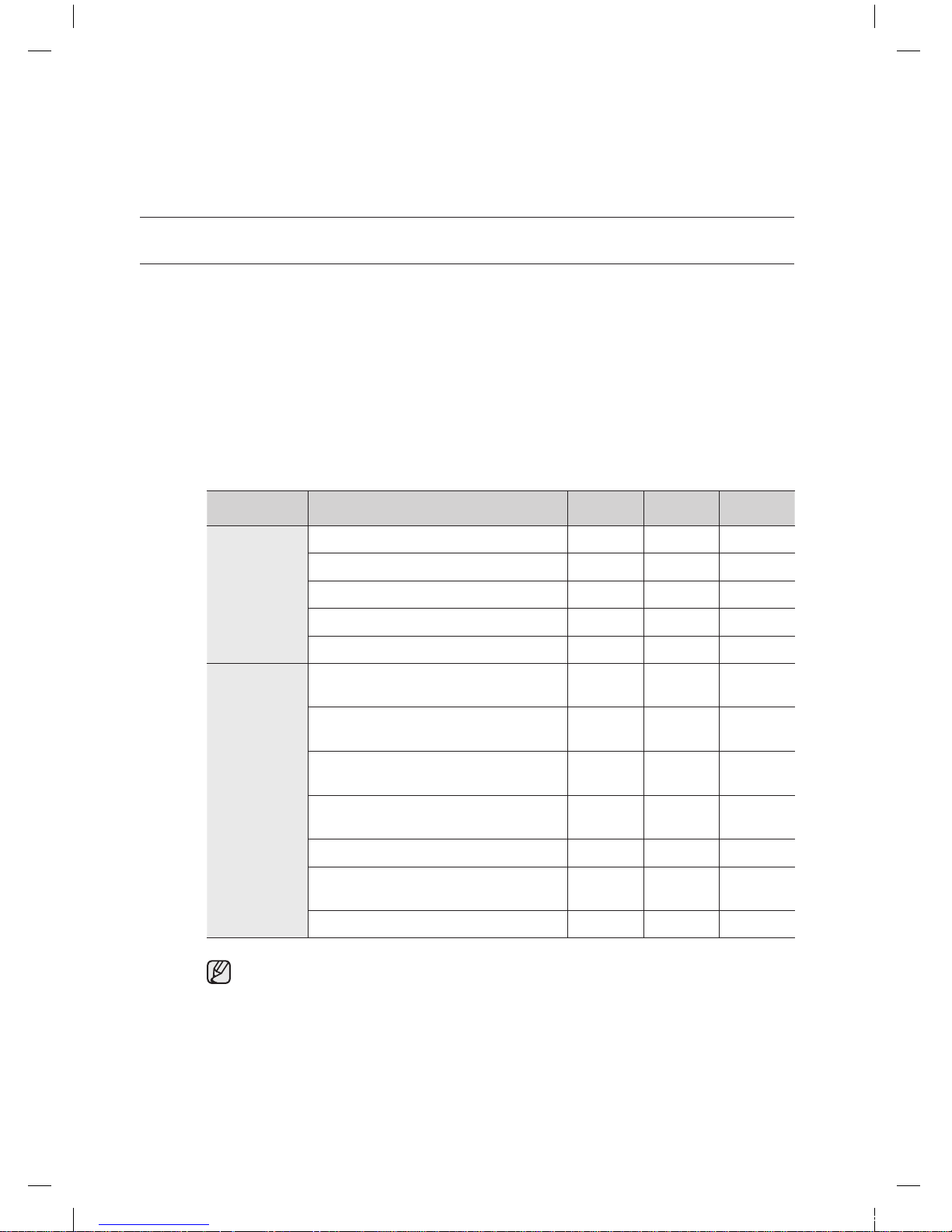
Periodical checks
Refer to the following chart to maintain the air conditioner properly.
Type Description Monthly
Every 4
months
Once a
year
Indoor unit
Clean the air filter (1)
Clean the condensate drain pan (2)
Thoroughly clean the heat exchanger (2)
Clean the condensate drain pipe (2)
Replace the remote control batteries (1)
Outdoor unit
Clean the heat exchanger on the outside of
the unit (2)
Clean the heat exchanger on the inside of
the unit (2)
Clean the electric components with jets of
air (2)
Verify that all the electric components are
firmly tightened (2)
Clean the fan (2)
Verify that all the fan assembly is firmly
tightened (2)
Clean the condensate drain pan (2)
The checks and maintenance operations described are essential to guarantee the
efficiency of the air conditioner. The frequency of these operations varies according to the
characteristics of the area, the amount of dust, etc.
(1) The described operations should be performed more frequently if the area of installation
is very dusty.
(2) These operations must always be performed by qualified personnel. For more detailed
information, see the Installation Manual.
Big Duct type_IB_E_33763-1.indd 11 2011-06-09 오후 12:32:32
Page 12
using your air conditioner _13
ENGLISH
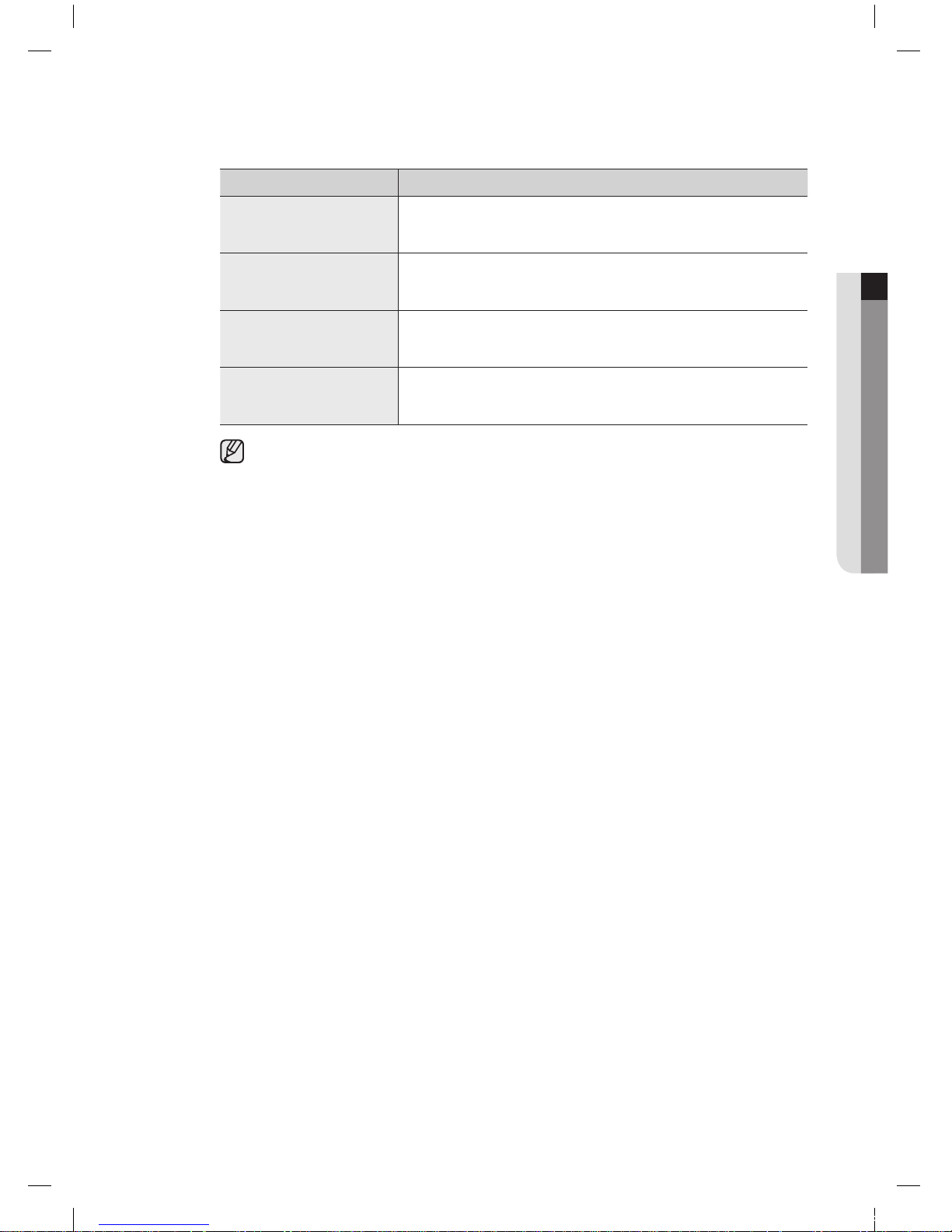
Internal protections via the unit control system
This internal protection operates if an internal fault occurs in the air conditioner.
Type Description
Against cold air
The internal fan will be off to against cold air when the heat pump is
heating.
De-ice cycle
The internal fan will be off to against cold air when the heat pump is
heating.
Anti-protection of
internal battery
The compressor will be off to protect internal battery when the air
conditioner operates in Cool mode.
Protect compressor
The air conditioner does not start operating immediately to protect the
compressor of the outdoor unit after it has been started.
If the heat pump is operating in Heat mode, De-ice cycle is actuated to remove frost from
an outdoor unit that may have deposited at low temperatures.
The internal fan is switched off automatically and restarted only after the de-ice cycle is
completed.
Big Duct type_IB_E_33763-1.indd 12 2011-06-09 오후 12:32:32
Page 13
14_ appendix
appendix
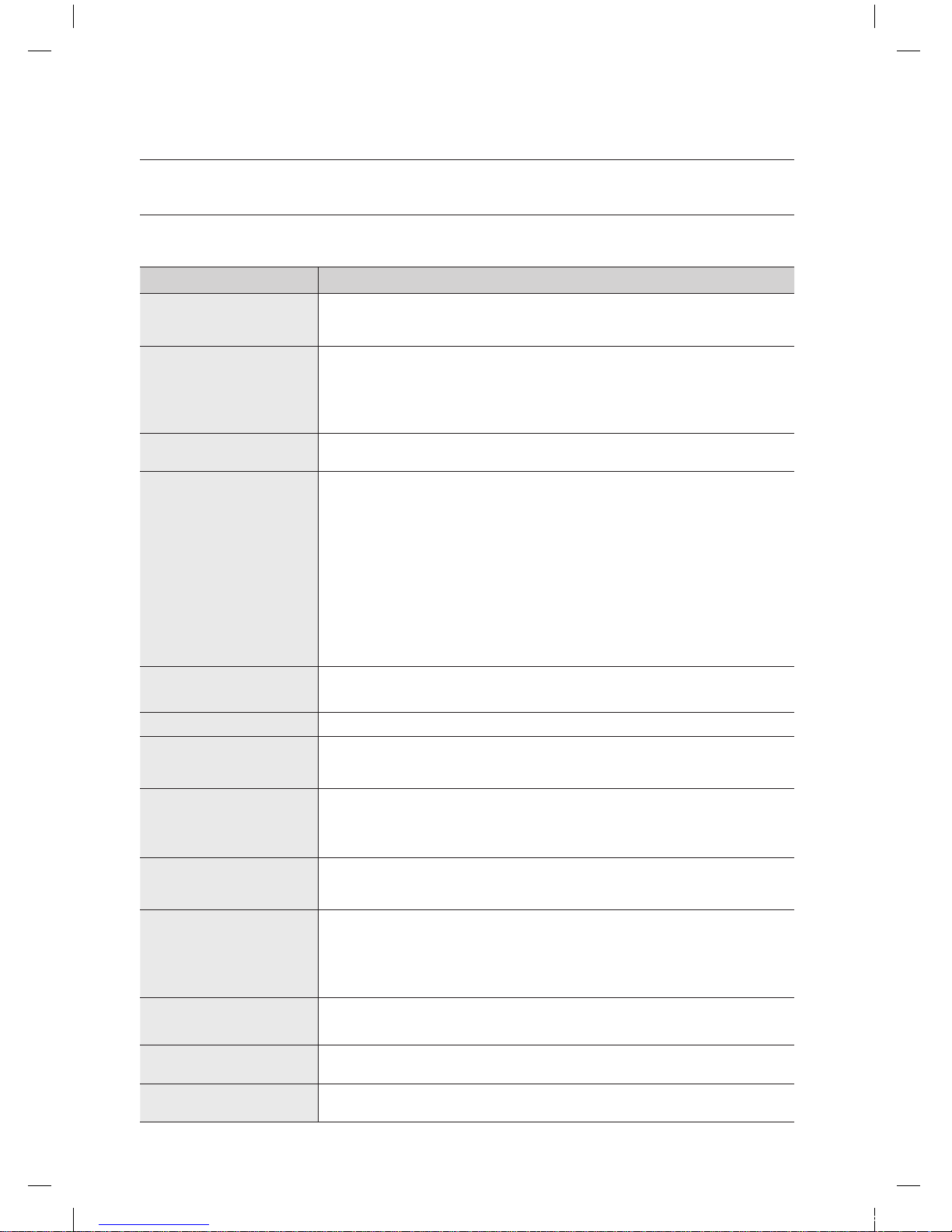
TROUBLESHOOTING
Refer to the following chart if the air conditioner operates abnormally. This may save time and unnecessary
expenses.
PROBLEM SOLUTION
The air conditioner does not
operate immediately after it
has been restarted.
• Because of the protective mechanism, the appliance does not start operating
immediately to keep the unit from overloading.
The air conditioner will start in 3 minutes.
The air conditioner does not
work at all.
• Check that the power plug is properly connected. Insert the power plug into the
wall socket correctly.
• Check if the circuit breaker is switched off.
• Check if there is a power failure.
• Check your fuse. Make sure it is not blown out.
The temperature does not
change.
• Check if you selected Fan mode.
Press the Mode button on the remote control to select another mode.
The cool (warm) air does
not come out of the air
conditioner.
• Check if the set temperature is higher (lower) than the current temperature. Press
the Temperature button on the remote control to change the set temperature.
Press the Temperature button to decrease or increase the temperature.
• Check if the air filter is blocked by dirt. Clean the air filter every two weeks.
• Check if the air conditioner has just been turned on. If so, wait 3 minutes. Cool air
does not come out to protect the compressor of the outdoor unit.
• Check if the air conditioner is installed in a place with a direct exposure to sunlight.
Hang curtains on windows to boost cooling efficiency.
• Check if the cover or any obstacle is not near the outdoor unit.
• Check if the refrigerant pipe is too long.
• Check if the air conditioner is only available in Cool mode.
• Check if the remote control is only available for cooling model.
The fan speed does not
change.
• Check if you selected Auto or Dry mode.
The air conditioner automatically adjusts the fan speed to Auto in Auto/Dry mode.
Timer function does not set. • Check if you press the Power button on the remote control after you have set the time.
Odors permeate in the room
during operation.
• Check if the appliance is running in a smoky area or if there is a smell entering from
outside. Operate the air conditioner in Fan mode or open the windows to air out the
room.
The air conditioner makes a
bubbling sound.
• A bubbling sound may be heard when the refrigerant is circulating through the
compressor. Let the air conditioner operate in a selected mode.
• When you press the Power button on the remote control, noise may be heard from
the drain pump inside the air conditioner.
Water is dripping from the
air flow blades.
• Check if the air conditioner has been cooling for an extended period of time with
the air flow blades pointed downwards. Condensation may generate due to the
difference in temperature.
Remote control is not
working.
• Check if your batteries are depleted.
• Make sure batteries are correctly installed.
• Make sure nothing is blocking your remote control sensor.
• Check that there are strong lighting apparatus near the air conditioner. Strong light
which comes from fluorescent bulbs or neon signs may interrupt the electric waves.
The air conditioner does not
turn on or off with the wired
remote control.
• Check if you set the wired remote control for group control.
The wired remote control
does not operate.
• Check if TEST indicator is displayed on the wired remote control. If so, turn off the
unit and switch off the circuit breaker. Call your nearest contact center.
The indicators of the digital
display flashes.
• Press the Power button on the remote control to turn the unit off and switch the
circuit breaker off. Then, switch it on again.
Big Duct type_IB_E_33763-1.indd 13 2011-06-09 오후 12:32:33
Page 14
appendix _15
ENGLISH
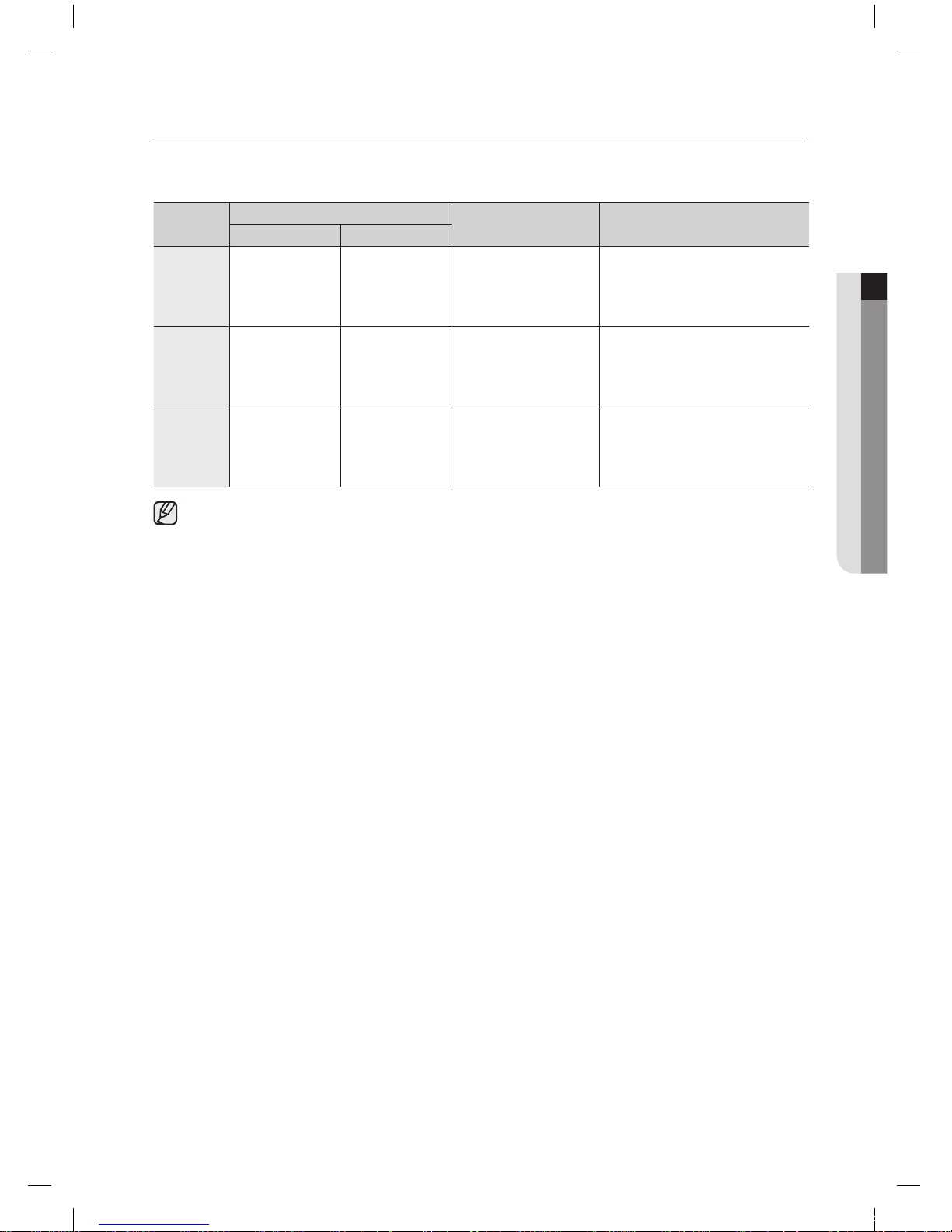
OPERATION RANGES
The table below indicates the temperature and humidity ranges the air conditioner can be operated within.
Refer to the table for efficient use.
MODE
OPERATIONAL TEMPERATURE
INDOOR HUMIDITY IF OUT OF CONDITIONS
INDOOR OUTDOOR
COOLING 18˚C to 32˚C -5˚C to 43˚C 80% or less
Condensation may occur on
the indoor unit with risk to have
either water blow off or drops on
the floor.
HEATING 27˚C or less -20˚C to 24˚C -
Internal protection triggers and
the air conditioner will stop.
DRYING 18˚C to 32˚C -5˚C to 43˚C -
Condensation may occur on
the indoor unit with risk to have
either water blow off or drops on
the floor.
The standardized temperature for heating is 7˚C. If the outdoor temperature drops to 0˚C or below,
the heating capacity can be reduced depending on the temperature condition.
If the cooling operation is used at over 32˚C(indoor temperature), it does not cool at its full capacity.
Big Duct type_IB_E_33763-1.indd 14 2011-06-09 오후 12:32:33
Page 15
16_ installing your air conditioner
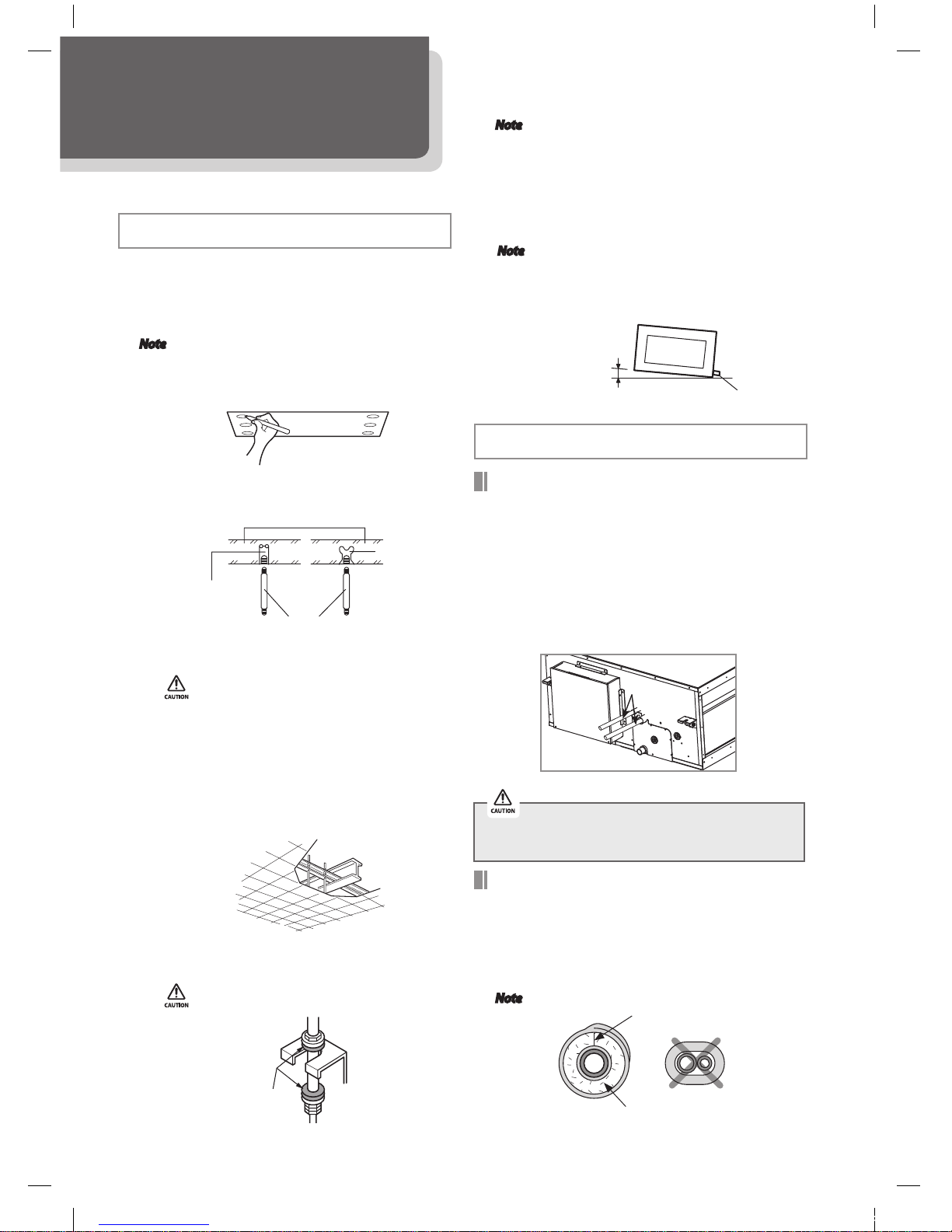
Indoor Unit Installation
It is recommended to install the Y- joint before installing the
indoor unit.
1.
Place the pattern sheet on the ceiling at the spot where you
want to install the indoor unit.
Since the diagram is made of paper, it may shrink
or stretch slightly due to temperature or humidity.
For this reason, before drilling the holes maintain
the correct dimensions between the markings.
Note
2.
Insert bolt anchors, use existing ceiling supports or
construct a suitable support as shown in figure.
3.
Install the suspension bolts depending on the ceiling type.
Ensure that the ceiling is strong enough to
support the weight of the indoor unit.
Before hanging the unit, test the strength
of each attached suspension bolt.
If the length of suspension bolt is more than
1.5m, it is required to prevent vibration.
If this is not possible, create an opening on
the false ceiling in order to be able to use it
to perform the required operations on the
indoor unit.
4.
Screw eight nuts to the suspension bolts making space for
hanging the indoor unit.
You must install the suspension bolts more than
four when installing the indoor unit.
Concrete
Suspension bolt(3/8" or M10)
Hole in anchor
Hole in plug
Insert
Ceiling support
5.
Hang the indoor unit to the suspension bolts between two nuts.
Piping must be laid and connected inside the
ceiling when suspending the unit. If the ceiling is
already constructed, lay the piping into
position for connection to the unit before
placing the unit inside the ceiling.
Note
6.
Screw the nuts to suspend the unit.
7.
Adjust level of the unit by using measurement plate for all 4 sides.
For proper drainage of condensate, give a 1° slant
to the left or right side of the unit which will be
connected with the drain hose, as shown in the
figure. Make a tilt when you wish to install the drain
pump, too.
Note
Performing Leak Test & Insulation
LEAK TEST WITH NITROGEN(before opening valves)
In order to detect basic refrigerant leaks, before recreating the
vacuum and recirculating the R410A, it’s responsible of installer
to pressurize the whole system with nitrogen(using a pressure
regulator) at a pressure above 4.1MPa(gauge).
LEAK TEST WITH R410A(after opening valves)
Before opening valves, discharge all the nitrogen into the
system and create vacuum. After opening valves check leaks
using a leak detector for refrigerant R410A.
Leak test
Discharge all the nitrogen to create a vacuum and
charge the system.
Rubber
1.
To avoid condensation problems, place T13.0 or thicker
Acrylonitrile Butadien Rubber separately around each
refrigerant pipe.
Always make the seam of pipes face upwards.
Note
Once you have checked that there are no leaks in the system,
you can insulate the piping and hose.
Insulation
No gap
NBR(T13.0 or thicker)
Installation Part
Drain hose port
1°
Leak check
Big Duct type_IB_E_33763-1.indd 15 2011-06-09 오후 12:32:33
Page 16
installing your air conditioner _17
ENGLISH
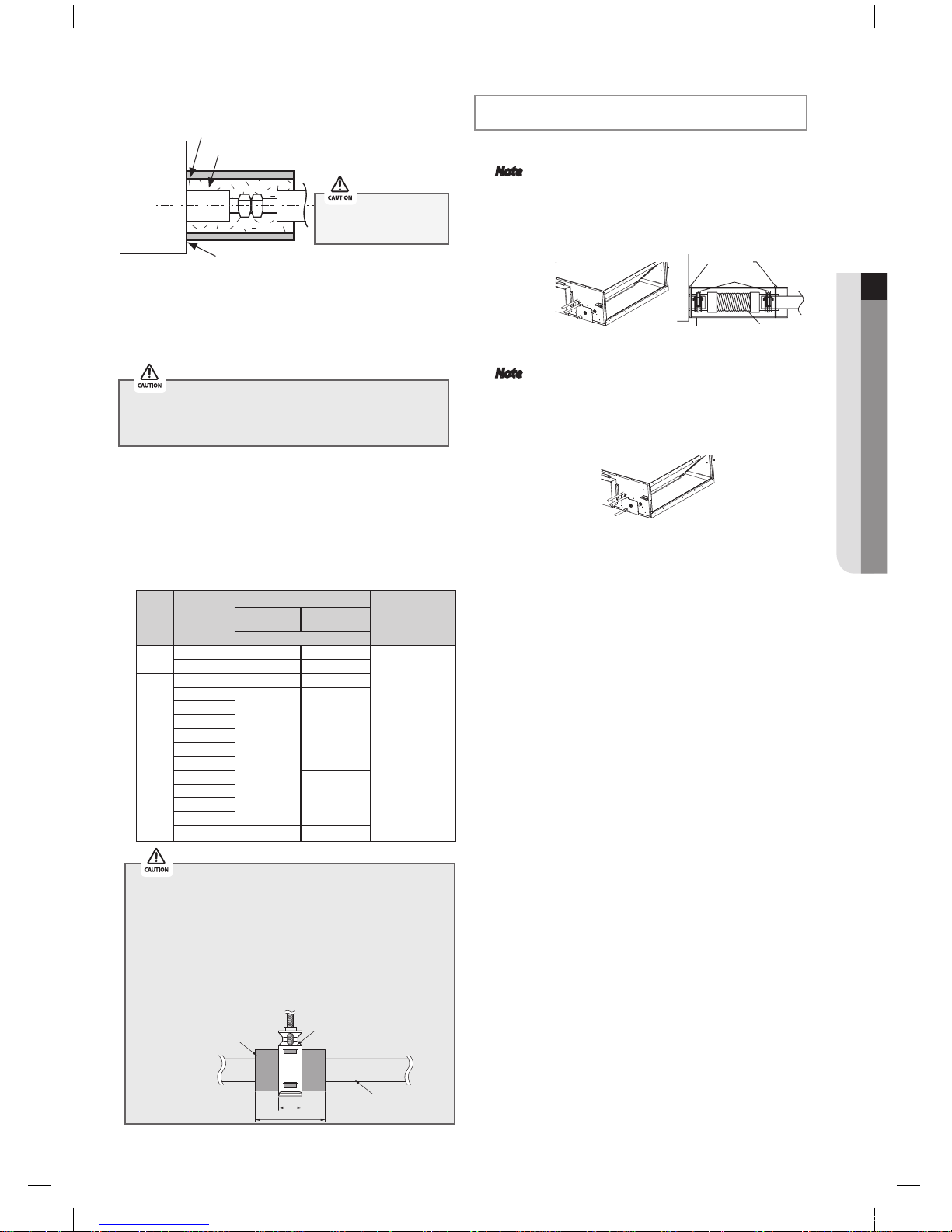
2. Wind insulating tape around the pipes and drain hose
avoiding to compress the insulation too much.
3. Fini sh wra pping insul ating tape around the rest of the
pipes leading to the outdoor unit.
4. The pipes an d e lect ri cal cable s c onnecting t he in do or
unit with the outdoor unit must be fixed to the wall with
suitable ducts.
Must fit tightly against
body without any gap.
Insulation cover pipe
Indoor unit
Be sure to overlap
the insulation
Insulation pipe
All refrigerant connection must be accessible, in order
to permit either unit maintenance or removing it
completely.
5. Select the insulation of the refrigerant pipe.
Insulate the gas side and liquid side pipe referring to the
thickness according to the pipe size.
Indoor temperature of 30°C and humidity of 85% is the stan-
dard condition.
If install in a high humidity condition,use one grade thicker
insulator by referring to the table below.
If installing in an unfavorable conditions,use thicker one.
Insulator’s heat-resistance temperature should be more than
120°C.
Install the insulation not to get wider and use
the adhesives on the connection part of it to
prevent moisture from entering.
Wind the refrigerant pipe with insulation tape
if it is exposed to outside sunlight.
Install the refrigerant pipe respecting that the
insulation does not get thinner on the bent part
or hanger of pipe.
Add the additional insulation if the insulation
plate gets thinner.
Additional insulation
Refrigerant pipe insulation
a× 3
a
Hanger
Drain pipe and Drain Hose Installation
1.
Install the drain hose as short as possible.
Give a 10mm slant to the drain hose for proper
drainage of condensate.
Secure the drain hose with the cable-tie not to
be separated from the unit.
The drain pump connection port is used when
using a drain pump.
Note
2.
Insulate the drain hose and then fix it as a picture.
Assemble flexible hose with clamps between
indoor unit and drain pipe.
Flexible hose clamps should be assembled
tightly to prevent being loosen. If it is loosen,
it may cause water drops.
Note
Flexible hoseInsulation
Cable-tie
Clamp
Pipe Pipe size
Insulation Type(Heating/Cooling)
Remarks
Standard
[30°C
,85%
]
High humidity
[30°C
,over 85%
]
EPDM,NBR
Liquid Φ6.35~Φ9.52 9t
←
Internal temperature
is higher than 120°C
pipe Φ12.7~Φ50.80 13t
←
Gas
Pipe
Φ6.35 13t 19t
Φ9.52
19t
25t
Φ12.70
Φ15.88
Φ19.05
Φ22.23
Φ25.40
Φ28.58
32t
Φ31.75
Φ38.10
Φ44.45
Φ50.80 25t 38t
Big Duct type_IB_E_33763-1.indd 16 2011-06-09 오후 12:32:34
Page 17
18_ installing your air conditioner
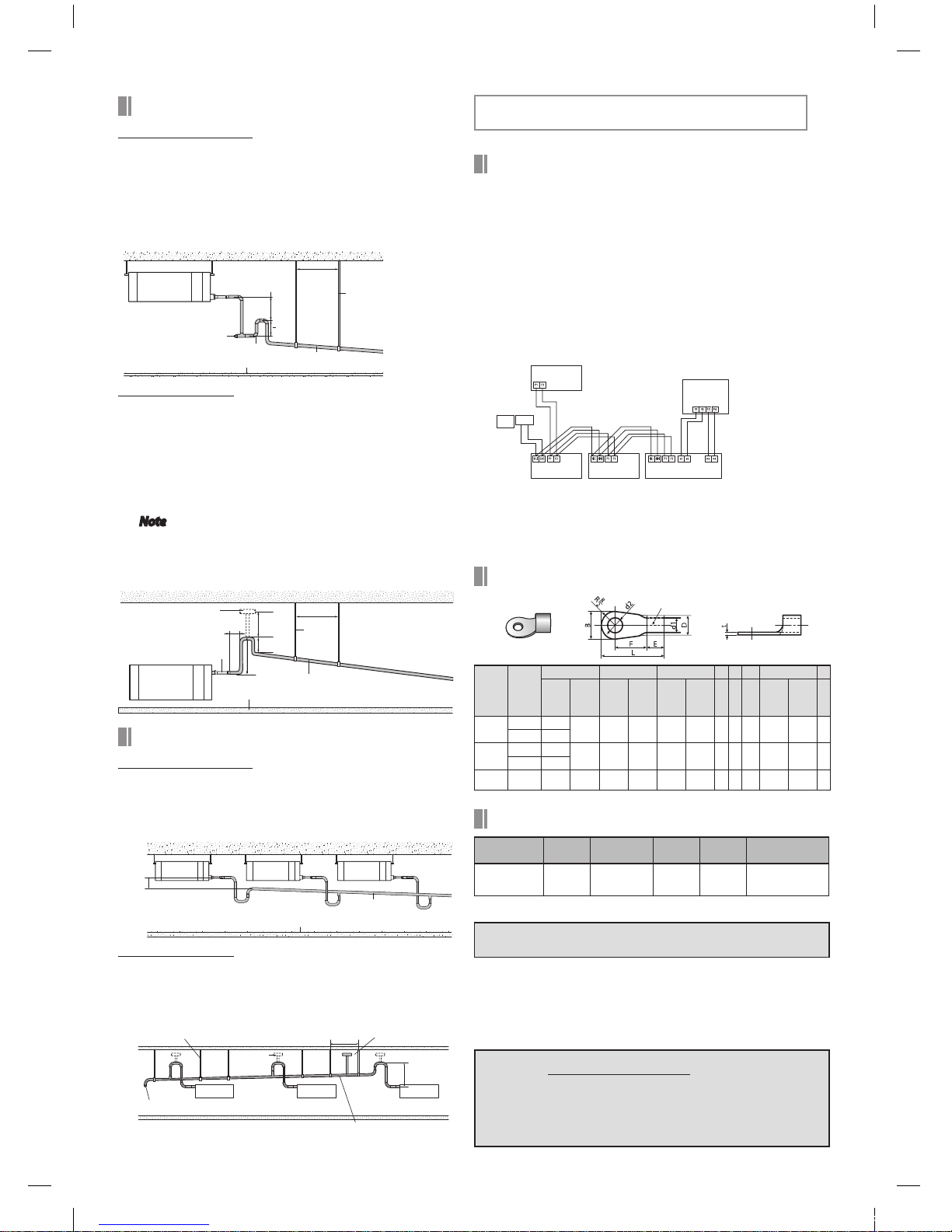
1.
Install horizontal drainpipe with a slope of 1/100 or more and
fix it by hanger space of 1.0~1.5m.
2.
Install U-trap at the end of the drainpipe to prevent a nasty
smell to reach the indoor unit.
3.
Do not install the drainpipe to upward position.
It may cause water flow back to the unit.
Drainpipe Connection
Wiring Work
Silver solder
1.
Before wiring work, you must turn off all power source.
2.
Indoor unit power should be supplied through the
breaker(ELCB or MCCB+ELB) separated by the outdoor
power.
ELCB: Earth Leakage Circuit Breaker
MCCB:Molded Case Circuit Breaker
ELB:Earth Leakage Breaker
3.
The power cable should be used only copper wires.
4.
Connect the power cable{1(L), 2(N)} among the units within
maximum length and communication cable(F1, F2) each.
5.
Connect V1, V2(for DC12V) and F3, F4(for communication)
when installing the wired remote Control.
Power and communication cable connection
ELCB
MCCB+
ELB
Indoor Unit 1
Outdoor
Unit
Wired Remote
Control
220-240V~
h
ELCB : Essential Installation
Indoor Unit 2 Indoor Unit 3
Selecting compressed ring terminal
Nominal
dimensions
for cable
(mm
2
)
Nominal
dimensions
for screw
(mm)
B D d1 E F L d2 t
Standard
dimension
(mm)
Allowance
(mm)
Standard
dimension
(mm)
Allowance
(mm)
Standard
dimension
(mm)
Allowance
(mm)
Min. Min. Max.
Standard
dimension
(mm)
Allowance
(mm)
Min.
1.5
4 6.6
±0.2 3.4
+0.3
-0.2
1.7 ±0.2 4.1 6 16 4.3
+0.2
0
0.7
4 8
2.5
4 6.6
±0.2 4.2
+0.3
-0.2
2.3 ±0.2 6 6 17.5 4.3
+0.2
0
0.8
4 8.5
4 4 9.5 ±0.2 5.6
+0.3
-0.2
3.4 ±0.2 6 5 20 4.3
+0.2
0
0.9
Specification of electronic wire
Power supply MCCB ELB or ELCB
Power
cable
Earth
cable
Communication
cable
Max : 242V
Min : 198V
X A
X A, 30mmA
0.1 sec
2.5mm
2
2.5mm20.75~1.5mm
2
Decide the capacity of ELCB(or MCCB+ELB) by below formula.
The capacity of ELCB(or MCCB+ELB) X [A] = 1.25 X 1.1 X ∑Ai
T X
: The capacity of ELCB(or MCCB+ELB).
T ∑Ai : Sum of Rating currents of each indoor unit.
T
Refer to each installation manual about the rating current of indoor unit.
Decide the power cable specification and maximum length
within 10% power drop among indoor units.
T Coef: 1.55
T L
k: Distance among each indoor unit[m],
A
k: Power cable specification[mm
2
], ik : Running current of each unit[A]
∑ (
Coef×35.6×L
k×ik
) <
10% of input
voltage[V]
1000×A
k
n
k=1
Without the drain pump
H
2
1
1~1.5m
Horizontal drainpipe
more than 1/100 slope
Ceiling
H≥50mm
Hanger
Drain Pipe
Cleaning hole
With the drain pump
1.
The drain pipe should be installed within 300mm to 550mm
from the flexible hose and then lift down 20mm or more.
2.
Install horizontal drainpipe with a slope of 1/100 or more
and fix it by hanger space of 1.0~1.5m.
3
Install the air vent in the horizontal drainpipe to prevent
water flow back to the indoor unit.
You may not need to install it if there were proper
slope in the horizontal drainpipe.
Note
4
The flexible hose should not be installed upward position,
it may cause water flow back to the indoor unit.
1.
Install horizontal drainpipe with a slope of 1/100 or more and
fix it by hanger space of 1.0~1.5m.
2.
Install U-trap at the end of the drainpipe to prevent a nasty
smell to reach the indoor unit.
Centralized Drainage
Without the drain pump
100mm or more
Ceiling
Horizontal drain
pipe more than 1/100 slope
1.
Install main air vent at the front of the farthest indoor unit from
the main drain when installed indoor units are more than 3.
2.
You may need to install individual air vent to prevent water
flow back at the top of each indoor unit drainpipe.
With the drain pump
Hanger
Main drainpipe
Individual
air vent
Main air vent
Centralized horizontal drainpipe
(more than 1/100 slope)
330mm
or less
1~1.5m
1~1.5m
20mm
or more
200mm
or more
Hanger
Within
330mm
Air vent
300mm or less
Flexible hose
Horizontal drainpipe
more than 1/100 slope
Ceiling
WARNING
Power off before connecting any wires;
Indoor PBA will be damaged while V1,V2,F3,F4
short each other.
or
Big Duct type_IB_E_33763-1.indd 17 2011-06-09 오후 12:32:35
Page 18
installing your air conditioner _19
ENGLISH
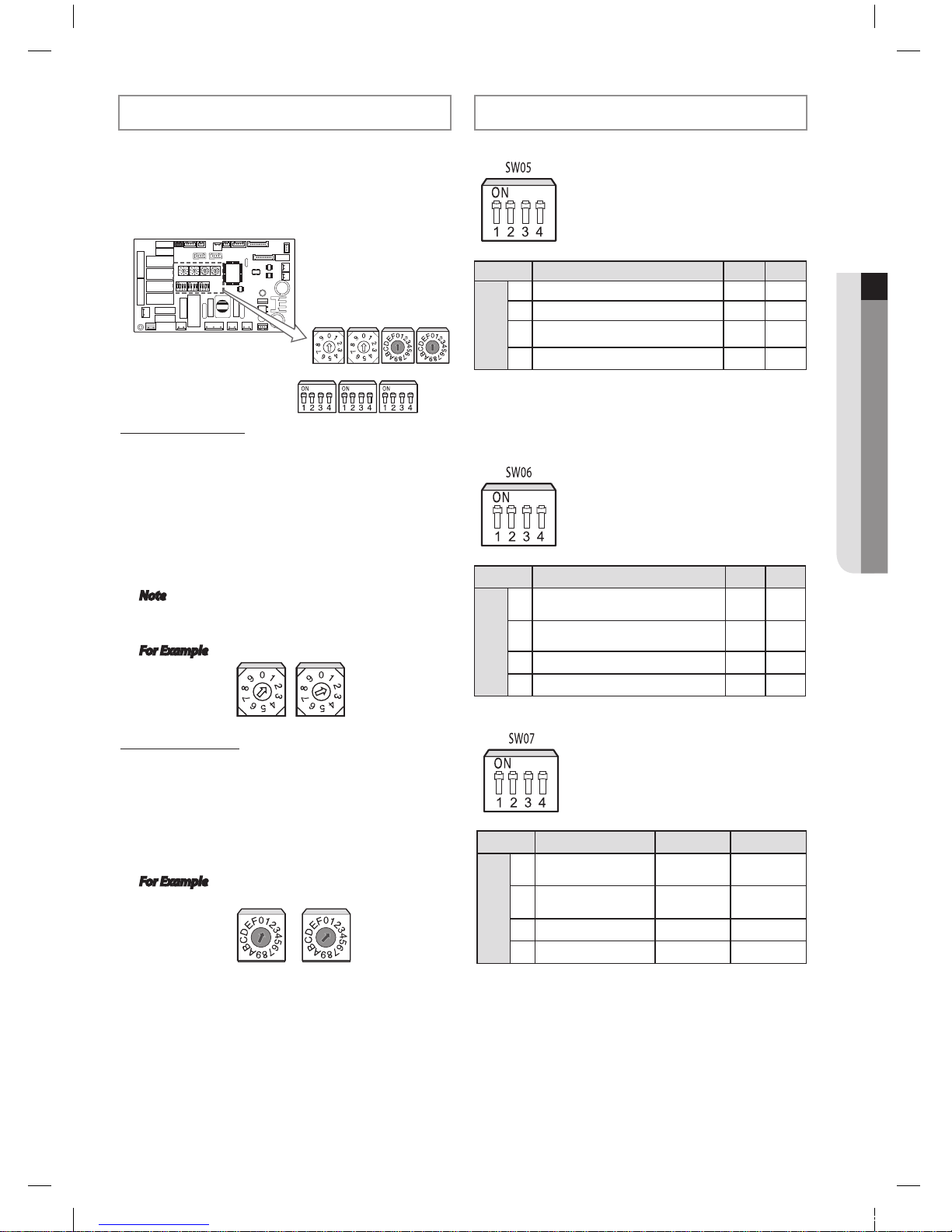
Indoor Unit Setting
1.
Before installing the indoor unit, assign an address to the
indoor unit according to the air conditioning system plan.
2.
The address of the indoor unit is assigned by adjusting
MAIN(SW01, SW02) and RMC(SW03, SW04) rotary switches.
K9K10K11K12
K5 K6 K7 K8
No. Function ON OFF
SW06
K5
Heating Current Temperature
Compensation
+2°C +5°C
K6 Filter Time
1000
hours
2000
hours
K7 Hot Water Heater Not use Use
K8 - - -
Setting MAIN Address
The MAIN address is for communication between the
indoor unit and the outdoor unit. Therefore, you must
set it to operate the air conditioner properly.
You can set the MAIN address from ‘00’ to ‘99’ by mixing
SW01 and SW02.
The MAIN address from ‘00’ to ‘99’ should differ from
each other.
Check the indoor unit address on the plan that you are
to install and set the address according to the plan.
You may not need to set MAIN address if you selected
Auto Address Setting from the outdoor unit: see details
on the outdoor unit installation manual.
Note
When MAIN address is set as “12”.
For Example
Setting RMC Address
The SW03 and SW04 RMC switch is the address setting
switch for controlling the indoor unit with the centralized
controller.
You must set the SW03, SW04 and K2 switch when using
the centralized controller.
You don’t have to set the SW03 and SW04 RMC switch
when not using the centralized controller.
When RMC address is set as “12”.
For Example
SW01 SW02 SW03
SW05 SW06 SW07
SW04
No. Function ON OFF
SW07
K9
Indoor Expansion Valve
For Heating Stop
Fix 160 step 0 or 160 step
K10
Wired Remocon Group
Master
Not use Use
K11 External control Not Use Use
K12 External Control Output Thermal ON Operation ON
Additional Functions
K1 K2 K3 K4
No. Function ON OFF
SW05
K1 External room sensor Not use Use
K2 Centralized controller Not use Use
K3 - - -
K4 Drain pump Not use Use
g The designs and shape
are subject to change
according to the model.
SW03 SW04
g K1 OFF
Heating mode : Setting temperature compensation
value = 0°C
Thermo OFF Fan OFF
Big Duct type_IB_E_33763-1.indd 18 2011-06-09 오후 12:32:36
Page 19
"EEE Yönetmeliğine Uygundur"
"This EEE is compliant with RoHS"
QUESTIONS OR COMMENTS?
COUNTRY CALL
OR VISIT US ONLINE
AT
COUNTRY CALL
OR VISIT US ONLINE
AT
ALBANIA 42 27 5755 RUSSIA 8-800-555-55-55 www.samsung.com
AUSTRIA
0810 - SAMSUNG
(7267864, € 0.07/min)
www.samsung.com GEORGIA 8-800-555-555
BELGIUM 02 201 2418
www.samsung.com/
be (Dutch)
www.samsung.com/
be_fr (French)
ARMENIA 0-800-05-555
BOSNIA 05 133 1999 AZERBAIJAN 088-55-55-555
BULGARIA 07001 33 11 www.samsung.com KAZAKHSTAN
8-10-800-500-55-500
(GSM: 7799)
www.samsung.com
CROATIA
062 SAMSUNG (062 726 7864)
www.samsung.com UZBEKISTAN 8-10-800-500-55-500 www.samsung.com
CZECH
800 - SAMSUNG (800-726786)
www.samsung.com KYRGYZSTAN
00-800-500-55-500
www.samsung.com
DENMARK 70 70 19 70 www.samsung.com TADJIKISTAN 8-10-800-500-55-500 www.samsung.com
FINLAND 030 - 6227 515 www.samsung.com UKRAINE 0-800-502-000
www.samsung.ua
www.samsung.com/
ua_ru
FRANCE 01 48 63 00 00 www.samsung.com BELARUS 810-800-500-55-500
GERMANY
01805 - SAMSUNG
(726-7864 € 0,14/Min)
www.samsung.com MOLDOVA 00-800-500-55-500
GREECE
IT and Mobile : 80111-SAMSUNG
(80111 7267864) from land line, local
charge/ from mobile, 210 6897691
Cameras, Camcorders, Televisions and
Household Appliances
From mobile and fixed 2106293100
www.samsung.com CANADA 1-800-SAMSUNG(726-7864) www.samsung.com
HUNGARY 06-80-SAMSUNG(726-7864) www.samsung.com MEXICO
01-800-SAMSUNG(726-7864)
www.samsung.com
ITALIA 800-SAMSUNG(726-7864) www.samsung.com U.S.A 1-800-SAMSUNG(726-7864) www.samsung.com
KOSOVO +381 0113216899 ARGENTINE 0800-333-3733 www.samsung.com
LUXEMBURG 261 03 710 www.samsung.com BRAZIL
0800-124-421
4004-0000
www.samsung.com
MACEDONIA 023 207 777 CHILE 800-SAMSUNG(726-7864) www.samsung.com
MONTENEGRO
020 405 888 COLOMBIA 01-8000112112 www.samsung.com
NETHERLANDS
0900-SAMSUNG
(0900-7267864) (€ 0,10/Min)
www.samsung.com COSTA RICA 0-800-507-7267 www.samsung.com
NORWAY 815-56 480 www.samsung.com DOMINICA 1-800-751-2676 www.samsung.com
POLAND
0 801 1SAMSUNG(172678)
022-607-93-33
www.samsung.com ECUADOR 1-800-10-7267 www.samsung.com
PORTUGAL
80820-SAMSUNG(726-7864)
www.samsung.com EL SALVADOR 800-6225 www.samsung.com
RUMANIA
08010 SAMSUNG (08010 726 7864)
only from landline, local network
Romtelecom - local tariff / 021 206 01
10 for landline and mobile, normal tariff
www.samsung.com GUATEMALA 1-800-299-0013 www.samsung.com
SERBIA
0700 Samsung (0700 726 7864)
www.samsung.com HONDURAS 800-27919267 www.samsung.com
SLOVAKIA 0800-SAMSUNG(726-7864)
www.samsung.com/sk
JAMAICA 1-800-234-7267 www.samsung.com
SPAIN
902-1-SAMSUNG (902 172 678)
www.samsung.com NICARAGUA 00-1800-5077267 www.samsung.com
SWEDEN 0771 726 7864 (SAMSUNG) www.samsung.com PANAMA 800-7267 www.samsung.com
SWITZERLAND
0848 - SAMSUNG
(7267864, CHF 0.08/min)
www.samsung.com/ch
www.samsung.com/
ch_fr/(French)
PERU 0-800-777-08 www.samsung.com
U.K 0330 SAMSUNG (7267864) www.samsung.com PUERTO RICO 1-800-682-3180 www.samsung.com
LITHUANIA 8-800-77777 www.samsung.com
TRINIDAD &
TOBAGO
1-800-SAMSUNG(726-7864) www.samsung.com
LATVIA 8000-7267 www.samsung.com VENEZUELA 0-800-100-5303 www.samsung.com
ESTONIA 800-7267 www.samsung.com AUSTRALIA 1300 362 603 www.samsung.com
LITHUANIA 8-800-77777 www.samsung.com INDIA
3030 8282
1800 3000 8282
www.samsung.com
Big Duct type_IB_E_33763-1.indd 19 2011-06-09 오후 12:32:36
 Loading...