

Page 1

R&S®ZPH
Cable and Antenna Analyzer
Instrument Security Procedures
Instrument Security Procedures
Version 01
1178939002
(;Üëè2)
Page 2

Contents
R&S®ZPH
2Instrument Security Procedures 1178.9390.02 ─ 01
Contents
1 Overview................................................................................................. 2
2 Instrument Models Covered..................................................................2
3 Security Terms and Definitions............................................................ 3
4 Types of Memory and Information Storage in the R&S ZPH..............3
5 Instrument Declassification.................................................................. 6
1 Overview
In many cases, it is imperative that the R&S ZPH Cable and Antenna Analyzers are
used in a secured environment. Generally these highly secured environments do not
allow any test equipment to leave the area unless it can be proven that no user information leaves with the test equipment. Security concerns can arise when devices need
to leave a secured area e.g. to be calibrated or serviced.
This document describes the types of memory and their usage in the R&S ZPH. It provides a statement regarding the volatility of all memory types and specifies the steps
required to declassify an instrument through memory clearing or sanitization procedures. These sanitization procedures are designed for customers who need to meet
the requirements specified by the US Defense Security Service (DSS).
2 Instrument Models Covered
Table 2-1: Cable and Antenna Analyzer models
Product name Order number
R&S ZPH 1321.1211.02
R&S ZPH 1321.1211.12
R&S ZPH 1321.1211.52, equivalent to 1321.1211.02
Page 3

Security Terms and Definitions
R&S®ZPH
3Instrument Security Procedures 1178.9390.02 ─ 01
3 Security Terms and Definitions
Clearing
The term "clearing" is defined in Section 8-301a of DoD 5220.22-M, "National Industrial
Security Program Operating Manual (NISPOM)". Clearing is the process of eradicating
the data on media so that the data can no longer be retrieved using the standard interfaces on the instrument. Therefore, clearing is typically used when the instrument is to
remain in an environment with an acceptable level of protection.
Sanitization
The term "sanitization" is defined in Section 8-301b of DoD 5220.22-M, "National
Industrial Security Program Operating Manual (NISPOM)". Sanitization is the process
of removing or eradicating stored data so that the data cannot be recovered using any
known technology. Instrument sanitization is typically required when an instrument is
moved from a secure to a non-secure environment, such as when it is returned for service of calibration.
The memory sanitization procedures described in this document are designed for customers who need to meet the requirements specified by the US Defense Security Service (DSS). These requirements are specified in the "Clearing and Sanitization Matrix"
in Section 14.1.16 of the ISFO "Manual for the Certification and Accreditation of Classified Systems under the NISPOM".
Instrument declassification
The term "instrument declassification" refers to procedures that must be undertaken
before an instrument can be removed from a secure environment, for example when
the instrument is returned for calibration. Declassification procedures include memory
sanitization or memory removal, or both. The declassification procedures described in
this document are designed to meet the requirements specified in DoD 5220.22-M,
"National Industrial Security Program Operating Manual (NISPOM)", Chapter 8.
4 Types of Memory and Information Storage
in the R&S ZPH
The R&S ZPH Cable and Antenna Analyzer contains various memory components.
The following table provides an overview of the memory components that are part of
your instrument. For a detailed description regarding type, size, usage and location,
refer to the subsequent sections.
Page 4

Types of Memory and Information Storage in the R&S ZPH
R&S®ZPH
4Instrument Security Procedures 1178.9390.02 ─ 01
Memory type Size Content Volatility User
Data
Sanitization
procedure
SDRAM 512 Mbyte Temporary information storage
for operating system and
instrument firmware
Volatile Yes Turn off instru-
ment power
Flash (µC
internal)
32 kbyte Power-up / Power-down firm-
ware
Non-volatile No None required
SRAM (µC
internal)
4 kbyte Temporary information storage
for Power-up / Power-down
firmware
Volatile No Turn off instru-
ment power
Flash 128 Mbyte
●
Operating System
●
Instrument firmware
●
Boot code
●
Calibration correction
data, product options and
serial number
●
User data and instrument
settings
Non-volatile Yes "Sanitize inter-
nal memory"
procedure
(see "Flash"
on page 5)
4.1 Volatile Memory
The volatile memory in the instrument does not have battery backup. It loses its contents as soon as power is removed from the instrument. The volatile memory is not a
security concern.
Removing power from this memory meets the memory sanitization requirements specified in the "Clearing and Sanitization Matrix" in Section 5.2.5.5.5 of the ISFO Process
Manual for the Certification and Accreditation of Classified Systems under the NISPOM.
SDRAM
The SDRAM on the CPU board has a size of 512 Mbyte and contains temporary information storage for operating system and instrument firmware. The SDRAM loses its
memory as soon as power is removed.
Sanitization procedure: Turn off instrument power.
SRAM (µC)
The SRAM of the µController has a size of 4 kbyte and contains temporary information
storage for Power-up / Power-down firmware. The SRAM loses its memory as soon as
power is removed.
Sanitization procedure: Turn off instrument power
Volatile Memory
Page 5
Types of Memory and Information Storage in the R&S ZPH
R&S®ZPH
5Instrument Security Procedures 1178.9390.02 ─ 01
4.2 Non-Volatile Memory
The R&S ZPH contains various non-volatile memories. Out of these, only the internal
Flash memory contains user data as well as instrument configuration. The Flash memory can be sanitized via "Sanitize internal memory" procedure.
All non-volatile memories of the R&S ZPH are not a security concern.
Flash (µC)
The µController internal flash memory has a size of 32 kbyte and contains the µController firmware for the Power-up / Power-down sequence. The flash does not hold user
data nor can the user access the flash storage.
Sanitization procedure: None required (no user data)
Flash
The flash memory has a size of 128 Mbyte of storage. It contains the boot code, operating system and instrument firmware, calibration correction data of product options
and serial number. Furthermore user data and instrument settings are stored here.
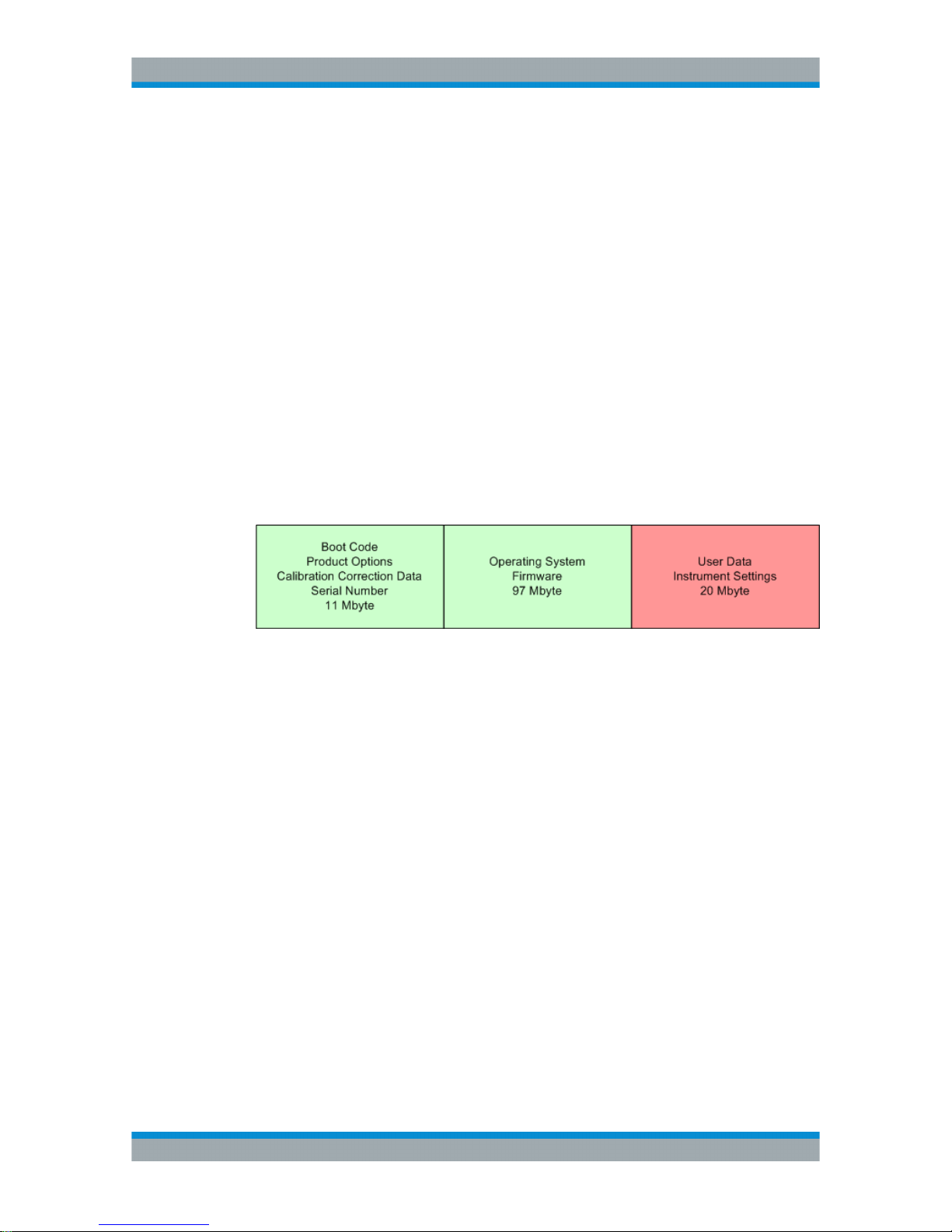
Figure 4-1: Logical sections of the Flash memory
The Flash memory is logically divided into three sections:
●
Boot Code / Product Options / Calibration Correction Data / Serial Number:
The 11 Mbyte memory section contains the boot code, the product options, the factory calibration correction data and the instrument serial number. This section is initialized during production and can be updated in case of firmware update and
option installation. It cannot be accessed by the user and is not modified during
instrument operation.
●
Operating System / Firmware:
The 97 Mbyte memory section contains the operating system and the instrument
firmware. This section is initialized during production and can be updated in case of
firmware update. It cannot be accessed by the user and is not modified during
instrument operation.
●
User Data / Instrument Settings:
The 20 Mbyte memory section contains the user data and automatically or manually saved instrument settings.
The R&S ZPH provides a sanitizing procedure that ensures that user data is irretrievably removed from the instrument.
Sanitization procedure: "Sanitize internal memory" procedure
Non-Volatile Memory
Page 6

Instrument Declassification
R&S®ZPH
6Instrument Security Procedures 1178.9390.02 ─ 01
The sanitizing procedure is part of the instruments maintenance system which can be
accessed by pressing the front panel buttons [PRESET] and softkey [5] during poweron.
After activating the sanitizing procedure, the following steps occur:
●
A full sector erase command as per manufacturer data sheet is applied to each
sector of the instrument settings and user data section. This explicitly includes sectors which might be declared as defect.
●
Every addressable location of the instrument settings and user data section is
overwritten by a single character.
●
Again, a full sector erase command as per manufacturer data sheet is applied to
each sector of the instrument settings and user data section, including defect sectors.
The "Sanitize internal memory" procedure meets the memory sanitization requirements
specified in the "Clearing and Sanitization Matrix" in Section 14.1.16 of the ISFO "Manual for the Certification and Accreditation of Classified Systems under the NISPOM".
5 Instrument Declassification
Firmware greater or equal 1.30 is required for the instrument declassification.
Before you can remove the R&S ZPH Cable and Antenna Analyzer from a secured
area (for example to perform service or calibration), all classified user data needs to be
removed. You can declassify the R&S ZPH as follows:
1. Turn off the R&S ZPH. This will sanitize the volatile memory.
2. To sanitize the internal Flash memory, perform the following steps:
a) Make sure, that no USB mass memory device is connected.
b) Press the front panel buttons [PRESET] and softkey [5] and hold them while
switching on the instrument again.
After a few seconds, the sanitizing procedure starts.
Sanitizing is indicated by the message "Secure Formatting Flash, please wait!" on
the instrument's screen. The sanitizing procedure takes approximately 8 minutes.
Afterwards, the instrument reboots. Since permanent adjustment values are not located in instrument settings and user data section of the flash, the validity of the
R&S ZPH Cable and Antenna Analyzer’s calibration is maintained throughout the sanitization.
Following these steps removes all user data from the R&S ZPH Cable and Antenna
Analyzer. The instrument can now leave the secured area.
Page 7

Instrument Declassification
R&S®ZPH
7Instrument Security Procedures 1178.9390.02 ─ 01
These declassification procedures meet the needs of customers working in secured
areas.
Validity of instrument calibration after declassification
The calibration makes sure that measurements comply to government standards.
Rohde & Schwarz recommends that you follow the calibration cycle suggested for your
instrument.
The flash is the only memory type used to hold permanent adjustment values required
to maintain the validity of the R&S ZPH's calibration.
Since only the flash instrument settings and user data section is erased during sanitization, performing the declassification procedure does not affect the validity of the
instrument’s calibration.
© 2018 Rohde & Schwarz GmbH & Co. KG
Mühldorfstr. 15, 81671 München, Germany
Phone: +49 89 41 29 - 0
Fax: +49 89 41 29 12 164
Email: [email protected]
Internet: www.rohde-schwarz.com
Subject to change – Data without tolerance limits is not binding.
R&S® is a registered trademark of Rohde & Schwarz GmbH & Co. KG.
Trade names are trademarks of the owners.
Throughout this manual, products from Rohde & Schwarz are indicated without the ® symbol , e.g.
R&S®SGS is indicated as R&S SGS.
 Loading...