

Page 1
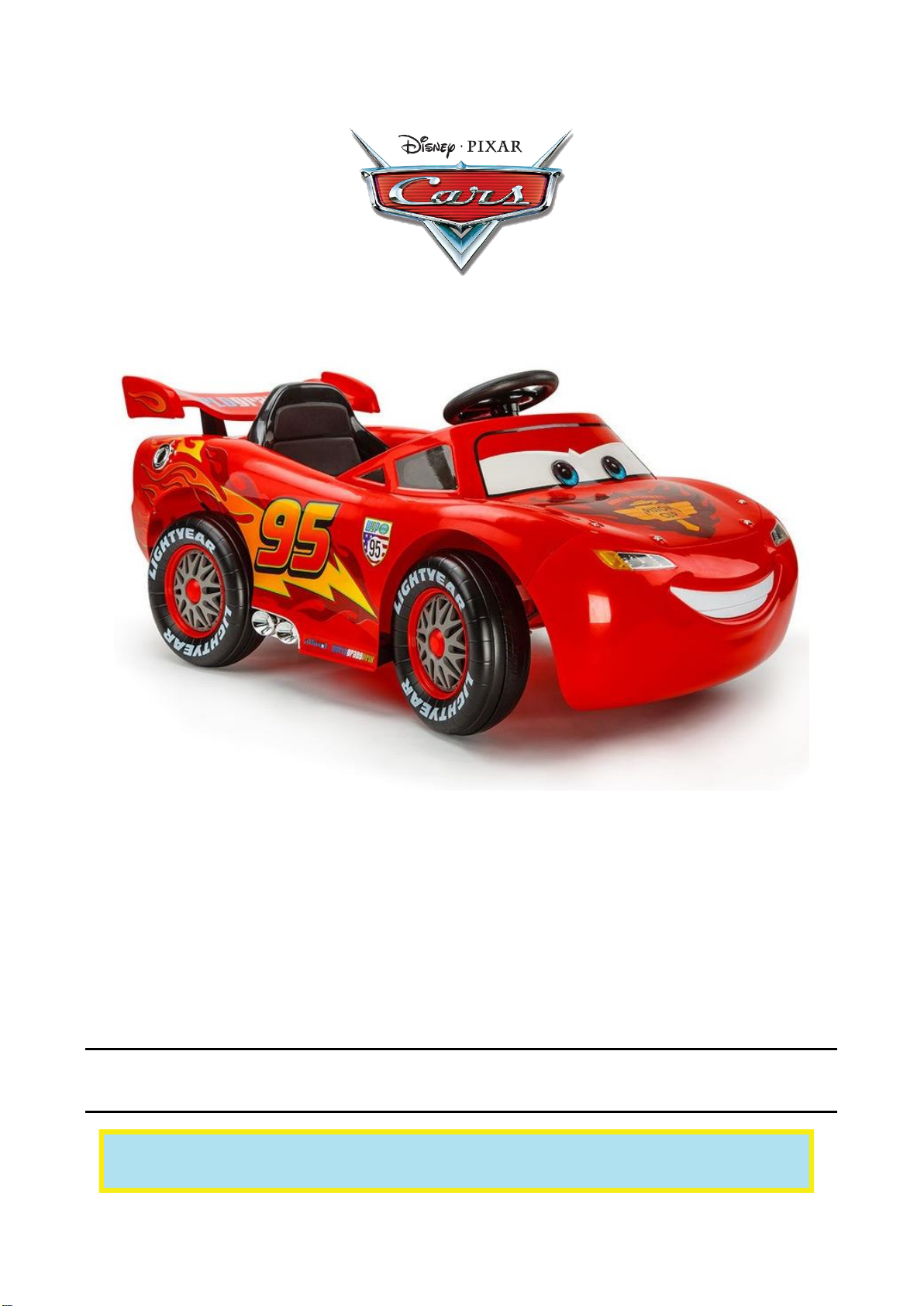
"Lightning McQueen"
THE BATTERY MAY HAVE SOME CHARGE ON ARRIVAL, IT IS IMPORTANT
HOWEVER THAT THE BATTERY IS CHARGED PRIOR TO USE.
Electric Ride-On Car
User Manual
[Revision 9.0 February 2018]
READ THIS MANUAL CAREFULLY BEFORE USE – FAILURE TO DO SO MAY RESULT IN INJURY, PROPERTY
DAMAGE AND MAY VOID WARRANTY. • KEEP THIS MANUAL FOR FUTURE REFERENCE. • Products covered by
this manual may vary in appearance, assembly, inclusions, specifications, description and packaging.
E&OE ©2018 Rovo-Kids
Page 2

"Lightning McQueen" Electric Ride-On Car
E&OE ©2018 Rovo-Kids 2
Safety
Read and understand all safety and operating instructions carefully before using the toy. The instructions not
only specify the assembly process and proper operation, but also help prevent injury and/or damage to the
toy and/or property due to incorrect operation.
•
WARNING! Choking hazard – small parts included. Not suitable for children under 3 years of age. The
packaging is not a toy and should be disposed of responsibly.
•
CAUTION! The toy must always be used under adult supervision. Although many children can master
the skills to control the toy, they do not have mature judgment skills. Never allow a child to operate the
toy unsupervised, and take the time to carefully evaluate child's skill levels and abilities to operate the toy
safely. Children cannot always recognize hazards even after instruction – teach appropriate safety rules
before allowing any child to use the toy. Instruction should include at least the following:
•
Starting, stopping and steering.
•
One rider only at a time, and always sit in the seat.
•
Do not place hands, feet or any part of the body, clothing or other articles near moving parts while
the toy is moving.
•
Maximum load capacity = 30kg.
•
This product should be assembled by an adult or checked by an adult to ensure it is properly assembled.
•
An adult should inspect the toy at regular Intervals for wear or loose fasteners and tighten as required.
Do not use the toy if abnormal conditions such as cracks or breaks exist.
•
Do not use the toy on public streets or roads, near moving vehicles, steep inclines or steps, near
swimming pools, or any other potentially dangerous areas.
•
The toy is designed for outdoor use on suitable surfaces and in dry conditions. Do not operate in the
dark, on sand or gravel, dirt, grass, uneven or rough ground. Running the toy indoors may cause
damage to flooring or other items.
•
This toy must not be overloaded or used to push or pull other objects.
•
This toy is suitable for children aged 3 and up.
•
Do not switch between forward and reverse when the toy is moving. Switch between forward and
reverse only when the toy is stationary.
•
Do not spray or immerse the toy in water as this will damage the electronics.
•
Keep the toy away from fire or other sources of heat.
•
The electric motors may produce sparks. Do not use the toy in areas where flammable or explosive
substances are present, such as petrol stations.
•
Do not allow children to touch moving parts. Keep other children away from the toy when it is moving.
•
The seat belt is a decoration only to develop a sense of safety in children; it cannot provide any
substantial protection.
•
If the toy malfunctions, do not use it until it is repaired.
•
CAUTION! When charging or replacing the battery, pay attention to the following:
•
Failure to follow instructions on correct battery maintenance may permanently damage the battery
and will void the warranty.
•
The vehicle battery must be fully charged before first use - initial battery charge is 10 hours.
•
Charge the battery at least once a month, even if the vehicle is not in use.
•
A damaged battery may leak or produce hazardous substances – use adequate precautions when
handling batteries.
•
Never modify the electrical system. Use of the wrong type battery or charger could cause a fire or
explosion.
Page 3

"Lightning McQueen" Electric Ride-On Car
E&OE ©2018 Rovo-Kids 3
•
The battery charger is not a toy and must be regularly examined for damage to the cord, plug,
enclosure and other parts. In the event of damage, the damage or worn part must not be used until
replaced.
•
The battery compartment and area under seat are not storage areas. Storing other articles may
create a fire hazard.
•
Battery charging should be performed by adults only.
•
Battery replacement should be performed by adults only.
•
Install batteries correctly according to polarity.
•
Keep the supply terminals from short-circuiting.
•
Never attempt to recharge non-rechargeable batteries.
•
Dispose of used batteries in an environmentally responsible manner.
•
Do not expose batteries to excessive heat, flammable or corrosive substances.
•
Remove the batteries if the toy will not be used for an extended period. Always remove used
batteries.
Page 4

"Lightning McQueen" Electric Ride-On Car
E&OE ©2018 Rovo-Kids 4
Table of Contents
Safety ............................................................................................................................................. 2
Battery Information ....................................................................................................................... 5
Battery Charging .......................................................................................................................................... 5
Charging the Battery .............................................................................................................................. 6
Battery Care and Disposal ........................................................................................................................... 6
Battery Care ........................................................................................................................................... 6
Battery Disposal ..................................................................................................................................... 6
Parts Identification ........................................................................................................................ 7
Assembly ....................................................................................................................................... 8
Operation ..................................................................................................................................... 10
Controls ...................................................................................................................................................... 10
Driver Mode Operation ............................................................................................................................... 10
Troubleshooting .......................................................................................................................... 11
Maintenance ................................................................................................................................ 12
Specifications ............................................................................................................................. 12
Page 5

"Lightning McQueen" Electric Ride-On Car
WARNING!
PREVENT FIRE
• Never modify the electrical system. Alterations could create a fire risk and/or destroy the electrical system.
• Use of the wrong battery type or charger could cause a fire or explosion resulting in serious injury. Use
batteries of the same or equivalent type as recommended must be used.
• The battery must be handled by adults only. The battery is heavy and contains sulphuric acid (electrolyte).
Dropping the battery could result in serious injury.
• Battery charging or replacement must be performed by adults only.
• Never lift or carry the battery by wires or connectors. This can damage the battery and possibly cause a
fire. Lift and carry the battery by the case only.
• Read the safety Instructions on the battery.
• Examine the battery, charger and their connectors for excessive wear or damage each time you charge
the battery. If damage or excessive wear is detected, do not use the charger or the battery until you have
replaced the worn or damaged part.
• Only use the battery charger in dry locations.
Thermal Fuses
The toy is equipped with a built-in thermal fuse. The fuse is a self-resetting safety device that shuts down the
toy if it is overloaded. Once a fuse has tripped it will automatically reset after approximately 10 seconds, and
the toy can be used again. To avoid repeated tripping, do not overload the toy by exceeding the maximum
weight capacity. Avoid inappropriate driving conditions, such as steep slopes or against fixed objects, which
can cause the wheels to stop rotating while power is being supplied to the motors.
If a thermal fuse in a battery continually trips under normal operating conditions and loads, have the vehicle
inspected by an authorised service centre or technician.
IMPORTANT NOTES
• Never recharge non-rechargeable batteries.
• The battery can fall out and cause injure if the vehicle overturns. Always use the battery cover.
• The battery must be charged for 10 hours before using it for the first time.
• You do not need to remove the battery from the vehicle to recharge it.
• The battery must be upright while charging.
• Do not short-circuit the battery or battery supply terminals.
• Before charging the battery, examine the battery case for cracks or other damage which may cause
sulphuric acid (electrolyte) to leak when charging. If damage is detected, do not charge the battery or use
it. Battery acid is highly corrosive and can cause severe personal injury and damage to surfaces it
contacts.
• Do not charge the battery on a surface that could be damaged by the acid in the battery. Take precautions
to protect surfaces where the battery is charged.
• If the battery is old and will not accept a charge, do not leave it in the toy. Always remove unserviceable
batteries.
CAUTION!
• Never recharge non-rechargeable batteries.
• Do not charge the battery for more than 20 hours continuously.
• Ensure the charger connector matches the vehicle battery charger port connector.
• Ensure the voltage and frequency of the charger is compatible with mains electrical supply.
• Do not short-circuit the battery or battery supply terminals.
Battery Information
Battery Charging
E&OE ©2018 Rovo-Kids 5
Page 6
"Lightning McQueen" Electric Ride-On Car
Charging the Battery
NOTE: The first battery charge requires approximately 18 hours. Subsequent charges require 8 to 12 hours.
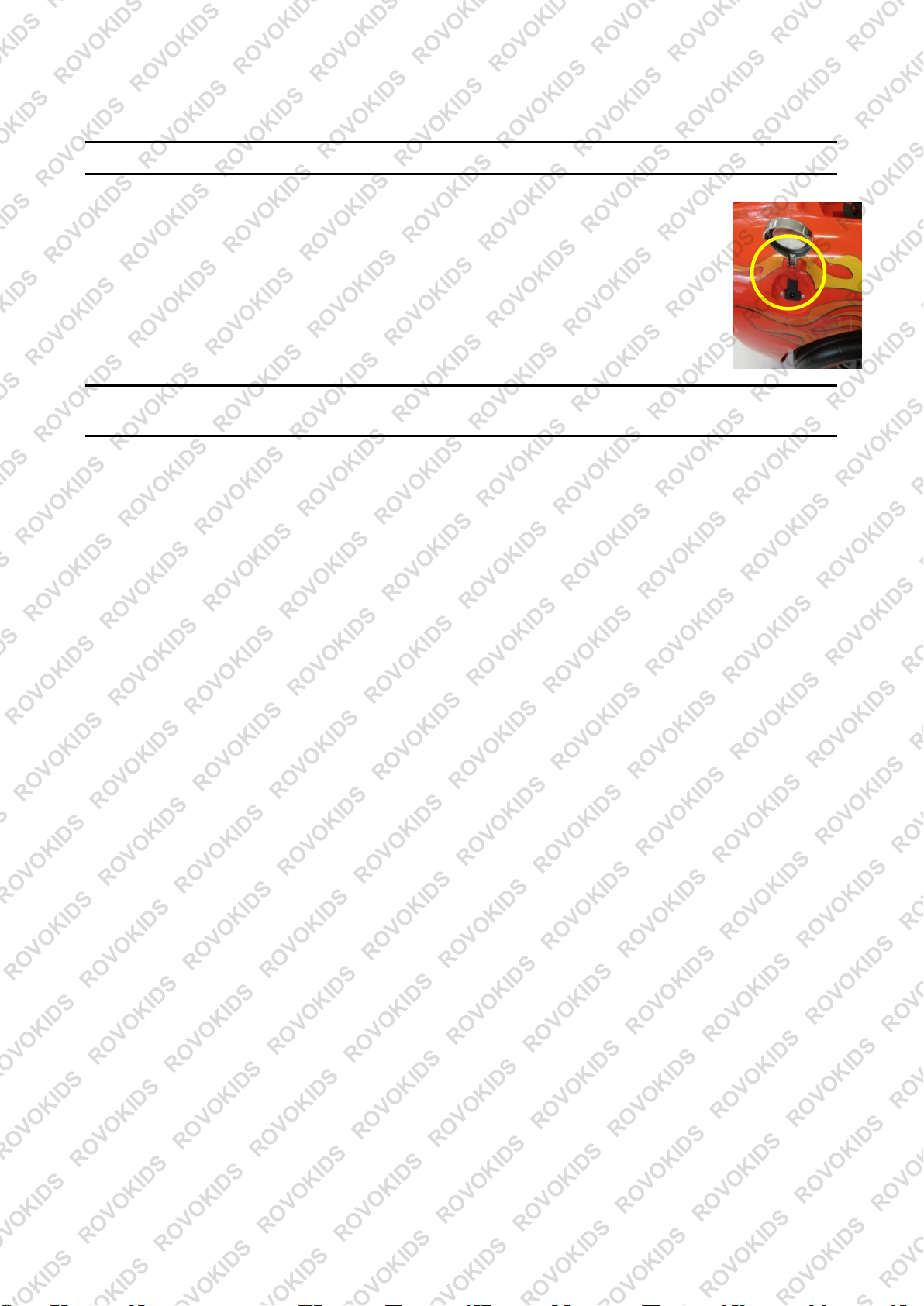
1. Insert the battery charger connector into the charger port located under the "fuel cap" at the right-side
rear of the toy. The cap is hinged, lift the bottom of the cap up to expose the
connector.
2. Plug the charger into a standard 240VAC wall socket and switch it ON. The charger
may feel warm during charging. This is normal and not a cause for concern.
3. After charging is complete, unplug the charger from the wall outlet and unplug the
battery connector from the charger port.
Battery Care and Disposal
NOTE: To prolong battery life and maximise battery performance, you must recharge the battery after each
use. You must also charge the battery at least once a month, even when not in use.
Battery Care
•
If a battery leak develops, avoid contact with the leaking acid and place the damaged battery in a
suitable container for disposal.
•
If battery acid contacts skin or eyes, call a physician immediately and flush with cool water for at least 15
minutes.
•
If battery acid is ingested, call a physician immediately and give water or milk. Do not induce vomiting.
•
Charge new batteries for 18 hours before first use.
•
Never charge the batteries longer than 20 hours continuously.
•
Over-charging or under-charging the battery may shorten battery life and decrease vehicle running time.
•
After the first charge, recharge the batteries for 8 to 12 hours after each use. Charge the batteries after
each use, regardless of how long the vehicle was used.
•
The toy must be upright while charging.
•
Do not allow the batteries to discharge completely before charging.
•
Charge the batteries before storing the toy.
•
Leaving the batteries in a discharged condition will destroy them.
•
If the toy will be stored for more than 2 months, disconnect the motor harness from the batteries.
•
Do not store batteries in temperatures above 40°C (104°F) or below -23°C (-10°F).
•
Always secure the battery in the battery compartment using the battery cover and four locating screws.
Adequately tighten all screws.
•
Examine the batteries, charger and its connector for excessive wear or damage each time you charge
the batteries. If damage is detected, do not use the charger or the batteries until you have replaced the
worn or damaged parts.
•
Always remove unserviceable batteries from the toy.
•
Battery leakage can damage the toy.
Battery Disposal
•
The batteries are a sealed lead-acid type. Recycle or dispose of batteries in an environmentally
responsible manner.
•
Never dispose of batteries as normal rubbish. The mixing of lead-acid batteries with household rubbish is
prohibited in most areas.
•
Never burn or dispose of batteries in a fire.
E&OE ©2018 Rovo-Kids 6
Page 7

"Lightning McQueen" Electric Ride-On Car
No.
Name
No.
Name
1
Body and Motor Assembly
6
Battery Charger
2
Steering Wheel
7
Wing
3
Rear Wheel (2)
8
Fasteners (1 x screw and nut for steering wheel,
2 x self-tapping screws for seat, 2 x washer for
front wheels)
4
Front Wheel (2)
5
Seat
5 1 4
2
7 6 3
8
Parts Identification
NOTE: Identify all parts before assembly and save all packaging material until assembly Is completed to
ensure that no parts are discarded. • Metal parts may be coated with lubricant for protection during shipment.
Wipe all metal parts with a paper towel to remove any excess lubricant. • Assemble the vehicle according to
instructions. Due to manufacturing techniques, it is possible that some parts are over-supplied. •
Screwdrivers may be required for assembly.
E&OE ©2018 Rovo-Kids 7
Page 8
"Lightning McQueen" Electric Ride-On Car
E J H F K
G
N
A
B
C I P O L
M
Video Tutorial:
Typical Ride-On Car Assembly
Assembly
CAUTION! Children may be harmed by small parts, sharp
edges and points or electrical components when the toy is
unassembled. Care should be taken to not allow children near parts
when unpacking and assembling the toy.
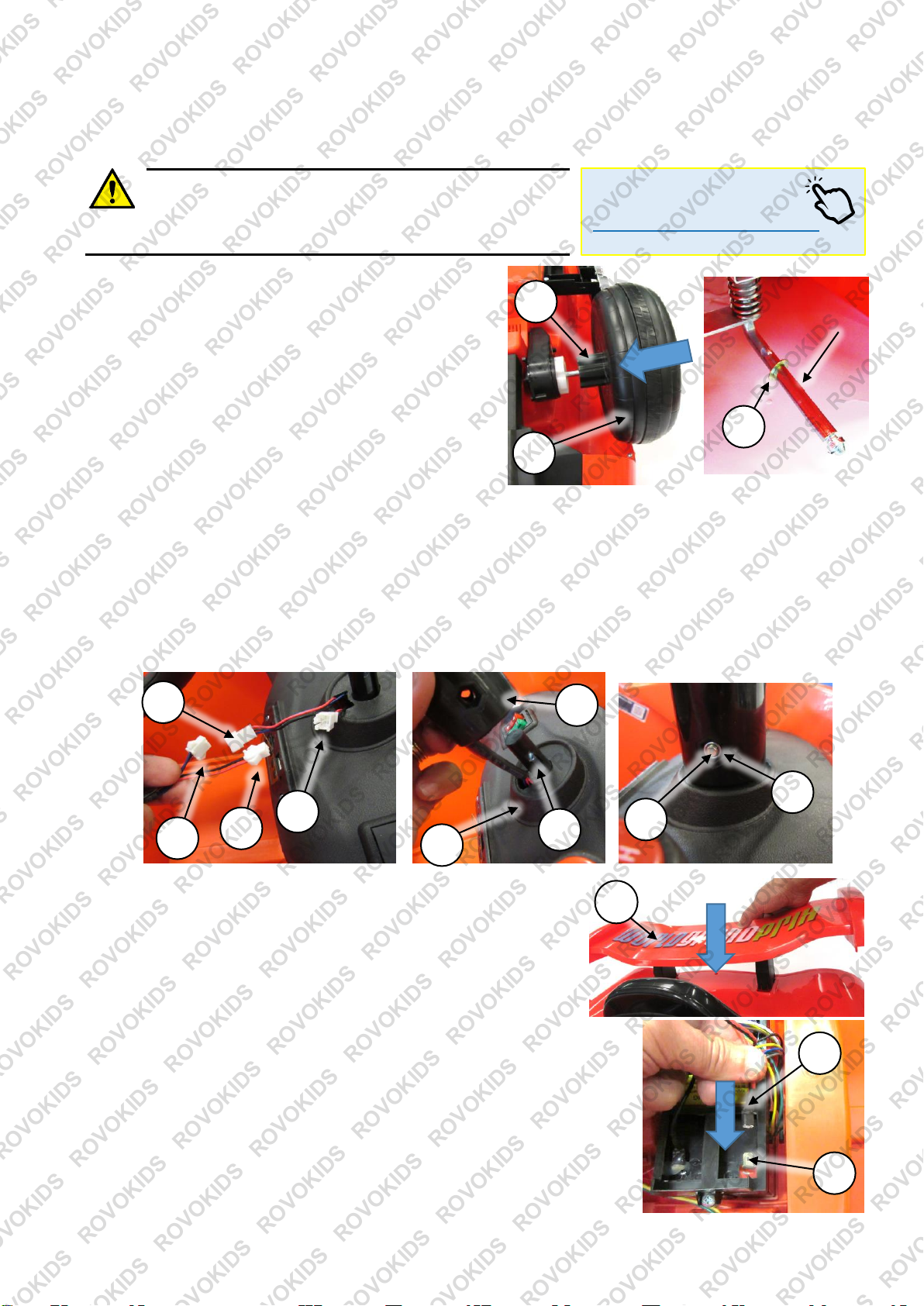
1. Install the rear (driven) wheels.
2. Place each rear wheel (A) on to the axle, with the drive
teeth (B) facing inward. Push the wheel onto the axle
until it "clicks" into place. It may be easier to install
both rear wheels at the same time, to prevent the axle
from being pushed.
3. Install the front wheels.
• Place a washer (C) on to each front axle (D).
• Place the wheel on to the axle, then push it on until
it "clicks" into place.
4. Install the steering wheel.
• Remove the screw and nut from the steering wheel stem. Plug the vehicle and steering wheel
electrical connectors (E, F, G & H) together. Feed excess wire into the steering column housing (I).
• Ensure the front wheels are straight then slide the steering wheel stem (K) onto the steering shaft (J)
– ensure that the steering wheel stem screw hole aligns with the hole in the shaft.
• Insert the nut (L) into the recess in the steering wheel stem. Insert the screw (M) from the other side
of the steering wheel stem, passing through the steering shaft and into the nut. Adequately tighten
the screw with an appropriate screwdriver.
5. Install the wing.
• Push the wing (N) into the slots at the rear of the body until it
"clicks" into place.
6. Connect the battery.
• Firmly push the unconnected battery wire (O) onto the free
battery terminal (P). Once connected, the battery can be
charged using the charging port.
E&OE ©2018 Rovo-Kids 8
Page 9
"Lightning McQueen" Electric Ride-On Car
X
X
S
T
Q
R
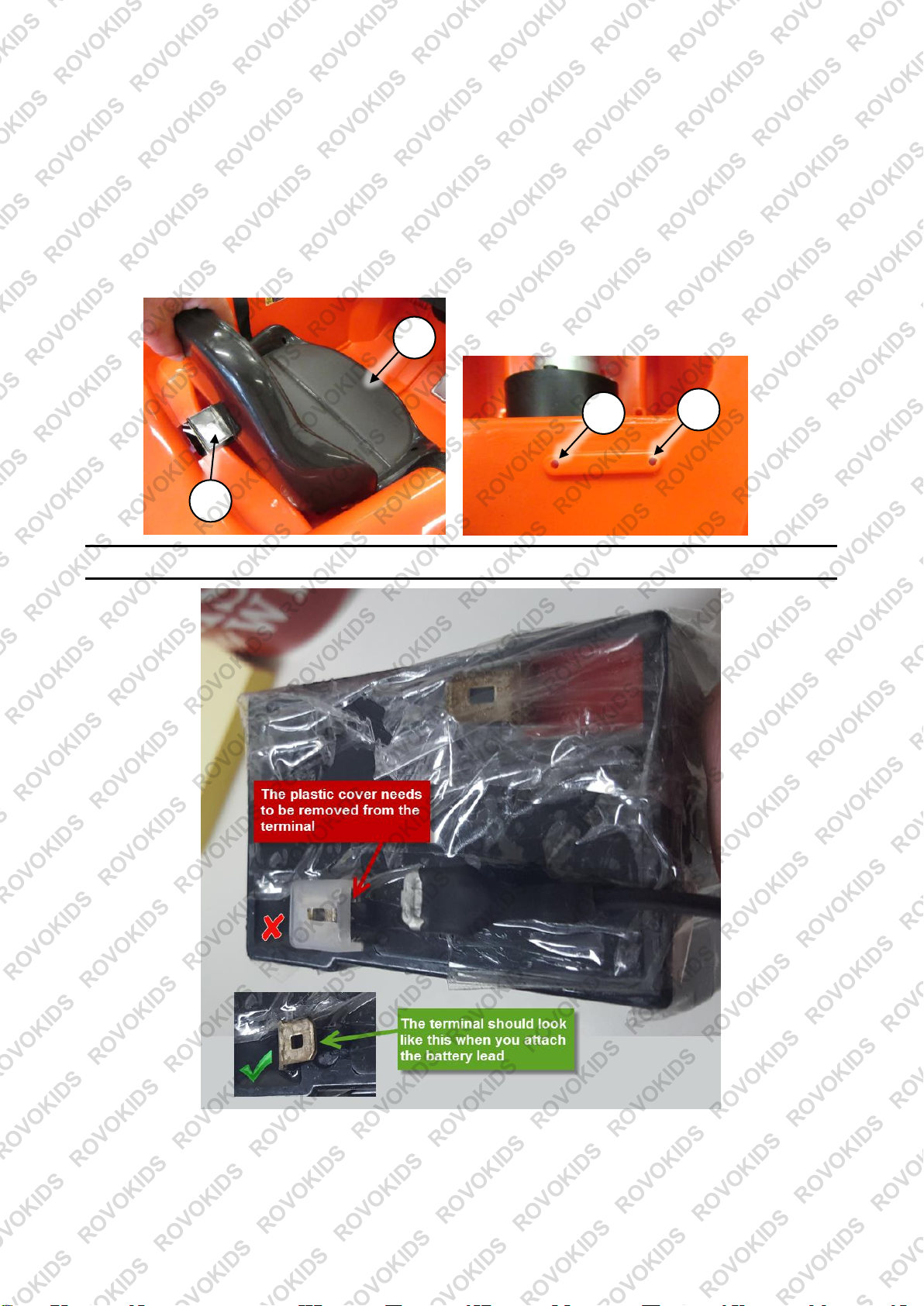
7. Install the seat (this also acts as a battery cover).
• Ensure no wires can be crushed or pinched when the seat is installed. Unbuckle the seat belt if
required and move it to the edges of the vehicle. Be sure to correctly insert the tongue (Q) on the
back of the seat (R) into the slot in the body, then slide the seat into position. Note that the seat has
two possible positions – use the forward holes (S) for smaller riders; use the rearward holes (T) for
larger riders.
• Attach the seat at points marked "X" using 2 self-tapping screws. Tighten (rotate right) the screws
using a Phillips head screwdriver, however, be careful not to over-tighten the screws as they are
screwing into plastic.
NOTE: Please remove the terminal cover first when assembling the battery (see image below).
Assembly is now complete.
E&OE ©2018 Rovo-Kids 9
Page 10
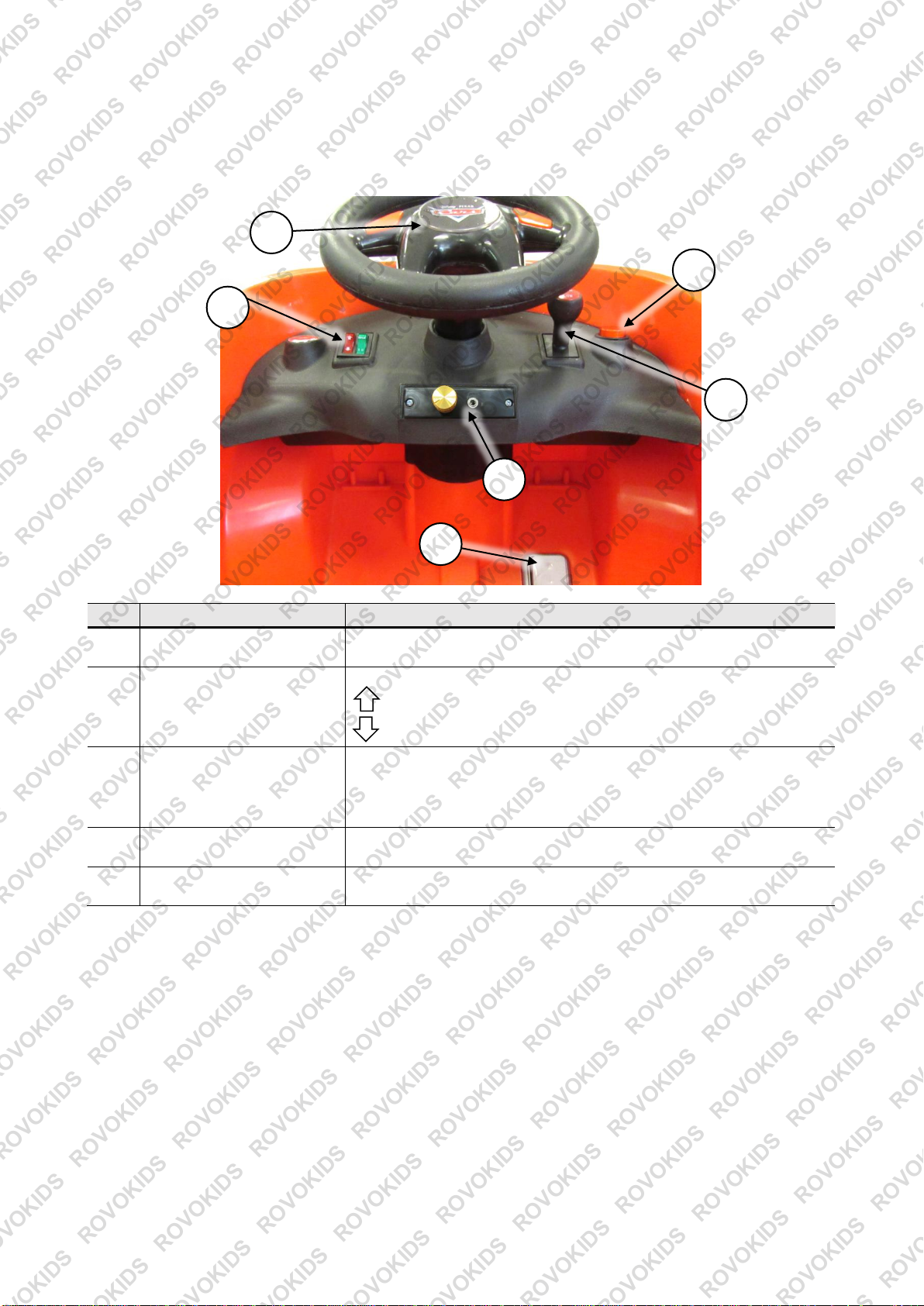
"Lightning McQueen" Electric Ride-On Car
No.
Name
Description
1
ON/OFF
Press to switch the toy ON or OFF. When the toy is ON, lights and controls
illuminate and sounds play.
2
Direction Control
Sets the desired direction of travel:
– Travel forward.
– Travel backward.
3
Speed Control
Controls speed:
High Speed – Travel at maximum speed.
Low Speed – Travel at minimum speed.
Middle Position – Prevent movement.
4
Accelerator
Press to travel in the direction set using the direction control (forward or
reverse). Release to stop.
5
Steering Wheel and Horn
Controls
When the toy is moving, rotate the steering wheel as required to change
direction. Press buttons to activate horn.
1 3 2 4 6
5
Operation
Controls
Driver Mode Operation
1. Ensure the “driver” is correctly and safely seated in the toy and the seat belt is buckled.
2. Press the ON/OFF button to switch the toy ON.
3. Select the direction of travel using the direction control.
4. Select the desired speed, music etc.
5. Press the accelerator pedal to begin moving. Release the accelerator to stop.
6. When finished, press the ON/OFF button to switch the toy OFF.
E&OE ©2018 Rovo-Kids 10
Page 11

"Lightning McQueen" Electric Ride-On Car
Malfunction
Analysis
Solution
Toy not running or
was running but
suddenly stopped
1. Fuse tripped.
2. Electrical connections
not secure.
3. Dead battery.
4. Under-charged battery.
5. Battery charger not
working.
6. Electrics or switches
damaged.
1. Toy overloaded or used on unsuitable surfaces. Fuse
resets after 10 seconds. Unload toy (30kg max.) and/or
move to suitable surface.
2. Check all wires and connections. Ensure the electrical
harness is fully connected. Ensure no motor wires are
loose or disconnected.
3. Battery no longer serviceable. Have battery checked by
an authorised service centre or replace.
4. Charge battery and ensure battery charging and care
procedures are followed.
5. Have charger professionally checked. If not working –
replace.
6. Seek diagnosis and repair from authorized service
center.
Short operating time
– less than 1 hour
per charge
1. Under-charged battery.
2. Over-charged battery.
3. Old or faulty battery will
not take full charge.
1. Charge battery and ensure battery charging and care
procedures are followed.
2. Battery no longer serviceable. Have battery checked by
authorised service centre or replace.
3. Expected battery life is 1 to 3 years depending on care,
use and conditions. Have battery checked by authorised
service centre or replace.
Movement is
sluggish
1. Under-charged battery.
2. Old or faulty battery will
not take full charge.
3. Toy overloaded.
1. Charge battery and ensure battery charging and care
procedures are followed.
2. Expected battery life is 1 to 3 years depending on care,
use and conditions. Have battery checked by an
authorised service centre or replace.
3. Toy overloaded or used on unsuitable surfaces. Unload
toy (30kg max.) and/or move to suitable surface.
Intermittent running
1. Electrical connections
not secure.
2. Main body electrics or
switches damaged.
1. Check all wires and connections. Ensure vehicle and
battery electrical harness is fully connected. Ensure no
motor wires are loose or disconnected.
2. Seek diagnosis and repair from authorized service
center.
Vehicle requires a
push to get running
1. Electrical connections
not secure.
2. Motor has “dead” spot.
1. Check all wires and connections. Ensure the electrical
harness is fully connected. Ensure no motor wires are
loose or disconnected.
2. Seek diagnosis and repair from authorised service
centre.
Gear box noisy
1. Broken or damaged
gears.
1. Seek diagnosis and repair from authorised service
centre.
Battery gets warm
during charging
Normal operation.
None required
Faint sounds and
heating from battery
when charging
Normal chemical reaction.
None required
Troubleshooting
E&OE ©2018 Rovo-Kids 11
Page 12

"Lightning McQueen" Electric Ride-On Car
Net Weight
12kg
Battery Type
6V 7Ah
Charger Type
6VDC 500mA (output)
Range
1 to 2 hours (full charge)
Charge Time
8 to 12 hours generally (full charge)
Maximum Rider Weight
30kg
Maintenance
•
If the toy is damaged, do not use it until it is repaired.
•
An adult should inspect the toy at regular Intervals for wear or loose fasteners and tighten as required.
Do not use the toy if abnormal conditions such as cracks or breaks exist.
•
The toy should be assembled by an adult or checked by an adult to make sure that it is properly
assembled.
•
Clean the toy with a clean cloth only. Do not use abrasives, solvents or harsh detergent when cleaning.
Do not spray or immerse the toy in water as this will damage the electronics.
Specifications
E&OE ©2018 Rovo-Kids 12
Page 13

Some experts believe the incorrect or prolonged use of almost any product could cause serious
injury or death. For information that may reduce your risk of serious injury or death, consult the
points below and additionally, the information available at www.datastreamserver.com/safety
• Consult all documentation, packaging and product
labelling before use. Note that some products feature
online documentation which should be printed and kept
with the product.
• Check product for loose / broken / damaged / missing
parts, wear or leaks (if applicable) before each use.
Never use a product with loose / broken / damaged /
missing parts, wear or leaks (if applicable).
• Products must be inspected and serviced (if applicable)
by a qualified specialist every 6 months assuming
average residential use by a person of average weight
and strength, above average technical aptitude, on a
property matching average metropolitan specification.
Intended use outside these guidelines could indicate
the product is not suitable for intended use or may
require more regular inspection or servicing.
• Ensure all possible users of the product have
completed an industry recognized training course
before being given access to the product.
• The product has been supplied by a general merchandise retailer that
may not be familiar with your specific application or your description
of the application. Be sure to attain third-party approval for your
application from a qualified specialist before use regardless of prior
assurances by the retailer or its representatives.
• This product is not intended for use where fail-safe operation is
required. As with any product (take an automobile, aircraft, computer
or ball point pen for example), there is always a small chance of
technical issues that needs to be repaired or may require replacement
of the product or a part. If the possibility of such failure and the
associated time it takes to rectify could in any situation inconvenience
the user, business or employee then the product is not suitable for
your requirements. This product is not for use where incorrect
operation or a failure of any kind, including but not limited to a
condition requiring product return, replacement, service by a
technician or replacement of parts could cause a financial loss, loss of
employee time or an inconvenience requiring compensation.
• If this item has been purchased in error after considering the points
above, simply contact the retailer directly for details of their returns
policy, if required.
©2018 Rovo-Kids. All rights reserved. No part of this document, including descriptive content, concepts,
ideas, diagrams or images may be reproduced or transmitted in any form or by any means, electronic or
mechanical, including photocopying, scanning or recording, or any information storage and retrieval system,
without express permission or consent from the publisher.
 Loading...