

Page 1
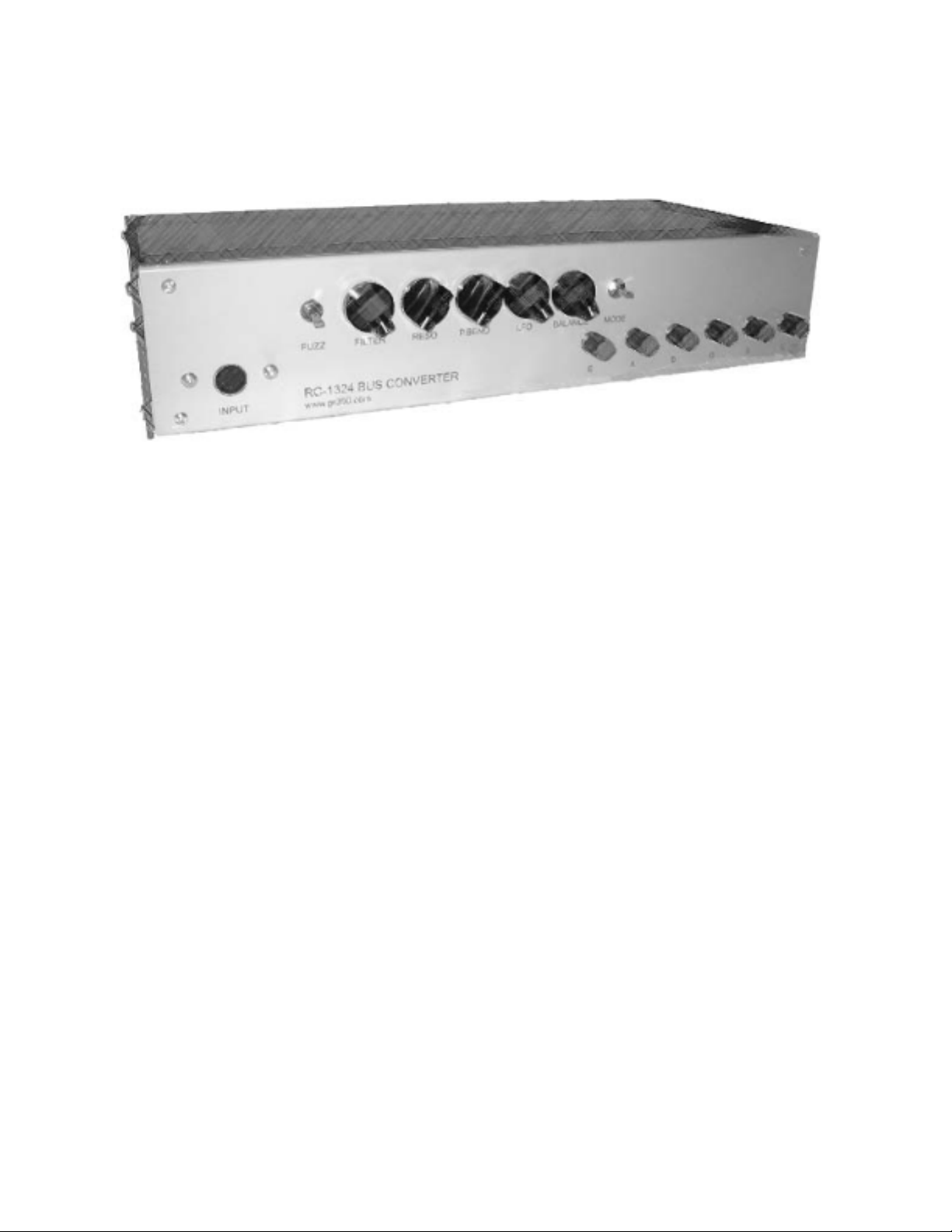
RC-1324
13 to 24 Pin Bus Converter
OWNER’S MANUAL
_______________________________________
DESCRIPTION
The RC-1324 is a unique processor designed to
convert modern, 13-pin Roland guitar synthesizer
signals to the 24-pin format used by vintage
Roland and Roland-compatible guitar
synthesizers.
Because the vintage Roland guitars featured
more controls than modern systems, the RC1324’s control panel recreates all the vital controls
for a vintage system.
In addition, the RC-1324 has its own built-in hex
fuzz generator, with a separate hex fuzz output.
To replace the LFO touch pads on a vintage guitar
controller, the RC-1324 has a CV pedal input on
the back for hands-free control over vibrato/LFO
depth.
Please read this owner’s manual carefully before
using the RC-1324.
The RC-1324 incorporates circuitry and concepts
designed by Mark Smart.
_______________________________________
IMPORTANT NOTES
• When connecting a guitar and
synthesizer to the RC-1324, be sure that
power to the synthesizer(s) is switched
off.
• The 13-pin connector used with the RC1324 is a locking style connector, and
therefore cables cannot be disconnected
unless the locking pin is released.
• Do not use the 1/4” output on the guitar
while at the same time using the 13-pin
output. A ground loop may result
Page 2

FRONT PANEL
_______________________________________
1. Guitar Synth Input: Input for 13-pin
style GK-Series guitar cable.
2. FUZZ Switch: This filter switch is for the
built-in hex fuzz. With the switch in the
down position, the RC-1324 outputs a hex
fuzz tone similar to that found on the
Roland G-303/G-808 guitar. With the switch
in the up position, a brighter, more
aggressive tone is produced.
3. FILTER Knob: Generally, this knob
controls the filter cutoff on the Roland GR100, GR-300, and GR-700. With the
Roland GM-70 and Ibanez MC-1, this knob
can be assigned various functions.
4. RESONANCE Knob: This knob
controls the filter resonance, or emphasis,
on the Roland GR-100 and GR-300. On the
Roland GR-700, this is the EDIT knob. With
the Roland GM-70 and Ibanez MC-1, this
knob can be assigned various functions.
5. P.BEND Knob: This control only works
with the Roland GM-70 and Ibanez MC-1.
The default assignment for this knob is
Pitch Bend, and turning the knob in a
clockwise direction will increase pitch.
However, like all controls used with the GM70 and MC-1, this knob can be re-assigned
to various functions.
6. LFO Knob: This knob controls the LFO
or vibrato depth on the Roland GR-100,
GR-300, and GR-700. With the Roland GM70 and Ibanez MC-1, this knob can be
assigned various functions, though the
default value is modulation depth. With a
CV pedal plugged into the LFO Pedal
jack on the back of the RC-1324, the LFO
Knob works together with the pedal. The
front panel LFO Knob always controls the
maximum amount of LFO depth. For
example, with the front panel control at
50%, or in the 12 o’clock position, the
maximum LFO depth will be 50%. Plugging
a pedal into the rear LFO jack and pressing
the pedal all the way to the floor will still only
result in a maximum LFO depth of 50%.
7. Balance Knob: This knob controls the
balance between the Synthesizer output
and the Guitar output. By turning the knob
in a clockwise direction, the output will
blend from 100% guitar to 100%
synthesizer. The 12 o’clock position will
result in an approximate 50/50 blend of
guitar and synthesizer. The knob in a fully
clockwise position results in a synthesizer
only output. To use this feature, it is
important to turn the guitar volume knob to
maximum. If you are using a GK-1, GK-2 or
GK-3 equipped guitar, be sure to have the
guitar plugged into the GK controller
module, and turn the regular guitar volume
to maximum. If no guitar is plugged into the
GK module, or if the volume is turned down
on the guitar, the Balance Knob will
simply work like a regular volume knob.
IF
YOUR GUITAR HAS A
GTR/GTR+SYNTH/SYNTH SWITCH,
SET THE POSITION TO “GTR+SYNTH”
8. MODE Switch: This switch reproduces
the function of the MODE Switch. Like
the MODE Switch on a vintage guitar,
Mode I is selected when the switch is in
the down position. Mode II is selected
when the switch is in the middle position,
and Mode III is selected when the switch
is in the up position.
9. String Level Adjustment Knob: Use
these knobs to adjust the output level of
each string. Start with the red knobs in the
50%, or 12-o’clock position, and play each
string and adjust for sensitivity. Each
Roland synthesizer responds differently to
string level. Some synthesizers will have
trouble tracking a string with the output
turned up too high.
Page 3

REAR PANEL
_______________________________________
1. Hex Fuzz Output: This is a line-level,
unbalanced high output signal for the hex
fuzz distortion circuit.
2. LFO Pedal: This is the input for a
Korg/Yamaha style CV pedal to control
LFO depth. A Roland or EV-5 style pedal
will not work. The maximum depth of the
LFO pedal is set by the Front Panel LFO
Knob. To get maximum control from the
LFO Pedal, set the front panel LFO
Knob to 100% (fully clockwise).
3. 24-Pin Output: This is the guitar
synthesizer output. Connect a Roland C24D or similar 24-pin cable from this
connector to a vintage Roland, or Roland
compatible guitar synthesizer.
_______________________________________
ADDITIONAL NOTES
The RC-1324 Bus Converter is powered by the connected 24-pin synthesizer. The unit will not work
unless the attached guitar synthesizer is turned on.
The RC-1324 uses special circuitry to adapt the volume knob on the 13-pin guitar to control the vintage,
24-pin synthesizer. The RC-1324 has been tested with the Roland US-20 Unit Selector. In this case the
volume knob on the guitar will control the volume of both the vintage, 24-pin synthesizer and the modern,
13-pin synthesizer.
The hex fuzz circuit in the RC-1324 is unique. While the filtering stages are designed to copy the sound of
the Roland G-303/G-808 hex fuzz, an additional gain stage has been added for a harder edged fuzz circuit
with more sustain. The front panel bright switch is designed to reproduce the effects of removing the filter
capacitor from a G-303/G-808 guitar to produce a brighter fuzz tone. With the original Roland systems, the
hex fuzz sound was only available when using a Roland G-202/303/505/808 guitar with a Roland GR-300
synthesizer. The RC-1324 always outputs the hex fuzz sound from its rear panel output jack, regardless of
what synthesizer is used, and independent of the volume or balance controls knobs.
_______________________________________
SPECIFICATIONS
RC-1324 Bus Converter:
• Connectors: One 24-pin output
connector, one 13-pin input connector,
and one 1/4” standard guitar jack for linelevel hex fuzz output.
• Dimensions: 19 (W) x 8(D) x 3.5(H)
inches
• Weight: 4 lbs 15 oz
v1.2 11.02.2005
© copyright November 2005
www.gr300.com
 Loading...