

Page 1
Page 2
Behavior Modeling
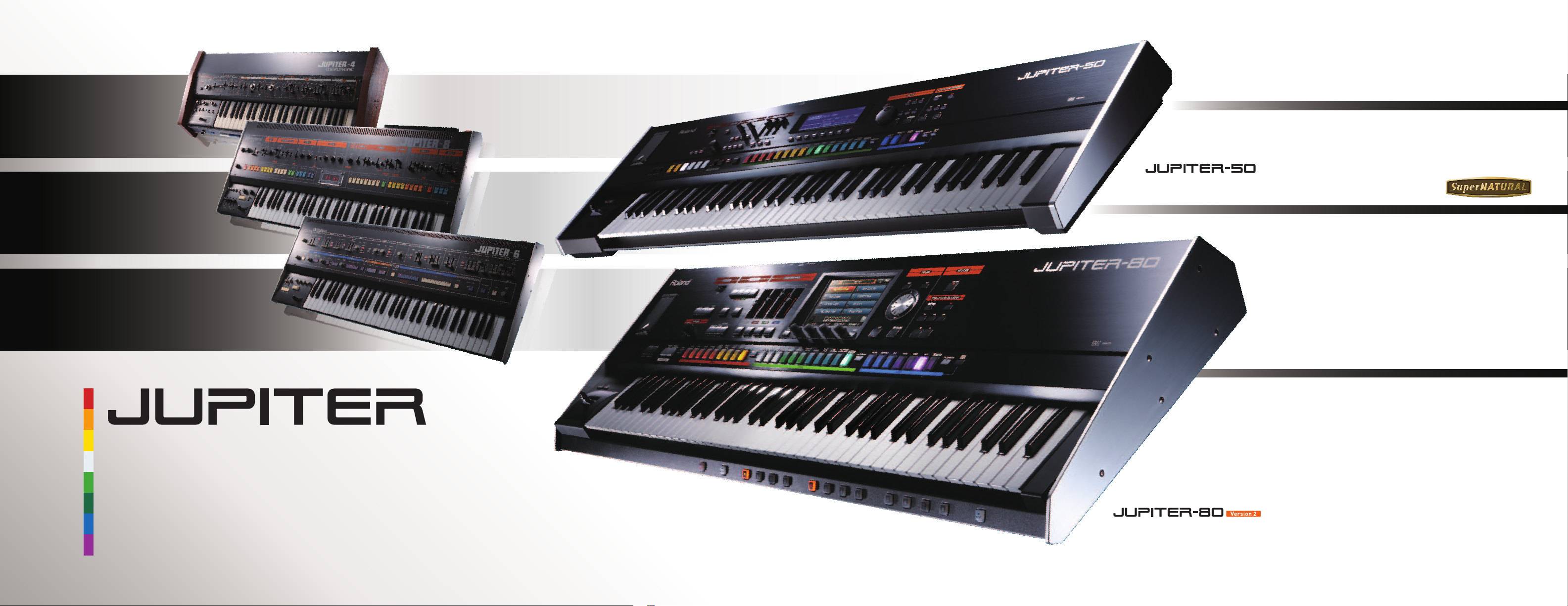
JUPITER-4
1978 — Roland's first polyphonic analog
synthesizer (4 voices). The 4VCO sound in
unison mode is superb, and it also has a
user patch-memory function built in.
JUPITER-8
1981 — A deluxe 8-voice polyphonic analog
synthesizer with 64 memory locations.
Its smorgasbord of features, including key split, patch
preset, and auto arpeggio, earned this synth global
praise and legendary status.
JUPITER-6
1983 — Scaling down the JUPITER-8 to 6-voice polyphony,
coupled with creative tweaking by Roland's engineers,
allowed the JUPITER-6 to hit the market at half the price
of its big brother. It also made news with its MIDI terminal
and highly stable oscillator.
Technology
Not only physical modeling of the instruments, Roland takes
it a step further by modeling the instrument's distinctive
behavior that responds to how the performer plays, resulting
in true-to-life, expressive sounds in realtime.
SuperNATURAL
Taking advantage of Behavior Modeling technology,
SuperNATURAL is Roland's exclusive sound set that achieves
a new level of realism and expression that were difficult to
realize with previous sound generators.
The JUPITER-80 and -50 are powered by SuperNATURAL,
offering mind-bending synthesis and surreal sound as well
as natural, true acoustic tones that reproduce the playing
expressions unique to acoustic instruments.
New Possibilities with
Live Sets and Registrations
The "JUPITER" name has become synonymous with innovation
and state-of-the-art design that's built for the future.
Since the game-changing debut of JUPITER-4 in 1978, all synthesizers anointed with
the "JUPITER" badge have symbolized the state of the art, and have ushered in new
creative possibilities as Roland's flagship synths. Today, the flagship JUPITER-80 has
evolved into Version 2, while the JUPITER-50, represents the expressive sound of the
JUPITER-80 in a more lightweight and affordable package. Both of these
new-generation instruments mark new milestones in the JUPITER lineage.
Live Sets are made by overlaying up to four SuperNATURAL
tones to achieve fat and heavy sounds with unique
expression. Live Sets that are mapped to the upper and
lower registrations in JUPITER-80, and the upper registration
in JUPITER-50, can be saved as "Registrations." You can
retrieve these registrations instantly for handy access during
live performance.
Page 3
SuperNATURAL sound — ultimate expression and authenticity
Enhanced SuperNATURAL Synthesizer Tones SuperNATURAL Acoustic Tones
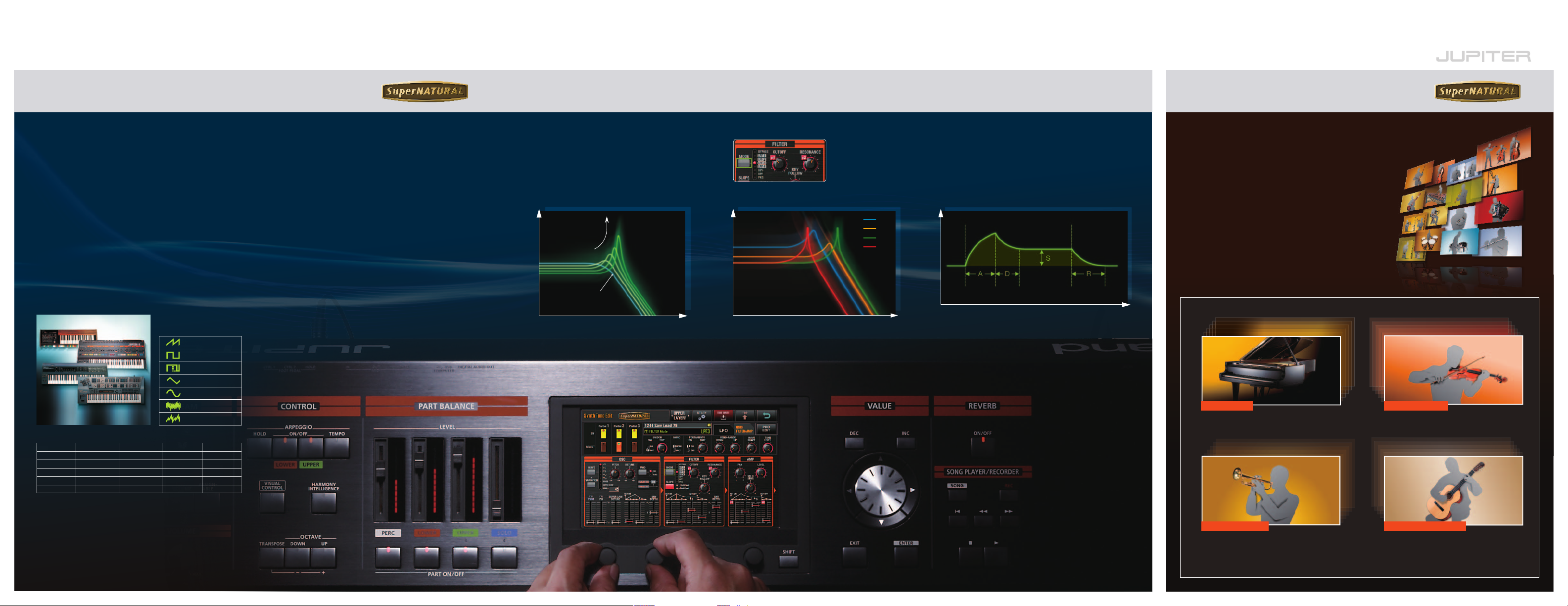
Emulates the envelope behavior of an analog
Authentic synth sounds — from classic vintage analog
to modern digital
To faithfully recreate the unique sound of analog synths, we've meticulously
analyzed the behavior of oscillators, filters, and envelopes that are unique
to analog synths. In the new JUPITER series, a single synth tone comprises
three OSC, FILTER, AMP, and LFO chains, which give you absolutely powerful
synthesis control over a single tone. You also have access to ring modulation,
WAVE shapes for creating complex tones, and the popular UNISON mode,
which lets you overlay up to eight waves per OSC to create thick and fat
analog synth tones.
More than 350 types of PCM digital-synth waveform
n
patterns are onboard, plus a coveted collection of analog
waveforms that harkens back to classic vintage synths.
Seven types of analog
waveforms provide the DNA
of vintage synthesizers.
SAW
SQUARE
PULSE/PWM
TRIANGLE
SINE
NOISE
SUPER SAW
PCM waveform patterns let you recreate contemporary digital synth sounds.
JP-8 Saw
MG Saw 1
GR-300 Saw
P5 Saw
JP-8 Pls 05
Sync Sweep
Unison Sync+
X-Mod Wave 7
FeedbackWave
SubOSC Wave3
JD Fat Saw
VP-330 Choir
Heaven Wave
DigiSpectrum
Syn Vox 2
SBF Lead 1
Atmosphere
FM Bell
5th Wave
Wave Table
JLOrg1 Fst L
FM EP 4
Dist Gtr 2
Solid Bass
FM Super Bs
Metal Vox 3+
Strings 5 L
Tp Section
Orch. Hit
Scratch 6
Three new vintage-inspired
LPF onboard
The filter section, which is a key to
creating expressive synth tones,
now comes with three new types of
vintage-inspired LPF (low-pass filter),
bringing the total to four types of
filters to chose from. These filters
allow you to create sounds that
are reminiscent of vintage analog
synthesizers.
Emulates the filter behavior of an analog synthesizer
n
The LPF plays an important role in shaping the tone. It can be used
to cut elements from the sound, and can also be used to emphasize
elements around the cutoff frequency with resonance. When you
control the resonance in an analog synth, the cutoff frequency
fluctuates, and signal levels below the cutoff frequency are affected
as well. The entire filter changes organically as if it's alive. These
changes occur due to the behavior of the analog circuits and the
components used, such as resistors and condensers, which make
up the unique sound of an analog synth.
Level
The response o f the LPF
when the reson ance is zero
■Ima ge: LPF actio ns of the JUPI TER-80/-50.
Frequency
Four types of LPFs with unique behavior
n
Level
■Ima ge: Filter ac tions of LPF-1 , -2, -3,-4.
The JUPITER-80 and -50
feature four types of LPFs.
Each filter behaves differently,
even if their cutoff and
resonance parameters are the
same. The LPF is personalized
by its parameter settings
and real-time control cutoff
frequency and resonance.
LPF1
LPF2
LPF3
LPF4
Frequency
n
synthesizer
In an analog synth, the electric charge/discharge rate of the envelope
rises and falls in a slightly curved line. The JUPITER-80 and -50 faithfully
reproduce this attribute for all of its envelopes, including the oscillator,
filter, and amplifier. By using this envelope to control the four LPF types,
the resulting sound has an incredibly smooth analog feel.
Level
■Ima ge: Envelope actions of the JUPITER-80/- 50.
Time
Reproducing acoustic instruments with
SuperNATURAL
When you play the JUPITER-80/-50, you'll
immediately be amazed at the quality and realism
of its rich SuperNATURAL acoustic sounds, and
how naturally and organically they respond and
evolve in response to your touch and phrasing.
You can enhance the performance characteristics
with expressive controllers such as pitch-bend/
modulation lever, assignable buttons (S1 and S2),
and D-Beam Control.
Examples of SuperNATURAL acoustic tones:
n
Piano sounds...
Grand-piano sounds exhibit natural decay and
seamless tonal changes in response your touch.
You can adjust a variety of parameters, such as
Stereo Width and Hammer Noise.
String sounds...
Pitches transition naturally from note to note
when playing tied legato-style melody lines.
Effortlessly realize portamento, pizzicato, and
other articulations unique to string instruments -no special playing technique required.
Brass sounds...
The JUPITER faithfully reproduces the dynamic
tonal changes unique to brass instruments -including the transitions of harmonic overtones
with a dramatic raise in pitch and the half-valve
sound when playing trills.
Acoustic-guitar sounds...
Reproduce chord fingerings, strumming, and
melody performances of steel- and nylon-string
guitars naturally and easily -- right from your
keyboard.
Page 4
Type 1
MFX 1
3
T
MFX 1
M
3
M
4
2
MFX 2
T
M
1
3
2
T
M
M
3
1
4
MFX 4
MFX 2
MFX 3
M 4
MFX 3
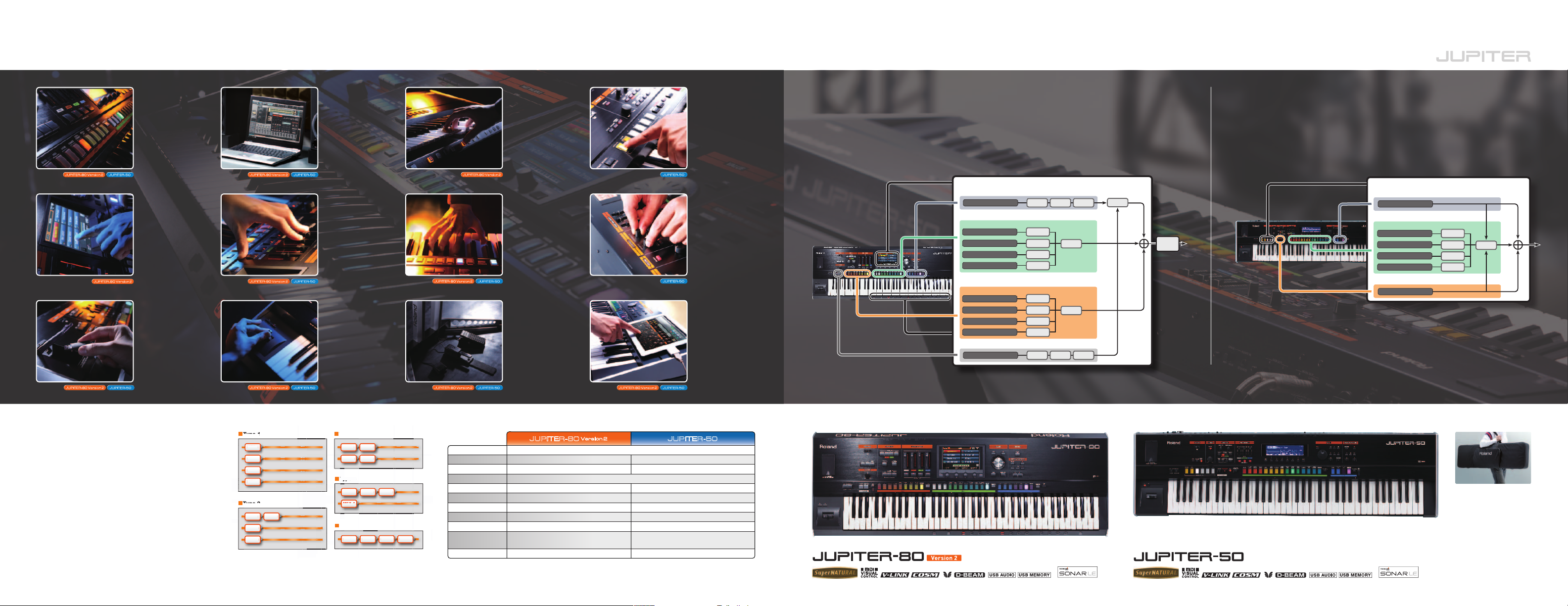
JUPITER is designed from the ground up for live performance, with intuitive operation and instant access to any function on stage.
Color-coded buttons
Live Se ts, whi ch are made
by over laying up to four
SuperNATURAL ton es, can
be mapp ed to t he upper
and low er regi strations
in JUPI TER-80, and the
upper r egistra tion in
JUPITER -50. The se tones
can the n be se lected
instant ly by p ressing any
of the color-c oded buttons.
Registration Play
screen
The Registration Play
screen lets you quickly
select your tones during live
performances. This screen
gives you a view of eight
registrations (one bank) at a
glance, and lets you access
your desired sound directly
through intuitive actions on
the touch panel.
USB memory port
The built-in USB
memory-based audio
player/recorder lets
you play and control
backing tracks directly
onboard. Additionally, the
JUPITER-80 and -50 are
capable of importing and
exporting tone data between
each other via USB.
Computer integration
with SONAR
These models now support
a special “Control Surface
Plug-in”* that features
ACT (Active Controller
Technology). This lets you
control SONAR, as well as
its plug-in effects and synths
directly, from JUPITER.
*The software is included with
JUPITER-50; web download is
available for JUPITER-80.
Part Balance sliders
Both JUPITERs are
equipped with Part Balance
sliders that let you quickly
set volume levels for
each part (four parts on
JUPITER-80, three on the
JUPITER-50).
The JUPITER-80's sliders,
which have companion
LED meter displays, let
you accurately control your
tones even under dark
stage lighting conditions.
Diverse range of live
controllers
Deliver dynamic live
performances with the
expressive front-panel
controllers, including the
pitch-bend/modulation lever,
assignable buttons (S1 and
S2), and invisible D-Beam.
Registration buttons
Optimally positioned
Registration buttons let you
instantly switch between
different combinations of
the four Parts — including
Upper and Lower Live Set
stacks of SuperNATURAL
sounds.
Exceptionally
expressive keyboard
The 76-key semi-weighted
keyboard provides
first-class playability, giving
you full control over the
subtle nuances of the
JUPITER’s amazing tones.
The JUPITER-80 is also
equipped with an
aftertouch-sensitive
keyboard.
Extensive foot-control
features
Multiple foot pedal functions
(CTRL 1, CTRL 2, and HOLD)
give you additional control
over a variety of expressive
performance parameters in
real time.
Manual button and
Registrations
The Manual button is very
useful for easily and quickly
selecting tones, as well as
combining different tones.
You can save settings
for individual parts to
Registrations, which you
can instantly retrieve during
live performances.
Cutoff and
Resonance knobs
Dedicated knobs are
provided for filter cutoff and
resonance. Use resonance
to emphasize frequencies
near the cutoff frequency,
giving your sounds edge
and emphasis. Explore the
many creative possibilities
these hands-on controls
provide.
Control synth tones
on your iPad
You can control
SuperNATURAL synth-tone
parameters, including the
new vintage-inspired filters,
from the comfort of your
large iPad display.
*Visit the Roland website for
more information and system
requirements for the “JP Synth
Editor” app.
®
JUPITER-80 Version 2 configuration
The JUPITER-80's sound engine consists of four parts: solo, upper, lower, and percussion. You can create
"Live Sets" by overlaying up to four SuperNATURAL tones, and then registering them to upper or lower
parts. And by layering two Live Sets, you can easily create fat, densely stacked tones. You can save
combinations of tones and other part settings as "Registrations" for instant retrieval.
Registration
Solo Part
SuperNATURAL Tone
Upper Part
Live Set s
SuperNATURAL Tone
SuperNATURAL Tone
SuperNATURAL Tone
SuperNATURAL Tone
Lower Part
Live Set s
SuperNATURAL Tone
SuperNATURAL Tone
SuperNATURAL Tone
SuperNATURAL Tone
Percussion Part
SuperNATURAL Tone
COMP EQ Delay
MFX 1
MFX 2
MFX 3
MFX 4
MFX 1
MFX 2
MFX 3
MFX 4
COMP EQ Delay
Reverb
リバーブ
Reverb
Reverb
MASTER
EQ
JUPITER-50 configuration
The JUPITER-50's sound engine consists of three parts: solo, upper, and
percussion/lower. You can select Live Sets that are comprised of up to four
SuperNATURAL upper -part tones. You can save combinations of tones and other
part settings as "Registrations" for instant retrieval.
Registration
Solo Part
SuperNATURAL Tone
Upper Part
Live Set s
SuperNATURAL Tone
SuperNATURAL Tone
SuperNATURAL Tone
SuperNATURAL Tone
Percussion/Lower Part
SuperNATURAL Tone
MFX 1
MFX 2
MFX 3
MFX 4
Reverb
Type 3
Five types of multi-effect
structures
You can freely change the MFX
(multi-effect) structure of Live Sets
on the JUPITER-80 Version 2 as
Type 1
MFX 1
MFX 2
MFX
MFX 3
MFX
MFX 4
well as the JUPITER-50.
Type 2
MFX 1
MFX 3
FX
MFX 4
FX
MFX 2
With five types of structures
onboard, these synths provide
extremely powerful and flexible
sound-creation capabilities
e
MFX 1
FX
MFX 3
Type 4
MFX 1
MFX 4
Type 5
MFX 1
256
256
4
COAXIAL
AC
Version 2
JUPITER-50
128
128
2,5 60
3
76 keys (with velocity)
240 x 64 dots graphic LCD (with backlit)
No
AC ad ap tor ( DC 9 V)
mm: 1,268 (W) × 361 (D) × 117 (H)
inches: 49-15/16 (W) x 14-1/4 (D) x 4-5/8 (H)
11.0 kg, 24 l bs. 5 o z.
For more details, visit Roland home page. For more details, visit Roland home page.
(for Windows)
(for Windows)
The JUPITER-50's chassis is
n
compact lightw eight.
A custo m-fitted CB-76R L
carrying ca se (sold sepa rately)
is ideal for c asual transpo rt.
MFX 2
MFX
MFX 4
Tones
Maximum Polyphony
JUPITER-80
Sup er NATU RA L Ac ou stic Tones, Su pe rNATUR AL Synth Tones
Registrations
MFX 2
MFX 3
Live Sets
Parts
Keyboard
Display
76 keys (with velocity and channel aftertouch)
Graphic Color LCD 800 x 480 dots (touch screen)
Digital Audio Out
Power Supply
MFX 2
MFX 3
MFX 4
Dimensions
Weight
mm: 1,231 (W) × 440 (D) × 140 (H)
inches: 48-1/2 (W) x 17-5/16 (D) x 5-1/2(H)
17. 7 kg , 39 lb s. 1 oz .
Page 5
JUPITER-80 Version 2 Specifications
Keyboard 76 keys (with velocity and channel aftertouch)
Keyboard Section
Sound Generator Section
USB Memory Song Player/
Recorder Section
Connectors
Dimensions/Weight
Other
■
Maximum Polyphony 256 voices (varies according to the sound generator load) ■Parts 4 parts (Upper, Lower, Solo, Percussion)
■
Registrations 256 (including pre-loaded registrations) ■Live Sets 2,560 (including pre-loaded Live Sets)
■
Effects [for Live Set (Upper/Lower Part)] Multi-Effects (MFX): 4 units, 76 types per each Upper/Lower (total: 8 units), Reverb: 1 unit, 5 types per
■
each Upper/Lower (total: 2 units) [for Solo part/Percussion part] Compressor + Equalizer + Delay: 1 set per each Solo/Percussion (total: 2 sets),
Reverb: 1 unit, 5 types [Master Effects ] 4-Band Equalizer: 1 unit
Tracks 1 stereo track ■Playable File Format Audio File: WAV, AIFF, MP3 ■Recording File Format Audio File: WAV (44.1 kHz,
■
16-bit Linear, stereo) ■Effects 4-Band Equalizer: 1 unit ■External Memory USB Flash Memory (sold separately) *Use USB Flash Memory
sold by Roland. We cannot guarantee operation if other products are used.
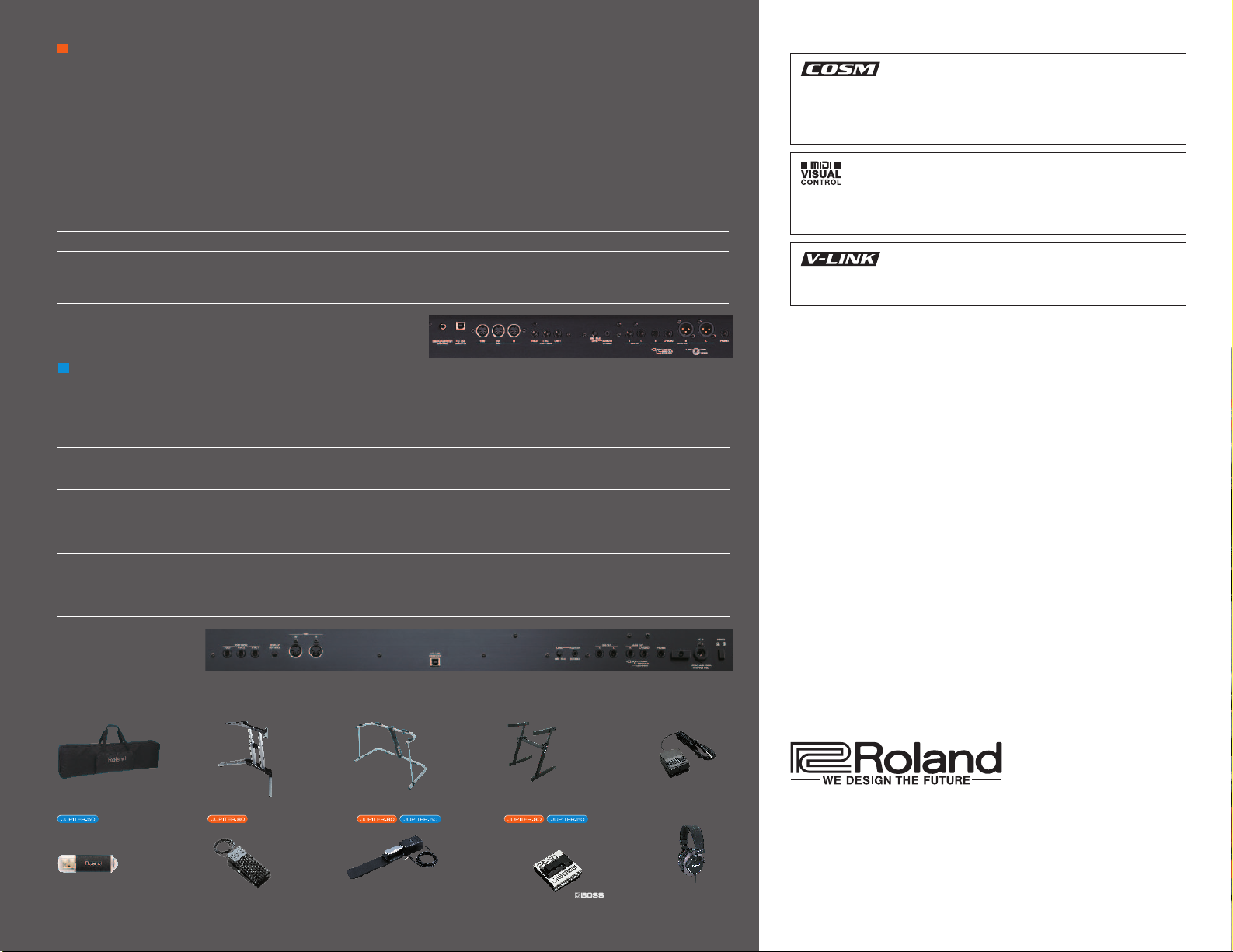
MAIN OUT jacks (L, R) (XLR type), MAIN OUT jacks (L/MONO, R) (1/4" TRS phone type), SUB OUT jacks (L, R) (1/4" phone type),
AUDIO IN jack (Stereo miniature phone type), DIGITAL AUDIO OUT jack (COAXIAL), FOOT PEDAL jacks (CTRL 1, CTRL 2, HOLD), MIDI
Connectors (IN, OUT, THRU), USB COMPUTER port (Audio/MIDI), USB Memory port, PHONES jack (stereo 1/4" phone type), AC IN jack
Dimensions 1,231 (W) x 440 (D) x 140 (H) mm (48-1/2" x 17-5/16" x 5-1/2") ■Weight 17.7 kg (39 lbs. 1 oz.)
■
Arpeggiator Preset: 128 styles, User: 128 styles ■Harmony Intelligence 17 types ■Controllers D-Beam controller,
■
Pitch Bend/Modulation lever, Assignable buttons (S1, S2), Assignable knobs (E1--E4), PART LEVEL sliders (PERC, LOWER, UPPER, SOLO)
Display Graphic Color LCD 800 x 480 dots (touch screen) ■Power Consumption 25 W
■
Accessories Owner's manual, CD-ROM (USB Audio/MIDI driver), DVD-ROM (SONAR LE), USB MEMORY Protector, Power Cord
■
JUPITER-50 Specifications
Keyboard 76 keys (with velocity)
Keyboard Section
Sound Generator Section
USB Memory Song Player/
Recorder Section
Connectors
Dimensions/Weight
Other
■
Maximum Polyphony 128 voices (varies according to the sound generator load) ■Parts 3 parts (Upper, Solo, Percussion/Lower)
■
Registrations 128 (including pre-loaded registrations) ■Live Sets 2,560 (including pre-loaded Live Sets)
■
Effects Multi-Effects (MFX): 4 units, 76 types Reverb: 1 unit, 5 types *Multi-Effects can be used only with a Live Set.
■
Tracks 1 stereo track ■Playable File Format Audio File: WAV, AIFF, MP3 ■Recording File Format Audio File: WAV (44.1 kHz,
■
16-bit Linear, stereo) ■External Memory USB Flash Memory (sold separately) *Use USB Flash Memory sold by Roland. We cannot guarantee
operation if other products are used.
MAIN OUT jacks (L/MONO, R) (1/4" TRS phone type), SUB OUT jacks (L, R) (1/4" phone type), AUDIO IN jack (Stereo miniature phone type),
FOOT PEDAL jacks (CTRL 1, CTRL 2, HOLD), MIDI Connectors (IN, OUT), USB COMPUTER port (Audio/MIDI), USB Memory port,
PHONES jack (stereo 1/4" phone type), DC IN jack
Dimensions 1,268 (W) x 361 (D) x 117 (H) mm (49-15/16" x 14-1/4" x 4-5/8") ■Weight 11.0 kg (24 lbs. 5 oz.)
■
Arpeggiator Preset: 128 styles, User: 16 styles ■Harmony Intelligence 17 types ■Controllers D-Beam controller,
■
Pitch Bend/Modulation lever, Assignable buttons (S1, S2), Assignable knobs (CUTOFF/C1, RESONANCE/C2),
PART LEVEL sliders (PERC/LOWER, UPPER, SOLO) ■Display 240 x 64 dots graphic LCD (with backlit) ■Power Supply AC Adaptor
Current draw 800 mA ■Accessories Owner's manual, CD-ROM (USB Audio/MIDI driver), DVD-ROM (SONAR LE),
■
USB MEMORY Protector, AC Adaptor, Power Cord (for AC Adaptor)
Once a musical instrument generates sound vibrations, it reaches the human ear through various mediating
objects, each of which significantly affects the sound. The material and configuration of the instrument, the
electric/magnetic amplifying system, the air and the reverberation of the room all affect the final sound. Sound
modeling, the latest DSP technology, “virtually” reconstructs these objects. Roland's breakthrough Composite
Object Sound Modeling (COSM) uses the advantages of multiple modeling methods and succeeds in
accurately emulating existing sounds, as well as producing sounds that have never before been created.
MIDI Visual Control is an internationally-used recommended practice that was added to the MIDI specification
so that visual expression could be linked with musical performance. Video equipment that is compatible with
MIDI Visual Control can be connected to electronic musical instruments via MIDI in order to control video
equipment in tandem with a performance.
Using V-LINK, musicians can “play” video from their electronic instrument — or even control a live video
camera — when used with Roland's video products. With V-LINK, musicians have a powerful interface for
realtime audio and video integration.
Options
CB-76RL
Carrying Bag
M-UF2G
2GB USB Flash Memory
KS-J8
Keyboard Stand
EV-5
Expression Pedal
KS-G8
Keyboard Stand
DP-10
Damper Pedal
KS-18Z
Keyboard Stand
When using the KS-18Z, ensure that the
height of the unit is one meter or lower.
FS-5U
(momentary type)
Footswitch
DP-2
Pedal Switch
RH-300
Stereo Headphones
Visit us online at www.Roland.com
lROLAND, BOSS, COSM, D-BEAM, and SuperNATURAL are either registered trademarks or trademarks of
Roland Corporation in the United States and/or other countries. l CAKEWALK and SONAR are either registered
trademarks or trademarks of Cakewalk, Inc. or Roland Corporation in the United States. l“JUPITER” is a registered
trademark of and is licensed by K.H.S. MUSICAL INSTRUMENT CO. LTD. in the United States and other countries.
liPad is a trademark of Apple Inc., registered in the U.S. and other countries. lAll specifications and appearances
are subject to chan ge without notice. lCompany names an d product names appearing in this document are
registered trademarks or trademarks of their respective owners. lIt is forbidden by law to make an audio recording,
video recor ding, copy or revision of a third p arty’s copyr ighted work (musical work, video work, broadcast, live
performance, or other work), whether in whole or in part, and distribute, sell, lease, perform, or broadcast it without
the permission of the copyright owner. lDo not use this product for purposes that could infringe on a copyright held
by a third party. We assume no responsibility whatsoever with regard to any infringements of third-party copyrights
arising through your use of this product.
Printed in Japan May, 2012 RAM-4770 AD-3 GR-GEN-SS
 Loading...