

Page 1
USER
GUIDE
Page 2

“We want Kids with disabilities to go
through the same stages of development
as other Kids and have the same opportu-
nities in life, even if they need some form of
adaptive equipment to do it.”
Wayne Hanson-
-
Mission Statement: To provide mobility for people with
disabilities in developing countries and to partner together for
ministry, youth empowerment, wheelchair distribution,
manufacturing and educational development
ROC Wheels is a faith-based 501 (C)(3) non-profit organization.
Providing wheelchairs and other mobility products for people in
developing countries without regard to political affiliation, religious
beliefs, or ethnic identity
PO Box 11765
Bozeman, Montana, USA, 59719
[email protected]
www.rocwheels.org
V1, February, 2015
2
Page 3

ROCKIT Wheelchair
Care-Giving Team ————————————–———————
The ROC Wheelchair User ———-——————–——–———-
The Importance of Early Intervention ——–—————————
ROC Wheelchair Features ————————–———-————
ROC Wheelchair Specifications———–—-———–—————-
Developmental Milestones Table ————–———-—————The
Impact of Optimal Postural Alignment —–——————————
Descriptive Terminology ———————————–———-——
Challenges in Pediatric Seating and Positioning ——–————--
Spectrum of Disabilities —————————————–————
Children with Cerebral Palsy———————————–————
Functional Positioning ———————–————–——————
Essential Wheelchair Features ————-———–———-——-
Wheelchair Safety ————————————————————
Basic Measuring Guide —————————————–————
ROC Chair Fitting Guide ——————————————–——
Measuring Worksheet ————————————–——-
Seat Cushion ————–——————————–————
Seat Belt ———————–—————————–———-
Back Cushion —————————————–—–———-
Tilt in Space ————————–——————–————Hip
Hip Guides/Abductor ————————–———-————
Arm Rest ————————————————————--
Foot/Ankle Support —————————————–———-
Trunk Supports —————————————–————
Independent Mobility ————————–———-——–—
Chest Harness ————–—-—————–—–—————
Therapeutic Tray -————————————–———-—--
Head Support ———–————————–———-———-
Hip Angle Adjustment ——–——————–——————-
Custom Applications ———————————–———-—
Wheelchair Distribution Procedures ————————————
Wheelchair Selection Guide ———————————————-
6
7
7
8
9
10
11
12
16
17
17
20
22
24
27
28
29
30
30
31
31
32
32
33
33
33
34
34
35
35
36
38
41
3
Page 4
This GUIDE is designed to help you serve the seating and mobility needs of
the children who will benefit from the ROCKIT Wheelchair. This is not
intended to replace the support and intervention needed from a qualified
therapist. Always work together with your therapist to insure that the child is
positioned correctly and receiving proper care.
Combining the resources of a variety of specialists, the physical, mental, emotional, and spiritual
needs of each person served are addressed by some or all of the following:
Your personal physician is welcome to stay actively involved in your personal care, or will be informed of
your progress..
The rehabilitation nurse provides individual nursing care and family teaching, reinforces the skills learned
in therapy and assists in discharge planning..
The occupational therapist helps gain independence in self-care skills including feeding, dressing, bath-
ing and homemaking..
The physical therapist helps gain independence in mobility skills including getting in and out o f a bed and
chair, walking or using a wheelchair, and going up and down stairs..
The speech/language pathologist assists with listening, reading, speaking, writ ing and thinking skills,
and also provides therapy for swallowing disorders..
The social worker helps with community resources, discharge planning and advance directives..
The rehabilitation psychologist cares for emotional needs and assists in coping..
Additional services are provided by dietitians, vocational counselors, home care coordinators, financial
counselors, chaplains and support staff.
Family members are a key part of the caregiving team and are
encouraged to participate in the rehab program. Family members often
act as coaches to help empower children to function to the best of
their ability.
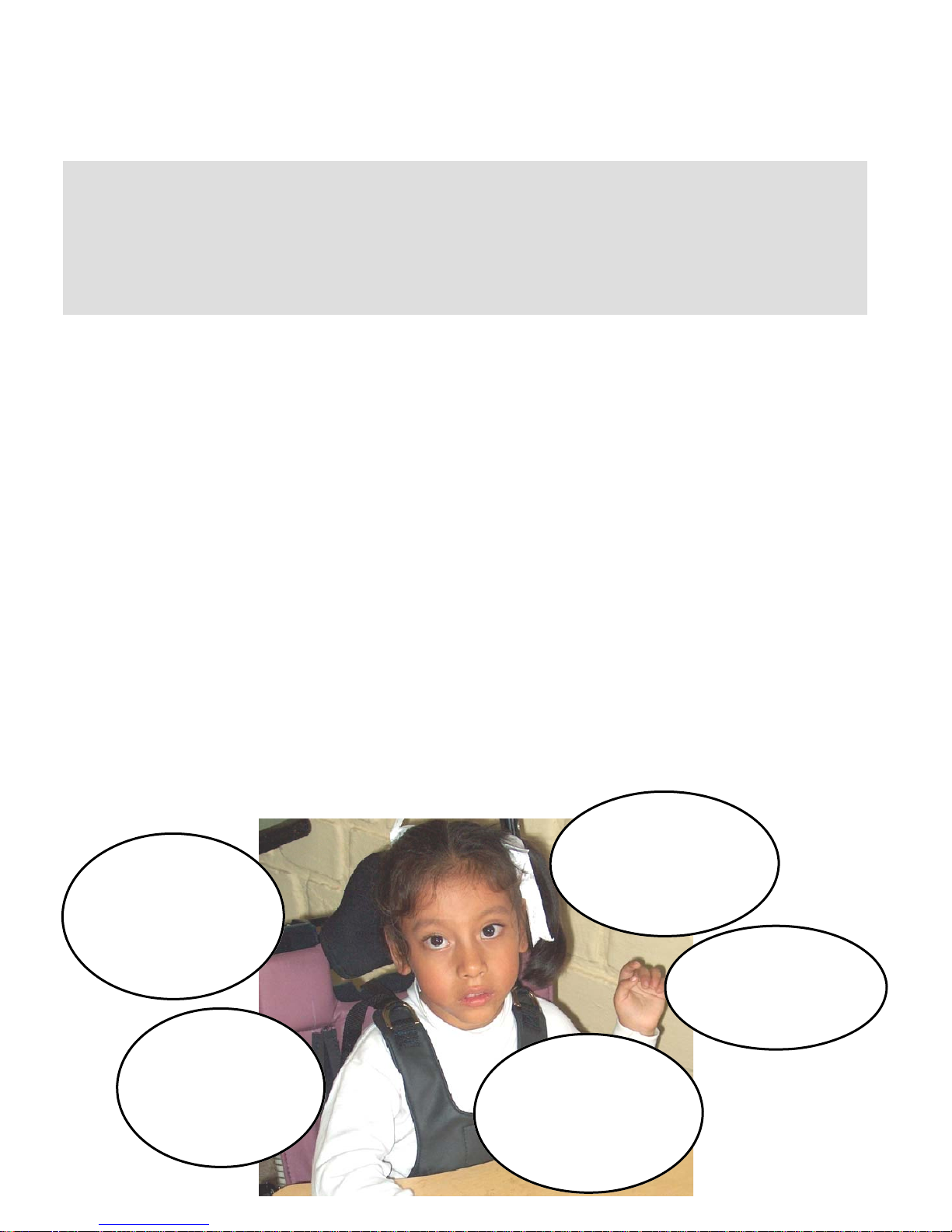
The
Family
(or other
custodial
caregivers)
The
Equipment
Provider
The
Rehabilitation
Team
The
Child’s
Peers
The
Funding
Agency
(if any)
4
Page 5
The ROCKIT Wheelchair User
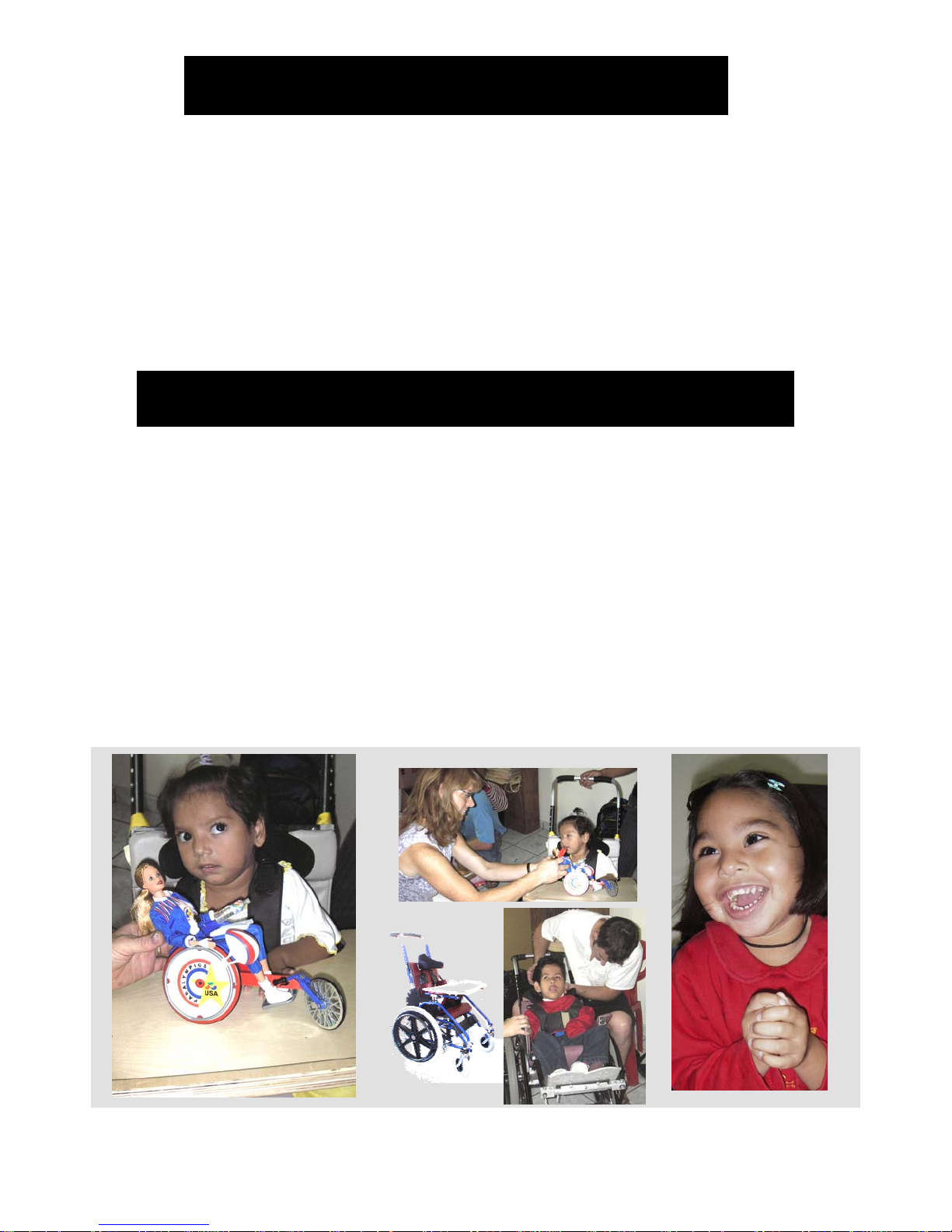
ROC Wheel’s pediatric positioning and dependent mobility products are
designed primarily for children from birth to 14 years of age who have been
diagnosed with mild to profound degrees of involvement. The ROCKIT wheelchair is a
multi-adjustable wheelchair that can be configured to accommodate dependent
children with severe involvement as well as the child who can self propel. All ROCKIT
wheelchairs come with a full spectrum of positioning components, a therapeutic tray,
and an adjustable wheel base for the more active self propelling child.
The Importance of Early Intervention
Over the years, it has become more evident that aggressive early
intervention for a child from infancy to age 4 is a critical element in the proper
development of the child with a disability .
The main reasons for aggressive early inte rvention are:
Provides freedom through mobility Encourages positive behavior
Prevents future deformities Enhances static control and motor control
Development of maturational processes Helps in the learning process
Increased interaction with the environment Relieves pain
5
Page 6
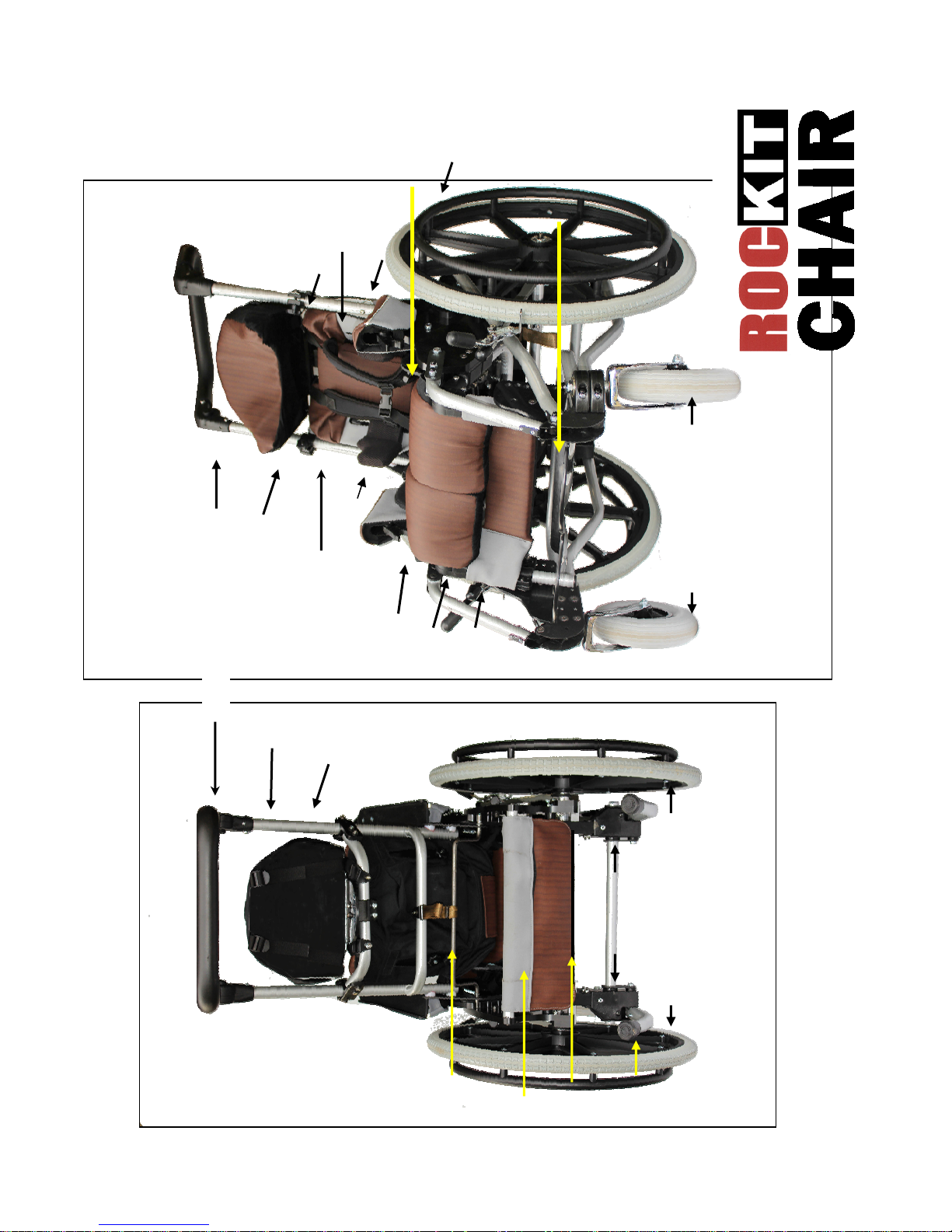
Ar
Hand
Seat Belt
Foot bed
Adjustable
Height/Angle
Chest Harness
Back Cushion
m
Swiveling Front Wheels
Lock
Wheel
Adjustable Height Handle Bar
Contoured/Adjustable Head Rest
Adjustable Height Seat Back
An- gle,
Height, Width AdjustableTrunk Supports
Knee Angle Adjust Ratchet
RECEIVER
STROLLER WHEEL
Quick Release Rear Wheels
Recline Lever
Rear Pocket
Tilt Lever
Anti-Tippers
6
Page 7

The ROC Chair wheelchair is designed for children from infancy to age 14 with moderate to severe
disabilities. The ROC Wheelchair can be retrofit as a highly functional self propelled wheelchair because of the multi-adjustable wheel base and the ability to equip it with positioning for the higher
functioning child.
M E T R I C
Description Size 1 Size 2
Hip Angle Positions 90, 81,73, 25 degrees 90, 81,73, 25 degrees
Tilt in Space Positions 5 - 40 degrees 5 - 40 degrees
Seat Back Height Range 29 - 46 cm. 33 - 53 cm.
Seat Depth Range 20—33 cm. 25 1/2 - 38 cm.
Hip Width Range 18 - 33 cm. 23 - 38 cm.
Lower Leg Length 13 - 34 cm. 13 - 36 cm.
Push Handle Adjustability multi-adjustable multi-adjustable.
Overall Width (with rear wheels) 59 cm. 64 cm.
Floor to Seat Height 46 cm. 46 cm.
Variable Wheelbase 31 cm—44 cm. 31 cm—44 cm.
Therapeutic Tray adj. depth,, 19 cm. Height adj. depth,, 19 cm. Height
Head Support Adjustability Depth, Height, Angle Depth, Height, Angle
Storage Bag Optional Optional
Medial Knee Block Optional Optional
Anti-Tips Included Included
I M P E R I A L
Description Size 1 Size 2
ROC Chair ROC Chair
13 Inch Max Hip Width 15 Inch Max Hip Width
ROC Chair ROC Chair
Hip Angle Positions 90, 81,73, 25 degrees 90, 81,73, 25 degrees
Tilt in Space Positions 5-40 degrees 5-40 degrees
Seat Back Height Range 11 1/2" - 18"” 13"-21"
Seat Depth Range 8"-13" 10"-15"
Hip Width Range 7” - 13” 9” - 15”
Lower Leg Length 5" - 13 1/2” 5" - 14 1/2'
Push Handle Adjustability multi-adjustable multi-adjustable
Overall Width (with rear wheels) 23” 25”
Floor to Seat Height 18” 18”
Variable Wheelbase 5”12"-17 1/2" 5”12"-17 1/2"
Therapeutic Tray adj. depth, 7 1/2" ht adj. depth, 7 1/2" ht
Head Support Adjustability Depth, Height, Angle Depth, Height, Angle
Storage Bag Optional Optional
Medial Knee Block Optional Optional
Anti-Tips Included Included
13 Inch Max Hip Width 15 Inch Max Hip Width
7
Page 8

Developmental Milestone Table
Age Gross Motor Visual/ Fine Language Social
Motor
1 month Prone, lifts head Hands usually Soothes to voice Regards face
fisted; stares
at objects
3 months Supports chest Grasps placed Coos Smiles easily,
in prone position rattle; follows laughs spontaneously
slow moving
objects with eyes
6 months Rolls and sits well, Reaches and Babbles, Fear of
without support grasps, transfers plays strangers,
hand to hand peek-a-boo smiles at self
in mirror
12 months Walks alone Plncer grasp of Says "mama" Shy, but plays
raisin "dada" + 2 games, gives
other words affection
18 months Walks up steps Stacks 3 blocks Points to Helps with simple
manages spoon named body tasks, imitates
parts, follows
simple command
24 months Alternates feet Stacks 6 cubes 50-word Washes/dries
helps get dressed on stairs, kicks turns book pages larger vocabulary
ball follows 2-steps
commands
30 months Jumps with Holds pencil in Uses pronou ns Plays tag, asserts
both feet hand, not fist I, you, me personality
correctly, says
full name
36 months Balances on 1 foot Builds block bridge Recognizes 3 Plays with kids,
buttons colors takes turns
Source: Adapted from Harriet Lane, Manual of Pediatrics, 13th ed., 1993
8
Page 9

THE IMPACT OF OPTIMAL
POSTURAL ALIGNMENT
When considering the importance of postural alignment and control on oral motor and fine motor skills, attention must first be directed towards developing an understanding of normal postural alignment. If the child is unable to control proximal body parts adequately against gravity,
adaptive equipment must be utilized for external support for the child. It then follows that an
understanding basic positioning principals utilized with adaptive equipment must also be developed.
The goal of achieving optimal alignment utilizing adaptive equipment is-"to provide the child
with enough postural support so all energies can be directed towards activities in any given
environment for any given task. The excessive energy used to stay upright or to fight the fear
of falling can then be diverted to better attending to visual and auditory input and motor control.
The central base of support must be stable so the child is better able to express himself /
herself orally and to perform academic and fine motor activities.
There are several disadvantages to consider when utilizing positioning devices as they limit
some types of sensory feedback received by the child. Most of the child's body is held in a
relatively static position with little joint mobility with roost of the tactile and kinesthetic activity
limited to the face and arms. For example, even though a child is on a mobile scooter board,
he cannot roll or wiggle in and out of various places and the de-creased perceptual experiences should not be disregarded.
Assessing the postural alignment required in different positions (i.e.: sitting vs. standing) requires an understanding of the optimal alignment and relationship between the trunk, head,
shoulders end pelvis. The distal func-tions of the legs, arms, eyes and mouth are dependent
on the biomechanical alignment of these proximal parts. To concentrate attention on manipulative or oral motor skills without first providing stable postural alignment will prove to be premature and usually ineffective. Without a stable postural base upon which to operate, visual,
oral motor, fine motor and ambulatory skills start from a compromised situation.
As most functional activities for children and adults occur from a seated position, the most logical place from which to address postural alignment is in sitting. Only after understanding these
concepts is it wise to proceed to techniques designed to enhance oral motor or manipulative
functions.
Source: Therapy Works, Tulsa Oklahoma., 1993
9
Page 10
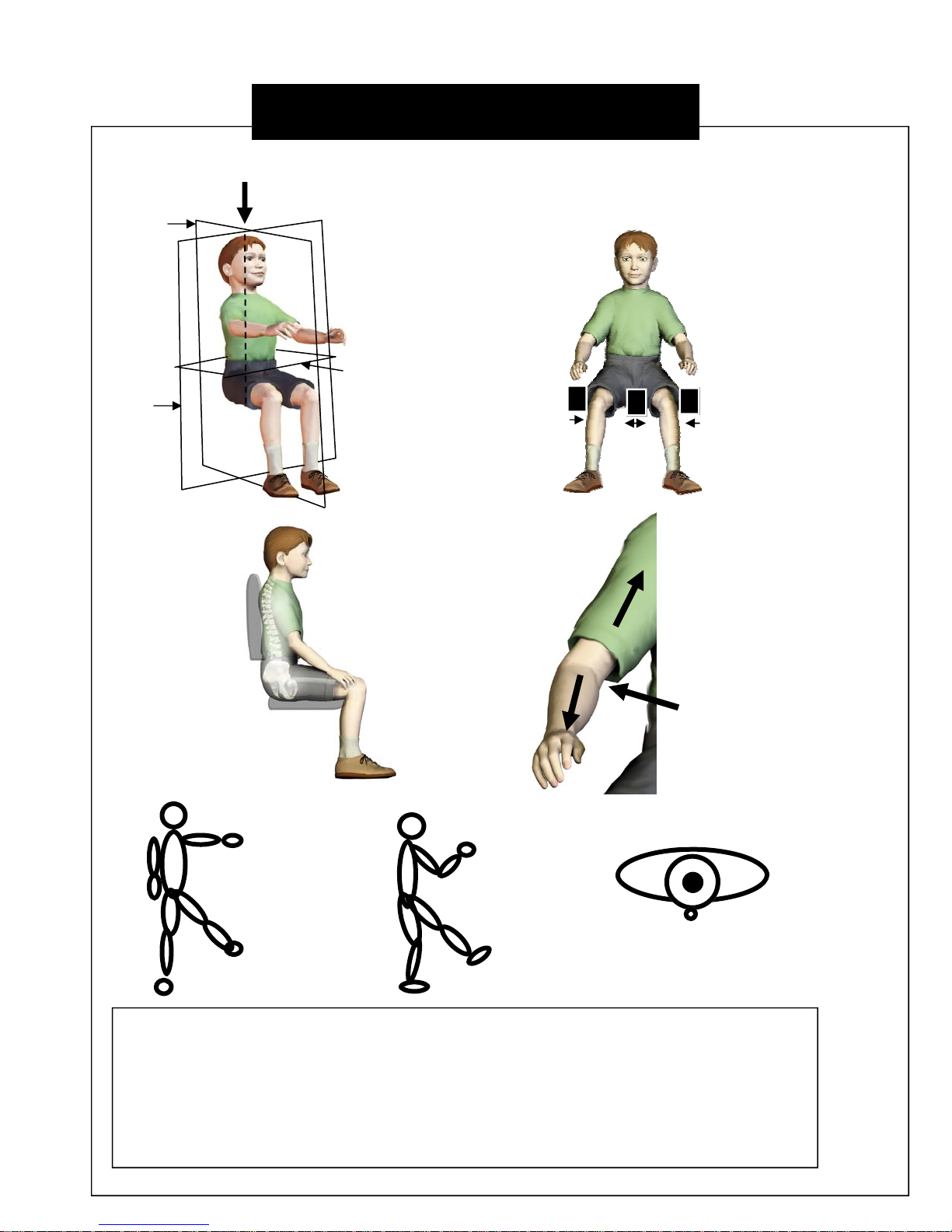
Descriptive Terminology
Sagittal
Plane
Horizontal
Frontal
Plane
Anterior Posterior
Plane
Adduction
Adduction
Abduction
Distal
Medial
Distal
FRONTAL AXIS SAGITAL AXIS
The Axis of the Human Body
Plane Axis Joint Motion
Sagital Plane frontal Flexion/extension
Frontal Sagital Abduction/lateral rotation,radial/ulnar rotation
Transverse Vertical Medial/lateral rotation, supination/pronation,
Right/left rotation,horizontal/ab/adduction
VERTICAL AXIS
10
Page 11
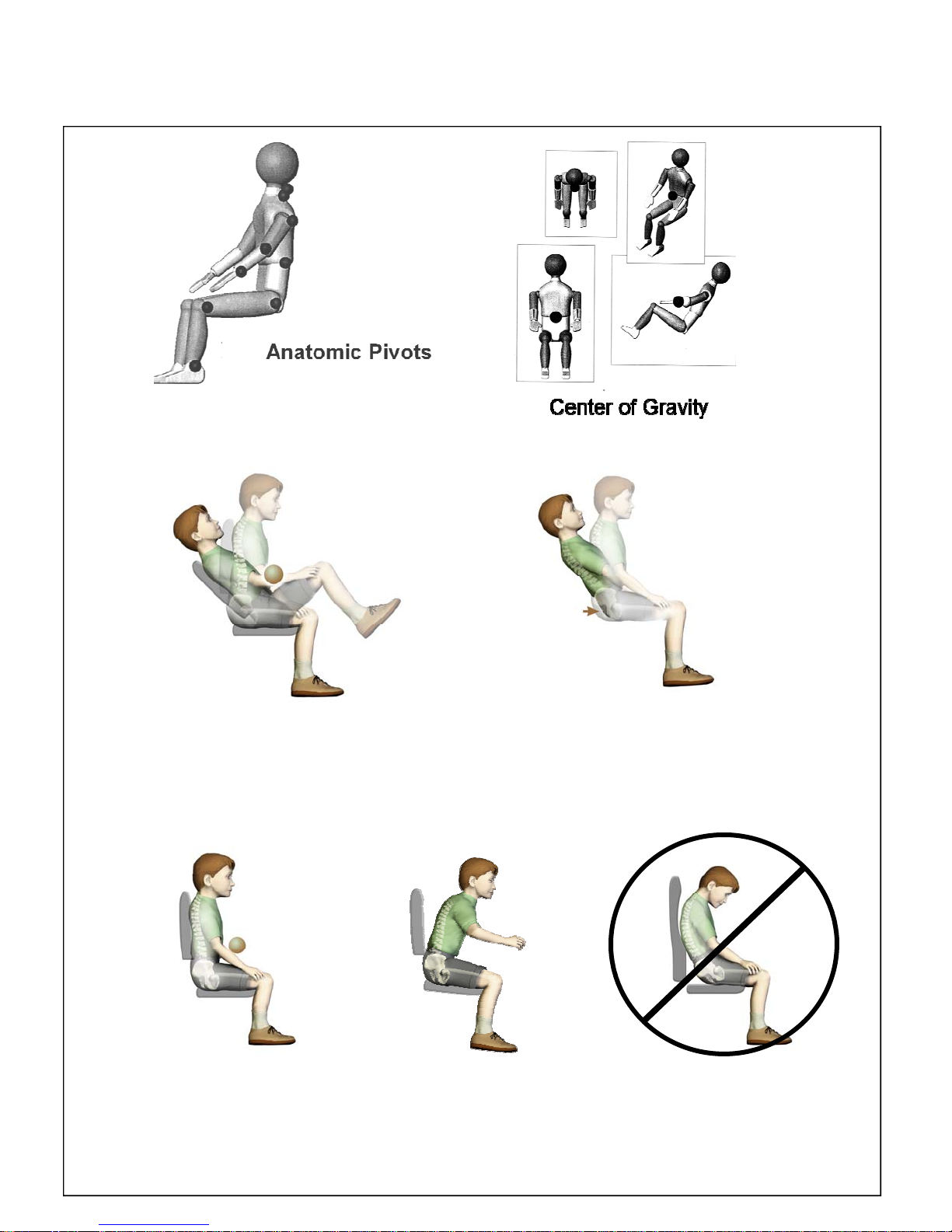
The anatomic pivots pictured represent the
major pivot points of the human body.
The center of gravity is the center of mass is. There is an equal
weight distribution on both sides of the center of gravity.
Tilt in Space
When a chair tilts in space, the person’s hip and
knee angle remain constant as the seat tilts
backward or forward.
Hip angle adjustment
When the hip angle is adjusted to a more
open or closed position
Passive Body Alignment Active Sitting Position Non-functional Sitting
Position
11
Page 12
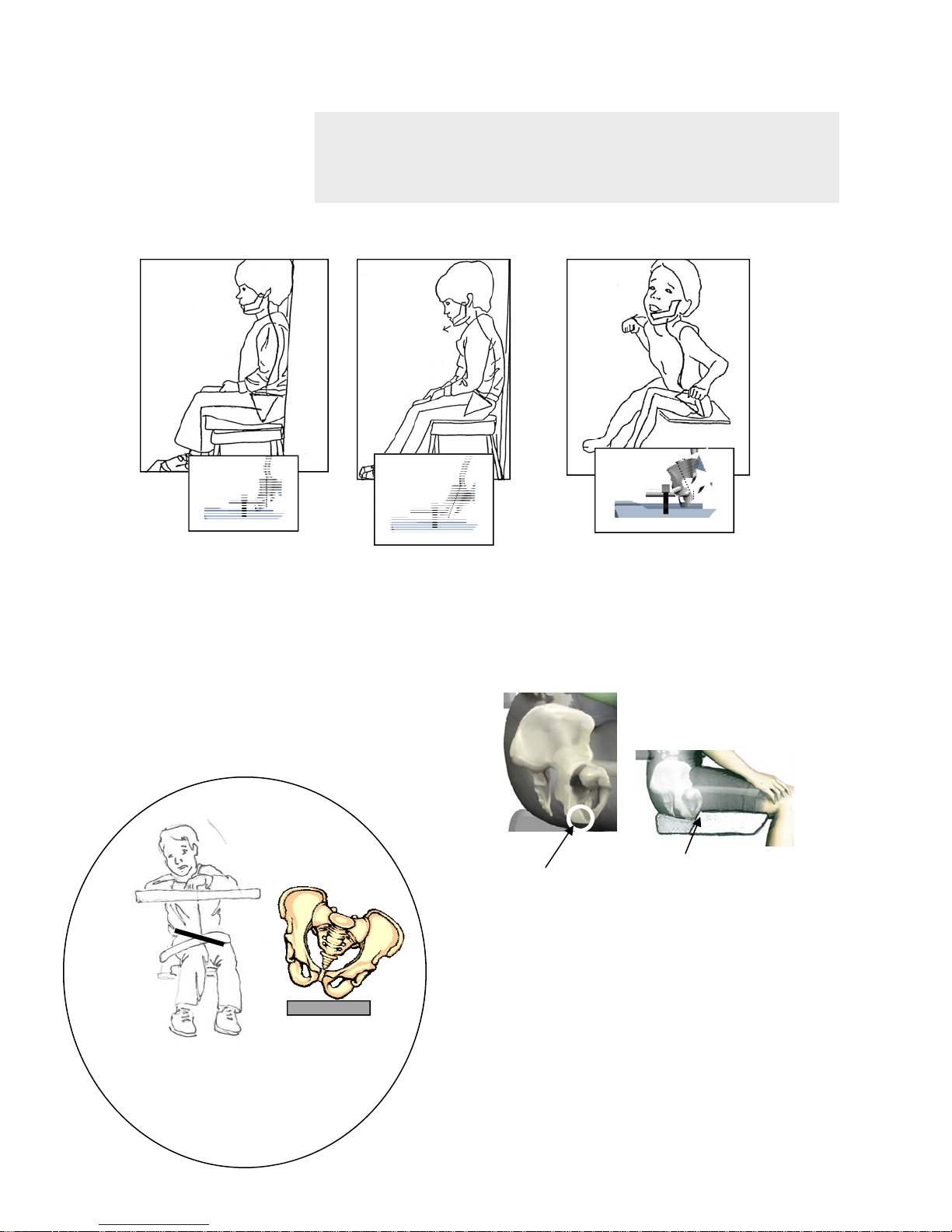
The Pelvis
The pelvis influences total body alignment and without a
good pelvic foundation, positioning of the legs, trunk or
arms becomes undermined.
Neutral Pelvic
Position
The upright pelvic
enabling balance of
the upper extremities and positioning
the pelvis to enable
the child to move,
prevent overcompensation and be
prepared for functional activity.
Pelvic
Obliquity
Posterior
Pelvic
Tilt
When pelvis
is tilted back
Ischial
Tuberosity
The pointed bony protrusion
on the bottom portion of the
pelvis.
Anterior
Pelvic
Tilt
When pelvis
is tilted forward
Ischial Ledge
A ledge created in
a seat cushion to
block the ischial
tuberosity which
can help keep the
pelvis back in the
neurtal position in
the seat.
When th pelvis is tilted laterally.
This normally results in overcompensation by the spine which
can result in progressive deformities.
12
Page 13
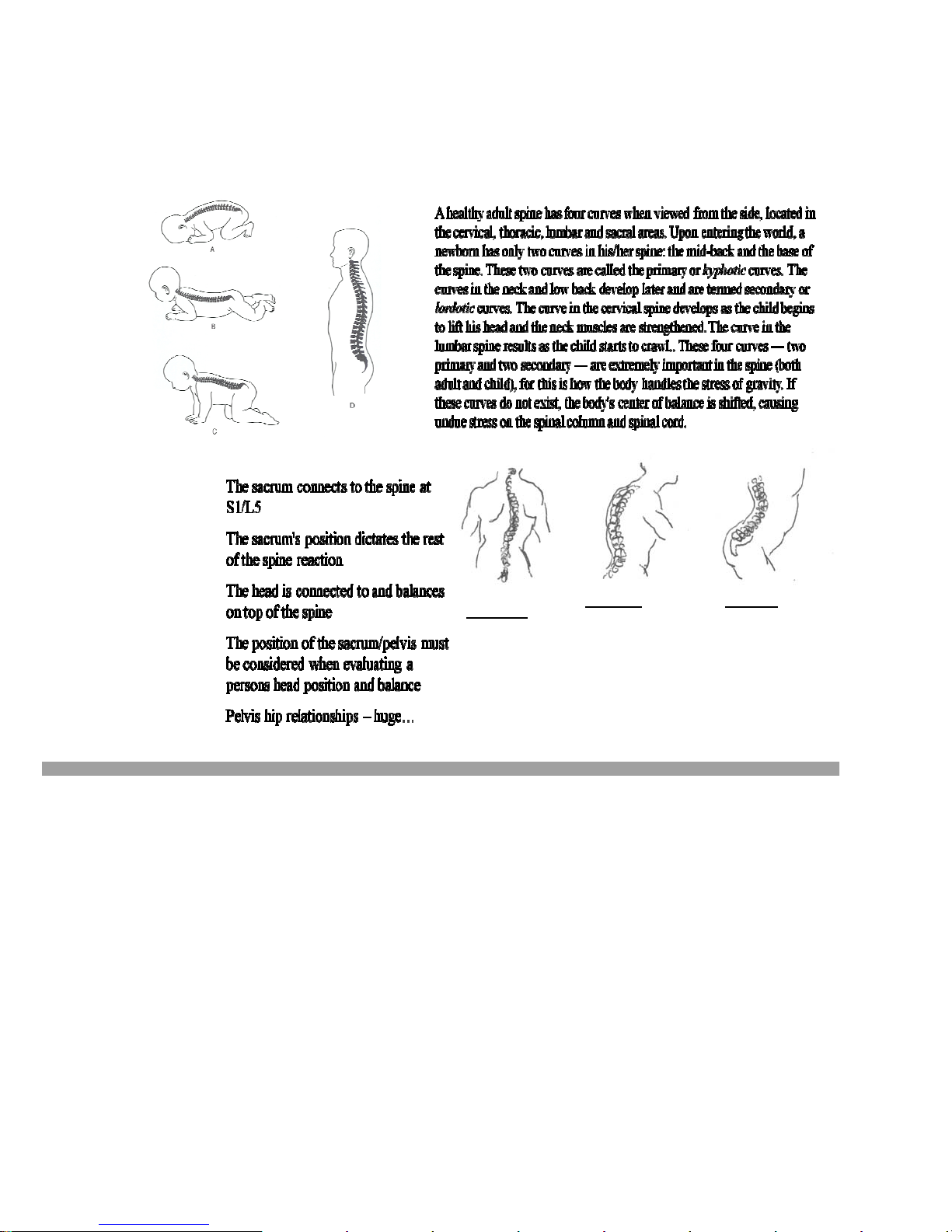
The Spine
Scoliosis
An abnormal
lateral curvature
of the spine
Kyphosis
abnormal increase
in normal kyphotic
(posterior) curvature of the thoracic
spine which can
result in a noticeable round back
deformity.
An
Lordosis
An abnormal increase in anterior
curvature of the thoracic spine which
can result in a noticeable convex back
deformity.
Muscle movement: Most skeletal muscles work in groups:
Agonists - muscles primarily responsible for an action due to their contraction.
Antagonists - muscles that relax to smooth the action of the agonists.Directions of movement:
Flexion - brings a body part forward.
Extension - moves a body part to the rear.
Abduction - moves an appendage laterally from the midline.
Adduction - moves an appendage toward the midline.
Circumduction - movement of an appendage in a circle around a joint.
Pronation - rotating the palm of the hand downward.
Supination - rotating the palm of the hand upward.
Inversion - turning the toes of the foot inward.
Eversion - turning the toes of the foot outward.
13
Page 14

Challenges in Pediatric Seating and Positioning
ack of Sustainable Resources: It can be extremely
L
difficult for a family to survive in a developing country
environment, even without having a child with disabilities. The
family often has to rely on their own resources and ingenuity
since outside support may be hard to find. Our goal is to provide
an opportunity for them to reach out to the community or other
organizations in order to improve their ability to function.
Parent's acceptance:
that addresses the parent's denial ( unacceptance ) of their child's medical needs
with a system that is both aesthetically pleasing and functional, ,and at the same
time, focusing on the child's medical needs by providing proper seating and positioning, leading to parental acceptance and participation.
Diagnosis may be difficult in the first year. With many congenital
and acquired disorders, proper diagnosis of the condition, is not always reliable
or feasible until age 2 or 3. This makes treatment a trial and error process until
an accurate diagnosis is ascertained.
Funding: In many cases, due to the difficulty of a proper diagnosis,
many funding agencies won't provide for proper special equipment until the time
the child is properly diagnosed. Agencies focus is on the bottom line and not the
child's medical needs at the early stages. Also, the level of education at the
funding agencies for the people approving funding, on the available products in
the markets, is sometimes 2 to 4 years behind.
Child's accelerated rate of growth
kids, due to special diets or medical conditions, experience accelerated rates of
growth compared to children in their age groups. This complicates the problem
twofold, one by having to deal with funding for new equipment sooner than
expected, and a challenge for manufacturers to provide equipment that can
accommodate this growth.
Child may not be anatomically developed yet.
Activities of daily living issues:
sleeping schedules, peer or sibling interaction and transportation. We need to
keep in mind these issues when thinking of the right equipment, since the parents of the child, the therapists and rehab personnel will be dealing with these
issues in a day-to-day basis.
By providing positioning and mobility systems
: In many cases, some of these
The most basics are dealing with feeding,
14
Page 15

Spectrum of Disabilities
We at Reach Out and Care (ROC) Wheels strive to accommodate the seating and
positioning needs of a wide range of impairments and disorders affecting children today. Some
of them are easily recognizable and some are very rare. This makes having a proper
diagnosis considerably difficult at times.
Listed below are some of the impairments and disorders that are seen more frequently. By no
means is this list all inclusive, so use resources available to you to help you in those cases
where you just don't know.
Cerebral Palsy
Children suffering traumas from harsh environment
Genetic and dysmorphic disorders
Neurologic disorders
Immunologic and metabolic disorders
Spinal cord injury
Traumatic brain injury
Shaken Child Syndrome
Fetal Alcohol Syndrome and "crack" babies
Children with Cerebral Palsy
The most common disability served is Cerebral Palsy. Below is detailed information on cerebral
palsy.
CEREBRAL PALSY (Mild to severe)
CEREBRAL PALSY is a collection of motor disorders resulting from damage to the brain that
occurs before, during, or after birth. The damage to the child's brain affects the motor system,
and as a result the child has poor coordination, poor balance, abnormal movement patterns, or
a combination of these characteristics.
Cerebral palsy is a static disorder of the brain, not a progressive disorder. The neuromotor
disorders associated with cerebral palsy are not temporary. Therefore, a child who has
temporary motor problems, or who has motor problems that get worse over time, does not
have Cerebral Palsy. Children with Cerebral Palsy have many other kinds of medical problems.
Not all of these problems are related to brain injury, but most of them are neurological in
nature, including epilepsy, mental retardation, learning disabilities and attention
deficit-hyperactivity disorders.
Congenital Cerebral Palsy (cerebral palsy that exists from birth) is responsible for the largest
proportion of cases of cerebral palsy. Injuries sustained during the birthing process (i.e. anoxia)
or in early childhood may be considered the cause of cerebral palsy.
15
Page 16

Cerebral Palsy is one of the most common congenital problems. Of every 2,000 infants born,
five are born with cerebral palsy. Due to advances in obstetrical and pediatric care, what has
changed in the last 30 years is the type of cerebral palsy. Thirty years ago, most children with
cerebral palsy had athetoid cerebral palsy. Athetoid CP is caused by hyperbilirubinemia and
characterized by slow, writhing involuntary movements (no muscle control). Today only five or
ten percent of children have this type of CP due to advances in the treatment of
hyperbilirubinemia. Spastic cerebral palsy (muscle stiffness and restricted movement) has
become more prevalent because of advances in intensive care of premature babies, and
newborns have resulted in higher survival rates for children who would have otherwise died at
a very young age. Kids with Cerebral Palsy range widely in their degree of involvement from
very mild to very severe. The level of seating and positioning, from basic planar seating to fully
customized seating and positioning, needed to address the child's medical needs will depend
on the child. Treating and providing equipment for a child with diplegia will be very
different compared to treating and providing equipment for a child with spastic quadriplegia.
The different types of cerebral palsy may be classified by the type of movement problem
(spastic, athetoid, or hypotonic) or by the body parts affected (legs only, one arm and one leg,
or all extremities). Motor ability varies greatly from one child to the other; not all statements
hold true for all children with cerebral palsy.
Spasticity refers to the inability of a muscle to relax (increased muscle tone). You will find that
the child also has restricted range of motion due to the constant muscle rigidity. When the arm
or leg is moved, the initial resistance is strong. Sometimes the spasticity will relax, and other
times it will not relax. These changes in muscle tone interfere with normal development.
Athetosis refers to the inability to control the movement of a muscle. It characterized
sometimes by slow, writhing, involuntary movements. It can also be characterized by abrupt,
involuntary movement other times. Muscle tone changes from time to time, and because of
these tone changes, muscle contractures are less likely to occur in this form of Cerebral Palsy
than with spastic Cerebral Palsy. In athetoid Cerebral Palsy, it is difficult to regulate movement
and maintain posture. Hypotonia is characterized by flaccidity (no muscle strength). Ataxia
refers to balance and coordination problems.
Hemiplegia is cerebral palsy that involves one arm and one leg on the same side of the body
Diplegla (also called paraplegia) primarily involves both legs. Tetraplegia (also know as
quadriplegia) refers to a pattern involving all four extremities and may include the neck
muscles.
The term for the dominant type of muscle movement is often combined with the term describing the part of the body affected. The result is a more specific description of the
condition. For example, a child with spastic quadriplegiam has mostly spastic muscle problems
affecting most of his body. He or she may also have some form of athetosis or ataxia present.
16
Page 17
In summary, we can classify different kids who have Cerebral Palsy by the types of movement
the child makes, by the part of the body that is affected, or both.
By type of movement
Spastic Rigid
Athetoid Unable to control muscle movement
Hypotonic Floppy child
Ataxia Balance and coordination problems
By affected body part
Hemiplegia Involving one arm and one leg on the same side
Diplegia Involving both legs typically, or both arms rarely
Tetraplegia Involving all four extremities, trunk and neck muscles
Providing proper seating and positioning for these children is a challenge. It will vary widely
depending on the type of Cerebral Palsy and the degree of involvement. Will basic planar
suffice, or will the child need more accurate positioning to control the hips and trunk? Will
contoured seating be sufficient, or do we need to look at a custom seating system? Do we
need to be concerned about pressure sores or skin integrity in the more involved children?
Some of these children will present with seizure activity. A large number will have strong extension/thrusting behaviors. How do we manage them?
You will also need to look at what type of mobility these children will need. Do they have the
ability to self propel (independent), or will they need someone to push them (dependent)? Will
they need special life support equipment? If so, how do we accommodate this equipment on
their respective mobility bases?
We will also need to remember activities of daily living (ADLs) and other occupations. ADLs
are feeding, dressing, bathing, toileting, grooming, and other self-care activities. Other
important occupations that improve overall quality of life include play, community mobility, education, sleep, socialization, and leisure. Will we need to consider four or five different pieces of
equipment, or can we find one piece of equipment that can serve two or three of these roles
while still providing the seating and positioning needed?
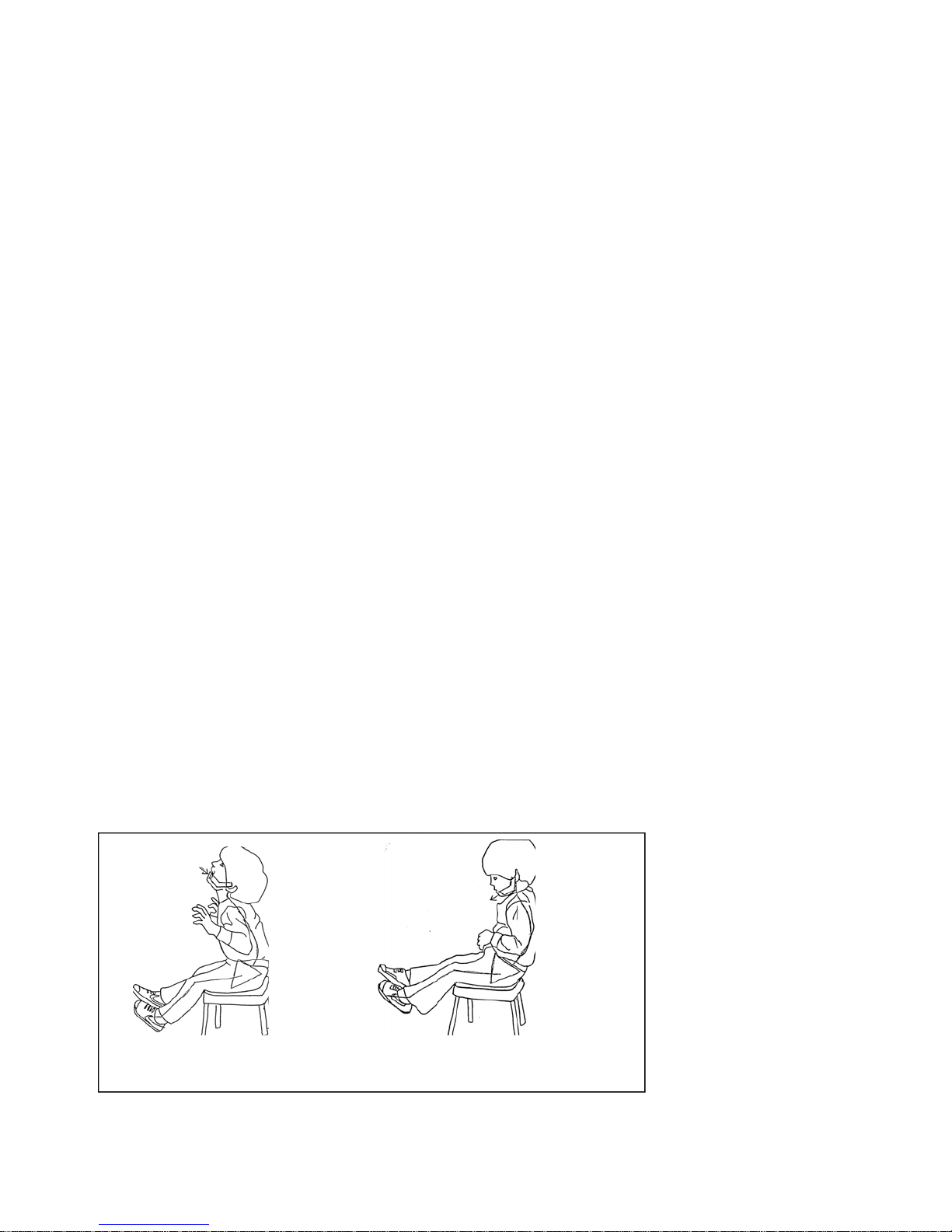
The “high guard” position of the Hip extension is usually
arms is often accompanied by head and accompanied by lower extremity
neck hyperextension extensions, adduction and Internal rotation
17
Page 18
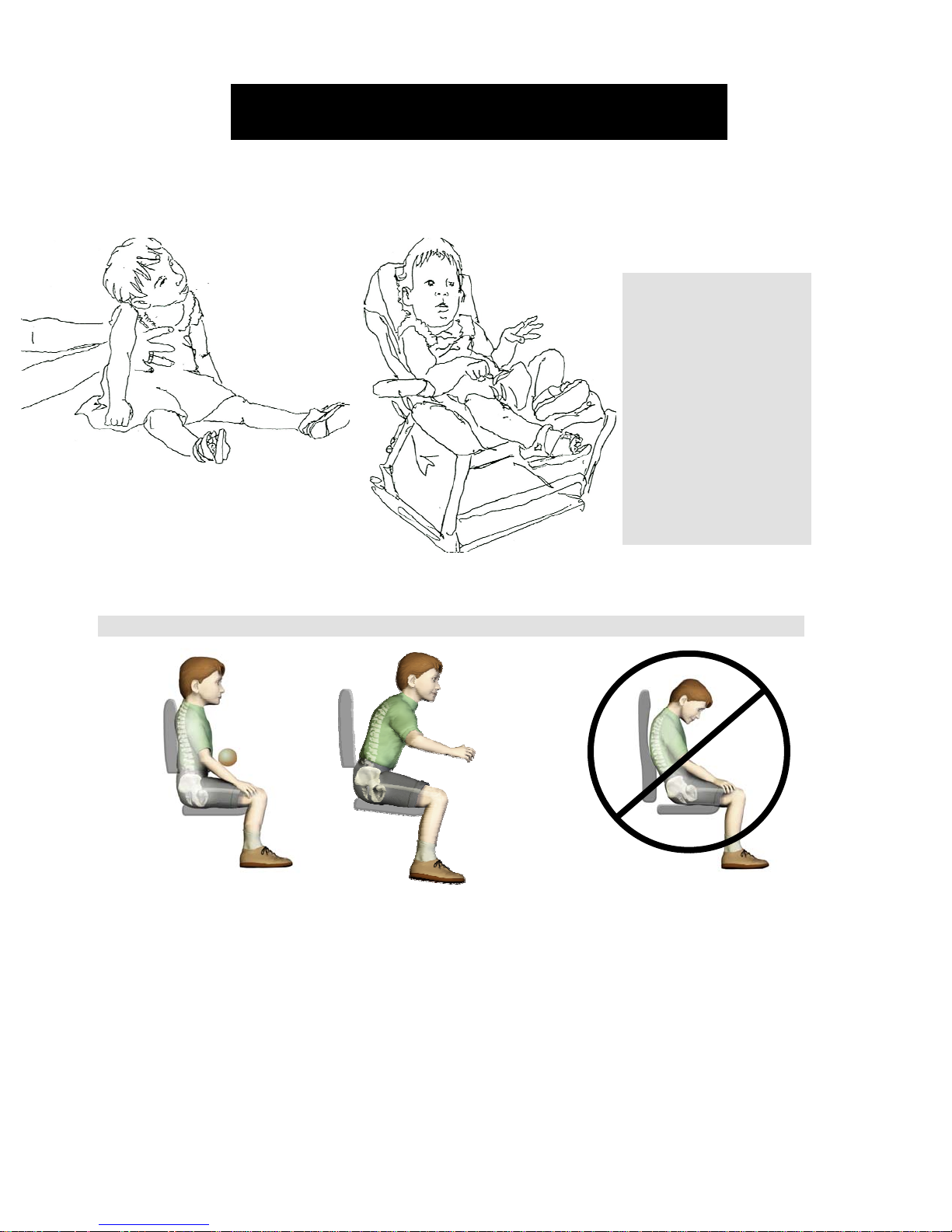
FUNCTIONAL POSITIONING
Position a child so that he or she can function
and interact with the rest of the world.
Functioning without support
Without proper support,
children with very low tone
may not have the strength
or the leverage to function
with their upper and lower
extremities. They may
also have difficulty
holding their heads up
enough to maintain line of
sight. A seating system
that is positioned for f
unction can stabilize their
upper extremities enabling
an increased level of
function.
Neutral Pelvic
Position
The neutral pelvic
position allows balance
and allows the upper
extremities to move and
be prepared for
functional activity.
Functioning with support
Active Body Position
Tilting forward into a ready position for activity. Note how the
pelvis is aligned with the spine
and the child is tilted slightly
forward poised to reach out or
engage in a number of activities.
Sacral Sitting Position
(Posterior Pelvic Tilt)
This sitting position puts
pressure on the sacrum and
ischial tuberosities. This position
makes functioning of the
extremities difficult. Children are
continually moving in their
seating system and will shift into
awkward and non-functional
positions. The proper seat
system is important to maintain
alignment .
18
Page 19
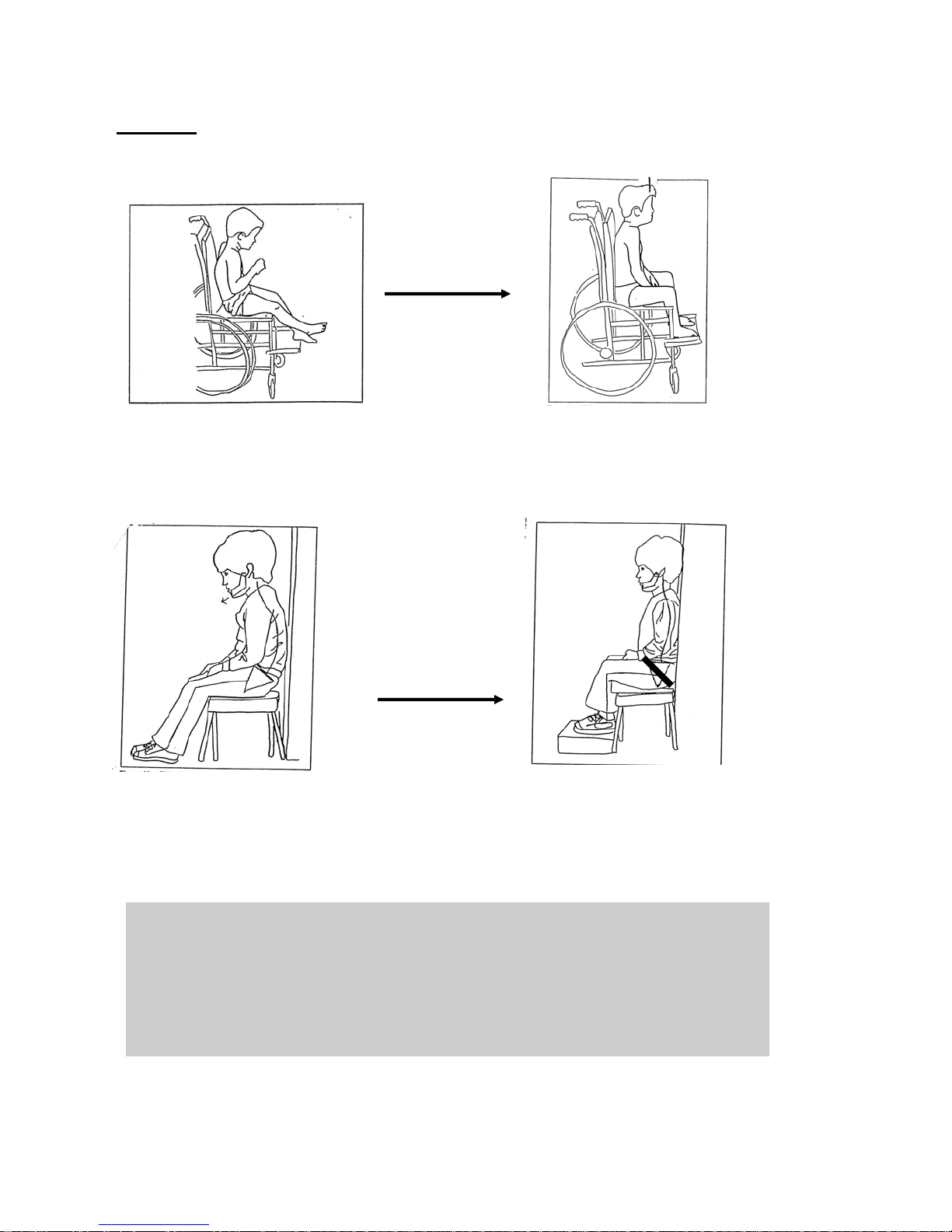
A firm seat with the legs fully supported in an upright neutral position is required. The seat depth is the
most important measurement: If the seat depth is too long, the pelvis tilts back creating posterior pelvic
tilt. If the seat depth is too short, the thighs are not supported as well, and the total base of support is not
adequate. Proper foot support is also required.
When the seat is too deep the client With proper seat depth, this same
will lean back to reach the support surface. This client can sit with a neutrally tilted pelvis
will create posterior pelvic tilt. and an erect spine.
.
The client sitting in A firm foot bed and a seat belt can provide
posterior pelvic tilt despite the 90 degree a platform to establish postural alignment
seat/back angle due to lack of lower extremity neutral pelvic stability.
stability and a seat belt.
These illustrations are meant as basic guidelines only.
Please work with your therapist to determine how to
determine the best mobility and positioning system for the
child.
19
Page 20

General Considerations
Provide the wheelchair user with optimal stability using minimal restraint
Ensure optimal spinal posture and pressure distribution
Minimize discomfort, fatigue, and energy expenditure
Specific areas of concern
Back height
Should support thoracic and lumber regions of the back for relaxation
Should not interfere with are motion for propulsion for function
Should employ higher back heights with scapular cutaways
Seat height
Should not limit the users access to the environment
Should allow for ease of transfers
Seat surface
Should provide a stable setting base
Should include a rigid seat insert
Armrests
Support the upper trunk and contribute to overall sitting stability
Need to be well padded
Need to be set with respect to height, angle of inclination, fore-aft position and width be-
tween (ideally these parameters would be adjustable)
Seat Inclination
Helps prevent the user’s buttocks from sliding forward which can occur secondary to de-
creased friction from seating surfaces designed to decrease surface pressure and enhance
transfers
Forces which occur with sudden acceleration or deceleration
Sliding due to road shock and vibration
Helps keep the user’s back against the backrest and aids in pelvic-sacral support
Back Inclination
Helps with trunk stabilization
Facilitates bimanual hand use in the face of severe weakness
Needs to be 10 to 15 degrees back from vertical
Needs to be greater with high level paralysis
Decreases body weight on sitting area
Back Cushion
Essential to improve the comfort and pressure distribution of the backrest
Should have firm pelvic-sacral and lower thoracic support
Should be softer foam in the upper thoracic support
Solid backs with little padding will push the user’s shoulders and trunk forward,
encouraging kyphosis
Solid backs with little foam can decrease lateral trunk stability
20
Page 21
Thigh to trunk angle
Should be approximately 95 degrees to allow for proper lumbar
lordosis
If greater than 100 degrees may cause sliding forward on the
seat
Pelvic-sacral Support
Should be made of dual density foam with very firm underlying
foam
Will reduce lumbar disc pressure
Will improve cervical spinal alignment
Will improve diaphragmatic breathing
Will assist with forward weight shifts
Lower thoracic support
Should be firm, just below the inferior angle of the scapula
Will promote spinal extension
Will provide stabilization of the thorax
Leg/footrest position
Creates stability for the seating system
Decreases fatigue
Helps maintain pelvis back in chair
Helps keep user in contact with the back support
Helps decrease the circulatory cut-off pressure at the distal pos-
terior thigh which effects cardiac output, fatgue, and discom-
fort
21
Page 22
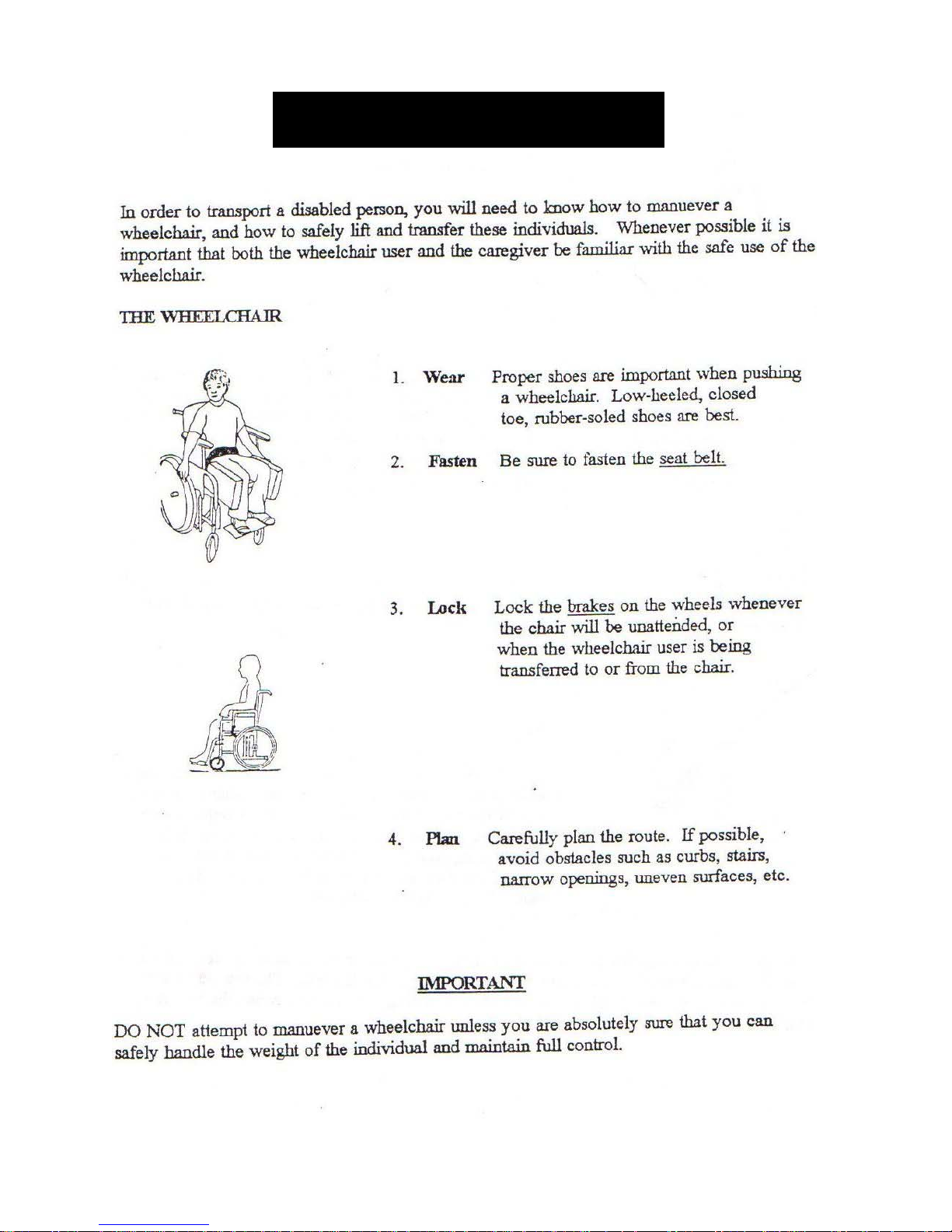
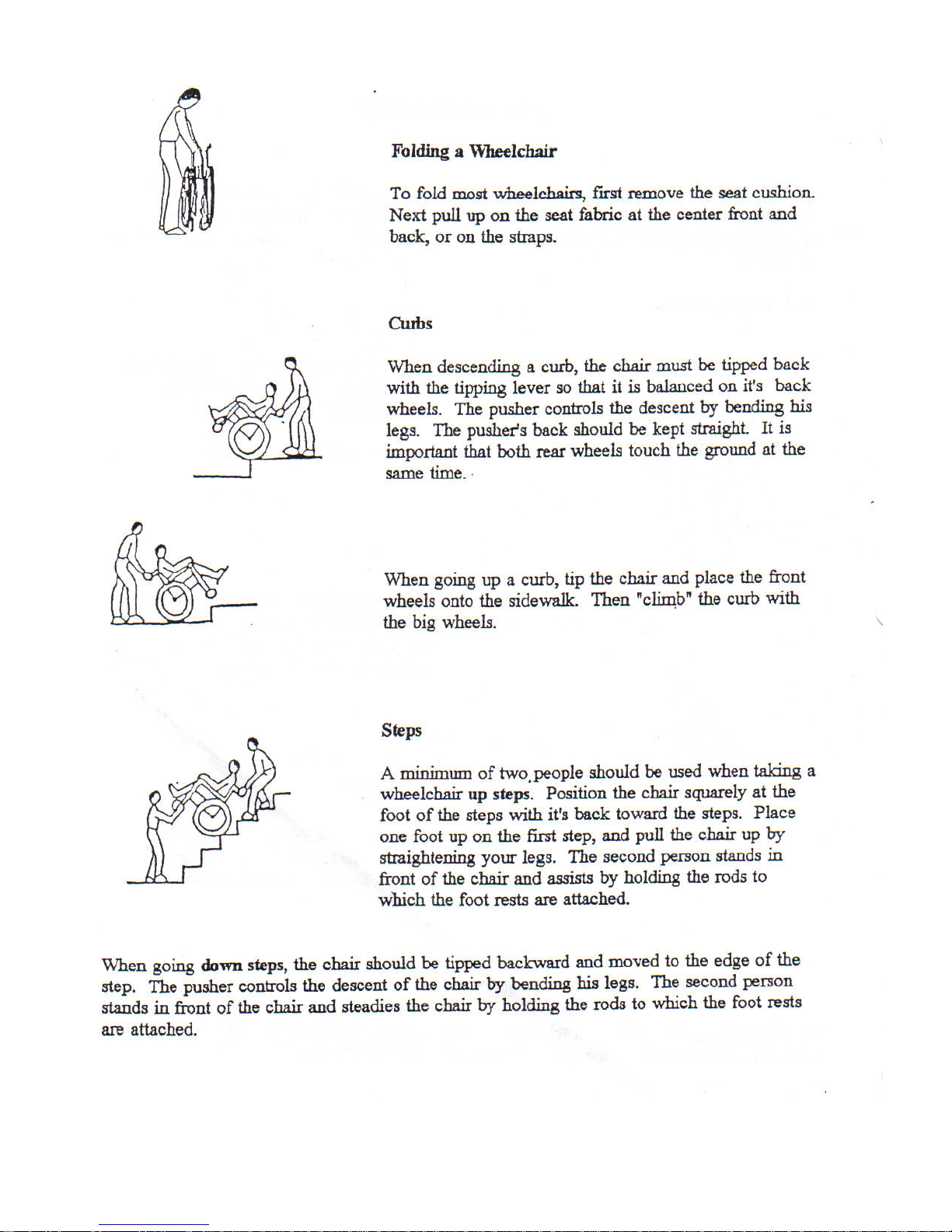
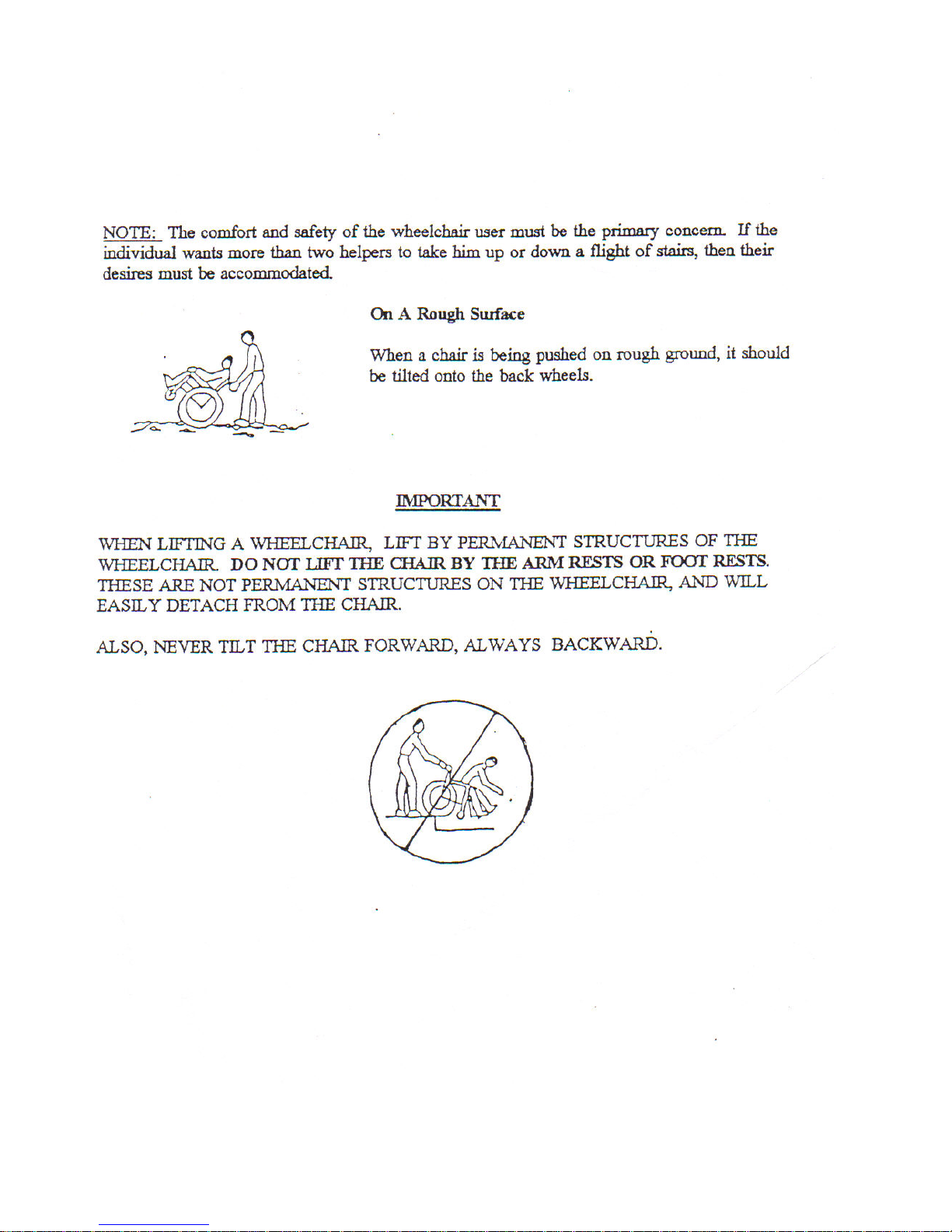
Wheelchair Safety
22
Page 23
23
Page 24
24
Page 25
Basic Measuring Guide
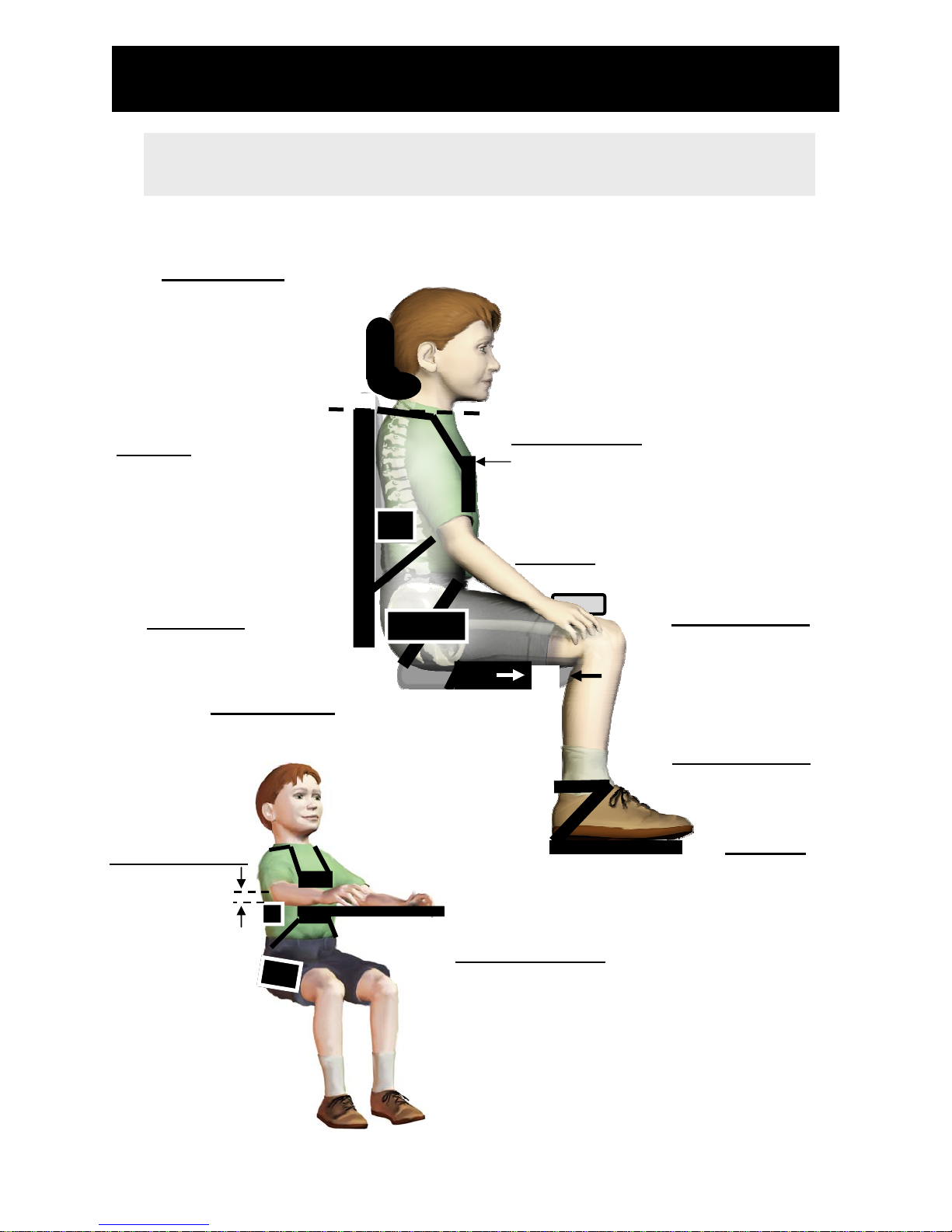
This is intended for use as a general guide. Many children require
special solutions not illustrated here.
Head Support
6
Head Rest should provide enough
support to enable the child to balance, laterally as well as fore and
aft, without preventing the child’s
ability to shift position to engage in
functional activities.
Seat Back
4
Cushion
The seat back cushion should provide
enough support to maintain proper
alignment while not impeding the
ability for the child to be actively engaged with his or her environment.
Hip Guides
8
1
Seat Cushion should provide firm support under the pelvis
and thighs to encourage a neutral pelvic position.
Trunk Supports
6
1“— 3”
The trunk supports help
maintain an erect upper
body. A 1-3” space
between Trunk supports
and arm pits helps prevent the child from hanging on the them.
Top of seat back cushion and chest harness
straps even with top of
shoulders
Seat Cushion depth adjustment
7
Chest Harness
5
Chest harness must
leave room for
breathing properly
Seat Belt should be firmly tightened to help position the pelvis
Seat Belt
2
1-2”
Therapeutic Tray
The therapeutic tray provides upper body support as well as a
platform to use for work, play or eating.
back in the seat in a neutral
position.
Abductor Block
9
1-2” space between
front of seat and back
of knees
1
Ankle Supports
Foot Bed
3
The feet should rest firmly on
the footbed to provide support
for lower extremities
25
Page 26
ROCKIT Wheelchair
Fitting Guide
The following information provides valuable information on the use, adjustment capability and the function for the various ROCKIT Wheelchair features. When completing the Measurement Worksheet, please be as thorough and as accurate as possible.
If possible, please include additional pictures if this will help to further illustrate the
nature of the child’s disability.
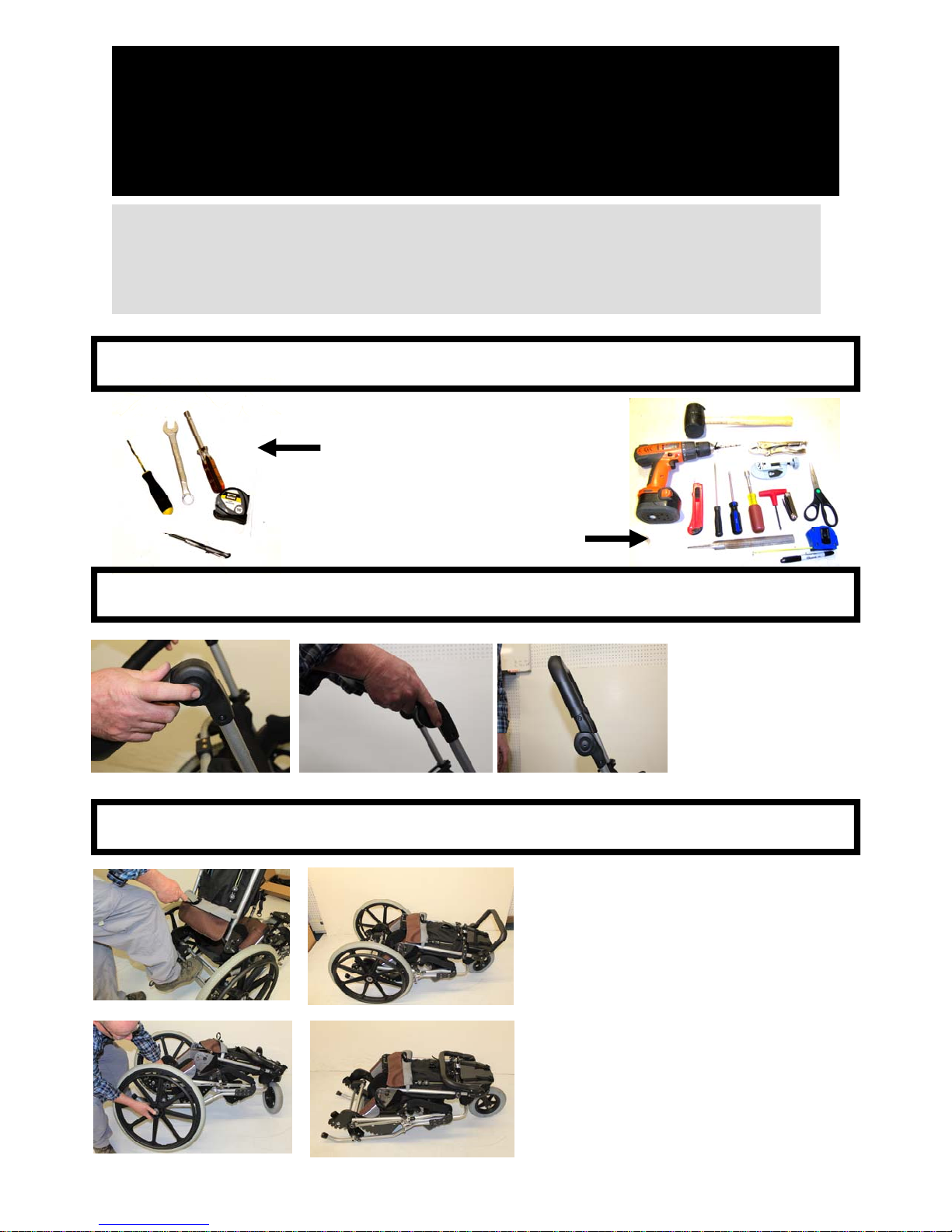
Tool Kit
The basic adjustment tools for the ROC
Wheelchair are: 7 1/16” nut driver, 5/32
allen wrench, 3/4” wrench for front
wheel caster bolt, tape measure, and
pen.
Other tools can be used for custom configurations
Adjustable Handle Bar
Folding
Folding –The ROCKIT Wheelchair
comes with quick releases rear
wheels and a foldable back cane.
For the most compact package,
make sure the chair is tilted all the
way forward and that the positioning components are not in the way.
The ROCKIT Wheelchair
handle bar is adjustable by
pressing the buttons at the
base of the handle.
26
Page 27
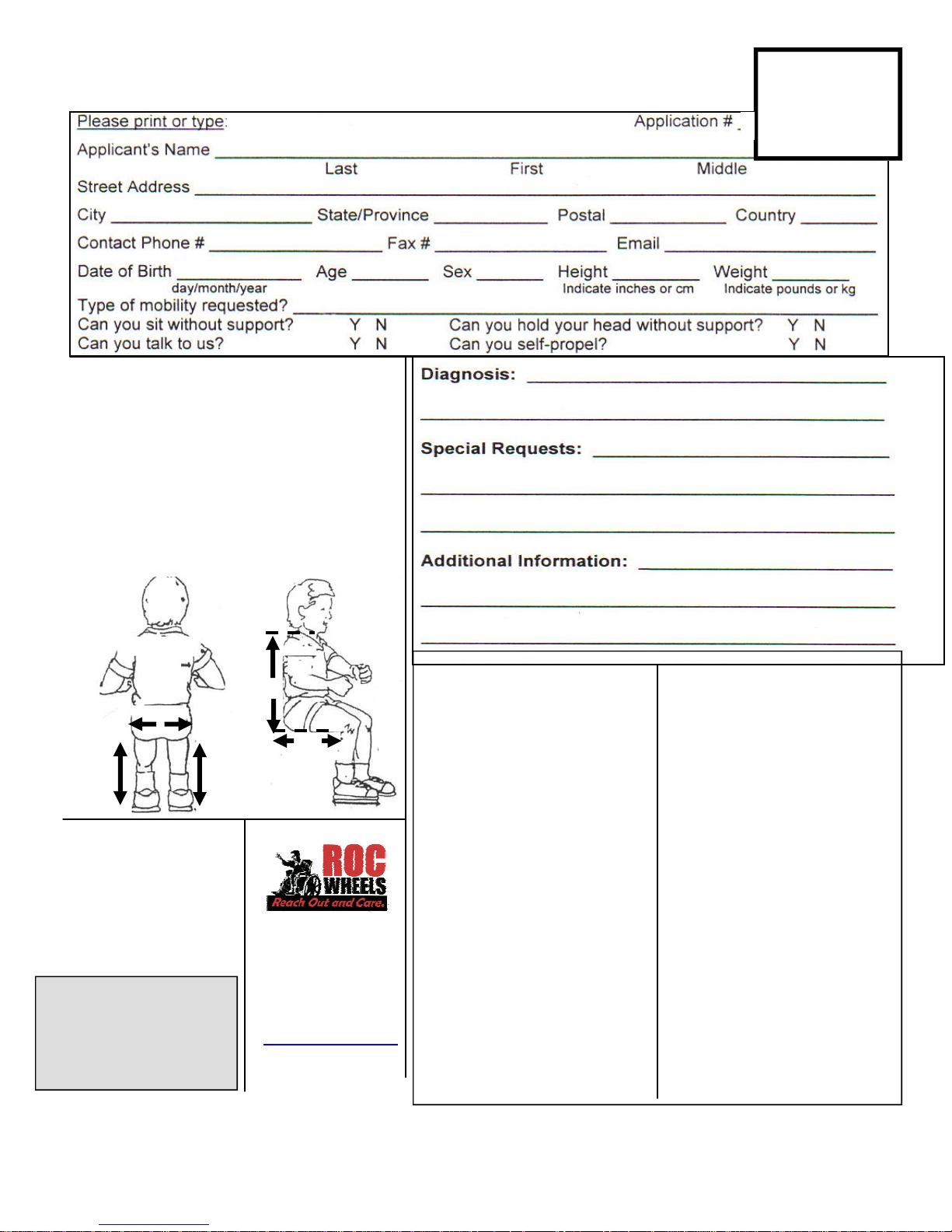
Patient’s Measurements
(See Diagram Below) cm___ inch___
1) Hip Width _______
2) Seat Depth _______
3) Foot Drop left __ right___
4) Top of Shoulders
to Seat _______
4
1
2
left
3
What type of wheelchair
would you suggest?
____________________
Person filling out form
____________________
Office Info. Only:
3
right
4135 Valley Commons Dr.
Suite D.
Bozeman, Montana, USA
59718
www.rocwheels.org
Before picture After picture
29
27
Page 28
Seat Belt
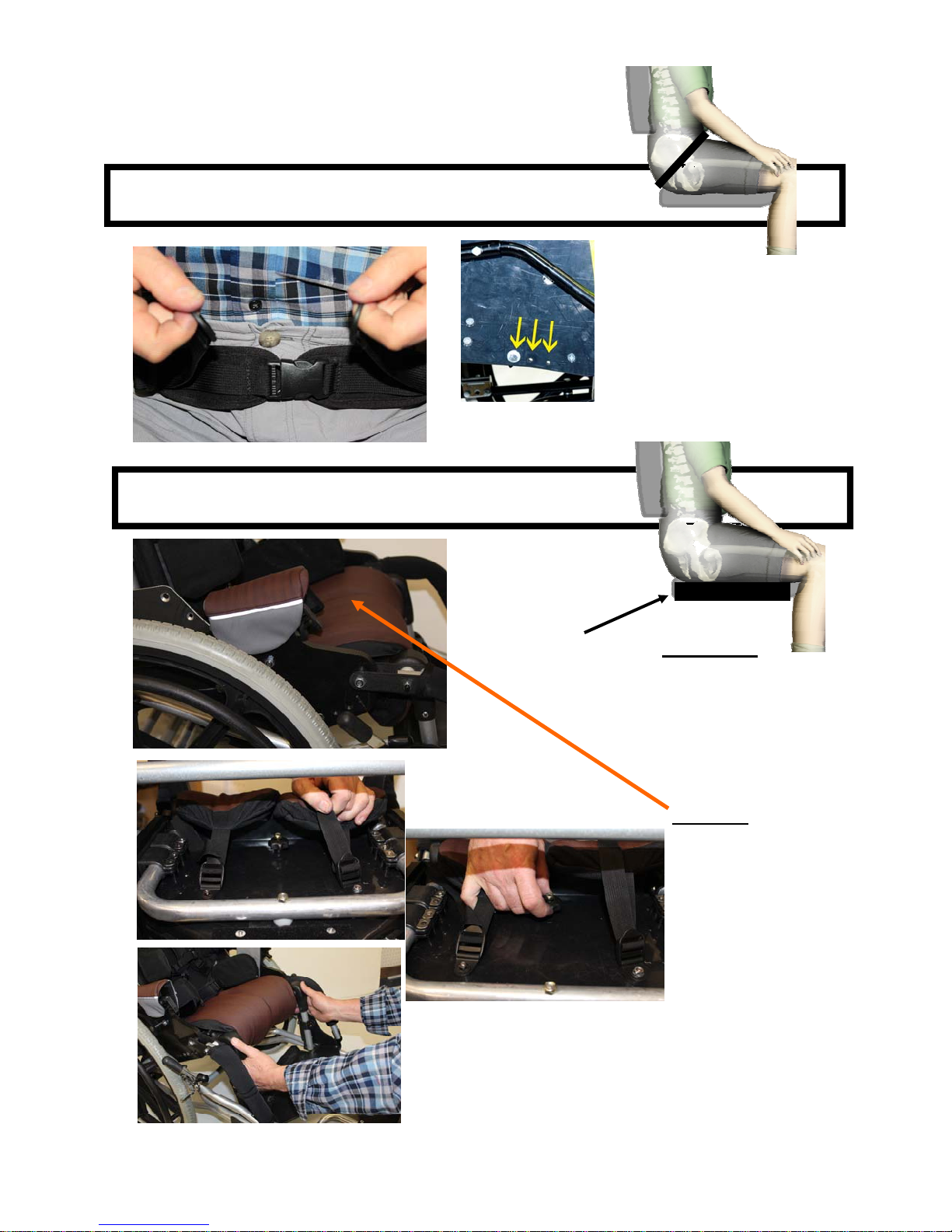
A properly positioned seat belt
holds the pelvis back in the
3 Seat Belt attachment positions
chair enabling the child to sit
correctly. An improperly placed
belt is worse than no belt.
Depending on the disability and
direction of forces, the seat belt
position may have to be
changed to keep the pelvis in
the neutral position.
Seat Cushion
Step 1
Step 3
Step 2
THE PELVIS:
The first area to be considered must
be the pelvis, with efforts made to
obtain a neutral position. The pelvis
influences total body alignment and
without a good pelvic foundation,
positioning of the legs, trunk or
arms becomes undermined.
A firm Seat
supported in a neutral position is
very important. The seat depth is
the most important measurement:
If it is to long, the pelvis tilts back; if
it is to short, the thighs are not
supported as well and the total
base of support is not as good.
Proper foot support is also
required.
The abductor wedge
can be placed via
hook and loop even
when the seat is
folded over for
shorter seat depths.
with the legs fully
28
Page 29
Back Cushion
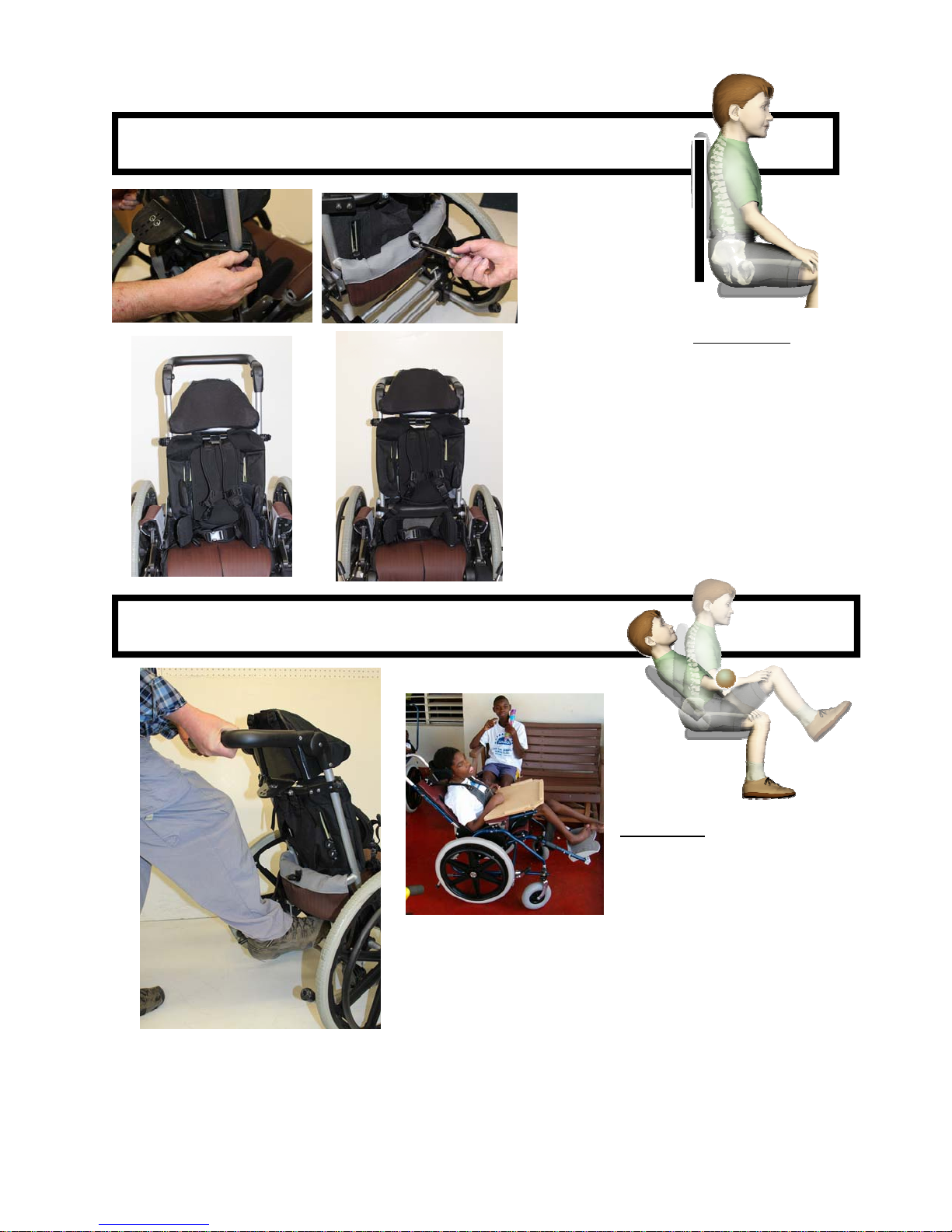
Seat back is adjusted with 7/16”
nut driver. Seat
back has 8” of
growth.
Optimally, position the firm seat back at 90
degrees to the sitting surface is needed to ensure maintaining a neutral pelvis. A soft back
encourages slouching. A reclined back
encourages a posterior pelvic tilt.
Back Cushion should support
thoracic and lumber regions
of the back for relaxation
It should not interfere with arm
motion for propulsion or function.
Tilt-in-Space
90 degrees
+7
+14
+21
+28
+35
+42
Tilt-in-space
space will assist the child’s
muscular trunk control against
gravity. If it is too erect, he may
slump. If too far back, he may pull
forward to become more erect. It is
important to position the child as
erect as possible to encourage the
child to develop the strength and
balance necessary to improve.
When necessary, tilt the child back
for support, but always be ready to
enable the child to challenge
gravity.
of the entire seat in
29
Page 30
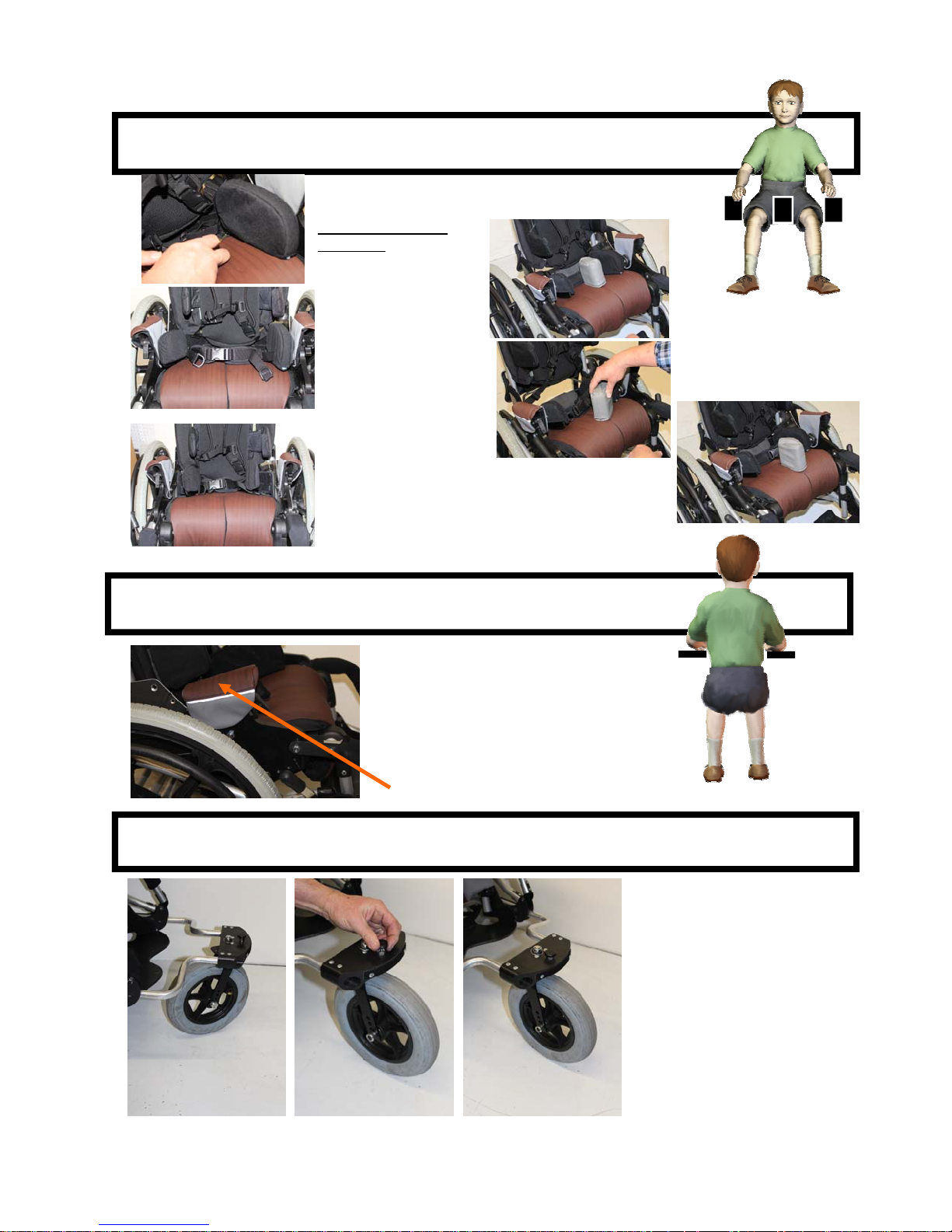
Hip Guides/ Abductor
Symmetrical pelvic
alignment must be
achieved on the seat. If
weight is shifted to one
hip, compensation posturing occurs in the
spine and extremities.
Hip guides or knee
straps can be used to
assist this.
Arm Rest
The arm rests provide upper extremity support which can enable the
individual to maintain alignment enabling improved function. The arm
rests also serve as the support for
the therapeutic tray.
Adduction Adduction
Abduction
To install the abductor
block, position child correctly. Then poke a hole
through the upholster and
through the seat base.
Front Caster
Insert information about
caster wheel here.
30
Page 31
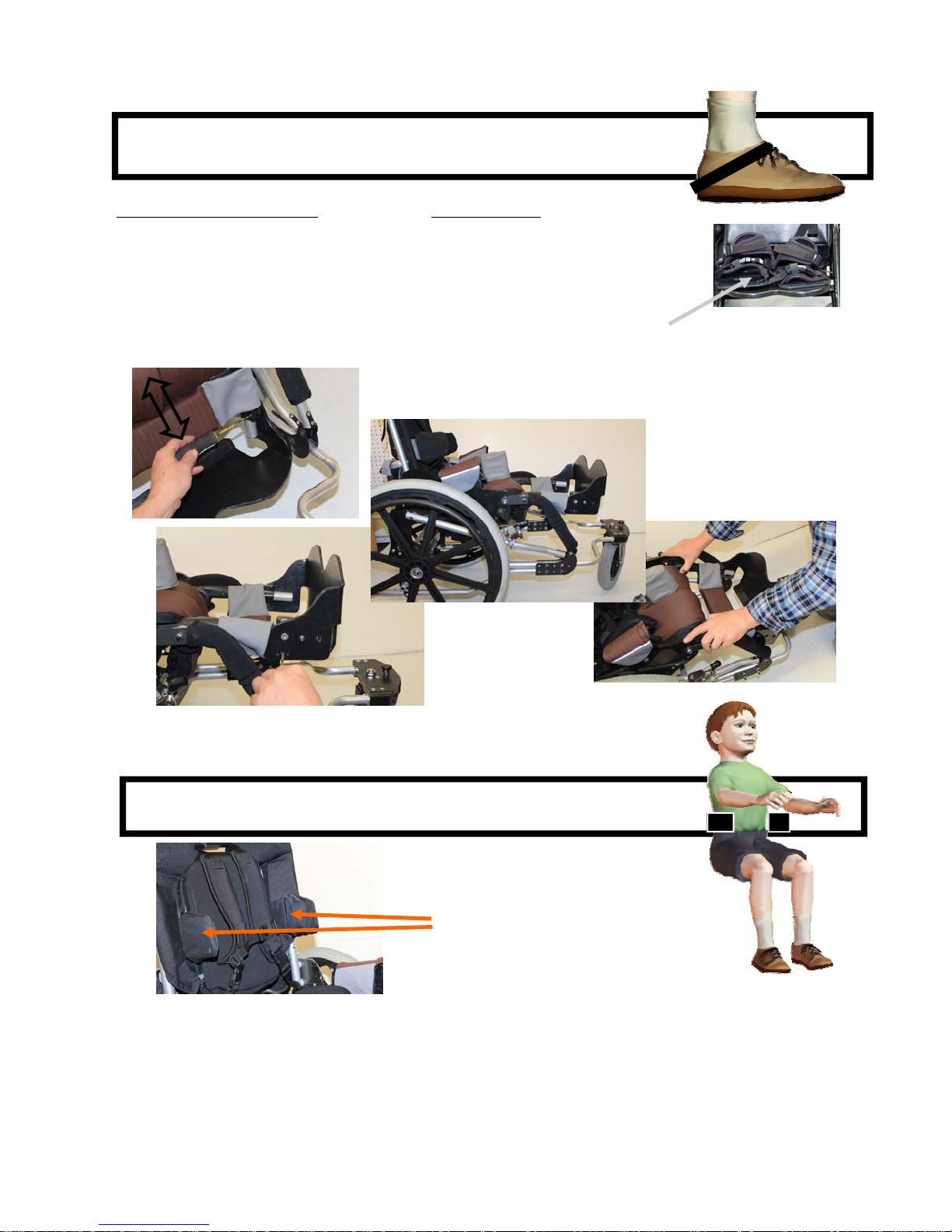
Foot / Ankle Support
Proper positioning of the legs
achieved after proper orientation of the
pelvis. If the legs extend and adduct a
spacer may be needed. If the legs abduct,
supports may be needed on the outside of
the legs. With tight hamstrings, knees
should be flexed to 90 degrees to avoid a
posterior pelvic tilt.
can only be
Footbed Adjustability
Up and down
Forward and Back
Foot positioning
possible only after achieving correct alignment of the pelvis and
legs. The foot should be flat with
most of the weight carried through
the heel. This may require blocks
or straps to achieve.
is critical and
Trunk Supports
The trunk supports are
adjustable in height,
width, depth and angle
Use the
7/16”
Nut driver to
adjust.
After achieving a proper base
of support in the pelvis and
legs, attention must be
turned to obtain neutral trunk
alignment. Proper
relationships between normal
spinal curves and the
position of the ribs is desired.
This also helps decrease changes of developing
spinal deformities. Most distortion of spinal curves
comes from low tone, or from reflex activity with
increased tone, with resultant inadequate trunk
control.
31
Page 32
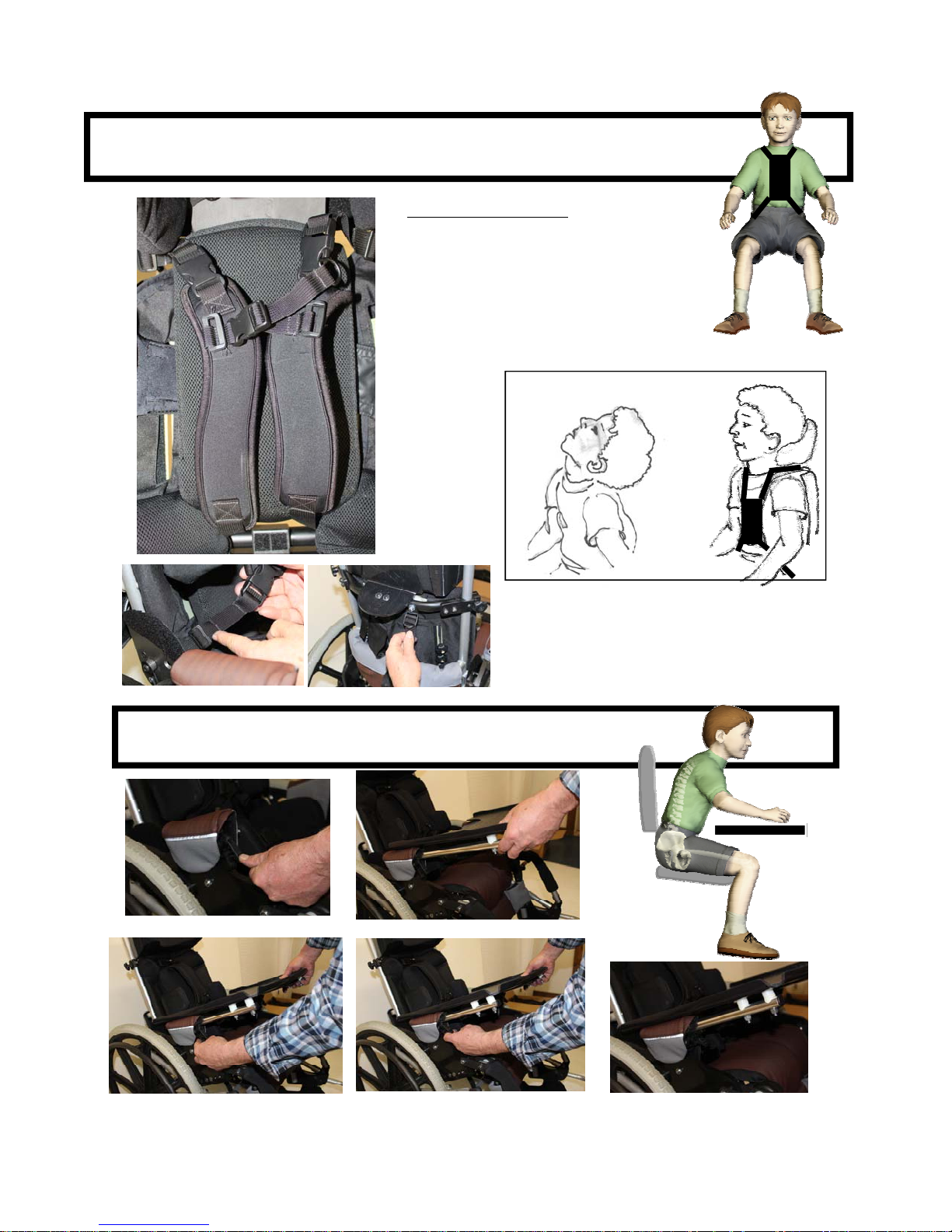
Chest Harness
Harnesses or strapping to
control forward flexion may be
used. If the child hangs on
them, backward tilting is necessary. Harnesses will not
control side bending and
should not be allowed to interfere with arm functions.
Therapeutic Tray
A chest Harnesses can be very instrumental in
keeping the shoulders aligned uprightly.
32
Page 33
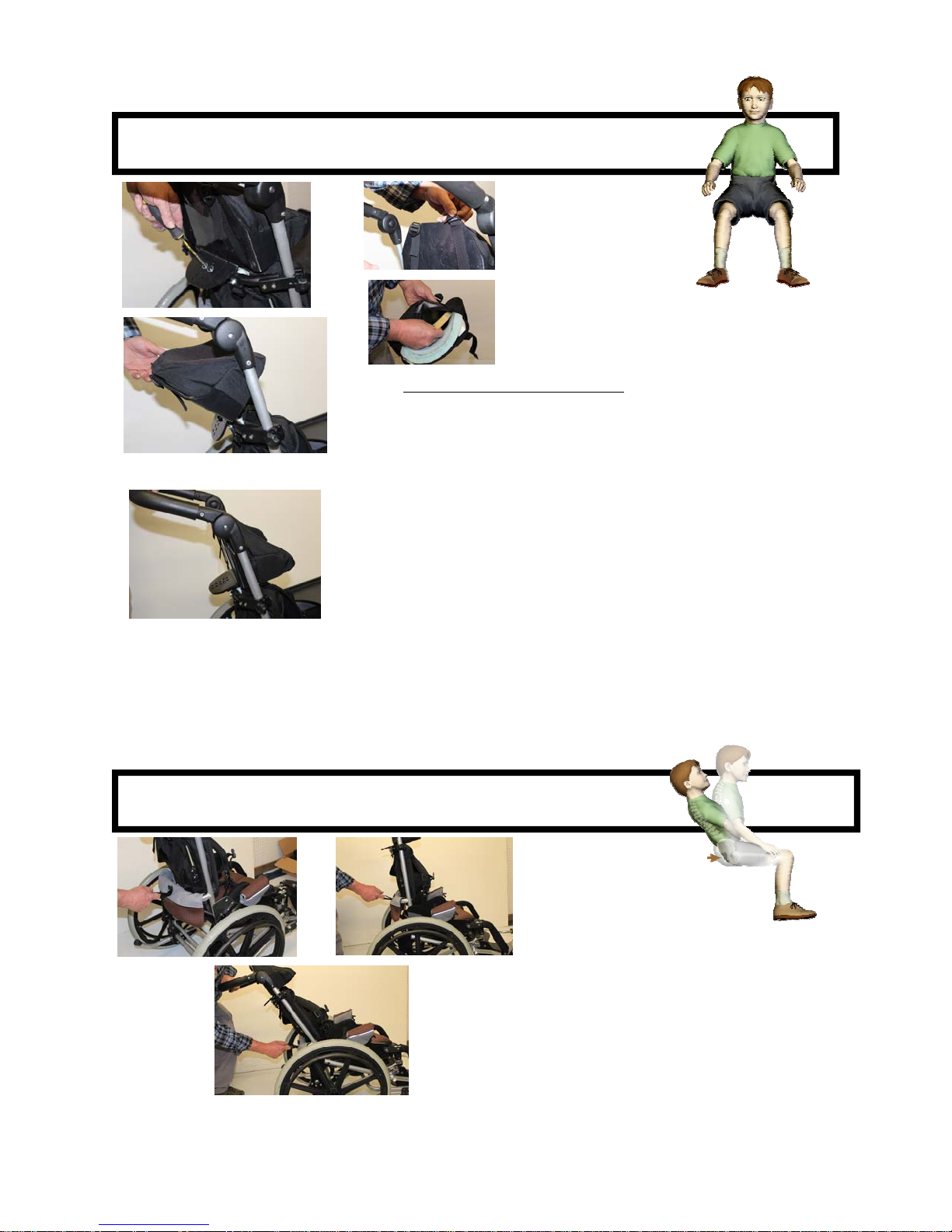
Head Support
Contouring can be
customized by
pulling off cover
and fitting in new
foam shapes to
help support the
child’s head.
THE HEAD AND SHOULDERS:
After obtaining optimal pelvic, leg and trunk control, efforts are directed
to achieving head and shoulder girdle positioning. Any distortion of
central control will interfere with head and shoulder alignment and with
Adjustable up and down
Adjustable forward
and backward
developing active control of the finer motor skills (the head, oral and
eye control, and the hands). The next task is to obtain the best position
of the head and shoulder girdle so that the child can better participate
in the environment.
“Ideal” head position is often very difficult to achieve as any distortion in
the intimate relationship between the head, neck and shoulder girdle
produces pathology in the other. Ideally, the head should be righted
with the eyes horizontal, and neutrally aligned on the neck. Mobility of
the head on the neck should be allowed within the range that the child
can control.
Some frequently encountered head problems are from, 1) floppy necks,
2) enlarged occiputs, 3) extensor hypertonus in the neck, 4) sidebending or rotation.
Hip Angle Adjustment
Helps with trunk stabilization
Facilitates bimanual hand use in the face of severe
weakness
Needs to be 10 to 15 degrees back from
vertical
Needs to be greater with high level paralysis
Decreases body weight on sitting area
33
Page 34
Custom Applications
The ROCKIT wheelchair can easily be adapted to fit the custom positioning needs of the
wheelchair recipient. Once the wheelchair specialist determines the unique needs of the
child, he or she should first determine if the ROCKIT wheelchair can be adjusted or modified
in its standard configuration to fit the child.
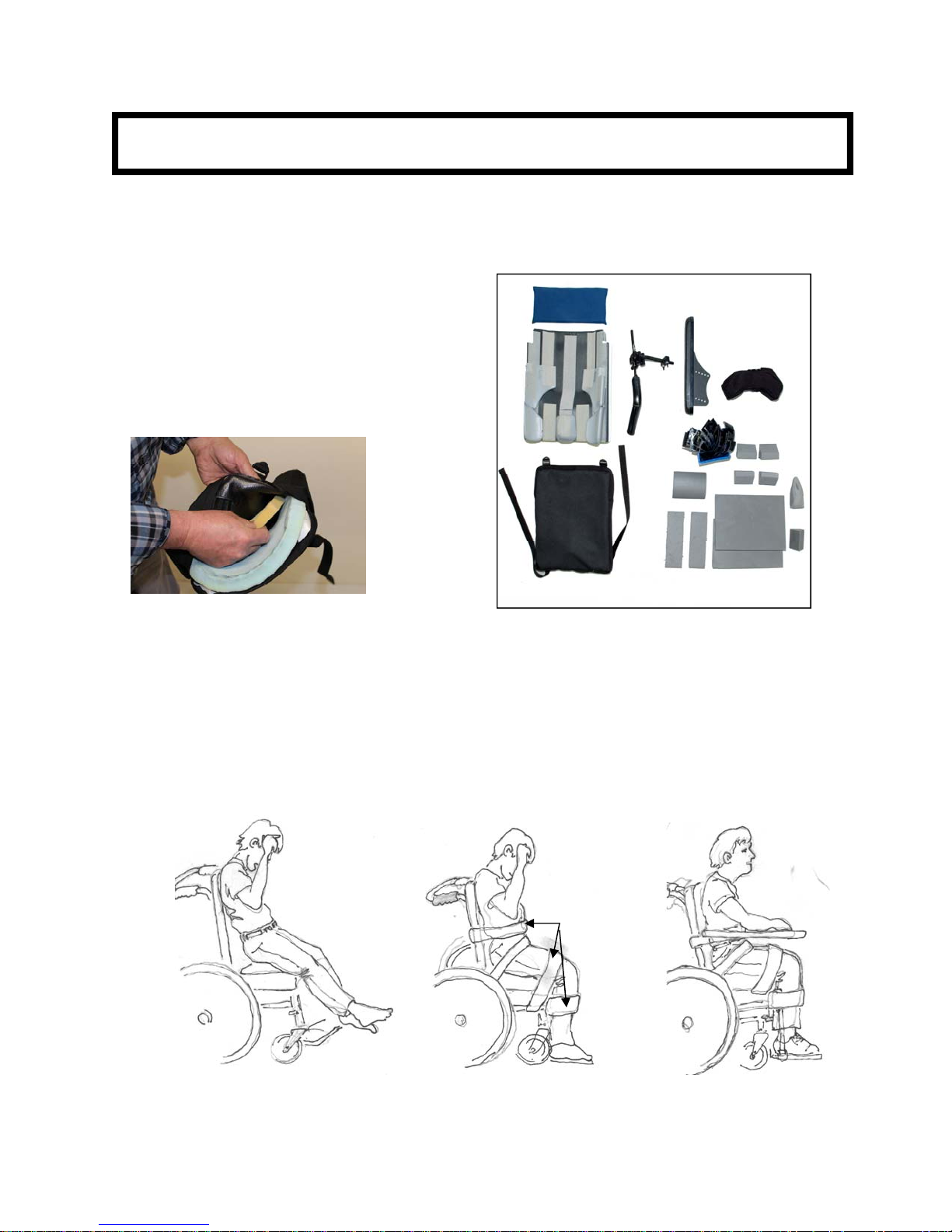
Here we have an illustration of some extra positioning components, including various foams, positioning hardware and various fasteners that enable the ROCKIT wheelchair to provide the
maximum therapeutic and functional benefit.
The foam inside the head rest, seat back, and seat bottom covers can be accessed to
add foam as necessary to ensure the correct amount of support and contouring
.
How many beneficial things can we accomplish with a simple
strapping system and the addition of a therapeutic tray?
1
2
3 strategically
placed
straps
Wide padded straps fastened with hook and l oo p can
provide support. They should not be so tight as to
restrict functional movement or circulation, but can
help in bringing the body into alignment.
3
The therapeutic tray can provide the
necessary support to help maintain
postural alignment
34
Page 35
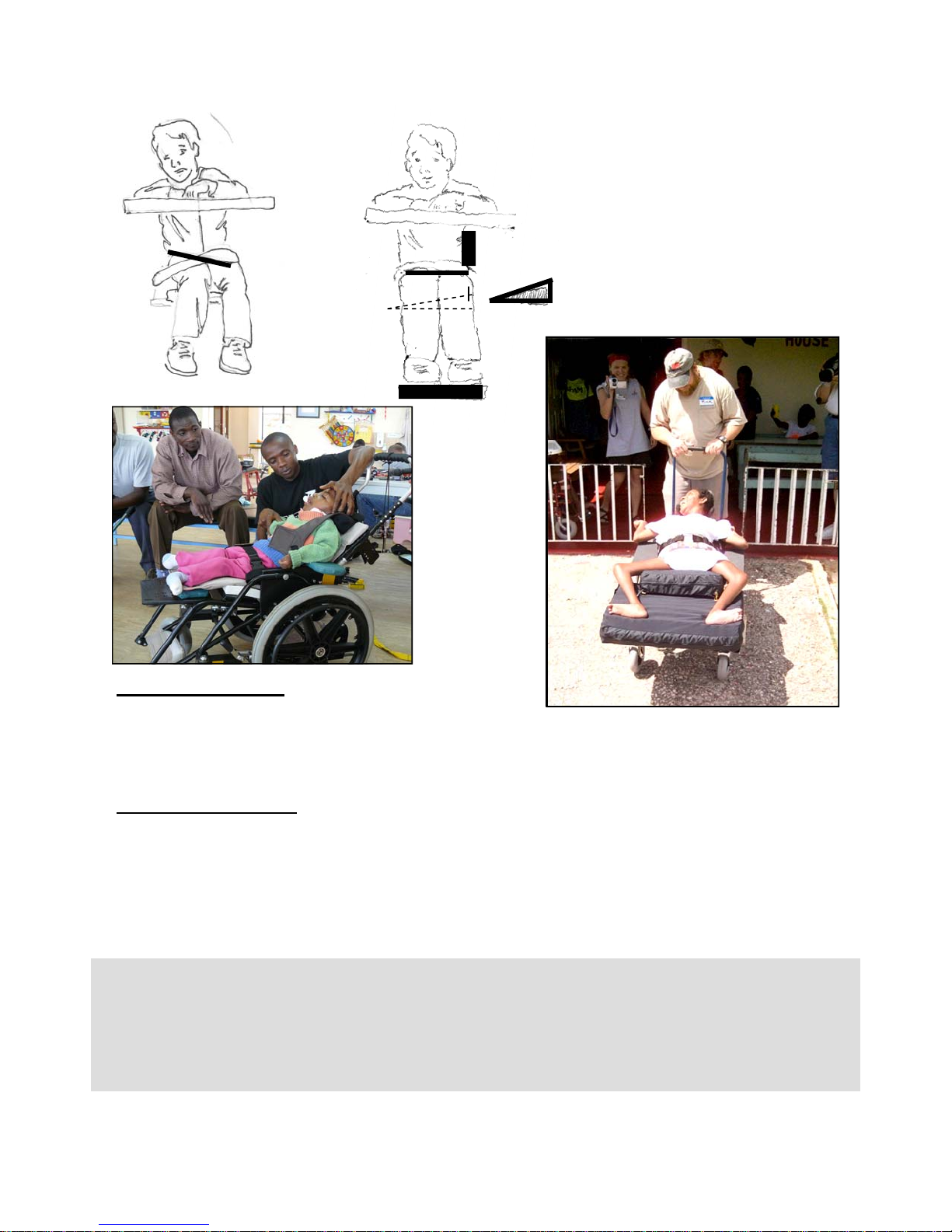
The child in figure 1 has pelvic obliquity.
1
2
Pelvic Alignment
The upper and lower extremities are
assymetrical to compensate and
maintain balance. A trunk support added
to the child’s left side helps straighten the
upper torso while the seating wedge is
placed under the pelvis due to the
obliquity. The footbed provides support
to brace the feet and help to balance the
entire body.
SPICA POSITIONING
Special adaptations can be performed for children in a temporary Spica cast system. The back
would be positioned at the 90-degree position and the standard handle bar would be used.
Once healing is complete and the cast removed, the standard seating system and footrest
system can be returned to the wheelchair.
SUPINE POSITIONING
A beneficial adaptation of the ROCKIT wheelchair is that the seat back can recline 90
degrees. This allows supine positioning for children with complex needs. The seat back can
be adjusted in special situations to provide a long flat surface. The adjustable footrest can be
raised to the seat base to extend the seating platform an additional 9 inches.
The ROCKIT Wheelchair is specially configured to provide the growth, therapeutic support, and anthropometric positioning to accommodate a large segment of
the pediatric population with mid through profound deformities. It is also
well-suited to custom configuring to fit a child using the child’s personal
requirements.
35
Page 36

Wheelchair Distribution Procedures
PRE-DISTRIBUTION COORDINATION
Establish the location for a distribution based upon requests from potential partners or the need
to return to past distribution sites to help more people while following up with past wheelchair
recipients.
Establish reliable contacts within the country to do a distribution at least 6 months in advance
Send measuring worksheets (e-mail version or by mail) and have them begin to re-
cord measurements and take a photo of each the recipient.
Have them contact local associations that serve the disabled, orphanages, physical
therapists, government health departments, etc
Once they’ve gathered 100 or 200 measuring worksheets have them mail them to
ROC Wheels
Review the measuring worksheets and the recommendations for mobility products if included
ROC Wheels and physical therapists review the measuring worksheets and determine the best
mobility product for each person
Begin initial fundraising if the partners show the ability to perform a distribution together
Create a budget for the cost of the mobility products based upon review of the measuring worksheets
Request a shipping quote from BKA Logistics (Manisha Lad) based upon the total number of
wheelchairs (100 wheelchairs = 20 footer and 200 wheelchairs = 40 footer)
Combine the mobility products cost, shipping costs, and estimated costs associated with performing the distribution in order to determine a final budget
Establish shipping sponsor
Continue fundraising based upon the total budget
Identify the consignee and contact person that will receive the shipment
Coordinate with partners and consignee to determine a location for storage of the mobility products until the distribution team arrives
Coordinate with partners and consignee the distribution sites and necessary logistical support
for transporting the mobility products and distribution team (if multiple sites)Coordinate with partners and consignee to arrange the accommodations, transportation, and meals for the distribution team
Continue fundraising until 75% of the budget has been received
Once 75% of budget received then submit a purchase order for the mobility products
Research costs for airfare, accommodations and meals and determine cost per team member.
Work with consignee and perform the necessary tasks in order to receive a Duty Free Exemption Certificate from the countries government or US based consulate
Make arrangements for the shipment through BKA Logistics and ask them to hold the booking
at the current quote until the duty free certificate has been received
Determine distribution date and number of team members based upon the expected arrival time
of the container and clearance from customs
Find a Physical Therapist to accompany the team, try to get PT sponsorship.
Gather distribution team and begin to educate the volunteers on the distribution procedures,
health concerns (vaccines), political and cultural environment, necessary financial support they
will need to pay or fundraise, and provide the distribution itinerary
Have a team meeting if possible before leaving to assign responsibilities for each distribution
day and ease any concerns or questions.
36
Page 37

PRE-DISTRIBUTION IN-COUNTRY
Once in-country give the team time to adjust to time-changes and culture shock
Meet with in-country partners and thank them for all their hard work (give gift or token of gratitude when appropriate)
Unload the shipping container, assemble all mobility devices, and match foot-rests and accessories to each wheelchair
Organize the inventory by the day of the distribution or by distribution site and prepare the load
for transport is necessary
If possible match and label each assigned mobility devices to a recipient determined by using
the measuring worksheet (if pre-determined)
Organize ROC team into a meeting before the distribution takes place and discus the roles that
each individual will perform- whenever possible empower others to take on a leadership role
and support them as needed
Explain the challenges that will be faced especially preparing them for challenges that will present themselves
Discus health concerns and proper procedures when serving recipients with potentially contagious illnesses
Detail a course of action to be taken by every team member if they are cut or injured
Field questions and concerns from the team and address the need to have the proper state of
mind and remain calm in the face of stress and adversity
Discus interpersonal challenges that may develop and how to deal with them- open dialogue is
very important before smaller issues fester and become worse
Visit the distribution site and layout the flow for the distribution. Identify the entry, custom fitting
stations, and exit point
Work with the team on a simulated fitting (including translators and physical therapists)
Begin with the waiting area proceeding to the entry point (finding their measuring work-
sheet)
Direct the recipient and caregiver to a custom fitting station and introduce all parties
Custom fitting team briefly assesses the recipient and compares with the measuring work-
sheet to determine the necessary mobility device
Once the mobility device has been determined bring the device to the fitting station and
begin the custom fitting *see custom fitting section*
Work with the physical therapist to determine the necessary adjustments and customiza-
tions to the mobility device to best serve the recipient. During this process communicate with
the recipient (if possible) and caregiver to educate them on the features of the wheelchairs,
medical concerns, and adjustments that can be made over time and the recipients grows.
Finish the custom fitting and have a physical therapist give their approval
Help the recipient and caregiver to the exit station and introduce all parties
The exit station will take the measuring worksheet and assign a code to the measuring
worksheet that matches the exit photo
Record the code, name, and location on the “photo board” and help arrange the recipient
and caregivers for a picture (note the direction of light and backdrop)
Take several pictures not just of the “adopt-a-chair” style picture, but close ups and try to capture the emotion of the moment
37
Page 38
Work with the fitting station teams to determine if they have adequate tools, fasteners, webbing, and foam
If sufficient time loosen all the adjustable features on the wheelchairs to reduce fitting times
during the distribution
Ask for further questions from the team
DISTRIBUTION DAY:
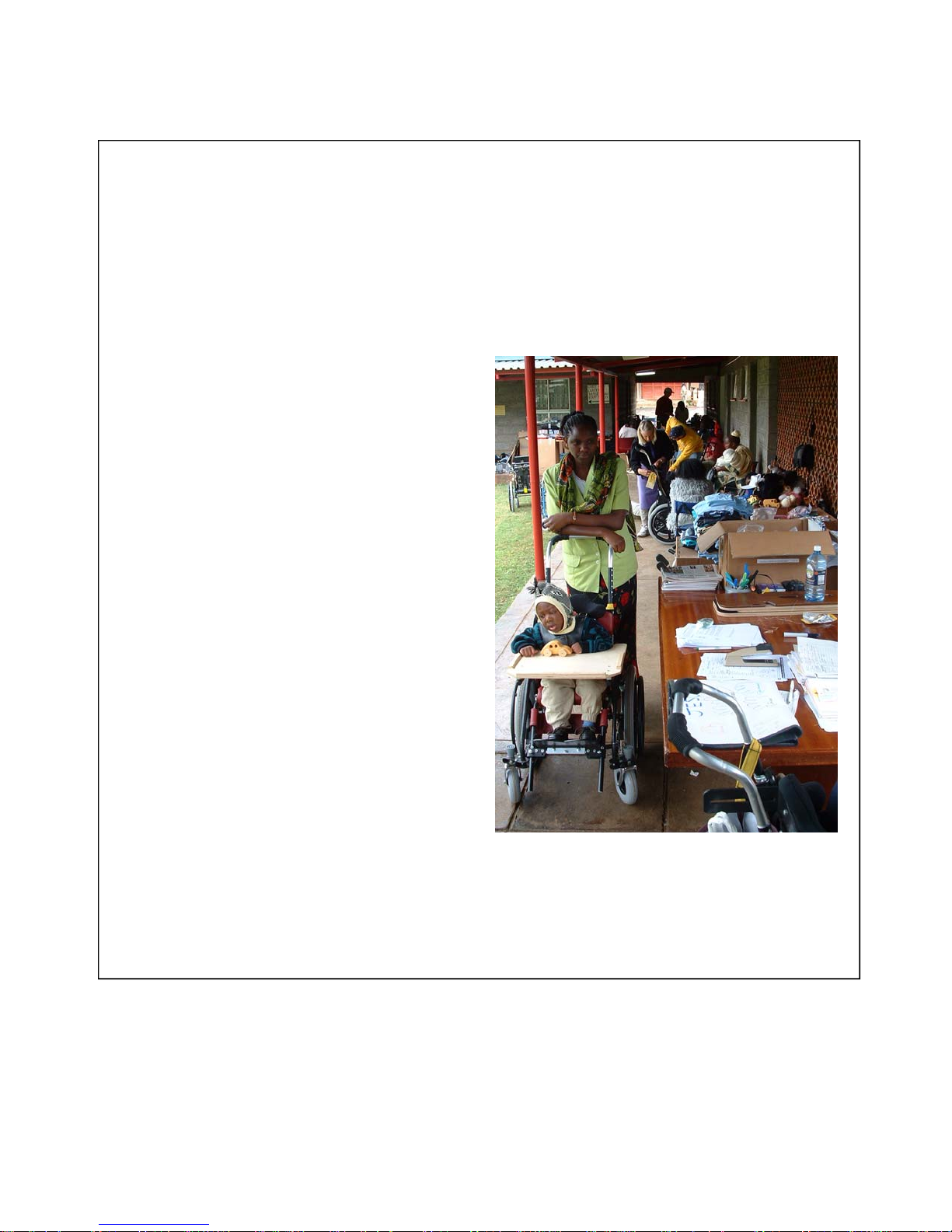
Most countries the wheelchair recipients and
their families will arrive well before the team does
so everyone should be ready to work upon arrival
Work with a translator to speak to all the recipients and thank them for coming and being gracious as they wait for their wheelchair
Explain the distribution to everyone and what
they should expect during the distribution:
Flow throughout the process
Time involved with custom fittings and how
this may effect their wait time
To be attentive and learn as much as they can
during the fitting- ask questions
Hand out the measuring worksheets to the caregiver or recipient Begin the distribution
FINISHING THE DISTRIBUTION:
Opportunity to throw a celebration dinner, luncheon, or party for partners and team
Be sure that partners have had sufficient training
and tools to follow up with recipients
Leave sufficient measuring worksheets so partners can continue to document children in need
of wheelchairs for the return trip
38
Page 39
Wheelchair Selection Guide
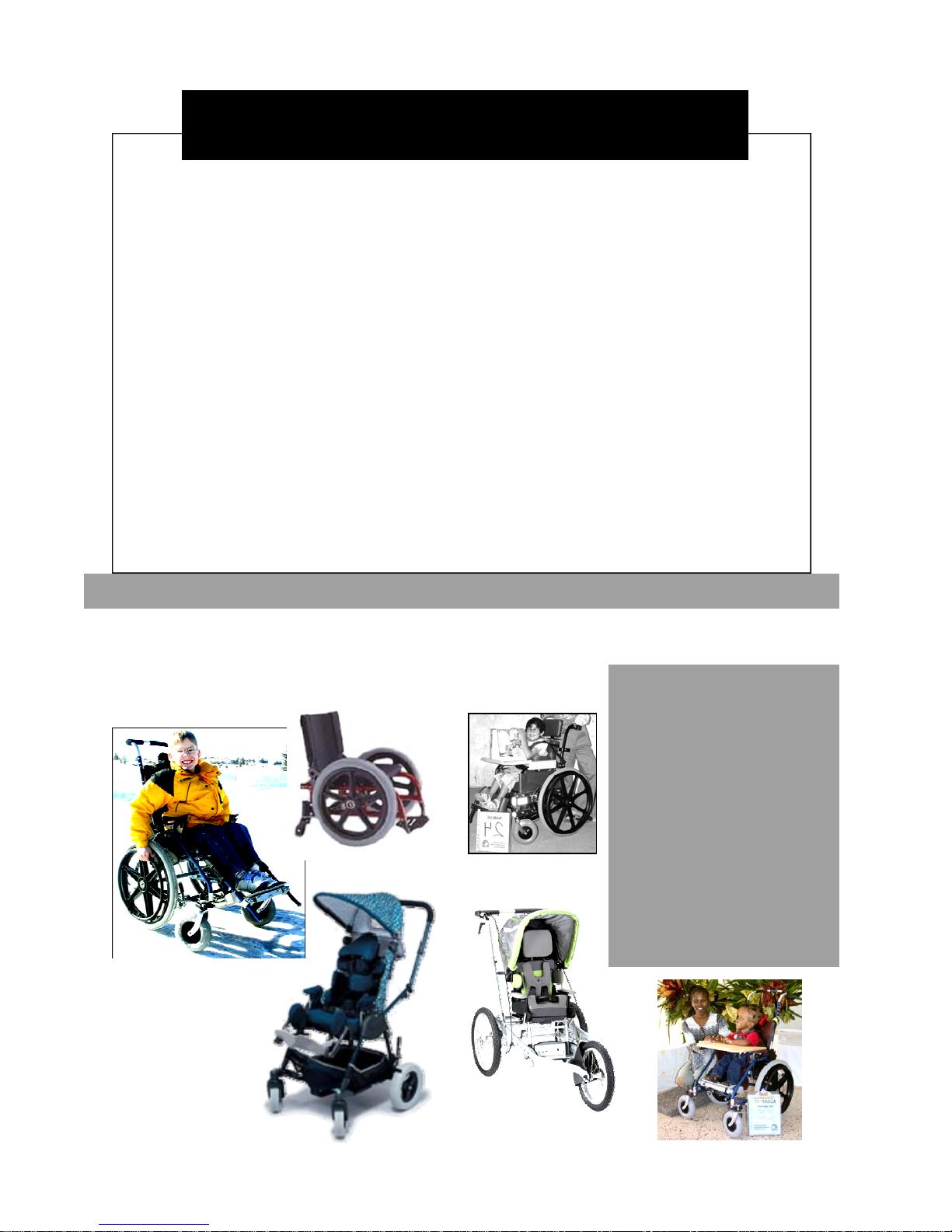
In order to deliver the proper selection of wheelchairs for an upcoming wheelchair distribution,
measuring worksheets are filled in and other valuable information is collected. The wheelchairs shipment is packaged based on this information. The
following guide helps you understand the type of
mobility devices that can be prescribed, based on
the individual needs of the wheelchair recipient.
Pediatric Strollers and Wheelchairs
Who is it for?
Pediatric wheelchairs must
allow for growth as well as
numerous levels of disability.
The adaptive wheelchair is for
children with moderate to
severe disabilities & provides
support for proper positioning
as well as enabling self
propulsion.
39
Page 40
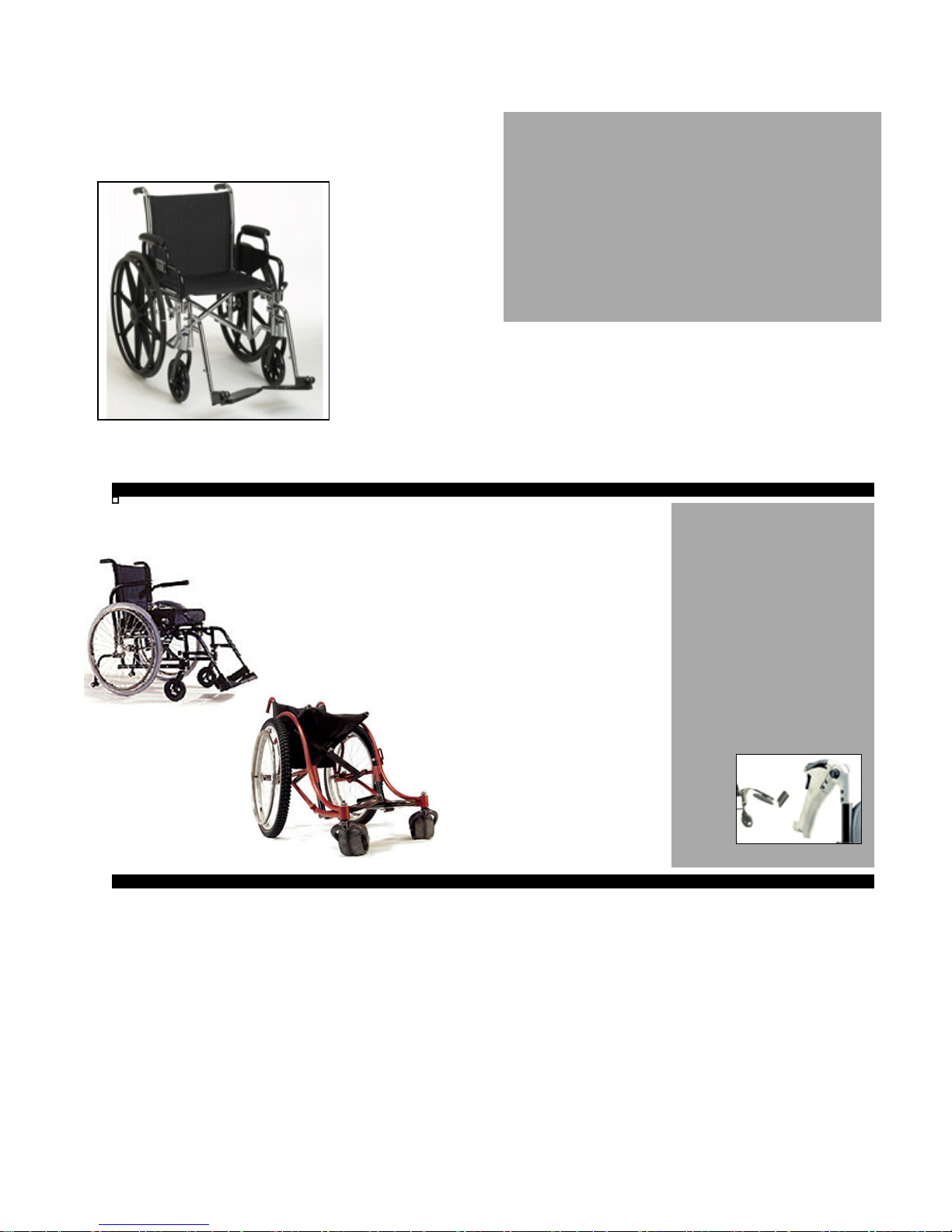
Standard Wheelchair
A standard w h eelchair comes with fixed armrests and
fixed foot plates. The foot plates can be adjusted up and down
to get the right seat height. It comes in different qualities like
stainless steel, chrome, aluminum and therefore has different
prices. Also the country of origin has an influence on the price.
Lightweight Wheelchair
Who is it for?
The standard wheelchair is suitable for patients who
need minimum to moderate assistance in sitting upright . They can be people who can or cannot self
propel, but do not need the extra performance of a
lighter, more expensive lightweight wheelchair. Patients normally need little adaptive support and chair
angle adjustability
Lightweight wheelchairs are more sophis-
ticated and more expensive, due to the special
types of wheels and optional components available, such as an adjustable wheelbase for highperformance mobility.
They often come in
many colors. These
chairs are often more
efficient to self-propel,
because of the lighter
weight and more refined
features . and of course
for younger wheelchair
Who is it for?
The lightweight wheelchair
is suitable for patients who
are strong in the upper
body and can benefit from
the lighter weight and
higher performance. Paraplegics are often good candidates for a lightweight
chair since they are often
very
strong
in the
upper
body.
40
Page 41
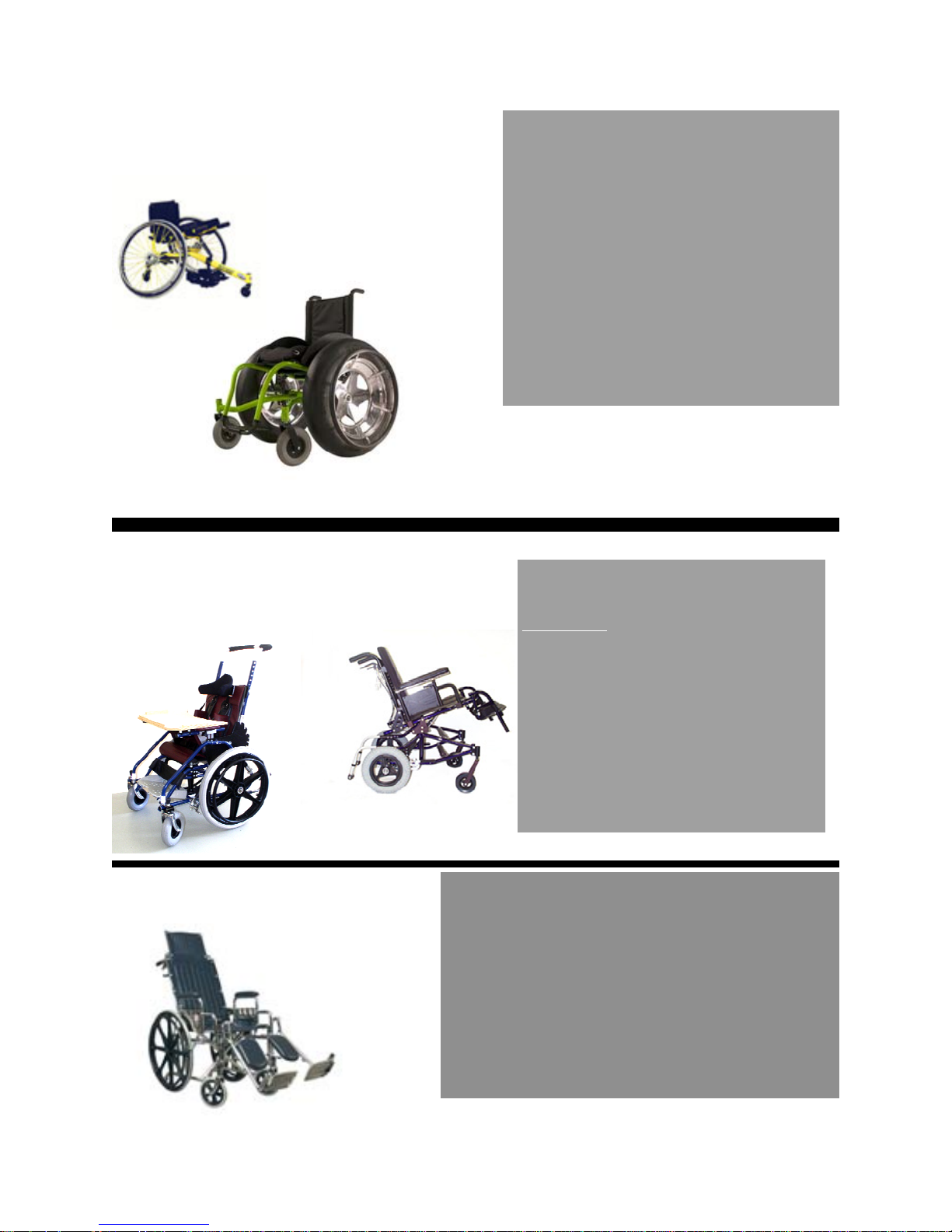
Sports Wheelchair
Adaptable Wheelchairs
with Tilt-in-Space
Who is it for?
Sports chairs are high performance wheel-
chairs that are made to help the user per-
form in sports such as tennis, basketball,
off road travel or other sports activities.
These chairs are often very expensive and
can limit the users ability to function in nor-
mal daily activities because of the special-
ized features.
Who is it for?
Tilt-in-space assists the child’s muscular
trunk control against gravity. If it is too
erect, he may slump, if too far back, he
may pull forward to become more erect. It
is important to position the child as erect as
possible to encourage the child to develop
the strength and balance necessary to improve. When necessary, tilt the child back
for support, but always be ready to enable
the child to challenge gravity.
R
This chair is meant for patients who need a more open
hip angle. The reclining wheelchair is appropriate for
people with fixed or other non-correctible deformities
that prevent them from sitting in a more upright position.
Often, people are too weak to sit upright. An elevating
leg rest is often needed as is additional specialized seat-
ing support to provide proper positioning support and
pressure relief.
41
Page 42
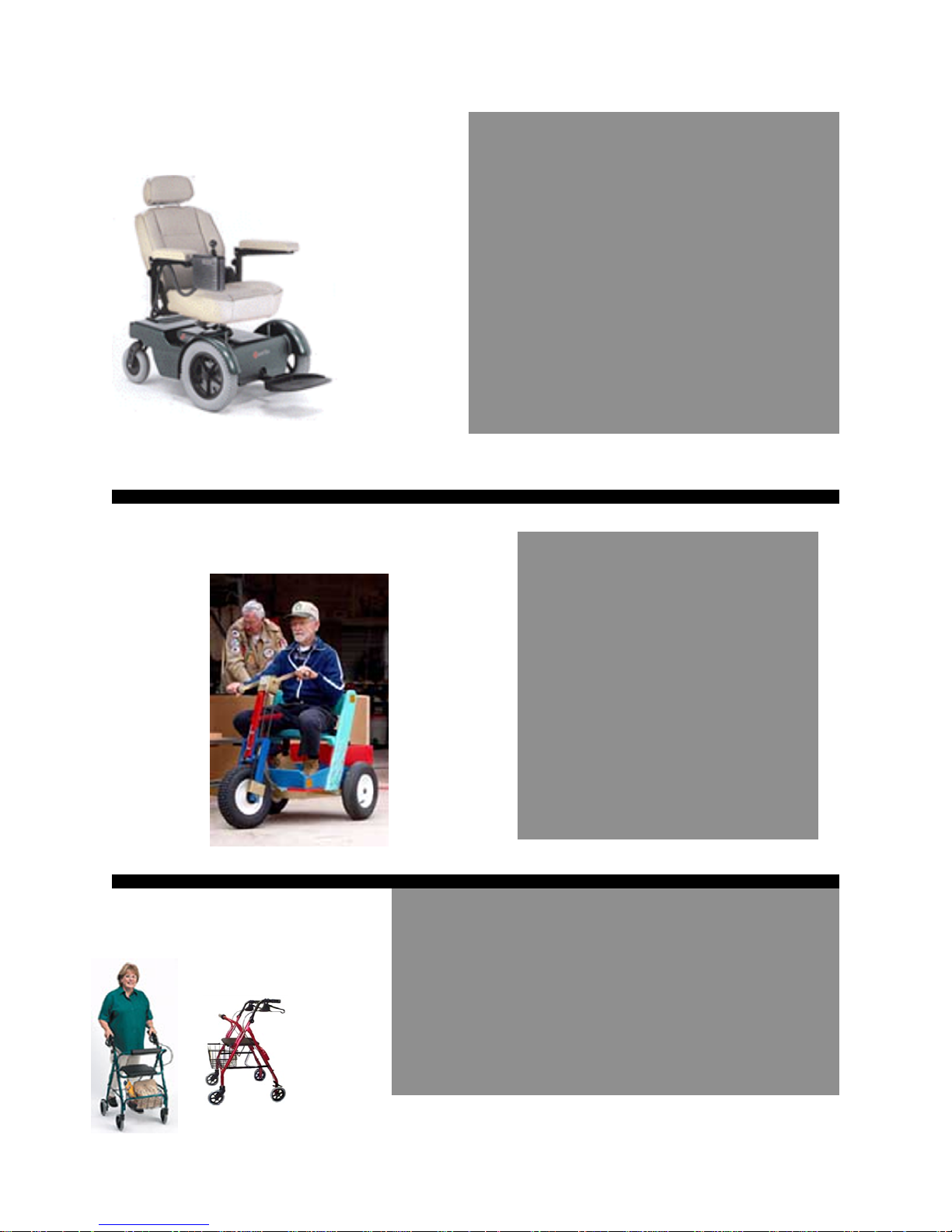
Power Wheelchair
Hand Bikes
Who is it for?
The power wheelchair provides the gift of inde-
pendent mobility for people who cannot self
propel and are cognitively able to navigate with
the chair. Power chairs can be appropriate for
children as young as 2 years old. Power wheel-
chairs are very expensive and normally de-
mand extensive technical upkeep, making them
inappropriate in many developing countries.
Who is it for?
Mobility Aids
Hand bikes provide independent mo-
bility for people who have strong up-
per body capacity. They often enable
mobility on roads and byways, and
can provide a vehicle for helping sus-
tain a roadside business, since many
bike have a large storage area for car-
rying goods.
Who is it for?
People often can benefit from mobility aids that either do
not need a wheelchair or as an additional mobility. Walk-
ers can serve people who have some ambulatory capabil-
ity. Other aids are available that help with bathing, toilet-
ing and other activities of daily living.
42
Page 43
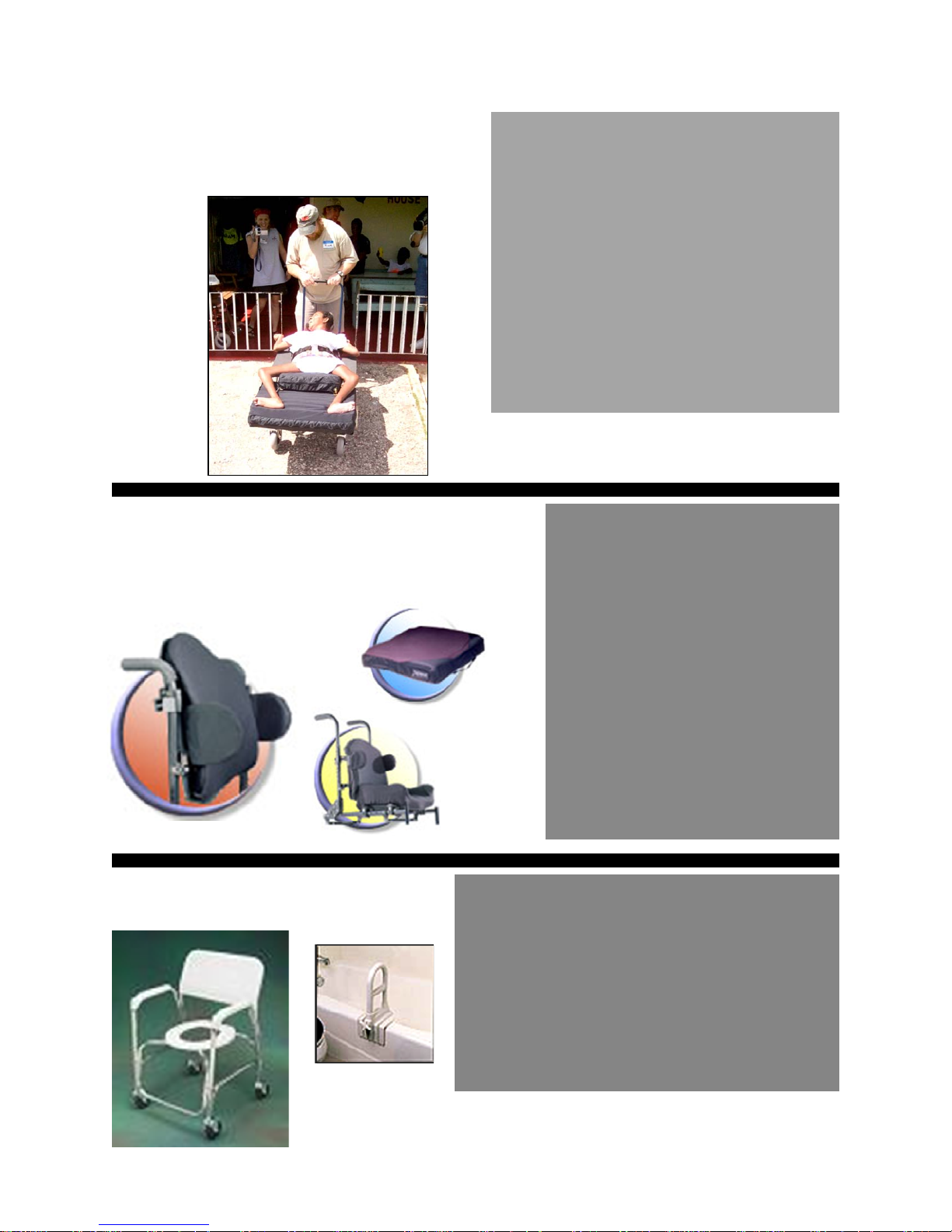
Highly Adaptable
Wheelchairs
Seating Systems and
Positioning Components
Who is it for?
There are a wide variety of disabilities that can-
not be served from without specialized adapta-
tions to the appropriate wheelchair. Some chil-
dren need special life support equipment, includ-
ing suction machines, ventilators, IV poles and
other critical care items. Some children have
developed fixed deformities which creates the
necessity of configuring the chair to accommo-
date the abnormal body position.
Who is it for?
There are a wide variety of seating sur-
faces, including foam, air cell and fluid
Bath Aids
which can help accommodate assymetri-
cal problems, as well as address pres-
sure sores and other pressure related
issues. Structural support, such as trunk
supports, head supports, adduction and
abduction are also critical an many
cases to enable the occupant to function
to the best of their ability.
Who is it for?
In addition to mobility and positioning products, it is
important to address activities of daily living.
It is difficult to sustain a healthy environment in many
developing countries. The wheelchair distribution team
can often bring a variety of bath aids that can support
the needs of the wheelchair recipient.
43
Page 44
 Loading...