

Page 1

12 V CORDLESS DRILL/DRIVER PAGE 4 ENG
12 V OLTIOS TALADRO INALAMBRICO PAGE 11 ESP
PERCEUSE/TOURNEVIS À 12 V PAGE 19 FRE
RK2510/RK2510K
RK2510K2/RK2510K2.1
Page 2

Thank you for purchasing a ROCKWELL® power tool. We are confident that you will appreciate
the quality of the product and you will be entirely satisfied with your purchase. Please read
carefully the user safety and operating instructions on how to operate this product correctly
within safety norms and regulations.
Gracias por su compra de un producto ROCKWELL®. Estamos seguros de que apreciará
la calidad del producto y de que estará completamente satisfecho con su compra. Lea
cuidadosamente las instrucciones de seguridad y de operación para obtener mayor información
acerca de cómo utilizar éste producto correctamente dentro de las normas y reglas de
seguridad.
Merci d’avoir choisi un produit de marque ROCKWELL
®
. Nous sommes certains que ous
apprécierez la qualité de ce produit et qu’il saura vous satisfaire. Pour être renseigné sur toutes
les méthodes de travail correctes et sécuritaires répondant aux normes et règlements de
sécurité, veuillez lire attentivement la notice de sécurité et de fonctionnement présentée.
Visit us on the web at www.rockwelltools.com
Page 3
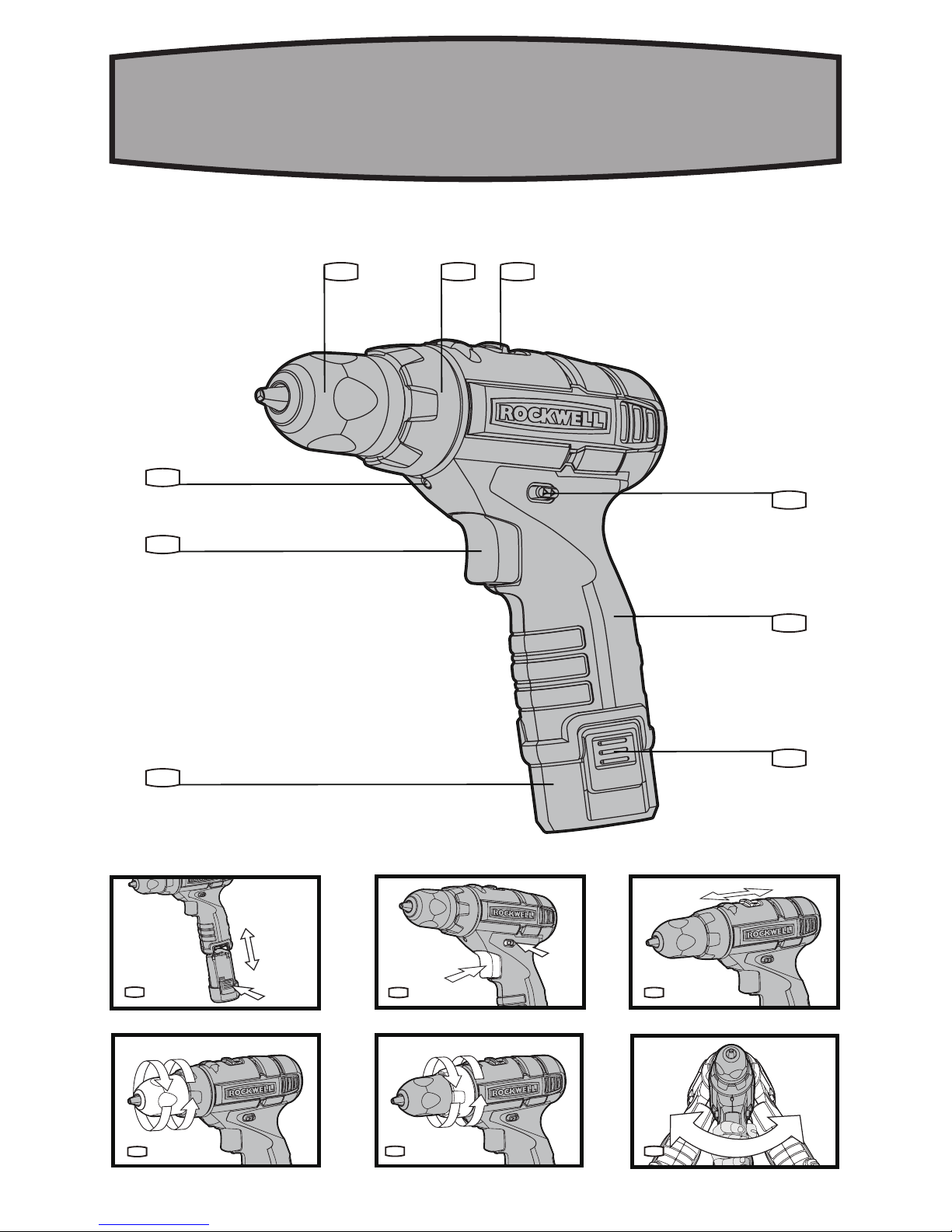
RK2510/RK2510K
RK2510K2/RK2510K2.1
E
D
A
B C
F
1 2 3
4
5
6
7
8
9
Page 4
12 V CORDLESS DRILL/DRIVER ENG
4
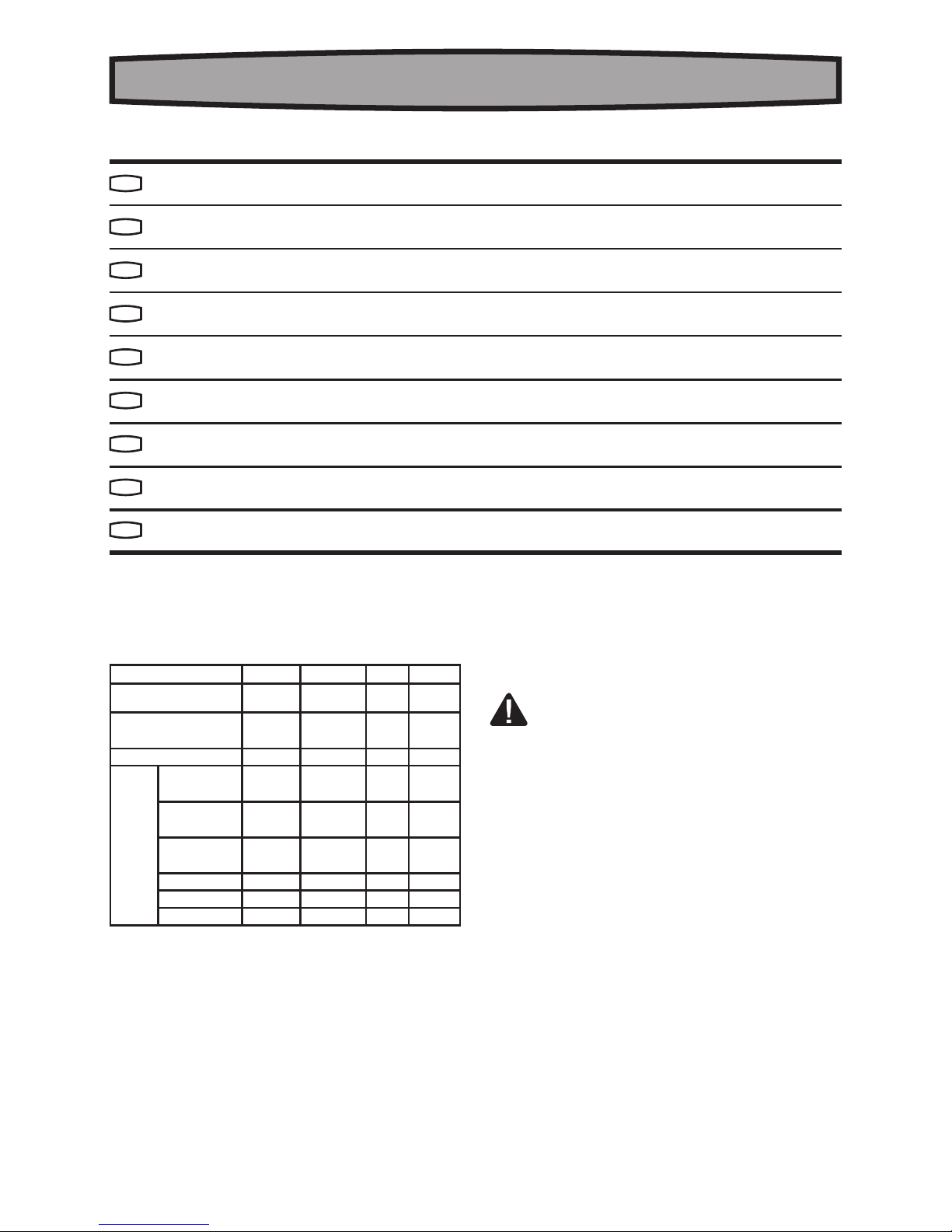
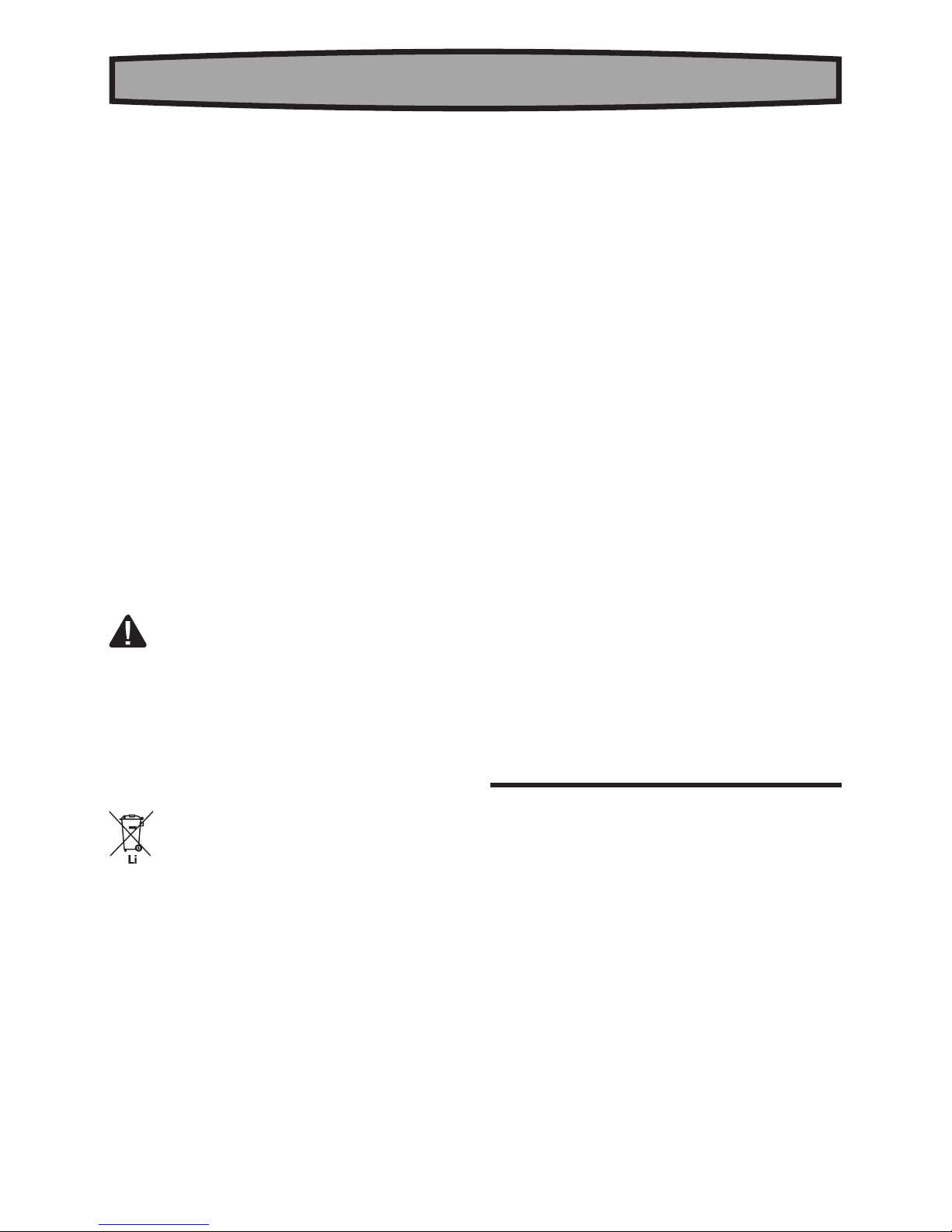
COMPONENT LIST
KEYLESS CHUCK
TORQUE ADJUSTMENT RING
TWO-SPEED GEAR CONTROL
FORWARD/REVERSE ROTATION CONTROL
SOFT GRIP HANDLE
BATTERY PACK RELEASE BUTTON
BATTERY PACK *
ON/OFF SWITCH
LED LIGHT
* Not all the accessories illustrated or described are included in standard delivery.
ACCESSORIES
We recommend that you purchase your accessories
from the same store that sold you the tool. Use good
quality accessories marked with a well-known brand
name. Choose the type according to the work you intend
to undertake. Refer to the accessory packaging for
further details. Store personnel can assist you and offer
advice.
GENERAL POWER TOOL SAFETY
WARNINGS
WARNING: Read all safety warnings and
instructions. Failure to follow the warnings
and instructions may result in electric shock, fire and/
or serious injury.
Save all warnings and instructions for future
reference.
The term power tool in the warnings refers to your
electric (corded) power tool or battery-operated
(cordless) power tool.
1. WORK AREA SAFETY
a) Keep work area clean and well lit. Cluttered or
dark areas invite accidents.
b) Do not operate power tools in explosive
atmospheres, such as in the presence of
flammable liquids, gases or dust. Power tools
create sparks which may ignite the dust or fumes.
c) Keep children and bystanders away while
operating a power tool. Distractions can cause
you to lose control.
1
2
3
4
5
6
7
8
9
RK2510K2
RK2510K2.1
RK 2510 RK2510K
Double ended bit 1 1 1 1
Battery pack
(RW9300)
2 2 / 1
Charger (RW9400) 1 1 / 1
PUCK
TM
Magnetic bit
holder
/ 1 / /
PH1, PH2(X2),
PH3
/ 4 / /
SQ1,
SQ2(X2), SQ3
/ 4 / /
6-8, 8-10 / 2 / /
T15, T20, T25 / 3 / /
4,5 / 2 / /
Page 5

12 V CORDLESS DRILL/DRIVER ENG
5
2. ELECTRICAL SAFETY
a) Power tool plugs must match the outlet.
Never modify the plug in any way. Do not use
any adapter plugs with grounded power tool.
Unmodified plugs and matching outlets will reduce
risk of electric shock.
b) Avoid body contact with grounded surfaces
such as pipes, radiators, ranges and
refrigerators. There is an increased risk of electric
shock if your body is grounded.
c) Do not expose power tools to rain or wet
conditions. Water entering a power tool will
increase the risk of electric shock.
d) Do not abuse the cord. Never use the cord
for carrying, pulling or unplugging the power
tool. Keep cord away from heat, oil, sharp
edges or moving parts. Damaged or entangled
cords increase the risk of electric shock.
e) When operating a power tool outdoors, use
an extension cord suitable for outdoor use
marked “W-A” or “W”. Use of a cord suitable for
outdoor use reduces the risk of electric shock.
f) If operating a power tool in a damp location
is unavoidable, use a Ground Fault Circuit
Interupter (GFCI) protected supply. Use of a
GFCI reduces the risk of electric shock.
3.
PERSONAL SAFETY
a) Stay alert, watch what you are doing and
use common sense when operating a power
tool. Do not use a power tool while you are
tired or under the influence of drugs, alcohol
or medication. A moment of inattention while
operating power tools may result in serious personal
injury.
b) Use personal protective equipment. Always
wear eye protection. Protective equipment such
as dust mask, non-skid safety shoes, hard hat, or
hearing protection used for appropriate conditions
will reduce personal injuries.
c) Prevent unintentional starting. Ensure the
switch is in the off-position before connecting
to power source and/or battery pack, picking
up or carrying the tool. Carrying power tools with
your finger on the switch or energizing power tools
that have the switch on invites accidents.
d) Remove any adjusting key or wrench before
turning the power tool on. A wrench or a key left
attached to a rotating part of the power tool may
result in personal injury.
e) Do not overreach. Keep proper footing and
balance at all times. This enables better control of
the power tool in unexpected situations.
f) Dress properly. Do not wear loose clothing or
jewelery. Keep your hair, clothing and gloves
away from moving parts. Loose clothes, jewelery
or long hair can be caught in moving parts.
g)
If devices are provided for the connection of
dust extraction and collection facilities, ensure
these are connected and properly used. Use of
dust collection can reduce dust-related hazards.
4. POWER TOOL USE AND CARE
a) Do not force the power tool. Use the correct
power tool for your application. The correct
power tool will do the job better and safer at the rate
for which it was designed.
b) Do not use the power tool if the switch does
not turn it on and off. Any power tool that cannot
be controlled with the switch is dangerous and must
be repaired.
c) Disconnect the plug from the power source
and/or the battery pack from the power tool
before making any adjustments, changing
accessories, or storing power tools. Such
preventive safety measures reduce the risk of
starting the power tool accidentally.
d) Store idle power tools out of the reach of
children and do not allow persons unfamiliar
with the power tool or these instructions
to operate the power tool.Power tools are
dangerous in the hands of untrained users.
e) Maintain power tools. Check for misalignment
or binding of moving parts, breakage of parts
and any other condition that may affect the
power tool’s operation. If damaged, have the
power tool repaired before use. Many accidents
are caused by poorly maintained power tools.
f) Keep cutting tools sharp and clean. Properly
maintained cutting tools with sharp cutting edges
are less likely to bind and are easier to control.
g) Use the power tool, accessories and tool bits
etc., in accordance with these instructions
and in the manner intended for the particular
Page 6

12 V CORDLESS DRILL/DRIVER ENG
6
type of power tool, taking into account
the working conditions and the work to be
performed. Use of the power tool for operations
different from those intended could result in a
hazardous situation.
h) Use clamps or another practical way to secure and
support the workpiece to a stable platform.
i) Holding the work by hand or against your body
leaves it unstable and may lead to loss of control.
5. BATTERY TOOL USE AND CARE
a) Recharge only with the charger specified by
the manufacturer. A charger that is suitable for
one type of battery pack may create a risk of fire
when used with another battery pack.
b) Use power tools only with specifically
designated battery packs. Use of any other
battery packs may create a risk of injury and fire.
c) When battery pack is not in use, keep it away
from other metal objects, like paper clips,
coins, keys, nails, screws or other small metal
objects, that can make a connection from
one terminal to another. Shorting the battery
terminals together may cause burns or a fire.
d) Under abusive conditions, liquid may be
ejected from the battery; avoid contact. If
contact accidentally occurs, flush with water.
If liquid contacts eyes, additionally seek
medical help. Liquid ejected from the battery may
cause irritation or burns.
6. SERVICE
a) Have your power tool serviced by a
qualified repair person using only identical
replacement parts. This will ensure that the
safety of the power tool is maintained.
WARNING: Some dust created by power
sanding, sawing, grinding, drilling and
other construction activities contains chemicals
known to the state of California to cause cancer,
birth defects or other reproductive harm. Some
examples of these chemicals are:
• Leadfromlead-basedpaints.
• Crystallinesilicafrombricksandcementand
other masonry products and.
• Arsenicandchromiumfromchemically-
treated lumber.
Y
our risk from these exposures varies, depending on
how often you do this type of work. To reduce your
exposure to these chemical: work in a well ventilated
area, and work with approved safety equipment,
such as those dust masks that are specially designed
to filter out microscopic
particles.
ADDITIONAL SAFETY RULES FOR
YOUR CORDLESS DRILL
1. Battery leakage may occur under extreme usage
or temperature conditions. If the fluid comes into
contact with the eyes, flush with water for several
minutes and contact a doctor immediately.
2. Never burn batteries, they can explode in a fire.
3. Do not charge a leaking battery.
4. Use of an attachment and charger not recommended
or sold by the drill manufacturer may result in a risk
of fire, electric shock, or injury to persons.
5. Before drilling into a wall or blind area, make
certain there is no danger of drilling into electric,
gas or water supply lines. Use and metal or voltage
detector if there is doubt.
6. Before you lay down the drill, make sure that all
moving parts have come to a stop.
7. Avoid frequent stalling when drilling, as this could
damage the batteries.
8. Only connect the charging device to an AC supply.
9.
Charge battery only with the appropriate charging device.
10. The charging device and the drill must be protected
from moisture!
11. Do not use the charging device outdoors.
12. Always charge the battery pack between
temperatures 36ºF to 95ºF (2oC to 35oC). Ideal
charging temperature is 65ºF to 84ºF (18oC to 29oC).
13. Do not short out the contacts of battery or charger.
14. Respect the polarity “+/-“when charging.
15. Save these instructions. Refer to them frequently
and use them to instruct others who may use this
tool. If someone borrows this tool, make sure they
have these instructions.
16. Use auxiliary handles supplied with the tool.
Loss of control can cause personal injury.
17. Wear ear protection with cordless drill.
Exposure to noise can cause hearing loss.
18. Hold power tool by insulated gripping
surfaces, when performing an operation
where the fastener may contact hidden
wiring. Fasteners contacting a “live” wire may
Page 7
12 V CORDLESS DRILL/DRIVER ENG
7
make exposed metal parts of the power tool live and
could give the operator an electric shock.
WARNING! If a small amount of electrolyte
should leak from the battery pack under
extremes of temperature or after heavy use, then
wash off immediately from your skin and hands
using clean water. For eye contact, rinse thoroughly with
clean water and seek medical treatment
immediately.
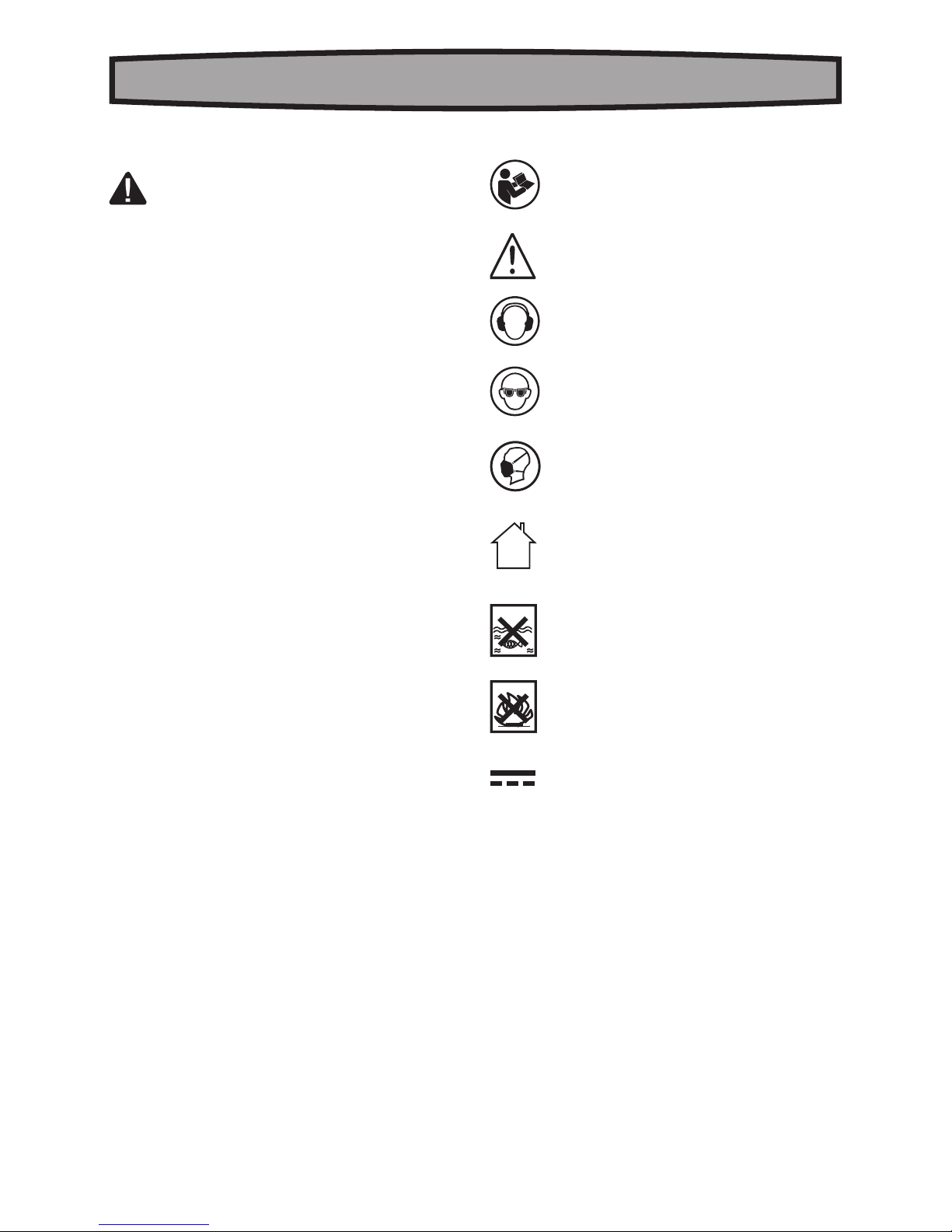
SYMBOLS
To reduce the risk of injury, user must read
instruction manual.
Warning
Wear ear protection
Wear eye protection
Wear dust mask
Indoor use only
Do not expose to rain or water
Do not burn
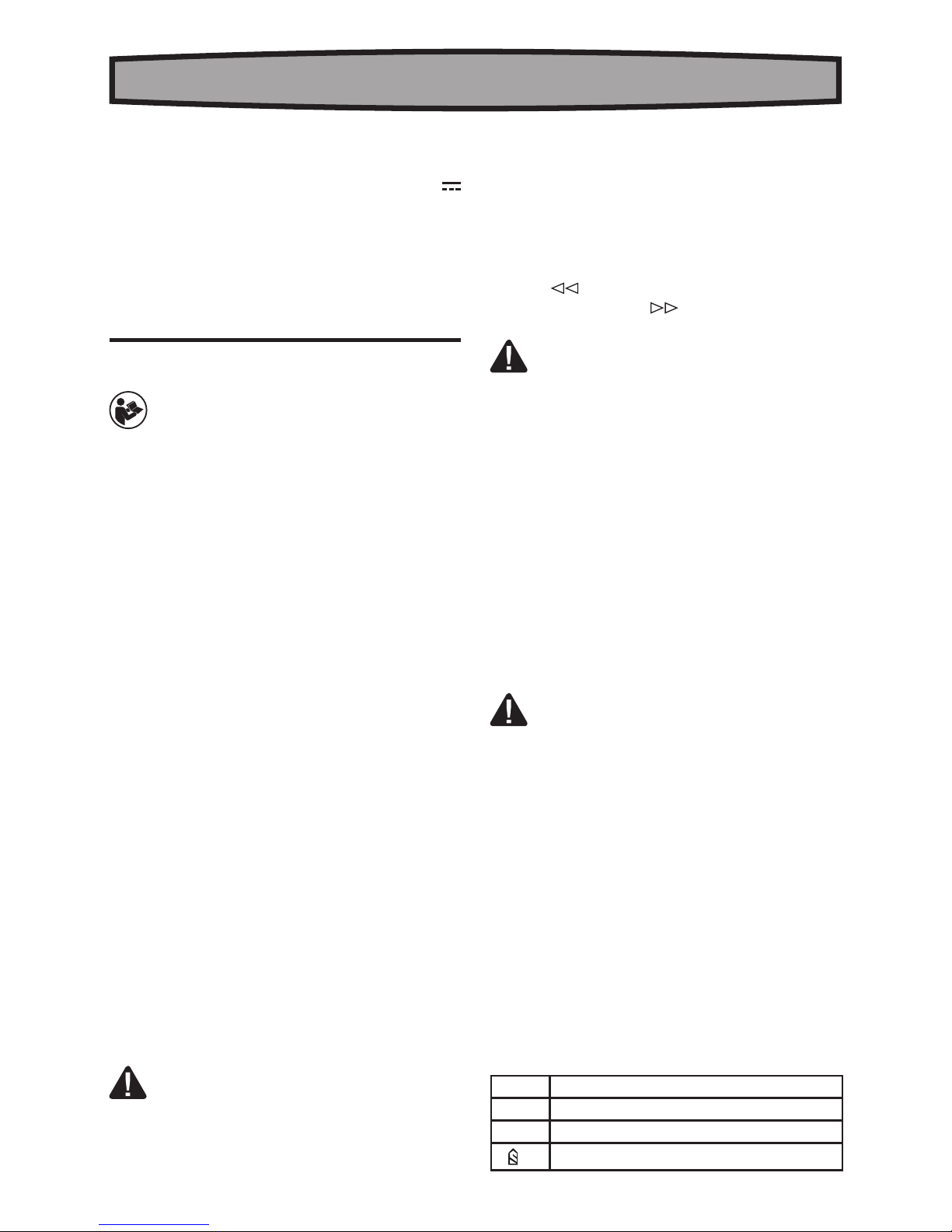
Direct current
Page 8
12 V CORDLESS DRILL/DRIVER ENG
8
TECHNICAL DATA
Charger voltage 120 V~60 Hz
Voltage 12 V
No-load speed 0-350/0-1300/min
Number of clutch positions 15+1
Max torque 210 in.lbs
Check capacity 3/8˝
Max. drilling capacity Steel 3/8˝
Wood 13/16 ˝
Machine weight 2.2 lbs
OPERATING INSTRUCTIONS
NOTE: Before using the tool, read the instruction
book carefully.
CHARGING
A) BATTERY CHARGING
The battery charger supplied is matched to the Li-ion
battery installed in the machine. Do not use another
battery charger.
The Li-ion battery is protected against deep
discharging. When the battery is empty, the machine is
switched off by means of a protective circuit: The chuck
no longer rotates.
In a warm environment or after heavy use, the battery pack
may become too hot to permit charging. Allow time for the
battery to cool down before recharging.
When the battery is charged for the first time and
after prolonged storage, the battery will only accept
approximately 60% charge. However, after several charge
and discharge cycles the battery will accept a 100% charge.
B) TO REMOVE OR INSTALL BATTERY PACK (SEE A)
Depress the battery pack release button to release and
slide the battery pack out from your tool. After recharge,
slide it back into your tool. A simple push and slight
pressure will be sufficient.
OPERATION
1. ON / OFF SWITCH (SEE B)
Depress the On/Off switch to start and release it to stop
your drill. The on/off switch is fitted with a brake function
which stops your chuck immediately when you quickly
release the switch.
It is also a variable speed switch that delivers higher
speed and torque with increased trigger pressure. Speed
is controlled by the amount of switch trigger depression.
WARNING: Do not operate for long periods
at low speed because excess heat will be
produced internally.
2. SWITCH LOCK
The switch trigger can be locked in the OFF position. This
helps to reduce the possibility of accidental starting when
not in use. To lock the switch trigger, place the rotation
control in the center position.
3. REVERSIBLE (SEE B)
For drilling and screw driving use forward rotation
marked “
” (lever is moved to the left). Only use
reverse rotation marked “
” (lever is moved to the
right) to remove screws or release a jammed drill bit.
WARNING: Never change the direction of
rotation when the chuck is rotating, wait
until it has stopped!
4. TWO-SPEED GEAR CONTROL (SEE C)
The drill has a two-speed gear control designed for
drilling or driving at LO (mark is 1) or HI (mark is 2)
speeds. A slide switch is located on top of the drill to
select either LO or HI speed. When using the drill in the
LO speed range, the speed will decrease and the drill will
have greater power and torque. When using the drill in
the HI speed range, the speed will increase and the drill
will have less power and torque.
Gear I
Low speed range: For screwdriving or working with large
drilling diameter.
Gear II
High speed range: For working with small drilling diameter.
WARNING: To prevent gear damage,
always allow the chuck to come to a
complete stop before changing the direction of
rotation or the two-speed gear control.
5. CHUCK ADJUSTMENT (SEE D)
To open the chuck jaws rotate the front section of the
chuck. Insert the drill bit between the chuck jaws and
rotate the front section in the opposite direction. Ensure
the drill bit is in the center of the chuck jaws. Finally,
firmly rotate the front chuck section in the opposite
directions. Your drill bit is now clamped in the chuck.
6. TORQUE ADJUSTMENT (SEE E)
(Screw driving force of your drill driver)
The torque is adjusted by rotating the torque adjustment
ring. The torque is greater when the torque adjustment
ring is set on a higher setting. The torque is less when
the torque adjustment ring is set on a lower setting.
Make the setting as follows:
1 - 4 for driving small screws
5 - 9 for driving screws into soft material
10-15 for driving screws into soft and hard material
for heavy drilling
Page 9
12 V CORDLESS DRILL/DRIVER ENG
9
7. AUTOMATIC SPINDLE LOCK (SEE F)
The automatic spindle lock allows you to use it as a
regular screwdriver. You can give an extra twist to firmly
tighten a screw, loosen a very tight screw or continue
working when the battery energy has expired. For
manual screwdriver purposes, the chuck is automatically
locked when the tool is off.
8. USING THE LED LIGHT
The sight light allows you to keep a clear view under less
illuminated circumstances. To turn on the light simply
press the on/off switch. When you release the on/off
switch, the light will be off.
LED is also a battery capacity indicator. It will flash when
power gets low.
9. DRILLING
When drilling into a hard smooth surface, use a center
punch to mark the desired hole location. This will prevent
the drill bit from slipping off center as the hole is started.
Hold the tool firmly and place the tip of the bit at the
point to be drilled. Depress the switch trigger to start the
tool. Move the drill bit into the workpiece, applying only
enough pressure to keep the bit cutting. Do not force or
apply side pressure to elongate a hole.
Tungsten carbide drill bits should always
be used for concrete and masonry. When
drilling in metal, only use HSS drill bits in good
condition. Always use a magnetic bit holder (not
included) when using short screwdriver bits.
When screw-driving, apply a small quantity of
liquid soap or similar to the screw threads to
ease insertion.
10. DISPOSAL OF AN EXHAUSTED BATTERY PACK
To preserve natural resources, please recycle
or dispose of the battery pack properly. This
battery pack contains Lithium batteries.
Consult your local waste authority for information
regarding available recycling and/or disposal options.
Discharge your battery pack by operating your drill, then
remove the battery pack from the drill housing and cover
the battery pack connections with heavy-duty adhesive
tape to prevent short circuit and energy discharge. Do
not attempt to open or remove any of the components.
PROBLEM SOLUTION
1. WHY DOES THE DRILL NOT TURN ON WHEN YOU
PRESS THE SWITCH?
The forward/reverse rotation control, which is on top of
the trigger, is positioned in the lock function. Unlock the
forward/reverse rotation control by putting it into the
required rotation position. Push the trigger and the drill
will start to rotate.
2. THE DRILL STOPS BEFORE THE SCREW IS
COMPLETELY TIGHTENED. WHY?
Verify the torque position of the torque adjusting ring,
you can find the torque-adjusting ring between the
chuck and the drill body. Position 1 is the lowest torque
(screw driving force) and position 15 is the highest
torque (screw driving force). Position 16 is for drill
operation. Regulate the torque adjusting ring to a higher
position to reach the best result.
3. REASONS FOR DIFFERENT BATTERY PACK
WORKING TIMES
Charging time problems, as above, and having not
used a battery pack for a prolonged time will reduce
the battery pack working time. This can be corrected
after several charge and discharge operations by
charging and working with your drill. Heavy working
conditions such as large screws into hard wood will use
up the battery pack energy faster than lighter working
conditions. Do not re-charge your battery pack below
32°F (0°C) and above 113°F (45°C) as this will affect
performance.
MAINTENANCE
Your tool requires no additional lubrication or
maintenance.
There are no user serviceable parts in your power tool.
Never use water or chemical cleaners to clean your
power tool. Wipe clean with a dry cloth. Always store your
power tool in a dry place. Keep the motor ventilation slots
clean. Keep all working controls free of dust. Occasionally
you may see sparks through the ventilation slots. This is
normal and will not damage your power tool.
Page 10

12 V CORDLESS DRILL/DRIVER ENG
10
2-YEAR WARRANTY STATEMENT
If your Rockwell tool becomes defective due to faulty
materials or workmanship within a period of 2 years
from the date of purchase, we guarantee to:
• Replaceorrepairalldefectiveparts,freeofcharge,
or.
• Repairproductsfreeofcharge,or.
• Replacetheunitwithaneworre-conditionedunit,
free of charge.
Your warranty is subject to the following conditions:
• Batterypacksareguaranteedfora12monthperiod
only.
• Thetoolhasnotbeenmisused,abused,neglected,
altered, modified or repaired by anyone other than
an authorized service center.
• OnlygenuineRockwellaccessoriesandpartshave
been used on or with the product
• Thetoolhasbeensubjectedtofairwearandtear.
• Thetoolhasnotbeenusedforrentalpurposes.
• Thetoolhasnotsustaineddamagethroughforeign
objects, substances or accidents.
Your warranty does not cover:
• Componentsthataresubjecttonaturalwearand
tear caused by use in accordance with operating
instructions.
• Unauthorized/impropermaintenance/handlingor
overload are excluded from this warranty as are
accessories such as bulbs, blades and bits, etc.
For guarantee claims, please contact the Rockwell
Helpline and you will need to submit a proof of purchase
in the form of a valid receipt that displays date and place
of purchase.
We may require the tool be sent postage prepaid to
an authorized service center, along with all original
equipment.
Rockwell Helpline 866-514-ROCK(7625)
This guarantee statement does not replace but is in
addition to your statutory rights.
This warranty does not apply to accessories supplied
with the tool.
This warranty applies only to the original purchaser and
may not be transferred.
All repairs and replacement tools will be covered by the
limited warranty for the balance of the warranty period
from the date of the original purchase.
Limited 30-Day exchange policy
During the first 30 days after date of purchase, you may
exchange a tool which does not work properly due to
defects in materials or workmanship by returning the
power tool to the retailer where it was purchased. To
receive a replacement power tool, you must present
a dated proof of purchase and return all original
equipment packaged with the original product. The
replacement power tool will be covered by the limited
warranty for the balance of the two year period from the
date of the original purchase.
Page 11
12 V OLTIOS TALADRO INALAMBRICO ESP
11
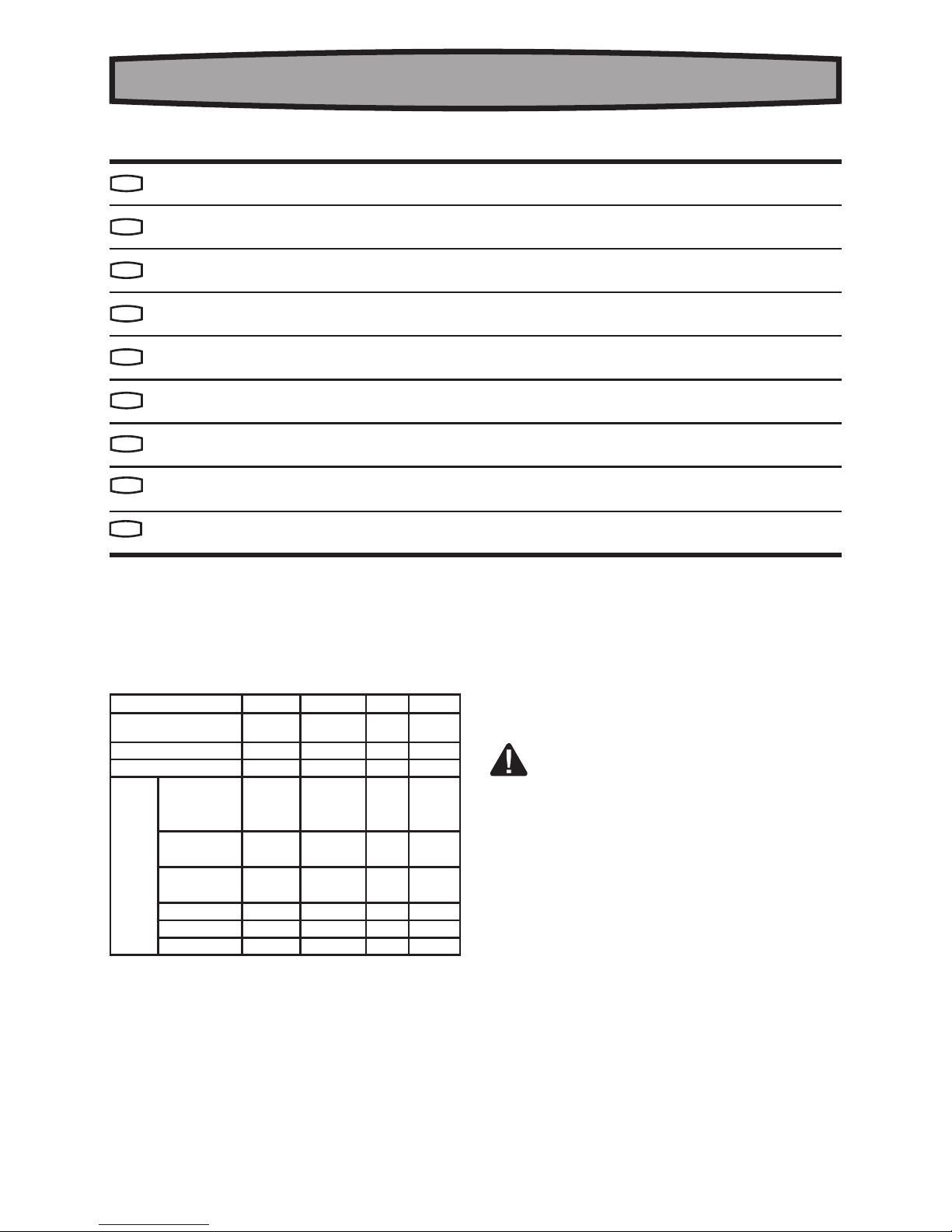
LISTA DE PARTES
MANDRIL SIN LLAVE
EMBRAGUE AJUSTABLE
CONTROL DE VELOCIDAD ALTA/BAJA
BOTÓN DE ADELANTE/ATRÁS/TRABA
MANGO BLANDO
LENGÜETAS DE LIBERACIÓN DE LAS BATERÍAS
PAQUETE DE BATERÍAS *
GATILLO DE ENCENDIDO/APAGADO CON CONTROL DE VELOCIDAD VARIABLE
LUZ DE VISTA
* No todos los accesorios ilustrados o descritos se incluyen junto con el producto estándar.
1
2
3
4
5
6
7
8
9
ACCESORIOS
RK2510K2
RK2510K2.1
RK 2510 RK2510K
Puntas reversibles 1 1 1 1
Bloc-piles (RW9300) 2 2 / 1
Cargador (RW9400) 1 1 / 1
PUCK
TM
Soporte
magnético de
puntas
/ 1 / /
PH1, PH2(X2),
PH3
/ 4 / /
SQ1,
SQ2(X2), SQ3
/ 4 / /
6-8, 8-10 / 2 / /
T15, T20, T25 / 3 / /
4,5 / 2 / /
Le recomendamos que compre todos los accesorios en
la tienda donde adquirió la herramienta. Use accesorios
de buena calidad una marca bien conocida. Seleccione
los que más convengan al trabajo que intenta hacer.
Consulte el empaque de los accesorios para obtener
más detalles. El personal de la tienda también puede
ayudarle y aconsejarle.
ADVERTENCIAS DE SEGURIDAD
GENERALES PARA LA
HERRAMIENTA MOTORIZADA
¡ADVERTENCIA! Lea y comprenda todas
las instrucciones. El no seguir todas
las instrucciones a continuación puede ocasionar
descargas eléctricas, incendios y/o heridas graves.
Conserve todas las advertencias e instrucciones
para consulta futura.
El término “ herramienta eléctrica” que figura en todas
las advertencias que aparecen a continuación hace
referencia a la herramienta que funciona con la red
de suministro eléctrico (con cable) o a la herramienta
eléctrica accionada a baterías (sin cable).
1. ÁREA DE TRABAJO
a) Mantenga su lugar de trabajo limpio y bien
iluminado. Bancos de trabajo desordenados y
lugares oscuros invitan a los accidentes.
b) No utilice herramientas eléctricas en
atmósferas explosivas, como por ejemplo en
presencia de líquidos, inflamables, gases o
Page 12

12 V OLTIOS TALADRO INALAMBRICO ESP
12
polvo. Las herramientas eléctricas crean chispas
que pueden encender el polvo o los vapores.
c) Mantenga a los espectadores, niños y
visitantes a una distancia prudente cuando
esté utilizando una herramienta eléctrica. Las
distracciones pueden hacerle perder el control.
2. SEGURIDAD ELÉCTRICA
a) Los enchufes de las herramientas eléctricas
deben coincidir con el tomacorriente.
No modifique de algún modo el enchufe.
No utilice enchufes adaptadores con
herramientas eléctricas conectadas a tierra.
Si no se modifican los enchufes y se utilizan los
tomacorrientes adecuados, se reducirá el riesgo de
una descarga eléctrica.
b) Evite el contacto del cuerpo con las
superficies conectadas a tierra tales como
tuberías, radiadores, estufas de cocina y
refrigeradores. Existe mayor riesgo de que se
produzcan descargas eléctricas si su cuerpo está
conectado a tierra.
c) No exponga las herramientas eléctricas a la
lluvia ni a los ambientes húmedos. La entrada
de agua en una herramienta eléctrica aumenta el
riesgo de que se produzcan descargas eléctricas.
d) No abuse del cable. Nunca use el cable para
transportar las herramientas ni para sacar el
enchufe de un tomacorriente. Mantenga el cable
alejado del calor, el aceite, los bordes afilados o las
piezas móviles. Los cables dañados aumentan el
riesgo de que se produzcan descargas eléctricas.
e) Cuando utilice una herramienta eléctrica en
exteriores, utilice un cable de extensión apto
para uso exterior. La utilización de un cable
de extensión reducirá el riesgo de una descarga
eléctrica.
f) Si no se puede evitar la utilización de una
herramienta motorizada en una ubicación
húmeda, utilice un suministro de alimentación
protegido por un interruptor de circuito
accionado por corriente de pérdida a tierra
(GFCI). El uso de un GFCI reduce el riesgo de
descarga eléctrica.
3. SEGURIDAD PERSONAL
a) Manténgase alerta, fíjese en lo que está
haciendo y use el sentido común cuando
utilice una herramienta eléctrica. No use
la herramienta cuando esté cansado o se
encuentre bajo la influencia de drogas,
alcohol o medicamentos. Un momento de
distracción al utilizar herramientas eléctricas puede
dar lugar a lesiones personales graves.
b) Utilice equipo de seguridad. Use siempre
protección ocular. La utilización del equipo de
seguridad como mascara antipolvo, zapatos de
seguridad antideslizantaes, casco o protección
auditiva para condiciones adecuadas reducirá el
riego de lesiones personales.
c) Evite el arranque accidental. Asegúrese de
que el interruptor esté en la posición de
trabado o de apagado antes de instalar el
paquete de baterías. Transportar herramientas
con el dedo en el interruptor o instalar el paquete de
batería cuando el interruptor está encendido invitan
a los accidentes.
d) Retire las llaves o claves de ajuste antes de
encender la herramienta. Una llave o clave
de ajuste dejada en una parte giratoria de la
herramienta puede causar una lesión personal.
e) No intente alcanzar demasiado lejos.
Mantenga un apoyo de los pies y un equilibrio
adecuados en todo momento. El apoyo de
los pies y el equilibrio adecuados permiten un
mejor control de la herramienta en situaciones
inesperadas.
f) Vístase apropiadamente. No se ponga ropa
holgada ni joyas. Mantenga su cabello, ropa
y guantes alejados de las piezas móviles.
La ropa holgada, las joyas o el pelo largo pueden
quedar atrapados en las piezas móviles.
g) Si se proporcionan dispositivos para la
extracción y recolección de polvo, asegúrese
que estos estén conectados y utilizados
correctamente. El uso de estos dispositivos puede
reducir peligros relacionados con el polvo.
4. USO Y CUIDADO DE LA HERRAMIENTA
a) No fuerce la herramienta. Emplee la
herramienta correcta para la aplicación que
desea. La herramienta correcta hará el trabajo
mejor y con más seguridad a la capacidad nominal
para la que está diseñada.
b) No utilice la herramienta si el interruptor no
Page 13

12 V OLTIOS TALADRO INALAMBRICO ESP
13
la enciende o apaga. Toda herramienta que no
se pueda controlar con el interruptor es peligrosa y
debe ser reparada.
c) Desconecte la batería de la herramienta o
ponga el interruptor en la posición de trabado
o de apagado antes de hacer cualquier
ajuste, cambio de accesorios o guardar
la herramienta. Estas medidas de seguridad
preventivas reducen el riesgo de encender la
herramienta accidentalmente.
d) Guarde las herramientas que no esté usando
fuera del alcance de los niños y otras
personas no capacitadas. Las herramientas
son peligrosas en las manos de los usuarios no
capacitados.
e) Mantenga las herramientas con cuidado.
Compruebe la desalineación o el atasco de
las piezas móviles, la ruptura de piezas y
cualquier otra situación que pueda afectar
el funcionamiento de las herramientas. Si la
herramienta está dañada, hágala arreglar
antes de usarla. Muchos accidentes son causados
por herramientas mantenidas deficientemente.
f) Conserve las herramientas de corte afiladas
y limpias. Las herramientas mantenidas
adecuadamente, con bordes de corte afilados,
tienen menos probabilidades de atascarse y son
más fáciles de controlar.
g) Utilice la herramienta eléctrica, accesorios,
brocas de la herramienta, etc. de acuerdo con
estas instrucciones y de la manera adecuada
para el tipo de herramienta eléctrica, teniendo
en cuenta las condiciones de trabajo y el
trabajo que se realizará. La utilización de la
herramienta eléctrica para operaciones diferentes
de aquellas para las que se encuentra diseñada
podría dar lugar a una situación peligrosa.
h) Fijar la pieza sobre la mesa estable con clip o
medios alternativos.
i) Fijar la pieza de mano o la apoyar contra el cuerpo
llevará a cabo la operación inestable, podrá estar
fuera de control.
5. UTILIZACIÓN Y CUIDADO DE LA HERRAMIENTA
ACCIONADA A BATERÍAS
a) Una herramienta accionada a baterías que
tenga baterías integradas o un paquete de
baterías separado se debe recargar solamente
con el cargador especificado para la batería.
Un cargador que puede ser adecuado para un
tipo de batería puede crear un peligro de incendio
cuando se usa con otra batería.
b) Utilice la herramienta accionada a baterías
solamente con el paquete de baterías
designado específicamente. El uso de cualquier
otra batería puede crear un peligro de incendio.
c) Cuando el paquete de baterias no se usa,
manténgalo alejado de otros objetos
metálicos como: sujetapapeles, monedas,
clavos, tornillos u otros pequeños objetos de
metal capaces de hacer una conexión entre
los terminales. El cortocircuito de los terminales
de una batería puede causar chispas, quemaduras o
incendio.
d) Bajo condiciones abusivas, la batería puede
expulsar líquido; evite el contacto. Si ocurre
un contacto accidental, enjuagar con agua.
Si el líquido entra en contacto con los ojos, busque
ayuda médica. El líquido expulsado por la batería
puede causar irritación o quemaduras.
6. REPARACIÓN
a) La herramienta debe ser reparada por una
persona calificada de servicio técnico y se
deben utilizar partes de reemplazo idénticas.
Esto asegurará el mantenimiento de la seguridad de
la herramienta eléctrica.
¡ADVERTENCIA! El polvo originado por la
utilización de herramientas motorizadas
contiene químicos que, según el Estado de
California, causan cáncer, defectos congénitos y
otros daños reproductivos. Algunos ejemplos de
esos productos químicos son:
• Elplomodelaspinturasabasedeplomo.
• Lasílicecristalinadelosladrillos,del.
cemento y de otros productos de albañilería
• Elarsénicoyelcromodelamaderatratada
químicamente.
El riesgo que se corre a causa del contacto con
esos productos varía según la frecuencia con
que usted realice este tipo de trabajos. Con el
fin de reducir su exposición a esas substancias
químicas: trabaje en un área bien ventilada;
utilice un equipo de seguridad adecuado, tal
como una máscara contra el polvo especialmente
diseñada para filtrar partículas microscópicas.
Page 14

12 V OLTIOS TALADRO INALAMBRICO ESP
14
INFORMACIÓN DE
SEGURIDAD ADICIONAL DE LA
HERRAMIENTA
1. La batería puede perder líquido bajo condiciones
extremas de uso o de temperatura. Si el fluido de la
batería entra en contacto con la piel, lávela con agua
y jabón y enjuáguela con jugo de limón y vinagre. Si
el fluido entra en contacto con los ojos, enjuáguelos
con agua durante varios minutos y llame a un
médico inmediatamente.
2. Nunca queme la batería, puede explotar en el fuego.
3. No cargue una batería con pérdidas.
4. El uso de un accesorio o un cargador no
recomendado o vendido por el fabricante del taladro
puede ocasionar un riesgo de incendio, choques
eléctricos o lesiones personales.
5. En caso de duda, antes de perforar una pared,
revise con un detector de metal/voltaje para
asegurarse de que no va a perforar líneas de
suministro de electricidad, gas o agua.
6. Antes de dejar la herramienta, asegúrese de que
todas las partes móviles se hayan detenido.
7 . Evite los atascamientos frecuentes al atornillar o
perforar, ya que podría dañar la batería.
8. Conecte únicamente el cargador a un tomacorriente
de CA.
9. Cargue la batería usando solamente el dispositivo de
carga correcto.
10. El dispositivo de carga y el taladro deben protegerse
contra la humedad.
11. No utilice el cargador en el exterior.
12. Cargue siempre el paquete de batería bajo
temperaturas de entre 36º F y 95º (2º C y 35º C). La
temperatura ideal de carga es entre 65º F et 84º F
(18º C y 29º C).
13. No ponga en cortocircuito los contactos de la batería
o del cargador.
14. Respete la polaridad “+/-” al cargar la batería.
15. Conserve estas instrucciones. Consúltelas con
frecuencia y úselas para enseñarles a las otras
personas que podrían usar esta herramienta. Si le
presta esta herramienta a alguien, asegúrese de que
tenga estas instrucciones.
16. Use los asideros auxiliares que se suministran
con la herramienta. La pérdida de control puede
provocar lesiones personales.
17. Lleve protectores auditivos cuando use la
broca de impacto. La exposición a ruido puede
producir la pérdida de la audición.
18. Sujete la herramienta por las áreas de agarre
aisladas cuando realice una operación en
la que la herramienta de corte pueda entrar
en contacto con cables ocultos o con su
propio cable. El contacto con un cable que tenga
corriente hará que ésta pase a las partes metálicas
descubiertas de la herramienta y que el operador
reciba descargas eléctricas.
ADVERTENCIA! Podría derramarse una
pequeña cantidad de electrolito de
la batería en condiciones extremas de uso o
temperatura. Evite el contacto con la piel y los
ojos. Lávese inmediatamente la piel y manos
con agua limpia. Si entra en contacto con sus ojos,
lávelos bien con agua limpia y busque asistencia médica
inmediata.
Page 15
12 V OLTIOS TALADRO INALAMBRICO ESP
15
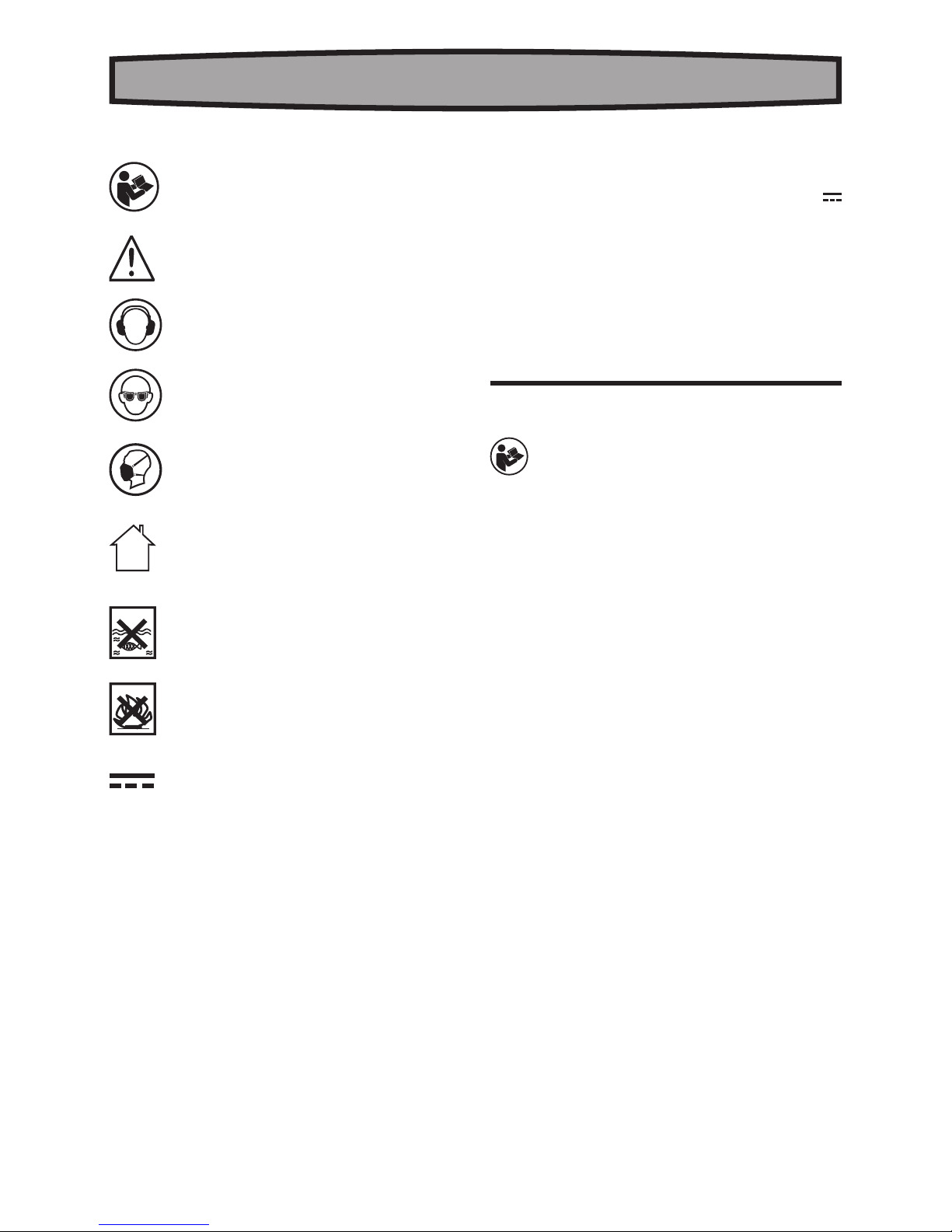
SÍMBOLOS DATOS TÉCNICOS
Voltios 120 V~60 Hz
Tensión nominal 12 V
Velocidad sin carga 0-350/0-1300 rpm
Posición de torque 15+1
Torque máximo 210 lb-pulg
Capacidad máx. Del mandril 3/8 pulg. (10 mm)
Capacidad de perforación Acero
3/8 pulg. (10 mm)
Madera
13/16 pulg. (21 mm)
Peso 2.2 libras
INSTRUCCIONES DE USO
NOTA: Antes de usar la herramienta, lea
atentamente el manual de instrucciones.
RECARGA DE LAS BATERÍAS
A) CARGANDO LA BATERÍA
El cargador de batería suministrado está diseñado para
la batería de Li-Ion instalada en la herramienta. No
utilice otro cargador de baterías.
La batería de Li-Ion está protegida contra descargas
excesivas. Cuando la batería está agotada, la
herramienta se desconecta a través de un circuito de
protección: El soporte de la herramienta deja de girar.
En un ambiente caluroso o luego de mucho uso, la
batería puede calentarse demasiado como para aceptar
carga. Permita que se enfríe antes de cargarla.
Cuando cargue la batería por primera vez o luego de no
usarla por mucho tiempo, aceptará sólo el 60% de la
carga. Sin embargo, luego de varios ciclos de carga y
descarga aceptará el 100% de la carga.
B) PARA EXTRAER O INSTALAR LA BATERÍA (VER A)
Presione la traba de liberación de la batería y extráigala
de la herramienta. Luego de la recarga, deslice la
batería en el puerto para la batería de la herramienta.
Basta con deslizarla y ejercer una leve presión.
USO
1.
GATILLO DE ENCENDIDO/APAGADO CON FUNCIÓN
DE FRENO (VER FIG B)
Oprima el gatillo para poner en marcha el taladro y
suéltelo para apagarlo. El gatillo tiene una función de
freno que detiene el mandril de inmediato si se suelta
rápidamente.
Esta herramienta cuenta con un gatillo de velocidad
variable que brinda mayor velocidad y torque cuando se
incrementa la presión. La velocidad se controla mediante
Advertencia– Para reducir el riesgo de
lesiones, el usuario deberá leer el manual de
instrucciones.
Advertencia
Use protección auditiva
Use lentes de seguridad
Use máscara contra el polvo
Úsela en el interior solamente
No exponer a la lluvia ni al agua
No arrojar al fuego
Corriente directa
Page 16
12 V OLTIOS TALADRO INALAMBRICO ESP
16
la cantidad de presión aplicada en el gatillo.
ADVERTENCIA: No la use por mucho
tiempo a velocidades bajas ya que podría
recalentarse.
2. BLOQUEO DEL GATILLO
El gatillo puede ser bloqueado en la posición APAGADO.
Esto ayuda a reducir la posibilidad de que el taladro
comience a funcionar accidentalmente cuando no está
en uso. Para bloquear el gatillo coloque el selector
de rotación en el centro presionando los botones de
dirección en los costados del taladro.
3. DIRECCIÓN DE ROTACIÓN REVERSIBLE (VER FIG B)
Para perforación y atornillado utilice la rotación hacia
adelante marcada “
” (la palanca se mueve hacia
la izquierda). Use la rotación inversa marcada “
”
(a palanca se mueve hacia la derecha) solamente para
retirar los tornillos o para liberar una broca atascada.
ADVERTENCIA: ¡Nunca cambie la dirección de
funcionamiento mientras la herramienta esté
rotando, espere hasta que se haya detenido!
4. ENGRANAJES DE DOS VELOCIDADES (VER FIG C)
El taladro tiene un tren de engranajes de dos velocidades
diseñado para taladrar o atornillar a velocidad baja (LO)
(1) o alta (HI) (2). En la parte superior del taladro se
encuentra una llave deslizable para seleccionar velocidad
baja (LO) (1) o alta (HI) (2). Cuando el taladro sea utilizado
en el la posición de velocidad (LO) (1), la velocidad
disminuirá y el taladro tendrá mayor potencia y torque.
Cuando sea utilizado en la posición de velocidad (HI) (2),
la velocidad se incrementará y el taladro tendrá menos
potencia y torque.
Velocidad I
Baja velocidad: para atornillar o practicar perforaciones
de gran diámetro
Velocidad II
Alta velocidad: para practicar perforaciones de pequeño
diámetro
AVERTENCIA: Para evitar daños a los
engranajes, deje que la herramienta
se detenga completamente antes de cambiar
la dirección de rotación o los engranajes de
velocidad.
5. AJUSTE DEL MANDRIL (VER FIG D)
Para abrir las mordazas del mandril gire la parte frontal
del mismo mientras sostiene la parte posterior. Inserte
la broca entre las mordazas y gire la parte frontal en
dirección opuesta, mientras sostiene la parte posterior.
Cerciórese de que la broca se encuentre centrada en las
mordazas del mandril. Finalmente, gire con firmeza las
dos partes del mandril en dirección opuesta. La broca se
encuentra ahora firmemente introducida en el mandril.
6. AJUSTE DE TORQUE (VER FIG E)
(Fuerza de atornillado de su taladro destornillador)
El torque se ajusta girando el anillo de ajuste del torque.
El torque es mayor cuando el anillo de ajuste se coloca
en un número más alto. El torque es menor cuando el
anillo de ajuste se coloca en un número más bajo.
Realice los ajustes como se muestra a continuación:
1 - 4 para instalar tornillos pequeños
5 - 9 para instalar tornillos en materials blandos
10 - 15
para instalar con tornillos en materiales
blandos y duros
para taladrado prolongado
7. BLOQUEO AUTOMÁTICO DEL EJE (VER FIGURA F)
El bloqueo automático del eje permite utilizar esta
herramienta como un destornillador común. Puede usarlo
para agregar una vuelta más a fin de ajustar firmemente
un tornillo, aflojar alguno muy duro o bien para continuar
trabajando cuando la batería se ha descargado. A los
fines del uso como destornillador manual, cabe destacar
que el mandril está automaticamente trabado cuando la
herramienta se encuentra apagada.
8. USO DE LA LUZ
La luz permite mantener una clara visión en condiciones
de iluminación inadecuadas. Para encender la luz
simplemente presione el botón de encendido. Cuando
suelte el interruptor de encendido/apagado, la luz se
apagará.
El LED es también un indicador de capacidad de la
batería. Parpadeará cuando la capacidad sea baja.
9. PERFORACIÓN
Cuando taladre una superficie dura y lisa utilice un
punzón para marcar la ubicación deseada del orificio.
Así evitará que la broca se desplace del lugar cuando
comience a agujerear. Para taladrar, sostenga la
herramienta con firmeza y ubique la punta de la broca
en el punto marcado. Apriete el gatillo para poner en
marcha la herramienta. Aplique sólo la presión necesaria
para que la broca continúe cortando. No fuerce o aplique
presión lateral para alargar un agujero.
ADVERTENCIA: Siempre utilice un
portabrocas magnético cuando emplee
puntas destornilladoras cortas. Cuando trabaje
con el destornillador aplique a las roscas de los
tornillos una pequeña cantidad de jabón líquido o
producto similar, para facilitar la inserción.
Page 17

12 V OLTIOS TALADRO INALAMBRICO ESP
17
10. CÓMO DESECHAR UNA BATERÍA AGOTADA
Para preservar los recursos naturales, recicle
o deseche el paquete de baterías de manera
apropiada. Este paquete de baterías contiene
baterías de Li. Para obtener mayor información acerca de
las diferentes opciones de reciclaje y desecho, consulte
con la autoridad local en materia de control de residuos.
Descargue el paquete de baterías haciendo funcionar el
taladro, luego extráigalo y cubra las conexiones con cinta
adhesiva de alta resistencia para evitar un cortocircuito y
la descarga de energía. No intente abrir o sacar ninguno
de sus componentes.
RESOLUCIÓN DE PROBLEMAS
1. POR QUÉ EL TALADRO NO SE ENCIENDE AL
PRESIONAR EL GATILLO?
El interruptor de marcha hacia adelante y atrás,
situado en la parte superior del gatillo, está colocado
en la función de bloqueo. Destrábelo colocándolo en la
posición de rotación requerida. Accione el gatillo y el
taladro comenzará a girar.
2. EL TALADRO SE DETIENE ANTES DE QUE EL
TORNILLO ESTÉ COMPLETAMENTE APRETADO.
¿POR QUÉ?
Verifique la posición de torque que tiene el aro de ajuste.
Este aro se encuentra entre el mandril y el cuerpo del
taladro. La posición 1 corresponde al torque más bajo
(fuerza de atornillado) y la posición 21 al torque más alto
(fuerza de atornillado). La posición 22 corresponde a la
función taladro. Regule el torque llevando el aro a una
posición más alta para obtener el mejor resultado.
3. RAZONES DE LOS DISTINTOS TIEMPOS DE
FUNCIONAMIENTO DEL PACK DE BATERÍA
Los problemas de tiempo de carga, como se señaló
arriba, y el hecho de no haber usado la batería por un
largo tiempo reducen el rendimiento del paquete de
batería. Esto puede remediarse luego de varios ciclos
de carga/descarga, utilizando su taladro. Condiciones
severas de trabajo, como por ejemplo tornillos grandes
en madera dura, agotarán más rápido la energía de la
batería que si se trabajara en condiciones más suaves.
No recargue su paquete de batería por debajo de 0ºC
(32ºF) ni por encima de 45ºC (113°F), ya que esto
afectará el rendimiento.
MANTENGA LAS
HERRAMIENTAS CON CUIDADO
Su herramienta no requiere lubricación ni mantenimiento
adicional.
No posee piezas en su interior que puedan ser reparadas
por el usuario. Nunca emplee agua o productos químicos
para limpiar su herramienta. Use simplemente un paño
seco. Guarde siempre su herramienta en un lugar seco.
Mantenga limpias las ranuras de ventilación del motor.
La observación de chispas que destellan bajo las ranuras
de ventilación, indica operación normal que no dañará su
herramienta.
DECLARACIÓN DE GARANTÍA DE
2 AÑOS
Si su herramienta Rockwell presenta algún problema
derivado de un defecto de materiales o mano de obra
durante un periodo de 2 años a partir de la fecha de
compra, se garantiza:
• Lasustituciónoreparaciónsincargodetodaslas
piezas defectuosas,
• Lareparacióndetodoslosproductossincargo,o
• Lasustitucióndelaunidadsincargoporunanueva
o reacondicionada.
La garantía se encuentra sujeta a las siguientes
condiciones:
• Lasbateríasposeenunagarantíadesólo12meses.
• Elproductonodebehabersidosometidoamal
uso, abuso, negligencia, alteración, modificación o
reparación por parte de cualquier entidad ajena a la
red de centros de asistencia autorizados.
• Debenhaberseutilizadoúnicamentepiezasy
accesorios originales de Rockwell Shop Series en el
producto o en conjunto con el mismo.
• Elproblemanodebeserproductodeldesgastey
deterioro naturales.
• Noseutilizólaherramientaparanesdealquiler.
• Elproductonodebehaberrecibidodaños
provocados por objetos extraños, sustancias de
cualquier tipo o accidentes.
Su garantía no cubre:
• Aquelloscomponentessometidosaldesgastey
deterioro naturales derivados de su funcionamiento
de acuerdo con las instrucciones de uso.
• Seexcluyendeestagarantíalamanipulación
Page 18

12 V OLTIOS TALADRO INALAMBRICO ESP
18
o mantenimiento no autorizado o incorrecto de
la herramienta, así como los accesorios como
bombillas, hojas, brocas, etc.
Si desea realizar una reclamación, póngase en contacto
con la línea de asistencia de Rockwell. Deberá enviar
una prueba de compra en forma de recibo válido de
venta en el que figure la fecha y el lugar de compra.
Es posible que solicitemos que se envíe la herramienta
con un franqueo prepago al centro de asistencia
autorizado, junto con todos los accesorios originales.
Línea de asistencia de Rockwell 866-514-ROCK
(7625)
Esta declaración de garantía no sustituye sus derechos
legales, sino que los complementa.
Esta garantía no es aplicable a los accesorios
suministrados con la herramienta.
Esta garantía solo es aplicable al comprador original y
no puede ser transferida.
Todas las reparaciones y sustituciones de productos
quedarán cubiertas un periodo de garantía limitada
equivalente al periodo de garantía restante desde la
fecha de compra original.
Garantía limitada de reemplazo por 30 Días
Durante los primeros 30 días luego de la fecha de
compra, podrá reemplazar una herramienta que no
funcione correctamente debido a defectos de material
o fabricación devolviéndola a la tienda donde la haya
comprado. Para recibir una herramienta de reemplazo,
deberá presentar un comprobante de compra fechado y
devolver todo el material de empaque original junto con
el producto.
La herramienta reemplazada seguíra cubierta por una
garantia limitada basada en el balance de el periodo de
dos años desde la fecha original de la compra.
Page 19
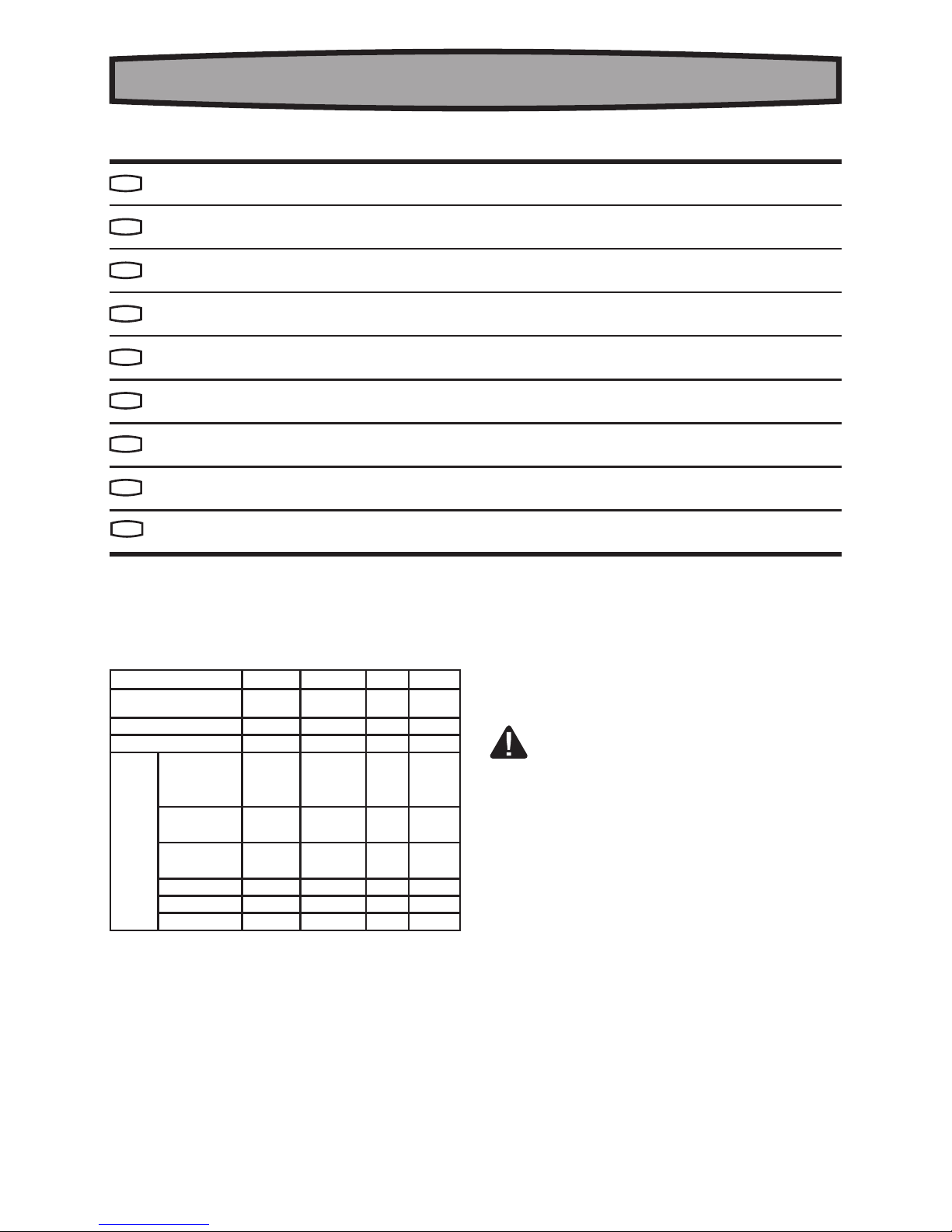
PERCEUSE/TOURNEVIS À 12 V FRE
19
LISTE DES ÉLÉMENTS
MANDRIN SANS CLÉ
NIVEAU DE COUPLE
COMMANDE BASSE VITESSE / HAUTE VITESSE DE LA BOÎTE D¹ENGRENAGES
SÉLECTEUR DE SENS DE ROTATION
POIGNÉE SOUPLE
MÉCANISME DE RETENUE DU BLOC-PILES
BLOC-PILES *
INTERRUPTEUR MARCHE/ARRÊT AVEC COMMANDE DE VITESSE
LUMIÈRE DE VISIBILITÉ
* Les accessoires illustrés ou décrits ne sont pas tous compris dans le cadre de la livraison standard.
1
2
3
4
5
6
ACCESSOIRES
RK2510K2
RK2510K2.1
RK 2510 RK2510K
Embout de tournevis 1 1 1 1
Batterie (RW9300) 2 2 / 1
Chargeur (RW9400) 1 1 / 1
PUCK
TM
Support
d'embouts
magnétique
/ 1 / /
PH1, PH2(X2),
PH3
/ 4 / /
SQ1,
SQ2(X2), SQ3
/ 4 / /
6-8, 8-10 / 2 / /
T15, T20, T25 / 3 / /
4,5 / 2 / /
Nous vous recommandons d’acheter tous vos
accessoires au même magasin où vous avez acheté
l’outil. N’utilisez que des accessoires de bonne qualité
et de marque renommée. Choisissez le type d’outil
approprié au travail que vous désirez entreprendre. Pour
de plus amples renseignements, consultez l’emballage
de l’accessoire. Le personnel du magasin peut
également vous conseiller.
AVERTISSEMENTS GENERAUX
CONCERNANT LA SECURITE DES
OUTILS ELECTRIQUES
AVERTISSEMENT! Lisez et assimilez
toutes les instructions. Le non-respect des
instructions ci-après peut entraîner un risque de choc
électrique, d’incendie et/ou de blessures graves.
Conservez tous les avertissements et instructions
pour pouvoir les consulter ultérieurement.
L’expression « outil électrique » dans tous les
avertissements énumérés ci-dessous se réfère à votre
outil électrique fonctionnant sur secteur (branché) ou à
batterie (sans-fil).
1.
AIRE DE TRAVAIL
a) Veillez à ce que l’aire de travail soit propre et
bien éclairée. Le désordre et le manque de lumière
favorisent les accidents.
b) N’utilisez pas d’outils électriques dans un
milieu présentant un risque d’explosion, par
exemple en présence de liquides, de gaz ou de
poussières inflammables. Les outils électriques
7
8
9
Page 20

PERCEUSE/TOURNEVIS À 12 V FRE
20
créent des étincelles qui pourraient enflammer les
poussières ou les vapeurs.
c) Gardez à distance les curieux, les enfants et
les visiteurs lorsque vous travaillez avec un
outil électrique. Ils pourraient vous distraire et
vous faire faire une fausse manoeuvre.
2. SÉCURITÉ ÉLECTRIQUE
a) Les fiches des outils électriques doivent
correspondre aux prises murales. Ne jamais
modifier la fiche de quelque façon que ce soit.
Ne pas utiliser de fiches d’adaptation avec
des outils électriques mis à la terre (mis à la
masse). Des fiches non modifiées et des prises
qui leur correspondent réduiront le risque de choc
électrique.
b) Évitez tout contact corporel avec des surfaces
mises à la terre (tuyauterie, radiateurs,
cuisinières, réfrigérateurs, etc.). Le risque de
choc électrique est plus grand si votre corps est en
contact avec la terre.
c) N’exposez pas les outils électriques à la
pluie ou à l’eau. La présence d’eau dans un outil
électrique augmente le risque de choc électrique.
d) Ne maltraitez pas le cordon. Ne transportez
jamais l’outil par son cordon et ne débranchez
jamais la fiche en tirant sur le cordon.
N’exposez pas le cordon à la chaleur, à des
huiles, à des arrêtes vives ou à des pièces en
mouvement. Un cordon endommagé augmente le
risque de choc électrique.
e) Quand vous utilisez un outil électrique à
l’extérieur, utilisez une rallonge qui convient à
un usage à l’extérieur. Ces cordons sont prévus
pour être utilisés à l’extérieur et pour réduire le
risque de choc électrique.
f) Si l’utilisation d’un outil électrique dans un
endroit humide est inévitable, utilisez une
alimentation protégée par un disjoncteur de
fuite de terre (GFCI). L’utilisation d’un GFCI réduit
les risques d’électrocution.
3. SÉCURITÉ DES PERSONNES
a) Restez alerte, concentrez-vous sur votre
travail et faites preuve de bon sens. N’utilisez
pas un outil électrique si vous êtes fatigué
ou sous l’influence de drogues, d’alcool ou
de médicaments. Un instant d’inattention lors de
l’utilisation d’outils électriques peut entraîner des
blessures graves.
b) Utilisez des accessoires de sécurité.
Portez toujours une protection oculaire.
De l’équipement de sécurité tel que le masque
antipoussière, les chaussures de sécurité
antidérapantes, des casques durs ou des
protections antibruit utilisés dans des conditions
appropriées réduiront les blessures corporelles.
c) Évitez les démarrages accidentels. Avant
d’insérer la batterie dans l’outil, assurez-vous
que son interrupteur est en position « OFF »
(Arrêt) ou verrouillée. Le fait de transporter un
outil avec le doigt sur la détente/l’interrupteur ou
d’insérer la batterie dans un outil dont la détente
est en position « ON » (Marche) peut causer un
accident.
d) Retirer les clés de réglage avant de mettre
l’outil sous tension. Une clé restée attachée à
une partie mobile de l’outil pourrait entraîner des
blessures corporelles.
e) Ne vous penchez pas trop en avant. Maintenez
un bon appui et restez en équilibre en tout
temps. Une bonne stabilité vous permet de mieux
réagir à une situation inattendue.
f) Habillez-vous convenablement. Ne portez
ni vêtements flottants ni bijoux. Gardez les
cheveux, les vêtements et les gants éloignés
des pièces en mouvement. Les vêtements
flottants, les bijoux ou les cheveux longs risquent
d’être happés par des pièces en mouvement.
g) Si un sac de récupération de la poussière est
fourni avec un connecteur pour aspirateur,
assurez vous qu’il est correctement relié
et utilisé de façon appropriée. L’utilisation
de ce système réduit les dangers physiques et
physiologiques liés à la poussière.
4. UTILISATION ET ENTRETIEN DE L’OUTIL
a) Ne forcez pas l’outil. Utilisez l’outil approprié
à la tâche. L’outil approprié fonctionne mieux et de
façon plus sécuritaire. Respectez aussi la vitesse de
travail qui lui est propre.
b) N’utilisez pas un outil si l’interrupteur ne le
met pas en marche ou ne peut l’arrêter. Un
outil qui ne peut être contrôlé par l’interrupteur est
dangereux et doit être réparé.
Page 21

PERCEUSE/TOURNEVIS À 12 V FRE
21
c) Débranchez la batterie de l’outil ou mettez
son interrupteur en position « OFF » (Arrêt) ou
« LOCKED » (Verrouillé) avant d’effectuer un
réglage, de changer d’accessoire ou de ranger
l’outil. De telles mesures de sécurité préventive
réduisent le risque de démarrage accidentel de
l’outil.
d) Rangez les outils hors de portée des enfants
et d’autres personnes inexpérimentées. Les
outils sont dangereux dans les mains d’utilisateurs
novices.
e) Prenez soin de bien entretenir les outils.
Soyez attentif à tout désalignement ou
coincement des pièces en mouvement, à tout
bris ou à toute autre condition préjudiciable
au bon fonctionnement de l’outil. Si vous
constatez qu’un outil est endommagé, faitesle réparer avant de vous en servir. De nombreux
accidents sont causés par des outils en mauvais
état.
f) Les outils de coupe doivent être toujours bien
affûtés et propres. Des outils bien entretenus,
dont les arêtes sont bien tranchantes, sont moins
susceptibles de se coincer et plus faciles à contrôler.
g) Utilisez l’outil électrique, les accessoires
et les forets etc., en conformité avec ces
instructions et de la manière conçue pour
le type particulier d’outil électrique, prend
en compte les conditions de travail et le
travail qui doit être accompli. L’emploi de l’outil
électrique pour des opérations différentes de celles
pour lesquelles il a été conçu pourrait entraîner une
situation dangereuse.
h) Inférieur dont la température et l’humidité soient
contrôlabes pour éviter le polluant électrique,et fixer
les pièces à raffiner sur une table stable avec pince
ou par d’autres façons.
i) Les opération comme fixation des pièces à raffiner
par main ou contre le corps soient conduire à une
déstabilisation, et peut-être un dérapage.
5. UTILISATION DE LA BATTERIE ET ENTRETIEN
a) Un outil à batterie avec batteries incorporées
ou une batterie séparée doit être rechargé
uniquement avec le chargeur indiqué pour la
batterie. Un chargeur qui peut être adéquat pour
un type de batterie peut créer un risque d’incendie
lorsqu’il est utilisé avec une autre batterie.
b) Utiliser un outil à batterie uniquement avec la
batterie désignée. L’emploi de toute autre batterie
peut créer un risque d’incendie.
c) Lorsque la batterie n’est pas utilisée, tenez-
la à l’écart d’autres objets métalliques tels
que trombones, pièces de monnaie, clés,
clous, vis ou autres petits objets métalliques
susceptibles d’établir une connexion d’une
borne à une autre. Le court-circuitage des bornes
de batterie peut causer des étincelles, des brûlures,
une explosion ou un incendie.
d) Dans le cadre de conditions d’abus, du
fluide peut être éjecté de la batterie, évitez
tout contact. Si un contact se produisait
accidentellement, rincez abondamment avec
de l’eau. Si le fluide touche les yeux, cherchez en
plus de la mesure précédente de l’aide médicale. Le
fluide éjecté de la batterie peut causer des irritations
ou des brûlures.
6. ENTRETIEN
a) Ayez votre outil électrique entretenu par un
réparateur agréé n’utilisant que des pièces
de rechange identiques. Cela assurera que la
sécurité de l’outil électrique est maintenue.
AVERTISSEMENT! Certaines des
poussières produites en utilisant des
outils électriques sont considérées par l’État de
Californie comme susceptibles de provoquer le
cancer, des anomalies congénitales et d’autres
problèmes de reproduction. Voici des exemples
de ces produits chimiques :
•Plomb issu de peinture à base de plomb.
•Silice crystalline issue de briques et du
ciment et autres produits de maçonnerie.
•Arsenic et chrome issus de bois traité
chimiquement.
Votre risque de ces expositions varie en fonction
de la fréquence à laquelle vous effectuez ce
travail. Pour réduire votre exposition à ces
produits chimiques : travaillez dans une zone
bien ventilée; portez un équipement de sécurité
approuvé, tel que des masques antipoussières
spécialement conçus pour éliminer les particules
microscopiques par filtrage.
Page 22
PERCEUSE/TOURNEVIS À 12 V FRE
22
INSTRUCTIONS
SUPPLÉMENTAIRES
CONCERNANT LA SÉCURITÉ DE
VOTRE OUTIL
1. Un affaiblissement de la batterie peut apparaître
en cas d’utilisation intense ou sous des conditions
extrêmes de température. En cas de contact du
fluide de la batterie avec la peau, laver avec du
savon et rincer avec du jus de citron et du vinaigre.
En cas de contact du fluide avec les yeux, rincer
abondamment à l’eau pendant plusieurs minutes
puis consulter immédiatement un docteur.
2. Ne jamais brûler des piles, elles peuvent exploser
dans un feu.
3. Ne pas charger une pile qui fuit.
4. L’utilisation d’une fixation et d’un chargeur n’est
par recommandée ou vendue par le fabricant de
perceuses, car cela pourrait entraîner un risque
d’incendie, de commotion électrique ou de blessure
corporelle.
5. Avant de percer dans un mur, en cas de doute,
vérifiez au moyen d’un détecteur de métaux/
tension que vous ne percez pas dans des tuyaux
d’approvisionnement en électricité, dans des tuyaux
d’alimentation de gaz naturel ou dans des tuyaux
d’alimentation en eau.
6. Avant de reposer la perceuse, assurez-vous que
toutes les pieces mobiles sont immobilisées.
7. Éviter un piétinement fréquent en vissant ou en
perçant car cela pourrait endommager les piles.
8. Connecter uniquement l’appareil de chargement à
une alimentation fournissant un courant alternatif.
9. Ne chargez la batterie qu’avec le chargeur
approprié.
10. La chargeur et la perceuse doivent être protégés de
l’humidité!
11. Ne pas utiliser l’appareil de chargement à l’extérieur.
12. Toujours recharger la pile dans des ambiances de
température comprises entre 2oC et 35oC (36ºF et
95ºF). La température idéale de chargement se
situe entre 18ºC et 29ºC (65ºF et 84ºF).
13. Ne pas raccourcir les contacts de la batterie ou du
chargeur.
14. Respecter la polarité “+/-“ en cours de chargement.
15. Conservez ces instructions. Reportez-vous y
fréquemment et utilisez-les pour informer d’autres
personnes qui pourraient utiliser cet outil. Si une
autre personne utilise cet outil, assurez-vous de lui
fournir ces instructions.
16. Utiliser les poignées auxiliaires fournies avec
l’outil. Une perte de contrôle peut provoquer des
blessures.
17. Porter des protège-oreilles avec un marteau
perforateur. Une exposition au bruit peut
provoquer une perte auditive.
18. Lors de l’exécution d’une opération au cours
de laquelle l’outil de coupe peut venir en
contact avec les fils cachés ou son propre
cordon, tenez l’outil par ses surfaces isolées
de préhension. Le contact avec un fil sous tension
rendra les pièces métalliques exposées de l’outil
sous tension et causera des chocs à l’opérateur.
AVERTISSEMENT : Une petite quantité
d’électrolyte pourrait couler de la batterie
après une exposition à de fortes températures ou
après une utilisation prolongée. Évitez tout contact
avec la peau et les yeux. Laver immédiatement
la peau et les mains en utilisant de l’eau propre.
En cas de contact avec les yeux, rincer abondamment à
l’eau et consulter immédiatement un médecin.
Page 23
PERCEUSE/TOURNEVIS À 12 V FRE
23
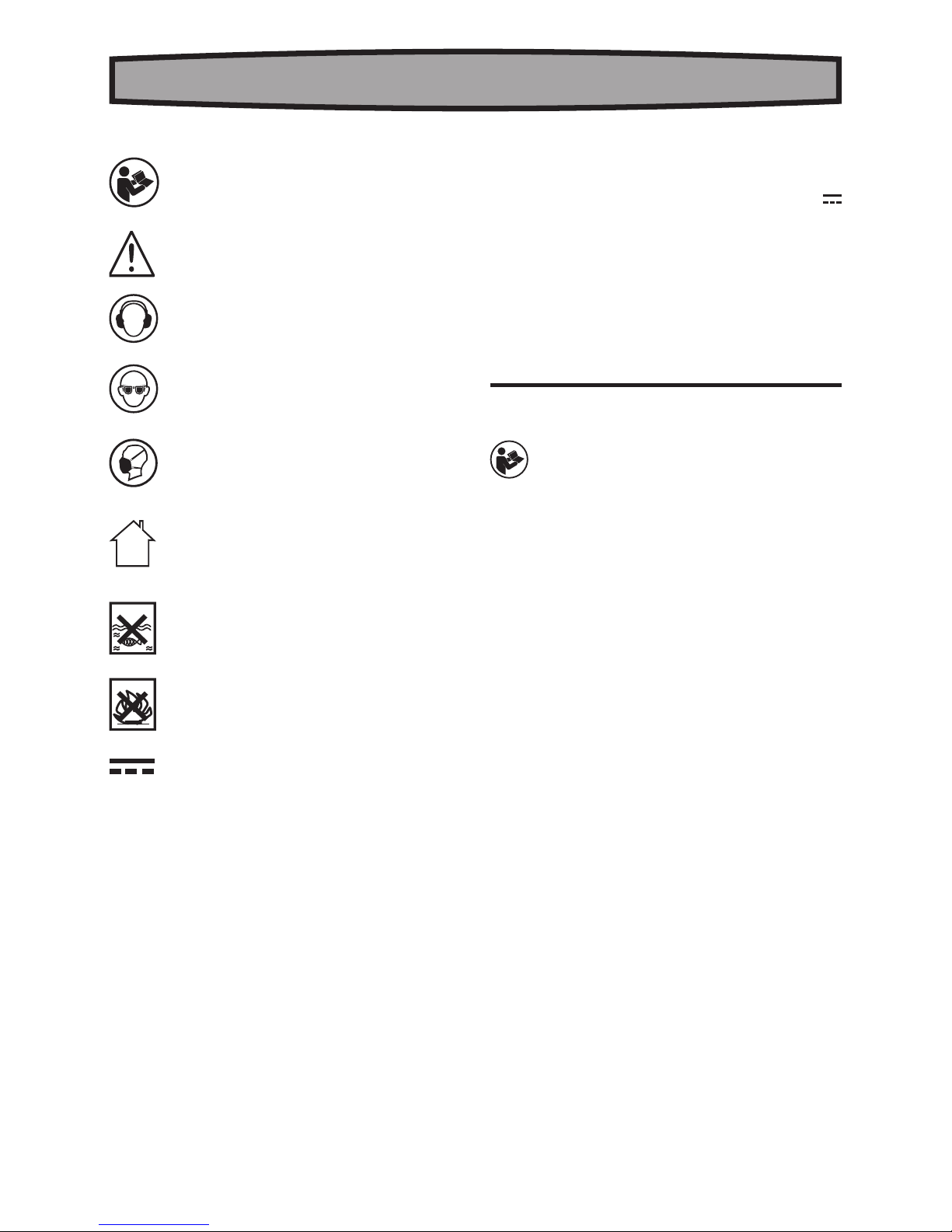
SYMBOLES DONNÉES TECHNIQUES
Tension 120 V~60 Hz
Tension nominale 12 V
Vitesse à vide 0-350 / 0-1300rpm
Position du couple 15+1
Couple maximal 210 po/lb
Calibre du mandrin 10mm (3/8 po)
Diamètres de perçage max Acier 10mm (3/8 po)
Bois 21mm (13/16 po)
Poids 1.0 kg (2 lb)
INSTRUCTIONS D’UTILISATION
REMARQUE: Avant d’utiliser cet outil, assurez-
vous de lire attentivement le manuel d’utilisation.
RECHARGE DE LA BATTERIE
A) CHARGER LA BATTERIE
Le chargeur de batterie fourni s’adapte à la batterie
au Lithium ion installée dans l’appareil. Ne pas utiliser
d’autre chargeur de batterie.
La batterie au Lithium ion est protégée contre une
décharge importante. Lorsque la batterie est vide, la
machine s’éteint grâce à un circuit de protection. La
poignée de l’outil s’arrête de tourner.
Dans un environnement chaud ou après une utilisation
prolongée, le pack de la batterie est trop chaud pour
permettre un chargement. Laisser la batterie se refroidir
un moment avant de recharger.
Lorsque la batterie est chargée pour la première fois et
après un entreposage prolongé, la batterie n’acceptera
qu’un chargement d’environ 60%. Toutefois, après
plusieurs cycles de chargement et déchargement, la
batterie acceptera une chargement à 100%.
B) RETRAIT/RÉINSTALLATION DE LA BATTERIE
(VOIR A)
Enfoncez le système de verrouillage de la batterie et
retirez la batterie de l’outil. Une fois rechargée, replacez
la batterie dans son emplacement. Une simple pression
d’insertion sera suffisante.
UTILISATION
1. INTERRUPTEUR DE MARCHE/ARRÊT AVEC
FONCTION DE FREINAGE (VOIR B)
Appuyez pour démarrer et relâchez pour arrêter la
perceuse. L’interrupteur marche/arrêt est doté d’une
fonction de freinage qui arrête le mandrin dès que
l’interrupteur est relâché rapidement.
Avertissement-Afin de réduire les risques
de blessure, l’utilisateur doit lire ce mode
d’emploi.
Avertissement
Portez des protections pour les oreilles
Portez des protections pour les yeux
Portez un masque anti-poussière
Pour usage à l’intérieur seulement
Ne pas exposez pas à la pluie et à l’eau
Ne pas jeter au feu
Courant continu
Page 24
PERCEUSE/TOURNEVIS À 12 V FRE
24
Cet outil possède une commande à vitesse variable qui
augmente la vitesse de l’outil et du couple avec une plus
grande pression sur la gâchette. La vitesse est contrôlée
par la profondeur de dépression de la gâchette.
AVERTISSEMENT! N’utilisez pas votre
machine à faible vitesse durant de longues
périodes car il existe un risque de surchauffe
interne à cette vitesse.
2. SYSTÈME DE VERROUILLAGE DE L’INTERRUPTEUR
La gâchette de l’interrupteur peut être verrouillée sur
la position arrêt. Cela aide à diminuer les risques de
démarrage accidentels lorsque l’outil est inutilisé.
Pour verrouiller la gâchette de l’interrupteur, placez le
sélecteur de rotation en position intermédiaire au centre.
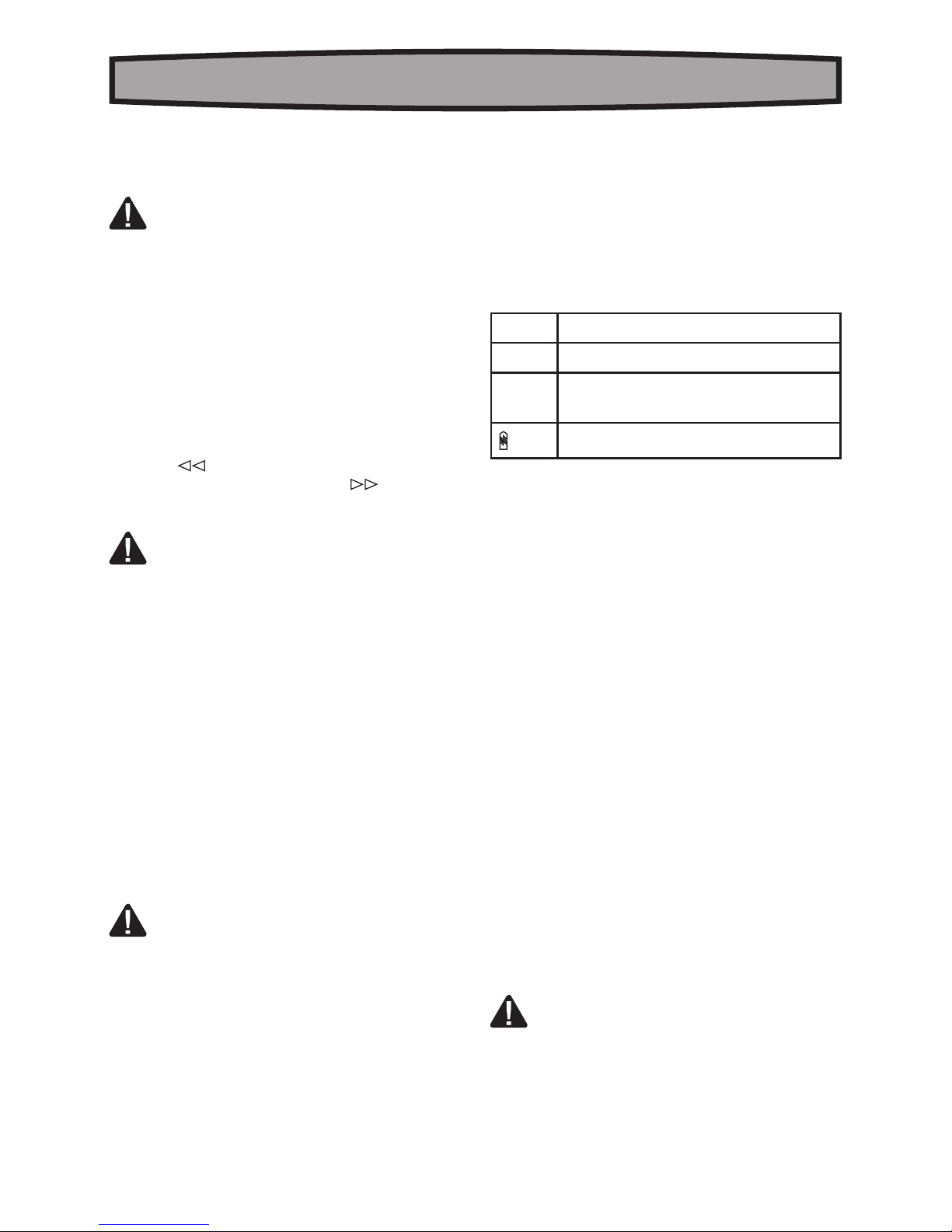
3. ROTATION DIRECTE/INVERSE (VOIR B)
Pour le perçage et le visage, utilisez la rotation avant
marquée “ ” (le levier est déplacé vers la gauche).
N’utilisez la rotation inverse marquée “ ” (le levier
est déplacé vers la droite) que pour retirer les vis ou
libérer un trépan coincé.
AVERTISSEMENT! Ne changez jamais la
direction de la rotation lorsque le mandrin
tourne, attendez qu’il soit arrêté.
4. TRAIN D’ENGRENAGES À DEUX VITESSES (VOIR C)
La perceuse possède un train d’engrenages à deux
vitesses conçu pour percer à une vitesse basse (1) ou
élevée (2). Un interrupteur à glissière est situé en haut de
la perceuse pour sélectionner la vitesse basse ou élevée.
Lors de l’utilisation de la perceuse à la vitesse basse,
la vitesse diminuera et la perceuse aura un couple plus
élevé. Lors de l’utilisation de la perceuse à la vitesse
élevée, la vitesse augmentera et la perceuse aura une
puissance plus élevée.
ENGRENAGE I
Vitesse lente: pour le vissage ou les travaux nécessitant
un grand diamètre de mèche
ENGRENAGE II
Vitesse rapide: pour les travaux nécessitant un petit
diamètre de mèche
AVERTISSEMENT! Pour éviter
d’endommager un engrenage, attendez
toujours que le mandrin soit complètement arrêté
avant de changer le sens de rotation ou le palier
de vitesse via le train d’engrenages.
5. MONTAGE DES FORÊTS ET DES EMBOUTS DE
VISSAGE (VOIR D)
Pour ouvrir les mors du mandrin, faites pivoter la partie
avant du mandrin tout en maintenant la partie arrière.
Insérez le foret dans les mors et faites pivoter la partie
avant dans le sens opposé que précédemment tout en
maintenant la partie arrière. Assurez-vous que le foret
est au centre des mors. Enfin, vissez fermement les deux
parties du mandrin dans des directions opposées. Le
foret est maintenant fixé sur le mandrin.
6. RÉGLAGE DE COUPLE (VOIR E)
(Force rotationnelle pour visser de l’outil)
Le couple se règle en faisant pivoter l’anneau de réglage
de couple. Le couple est plus élevé lorsque l’anneau
est positionné sur un réglage élevé. Le couple est faible
lorsque l’anneau est positionné sur un bas réglage.
Faites les réglages suivants:
1 - 4 pour les petites vis
5 - 9 pour visser dans des matériaux souples
10 - 15 pour visser dans des matériaux souples
ou durs
pour les gros travaux de perçage
7. VERROUILLAGE AUTOMATIQUE DE L’ARBRE (VOIR F)
Le verrouillage automatique de l’arbre permet d’utiliser
la perceuse comme un tournevis manuel. Il permet de
donner un tour supplémentaire de vis pour la visser
fermement, de dévisser une vis très serrée ou de
continuer à travailler lorsque la pile est déchargée.
Pour fin de vissage manuel, le mandrin se bloque
automatiquement lorsque l’outil est arrêté.
8. LUMIERE DE VISIBILITE
La petite lampe vous permet de voir clairement dans les
situations peu éclairées. Pour allumer la lumière, appuyer
simplement sur l’interrupteur marche/arrêt. La lampe
s’éteindra lorsque vous relâchez le bouton marche/arrêt.
Le témoin lumineux permet également d’afficher l’état de
la batterie. Il clignote lorsque la batterie devient faible.
9. PERÇAGE
Lors d’opérations de perçage dans des surfaces dures et
lisses, utilisez un pointeau pour désigner l’emplacement
du trou souhaité. Cela empêchera le foret de glisser
hors du centre lors du début de la réalisation du trou.
Maintenez fermement l’outil et placez le bout du foret
sur la zone à percer. Enfoncez la gâchette pour faire
démarrer l’outil. Enfoncez le foret dans la pièce à
travailler en appliquant uniquement la pression suffisante
pour que la coupe se poursuive. Ne forcez pas ou
n’appliquez pas de force latérale pour évaser le trou.
AVERTISSEMENT! Lors de travaux de
perçage dans du métal, utilisez uniquement
des mèches HSS en bon état. Lors de l’utilisation
de d’embouts de vissage courts, utilisez toujours
un porte-embout magnétique. Lors du vissage,
appliquez une petite quantité de savon liquide ou
autre produit similaire sur les filets de vis pour
faciliter l’insertion.
Page 25

PERCEUSE/TOURNEVIS À 12 V FRE
25
10. DISPOSITION DE BLOCS-PILES
Afin de préserver les ressources naturelles,
recyclez ou jetez le bloc-pile de façon appropriée.
Ce bloc-pile contient des piles au Li. Consultez
les autorités locales de recyclage pour connaître les
solutions de recyclage ou de disposition des déchets
disponibles. Déchargez la pile en faisant fonctionner
l’outil, puis retirez la du boîtier de la perceuse et
recouvrez ses bornes de connexion avec une bande
adhésive très résistante pour éviter les court-circuits
et les décharges d’énergie. N’essayez pas d’ouvrir ou
d’enlever ses différents composants.
PROBLEMES ET SOLUTIONS
1. POURQUOI EST-CE QUE LA MACHINE NE
DÉMARRE PAS LORSQUE J’APPUIE SUR LA
GÂCHETTE ?
Le bouton de rotation directe/inverse au-dessus de la
gâchette est en position centrale verrouillée. Placez-le à
gauche ou à droite puis appuyez sur la gâchette.
2. POURQUOI LA PERCEUSE S’ARRÊTE-T-ELLE
AVANT QUE LA VIS SOIT COMPLÈTEMENT SERRÉE ?
Vérifiez la position de la bague de couple située entre
le mandrin et le corps de la machine. La position 1 est
le couple le plus faible et la position 15 est le couple le
plus élevé. La position 16 est utilisée pour le perçage.
Ajustez la bague sur une valeur plus élevée pour serrer
complètement la vis.
3. QUELLES SONT LES RAISONS DE LA DIFFÉRENCE
D’AUTONOMIE DES BLOCS-PILES ?
Des situations de charge comme celles mentionnées
ci-haut et de stockage prolongé peuvent réduire
l’autonomie et la durée de vie du bloc-pile. Ceci peut
être corrigé après plusieurs cycles de charges et de
décharges. Des conditions de travail sévères, par
exemple de vissage de grosses vis dans du bois dur,
déchargeront plus rapidement le bloc-pile que des
conditions moins sévères. Ne rechargez pas votre pile
en dessous de 32oF(0oC) ni au-dessus de 113oF(45oC)
car ceci affectera ses performances.
PRENEZ SOIN DE VOS OUTILS ET
ENTRETENEZ LES BIEN
Votre outil ne nécessite aucune lubrification ou entretien
supplémentaire.
Il ne comporte aucune pièce à réparer ou à entretenir
par l’utilisateur. N’utilisez jamais de l’eau ou des
nettoyants chimiques pour nettoyer l’outil. Essuyez-le
avec un chiffon sec. Rangez toujours votre outil dans
un endroit sec. Gardez propres les ouvertures de
ventilation du moteur. Si vous remarquez des étincelles
dans les ouvertures de ventilation, ceci est normal et
n’endommagera pas votre outil.
DÉCLARATION DE GARANTIE DE
2 ANS
Si votre outil Rockwell devient défectueux suite à un
défaut de matériaux ou de fabrication dans un délai de
2 ans à compter de la date d’achat, nous garantissons
que nous:
• Remplaceronsourépareronstouteslespièces
défectueuses, sans aucun frais, ou,
• Répareronslesproduitsgratuitement,ou
• Remplaceronsl’appareilavecunneufouune
nouvelle unité reconditionnée, gratuitement.
La garantie est soumise aux conditions suivantes:
• Lesbatteriessontgarantiespourunepériodede12
mois seulement.
• Leproduitn’apasétémalutilisé,maltraités,
négligé, altéré, modifié ou réparé par quelqu’un
d’autre qu’un centre de service agréé.
• SeulementdesaccessoiresetpiècesRockwell
d’origine ont été utilisés sur ou avec le produit
• Leproduitaétésoumisàuneusurenormale.
• Leproduitn’apasétéutilisépourdeslocations.
• Leproduitn’apassubidedommagespardesobjets
étrangers, des substances ou accidents.
La garantie ne couvre pas;
• Lescomposantsquisontsoumisàl’usure
naturelle causée par l’utilisation conformément aux
instructions de fonctionnement.
• Unmauvaisentretien,unemauvaisemanipulation,
des manipulations non autorisées ou une surcharge;
de plus, les accessoires tels que les ampoules, les
lames et les mèches, etc. ne sont pas couverts pas
la garantie.
Page 26

PERCEUSE/TOURNEVIS À 12 V FRE
26
Pour des réclamations, contacter la ligne téléphonique
de Rockwell. Vous devrez présenter une preuve d’achat
sous la forme d’un reçu valide qui affiche la date et le
lieu d’achat.
Nous pouvons exiger l’envoi en port payé de l’outil à un
centre de service autorisé, avec tous les équipements
d’origine.
Ligne téléphonique de Rockwell 866-514-ROCK
(7625)
Cette déclaration de garantie ne se substitue pas mais
s’ajoute à vos droits statutaires.
Cette garantie ne s’applique pas aux accessoires fournis
avec l’outil.
Cette garantie ne s’applique qu’à l’acheteur d’origine et
peut ne pas être transférer.
Toutes les réparations et tous les remplacements de
produit seront couverts par la garantie limitée pour le
reste de la période de garantie à partir de la date d’achat
initial.
Politique d’échange limitée de soixante (30) jours
Un outil qui ne fonctionne pas correctement à
cause d’un défaut de pièce ou de main-d’œuvre est
échangeable durant les soixante (30) premiers jours
après la date d’achat en rapportant l’outil au détaillant
où il a été acheté. Pour obtenir un outil de remplacement
vous devez présenter une preuve d’achat datée et
retourner l’outil dans son emballage original. L’outil
remplacé sera couvert par la balance de la garantie
limitée de deus ans.
Page 27

Page 28

Copyright © 2011, Positec. All Rights Reserved.
 Loading...