

Page 1

Version 1.1
Page 2

Page 3

3
Club
Spot
500
CT
Table of contents
1. Safety instructions..................................................................................................................... 4
2. Operating determinations......................................................................................................... 4
3. Description of the device.......................................................................................................... 5
4. Installation.................................................................................................................................. 6
4.1 Fitting the lamp........................................................................................................................... 6
4.2 Lamp adjustment........................................................................................................................ 7
4.3 Inserting / Exchanging gobos.................................................................................................. 7
4.4 Manual zoom............................................................................................................................... 7
4.5 Connection to the mains............................................................................................................ 8
4.6 Changing the power supply settings ........................................................................................8
4.7 Rigging the xture...................................................................................................................... 9
4.8 DMX-512 connection/connection between xtures ...............................................................10
5. DMX protocol - version 1.0...................................................................................................... 12
6. Controller mode .......................................................................................................................14
6.1 DMX addressing ........................................................................................................................14
6.2 Remotely controllable functions............................................................................................. 14
7. Stand - alone mode.................................................................................................................. 15
8. Control menu map.................................................................................................................... 16
9. Control menu............................................................................................................................18
9.1 Fixture Address ........................................................................................................................18
9.2 Slave control ...........................................................................................................................18
9.3 Fixture informations ................................................................................................................18
9.4 Personality ............................................................................................................................19
9.5 Lamp On/Off............................................................................................................................. 20
9.6 Test sequences ........................................................................................................................20
9.7 Stand-alone setting ................................................................................................................. 20
9.8 Reset functions ........................................................................................................................21
9.9 Special functions .....................................................................................................................21
10. Error and information messages.......................................................................................... 21
11. Technical specications........................................................................................................ 22
12. Maintenance and cleaning..................................................................................................... 25
Page 4

4
5
CAUTION! Keep this device away from rain and moisture!
Unplug mains lead before opening the housing!
FOR YOUR OWN SAFETY, PLEASE READ THIS USER MANUAL CAREFULLY
BEFORE YOU INITIAL START - UP!
1. Safety instructions
Every person involved with installation and maintenance of this device have to:
- be qualiled
- follow the instructions of this manual
CAUTION! Be careful with your operations. With a high voltage you can suffer
a dangerous electric shock when touching the wires!
This device has left our premises in absolutely perfect condition. In order to maintain this condition and to ensure a safe operation, it is absolutely necessary for the user to follow the safety instructions and warning notes written in this manual.
Important:
The manufacturer will not accept liability for any resulting damages caused by the non-observance of this manual or any
unauthorized modication to the device.
Please consider that damages caused by manual modications to the device are not subject to warranty.
Never let the power-cord come into contact with other cables! Handle the power-cord and all connections with the mains
with particular caution!
Make sure that the available voltage is not higher than stated on the rear panel.
Always plug in the power plug least. Make sure that the power-switch is set to off -position before you connect the device
to the mains. The power-plug has to be accessable after installing the device.
Make sure that the power-cord is never crimped or damaged by sharp edges. Check the device and the power-cord from
time to time.
Always disconnect from the mains, when the device is not in use or before cleaning it. Only handle the power-cord by the
plug. Never pull out the plug by tugging the power-cord.
This device falls under protection class I. Therefore it is essential to connect the yellow/green conductor to earth.
The electric connection, repairs and servicing must be carried out by a qualied employee.
Do not connect this device to a dimmer pack.
Do not switch the xture on and off in short intervals as this would reduce the lamp’s life.
During the initial start-up some smoke or smell may arise. This is a normal process and does not necessarily mean that
the device is defective.
Do not touch the device’s housing bare hands during its operation (housing becomes hot)!
For replacement use lamps and fuses of same type and rating only.
CAUTION ! EYEDAMAGES !
Avoid looking directly into the light source (meant especially for epileptics) !
2. Operating determinations
This device is a moving-head spot for creating decorative effects and was designed for indoor use only.
If the device has been exposed to drastic temperature uctuation (e.g. after transportation), do not switch it on immediately. The arising condensation water might damage your device. Leave the device switched off until it has reached room
temperature.
Page 5
5
Never run the device without lamp!
Do not shake the device. Avoid brute force when installing or operating the device.
Never lift the xture by holding it at the projector-head, as the mechanics may be damaged. Always hold the xture at the
transport handles.
When choosing the installation-spot, please make sure that the device is not exposed to extreme heat, moisture or dust.
There should not be any cables lying around. You endanger your own and the safety of others!
The minimum distance between light-output and the illuminated surface must be more than 2 meters.
Make sure that the area below the installation place is blocked when rigging, derigging or servicing the xture.
Always x the xture with an appropriate safety-rope. Fix the safety-rope at the correct holes only.
Only operate the xture after having checked that the housing is rmly closed and all screws are tightly fastened.
The lamp must never be ignited if the objective-lens or any housing-cover is open, as discharge lamps may explose and
emit a high ultraviolet radiation, which may cause burns.
The maximum ambient temperature 40° C must never be exceeded. Otherwise, the lamp is switched off and the xture
is out of operation for 5 minutes.
CAUTION! The lens has to be replaced when it is obviously damaged,
so that its function is impaired, e. g. due to cracks or deep scratches!
Operate the device only after having familiarized with its functions. Do not permit operation by persons not qualied for
operating the device. Most damages are the result of unprofessional operation!
CAUTION! The lamp has to be replaced when it is damaged
or deformed due to the heat!
Please use the original packaging if the device is to be transported.
Please consider that unauthorized modications on the device are forbidden due to safety reasons!
If this device will be operated in any way different to the one described in this manual, the product may suffer damages
and the guarantee becomes void. Furthermore, any other operation may lead to dangers like short-circuit, burns, electric
shock, burns due to ultraviolet radiation, lamp explosion, crash etc.
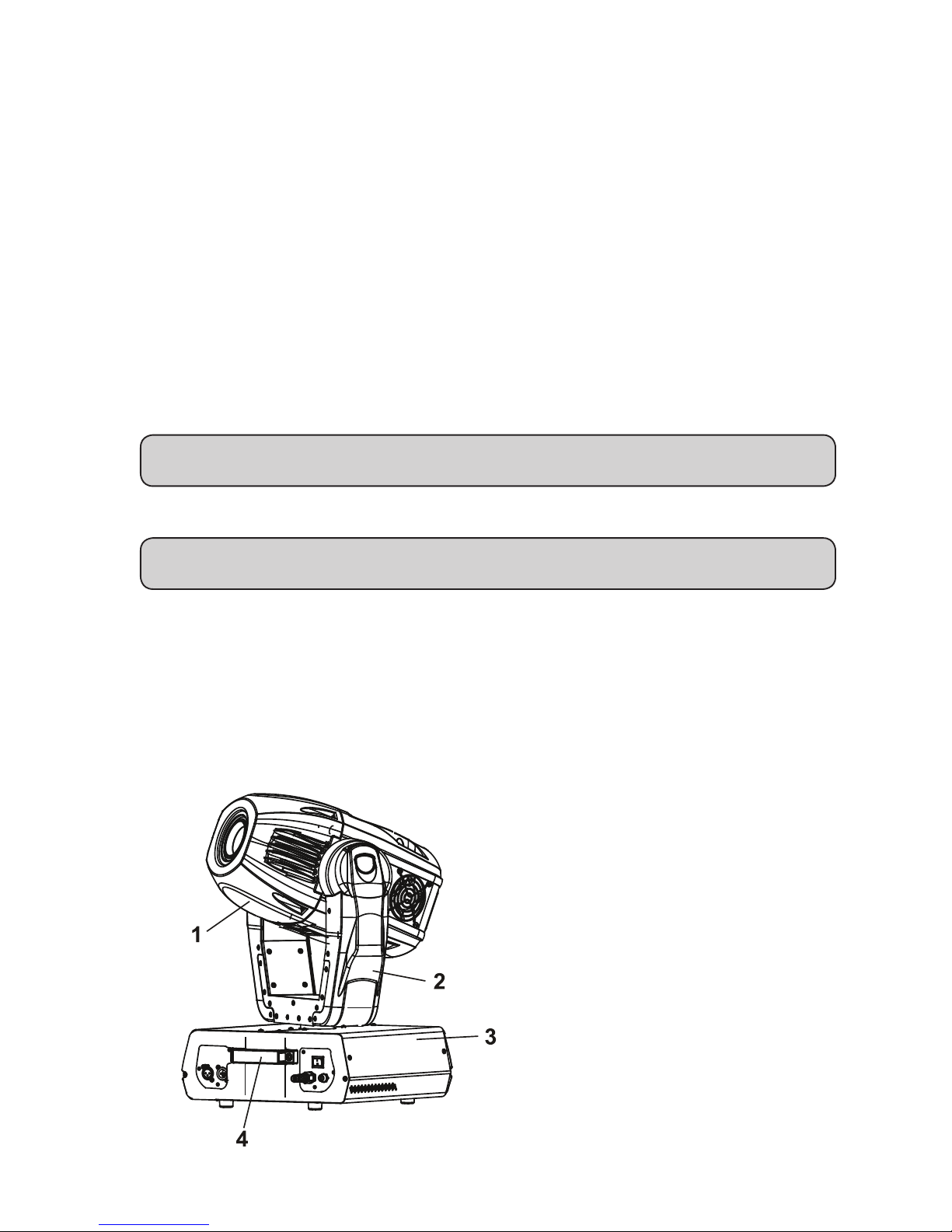
3. Description of the device
1 - Moving head
2 - Yoke
3 - Base
4 - Handle
Page 6
6
7
4. Installation
4.1 Fitting the lamp
DANGER ! Install the lamps with the device switched off only.
Unplug from mains before !
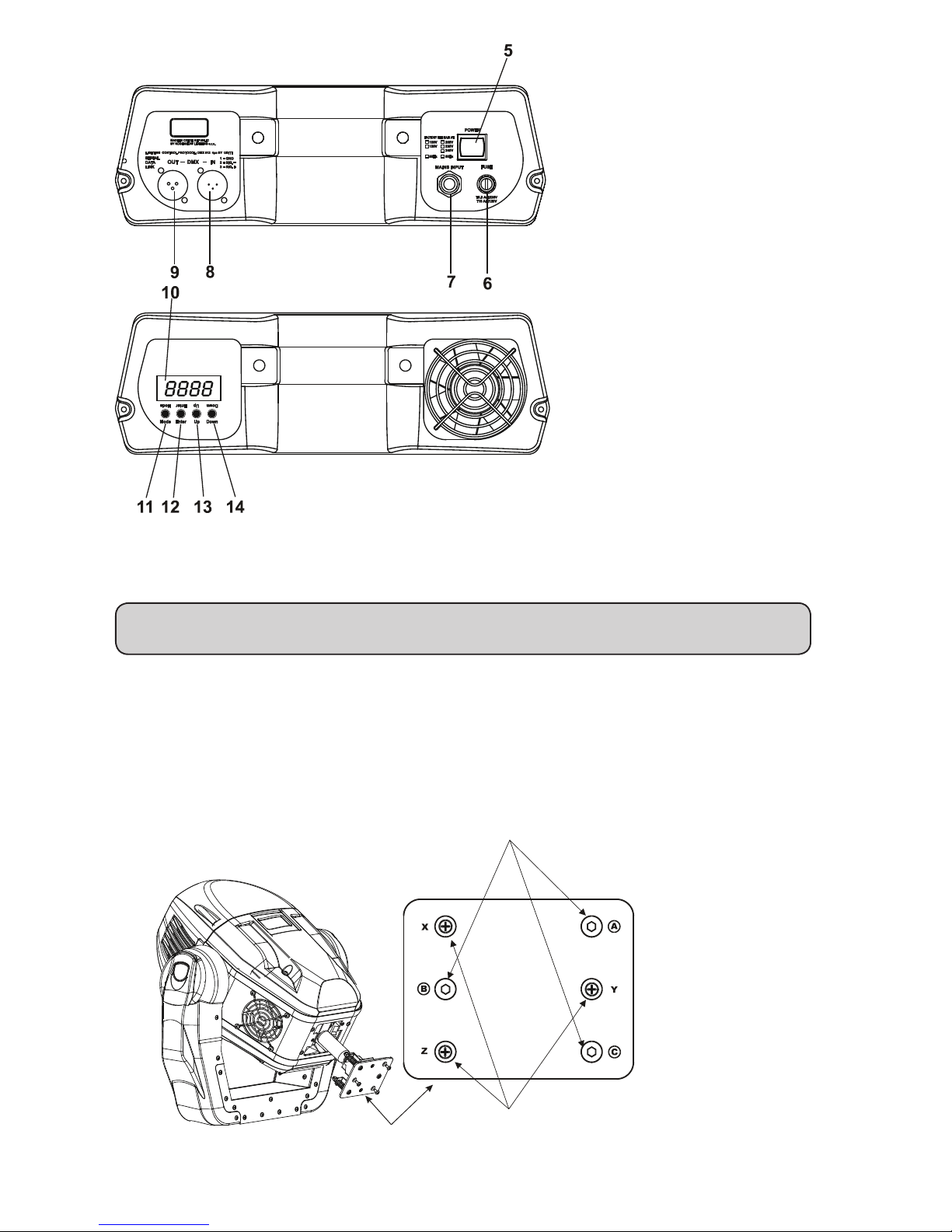
To insert the lamp MSR 575/2 loosen the lamp cover at the rear of head (see the drawings ) by remowing the 3 fastening
screws which are marked „X,Y,Z”. Carefully pull out the cover with the lamp socket assembly.If changing the lamp, remove
the old lamp from the socket. Insert the lamp to the socket.
Do not install a lamp with a higher wattage! A lamp like this generates temperatures the device is not designed for. Damages
caused by non-observance are not subject to warranty. Please follow the lamp manufacturer‘s notes! Do not touch the glass-
-bulb with bare hands during the installation! Make sure that the lamp is installed tightly into the lampholder system.
Reclose the lamp cover and tighten the 3 screws.
Before striking the lamp, reset the “LAti”and “LASt” counter s in the menu of the Control Board, by pressing the “Up”
and “Down” buttons in one time and then conrming with the Enter-button.
Front panel of the base
10 - Display
11 - Mode-button
12 - Enter-button
13 - Up-button
14 - Down-button
Rear panel of the base
5 - Power switch
6 - Fuse holder
7 - Power cord
8 - DMX input
9 - DMX output
3 fastening screws X,Y,Z
3 adjusting screws A,B,C
lamp cover
Page 7
7
Do not operate this xture with open housing-cover!
4.2 Lamp adjustment
The ClubSpot 500 CT lamp holder is aligned at the factory. Due to differences between lamps, ne adjustment may improve light performance.
Strike the lamp,open the shutter and set the dimmer intensity onto 100% and focus the light on a at surface (wall). Center
a hot-spot(the brightest part of the image) by using the 3 adjustment screws „A, B, C”. Turn one screw after another a
quarter-turn clokwise(counter-clokwise) to set the hot-spot in the center of the image. If you cannot detect the hot-spot,
adjust the lamp until the light is evenly distributed.
4.3 Inserting / Exchanging gobos
DANGER! Install the gobos with the device switched off only.
Unplug from mains before!
ITurn off the lamp and allow it to cool for at least 10 minutes. Disconnect the xture from power.
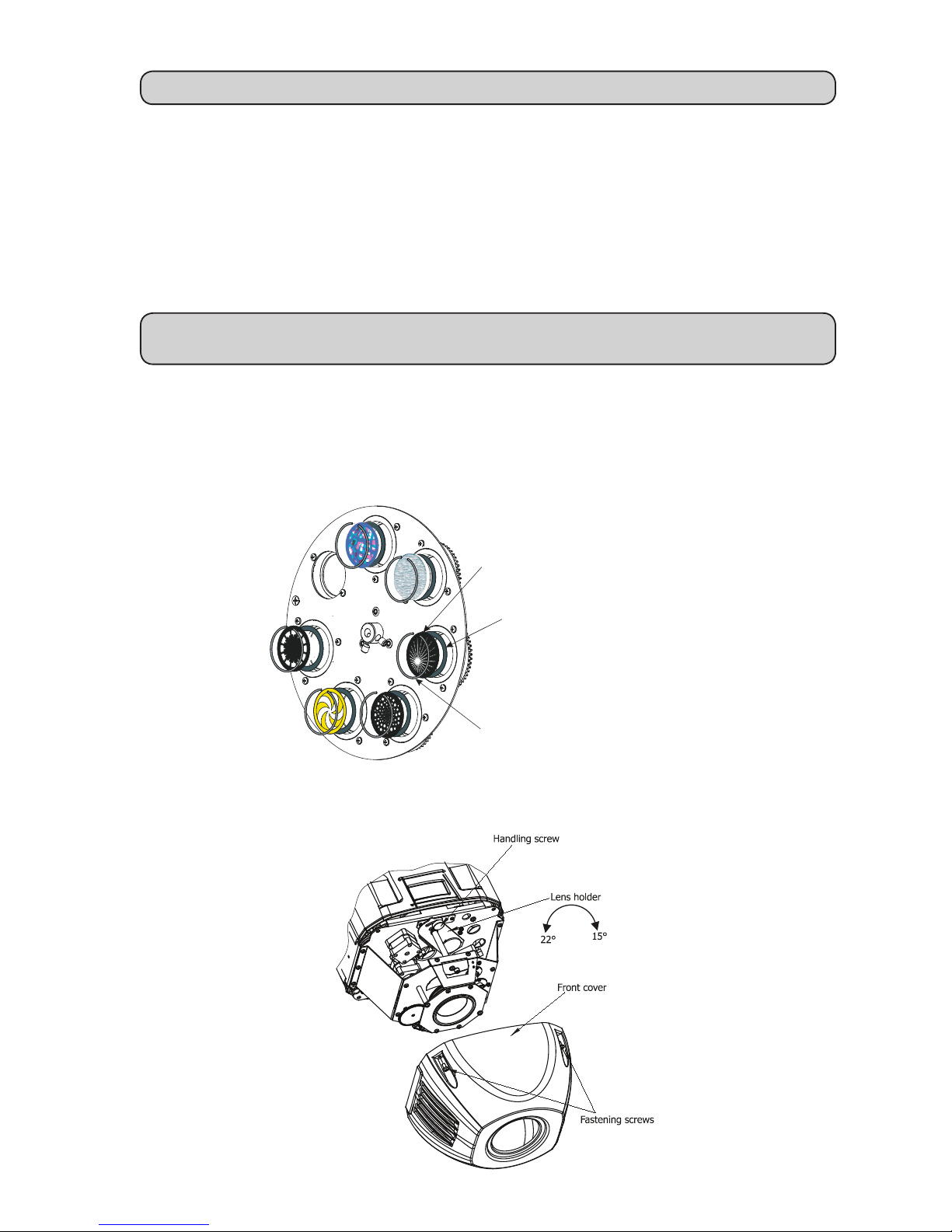
Open the top cover of the moving head by loosening the 2 quarter-turn fasteners on the top cover and follow the instructions below:
1. Use an appro
priate tool (e.g. screwdriver with narrow tip)
to pull out the spring gobo-lock
.
2. Caution remove the gobo and supporting ring from gobo holder.
3. Insert the supporting ring and the new gobo (black side towards the objective) back to the gobo holder.
4. Insert the
spring gobo-lock into gobo holder to fasten the new gobo.
4.4 Manual zoom
The Clubspot 500 CT has manually adjustable zoom 15°or 22°.To change the zoom , remove the front cover by unscrewing the 4 fastening screws.Loosen the handling screw and move the lens holder into desired position as shown on the
picture below (lens inserted in beam path=22° angle).Tighten the handling screw to x lens holder in desired position and
put the front cover back.
gobo
supporting ring
spring gobo-lock
Page 8

8
9
4.5 Connection to the mains
Verify the power supply settings before applying power!
If you wish to change the power supply settings, see the chapter below.
Connect the xture to the mains with the enclosed power plug. If you need to install other power plug on the power cable,
follow the identication table below.
The earth has to be connected!
Do not connect the xture to a dimmer system!
The occupation of the connection-cables is as follows:
Cable (EU) Cable (US) Pin International
Brown Black Live L
Liht blue White Neutral N
Yellow/
Green
Green Earth
4.6 Changing the power supply settings
Both the transformer and the ballast must be connected correctly for the local AC voltage and frequency.
The wrong settings can cause poor performance or demage of the moving head. The factory settings are printed next to
the power switch.
If you want to change the power supply settings, follow the instructions:
1. Disconnect the xture from AC power.
2. Remove the top base covers by unscrewing 9 screws on each cover.
3. Move the wire (1) on the transformer connection block to the position according to the desired voltage.
4. Move the wires (2) and (3) on the ballast connection block to the position according to the desired frequency (voltage).
5. Close the base before applying AC power.
Examples:
Power supply settings: 230V / 50Hz
Page 9

9
4.7 Rigging the xture
DANGER TO LIFE!
Please consider the respective national norms during the installation!
The installation must only be carried out by an authorized dealer!
The installation of the projector has to be built and constructed in a way that it can hold 10 times the weight for 1 hour
without any harming deformation.
The installation must always be secured with a secondary safety attachment, e.g. an appropriate catch net. This secondary
safety attachment must be constructed in a way that no part of the installation can fall down if the main attachment fails.
When rigging, derigging or servicing the xture staying in the area below the installation place, on bridges, under high
working places and other endangered areas is forbidden.
The operator has to make sure that safety-relating and machine-technical installations are approved by an expert before
taking into operation for the rst time and after changes before taking into operation another time.
The operator has to make sure that safety-relating and machine-technical installations are approved by an expert after
every four year in the course of an acceptance test.
The operator has to make sure that safety-relating and machine-technical installations are approved by a skilled person
once a year.
The projector should be installed outside areas where persons may walk by or be seated.
IMPORTANT! OVERHEAD RIGGING REQUIRES EXTENSIVE EXPERIENCE, including (but not limited to) calculating
working load limits, installation material being used, and periodic safety inspection of all installation material and the
projector. If you lack these qualications, do not attempt the installation yourself, but instead use a professional structural
rigger. Improper installation can result in bodily injury and.or damage to property.
The projector has to be installed out of the reach of people.
If the projector shall be lowered from the ceiling or high joists, professional trussing systems have to be used. The projector
must never be xed swinging freely in the room.
Caution: Projectors may cause severe injuries when crashing down! If you have doubts concerning the safety of a possible
installation, do NOT install the projector!
Before rigging make sure that the installation area can hold a minimum point load of 10 times the projector’s weight.
Power supply settings: 120V / 60Hz
Page 10

10
11
Danger of re ! When installing the device, make sure there is no highly
inammable material (decoration articles, etc.) in a distance of
min. 0.5 m.
Warning ! Use 2 clamps to rig the xture on the truss.
Follow the instructions mentioned at the bottom of the base.
Make sure that the device is xed properly!
Ensure that the structure (truss) to which you are attaching
the xtures is secure.
The projector can be placed directly on the stage oor or rigged in any orientation on a truss without altering its operation
characteristics.
For overhead use, always install a safety-rope that can hold at least 10 times the weight of the xture. You must only use
safety-ropes with screw-on carabines. Pull the safety-rope through the two apertures on the bottom of the base and over
the trussing system etc. Insert the end in the carabine and tighten the xation screw.
Fixation via the omega holders
1. Bolt each clamp (1) to the omega holder (4) with M12 bolt and lock nut through the hole in the holder.
2. Fasten the omega holders on the bottom of the base by inserting both quick-lock fasteners (3) into the holes of the
base and tighten fully clockwise.
3. Fasten the safety-rope (2) through the two apertures on the bottom of the base and over the trussing system.
1 - Shield
2 - Signal (-)
3 - Signal (+)
When installing xtures side-by-side, avoid illuminating one xture with another!
Before taking into operation for the rst time,
the installation has to be approved by an expert!
4.8 DMX-512 connection/connection between xtures
The xture is equipped with 3-pin XLR sockets for DMX input and output.
Only use a shielded twisted-pair cable designed
for RS-485 and 3-pin XLR-plugs and connectors in order to connect the controller with the xture or one xture with
another.
DMX - output DMX-input
XLR mounting-socket (rear view): XLR mounting-plug (rear view):
If you are using the standard DMX controllers, you can connect the DMX output of the controller directly with the DMX
Page 11

11
input of the rst xture in the DMX-chain. If you wish to connect DMX-controllers with other XLR-outputs, you need to use
adapter-cables.
Building a serial DMX-chain:
Connect the DMX-output of the rst xture in the DMX-chain with the DMX-input of the next xture. Always connect one
output with the input of the next xture until all xtures are connected.
Caution: At the last xture, the DMX-cable has to be terminated with a terminator. Solder a 120 Ohm resistor between
Signal (–) and Signal (+) into a 3-pin XLR-plug and plug it in the DMX-output of the last xture.
Building a master/slave-chain:
Connect the DMX-output of the master xture in the data-chain with the DMX-input of the rst slave. Always connect output
with the input of the next slave until all slaves are connected (up to 9 xtures).
Caution: It’s necessary to insert the XLR termination plug (with 120 Ohm) into the input of the master xture and into the
output of the last slave xture in the link in order to ensure proper transmission on the data link.
Master/slave operation
Controller operation
Page 12

12
13
5. DMX protocol - version 1.0
Mod1 Mod2 8bit
Value
Function
Type
of control
1 1 1 0 - 255
Pan
Pan movement by 530°
proportional
3 2 0 - 255
Pan Fine
Fine control of pan movement
proportional
2 3 2 0 - 255
Tilt
Tilt movement by 280°
proportional
4 4 0 - 255
Tilt ne
Fine control of tilt movement
proportional
5 5 3
0
1-249
250-252
253-255
Speed of Pan/Tilt movement
Max. speed (tracking mode)
From max. speed to min.speed (vector mode)
Max.speed (tracking mode),black-out while colour wheel moving
or gobo changing
Max.speed (vector mode),black-out while colour wheel or pan/tilt
moving or gobo changing
step
proportional
step
step
6 6 4
0 - 127
128-139
140-229
230-239
240 - 255
Fans speed control,Lamp on/off,reset
Fans speed from max.to min.
Lamp ON,reset
No function
Lamp OFF after 3 sec.
No function
proportional
step
step
step
step
7 7 5
0
13
26
38
51
64
77
90
102
115
128-189
190-193
194-255
Colour wheel 1
Continual Positioning
Open/white
Light blue
Red
Blue
Light green
Yellow
Magenta
Cyan
Green
Orange
Forwards rainbow effect from fast to slow
No rotation
Backwards rainbow effect from slow to fast
proportional
proportional
proportional
proportional
proportional
proportional
proportional
proportional
proportional
proportional
proportional
step
proportional
8 8 6
0
1-63
64
65-127
128-135
136-143
144-151
152-159
160-167
68-175
176-183
184-191
192-199
200-207
208-215
216-223
224-231
232-239
240-247
248-255
Prism
Open position (hole)
Forwards rotation from fast to slow
No rotation
Backwards rotation from slow to fast
Prism/gobo macros
Macro 1
Macro 2
Macro 3
Macro 4
Macro 5
Macro 6
Macro 7
Macro 8
Macro 9
Macro 10
Macro 11
Macro 12
Macro 13
Macro 14
Macro 15
Macro 16
step
proportional
step
proportional
step
step
step
step
step
step
step
step
step
step
step
step
step
step
step
step
Mode/Channel
Page 13

13
Mod1 Mod2 8bit
Value
Function
Type of
control
9 9 7
0 - 31
32-63
64-95
96-127
128-159
160-191
192-223
224-255
Rotating gobos
Open/hole
Rot.gobo 1(multicolour dichroic)
Rot.gobo 2
Rot.gobo 3
Rot.gobo 4
Rot.gobo 5 (dichroic)
Rot.gobo 6
Rot. gobo wheel cont. rotation from slow to fast
step
step
step
step
step
step
step
proportional
10 10 8
0-127
128-190
191-192
193-255
Rotating gobo indexing and rotation
Gobo indexing
Forwards gobo rotation from fast to slow
No rotation
Backwards gobo rotation from slow to fast
proportional
proportional
step
proportional
11 11 9
0-255
Focus
Continuous adjustment from far to near proportional
12 12 10
0-31
32-63
64-95
96-127
128-143
144-159
160-191
192-223
224-255
Shutter,strobe
Shutter closed
Shutter open
Strobe-effect from slow to fast
Shutter open
Closing pulses from slow to fast
Opening pulses from fast to slow
No function
Random strobe -effect from slow to fast
Shutter open
step
step
proportional
step
proportional
proportional
step
proportional
step
13 13 11
0 - 255
Dimmer intensity
Closed to open proportional
Mode/Channel
Page 14

14
15
6. Controller mode
The xtures are individually addressed on a data link and connected to the controller. The xtures respond to the DMX
signal from the controller.
6.1 DMX addressing
The control panel on the front panel of the xture allows you to assign the DMX xture address, which is dened as the
rst channel from which the ClubSpot 500 CT will respond to the controller.
If you set, for example, the address to channel 14, the ClubSpot 500 CT will use the channel 14 to 26 for control
(if mode 1 is selected).
Please, be sure that you don’t have any overlapping channels in order to control each ClubSpot 500 CT correctly and
independently from any other xture on the DMX data link.
If two, three or more ClubSpot 500 CT are addressed the same, the will work parallely.
For address setting, please refer to the instructions under „Addressing” (menu „A001”).
Controlling:
After having addressed all ClubSpot 500 CT, you may now start operating these via your lighting controller.
Note: After switching on, the ClubSpot 500 CT will automatically detect whether DMX 512 data is received or not.
If there is no data received at the DMX-input, the display will start to ash „A001” with actually set address.
This situation can occur if:
-
the 3 PIN XLR plug (cable with DMX signal from controller) is not connected with the input of the ClubSpot 500 CT
- the controller is switched off or defective, the cable or connector is defective or the signal wires are swaped in the input
connector.
Note: It’s necessary to insert the XLR termination plug (with 120 Ohm) to the last xture in the link in order to ensure
proper transmission on the DMX data link.
6.2 Remotely controllable functions
Lamp
The ClubSpot 500 CT is to be operated with a Philips MSR 575/2 or Osram HSR 575/2.
A relay inside of the ClubSpot 500 CT allows you to switch on and off the lamp via the control panel or via your DMX-
-controller without affecting the rest of the lighting.
To switch On/Off the lamp, please refer to „Switching On/Off the lamp“ (menu „LAMP”).
Note: It is also important to note, that the discharge lamp is cold restrike types, that means, that they have to be cold
before re-striking. For this reason, you have to wait 5 minutes (max. speed of fan must be adjusted) after having switched
Off the lamp before you can switch it back „On” again. If you try to switch „On” the lamp within 5 minutes after having
switched it „Off”, the ClubSpot 500 CT will store this information and automatically ignites the lamp when the 5 minutes
period has expired. The message „HEAt” will appear on the control panel display of the ClubSpot 500 CT. If the ignition
of the lamp is seven times unsuccessful, on the display will appear „LA.Er”, meaning that the lamp could be damaged or
even missed, or there could be a failure on the ignitor or ballast.
Colour wheel
This wheel contains 9 dichroic lters + open. It is also possible to rotate the colour wheel continuously at different speeds
("Rainbow effect“ in both directions).
Rotating gobo wheel
The rotating gobo wheel includes 6 glass gobos (one effect-glass, one dichroic ,one multicolour and 3 black and white
gobos rotating in both directions, indexable and interchangeable.
3-facet rotating prism
The 3-facet prism rotating in both directions at different speeds,16 prism-gobo macros
Focus
Motorized focus enables the beam to be focused anywhere on the stage.
Dimmer/Shutter/Strobe
Smooth 0 - 100 % dimming is provided by the combined mechanical dimmer/shutter unit. This unit may also be used for
strobe effect (1 - 10 ashes per second)
Page 15

15
7. Stand - alone mode
The xtures on a data link are not connected to the controller but can execute pre-set programs which can be different for
every xture. To set the program to be played, see the „Stand-alone setting” (menu „St.AL.”).
„Stand-alone operation” can be applied to the single xture (the xture may be set to the master /slave mode or controller
mode) or to multiple xtures operating synchronously.
Synchronous operation of multiple xtures requires that they must be connected on a data link and one of them is set as
a master (master mode) and the rest as the slaves (slave mode). The slaves are assigned to SLA1-SLA9 and on the
certain slave address can be connected only one xture.To set the xture as the master or slave, see the „Addressing”
(menu „A001”).
If the master xture runs a reset, switches On/Off the lamp or plays test (program), all slaves will execute these
acts too (e.g. if the master xture has switched the lamp off, no slave can switch the lamp on)!
The master xture starts simultaneous program start in the other slave xtures.All xtures have a denite, synchronized
starting point when playing back their programs. The number of running program is the same in all slaves and depends
on the master’s choice (menu „St.AL.” ). Every xture runs its program repeatedly, starting the program step No.1 when
requested by the master.
For example:
If the slave xture has a shorter program length, it will continously repeat its program until the master xture nishes its
own program and restarts its program running (slave 1- prog.step 3 will not be nished).
If the slave xture has a longer program length, it will restart at prog. step 1 before it completes all its prog. steps
(slave 2 - prog. step 5 will not be played) - see the picture bellow.
Note: Disconect the xtures from the DMX controller before master/slave operating, otherwise data collisions can occur
and the xtures will not work properly!
Page 16

16
17
8. Control menu map
Default settings = Bold print
A001
dM.Ad.
001
:
512
MA.SL.
d.Abl
MASt.
SLA.1
:
SLA.9
SL.Ct.
InFo
Po.ti.
totl
rSEt
La.ti.
totl
rSEt
LA.St.
totl
rSEt
Hi.tE.
totl
rSEt
tEMP.
DM.ln.
Pan (0-255)
:
dim (0-255)
VErS (ICI.b......ICIr.)
PErS.
r.PAn (On, Off)
r.tilt (On, Off)
16b.r.
Mod.1
Mod.2
8bit
La.Pr.
LA.Au. (On, Off)
d.L.O.F. (On, Off)
dM.On (On, Off)
dM.OF (On, Off)
En.Sn. (On, Off)
dISP.
turn (On, Off)
d.On (On, Off)
d.lnt. (20...100)
bL.Co. (On, Off)
FEEd. (On, Off)
FAn.S. (Auto, High,rEG,LoOF,LoHi)
dF.SE.
LAMP (On, Off)
Page 17

17
tESt
Mod.1
Mod.2
St.AL.
Auto.
Off
tESt
PrG.1
PrG.2
PrG.3
PLAY
tESt
PrG.1
PrG.2
PrG.3
Edit
PrG.1
PrG.2
PrG.3 St.01
:
St.99 PAn (0-255)
:
S.tim. (0.1-25.5) (s)
rESE COPY
SPEC
MAnu.
PAn (Pan.1...Pan.3)
:
dimr (dim.0...dim.C.)
LA.Ad.
PAn (0-255)
tilt (0-255)
Foc. (0-255)
CodE
AdJ.
PAn
:
F.CAL
Colo. (0-255)
:
dimr (0-255)
A.rES.
UPd.M.
Page 18

18
19
9. Control menu
The control panel situated on the front panel of the base offers several features. You can simply set the DMX address,
read the number of the lamp or unit hours, switch On and Off the lamp, run test, make a reset and also use many functions
for setting xture behaviour.
Control elements on the control board:
[MODE] button-leaves menu without saving changes.
[ENTER] button- enters menu, conrms adjusted values and leaves menu.
[UP] button and [DOWN] button- moves between menu items on the the same level, sets values.
After switching the xture on, the display shows the initial screen:
Use [UP], [DOWN] to browse through the menu. To select a function or submenu, press [ENTER].
9.1 Fixture Address
Use this menu to set the DMX address of the xture or set the xture as a Master (Slave).
dM.Ad. - DMX addressing. Select this submenu to set DMX start address.
MA.SL. - Master/slave addressing. Select this submenu to set the xture as a Master or Slave (Slave1- Slave 9).
Option „d.AbL” deactivates master/slave setting.
9.2 Slave control
This function allows you to control the slaves from the master’s control panel in a master/slave operation.
Select this function from the main menu and press [ENTER]. Browse the list of all connected slaves („SL.C.1” - „SL.C.9”)
by pressing [UP] or [DOWN]. Select the desired slave and press [ENTER]-button.The matching slave control panel is
available from the master control panel.
Note: This function is available from the master xture only.
9.3 Fixture informations
Use this menu to read an useful information about the xture.
Po.ti. - Power on time. Select this submenu to read the number of operation hours.
totL -
The function shows the total number of the operation hours since the ClubSpot 500 CT has been fabricated.
rSEt - The function shows the number of the operation hours that the ClubSpot 500 CT has been powered on
since the counter was last reset. In order to reset this counter to 0 you have to hold [UP] and [DOWN] and press
the [ENTER].
La.ti. - Lamp on time. Select this submenu to read the number of the operation hours with the lamp on.
totL - The function shows the total number of the operation hours with the lamp on since the ClubSpot 500 CT
has been fabricated.
rSEt - The function shows the number of the operation hours with the lamp on that the ClubSpot 500 CT has
been powered on since the counter was last reset. In order to reset this counter to 0 you have to hold [UP] and
[DOWN] and press the [ENTER].
LA.St. - Lamp strikes. Select this submenu to read the total number of the lamp strikes.
totL - The function shows the total number of the lamp strikes since the ClubSpot 500 CT has been fabricated.
rSEt - The function shows the number of the lamp strikes since the counter was last reset. In order to reset this
counter to 0 you have to hold [UP] and [DOWN ] and press the [ENTER].
tEMP - Current temperature of the head inside. Temperatures below 80°C are not critical. 80° C and more lead to
the lamp being switched off.
Hi.tE. - Maximum xture temperatures.
totL. - The function shows the max. temperature in the head inside since the ClubSpot 500 CT has been
fabricated.
rSEt - The function shows the max.temperature of the head inside since the since the counter was last
reset. In order to reset this counter to 0 you have to hold [UP] and [DOWN ] and press the [ENTER].
DM.In. -
Readout of DMX values. Select this function to read DMX values (0-255) of each channel received by the xture.
PAn a coarse pan movement G.rot. a gobo indexing and rotation
F.PAn a ne pan movement Pris. a prism
tilt a coarse tilt movement Foc. a focus
Page 19

19
F.tilt a fine tilt movement Stro. a shutter,strobe
SpEd a pan/tilt speed dimr a dimmer
Func. a special function
Colo. a colour wheel
r.Gob. a rotating gobo wheel
VErS. - Software version. Select this function to read the software version of processors:
C1.b. - Main processor on the main board in the xture base
IC2.b. - Pan processor on the main board in the xture base
IC3.b. - Tilt procesor on the main board in the xture base
IC1.L. - Processor 1 in the left arm of the xture
IC1.r. - Processor 1 in the right arm of the xture
9.4 Personality
Use this menu to to modify ClubSpot 500 CT operating behavior.
r.PAn - Pan reverse.Select this function to invert the pan movement.
r.tilt - Tilt reverse. Select this function to invert the tilt movement.
16br. -
16 bit resolution. Select this function to set desired effects assigning to the channels. Please refer to the chapter
„DMX protocol” for detail description.
LA.Pr. - Lamp presetting. Select this menu to change the lamp „behaviour”.
LA.Au. - Select this function to turn the lamp on automatically after switching the xture on.
d.L.OF. - Select this function to switch off the lamp via DMX.
dM.On - This function allows you to strike the lamp automatically after 26 seconds if DMX signal is present on
the data link. If the ignition is unsuccessfull (e.g.lamp is too hot), the xture will try to ignite the lamp after next 26
s.This process will repeat until the lamp lights.
dM.OF. - This function allows you to switch Off the lamp automatically after 2 minutes if DMX signal is missing
on the data link.
En.Sn. - Switching on/of the lamp light sensor. Select this function to switch the lamp light sensor on or off.The option
„On” is for the standard operation.
Important: The option „Off” is for „emergency operation” only if the lamp light sensor is defective and you will wait for
a service intervertion! If the lamp light sensor is switched off and at switching the lamp on the electronics will still try to
ignite the lamp until it shines (even when the lamp is damaged or absent), on this account some electronics parts could
be damaged!
diSP. - Display adjusting. This function allows you to change the display settings.
turn - Select this function to turn the display by 180°.
d.On - This function allows you to keep the display on or to turn off automatically 2 minutes after last pressing any
button on the control panel.
d.Int. - Select this function to adjust the display intensity (20-min.,100-max.).
bL.Co. -
Blackout during movement correction. Select this function to enable the blackout during the head movemen
t
correction (if the moving head lost its right pan/tilt position for a short moment).
FEEd - Pan/Tilt feedback.This function allows to return the mowing head to the required pan/tilt position after changing
the position by external force (e.g.by stroke).
Be careful, the Pan/Tilt Feedback OFF is not the standard operation and the head of the xture can be demaged!
Note: If the feedback was switched off, the pan/tilt-position is changed by an external force and the feedback is switched
on again, the moving head might not to be synchronized with the DMX signal. You have to make a reset in order to synchronize the moving head with the DMX signal.
Fan.S. -
Fan speed operating modes. By using this function you can choose 5 types of the fan speed operating modes
.
Auto - The fans automatically raise their speed in order to control inside temperature of the head, if the temperature inside increases about certain level (the low fan speed reduces the cooling of the lighting). This cycle can
repeat several times until the temperature inside is on a suitable level.
HIGH - The cooling fans work on max. speed (max. cooling). This mode we recommend for high ambient temperature (30°C and more).
rEG - This mode is the same as a Auto but the the bottom level of fans speed can be adjusted by DMX (channel
6)
LoOF - The fans keep the adjusted low speed until the temperature exceeds max. inside temperature of the
xture, then the ClubSpot 500 CT automatically switches off the lamp.
LoHi - The fans keep the adjusted low speed until the temperature exceeds max. inside temperature of the
xture, then the ClubSpot 500 CT automatically switches from low to high the fan speed.
Page 20

20
21
dF.SE. - Default Settings. Select this option to reset all xture personalities to the default values.
9.5 Lamp On/Off
Use this option in order to switch on/off the lamp.It is also important to note, that the lamp is cold restrike type that means
that it has to be cold before striking.
9.6 Test sequences
Use this menu to to run a special demo-test sequences without an external controller, which will show you some possibilities of using ClubSpot 500 CT.
Mod. 1 - Mode 1. This mode is suitable for projections on the wall, ceiling or ground without any head movement.
Mod. 2 - Mode 2. This mode uses all ClubSpot 500 CT functions including pan/tilt movement and therefore is good for
a complete introduction of the xture.
9.7 Stand-alone setting
Use this menu to set options for stand-alone mode as a selection of the playing program,programming and modifying
current programs.
Auto - Presetting playback. This function allows you to select the program which will be played in the stand-alone
mode after switching the xture on. Selected program will be played continuously in a loop.
d.Abl - The option disables „Auto” function.
tESt - The option will start built-in test program.
PrG. 1 - The option will start created program No. 1
PrG. 2 - The option will start created program No. 2
PrG. 3 - The option will start created program No. 3
Note: If the xture operates in the controller mode (DMX controller is connected) and any program from this menu is
selected, in this case the xture will not respond to the DMX controller after switching on and will play selected program.
PLAY - Playing program. Select this menu to run a bilt-in program or the 3 freely-programmable programs in a loop.
tESt - The option starts built-in test program.
PrG.1 - The option starts created program No. 1
PrG.2 - The option starts created program No. 2
PrG. 2 - The option starts created program No. 3
Select the program you wish and press [ENTER]. The selected program starts running. By Pressing [ENTER] again is
possible to pause the program running.
Edit - Editing program. Select this menu to edit or create the program. The ClubSpot 500 CT has one built-in program
and the 3 free programs, each up to 99 steps. Each program step has a step time. Step time-the time, during which effects
last in the current step.
If the xture is set as a master, then you may edit any program in the slaves. You can’t edit programs on the slave xtures
from their control panels if the master xture is switched on and connected to the slaves (editing is possible by the master
control panel only).
Procedure:
1. Press [UP] or [DOWN] to select the program you want to edit („PrG.1” - „PrG.3”) and press [ENTER].
2. Press [UP] or [DOWN] to select the desired xture („MASt.“ - „SLA.9“) and press [ENTER]-button.
3. Press [UP] or [DOWN] to select the desired program step (“St.01” - “St.99”) and press [ENTER]-button.
4. Press [UP] or [DOWN] to select the desired item and press [ENTER]-button. Now you can edit by [UP] or [DOWN]
buttons the DMX value (0-255) for selected item:
P.End.
a total number of the program steps (value 1-99). This value you must set before start programming
(e.g. if you want to create program with the 10 steps, set P.End=10).
PAn a coarse pan movement G.rot. a gobo indexing and rotation
F.PAn a ne pan movement Pris. a prism
tilt a coarse tilt movement Foc. a focus
F.tilt a fine tilt movement Stro. a shutter,strobe
SpEd a pan/tilt speed dimr a dimmer
Func. a special function
Colo. a colour wheel
r.Gob. a rotating gobo wheel
S.tim. a step time, value 0.1-25.5 seconds
COPY. a copying the current prog. step to the next prog. step. If the last prog. step is copied to the
next prog.step, parameter „P.End” is increased about one by itself (except step 99).
5. Press [ENTER]-button to conrm adjusted value .
Page 21

21
6. Press [MODE]-button, select next prog. step and repeat this procedure (steps 4 - 6).
9.8 Reset functions
This option enables the ClubSpot 500 CT to index all effects (functions) and return to their standard positions.
9.9 Special functions
Use this menu for special services like adjusting lamp or adjusting effects.
MAnu. - Manual effect control. Select this menu to call up presetted positions of the channel effects.
LA.Ad. - Lamp adjustment. This function can be used when you make the ne adjustment of the lamp. If you select this
function, all effects will be canceled, shutter will be opened and the dimmer intensity will be set onto 100%.By using the
options „PAn, tilt, Foc.” you can focus the light on a at surface (wall) and perform the ne lamp adjustment.
CodE - Code.This function contains identication hexadecimal code (0000-FFFF) for the xture, which is used for the
master/slave operation.
AdJ. - Effect adjustment. By this function you can calibrate and adjust the effects to their standard/right positions. Disconect the DMX controller from the xture and select „AdJ.” menu. The display shows step by step effects by which you
can adjust the xture to the required position before the function calibration(DMX controller must be disconnected). When
the positioning is nished, select „F.CAL.” and press [ENTER]:
1. Calibration via the control board
Disconnect DMX controller from the xture. Press [ENTER] and use [UP] and [DOWN] in order to display the following
items: „Colo, r.Gob.,G.rot.,dimr ” for very smooth function calibration. Select one of them, press [ENTER] and use the
[UP] and [DOWN] in order to adjust their right value from 0 to 255. Then press [ENTER] to conrm or [MODE] to cancel and return to the menu. This can be repeated for each calibration parameter if it is required. When the calibration is
nished, it is necessary to use the „A.rES” function in order to write the calibration values to the memory (EPROM) and
to make a reset in order to check the newly adjusted positions of the colour, gobo wheels and dimmer. When the reset of
the xture is nished, the display will show the „F.CAL” message. Press [ENTER] to repeat the calibration or [MODE]
to return to the „AdJ.” menu.
2. Calibration via the external controller
Connect the DMX controller to the xture, press [ENTER] and the [UP] and [DOWN] buttons in order to display the following items: „Colo., r.Gob,.G.rot.,dimr”. Select one of them and press [ENTER].
Now you can calibrate this effect by your controller. DMX calibration protocol:
Function Mod 1 Mod 2
“Colo.”- Colour wheel channel 1 channel 1
“r.Gob.”- Rotating gobo wheel channel 2 channel 2
“G.rot.” - Gobo rotation channel 3 channel 3
„dimr“ -Dimmer channel 4 channel 4
No function channels 5-6 channels 5-6
Standard DMX protocol channels 7-13 channels 7-13
After having calibrated required effects, press [ENTER] to conrm (or [MODE] to cancel and return to the menu without
reset by the „A.rES.” function) and use the „A.rES.” function in order to write the calibration values to the memory ) and
to make a reset in order to check the new adjusted positions of the colour and gobo wheels .
10. Error and information messages
HEAt
This message appears if you try to switch on the lamp within 5 minutes after having switched it off (the lamp is too hot).
The message will appear on the display if the lamp doesn’t ignite within 28 seconds. The ClubSpot 500 CT will store this
information and automatically ignite the lamp when the 5 minutes period has expired.
Caution: The message is disabled if the lamp light sensor (function „En.Sn.”) is switched off.
LA.Er.
The ignition of the lamp is seven times unsuccessful (the „HEAt” message appeared six times before), and the display
shows „LA.Er”, meaning that the lamp could be damaged or even missed or there could be a failure on the ignitor or
ballast. Please place or replace the lamp, check the ambient temperature or contact your distributor if the situation was
not caused by the lamp.
Caution: The message is disabled if the lamp light sensor (function „En.Sn.”) is switched Off.
Mb.Er.
This messsage informs you that the main PCB does not communicate correctly with the Control Board.
Page 22

22
23
CoEr.
This messsage will appear after the reset of the xture if the magnetic-indexing circuit malfunctions (sensor failed or
magnet missing) or the stepping-motor is defective (or its driver circuit on the main PCB). The color-wheel is not located
in the default position after the reset.
rGEr.
The message will appear after the reset of the xture if the magnetic-indexing circuit malfunctions (sensor failed or magnet
missing) or the stepping-motor is defective (or its driver circuit on the main PCB). The rotating gobowheel is not located
in the default position after the reset.
iGEr.
The message will appear after the reset of the xture and if the magnetic-indexing circuit malfunctions (sensor failed or
magnet missing) or the stepping-motor is defective (or its driver circuit on the main PCB). The rotating gobo is not located
in the default position after the reset.
PrEr.
This message will appear after the reset of the xture if the magnetic-indexing circuit malfunctions (sensor failed or magnet
missing) or the stepping-motor is defective (or its driver circuit on the main PCB). The prism wheel is not located in the
default position after the reset.
Ft.Er.
This error message informs you that the xture was overheating (occured if the ambient temperature is 40° C or more)
and that the relay switched off the lamp. This message will appear on the display until the temperature will be on a suitable
level, then the display will show the massage „HEAt” meaning the lamp is too hot (explanation see above).
Fr.Er.
This message will appear if the frequency of the main is not standard 50 or 60 Hz. This message can appear as a result
of the interference during the lamp starting (if the lamp or igniter is old) or as a result of the interference by neighbouring
devices. In these cases the message does not affect the xture operating!
Sn.Er.
This message appears if the lamp lighting sensor is failed.
PoEr
This message will appear if the xture was shortly disconnect from the main.
PA.Er. (Pan movement error)
This message will appear after the reset of the xture if the yoke.s magnetic-indexing circuits malfunction (sensors failed
or magnet missing) or the stepping motor is defective. (Or its driving IC on the main PCB). The yoke is not located in the
default position after the reset.
ti.Er. This message will appear after the reset of the xture if the head.s magnetic-indexing circuit malfunctions (sensor
failed or magnet missing) or the stepping motor is defective. (Or its driving IC on the main PCB). The head is not located
in the default position after the reset.
MA.Er.
The message informs you that the xture was addressed as a master and DMX signal is connected to its input.Disconnect
the DMX controller from xture’s input and address the xture as the master again.
t.M.Er.
The message informs you that the communication betwen the head and the main board in the xture base was cut off (or
the head temperature sensor is defective) and the lamp was automatically switched off.
11. Technical specications
Power supply:
EU-model: Voltage:...........................208/230/240V AC, 50/60Hz ~
Fuse:...............................T 6.A@230V
US-model: Voltage:...........................100/120/208/230 V AC, 50/60Hz ~
Fuse:................................T 10A@120V
Power consumption:.........740 VA
Lamp: -Philips MSR 575/2 or Osram HSR 575/72
Optical System:
-High luminous-efciency glass reector
-Focus lens and multistep zoom lenses system
-All lenses are anti-reection coated
Colour wheel:
-9 dichroic lters + open
Page 23

23
Rotating gobo wheel:
-6 glass gobos (1 effect-glass gobo, 3 black and white gobos,1 multicolour and 1 dichroic gobo)
-Gobo indexing and rotation in both directions at different speeds
-Gobo carousel cont. rotation
-All rotating gobos are easily replaceable
-Gobo dimensions: outside diameter=26.8mm, thickness=1.1mm, high temperature
-borooat or better glass, image diameter=22 mm
-Effect-glass gobo: outside diameter=26.8 mm, max.thickness=4mm, high temperature borooat or
better glass
Strobe:
-Strobe effect with variable speed (max.10 ashes per second)
Dimmer:
-Smooth dimmer from 0 - 100 %
Prism:
-3-facet-prism rotating in both directions at different speeds
Focus/Zoom:
-Remotely controllable focus via DMX
-Manual zoom 15° and 22°
Electronics:
-Addressing,special functions setting, effects calibration via control panel with 4-digit LED display
-Readout xture and lamp usage, receiving DMX values, temperature, etc
-Built-in analyzer for easy fault nding, error messages
-Remotely switching of the lamp
-Bilt-in demo sequences
-Silent fans cooling, remotely controllable speed of fans
-Self-resetable thermo-fuse
-Stand-alone operation
-Master/slave operation
-Digital serial input DMX-512
-3 DMX protocol modes (11 or13 control channels)
Pan/Tilt:
-Pan movement range 530°
-Tilt movement range 280°
-8 or 16 bit movement resolution
-Automatic Pan/Tilt position correction
-Remotely controllable speed of pan/tilt movement for easy programming
-Movement control:tracking and vector
Rigging:
-Mounting points: 4 pairs of 1/4-turn locks
-Mounting horizontally or vertically via 2 Omega brackets
-Safety chain/cord attachment point
Temperatures:
-Maximum ambient temperature: 40° C
-Maximum housing temperature: 80° C
Minimum distances:
-Min. distance from ammable surfaces: 0.7m
-Min. distance to lighted object: 2.0m
Accessories
-Omega holder (2 pieces) ..............................No. 99010420
Optional Accessories
-Flash cable RS232/DMX................................No.13050624
Page 24

24
25
Beampath:
Dimensions (mm):
Weight (net):
EU version: 31.7 kg
US version: 35.6 kg
Page 25

25
12. Maintenance and cleaning
It is absolutely essential that the xture is kept clean and that dust, dirt and smoke-uid residues must not build up on or
within the xture. Otherwise, the xture. s light-output will be signicantly reduced. Regular cleaning will not only ensure
the maximum light-output, but will also allow the xture to function reliably throughout its life.
A soft lint-free cloth moistened with any good glass cleaning uid is recommended, under no circumstances should alcohol
or solvents be used!
DANGER !
Disconnect from the mains before starting any maintenance work
The front objective lens will require weekly cleaning as smoke-uid tends to building up residues, reducing the light-output
very quickly. The cooling-fans should be cleaned monthly.
The gobos may be cleaned with a soft brush. The interior of the xture should be cleaned at least annually using a vacuum-cleaner or an air-jet.
The dichroic colour lters, the gobo wheel and the internal lenses should be cleaned monthly.
There are no serviceable parts inside the device except for the lamp and the fuse.
Please refer to the instructions under “Fitting/Exchanging the lamp”.
Maintenance and service operations are only to be carried out by authorized dealers.
Replacing the fuse
If the lamp burns out, the ne-wire fuse of the device might fuse, too. Only replace the fuse by a fuse of ame type and rating.
Before replacing the fuse, unplug mains lead.
Procedure:
1) Unscrew the fuseholder on the rear panel of the base with a tting screwdriver from the housing (anticlockwise).
2) Remove the old fuse from the fuseholder.
3) Install the new fuse in the fuseholder.
4) Replace the fuseholder in the housing and x it.
Specications are subject to change without notice.
Page 26

26
 Loading...