

Page 1
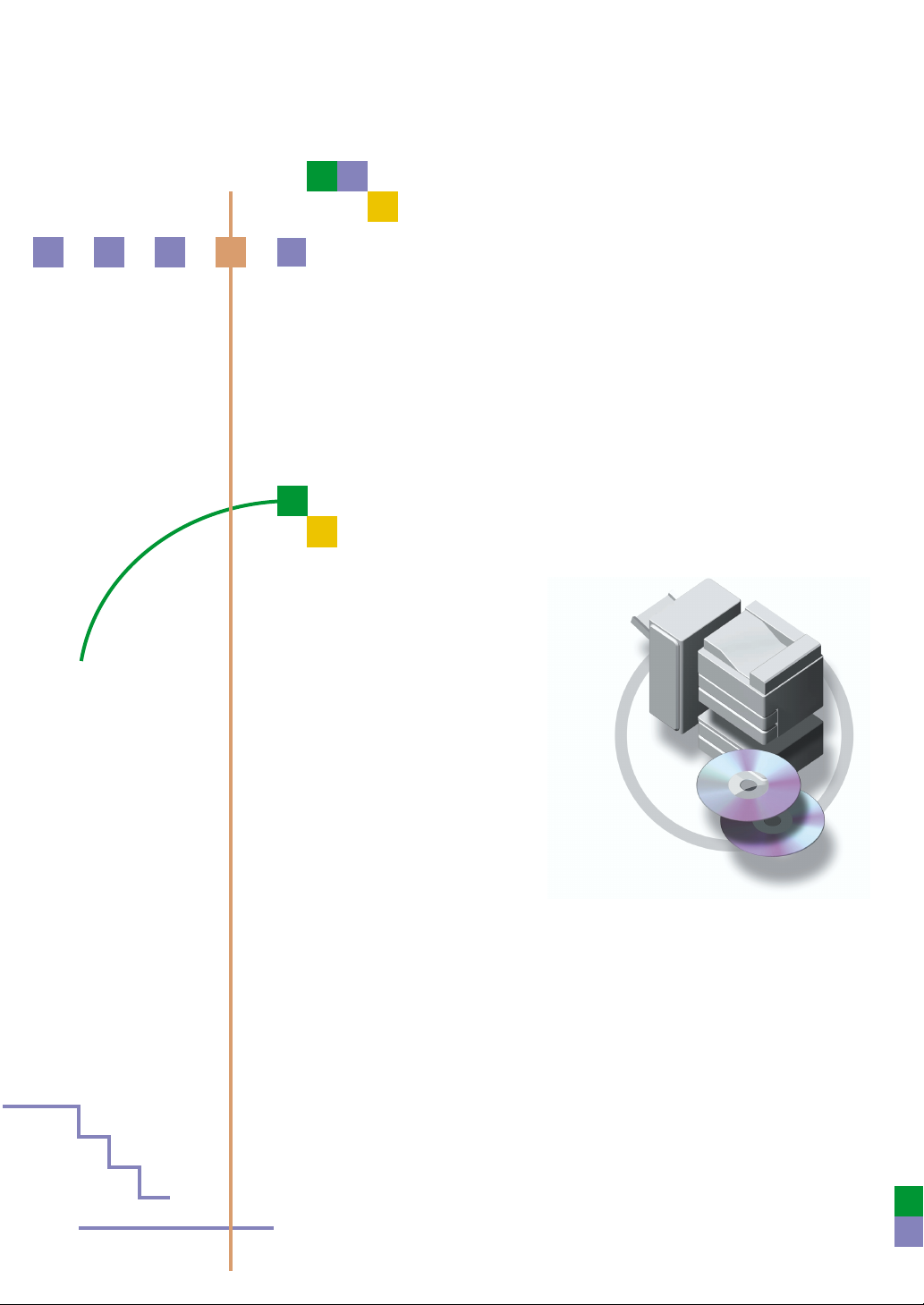
Color Controller
RC-200
OPERATING INSTRUCTIONS
PRINTER REFERENCE
Read this manual carefully before you use this product
and keep it handly for future reference.
For safety, please follow the instructions in this manual.
Page 2

Introduction
This manual contains detailed instructions on the operation and maintenance of this machine. To get
maximum versatil ity from this ma chine all opera tors sho uld careful ly read an d follow the ins tructi ons in
this manual.
Please read the Safety Information in the “Copy Reference” before using this machine. It contains important information related to USER SAFETY and PREVENTING EQUIPMENT PROBLEMS.
Important
Parts of this manual are subject to change without prior notice. In no event will the company be liable
for direct, indirect, special, incidental, or consequential damages as a result of handling or operating
the machine.
Trademarks
®
RICOH-SCRIPT2
is a registered trademark of Ricoh Company.
Microsoft® and Windows are registered trademarks of Microsoft Corporation in the United States and/
or other countries.
®
Ethernet
is a registered trademark of Xerox Corporation.
PostScript® and Acrobat® are registered trademarks of Adobe System Incorporated.
Other product names us ed herei n are for iden tifica tion purp oses on ly and migh t be tradem arks of th eir
respective companies. We disclaim any and all rights in those marks.
Warning:
Use of controls or adjustment or performance of procedures other than those specified in this manual
might result in hazardous radiation exposure.
Notes:
Some illustrations might be slightly different from your machine.
Certain options migh t no t be av ail abl e in some countries. F or de tails, please contac t yo ur local dealer.
Note
The proper names of Windows operating system are as follows:
•Microsoft® Windows® 95 operating system
•Microsoft® Windows® 98 operating system
•Microsoft® Windows NT® Server operating system Version 4.0
®
•Microsoft
Windows NT® Workstation operating system Version 4.0
Page 3

Manuals for this Machine
There are five manuals that describe the operational procedures separately for
the operation and maintenance of the machine.
This manual, the Printer Reference, contains detailed instructions for using this
machine as a printer.
To ensure safe and efficient operation of the machine, all users should read and
follow the instructions contained in the following manuals.
❖
Operating Instructions that Describes the Copy Functions
Describes the procedures and functions for using this machine as a copier.
❖
Printer Reference Provided as a Paper Manual
Describes the system settings, procedures and functions for using this machine as a printer.
❖
Printer Reference Provided as a PDF File
Describes the procedures and provides necessary information on using this
machine as a printer. The manual is included as a PDF file in the CD-ROM.
(This Manual)
❖
RICOH-SCRIPT2 Operating Instructions
Describes the menus and features you can set using the RICOH-SCRIPT2
printer driver. The manual is included as a PDF file in the CD-ROM.
❖
Network Interface Board Operating Instructions
Describes the procedures and provides necessary information on setting up
and using the printer under the network environment. The manual is included as a PDF file in the CD-ROM.
i
Page 4

TABLE OF CONTENTS
1.Uninstalling the Printer Driver and Software
Uninstalling the IPDL-C Printer Driver..................................................... 1
Windows 95/98 - Uninstalling the IPDL-C Printer Driver.............................. 1
Windows NT 4.0 - Uninstalling the IPDL-C Printer Driver............................. 1
Uninstalling the RICOH-SCRIPT2 Printer Driver..................................... 2
Windows 95/98 - Uninstalling the RICOH-SCRIPT2 Printer Driver ............... 2
Windows NT 4.0 - Uninstalling the RICOH-SCRIPT2 Printer Driver............. 2
Macintosh - Uninstalling the RICOH-SCRIPT2 Printer Driver....................... 3
2.Setting up the Printer Driver and Canceling a Print Job
IPDL-C Accessing the Printer Properties................................................ 5
Windows 95/98 - Accessing the Printer Properties....................................... 5
Windows NT 4.0 - Accessing the Printer Properties..................................... 6
RICOH-SCRIPT2 - Setting up for Printing ............................................... 9
Windows 95/98 - Accessing the Printer Properties....................................... 9
Windows NT 4.0 - Accessing the Printer Properties................................... 10
Macintosh - Setting up for Printing.............................................................. 11
Canceling a Print Job.............................................................................. 13
Windows 95/98 - Canceling a Print Job...................................................... 13
Windows NT 4.0 - Canceling a Print Job .................................................... 13
Macintosh - Canceling a Print Job .............................................................. 14
3.Troubleshooting
Error & Status Messages on the Operation Panel................................ 17
Error & Status Messages on the Operation Panel...................................... 17
Getting Printer Information over the Network.............................................. 21
Machine Does not Print........................................................................... 26
Other Printing Problems......................................................................... 29
4.Adjusting the Color Calibration of the Printer
Operation on the Copy Function Mode................................................. 34
Operation on the Printer Function Mode............................................... 35
Restoring Previous Color Calibration Settings.................................... 38
Operation on the Copy Function Mode....................................................... 38
Operation on the Printer Function Mode..................................................... 38
5.Using the Operation Panel
Setting Menu............................................................................................ 42
ii
Page 5

Protecting the Menus.............................................................................. 44
Protecting the Menus.................................................................................. 44
Changing the Menu Settings without Removing Protect............................. 45
Removing Protect...................... .................................. ................................ 47
Menu Table............................................................................................... 49
IPDL-C Menu ............... .................................................. ............................. 51
RICOH-SCRIPT2 Menu.............................................................................. 51
System Menu.............................................................................................. 55
Printing the Configuration Page ............................................................ 58
Interpreting the Configuration Page...................................................... 60
Interpreting the Configuration Page/IPDL-C ............................................... 60
Interpreting Configuration Page/RICOH-SCRIPT2..................................... 61
Resetting Menus........................................ .... ..... ..... ............................ .... 63
Administering Printing by User Code.................................................... 65
Viewing the Number of Pages Printed for Each User Code........................ 65
Reading the Statistics Report...................................................................... 67
Deleting the User Code Record.................................................................. 67
Using the Job Log................................................................................... 69
Printing the Job Log.................................................................................... 69
Reading the Job Log................................................................................... 71
6.Appendix
Color Guide.............................................................................................. 73
Color Printing Basics................................................................................... 73
Paper Size and Color Level.................................................................... 75
Specifications.......................................................................................... 76
INDEX........................................................................................................ 77
iii
Page 6

iv
Page 7
1. Uninstalling the Printer
Driver and Software
Uninstalling the IPDL-C Printer Driver
This section provides basic procedures for uninstalling the IPDL-C printer driver. The actual procedure may differ depending on your operating system.
Follow the procedure below.
Windows 95/98 - Uninstalling the IPDL-C Printer Driver
A Close all applications that are currently running.
B Click
The
[
]
[
Start
Printers
, point to
window appears.
]
[
Settings
and click
]
[
Printers
.
]
C Select the icon of the printer you want to remove by clicking it.
D On the
A confirmation dialog box appears.
E Click
[
menu, click
]
[
File
to delete the printer driver.
]
Yes
[
Delete
Windows NT 4.0 - Uninstalling the IPDL-C Printer Driver
Limitation
❒
Uninstalling a printer driver requires Full Control access permission. Members of the Administrators, Server Operators, Print Operators, and Power Users groups have Full Control permission by default. When you uninstall a
printer driver, log on using an account that has Full Control permission.
.
]
A Close all applications that are currently running.
B Click
The
[
]
[
Start
Printers
, point to
window appears.
]
[
Settings
and click
]
[
Printers
.
]
C Select the icon of the printer you want to remove by clicking it.
D On the
A confirmation dialog box appears.
E Click
[
menu, click
]
[
File
to delete the printer driver.
]
Yes
[
Delete
.
]
1
Page 8

Uninstalling the Printer Driver and Software
Uninstalling the RICOH-SCRIPT2 Printer Driver
1
This section provides basic procedures for uninstalling the RICOH-SCRIPT2
printer driver. The actual procedure may differ depending on your operating
system.
Follow the procedure below.
Windows 95/98 - Uninstalling the RICOH-SCRIPT2 Printer Driver
A Close all applications that are currently running.
B Click
The
[
]
[
Start
Printers
on the taskbar, point to
window appears.
]
[
Settings
, and then click
]
[
Printers
.
]
C Select the icon of the printer you want to remove by clicking it.
D On the
E Click
[
menu, click
]
[
File
to delete the printer driver.
]
Yes
[
Delete
Windows NT 4.0 - Uninstalling the RIC O H-SCRIPT2 Print er Driver
Limitation
❒
Uninstalling a printer driver requires Full Control access permission. Members of the Administrators, Server Operators, Print Operators, and Power Users groups have Full Control permission by default. When you uninstall a
printer driver, log on using an account that has Full Control permission.
.
]
A Close all applications that are currently running.
B Click
The
[
]
[
Start
Printers
on the taskbar, point to
window appears.
]
[
Settings
, and then click
]
C Select the icon of the printer you want to remove by clicking it.
2
D On the
E Click
menu, click
]
[
File
to delete the printer driver.
]
[
Yes
[
Delete
.
]
[
Printers
.
]
Page 9

Uninstalling the RICOH-SCRIPT2 Printer Dr iver
Macintosh - Uninstalling the RICOH-SCRIPT2 Printer Driver
This section provides basic procedures for uninstalling the PPD File. The actual
procedure may differ depending on the operating system.
Follow the procedure below.
A Drag the “Color Controller RC-200” or “Color Controller RC-200(D)” file
inside
[
Trash
[
Printer Descriptions
.
]
in the
]
[
Extensions
folder in
]
[
System folder
to
]
1
3
Page 10

1
Uninstalling the Printer Driver and Software
4
Page 11
2. Setting up the Printer Driver
and Canceling a Print Job
IPDL-C Accessing the Printer Properties
Windows 95/98 - Accessing the Print er Properties
There are two methods you can use to open the Printer Properties.
Making default printer settings
To make the default printer settings, first open the
from the
Note
❒
With some applications, the printer driver's settings are not used, and the application's own initial default settings are applied.
❒
The following tabs are standard Windows tabs. For more information on
these tabs, see the documentation that comes with the Windows operating
system.
• Windows 95:
[
• Windows 98:
[
❒
A Click
The
[
Printers
General
General
], [
], [
Note
Profiles set in the
[
Start
[
Printers
window.
]
and
]
Details
Details
on the taskbar, point to
]
window appears.
]
[
Sharing
], [
Color Management
[
Color Management
]
and
]
[
Sharing
tab are not supported.
]
[
Settings
[
Printer Properties
]
, and then click
]
dialog box
]
[
Printers
.
]
B Select the icon of the printer whose default settings you want to change by
clicking it.
C On the
D Make settings and click
Making printer settings from an application
To make the printer settings from an application, open the
alog box from that application. The following example describes how to make
settings for the WordPad application that comes with Windows 95.
menu, click
]
[
File
[
Properties
.
]
[
OK
.
]
di-
[
Printer Properties
]
5
Page 12

2
Setting up the Printer Driver and Canceling a Print Job
Note
❒
The actual procedure you should follow to open
depending on the application. For more information, see the documentation
that comes with the application you are using.
❒
With some applications, the printer driver's settings are not used, and the application's own initial default settings are applied.
❒
Any settings you make in the following procedure are valid for the current
application only.
[
Printer Properti es
may differ
]
A On the
The
[
Print
menu, click
]
[
File
dialog box appears.
]
B Select the printer you want to use from the
.
[
Properties
The Printer Properties dialog box appears.
]
C Make settings, and click
D Click
to start printing.
]
[
OK
[
Print
[
OK
.
]
list box, and then click
]
[
Name
.
]
Windows NT 4.0 - Accessing the Printer Properties
Making default printer settings - Printer Properties
Limitation
❒
Changing the setting of the printer requires Full Control access permission.
Members of the Administrators, Server Operators, Print Operators, and Power Users groups have Full Control permission by default. When you set up
options, log on using an account that has Full Control permission.
Note
❒
With some applications, the printer driver's settings are not used, and the application's own initial default settings are applied.
❒
The following tabs are standard Windows tabs. For more information on
these tabs, see the documentation that comes with the Windows operating
system.
•
[
General
A Click
The
[
], [
Ports
]
[
Start
Printers
], [
Scheduling
on the taskbar, point to
window appears.
]
], [
Sharing
and
]
[
[
Settings
Security
, and then click
]
B Select the icon of the printer you want to use by clicking it.
6
C On the
The Printer Properties dialogue box appears.
menu, click
]
[
File
[
Properties
.
]
]
[
Printers
.
]
Page 13

IPDL-C Accessing the Printer Properties
D Make settings and click
Note
❒
The settings you make here are used as the default settings for all applications.
[
OK
.
]
Making default printer settings – Default Document Properties
Limitation
❒
Changing the setting of the printer requires Full Control access permission.
Members of the Administrators, Server Operators, Print Operators, and Power Users groups have Full Control permission by default. When you set up
options, log on using an account that has Full Control permission.
A Click
The
[
]
[
Start
Printers
on the taskbar, point to
window appears.
]
[
Settings
, and then click
]
[
Printers
B Select the icon of the printer you want to use by clicking it.
C On the
The Default Document Properties dialogue box appears.
menu, click
]
[
File
[
Document Defaults
.
]
2
.
]
D Make settings and click
Note
❒
Settings you make here are used as the default settings for all applications.
[
OK
.
]
Making printer settings from an application
To make the printer settings from an application, open the
dialog box from that application. The following example describes how to make
settings for the WordPad application that comes with Windows NT 4.0.
Note
❒
The actual procedures you should follow to open the
alog box may differ depending on the application. For more information, see
the documentation that comes with the application you are using.
❒
With some applications, the printer driver's settings are not used, and the application's own initial default settings are applied.
❒
Any settings you make in the following procedure are valid for the current
application only.
A On the
The
[
Print
menu, click
]
[
File
dialog box appears.
]
[
Print
.
]
[
Document Properties
[
Document Properties
di-
]
]
7
Page 14

Setting up the Printer Driver and Canceling a Print Job
2
B Select the printer you want to use from the
.
[
Properties
The Document Properties dialog box appears.
C Make settings, and click
D Click
]
to start printing.
]
[
OK
[
OK
.
]
[
Name
list box, and then click
]
8
Page 15

RICOH-SCRIPT2 - Setting up for Printing
RICOH-SCRIPT2 - Setting up for Printing
Windows 95/98 - Accessing the Print er Properties
There are two methods you can use to open the Printer Properties dialog box.
Making default printer settings
To make the default printer settings for printing from applications, open the
Printer Properties dialog box from the
Note
❒
The following tabs are standard Windows tabs. For more information on
these tabs, see the documentation that comes with the Windows operating
system.
• Windows 95:
[
General
• Windows 98:
[
General
❒
A Click
The
], [
Details
], [
Details
Note
Profiles set in the
]
[
Start
[
Printers
and
]
[
Sharing
], [
Color Management
[
Color Management
, point to
window appears.
]
[
Settings
]
]
[
Printers
and
]
]
, and then click
B Select the icon of the printer you want to use by clicking it. On the
menu, click
The Printer Properties dialog box appears.
[
Properties
.
]
window.
]
[
Sharing
tab are not supported.
]
[
Printers
.
]
[
File
2
]
Reference
For more information on making default printer settings, see the “Operating Instructions” of RICOH-SCRIPT2 (RPS2) that is included in this CDROM.
Making printer settings from an application
The contents of the tabs are the default settings made in the Printer Properties
dialog box opened from the
want for printing from the application you are currently running. Any settings
you make in these tabs are valid for the current application only.
[
Printers
window. You can make any changes you
]
A Open the application's print menu.
The
dialog box appears.
[
]
Print
9
Page 16
Setting up the Printer Driver and Canceling a Print Job
Note
❒
You can use this dialog box to make basic settings, such as the number of
copies and the print range.
2
B Select the printer you want to use from the
group, and then click
The Printer Properties dialog box for the printer you selected appears.
Reference
For more information on each tab, see the “Operating Instruction” of
RICOH-SCRIPT2 that is included in this CD-ROM.
[
Properties
.
]
[
list box of the
]
Name
[
Windows NT 4.0 - Accessing the Printer Properties
Making default printer settings - Printer Properties
Limitation
❒
Changing the setting of the printer requires Full Control access permission.
Members of the Administrators, Server Operators, Print Operators, and Power Users groups have Full Control permission by default. When you set up
options, log on using an account that has Full Control permission.
Note
❒
With some applications, the printer driver's settings are not used, and the application's own initial default settings are applied.
Printer
]
❒
The following tabs are standard Windows tabs. For more information on
these tabs, see the documentation that comes with the Windows operating
system.
•
[
General
A Click
The
[
], [
Ports
]
[
Start
Printers
], [
Scheduling
, point to
window appears.
]
[
Settings
], [
Sharing
, and then click
]
and
]
[
Security
[
Printers
]
.
]
B Select the icon of the printer you want to use by clicking it. On the
10
menu, click
The Printer Properties dialog box appears.
Reference
For more information on making default printer settings, see the “Operating Instructions” of RICOH-SCRIPT2 (RPS2) that is included in this CDROM.
Note
❒
Settings you make here are used as the default settings for all applications.
[
Properties
.
]
[
File
]
Page 17

RICOH-SCRIPT2 - Setting up for Printing
Making printer default settings - Default Document Properties
A Click
The
[
]
[
Start
Printers
, point to
window appears.
]
[
Settings
, and then click
]
[
Printers
.
]
B Select the icon of the printer you want to use by clicking it. On the
menu, click
The Default Document Properties dialog box appears.
Reference
For more information on making printer default settings, see the “Operating Instructions” of RICOH-SCRIPT2 (RPS2) that is included in this CDROM.
Note
❒
Settings you make here are used as the default settings when printing from
applications.
Making printer settings from an application
Note
❒
General users can change the settings in an application's
A Select the application's
The
[
Print
[
Document Defaults
[
dialog box appears.
]
.
]
command on the
]
Print
[
File
[
menu.
]
dialog box.
]
Print
[
File
]
2
B Confirm that the displayed printer name is the printer you want to use, and
then click
The Document Properties dialog box appears.
[
Properties
C Make settings, and click
D Click
Macintosh - Setting up for Printing
Making paper settings from an application
to start printing.
]
[
OK
.
]
.
]
[
OK
A Open the file you want to print.
B On the
The
[
LaserWriter 8 Page Setup
menu, click
]
[
File
[
Page Setup
dialog box appears.
]
.
]
11
Page 18

Setting up the Printer Driver and Canceling a Print Job
2
C Confirm that the printer you want to use is shown in
to select the paper size you want to use.
]
[
Paper
Note
❒
If the printer is now shown in the
display a list of available printers.
Reference
The actual appearance of the
cation you are using. See the documentation that comes with the Macintosh for details.
D After configuring the settings, click
Small Size Print Area
-
This printer supports printing on print areas such as “A4 Small” and “Letter
Small” when printing from a Macintosh, only with specific versions of the driver. Printing with the LaserWriter 8.4x (or later) driver supports printing on both
standard and small print areas. However, with the LaserWriter 8.3x (or earlier),
the small print area options are not displayed.
With LaserWriter 8.3x (or earlier), select A4, for example, and click
the
[
Page Setup
er Print Area
standard A4 print area. Unchecking the
sult as the LaserWriter 8.4x (or later) “A4 Small” print area.
dialog box, then use the
]
produces the same printing result as the LaserWriter 8.4x (or later)
]
[
Format for:
[
Page Setup
[
OK
[
Larger Print A rea
[
Larger Print Area
.
]
box, use the pop-up menu to
]
dialog box depends on the appli-
]
[
Format for:
option. Checking
]
produces the same re-
]
. Then, use
]
[
Options
]
[
Larg-
in
Setting up for printing from an application
A Open the file you want to print.
B On the
The
[
Printer
menu, click
]
[
File
dialog box appears.
]
[
Print
.
]
C Confirm that the printer is selected in the
printer settings you want.
Reference
For more information on setting up for printing from an application, see
the “Operating Instructions” of RICOH-SCRIPT2 (RPS2) that is included
in this CD-ROM.
D After configuring the settings, click
12
[
Print
[
Printer
.
]
box, and then make the
]
Page 19

Canceling a Print Job
Windows 95/98 - Canceling a Print Job
A Double-click the printer icon on the Windows taskbar.
Canceling a Print Job
A window appears, showing all the print jobs that are currently queuing to
be printed. Check the current status of the job you want to cancel.
B Select the name of the job you want to cancel.
C On the
❒
[
Document
Note
You can also open the print job queue window by double-clicking the
printer icon in the
menu, click
]
[
Printer
]
[
Cancel Printing
window.
D Confirm that the printer's on line indicator is lit, and press
machine's operation panel.
The message appears on the operation panel display indicating that the print
job is being cancelled.
Important
❒
The preceding procedure cancels the print job that is being processed by
the printer. In some cases, the printer may already be processing data for
the next print job following the one currently being output. In such a case,
the next print job is also canceled when you press
❒
When the printer is being shared by multiple computers, be careful not to
accidentally cancel someone else's print job.
.
]
on the
Reset
}
{
Reset
{
.
}
2
Note
❒
You cannot stop printing data that has already been processed internally
by the printer. Because of this, printing may continue for a few pages after
you press
❒
A print job that contains a large volume of data may take considerable time
to stop.
{
Reset
.
}
Windows NT 4.0 - Canceling a Print Job
A Double-click the printer icon on the Windows taskbar.
A window appears, showing all the print jobs that are currently queuing to
be printed. Check the current status of the job you want to cancel.
B Select the name of the job you want to cancel.
13
Page 20

Setting up the Printer Driver and Canceling a Print Job
2
C On the
❒
[
Document
Note
You can also open the print job queue window by double-clicking the
printer icon in the
menu, click
]
[
Printer
]
[
Cancel Printing
window.
D Confirm that the printer's On Line indicator is lit, and press
machine's operation panel.
The message appears on the operation panel display indicating that the print
job is being cancelled.
Important
❒
The preceding procedure cancels the print job that is being processed by
the printer. In some cases, the printer may already be processing data for
the next print job following the one currently being output. In such a case,
the next print job is also canceled when you press
❒
When the printer is being shared by multiple computers, confirm that you
do not accidentally cancel someone else's print job.
Note
❒
You cannot stop printing data that has already been processed internally
by the printer. Because of this, printing may continue for a few pages after
you press
❒
A print job that contains a large volume of data may take considerable time
to stop.
{
Reset
.
}
.
]
Reset
}
{
Reset
{
.
}
on the
Macintosh - Canceling a Print Job
A Double-click the printer's icon on the desk top.
A window appears, showing all the print jobs that are currently queuing to
be printed.
B Check the current status of the job you want to cancel.
C Select the name of the job you want to cancel.
, and then click
]
[
Trash Button
14
D Click
E Press
The message appears on the operation panel display indicating that the print
job is being cancelled.
❒
[
Pause Button
on the machine's operation panel.
Reset
}
{
Important
The preceding procedure cancels the print job that is being processed by
the printer. In some cases, the printer may already be processing data for
the next print job following the one currently being output. In such a case,
the next print job is also canceled when you press
.
]
{
Reset
.
}
Page 21

Canceling a Print Job
❒
When the printer is being shared by multiple computers, be careful not to
accidentally cancel someone else's print job.
Note
❒
You cannot stop printing data that has already been processed internally
by the printer. Because of this, printing may continue for a few pages after
you press
❒
A print job that contains a large volume of data may take considerable time
to stop.
{
Reset
.
}
2
15
Page 22

2
Setting up the Printer Driver and Canceling a Print Job
16
Page 23
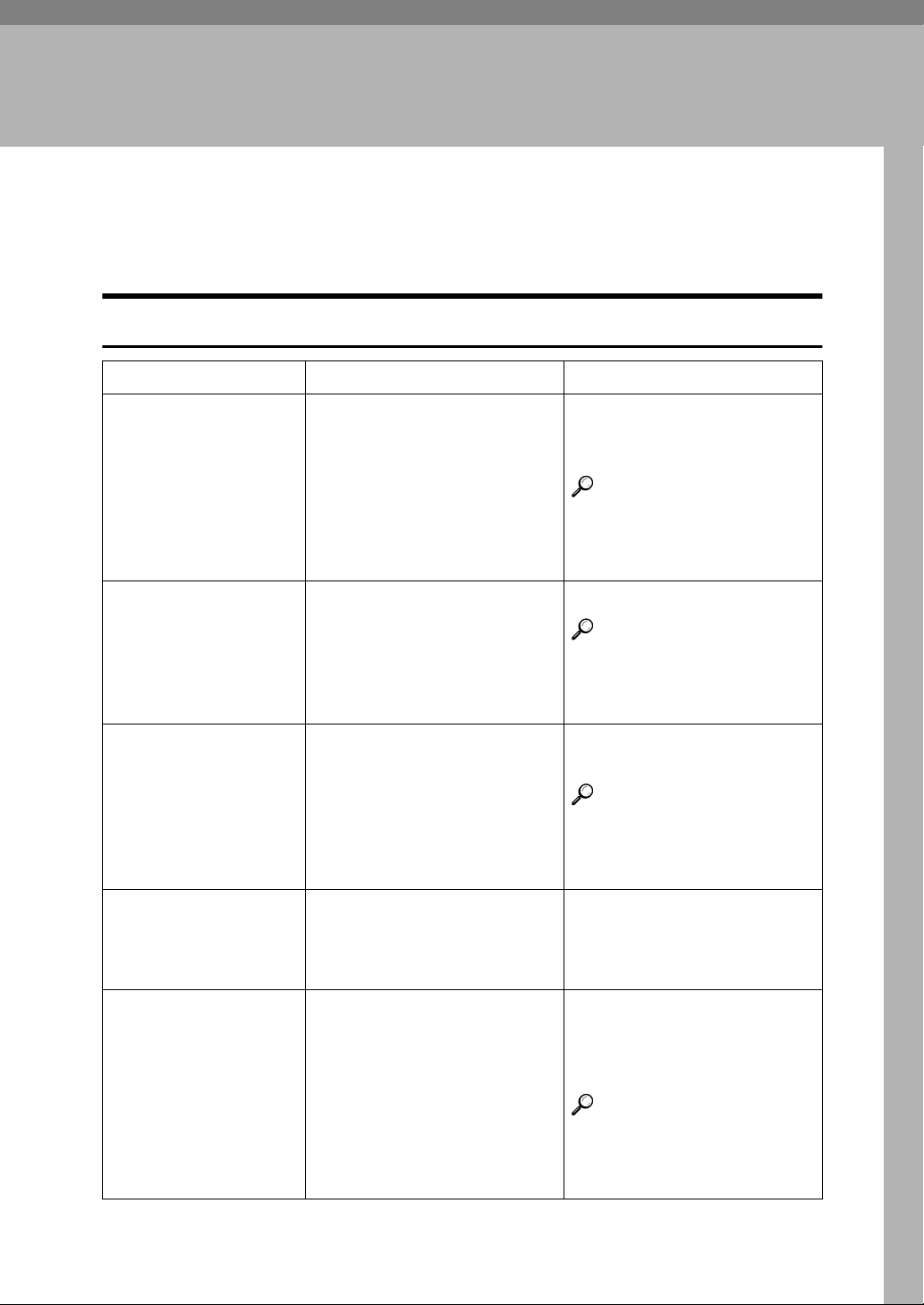
3. Troubleshooting
Error & Status Messages on the Operation Panel
Error & Status Messages on the Oper ati on Panel
Message Description Comments
Add Fuser Oil The fuser oil is empty. Replace the fuser oil. Contact
your sales or service representative.
Reference
See the operating instructions that describes copy
functions.
Add Staples Stapler is almost empty. Add staples.
Reference
See the operating instructions that describes copy
functions.
Add Toner
xxx
Call Service There is a malfunction in the
Close Door(s)/
Cover(s)
The indicated toner is empty. Replace the indicated toner
cartridge.
Reference
See the operating instructions that describes copy
functions.
Turn the power off and on. If
printer.
Doors or covers are open. Close doors or covers. The
this does not clear the problem, contact your sales or service representative.
operation panel of the copier
displays which doors or covers are open.
Reference
See the operating instructions that describes copy
functions.
17
Page 24
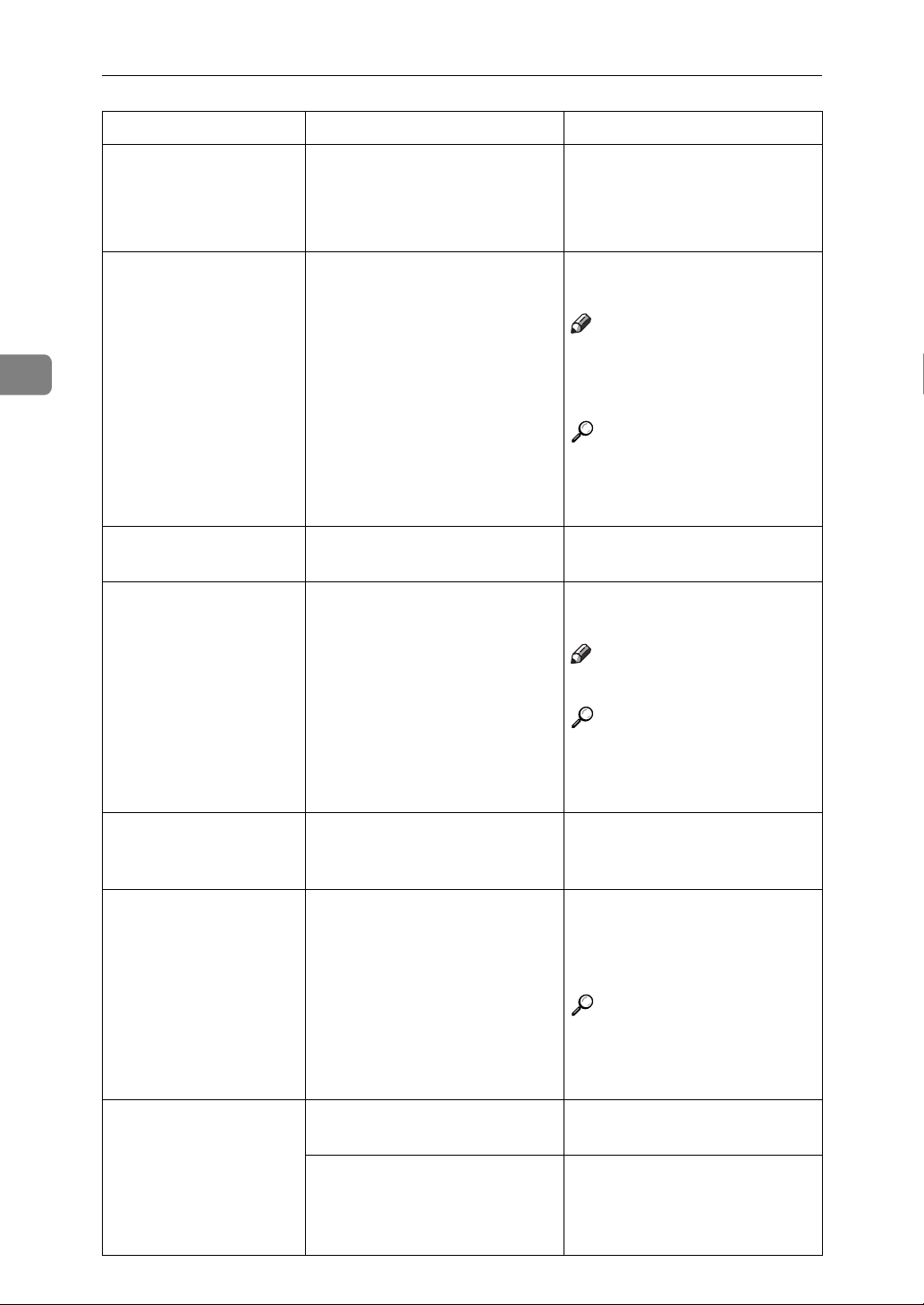
Troubleshooting
Message Description Comments
3
Initializing RICOH-SCRIPT2 is initializ-
ing.
Low on: xxx Toner is almost empty. Replace the indicated toner
It is not an error message.
Process of initializing starts
up in the RICOH-SCRIPT2
mode.
cartridge.
Note
xxx is the color of the ton-
❒
er, and CMYK is the combination.
Reference
See the operating instructions that describes copy
functions.
Load Paper There is no paper in the By-
pass Tray.
Load
YYY
There is no indicated paper
size in the tray.
Load paper in the Bypass
Tray.
Load the indicated paper size
in the tray.
Note
YYY is the paper size.
❒
18
Offline Printer status is offline. The
printer cannot accept or print
data.
Clear Misfeed(s) Paper jam has occurred in the
printer.
Please wait The printer is preparing for
printing.
The printer adjusts itself reg-
ularly to maintain print quality. (This message might
appear while printing.)
Reference
See the operating instructions that describes copy
functions.
To put the printer online,
press
{
Remove the jammed paper.
The operation panel of the
copier displays where the paper jam has occurred.
Online
}
Reference
See the operating instructions that describes copy
functions.
Wait until the printer is
warmed up.
It is not an error message.
The printer is working prop-
erly. Just wait a while.
Page 25
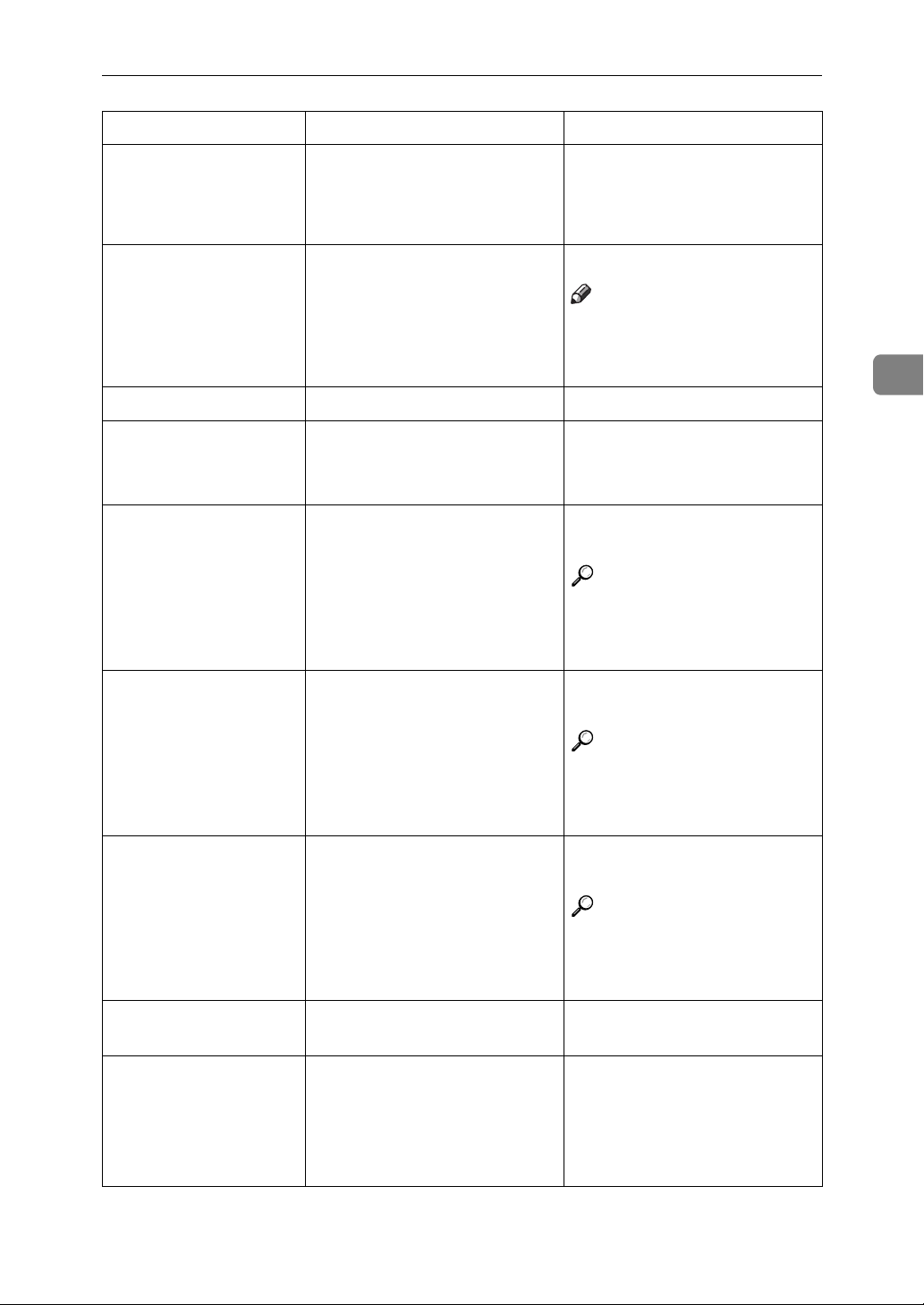
Error & Status Messages on the Operation Panel
Message Description Comments
Power Off / On
No : XXX-YYYYYYYY
Printing ... Doing print job. Wait for a while.
There is communication error
between the engine and the
controller.
Turn the power off and on. If
this does not clear the problem, contact your sales or service representative.
Note
This message appears
❒
only in the RICOH-
SCRIPT2 mode.
Processing Print data is being processed. Wait for a while.
Ready The printer is ready for print-
ing.
Remove Paper
From Duplex Tray
Paper is left in the Duplex
tray.
It is not an error message.
The printer is working prop-
erly.
Remove the paper from the
Duplex tray.
Reference
See the operating instruc-
tions that describes copy
functions.
3
Remove Paper
From Sorter
Reset Paper Tray
Correctly
Resetting ... A print job was interrupted
Waiting Printer is waiting for the next
Paper is left in the sorter bin. Remove the paper from the
The paper tray is not installed
correctly.
by pressing
data to print.
The menu is about to be set
on the printer's operation
panel.
{
Reset
.
}
sorter bin.
Reference
See the operating instruc-
tions that describes copy
functions.
Install the paper tray correctly.
Reference
See the operating instruc-
tions that describes copy
functions.
Wait for a while.
Wait for a while.
19
Page 26
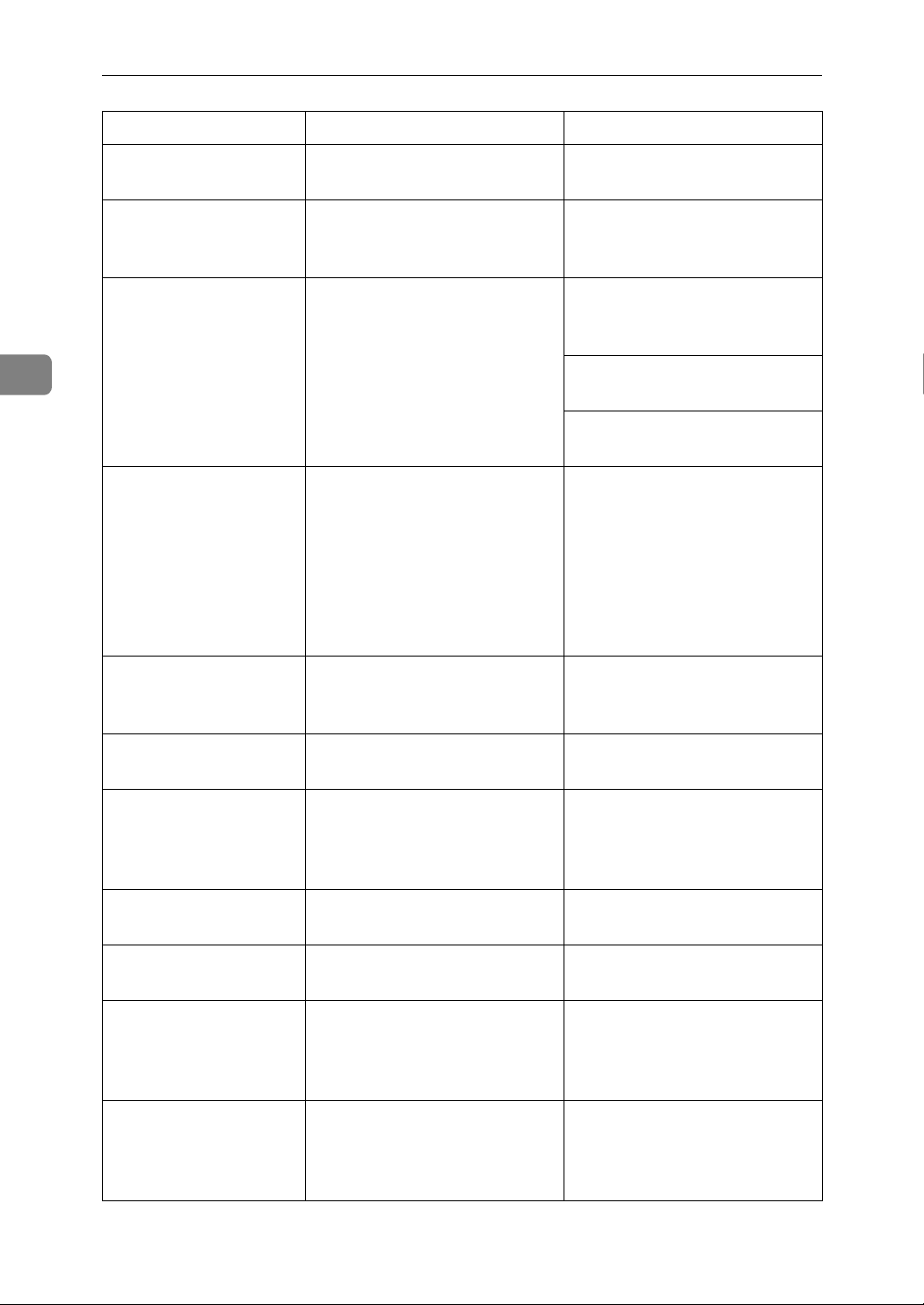
Troubleshooting
Message Description Comments
3
Warming Up The printer is preparing for
printing.
Waste Toner is
Full
A3:Error There is too much data for the
A6:Error There is not enough printer
AB:Error The printer is unable to pro-
The waste toner bottle is full. Replace the waste toner bot-
I/O buffer to handle.
memory to print one or more
of the pages in the print job.
cess the data you are trying to
print.
Wait until the printer is
warmed up.
tle. Contact your sales or service representative.
Check if the interface cable is
inserted into the printer and
your computer securely.
Check if the interface cable is
not damaged or broken.
Increase the size of I/O buffer.
Change the Color Level using
the printer driver to set the
image resolution to [
change the Color Level to [
]. Turn on “Image Memo-
bit
ry” using the printer's “System Menu” to turn on “Image
Memory”.
Reduce the amount of data
being sent to the printer.
Fast
], or
1
20
B1:Error An error has occurred in the
standard parallel interface.
B3:Error The printer setting is wrong. Reset the printer using
B4:Error An error has occurred in the
IC card slot.
B5:Error An error has occurred in the
RICOH-SCRIPT2 module.
B7:Error An error has occurred in the
network interface board.
85:Error An error has occurred in the
printer's standard memory.
Contact your sales or service
representative.
"Menu Reset" of the "Maintenance" menu. ⇒ P.63
ting Menus”
Contact your sales or service
representative.
Contact your sales or service
representative.
Turn the printer's power
switch off and on. Contact
your sales or service representative.
Turn off and on the printer's
power switch. Contact your
sales or service representative.
“Reset-
Page 27

Error & Status Messages on the Operation Panel
Message Description Comments
86:Error You may be trying to print
with the wrong printer driver.
You might not be using the
correct interface cable.
91:Error An error has occurred in the
printer's standard memory.
94:Error An error has occurred in the
printer's standard memory.
Note
❒
If you cannot solve the problem by taking above actions, turn the power off
Confirm that you are using
the correct printer driver.
Confirm that you are using
the correct interface cable.
Turn off and on the power
switch.
Turn off and on the power
switch. Contact your sales or
service representative.
and then on again. If this does not clear the error message, write down the error number and the message, and contact your sales or service representative.
Getting Printer Informati on over the Network
Printer current status
3
You can check the printer's status using the telnet command.
❖
telnet
Use status command. For more information, see “Remote Maintenance by telnet (mshell)” in the “Operating Instructions” of Network Interface Board included in the CD-ROM.
Message Description Comments
Call Service There is malfunction in the
printer.
Close Front Cover The front cover is open. Close the front cover.
Close Bank Cover The bank cover is open. Close the bank cover.
Close Sorter Cover The sorter cover is open. Close the sorter cover.
Close Right Cover The right cover is open. Close the right cover.
Close Left Cover The left cover is open. Close the left cover.
Duplex Tray: Not Set
Correctly
The duplex tray is not installed correctly.
Turn the printer off and then
on.
If this does not clear the problem, contact your sales or service representative.
Install the duplex tray correctly.
21
Page 28

Troubleshooting
Message Description Comments
3
Energy Save Mode The printer is in Energy Save
mode.
Fuser Oil is Empty Fuser oil is empty. Replace the fuser oil . Contact
No Paper There is no paper of the indi-
cated paper size in the paper
tray being used.
Wait for a while.
your sales or service representative.
Load paper of the indicated
paper size into the paper tray
being used.
Reference
See the operating instruc-
tions that describes copy
functions.
No Staple There is no staple. Replace staples.
Reference
See the operating instruc-
tions that describes copy
functions.
Paper in Duplex Tray There is paper left in the du-
plex tray.
Remove the paper from the
duplex tray.
Paper on Sorter Bin There is paper left in the sort-
er bin.
Paper Tray: Not Set
Correctly
Low on XXX Toner The indicated toner is low or
XXX Toner is Empty The indicated toner is empty. Replace the toner cartridge.
WarmUp The printer is preparing for
Waste Toner is Full The waste toner bottle is full. Replace the waste toner bot-
The paper tray is not installed
correctly.
has run out.
printing.
Remove the paper from the
sorter bin.
Install the paper tray correctly.
Replace the toner cartridge.
Wait until the printer is
warmed up.
tle. Contact your sales or service representative.
22
Page 29

Error & Status Messages on the Operation Panel
Printer configuration
You can check the printer configuration using telnet.
❖
telnet
Use info command. For more information, see “Remote Maintenance by Telnet (mshell)” in the “Operating Instructions” of Network Interface Board included as a PDF file in the CD-ROM.
Note
❒
“*” (asterisk) is displayed with the current setting.
❒
Regarding *1–*6, see the attached table.
Item Description
Printer System Version of the printer
Network Board Version of the network board
Input Tray
No.
ID number of the paper tray
Name
PageSize
Status
Name of the paper tray
Paper size loaded in the paper tray
Current status of the paper tray
*1
*3
3
*2
Output Tray
No.
Name
Status
Emulation
No.
Name
Version
Program
No.
Name
ID number of the output tray
Name of the output tray
Current status of the output tray
ID number of the emulation used by the
printer
Name of the emulation used in the print-
*6
er
Version of the emulation
ID number of the program
Name of the program (The fixed name is
blank.)
4
5
23
Page 30

3
Troubleshooting
❖
*1 Input Tray: Name
Name Description
Tray1 Name of installed paper tray
Tray2
Tray3
Tray4
Manual Tray Bypass Tray
❖
*2 Input Tray: Paper Size
Paper Size Description
A3R A3
B4R B4
A4R A4
A4 A4
B5R B5 JIS
B5 B5 JIS
A5R A5
A5 A5
B6R B6 JIS
A6R A6
L
L
L
K
L
K
L
K
L
L
DL+ 12"×18"
DLR 11"×17"
LGR
F4R
LTR
LT
1
8
/2"×14"
1
/2"×13"
8
1
/2"×11"
8
11"×8
1
L
L
/2"
L
L
L
K
24
FLR
1
/4"×13"
8
FR 8"×13"
HLR
HLT
1
5
/2"×81/2"
1
/2"×51/2"
8
L
L
L
K
Page 31

❖
*3 Input Tray: Status
Error & Status Messages on the Operation Panel
Status Description
Normal
NoTray There is no paper tray
PaperEnd There is no paper in the paper tray
❖
*4 Output Tray: Name
Name Description
Standard Standard Tray
Bin 1 ~ Bin 20 Sorter
❖
*5 Output Tray: Status
Status Description
Normal Normal
PaperExist There is paper in the output tray
OverFlow Output tray is full of paper
❖
*6 Emulation: Name
Proof Tray; if the sorter is installed
3
Emulation Name Description
RWC (IPDL-C) IPDL-C
RPS (RicohScript2) RICOH-SCRIPT2
25
Page 32

Troubleshooting
Machine Does not Print
Possible Cause Solutions
Is the power on? Confirm that the power cord is securely plugged into the
wall socket.
Turn on the power switch.
3
Is the interface cable
properly connecting the
printer to your computer connected securely?
Are you using a correct
interface cable?
Does the
cator stay on?
Is the paper set? Load paper into the paper tray or on the bypass tray.
Is paper left in the sorter
bin?
Is the machine working
as a copier?
Does the
stay red?
On Line
Error
indi-
indicator
Connect the interface cable properly. If there are any connectors or screws, confirm that they are fastened securely.
The type of interface cable you should use depends on your
computer. Be sure to use the correct one.
If the cable is damaged or worn, replace it with a new one.
Press
{
On Line
Remove paper from the sorter bin.
It may not be able to use the machine as a printer when the
machine is working as a copier.
Check the error message on the panel display and take the
required action.
to light it up.
}
26
Page 33

Possible Cause Solutions
Machine Does not Print
Is the
Data In
blinking or lit after starting the print job?
indicator
If not, the data is not being sent to the printer, or the printer
may be resetting the print job because there was a long delay in receiving the data from the computer.
❖
If the printer is using "I/O Timeout"
Increase the value of the "I/O Timeout" setting of the "IPDL-C Menu" or "RPS2 Menu". Or set the "I/O Timeout"
value to "0" (this is the off setting).
Set a longer [
properties when the RICOH-SCRIPT2 printer driver is
selected.
❖
If the printer is connected to the computer using the in-
Wait timeout
] period accessing the printer
terface cable
Confirm that the printer port settings are correct. For a
parallel port connection, port LPT1 or LPT2 should be
set.
Reference
For more information on the printer port settings, see
the notes after this table.
❖
Network Connection
Contact your network administrator.
3
If the
Data In
The printer may be resetting the print job. Take the following steps to correct the situation.
• Increase the "Job Timeout" setting of the "IPDL-C Menu"
or "RPS2 Menu".
• Confirm that the printer driver settings are correct.
• Change the "Transfer" setting of the "System Menu".
• Confirm that the "Parallel" of the "System Menu" is correct.
indicator is blinking or lit.
27
Page 34

Troubleshooting
Possible Cause Solutions
3
Is the
Data in
off after blinking or lit
for a while?
Can you print a test
page (configuration
page)?
indicator
It might occur when the printer does not have enough memory to print a page.
The following are the actions you should take when you encounter memory shortage problems. If these actions do not
solve the problem individually, try them in combination
with each other.
Change the Color Level to [
A
Use the printer property to change the Color Level to [
].
bit
Turn on "Image Memory".
B
Use the printer's "System Menu" to turn on "Image Memory".
If you cannot print a test page, it probably indicates a printer malfunction. You should contact your sales or service
representative.
If you can print a test page but cannot get the printer to print
when you issue a print command from your computer, it
probably means there is a problem with your computer.
Also keep in mind that large, complex data might take a
long time for the printer process.
1 bit
].
1
If you cannot solve the problem by taking the above actions, contact your sales
or service representative.
Note
• Windows 95/98
A Click
B Select the icon of the printer by clicking it. Next, on the
[
Properties
C Click the
D Check the
, point to
]
[
Start
.
]
[
Details
[
Print to the following port
tab.
]
[
Settings
, and then click
]
box to confirm that the correct port
]
[
Printers
is selected.
• Windows NT 4.0
A Click
B Select the icon of the printer by clicking it. Next, on the
[
Properties
C Click the
D Check the
, point to
]
[
Start
.
]
tab.
]
[
Port
[
Print to the following port
[
Settings
, and then click
]
box to confirm that the correct port
]
[
Printers
is selected.
• Macintosh
A Click
B In the
[
Apple Menu
[
connect via.
, point to
]
list box, select
]
[
Control Panel
[
Ethernet
and then click
]
.
]
.
]
[
File
.
]
[
File
[
Apple Talk
menu, click
]
menu, click
]
.
]
28
Page 35

Other Printing Problems
Other Printing Problems
Note
❒
For more information on IPDL-C, see the printer driver's Help.
❒
For more information on RICOH-SCRIPT2, see the “Operating Instructions”
included as a PDF file in the CD-ROM.
Status Possible Causes, Descriptions, and Solutions
The
Data in
off after blinking or lit for a
while.
Image is printed on the reverse side of the paper.
Paper misfeeds occur frequently.
indicator will be
It might occur when the printer does not have enough
memory to print a page.
The following are the actions you should take when
you encounter memory shortage problems. If these actions do not solve the problem individually, try them
in combination with each other.
Change the Color level to [
A
Use the printer property to change the Color Level
to [
Turn on "Image Memory".
B
Use the printer's "System Menu" to turn on "Image
Memory".
The paper in the paper tray is upside down.
• Standard Tray (Tray 1~ 4)
Load paper with the print side down.
• Bypass Tray
Load paper with the print side up.
Check if the paper tray is set correctly. If not, set it correctly.
Paper is not loaded correctly in the paper tray. Remove
the paper from the tray and reload it correctly.
1 bit
].
1 bit
].
3
Check the paper type settings. The type of paper set
with the printer driver might be different from the actual paper or media type. Make the correct paper or
media type setting.
You might use paper not supported by this machine.
Use the appropriate type of paper. For more information on supported paper by this machine, see the operating instructions that describes the copy functions.
29
Page 36

Troubleshooting
Status Possible Causes, Descriptions, and Solutions
3
It takes too much time to
print the first page.
It takes too much time to
print.
The data is so large or complex that it takes time to process it. If the
cessing is being done. Just wait until it resumes.
The Energy Saver mode might be enabled. In the Energy Saver mode, it takes time for the machine to warm
up.
Photographs and other data intensive pages take a
long time for the printer to process, so simply wait
when printing such data.
You can also speed up printing by using the printer
driver to select [
The printer takes more time to print documents that
contain a large volume of data. A blinking or lit
indicator means that data is reaching the printer, so
In
just wait for the data to be processed and printed.
If "Please Wait" appears on the panel display, the print-
er is now warming up or busy. Wait for a while.
The printer takes more time to print if the "Interleave
Print" is set to on in the copy function. For more information, see the operating instructions that describes
copy functions.
Data In
indicator is blinking, the data pro-
] as the print mode.
1 bit
Data
It takes too much time to perform black and white printing.
Paper is not fed from the desired paper tray.
Desired paper size is not
used for the output.
] is selected on the printer driver. Change this set-
[
Color
ting to [
Black and White
] in the [
Color Mode
].
Note
Some applications ignore the color mode setting
❒
made with the printer driver.
The printer driver setting is not correct. Change the setting. See the printer driver's Help for further details.
The printer driver setting is not correct. Change the setting. See the printer driver's Help for further details.
Specified paper is not loaded correctly in the paper
tray. Remove the paper from the tray and reload the
specified paper correctly.
Note
If you select Bypass Tray to print with IPDL-C, you
❒
must set the paper size both on the printer driver
and on the operation panel.
If you select Bypass Tray to print with RPS2, you
❒
can set the paper size on the operation panel.
30
Page 37

Other Printing Problems
Status Possible Causes, Descriptions, and Solutions
The area on the page that
should be white or free of
toner is a hazy gray.
Image density is too light. Turning on [
Toner is not fused well when
printing on thick paper or
OHP transparencies.
Check the image density setting.
Adjust the Color Calibration.
blurred and result in very thin lines not printing at all.
With color printing, toner saving can cause abnormal
coloring. Try printing again after turning [
off. See the printer driver's online help for details about
changing the settings on this tab.
If the message "Add Toner XXX" is on the panel display, replace the toner cartridge for the indicated color.
For more information on replacing the toner cartridge,
see the operating instructions that describes copy functions.
You might be using paper not supported by this printer. Use the appropriate type of paper. For more information of supported paper, see the operating
instructions that informs the copy functions.
The printer is not in the "Thick Paper" or "OHP Transparency" mode. Select [
(IPDL-C) or [
printer driver.
Toner Saving
] (RPS2) in the [
OHP
] can cause the output to be
Thick Paper
Toner Saving
], [
OHP Transparency
Paper Type
] box of the
]
3
]
The color of the printout is
different from the color on
the computer's display.
The toner based color system used by the printer is different from the light based color system of the computer screen. ⇒ P.73
Turning on the [
ities.
Check the settings of the printer driver's [
tab and restore the default settings.
Adjusting the color calibration.⇒ P.33
Color Calibration of the Printer”
“Color Guide”
Toner Saving
] can cause color irregular-
Color Setting
“Adjusting the
]
31
Page 38

Troubleshooting
Status Possible Causes, Descriptions, and Solutions
3
The printout is different
from the image on the computer screen.
Changing the color settings
with the printer driver causes a drastic change in printout color.
Photograph printing looks
rough.
Certain applications or image creation methods produce images that cannot be printed exactly as they appear on the computer screen.
With IPDL-C, checking the [
printer driver's [
converted to image data before it is sent to the printer,
which produces a printout that is closest to what appears on your computer screen.
] tab causes the print data to be
Setup
Print as bitmap
] item of the
Note
The setting also causes large-volume print jobs
❒
which take longer to print because of the required
conversion process.
With IPDL-C, do not make radical changes in the settings of the [
Also note that the sample shown by the printer driver
is intended to show what processes are being applied,
not exactly what your printout will look like.
With IPDL-C, select [
Printing from some applications results in a loss of res-
olution.
Color Setting
] tab.
Fine
] on the [
Print Quality
] tab.
Color documents are printed
in black and white.
Fine dot pattern does not
print.
Solid area, line or text are
shiny or glossy, when created as a mixture of cyan, magenta, yellow.
Black gradation is not natural.
When printing on OHP
transparencies, a sheet of paper is not placed between
printed OHP transparencies.
The printer driver is not set up for color printing. Select
] in the [
[
Color
Some applications normally print color text as black
and white.
With IPDL-C, select [
box.
With IPDL-C, select [
] . See the printer driver's online help for details
Mode
about changing the settings on this tab.
With IPDL-C, select [
[
Graphic Mode
The size and direction of the paper loaded in the paper
tray are different from those of the OHP transparency.
Load the same size and direction paper as the OHP
transparency into the paper tray.
The "OHP Slip” setting is set to "Off”. Change the setting with operation panel.
Color Mode
].
] on the printer driver.
Photographic
] on the printer driver's [
K
CMY + K
] in the [
] on the printer driver's
Dithering
] list
Graphic
If you cannot solve the problem by taking the above actions, contact your sales
or service representative.
32
Page 39

4. Adjusting the Color
Calibration of the Printer
To maintain a constant print quality, color calibration is important for color
printers. Color output may change after many prints, after a new toner cartridge
is installed or with changes in temperature and atmospheric conditions.
This section provides instructions on printer color calibration.
Important
❒
In order to do a full color calibration, you have to do the “Auto Color Calibration” in the copy mode at first, then in the printer mode.
❒
Color calibration should be done separately to match the printer driver's settings. You can select among 3 Color Levels
*1
1 bit, 2 bit, 4 bit (High Quality)
Note
❒
The adjustment of the color calibration affects the output of all of the users
who use the same printer.
❒
Use the same type of paper for each print of the test pattern. An inaccurate
adjustment can occur if the scanned paper type is different from the output
paper type.
*1
from the printer properties.
33
Page 40

Adjusting the Color Calibration of the Printer
Operation on the Copy Function Mode
Preparation
The operation panel of the copy machine must be used to follow the procedure.
4
A Press
B Press
❒
C Press
❒
D Press
❒
❒
❒
{
User Tools
[
Auto Color Calibration
Note
If the machine is a simplex machine with the hard key type, select
, select
features
Note
If the machine is a simplex machine with the hard key type, press
Note
If the machine is a simplex machine with the hard key type, press
The test pattern is printed on A4K,11"×8
available, the test pattern is printed on either B4L, 8
11''×17''L.
The test pattern is not counted on the counter.
]
.
]
[
Start
[
Print Start
.
}
and select
]
[
Image Adjustment
to print the test pattern.
]
and select
]
[
Printer Mode
[
Auto Color Cal.
1
/
"K. If A4K,11"×8
2
.
]
[
Copy
.
]
.
[
]
OK
.
[
]
Print
1
1
/
2
/2"K is not
"×14''L or A3L,
E Place the test pattern on the exposer glass (platen glass) and place a few
pieces of blank paper on the back of the test pattern.
34
Limitation
❒
Do not place them in the document feeder. Put them on the exposure glass
(platen glass). Using the document feeder may cause a misoperation.
F Press
❒
G Press
[
Scan Start
Note
If the machine is a simplex machine with the hard key type, press
{
User Tools
to adjust the color calibration.
]
.
}
[
Scan
.
]
Page 41

Operation on the Printer Function Mode
Operation on the Printer Function Mode
Preparation
The printer operation panel must be used to do the following procedure.
Confirm that a tray for either A4 size paper or not less than 8
is selected.
Selecting a paper tray is necessary if one has not yet been selected.
1
/
"×11” paper
2
A Press
The Menu appears on the panel display.
{
Menu
.
}
<Menu> j
IPDL-C Menu l
B Press
{U}
or
to display “Maintenance”.
{T}
<Menu> j
Maintenance l
C Press
The following message appears on the panel display.
{
# Enter
.
}
4
<Maintenance> j
1.Color Calib. l
D Press
The following message appears on the panel display.
{
# Enter
.
}
<Color Calib.> j
1.2 bit l
35
Page 42

Adjusting the Color Calibration of the Printer
4
E Press
The following message appears on the panel display.
{
# Enter
.
}
<2 bit> j
1.Test Pattern l
F Press
The following message appears and the test pattern begins being printed.
{
# Enter
.
}
<Test Pattern>
Press # key
G Press
The following message appears while the test pattern is being printed.
{
# Enter
}
Printing...
Test Pattern
The following message appears on the panel display after printing the test
pattern.
Set Pattern on
Glass, Press #
H Place the test pattern on the exposure glass (platen glass) and place a few
pieces of blank paper on the back of the test pattern.
Limitation
❒
Do not place them in the document feeder. Put them on the exposure glass
(platen glass). Using the document feeder may cause a misoperation to occur.
I Press
The following message appears on the panel display during calibration.
{
# Enter
Calibrating...
The following message appears after the adjustment of the color calibration
has been completed.
Completed
to adjust the color calibration.
}
36
Page 43

Operation on the Printer Function Mode
The menu
[
Color Calib.
appears.
]
<Color Calib.> j
1.2 bit l
Note
❒
Adjust the color calibration for both the 1 bit and 4 bit (High Quality)
modes following steps E to I.
J Press
{
On Line
to return to the “Ready” display.
}
IPDL-C
Ready
4
37
Page 44

Adjusting the Color Calibration of the Printer
Restoring Previous Color Calibration Settings
This machine can store the current and previous color calibration settings. In order to restore the previous setting, you should delete the current one.
Operation on the Copy Function Mode
Preparation
The operation panel of the copy machine must be used to follow the procedure.
4
A Press
B Press
❒
C Press
❒
{
User Tools
[
Auto Color Calibration
Note
If the machine is a simplex machine with the hard key type, select
, select
]
Mode
[
Prev. Setting
Note
If the machine is a simplex machine with the hard key type, select
.
]
ous
.
}
and
]
[
Image Adjustment
.
]
[
Printer Mode
.
]
.
]
Operation on the Printer Function Mode
A Press
{
Menu
.
}
[
Printer
[
Previ-
38
The Menu appears on the panel display.
<Menu> j
IPDL-C Menu l
Page 45

Restoring Previous Color Calibration Settings
B Press
{U}
or
to display “Maintenance”.
{T}
<Menu> j
Maintenance l
C Press
The following message appears on the panel display.
{
# Enter
.
}
<Maintenance> j
1.Color Calib. l
D Press
The following message appears on the panel display.
{
# Enter
.
}
<Color Calib.> j
1.2 bit l
E Press
{U}
or
to display the color level which you want to restore.
{T}
<Color Calib.> j
2.4 bit l
4
F Press
{
# Enter
.
}
<4 bit> j
1.Test Pattern l
G Press
{U}
or
to display “Restore”.
{T}
<4 bit> j
3.Restore l
H Press
The following message appears on the panel display.
{
# Enter
.
}
<Restore>
Press # key
I Press
{
# Enter
to restore the previous color calibration setting again.
}
Restored
39
Page 46

Adjusting the Color Calibration of the Printer
The following message appears on the panel display.
<4 bit> j
3.Restore l
4
J Press
{
On Line
to return to the “Ready” display.
}
IPDL-C
Ready
40
Page 47

5. Using the Operation Panel
Though the factory default settings of the printer are suitable for most printing
jobs, the Printer Menu gives you access to a number of settings that control basic
printer operations. Printer Menu settings you make are retained even when you
turn off the printer.
This section provides the following Printer Menu information.
❖
Setting Menus
Describes the basic procedures for changing Printer Menu settings.
❖
Protecting the Menus
Describes how to protect System Menu settings against accidental changes.
❖
Menu Table
A table chart that shows all of the Printer Menu.
Note
❖ {
Menu} and {Media} setting priorities
Some of the settings accessed by
tings made by
{
Menu
take priority over settings by
}
{
Menu
can be accessed by
}
{
Media
}
{
.
Media
. Set-
}
41
Page 48

Using the Operation Panel
Setting Menu
5
A Press
The following message appears on the panel display.
{
Menu
.
}
<Menu> j
IPDL-C Menu l
B Press
{U}
or
to display the setting you want to change.
{T}
<Menu> j
System Menu l
C Press
The following message appears on the panel display.
{
# Enter
.
}
42
<System Menu> j
1.Paper Tray l
D Press
The following message appears on the panel display.
{
# Enter
.
}
<Paper Tray> j
*Tray 1 l
An asterisk “*” is indicated at the left side of the currently selected item.
E Press
{U}
or
to display the menu item you want to change.
{T}
<Paper Tray> j
Tray 2 l
Page 49

Setting Menu
F Press
{
# Enter
.
}
<Paper Tray> j
*Tray 2 l
This registers the setting.
G Repeat steps C to F to change the settings of other items.
H Press
The following message appears on the panel display.
{
On Line
Take Offline
Then Press Reset
.
}
5
I Press
The On Line indicator stays off.
J Press
This restarts the printer with the new settings.
❒
{
On Line
{
Reset
Note
You can check the current Menu settings by printing a configuration page.
⇒ P.58
to enter the offline condition.
}
.
}
“Printing the Configuration Page”
43
Page 50

Using the Operation Panel
Protecting the Menus
This procedure lets you protect System Menu settings against accidental changes. It makes it impossible to change the System Menu settings you make with the
normal procedure unless you perform the required key operation. In a network
environment, protecting settings restricts changes to the System Menu settings
to network administrators.
Protecting the Menus
5
A Check if the On Line indicator is on. If not, press
line condition.
B Press
The following message appears on the panel display.
{
# Enter
, then
}
{
Escape
<Menu> j
IPDL-C Menu l
C Press
{U}
or
to display "Maintenance".
{T}
<Menu> j
Maintenance l
, and then
}
{
Menu
.
}
{
On Line
to enter the on-
}
44
D Press
The following message appears on the panel display.
{
# Enter
}
<Maintenance> j
1.Color Calib l
E Press
{U}
or
to display "3.Menu Protect".
{T}
<Maintenance> j
3.Menu Protect l
Page 51

Protecting the Menus
F Press
The following message appears on the panel display.
{
# Enter
.
}
<Menu Protect> j
Off l
G Press
{U}
or
to display “On”.
{T}
<Menu Protect> j
On l
H Press
This registers the setting. The “Maintenance” menu appears.
{
# Enter
.
}
<Maintenance> j
3.Menu Protect l
I Press
{
On Line
.
}
5
The “Ready” message appears on the panel display.
IPDL-C
Ready
Changing the Menu Settings wi thout Removing Protect
This procedure allows you to change System Menu settings without turning off
menu protection. The changes you make are automatically protected as soon as
you register them.
45
Page 52

Using the Operation Panel
5
A Press
The following message appears on the panel display.
{
Menu
.
}
<Menu> j
IPDL-C Menu l
B Press
{U}
or
to display "System Menu".
{T}
<Menu> j
System Menu l
C Press
A message that System Menu settings are protected appears.
{
# Enter
.
}
Menu Protected
Press Escape key
D Press
The following message appears on the panel display.
{
Media
.
}
<System Menu> j
1.Paper Tray l
E Change the setting following the normal procedure. ⇒ P.42 “Setting Menu”
46
Page 53

Removing Protect
Protecting the Menus
A Check if the On Line indicator stays on. If not, press
online condition.
B Press
The following message appears on the panel display.
{
Enter
, then
}
{
Escape
<Menu> j
IPDL-C Menu l
C Press
{U}
or
to display "Maintenance".
{T}
<Menu> j
Maintenance l
and then
}
{
Menu
.
}
{
On Line
to enter the
}
5
D Press
The following message appears on the panel display.
{
# Enter
.
}
<Maintenance> j
1.Color Calib. l
E Press
{U}
or
to display "3.Menu Protect".
{T}
<Maintenance> j
3.Menu Protect l
F Press
The following message appears on the panel display.
{
# Enter
.
}
<Menu Protect> j
On l
47
Page 54

Using the Operation Panel
5
G Press
{U}
or
to display "Off".
{T}
<Menu Protect> j
Off l
H Press
This turns off protection and the “Maintenance” menu appears.
{
# Enter
.
}
<Maintenance> j
3.Menu Protect l
I Press
The “Ready” message appears on the panel display.
{
On Line
.
}
IPDL-C
Ready
48
Page 55

Menu Table
IPDL-C Menu 1. Job Timeout
2. I/O Timeout
RPS2 Menu 1. Color Level
2. Color Mode
3. Color Set
4. Color Profile
5. Smoothing
6. Toner Saving
7. Dithering
8. Paper Type
Menu Table
9. Auto Tray SW
A. Auto Duplex
B. Duplex Bind
C. Collate / Stack
D. Face Up / Down
*1
*2
*3
*4
E. Job Timeout
F. I/O Timeout
G. Feed timeout
H. Print Error
I. Ktalk Mode
J. Parallel IF1
*1
This menu appears when the machine is a duplex machine.
*2
This menu appears when the machine is a duplex machine and has the optional 10bin or 20-bin sorter installed.
*3
This menu appears when the machine has the optional 10-bin or 20-bin sorter installed.
*4
This menu appears when the machine has the optional 10-bin or 20-bin sorter installed.
5
49
Page 56

Using the Operation Panel
System Menu 1. Paper Tray
2. I/O Buffer
3. Transfer
4. Image Memory
5. Parallel
6. Bi-direction
7. OHP Slip
8. PrinterLang. (Printer Language)
9. Language
32. IP Address
33. Subnet Mask
34. Gateway Add (Gateway Address)
5
35. Access CTL. (Access Control)
36. Access Mask
37. Net Boot (Network Boot)
38. Frame NW (Frame Type NW)
39. Active PTL.
Maintenance 1. Color Calib.⇒ P.33
2. Menu Reset⇒ P.63
*3
*2
⇒
*1
⇒
P.67
P.44
3. Menu Protect
4. Log Protect
5. Log Clear
List Print 1. Config.Page⇒ P.58
2. Job Log⇒ P.69
3. Statistics⇒ P.65
*1
This menu appears when
er is
*2
*3
On Line
This menu appears when
er is
On Line
If “Log Protect” is set to On, “Log Clear” will not appear.
.
.
{
{
# Enter
# Enter
}, {
}, {
Escape
Escape
and
}
and
}
{
{
are pressed while the print-
}
Menu
are pressed while the print-
}
Menu
50
Page 57

Menu Table
IPDL-C Menu
The following are the settings you can make with the “IPDL-C Menu”.
Note
❒
Italicized settings indicate default settings.
❖
1. Job Timeout
You can set how long the printer waits before terminating a print job when
the printer doesn't receive the end of that print job.
•
000 Off
• 0 (Off) to 999 seconds
❖
2. I/O Timeout
You can set how long the printer waits for more print data before ending its
waiting period for data and terminating a job.
•
300 Sec
• 0 (Off) to 999 seconds
5
RICOH-SCRIPT2 Menu
Settings that you can select are described below. Settings made with the printer
driver normally take priority, except when a printer driver setting is set to use
the printer's settings.
Note
❒
Italicized settings indicate default settings.
❖
Color Level
Use this setting to select the number of colors used per dot to
.
]
bit
•1 bit
•
2 bit
•4 bit
❖
Color Mode
Use this setting to select either monochrome or color printing.
•
Color
• Black & White
❖
Color Set (Color Setting)
Use this setting to select the correction method used for converting the RGB
data to CMYK data.
•Off
No modification to the color setting.
[
1 bit
], [
2 bit
]
or
[
4
51
Page 58

5
Using the Operation Panel
•
Vivid
Select this setting to perform CMYK conversion with enhanced saturation
and brightness to print vivid colors.
• Super Vivid
Select this setting to perform CMYK conversion. The colors printed with
this setting are more vivid than those printed with the "Vivid" setting. All
of the colors in the image, especially the lighter ones, are emphasized.
•Fine
Select this setting to perform color matching based on the printer's built-in
color rendering dictionaries, and perform CMYK conversion. It makes it
possible to print colors that are close to the displayed colors on the computer screen.
The color rendering dictionaries refer to the contents selected by the Color
Profile. This setting is useful when the application and printer driver do
not support the color matching features.
Note
❒
The color rendering dictionary that is selected on the Color Profile settings is used.
• Super Fine
Like the "Fine" setting, the color rendering dictionary is used, however,
output is more vivid. This setting is enabled to make light colors print
more vivid.
❖
Color Profile
Use this setting to select the color rendering dictionary (CRD). The CRD is referred to for color matching, so you should select the appropriate CRD for the
document you are printing. The CRD you select is also referred to when
“Fine” or “Super Fine” is selected for the “Color Setting”.
Note
❒
When selecting
use a color profile specifically for OHP. Even though the color profile has
been optimized for OHP, the adjustments are automatic and are not indicated on any of the dialog boxes. In this case, this setting is not enabled.
• Photograph
Use this setting to enhance the reproduction of photos and graphics that
include midtones.
•
Presentation
Use this setting to enhance the reproduction of documents that contain text
and graphics. This CRD is best for printing colored charts, graphs, presentation materials and so on. If you use this CRD for printing photographs,
color gradations might not be reproduced well.
• Solid Color
Use this setting to print specific colors, logos and so on.
as the paper type, the CRD automatically adjusts to
[
]
OHP
52
Page 59

❖
Smoothing
Use this setting to select whether Smoothing is available or not.
•Off
•
Auto
Limitation
❒
When the Color Level is set to
❒
When Toner Saving is selected, Smoothing is not enabled.
❖
Toner Saving
Use this setting to select whether Toner Saving is available or not.
•
Off
•On
Note
❒
Turning on toner saving can cause the output to become blurred and result
in very thin lines not printing at all. In the case of color printing, toner saving can cause colors to be different from those expected. Because of this,
use toner saving only for proofing and intermediate drafts, and turn it off
for final prints when top quality is important.
, Smoothing is enabled.
[
]
1 bit
Menu Table
5
❖
Dithering
Use this setting to select the image mode that is best for the type of data you
are printing.
•
Auto
Select this setting to set automatically a mode that is suitable for printing.
• Photographic
Select this setting to print photographs.
•Text
Select this setting to print text.
❖
Paper Type
Use this setting to select the paper type for printing as: Plain Paper, Thick Paper, or OHP Transparency.
•
Plain Paper
•OHP
• Thick Paper
Selecting an OHP Transparency as the paper type automatically adjusts internal settings to use a color profile specifically for OHP. Even though the color
profile has been optimized for OHP, the adjustments are automatic and are
not indicated on any of the dialog boxes. In this case, the
is not enabled.
[
Color Profile
setting
]
53
Page 60

5
Using the Operation Panel
❖
Auto Tray SW (Auto Tray Switch)
Use this setting to make the printer automatically switch to the other tray if it
has the same paper size as the current tray when paper runs out while printing.
•
On
•Off
To use this feature, the optional tray unit should be installed on the printer,
and paper having the same size and direction should be loaded in both the
standard and optional trays.
❖
Auto Duplex
Use this setting to select duplex print.
This item can be used only a duplex machine.
•
Off
•On
❖
Duplex Bind
Use this setting to select the binding position of duplex prints.
•
Short Edge
• Long Edge
❖
Sort/Stack
Use this setting to select sort or stack.
•
Off
•Sort
•Stack
❖
Face Up/Down
Use this setting to select face-down or face-up printing. This setting can be
used only when
ed in Auto Duplex, this selection will be ignored.
•
Face Down
• Face Up
❖
Job Timeout
Use this setting to set how long the printer waits before terminating a print
job when the printer does not receive the end of the current print job. You can
set a time ranging from 1 to 999 seconds, or you can turn this feature off (no
time limit = 0 second).
•
000 Off
• 0 (Off) to 999 seconds
[
3 bin Sorter
is selected. If
]
[
Long Edge
or
]
[
Short Edge
is select-
]
54
Page 61

Menu Table
❖
I/O Timeout
Use this setting to set how long the printer waits for more print data before
ending its wait period and terminating a job. The job is automatically cancelled if no data is received for the selected time.
•
300 Sec
• 0 (Off) to 999 seconds
❖
Feed timeout
Use this setting to set how long the printer waits for the correct paper size
loaded, when paper runs out while printing. The job is printed with the paper
currently loaded if the correct size is not loaded within the selected time.
•
60 Sec
• 0 (Off) to 999 seconds
❖
Print Errors
Use this setting to select if an error report should be printed from the current
tray when a PostScript error occurs while printing.
•
Off
•On
5
❖
Ktalk Mode
This setting is not available.
❖
Parallel IF
Use this setting to select the parallel interface timing. When “System Default”
is selected, the setting in the “System Menu” is used.
•
System Default
•ACK Inside
• ACK Outside
System Menu
The following are the settings you can make with the “System Menu”.
Note
❒
Italicized settings indicate default settings.
❖
1. Paper Tray
You can select the default paper tray whenever you turn on the printer. Only
available trays will be displayed.
•
Tray 1
• Tray 2
• Tray 3
• Tray 4
•Bypass
55
Page 62

Using the Operation Panel
❖
2. I/O Buffer
You can select the size of the I/O buffer. Normally it is not necessary to
change this setting.
• 16KB
• 32KB
• 64KB
•
128KB
• 256KB
• 512KB
❖
3. Transfer
You can select the data transfer speed of the parallel interface. If you are having trouble with data transfers, try changing this setting to “Normal”.
•
Hi-speed
•Normal
5
❖
4. Image Memory
This setting controls what the printer does when the printer memory is not
enough to print a certain page.
•
Off
•On
❖
5. Parallel
You can select the parallel interface timing setting. Normally it is not necessary to change this setting.
•ACK Inside
•
ACK Outside
•STB Down
❖
6. Bi-direction
You can select the printer response mode for status fetch requests when the
standard parallel interface is being used. Use the "Standard" setting when you
are experiencing problems while the printer is connected to another manufacturer's print box.
•
Original Mode
• Standard
56
❖
7. OHP Slip
The OHP Slip is a sheet of paper placed between printed OHP transparencies.
You can set this option to off or on.
•
On
•Off
Page 63

Menu Table
❖
8. PrinterLang.
You can select the printer language that is automatically used when the printer is turned on. Selecting IPDL-C or RPS is required when you set the menu
for each printer language.
•
IPDL-C
• RPS (RICOH-SCRIPT2)
❖
9. Language
You can select the language of the text that appears on the panel display.
•
English
•French
• German
• Italian
•Dutch
• Japanese
❖
32. IP Address– 39. Active PTL
You can configure the printer for the network.
Reference
For more information on configuring the printer for the network, see the
“Printer Reference” that is provided as a paper manual.
5
57
Page 64

Using the Operation Panel
Printing the Configuration Page
Use the following procedure to print the configuration page which shows the
current printer settings.
Note
❒
If you want to print the configuration page in the RICOH-SCRIPT2 mode,
confirm that the printer language is set to the RPS2 mode. Normally the printer is set to the IPDL-C mode. Follow the procedure below from B.
Reference
For more information on selecting a printer language, see the "Printer Reference" that is provided as a paper manual.
5
A Press
The following message appears on the panel display.
{
Menu
.
}
<Menu> j
IPDL-C Menu l
B Press
{U}
or
to display "List Print".
{T}
<Menu> j
List Print l
C Press
The following message appears on the panel display.
{
# Enter
.
}
58
<List Print> j
1.Config.Page l
D Press
The following message appears on the panel display.
{
# Enter
.
}
<1.Config.Page>
Press # key
Page 65

Printing the Configuration Page
E Press
This starts printing the configuration page.
The following message appears while printing the configuration page.
{
# Enter
.
}
Printing...
Config.Page
The “List Print” menu appears after printing the configuration page.
<List Print> j
1.Config.Page l
F Press
{
On Line
.
}
5
The “Ready” message appears on the panel display.
IPDL-C
Ready
59
Page 66

Using the Operation Panel
Interpreting the Configuration Page
Interpreting the Configuration Page/IPDL-C
Reference
❖
Firmware Version
This shows the version of the printer firmware.
❖
Total Installed RAM
This is the total amount of memory installed in the printer.
Printer information
5
❖
Tray 1–4, Bypass Tray
This table shows the paper sizes for each tray. Only the available trays are
shown.
Note
Paper Size Indicated on the
Configuration Page
A3
L
B4
L
A4
L
A4
K
B5 JIS
B5 JIS
A5
L
A5
K
B6 JIS
A6
L
12"×18"
L
K
L
L
A3R
B4R
A4R
A4
B5R
B5
A5R
A5
B6R
A6R
DL+
60
11"×17"
1
8
/2"×14"
1
/2"×13"
8
1
/2"×11"
8
L
L
L
L
DLR
LGR
F4R
LTR
Page 67

Paper Size Indicated on the
Configuration Page
Interpreting the Configuration Page
L
K
LT
FLR
FR
HLR
HLT
11"×81/2"
1
/4"×13"
8
8"×13"
L
1
/2"×81/2"
5
1
/2"×51/2"
8
❖
Pages Printed
K
L
This is the total number of pages printed by the printer to date.
❖
Printer Error
This shows information on the status of consumable items and so on.
Status list
❖
IPDL-C
This shows current "IPDL-C" settings.
❖
System
This shows current "System Menu" settings.
5
❖
Network
These are the settings and status of the Network Interface Board.
Error log
This is a log of printer errors.
Interpreting Configuration Page/RICOH-SCRIPT2
❖
Reference
Shows the printer system version, ID and so on. You can also see the status of
the paper tray and the total number of pages printed to date.
❖
Tray Status
Shows the status of the paper trays.
❖
RPS2 Status
Shows the current settings for the RPS2 mode.
❖
Memory Status
Shows the amount of printer memory, VM area and so on.
61
Page 68

5
Using the Operation Panel
❖
Font Status
This is not used for this printer.
❖
Installed Fonts
Shows the fonts installed on the printer.
❖
Interface Status
Shows that the Network Interface Board is installed.
❖
Network & TCP/IP Status
Shows the network and TCP/IP items and their settings.
❖
NetWare St atus
Shows the NetWare items and their settings.
❖
NetBEUI Status
Shows the NetBEUI items and their settings.
❖
AppleTalk Status
Shows the AppleTalk items and their settings.
62
Page 69

Resetting Menus
Resetting Menus
Use the following reset procedure to return the settings of all menus to their initial default settings.
A Turn on the power switch.
B Press
The following message appears on the panel display.
{
Menu
.
}
<Menu> j
IPDL-C Menu l
C Press
{U}
or
to display "Maintenance".
{T}
<menu> j
Maintenance l
D Press
The following message appears on the panel display.
{
# Enter
.
}
5
<Maintenance> j
1.Color Calib. l
E Press
{U}
or
to display "2.Menu Reset".
{T}
<Maintenance> j
2.Menu Reset l
F Press
The following message appears on the panel display.
{
# Enter
.
}
<Menu Reset>
Press # Key
63
Page 70

Using the Operation Panel
5
G Press
The following message appears on the panel display.
{
# Enter
.
}
Take Offline
Then Press Reset
H Press
The “Ready” message appears on the panel display.
{
On Line
.
}
IPDL-C
Ready
I Press
The On Line indicator stays off.
{
On Line
to enter the offline condition.
}
J Press
This resets all menus to their initial factory defaults, and returns to the
“Ready” display.
{
Reset
.
}
IPDL-C
Ready
64
Page 71

Administering Printing by User Code
Administering Printing by User Code
This printer keeps a record of the number of pages printed for each User Code
set in the printer driver. Using an 8 digit code allows you to keep a record of the
number of prints made by each user code for 3 types of printing. You can monitor, black and white, 3 or 4 colors and other print jobs.
tents of a statistics report through the PRINTER MANAGER for ADMIN.
You can also set the same User Code within a department in the office. Up to 100
User Codes are available.
*1
Other means black and an additional color, or two colors neither of which is black.
• With Windows 95/98, you can set the User Code during driver installation.
• With Windows NT 4.0, you can set the User Code from the Printer Properties
after installing the printer driver.
• With RICOH-SCRIPT2, you can only select whether or not to use the fixed
User Code.
*1
You can view the con-
Important
❒
With Windows 95/98, changing the User Code can only be done after reinstalling the printer driver.
❒
With Windows 95/98, if the printer name is changed after installing the printer driver, the User Code will be cancelled.
Viewing the Number of Pages Printed for Each User Code
The following procedure shows how to print the list of User Codes and the number of pages printed for each User Code.
A Press
The Menu appears.
{
Menu
.
}
5
<Menu> j
IPDL-C Menu l
B Press
{U}
or
to display “List Print”.
{T}
<Menu> j
List Print l
65
Page 72

Using the Operation Panel
5
C Press
The following message appears on the panel display.
{
# Enter
.
}
<List Print> j
1.Config.Page l
D Press
{U}
or
to display “3.Statistics”.
{T}
<List Print> j
3.Statistics l
E Press
The following message appears on the panel display.
{
# Enter
.
}
<3.Statistics>
Press # key
Press
{
# Enter
The following message appears while printing the statistics report.
.
}
Printing...
Statistics
The “List Print” menu appears after printing the statistics report.
<List Print> j
3.Statistics l
F Press
The “Ready” message appears on the panel display.
{
On Line
.
}
IPDL-C
Ready
66
Page 73

Reading the Statistics Report
Administering Printing by User Code
5
User Code
1.
Shows a list of User Codes. However, if
User Codes have not been configured,
“other” appears.
With RICOH-SCRIPT2, User Code is
fixed to “99999999”.
Black
2.
Indicates the number of pages printed in
black and white.
Two Color
3.
Indicates the number of pages printed
with two colors or less (excluding Black
and White).
Full Color
4.
Indicates the number of pages printed
with three or four colors.
Deleting the User Code Record
The following procedure shows how to delete the User Code record.
A Press
{
Menu
.
}
67
Page 74

Using the Operation Panel
The Menu appears.
<Menu> j
IPDL-C Menu l
5
B Press
{U}
or
to display “Maintenance”.
{T}
<Menu> j
Maintenance l
C Press
The following message appears on the panel display.
{
# Enter
.
}
<Maintenance> j
1.Color Calib. l
D Press
{U}
or
to display “Log Clear”.
{T}
<Maintenance> j
3.Log Clear l
E Press
The following message appears on the panel display.
{
# Enter
.
}
<Log Clear>
Press # key
68
F Press
G Press
The “Ready” message appears on the panel display.
{
# Enter
{
On Line
to delete the User Code record.
}
.
}
IPDL-C
Ready
Page 75

Using the Job Log
Using the Job Log
This printer records a Job Log which shows the time of each print job, the number of pages, and the current print status of each job. The Job Log also shows
User ID for each job, making it easy to find the job in the log.
You can set up a User ID using 8 characters or less, which can help you to find
your own job log among many who share the same User Code. Up to 64 User IDs
are available.
Note
❒
Set up a User ID with the printer driver when you print.
❒
You can change the User ID every time you print.
❒
You can also browse the job log on your computer by accessing PRINTER
MANAGER FOR ADMIN/CLIENT.
❒
Turning off the power or resetting the printer deletes the job log.
Printing the Job Log
5
A Press
The Menu appears.
{
Menu
.
}
<Menu> j
IPDL-C Menu l
B Press
{U}
or
to display “List Print”.
{T}
<Menu> j
List print l
C Press
The following message appears on the panel display.
{
# Enter
.
}
<List Print> j
1.Config.Page l
69
Page 76

Using the Operation Panel
5
D Press
{U}
or
to display “Job Log”.
{T}
<List Print> j
2.Job Log l
E Press
The following message appears on the panel display.
{
# Enter
.
}
<2.Job Log>
Press # Key
F Press
The following message appears while printing the job log.
{
# Enter
.
}
Printing...
Job Log
The “Print List” menu appears after printing the job log.
<List Print> j
2.Job Log l
G Press
The “Ready” message appears on the panel display.
{
On Line
.
}
IPDL-C
Ready
70
Page 77

Reading the Job Log
Using the Job Log
5
User ID
1.
Indicates the User ID. “?” appears when
the User ID is not set up. If the “Statistics
Code” is set to [
SCRIPT2 mode, the fixed User ID of RPS2
will appear.
Printer Language
2.
Indicates the printer Language, either
IPDL-C or RICOH-SCRIPT2 (RPS2).
Request Time
3.
Indicates the time when the job was requested by the printer driver.
Note
It is not available with RPS2.
❒
Black
4.
Indicates the number of pages printed in
black and white.
Two Color
5.
Indicates the number of pages printed
with two colors or less (excluding Black
and White).
] in the RICOH-
On
Full Color
6.
Indicates the number of pages printed
with three or four colors.
Status
7.
Indicates the current status of each job.
71
Page 78

5
Using the Operation Panel
72
Page 79

6. Appendix
Color Guide
Color Printing Basics
Additive (Emitted) and Subtractive (Reflected) Color Models
All light is a mixture of red, green, and blue, which is normally called the RGB
model. When red, green, and blue are of equal intensities, the RGB color model
produces white.
red
green
Note
❒
RGB is also called additive or emitted color. The colors on your computer
screen are produced by varying the intensities of RGB.
Printed color is a mixture of cyan, magenta, and yellow, which is normally called
the CMY color model. When mixed in equal proportions the CMY color model
produces black.
yellow
cyan
Note
❒
CMY is also called subtractive or reflective color. The printer uses CMY toner
plus K (black) toner (CMYK color model) to provide full color printing.
blue
magenta
73
Page 80

Appendix
The colors of the RGB color model can be mixed to produce the cyan, magenta,
and yellow of the CMY color model and vice versa. Two colors of one model are
mixed to produce the color of the other model (mixing blue and green produces
cyan, for example). The remaining color is the compliment of the color produced
(red in this example). Complimentary colors are: red and cyan, green and magenta, blue and yellow.
6
yellow magenta
green
red
blue
cyan
Printed Color
The printer produces full-color output using four toner colors: cyan, magenta,
yellow, and black. These four colors make up the CMYK color model.
Note
❒
Mixing CMY in equal proportions should hypothetically produce pure black,
but imperfections in the ink cause an equal measure of these colors to produce
a muddy or dark brown. Black toner is added to the color model in order to
make it possible to produce pure black.
74
Page 81

Paper Size and Color Level
Paper Size and Color Level
The following table shows the correspondence between the color level selected
in the printer driver and the available paper size to be printed.
Paper Size 1 bit 2 bit 4 bit
12"×18"
A3, 11"×17"
1
B4, 8
/2"×14"
1
/2"×11" or smaller
A4, 8
√
√√
√√
√√√
• √ means the printing can be accomplished with both black and white and color modes.
• Blank cell means the printing may not be completed, if the document contains
a large volume of data.
6
75
Page 82

Appendix
Specifications
This section contains the electrical and hardware specifications for the printer
controller.
Component Specification
Resolution 600 dpi
Printing Speed 14 ppm (Monochrome) / 4 ppm (Color) : Simplex machine
18 ppm (Monochrome) / 4 ppm (Color) : Duplex machine
(A4K, 8
Parallel Interface IEEE1284B
Standard 36–pin printer cable and a parallel port on the host
computer
❒
1
/2"×11"K)
Note
Do not use a parallel cable that is longer than 2.5 meters (8.2
feet).
6
Network Interface 10BASE-T/100BASE-TX shielded twisted-pair (STP) cable and
category / Type 5 cable
Page description language
Fonts 39 Roman fonts (RICOH-SCRIPT2)
Memory Standard and Maximum : 96 MB
Operation System
Supported by this
printer
Network
Supported Copier
Models
IPDL-C
RICOH-SCRIPT2
Windows 95/98
Windows NT 4.0
MacOS 7.6~8.6
Topology :
Protocol :
Ricoh Aficio Color 3006, 4006, 4106
Gestetner CS206, CS206d, CS206de
Savin SDC306, SDC306A, SDC306E
Lanier 5706AG, 5706AH, 5806AG, 5806AH
Ethernet 10BASE-T/100BASE-TX
IPX/SPX, NetBEUI, TCP/IP, AppleTalk
5806E AG, 5806E AH
76
Page 83

INDEX
B
Bi-direction
,
56
C
,
CMY
CMY color model
Color Models
73
,
,
73
E
Error Messages
,
17
F
Firmware Version
,
I
61
,
56
,
,
51
56
Image Memory
I/O Buffer
I/O Timeout
IPDL-C
,
J
Job Log
Job Timeout
,
69
,
51
M
Machine Does not Print
Macintosh
canceling a job
,
73
60
14
,
26
R
,
RGB
RGB color model
73
,
S
small size print area
Status Messages
System
,
,
61
T
Total Installed RAM
Transfer
Troubleshooting
,
56
,
U
User Code
User ID
,
65
Statistics Report
,
69
W
Windows 95/98
Canceling a Print Job
printer properties, PostScript
Windows NT 4.0
canceling a job
document defaults, IPDL-C
document defaults, PostScript
printer properties, PostScript
17
17
,
73
,
,
,
13
12
60
67
,
13
,
,
,
,
9
7
11
10
N
Network
,
61
O
OHP Slip
,
56
P
,
56
,
,
55
,
,
Pages Printed
Paper Tray
Parallel
Printer Error
PrinterLang.
Printing Problems
61
57
61
,
29
77
Page 84

78 UE USA G528
Page 85

Note to users in the United States of America
Notice:
This equipment has be en tes ted and found t o com ply w ith the limi ts for a Cl ass B d igital devic e, purs uant to Part 15 of the FCC Rules. These limits are designed to provide reasonable protection against
harmful interference i n a resid ential instal lation . This e quipm ent gene rates, u ses an d can rad iate rad io
frequency energy and, if not instal led and used in accorda nce with the ins tructions , may caus e harmful
interference to radio communications.
However, there is no guarantee that interference will not occur in a particular installation. If this equipment does cause harmfu l interference to radio or television reception, whic h can be determined by turning the equipment off and on, the user is encouraged to try to correct the interference by one more of
the follo wing measures:
Reorient or relocate the receiving antenna.
Increase the separation between the equipment and receiver.
Connect the equipment into an outlet on a circuit different from that to which the recei ver is
connected.
Consult the dealer or an experienced radio/TV technician for help.
Warning
Changes or modifications not expressly approved by the party responsible for compliance could void
the user's authority to operate the equipment.
Caution (in case of 100BASE-TX environment):
Properly shielded and grounded cables (STP) and connectors must be used for connections to host
computer (and/or peripheral) in order to meet FCC emission limits.
STP with ferrite core must be used for RF interference suppression.
Declaration of Conformity
Product Name: Printer Controller
Model Number: Color Controller RC-200
Responsible party: Ricoh Corporation
Address: 5 Dedrick Place, West Caldwell, NJ 07006
Telephone number: 973-882-2000
This device complies with part 15 of FCC Rules.
Operation is subject to the following two conditio ns:
1. This device may not cause harmful interference, and
2. this device must accept any interference received,
including interference that may cause undesired operation.
Note to users in Canada
Note:
This Class B digital apparatus complies with Canadian ICES-003.
Remarque concernant les utilisateurs au Canada
Avertissement:
Cet appareil numérique de la classe B est conforme à la norme NMB-003 du Canada.
Copyright © 1999
Page 86

Model number : G 528-17
UE USA G528-8637
 Loading...