

Page 1
reedinstruments
www
com
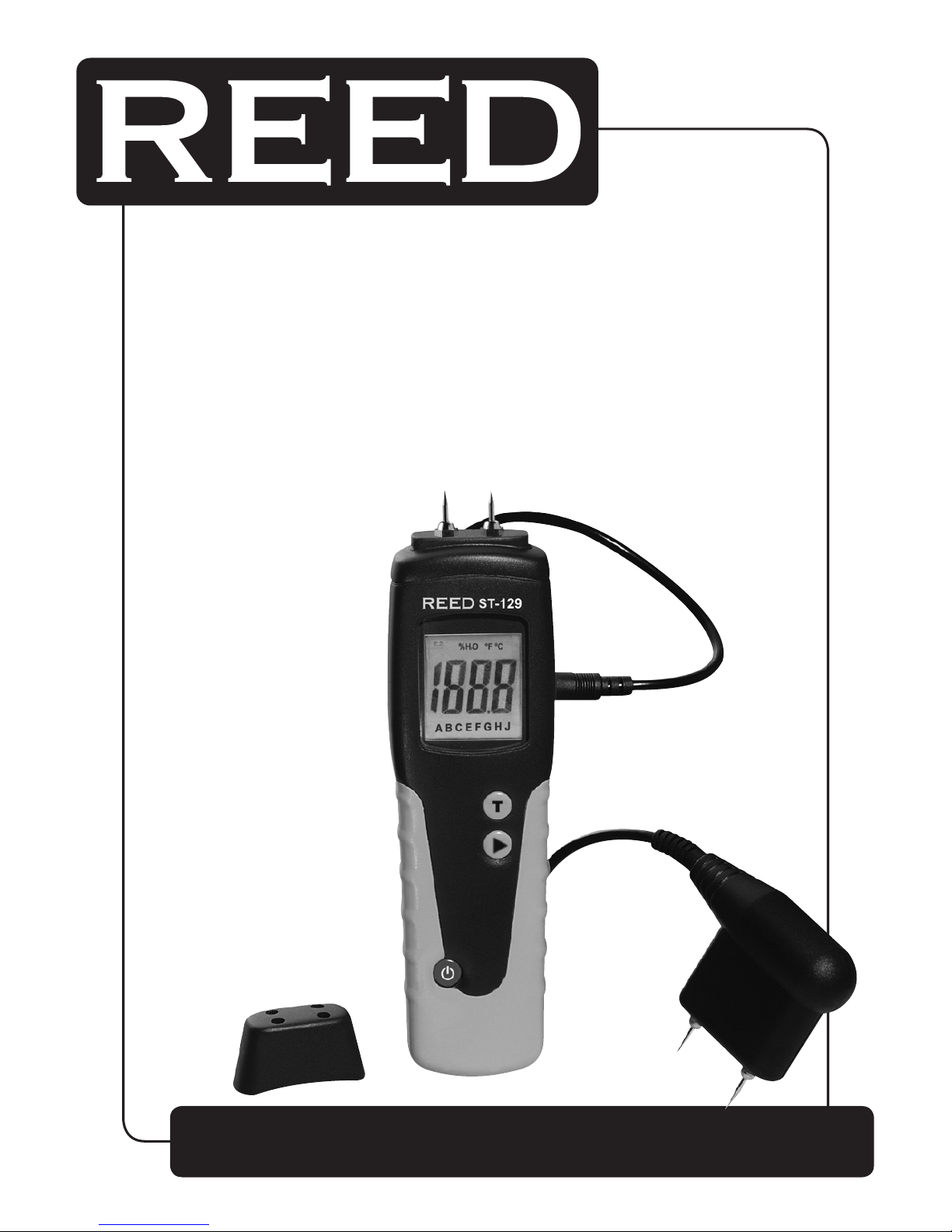
Model
ST-129
Wood Moisture Meter
Instruction
Manual
Page 2

reedinstruments
www
com
2
Table of Contents
Features ......................................................................................... 3
Specications ................................................................................3
Operating Instructions ................................................................4-9
Taking a Measurement ................................................................ 4
Measuring Without Temperature Probe ....................................... 4
Automatically Temperature Corrected (ATC) .............................4-5
Auto Power-Off Set-up ................................................................ 5
Calibration Check ........................................................................ 5
Care and Maintenance ................................................................ 5
Calibration Table for Wood .......................................................... 6
Common Timber Species .......................................................7-9
For service on this or any other REED product or information on other
REED products, contact REED Instruments at [email protected]
Page 3

reedinstruments
www
com
3
Features
• Measure moisture content in wood either directly with the built-in
moisture pins or use the remote hand-press probe (included) on hard
surfaces
• Automatic Temperature Compensation when used with included
temperature probe improves accuracy of moisture measurements
• Memory contains 8 wood groups with calibrations for approximately
170 species of wood
• Built-in 2-point calibration check
• User settable Auto Power-Off with override
• Low battery indicator
Specifications
Measuring Principle: Electrical resistance
Measuring Range: 6 to 99.9% MC
Accuracy: ±1% MC
Moisture Electrode: 8mm long replaceable contact pins
Temp. Compensation: -31 to 176°F (-35 to 80°C)
Power Supply: 2 x AAA batteries
Dimensions: 7 x 1.9 x 2” (180 x 50 x 31mm)
Weight: 6.1 oz (175g)
Includes: Remote hand-press moisture probe,
temperature probe, protective cap,
replacement pins, two AAA batteries,
and a soft carrying case
Optional Accessories: Replacement pins (model ST-129-P)
Page 4

reedinstruments
www
com
4
Operating Instructions
This instrument is a conductivity moisture meter specically designed for
the timber industry. This instrument has eight calibration scales enabling
the user to take accurate moisture measurements in 150 wood species.
Moisture measurements can be taken using the integral pin electrodes
or by using the heavy-duty moisture probe. When used with the temperature probe the moisture measurements are automatically corrected
with respect to the ambient temperature. This instrument is switched ON
by pressing the button and switched OFF by pressing the button
for approx 3 seconds. The default auto power-off for this instrument is 5
minutes but can be set manually (see auto power-off set-up).
Taking a Measurement
Remove the cap to expose the needle electrodes or connect the heavyduty moisture probe on the right hand side of this instrument and switch
the instrument on by pressing the button. Select the appropriate wood
calibration scale (A, B, C, E, F, G, H or J) by referring to the enclosed
wood calibration table (see calibration table for wood and common
timber species) and by pressing the button. Push the needle pins or the
heavy-duty moisture probe pins into the wood and observe the reading in
the LCD display.
Measuring Without Temperature Probe
This instrument is calibrated for wood at 20°C (68°F). In general, timber
that is hotter than 20°C will give higher readings and timber colder than
20°C will give lower readings. An approximate manual correction of 0.5%
moisture content per 5°C may be subtracted from timber that is above
20°C. For timber that is below 20°C, a manual correction of 0.5% moisture content per 5°C may be added to the measured value.
Automatically Temperature Corrected (ATC)
Switch the instrument ON and select the appropriate wood calibration
scale as detailed in ‘Taking a Measurement’. Using a hammer and nail of
nominal 3mm diameter, make a hole in the wood to be tested. Remove
the nail and push the temperature probe into the hole until the tip is at the
required depth.
continued ...
Page 5
reedinstruments
www
com
5
Connect the temperature probe into the instrument via the temp socket.
Using the instrument to measure timber you can obtain the automatically temperature corrected (ATC) moisture value. If you need to read
the current temperature of the timber press the button, then the LCD
will display the temperature. Press the button again and the LCD will
display the other °C or °F temperature. Press the button and the LCD
will display the moisture value again.
Auto Power-Off Set-up
To change the default auto power-off times press the and buttons
together. Hold the
button and press the button to change the auto
power-off time (to either disable the auto power-off or to set it from 1 to 9
minutes) by changing the code.
0 disables the auto power-off function, 1 sets the instrument to auto
power-off in one minute, 2 sets it to two minutes, 3 to three minutes, and
respectfully up to 9 for nine minutes for the instrument to auto power-off.
Calibration Check
There are two checked calibrators in the cap of this instrument. When
checking the calibration, the A scale should be selected and the temperature probe must be disconnected. Use the needle to touch the two poles
of calibrator. If correctly calibrated, the instrument will register %H2O
values in the range 17.7 to 18.3 (at the “T” calibration) and in the range
25.5 to 26.5 (at “B” calibration). If the range is over +/-1 the Instrument
can’t accurately measure the moisture of timber. Open the back cover and
adjust the rheostat to make the tolerance meet the range.
Care and Maintenance
When the instrument is not in use, keep it in its pouch together with its
accessories. Store the kit in a stable, dust-free environment out of direct
sunlight. Remove the batteries from the instrument if it is to be stored for
periods of more than one month, or when the battery symbol appears on
the display. Be sure to check the condition of the accessories used with
this instrument on a regular basis and replace them if they become worn
or damaged.
Page 6
reedinstruments
www
com
6
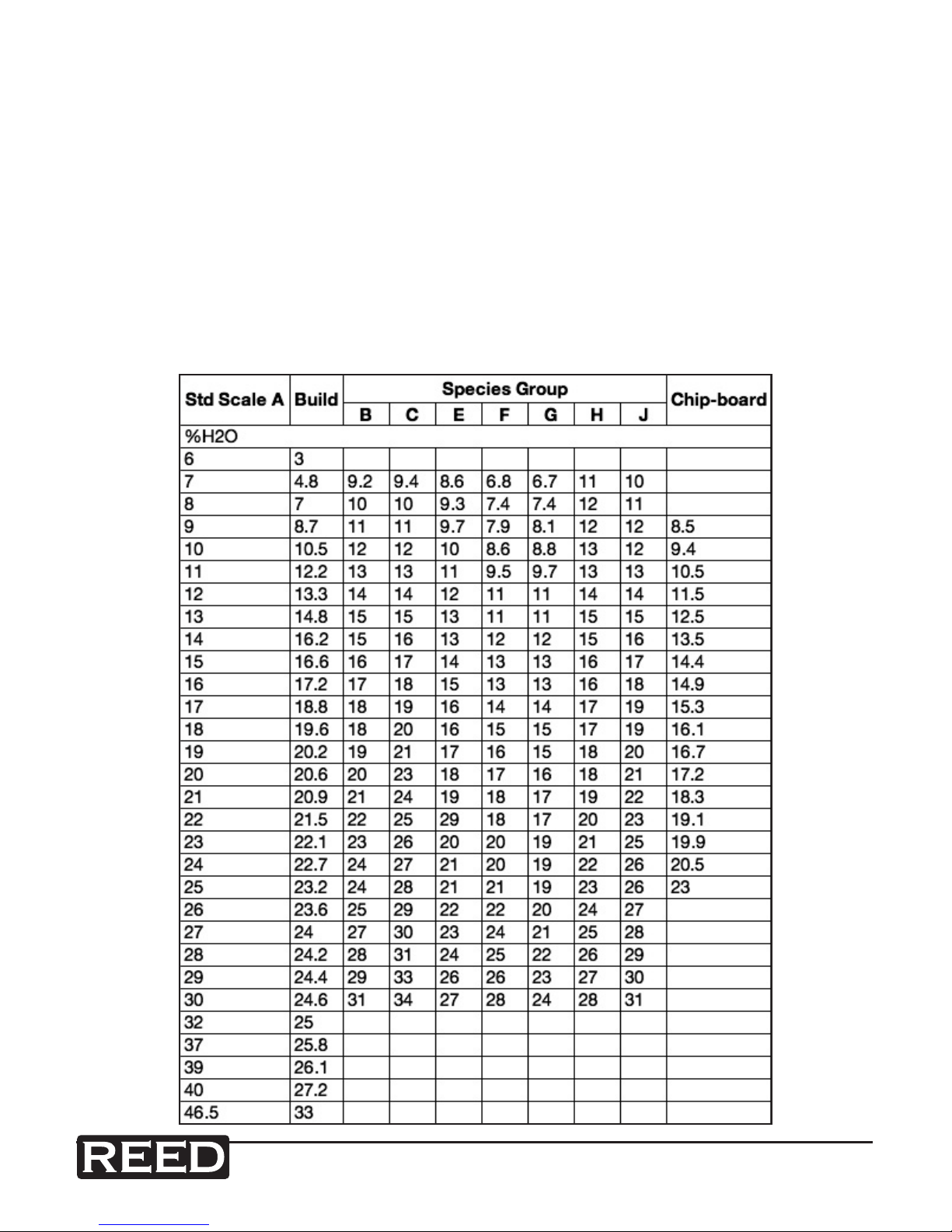
Calibration Table for Wood
The calibration data in the below table is based on standard tests by oven
drying commercial samples of the various wood species, between 7%
and ber saturation. Above ber saturation point (25%-30%) readings are
approximate and only generally apply to wood that has been dried and
re-hydrated. Readings higher by 1%-2% may be obtained where wood
has been impregnated with a water-borne preservative. High readings
obtained with some plywood of peculiar composition must be treated with
caution. For measuring building materials select scale A and refer to the
following table so you can obtain the building material moisture value.
Page 7
reedinstruments
www
com
7
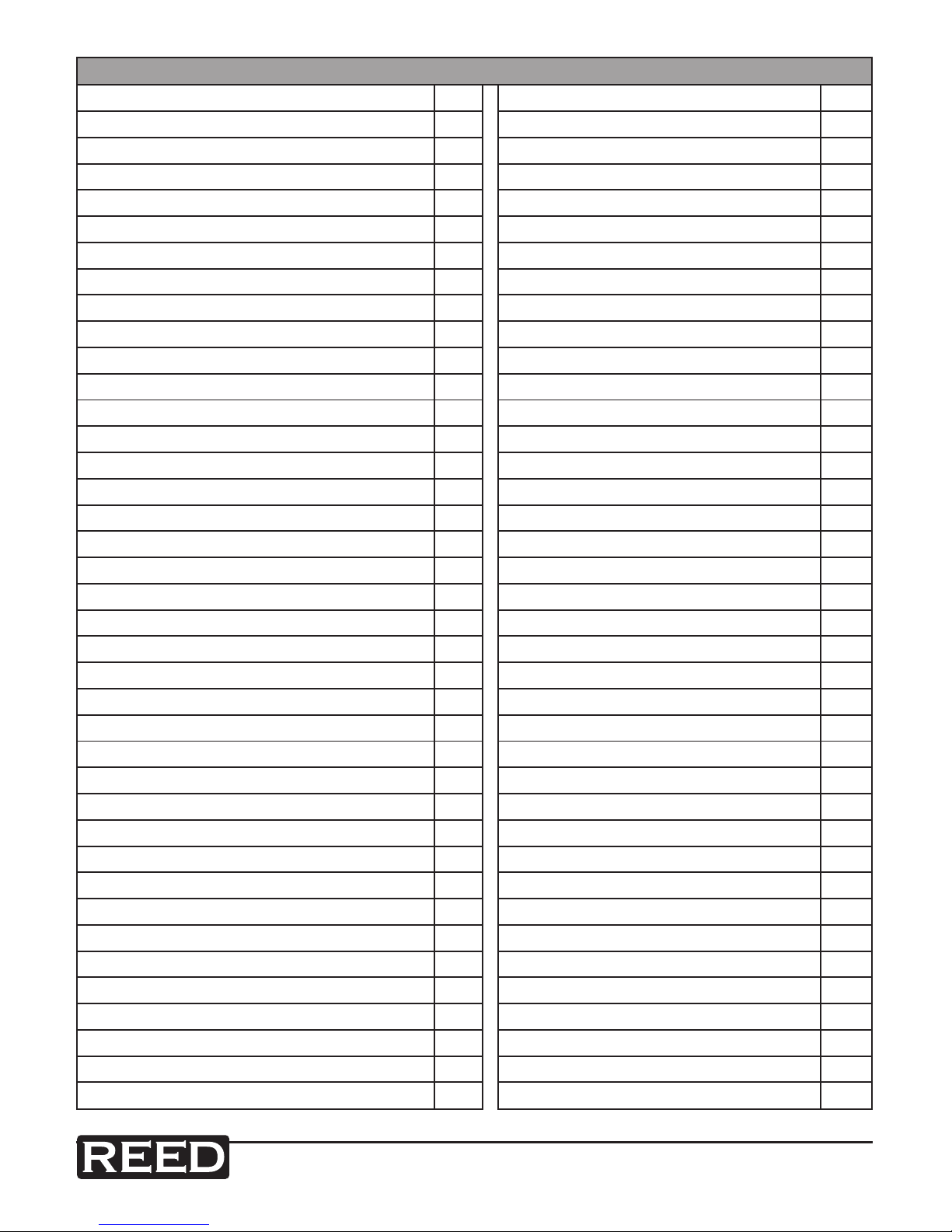
Common Timber Species
Cypress, Japanese (18-28%mc) C Guarea, White H
Spruce, Japanese (18-28%mc) C Santa Maria H
Cypress, Japanese (8-18%mc) J Cedar, WestIndian J
Spruce, Japanese (8-18%mc) J Mahogany, West Indian B
Meranti, Red (dark/light) B Birch, European J
Redwood, Baltic (European) A Cherry, European J
Spruce, Norway (European) C Empress, Tree J
Ash, European A Fir, Noble J
Ash, Japanese A Guarea, Black J
Banga Wanga A Kauri, Queensland J
Birch, Yellow A Mahogany, African J
Boxwood, Maracaibo A Queensland Kauri J
Fir, Grand A Walnut, African J
Gum, Spotted A Cordia, American Light F
Maple, Pacific A Pine, American long leaf C
Maple, Rock A Pine, American pitch C
Maple, Sugar A Pine, Caribbean Pitch C
Myrtle, Tasmanian A Pine, Nicaraguan Pitch C
Oak, European A Cedar, Western Red C
Oak, Japanese A Gum, American Red A
Panga Panga A Oak, American Red A
Pine, Lodgepole A Oak, American White A
Pine, Scots A Kauri, New Zealand E
Pine, Yellow A Pine, New Zealand White B
Poplar, Black A Abura E
Pterygota, African A Afara A
Rosewood, Indian A Aformosa G
Sterculia, Brown A Afzelia E
Walnut, American A Agba J
Camphorwood, E African C Amboyna G
Cypress, E African A Ayan C
Olive, E African B Balsa A
Silky Oak,African C Basswood G
Silky Oak,Australian C Berlina B
Ash, American B Binvang E
Canarium, African B Bisselon E
Cedar, Japanese B Bitterwood F
Douglas Fir B Blackbutt C
Fir, Douglas B Bosquiea A
continued ...
Page 8
reedinstruments
www
com
8
Gum, Saligna B Chestnut C
Gum, Southern B Coachwood G
Maple, Queensland B Dahoma A
Meranti, White B Danta C
Pine, Bunya B Erimado F
Pine, Huon B Greenheart C
Pine, Maritime B Gurjun A
Pine, Parana B Hiba J
Pine, Red B Hickory F
Redwood, Californian B Hyedunani B
Pine, Japanese Black B Iroko F
Beech, European C Ironbank B
Hemlock, Western C Jarrah C
Larch, European C Jelutong C
Larch, Japanese C Karpur A
Oak, Tasmanian C Karri A
Pine, Corsican C Keruing F
Pine, Hoop C Kuroka A
Pine, Ponderosa C Lime E
Pine, Radiata C Loliondo C
Pine, Sugar C Makore B
Queensland Walnut C Mansoia B
Seraya, Red C Matai E
Spruce, Sitka C Merbau B
Stringybark, Messmate C Missanda C
Stringybark, Yellow C Muhuhi J
Walnut, European C Muninga G
Walnut, Queensland C Musine J
Elm, English E Musizi J
Elm, Rock E Naingon C
Elm, White E Obeche G
Oak, Turkey E Odoko E
Pine, Kauri E Okwen B
Baguacu, Brazilian F Olivillo G
Larch, Western F Opepe H
Padauk, African F Padang A
Elm, Japanese Grey Bark B Persimmon G
Walnut, New Guinea B Pillarwood F
Gegu, Nohor H Pyinkado E
Rubberwood H Ramin G
continued ...
Page 9

reedinstruments
www
com
9
Notes _________________________________________
________________________________________________
________________________________________________
________________________________________________
________________________________________________
________________________________________________
________________________________________________
________________________________________________
________________________________________________
________________________________________________
________________________________________________
________________________________________________
________________________________________________
For service on this or any other REED product or information on other
REED products, contact REED Instruments at [email protected]
Rubberwood H Totara E
Sapele C Turpentine C
Sen A Utile J
Sycamore F Wawa G
Tallowwood A Wandoo J
Teak F Whitewood C
Yew C
Page 10

reedinstruments
www
com
10
Notes _________________________________________
________________________________________________
________________________________________________
________________________________________________
________________________________________________
________________________________________________
________________________________________________
________________________________________________
________________________________________________
________________________________________________
________________________________________________
________________________________________________
________________________________________________
________________________________________________
________________________________________________
________________________________________________
________________________________________________
________________________________________________
Page 11

reedinstruments
www
com
11
Notes _________________________________________
________________________________________________
________________________________________________
________________________________________________
________________________________________________
________________________________________________
________________________________________________
________________________________________________
________________________________________________
________________________________________________
________________________________________________
________________________________________________
________________________________________________
________________________________________________
________________________________________________
________________________________________________
________________________________________________
________________________________________________
Page 12

reedinstruments
www
com
12
Notes _________________________________________
________________________________________________
________________________________________________
________________________________________________
________________________________________________
________________________________________________
________________________________________________
________________________________________________
________________________________________________
________________________________________________
________________________________________________
________________________________________________
________________________________________________
________________________________________________
________________________________________________
________________________________________________
________________________________________________
________________________________________________
 Loading...