

Page 1
OBET, OBETXU, ON BOARD Battery Chargers
INTRODUCTION:
SOME APPLICATIONS:
Golf cars, pallet trucks, personnel carriers, scissor lifts, floor scrubbers, robotics.
IMPORTANT: DO NOT USE THIS CHARGER UNTIL YOU HAVE READ ALL THE
INSTRUCTIONS.
INITIAL INSTALLATION:
Before making AC connections, refer to the AC requirements labeled on the charger. If your
charger is not equipped with an AC plug (a 220 volt model) have a qualified electrician install
one.
CAUTION: To reduce the risk of fire, use this charger only on circuits provided with
a maximum of 20 ampere branch circuit protection (circuit breaker or fuse),
In accordance with the National Electric Code, ANSI/NFPA 70, and all local
codes and ordinances.
GROUNDING INSTRUCTIONS:
This battery charger must be grounded to reduce the risk of electric shock. If the charger is
equipped with a grounding type plug, it must be plugged into a nominal 115 volt, 60 Hertz
circuit. If the charger is supplied with no plug, have a qualified service person install one.
WARNING: Improper connection of the equipment grounding conductor can result in a
risk of an electric shock. DO NOT USE THIS CHARGER ON A TWO
POLE UNGROUNDED OUTLET OR ATTEMPT TO BREAK OFF
THE GROUND PRONG FOR USE ON A RECEPTACLE OR
EXTENSION CORD NOT HAVING A GROUND.
The use of an extension cord with this charger should be avoided. The use of an improper
extension cord result in a risk of a fire or electric shock. If an extension cord must be used, make
sure it is in good condition. Use a three conductor cord no smaller than 16 AWG. And keep it as
short as possible. Locate all cords so that they will not be stepped on, tripped over, or otherwise
subjected to damage or stress.
Do not operate this charger if it shows any signs of physical damage.
1
Page 2
PROPER CARE AND USE OF BATTERIES:
CAUTION: Always wear protective eye shields and clothing when working with batteries.
Batteries contain acids which can cause bodily harm. Do not put wrenches or
Other metal objects across the battery terminal or battery top. Arcing or
explosion of the battery can result. Do not wear jewelry when working around
batteries. Arcing can cause sever burns.
New batteries will not deliver their full performance until after several cycles.
The tops of the batteries and battery hold downs must be kept clean and dry at all times to
prevent excessive self discharge and flow of current between the battery post and frame.
Maintain the proper electrolyte level by adding water when necessary. Never allow the
electrolyte level to fall below the top of the battery plates. Electrolyte levels fall during
discharge and rise during charging. Therefore, to prevent the overflow of electrolyte when
charging, add water ONLY AFTER the batteries have been fully charged DO NOT
OVERFILL. Old batteries require more frequent additions of water than do new batteries.
Do not over discharge the batteries. Excessive discharge can cause polarity reversal of
individual cells resulting in complete battery failure.
Provide adequate ventilation for the batteries and charger. Do not obstruct the flow of cooling air
around the charger. Provide at least 1" of space around charger. Do not allow clothing, blankets
or other material to cover the charger. Mount the charger firmly in place.
WARNING: Chargers can ignite flammable materials and vapors. Do not use near fuels,
grain, dust, solvents, or other flammable’s.
CAUTION: Before connecting the charger to the batteries, make sure the battery pack is of
the same voltage rating of the charger. If you are unsure, count the number of
cells on the battery pack and multiply by two. This figure should be the same
as the DC voltage rating of the charger. (see ratings label on charger).
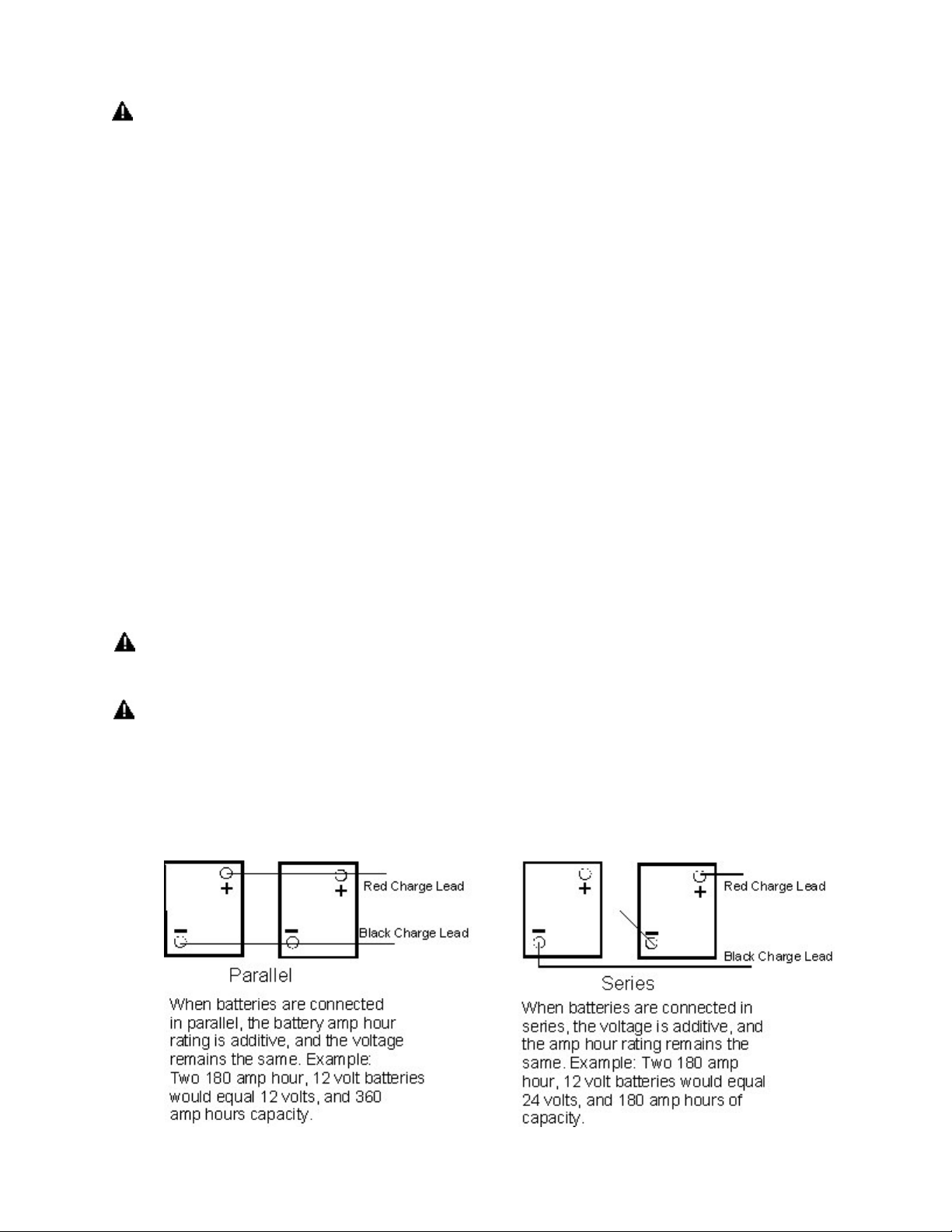
Below is an illustration of Parallel and Series battery packs.
2
Page 3
WARNING: Make sure the DC output leads, terminals, or connector are all in good
working condition.
DO NOT USE THIS CHARGER IF:
The DC output connector, (if equipped) is loose or does not make good contact; Is cracked or
broken; The leads are cut or have exposed wires; The DC output leads or connector feel hot when
used.
Using this charger with any of the above symptoms could result in a fire, property damage, or
personal injury. Have a qualified service person make the necessary repairs. Repairs should not
be made by people who are not qualified.
NORMAL OPERATION:
1.) When connecting charge leads directly to the battery, apply grease to the terminals to inhibit
corrosion.
2.) Plug the charger into AC power having the same ratings as that of the ch arger.
3). The LED on the charger w ill light, indicating ch arge current is flowing.
4). The OBET chargers are equipped with a electronic timer. At the battery gassing threshold,
(2.3 volts per cell) the timer will activate and run for three hours. During this period, the
batteries are in a gassing mode. (2.5 - 2.6 volts per cell max.) After three hours the charger
will shut off. Indicated by an extinguished LED
5). To discontinue charging, unplug the AC power cord. Plugging the AC power back in will
cause the charger to repeat the cycle.
EQUALIZATION:
When using multiple batteries in series, cells become uneven during charge and discharge cycles.
At least once a month perform two charge cycles back to back, this will bring up cells that are
lagging behind full charged cells and is important to overall battery performance.
WARNING: Do not disconnect the DC output leads or unplug the connector from the
batteries when the charger is on. The resulting arcing could cause the
batteries to explode. If the charger must be stopped unplug the AC power.
WARNING: Failure to unplug AC power before moving or driving equipment will result
in damage to cords, plugs and receptacles.
TROUBLE SHOOTING:
CAUTION: DO NOT DISASSEMBLE THE CHARGER. Incorrect assembly may result in
a ris k of electric shock or fire. Contact factory.
DANGER: To reduce the risk of electric shock, always disconnect both the AC power
supply cord and the output leads or connector before attempting any
maintenance cleaning.
3
Page 4

1). LED DOES NOT COME ON WHEN POWER IS APPLIED
Be sure you are plugged into a live circuit. Check the AC cord for breaks in the cord or plug.
Check the DC leads for breaks. Check the DC connections to the battery, clean if heavily
corroded.
Place a volt meter across the battery terminals where the charger is connected. Apply AC
power. If the voltage rises on the battery, the charger is working and the LED is defective.
NOTE: LED’s do not burn out, but it has probably received a sharp blow causing physical
damage. No harm will come from operating the charger without a working LED.
2). LED NEVER GOES OFF
The batteries never reached timer trip voltage and the charger was unable to gas and shut off.
This indicates several shorted cells. Overheating and excessive water usage are symptoms
of this condition. Performance will also be greatly diminished. Replace defective battery.
3). AC LINE OR CIRCUIT BREAKER BLOWS
Either the circuit breaker or fuse is weak, or the charger is shorted internally.
4). NO POWER IS PRESENT ACROSS THE DC LEADS WHEN A VOLT METER IS
CONNECTED
Good. The charger will not turn on until leads are connected, correct polarity to the battery.
5). BATTERIES DON’T RECEIVE FULL CHARGE
The battery you are charging may be to large for the charger, or if you have the charger
plugged into a long extension cord that is too small, a voltage drop will cause a decrease in
charger output, extending charge times.
QUICK CHARGE O BET Battery Chargers
“LIMITED WARRANTY”
Quick Charge corporation warrants the OBET line of chargers for three (3) years from the date of purchase.
After the warranty period, chargers returned to the factory for repair will be charged a minimum rate of $25.00. Charger will be
returned, freight and repair charges, C.O.D. unless other arrangements have been made
This warranty covers all defects in manufacture and performance, provided the unit is operated in compliance with manufacture’s
operating instructions.
For repairs to be made at the Quick Charge factory, a charger and/or component(s) should be sent, freight prepaid to Quick
Charge at:: Quick Charge Corp.
Quick Charge, will at it’s option, repair or replace the charger or component in question. The repaired item will then be returned,
freight prepaid by Quick Charge. This warranty is void if the charger or component have been altered, changed, or repaired by
anyone not authorized by Quick Charge, or if the charger or component, have been subjected to misuse, negligence, or harsh
environmental conditions. (Except those chargers designed for such conditions)
If returning the charger to the factory is not practical, replacement parts may be shipped to the customer for field repair at no
charge. On parts such as circuit boards, the customer will be required to return the board suspected to be defective to Quick Charge,
freight prepaid. If such defective parts are not returned, the customer will be invoiced for the repair parts.
Field repairs are made at the user’s own risk. “Authorization” by Quick Charge to repair refers to maintaining the warranty only.
Quick Charge assumes no responsibility or liability for field servicing, and shall not be responsible for incurred travel or labor
charges.
Quick Charge corporation shall not in any event be liable for the cost of any special, indirect or consequential damages to anyone,
product or thing. This warranty is in lieu of all other warranties expressed or implied. Quick Charge neither assumes nor authorizes
any representative or other person to assume for us any liability in connection with the sale of this product.
1032 S.W. 22nd St.
Oklahoma City, OK. 73109
4
 Loading...