

Page 1
C1600 BATTERY LOAD TESTER
INTRODUCTION:
TheC1600 is designed for high volume testing of 6, 8 and 12 volt starting, and deep cycle lead
acid batteries.
IMPORTANT: DO NOT USE THIS TESTER UNTIL YOU HAVE READ ALL THE
INSTRUCTIONS.
CAUTION: Always wear protective eye shields and clothing when working with
batteries. Batteries contain acids which can cause bodily harm. Do not put
wrenches or other metal objects across the battery terminal or battery top.
Arcing or explosion of the battery can result. Do not wear jewelry when
working around batteries. Arcing can cause sever burns.
Do not operate this tester if it shows any signs of physical damage.
Provide adequate ventilation for the batteries and tester. Do not obstruct the flow of cooling air
around the tester. Provide at least 10" of space around tester. Do not allow clothing, blankets
or other material to cover the tester. Certain parts of the tester will become hot when testing large
volumes of batteries.
DO NOT USE THIS TESTER IF:
The DC output clamps, or connector is loose, worn or does not make good contact; The leads are
cut or have exposed wires; The DC output leads or connector/clamps feel hot when used, or if
one or both fans do not come on when clamps are connected to battery.
NORMAL OPERATION:
6, 8, & 12 VOLT BATTERIES
NOTE: Only load test batteries at or above 75% state of charge.
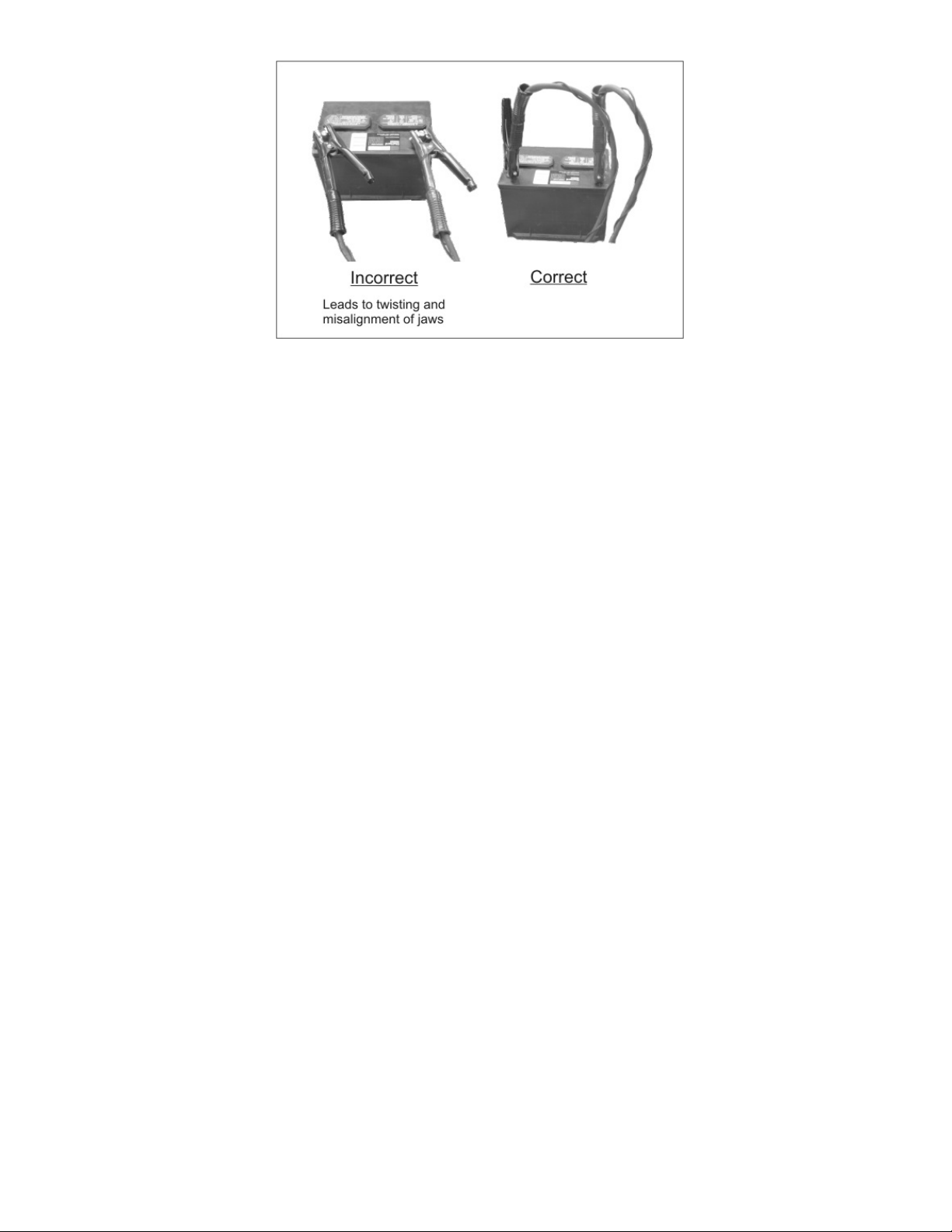
1). Throughly clean post’s with a wire brush. This is important for volt meter accuracy. Observing
polarity, connect clamps to battery per illustration. Both fans should come on, if they don’t,
have them replaced by a qualified person.
Page 2
2). Press the START button.
3). Adjust the knob to match the CCA of the battery.
4). For 12 volt batteries the minimum acceptable voltage is 9.6 volts @ 70F (21C). For 8 volt
batteries the minimum is 6.41 volts, for 6 volt batteries the minimum is 4.8 volts @ 70F (21C)
5). When the timer times out, remove clamps and connect another battery. Repeat. NOTE: As the
carbon pile heats up the resistance will change and the setting will drift, small knob
adjustments will be needed to keep the amps at the battery CCA rating.
6). The C1600 is equipped with a timer override button. Should you need to interrupt a test,
simply push the button. Timer is factory set at 15 seconds. To adjust, use a miniature screwdriver, locate
1/4" hole in back, insert screwdriver and turn potentiometer to desired time. 5-15 seconds.
CARE & MAINTENANCE:
1). Heat is the enemy of your tester. To prolong component life; When testing large volumes of
batteries, leave tester connected to last battery for a minimum of 5 minutes to allow fans to
exhaust residual heat from cabinet. When using a setting higher than 600CCA, allow 30
second cooling off period between batteries.
2). The aluminum cabinet is susceptible to acid fume corrosion, and staining as are all surfaces,
periodically wipe the unit down with a damp cloth. Use water only. Take care to keep
electrolyte off the unit as it will cause rapid deterioration, especially the volt meter lens.
3). Keep the clamp jaws clean with a wire brush. High resistance connections can give a low volt
reading, and cause cracking and popping and intermittent connections under load.
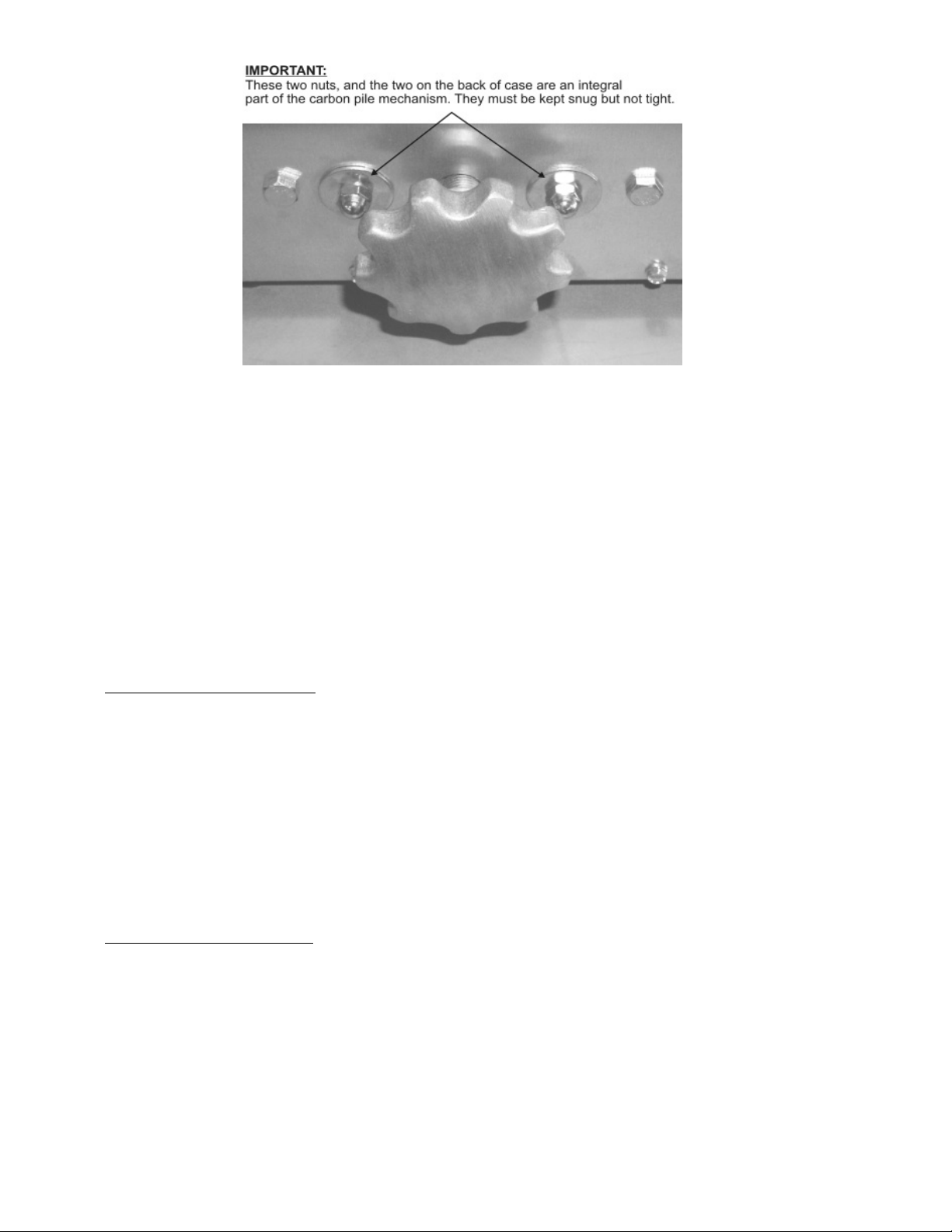
3). Periodically remove load screw and flush with silicon lubricant spray to remove grit and
assure smooth operation.
Page 3
TROUBLE SHOOTING:
Voltmeter does not work, or reads low.
Sense lead to clamps broken. Weak corroded clamps, or dirty battery post’s can cause a
resistance and make the meter read low. Clean clamp jaws, and post’s with a wire brush.
Solenoid drops out prematurely, or cannot pack a load.
Check clamp condition, weak clamps will not hold, or defective solenoid.
Times out too soon.
Check timer setting.
Digital voltmeter accuracy
On 12 volt batteries the meter is accurate to ± .05 volts. To check accuracy, first clean the load
clamp jaws with a wire brush, then connect to battery. Connect the leads of a secondary digital
voltmeter with minimum accuracy of ± .01 volts to the jaws of the clamps. As an example, if the
load tester meter reads 12.00, the secondary volt meter should read between11.94 - 12.06. If the
reading falls outside this range, the load tester meter should be re-calibrated or replaced. Contact
Quick Charge for illustrative instructions on re-calibrating and replacing meter.
The meter requires 5 volts to operate accurately. A load test on a 6 volt battery where the voltage
falls below 5 volts will cause the meter to register inaccurately.
Analog ammeter accuracy
Keep the needle zeroed on meter.
Page 4

QUICK CHARGE C1600 LOAD TESTER
“LIMITED WARRANTY”
Quick Charge corporation warrants the C1600 load tester for (1) year from the date of purchase.
After the warranty period, chargers returned to the factory for repair will be charged a minimum rate of $25.00. Charger will be returned, freight and repair
charges, C.O.D. unless other arrangements have been made
This warranty covers all defects in manufacture and performance, provided the unit is operated in compliance with manufacture’s operating instructions.
For repairs to be made at the Quick Charge factory, a charger and/or component(s) should be sent, freight prepaid to Quick Charge at:
Quick Charge Corp.
Quick Charge, will at it’s option, repair or replace the charger or component in question. The repaired item will then be returned, freight prepaid by Quick
Charge. This warranty is void if the charger or component have been altered, changed, or repaired by anyone not authorized by Quick Charge, or if the charger
or component, have been subjected to misuse, negligence, or harsh environmental conditions. (Except those chargers designed for such conditions)
If returning the charger to the factory is not practical, replacement parts may be shipped to the customer for field repair at no charge. On parts such as circuit
boards, the customer will be required to return the board suspected to be defective to Quick Charge, freight prepaid. If such defective parts are not returned,
the customer will be invoiced for the repair parts.
Field repairs are made at the user’s own risk. “Authorization” by Quick Charge to repair refers to maintaining the warranty only. Quick Charge assumes no
responsibility or liability for field servicing, and shall not be responsible for incurred travel or labor charges.
Quick Charge corporation shall not in any event be liable for the cost of any special, indirect or consequential damages to anyone, product or thing.
This warranty is in lieu of all other warranties expressed or implied. Quick Charge neither assumes nor authorizes any representative or other person to
assume for us any liability in connection with the sale of this product.
1032 S.W. 22nd St.
Oklahoma City, OK. 73109
1032 S.W. 22 St. Oklahoma City, OK. 73109 800 658-2841 Fax (405) 632-5667 www.quickcharge.com
nd
 Loading...