

Page 1

Treasure Hunter Silver Metal Detector
PHMD2
www.pyleaudio.com
Instruction Manual
This Tre a sur e Hun ter Sil ver is a full-featured and easy to use metal
detector. It is ideal ly suited to metal detect in g beginners. We stron gly
recommend you read the manual carefully before using the unit.
Page 2

CONTENTS
Specification
Assembly
Batteries
Panel and Controller
Quick-Start
Field Operation
Caution
Trouble Shooting Guide
Specification:
Operation Modes :Two kinds
Motion Mode: DISCRIMINATION
No-motion Mode: PINPOINT
Adjusting Sensitivity
Adjusting Discrimination
Target Pinpoint: Target Button
Volume Control
Low Battery Indication
6.5 inch Water Proof Search Coil
1/8 inch Earphone Jack(earphone not supplied)
Batteries: Six AA Batteries(not supplied)
Page 3

Assembly
Assembly is easy and requires no special tools.
1. Align the plastic trapeziform raised part on the handle, with the trapeziform lower
groove at the control box bottom (Figure.1). push the two parts tightly together.
Figure.1
2. Align the threaded bolts at the handle bottom, with the knobs under the control
box; lock it with the bolts (Figure.2).
Figure.2
3. Turn the stem’s lock nut clockwise until it loosens. This will enable lengthening or
shortening of the stem. When you stand upright with the detector in your hand, the
search coil should be about 1/2 inch above the ground with your arm relaxed at
your side.( Figure.3).
Figure.3
Page 4

4. Loosen the knobs at t h e search coil’s end, then adjust the search coil to t he de si red
angle. Let the search coil be parallel with the ground and be careful not to install
backwards. Long end of the search coil should face forward. (Figure.4).
Figure.4
Batteries
Please use six AA alkaline batteries.
1. Press the “key” on the battery compartment in the direction of the arrow. Pull out
the battery compartment cover (Figure.5). Note: the word UP is labeled on the
battery compartment, don’t try to install upside down.
Figure.5
2. Insert six AA batteries into the compartment as indicated by the polarity symbols
marked inside the compartment (Figure.6).
Page 5

Figure.6
3. Close the battery compartment cover; please note that the word UP is facing up.
4. Six alkaline batteries may be used for more than 40 hours. If you do not plan to
use the detector for a long time, remove the batteries.
5. Do not mix old and new batteries.
Panel and Controller
The Panel Controller (Figure.7)
Figure.7
Power off: Power on/off power supply, the same knob with the sensitivity.
Sensitivity: Is used to adjust the detector’s sensitivity. It’s appropriate to reduce
the sensitivity where there is interference.
Discrimination: Rotate the control clockwise from left to right; the detector may
reject the objects t hat you don’t want in order. The most left is the ALL METAL
position. In this position the unit will respond to any metal objects. While in the
most right position the unit will reject most metal objects and it will only respond
to the highest conductivity silver metals.
Page 6
Volume: Is used to adjust the loudness of the speaker.
Low Batter: When the red LED lights, indicates the user should replace the
batteries.
Target Button: Press and hold the red Target Button, the detector mode will
convert from motion mode to no-motion mode and the detector won’t
discriminate objects anymore. At this time as long as the search coil approaches
the metals slowly the detector will respond. The clos er the distan ce is, the louder
the sound will be. It may help to pinpoint the target position.
Earphone Jack: This is located on the back of the control housing. When the
earphone is plugged in, the speaker will no longer sound.
Quick Start:
To m aster how to operate the metal detector quickly we suggest that you should
read the quick start carefully and practice indoor. When you are familiar with the
detector, you can hunt for the treasures.
1. Prepare with a sort of metal samples
an iron nail
a pull-tab and a five cents nickel coin
a 25 cent silver coin
2. Lay the metal detector properly
In order to avoid the metals influence the detector, be sure to lay the metal
detector properly.
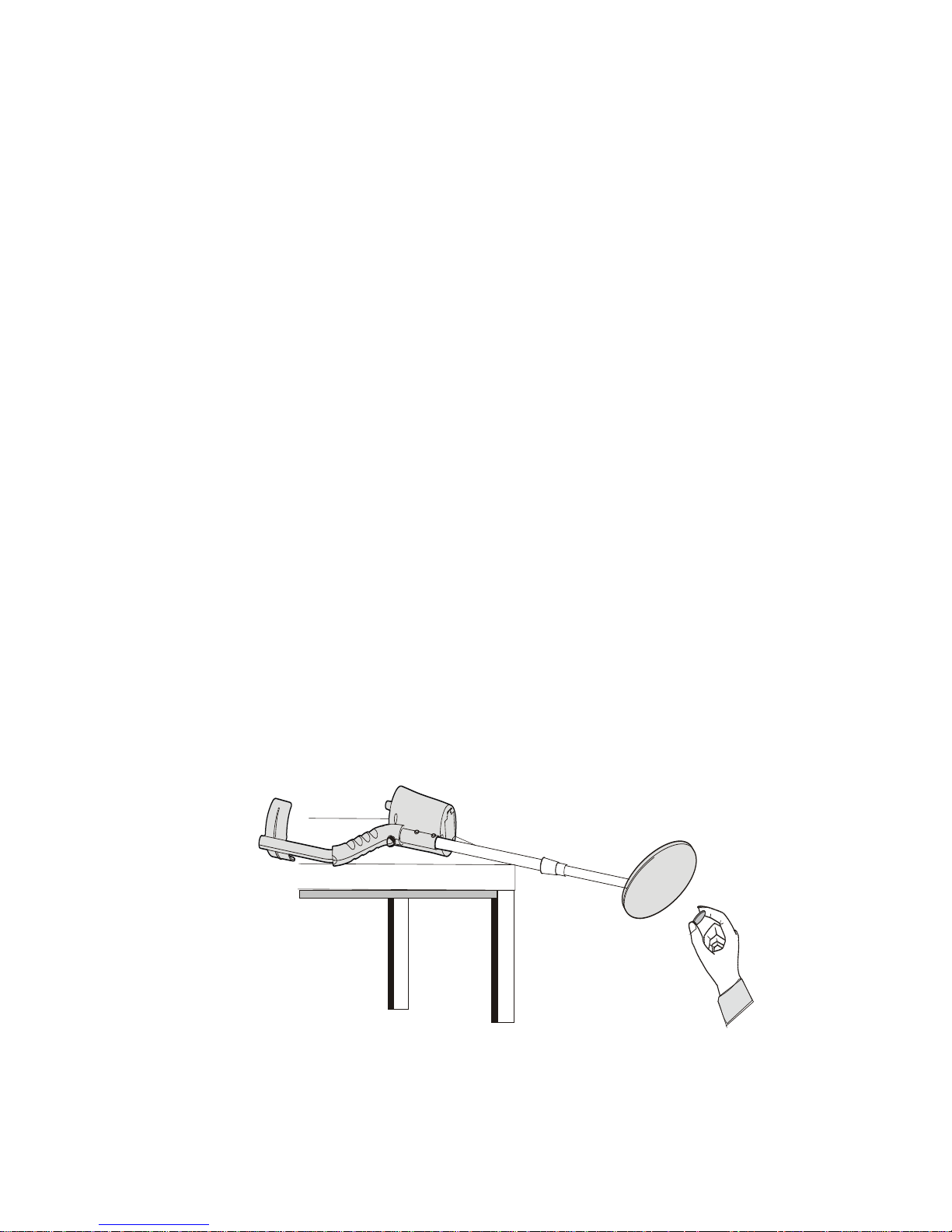
Place the detector on a wooden or plastic tabl e. Let the search coil exceeds the
table edge about more than 6 inches(15cm),keep the flat part points
outwards(Fig.8).Please note the locations of the search coil and aluminium tube,
don’t mistake them(Fig.9).
Figure.8
Page 7
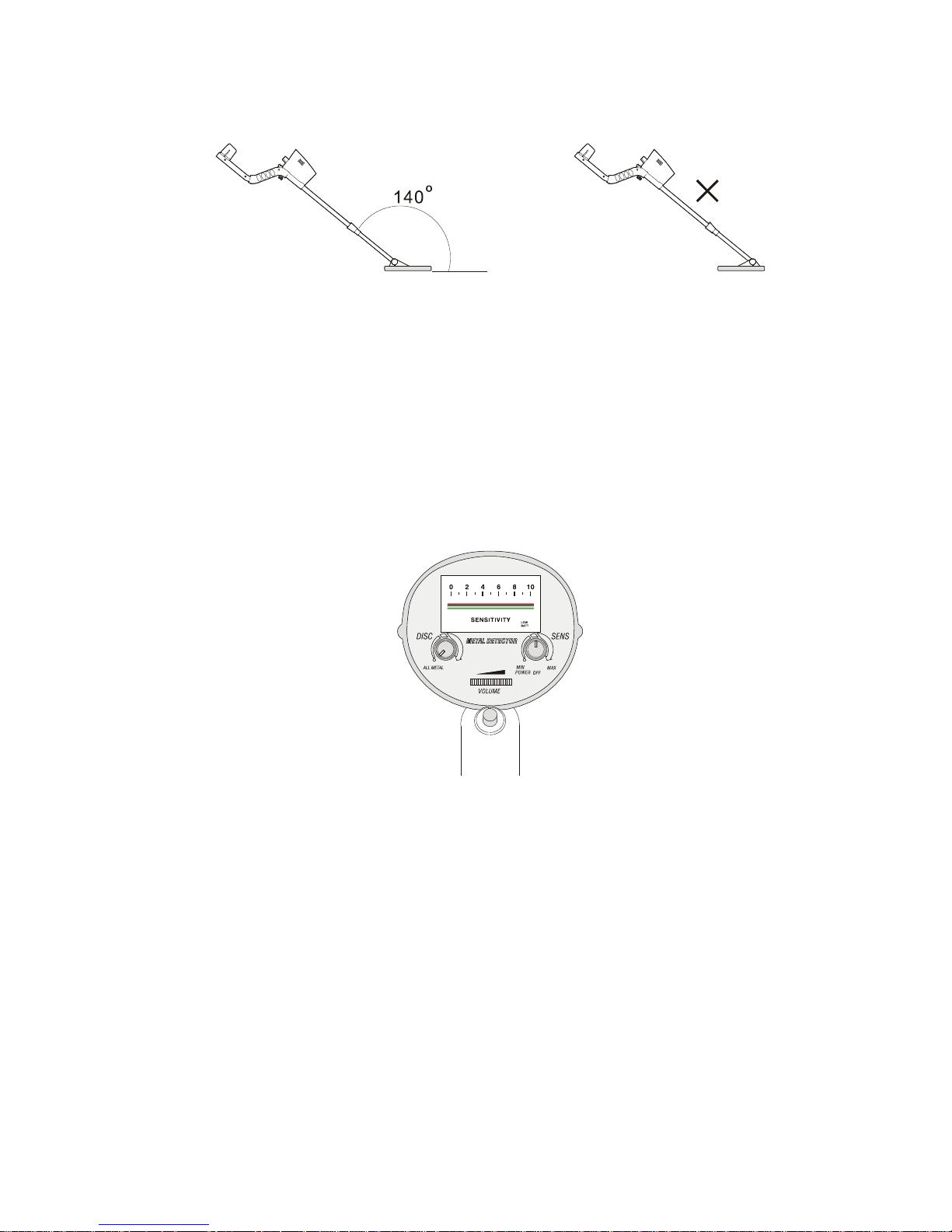
Figure.9
Please take off any jewelry or other metal objects on your hand/arm. Keep the
detector away from the wall, floor and other metal objects.
Be sure to keep the detector away from the light, TV, computer and mobile
telephone. These can cause electro-magnetic interference.
3. Turn on
Turn on the power supply by the SENS knob and set the volume knob to the
mid position.
4. Learn to use the ALL METAL mode.
Set the DISC knob to ALL METAL and SENS to the mid position(Fig.10).
Figure.10
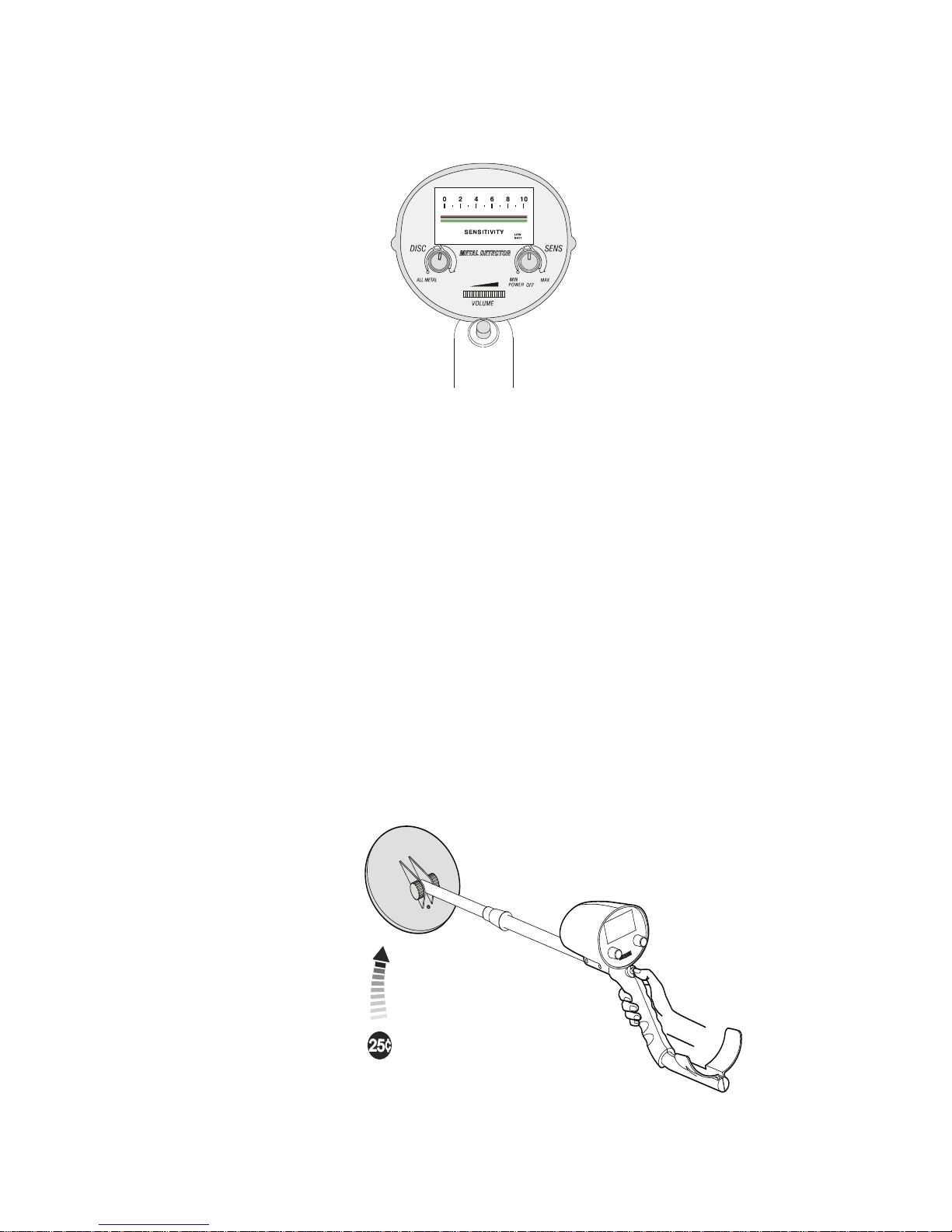
Sweep the metal sam ples you prepared 2 t o 3 inches(5-8cm) abov e the center
of the search coil in turn the detector will respond with a “DI” tone and the
pointer will swing to the right for one time.(Fig.11)
Page 8
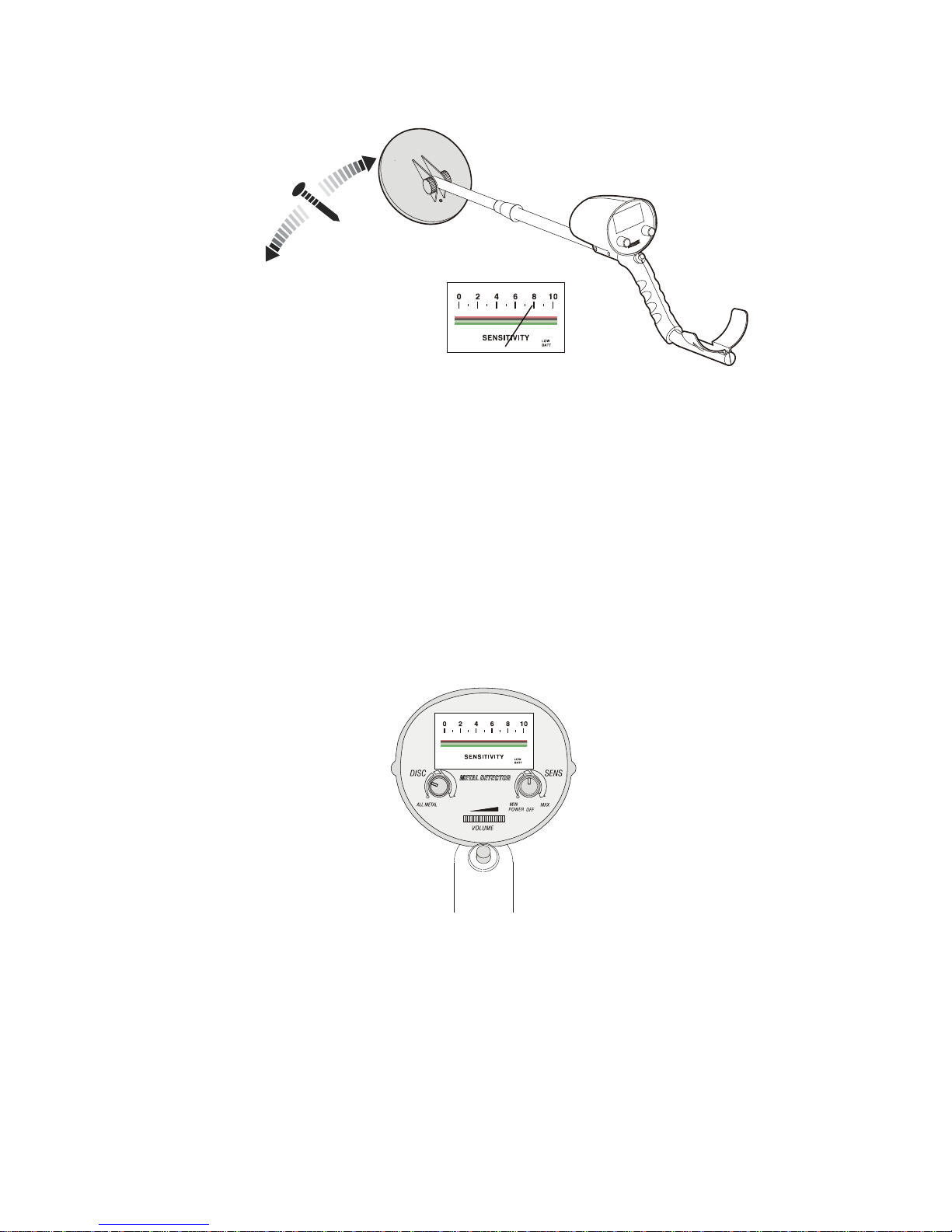
Figure.11
Note: You have to move the metal objects as the metal detector is in the motion
mode. If you don’t move the metals, the detector will not respond.
Then rotate the SENS knob from “MIN” to “MAX” and change t he height of
the metal samples at the same time. You will find that the sensitivity of the
detector becomes higher.
5. Learn to use the “DISC” mode
If you want to classify the metal types you should use the “DISC” knob.
a. Eliminate iron
Set the DISC knob to “ALL METAL” and the unit will respond to any metal
objects with a “DI” tone and the pointer will swing to the right for one time.
Rotate the DISC knob and set it in the position of “9:00” to “10:00”.(Fig.12)
Figure.12
Sweeping th e iron nail about 2-3 inches(5-8cm) above the centr e of the search
coil and the unit will not respond(the speaker will be silent and the pointer
won’t swing).While sweeping other metal samples, such as 5¢,pull tab, 25¢,the
unit will respond(the speaker will sound a “DI” tone and the pointer will
swing).
It means that the iron is eliminated.
Page 9
b. Eliminate nickel coin and pull tab
Set the DISC knob to the position of “12:00” to “1:00”.(Fig.13)
Figure.13
Sweeping the iron nail, 5¢ and pull tab about 2-3 inches(5-8cm) above the
centre of the search coil respectively ,the unit won’t respond(the speaker is
silent and the pointer won’t swing).While sweeping the 25¢,the unit will
respond.
It means that iron nail, 5¢ and pull tab are eliminated.
For different metals the location of the DISC knob is different. When rotating
the knob from MIN to MAX; Iron, Nickel, Pull tab, Zinc, Copper and
Aluminum will be rejected one by one. Note: Silver will not be rejected. The
discrimination position of aluminum is similar to silver. The discrimination
position of gold is similar to pull tab.
6. Learn to use the TARGET button
Press the red TARGET button on the handle and the detector comes into the
no-motion mode. If only the metals approach, then the detector will respond.
Let a 25¢ coin approaches the search coil slowly and when it’s about 5
inches(13cm) from the centre of the search coil, the unit will sound a
continuous long tone and the pointer will swing.(Fig 14)
Page 10

Figure.14
Keep the coin stable and release the red TARGET button. After one or two
seconds press the red TARGET button again and the unit’s sensitivi ty reduces.
Although the location of the coin hasn’t changed and the unit won’t sound a
tone. The coin approach es the centre of the search coil again and the unit will
respond with a long tone.
Repeat the above st eps and reduce the height of the coin time after time until
it’s close to the centre of the search coil.
7. Operate Outdoors
You have now learned how to operate the detector in the wild, as the soil, sea
sand, ores and other environmental impacts and the interference of electromagnetic
fields. The detector sensitivity and location of discrimination will change. You should
practice tim e after ti me and accum ulate t he expe rience to m aster the ski ll of det ecting
gradually and you will taste the joy of treasure-hunting.
Field Operation
Metal detector is used outdoors. There are too many metallic objects indoors and
also all kinds of electrical equipments that will bring interference signals, so it’s not
fit for using the detector.
Field detection is more complicated and the composition of the det ected re gional
soil, the component, size, shape and the oxidation degree of the underground metals
will all affect the detection results. This chapter is only the general steps of the field
detection. The operato r should practice ti me after time and accumul ate experience to
achieve good results.
1. Turn on
Rotate the SENS knob to the right side and switch on the power supply. The
detector will sound a DI tone。
2. Set DISC
In general, the operator should set the “DISC” to the ALL METAL. At this time
the detector will respond to all kinds of metals. When finding the target you could
discriminate the metal type approximately by the DISC knob.
If the operator is very experienced and there is clear target object, you should
directly adjust the “DISC” to the appropriate position. If there is undesired trash
metals such as iron and pull tabs. You should set the “DISC” to the near of
“12:00”.Since the soil will deviate from the discrimination position, we suggest you
take some samples with you, such as iron nail, pull tab, 5¢ nickel coin and 25¢
silver coins. Bury these sampl es i n t he det ect ion soil respectively and t ry to detect and
observe the DISC position of the metal being rejected. It will help you judge the type
of the target in case you omit the treasures that you want to find.
3. Choose the SENS
The operators always expects the detector’s sensitivity to be higher. However, in
Page 11
the higher sensitivity range the detector will be sensitive to the electromagnetic
interference that comes from the power lines or cables around and it will be abnormal
to the mineralization soil or electrical conductivity soil. If you move the search coil in
the detection area and the detector always sends a false unstable signal or there is no
metal objects in the soil, please decrease the sensitivity.
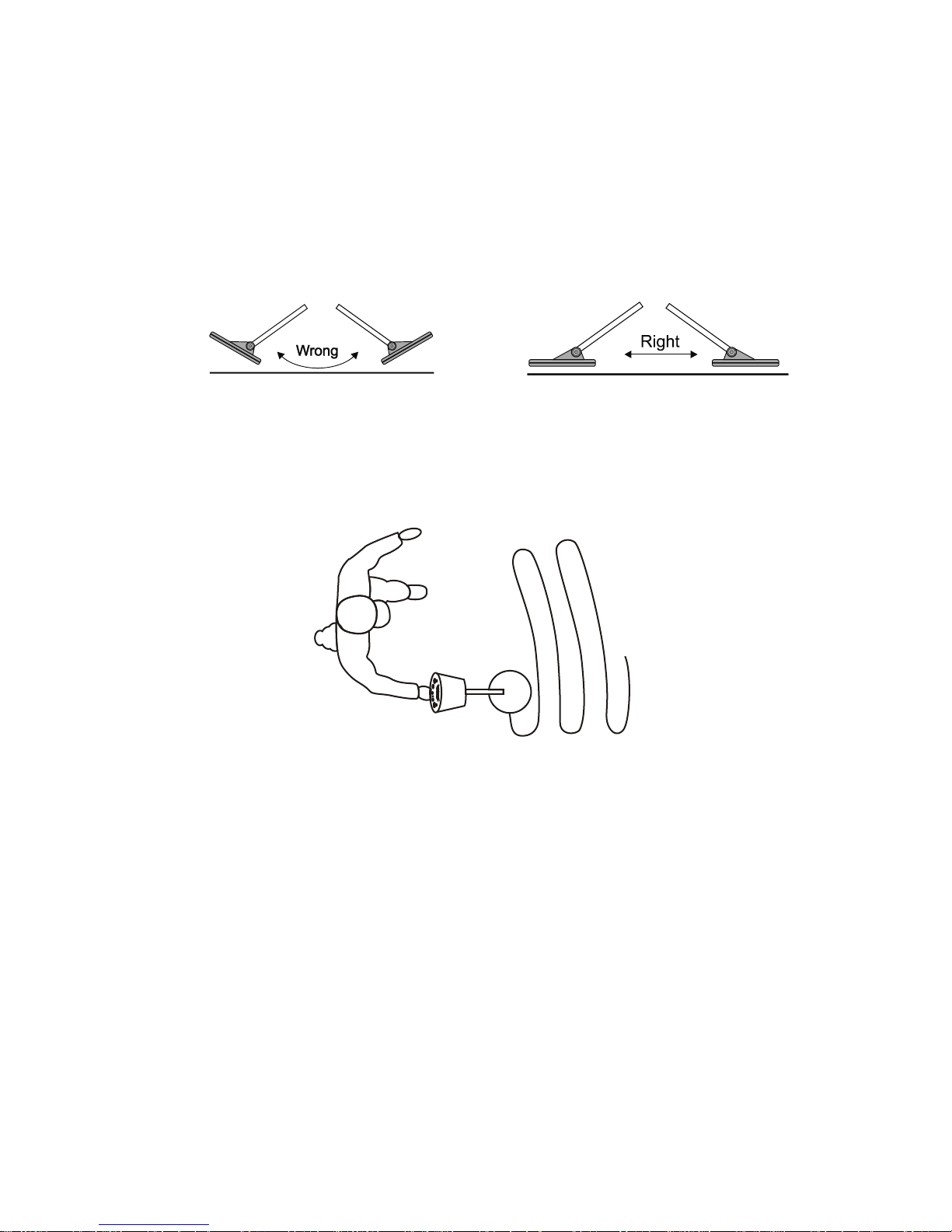
4. Move the search coil
When moving the search coil you should move it at a constant speed and not in
an unsteady motion.
Figure.15
Let the search coil be parallel and about 1/2 inch from the surface. Do not swing
it like a pendulum high and low above the ground.( Figure.15,16)
Figure.16
Most valuable metal objects could send repeatable signals. If the signal can’t be
repeated, it’s probably false. You could also move the search coil above the target
objects fast in order to get a more stable signal. When there is a clear sound
instructing that there are buried targets you can make use of the “DISC” button to
determine the metal type. Please note such judgment isn’t accurate and just for
reference to decide whether to dig it out or not. Be careful not to miss any treasure.
5. PINPOINT
When searching in the motion mode you should persistently move the sear ch coi l.
When you find the region of the buried metals, it will become harder to find the exact
location of the metallic objects. At this time you should recur to the no-motion mode.
a. Hold the search coil 2 inches from the ground, press and hold down the TARGET
red button and the unit enters the no-motion mode.
b. Let the search coil appr oach the ground without any metals. If the unit sounds a
Page 12

tone, please repeat the above operation (Release and then press the TARGET
button again) until the detector won’t sound a tone.
c. Slowly move the search coil in the region that you find target object, In the
position that the detector will sound a tone. Continue moving the search coil
slowly until the sound reaches the loudest.
d. Maintain the position of the detector and r elease the TARGET button for s everal
seconds. Press the TARGET button again and the detector is self -balanced and the
unit won’t sound a tone any more. At this point move the search coil again to
make the sound more louder.
e. Repeat the operation until you pinpoint the location of the metal target.
6. The application of no-motion mode
In fact, directly using the no-motion mode to find metal objects is also a way of
choice. Just only press and hold down the TARGET button to carry through the detect,
without adjusting the DISC and SENS. In some areas, as the ground is uneven the
space is too narrow and you should not use search coil and you should choose
no-motion mode. In the severe mineralization or salinization district you could try
using no-motion mode directly. Please note whe n pressing the TARGET button, the
DISC and SENS button are no longer functionary and the detector will respond to all
kinds of metals.
Caution
1) In areas with heavy traffic, please don’t wear earphone in case an accident occurs.
2) Always obtain permission before searching any site.
3) Keep away from the re gion that may bury electric al line, cable line or pi peline, in
particular the pipes that are full of flammable gases and liquids.
4) Do no detect in the military area that may bury bombs or gas explosives.
5) When digging out the target, use a reasonable method and do not destroy the
vegetation. Leave the land and vegetation as it was before excavation began.
Page 13

TROUBLE SHOOTING GUIDE
SYMPTOM SOLUTION
No power, no start up sound. 1. Be sure that the polarity of batteries are
installed correctly.
2. Be sure that the up-si de of the battery
cover is up.
3. Replace the batteries.
Sound a successive “DI” “DI” tone 1. Make sure th at there is no other metal
detector operating around.
2. The position of the search coil is lay
correctly(Fig.9).
Sound an irregular tone. 1. Don’t use it indoors, because there is
many metals there.
2. Make sure whethe
r there is
electromagnetic interference sources;
such as power lines, cables, electronic
fences and so on. Keep awa y from thes e
areas that there are i nterferenc e exis ted,or
try reducing the sensitivity.
3. Change the detection place, in order to
distinguish whether it can get more st able
signal.
4. If the target is buried deep, you can try
increasing the sensitivity or you should
add the search coil moving speed in order
to get stable signal.
5. It may be several metals buried there.
6. You may find a severe oxidation target
or the surface is severely magnetized.
You could try reducing the sensitivity.
Press TARGET button, when the search
coil approaching the ground without an y
metals, the unit still sounds a tone.
The surface is severe magnetic. Release
and then press the TARGET button again
in order to reduce the sensitivity.
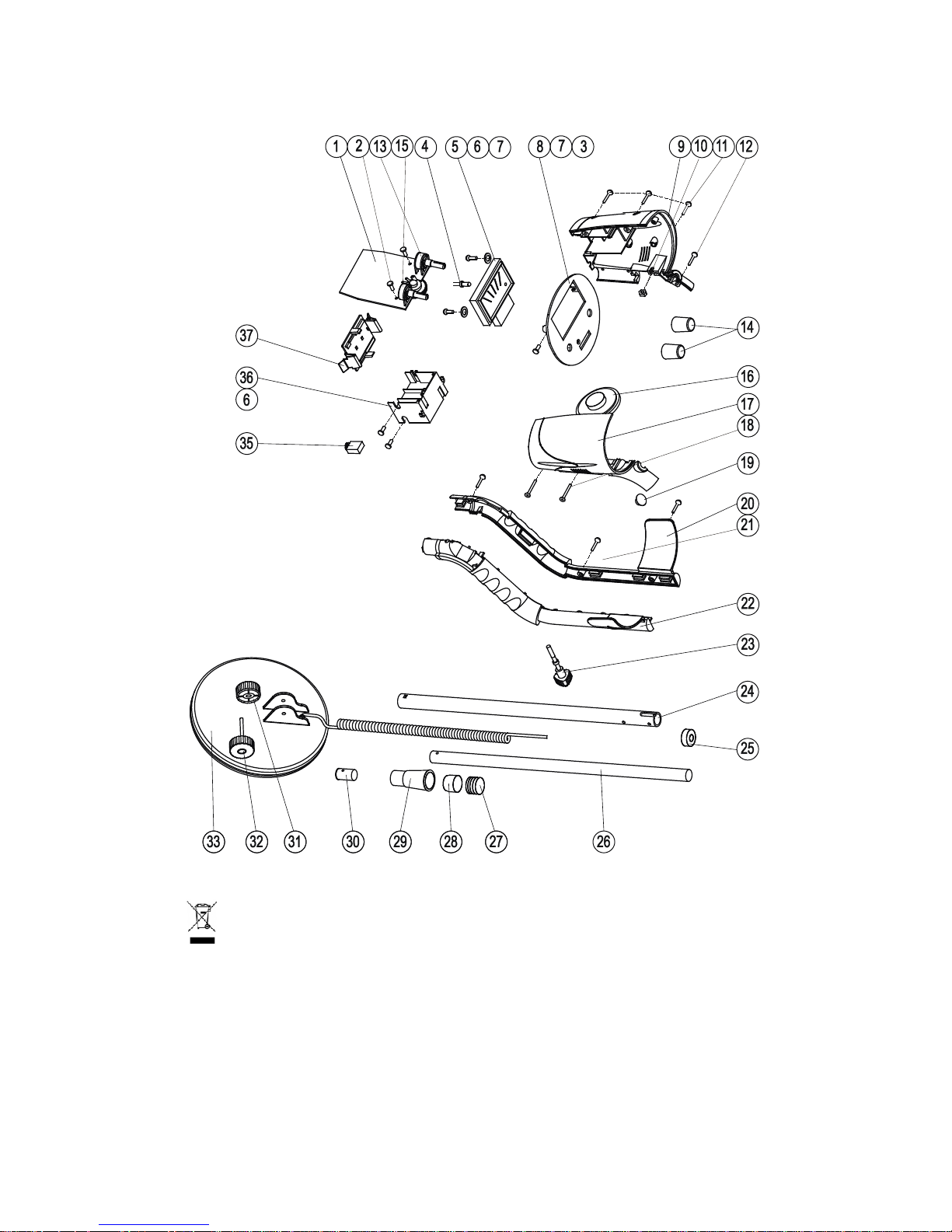
PARTS LIST PARTS LIST
Page 14

Part Description Q’ty Part Description Q’ty
1 PCB 1 20 Left Arm Rest Support 1
2 Screw M3X8 2 21 Screw M3X12 3
3 Adhesive St icker 1 22 Right Arm Rest Support 1
4 LED 1 23
Support Arm Adjustment Knob
1
5 View Meter 1 24 Outer Stem 1
6 Washer 3mm 2 25 Washer 1
7 Screw M3X8 2 26 Inner Stem 1
8 Control Panel 1 27 Lock Nut Interior 1
9 Support Arm(Right Side) 1 28 Lock Nut Exterior 1
10 Nut M4 4 29 Look Nut Cover 1
11 Screw M3X18 4 30 Bushing 1
12 Screw M3X14 1 31 Coil Button(Nut) 1
13 SENS Dial 1 32 Coil Button(Screw) 1
14 Knobs 2 33 Search Coil 1
15 DISC Dial 1 34 Support Arm Pad 1
16 Speaker 1 35 Earphone Jack 1
17 Support Arm(Left Side) 1 36 Battery Compartment 1
18 Screw M3X25 2 37
Battery Compartment Cover
1
19 Red Button/Switch 1
Page 15
WEEE Directive & Product Disposal
At the end of its serviceable life, this product should not be treated as
household or general waste. It should be handed over to the applicable
collection point for the recycling of electrical and electronics equipm ent, or
returned to the supplier for disposal.
 Loading...