

Page 1

High Power
Lighting Module
INSTALLATION AND OPERATING INSTRUCTIONS
For Models:
XP4LS
XP1LS
10012 North Dale Mabry, Ste. 115
Tampa, FL 33618
Tel: (800) TECH-003
Fax: (813) 265-1011
Email: [email protected]
Web: www.X10PRO.com
Page 1
Page 2

Congratulations! You have just purchased the best quality powerline carrier
lighting module available. X-10 PRO's Lighting Module is a high quality, X-10
compatible product that is a low cost alternative to hard-wired lighting systems.
This booklet covers all X-10 PRO models XP4LS and XP1LS.
CAUTION!!
READ AND UNDERSTAND THESE INSTRUCTIONS BEFORE INSTALLING DEVICE.
This device is intended for installation in accordance with the National Electric Code
and local regulations. It is recommended that a qualified electrician perform this
installation.
To reduce the risk of overheating and possible damage to other equipment, do not
install dimming versions to control a receptacle, a motor-operated appliance, a
fluorescent lighting fixture, or a transformer-supplied appliance. This product is for
indoor use only. Connect only copper or copper clad wire to this device.
Pour re'duire le risque d'augmenter la chaleur des diffe'rents equipments, ne pas
installer une piece de control, une machine `a moteur, une fixture fluorescente or un
transformateur.
Retain these instructions for future reference.
INSTALLATION
Installation Notes
a. Be sure that power to the supply circuit has been disconnected by removing fuse or
turning circuit breaker off. Installing the module with power on may expose you to
dangerous voltages and may damage the device.
Installation Procedures
1. Install a standard 4 gang box or RACO 953 box, pre-wire for power, loads, remote
switch, and transmitter controls.
2. Power should be a 20 circuit directly from a breaker 2x12ga wire and ground.
3. Load, remote switch, and transmitter circuits should each be connected via separate
sets of two 14ga wire with ground.
4. Using a voltage tester, identify and mark the “Hot” and the “Neutral” wires.
5. Identify and label each pair of load and control point wires.
6. If setting up an X-10 PRO lighting system enter the appropriate circuit labels and
addresses in the programming manual worksheets and on the module labels.
7. After all connections have been made, be certain all wire connectors are firmly
attached and there are no exposed wires (except the bare ground wire).
8. Place wires and insert into wall box and screw unit into place with supplied screws.
Four gang box uses four or eight 6x32x1/2 screws, Raco 953 box uses four
8x32x1/2 screws.
Page 2
Page 3
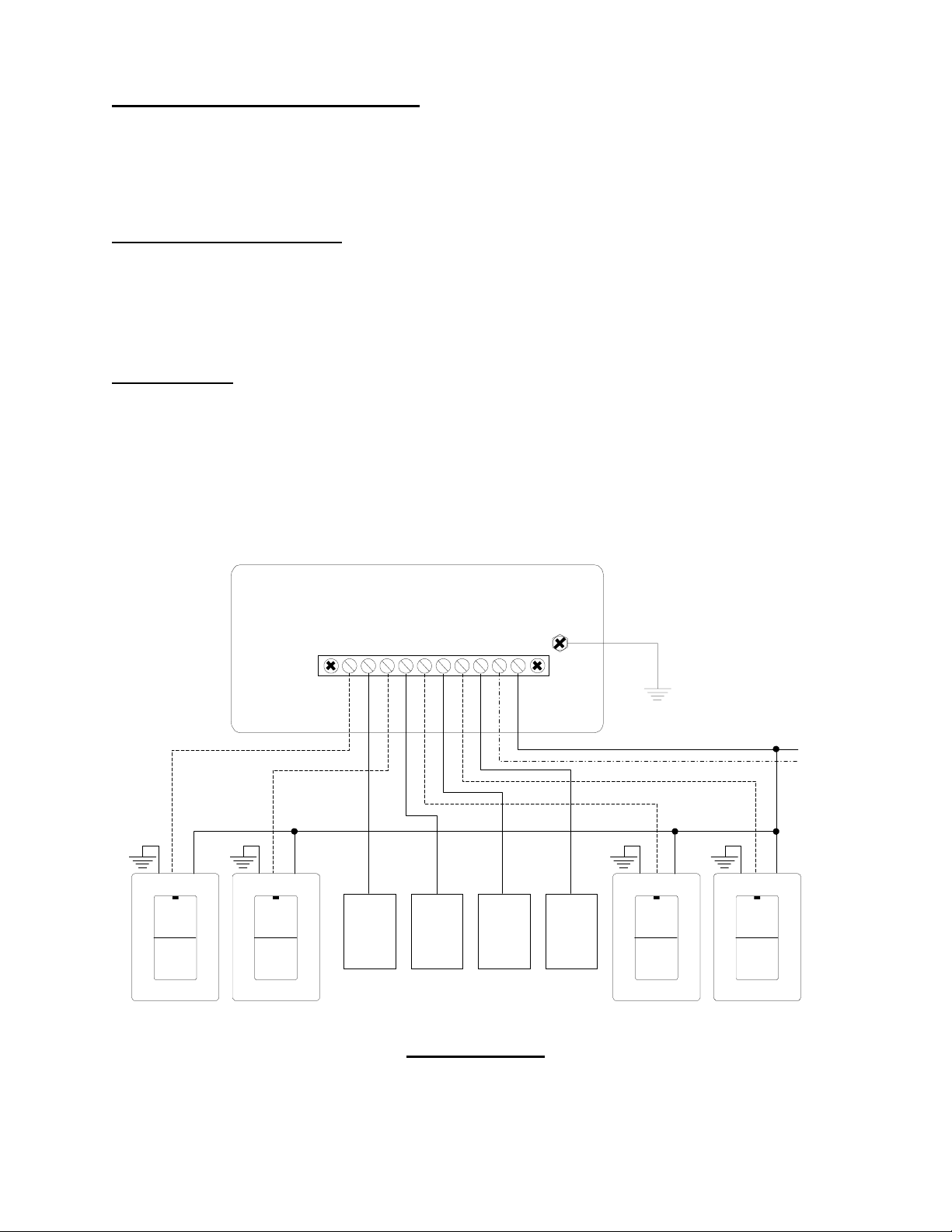
WIRING CONFIGURATION
The Lighting Module is wired directly to the lighting circuit and can be controlled by one
or more Remote switches producing three, four, or five-way circuits. Multiple-way
circuits make it possible for a group of switches to control the same set of lights. This
section will illustrate how to hook-up the connections.
Configuration Definitions:
SERVICE PANEL - Source of electricity providing the Line and Neutral
REMOTE SWITCH - One or more remote switches controlling the light circuit via the
Lighting Module control inputs.
Wiring Notes:
a. Remote switches require a Line Voltage input (Black) that is always hot. Do not
connect to the load (switched) circuit.
b. The gray wire on the Remote Switch only serves to light the red LED, which
provides as a night light and power indicator. It does not indicate the state of t he
load. This wire can be tied to neutral or earth ground.
Light i ng Mo du l e
CNTRL1
LOAD1
CNTRL2
LOAD2
CNTRL3
LOAD3
CNTRL4
LOAD4
WHITE
LINE
Ground
(Yellow)
(Gray)
Gnd* Gnd* Gnd* Gnd*
Remote 1 Remote 2 Remote 3 Remote 4
(Black)
Light
Fixture 1
* Can be connected to Nuetr al
Light
Fixture 2
Light
Fixture 3
Light
Fixture 4
Line
Neutral
Remote
Switches
(Optional)
Wiring Diagram
Page 3
Page 4
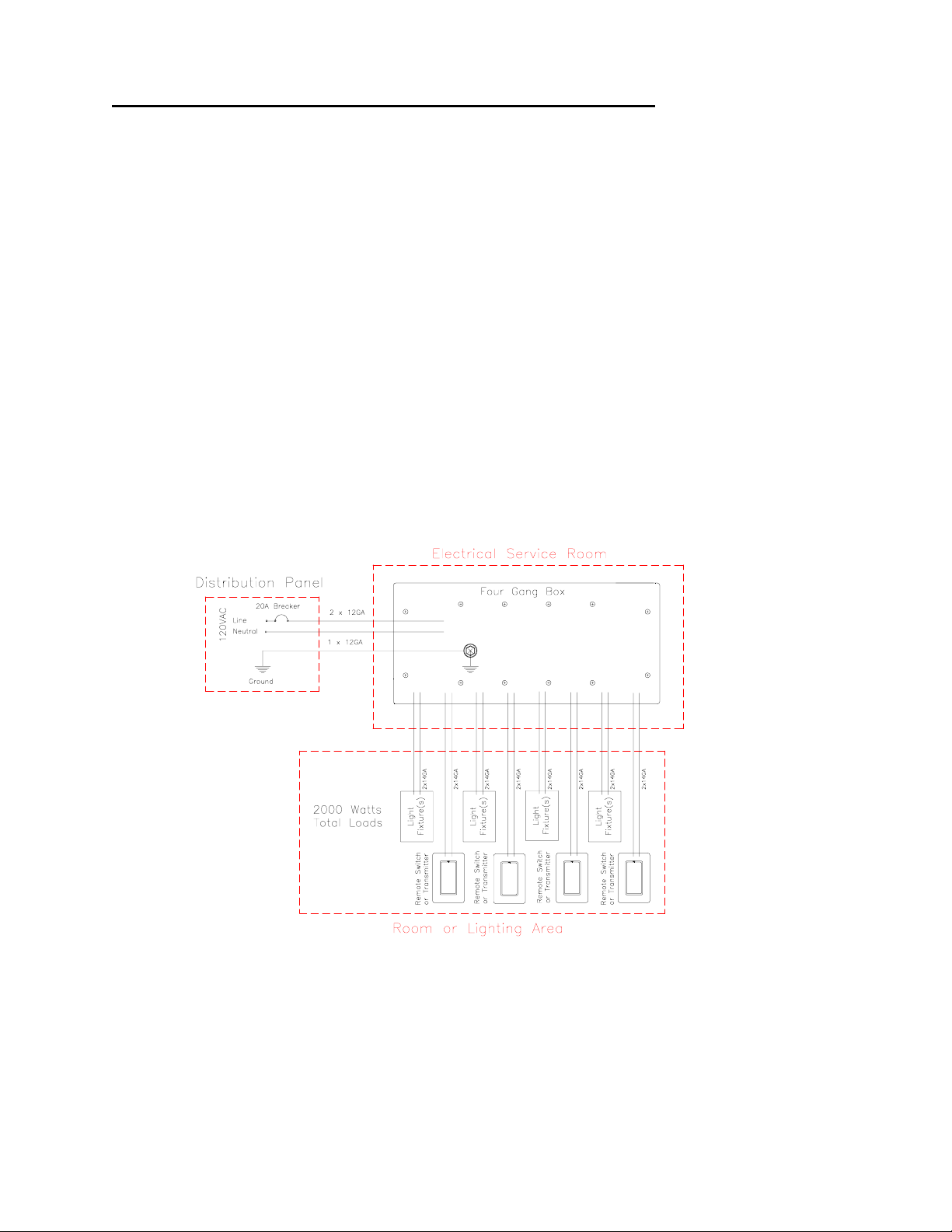
PRE-WIRING for X-10 PRO's Lighting Modules
The following is a guide to a “home-run” type wiring configuration that ensures a
versatile and reliable system. This configuration costs slightly more in materials and
labor to run the 14 gage home-runs for each load and control point. This expense,
however, is more than offset by the increase in system reliability having all associated
lighting and control points electrically “close” or in the same vicinity. The ease of setup
and programming are worth it for simple and inexpensive installation.
The "home-run" wiring scheme is very different than conventional wiring methods. The
conventional way typically taps off or "daisy chains" as many fixture/switch sets as
possible off of each 20A supply circuit. This method is the least expensive method in
getting the required control points/fixtures connected throughout the house but doesn't
allow for other methods of control.
The "home-run" method proposed in this pre-wiring guide cost somewhat more, but is
so versatile that anything from complex scene systems to simple switch/fixture
arrangements can be easily implemented.
Single Room Wiring
A typical wiring diagram for one room might be as shown in Figure 1.
Page 4
Page 5
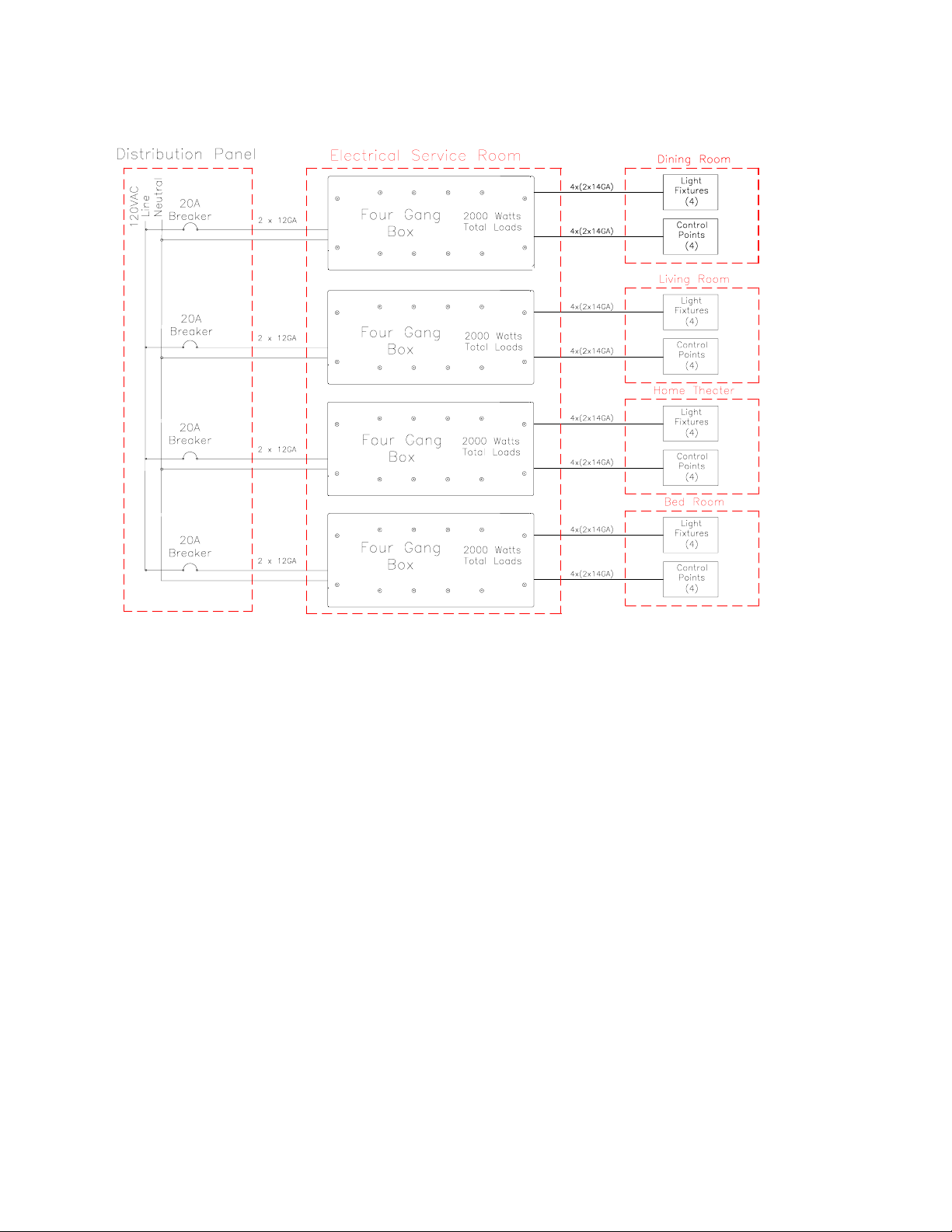
Whole House Wiring
The three important things to remember when wiring for controlled lighting are:
1. Wire fixture (load) circuits and control (transmitter/switch) circuits separately back to
a common location ("home-run" method).
2. Use a deep four gang box or boxes as the junction point for loads, controls and
power. This is for the following reasons:
a) four gang box is relatively inexpensive
b) allows for a very clean wiring arrangement
c) allows for the greatest variety of both single gang and four gang control devices
including those manufactured by PCS, Lutron, Lightolier, Leviton, X-10, and ACT
d) provides ample wiring room for large number of wire nut connections often
required
e) circuits can be easily rewired to function with no electronic control should it ever
be necessary to remove all controls
3. Provide common area or areas for installation of multiple four gang boxes. This area
should be relatively cool (not in an attic) and have adequate ventilation to dissipate 1
watt of controller heat for 100 watts of lighting to be controlled. This also allows for
simple coupling of different circuits, isolation of noise sources, easy programming
and easy repair and replacement, and simple reconfiguration.
Page 5
Page 6

REMOTE SWITCH OPERATION
Turning the Lighting Circuit On Tap the Rocker Top once.
Turn On to Full Bright Tap the Rocker Top twice.
Brightening the Lighting Circuit Hold Top down until lighting level is achieved.
Turning the Lighting Circuit Off Tap the Rocker Bottom once.
Dimming the Lighting Circuit Hold Bottom down until lighting level is achieved
LIGHTING MODULE PROGRAMMING
X-10 Addressing and Programming Interface
The X-10 protocol allows units to have a unique address made up of any combination
of a House Code (a letter from A to P) and a Device Code (a number from 1 to 16).
The most cost-effective product to program the Lighting Modules is the X-10
Maxicontroller. This unit is inexpensive and can send the full set of standard X-10
signals.
Modes of Programming
In addition to
Primary Address
and the
Normal Operation
Scene Addresses
, the
Advanced Programming Options.
, there are five programming modes used to set the
, the
Scene Enables, Scene Ramp Rates
Normal Operation
Mode 1
Mode 2
Mode 3
Mode 4
Mode 5
Scene Number
for scene address, channel enable, ramp rate and lighting level.
Channel Number
has 4 channels (Channel Numbers 1 to 4) and XP1LS has only 1 channel (Channel
Number 1).
NOTE:
The X-10 PRO lighting system will provide visual feedback while in programming mode.
Lights will flash and the LED pattern will change
to give the installer feedback that his actions are being entered.
- mode used to set primary address of the channel(s).
- mode used to set scene addresses to the scene numbers.
- mode used enable or disable individual channels to scenes.
- mode used to set ramp rates to the scene numbers.
- modes used to set the Advanced Programming Options.
Elementary programming can be performed using this instruction manual. To
fully understand the scene features of the system, please read the
Programming Manual
This is available free from the X-10 PRO web site (www.X10PRO.com).
- this is the normal operating state of the Lighting Module.
- A number from 1 to 16 representing each scene and holds settings
- A number representing the lighting channel of product. The XP4LS
X-10 PRO's
which covers the complete programming of this device.
during the course of programming
Page 6
Page 7

To Enter any Mode:
Press and hold down the PROGRAM button and release it when the LED starts
1)
blinking green.
Tap the PROGRAM button once. The LED is blinking red.
2)
(Setting New Scene Addresses).
Tap the PROGRAM button once. The LED is blinking orange.
3)
(Setting Channel Enables).
Tap the PROGRAM button once. The LED is alternating green and red
4)
in Mode 4 (Setting Ramp Rates).
Tap the PROGRAM button once. The LED is alternating green and orange.
5)
are in Mode 5 (Setting Advanced Programming Options).
LED Color Indicator
Program Mode Mode Name LED Pattern
Mode 1 Setting New Primary Address Blinking Green
You are now in Mode 1 (Setting New Primary Address).
You are in Mode 2
You are in Mode 3
. You are
Normal Operation Solid Red
You
Mode 2 Setting New Scene Addresses Blinking Red
Mode 3 Setting Channel Enables Blinking Orange
Mode 4 Setting Ramp Rates Alternating Green and Red
Mode 5 Advanced Programming Options Alternating Green and Orange
Mode 1 Programming - Setting the Primary Address
Enter Mode 1.
1)
Transmit X-10 address.
2)
Press All-Lights-On key.
3)
Press All-Lights-On key 3 times.
4)
mode and into normal operation.
See To Enter any Mode section.
This address will be the new Primary Address.
The product stores new Primary Address into memory.
The product is transferred out of programming
Page 7
Page 8

Mode 2 Programming - Setting Scene Addresses
Enter Mode 2.
1)
Press Scene Number.
2)
Press All-Lights-On key.
3)
Transmit X-10 address.
4)
Press All-Lights-On key.
5)
Press All-Lights-On key 3 times.
6)
mode and into normal operation.
Mode 3 Programming - Setting Channel Enables
Enter Mode 3.
1)
Press Scene Number.
2)
Press All-Lights-On key.
3)
See To Enter any Mode section.
A number between 1 and 16 representing scene of product.
Product confirms Scene Number is entered.
Address will be the address of the scene number selected.
The product stores new Scene Address into memory.
The product is transferred out of programming
See To Enter any Mode section.
A number between 1 and 16 representing scene of product.
Product confirms Scene Number is entered.
Press all applicable Channel Numbers.
4)
want to change. LM4s have channel numbers 1 through 4. MM2s have channel
numbers 1 and 2. SS1s have only channel number 1.
Press the ON key or OFF key.
5)
channel will respond or not respond to the Scene Address.
Press All-Lights-On key.
6)
Press All-Lights-On key 3 times.
7)
mode and into normal operation.
Mode 4 Programming - Setting Ramp Rates
Enter Mode 4.
1)
Press Scene Number.
2)
Press All-Lights-On key.
3)
Press Ramp Rate number.
4)
duration. The "1" key is an instant-on, "2" is 3 seconds, "3" is 6 seconds, "7" is 20
seconds, "12" is 7 minutes, "15" is 13 minutes, "16" is the security flashing mode.
See To Enter any Mode section.
A number between 1 and 16 representing scene of product.
Pressing ON or OFF key will determine if the
The product stores new Channel Enables into memory.
The product is transferred out of programming
Product confirms Scene Number is entered.
A number between 1 and 16 representing the ramp rate
A number representing which channel you
Press All-Lights-On key.
5)
Press All-Lights-On key 3 times.
6)
mode and into normal operation.
The product stores new Ramp Rate into memory.
The product is transferred out of programming
Page 8
Page 9

Mode 5 Programming - Setting Advanced Programming Options
The Advanced Programming Options are given the following table. The sequence of
programming is different for these options, so we will separate them as follows.
Advanced Programming Options 1 through 7
Enter Mode 5.
1)
Press Advanced Programming Option number.
2)
defined in the following table.
Press All-Lights-On key.
3)
Press all applicable Channel Numbers.
4)
want to change. LM4s have channel numbers 1 through 4. MM2s have channel
numbers 1 and 2. SS1s have only channel number 1.
Press the ON key or OFF key.
5)
channel will respond or not respond to the Scene Address.
Press All-Lights-On key.
6)
See To Enter any Mode section.
A number between 1 and 7 as
Product confirms Option Number is entered.
A number representing which channel you
Pressing ON or OFF key will determine if the
The product stores new setting into memory.
Press All-Lights-On key 3 times.
7)
mode and into normal operation.
Advanced Programming Options 8 and 10
Enter Mode 5.
1)
Press Advanced Programming Option number.
2)
following table.
Press All-Lights-On key.
3)
Press the ON key or OFF key.
4)
channel will respond or not respond to this option.
Press All-Lights-On key.
5)
Press All-Lights-On key 3 times.
6)
mode and into normal operation.
See To Enter any Mode section.
Product confirms Option Number is entered.
The product stores new setting into memory.
The product is transferred out of programming
Pressing ON or OFF key will determine if the
The product is transferred out of programming
Number 8 or 10 as defined in the
Page 9
Page 10

Advanced Programming Option 9
Enter Mode 5.
1)
Press Advanced Programming Option 9.
2)
following table.
Press All-Lights-On key.
3)
Press the Receive Level.
4)
receive level of the product. The default is "4" (50mV). The "1" key is 5mV, "7" is
125mV, "11" is 225mV, "14" is 300mV, and "16" is 350mV.
Press All-Lights-On key.
5)
Press All-Lights-On key 3 times.
6)
mode and into normal operation.
See To Enter any Mode section.
Press key "9" which is defined in the
Product confirms Option Number is entered.
A number between 1 and 16 representing the voltage
The product stores new setting into memory.
The product is transferred out of programming
Numbered Key on
Transmitter/Controller
1 Soft Start Enabled
2 All Lights On Enabled
3 All Lights Off Enabled
4 All Units Off Enabled
5 Universal All Lights On Disabled
6 Universal All Lights Off Disabled
7 Universal All Units Off Disabled
8 Master Scene Enable Disabled
9 Receive Level 4
10 Remote Access Disabled
ADVANCED PROGRAMMING OPTIONS
Advanced Programming
Option
Default Setting
RESET TO DEFAULT SETTINGS
The following steps will return this product to its default settings as given on the next
page.
Enter Mode 1.
1)
Press All-Units-Off key 3 times.
2)
Press All-Lights-On key 3 times.
3)
mode and into normal operation.
See To Enter any Mode section.
This will reset to factory defaults.
The product is transferred out of programming
Page 10
Page 11
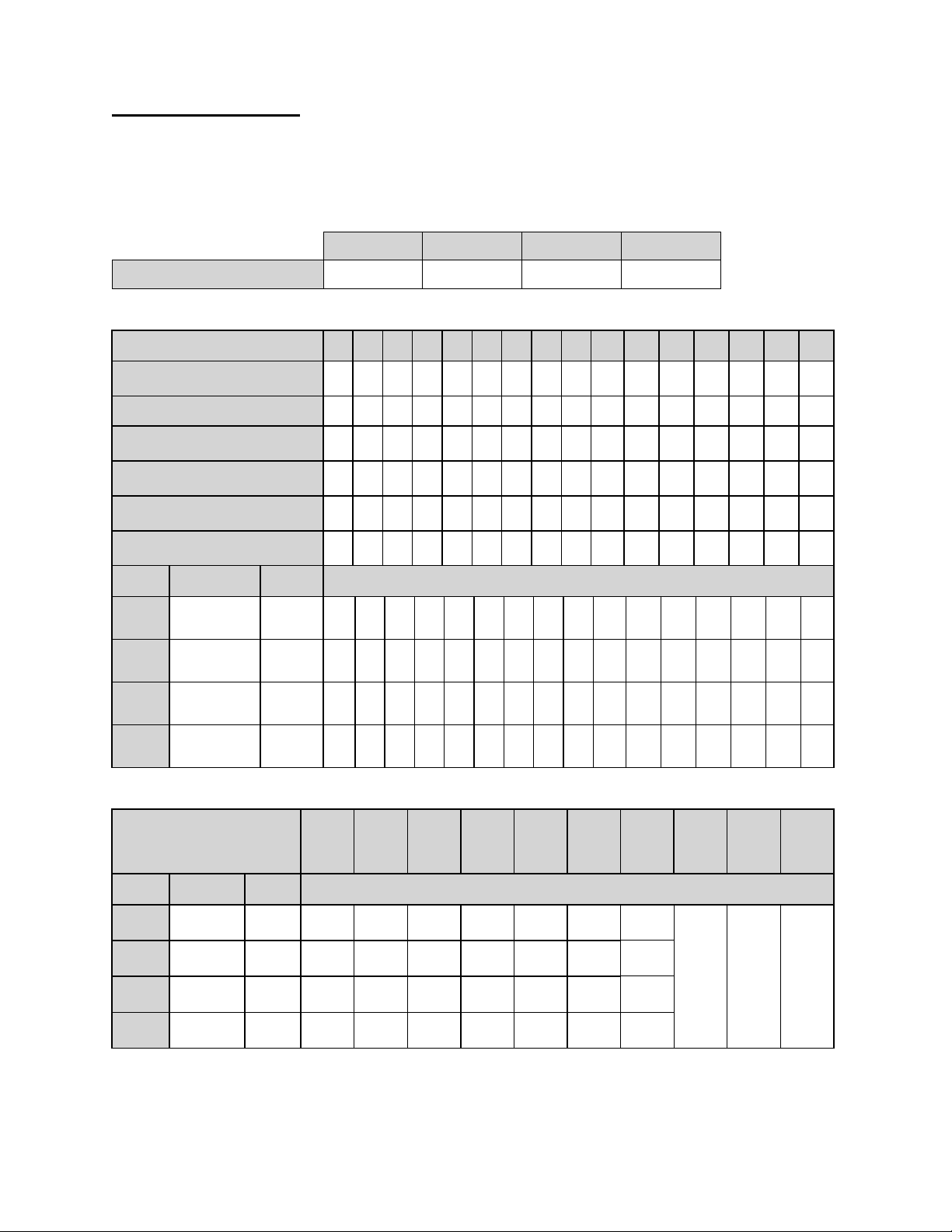
Default Settings
The default settings for the four channel modules (XP4LSs) are shown in the tables
below. The single channel module (XP1LS) are the same except for the absence of
channels 2, 3 and 4.
Primary Address Defaults
Channel 1 Channel 2 Channel 3 Channel 4
Primary Address
Scene System Defaults
SCENE NUMBER 1 2 3 4 5 6 7 8 9 10 11 12 13 14 15 16
SCENE ADDRESSES
RAMP RATES
CHANNE L 1 E NABLE
CHANNE L 2 E NABLE
CHANNE L 3 E NABLE
CHANNE L 4 E NABLE
XCHAN
NO.
Ch 1
Ch 2
Ch 3
CIRCUIT
NAME
Channel 1 A1
Channel 2 A2
Channel 3 A3
PRIME
ADDR
A1 A2 A3 A4
B1 B2 B3 B4 P5 P6 P7 P8 H1 H2 H3 H4 H5 H6 H7 H8
2222222222 2 2 2 2 216
On On On On On On On On On On On On On On On On
On On On On On On On On On On On On On On On On
On On On On On On On On On On On On On On On On
On On On On On On On On On On On On On On On On
LIGHTING LEVELS
70%
40%
100%
100%
100%
70%
70%
40%
40%
20%
20%
20%
100%
100%
100%
70%
70%
70%
40%
40%
40%
20%
20%
20%
100%
100%
100%
70%
70%
70%
40%
40%
40%
20%
20%
20%
100%
100%
100%
70%
70%
70%
40%
40%
40%
100%
100%
100%
Ch 4
Channel 4 A4
100%
70%
40%
20%
100%
70%
40%
20%
100%
70%
Advanced Programming Defaults
CHANNE L ADVANCED
PROGRAMMING
CHAN
NO.
Ch 1
Ch 2
Ch 3
Ch 4
CIRCUIT
NAME
Channel 1 A1 On
Channel 2 A2 On
Channel 3 A3 On
Channel 4 A4 On
PRIME
ADDR
1
Soft
Start
NOTE 1OnNOTE 2OnNOTE 2
NOTE 1OnNOTE 2OnNOTE 2
NOTE 1OnNOTE 2OnNOTE 2
NOTE 1OnNOTE 2OnNOTE 2
NOTE 1: Advanced Programming Option 1 does not apply to appliance (relay) modules.
NOTE 2: This setting is off for appliance (relay) modules.
2
All Lts
ON
3
All Lts
OFF
4
All Uts
OFF
On Off Off Off
On Off Off Off
On Off Off Off
On Off Off Off
5
Univ Lts
ON
OPTION S ETTINGS
6
Univ Lts
OFF
Univ Uts
7
OFF
Page 11
40%
20%
8
MstrScn
Enable
Off 4 Off
100%
Receive
Level
70%
9
40%
10
Rmt Acs
Enable
100%
Page 12
SPECIFICATIONS
Model Number XP4LS XP1LS
Operation
Max Total Load
Channels
Max Channel Load
Standard Load Types
Input Power
Min Load
Min Receive Level
Max Noise Rejection
Connections
LED Indicator
Dimensions
Weight
Mounting
Dimming (Triac) Dimming (Triac)
2000 W / 2000 VA 2000 W / 2000 VA
Four One
1000 W 2000 W
Incandescent,
Magnetic Low Voltage
Incandescent,
Magnetic Low Voltage
125 VAC 125 VAC
60 W 60 W
5 mV 5 mV
350 mV 350 mV
16 AWG 16 AWG
Yes Yes
11.0 X 5.0 X 1.63 in
3
11.0 X 5.0 X 1.63 in
1.25 lb. 1.25 lb.
Std 4 gang J box Std 4 gang J box
3
Operating Temp
-40 °F to 104 °F -40 °F to 104 °F
Page 12
 Loading...