

Page 1
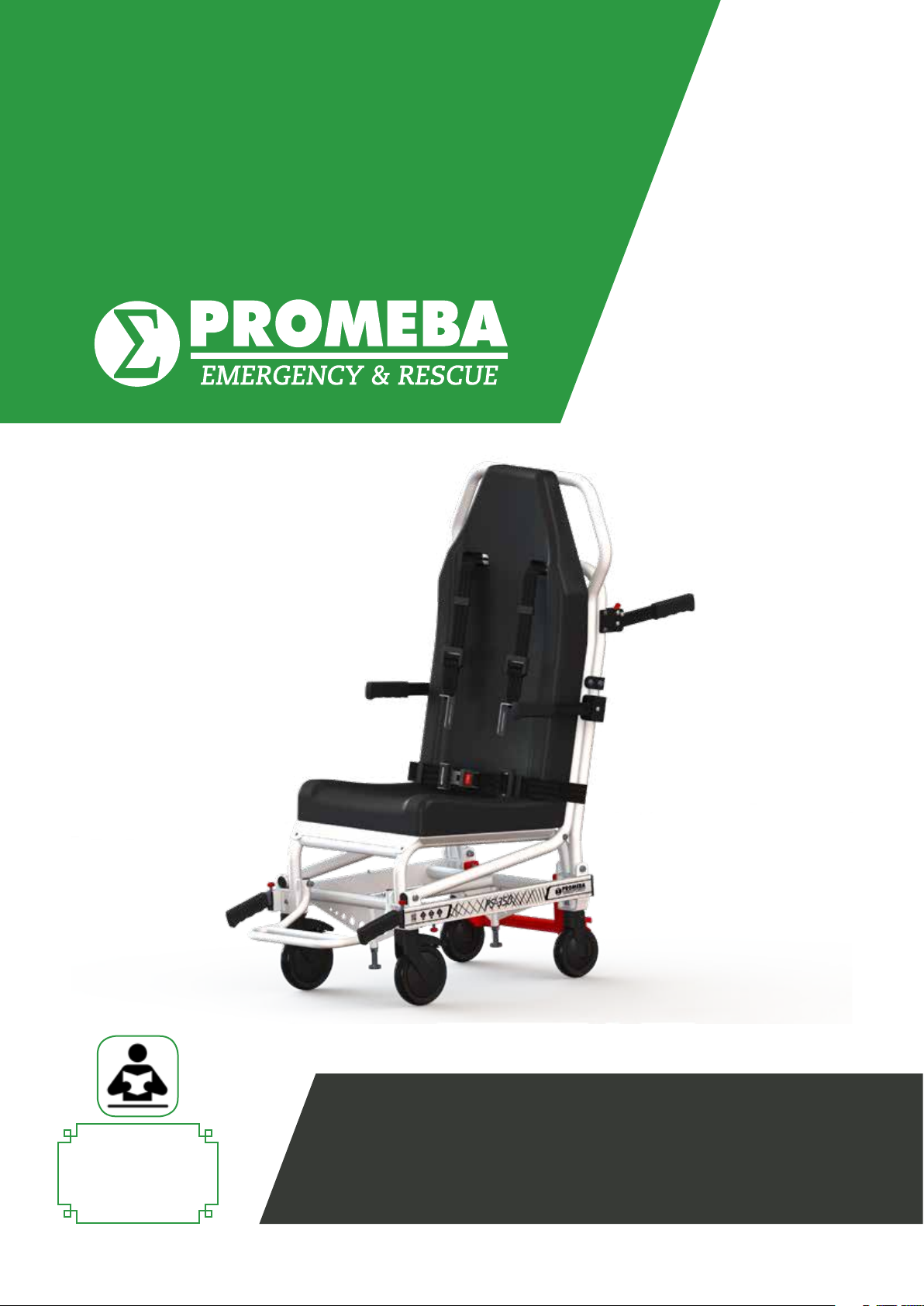
USER GUIDE
Read the instruction
manual and store it for
future reference
EMERGENCY CHAIR PS-350
Review 06/19
Page 2

Page 3

USER MANUAL // EMERGENCY CHAIR PS-350
Review 06/19
INDEX
01 INTRODUCTION
01.1 Using this manual 05
01.2 Meaning of Symbols 06
01.3 Serving request 06
01.5 Demolition 06
01.6 Characteristics 07
01.7 Technical data sheet 09
02 WARNINGS
02.1 General warnings 10
02.2 Specic warnings 13
02.3 Contradictions and side eects 15
02.4 Physical requirements of the operators 15
03 INSTALATION
03.1 Transporting and unpacking 16
03.2 Chair’s preparaion 17
04 OPERATING
04.1 General elements of evacuation chair PS-350 19
04.1.1 Armrests 20
04.1.2 Belts 20
04.1.3 Telescopic handles 21
04.1.4 Footrest 21
04.1.5 Front swivel wheels with brake 22
04.1.6 Transport handles 22
04.1.7 Two locking points device for the ambulance 23
04.1.8 Track anchor system 24
05 MOUNTING AND COMPONENTS
05.1 Main exploded view CHAIR PS-350 27
05.2 Exploded lower structure 28
05.3 Bill of materials exploded lower structure 29
05.4 Exploded seat+backrest strucucture 30
05.5 Bill of materials exploded seat+backrest strucucture 31
05.6 Exploded Footrest 32
05.7 Bill of materials exploded Footrest 33
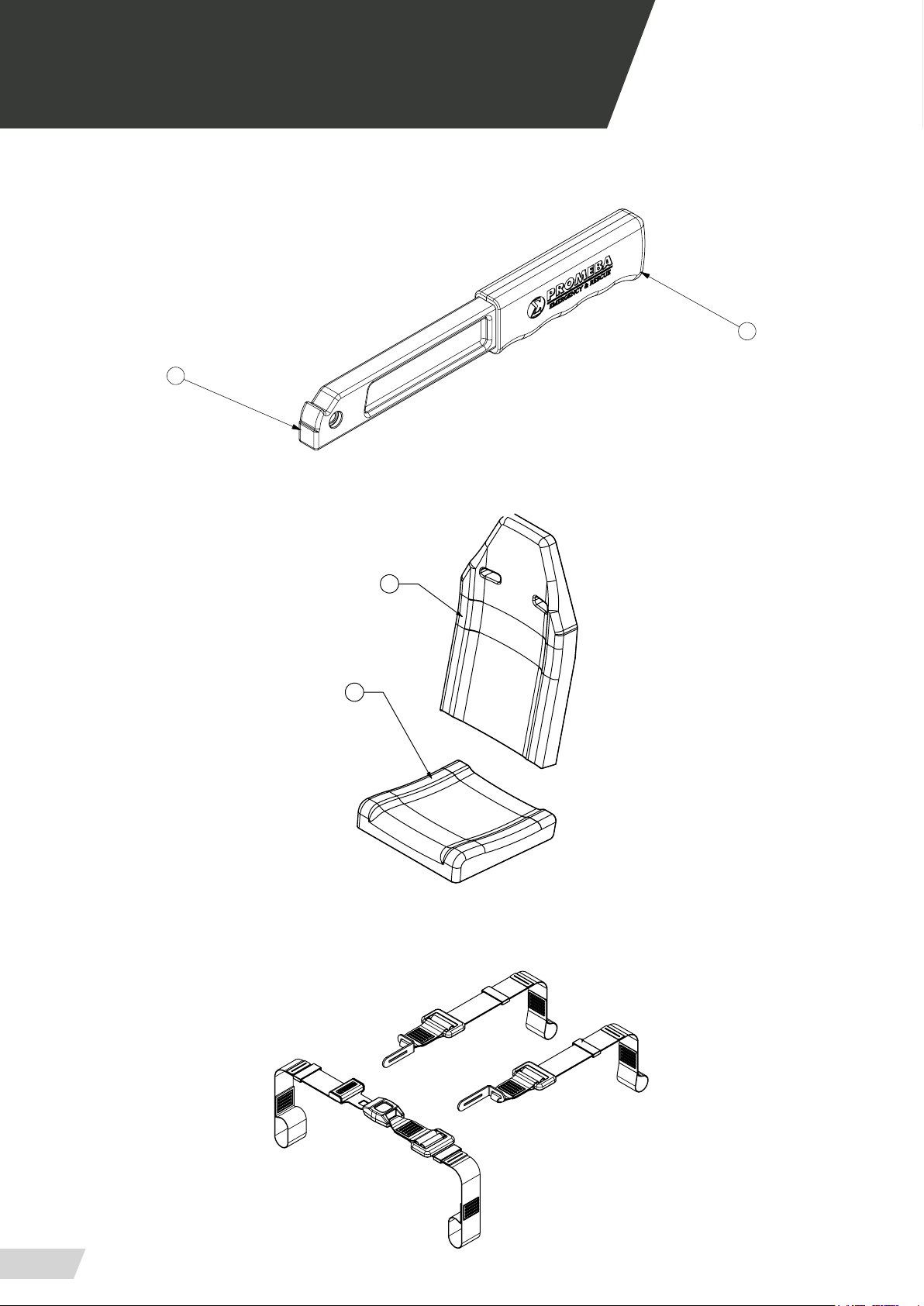
05.8 Exploded handle 34
05.9 Bill of materials exploded handle 35
05.10 Sit-upon and backrest chair 34
05.11 Bill of materials Sit-upon and backrest chair 35
05.12 Exploded harness belt 10G chair PS-350 34
05.13 Bill of materials exploded harness belt 10G chair PS-350 35
06 GENERAL MAINTENANCE 37
07 LEGAL NOTICES 38
08 PRODUCT WARRANTY 39
09 TRAINING REGISTER 40
10 MAINTENANCE REGISTER 41
3
Page 4

Page 5

USER MANUAL // EMERGENCY CHAIR PS-350
Review 06/19
01 INTRODUCTION
01.1 Using this manual
This manual provides using and maintenance instructions of the product, as well as the way of xing minor
faults that could appear.
It is recommended before the operation of the product
to read carefully this manual in order to avoid damages
caused by a misuse.
Do not lose this document, it should be accessible to
any doubt that could appear by medical personnel.
Remember that a good use and maintenance are necessary for the proper operation of the product.
Each product incorporates an identication sticker with
the serial number and the model. Keep these numbers
so that they can be indicated to the dealer if necessary.
5
Page 6
USER MANUAL // EMERGENCY CHAIR PS-350
Review 06/19
01 INTRODUCTION
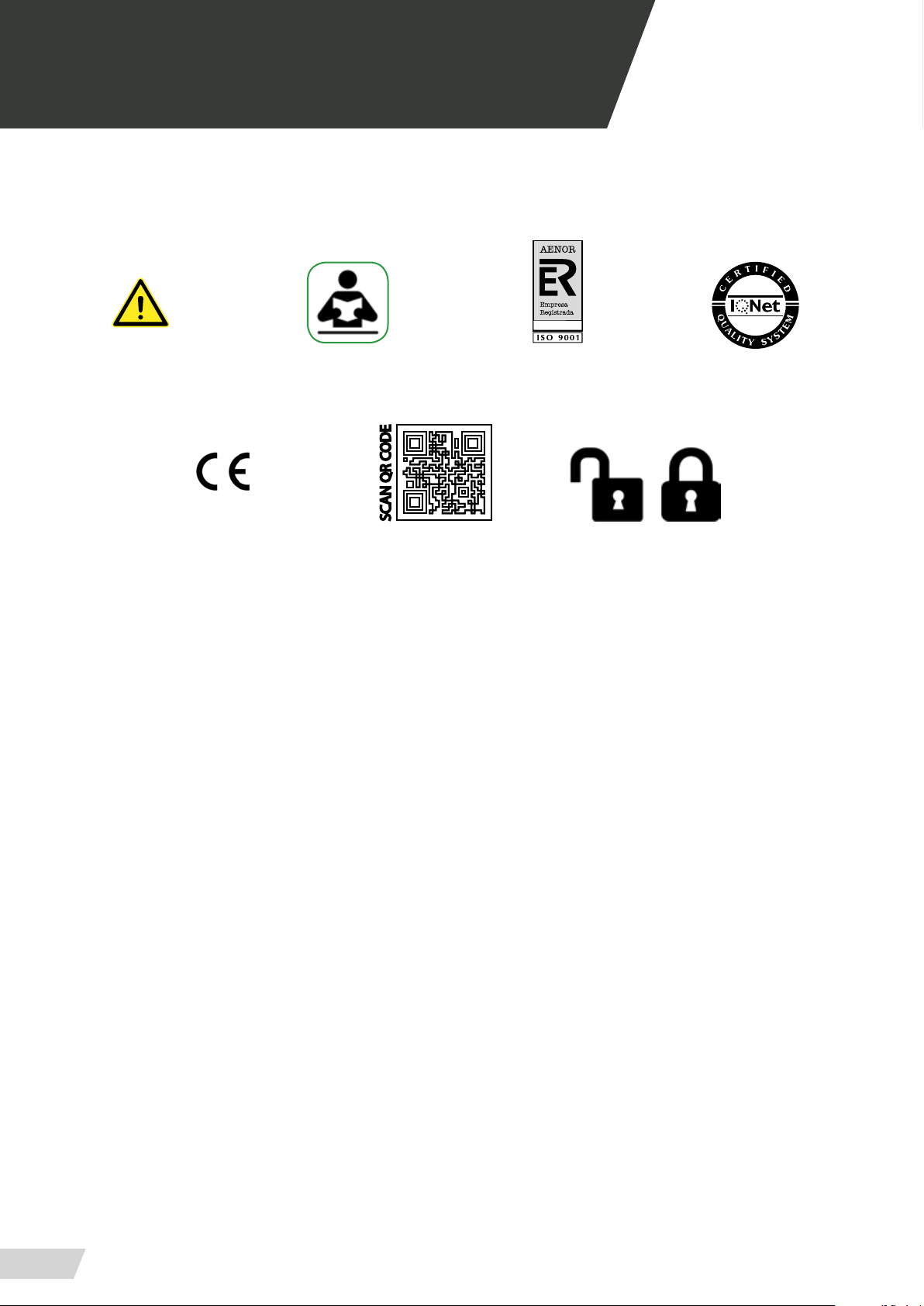
01.2 Meaning of Symbols
ER-0687/1998
General warning of
possible injuries
This product is compliant
with the specications of
the Directive 93/42/CEE
Read the user manual
QR Code
(Access Online Web)
Certicate of Qua-
lity Management
System
Unlocked Locked
IQNet Certicate
01.3 Serving request
For information of the correct interpretation of the instruction manual, the use, maintenance, installation and restoration of the product, please contact Promeba customer service T. 93 837 12 00, Fax
93082061008, email [email protected] or write to PROMEBA, S.L. - Ctra C-16 Km 59.5 · 08650
Sallent (Barcelona) · SPAIN.
02.4 Demolition
When the devices are no longer suitable for use, if they have not been contaminated by any particular
agent, they can be disposed of as normal solid waste, otherwise, follow the current demolition regulations.
6
Page 7
USER MANUAL // EMERGENCY CHAIR PS-350
Review 06/19
01 INTRODUCTION
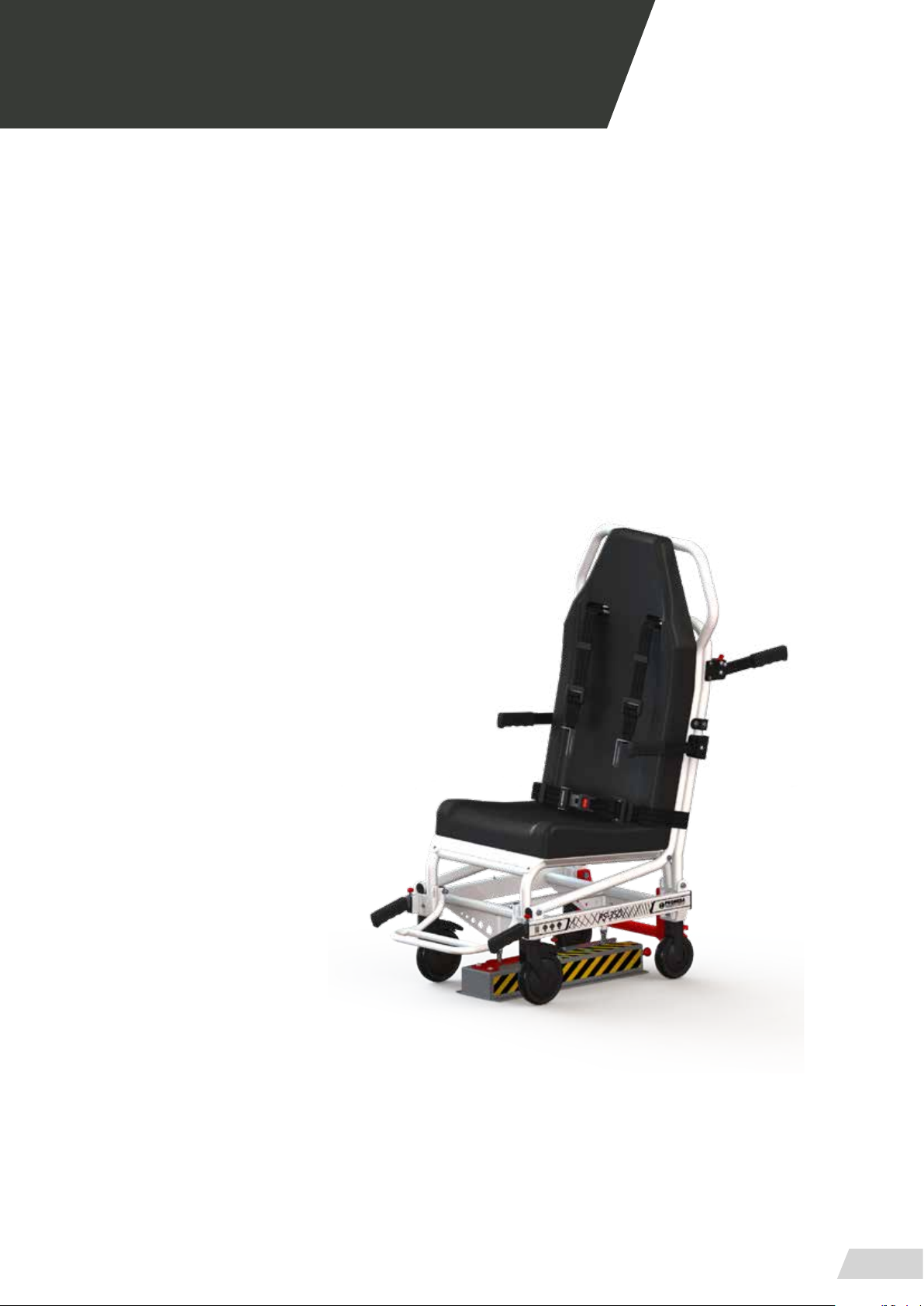
01.5 Characteristics
1. Use for emergency situations in elderly people, public safety, hospitals, hotels, etc.
2. Foldable armrests.
3. Four wear resistant wheels.
4. Telescopic handles with the possibility of total extraction.
5. Seat and back with heat sealed seams for a great hygiene and easy to clean.
6. Two locking points device for the ambulance.
7
Page 8

Page 9
USER MANUAL // EMERGENCY CHAIR PS-350
Review 06/19
01 INTRODUCTION
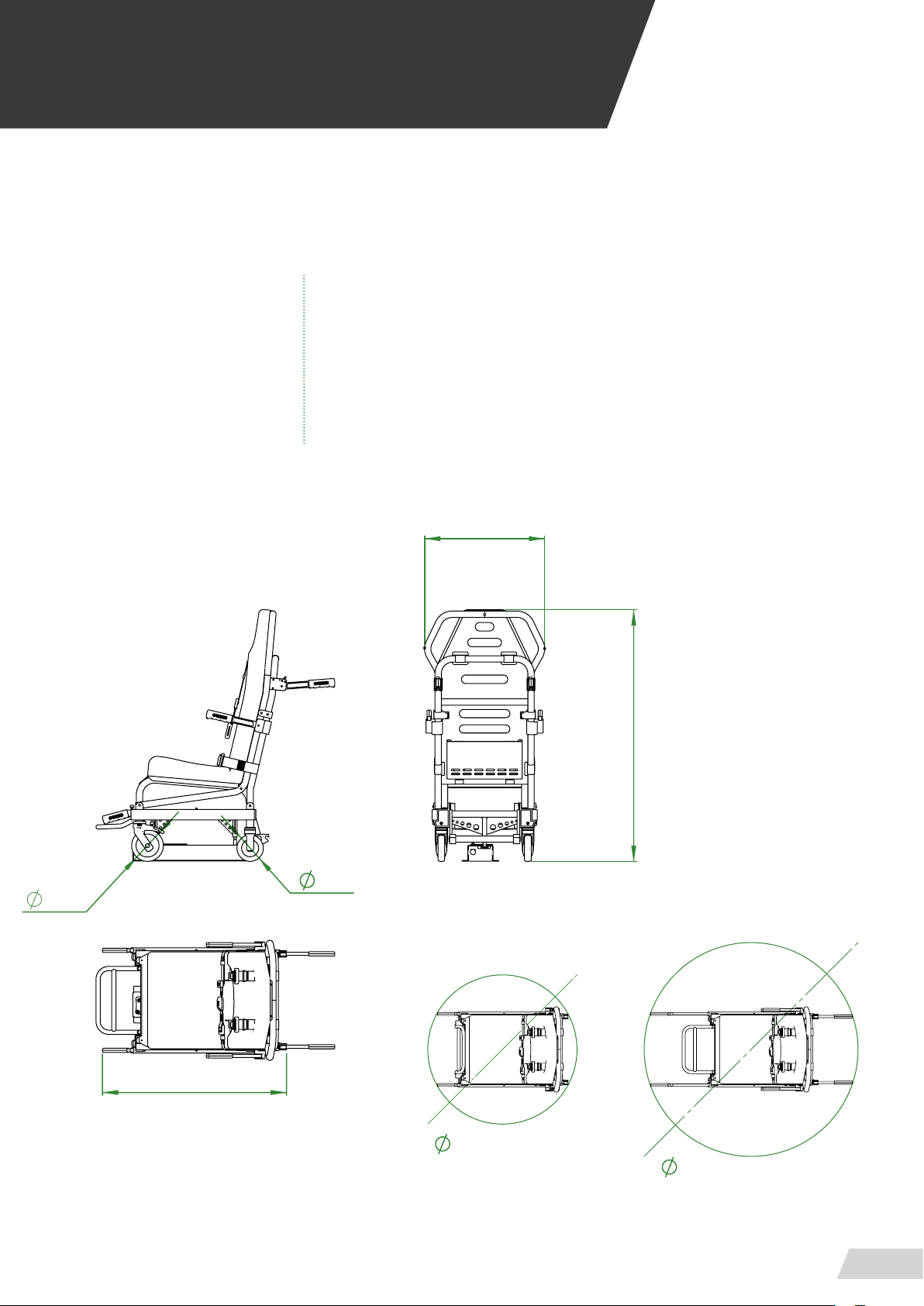
01.2 Technical data sheet
MEASURES AND FEATURES //
LENGHT 873 mm MAX. LOAD 180 Kg
WIDTH 570 mm WHEELS 150x32/125x32
HEIGHT 1194 mm HANDLES 4(2 Front extensible + 2 Rear)
*WEIGHT 18 Kg OPERATOR REQUIRED 2
*No mattress or belts
Weight of mattress and belts 2 Kg
150
570
1194
125
873
995
1426
9
Page 10

USER MANUAL // EMERGENCY CHAIR PS-350
Review 06/19
02 WARNINGS
02.1 General warnings
· The product has to be used by trained personnel only, who must have specic training for the use of
this product and not for similar products.
· Training routines must be registered on a special register in which the names of the persons trained,
their trainers, the place and the date of the training are indicated. This registry, which will certify the
eligibility of the operators to use the Promeba product, must be retained for a period of 10 years after
the elimination of the product. This record will be made available to the competent authorities and/or
the manufacturer if requested.
· Promeba, S.L. is always at your disposal to plan the product formations.
· Before carrying out any type of operation on the product (training, installation, use), the operator
must carefully read the attached instructions, paying special attention to the correct safety precautions
and the procedures that must be followed for the installation and for the correct use.
· If you have any questions regarding the interpretation of these instructions, please contact Promeba,
S.L. for any kind of clarication.
· If the instructions belong to another device and not to the purchased device, inform the manufacturer
immediately and avoid the use of this device.
· Before each use of the device, the perfect functioning of the device must be veried, as specied in
the instruction manual. In case of detecting damages or anomalies that could inuence in some way
the correct functioning or safety of the device, the patient or the operator; the device must be immediately removed from service and you must contact the manufacturer.
· In case of detecting any failure or incorrect functioning of the device, it must be replaced immediately
by a similar device in order to be able to guarantee the rescue procedures without any interruption.
· Regularly check the product, carry out the prescribed maintenance and respect the service life, as
indicated by the manufacturer in this manual.
· Do not allow people without training to help during the use of the device, because they could cause
damage to the patient or to themselves.
· It is totally forbidden to use the device in any other way than the one described in this manual.
· Do not alter or modify this device in any way; any modication of this device could cause malfunctions
and injuries to the patient and/or rescue personnel.
· Handle with care.
· The device must not be manipulated in any way (modication, adjustment, replacement). In such
cases all responsibility will be denied for any malfunctions or injuries caused by this device. In addition,
CE certication and product warranty will be considered void.
10
Page 11

USER MANUAL // EMERGENCY CHAIR PS-350
Review 06/19
02 WARNINGS
· All those who modify or have modied, prepared or have prepared medical devices in such way that
they no longer serve the purpose for which they were designed, or no longer provide the desired service, must satisfy the valid conditions for the introduction of these in the market.
· Register and store with these instructions: lot number, place and date of purchase, rst date of use,
date of checks, name of operators and any other comments.
· Be sure to take all necessary precautions to avoid the dangers that may arise as a result of contact with
blood or body uids.
· Do not store the device under heavy objects that could cause structural damage.
· Store in a cool, dry, dark place and do not expose the device directly to the sun.
· Store and transport the product in its original packaging.
· The product must not be exposed or come into contact with any source of combustion or ammable
agents.
· Position and adjust the device being careful not to cause any obstruction to rescuers and/or any other
rescue equipment.
· When the product is being used, the assistance of qualied personnel must be guaranteed
· Attention: laboratory tests, post-production tests, instruction manuals cannot always consider all pos-
sible scenarios of use. This means that, in some cases, the performance of the product could have signicantly dierent from results to date obtained. Instructions are continually updated and are under the
strict supervision of fully qualied personnel with the appropriate technical formation.
· In addition, both public and private services are obliged to inform the manufacturer of any measures
that should be adopted in order to take the necessary steps to guarantee the safety and health of patients and users of any medical device.
· As a distributor or end users of products manufactured and/or marketed by Promeba, S.L., it is strictly
required that you have a basic knowledge of any legal requirement that applies to the supplied devices,
for the countries in which they will end up (including laws and norms regarding technical specications
and/or safety requirements) and, therefore, it is also strictly required to have the necessary knowledge
to guarantee all aspects related to the total conformity of the products to the regulations in the corresponding territory.
· Promptly notify Promeba, S.L. with respect to any revision that the manufacturer must carry out in
order to guarantee the conformity of the product to the legal specications of the territory (including
those resulting from rules and/or norms of other nature).
· Act, with due care and diligence, and help ensure compliance to general security requirements of all
devices marketed in the territory, providing end users with all the information necessary to perform
periodic checks of their devices, as specied in the instruction manual.
11
Page 12

USER MANUAL // EMERGENCY CHAIR PS-350
Review 06/19
02 WARNINGS
· Actively contribute to the security controls of the products sold, communicating any relevant risk
analysis information both the manufacturer and to competent authorities so that the necessary measures can be taken promptly.
· You are aware that, in case of it does not comply with the above mentioned requirements, you will
be considered totally responsible for all damages that may occur. Therefore we expressly disclaim any
responsibility and/or liability for your non-compliance with the present regulatory provisions.
12
Page 13

USER MANUAL // EMERGENCY CHAIR PS-350
Review 06/19
02 WARNINGS
02.2 Specic warnings
· Establish a maintenance program and periodic tests, identifying a reference employee. The person en-
trusted with the ordinary maintenance of the device must guarantee the basic requirements foreseen
by the manufacturer in the user manual.
· Use only accessories/spare parts original or approved by Promeba, S.L., in order to carry out any ope-
ration without altering or modifying the device; otherwise we assume no responsibility for the correct
operation or damage resulting from the device to the patient or the operator and the warranty will be
considered void, in accordance with the compliance of the Medical Device Directive 93/42/EEC.
· Always respect the maximum load capacity of the device, as indicated in this manual. The maximum
load capacity means the total weight distributed according to the human anatomy. When determining the load of the total weight on the product, the operator should consider the patient’s weight,
equipment and accessories. In addition, the operator must consider that the overall dimensions of the
patient do not reduce the functionality of the device.
· Never leave the patient without any assistance in the device, because he could be injured.
· The device and all its components, after being washed, should be allowed to dry completely before
storage.
· Lubrication must be carried out after cleaning and complete drying.
· Follow the procedures approved by the Emergency Medical Services for the immobilization and trans-
portation of the patient.
· Follow the procedures approved by the Emergency Medical Services for the positioning and transpor-
tation of the patient.
· Avoid contact with sharp objects.
· Do not use the device if it is pierced, torn or frayed.
· Make sure that, before lifting the device, operators have a rm grip on the device.
· Avoid pulling the device on rough surfaces.
· Do not lift by crane or other mechanical lifts.
· The device is a stretcher/chair for transporting patients and cannot be used as a stationing device.
First, practice with an empty stretcher/chair to get used to the way in which the stretcher/chair manoeuvres.
· For the use of the device, at least two operators are needed in appropriate physical conditions; the-
refore, they must have strength, balance, coordination and common sense and must be trained on the
correct functioning of the device of the stretcher/chair.
13
Page 14

USER MANUAL // EMERGENCY CHAIR PS-350
Review 06/19
02 WARNINGS
· For techniques for loading particularly heavy patients, for rescue operations on steep ground or in
unusual circumstances, the presence of more operators is recommended (not only two, as required
under standard conditions).
· The maximum weight sustained by each rescuer must comply with the requirements prescribed by
the law of the country, related to health and safety at work.
· Before each use, check the integrity of the belts and their hooks, as specied in the manual. In case of
malfunction or any damage that may compromise the function and safety of the device, the patient or
the operator, it is necessary to replace the belts.
· Make sure the belts are tight to the chassis of a stretcher/chair.
· Always immobilize the patient, using the straps supplied by the manufacturer; the lack of immobiliza-
tion can cause serious damage.
· Use the emergency chair only as described in this manual.
· Do not alter or modify the emergency chair arbitrarily to make it t into the ambulance: the modi-
cation can cause unpredictable functioning and damage to the patient and operators. In any case the
guarantee will be lost.
· Pay close attention to possible obstacles (water, ice, debris, etc.) on the route of the stretcher/chair,
because they could cause loss of balance for the operator and compromise the proper functioning of
the device. If you cannot set the path free from obstacles, choose an alternative path.
· For height gradients, the device must be raised, taking care to grasp the structure and not from the
banks/platforms.
· Condensation, water, ice and accumulations of dust can aect the correct functioning of the device,
which makes it unpredictable and causes a sudden change in the weight that operators have to carry.
· The transport chairs are certied for use with Promeba fastening systems, therefore, the use of belts
not approved by the manufacturer is prohibited. Fastening systems that have not been approved can
alter the structural and functional characteristics of the chairs.
· Replace the wheels with original parts, in case of failure to stop the device.
14
Page 15

USER MANUAL // EMERGENCY CHAIR PS-350
Review 06/19
02 WARNINGS
02.3 Contradictions and side eects
The use of this device, if used as described in this manual, does not present any contradiction or collateral eect.
02.4 Physical requirements of the operators
This product is intended only for use by specialized operators. The rescue team must have, at least, the
following requirements:
· Physical capacity to be able to operate the device.
· Being able to grasp the device rmly with both hands
· Strong back, arms and legs to lift, push and pull the device.
· Have a good muscular coordination.
The operators must be trained to be able to transport eciently, eciently and safely.
For extremely heavy patient loading procedures, operations on dicult terrain and, in particular situations more operators may be needed (not only 2 as in normal conditions).
The capabilities of the various operators must be considered before determining the function they will have in the operation of the device.
15
Page 16
USER MANUAL // EMERGENCY CHAIR PS-350
Review 06/19
03 INSTALATION
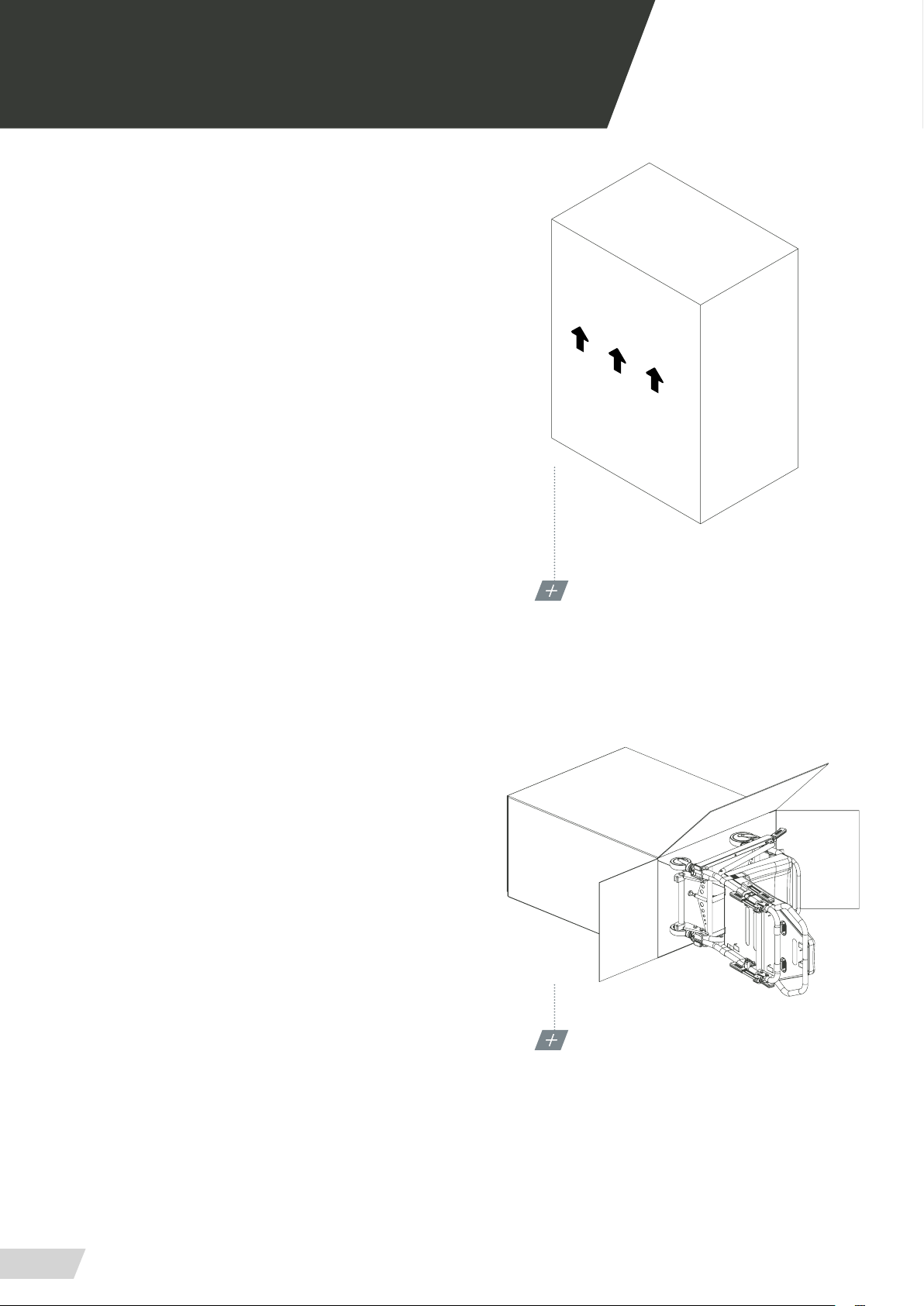
03.1 Transport and unpacking
First remove the packaging carefully so as not to damage the outside of the chair
1. Transport
Before transporting the product, make sure it is properly packed, making sure there are no risks of crashes,
bumps or falls during transport.
Keep the original packaging for use in case of any other
transport and storage. Damage to the product caused
during transportation and handling is not covered
by the warranty. Repairs or replacement of damaged
parts are the responsibility of the customer. The device should be stored in a dry and cool place, away from
direct sunlight. It must not come into contact with chemical substances or agents that may cause damage
and reduce safety features.
Durante el almacenamiento, no coloque materiales pesados sobre el dispositivo. El producto no debe considerarse ni utilizarse como estante para ningún tipo de
material.
PACKING UNIT
RESPECT THE PACKAGING TRANSPORT POSITION
During storage, do not place heavy materials on the
device. The product must not be considered or used as
a shelf for any type of material.
· Always x the load, if it is necessary stack. you should
follow the diagram shown.
· Transport the level load and following all the precepts
and regulations regarding the transport of loads.
2. Unpacking
· Put the box on a at and stable surface, open the seal
carefully not to damage inside.
· Remove the product from the inside of the case as
shown in the chart below.
Each product has been thoroughly inspected when
leaving the factory. To ensure that the transport has not
deteriorated it, please inspect the exterior and interior
carefully, and in the event of any damage, contact the
installer immediately.
UNPACKING THE PRODUCT
ALWAYS USE FLAT SURFACE
16
Page 17

USER MANUAL // EMERGENCY CHAIR PS-350
Review 06/19
03 INSTALATION
03.2 Chair’s preparation
On receipt of the product it is advised:
· Remove the packaging and distribute the material such that all components are visible.
· Verify that all components / parts in the attached list are present.
The appliance must be checked before each use in order to detect any malfunction and / or damage
caused by transport and / or storage. In particular, check:
· General functionality of the device.
· Cleaning the device (remember that lack of cleanliness can cause the risk of cross-infection).
· Absence of cuts, holes, rips in the structure, including belts.
· Correct xing of all nuts, bolts and nuts.
· Correct xing of the belts.
· Correct attachment of the belts.
· State of use (moving parts, wheels, belts, covers)
· Integrity of belts and covers.
· Integrity of the components.
· Integrity of the handles.
· Lubrication of moving parts.
· State of use of the wheels and braking system.
· Operation of springs.
· The emergency vehicle is equipped with a fastening system dedicated to the Promeba
product.
· There are safety belts for the immobilization of the patient and they are intact and operating.
· The welds are intact, without cracks or breaks.
· No tube or sheet metal present curves or cracks
If the above conditions are met, the device can be considered ready for use; Otherwise, you must immediately remove the device from the service and contact the manufacturer.
17
Page 18

Page 19
USER MANUAL // EMERGENCY CHAIR PS-350
Review 06/19
04 OPERATING
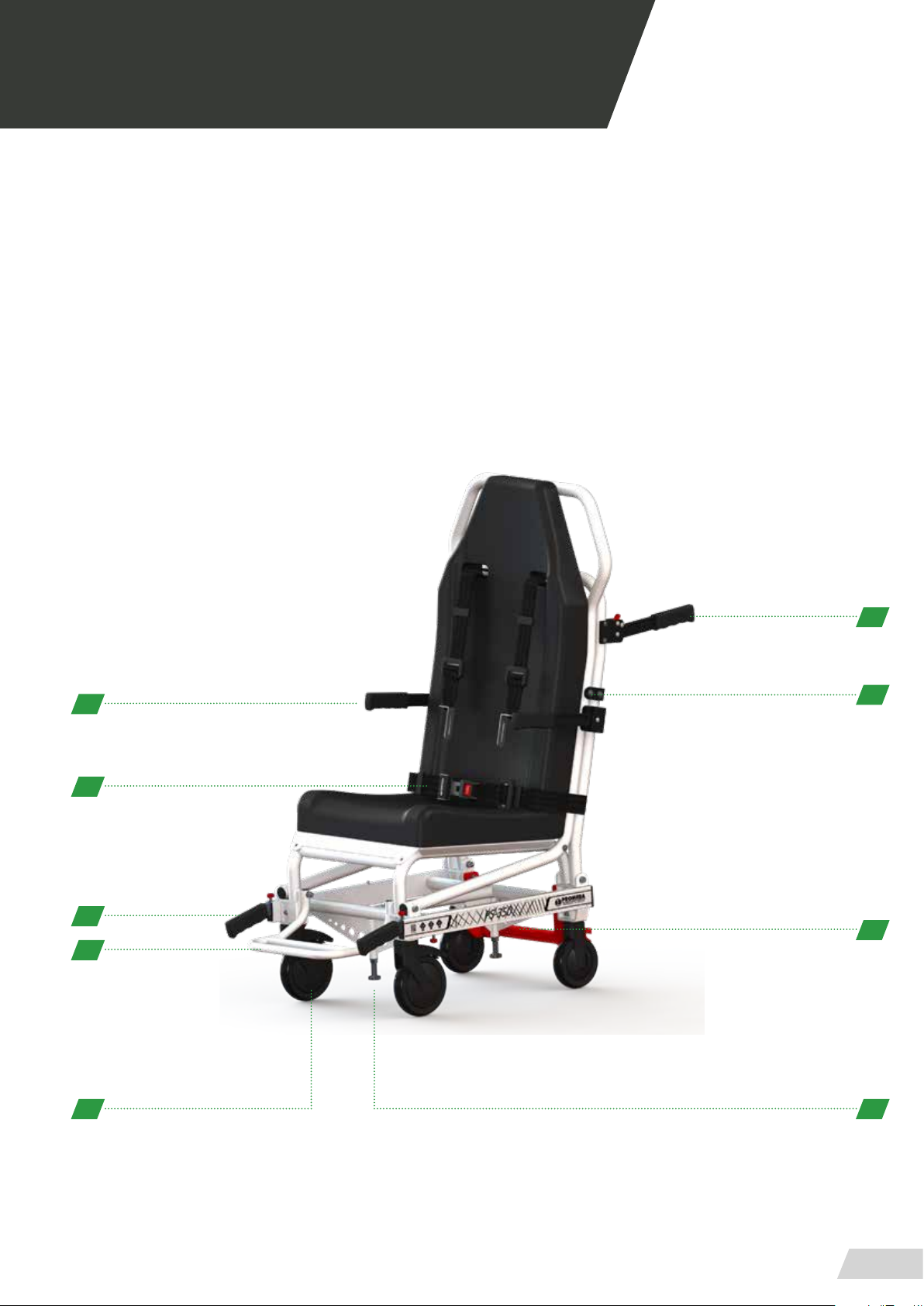
03.1 General elements of CHAIR PS-350
1. Foldable armrests
2. Leag and chest belts with adjustable safety lock
3. Telescopic handles with the possibility of total extraction
4. Integrated folding footrest
5. Front swivel wheels with brake
6. Foldable transport handles
7. Two locking points device for the ambulance
8. Track anchor system
6
1
2
3
4
8
8
5
7
19
Page 20
USER MANUAL // EMERGENCY CHAIR PS-350
Review 06/19
04 OPERATING
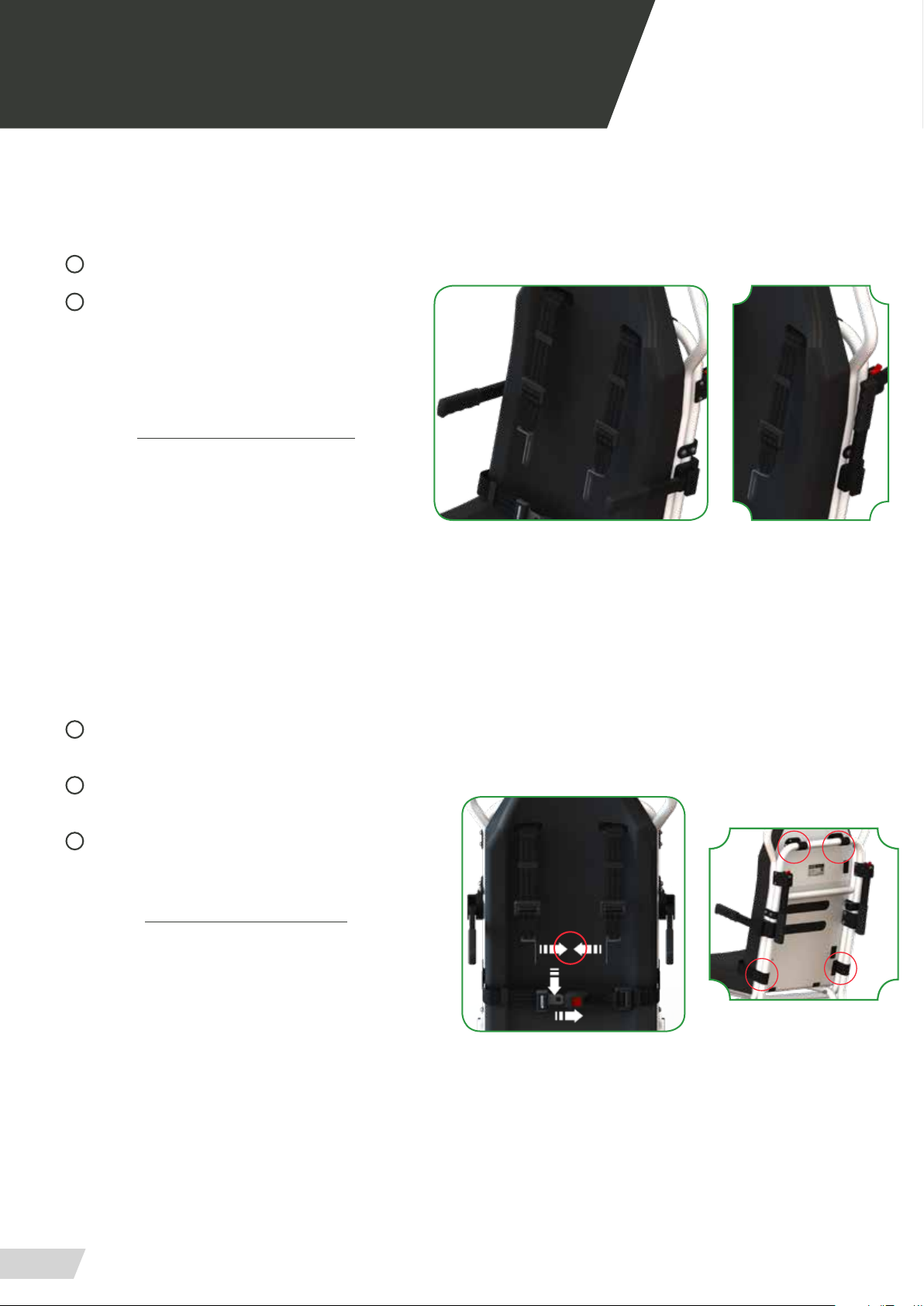
04.1.1 Armrests
The armrest has two positions:
1 Lifting for storage
(See in Figure 2)
2 Lowered for use
(See in Figure 1)
- To lower the armrest, push it down until it stops.
- To lift the armrest, lift it until it stops.
Instructions for using the armrest:
· Keep the armrest raised when it is not in use.
· Keep the armrest clean, avoiding patient
contact with external uids.
04.1.2 Belts
Use patient restraint systems to help the patient in the
chair.
Follow these instructions to properly anchor the belts:
1 Join the two buckles indicated in Figure 3, fo-
llowing the direction of the arrows.
2 Pass the buckles through the hole in the hori-
zontal belt buckle, following the direction of the arrow.
3 Close the system, following the direction of
the arrow until you see that it does not open.
Instructions for use of the belts:
· Make sure that they are well secured in their
respective anchor points, which can be observed in Figure 4.
FIGURE 1 - LOWERED ARMREST FIGURE 2 - LIFTED ARMREST
1
2
· Use a minimum of two belts.
· A safety belt should be secured on the seat of
the chair to keep the patient on the chair.
20
3
FIGURE 3 - CLOSURE BELTS FIGURE 4 - BELT POSITION
Page 21
USER MANUAL // EMERGENCY CHAIR PS-350
Review 06/19
04 OPERATING
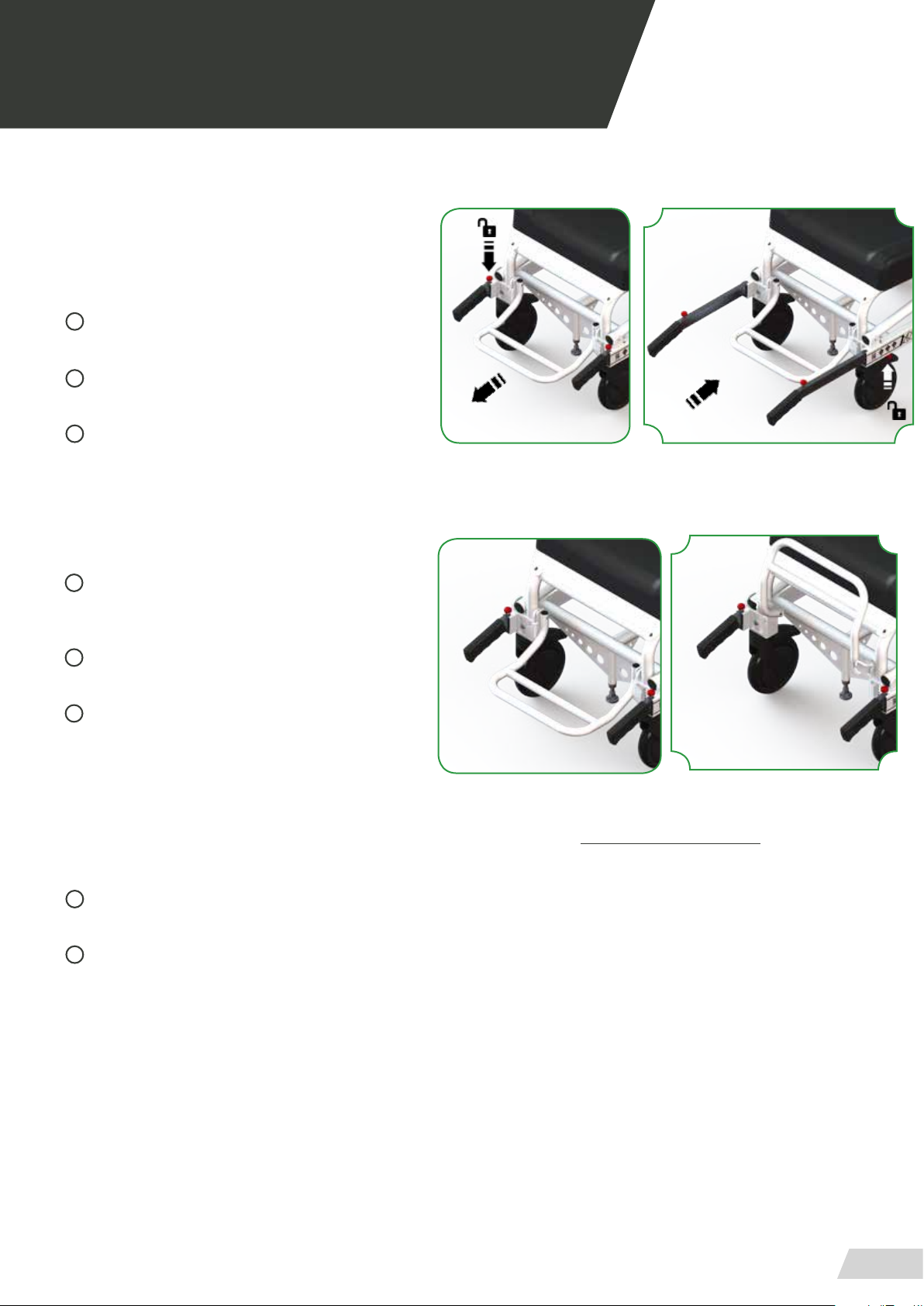
04.1.3 Telescopic handles
The telescopic handles adjust to two locked positions.
Adjust the handles according to the preferences of the
operator and the task.
EXTEND THE HANDLES:
1 Press the release button (Figure 5) and pull the
handle until you nd the locking position
2 Release the button and slide the handle
forward until it clicks into place.
3 Lock both handles in the same position.
Verify that both handles are locked when you
try to push or remove them without pressing
the release buttons. When the locks are
engaged, the handles will not move.
FIGURE 5 - NON-EXTENDING HANDLE FIGURE 6 - EXTENDED HANDLE
RETRACT THE HANDLES:
1 Press the release button (Figure 6) and push
the handle until you nd the blocking
position.
2 Release the button and slide the handle
backwards until it clicks into place.
3 Lock both handles in the same position.
Verify that both handles are locked when you
try to push or remove them without pressing
the release buttons. When the locks are
engaged, the handles will not move.
04.1.4 Footrest
The footrest has two positions:
1 Lifting for storage
(See in Figure 7)
2 Lowered for use
(See in Figure 8)
- To lower the footrest, lower it down until it stops.
FIGURE 7 - LOWER FOOTREST FIGURE 8 - LIFTED FOOTREST
Instructions for footrest use:
· Use the footrest correctly to ensure that it
does not interfere with the patient’s or
operator’s feet.
· Before transferring the patient to the chair,
make sure that the footrest is raised in the
storage position. Sit down the patient before
lowering the footrest.
- To lift the footrest, lift it until it stops.
· At the time to move the patient from the chair,
lift the footrest to the storage position before
loosening the belts. This will prevent the
patient from trying to stop before the footrest
has been stowed out of the way of his feet.
· Keep the repository elevated when it is not in
use.
21
Page 22
USER MANUAL // EMERGENCY CHAIR PS-350
Review 06/19
04 OPERATING
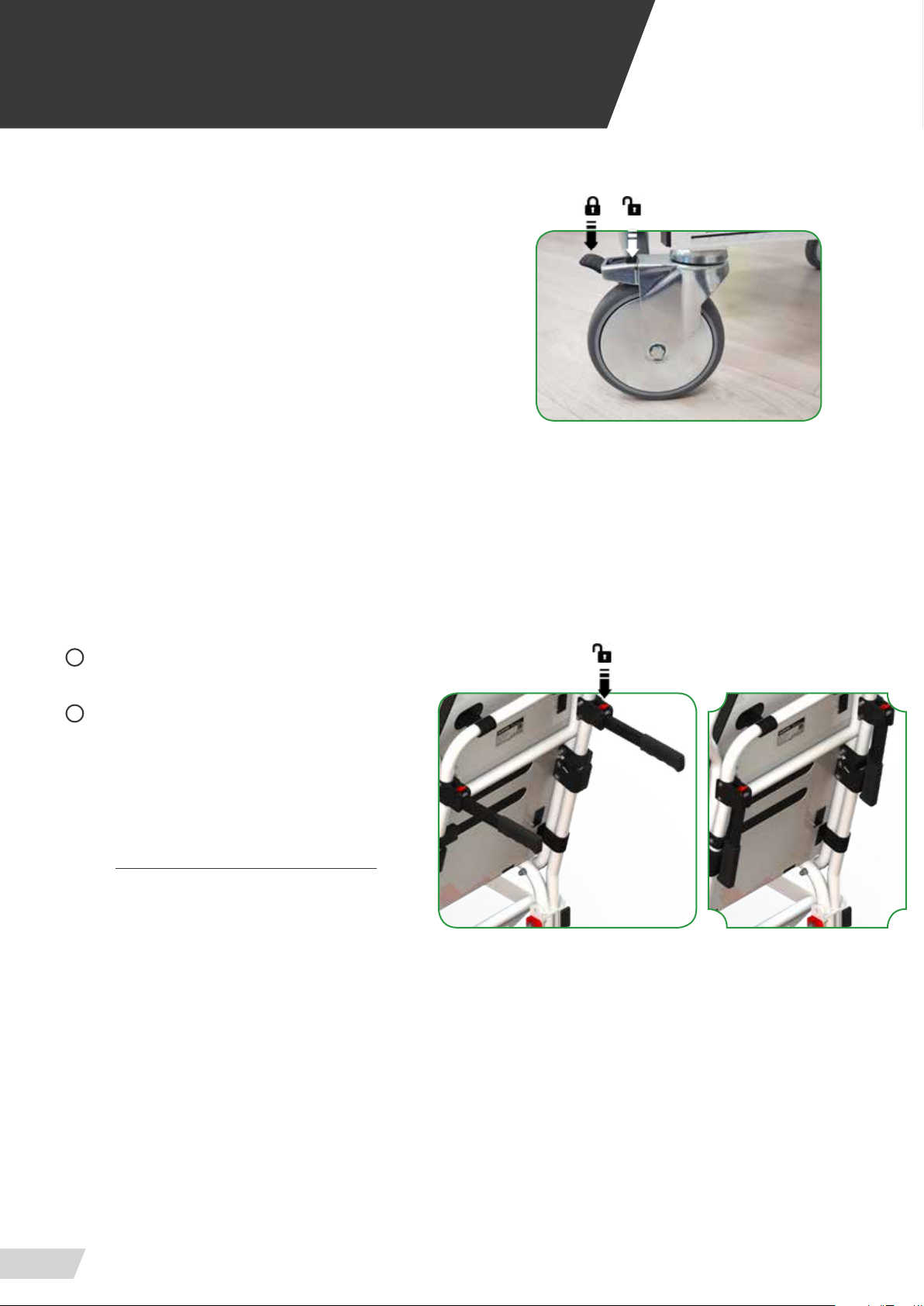
04.1.5 Front swivel wheels with brake
The front wheels of the chair are equipped with brakes
to prevent the chair from moving during the transfer of
the patient or during a stop.
- Be with the chair and keep control of it at all times. Do
not use wheel locks as a substitute for operator control.
- To activate a wheel lock, press down the rear end of
the lock pedal.
(See in Figure 9)
- To deactivate a wheel lock, press down the front end
of the lock pedal.
(See in Figure 9)
04.1.6 Transport handles
The transport handles have two positions:
1 Lowered for storage
(See in Figure 11)
2 Lifted for use
(See in Figure 10)
- To lower the carrying handles, press the release button (Figure 9) and push them down until they stop.
- To lift the carrying handles, lift them until they stop.
Instructions for use of transport handles:
FIGURE 9 - ROTATING WHEEL BRAKES
· Keep the carrying handles down when they
are not in use.
· Keep the carrying handles clean, avoiding
operator contact with external uids.
22
FIGURE 10 - LIFTED TRANSPORTATION HANDLES FIGURE 11 - TRANSPORT HANDLES LOWERED
Page 23
USER MANUAL // EMERGENCY CHAIR PS-350
Review 06/19
04 OPERATING
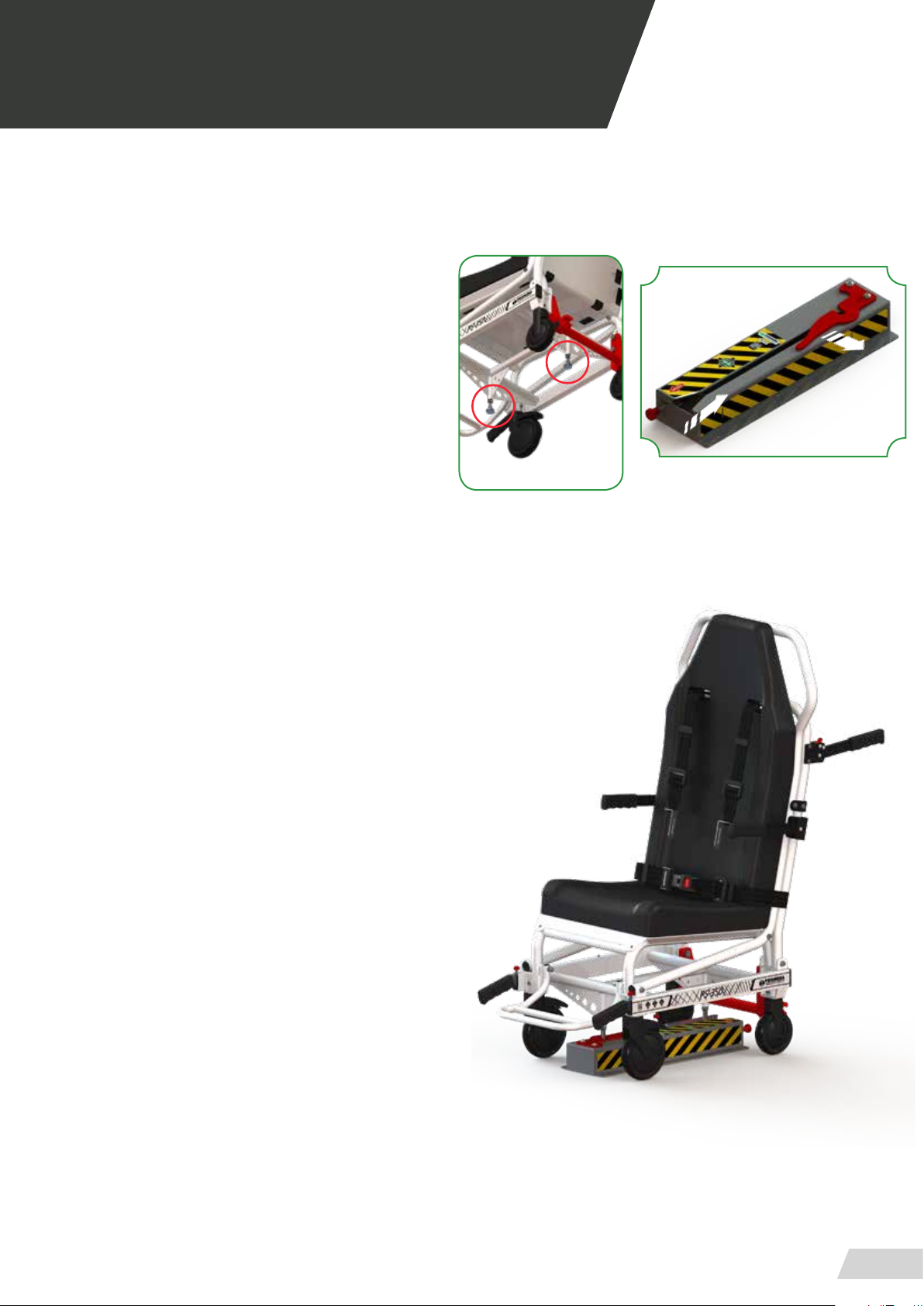
04.1.7 Two locking points device for the ambulance
Use the two-point system for an ambulance when you
want to x the chair to the oor of the ambulance, to
transport the patient.
INSTRUCTIONS FOR ANCHORING THE CHAIR:
First of all, be sure to place the chair in front of you, as
you can see in the illustration of the chair’s closing assembly, since if you insert it from behind, their unlocking will be complicated
At the time of put it, place the anchor of the chair through the hole in the closure, pushing the chair through
the guide, while activating the locking handle of the
closure in the direction shown in Figure 13. Once inserted, leave the handle and make sure that it is well anchored by pulling and pushing from the chair.
FIGURE 12 - ANCHORAGE CHAIR FOR AMBULANCE FIGURE 13 - CLOSURE FOR AMBULANCE PA-370
INSTRUCTIONS FOR THE DEVELOPMENT OF THE CHAIR:
To unhook the chair, operate the lock locking handle in
the direction shown in Figure 13 and proceed to remove the chair in the opposite direction to when you introduced it. Once it is no longer in the slot of the handle,
you can release it.
23
Page 24
USER MANUAL // EMERGENCY CHAIR PS-350
Review 06/19
04 OPERATING
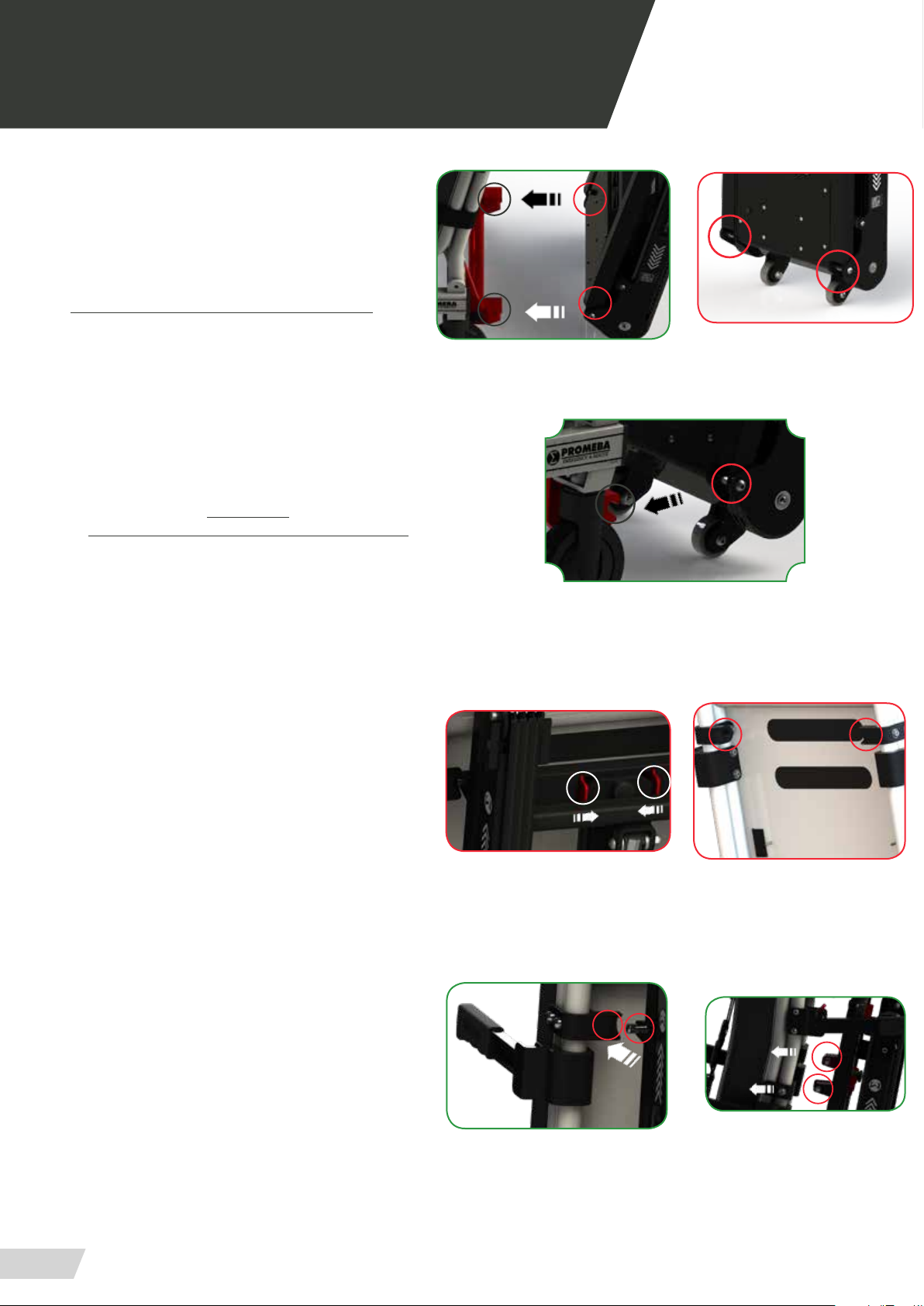
04.1.8 Track anchor system
Use the track anchor system when you want to attach a
track to the chair to facilitate patient transport by stairs.
INSTRUCTIONS FOR ANCHORING THE TRACK:
BOTTOM (FIGURE 14 - FIGURE 15 - FIGURE 16)
First install the bottom part. To do this, x the wheels
of the chair to prevent it from moving. Then, place the
track as shown in the three gures, tilting the track slightly. Next, insert the track attachment hook, which can
be seen in Figure 16, on the red anchor bracket on the
chair. Make sure it is well anchored. To do this, pull the
track slightly, being able to ensure that it is well anchored from the bottom.
UPPER PART
(FIGURE 17 - FIGURE 18 - FIGURE 19 - FIGURE 20)
FIGURE 14 - LOWER TRACK ANCHORING SYSTEM
FIGURE 15 - BOTTOM TRACK ANCHOR PA-260
Once the lower part is anchored, get ready to x the
upper part. To do this, activate the unlocking and do not
leave it until you have completed the operation, as indicated in Figure 17, and insert the track blocking shelf
illustrated in Figures 19 and 20, into the support anchor.
Once these are already anchored, stop activating the
unlocking and make sure that it is rmly xed by pulling
the track slightly, thus ensuring that the upper part is
well secured.
Finally, unlock the chair to be able to use this track-saddle system.
FIGURE 16 - LOWER TRACK ANCHORING SYSTEM
FIGURE 17 - UPPER ANCHOR TRACK-CHAIR PS-350
FIGURE 18 - UPPER ANCHOR TRACK-CHAIR PS-350
FIGURE 19 - UPPER ANCHOR ORUGA PA-260
24
FIGURE 20 - UPPER ANCHOR ORUGA PA-260
Page 25
USER MANUAL // EMERGENCY CHAIR PS-350
Review 06/19
04 OPERATING
Instructions for use of the track:
· The use of the chair on the stairs requires a
minimum of two trained operators. It is
recommended to use a third person as an
“observer”.
· Verify that the tracking system is completely
open and locked before using it.
· Never lubricate the belts. Lubrication can
cause the belts to work unpredictably, which
can cause injury to the patient and/or
operators.
· Moisture, water, snow, ice or debris on or
between track and belts can cause uneven belt
operation that causes sudden changes in the
weight that operators must bear. Make sure the
tracks and belts are clean and dry before using
the chair on the stairs.
· Humidity, water, snow, ice or debris on ladders
can cause poor balance for operators. To avoid
possible injuries, clear the stairs or select an
alternative route.
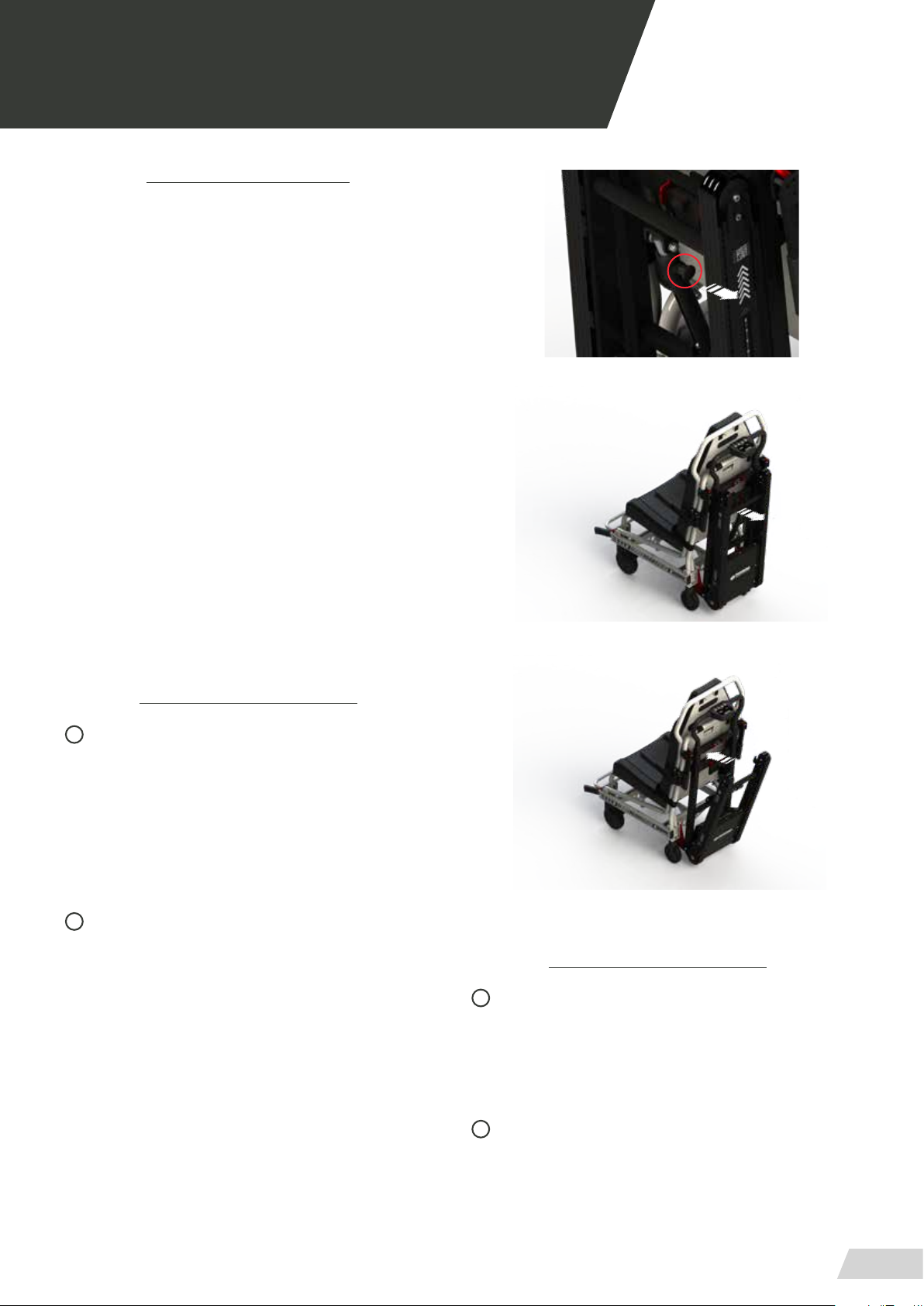
OPENING OF THE TRACK SYSTEM
1 Hold the unlocking knob to unfold the track
shown in Figure 21 and rmly pull it in the
indicated direction until you see that the
deployment adjustment system moves, and
push the track in the direction shown in Figure
22 , placing it in the desired position (Position
1, Position 2, Position 3) as it suits you,
depending on the conditions you are in when
moving the chair up the stairs.
2 Verify that the system has been locked by
pushing it as if you wanted to close it. If the
blockage is completely engaged, the track
system will not close.
FIGURE 21 - UNLOCKING KNOB FOR DEPLOYMENT OF THE TRACK
FIGURE 22 - OPENING OF THE TRACK SYSTEM
FIGURE 23 - CLOSURE OF THE TRACK SYSTEM
CLOSURE OF THE TRACK SYSTEM
1 Hold the release knob to unfold the track shown
in Figure 21 and pull rmly in the indicated
direction until you see the deployment
regulation system move, close the track in the
direction shown in Figure 23 to that it is
completely closed.
2 Verify that the system has been locked by
pushing it as if you wanted to open it. If the
blockage is completely engaged, the track
system will not open.
25
Page 26

Page 27
USER MANUAL // EMERGENCY CHAIR PS-350
Review 06/19
05 MOUNTING AND COMPONENTS
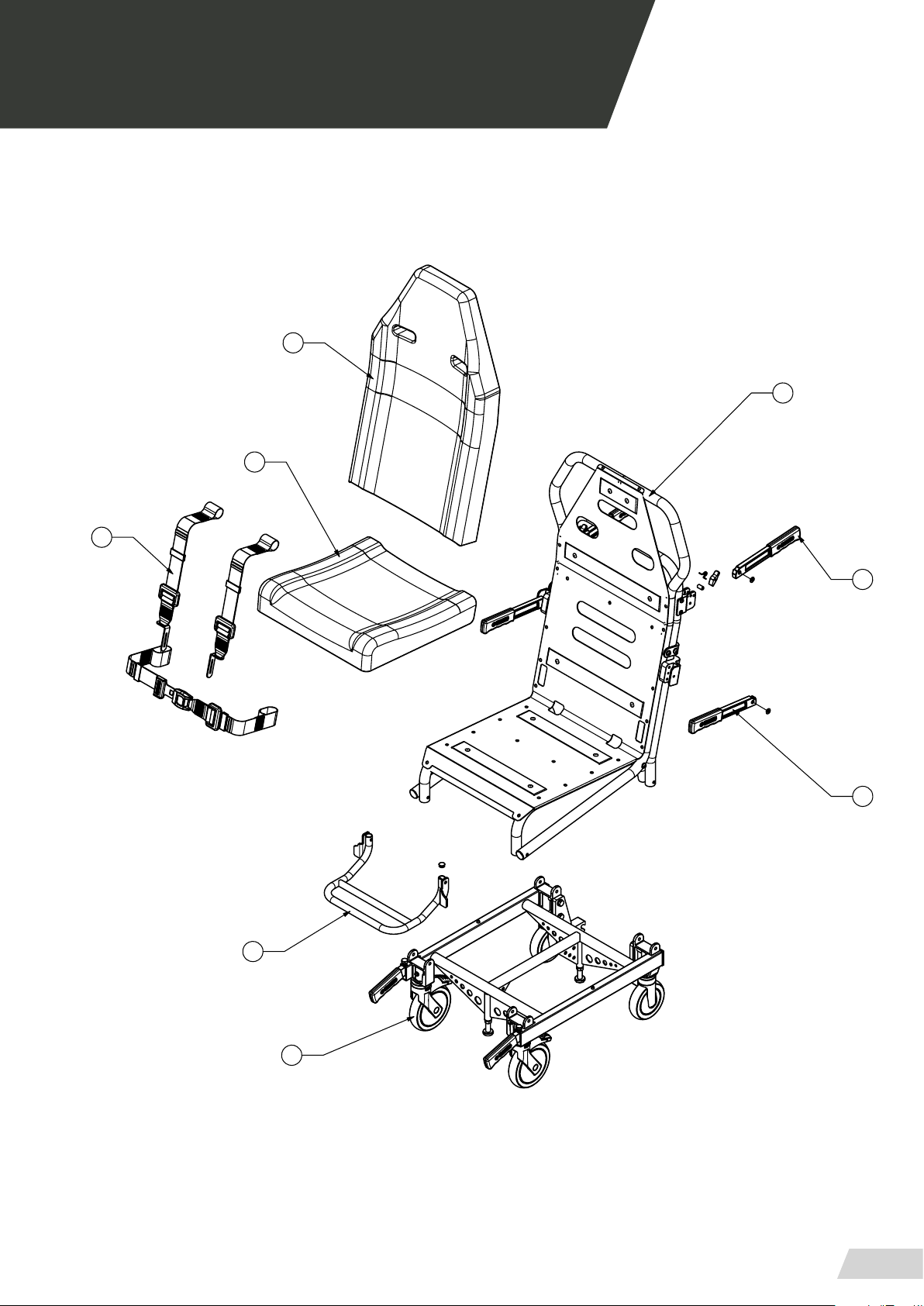
05.1 Main exploded view CHAIR PS-350
Sit-upon chair PS-350
6
Exploded harness belt
10G chair PS-350
P. 34
Backrest chair PS-350
P. 34
P. 34
5
5
2
Exploded seat+backrest
strucucture
P. 30
4
Exploded handle
P. 34
Exploded Footrest
Exploded lower structure
3
P. 32
P. 28
4
1
27
Page 28
USER MANUAL // EMERGENCY CHAIR PS-350
Review 06/19
05 MOUNTING AND COMPONENTS
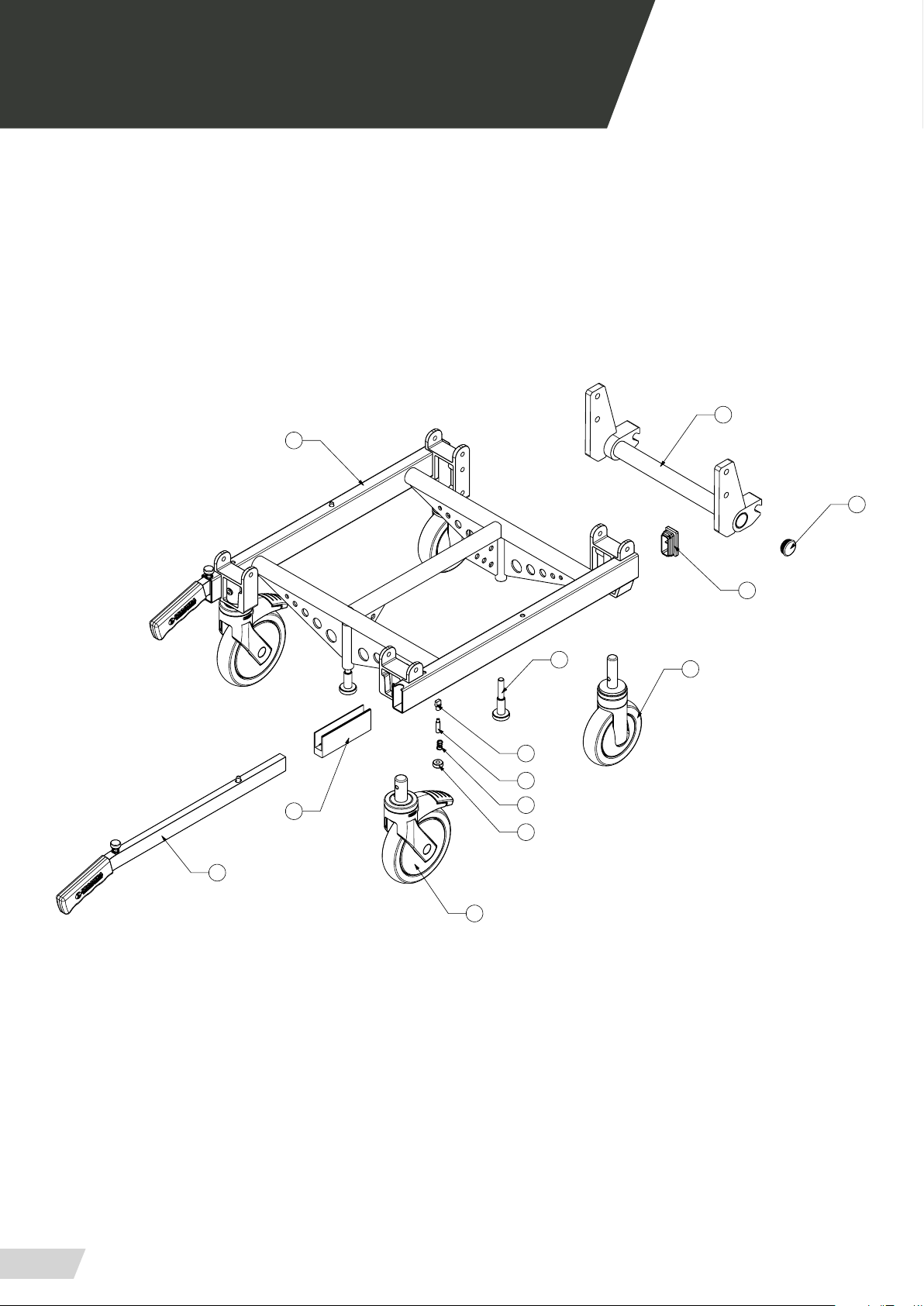
05.2 Exploded lower structure PS-350
1
11
2
9
10
5
7
4
3
13
6
8
12
28
Page 29

USER MANUAL // EMERGENCY CHAIR PS-350
Review 06/19
05 MOUNTING AND COMPONENTS
05.3 Bill of materials LOWER STRUCTURE PS-350
NUM. ELEMENT CODE - DESCRIPTION UNITS
1.01 PS3500-02002 - SUBCONJUNT ESTRUCTURA INFERIOR 1
1.02 TAP-PLASTØ30 - TAPON PLASTICO Ø30 - MOD. 17-30 2
1.03 PS2510-04110 - SUB. TUBO INTERIOR MANETA EXTENSIBLE
1.04 PS2510-04050 - PATIN INTERIOR MANETA EXTENSIBLE 2
1.05 PS2510-04061 - BULON DE SEGURIDAD MANETA EXTENSIBLE
1.06 PS2510-04080 - MUELLE COMPRESION REF. 22367 OLDISFER
1.07 PS2510-04091 - EJE ACTUADOR DESBLOQUEO MANETA
EXTENSIBLE
1.08 PS2510-04100 - PULSADOR ACTUADOR DESBLOQUEO 2
1.09 TAPPLA-50X25 - TAPON PLASTICO 50x25 2
1.10 PS3500-01021 - TORRIO ANCLATGE CADIRA PS-350 2
1.11 PS3500-04002 - SUBCONJUNT ANCLATGE INFERIOR
ORUGA
1.12 PS3500-01040 - RODA FIXE TENTE 5328PJX125R05-18x62
INOX
1.13 PS3500-01050 - RODA GIRATORIA AMB FRE TENTE
5377PJP150R05-22x45 INOX
2
2
1
2
1
2
2
29
Page 30
USER MANUAL // EMERGENCY CHAIR PS-350
Review 06/19
05 MOUNTING AND COMPONENTS
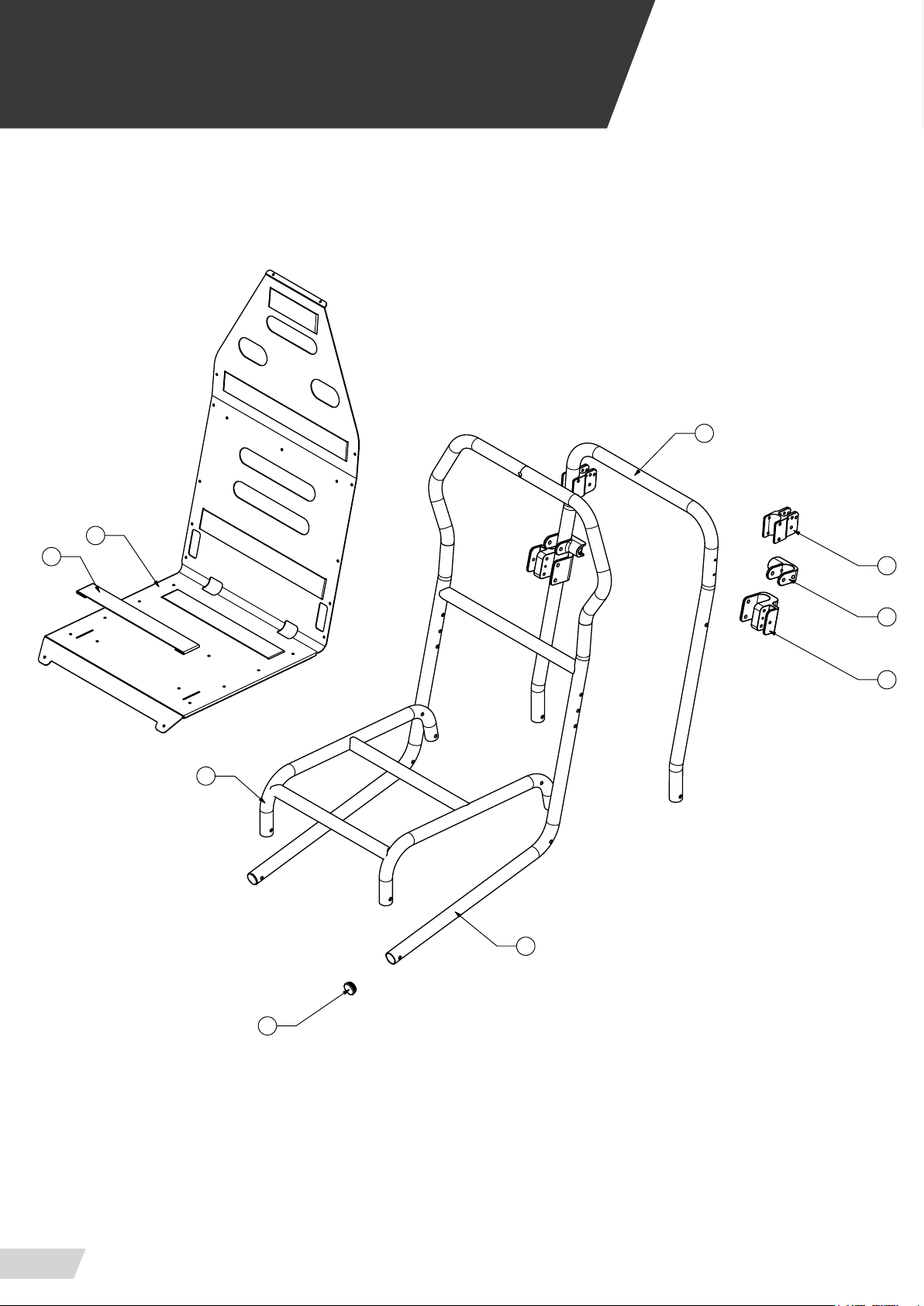
05.4 Exploded seat+backrest strucucture PS-350
4
5
9
1
2
7
3
6
8
30
Page 31

USER MANUAL // EMERGENCY CHAIR PS-350
Review 06/19
05 MOUNTING AND COMPONENTS
05.5 Bill of materials SEAT+BACKREST STRUCUCTURE PS-350
NUM. ELEMENT CODE - DESCRIPTION UNITS
2.01 PS3500-07002 - SUBCONJUNT ESTRUCTURA SEIENT 1
2.02 PS3500-08002 - SUBCONJUNT TUB ESTRUCTURA RESPATLLER
2.03 PS3500-06012 - SUPORT ANCLATGE BALDES ORUGA 2
2.04 PS3500-06022 - TUB REFORÇ POSTERIOR RESPATLLER 1
2.05 PS3500-06032 - XAPA SEIENT-RESPATLLER CADIRA 1
2.06 PS3500-06052 - SUPORT REPOSABRAÇOS RESPATLLER 2
2.07 PS2510-01212 - FRONTISSA MANETA POSTERIOR 2
2.08 TAP-PLASTØ30 - TAPON PLASTICO Ø30 - MOD. 17-30 2
2.09 VELCRO-N50F - VELCRO AMPLE 50mm NEGRE (FEMELLA)
1
5
31
Page 32
USER MANUAL // EMERGENCY CHAIR PS-350
Review 06/19
05 MOUNTING AND COMPONENTS
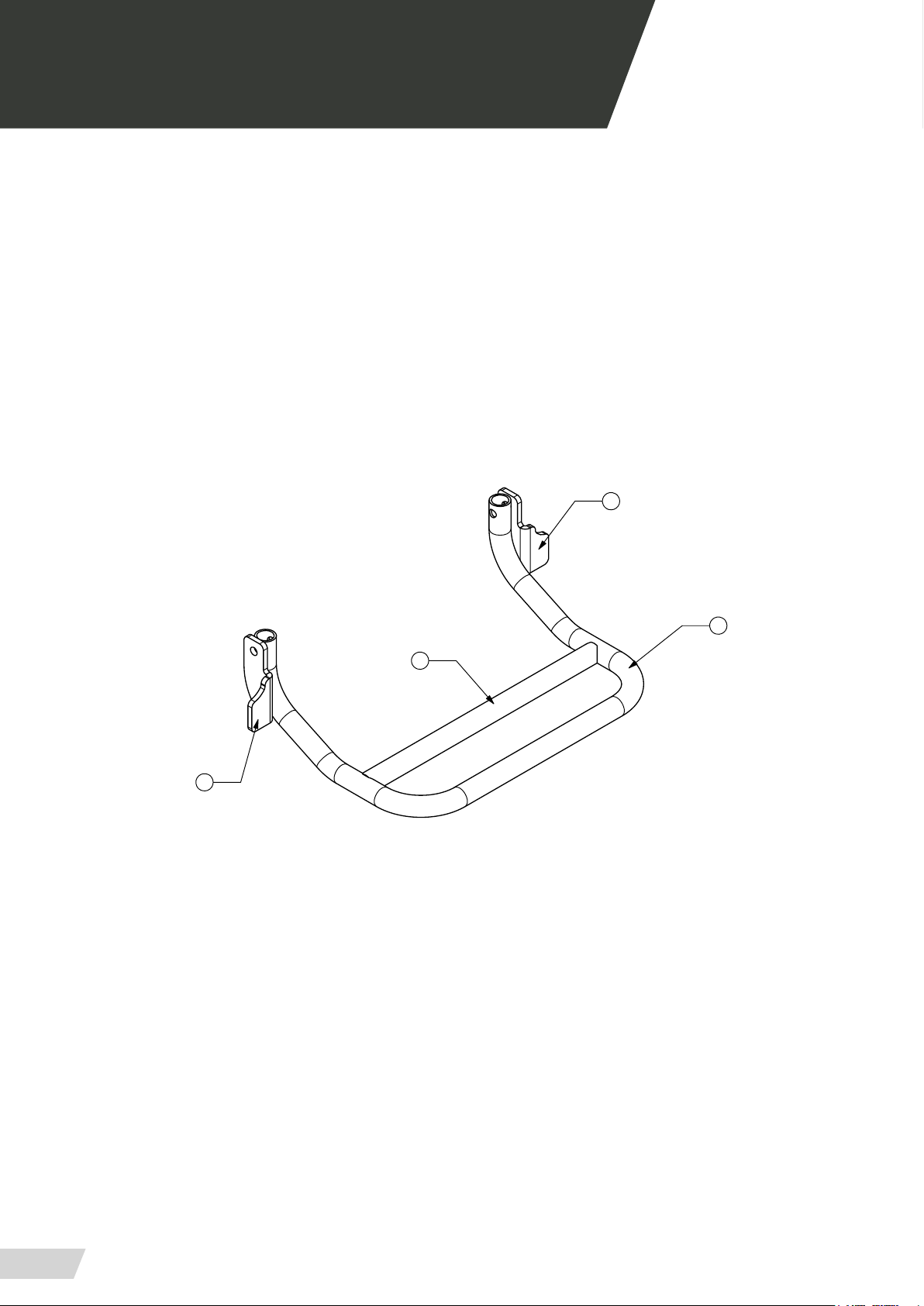
05.6 Exploded Footrest PS-350
2
1
3
4
32
Page 33

USER MANUAL // EMERGENCY CHAIR PS-350
Review 06/19
05 MOUNTING AND COMPONENTS
05.7 Bill of materials FOOTREST PS-350
NUM. ELEMENT CODE - DESCRIPTION UNITS
3.01 PS3500-05010 - TUB REPOSAPEUS 1
3.02 PS3500-05040 - ANGLE DRETA TOPALL REPOSAPEUS 1
3.03 PS3500-05030 - TRAVESSER REPOSAPEUS 1
3.04 PS3500-05050 - ANGLE ESQUERRA TOPALL REPOSAPEUS
1
33
Page 34
USER MANUAL // EMERGENCY CHAIR PS-350
Review 06/19
05 MOUNTING AND COMPONENTS
05.8 Exploded handle PS-350
1
2
05.10 Sit-upon and backrest chair PS-350
2
1
05.12 Exploded harness belt 10G chair PS-350 PS-350
34
Page 35

USER MANUAL // EMERGENCY CHAIR PS-350
Review 06/19
05 MOUNTING AND COMPONENTS
05.9 Bill of materials HANDLE PS-350
NUM. ELEMENT CODE - DESCRIPTION UNITS
4.01 PS2510-01262 - MANETA PLEGABLE 1
4.02 PS2500-01260 - EMPUNYADURA PVC MANETA PLEGABLE
CADIRA
05.11 Bill of materials SITUPON AND BACKREST CHAIR PS-350
1
NUM. ELEMENT CODE - DESCRIPTION UNITS
5.01 PS3500-00020 - COIXI SEIENT CADIRA PS-350 1
5.02 PS3500-00010 - COIXI RESPATLLER CADIRA PS-350 1
05.13 Bill of materials HARNESS BELT 10G CHAIR PS350 PS-350
NUM. ELEMENT CODE - DESCRIPTION UNITS
6.01 PS3500-11000 - CONJUNT CINTURO ARNES 10G CADIRA
PS-350
1
35
Page 36

Page 37
USER MANUAL // EMERGENCY CHAIR PS-350
Review 06/19
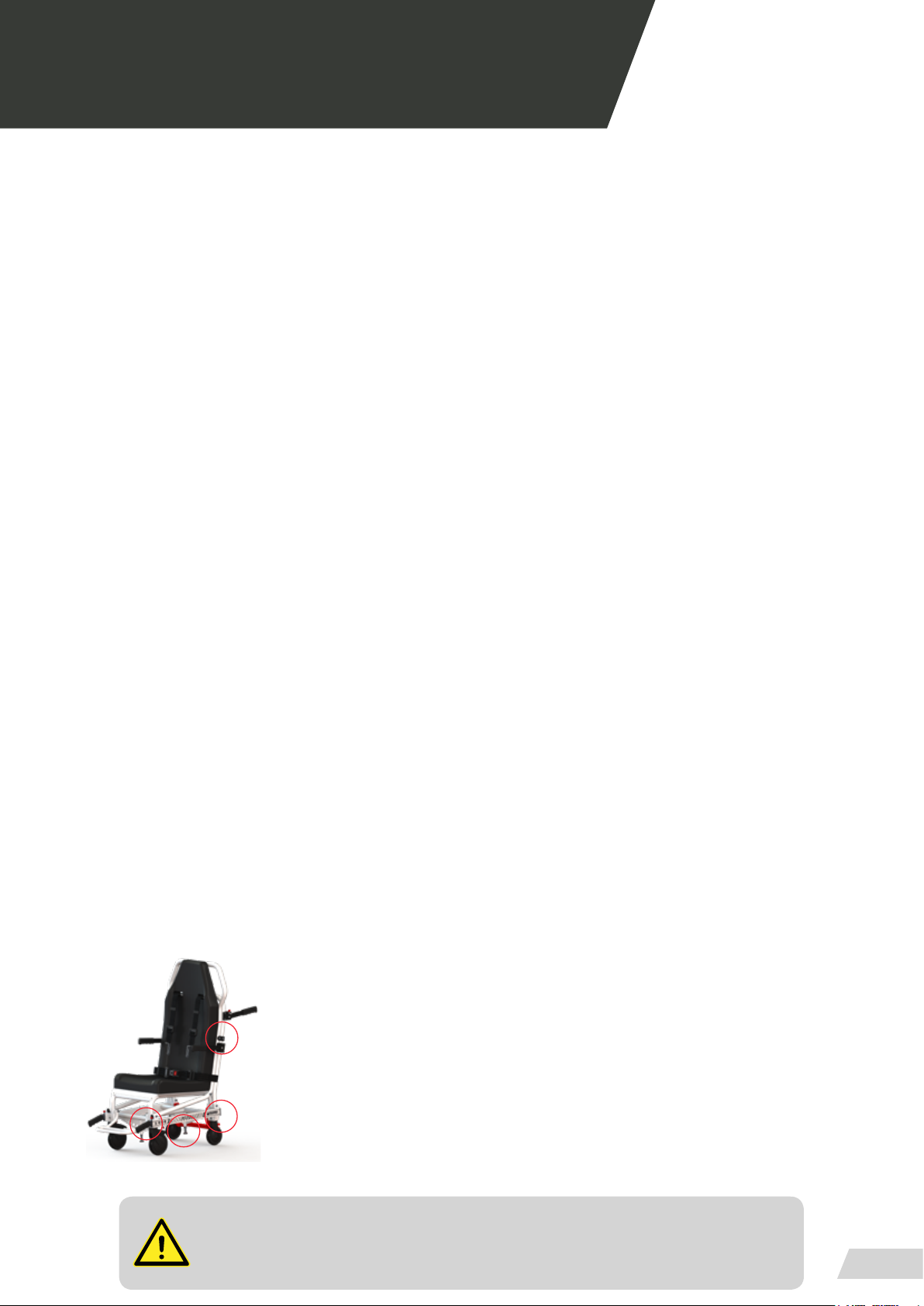
06 GENERAL MAINTENANCE
CLEANING
Keeping the equipment clean is essential to ensure
good use and durability of the assembly. It is necessary
to perform a thorough cleaning periodically, especially
in areas exposed to dirt that can suer damage such as
gears, connectors, buttons, etc. Do not use high pressure washers, they may damage the electrical elements.
CONTROLS AND SELECTORS
Due to the intense and continuous use of the movable elements, as the controls and selectors, periodically
check the proper functioning of the same. There may
be faults in the micro-breakers and wiring, check the
xings and electrical or mechanical connections that
may exist.
OIL
In general, any moving part must be oiled. Our products come from the factory completely oiled and lubricated, however, it is possible that with the time and
use of the product the elements are decreased, either
by loss of lubrication or by dirt. Clean and grease periodically aected areas, according to manufacturer’s
specications.
WEARING AREAS
Inspecting regularly to see if there is wear on the system components is a preventive measure that can reduce breakdowns. Check for possible lubricant leaks,
grooves or bearings in poor condition.
MECHANICAL FASTENING ELEMENTS
In general, we call mechanical fastening elements for
the components that are used to x the whole of the
product, mainly fasteners and derivatives.
In some conditions of use, due to vibrations and impacts, certain elements can lose their tightening torque or xing properties.
Check periodically that there are no loose elements,
especially in moving parts of the assembly. Always observe the recommended tightening torques.
REPLACEMENT OF COMPONENTS
This instruction manual does not include procedures
for all parts. Typically, qualied service personnel replace wires, switches and certain mechanical parts without the need for step-by-step procedures.
Check for loose, missing, or worn parts. Periodically
inspect all moving parts to make sure components are
tight.
Due to its dry slip system, do not grease the platform
guide.
ATTENTION: Do not lubricate the rail and / or stretcher
when connected to the mains.
Qualied service personnel should contact our sales
department for information on ordering parts and installing them.
BE SURE TO KEEP THESE ZONES FREE OF DIRT.
HAVE SPECIAL CARE IN THE CLEANING TO ENSURE A GOOD FUNCTIONING OF THE SET
37
Page 38

USER MANUAL // EMERGENCY CHAIR PS-350
Review 06/19
07 LEGAL NOTICES
This document may contain technical inaccuracies or
typographical errors.
Periodic changes are made to the information contained herein; These changes will be incorporated in new
editions of the publication.
Promeba, S.L. Reserves the right to make any changes
or improvements to the products described in this publication, if deemed appropriate.
Promeba, S.L. May have patents or pending patent
applications addressing issues described in this document. The possession of this document does not confer
any license on said patents.
The information contained in this document does not
aect or change the specications or warranties of the
product Promeba, S.L.
No part of this document shall be construed as an express or implied license or indemnication under the
intellectual property rights of Promeba, S.L. Or third
parties.
All information contained in this document has been
obtained in specic environments and is presented as
an illustration. Results obtained in other operating environments may vary.
Promeba, S.L. may use or distribute the information
provided by the customer in a way that creates timely,
without incurring any obligation with the client.
38
Page 39

USER MANUAL // EMERGENCY CHAIR PS-350
Review 06/19
08 PRODUCT WARRANTY
Promeba, S.L. ensures that your products have passed
satisfactorily all the established quality controls, both
functional and material. The duration of the warranty is
2 years from the date of purchase of the product.
This warranty is valid only when it is presented with
the original invoice or proof of purchase (indicating the
date of purchase, model and dealer name) together
with the defective product during the period covered
by the warranty. Promeba, S.L. reserves the right not
to oer the free warranty service if the indicated documents are not presented or if the information they
contain is incomplete or illegible.
1. This warranty does not apply if the model name or serial number of the product has been altered, deleted, disappeared or is unreadable.
2. This warranty does not cover transport costs or the risks associated with transporting your product to and from
Promeba, S.L.
3. This warranty does not cover any of the following:
a) Periodic maintenance and repair or replacement of
parts derived from normal wear and tear.
b) Periodic maintenance and repair or replacement of
consumables (components that are expected to require
periodic replacement during the life of the product, such
as non-rechargeable batteries, bulbs, etc.). Parts from nor-
mal wear and tear....
c) Damage or defects arising from improper use, operation or treatment of the product and not from normal use
of the product.
d) Damage arising from:
i. Misuse, including:
- Treatment resulting in damage or changes in the physical, surface or appearance of the product.
ii. Use of components not provided with the product or
improper installation of accessory parts not previously
tested.
iii. States or defects of the system in which the product
is used or incorporated with the exception of other products Promeba, S.L. designed for use with the product.
iv. Use of the product with accessories, peripheral units
and other products of a type, condition or standards
not established by Promeba, S.L.
v. The manufacturer or distributor will be solely responsible for deciding the shipment of the parts for repair,
or replacement of the product in its entirety. In no case
will workers be sent for such repair or replacement of
the product.
Except in the cases mentioned above, Promeba, S.L.
shall not give any warranties with respect to the product, performance, accuracy, reliability or adaptability
to a purpose of the logical or other equipment. If this
exception is not lawful or contemplated by the current
law, Promeba, S.L. limit or exclude its warranties only
to the extent permitted by law.
The only obligation on the part of Promeba, S.L. in
connection with this warranty is to repair or replace
the parts subject to the terms and conditions of this
warranty.
Promeba, S.L. is not responsible for the loss or damage
of products, this warranty or others, including economic loss or non-evaluable damages; The price paid for
the product; Loss of prots, income, information, usufruct or use of the product or associated products or
indirect, accidental or critical loss or damage.
This clause refers to whether the loss or damage is due
to deterioration or inoperability of the associated product due to defects or unavailability of Promeba, S.L.,
which has caused a downtime, loss of user time or a
business interruption.
- Installation, use or storage of the product in a manner
that does not comply with the instructions described
by Promeba, S.L.
- Maintenance of the product in a manner that does not
comply with the instructions of Promeba, S.L. for proper maintenance.
- Installation or use of the product in a manner that
does not respect the technical or safety standards of
the country where it is used or installed.
In cases where the law prohibits or limits these exclusions of liability, Promeba, S.L. exclude or limit its liability only to the extent permitted by applicable law.
For example, there are countries that prohibit the exclusion or limitation of damages caused by negligence, reckless negligence, willful misconduct, fraud, and
similar acts. The responsibility of Promeba, S.L. in this
warranty will not exceed, in any case, the price paid for
the product, but if the current law allows only limitations of greater responsibilities, these will apply.
39
Page 40

USER MANUAL // EMERGENCY CHAIR PS-350
Review 06/19
09 TRAINING REGISTER
PLACE AND
DATE
NAME OF THE OPERATOR NAME OF TRAINER TYPE OF TRAINING
40
Page 41

USER MANUAL // EMERGENCY CHAIR PS-350
Review 06/19
10 MAINTENANCE REGISTER
DATE
TYPE OF SERVICE
(Maintenance / verication /
extension of useful life)
OPERATIONS OF
MAINTENANCE
REALIZED
PERSON IN CHARGE OF
SERVICE
(Operator / Center
Authorized / Manufacturer)
41
Page 42

Todos los derechos reservados. Reservado el derecho ha modicaciones sin previo aviso.
Promeba, S.L. no se considera responsabe de los daños causados por la falta o la inexactitud de
la información aquí mencionada.
All rights reserved. Variations can be done whitout notice.
Promeba, S.L. is to be considered not responsible for damages caused by the lack or the wrongness
of the information here mentioned.
PROMEBA, S.L.
ER-0687/1998
Ctra C-16 Km 59.5 · 08650 Sallent (Barcelona) · SPAIN
T. 93 837 12 00 · Fax 93 820 61 08
[email protected] · www.promeba.com
 Loading...