

Page 1
U S E R M A N U A L
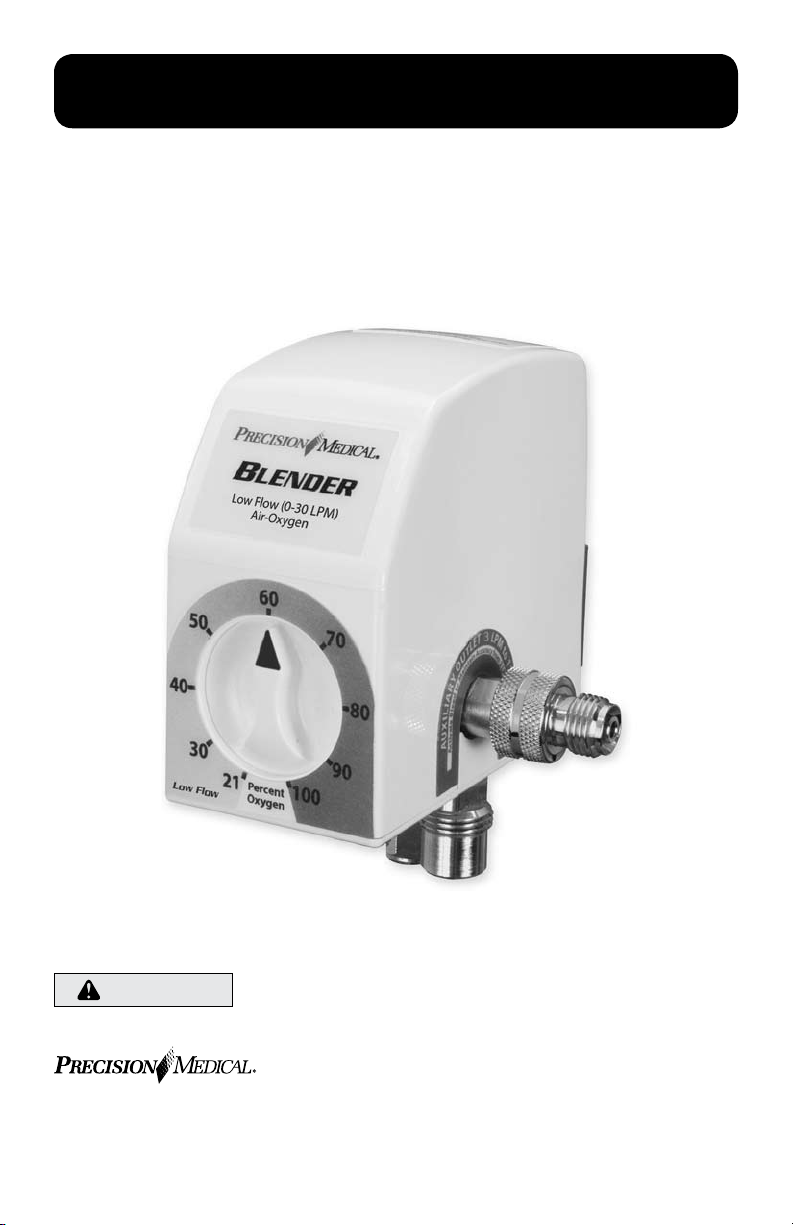
AIR-OXYGEN BLENDER
(DISS and NIST Connections)
Model No. PM5200 Series
PM5300 Series (shown)
SAVE THESE INSTRUCTIONS
CAUTION
300 Held Drive Tel: (+001) 610-262-6090
Northampton, PA 18067 USA Fax: (+001) 610-262-6080
Federal (USA) law restricts this device to sale
by or on the order of a physician.
www.precisionmedical.com
Page 2

CONTENTS
RECEIVING / INSPECTION .........................................................2
INTENDED USE ..........................................................................2
READ ALL INSTRUCTIONS BEFORE USING ............................2
EXPLANATION OF ABBREVIATIONS ......................................... 2
SAFETY INFORMATION - WARNINGS AND CAUTIONS ...........3
SPECIFICATIONS ......................................................................5
DIAGRAMS .................................................................................. 7
COMPONENT DESCRIPTION .................................................... 8
COMPONENT DESCRIPTION .................................................... 9
ALARM TEST .............................................................................10
REVERSE GAS FLOW PROCEDURE .......................................10
OPERATING INSTRUCTIONS ...................................................10
PERFORMANCE CHECK ..........................................................11
CLEANING ................................................................................11
MAINTENANCE .........................................................................12
TECHNICAL DESCRIPTION .....................................................12
RETURNS ..................................................................................12
DISPOSAL INSTRUCTIONS .....................................................12
TROUBLESHOOTING ...............................................................13
LIMITED WARRANTY ............................................................... 14
DECLARATION OF CONFORMITY ...........................................15
Blender
Air-Oxygen
1
Page 3

RECEIVING / INSPECTION
Remove the Precision Medical, Inc. Air-Oxygen Blender from
the packaging and inspect for damage. If there is any damage,
DO NOT USE and contact your Provider.
INTENDED USE
Precision Medical, Inc. Air-Oxygen Blender dispenses a
continuous and precise blend of medical air and USP oxygen
via outlet ports to infant, pediatric and adult patients. The exact
Fractional Concentration of Inspired Oxygen (FiO2) blend of gases
corresponds to the dialed in FiO2 setting indicated by the control
knob (dial).
READ ALL INSTRUCTIONS BEFORE USING
This manual instructs a Professional to install and operate the
Air-Oxygen Blender. This is provided for your safety and to prevent
damage to the Air-Oxygen Blender. If you do not understand this
manual, DO NOT USE the Air-Oxygen Blender and contact your
Provider.
DANGER
This product is not intended as a life-sustaining or lifesupporting device.
EXPLANATION OF ABBREVIATIONS
FiO2 Fractional Concentration of Inspired Oxygen
DISS Diameter Indexed Safety System
NIST Non-Interchangeable Screw Thread
psi Pounds Per Square Inch
lpm Liters Per Minute
2
Blender
Air-Oxygen
Page 4
SAFETY INFORMATION - WARNINGS AND CAUTIONS
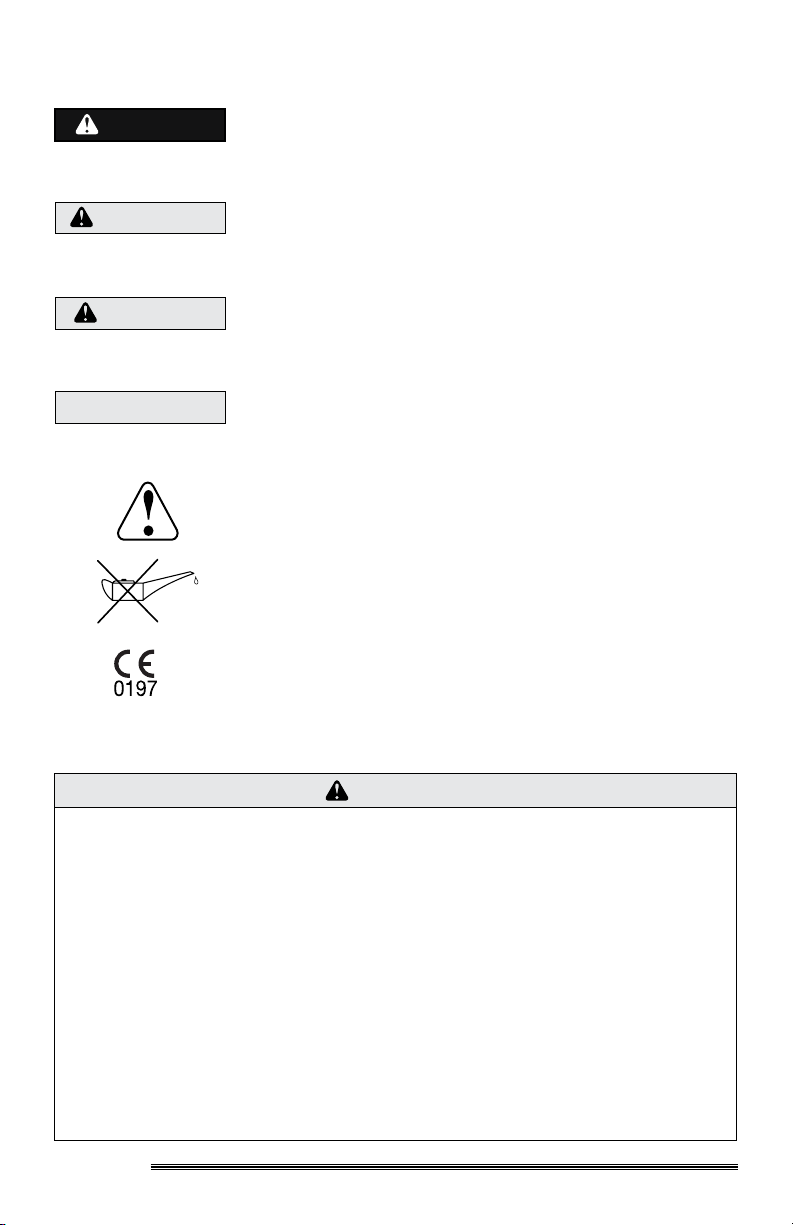
DANGER
WARNING
CAUTION
CAUTION
Indicates an imminently hazardous situation
which, if not avoided, will result in death or
serious injury.
Indicates a potentially hazardous situation
which, if not avoided, could result in death or
serious injury.
Indicates a potentially hazardous situation
which, if not avoided, may result in minor or
moderate injury.
Used without the safety alert symbol indicates
a potentially hazardous situation which, if not
avoided, may result in property damage.
CONSULT ACCOMPANYING DOCUMENTS
Symbol for “USE NO OIL”
Symbol indicates the device complies with the
requirements of Directive 93/42/EEC concerning
medical devices and all applicable International
Standards. (On CE marked Devices ONLY)
WARNING
Only trained, qualified medical personnel under the
•
direct supervision of a licensed physician should operate
the Air-Oxygen Blender .
Use this Air-Oxygen Blender only for its Intended Use as
•
described in this manual.
Confirm prescribed dose before administering to patient.
•
Monitor on a frequent basis.
The Air-Oxygen Blender shall be serviced by a qualified
•
service technician.
•
Always follow ANSI and CGA standards for Medical Gas
Products, Flowmeters and Oxygen Handling.
Blender
Air-Oxygen
3
Page 5

WARNING
•
An Oxygen Analyzer/Monitor must be used to verify
oxygen concentration.
Accuracy of oxygen concentration will be affected if bleed
•
is not activated at flow settings below 15 lpm for the High
Flow Blender, and 3 lpm for the Low Flow Blender.
•
DO NOT
•
DO NO
•
DO NOT
•
DO NOT
obstruct the alarm.
T use Blender when alarm is sounding.
use oil in or around the Blender.
occlude or obstruct the bleed port on the
auxiliary outlet of the Blender.
•
DO NOT
use near any type of flame or flammable/
explosive substances, vapors or atmosphere.
Oxygen Concentration Dial does not rotate 360 degrees.
•
Rotating the dial less than 21% or over 100% oxygen will
damage the Blender.
CAUTION
Turn off gas supplies when Air-Oxygen Blender is not in use.
•
Store the Air-Oxygen Blender in a clean, dry area when
•
not in use.
The Air-Oxygen Blender contains magnetic, ferrous
•
material that may affect the results of an MRI.
Ensure all connections are tight and leak free.
•
Avoid excessive pressure surges greater than 100 psi
•
(6.9 bar) when pressuring the Blender inlets.
•
DO NOT
•
DO NOT
•
DO NOT
•
DO NOT
steam autoclave.
immerse Air-Oxygen Blender into any liquid.
gas sterilize with (ETO) Ethylene Trioxide.
use if dirt or contaminants are present on or
around the Blender or connecting devices.
•
DO NOT
smoke in an area where oxygen is being
administered.
•
DO NOT
clean with aromatic hydrocarbons.
Blender
4
Air-Oxygen
Page 6

SPECIFICATIONS
Model PM5200 High Flow PM5300 Low Flow
Primary Outlet
Flow Range
Auxiliary Outlet
Flow Range
Bleed Flow
Maximum
Combined
Flow (All Outlets)
Bypass Flow
(Loss of Air or
Oxygen supply)
Bypass Alarm
Activation
15 - 120 lpm 3 - 30 lpm
With both supply pressures at 50 psi (3.4 bar)
with NO BLEED
2 - 100 lpm 0 - 30 lpm
With both supply pressures at 50 psi (3.4 bar)
with BLEED
13 lpm or less
at 50 psi (3.4 bar)
3 lpm or less
at 50 psi (3.4 bar)
≥ 120 lpm ≥ 30 lpm
> 85 lpm > 45 lpm
50 psi
(3.45 bar)
13-25 psi
0.9-1.7 bar 1.1-1.65 bar 1.2-1.5 bar 1.1-1.65 bar
60 psi
(4.14 bar)
50 psi
(3.45 bar)
60 psi
(4.14 bar)
16-24 psi 18-22 psi 16-24 psi
Alarm Reset:
Alarm Sound Level:
Oxygen Concentration
Adjustment Range:
Gas Supply Pressure:
Mixed Gas Stability:
Connection Types:
Blender
Air-Oxygen
When pressure differential is
6 psi (0.4 bar) or less.
≥ to 80 db at 1 ft (0.3 m)
21 - 100%
30 - 75 psi (2.1 - 5.2 bar)
Air and Oxygen within 10 psi (0.67 bar)
of each other
±1% Oxygen
DISS Type - Air & Oxygen Inlets & Outlets
and / or
NIST Type - Air & Oxygen Inlets
5
Page 7

SPECIFICATIONS continued
Dimensions: (without fittings)
Depth: 4.9 in
Width: 2.3 in
Height: 4.1 in
Weight: 2.9 lbs
Shipping Weight: 3.5 lbs
Operating Temperature Range:
59°F to 104°F (15°C to 40°C)
Transport / Storage Requirements
Temperature Range:
Humidity:
FiO2 Accuracy:*
-10°F to 140°F (-23°C to 60°C)
Max 95% Noncondensing
± 3% of full scale @ 50 psi (3.4 bar)
± 4% of full scale @ 60 psi (4.14 bar)
Pressure Drop:
(12.5 cm)
(5.7 cm)
(10.4 cm)
(1.3 kg)
(1.6 kg)
Low Flow:
≤ 2 psi (0.14 bar) at inlet pressures from 30-90 psi
(2.1- 6.2 bar) and at 10 lpm flow rate at 60% FiO2.
High Flow:
≤ 3 psi (0.21 bar) at inlet pressures from 30-90 psi
(2.1- 6.2 bar) and at 30 lpm flow rate at 60% FiO2.
The Air-Oxygen Blender has been degreased for Oxygen Service prior to delivery.
The Air-Oxygen Blender reverse gas flow complies with clause 6 of ISO 11195.
The Oxygen Analyzer should comply with ISO 7767 to meet CE requirement.
Dryness and Composition for inlet gases:
Air:
Oxygen:
Dew Point:
(ONLY for CE
requirements)
* Accuracy of oxygen concentration will be affected if bleed is not activated at flow settings below 15 lpm for the high flow
Blender, and 3 lpm for the low flow Blender.
Specifications are subject to change without prior notice.
Medical Air supply should meet the requirements of
ANSI Z86.1 - 1973 commodity specification for Air, type
1 grade D or better.
Oxygen supply must meet all requirements of USP
Medical Oxygen Grade N.
Both inlets should remain 10°F (5.5°C) or more
below the lowest temperature to which the air
distribution system equipment is exposed. At a
temperature of 25°F (-3.9°C) and a pressure of
90 psi (6.33 kg/cm2) this equates to 2000 mg/m3.
Blender
6
Air-Oxygen
Page 8
DIAGRAMS
CAUTION
Missing or illegible labels must be replaced, contact
Precision Medical, Inc.
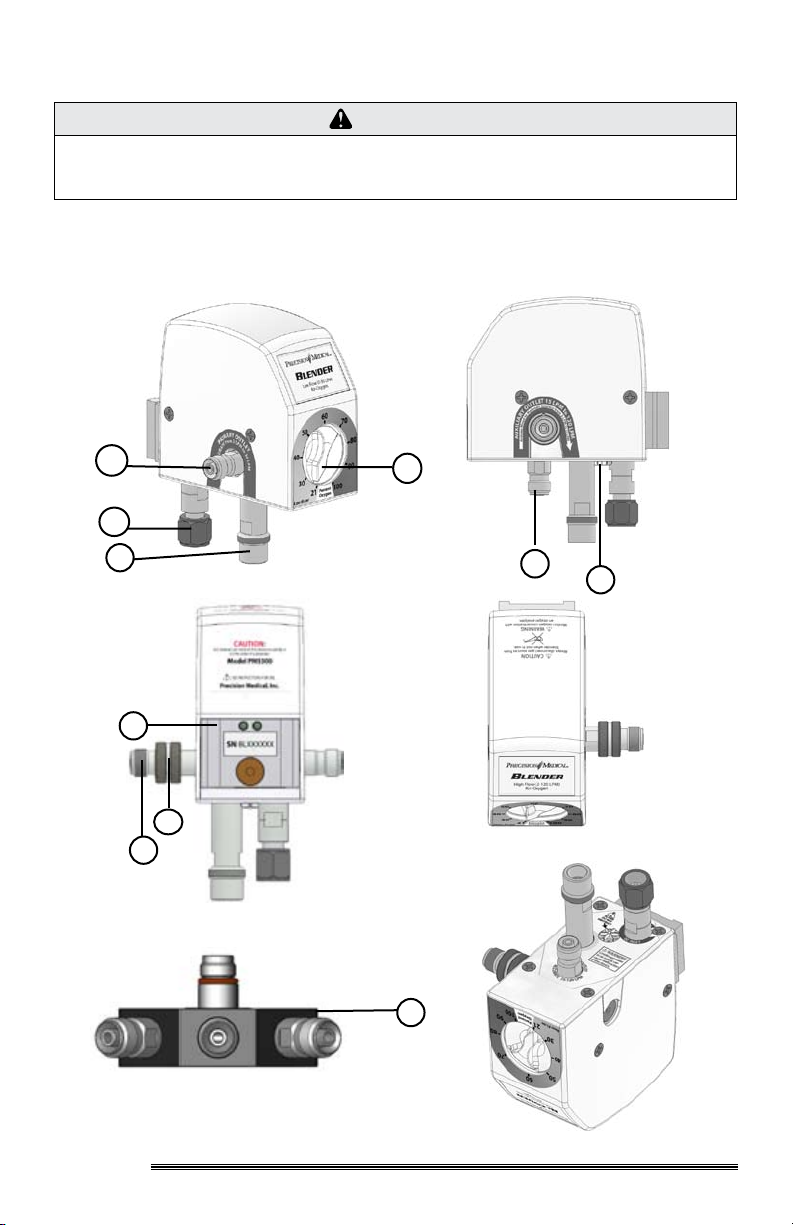
Depending on model, your fittings may differ from these diagrams.
PM5300 Model
B
E
F
I
D
C
PM5200 Model
A
B
G
Blender
Air-Oxygen
H
7
Page 9

COMPONENT DESCRIPTION
ITEM DESCRIPTION
A Oxygen Concentration Dial
A dial used for selecting oxygen concentrations between
21%-100%. The FiO2 scale is used for reference only.
This Dial does not rotate 360°.
and ends at 100%.
B Primary Outlet Port
A male DISS oxygen fitting with check valve that delivers
flow when engaged to any controlling device, such as
a flowmeter.
C Auxiliary Outlet Port
A male DISS oxygen fitting with check valve that delivers
flow when engaged to any controlling device, such as a
flowmeter. This outlet is equipped with a bleed valve that
allows the user to control if the bleed is ON or OFF. With
the bleed in the ON position, this outlet delivers accurate
oxygen concentrations in the following flows:
Model Flow Range
High Flow 2 – 100 lpm
Low Flow 0 – 30 lpm
The dial starts at 21%
D Auxiliary Bleed Collar
The collar is used to engage and disengage the bleed.
The bleed is necessary to maintain accurate FiO2
Concentration below 15 lpm for the High Flow and 3
lpm for the Low Flow. This collar is designed to prevent
accidental disengagement of the bleed. To activate
the bleed, turn the knurled collar until the bleed pin is
engaged. Slide collar back until it contacts the cover.
To deactivate the bleed, pull collar away from cover
while rotating until the collar slot engages the pin, turn
additional 1/4 turn to lock in place.
E Oxygen Inlet Fitting
A female DISS or NIST oxygen fitting with one way valve
that is used to connect an oxygen supply hose.
8
Blender
Air-Oxygen
Page 10

COMPONENT DESCRIPTION
ITEM DESCRIPTION
F Air Inlet Fitting
A male DISS or NIST air fitting with one way valve
that is used to connect an air supply hose.
G Alarm
An audible alarm that sounds due to an excessive
pressure drop or deletion of either gas supply.
H Manifold Outlet (Optional)
Manifold with 3 primary outlets.
I Rear Slide Mount with dove tail.
INSTALLATION
WARNING
•
Read this User Manual before installing or operating the
Air-Oxygen Blender.
Confirm the concentration of air/oxygen with an Oxygen
•
Analyzer/Monitor.
1. Secure the Air-Oxygen Blender to a wall or pole bracket in an
upright position.
2. It is recommended to install a condensation trap in the air
supply line.
3. Connect the air and oxygen supply lines to the appropriate
inlet fittings on the bottom of the Blender.
4. Attach a flowmeter, or other metering device to one of the
outlet ports.
Primary Outlets Flow capacity:
• High Flow Blender (PM 5200 Model) 15 lpm to 120 lpm
• Low Flow Blender (PM 5300 Model) 3 lpm to 30 lpm
Auxiliary Outlet:
This will bleed off some of the air/oxygen mixture to
maintain concentration accuracy at the Low Flow setting.
• High Flow Blender (PM 5200 Model) 15 lpm or less
• Low Flow Blender (PM 5300 Model) 3 lpm or less
5. Attach a supply line to the outlet port of the flowmeter.
Blender
Air-Oxygen
9
Page 11

ALARM TEST
1. The Air-Oxygen Blender is installed and the flowmeter is turned
on. Disconnect or turn off the air supply line to the Air-Oxygen
Blender.
2. The Blender should alarm with a loud whistle noise. The whistle
indicates the alarm is operating correctly.
3. Reconnect and activate the air supply line to the Blender, the
alarm should stop whistling.
4. Disconnect or turn off the oxygen supply line to the Blender.
5. The Blender should alarm with a loud whistle noise. The whistle
indicates the alarm is operating correctly.
6. Reconnect and activate the oxygen supply line to the
Blender, the alarm should stop whistling.
7. If alarm fails to function properly, DO NOT USE.
REVERSE GAS FLOW PROCEDURE
(CE Requirements ONLY)
1. Disconnect the oxygen hose from the gas source. Remove all
outlet connections from the Blender to ensure that there is no
outlet flow.
2.
Place the free end of the oxygen supply hose under water. While
gradually increasing the air supply pressure from 30-75 psi (2.07-
5.17 bar) check for leakage past the oxygen inlet check valve.
3. Replace the Duckbill Check Valve in the oxygen inlet if
bubbles indicate leakage. Reference Air-Oxygen Blender
Service Manual (P/N 504827.)
4. Repeat steps 1-3 to check for leakage past the air inlet check
valve.
OPERATING INSTRUCTIONS
CAUTION
Inspect the Air-Oxygen Blender for visual damage before
use, DO NOT USE if damaged.
1. Turn “ON” the Air and Oxygen supply.
2. Adjust the Oxygen Concentration Dial to the prescribed
concentration.
NOTE: The Oxygen Concentration Dial does not rotate
360°. DO NOT force dial less than 21% or over 100%
oxygen, this will damage the Blender.
10
Blender
Air-Oxygen
Page 12

3. To activate the bleed, turn the knurled collar until the bleed
pin is engaged. Then slide the collar back until it contacts the
cover.
4. Confirm the concentration of air/oxygen with an Oxygen
Analyzer/Monitor.
5. Confirm the flow of air and/or oxygen mixture to the patient.
6. Turn “OFF” the Air and Oxygen supply when deactivating the
Auxiliary bleed, and no device is attached to the outlet port.
7. To deactivate the bleed, pull the collar out away from the cover
while rotating the collar until the slot engages the pin. Then
slide the collar past the pin and turn an additional 1/4 turn to
lock in place.
NOTE: This Procedure is completed with ease when all gas
supplies to the Blender are turned “OFF”.
8. Turn “OFF” the Air and Oxygen supply or disconnect when
the Blender is not in use.
9. Operational Verification listed below should be done before
the Blender is placed in service.
Verification consists of:
• Alarm Test
•
Verify FiO2 Concentration with a Oxygen Analyzer/Monitor
• Reverse Gas Flow Procedure
PERFORMANCE CHECK
A detailed description of the tests listed below can be found in the
Blender Service Manual (P/N 504827), available on the Internet;
www.precisionmedical.com
• Reverse Gas Flow Procedure
• Operational Verification Procedure (OVP)
CLEANING
CAUTION
DO NOT
•
DO NOT
•
DO NOT
•
DO NOT
•
DO NOT
•
Blender
Air-Oxygen
steam autoclave.
immerse the Air-Oxygen Blender into any liquid.
use any strong solvent or abrasive cleaners.
gas sterilize with (ETO) Ethylene Trioxide.
clean with aromatic hydrocarbons.
11
Page 13

1. Disconnect all gas connections and equipment before
cleaning.
2. Clean exterior surfaces with a cloth dampened with mild
detergent and water.
3. Wipe dry with a clean cloth.
MAINTENANCE
The following maintenance on the Air-Oxygen Blender must be
performed by a trained service technician:
Every month verify proper functioning of alarm.
•
Every year conduct the Operational Verification Procedure (OVP).
•
Every 2 years the Air-Oxygen Blender should be serviced.
•
PM5200 (P/N 505407) PM5300 (P/N 504932)
Refer to the Air-Oxygen Blender Service Manual (P/N 504827)
•
for complete details regarding further maintenance and
testing.
TECHNICAL DESCRIPTION
For a complete Technical Description of the Air-Oxygen Blender
and list of Replacement Parts, reference the Air-Oxygen Blender
Service Manual (P/N 504827) available on the Internet;
www.precisionmedical.com.
RETURNS
Returned products require a Returned Goods Authorization
(RGA) number, contact Precision Medical, Inc. All returns must
be packaged in sealed containers to prevent damage. Precision
Medical, Inc. will not be responsible for goods damaged in transit.
Refer to Precision Medical, Inc. Return Policy available on the
Internet; www.precisionmedical.com.
DISPOSAL INSTRUCTIONS
This device and its packaging contain no hazardous materials.
No special precautions need to be taken when disposing the
device and/or its packaging.
Please Recycle
Blender
12
Air-Oxygen
Page 14

TROUBLESHOOTING
If the Air-Oxygen Blender fails to function, consult the
Troubleshooting Guide below.
If problem cannot be solved by using Troubleshooting Guide
refer to the Air-Oxygen Blender Service Manual (P/N 504827)
available on the Internet; www.precisionmedical.com or consult
your Provider.
Problem Probable Cause Remedy
Oxygen
concentration
discrepancy
between Blender
setting and
Analyzer/Monitor
(greater than 3%)
No flow at
Blender outlets
1. High Flow model,
flow requirement
below 15 lpm.
Low Flow model,
flow requirement
below 3 lpm.
2. Analyzer/Monitor
inaccurate
3. Low flow bleed
obstructed
4. Gas supply
contaminated
5. Downstream device
causing back flow
or restricted flow
1. Gas sources turned
“OFF”
2. Gas sources not
connected
1. Use auxiliary outlet
& engage bleed
2. Recalibrate
Analyzer/Monitor or
Verify with second
Analyzer/Monitor
3. Remove obstruction
4. Check gas sources
with calibrated
Oxygen Analyzer/
Monitor to
Oxygen is 100% and
Air is 21%
5. Isolate Blender.
Check oxygen
concentration at
Blender Outlets
1. Turn gas sources
“ON”
2. Connect gas
sources
confirm
Alarm sounding 1. Difference between
Oxygen and air inlet
pressures greater
than specified
Blender
Air-Oxygen
13
1. Correct pressure
difference until
Air and Oxygen
pressures are within
specification
Page 15

LIMITED WARRANTY
AND
LIMITATION OF LIABILITY
Precision Medical, Inc. warrants that the Blender, (the Product), will be
free of defects in workmanship and/or material for the following period:
Two (2) years from shipment
Should any failure to conform to this warranty appear within the applicable
period, Precision Medical, Inc. shall, upon written notification thereof and
substantiation that the goods have been stored, installed, maintained and
operated in accordance with Precision Medical, Inc.’s instructions and
standard industry practice, and that no modifications, substitutions, or
alterations have been made to the goods, correct such defect by suitable
repair or replacement at its own expense.
ORAL STATEMENTS DO NOT CONSTITUTE WARRANTIES.
The representatives of Precision Medical, Inc. or any retailers are not
authorized to make oral warranties about the merchandise described in
this contract, and any such statements shall not be relied upon and are
not part of the contract for sale. Thus, this writing is a final, complete and
exclusive statement of the terms of that contract.
THIS WARRANTY IS EXCLUSIVE AND IS IN LIEU OF ANY WARRANTY
OF MERCHANTABILITY, FITNESS FOR A PARTICULAR PURPOSE OR
OTHER WARRANTY OF QUALITY, WHETHER EXPRESS OR IMPLIED.
Precision Medical, Inc. shall not under any circumstances be liable for
special, incidental or consequential damages including but not limited to
lost profits, lost sales, or injury to person or property. Correction of nonconformities as provided above shall constitute fulfillment of all liabilities
of Precision Medical, Inc. whether based on contract, negligence, strict
tort or otherwise. Precision Medical, Inc. reserves the right to discontinue
manufacture of any product or change product materials, designs, or
specifications without notice.
Precision Medical, Inc. reserves the right to correct clerical or
typographical errors without penalty.
Blender
14
Air-Oxygen
Page 16

DECLARATION OF CONFORMITY
Manufacturer: Precision Medical, Inc.
300 Held Drive, Northampton, PA 18067, USA
CONTACT: Quality Manager
Phone: 610-262-6090
Authorized European Representative:
Molenstraat 15
2513 BH, The Hague
The Netherlands
Product: Gas Mixers for Medical Use
Emergo Europe
Model(s):
MDD Class: IIb
Classification criteria: Clause 3.1 Rule 11 of Annex IX of MDD
As delivered, the object of the declaration described above is in conformity with the
requirements of MDD 93/42/EEC Annex II.3 and the following documents:
Document Title Edition
ISO 14971 Medical Devices - Application of Risk Management
to Medical Devices
EN 980 Graphical Symbols for Use in the Labeling of Medical 2003
Devices
EN 1041 Information supplied by the Manufacturer with Medical 1998
Devices
ISO 11195 Gas mixers for medical use - stand alone gas mixers 1995
ISO 15001 Anesthetic and respiratory equipment -- Compatibility 2004
with oxygen
Notified Body: TÜV Rheinland Products Safety GmbH
EC Certificate No.: HD600119110 0001
PM5200EN, PM5200MEN, PM5300EN, PM5300MEN
2000+A1:2003
www.precisionmedical.com
ISO 13485 Certified
504745 Rev8 (E) 03/18/08 (?M) Printed in USA
 Loading...