

Page 1

Powerfocus
Battery Charger BC1000
1. Intended Use
The product is intended to charge and discharge NiCd or NiMH
rechargeable batteries. It provides four independent charging slots for
AA/AAA rechargeable batteries. The charger can also optimize and test
the maximum capacity of the rechargeable batteries. Each charging slot
has its own display to show various information, such as, charging current,
battery voltage, charged capacity, battery internal resistance and ellapsed
charging time.
The charging current can be selected from 200mA to 1400mA with 200mA
per increment. If 4 batteries are needed to be charged, then the maximum
current for each slot is limited to 1000mA. If battery in slot 2 or 3 is not
present, then the maximum current for slot 1 and 4 can be selected up to
1400mA.
The charger can charge batteries of different type and size and with
different capacity at the same time. It also integrates the minus delta
voltage (-ΔV) function, which monitors the voltage over the charging cycle.
When battery is fully charged, the charger will switch to trickle charging
automatically. Therefore the battery will be kept at its optimum capacity.
The charger also includes overheat detection to protect rechargeable
batteries and charger itself from overheating.
Specially design improved charging circuit provides excellent
heating management during high current charging process, which
assures the best charging condition for batteries.
The charger can only be powered by power supply rated 12v/1.0A.
Operate and store it in dry indoor environment only.
This product fulfills European and national requirements related to
electromagnetic compatibility (EMC). CE conformity has been verified and
the relevant statements are available upon request.
Unauthorized conversion and/or modification of the device are
inadmissible because of safety and approval reasons (CE). Any usage
other than described above is not permitted and can damage the product
and lead to associated risks such as short-circuit, fire, electric shock, etc.
Please read the operating instructions thoroughly and keep them for future
reference.
The charger has its backlight turned on after each key press. Back light will
be switched off after 30 seconds when no key is pressed.
The charger is capable of charging C,D size NI-MH batteries if used
together with specially designed C,D size battery adapter. The
maximum charging capacity can be up to 20,000mAH.
2. Delivery Content
Battery Charger BC1000 1pcs
Power Adapter 1pcs
Operation Instructions 1pcs
Optional accessory Part:
C,D size battery Adapter not included
3. Safety Instructions
We do not assume liability for resulting damages to property or personal
injury if the product has been abused in any way or damaged by improper
use or failure to observe these operating instructions. The warranty will
then expire!
3.1 Product Safety
The product must not be exposed to substantial mechanical strain or
strong vibrations.
The product must be protected against electromagnetic fields, static
electrical fields, extreme temperatures, direct sunlight and moisture
The manufacturer ’s instruction for the respective batteries must be
observed, before they are charged.
The product should not be connected immediately after it has been
brought from an area of cold temperature to an area of warm
temperature. Condensed water might destroy the product. Wait until
the product adapts to the new ambient temperature before use.
Sufficient ventilation is essential when operating the charger. Never cover
the ventilating slots of the charger. Please take cautions especially when
ambient temperature is over 35 degrees Celsius and charging current rate
is over 0.5C. If higher charging current applied, it is more easy to build up
temperature on batteries.
3.2 Battery Safety
Correct polarity must be observed while inserting the batteries.
Non-rechargeable batteries, rechargeable alkaline batteries (RAM),
lead acid batteries and lithium batteries must not be charged with
this product. There is danger of explosion!
Batteries should be removed from the device if it is not used for a
long period of time to avoid damage through leaking. Leaking or
damaged batteries might cause acid burns when in contact with skin,
therefore use suitable protective gloves to handle corrupted
batteries.
Batteries must be kept out of reach of children. Do not leave the
battery lying around, as there is risk, that children or pets swallow it.
Batteries must not be dismantled, short-circuited or thrown into fire. Never
Page 2
recharge non-rechargeable batteries. There is a risk of explosion!
3.2 Miscellaneous
Repair works must only be carried out by a specialist/specialist workshop.
If you have queries about handling the device, which are not answered in this operating instruction, please check with the distributor for further help.
4. Operating Elements
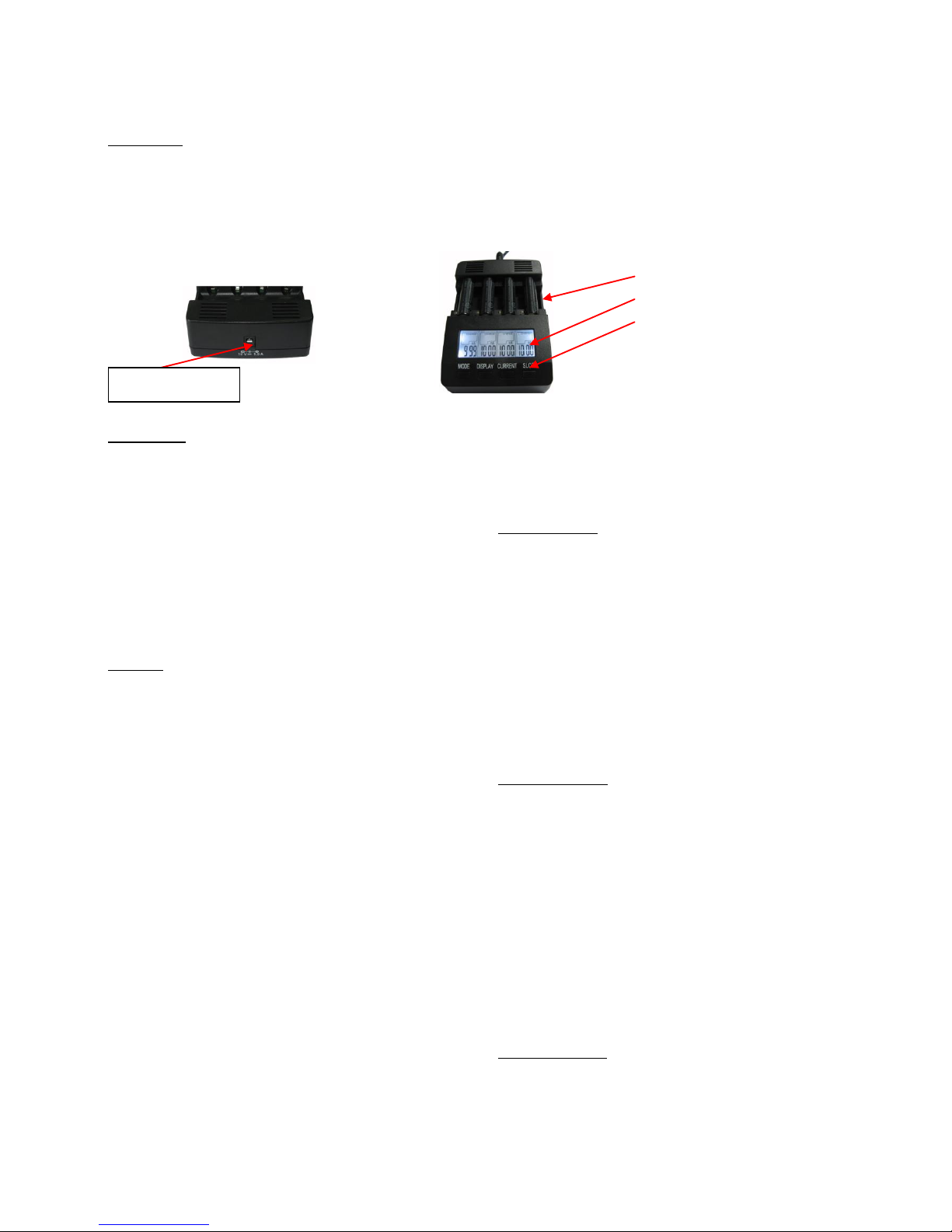
1. Battery Slots
2. LCD display area
3. Button
5. Power Supply
The shipped power adapter is the power supply for this charger. In case
you need to use other power adapter, please be aware that power supply
has the correct polarity plug. Also please be noted that power supply need
be able to supply minimum 1.0A current. Low output power adapter could
lead to working improperly.
When the charger is powered up, 2.1 version number is displayed for 2s .
Then all LCD segments will light up momentarily. “null” will be shown until
any batteries are inserted.
6. Operation
Once a rechargeable battery is inserted, its present voltage( for example,
“1.12v”) will be displayed for 3 seconds, then 400mA default charging
current will be shown on display for another 3 seconds. If MODE or
CURRENT button is not pressed during this 6 seconds, the charging
process will start. During the first 6 second time, If any button is pressed,
the unit will wait for another 10s before finishing current slot setting. Press
“SLOT” button will confirm the setting right way without the needs of
waiting the 10s auto time-out time elapsed. All other battery can be
handled the same. So each battery can have its own setting independently.
While the previous battery slot setting mode is in effective (telling by the
flashing display of that battery slot LCD ), and the next battery is inserted,
then both battery slot display will be flashing, which means that any setting
change will be applied for all batteries in setting mode at the same time.
Once start normal working mode, charging current can no longer be
changed unless its working mode is changed or batteries are taken out
from charger and insert into charger again.
During normal working mode, if no particular slot is selected by pressing
the SLOT button, MODE, CURRENT and DISPLAY button are always
referring to 4 slots simultaneously. If a different working or display mode is
desired for particular slot, press the SLOT button to select the slot and then
press “Mode” or “Display” to select your wanted working or display mode..
6.1 Mode Selection
Press and hold the “MODE” button for 2 seconds to start working
mode selection for all four battery slot.
Press the “MODE” button subsequently to toggle among the
“Charge”, ”Discharge”, ”Test” , “Quick Test” and “Refresh” mode
When particular slot working mode need to be changed, press SLOT
button to select the desired slot and then press MODE button to
choose wanted working mode.
When working mode is changed, working current adjustment is
possible.
6.2 Current Selection
Within the first 6 seconds after inserting the battery or right after power up,
press the “CURRENT” button to select desired charge current for slots
loaded with battery at the same time. Current setting can not be altered
once the setting has been confirmed in the initial stage. If different working
current is needed afterwards, either changing the working mode or
rechargeable battery must be taken out and inserted again. Discharge
current is automatically set to half of the selected charge current.
Batteries for slot 1 and 4( no batteries present at slot 2 or 3), its charging
current can be selected for 1200 or 1400mA further. Slot 2&3 maximum
charging current is limited to 1000mA only.
6.3 Display Selection
“DISPLAY” button is for toggling display information for voltage, current,
capacity, work time etc.
Power Jacket
Page 3

6.4 SLOT Selection.
This button is used to select desired slots for different working mode,
charge current or display mode. Press SLOT button will start the slots
selection processing in the sequence cycle of 1->2->3->4->4 slots->exit.
7. Overheat Protection
With our improved charging circuit design, for normal good quality battery
with low impedance, heating built up on battery during charging process is
almost unnoticeable. However during the last charging stage, when battery
is almost full, batteries can become hot. This is normal: the larger charging
current applied, the more heat will build up. When battery temperature is
sensed to be over 60C, then over heat protection will be kicked in for
safety reason. Beside the four battery temperature sensor, there are also
two temperature sensor located on controller board, located at the area
where most heat is generated. So both battery and controller temperature
is monitored during the operation of the charger.
When overheating occurs, either from battery over 60 degrees Celsius or
controller board over 77 degrees Celsius, current working mode will be
automatically halted. If controller board over heat is detected, over heat
protection will be applied for the corresponding 2 battery slots at the same
time. If battery temperature over heat detected, only the over heated
channel will be halted accordingly. To tell if it is in the state of overheating
protection mode, charging current will be reduced to 0mA.
Charging/discharging process will only resume after battery temperature
drops below 40 degrees Celsius and/or charger controller board drops
below 50 degrees Celsius.
8. Operation Modes and Display
8.1 Operation Modes:
Charge Mode: The rechargeable battery is charged up to its
maximum capacity. Accumulated charging capacity is displayed
at mAH display mode.
Discharge Mode: It is used to reduce the memory effect. The
rechargeable battery is discharged to a preset battery voltage
(0.9v). Once discharge is finished, total accumulated discharging
capacity is displayed at mAH display mode, showing how much
energy is discharged from the battery, which is always referring to
the accumulated discharging capacity. No trickle charge current
will be applied after discharge cycle is finished.
Refresh Mode: The rechargeable battery is charged and
discharged repeatedly to optimize to its maximum capacity. Old
rechargeable batteries or rechargeable batteries that have not
been used for a long period of time can be restored to their rated
capacity. Depends on the selected charge current and battery
impedance, it can take tens hours or even days time before
complete. Refresh mode will make 3 complete discharge-charge
working cycles before complete. After charge cycle is complete,
the total charged capacity will be displayed in mAH display mode
even it is at discharging stage of that cycle.
Test mode: Checks the present capacity of a rechargeable
battery. The maximum capacity is determined by discharging the
rechargeable battery after it was fully charged. If the maximum
capacity is much lower than the rated capacity then it may reach
the end of its lifetime.
Quick Test mode: The charger will analyze the dynamic internal
battery resistance by applying a load current and this current
reading is referred to the voltage drop detected on the battery.
Within 10s, the tested battery resistance will be displayed in the
unit of milliohm. For good quality batteries, the internal resistance
is very low: in the range of 20 ~ 80 milliohms. If battery internal
resistance is over 500milliohms, then these batteries are not
good for supplying power to high current loads, such as digital
camera etc. But they can still be used for low energy loads, such
as clock, remote controllers etc. Always use batteries with close
internal resistance range when they are used in serial to achieve
maximum battery life. Alkaline and any other 1.5v batteries can
be tested on this charger as well. If a completely empty battery is
to be tested, it is not possible to give any correct reading. Please
be noted that since the internal battery resistance can be very
small, and contact resistance can be a major influence factor,
thus same battery tested in different slot or even at the same slot
with different contact condition, the reading can be varied for 10%
to 20%. This is normal.
When a high impedance battery( eg. Over 2500milli ohm) is
loaded onto the charger, due to its high internal impedance, real
displayed charging current can be much less than your
pre-selected charging current. When this happened, it doesn’t
means the charger is defective. Eventually it needs longer
charging time until fully charged.
8.2 Display
Charge/Discharge Current: instantaneous current is displayed.
Time Elapsed: The charging/discharging time of the last cycle is
displayed.
Page 4
Accumulated Capacity: The accumulated battery capacity is
displayed in mAh. For discharge mode, it is referring to the
accumulated energy discharged from that battery. For refresh mode,
previous charging capacity is displayed even when current working
stage is at discharge cycle.
Battery Voltage: The instantaneous battery voltage is displayed.
At QUICK TEST mode, it shows the internal battery resistance in
mili- ohm(0.001R).
Full: After the rechargeable battery is fully charged in any of the
operation modes, trickle charging will be started automatically.
Trickle charging prevents the rechargeable batteries from being
overcharged and compensates for self-discharging of the batteries
9. Maintenance
The device is maintenance-free but should be cleaned occasionally. When
cleaning, the device must be removed from any power source. Only use
dry and soft cloth to clear the housing of the charger. Do not use abrasive
or solvents.
10. Disposal
10.1 Disposal of waste electrical and electronic equipment
In order to preserve, protect and improve the quality of environment,
protect human health and utilize natural resources prudently and rationally,
the user should return unserviceable product to relevant facilities in
accordance with statutory regulations.
The crossed-out wheeled bin indicates the product needs to be disposed
separately and not as municipal waste.
10.2 Used batteries/rechargeable batteries disposal
The user is legally obliged (battery regulation) to return used batteries and
rechargeable batteries. Disposing used batteries in the household waste is
prohibited! Batteries/rechargeable batteries containing hazardous
substances are marked with the crossed-out wheeled bin. The symbol
indicates that the product is forbidden to be disposed via the domestic
refuse. The chemical symbols for the respective hazardous substances
are Cd= Cadmium, Hg = Mercury, Pb = Lead.
You can return used batteries/rechargeable batteries free of charge to any
collecting point of your local authority.
11. Technical Data
Operating Voltage
12V ~16VDC
Power Adapter
Input:
100~240V~, 50/60Hz
Output:
12V DC, 1.0A
Charging Current range
200 ~ 1400 mA
Discharging Current
range
100 ~ 700 mA
Max. Charging Capacity
20000mAh
Operating Temperature
0 to 40 ℃
 Loading...