

Page 1

5-Way
Test Kit
To test for:
Chlorine
Bromine
pH
Alkalinity
Acid Demand
Regular Testing Helps Maintain
a Clean, Clear Sparkling Pool.
Page 2
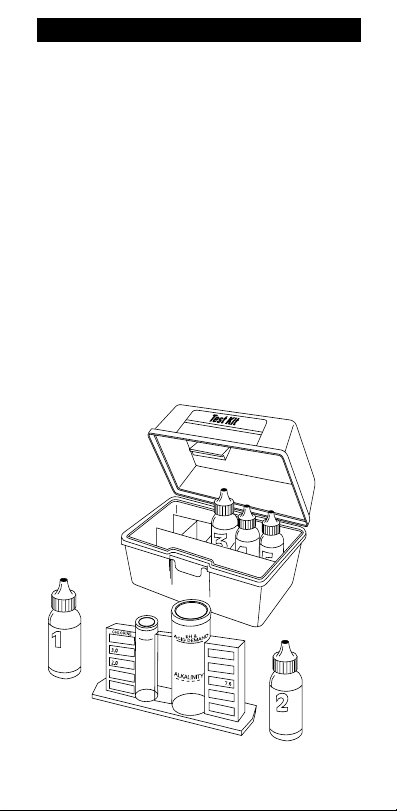
TABLE OF CONTENTS
Page
Introduction..................................................................1
Key Pool Water Measurements ...............................2
#1 Test - Chlorine Residual/Bromine .......................5
#2 Test - pH Level ........................................................6
#3 Test - Acid Demand ...............................................7
#4 Test - Total Alkalinity .............................................8
Acid Demand Table ..................................................10
Testing Hints ..............................................................11
How To Estimate The Capacity
Of Your Pool In Gallons Of Water ........................... 12
Observe These Common Sense
Pool Chemical Handling Precautions ....................13
Page 3

INTRODUCTION
Your swimming pool is a source of enjoyment and
relaxation for the entire family. It is a pleasure
to have a clean, clear, sparkling pool. And, it is
important to have sanitary and “comfortable”
pool water.
To be sure that pool water is attractive, sanitary
and “comfortable” to swim in, it must be free
from dust, algae, mineral deposits, bacteria and
other foreign matter, which regularly enter the
pool water from wind, rain, pollen, leaves, dust
and the bodies of swimmers. If untreated, these
contaminants cannot only create a serious health
hazard, but can also cause water cloudiness and
discoloration, slimy conditions and unpleasant
odors. Further, trouble can arise with pool
equipment, accessories and the pool’s interior
finish because of improper water treatment.
So, water must be treated. In order to treat a
pool properly, it is necessary to test the water
for key pool water measurements. These key
measurements can be easily made with your
Poolmaster test kit. This easy-to-use test kit gives
you tests for Chlorine, Bromine, pH, Alkalinity and
Acid Demand.
That, along with taking the necessary steps to
maintain your pool water through proper filtration
and “chemical feeding”, will ensure clean, clear
sparkling pool water.
1
Page 4

KEY POOL WATER MEASUREMENTSKEY POOL WATER MEASUREMENTS
There are four essential measurements of a
There are four essential measurements of a
pool’s “health”:
pool’s “health”:
1. Chlorine Residual/Bromine:
1. Chlorine Residual/Bromine:
} Chlorine Residual - The amount of free chlorine
} Chlorine Residual - The amount of free chlorine
in pool water, measured on a ppm basis (parts
in pool water, measured on a ppm basis (parts
per million).
per million).
} Bromine - Similar to chlorine, it is used to
} Bromine - Similar to chlorine, it is used to
sanitize water and measured on a ppm basis.
sanitize water and measured on a ppm basis.
2. pH - The balance of acidity versus alkalinity in
2. pH - The balance of acidity versus alkalinity in
the water. This is measured on a scale from 0 to
the water. This is measured on a scale from 0 to
14, with 0 being the most acidic, 7 being neutral
14, with 0 being the most acidic, 7 being neutral
and 14 being the most alkaline.
and 14 being the most alkaline.
3. Total Alkalinity - The amount of certain alkaline
3. Total Alkalinity - The amount of certain alkaline
buffering materials in the water, usually
buffering materials in the water, usually
measured on a ppm basis.
measured on a ppm basis.
4. Acid Demand - Determines for you the amount
4. Acid Demand - Determines for you the amount
of acid to be added to the pool water to return it
of acid to be added to the pool water to return it
to the proper pH level based on the size of your
to the proper pH level based on the size of your
pool.
pool.
These measurements are made with your
These measurements are made with your
test kit. Prevent pool problems before they develop
test kit. Prevent pool problems before they develop
by using your test kit regularly.
by using your test kit regularly.
CHLORINE RESIDUAL
CHLORINE RESIDUAL
When chlorine is added to a pool, it immediately
When chlorine is added to a pool, it immediately
goes to work to attack and kill bacteria, algae and
goes to work to attack and kill bacteria, algae and
other foreign materials in the water. In the course
other foreign materials in the water. In the course
of destroying these organisms, the chlorine literally
of destroying these organisms, the chlorine literally
gets “used up”. It is also dissipated by sunlight
gets “used up”. It is also dissipated by sunlight
and lost by water splash-out. The chlorine that
and lost by water splash-out. The chlorine that
is left to protect the pool water against incoming
is left to protect the pool water against incoming
bacteria and algae is called the “chlorine residual”.
bacteria and algae is called the “chlorine residual”.
For proper disinfection, the free chlorine residual
For proper disinfection, the free chlorine residual
should be maintained at 2.0 parts per million (ppm).
should be maintained at 2.0 parts per million (ppm).
2
Page 5

This can and should be determined through regular
use of your test kit. The chlorine residual can exist
as free (active) chlorine and/or combined (less
effective) chlorine. You can distinguish between
free and combined chlorine by following the test
procedures outlined in step 4 of the Chlorine Residual
Test. Regular use of chlorine will normally keep the
chlorine residual at the proper level. However,
once in a while, during periods of high bather load,
heavy rains or extremely high temperatures, a
“shock treatment” or “super chlorination” of three
to four times the normal chlorine application may be
needed to kill the abnormal amounts of algae and
bacteria which may have entered the pool.
BROMINE
Bromine is another effective pool and spa sanitizer,
although it is somewhat different from chlorine. Pool
or spas using bromine do not require a conditioner.
Like chlorine, bromine combines with nitrogen and
ammonia compounds to form bromamines (not
chloramines). Unlike chloramines, bromamines do
not irritate eyes or have an offensive odor.
pH BALANCE
pH is the relative measure of acidity versus alkalinity
in the pool water.
High pH (too much alkaline or a reading over 7.6)
will cause loss of chlorine effectiveness and may
cause cloudy water and scale formation on pipes
and the sides of the pool. Low pH (too much acid
or a reading under 7.2) may cause irritation to the
eyes, ears, noses and throats of swimmers and
may result in corrosion of pipes and fixtures and
deterioration of the filter.
The pH of pool water should be maintained
between 7.2 and 7.6 on the pH scale. At that level,
with proper chlorination, most algae, corrosion and
scale problems will be avoided.
3
Page 6

TOTAL ALKALINITY
It is important not to confuse total alkalinity with
pH. Total alkalinity refers to the quantity of alkaline
materials in the pool water, while pH measures the
balance point between these alkaline materials and
acidic materials. Total alkalinity could be too high or
too low even if pH was normal.
High alkalinity may cause cloudy water, calcium
deposits on pool walls and pipes and irritation
to the body tissues of swimmers. Low alkalinity
may cause eye irritation and corrosion of pool
equipment.
Swimming pool water is most satisfactory when the
total alkalinity level is between 80 and 100 ppm. At
that level, the alkalis help stabilize the pH and allow
the chlorine to do its job.
Once the proper level of alkalinity is achieved, it will
hold steady for weeks without further treatment,
although it is recommended that test readings be
taken a least twice a month.
4
Page 7
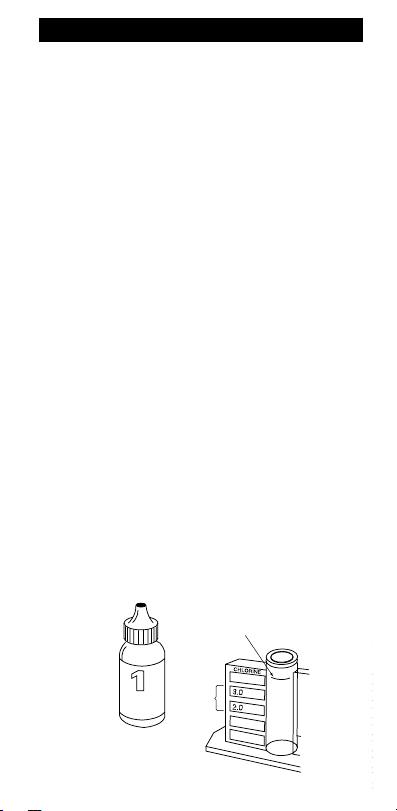
TEST 1: Chlorine Residual or Bromine
1. Fill small test vial to line with pool water.
2 Add 5 drops Solution 1.
3 Place cap on vial and invert several times to mix.
4. Free Chlorine Reading: Within 2-3 seconds, compare
color in tube with the chlorine standards on the left
to determine the free chlorine level (in ppm).
5. Combined Chlorine Reading: Wait 1-2 minutes and
compare the color in the tube again with the chlorine
standards to determine the combined chlorine
(chlorine residual) level (in ppm).
A desirable free chlorine reading is 2.0. However,
additional chlorine may be needed to maintain a proper
level. A difference of more than 0.2 ppm between the
Free Chlorine and Combined Chlorine level indicates a
need for superchlorination.
If chlorine residual is above 3.0, be sure to add 1
additional drop of Solution 4 to test vial during tests 2
and 4 to assure accurate results of the remaining tests.
TO TEST BROMINE
1. Rinse test vial marked BR and fill to mark with spa or
pool water.
2. Add 5 drops of #1 Solution.
3. Place cap on vial and invert several times to mix.
4. Match color in vial with bromine standards on the
right within 30 seconds (make sure the BR marked
side of the test block is being read). The results are
read in parts per million (ppm). A desirable reading
is 4.4 ppm. However, additional bromine may be
needed to maintain proper level.
OTO Solution #1
Yellow
Cap
Fill Line
Ideal
5
Page 8
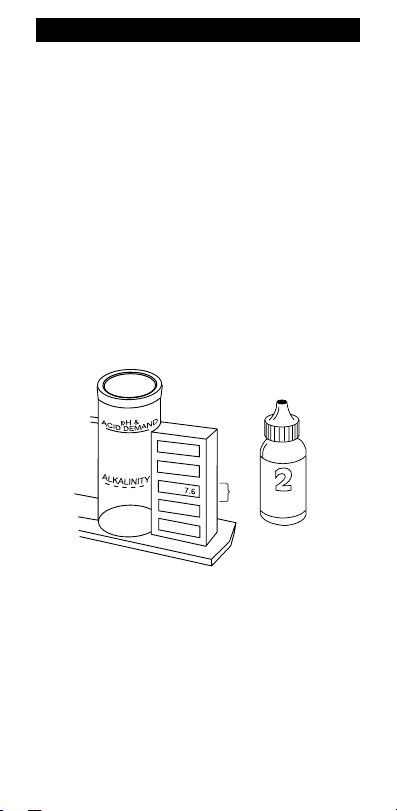
TEST 2: pH Level
Phenol-Red
(for degree of acidity or alkalinity of pool water)
1. Fill the large vial with pool water to the top (solid) line
marked “pH & Acid Demand”.
2 Add 1 drop of Solution #4. Place cap on vial and
invert several times to mix.
3. Add 5 drops of Solution #2. Place cap on vial and
swirl to mix.
4. Compare color with pH color standards on the right.
5. A desirable pH reading is 7.2 to 7.6. If reading is 7.8
or above, acid is required. Perform Test 3 for ACID
DEMAND using this same water sample.
If reading is below 7.2, raise it by adding soda ash.
See your local pool supply dealer for recommended
dosage.
Red Cap
Ideal
Solution #2
6
Page 9

TEST 3: Acid Demand
(when pH reading is 7.8 or above)
1. Use sample water from the pH test. Counting each
drop, add Solution #3 (swirling between drops)
until the color matches approximately the 7.4 color
standard. Do not count the drop which lowers the
pH to 7.2 or below.
2. Refer to Acid Demand Table on Page 12 for proper
amount of acid to be added based on the capacity of
your pool or spa.
3. If more than 1 pint of acid per 10,000 gallons is
required, add it in two or more doses. Allow about
1 hour between doses and do not add more than 2
quarts in one day. Test again in 24 hours. Additional
acid may be needed to maintain correct pH.
4. Add acid only when the filter is running and avoid
acid concentrations in any one place. Add slowly
to deep end of pool away from the vicinity of the
surface skimmer and 12 to 18 inches out from the
pool walls. Leave filter on for at least one hour.
5. If the first drop of Solution #3 lowers the pH to 7.2
or below, it is an indication that the total alkalinity is
too low (Test 4). Don’t add acid. Proceed to Test 4 to
determine your TOTAL ALKALINITY.
7
Page 10
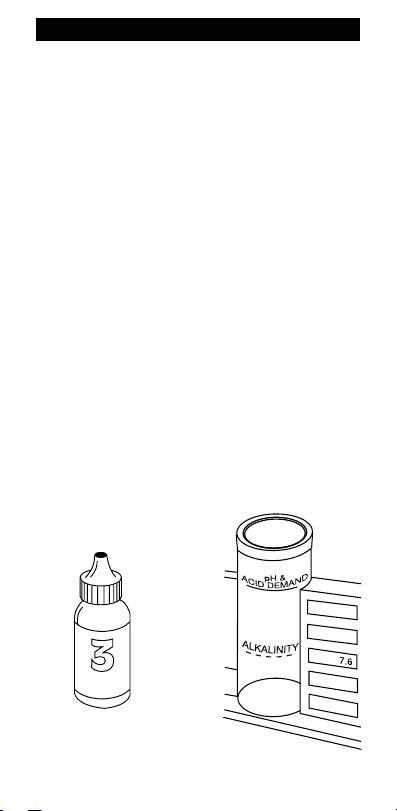
Large Vial
White Cap
Acid Demand & Alkalinity
Solution #3
TEST 4: Total Alkalinity
1. Rinse the large vial with pool water and fill to the
lower (dashed) line marked “Alkalinity”.
2. Add 1 drop Solution #4 and swirl to mix.
3. Add 2 drops Solution #5 and swirl to mix. The test
solution will now be violet in color.
4. Add Solution #3 counting each drop and swirling
between drops, until the color makes a permanent
change to light yellow or clear.
5. Multiply the number of drops of Solution #3 used by
10 to determine the total alkalinity. Example: 8 drops
= 80 ppm.
6. Total alkalinity of 80-100 ppm is desirable.
If alkalinity is less than 80 ppm, raise it by adding
sodium bicarbonate. See Raising Total Alkilinity Chart
on page 11 for details.
If alkalinity is more than 120 ppm, pH and Acid Demand
test should be performed more than once a week.
Make the proper additions according to the test results.
Add up to, but no more than, one quart of acid daily
until the alkalinity level drops below 120 ppm. Do not
add acid if the pH level is below 7.6. A total alkalinity
range above 200 ppm indicates one or more daily
additions of acid may be needed to adjust pH and
destroy the excess alkalinity.
This test should be performed about once a week
until the alkalinity is adjusted to the desired range.
Thereafter, twice a month should be sufficient.
8
Page 11
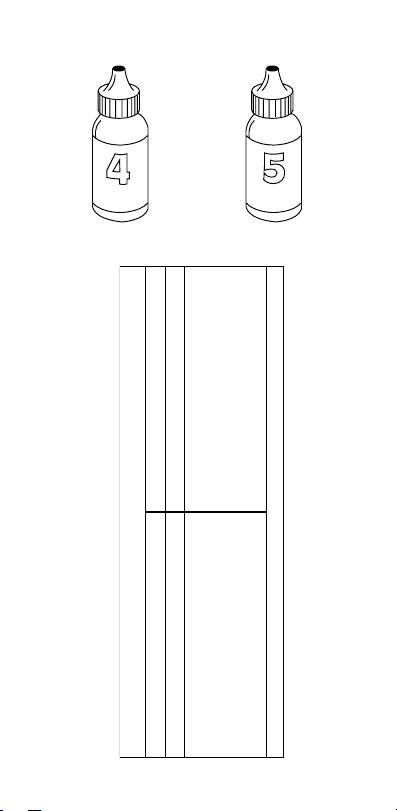
Large Vial
Chlorine Neutralizer
Solution #4
Green Cap
Total Alkalinity Test
Solution #5
Blue Cap
White Cap
Acid Demand & Alkalinity
Solution #3
METRIC
1.08 kg
720 gr
360 gr
Liters 10PPM 20 PPM 30 PPM
20,000
2.16 kg
4.10 kg
1.40 kg
2.70 kg
720 gr
1.36 kg
40,000
75,000
5.10 kg
10.25 kg
3.40 kg
6.80 kg
1.70 kg
3.40 kg
95,000
190,000
lb
4
/
/2 lb
1
1
/4 lb
/2 lb
1
1
lb 11
2
/2 lb 2
/
1
1
U.S.
Raising Total Alkalinity with Sodium Bicarbonate*
Gallons 10PPM 20 PPM 30 PPM
/2 lb 3 lb 4
1
10,000 1
5,000 12 oz 1
20,000 3 lb 6 lb 9 lb
lb 7
4
/
/2 lb 15 lb 22
3
1
50,000 7
25,000 3
* See your dealer for recommended products
9
Page 12

3-1/2 P
Q2
1-3/4 C
3-1/2 C
2-4/5 oz
4-1/5 oz
5-3/5 oz
3 P
3 C
1-1/2 C
2-2/5 oz
3-3/5 oz
4-4/5 oz
2 oz
3 oz
4 oz
2 1/2 P
1-1/4 C
2-1/2 C
1 P
1 C
2-2/5 oz
3-1/5 oz
1 Q
4/5 oz 1 oz 1-1/5 oz 1-2/5 oz
1-3/5 oz
DROPS OF SOLUTION 3
ACID DEMAND TEST
3/4 C
3/5 oz
Amount of Muriatic Acid Required
1-1/5 oz
2-2/5 C
1-4/5 oz
1-1/2 P
1-1/2 C
2-1/2 Q
G1-3/4 G5-1/2 Q4-1/2 Q2-1/4 P
3-1/2 Q
4-1/2 Q
1-1/4 G
1-1/2 G
3 Q
1 G
1-1/4 G
2-1/4 Q
4-1/2 Q
1 G
2 Q
3 Q
2-1/2 Q
4-1/2 Q
3 P
2 Q
3 Q
3-1/2 Q
2-1/2 Q
3 P
2 Q
2-1/4 P
2-1/4 Q
2-3/4 Q
270-3_2Stn
1 Quart Muriatic Acid = 40 oz Dry Pool Acid
1 oz Muriatic Acid = 1-1/4 oz Dry Acid 1 Cup Muriatic Acid = 10 oz Dry Pool Acid
234567
2/5 oz
4/5 oz
C = Cup P = Pint Q = Quart G = Gallon 2 Cups = 1 Pint 2 Pints = 1 Quart 4 Quarts = 1 Gallon
1
2/5 oz
1/5 oz
in
Pool
500
250
Gallons
Capacity
oz = Ounce
1/2 C
1-1/5 oz
1-3/5 oz
1/4 C
3/5 oz
4/5 oz
750
1,000
2,500
1 C
1/2 C
5,000
10
1 P
1-1/2 P
1 C
1-1/2 C
10,000
15,000
3 P
1 Q
2 Q3 Q 1-3/4 G1-1/2 G1-1/4 G1 G1 Q
2-1/2 P
3-1/2 P
4-1/2 P 3-1/2
2-1/2 Q1 G 2-1/4 G2 G1-1/2 G1-1/4 G1-1/4 Q
1 Pint Muriatic Acid = 20 oz Dry Pool Acid
1 P
1-1/4 P
1-1/2 P
1-3/4 P
20,000
25,000
30,000
35,000
40,000
45,000
50,000
Dry Acid Equivalents 4/5 oz Muriatic Acid = 1 oz Dry Acid
NOTES: Use only Clean Plastic measuring cups or spoons with liquid or dry acid. See page 9 for important information on Acid Demand.
Page 13

Testing Hints
}
Conduct tests before adding chemicals.
} Test on a regular basis to assure proper
and healthful pool maintenance.
} Keep test vials clean by rinsing with pool
water before and after each test.
} Take pool water samples from a depth of at
least 12 to 18 inches below the surface
away from return lines.
} To save time, fill both small and large vials
at the same time, capping the large vial
until needed for the pH Test.
} Slowly add drops of test solution to water
samples while holding dropper bottle and
test vial vertically to ensure full size drop.
} Read all test results immediately after
swirling unless directed otherwise.
} For accurate color comparisons during
daytime, perform tests out of bright sunlight
facing away from the light.
} It is recommended that colors be matched
against a light background.
} As with all chemicals, store your test kit
in a cool, dark place and keep the test kit
block and solutions in the original case.
Too much heat or freezing temperatures
may alter the indicator solutions.
} For accuracy, check color standards once a
year and use fresh solutions to start each
season.
} Know the size (capacity) of your pool. See
next page for easy-to-use formulas.
11
Page 14

HOW TO ESTIMATE THE CAPACITY OF YOUR
POOL IN GALLONS OF WATER
Rectangular or Square Pools:
Average depth x length x width x 7.5.
Example: Length: 40'
Width: 20'
Depth: 5'
5 x 40 x 20 x 7.5 = 30,000 gallons
Round Pools:
Diameter of the pool x the diameter of the
pool x the average depth of the pool x 5.9.
Example: Diameter: 20'
Depth: 4'
20 x 20 x 4 x 5.9 = 9,440 gallons
Oval Pools:
Average depth x length x width x 5.9 = total gallons
Free Form Pools:
Estimate as closely as you can the number of
cubic feet and multiply this by 7.5, the
number of gallons is each cubic foot.
If pool has sloping sides, multiply gallonage by
0.85. In many instances, your pool contractor
knows how many gallons there are in your pool.
Give him a call; he will be pleased to be of service.
Number of gallons in pool_________________
12
Page 15

1. Store all chemicals out of the reach of children.
2. If you get any chlorine on yourself, rinse the area
of contact with plenty of water. If you spill chlorine
outside the pool, clean it up and wash the area.
3. Never mix different kinds of chemicals.
4. Chlorine and acid should not be added to your pool
at the same time. Allow approximately one hour
between application of chlorine and acid.
5. When you add chlorine or acid to the pool water, do
it carefully. When the product is powder or granular,
add it close to the surface of the water so that
particles won’t be blown by the wind.
6. When you add chlorine or acid to the water, be sure
filter is in operation to assure adequate dispersal.
Leave filter on for at least one hour.
Questions or comments?
Call: 800-854-1492
¿Preguntas o comentarios?
Llame al: 800-854-1492
Des questions ou des
commentaires?
Appeler le 800-854-1492
260-8
© 2014 Poolmaster,® Inc.
Poolmaster is a registered
trademark of Poolmaster, Inc.
www.poolmaster.com
13
 Loading...