

Page 1
S-002657E Rev. 0 05/06
P
PTS PANELS™HDL Cholesterol Test Strips
for use with CardioChek®Brand Analyzers
I
NTENDED USE
PTS PANELS HDL Cholesterol Test Strips provide a quanti tative measurement of High Density
Lipoprotein (HDL) Cholesterol. This system is intended to assist in screening for decreased HDL
Cholesterol, a risk factor in coronary heart disease, and is intended for in-home (self-testing) or
professional use.
SUMMARY
HDL Cholesterol, often referred to as “good cholesterol”, is an important component of a lipid profile. A
low HDL indicates increased risk of coronary heart disease, while a high HDL indicates decreased risk.
Individuals should consult their healthcare professional with any questions about HDL levels and when
to use this test. A MEMo Chip
inserted into the analyzer before any test can be run. The MEMo Chip contains test name, calibration
curve, lot number and test strip expiration date. After the test strip is inserted into the analyzer and
blood applied to the strip, test results are displayed in about a minute.
PRINCIPLE OF THE TEST
HDL Cholesterol test results are based on a reading of light reflected off a test strip that has changed
color after blood is applied. The deeper the color is, the higher the HDL level. The analyzer converts
this reading into an HDL result and displays it. This procedure is based on the “Trinder Method” for the
determination of cholesterol.
MATERIALS PROVIDED
• PTS PANELS HDL Cholesterol Test Strips
• MEMo Chip (contains lot-specific test strip information)
• Instructions
MATERIALS NEEDED BUT NOT PROVIDED
• CardioChek brand analyzer
• Quality Control Materials
• Lancets for fingerstick (or venous blood collection supplies)
• Alcohol wipes and/or gauze
• Capillary Blood Collector or other precision pipet for blood collection and application
CHEMICAL COMPOSITION
Each HDL Test Strip contains the following active ingredients:
Cholesterol Esterase (Microorganism). . . . . . . . . . . . . . . . . . >
Cholesterol Oxidase (Microorganism) . . . . . . . . . . . . . . . . . . >
Magnesium chloride hexahydrate . . . . . . . . . . . . . . . . . . . . . >
D-sorbitol. . . . . . . . . . . . . . . . . . . . . . . . . . . . . . . . . . . . . . . . . >
Tris buffer . . . . . . . . . . . . . . . . . . . . . . . . . . . . . . . . . . . . . . . . >
Dextran sulfate . . . . . . . . . . . . . . . . . . . . . . . . . . . . . . . . . . . . >
PVA (polyvinyl alcohol) . . . . . . . . . . . . . . . . . . . . . . . . . . . . . . >
MOPS . . . . . . . . . . . . . . . . . . . . . . . . . . . . . . . . . . . . . . . . . . . >
Sucrose . . . . . . . . . . . . . . . . . . . . . . . . . . . . . . . . . . . . . . . . . . >
Peroxidase (Horseradish). . . . . . . . . . . . . . . . . . . . . . . . . . . . >
4-aminoantipyrine . . . . . . . . . . . . . . . . . . . . . . . . . . . . . . . . . . >
Substituted aniline derivatives . . . . . . . . . . . . . . . . . . . . . . . . >
Each vial contains not more than 5 g silica gel desiccant.
STORAGE AND HANDLING
• Store test strip package in a cool, dry place at room temperature of 68-86°F (20-30°C). Strips may
be stored in a refrigerator at 35-46°F (2-8°C), but must be brought to room temperature before using.
Do not freeze.
• Keep away from heat and direct sunlight.
• Do not remove or discard the desiccant packet in the vial.
• Always replace vial cap immediately after removing a test strip.
• Use test strip as soon as you have removed it from the vial.
• Keep the MEMo Chip either in the analyzer or stored with the original lot of strips.
• Store the test strips in the original vial. Do not combine with other strips and do not
MEMo Chip in the test strip vial.
• After opening, the test strips are stable until expiration date if vial is properly stored and always
capped.
PRECAUTIONS
• For in vitro diagnostic use. Intended for self-testing.
• PTS PANELS Test Strips can only be used in the CardioChek brand analyzer.
• Make sure the MEMo Chip and test strip lot numbers match. Never use a MEMo Chip from a
different lot than the test strip.
• Out-of-date or expired strips cannot be used in your test system. Check vial for expiration date.
• Add all of the blood to the test strip at once. If you do not get all of the blood on the strip, do not add
blood to the same strip. Test again with a new unused test strip and fresh blood sample.
• Discard test strip after using. Strips are to be read once. Never
• Do not ingest.
SPECIMEN COLLECTION AND PREPARATION
PTS PANELS Test Strips are designed for use with fresh capillary (fingerstick) whole blood. Fresh
venous whole blood collected in EDTA or heparin tubes is also an acceptable sample. To obtain a drop
of blood from a fingerstick, follow the steps listed below:
• Use of lotions and handcreams should be avoided before testing.
• Hands should be washed in warm water with antibacterial soap, rinsed and dried thoroughly.
• If you wipe the fingertip with alcohol, be sure that the alcohol dries completely before sticking the
finger.
• Use a sterile, disposable lancet to puncture the side of the fingertip.
™
is provided with each package of test strips and must be properly
0.6 I.U.
0.8 I.U.
500 µg
3 mg
150 µg
200 µg
300 µg
200 µg
500 µg
1 I.U.
12 µg
30 µg
store the
insert or read a used test strip.
• Wipe away the first drop of blood with a clean piece of gauze.
• Gently, without force, apply pressure to the fingertip to accumulate a drop of blood.
• Excessive squeezing of the finger may alter test results.
• See the “TESTING” section for information on how to apply the blood to the test strip.
• Discard used materials properly.
Caution: Handle and dispose of all materials coming in contact with blood according to
universal precautions and guidelines.
TESTING
IMPORTANT: Read all instructions carefully before testing.
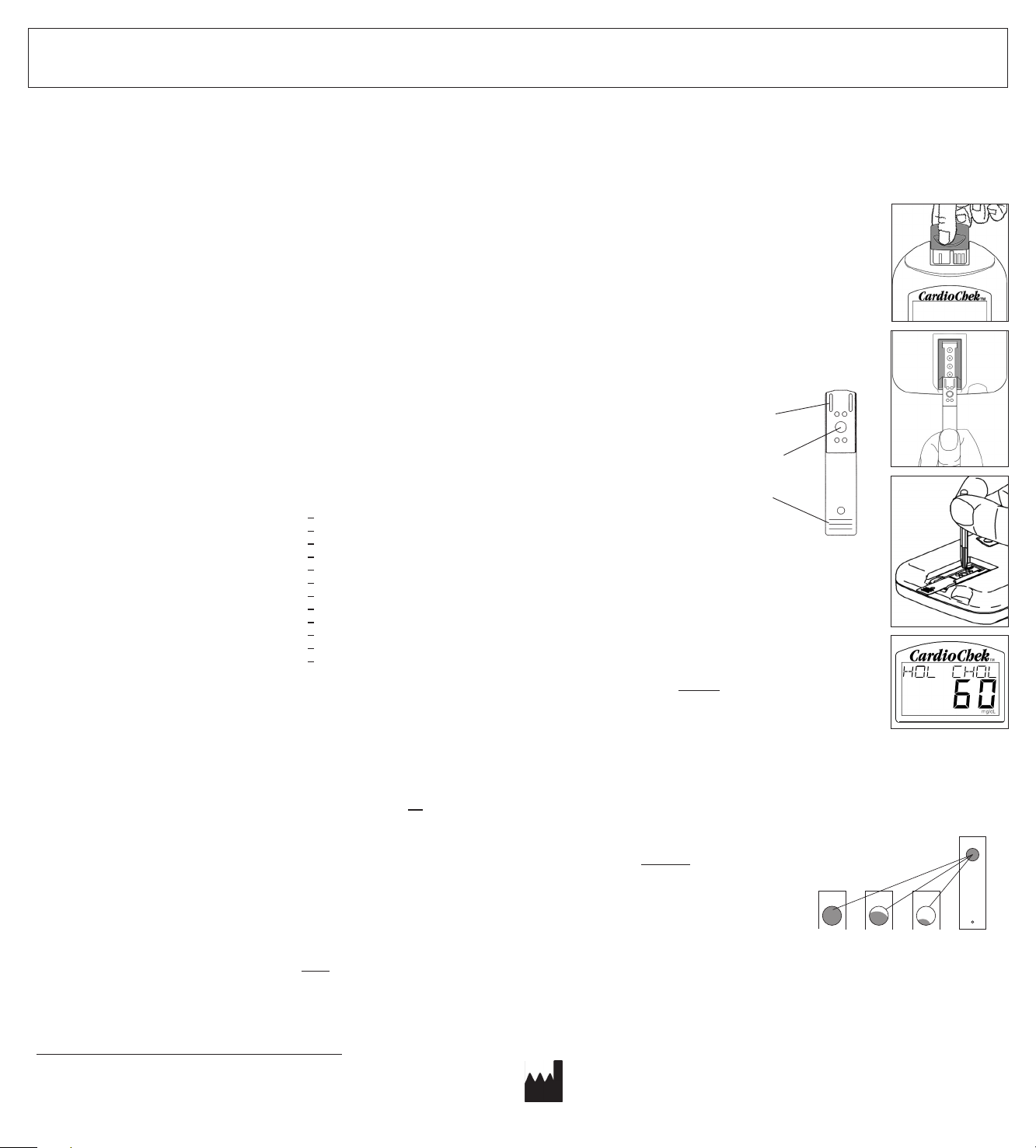
1. Insert the MEMo Chip that matches the lot number on the
test strip vial and press one of the buttons to turn the
analyzer ON.
2. Hold the test strip by the end with the horizontal raised
lines. Insert the opposite end of the strip into analyzer.
Push the strip in as far as it will go.
Ribs that guide the strip into
the analyzer
Blood application window
Hold strip by this end.
3. When APPLY SAMPLE appears on the display, use a
capillary blood collector or pipet to apply 15 µL of whole
blood to the test strip blood application window.
4. In about a minute, the result will appear on the display.
Remove and discard strip. DO NOT
add more blood to a
test strip that has been used.
ADDITIONAL CONSIDERATIONS
1. If no result is displayed, make sure:
– Enough blood was added to the test strip to completely fill the blood application window.
– Analyzer is ON. (If it won’t turn ON, refer to analyzer User Guide section on changing
batteries.)
– MEMo Chip is properly installed in port.
2. If you get a reading of, “<___”, “ >___” or any
unexpected result, test again.
3. See analyzer User Guide Troubleshooting section
for additional help.
4. To verify enough blood has been applied to the test
strip, remove strip after testing and check back side
of reac tion area. Reaction area should be
completely and evenly colored. If the area is not
completely and evenly colored, discard the used
test strip and test again.
Manufactured by
Polymer Technology Systems, Inc.
Indianapolis, IN 46268 USA
CUSTOMER SERVICE (877) 870-5610 (toll-free inside the U.S.)
(317) 870-5610 Fax (317) 870-5608
Enough
blood
Examples of not
enough blood
Back of
Test Strip
Page 2
TEST RESULTS
Results are displayed in either milligrams per deciliter (mg/dL) or in milli moles per liter (mmol/L). The
mg/dL measurement is a US version, while mmol/L is used in many countries around the world. The
analyzer is preset to US units by the manufacturer. No calculation of results is necessary. To change to
INTL (mmol/L) units, please see the analyzer User Guide.
QUALITY CONTROL
Please refer to the analyzer User Guide for the proper pro cedure and materials to be used to perform
Quality Control tests. Quality Control tests are used to ensure that the system (analyzer, strips, and
MEMo Chip) is working properly. Users should run controls when results are questionable or to comply
with their own facility’s quality control requirements.
EXPECTED VALUES
Blood cholesterol levels will vary from time to time depending on food consumed, activity levels, health
status, medication dosages, stress or exercise.
The expected or reference ranges recommended are from the US National Cholesterol Education
Program (NCEP) 2001 Guidelines and are:
40 mg/dL and below (1.04 mmol/L) - Low (increased risk for coronary heart disease)
•
9
• 60 mg/dL and above (1.55 mmol/L and above) - High (decreased risk of coronary heart disease)
A healthcare professional will discuss values that are specifically appropriate for each patient.
ALWAYS CONSULT A HEALTHCARE PROFESSIONAL BEFORE MAKING ANY CHANGES IN
TREATMENT PLANS OR MEDICATION.
MEASURING RANGE
The HDL cholesterol test system will detect HDL levels from 25-85 mg/dL (0.65-2.20 mmol/L) and will
display a number value for results in this range. If the display reads “<___” (less than measuring range),
the HDL cholesterol level is below 25 mg/dL (0.65 mmol/L). Results above 85 mg/dL (2.20 mmol/L) will
read “ >___” (greater than measuring range). If a “ < ” or “ > ” result is displayed, always test again.
At least two measurements of HDL Cholesterol on sepa rate occasions should be made before a
medical decision is made, since a single reading may not be representative of a patient’s usual HDL
Cholesterol concentration.
This test does not replace a lipid panel run by a laboratory. Never make any medical decisions based
on your results. Always contact your healthcare professional for advice.
LIMITATIONS OF THE PROCEDURE
1. PRESERVATIVES: Blood samples preserved with Fluoride or Oxalate should not be used for
testing with this system. EDTA and Heparin do not interfere with the test. Fresh whole blood is
the specimen of choice.
2. NEONATAL USE: This product has not been tested using neonatal blood. Until testing is done
this test system should not be used on neonatal blood samples.
3. METABOLITES: Reducing substances such as Vitamin C may falsely decrease the test result.
4. Bilirubin up to 10 mg/dL and hemoglobin up to 750 mg/dL do not interfere. Triglycerides up to
1000 mg/dL do not interfere.
5. HEMATOCRIT: Hematocrit values above 49% may incorrectly lower the test result and below
33% may incorrectly increase the test result.
6. DRUGS: Both dopamine and α-methyldopa interfered at all levels tested starting at levels of
1.75 mg/dL for dopamine and 0.625 mg/dL for α-methyldopa.
PERFORMANCE CHARACTERISTICS
1. ACCURACY:
In a two-site clinical study, correlation was established between a new modified test strip and a
previous formulation of the test strip. HDL cholesterol of forty (40) subjects was measured on
both the new and the previous test strip formulation. The results for the comparison follow.
PTS PANELS HDL Cholesterol New vs. Original
Number of patients = 40
Range of patient results: 29 to 83 mg/dL
slope = 0.835 y-intercept = 5.6 r = 0.96
Bias at 40 mg/dL = -1.0 mg/dL
The following three studies were performed using the original test strip formulation to which the
new test strip was compared above.
A professional clinical study was performed at three sites. HDL cholesterol levels were measured
on fresh capillary blood specimens from 88 persons by healthcare professionals. The HDL
Cholesterol Test Strips were compared to results from an automated HDL method.
PTS PANELS HDL Cholesterol vs. Automated Method
Number of patients = 88
Range of patient results: <25 to >85 mg/dL
slope = 1.1 y-intercept = -4.1 r = 0.89
Bias at 35 mg/dL = -0.2 mg/dL
In another study, the HDL Cholesterol Test Strips were run by professionals on 87 patients from
four sites and results compared to those run on the same patients by the Abell-Kendall method in
a Cholesterol Reference Method Laboratory Network (CRMLN) laboratory. The results were:
PTS PANELS HDL Cholesterol vs. Abell-Kendall Method
Range of patient results: <25 to 80 mg/dL
Slope = 0.85 y-intercept = 2.2 r = 0.85
bias at 35 mg/dL = -3.1 mg/dL
In a consumer study eighty-seven (87) consumers tested their HDL cholesterol with the PTS
PANELS HDL Test Strips. These consumer results were compared to a reference HDL method
that is recommended by the Centers for Disease Control (CDC).
None of the consumers’ results in this study indicated their HDL cholesterol was 35 mg/dL or
greater when their HDL was below 35 mg/dL by the reference method. About 28% of consumers
in this study who tested their own HDL one time obtained results less than 35 mg/dL when their
HDL was 35 mg/dL or higher by the reference method. When the test was repeated, this rate
improved to 16%. This means that when you test your own HDL, you may at times get results
below 40 mg/dL when your results are actually above 40 mg/dL. Duplicate testing is especially
important to confirm results below 40 mg/dL.
. PRECISION: A laboratory professional tested twenty replicates of three levels of whole blood for
2
HDL cholesterol. The following results were obtained:
No. of Samples 20 20 20
Mean HDL Cholesterol Conc. (mg/dL) 36.4 45.5 65.0
Std. Deviation (mg/dL) 1.67 2.56 4.73
Coefficient of Variation (%) 4.59 5.63 7.28
Two lay persons tested blood at two levels of HDL cholesterol with the following results:
Lay person 1 Lay person 2
No. of Samples 20 20 20 20
Mean HDL Cholesterol Conc. (mg/dL) 45.8 69.4 45.2 64.3
Std. Deviation (mg/dL) 2.73 5.06 2.95 3.34
Coefficient of Variation (%) 5.97 7.29 6.52 5.19
This means that results should not vary more than about 8%.
3. INTERFERENCES: See LIMITATIONS section.
AVAILABILITY
REF/CAT NO. DESCRIPTION
1714 PTS PANELS HDL Cholesterol Test Strips – 25 Tests
1715 PTS PANELS HDL Cholesterol Test Strips – 6 Tests
1788 PTS PANELS HDL Cholesterol Test Strips – 3 Tests
730 / 1709 CardioChek Analyzer
1708 CardioChek P•A Analyzer
722 PTS PANELS HDL Cholesterol Controls – Level 1 & Level 2
CLIA INFORMATION (US only)
Complexity Categorization: Waived
REFERENCES
1. Data on file, Polymer Technology Systems, Inc., Indianapolis, IN 46268.
2. Clinical Diagnosis and Management by Laboratory Methods, Eighteenth Edition, John Bernard Henry, Editor,.
W.B. Saunders Company, Philadelphia, 1991.
3. NCCLS Proposed Guideline EP6-P, Evaluation of the Linearity of Quantitative Analytical Methods. Villanova,
PA: National Committee for Clinical Laboratory Standards, 1986.
4. NCCLS Tentative Guideline EP7-T. Interference Testing in Clinical Chemistry. Villanova, PA: National
Committee for Clinical Laboratory Standards, 1986.
5. National Cholesterol Education Program. Report of expert panel on detection, evaluation, and treatment of high
blood cholesterol in adults. National Heart, Lung and Blood Institute, NIH, Bethesda, MD, Arch. Int. Med.,
148:36-69 (1988).
6. NCCLS. User evaluation of precision performance of clinical chemistry devices: tentative guidelines.
1984:2(1):1-48.EP5-T.
7. National Cholesterol Education Program. ATP III Guidelines At-A-Glance Quick Desk Reference. National
Institutes of Health. National Heart, Lung and Blood Institute. NIH Publication No. 01-3305, May 2001.
CUSTOMER SERVICE
Customer Service is available to answer questions regarding the CardioChek brand analyzers and
PTS Panels Test Strips. Outside Customer Service hours, please contact your healthcare professional.
(877) 870-5610 (8 a.m. – 5 p.m. EST, M-F toll-free inside the USA)
(317) 870-5610, FAX 1 (317) 870-5608
E-mail [email protected]
© 2006 by Polymer Technology Systems, Inc.
The CardioChek brand analyzers and PTS PANELS Test Strips are manu fac tured in the US by
Polymer Technology Systems, Inc., Indianapolis, IN 46268 USA.
0197
AUTHORIZED EUROPEAN REPRESENTATIVE
per IVDD 98/79/EC
MDSS GmbH
D-30163 Hannover, Germany
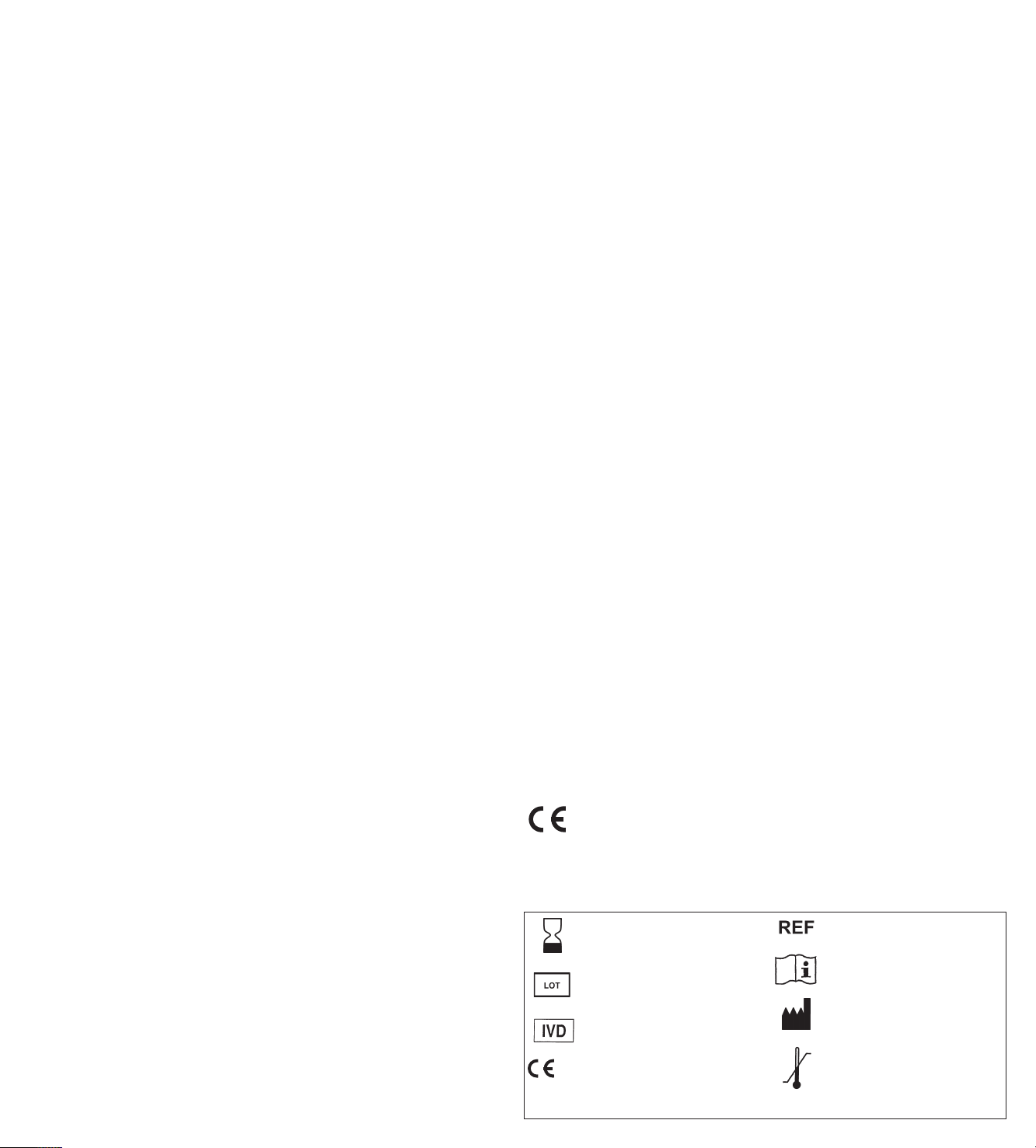
Explanation of Symbols
Use By/Expiration date
Batch Code/Lot number
For in vitro diagnostic use
This product fulfils the requirements
0197
of Directive 98/79/EC on in vitro
diagnostic medical devices.
Catalog number
Consult instructions for use
Manufacturer
Store at/Temperature limitation
 Loading...