

Page 1

Polar Soft Strap
Polar H1 Heart Rate Sensor
Polar H2 Heart Rate Sensor
User Manual
Page 2
B3
B2
B1
A1
A2
B4
Page 3

ENGLISH
This user manual contains instructions for Polar
Soft strap, and Polar H1 and H2 heart rate
sensors. The model of your heart rate sensor is
printed on the connector.
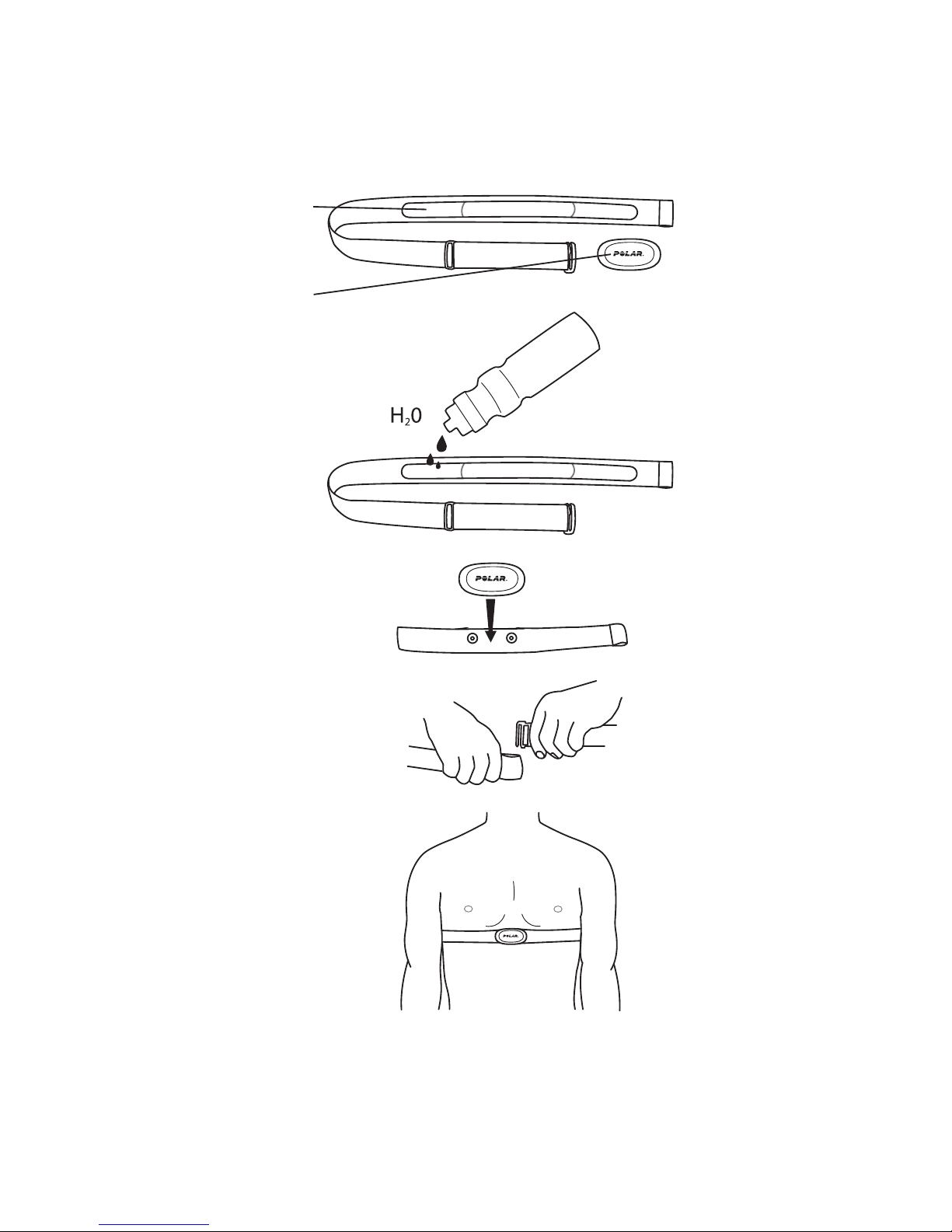
Please follow the pictures on the front and back
covers.
Heart Rate Sensor Parts
1. The plastic electrode areas on the reverse
side of the strap detect heart rate. Picture
A1.
2. The connector sends the heart rate signal
to the training computer. Picture A2.
Polar heart rate sensors enable training in a
group without interference from other heart rate
sensors.
Heart rate sensors with Polar specific
magnetic data transmission technology, e.g.
Polar H1 and H2, can be used with compatible
gym equipment.
Wear the Heart Rate Sensor
1. Moisten the electrode areas of the strap.
Picture B1.
2. Attach the connector to the strap. Picture
B2.
3. Tie the strap around your chest, just below
the chest muscles, and attach the hook to
the other end of the strap. Picture B3.
4. Adjust the strap length to fit tightly but
comfortably.
1
Page 4

5. Check that the moist electrode areas are
firmly against your skin and that the Polar
logo of the connector is in a central and
upright position. Picture B4.
Detach the connector from the strap and rinse
the strap under running water after every use.
Sweat and moisture may keep the electrodes
wet and the heart rate sensor activated. This
will reduce the battery life.
See detailed washing instructions in the Caring
for Your Heart Rate Sensor section.
Using a New Heart Rate Sensor
When you purchase a new Polar H2 heart rate
sensor, it has to be paired with the training
computer in order to measure your heart rate.
See your Polar training computer's user manual
for instructions on how to take the heart rate
sensor into use.
Using Your Heart Rate Sensor in Water
Polar H1 and Polar H2 heart rate sensors can
be used in water activities with training
computers that use magnetic data transmission.
Please notice that sea and pool water are very
conductive, and electrodes may short-circuit,
preventing ECG signals from being detected by
the heart rate sensor.
When using a bathing suit, the best
performance is achieved by wearing the heart
rate sensor underneath it.
Caring for Your Heart Rate Sensor
The heart rate sensor is a high-tech instrument
that should be handled with care. Follow the
caring instructions to ensure reliable
measurement and to maximize the life span of
the heart rate sensor. The following instructions
will help you fulfill guarantee obligations.
2
Page 5

Connector: Detach the connector from the strap
after every use and dry the connector with a soft
towel. Clean the connector with a mild soap and
water solution when needed. Never use alcohol
or any abrasive material (eg. steel wool or
cleaning chemicals).
Strap: Rinse the strap under running water after
every use and hang to dry. Clean the strap
gently with a mild soap and water solution when
needed. Do not use moisturizing soaps, because
they can leave residue on the strap. Do not
soak, iron, dry clean or bleach the strap. Do not
stretch the strap or bend the electrode areas
sharply.
Dry and store the strap and the connector
separately, to maximize the heart rate sensor
battery lifetime. Keep the heart rate sensor in
a cool and dry place. Do not store the heart rate
sensor wet in non-breathing material, such as a
sports bag, to prevent snap oxidation. Do not
expose the heart rate sensor to direct sunlight
for extended periods.
Check the label on your strap to see if it is
machine washable. Never put the strap or the
connector in a dryer!
Service
During the two-year guarantee/warranty period
we recommend that you have service, other than
battery replacement, done by an authorized
Polar Service Center only. The warranty does not
cover damage or consequential damage caused
by service not authorized by Polar Electro.
3
Page 6

Changing Battery
All connectors have user changeable batteries.
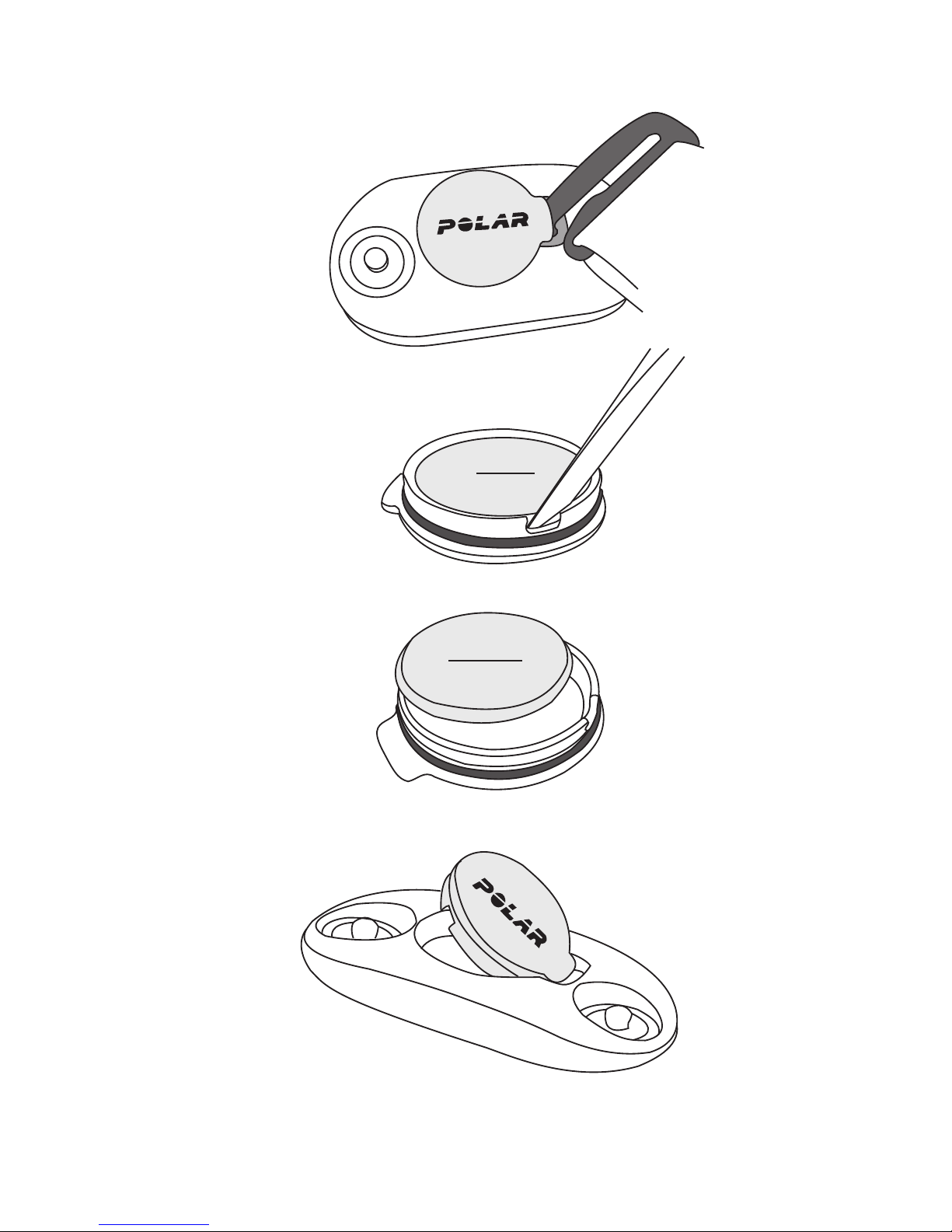
To change the battery yourself, follow the
instructions below, and see the markings on the
connector and pictures on the back cover of this
user manual.
1. Lever the battery cover open by using the
clip on the strap. Picture C1.
2. Remove the old battery from the battery
cover with a suitable sized small ridgid
stick or bar, such as a toothpick. A
non-metal tool is preferable. Be careful not
to damage the battery cover. Picture C2.
3. Insert a new battery (CR 2025) inside the
cover with the negative (-) side facing up.
Picture C3.
4. Align the ledge on the battery cover with
the slot on the connector and press the
battery cover back into place. You should
hear a snap. Picture C4.
When changing the battery, make sure the
sealing ring is not damaged, in which case you
should replace it with a new one to ensure the
water resistance of the connector.
You can purchase the sealing ring/battery kits at
well-equipped Polar retailers and authorized
Polar Services. In the USA and Canada, the
additional sealing rings are available at
authorized Polar Service Centers.
Keep batteries away from children. If
swallowed, contact a doctor immediately.
Batteries should be properly disposed of
according to local regulations.
Caution: Risk of explosion if battery is replaced
by an incorrect type. Dispose of batteries
according to the instructions.
4
Page 7

Precautions
For allergy information, see the listed materials
in Technical Specifications. Avoid skin
reactions by wearing the heart rate sensor over a
shirt, moistened under the electrodes.
The combined impact of moisture and intense
abrasion may cause a black color to come off
the heart rate sensor’s surface, possibly
staining light-colored clothes. If you use
perfume or insect repellent on your skin, you
must ensure that it does not come into
contact with the heart rate sensor.
Technical Specifications
Battery type CR 2025
Battery sealing ring O-ring 20.0 x 0.90
Material Silicone
Polar H1 battery life 1500 h
Polar H2 battery life 800 h
Operating
temperature
14 °F to 122 °F / -10
°C to +50 °C
Connector material ABS
Strap material 38% Polyamide, 29%
Polyurethane, 20%
Elastane, 13%
Polyester
The Polar heart rate sensors apply the following
patented technology, among others:
• OwnCode®coded transmission
5
Page 8
C4
C3
C1
C2
 Loading...