

Page 1
User’s Manual
3 Mega-Pixel Vari-Focal
Bullet IR IP Camera
ICA-3350V
www.PLANET.com.tw
Page 2

Copyright
Copyright © 2012 by PLANET Technology Corp. All rights reserved. No part of this publication
may be reproduced, transmitted, transcribed, stored in a retrieval system, or translated into any
language or computer language, in any form or by any means, electronic, mechanical, magnetic,
optical, chemical, manual or otherwise, without the prior written permission of PLANET.
PLANET makes no representations or warranties, either expressed or implied, with respect to
the contents hereof and specifically disclaims any warranties, merchantability or fitness for any
particular purpose. Any software described in this manual is sold or licensed "as is". Should the
programs prove defective following their purchase, the buyer (and not PLANET, its distributor, or
its dealer) assumes the entire cost of all necessary servicing, repair, and any incidental or
consequential damages resulting from any defect in the software. Further, PLANET reserves the
right to revise this publication and to make changes from time to time in the contents hereof
without obligation to notify any person of such revision or changes.
All brand and product names mentioned in this manual are trademarks and/or
registered trademarks of their respective holders.
Federal Communication Commission Interference St atement
This equipment has been tested and found to comply with the limits for a Class B digital device,
pursuant to Part 15 of FCC Rules. These limits are designed to provide reasonable protection
against harmful interference in a residential installation. This equipment generates, uses, and
can radiate radio frequency energy and, if not installed and used in accordance with the
instructions, may cause harmful interference to radio communications. However, there is no
guarantee that interference will not occur in a particular installation. If this equipment does cause
harmful interference to radio or television reception, which can be determined by turning the
equipment off and on, the user is encouraged to try to correct the interference by one or more of
the following measures:
1. Reorient or relocate the receiving antenna.
2. Increase the separation between the equipment and receiver.
3. Connect the equipment into an outlet on a circuit different from that to which the receiver is
connected.
4. Consult the dealer or an experienced radio technician for help.
FCC Caution
To assure continued compliance. (example-use only shielded interface cables when connecting
to computer or peripheral devices). Any changes or modifications not expressly approved by the
party responsible for compliance could void the user’s authority to operate the equipment.
This device complies with Part 15 of the FCC Rules. Operation is subject to the Following two
conditions: (1) This device may not cause harmful interference, and (2) this Device must accept
any interference received, including interference that may cause undesired operation.
Federal Communication Commission (FCC) Radiation Exposure Statement
This equipment complies with FCC radiation exposure set forth for an uncontrolled environment.
In order to avoid the possibility of exceeding the FCC radio frequency exposure limits, human
proximity to the antenna shall not be less than 20 cm (8 inches) during normal operation.
Safety
This equipment is designed with the utmost care for the safety of those who install and use it.
However, special attention must be paid to the dangers of electric shock and static electricity
2
Page 3

when working with electrical equipment. All guidelines of this and of the computer manufacture
must therefore be allowed at all times to ensure the safe use of the equipment
.
CE Mark Warning
This is a Class A product. In a domestic environment, this product may cause radio interference,
in which case the user may be required to take adequate measures.
WEEE Regulation
To avoid the potential effects on the environment and human health as a result of the
presence of hazardous substances in electrical and electronic equipment, end users
of electrical and electronic equipment should understand the meaning of the
crossed-out wheeled bin symbol. Do not dispose of WEEE as unsorted municipal
waste and have to collect such WEEE separately.
Revision
User’s Manual for PLANET 3 Mega-Pixel Vari-Focal Bullet IR IP Camera
Model: ICA-3350V
Rev: 1.0 (May. 2012)
Part No. EM-ICA3350V_v1.0
3
Page 4

Table of Content
1. Introduction......................................................................................................5
1.1 Overview .................................................................................................5
1.2 Features ..................................................................................................5
1.3 Package Contents ...................................................................................6
2. Basic Setup .....................................................................................................8
2.1 System Requirement...............................................................................8
2.2 Physical Description ................................................................................9
2.2.1 Identification of ICA-3350V physical detail....................................9
2.2.2 I/O Control Instruction.................................................................10
2.2.3 Adjust zoom/focus of lens...........................................................12
2.3 Hardware Installation.............................................................................13
2.4 Initial Utility Installation ..........................................................................14
2.5 Preparation............................................................................................16
2.5.1 Search and View by PLANET IP Wizard II..................................16
2.5.2 Configure Network by PLANET IP Wizard II ...............................18
2.6 Using UPnP of Windows XP or Vista.....................................................20
2.6.1 Windows XP ...............................................................................20
2.6.2 Windows Vista ............................................................................24
2.6.3 Windows 7 .................................................................................. 25
2.7 Setup ActiveX to use the Internet Camera ............................................26
2.7.1. Internet Explorer 6 for Windows XP............................................26
2.7.2. Internet Explorer 7 for Windows XP............................................27
2.7.3. Internet Explorer 7 for Windows Vista.........................................28
3. Web-based Management ..............................................................................30
3.1 Introduction............................................................................................30
3.2 Connecting to Internet Camera .............................................................30
3.3 Live View ...............................................................................................32
3.4 ActiveX Control......................................................................................34
3.4.1. Digital Zoom................................................................................34
3.4.2. Record ........................................................................................35
3.4.3. Snapshot.....................................................................................35
3.4.4. Volume........................................................................................36
3.4.5. About ..........................................................................................36
3.5 Network Configuration ...........................................................................37
3.5.1. Network.......................................................................................37
3.5.2. IPv6 ............................................................................................39
3.5.3. HTTPS........................................................................................39
3.5.4 DDNS server...............................................................................40
3.5.5. PPPoE ........................................................................................41
3.5.6. Streaming....................................................................................42
3.5.7. UPnP ..........................................................................................43
3.5.8. Bonjour .......................................................................................44
3.5.9. ONVIF.........................................................................................45
3.5.10. IP Filter .....................................................................................45
3.5.11. IP Notification ............................................................................ 46
4
Page 5

3.6 Camera Configuration ...........................................................................48
3.6.1. Picture.........................................................................................48
3.6.2. Privacy Mask ..............................................................................50
3.6.3. PTZ Setting.................................................................................51
3.6.4. Preset Setting .............................................................................52
3.6.5. Tour Setting.................................................................................52
3.7 System ..................................................................................................54
3.7.1. System........................................................................................54
3.7.2. Date & Time ................................................................................55
3.7.3. Maintenance ............................................................................... 56
3.8 Video .....................................................................................................58
3.8.1. Common .....................................................................................58
3.8.2. Overlay Image ............................................................................58
3.8.3. Video Profile ...............................................................................59
3.8.4. ROI .............................................................................................60
3.9 Audio Configuration ...............................................................................61
3.10 User Privilege Access Configuration................................................... 63
3.11 E-Mail Configuration ...........................................................................64
3.12 Object Detection .................................................................................65
3.13 Storage Configuration .........................................................................66
3.13.1 SD Card.....................................................................................66
3.13.2 SAMBA Server...........................................................................67
3.14 Continuous Recording ........................................................................68
3.15 Recording List.....................................................................................68
3.16 Event Server Configuration.................................................................70
3.16.1 FTP Server ................................................................................70
3.16.2 TCP Server ..............................................................................71
3.16.3 HTTP Server ............................................................................72
3.16.4 SAMBA Server .........................................................................73
3.17 Event Schedule Configuration ............................................................74
3.17.1 Setting .......................................................................................74
3.17.2 Record Configuration.................................................................78
3.17.3 Port Status .................................................................................78
Appendix A: PING IP Address ...........................................................................79
Appendix B: 3GPP Access.................................................................................80
Appendix C: Bandwidth and Video Size Estimation ...........................................81
Appendix D: DDNS Application ..........................................................................82
Appendix E: Configure Port Forwarding Manually .............................................83
Appendix F: Power Line Frequency...................................................................86
Appendix G: Troubleshooting & Frequently Asked Questions............................87
Appendix H: Product Specification.....................................................................92
5
Page 6

1. Introduction
PLANET ICA-3350V is the new 3 Mega-Pixel Outdoor Vari-Focal Bullet PoE IP Camera featuring
25M IR function. It provides Full HD Resolution (2048 x 1536) and supports the highest video
compression – H.264 to offer the best Internet video surveillance solution for securing your
property and life.
Multi Profiles Streaming
The Multi-profile Streaming function enables the ICA-3350V to generate H.264, MPEG-4 and
M-JPEG streaming simultaneously, and differentiate users in different resolutions and frame rates.
This state-of-the-art design is considerable to fit in various network environments.
Weather Proof IP66 Protection
With the Aluminum rugged all-weather IP66 housing enclosure, the ICA-3350V infrared PoE IP
Camera performs reliable operation in any environment.
Flexible Application by PoE Feature
Compliant with IEEE 802.3af PoE interface, the ICA-3350V can be located in places where there
are no power outlets. And through power feeding over Ethernet to the ICA-3350V, the installers
are fearless of the power breakdown as it can be powered from the system’s UPS.
Day & Night Operations
There are 24 IR illuminators built around the lens of the ICA-3350V bringing you the clearest vision
at night. Via the new LED technology, the illuminator ensures high-quality monochrome images in
complete darkness up to 25 meters. The ICA-3350V also offers high flexibility to be applied in
various kinds of IP surveillance environment as it has built-in ICR (IR-Cut filter Removable) for day
/ night capability supporting low light surveillance at low lux.
ONVIF Certified / Professional Management Software
The ICA-3350V follows the standard SDK for user to easily integrate with the third party’s software.
The ICA-3350V can work perfectly with the PLANET Cam Viewer Three Lite / Pro Management
software and Network Video Recorder products for monitoring, recording and event management
of video surveillance applications.
1.1 Overview
This user’s guide explains how to operate this camera from a computer. User should read this
manual completely and carefully before you operate the device
1.2 Features
Camera
3 Mega-Pixel CMOS sensor Built in
24 IR LEDs support up to 25 meters visible distance at night
Vari-Focal Lens: f 3.0-9.0mm with auto Iris and ICR
40 ~ 97 degree horizontal / 30 ~ 81 degree vertical angle of view
High Resolution Video Preview: QXGA (2048 x 1536) pixels
Min Illumination: 0.5 lux @ F1.2
Intelligent motion detection up to 10 zones
5
Page 7

ICR for day and night sharp vision surveillance
Video
Multi-Profile encoder supports H.264 / MPEG-4 and M-JPEG video compression
simultaneously
Supports Variable Bit Rate and Constant Bit Rate and Enhanced Variable Bit Rate
3MP resolution or 1080p mode selectable
Up to 30fps for all resolutions
Digital WDR to provide clear images even under back light circumstances
3D de-noise to improve picture quality at low Lux
Audio
2-Way Audio and 3GPP for Real Time surveillance communication
Sensor input and alarm output
Network and Configuration
Gigabit 1000Base-T Ethernet
Easy configuration and management via Windows-based utility or web interface
Compliant with IEEE 802.3af PoE interface for flexible deployment
20-profile encoder simultaneously
UDP / TCP / HTTP / HTTPS protocols selectable
Cam Viewer 3 Central management software supported
System Integration
Store-To-NAS function enables video files saved without operating software
DDNS, PPPoE and FTP uploading support more alternatives in surveillance network
ONVIF standard supported
3GPP for 3G mobile remote applications
UPnP device discovery and NAT router transversal for easy installation
IP66 outdoor classifications with fan for rigorous environment
Environment
RS485 interface for P/T scanner control
Analog video (BNC) output, works with conventional video devices such as TV Monitors,
analog DVRs
1.3 Package Contents
User can find the following items in the package:
Camera unit x 1
Power Adapter x 1
Accessory Kit x 1
User’s Manual CD x 1
Quick Installation Guide x 1
6
Page 8

NOTE:
1. If any of the above items are missing, please contact your dealer immediately.
2. Using the power supply that is not the one included in Internet Camera packet
will cause damage and void the warranty for this product.
7
Page 9

2. Basic Setup
This chapter provides details of installing and configuring the Internet Camera.
2.1 System Requirement
The Internet Camera can be monitoring on all of Windows operating system that suggest with
system requirment below in order to got better video performance.
CPU
RAM
Video RAM
Display Resolution
Operating System
DirectX
Network
NOTE: 1. The listed information is minimum system requirements only. Actual requirement
will vary depending on the nature of your environment.
2. The ICA-3350V series can be managed by PLANET IP Wizard II if you want to
configure more detail information and settings of PLANET IP Wizard II software
please refer to the CD-ROM folder “D:\Utility\IPWizardII\setup.exe”, assume D is
your CD-ROM drive.
Intel Dual Core 2.4GHz or higher
2GB
(above Recommended)
256MB
1280x1024 24bits
Windows XP / Vista / Win7
10 or above
Wired Ethernet 100Base-TX
(above Recommended )
or above
8
Page 10
g
2.2 Physical Description
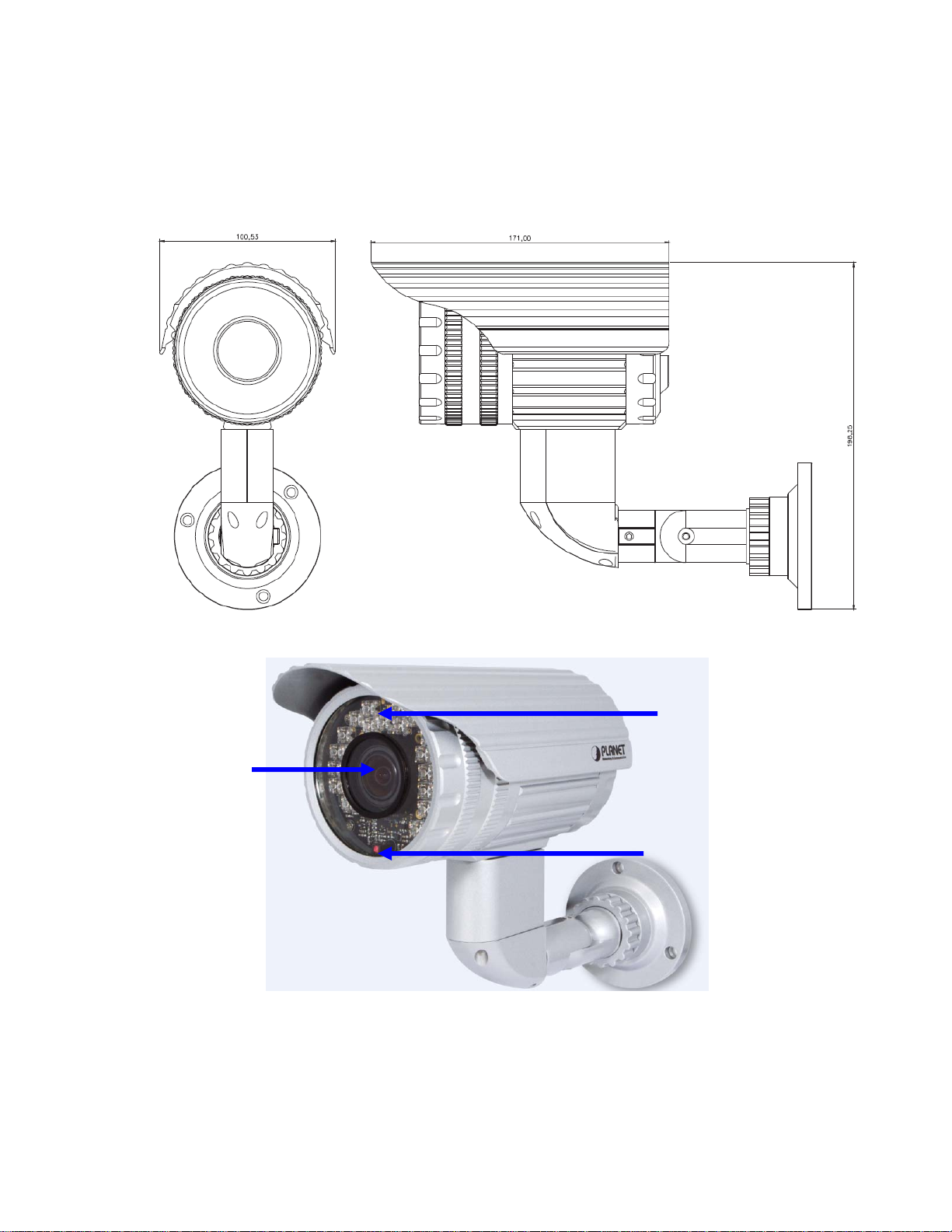
2.2.1 Identification of ICA-3350V physical detail
Front View
Lens
IR LEDs x 24
Li
ht sensor
9
Page 11
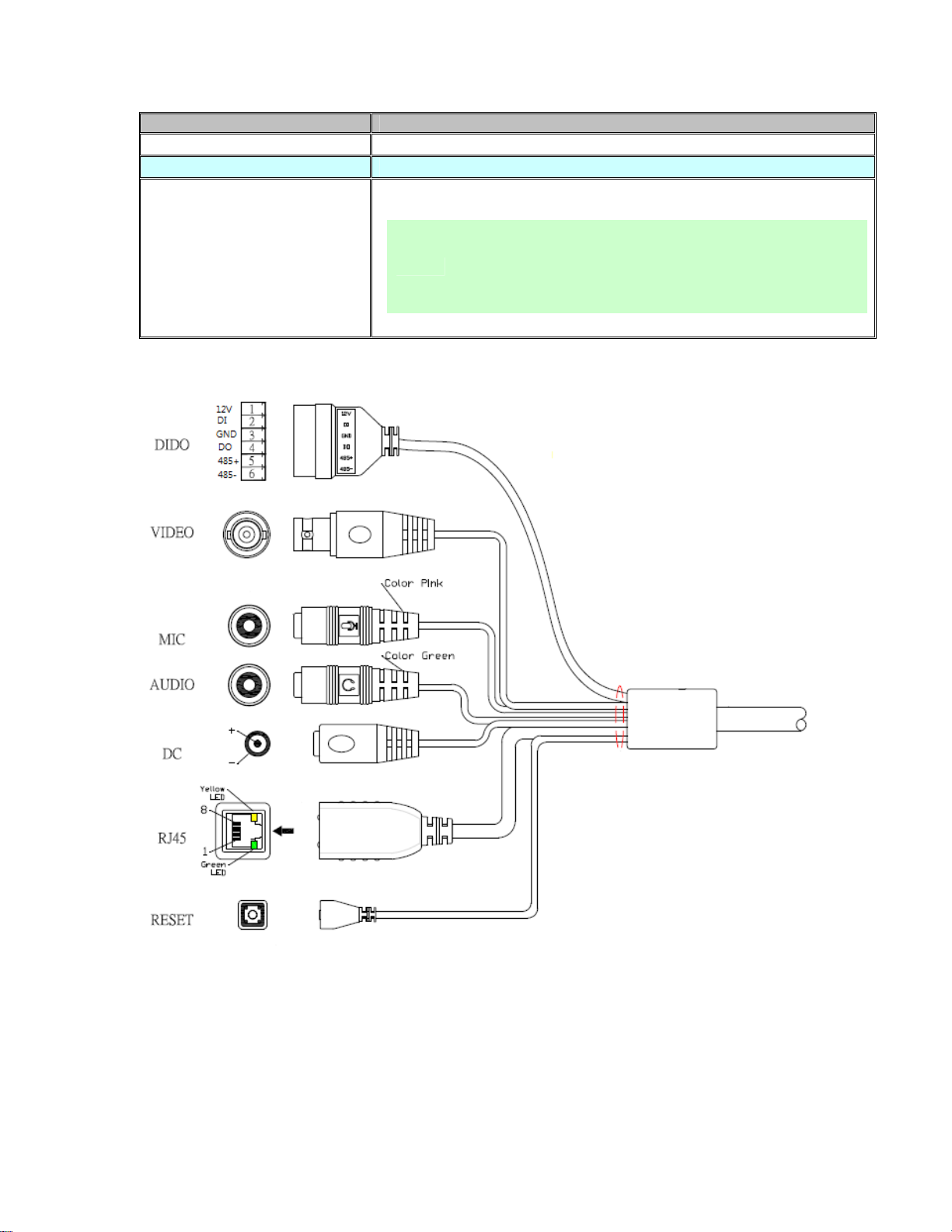
Item Description
Lens
IR LEDs
Light sensor
Lens set. Keep this area clean to keep excellent video quality.
Emits infrared light to provide light source in dark places
Detects the illumination level or the place where this IP camera is
installed, and switches IR LEDs on when it’s required.
2.2.2 I/O Control Instruction
NOTE:
When IR LEDs are switched on, this IP camera will switch
to black and white video mode to enhance video quality.
Do not cover light sensor or this IP camera will work in
black and white mode only.
10
Page 12
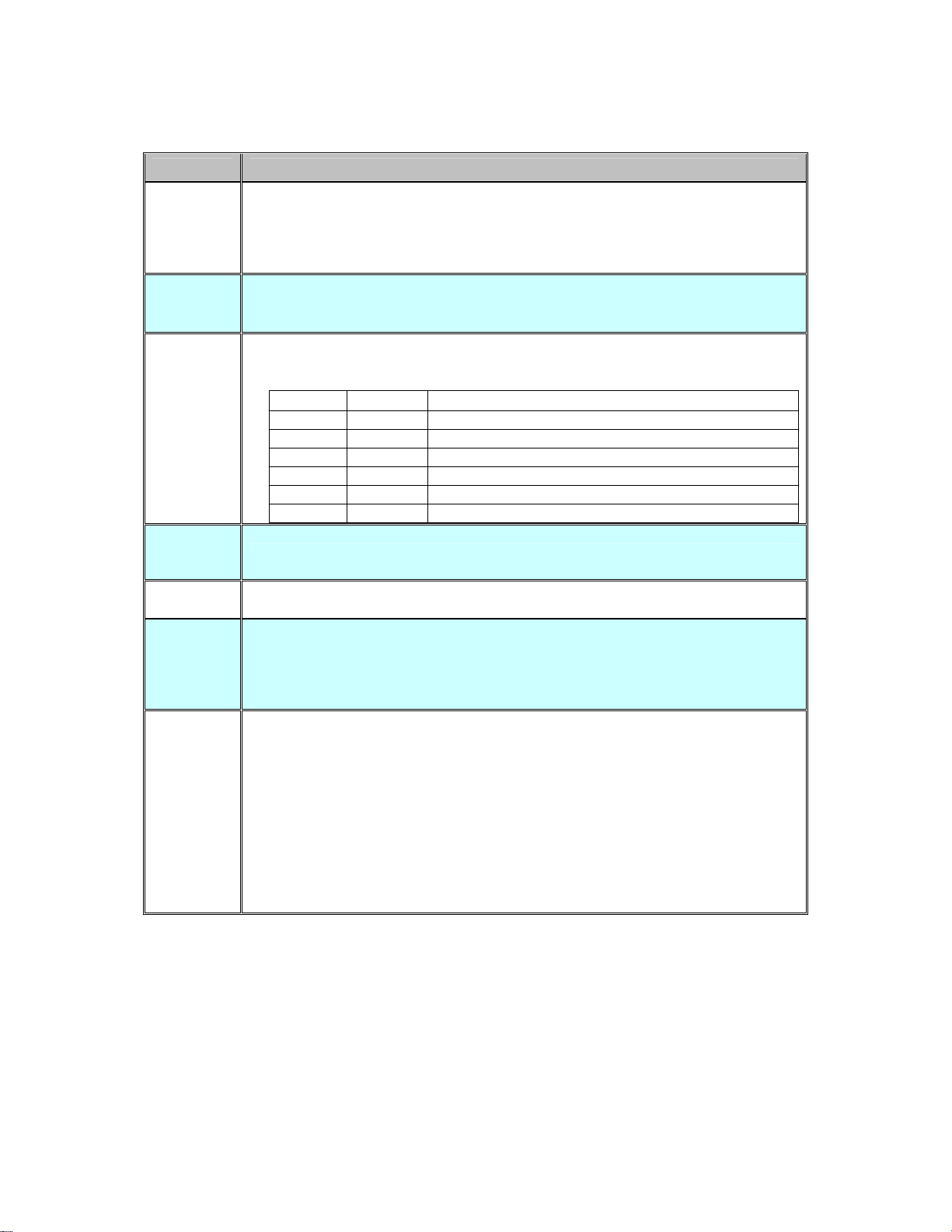
Descriptions for I/O cable set:
Interface Description
Connects to your local area network by Ethernet cable
RJ45 LAN
socket
DC-in Jack
RS-485 &
digital I/O
MIC in
(Audio
in)
Audio out
Video out
(BNC
connec
tor)
Reset
LAN LED (green color)
This LED will be flashing while network accessing via Ethernet
Power LED (orange color)
This LED is used to indicate whether DC power is on or not
DC power input, connect to AC power adapter
Note: that supply the power to the Network Camera with the power
adapter included in package
RS-485:Connect to a local keyboard controller
DI/ DO: Connect to sensor in and alarm out devices
Cable for I/O connectors:
Name Number Function
12VDC 1 DC 12V (50mA maximum)
DI 2 Digital signal input
GND 3 GND
DO 4 Digital signal output
485+ 5 RS485 data +
485- 6 RS485 data -
Connect a microphone to the network camera
Connect a loud speaker to the network camera. This function is for voice alerting
and two-way audio
The Network Camera also provides composite video output. The video output
function is only for easy installation to check view angle and focus. The output is
not a Mega-pixel resolution. Furthermore, only “720p Mode” supports this
function. “2 Mega Mode” does not support it. Please refer to Setting \ Video \
Common chapter
This button is used to restore the all factory default settings. Sometimes
restarting the device will make the system back to a normal state. However, if
the system still got problems after restart, user can restore the factory default
settings and install it again.
Restore the device:
1. While the Camera is ready and then press the button down continuously
2. Hold the button at least 5 seconds and release it. Then the device has been
restored to default settings and reboot again
Note: Restoring the factory default setting will lose the all previous settings
included IP address forever. User needs to run the IPWizard II program to
search the device and configure it to let the device work properly again
11
Page 13
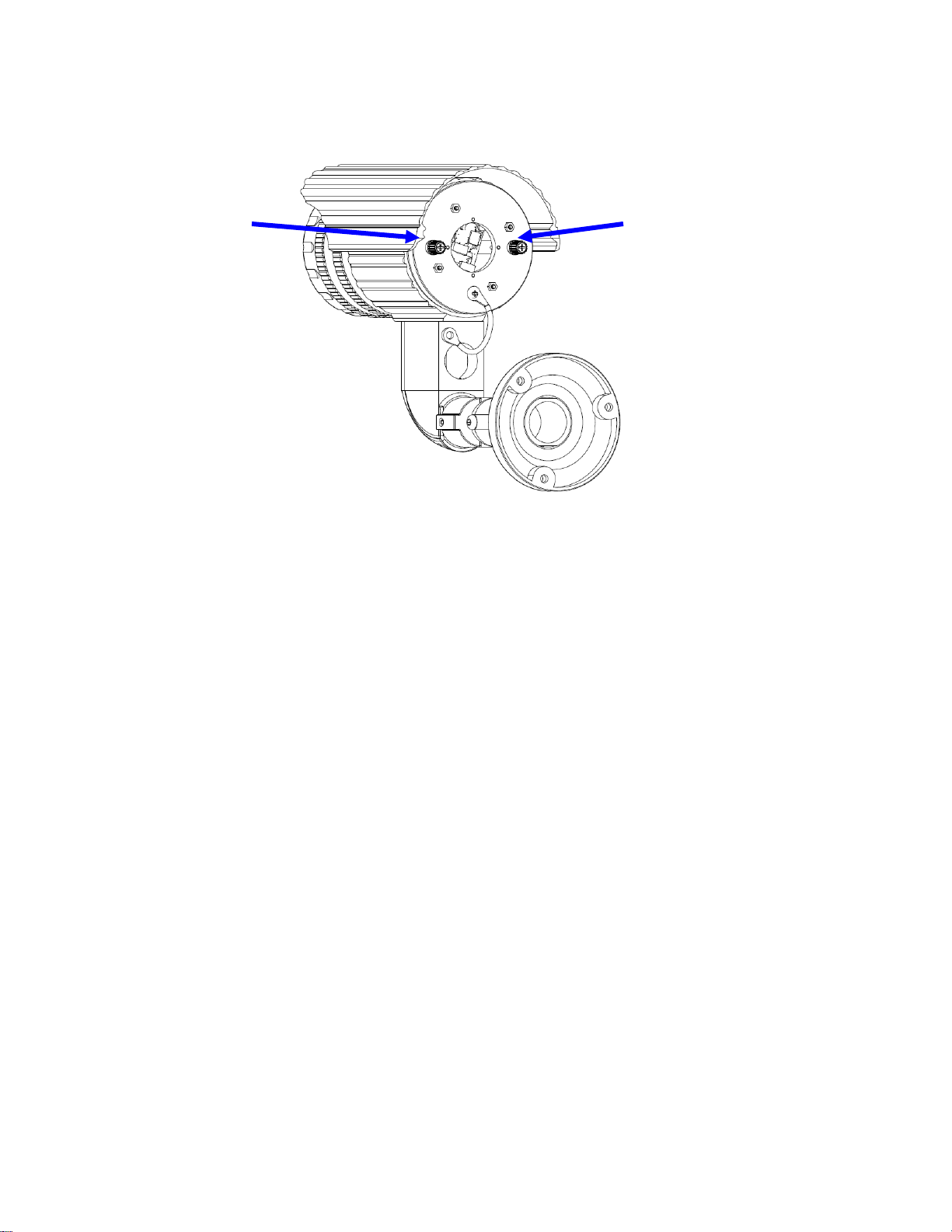
2.2.3 Adjust zoom/focus of lens
Focus stick Zoom stick
1. Open the back cover of the camera
2. Adjust zoom stick first
3. Adjust focus stick to get clear image
4. Close the back cover of the camera tightly. Otherwise, the camera may fail to
waterproof.
12
Page 14
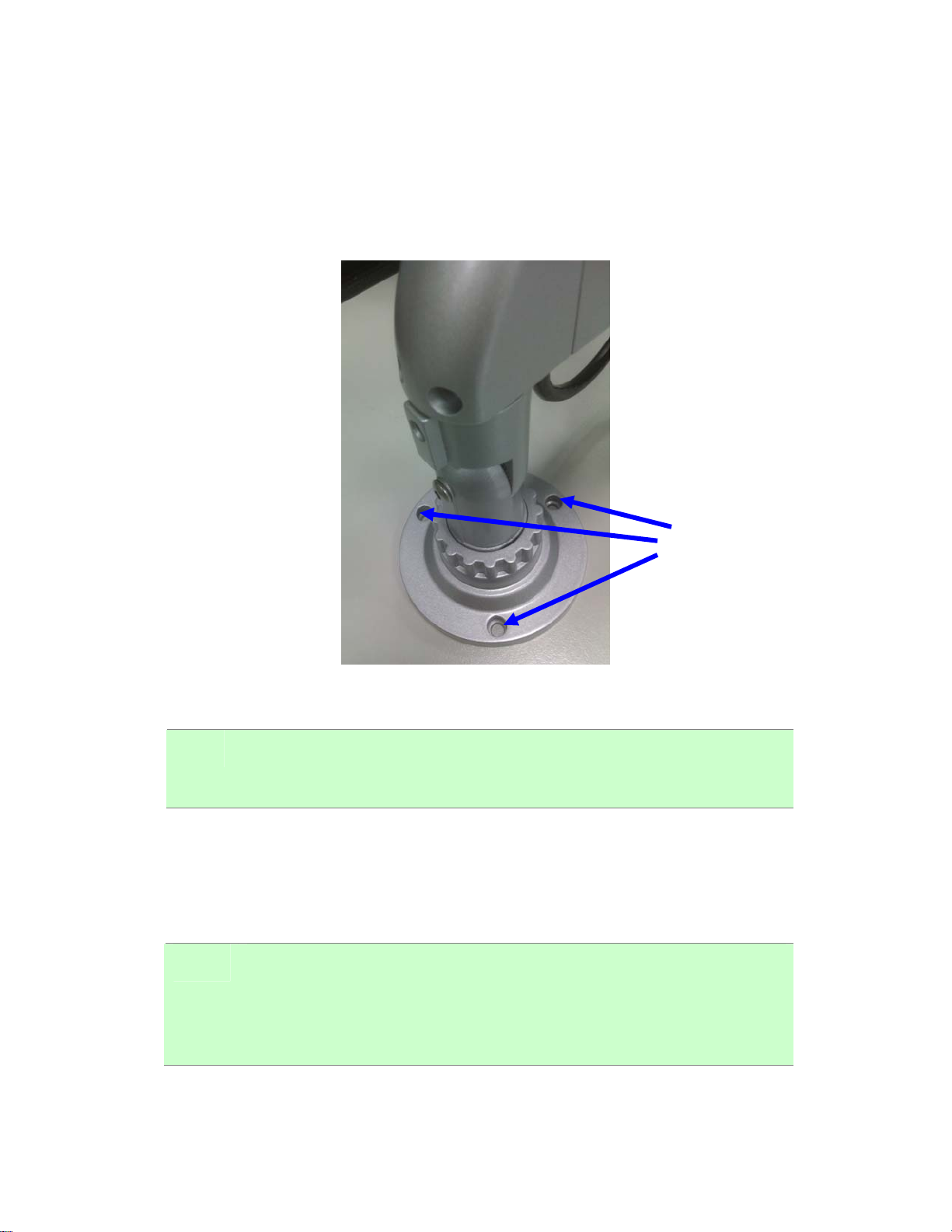
2.3 Hardware Installation
1. Fix IR camera to desired location with stand
Use three screws to fix the Network Camera onto the ceiling or wall. You could also put
the Network Camera on the table directly.
Fixed it by
2. Connect an Ethernet cable
Connect Ethernet cable to IP camera’s Ethernet port.
NOTE: If there has an IEEE802.3af PoE switch in your network, you can connect the
camera LAN cable to this PoE switch to obtain power. The power adapter is
unnecessary when Internet camera is connected to a PoE switch.
3. Connect RS485 D+ and D- (if you need to control PT scanner)
4. Attach the power supply
Plug in power adapter and connect to power source. After power on, the camera will start to
operate.
NOTE: 1. Only use the power adapter supplied with Internet camera Otherwise, the
product may be damaged.
2. The power adapter is unnecessary when Internet camera is connected to a
PoE switch. Otherwise, the product may be damaged when Internet camera
is connected to a PoE switch and power adapter simultaneously.
13
Page 15
5. Attach BNC connector (option)
Connect the video BNC connector to a monitor set if necessary check camera viewing angle and
focus.
6 Attach Speaker to camera (option)
If user needs not only video stream but also audio stream, then the speaker should be attached to
camera.
7. Done
2.4 Initial Utility Installation
This chapter shows how to quick set up your H.264 camera. The camera is with the default
settings. However to help you find the networked camera quickly the windows utility PLANET IP
Wizard II can search the cameras in the network that shall help you to configure some basic
setting before you started advanced management and monitoring.
1. Insert the bundled CD into the CD-ROM drive to launch the auto-run program. Once
completed, a welcome menu screen will appear.
2. Click the “IP Wizard II” hyperlink; you will see the dialog box as below.
NOTE:
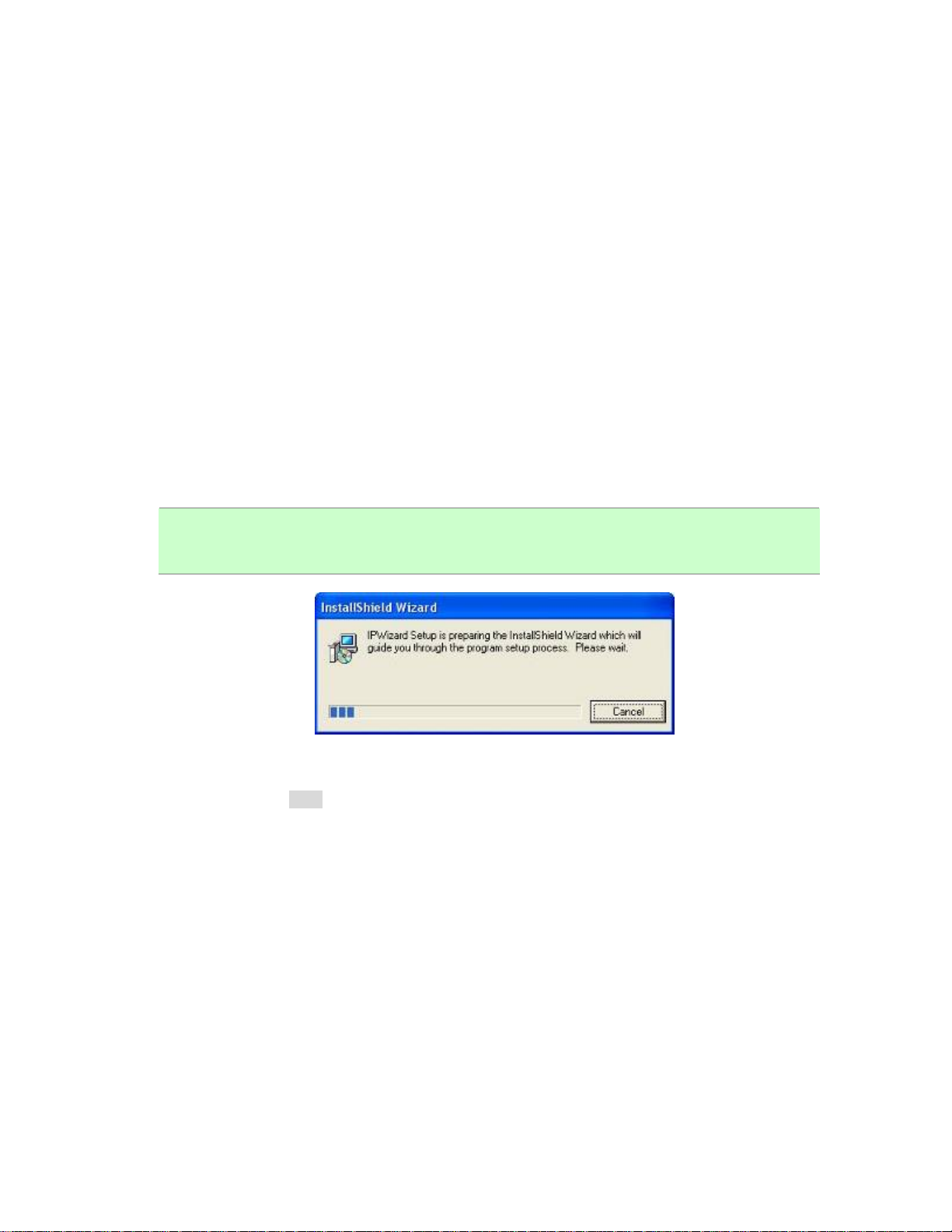
3. The “Welcome to the InstallShield Wizard for PLANET IP Wizard II” prompt will display on the
screen and click “Next” to continue.
If the welcome screen does not appear, click “Start” at the taskbar. Then, select
“Run” and type “D:\Utility\IPWizard II\setup.exe”, assume D is your CD-ROM drive.
14
Page 16
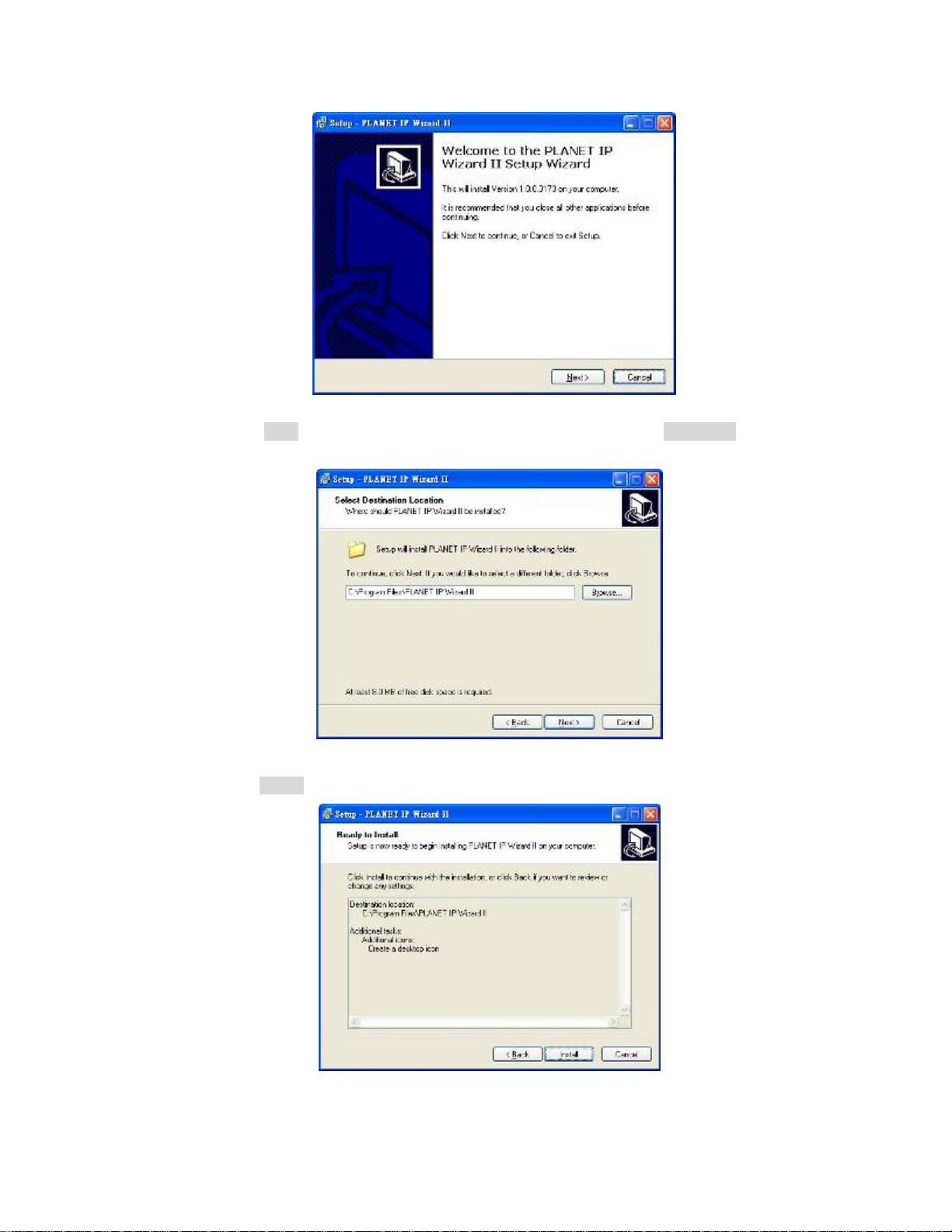
4. Please click “Next” to install with original settings, or you may click “Change…” button to
modify the install folder then press “Next” to continue.
5. Please click “Install” to start the installation.
15
Page 17
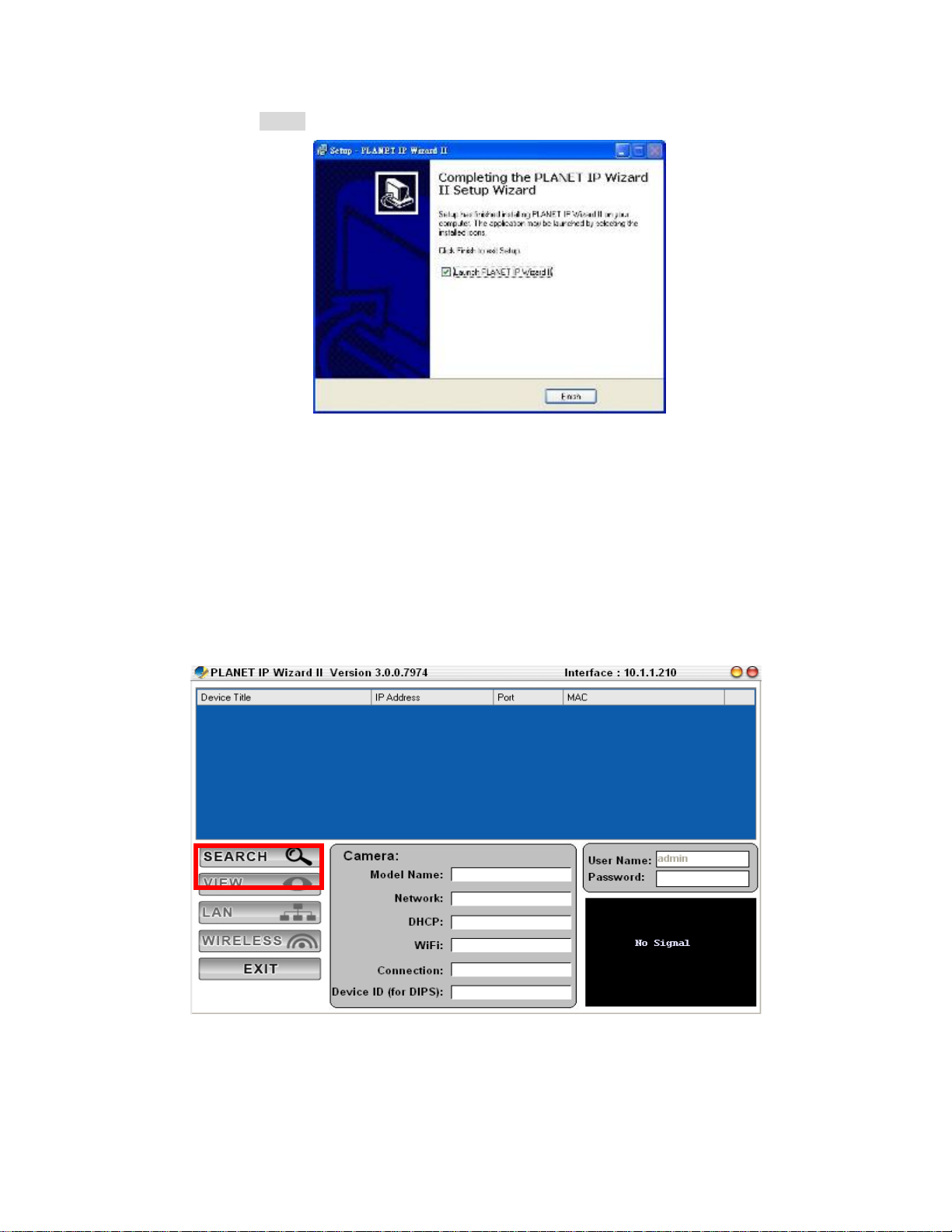
6. Please click “Finish” to complete the installation and launch program immediately.
2.5 Preparation
When you installed the Internet Camera on a LAN environment, you may execute PLANET IP
Wizard II to discover camera’s IP address and set up related parameters in the camera.
2.5.1 Search and View by PLANET IP Wizard II
When you installed the Internet Camera on a LAN environment, you have two easy ways to search
your cameras by PLANET IP Wizard II or UPnP discovery. Here is the way to execute PLANET IP
Wizard II to discover camera’s IP address and set up related parameter in a camera.
Search
16
Page 18
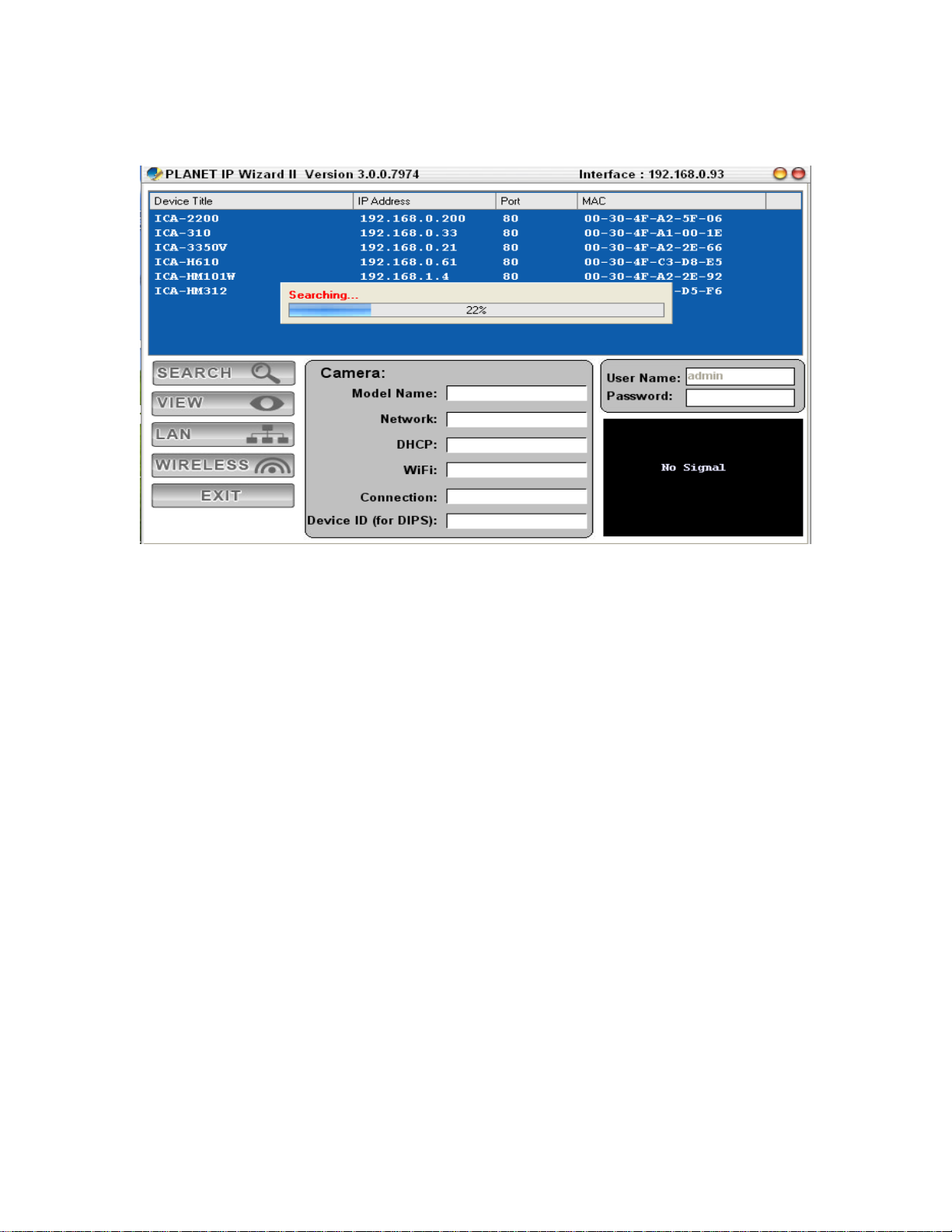
When launch the Planet IP Wizard II, a searching windows will pop up. Planet IP Wizard II is
starting to search Internet Cameras on the LAN. The existed devices will be listed as below.
17
Page 19
View
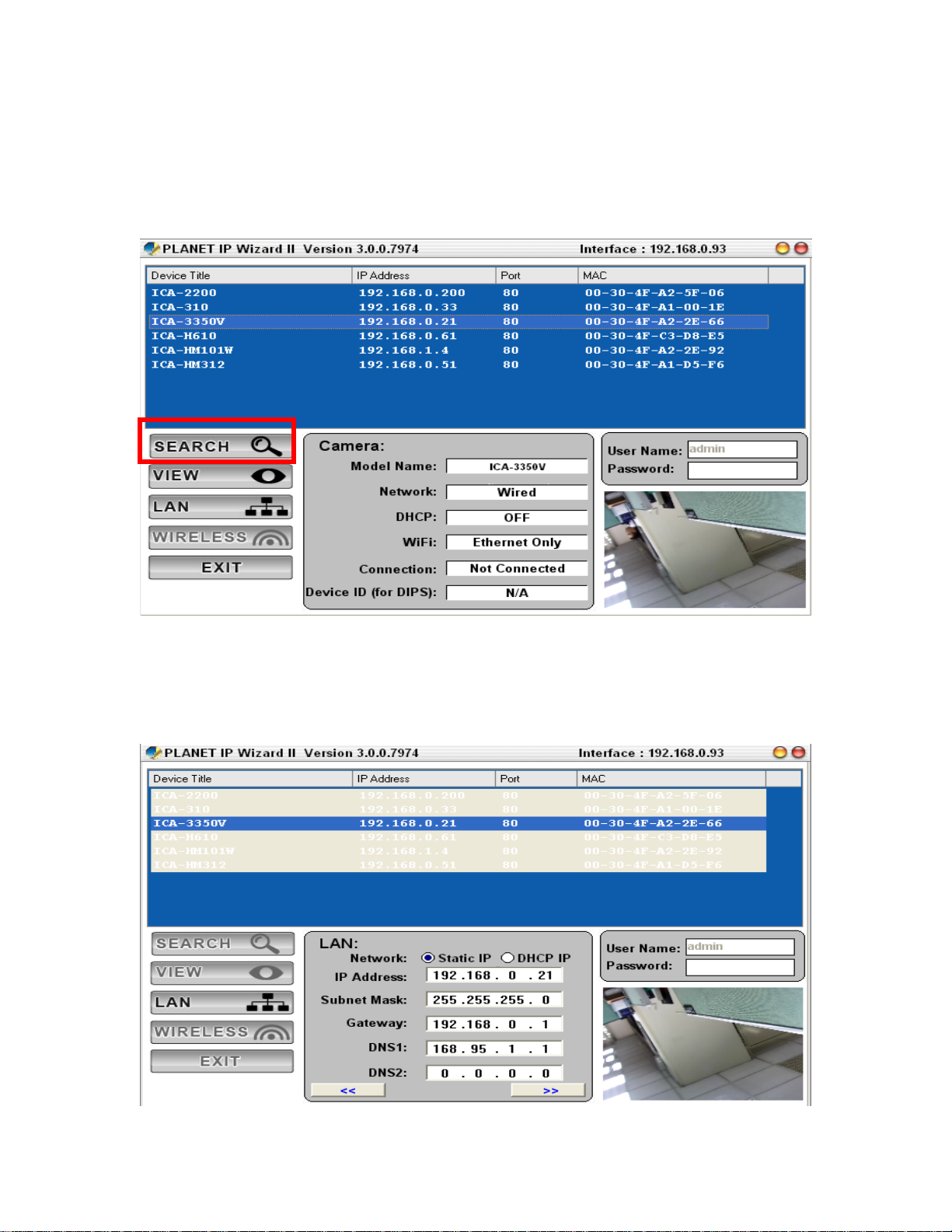
If Planet IP Wizard II finds Internet Camera, View button will be available. Please
select the camera you want to view and click the View button. Then you could see
the Video from camera directly. Furthermore you could double click the left button
of mouse to link to the Internet Camera by browser.
2.5.2 Configure Network by PLANET IP Wizard II
In case you want to change the IP related parameters of wired interface, please
select the Internet Camera you want to configure and click the LAN button.
Relative settings will be carried out as below.
18
Page 20
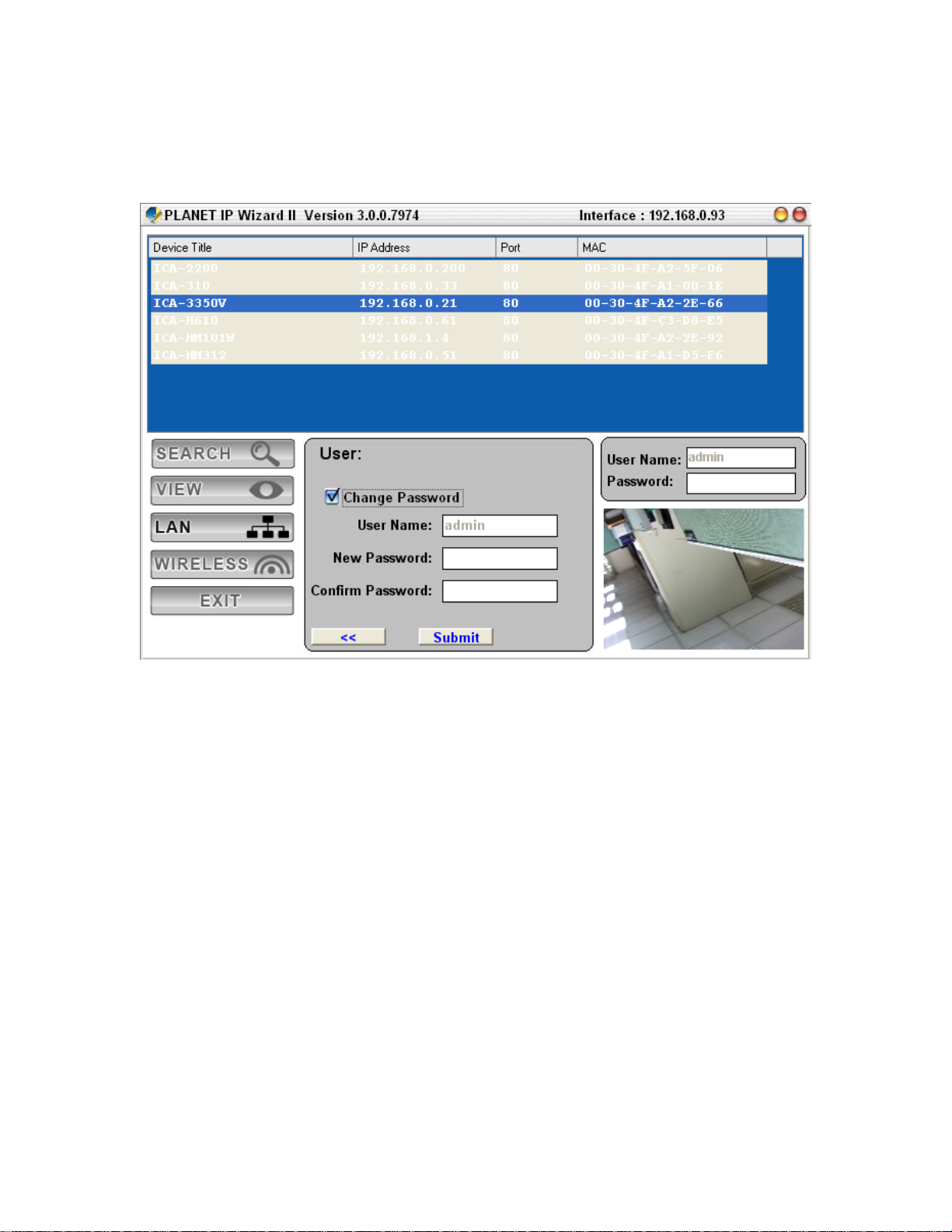
In case, you do not want to change username and/or password, then just click “Submit” button to
perform your setting accordingly. Click “<<” button will go back to previous page.
If you like to change username and/or password of the device, just click the check button. Then,
the related fields will show up as below.
After keying in new username and password, click “Submit” button to perform your setting
accordingly. Click “<<” button will go back to previous page.
19
Page 21

2.6 Using UPnP of Windows XP or Vista
2.6.1 Windows XP
UPnP™ is short for Universal Plug and Play, which is a networking architecture that provides
compatibility among networking equipment, software, and peripherals. This device is an UPnP
enabled device. If the operating system, Windows XP, of your PC is UPnP enabled, the device will
be very easy to configure. Use the following steps to enable UPnP settings only if your operating
system of PC is running Windows XP.
NOTE: Please notice that MS Windows 2000 does not support UPnP feature.
Go to Start > Settings, and Click Control Panel.
The “Control Panel” will display on the screen and double click “Add or Remove Programs” to
continue.
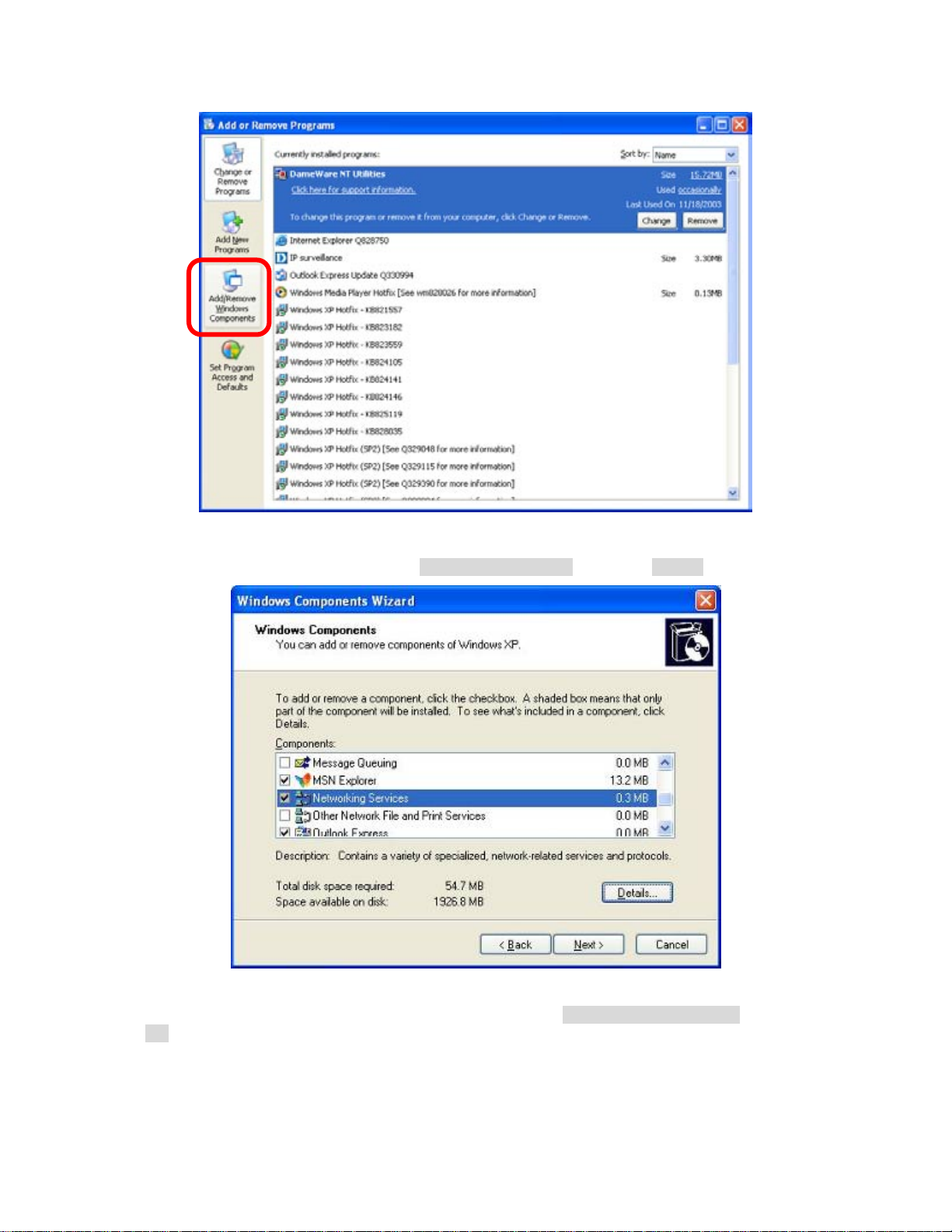
The “Add or Remove Programs” will display on the screen and click Add/Remove Widows
Components to continue.
20
Page 22
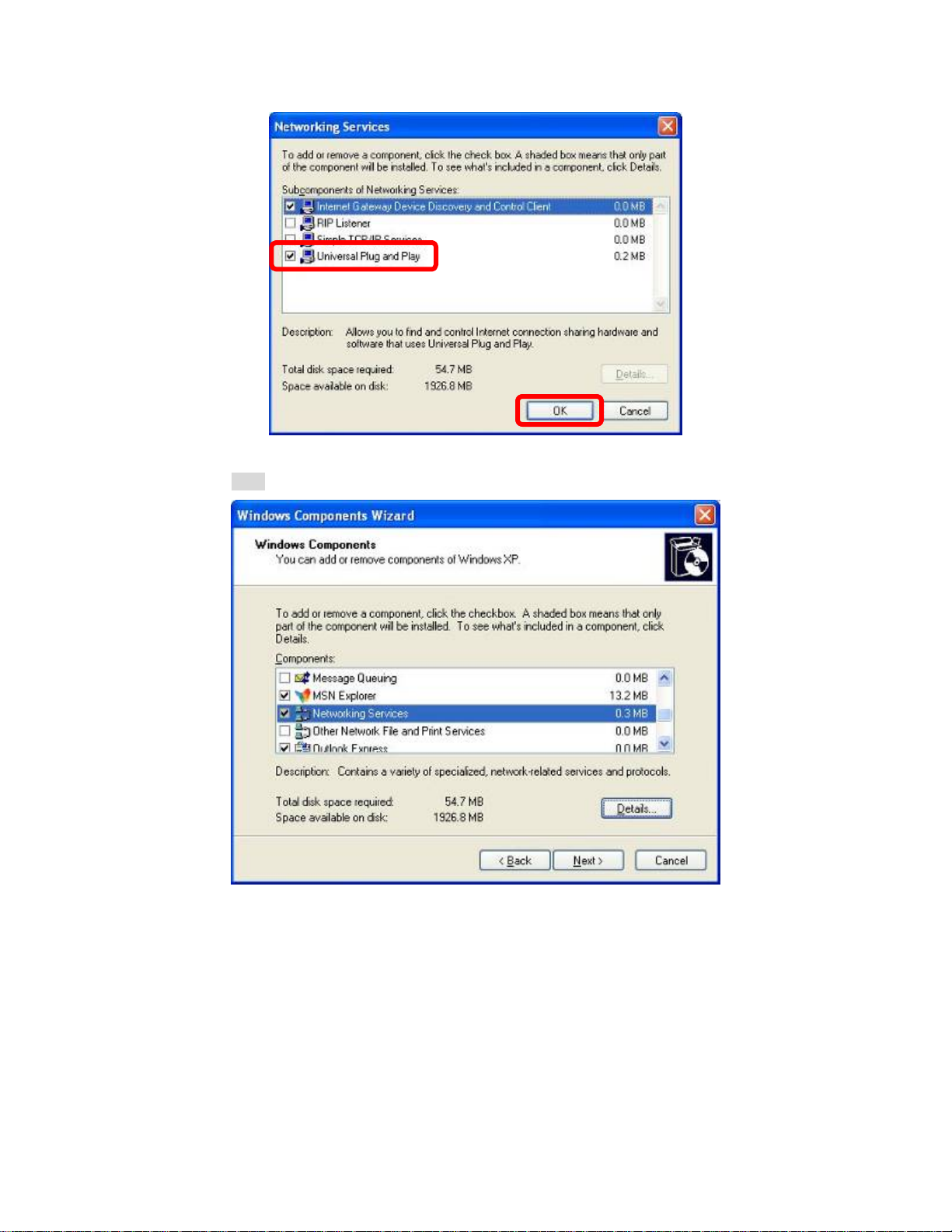
The following screen will appear, select “Networking Services” and click “Details” to continue.
The “Networking Services” will display on the screen, select “Universal Plug and Play” and click
“OK” to continue.
21
Page 23
Please click “Next” to continue.
The program will start installing the UPnP automatically. You will see the below pop-up screen,
please wait while Setup configures the components.
22
Page 24
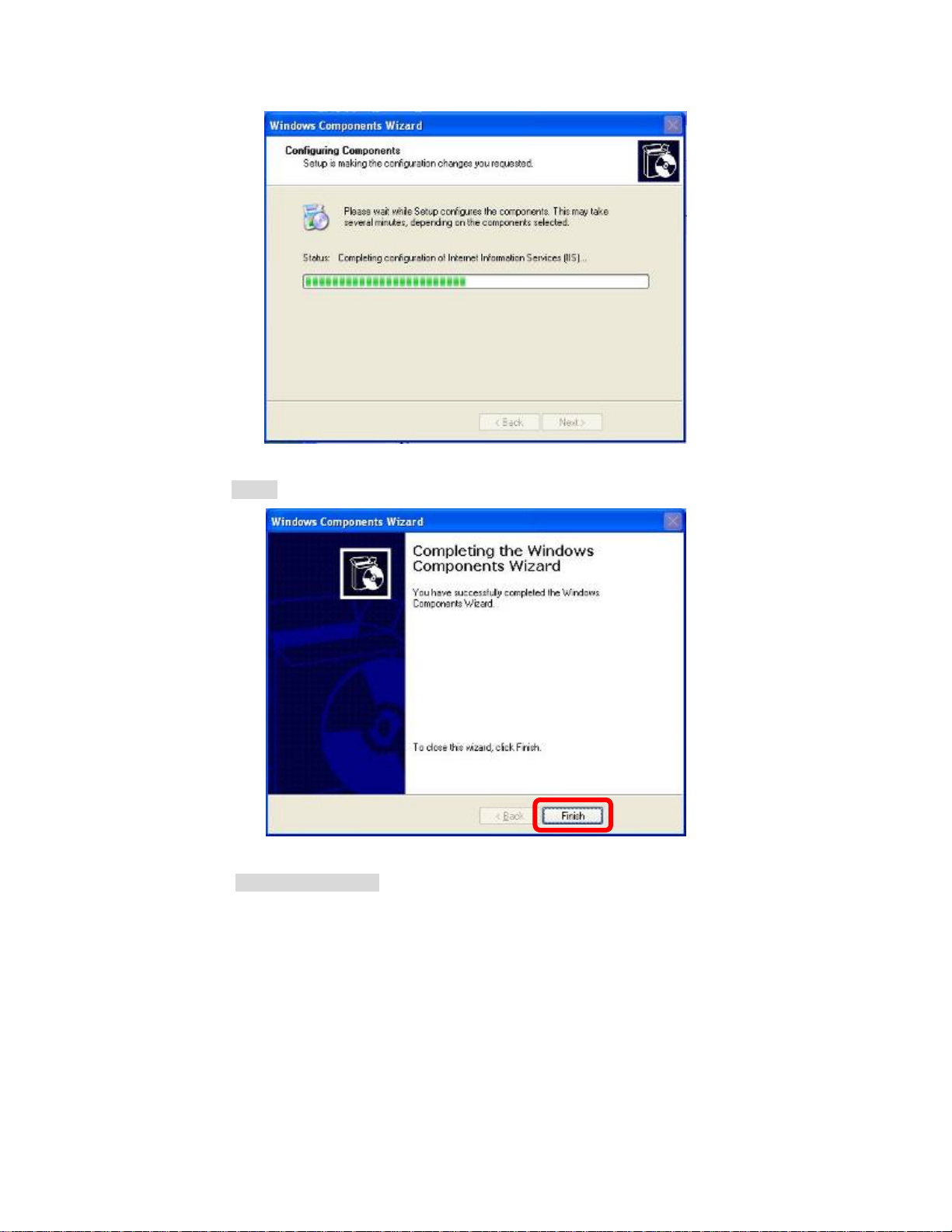
Please click “Finish” to complete the UPnP installation
Double-click “My Network Places” on the desktop, the “My Network Places” will display on the
screen and double-click the UPnP icon with Internet Camera to view your device in an internet
browser.
23
Page 25
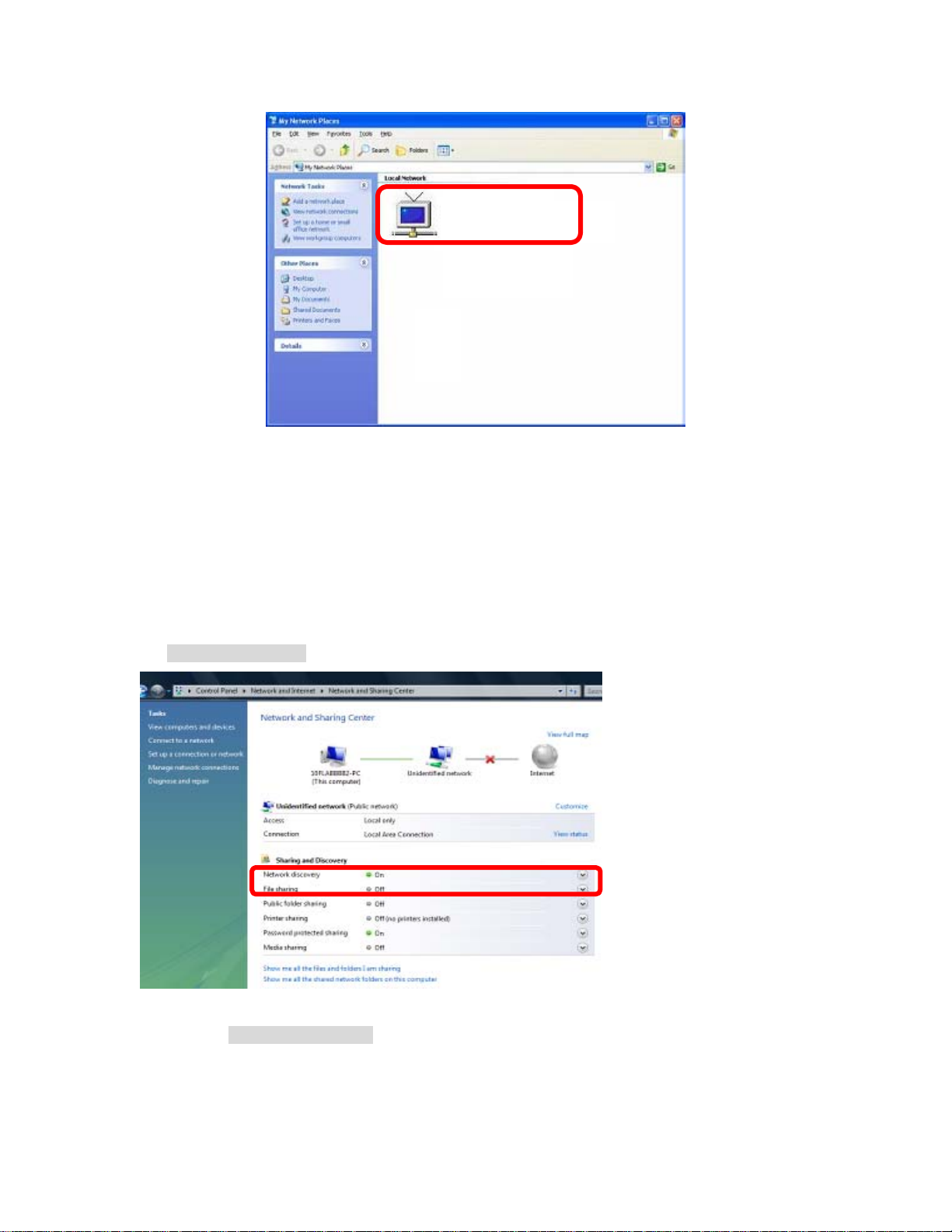
ICA-3350V – 00304f0a145a
2.6.2 Windows Vista
UPnP™ is short for Universal Plug and Play, which is a networking architecture that provides
compatibility among networking equipment, software, and peripherals. This device is an UPnP
enabled device. If the operating system, Windows Vista, of your PC is UPnP enabled, the device
will be very easy to configure. Use the following steps to enable UPnP settings only if your
operating system of PC is running Windows Vista.
Go to Start > Control Panel > Network and Internet > Network and Sharing Center, and turn
on “Network Discovery”.
Double-click “My Network Places“ on the desktop, the “My Network Places” will display on the
screen and double-click the UPnP icon with Internet Camera to view your device in an internet
browser.
24
Page 26
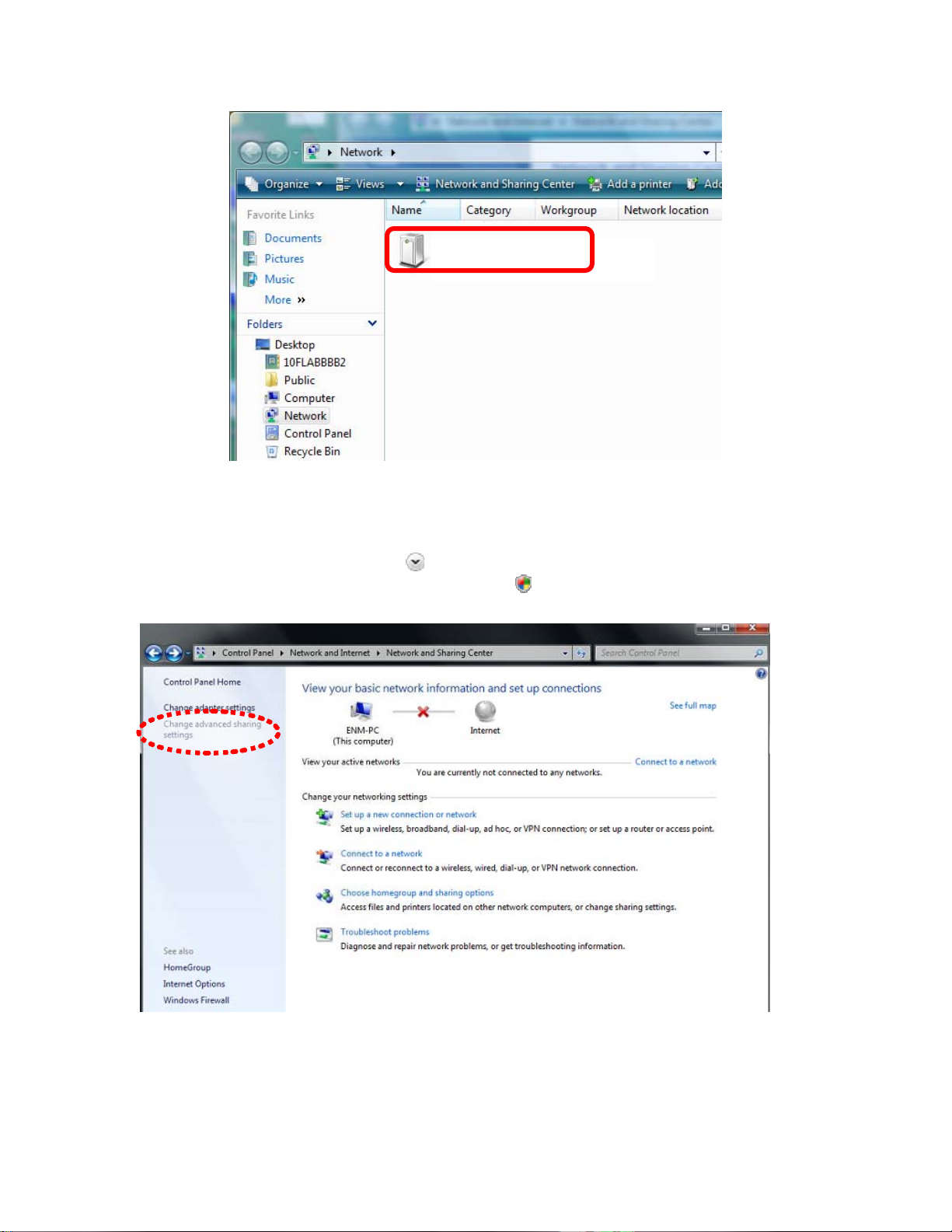
ICA-3350V – 00304fA15076
2.6.3 Windows 7
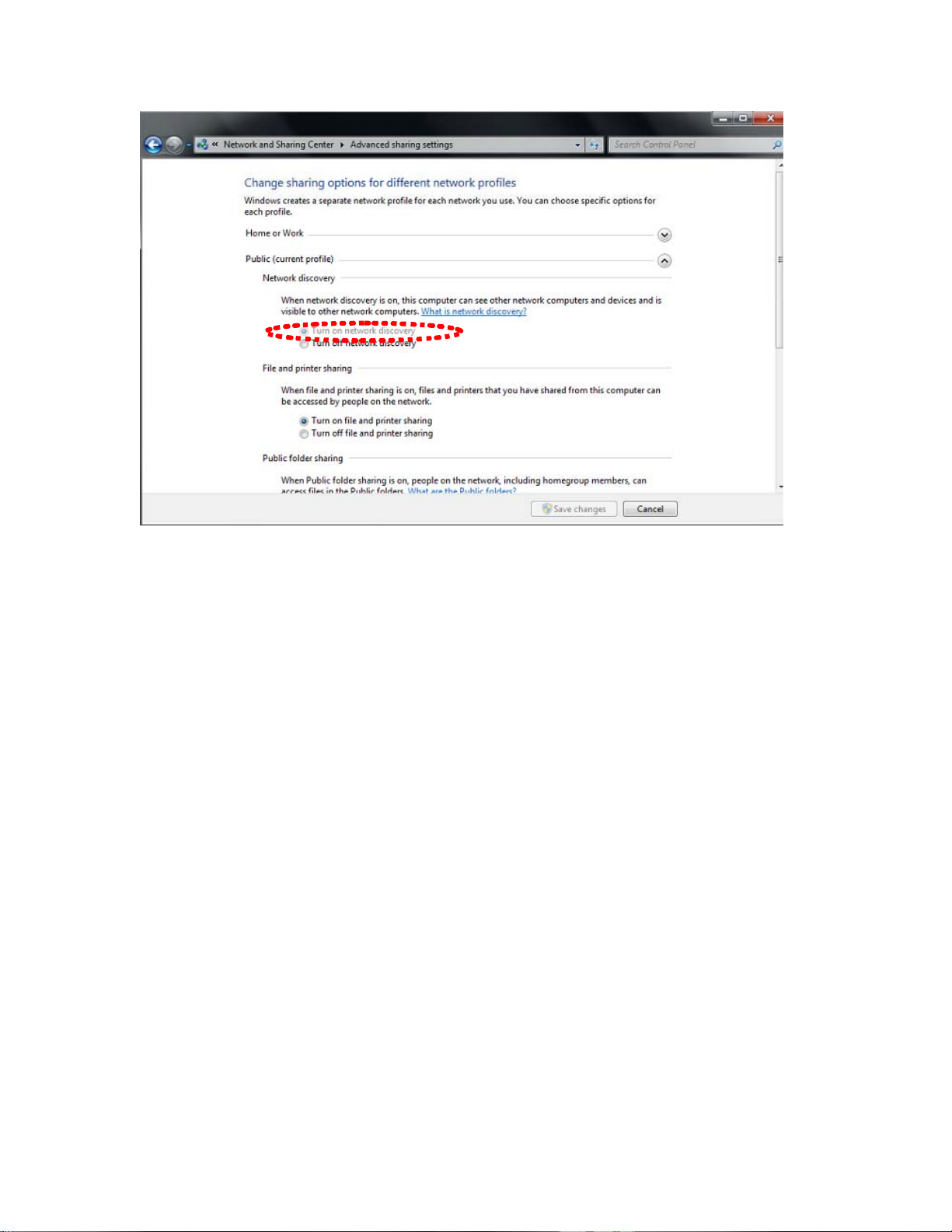
Go to Start > Control Panel > Network and Internet > Network and Sharing Center, if network
discovery is off; click the arrow button
Click Turn on network discovery, and then click Apply.
password or confirmation, type the password or provide confirmation.
to expand the section.
If you are prompted for an administrator
25
Page 27
2.7 Setup ActiveX to use the Internet Camera
The Internet Camera web pages communicate with the Internet Camera using an ActiveX control.
The ActiveX control must be downloaded from the Internet Camera and installed on your PC. Your
Internet Explorer security settings must allow for the web page to work correctly. To use the
Internet Camera, user must setup his IE browser as follows:
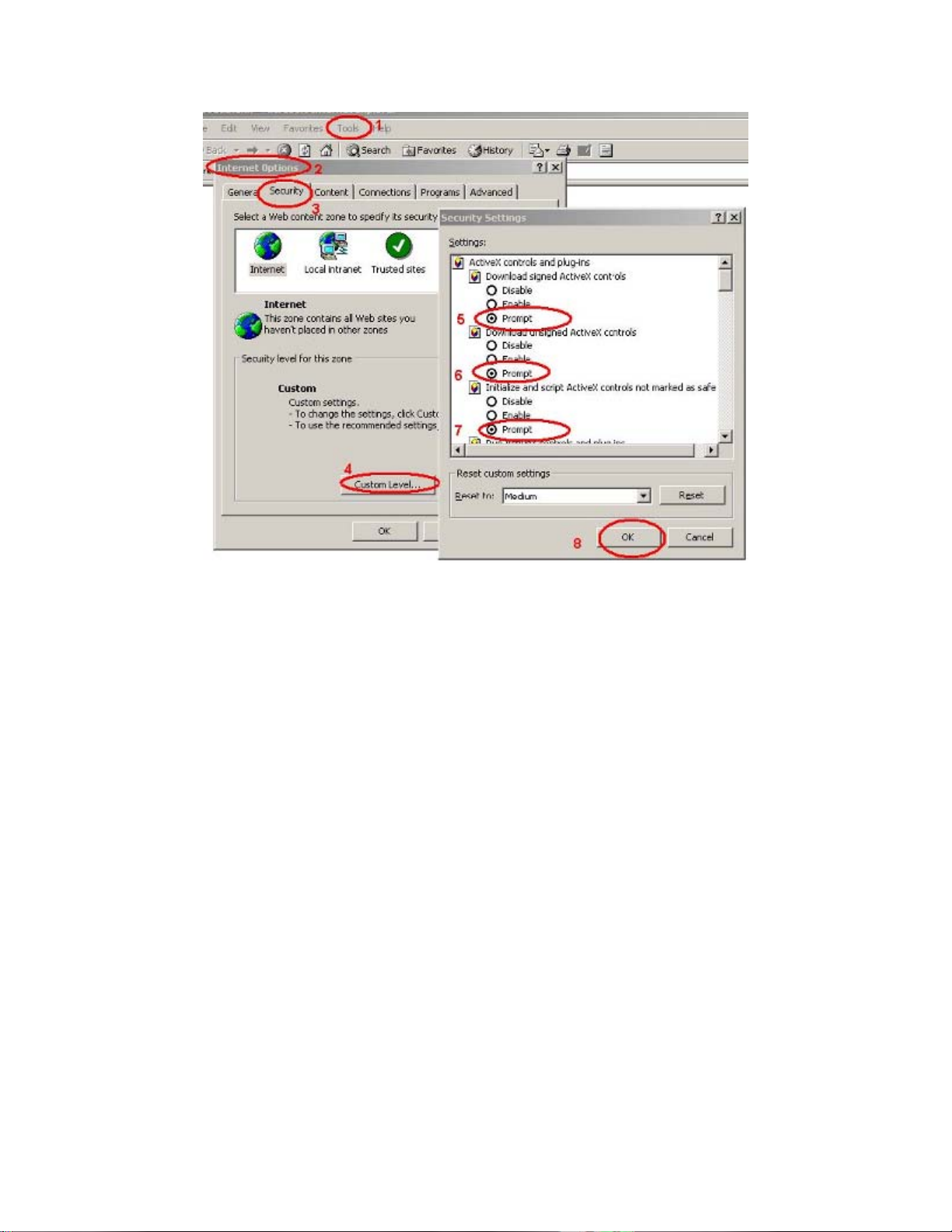
2.7.1. Internet Explorer 6 for Windows XP
From your IE browse Î ”Tools” Î ”Internet Options…” Î ”Security” ΔCustom Level…”, please
setup your “Settings” as follow.
Set the first 3 items
• Download the signed A ctiveX co ntrols
• Download the unsigned ActiveX controls ActiveX controls
• Initialize and script the ActiveX controls not masked as safe to Prompt • Initialize and script the ActiveX controls not masked as safe to Prompt
26
Page 28
By now, you have finished your entire PC configuration for Internet Camera.
2.7.2. Internet Explorer 7 for Windows XP
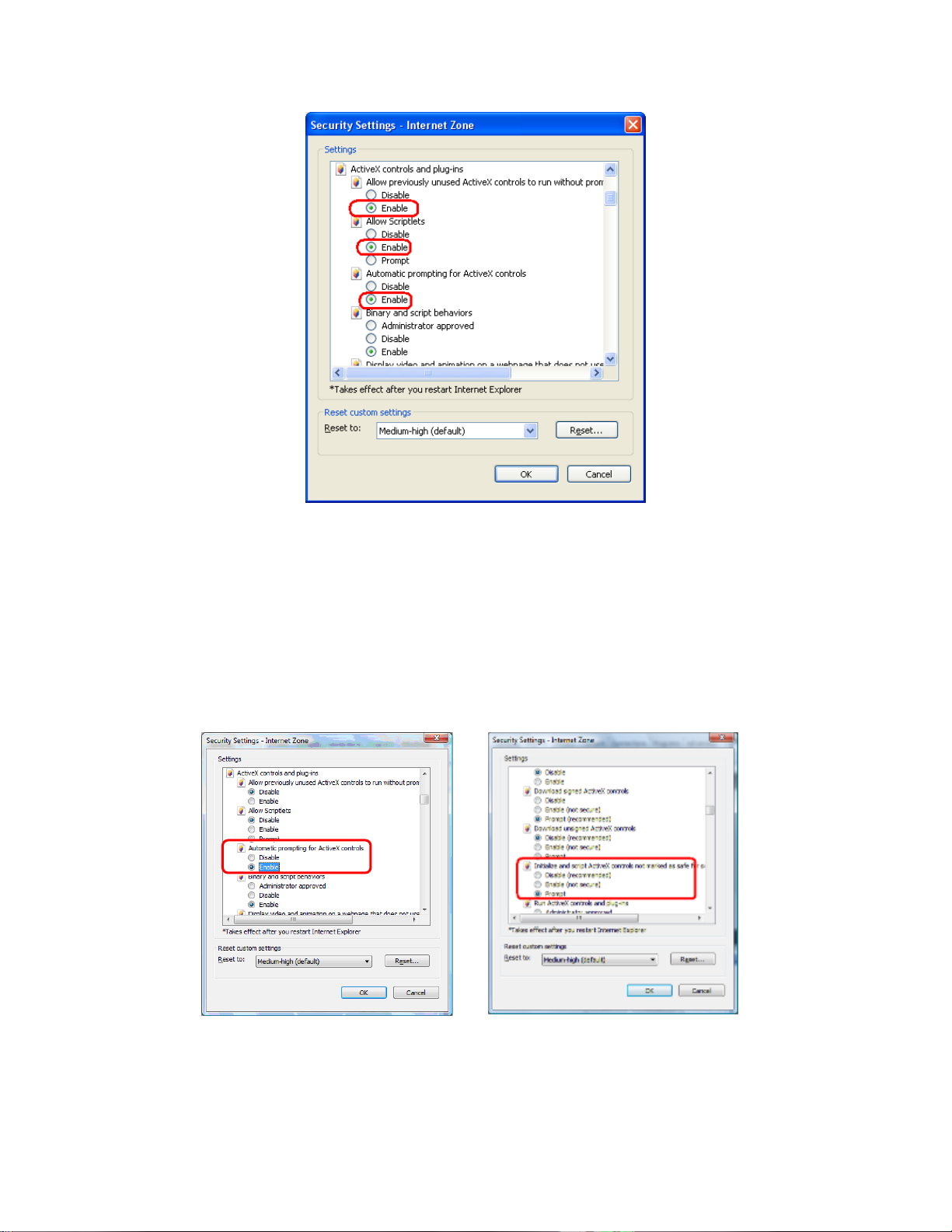
From your IE browse Î ”Tools” Î ”Internet Options…” Î ”Security” ΔCustom Level…”, please
setup your “Settings” as follow.
Set the first 3 items
• Allow previously unused ActiveX control to run…
• Allows Script lets
• Automatic prompting for ActiveX controls
27
Page 29
By now, you have finished your entire PC configuration for Internet Camera.
2.7.3. Internet Explorer 7 for Windows Vista
From your IE browse Î ”Tools” Î ”Internet Options…” Î ”Security” Î ”Internet” ΔCustom
Level…”, please setup your “Settings” as follow.
• Enable “Automatic prompting for ActiveX controls”
• Prompt “Initialize and script active controls not marked….”
From your IE browse Î ”Tools” Î ”Internet Options…” Î ”Security” Î ”Trusted Sites”
ΔCustom Level…”, please setup your “Settings” as follow.
• Enable “Automatic prompting for ActiveX controls”
28
Page 30

• Prompt “Initialize and script active controls not marked….”
By now, you have finished your entire PC configuration for Internet Camera.
29
Page 31

3. Web-based Management
This chapter provides setup details of the Internet Camera’s Web-based Interface.
3.1 Introduction
The Internet Camera can be configured with your Web Browser. Before configure, please make
sure your PC is under the same IP segment with Internet Camera.
3.2 Connecting to Internet Camera
z Use the following procedure to establish a connection from your PC to the Internet Camera.
z Once connected, you can add the camera to your Browser’s Favorites or Bookmarks.
Start the web browser on the computer and type the IP address of the camera.
The Default IP: “http://192.168.0.20
“
The login window of Internet Camera will appear,
Default login username/password is: admin / admin
NOTE:
If the User name and Password have been changed with PLANET IP Wizard II,
please enter the new User name and Password here.
After logged on, you should see the following messages at the top of Internet Explorer:
30
Page 32

Click on the message, and click Install ActiveX Control…
When you see this message, click Install’ to install required ActiveX control
After the ActiveX control was installed and run, the first image will be displayed.
You should be able to see the images captured from the Internet Camera in the web page now. For
advanced functions, please refer to instructions given in follows chapters.
If you log in the camera as an ordinary user, setting function will be not available. If
NOTE:
you log in the camera as the administrator, you can perform all the settings
provided within the device.
31
Page 33

A
3.3 Live View
Start-up screen will be as follow no matter an ordinary users or an administrator.
Video Profile
Monitor Image
Section
Streaming Protocol
ctiveX Control
Language
Monitor Image Section
Setting Menu
Client Setting
Video Information
2-Way Audio Full Screen
The image shot by the camera is shown here. The date and time are
displayed at the top of the window.
Video Profile The camera support multi-profile for three compressions H264,
MEPG-4 and M-JPEG simultaneously. User can chose the proper
and/or preferred profile here.
Full Screen Click this button to display the image in full-screen mode (uses every
available space to display the image captured by this camera).
2-Way Audio The Internet Camera supports 2-way audio function. User can chose
to enable or disable this function by toggling the icon below
: Disable audio uploading function.
: Enable audio uploading function.
ActiveX Control The plug-in ActiveX control supports a lot of functions by clicking the
left mouse button. Note that this feature only supports on the ActiveX
32
Page 34

control within Microsoft® Internet Explorer.
Setting Menu
This function is detail setting for the camera that only available for
user logged into camera as administrator.
Item Action
Configure Network settings such as Wireless,
Network
Camera Adjust camera parameters.
System
Video
Audio Configure audio parameters.
User Setup user name, password and login privilege.
E-Mail Setup E-Mail configuration.
Object Detection Setup Object detection.
IPv6, ONVIF, DHCP, DDNS, 3GPP, PPPoE and
UPnP.
Configure system information, date & time,
maintenance, and view system log file.
Configure bit rate and frame rate of video
profiles.
Storage
Continuous
Recording
Recording List Files list inside the SD Card.
Event Server Setup FTP/TCP/HTTP/Samba server for event
Event Schedule Configure the schedule while event triggered.
Streaming Protocol User can select proper streaming protocol according to networking
environment.
Language The device could provide multiple languages to meet customer’s
requirement.
Client Setting: Click this button to display the client extra control panel for 2-way
Audio and Full Screen.
Video Information Display video information including video format, resolution, frame
rate and bit rate.
Status and configuration of SD card and Samba
server.
Files list inside the SD Card and Samba server.
33
Page 35

3.4 ActiveX Control
The plug-in ActiveX control supports a lot of functions by clicking the left mouse button. Note that
this feature only supports on the ActiveX control within Microsoft® Internet Explorer.
On the ActiveX control icon, click the Left Mouse Button, then a menu pop-up. This menu provides
features that are unique to the ActiveX control. These features include:
• Digital Zoom,
• Record,
• Snapshot,
• Volume,
• About
3.4.1. Digital Zoom
Click Digital Zoom to active this function as above. User can drag or scale the box over the video
to adjust zoom ratio and position.
34
Page 36

3.4.2. Record
Click Record to activate this function. Press Record button to start recording. The video file is
saved as ASF format into your local PC. While you want to stop it, press Stop to stop recording.
Select Browser, the pop-up window to select the save path and file name prefix, select OK to
continue.
After stop recording, list the files, this file is named as Video_yyyymmddhhmmss.asf
The ASF files can be display by the standard Windows Media Player, but it needs the DixectX 9.0
or later version to be installed.
NOTE: Default save path is “C:\Documents and Settings\All user\Desktop”
3.4.3. Snapshot
Click Snapshot to activate this function. Press Snapshot button to take a picture. The image file is
saved as JPEG format into your local PC. Select Browser, the pop-up window to select the save
path and file name prefix, select OK to continue.
If you like to retrieve the saved image, select the file to display the saved image by using any one
of graph editing tools.
NOTE: Default save path is “C:\Documents and Settings\All user\Desktop”
35
Page 37

3.4.4. Volume
Click Volume to activate this function. These have two control bars for speaker and microphone
volume. Scroll this control bar to adjust the audio attribute. Check the volume mute will mute the
speaker output.
3.4.5. About
Click About to show the ActiveX information
36
Page 38

3.5 Network Configuration
Use this menu to configure the network to connect the device and the clients.
3.5.1. Network
This section provides the menu of connecting the device through Ethernet cable.
MAC address
Obtain an IP address
automatically (DHCP)
Display the Ethernet MAC address of the device. Note that user cannot
change it.
Enable this checked box when a DHCP server is installed on the
network to issue IP address assignment. With this setting, the IP
address is assigned automatically. If this device cannot get an IP
address within limited tries, the device will assign a default IP address
for 192.168.0.20.
37
Page 39

IP Address
Subnet Mask
Gateway
If you do not select “Obtain an IP address automatically”, then you
need to enter these network parameters by yourself.
This address is a unique numbers that identifies a computer or device
on the WAN or LAN. These numbers are usually shown in groups
separated by periods, for example: 192.168.0.200
Subnets allow network traffic between hosts to be separated based on
the network's configuration. In IP networking, traffic takes the form of
packets. IP subnets advance network security and performance to
some level by organizing hosts into logical groups. Subnet masks
contain four bytes and usually appear in the same "dotted decimal"
data. For example, a very common subnet mask in its binary
demonstration 11111111 11111111 11111111 00000000 will usually be
shown in the corresponding, more readable form as 255.255.255.0.
A gateway is a piece of software or hardware that passes information
between networks. You'll see this term most often when you either log
in to an Internet site or when you're transient email between different
servers.
Obtain DNS from
DHCP
Primary DNS
Secondary DNS The same function as DNS1. It is option not necessary
HTTP Port
Enable this checked box when a DHCP server is installed on the
network and provide DNS service.
When you send email or position a browser to an Internet domain such
as xxxxx.com, the domain name system translates the names into IP
addresses. The term refers to two things: the conventions for naming
hosts and the way the names are control across the Internet.
The device supports two HTTP ports. The first one is default port 80
and this port is fixed. This port is very useful for Intranet usage. The
second HTTP port is changeable. Users could assign the second port
number of http protocol, and the WAN users should follow the port
number to login. If the http port is not assigned as 80, users have to
add the port number in back of IP address. For example:
http://192.168.0.20:8080.
Therefore, the user can access the device by either
http://xx.xx.xx.xx/, or
http://xx.xx.xx.xx:xxxx/ to access the device.
If multiple devices are installed on the LAN and also required to be
38
Page 40

accessed from the WAN, then the HTTP Port can be assigned as the
virtual server port mapping to support multiple devices.
NOTE
When the configuration is finish, please click “OK” to save and enable
the setting.
3.5.2. IPv6
Internet Protocol version 6 (IPv6) is called the “IP Next Generation” (IPng), which is designed to fix
the shortcomings of IPv4, such as data security and maximum number of user addresses. It is
backward compatible and thus expected to slowly replace IPv4, with the two existing side by side
for many years.
IPv6 To enable or disable the IPv6 function here.
3.5.3. HTTPS
HTTPS: Stands for Hypertext Transfer Protocol Secure
HTTPS is a combination of the Hypertext Transfer Protocol with the SSL/TLS protocol to provide
encrypted communication and secure identification of a network web server. HTTPS connections
are often used for sensitive transactions in corporate information systems. The main idea of
HTTPS is to create a secure channel over an insecure network. This ensures reasonable
protection from eavesdroppers and man-in-the-middle attacks, provided that adequate cipher
suites are used and that the server certificate is verified and trusted.
39
Page 41

To enable or disable the HTTPS service here. Note that the HTTPS
HTTPS
function of this device is not only encrypted the web content but also
audio/video data.
Port Choose the HTTPS port. The default value is 443.
3.5.4 DDNS server
Stands for Dynamic Domain Name Server
The device supports DDNS If your device is connected to xDSL directly, you might need this
feature. However, if your device is behind a NAT router, you will not need to enable this feature.
Because DDNS allows the device to use an easier way to remember naming format rather than an
IP address. The name of the domain is like the name of a person, and the IP address is like his
phone number. On the Internet we have IP numbers for each host (computer, server, router, and
so on), and we replace these IP numbers to easy remember names, which are organized into the
domain name. As to xDSL environment, most of the users will use dynamic IP addresses. If users
want to set up a web or a FTP server, then the Dynamic Domain Name Server is necessary. For
more DDNS configuration, please consult your dealer.
Your Internet Service Provider (ISP) provides you at least one IP address which you use to
connect to the Internet. The address you get may be static, meaning it never changes, or dynamic,
meaning it’s likely to change periodically. Just how often it changes, depends on your ISP. A
dynamic IP address complicates remote access since you may not know what your current WAN
IP address is when you want to access your network over the Internet. The solution to the dynamic
IP address problem comes in the form of a dynamic DNS service.
The Internet uses DNS servers to lookup domain names and translates them into IP addresses.
Domain names are just easy to remember aliases for IP addresses. A dynamic DNS service is
unique because it provides a means of updating your IP address so that your listing will remain
current when your IP address changes. There are several excellent DDNS services available on
the Internet and best of all they’re free to use. One such service you can use is www.DynDNS.org.
You’ll need to register with the service and set up the domain name of your choice to begin using it.
Please refer to the home page of the service for detailed instructions or refer to Appendix E for
more information.
40
Page 42

DDNS To enable or disable the DDNS service here.
Server name Choose the built-in DDNS server.
DDNS Host The domain name is applied of this device.
User Name The user name is used to log into DDNS.
Password The password is used to log into DDNS.
3.5.5. PPPoE
PPPoE: Stands for Point to Point Protocol over Ethernet
A standard builds on Ethernet and Point-to-Point network protocol. It allows Internet Camera
connect to Internet with xDSL or cable connection; it can dial up your ISP and get a dynamic IP
address. For more PPPoE and Internet configuration, please consult your ISP.
It can directly connect to the xDSL, however, it should be setup on a LAN environment to program
the PPPoE information first, and then connect to the xDSL modem. Power on again, then the
device will dial on to the ISP connect to the WAN through the xDSL modem.
The procedures are
• Connect to a LAN by DHCP or Fixed IP
• Access the device, enter Setting Î Network Î PPPoE as below
41
Page 43

PPPoE To enable or disable the PPPoE service here.
User Name Type the user name for the PPPoE service which is provided by ISP.
Password Type the password for the PPPoE service which is provided by ISP.
IP Address / Subnet
Mask / Gateway
Status Shows the Status of PPPoE connection.
Shows the IP information got from PPPoE server site.
3.5.6. Streaming
RTSP is a streaming control protocol, and a starting point for negotiating transports such as RTP,
multicast and Unicast, and for negotiating codecs. RTSP can be considered a "remote control" for
controlling the media stream delivered by a media server. RTSP servers typically use RTP as the
protocol for the actual transport of audio/video data.
42
Page 44

RTSP Port
RTP Port
Choose the RTSP port. The RTSP protocol allows a connecting client to
start a video stream. Enter the RTSP port number to use. The default value
is 554.
Specify the range of transmission port number of video stream. The default
range is 50000 to 50999. User can specify a number between 1024 and
65535.
1. To use the 3GPP function, in addition to previous section, you might
need more information or configuration to make this function work.
2. The camera must be set as Multi-profile mode, not Mega-pixel mode.
Otherwise this device cannot serve 3GPP stream.
NOTE
Dialing
procedure
Compatible
3G mobile
phone
3. To use the 3GPP function, it strongly recommends installing the
Networked Device with a public and fixed IP address without any
firewall protection.
4. Port 554 is the default for RTSP service. However, sometimes, some
service providers change this port number for some reasons. If so,
user needs to change this port accordingly.
1.Choose a verified player (PacketVideo, QuickTime or Real player
currently)
2. Use the following URL to access: rtsp://host/mpeg4/media.3gp
Where host is the host name or IP address of the camera.
Please contact your dealer to get the approved list of compatible 3G
phone.
3.5.7. UPnP
UPnP is short for Universal Plug and Play, which is a networking architecture that provides
compatibility among networking equipment, software, and peripherals. This device is an UPnP
enabled Internet Camera. If your operating system is UPnP enabled, the device will automatically
be detected and a new icon will be added to “My Network Places.” If you do not want to use the
UPnP functionality, it can be disabled
In addition, this device also provides UPnP IGD function for NAT traversal easily. Use NAT
traversal when your device is located on an intranet (LAN) and you wish to make it available from
the other (WAN) side of a NAT router. With NAT traversal properly configured, all HTTP traffic to
an external HTTP port in the NAT router will be forwarded to the device.
43
Page 45

UPnP To enable or disable the UPnP service here.
Friendly Name Shows the friendly name of this device here.
When enabled, the device will attempt to configure port mapping in
UPnP NAT Traversal
Port Range The port range will open in NAT router.
External IP address
a NAT router on your network, using UPnP™. Note that UPnP™
must be enabled in the NAT router first.
Show the IP address and port for WAN access through Internet. If
NAT traversal is configured successfully, user can use this IP
address and port to access this device.
3.5.8. Bonjour
The Bonjour service allows IP camera can be discovered with Apple Safari browser applied, once
the option enable the IP camera will be show the Friendly Name in the Bonjour bookmarks menu
of Safari browser.
44
Page 46

Bonjour To enable or disable the Bonjour service here.
Friendly Name Shows the friendly name of this device here.
3.5.9. ONVIF
ONVIF is a global and open industry forum with the goal to facilitate the development and use of a
global open standard for the interface of physical IP-based security products. Or in other words, to
create a standard for how IP products within video surveillance and other physical security areas
can communicate with each other.
ONVIF To enable or disable the ONVIF interface here.
Version Currently, the V1.0 or V1.01/1.02/V2.0/V2.1.1 is available.
3.5.10. IP Filter
You can enter different user’s IP address which are allowing enter or denying by the device.
45
Page 47

IP Filter To enable or disable the IP filter function here.
IP Filter Policy Choose the filter policy where is denying or allowing.
3.5.11. IP Notification
In case the IP address is changed, system is able to send out an email to alert someone if the
function is enabled.
SMTP Notification (e-mail)
Send To
Subject Type the subject/title of the E-mail.
TCP Notification
TCP Server Type the server name or the IP address of the TCP server.
TCP Port Set port number of TCP server.
Message The message will be sent to FTP server.
HTTP Notification If enable this function, then the fields below need to be filled.
If enable this function, then the “Send to“ and “Subject” field
need to be filled.
Type the receiver’s e-mail address. This address is used for
reply mail.
If enable this function, then the “TCP Server“, “TCP Port”,
and “Message” fields need to be filled.
46
Page 48

URL Type the server name or the IP address of the HTTP server
HTTP Login name Type the user name for the HTTP server.
HTTP Login Password Type the password for the HTTP server.
Proxy Address Type the server name or the IP address of the HTTP Proxy.
Proxy Port Set port number of Proxy.
Proxy Login name Type the user name for the HTTP Proxy.
Proxy Login Password Type the password for the HTTP Proxy.
Custom parameter User can set specific parameters to HTTP server.
Message The message will be sent to HTTP server.
47
Page 49

3.6 Camera Configuration
Use this menu to set the function of the camera of Internet Camera
3.6.1. Picture
Turn the “Mirror” and “Vertical Flip” On or OFF. The image will
be overturned as below.
Rotation
Auto: will adjust the white balance automatically.
White Balance
Hold: will hold the white balance.
48
Page 50

Iris / Exposure Control
Auto Exposure: will adjust the internal gain automatically.
Hold Exposure: will hold the internal gain.
Auto Iris:
This Camera is built-in a DC-Iris lens. User can choose the Iris
control mode from “Auto” or “Off”. In case, the “Auto” mode is
selected, the Camera will control DC Iris automatically. On the
hand, if the “Off” mode is selected, the Camera will open the lens
Iris to maximize.
Sometimes, the Auto Iris may work abnormally under some
environments. In this case, user can click “Calibrate” button to
adjust Auto Iris function again.
Outdoor:
If the camera is installed in outdoor, then shall enable this option.
Otherwise, disable it. The feature is used to improve
auto-exposure performance under strong sunlight.
Maximum Exposure
Time
Power Frequency Frequency of power line: 50 or 60Hz
Color Level Large value will be colorful.
Hue Change the value will result to color tuning.
Brightness Large value will brighten camera.
Sharpness Large value will sharpen camera.
Contrast Large value will contrast camera heavily.
Local video output
User can limit the maximum exposure time of the image sensor.
The larger value means longer exposure time possibly.
Enable or disable video signal of BNC to a TV monitor. It’s very
useful to check view angle or focus during camera installation.
However, disable this function will save power a lot. Suggest to
disable it after camera installed
Use built-in photo sensor or manual to control ICR.
ICR
In case user selects manual mode, there are 4 modes: Night
(On), Day (Off), Auto or Schedule to control built-in IR LEDs. This
function is very useful under low illumination environment even 0
Lux.
In case the Auto mode is selected, user needs to specify 3
49
Page 51

parameters in advance:
Night Mode Threshold (0~10000): this value set the threshold to
turn on IR LED. It should be lower or equal to Day Mode
Threshold.
Day Mode Threshold (0~10000): this value set the threshold to
turn off IR LED. It should be higher or equal to Night Mode
Threshold.
Delay Time: The delay time between LED ON/OFF switching.
Note: that Current Value is the current luminance from the
captured video. It’s a useful reference to set LED ON/OFF
Threshold.
3D De-Noise
WDR
Default Settings Restore to factory image settings.
3D De-Noise can remove or lower unwanted noise and preserve
fine details and edges.
This function is to provide clear images even under back light
circumstances. The higher “Strength” level will adjust contrast
compensation stronger.
3.6.2. Privacy Mask
Use this page to specify privacy mask window 1 to window 8 and set the name and gray level for
selected window.
50
Page 52

Add and Delete
To add or delete the privacy mask windows, user can specify up to 7
windows to mask the video captured by this device. By dragging
mouse on the image, you can change the position and size of the
selected window accordingly.
Name
Level
Name of the specified privacy window
To define the gray level of mask block. The smaller value will be
darker.
3.6.3. PTZ Setting
This page allow user to modify the RS-485 interface according to the P/T scanner.
Camera Protocol
Camera Address
Baud rate
NOTE
This device can connect to a PTZ camera or speed dome camera and
controls them thru RS-485 interface.
This is the camera ID set in PTZ camera or speed dome camera.
Note that please DO NOT changes the default value if unnecessary.
If so, user needs to check and set value properly for both sides.
This is the communication speed between network module and P/T
scanner.
If need to change these parameters, user needs to check and set
value properly for both, network module and P/T scanner.
51
Page 53

3.6.4. Preset Setting
This page provides the edit tool to modify or delete the “Preset Setting” item by item.
3.6.5. Tour Setting
Up to 64 positions can be preset, and the camera can be programming to move to the preset
position sequentially.
52
Page 54

Tour Name
Running Enable or disable this camera tour.
Preset
Wait Time
NOTE
The group name of the sequence of camera tour. The maximum number of
camera tour is 16.
Set the sequence of the tour. Maximum 16 points can be assigned. The
selected preset position is added in the Sequence list from 1 to 16.
Type a period of time during which the camera is to stay at each preset point,
between 0 to 36000 seconds.
To use the camera tour function, user must preset some camera positions
first. The maximum number of preset points is 64.
53
Page 55

3.7 System
Use this menu to perform the principal settings of Internet Camera.
3.7.1. System
Device title
Software version This information shows the software version in the device.
Network LED
Power LED Switch the LED light of this Internet Camera on or off.
Log
Reload Click this button; user can refresh the log information of the device.
You can enter the name of this unit here. It’s very useful to identify the
specific device from multiple units.
Switch the LED light of this Internet Camera on or off, that Network
LEDs will stop working; in case you don’t want other people know the
camera is transferring data.
User can check the system log information of the device, including the
Main Info, Appended Info, Operator IP, and so on …
54
Page 56

3.7.2. Date & Time
User can setup the time setting of Internet Camera, make it synchronized with PC or remote NTP
server. Also, you may select the correct time zone of your country.
Server Date & Time Displays the date and time of the device
PC Time Displays the date and time of the connected PC
Adjust
NTP server name
NTP sync. Interval
Time zone
Synchronize
with PC:
Manual setting: Click this option to set time and date manually
Synchronize
with NTP:
Type the host name or IP address or domain name of the NTP
server.
Select an interval between 1 and 23 hours at which you want to
adjust the device’s time referring to NTP server
Set the time difference from Greenwich Mean Time in the area
where the device is installed.
Click this option to enable time synchronization
with PC time
Click this option if you want to synchronize the
device’s date and time with those of time server
called NTP server (Network Time Protocol)
Daylight saving Check this item to enable daylight saving adjustment.
Daylight Saving
Start Time
Sets up the date and time of daylight saving start time.
55
Page 57

Daylight Saving
Stop Time
Daylight Saving
Offset
3.7.3. Maintenance
Sets up the date and time of daylight saving stop time.
Sets up the date of daylight saving offset.
Default Settings
(Include the network
setting)
Default Settings
(Except the network
setting)
Backup Setting
Restore Setting
Firmware upgrade The device supports new firmware upgrade.
1. Close all other application programs which are not
Recall the device hard factory default settings. Note that click
this button will reset all device’s parameters to the factory
settings (including the IP address).
The unit is restarted and most current settings are reset to
factory default values. This action will not reset the network
setting.
To take a backup of all of the parameters, click this button. If
necessary, it will then be possible to return to the previous
settings, if settings are changed and there is unexpected
behavior.
Click the “Browse” button to locate the saved backup file and
then click the “Restore Setting” button. The settings will be
restored to the previous configuration.
necessary for firmware update.
56
Page 58

2. Make sure that only you access this device at this moment
3. Disable Motion Detection function.
4. Select “Firmware name”
5. Select the Firmware binary file.
Note!! That it must make sure that the Firmware only applies to this device, once update, it
will be burned into FLASH ROM of system.
6. Once the firmware file was selected, select “Upgrade”.
7. The upgrade progress information will be displayed on the
screen.
8. A message will be shown while the firmware upgraded.
Once the upgrading process completed, the device will
reboot the system automatically.
9. Please wait for 80 seconds, and then you can use PLANET
IPWizard II to search the device again.
Warning!!! The download firmware procedure cannot be interrupted. If the power
and/or network connection are broken during the download procedure, it might
possibly cause serious damage to the device.
Please be aware that you should not turn off the power during updating the firmware
and wait for finish message.
Furthermore, do not try to upgrade new firmware if it’s not necessary.
System Restart The device is restarted without changing any of the settings.
57
Page 59

3.8 Video
This device provides 2 modes of video profile. The first one is 3Mega mode which supports video
resolution up to 3 Mega-pixel. The second one is 2Mega mode which supports video resolution up
to 2 Mega-pixel. User only can select either 3Mega or 2Mega mode to operate the camera.
Switching 3Mega and 2Mega mode, the device will take time to reboot system.
3.8.1. Common
User can only choose either 3Mega or 2Mega modes. 3Mega mode
Video Profile
Text Overlay Setting
can serve streams up to 2048x1536 resolution maximum. On the
other hand, 2 Mega mode, it can streams up to 1920x1080
resolution maximum.
There are some important information can be embedded into
image, including date, time, and/or text.
3.8.2. Overlay Image
User can upload “bmp” format picture to IP cam
58
Page 60

Upload own image Select your picture to upload
Coordinates Select the location of the picture
3.8.3. Video Profile
User can modify the detail parameter for each video profiles in this page.
59
Page 61

Name To assign a name to the selected profile.
Video Type Video codec of the selected profile.
Resolution Resolution of the selected profile.
ROI
Rate Control
Assign the selected profile as a ROI stream or not. (Only available
for the profiles with max resolution)
Defines the rate control method of this profile. There are four
options: Constant Bit Rate (CBR), Variable Bit Rate (VBR),
Enhanced Constant Bit Rate (ECBR), and Enhanced Variable Bit
Rate (EVBR).
For CBR, the video bit rate is between low to high bandwidth based
on different resolutions. User can set the desired bit rate to match
the limitation of bandwidth.
For VBR, user should choose the quality level to set the video quality
rather than bit rate. The quality level is between 1 and 100. The
higher value can reach the better quality but of course will consume
higher bandwidth.
For ECBR, the video bitrates is based on normal CBR mode.
However, the target bitrates can be increased to max target bitrate
while lots of motion in video. The max target bitrates will keep a
pre-defined time period and then back to normal CBR bitrates.
For EVBR, the video bitrates is based on normal VBR mode.
However, the target bitrates can be increased to max target bitrates
while lots of motion in video. The max target bitrates will keep a
pre-defined time period and then back to normal VBR mode.
Defines the targeted frame rate of this profile. For example, set the
Max Frame Rate
GOP Control
frame rate to 15 fps, then the image will be updated for 15 frames
per second. User can set the desired max frame rate versus video
quality under the limited bandwidth.
Defines the Intra/Inter-frame (I/P) ratio of this profile. For example,
set the GOP to 30, then the video stream will have one Intra-frame
every 30 frames.
3.8.4. ROI
ROI means Region of Interest. Use this page to specify location of ROI windows. Only the
maximum resolution profiles can be defined as ROI. In this model, the default ROI windows are
profile 4 and 5.
60
Page 62

3.9 Audio Configuration
It’s M-JPEG mode in this profile.
Audio To enable or disable audio function.
Audio type To select G711 or G726 for audio coding.
61
Page 63

Audio Mode: To select Simplex or Full duplex (2-way audio) mode.
Input Gain: To adjust gain of input audio.
Output Gain: To adjust gain of output audio.
Speaker Our To enable or disable speaker function.
62
Page 64

3.10 User Privilege Access Configuration
Use this menu to set the user names and password of the Administrator and up to 10 users, and
access right of each user.
Viewer Login
Access Right
PTZ Control
Add, Modify, and Delete of
Users account
Select “Anonymous” to allow any one viewing the video once
connected. Otherwise, only users in database can view the
video after login.
Administrator can access every function in this device.
However, Viewers only can view the video and access
limited function.
Authorize this user to control PTZ function or not.
Manage the user’s account of viewer user.
63
Page 65

3.11 E-Mail Configuration
You may setup SMTP mail parameters for further operation of Event Schedule. That’s, if users
want to send the alarm message out, it will need to configure parameters here and also add at
least one event schedule to enable event triggering.
SMTP Server Type the SMTP server name or the IP address of the SMTP server.
Test
SMTP Port Set port number of SMTP service.
SSL Enable SSL function or not.
SMTP Authentication
Authentication User
Name
Authentication Password
E-mail From
Send a test mail to mail server to check this account is available or
not.
Select the authentication required when you send an e-mail.
Disable: If no authentication is required when an e-mail is send.
Enable: If authentication is required when an e-mail is sent.
Type the user name for the SMTP server if Authentication is
Enabling.
Type the password for the SMTP server if Authentication is
Enabling.
Type the sender’s E-mail address. This address is used for reply
e-mails.
E-mail To Type the receiver’s e-mail address.
64
Page 66

E-mail Subject Type the subject/title of the e-mail.
3.12 Object Detection
Use this menu to specify motion detection window 1 to window 4 and set the conditions for
detection while observing a captured image.
Add and Delete
Included or Excluded
Window
Name Name of the specified motion window.
Object Size
Sensitivity
To add or delete the motion windows. User can specify up to 4
Included and /or Excluded windows to monitor the video captured by
this device. By dragging mouse on the image, you can change the
position and size of the selected motion window accordingly.
These windows can be specified as Included or Excluded type.
Included:
Windows target specific areas within the whole video image
Excluded:
Windows define areas within an Include window that should be
ignored (areas outside Include windows are automatically ignored)
Defines the object size of motion detection. The higher object size will
only larger objects trigger motion detection. The lower object size will
even small objects trigger motion detection too. Generally speaking,
the smaller size will be easier to trigger event.
Defines the sensitivity value of motion detection. The higher value will
be more sensitivity.
65
Page 67

3.13 Storage Configuration
This page shows the status of attached SD card and Samba server. You may setup related
parameters to manage the attached SD card or Samba server also.
3.13.1 SD Card
Disk ID This name of SD card.
Status This information of SD card.
Enable automatic disk cleanup
Remove recordings order than Delete old files by days.
Remove oldest recordings
when disk is
Lock disk Avoid write data and delete at SD card
Delete old recorded files while the conditions are reached as
below.
Delete old files by left capacity.
66
Page 68

3.13.2 SAMBA Server
Host
Share
User Name
Password
Type the server name or the IP address of the SAMBA server.
Set working directory path of SAMBA server.
Type the user name for the SAMBA server
Type the password for the SAMBA server.
67
Page 69

3.14 Continuous Recording
You may enable or disable continuous recording function here. Select SD card or Samba server
for storage destination.
Note: When enable continuous recording that press restart will delete correct recording
3.15 Recording List
This page shows the files list information, files list inside the SD Card. User may reload file from
SD card that play or remove the selected file.
68
Page 70

This page shows the files list information, files list inside the SD Card or Samba server. User may
reload file from SD card or Samba server that play or remove the selected file.
69
Page 71

3.16 Event Server Configuration
3.16.1 FTP Server
You may setup FTP parameters for further operation of Event Schedule. That’s, if users want to
send the alarm message to an FTP server, it will need to configure parameters here and also add
at least one event schedule to enable event triggering as SMTP.
Name User can specify multiple FTP paths as wish. Therefore, user
needs to specify a name for each FTP setting.
FTP Server Type the server name or the IP address of the FTP server.
Test Check the FTP server whether this account is available or not.
FTP Login name Type the user name for the FTP server.
FTP Login Password Type the password for the FTP server.
FTP Port Set port number of FTP service.
FTP Path Set working directory path of FTP server.
FTP Passive Mode Select passive or active mode connecting to FTP server.
70
Page 72

3.16.2 TCP Server
In addition to send video file to FTP server, the device also can send event message to specified
TCP server.
Name User can specify multiple TCP servers as wish. Therefore, user
needs to specify a name for each TCP server setting.
TCP Server Type the server name or the IP address of the TCP server.
TCP Port Set port number of TCP server.
71
Page 73

3.16.3 HTTP Server
The device also can send event message to specified HTTP server.
Name User can specify multiple HTTP servers as wish. Therefore, user
needs to specify a name for each HTTP server setting.
URL Type the server name or the IP address of the HTTP server.
Test Check the HTTP server whether it is available or not.
HTTP Login name Type the user name for the HTTP server.
HTTP Login Password Type the password for the HTTP server.
Proxy Address Type the server name or the IP address of the HTTP Proxy.
Proxy Login name Type the user name for the HTTP Proxy.
Proxy Login Password Type the password for the HTTP Proxy.
Proxy Port Set port number of Proxy.
72
Page 74

3.16.4 SAMBA Server
The device also can send video stream to specified SAMBA server. Most of the time, the SAMBA
server will be another PC or NAS server.
Name User can specify multiple HTTP servers as wish. Therefore, user
needs to specify a name for each HTTP server setting.
SAMBA Server Type the server name or the IP address of the SAMBA server.
Test Check the SAMBA server whether this account is available or not.
SAMBA Login name Type the user name for the SAMBA server.
SAMBA Login Password Type the password for the SAMBA server.
SAMBA Path Set working directory path of SAMBA server.
73
Page 75

3.17 Event Schedule Configuration
This menu is used to specify the schedule of Events and activate the some actions provided by
this device.
3.17.1 Setting
Name Name of the Event or Schedule.
Enable Enable or disable this Event or Schedule.
Type Schedule start with Event trigger or Schedule trigger.
Enable Time Define the feasible time slot.
Trigger by Select the triggered sources with event trigger.
Record File
Prefix
Action Define the actions once event triggered.
Define the prefix of recorded filename
74
Page 76

Example1.
Send file to FTP server by motion triggered always:
1. Select event trigger
2. Enable time: start from 00:00 to 24:00 every day
3. Trigger by: Motion Area (Added in Object Detection page)
4. Action : Send FTP (Add in Event Server -> FTP Server page)
75
Page 77

Example2.
Send file to E-Mail server by motion triggered from Friday 18:00 to Saturday
06:00
1. Select event trigger.
2. Enable time: start from Friday 18:00 and keep work in 12 hours, so
it will stop on Saturday 06:00.
3. Trigger by : Motion Area (Added in Object Detection page)
4. Action : Send e-mail (Add in E-Mail page)
i. To email address: You need to input the receiver email
address.
ii. Subject: You could specify the email subject.
iii. Message: You could specify the email content.
76
Page 78

Example3.
Enable Voice Alert every 10-minute during 18:00 to 24:00 from Monday to
Friday.
1. Type: Select schedule trigger and interval is 10-minute.
2. Enable Time: Select Monday to Friday, and set start time from 18:00
and keep work in 6 hours.
3. Trigger by: You do not need to choose it, because this will be
triggered every minute.
4. Action: Voice Alert.
77
Page 79

3.17.2 Record Configuration
User can choose the type of record file for event or schedule application.
Record File Type Choose AVI or JPEG file format for record file.
Record File Prefix Define the prefix of recorded filename.
Pre-Trigger Duration Define the maximum duration of pre-alarm.
Best Effort Duration Define the best effort duration of post-alarm.
Max File Size Define the maximum buffer size of record file.
3.17.3 Port Status
User can check the status of digital input and output (DIDO).
78
Page 80

Appendix A: PING IP Address
The PING (stands for Packet Internet Groper) command is used to detect whether a specific IP
address is accessible by sending a packet to the specific address and waiting for a reply. It’s also
a very useful tool to confirm Internet Camera installed or if the IP address conflicts with any other
devices over the network.
If you want to make sure the IP address of Internet Camera, utilize the PING command as follows:
z Start a DOS window.
z Type ping x.x.x.x, where x.x.x.x is the IP address of the Internet Camera.
The replies, as illustrated below, will provide an explanation to the problem.
If you want to detect any other devices conflicts with the IP address of Internet Camera, also can
utilize the PING command but you must disconnect the Internet Camera from the network first.
79
Page 81

Appendix B: 3GPP Access
To use the 3GPP function, in addition to previous section, you might need more information or
configuration to make this function work.
Note
RTSP Port:
Port 554 is the default for RTSP service. However, sometimes, some service providers change
this port number for some reasons. If so, user needs to change this port accordingly.
Dialing procedure:
1. Choose a verified player (PacketVideo or Realplayer currently)
2. Use the following URL to access:
Where host is the host name or IP address of the camera.
Compatible 3G mobile phone:
Please contact your dealer to get the approved list of compatible 3G phone.
That to use the 3GPP function, it strongly recommends to install the Networked Device
with a public and fixed IP address without any firewall protection.
rtsp://host/mpeg4/media.3gp
Note
Besides IP camera and 3G mobile phone. You will also need to make sure the ISP and
telephone company has provided the 3GPP service to you.
80
Page 82

Appendix C: Bandwidth and Video Size
Estimation
The frame rate of video transmitted from the Internet Camera depends on connection bandwidth
between client and server, video resolution, codec type, and quality setting of server. Here is a
guideline to help you roughly estimate the bandwidth requirements for your Internet Camera.
The required bandwidth depends on content of video source. The slow motion video will produce
smaller bit rate generally and fast motion will produce higher bit rate vice versa. Actual results
generated by the Internet Camera may be varying.
Image
Resolution
320 x 240
640 x 480
1920 x 1080 200 ~ 500k byte per
2048 x 1536 300 ~ 750k byte per
Average range of
data sizes for JPEG
mode
8 ~ 20k byte per
frame
20 ~ 50K byte per
frame
frame
frame
Average bit rate for
MPEG4 mode
256kbps~768kbps
@ 30fps
512kbps~3072kbps @
30fps
- 1536kbps~10000kbps
- 2048kbps~12000kbps
Average bit rate for
H.264 mode
192kbps~512kbps
@ 30fps
384kbps~1536kbps
@ 30fps
@ 30fps
@ 30fps
NOTE: Audio streaming also takes bandwidth around 32kbps. Some xDSL/Cable
modem upload speeds could not even reach up to 128 kbps. Thus, you may
not be able to receive good quality video while also streaming audio on a 128
kbps or lower connection. Even though the upload speed is more than
128kbps, for optimal video performance, disabling audio streaming will get
better video performance.
81
Page 83

Appendix D: DDNS Application
1. Configure PLANET DDNS steps:
Step 1: Enable DDNS option through accessing web page of NAS
Step 2. Select on DDNS server provide, and register an account if you do not use yet.
Let’s take dyndns.org as an example. Register an account in http://planetddns.com
82
Page 84

Appendix E: Configure Port Forwarding Manually
The device can be used with a router. If the device wants to be accessed from the WAN, its IP
address needs to be setup as fixed IP address, also the port forwarding or Virtual Server function
of router needs to be setup. This device supports UPnP traversal function. Therefore, user could
use this feature to configure port forwarding of NAT router first. However, if user needs to
configure port forwarding manually, please follow the steps as below:
Manually installing the device with a router on your network is an easy 3–step procedure as
following:
1. Assign a local/fixed IP address to your device
2. Access the Router with Your Web browser
3. Open/Configure Virtual Server Ports of Your Router
1. Assign a local/fixed IP address to your device
The device must be assigned a local and fixed IP Address that allows it to be recognized by the
router. Manually setup the device with a fixed IP address, for example, 192.168.0.100.
2. Access the Router with Your Web browser
The following steps generally apply to any router that you have on your network. The PLANET
WNRT-620 is used as an example to clarify the configuration process. Configure the initial settings
of the router by following the steps outlined in the router’s Quick Installation Guide.
If you have cable or DSL service, you will most likely have a dynamically assigned WAN IP
Address. ‘Dynamic’ means that your router’s WAN IP address can change from time to time
depending on your ISP. A dynamic WAN IP Address identifies your router on the public network
and allows it to access the Internet. To find out what your router’s WAN IP Address is, go to the
Status screen on your router and locate the WAN information for your router. As shown on the
following page the WAN IP Address will be listed. This will be the address that you will need to
type in your web browser to view your camera over the Internet. Be sure to uncheck the Reset IP
address at next boot button at the top of the screen after modifying the IP address. Failure to do
so will reset the IP address when you restart your computer.
83
Page 85

Your WAN IP Address will be listed here.
3. Open/set Virtual Server Ports to enable remote image viewing
The firewall security features built into the router and most routers prevent users from accessing
the video from the device over the Internet. The router connects to the Internet over a series of
numbered ports. The ports normally used by the device are blocked from access over the Internet.
Therefore, these ports need to be made accessible over the Internet. This is accomplished using
the Virtual Server function on the router. The Virtual Server ports used by the camera must be
opened through the router for remote access to your camera.
Follow these steps to configure your router’s Virtual Server settings
z Click Enabled.
z Enter a unique name for each entry.
z Select Both under Protocol Type (TCP and UDP)
z Enter your camera’s local IP Address (e.g., 192.168.0.100, for example) in the Private
IP field.
z If you are using the default camera port settings, enter 80 into the Public and
Private Port section, click Add.
A check mark appearing before the entry name will indicate that the ports are enabled.
NOTE Some ISPs block access to port 80. Be sure to check with your ISP so that you can
open the appropriate ports accordingly. If your ISP does not pass traffic on port 80, you
will need to change the port the camera uses from 80 to something else, such as 8080.
Not all routers are the same, so refer to your user manual for specific instructions on
how to open ports.
84
Page 86

Enter valid ports in the Virtual Server section of your router. Please make sure to check the box
on this line to enable settings. Then the device can be access from WAN by the router’s WAN IP
Address.
By now, you have finished your entire PC configuration for this device.
85
Page 87

Appendix F: Power Line Frequency
COUNTRY
Argentina 220V 50 Hz
Australia 230V* 50 Hz
Austria 230V 50 Hz
Brazil 110/220V* 60 Hz
Canada 120V 60 Hz
China 220V 50 Hz
Finland 230V 50 Hz
France 230V 50 Hz
Germany 230V 50 Hz
Hong Kong 220V* 50 Hz
India 230V 50 Hz
Italy 230V 50 Hz
Japan 100V 50/60 Hz*
Malaysia 240V 50 Hz
VOLTAGE FREQUENCY COMMENTS
*Neutral and line wires are reversed from that
used in Australia and elsewhere.
*Outlets typically controlled by adjacent
switch.
Though nominal voltage has been officially
changed to 230V, 240V is within tolerances
and commonly found.
*127V found in states of Bahia, Paran
(including Curitiba), Rio de Janeiro, Paulo and
Minas Gerais (though 220V may be found in
some hotels). Other areas are 220V only,
with the exception of Fortaleza (240V).
*Eastern Japan 50 Hz (Tokyo, Kawasaki,
Sapporo, Yokohoma, and Sendai); Western
Japan 60 Hz (Osaka, Kyoto, Nagoya,
Hiroshima)
Netherlands 230V 50 Hz
Portugal 230V 50 Hz
Spain 230V 50 Hz
Sweden 230V 50 Hz
Switzerland 230V 50 Hz
Taiwan 110V 60 Hz
Thailand 220V 50 Hz
United Kingdom 230V* 50 Hz
United States of America 120V 60 Hz
86
*Outlets typically controlled by adjacent
switch.
Though nominal voltage has been officially
changed to 230V, 240V is within tolerances
and commonly found.
Page 88

Appendix G:
Troubleshooting & Frequently Asked Questions
Features
The device utilizes H.264, MPEG-4 and M-JPEG triple compression
to providing high quality images. Where H.264 and MPEG-4 are
The video and audio codec is
adopted in the device.
The maximum number of user
accesses the device
simultaneously.
standards for video compression and M-JPEG is a standard for
image compression.
The audio codec is defined as AMR for 3GPP and G.711/G.726 for
RTSP streaming.
The maximum number of users is limited to 20. However, it also
depends on the total bandwidth accessed to this device from clients.
The maximum data throughput of the device is around 100~200
Mbps for UDP mode and 50Mbps for HTTP mode. Therefore, the
actual number of connected clients is varying by streaming mode,
settings of resolution, codec type, frame rate and bandwidth.
Obviously, the performance of the each connected client will slow
down when many users are logged on.
The device can be used outdoors
or not.
Status LED does not light up.
The network cabling is required for
the device.
The device will be installed and
work if a firewall exists on the
network.
The username and password for
the first time or after factory default
reset
Forgot the username and
password
The device is weatherproof and can be use outdoors.
Install this device
Check and confirm that the DC power adaptor, included in
packaged, is used. Secure the power connector and re-power it on
again.
The device uses Category 5 UTP cable allowing 10 and/or 100
Base-TX networking.
If a firewall exists on the network, port 80 is open for ordinary data
communication. The HTTP port and RTSP port need to be opened
on the firewall or NAT router.
Username = admin and password = admin.
Note that it’s all case sensitivity.
Follow the steps below.
1. Restore the factory default setting by press pressing and holding
down more than 5 seconds on the device.
Forgot the IP address of the
device.
2. Reconfigure the device.
Check IP address of device by using the PLANET IP Wizard II
program or by UPnP discovery or set the device to default by Reset
button.
87
Page 89

z Re-power the device if cannot find the unit within 1 minutes.
z Do not connect device over a router. PLANET IP Wizard II
program cannot detect device over a router.
z If IP address is not assigned to the PC which running PLANET IP
PLANET IP Wizard II program
cannot find the device.
Wizard II program, then PLANET IP Wizard II program cannot
find device. Make sure that IP address is assigned to the PC
properly.
z Antivirus software on the PC might interfere with the setup
program. Disable the firewall of the antivirus software during
setting up this device.
z Check the firewall setting of your PC or Notebook.
Internet Explorer does not seem to
work well with the device
PLANET IP Wizard II program fails
to save the network parameters.
Can not work with NAT router
Some IP cameras are working but
others are failed
Make sure that your Internet Explorer is version 6.0 or later. If you
are experiencing problems, try upgrading to the latest version of
Microsoft’s Internet Explorer from the Microsoft webpage.
Network may have trouble. Confirm the parameters and connections
of the device.
UPnP NAT Traversal
Maybe NAT router does not support UPnP function. Please check
user’s manual of router and turn on UPnP function.
Maybe too many IP cameras have been installed on the LAN, and
then NAT router is out of resource to support more cameras. You
could turn off and on NAT router to clear out of date information
inside router.
Access this device
z Maybe the IP Address of the Internet Camera is already being
used by another device or computer. To confirm this possible
problem, disconnect the Internet Camera from the network first,
and then run the PING utility to check it out.
z Maybe due to the network cable. Try correcting your network
cable and configuration. Test the network interface by connecting
a local computer to the Internet Camera via a crossover cable.
Cannot access the login page and
other web pages of the Internet
Camera from Internet Explorer
z Make sure the Internet connection and setting is ok.
z Make sure enter the IP address of Internet Explorer is correct. If
the Internet Camera has a dynamic address, it may have
changed since you last checked it.
z Network congestion may prevent the web page appearing
quickly. Wait for a while.
The IP address and Subnet Mask of the PC and Internet Camera
must be in the same class of the private IP address on the LAN.
z Make sure the http port used by the Internet Camera, default=80,
is forward to the Internet Camera’s private IP address.
88
Page 90

z The port number assigned in your Internet Camera might not be
available via Internet. Check your ISP for available port.
z The proxy server may prevent you from connecting directly to the
Internet Camera, set up not to use the proxy server.
z Confirm that Default Gateway address is correct.
z The router needs Port Forwarding feature. Refer to your router's
manual for details.
z Packet Filtering of the router may prohibit access from an
external network. Refer to your router's manual for details.
z Access the Internet Camera from the Internet with the global IP
address of the router and port number of Internet Camera.
z Some routers reject the global IP address to access the Internet
Camera on the same LAN. Access with the private IP address
and correct port number of Internet Camera.
z When you use DDNS, you need to set Default Gateway and DNS
server address.
z If it’s not working after above procedure, reset Internet Camera to
default setting and installed it again.
Image or video does not appear in
the main page.
How to check the device’s ActiveX
is installed on your computer
Internet Explorer displays the
following message: “Your current
security settings prohibit
downloading ActiveX controls”.
The device work locally but not
externally.
z The first time the PC connects to Internet Camera, a pop-up
Security Warning window will appear to download ActiveX
Controls. When using Windows XP, or Vista, log on with an
appropriate account that is authorized to install applications.
z Network congestion may prevent the Image screen from
appearing quickly. You may choose lower resolution to reduce
the required bandwidth.
Go to C:\Windows\Downloaded Program Files and check to see if
there is an entry for the file “IPCamera Control”. The status column
should show “Installed”. If the file is not listed, make sure your
Security Settings in Internet Explorer are configured properly and
then try reloading the device’s home page. Most likely, the ActiveX
control did not download and install correctly. Check your Internet
Explorer security settings and then close and restart Internet
Explorer. Try to browse and log in again.
Setup the IE security settings or configure the individual settings to
allow downloading and scripting of ActiveX controls.
z Might be caused from the firewall protection. Check the Internet
firewall with your system or network administrator. The firewall
may need to have some settings changed in order for the device
to be accessible outside your LAN.
z Make sure that the device isn’t conflicting with any other web
server running on your LAN.
z Check the configuration of the router settings allow the device to
be accessed outside your local LAN.
89
Page 91

z Check the bandwidth of Internet connection. If the Internet
bandwidth is lower than target bit rate, the video streaming will
not work correctly.
The unreadable characters are
displayed.
Frame rate is slower than the
setting.
Blank screen or very slow video
when audio is enabled.
Image Transfer on e-mail or FTP
does not work.
Use the operating system of the selected language. Set the
Encoding or the Character Set of the selected language on the
Internet Explorer.
z The traffic of the network and the object of the image affect the
frame rate. The network congestion causes frame rate slower
than the setting.
z Check the bandwidth of Internet connection. If the Internet
bandwidth is lower than target bit rate, the video streaming will
not work correctly.
z Ethernet switching hub can smooth the frame rate.
z Your connection to the device does not have enough bandwidth
to support a higher frame rate for the streamed image size. Try
reducing the video streaming size to 160x120 or 320x240 and/or
disabling audio.
z Audio will consume 32 kbps. Disable audio to improve video.
Your Internet connection may not have enough bandwidth to
support streaming audio from the device.
z Default Gateway and DNS server address should be set up
correctly.
z If FTP does not work properly, ask your ISP or network
administrator about the transferring mode of FTP server.
Pan/Tilt does not work. (including
Click to Center and Preset
Positioning)
Pan/Tilt does not work smoothly.
The focus on the Camera is bad.
The color of the image is poor or
strange.
z Click “Refresh” on the Internet Explorer when the communication
stops with the device. The image will refresh.
z Other clients may be operating Pan/Tilt.
z Pan/Tilt operation has reached the end of corner.
There may be a slight delay when you are using the Pan/Tilt feature
in conjunction with streaming audio and video. If you find that there
is a significant delay while panning or tilting the camera, try disabling
the audio streaming and/or reducing the video streaming size.
Video quality of the device
The lens is dirty or dust is attached. Fingerprints, dust, stain, etc. on
the lens can degrade the image quality.
z Adjust White Balance.
z To insure the images you are viewing are the best they can be,
set the Display property setting (color quality) to 16bit at least and
24 bit or higher if possible within your computer.
z The configuration on the device image display is incorrect. You
need to adjust the image related parameters such as brightness,
90
Page 92

contrast, hue and sharpness properly.
z Wrong power line frequency makes images flicker. Make sure the
Image flickers.
Noisy images occur.
Can not play the recorded ASF file
50 or 60Hz format of your device.
z If the object is dark, the image will flicker. Make the condition
around the Camera brighter.
The video images might be noisy if the device is located in a very
low light environment. Make the condition around the camera
brighter or turn the
Miscellaneous
Please installed Microsoft®’s DirectX 9.0 or later and uses the
Windows Media Player 11.0 or later to play the AVI filed recorded by
the Device.
IR LED on.
Can not unmount SD card
immediately after stop continuous
recording
When stop continuous recording can’t run unmount SD card
immediately. Because of ICA-3350V series need about two
minutes to stop recording procedure. Please wait two minutes
later then run unmount SD card.
91
Page 93

Appendix H: Product Specification
Product
Camera
Image Sensor
Image Size
Lens
View Angle
Effective Pixels
Min Illumination
Iris type
ICR type
Signal to Noise
LED
Indication LED
Motion Detection
Video
ICA-3350V
3 Mega-pixel Sony Exmor image sensor
1/2.8”
Vari-focal lens: f 3.0-9.0mm
H: 40 ~ 97 degree
V: 30 ~ 81 degree
2048 x 1536 (QXGA)
0.5 lux @ F1.2
DC Iris
Mechanical
48 dB
24 IR LEDs
Green :LAN LED
Orange :Power / Wireless LED
10 area definable
Video Encoder
Video Profile
Video Resolution
Region of Interest
Rate Control
Frame Rate
Image Setting
H.264 / MPEG-4 / M-JPEG
8 profiles simultaneously for 3M mode
12 profiles simultaneously for 1080p mode
H.264 QXGA / SXGA / VGA / QVGA
MPEG4 VGA / QVGA
M-JPEG QXGA / SXGA / VGA / QVGA
Max. 2 ROI @ 3M pixels mode. Editable range
Max. 3 ROI @ 1080p mode. Editable range
CBR (Constant Bit Rate)
VBR (Variable Bit Rate)
EVBR (Enhanced Variable Bit Rate)
8SWRISVIRUDOOUHVROXWLRQV
AE, AWB
3D Noise reduction
Digital WDR
Color, brightness, sharpness, contrast, Hue
Mirror/Flip
Privacy Masks
Text, time and date overlay
92
Page 94

Streaming
Audio
Audio Codec
Audio Streaming
Microphone
Simultaneously multi-profile streaming
Streaming over UDP, TCP, or HTTP
M-JPEG streaming over HTTP (server push)
Supports 3GPP mobile surveillance (MPEG4)
Controllable frame rate and bandwidth
Constant and variable bit rate (MPEG4 / H.264)
ROI
RTSP: G.711 64kbps, G.726 32kbps
One-Way or 2-Way
External microphone input
Audio Output
Network and Configuration
Network Interface
Network Standard
Network Protocol
Browser / Software
Users
Connection type
Management
System Integration
SDK
Alarm Triggers
Adjustable audio output gain
10Base-T/100Base-TX/1000Base-T auto negotiation
IEEE 802.3
IEEE 802.3u
IEEE 802.3z
TCP/IP, UDP, HTTP, SMTP, FTP, NTP, DNS, DDNS, DHCP, DIPS
ARP, Bonjour, UPnP, RTSP, RTP, RTCP, IGMP, PPPoE, 3GPP, ICMP,
Samba
Microsoft ® Internet Explorer 6.0 or later, PLANET Cam Viewer 3
Lite / Pro (CV3L . CV3P)
20 simultaneous unicast users
Static IP, DHCP
Web, CV3P, CV3L
Open API for software integration
ONVIF
Intelligent video motion detection
external input
Alarm Events
Video Buffer
Environment
Power Requirement
Connectors
File upload via FTP, Samba, Email
Notification via email, HTTP, and TCP
External output activation
Audio alerting output
Pre and post alarm buffering
12V DC, 1A
IEEE 802.3af
RJ-45 10Base-T/100Base-TX/1000Base-T
12VDC power jack
1 alarm input and 1 output
93
Page 95

RS485
Audio out
External MIC input
Composited video out
Factory default reset
Dimension (Φ x L)
Weight
Power Consumption
Operating Temperature
Operating Humidity
Emission
100 x 171mm
940g
10W (12VDC)
-10 ~ 50 Degree C
5 ~ 95% (non-condensing)
CE, FCC
94
 Loading...