

Page 1
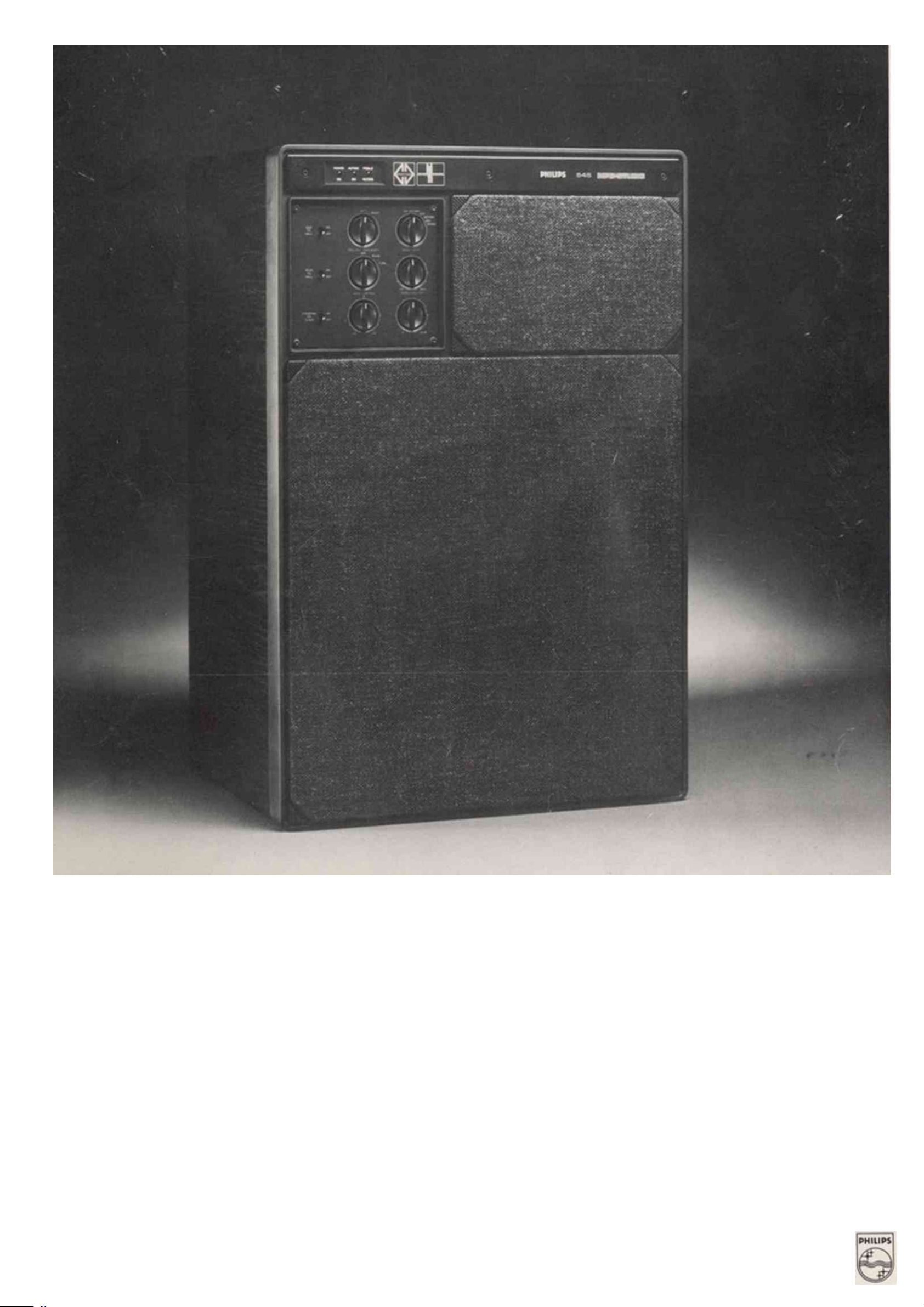
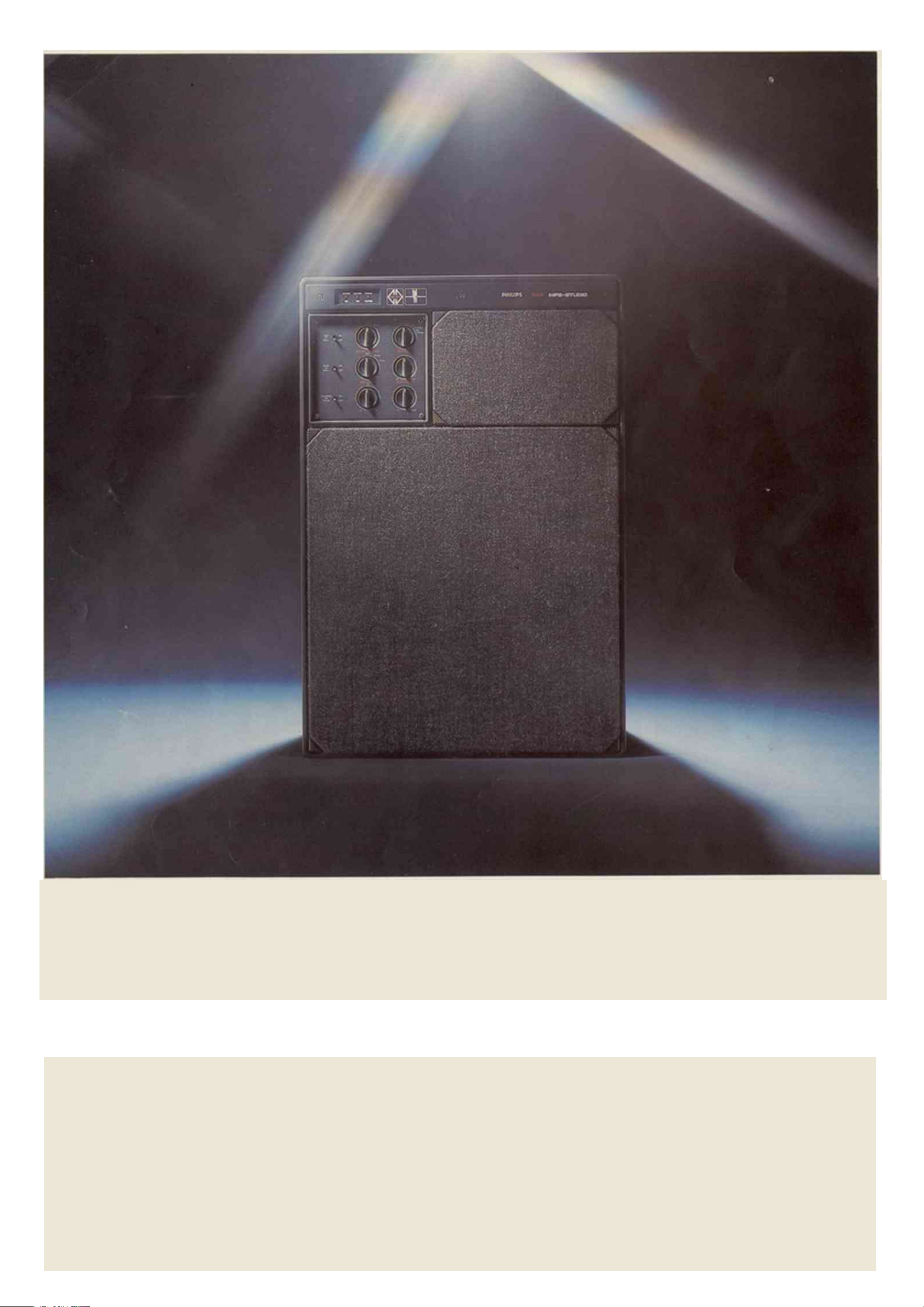
Philips 545MFB Studio Loudspeaker
- 3-way loudspeaker with integrated 100 W 3-channel
power electronics
- transmission range 20 to 20000 Hz
- over-all sound pressure at a distance of 1 m: 108 dB
- electronic precision filter for accurate adjustment of
sound pressure to positioning of loudspeaker box
(positional matching)
- high reliability
- overload protection
- loudspeakers:
woofer 50-watt sine-wave 12"
squawker 35-watt sine-wave 2"
tweeter 15-watt sine-wave 1"
- volume of housing 70 litres
MFB loudspeaker
dome loudspeaker
dome loudspeaker
PHILIPS
Page 2
Philips545MFB Studio Loudspeaker
BRIEF DESCRIPTION
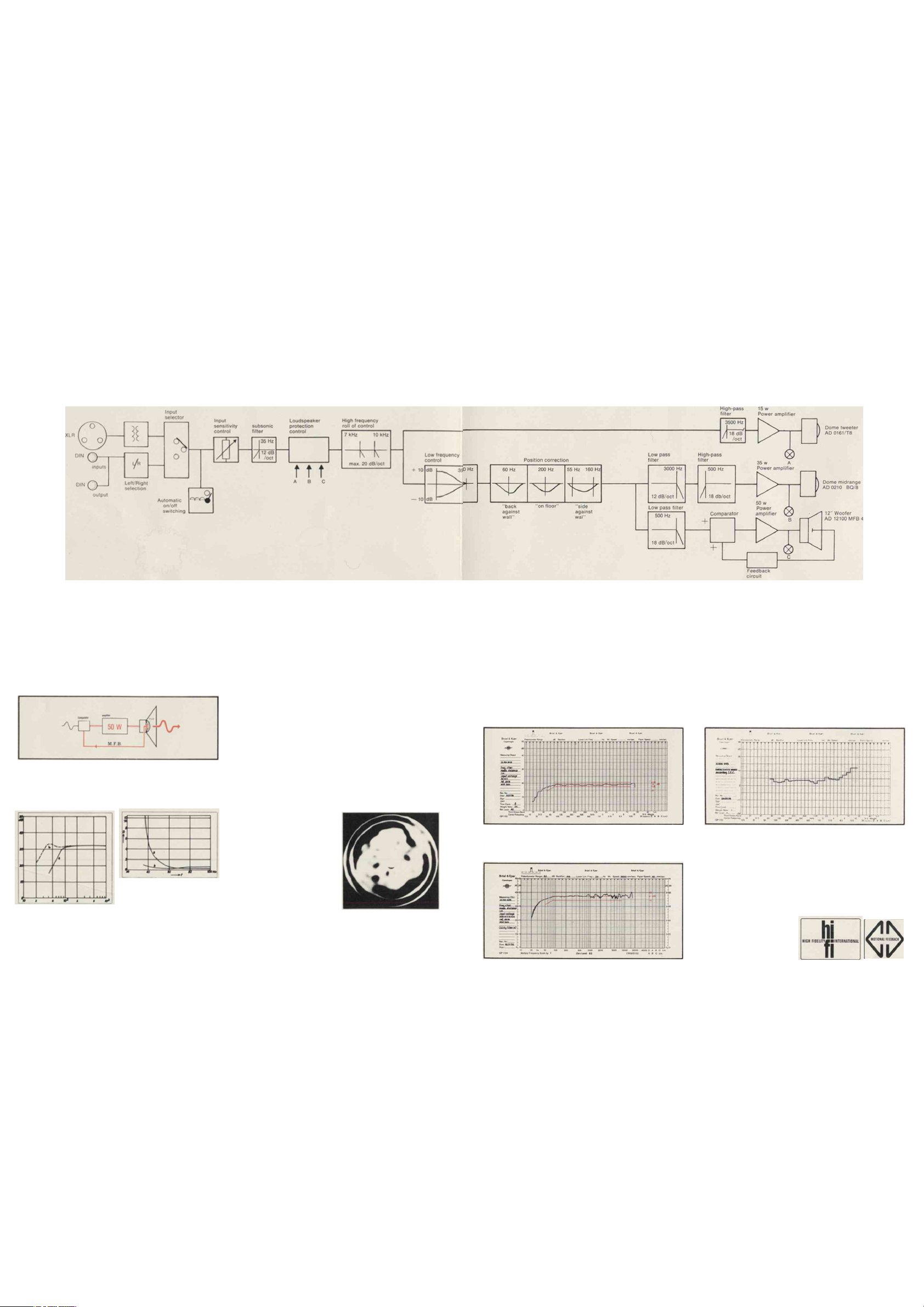
A 70-litre box houses three special loudspeakers together with trimming and control circuitry, and three integrated power amplifiers.
A 50-watt amplifier drives the woofer in accordance with the input signal it receives. The woofer carries at the centre of its cone an
acceleration transducer in the form of a piezoelectric element (PXE for short* ) This produces a voltage proportional to the acceleration of
the cone, which is compared with the original input signal of the amplifier in a comparator stage.
A correction signal, produced by the comparator as the result of the difference between the original signal and the PXE-signal, is fed back by
the comparator, with reversal of phase, to the amplifier, thus making it possible for the motional errors of the woofer cone, which would be
inevitable in the absence of MFB**’. to be eliminated at the source.
The acoustic signal emitted by the woofer is thus a faithful replica of the original driving signal.
A 35-watt power amplifier drives the medium-frequency dome loudspeaker (squawker), while a 15-watt power amplifier drives the tweeter
(also a dome loudspeaker). The over-all transmission range is divided into three frequency bands (crossoverpoints at 500 and 3000 Hz) by
precision active filters situated before the power amplifiers.
Three high-precision electronic filters (with gyrators). which can be used in any desired combination, make it possible to correct the distortion
of the sound-pressure field due to the positioning of the box.
An active low-frequency filter with an adjustment range of ± 10 dB and a passive high-frequency filter with a choice of cut-off frequency
(7 or 10 kHz) and an adjustable damping slope (max. 20 dB/octave) serve for matching the box to the acoustics of the room.
A high-pass filter with a cut-off frequency of 35 Hz protects against infrafrequencies below 20 Hz. Each of the three loudspeaker channels
has its own overload protection unit, which interrupts the amplifiers in question as long as the overload lasts.
Apart from the symmetrical studio input, the box is also provided with an asymmetrical input (mainly intended for use in the home studio).
The latter is connected to a signal-controlled relay which automatically switches the box from "ready” to "on”, and back to "ready" again if
no signal is received for longer than 2 minutes: this function can be switched off if desired.
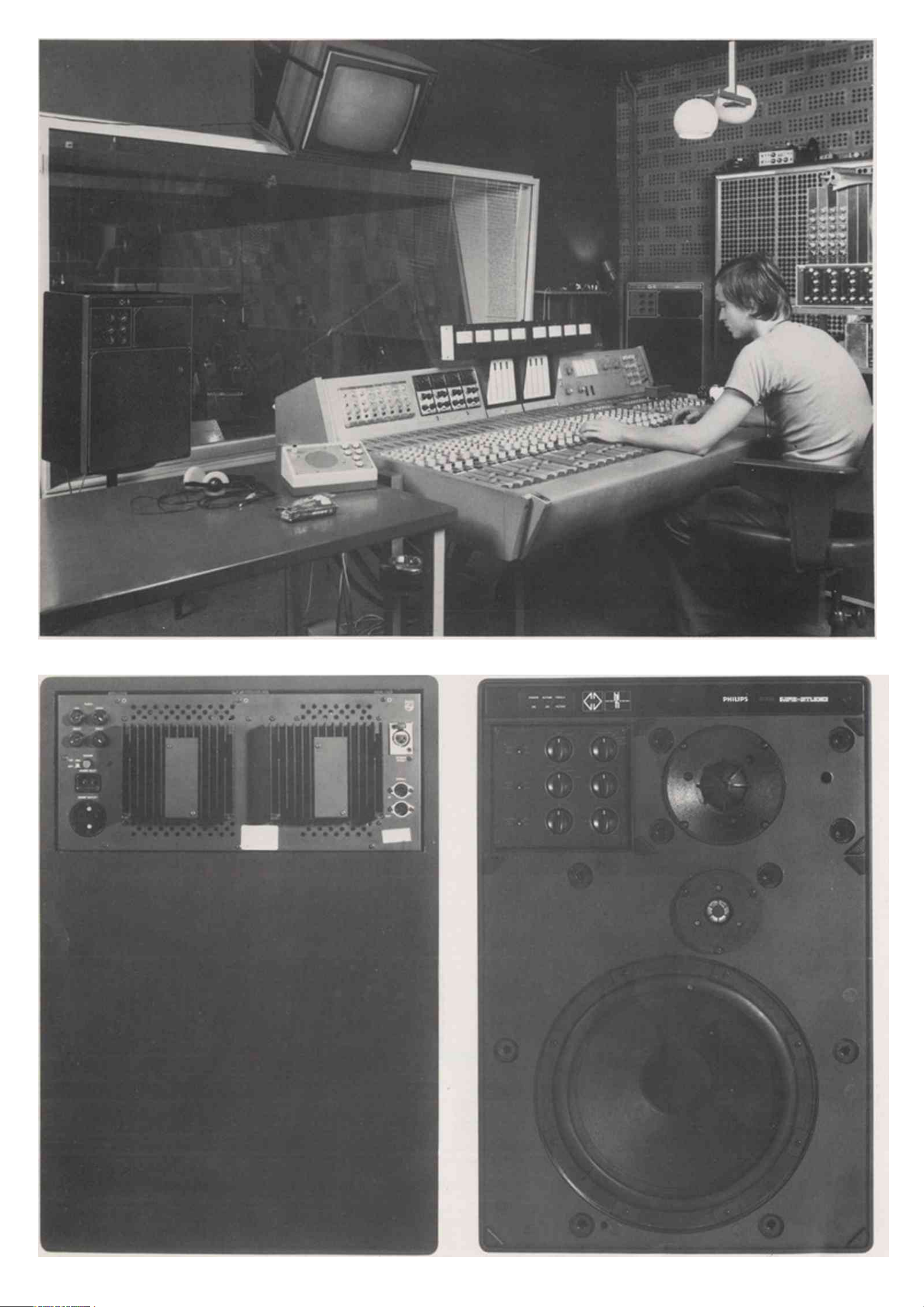
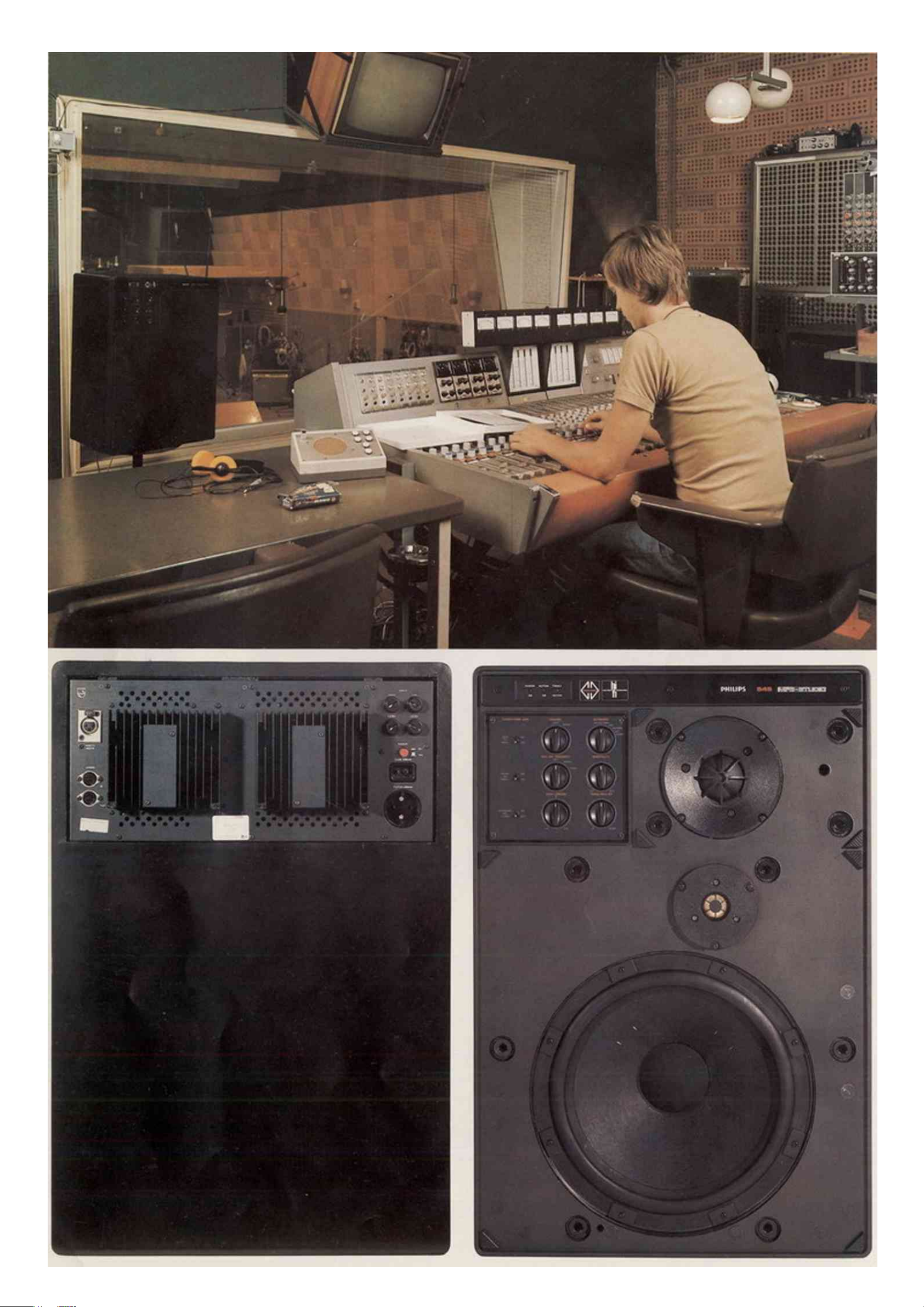
This active 3-way loudspeaker has been designed in accordance with the
state of the art to meet the high requirements of the professional studio
With its realistic acoustics, it represents an ideal audio monitor for use m
mixing work
Thanks to the use of motional feedback (MFB) m the low-frequency
channel, the over-all dimensions of the box could be kept so low that it
can easily be mounted on the wall, m a rack or on a stand, as desired
This permits free radiation of the sound, even at low frequencies,
unhindered by the mixing control desk
Philips research shows the way
Motional feedback in loudspeakers
JA. Klaassen and S.H. de Koning. Philips Research Laboratories
Eindhoven 1968
Fig. 1. Amplitude charac
teristics determined with the
loudspeaker in an enclosed
10-litre housing, a) without
motional feedback, b) with
acceleration feedback
Fig. 2 Non-linear distortion D
as a function
of
frequency
for the woofer 9710. a) with
out motional feedback, b)
with acceleration feedback
corresponding to the ampli
tude characteristic b of Fig. 1.
Vibration and sound radiation of loudspeaker cones
F.J.M Frankorter. Philips Research Laboratories. Eindhoven 1975
A computer programme (involving
12 simultaneous equations) for a
large number of frequencies and
different cone types makes it
possible to build loudspeakers with
predetermined characteristics
For example, a woofer cone must
vibrate as a rigid whole within its
transmission range. Holograms
show that a woofer designed with
the aid of this programme does not
start to show standing waves until
two octaves above its transmission
range
Its transmittance (as determined in free-field measurements with noise having
a bandwidth of a third of an octave) remains frequency-independent within
tolerances of ± 1.5 dB (in accordance with recommendations of the IRT) from
45 Hz to 17 kHz
PXE - piezoxide element, a piezoceramic Philips product
* * MFB - Motional feedback
With a sinusoidal signal, the free-field transmittance is frequency-independent
between 40 Hz and 18 kHz within tolerances of ± 3dB (in accordance with
recommendations of the IRT).
The bundling required for proper directional hearing shows low frequency
dependence, and is largely in accordance with the stringent requirements of
the IRT
Page 3
Sound-pressure level
Pain threshold
we-
.wo«
-OO
wj wre stutxo .
«
.80
II
.40
.20
;0 Hearing
threshold
In order to provide the high
playback volume generally
required for audio mixing work,
the over-all sound-pressure level
(over the full range of
Vh
octaves) as determined in a
free-field measurement at a
distance of 1 m is 108 dB
Since the sound radiation at low
frequencies is highly dependent
on the positioning of the
loudspeaker, three precision
electronic filters (with high
quality-factor gyrators) are
provided for accurate correction of
the sound pressure. This
eliminates the potential sources
of sound distortion otherwise
present when the box is positioned
against a rear wall, a side wall, or
on the floor, and making the
sound-pressure characteristic
independent of the positioning of
the loudspeaker. In many cases,
this makes it unnecessary to
calibrate the loudspeaker after
installation in the studio.
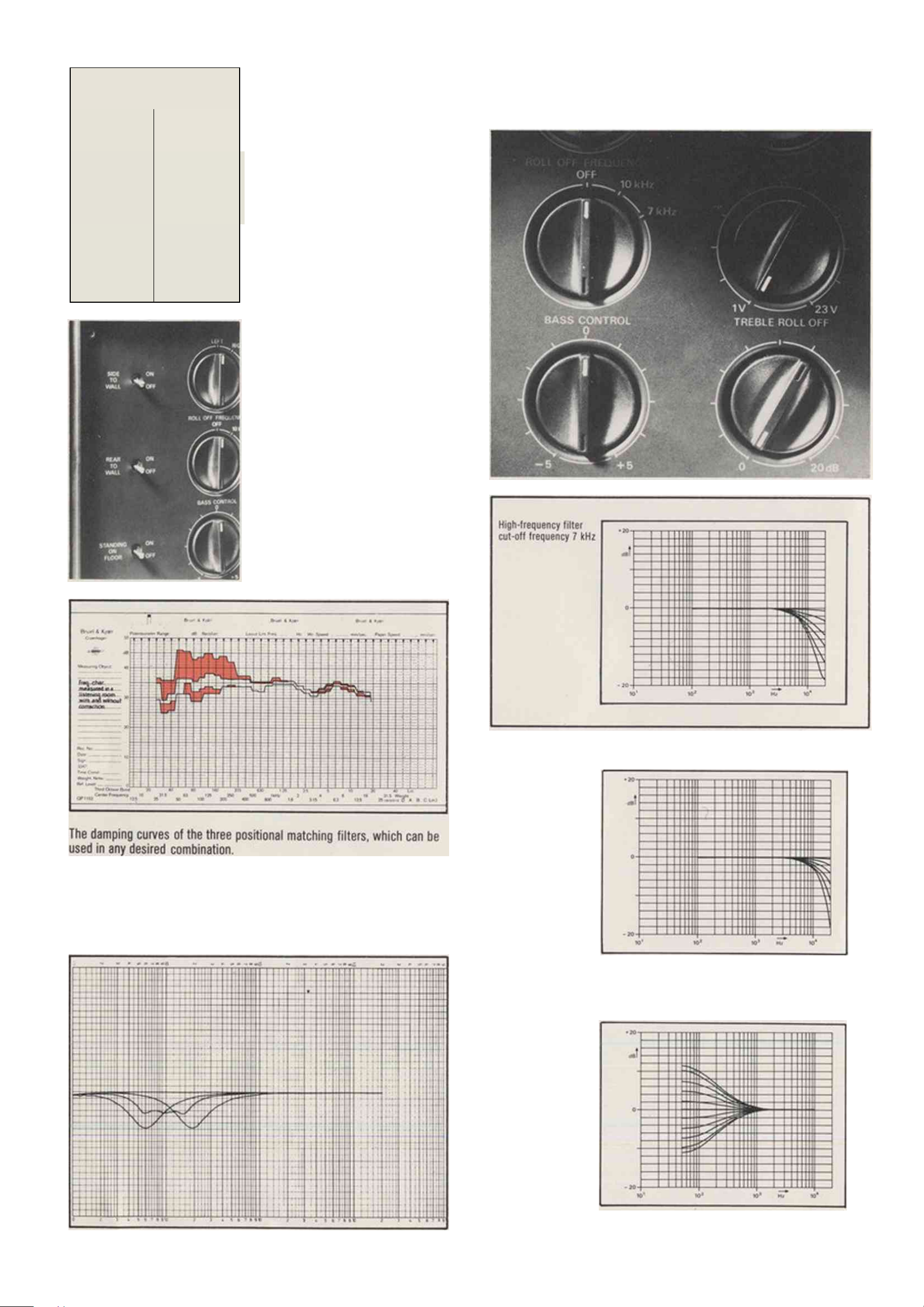
Sound-pressure curves with and without positional matching filter, with the
boxes at various places in the playback room.
For matching the box to the acoustics of the room, an active lowfrequency filter and a high-frequency filter with a choice of two cut-off
frequencies and adjustable damping slope are available.
High-frequency filler
cut-off frequency 10 kHz
Low-frequency
filter
Page 4
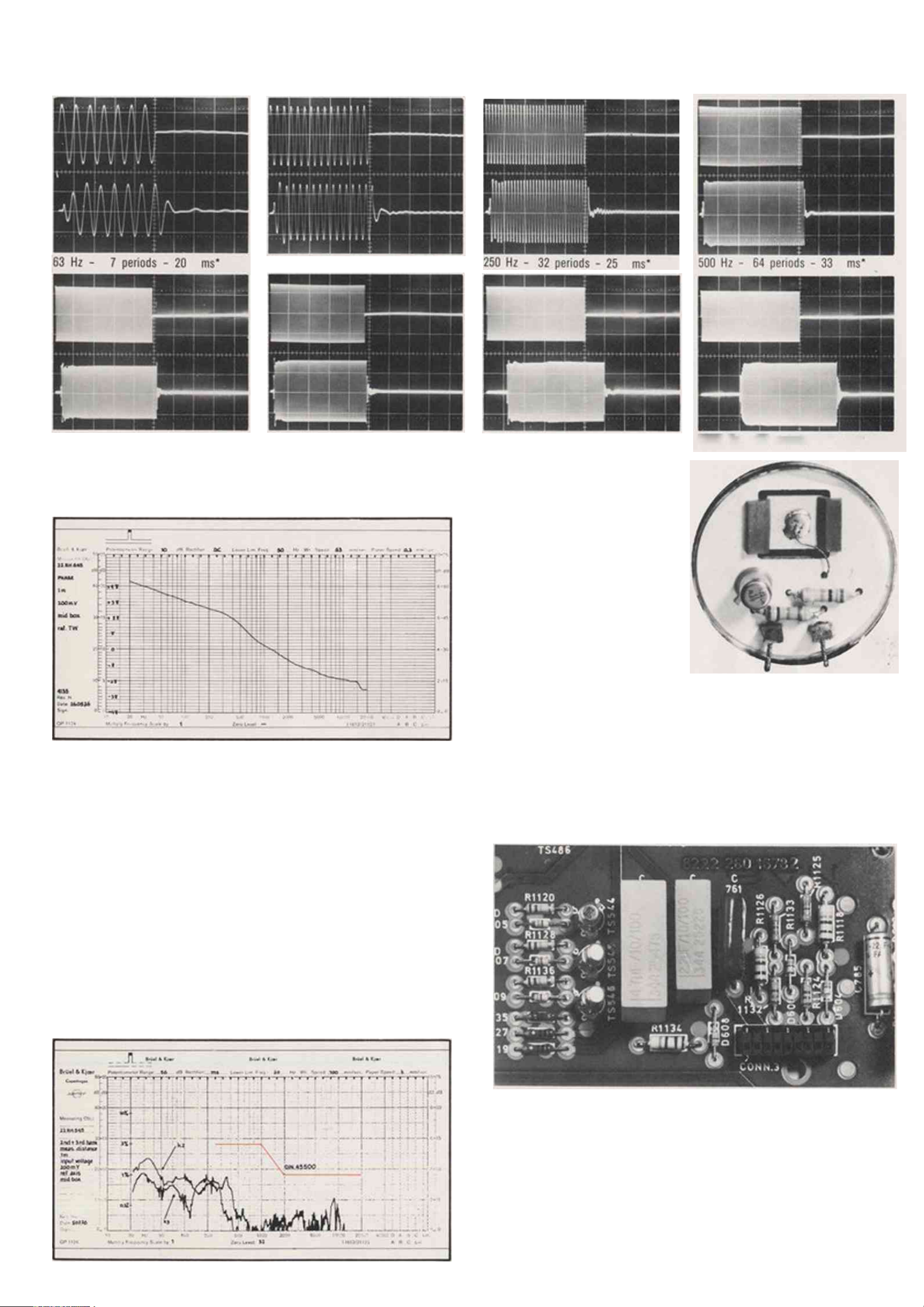
The oscillograms of the build-up and decay of the notes from various musical instruments, as reproduced by the 545 MFB
STUDIO, shown alongside illustrate the excellent pulse response of this loudspeaker, which is very important for faithful
reproduction of complicated sound structures.
1000 Hz -128 periods - 25 ms*
125 Hz - 15 periods - 25 ms*
2000 Hz -128 periods - 12.5 ms*
8150 Hz - 128 periods - 4 ms*
16000 Hz - 125 periods - 2 ms’
The phase response of the loudspeaker is highly linear.
No complete answer has yet been given to the question of whether
phases" can actually be heard.
So far, the direct audibility of phase changes has only been scientifically
demonstrated for speech, but not for music
Consequently, the phase response is not so important for the audibility of
"phases"; but (together with the amplitude response) it is very important
for the complete description of the pulse behaviour of a "converter” such
as a loudspeaker. The more linear the amplitude and phase response, the
more accurately will pulsed signals be reproduced. This is particularly
important for contemporary music, where such tones occur relatively
often.
The following values were measured for the non-linear distortion at a
sound-pressure level of 80 dB and a distance of 1 m:
between 300 and 450 Hz. K, < 0.6%, K
3
< 0.6%;
above 450 Hz. K? < 0.3%, K3 < 0.3%.
This little print card with the PXE
acceleration transducer and fieldeffect transistor is the heart of
each MFB loudspeaker. It is
mounted at the centre of the
loudspeaker cone. This element is
subjected to high loads, as it
vibrates with the cone and
undergoes the full changes in
acceleration affecting the latter.
Careful design with over
dimensioned components and
stringent life testing ensure
reliable operation for the
loudspeaker as a whole.
In the interests of high reliability of operation, all components are over
dimensioned. and all transistors used have metal housings. The circuits
are built up on reinforced epoxy print cards with fully metallized
mounting holes.
The loudspeaker has passed the loading test of DIN 45 573 sheet 2.
according to which the full load power is applied to the loudspeaker
without interruption for 100 hours.
The 545 MFB STUDIO can be connected to many different kinds of
high-quality amplifiers;
- without power output stage, with symmetrical 1-V output
- without power output stage, with asymmetrical 1-V output
- with power output stage up to 100 W.
When asymmetrical inputs are used, several boxes can if desired be
connected together to form a group. For this purpose, each input terminal
is connected in parallel with a corresponding output terminal.
Page 5
Page 6

Technical data
Transmission range
20 - 20000 Hz
Sound pressure level
108 dB at distance of 1 m
(over full 7'£-octave range)
Volume
70 litres (acoustic section 501.
electronics 20 1)
Loudspeaker systems
tweeter
1" dome loudspeaker
A0 0162/T8
squawker
2" dome loudspeaker
A0 0210/Sq 4
woofer
12" low-tone loudspeaker
A0 121 00/W4
Cross-over frequencies
500 Hz and 3 kHz
(active filter)
Amplifiers:
Low-frequency channel
output power 50 W sine-wave
(at 100 Hz. 40 W: k < 0.1%)
Bandwidth 5 Hz- 5 kHz
Medium-frequency channel
output power 35 W sine-wave
(at 1000 Hz. 25 W: k < 0.1%)
Bandwidth 40 Hz - 30 kHz
High-frequency channel
output power 15 W sine-wave
(at 5 kHz. 10 W: k < 0.1%)
Bandwidth 40 Hz - 50 kHz
Sound-pressure correction filters
Positional matching:
200 Hz -5 dB
60 Hz -5 dB
55-160 Hz -3 dB
Bass tone control: Down from
350 Hz: ± 10 dB at 60 Hz.
in 11 steps.
treble tone control: continuously
variable from 7 or 10 kHz.
0 - 20 dB/octave
(a pilot light shows when this
control is switched on)
Electronic automatic 0N/0FF response time: < 1 second
switching (only with 0IN for input signals above about
asymmetrical input; can be
1.5 mV
switched off) decay time > 2 minutes
A pilot light shows when this
function is switched on
Input sensitivity Continuously adjustable 1 - 23 V
symmetrical 1 V into 10 kohm
asymmetrical 1 V into 100 kohm
Connections
CANNON studio input connector
(symmetr.)
0IN input corrector. 5-pole
(asymmetr.)
mains input terminal. 0IN/IEC
mains output terminal. DIN/IEC
Semiconductors 85 transistors. 39 diodes
Mains 220 V. 50/60 Hz
(il desired, can be adjusted by
our service technicians to 110.
127 or 240 V)
Power consumption 200 W max. consumption
A pilot light shows when the box
is connected to the mains
Housing wooden cabinet (black ash)
textile front panel (removable)
Dimensions 436 x 650 x 320 mm
(width x height x depth)
•
This delay of approx. 3 ms which can be seen in the loudspeaker
oscillogram s results from the sound transmission time between
the loudspeaker and the test microphone.
Page 7

Page 8
PHILIPS
Philips 545 MFB Studio
Less than a thousandth
of the thickness
ofthissheetofpaper...
Page 9
Less than a thousandth of the thickness
of this sheet of paper...
Have you ever paused to consider what a wonderful instrument our ear is? For example, at a
party we have no trouble in hearing people talking a yard away. Nothing very special in that,
you may say... and yet it means that our ear is capable of detecting sound waves with an
amplitude of no more dan 1/10000 mm, or 1/1000th of the thickness of this sheet of paper.
And what is more, we are able to distinguish tiny details of these sound waves. The range in
which the human ear experiences vibrations as audible sounds runs roughly from 20 to 16000
Hz. In the frequency range around 1000 Hz, the limit of detectability of differences in sound
pressure is about 3 dB.
Page 10
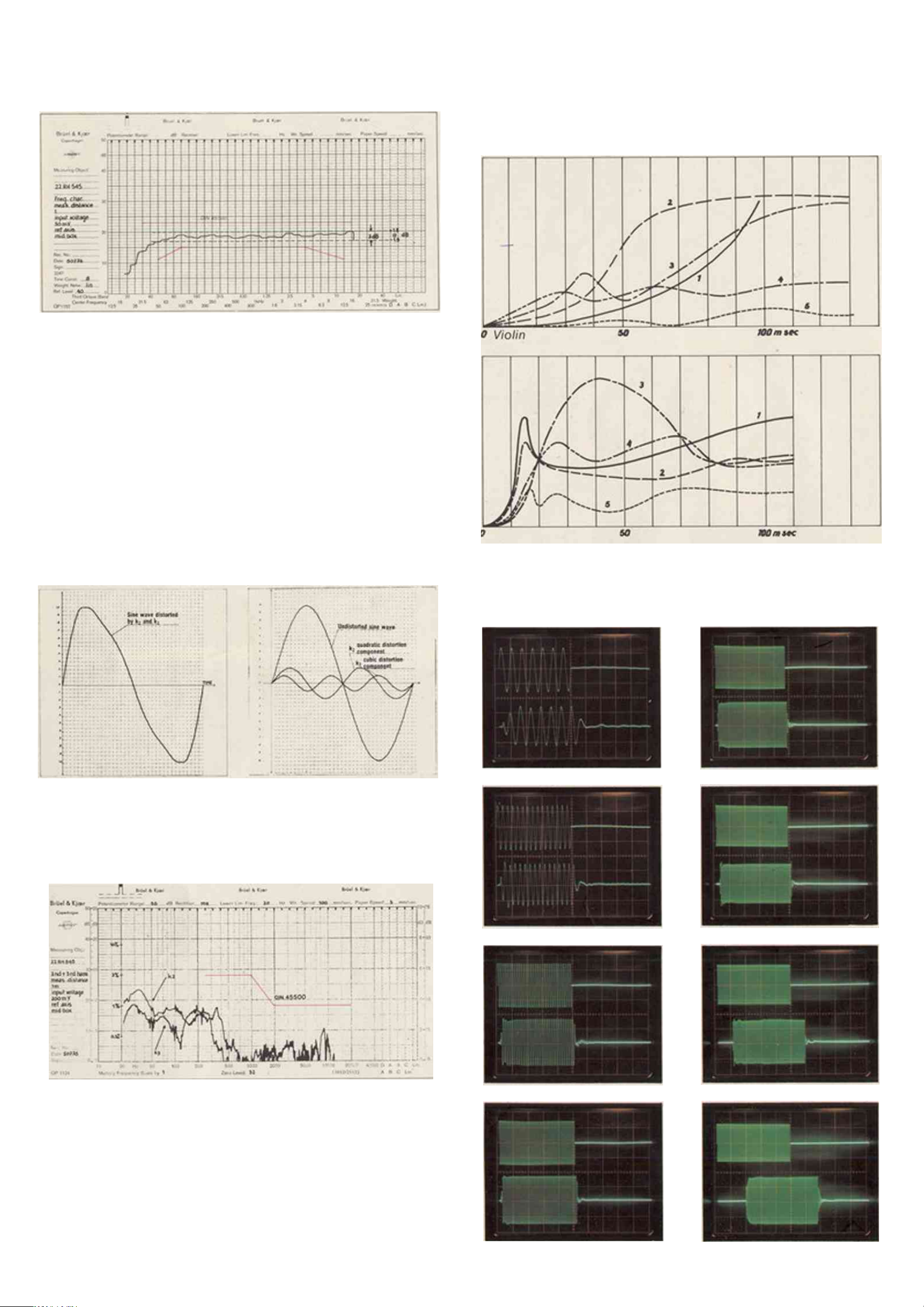
The PHILIPS 545 MFB Studio loudspeaker has a transmission range
extending from 20 to 20 000 Hz. Between 45 and 17000 Hz. fluctuations in
its sound pressure are kept within the narrow tolerances of ± 1.5 dB. as
demonstrated by "free-field" measurements.
A high-quality loudspeaker must possess extreme purity of tone.
The extent to which we experience tones which are not present in the
original sound (because they are first produced during the transformation of
electrical vibrations into acoustic ones) as impurity of tone, or distortion,
depends on the playback volume and the complexity of the original sound.
Even when only two notes are played together, combination tones and
difference tones will be produced in addition to the harmonics of the
original notes. We will experience these as annoying if they are too loud
and if they don't harmonize with the original tones
The discord will be greater when the chord in question is not played quite
cleanly - and this is almost inevitable in music-making, since no musical
instrument is perfectly pitched. The audibility limits of such discord are
lowest in the sound-pressure range from 50 to 70 dB. Only in this range,
above about 300 Hz. and only under extremely ..favourable" conditions is
non-linear quadratic distortion (K
?
) audible down to 1%. and non-linear
cubic distortion (K3) down to 0.5%.
In the PHILIPS 545 MFB Studio loudspeaker, the non linear distortion lies practically
outside the audibility range Typical values ol this distortion are:
from 300 to
450 Hz: Kt < 0.6%. Ks
« 0.6%; above 450
Hz: K?
< 0.3%.
Ki
< 0.3%
Both the quadratic and the cubic distortion components lall off from 0 6% to less than
0 3% between 300 Hr and 450 Hr Distortion peaks with a width of less than a third
remain inaudible.
__
For the real music lover, there is nothing finer than following the individual
instruments in an ensemble. Our ability to do this depends on the ear's
astonishing capacity for hearing very quick changes in sounds. In the range
from 50 to 10003 Hz. the ear can distinguish the slightest differences in the
build-up of a no'e, even when the time involved is no more than 0.25 ms.
The build-up tine of a note produced by a musical instrument is much
longer than this.
For example, a trumpet note can be built up to full volume in 20 ms under
optimum conditions, while a saxophone takes 36 to 40 ms. a clarinet 50 to
70 ms and a flute 200 to 300 ms. It is generally known that the timbre of
the notes produced by the various musical instruments is determined by the
harmonics in these notes. What is not generally appreciated, however, is
that these harmonics can only be accurately identified during the build-up
of the note in question
If we don't hear this build-up. we cannot tell the difference between a flute,
violin. French horn or trumpet, despite the presence of the characteristic
harmonics. Musical instruments can thus only be distinguished by the
build up of the notes they produce.
Trumpet
This means that a studio-class loudspeaker must have a very high-speed,
precise amplitude response, so that it is able to reproduce the form of the
amplitude build-up of a sound exactly.
63 Hz - 7 periods - 20 ms*
125 Hz - 15 periods - 25 ms*
250 Hz - 32 periods - 25 ms*
500 Hz - 64 periods - 33 ms*
1000 Hz - 128 periods - 25 ms*
2000 Hz - 128 periods - 12.5 ms*
8150 Hz - 128 periods - 4 ms*
16000 Hz -125 periods - 2 ms*
Page 11
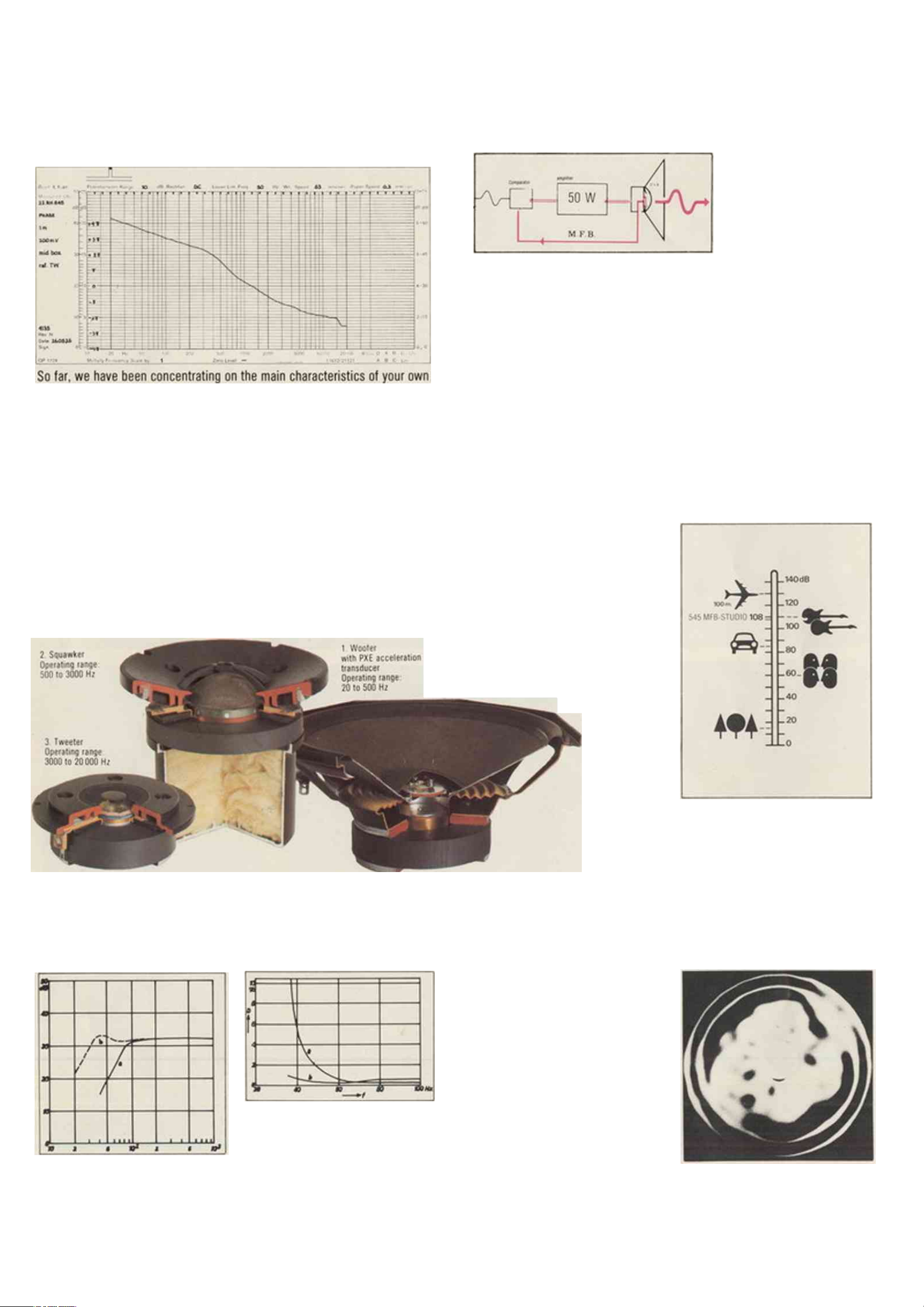
For complete characterization of the high-speed response of a loudspeaker
(its "pulse response"), we need to know how its sound pressure and
acoustic phase vary with time. The more linear the amplitude and phase
response, the more exactly will pulsed signals be reproduced. This is
especially important in contemporary music, where pulsed tones are
relatively common.
• simple adjustment of the linear acoustic response characteristic to meet
the requirements of the playback room ("positional matching");
• special filters for matching the loudspeaker to the acoustics of the room
in the high- and low-frequency ranges.
These stringent specifications could never have been met without the help
of the exhaustive work carried out in Philips' Research Laboratories.
personal acoustic "receiver" - your ear. We will now tell you something
about the corresponding quality characteristics of an acoustic "transmitter"
- the PHILIPS 545 MFB Studio loudspeaker - which matches your ear very
well. We felt obliged to present you with both sets of data, because
technical data without reference to the reality of hearing satisfy us (your
Philips HiFi team) no more than they do you
The team responsible for the development of the 545 MFB Studio was given
the task of building a loudspeaker whose tone reproduction was realistic
enough to meet all requirements made by professional studio workers - a
real "specialist" among specialists.
This "specialist" had to have the following interesting "qualifications",
among others:
• a small housing, which still permits faultless reproduction of low notes
right down to 20 Hz;
• playback volume characteristics which meet all studio requirements,
without audible distortion;
Some of thî concrete
results of Philips research
in the 545 MFB Studio
loudspeaker are as
follows:
A 70-litre box into which
are built three special
loudspeakers together with trimming and control circuitry, and three power
amplifiers with outputs of 50.35 and 15 watt R.M.S. sine-wave.
The 50-watt amplifier drives the woofer in accordance with the input signal
it receives. The woofer carries at the centre of its cone an acceleration
transducer in the form of a piezoelectric element (PXE for short). This
produces a voltage proportional to the acceleration of the cone, which is
compared with the input signal of the amplifier in a comparator stage. A
correction signal produced by the comparator as the result of the difference
between the original signal and the PXE-signal. is fed back by the
comparator, with reversal of phase, to the amplifier, thus making it possible
for the motional errors of the woofer cone, which would be inevitable in the
absence of MFB (motional feedback), to be eliminated at the source. The
acoustic signal emitted by the woofer is hence a faithful replica of the
original driving signal.
The 35-watt amplifier drives the medium-frequency dome loudspeaker
(squawker). while the 15-watt amplifier drives the tweeter (also a dome
loudspeaker). The over-all transmission range is divided into three frequency
bands (at 500 and 3000 Hz) by
precision cross-over filters situated
before the power amplifiers.
Since it is important for HiFi repro
duction that the amplitude response
should be correct, even for the big
dynamic peaks which occur relatively
often in big orchestral performances,
the 545 MFB STUDIO can deliver a
total sound-pressure level (over its
entire 7Voctave range) of 108 dB
at a distance of
1 metre from
the box.
Philips research shows the way
Motional feedback in loudspeakers
J A Klaassen and S.H. de Koning. Philips Research Laboratories.
Eindhoven 1968.
Fig. 1. Amplitude charac
teristics determined with the
loudspeaker in an enclosed
10-litre housing, a) without
motional feedback, b) with
acceleration feedback
Fig. 2 Non linear distortion D
as a function of frequency
for the woofer 9710. a) with
out motional feedback, b)
with acceleration feedback
corresponding to the ampli
tude characteristic b of Fig 1
Vibration and sound radiation of loudspeaker cones
F.J.M. Frankorter. Philips Research Laboratories. Eindhoven 1975
A computer programme (involving
12 simultaneous equations) for a
large number of frequencies and
different cone types makes it
possible to build loudspeakers with
predetermined characteristics.
For example, a woofer cone must
vibrate as a rigid whole within its
transmission range. Holograms
show that a woofer designed with
the aid of this programme does not
start to show standing waves until
two octaves above its transmission
range
Page 12
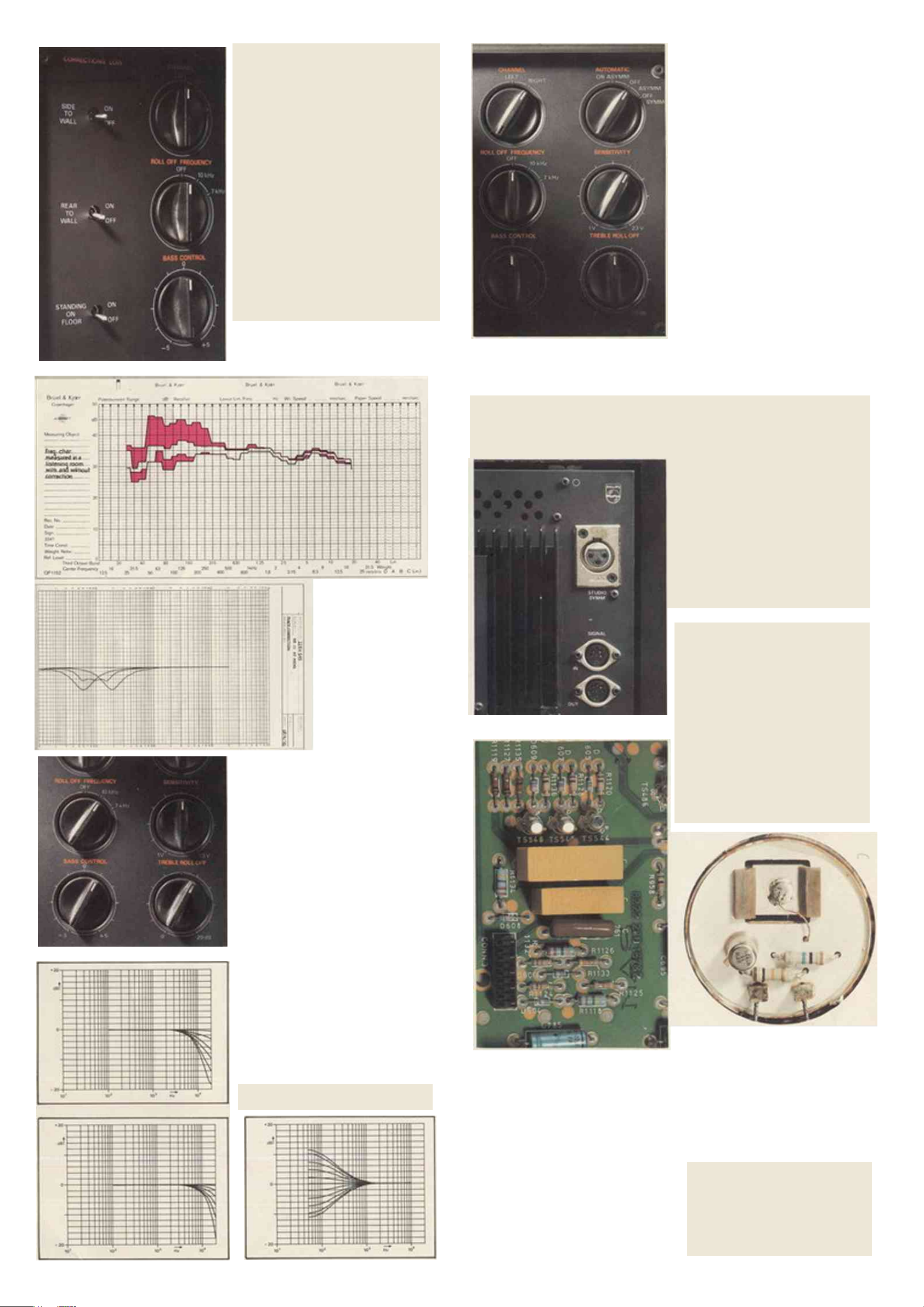
Since the sound radiation at low
frequencies is highly dependent on
the positioning of the loudspeaker,
three high-precision electronic
filters (with gyrators) are provided
for accurate correction of the sound
pressure (positional matching). This
eliminates the potential sources of
sound distortion otherwise present *
when the box is positioned against
a rear wall, a side wall, or on the
floor, and making the sound-
pressure characteristic independent
of the positioning of the loudspeaker.
What that means to you in practical
terms is that the low tones are
reproduced without the slightest
distortion.
The damping curves
of the three posi
tional matching
fitters, which can be
used m any desired
combination
Sound-pressure
curves with and
without positional
matching filler, wilh
the boxes at vanous
places in the play
back room
An active low-pass filter with an
adjustment range of ± 10 dB and a
passive high-pass filter with a
choice of cut-off frequencies (7 or
10 kHz) and an adjustable damping
slope (max. 20 dB/octave) serve
for matching the box to the acous
tics of the room
For example, the effect of an un
welcome rise in reverberation in the
low-frequency range can be cut out
with the aid of the low-pass filter
1
J
A high-pass filter with a cut-off
frequency of 35 Hz protects against
distortion from infrafrequencies
below 20 Hz.
High-frequency filler
cut-off frequency 7 kH?
Hiqh frequency filler low-frequency
cut nit frequency 10 kH/ filter
Thanks to the well thought out
design, the boxes are easy to
operate despite the relatively large
amount-of circuitry they house. For
example, only 6 switches are needed
to adjust the box to the acoustics of
the room - 3 for positional matching
and 3 for reverberation matching.
The 3 remaining controls on the
neat little control panel are for
facilitating the connection of the
box. The first of these is for
selecting the nature of the input:
symmetrical (studio norm) or asym
metrical (OIN home-studio norm
45500). With the asymmetrical
input, there is no need to switch the
box on and off manually. A signal-,
controlled relay switches automati
cally from "ready" to "on", and back
to "ready" again if no signal is received for more than 2 minutes. The
second control adjusts the input sensitivity to the desired level in 11 steps,
while the third and last adjusts the box for connection to the right-hand
This little print card with the PXE
acceleration transducer and fieldeffect transistor is the heart of each
MFB loudspeaker. It is mounted at
the centre of the loudspeaker cone
This element is subjected to high
loads, as it vibrates with the cone
and undergoes the full changes in
acceleration affecting the latter
Careful design with over-dimen
sioned components and stringent
life testing ensure reliable operation
for the loudspeaker as a whole
or left-hand stereo channel.
The 545 MFB STUDIO can thus be connected to several different types
of signal source:
amplifier without power output stage, with symmetrical 1-V output.
amplifier without power output
stage, with asymmetrical 1-V output;
HiFi amplifier with power output
stage, up to 100 W
If the output power available is in
adequate. it is possible to connect
several boxes to form a group. For
this purpose, each input connector
has a corresponding output con
nector in parallel with it.
The three loudspeakers are pro
tected against overload by means
of a safety circuit which interrupts
the channels in question for the
duration of the overload (e g. an
overvoltage).
In the interests of reliable operation,
all components are overdimen
sioned. and all transistors used are
mounted in metal housings. The
circuits are built up on reinforced
epoxy print cards, with fully metal
lized mounting holes.
This delay of approx. 3 m s
which can be seen in the
loudspeaker oscillograms
results from the sound
transmission time between the
loudspeaker and the test
microphone.
Page 13
Page 14
Technical data
Transmission range
20 - 20000 Hz
Sound pressure level
108 dB at distance of 1 m
(over full 77z-octave range)
Volume
70 litres (acoustic section 50
1
,
electronics 201)
Loudspeaker systems
tweeter
1" dome loudspeaker
AO 0162/T8
squawker
2" dome loudspeaker
AO 0210/Sq 4
woofer
12" low-tone loudspeaker
AO 121 00/W4
Cross-over frequencies
500 Hz and 3 kHz
(active filter)
Amplifiers:
Low-frequency channel
output power 50 W sine-wave
(at 100 Hz. 40 W: k < 0.1%)
Bandwidth 5 Hz- 5 kHz
Medium-frequency channel
output power 35 W sine-wave
(at 1000 Hz. 25 W: k < 0.1 %)
Bandwidth 40 Hz - 30 kHz
High-frequency channel
output power 15 W sine-wave
(at 5 kHz. 10 W: k < 0.1%)
Bandwidth 40 Hz - 50 kHz
Sound-pressure correction filters Positional matching:
200 Hz -5 dB
60 Hz -5 dB
55-160 Hz -3 dB
Bass tone control: Down from
350 Hz: ± 10 d8 at 60 Hz.
in 11 steps.
treble tone control: continuously
variable from 7 or 10 kHz.
0 - 20 dB/octave
(a pilot light shows when this
control is switched on)
Electronic automatic ON/OFF response time: < 1 second
switching (only with DIN
for input signals above about
asymmetrical input: can be
#
1.5 mV
switched off) decay time > 2 minutes
A pilot light shows when this
function is switched on
Input sensitivity Continuously adjustable 1 - 23 V
symmetrical 1 V into 10 kohm
asymmetrical 1 V into 100 kohm
Connections
CANNON studio input connector
(symmetr.)
DIN input corrector. 5-pole
(asymmetr.)
mains input terminal. DIN/IEC
mains output terminal. DIN/IEC
Semiconductors 85 transistors. 39 diodes
Mains
220 V. 50/60 Hz
(if desired, can be adjusted by
our service technicians to 110.
127 or 240 V)
Power consumption 200 W max. consumption
A pilot light shows when the box
is connected to the mains
Housing wooden cabinet (black ash)
textile front panel (removable)
Dimensions 436 x 650 x 320 mm
(width x height x depth)
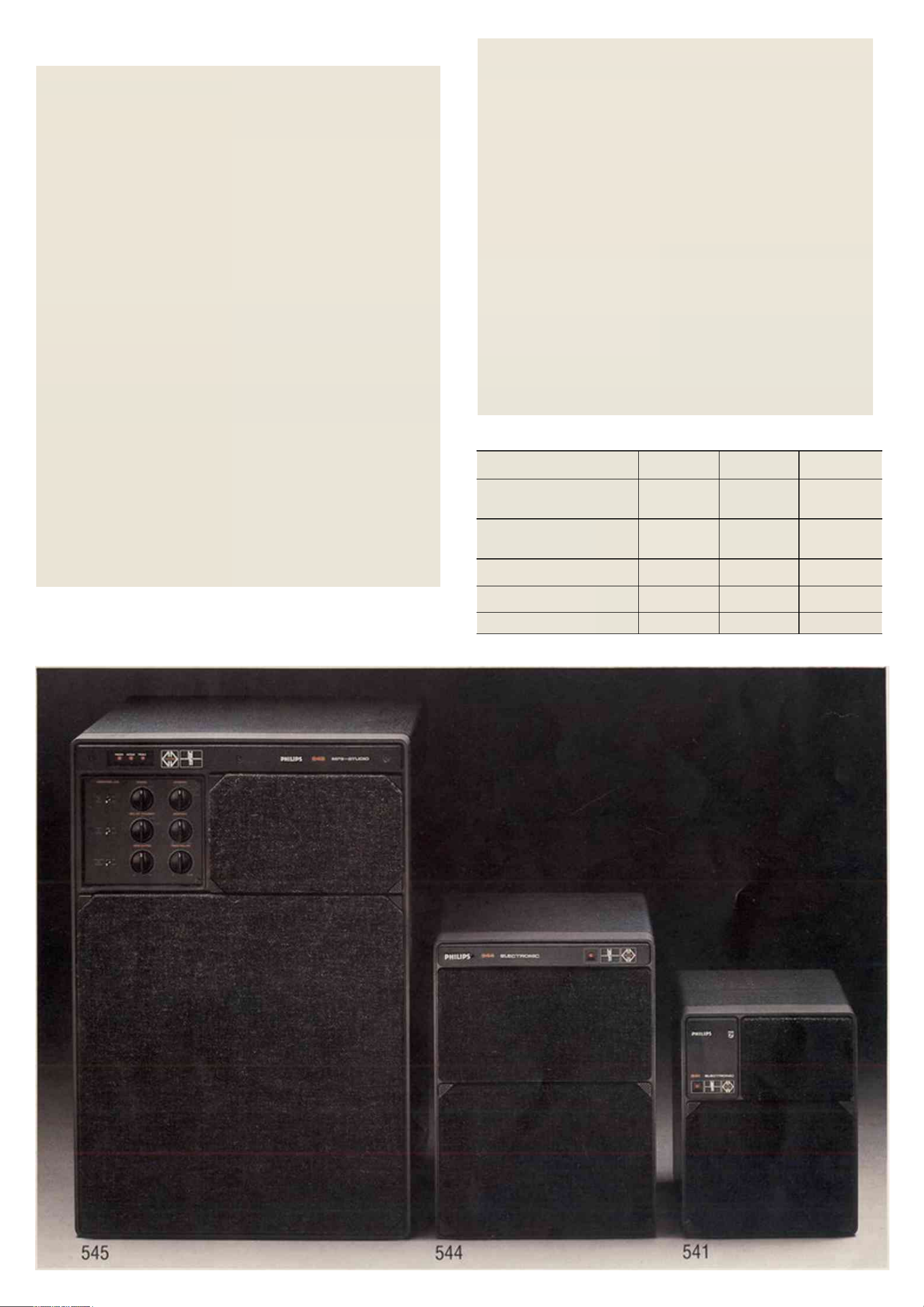
Comparison of the main points of various Philips HiFi loudspeaker boxes
545 544
541
No. of channels/
No. of amplifiers
3/3 3/2
3/1
Sound pressure total,
at a distance of 1 m dB 108
105
102
Transmission range
Hz 20-20000 30-20000
35-20000
Volume, net
1
70 15 8
Output power W
100 60
30
Page 15

 Loading...