

Page 1

Product Manual
3175 - RTD Interface Kit
Page 2

Phidgets 3175 - Product Manual
For Revision 0
© Phidgets Inc. 2010
Page 3
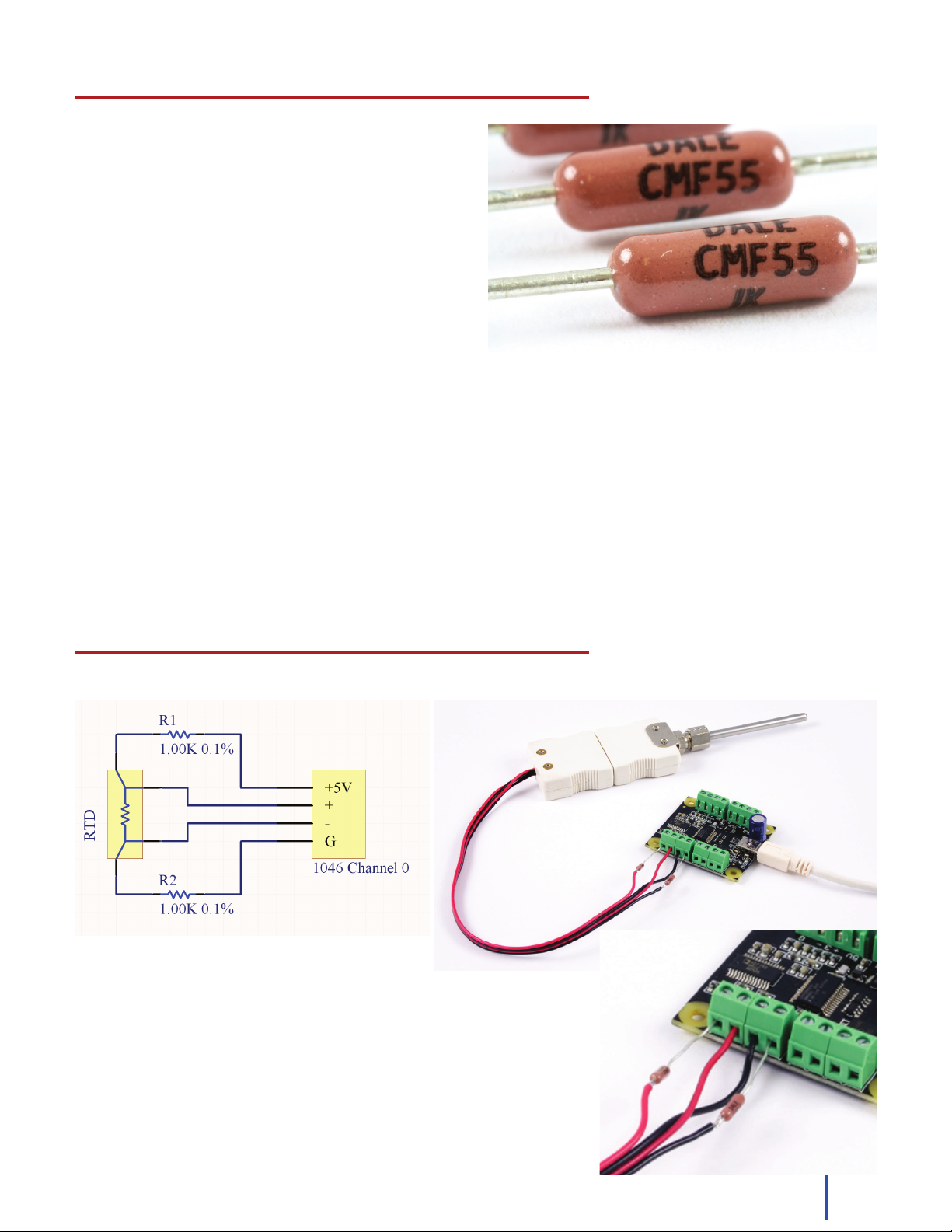
What is the 3175 RTD Resisitor Kit
The 3175 RTD Resistor Kit includes four pieces of 1.00
KiloOhm resistors. These precision resistors are used
to interface Platinum RTDs to the 1046 PhidgetBridge.
Platinum RTDs (Resistive Thermal Devices) are used to
make very precise temperature measurements. RTDs
are very accurate, and will measure temperatures up
to 500 degrees Celsius. The electrical resistance of the
RTD changes predictably with temperature, and RTDs
are the most accurate commonly available temperature
sensors.
Measuring the resistance of an RTD requires accurate
components all through the system - otherwise there
is no point in paying for an RTD. The resistors in the 3175 RTD Resistor Kit have a worst case error of 0.1% translating to a typical temperature error of 0.05 Celsius. The resistors also change their resistance very little with
temperature - ambient temperature variation is a signicant source of error for thermocouples. RTDs with a well
designed data acquisition system will not be subject to these temperature variation errors.
Wiring the resistors to your RTD allows the 1046 PhidgetBridge to convert the resistances into a voltage, which
it then measures. The PhidgetBridge is by far the most precise Phidget device for measuring voltage. The
PhidgetBridge also cancels the errors resulting from USB voltage variation.
Wiring up your RTD and Precision Resistors
Shown above is how to connect the RTD to the precision resistors and the
1046 PhidgetBridge.
3175_0_Product_Manual - December 14, 2011
3
Page 4
Using the PhidgetBridge Code
Sample on Windows
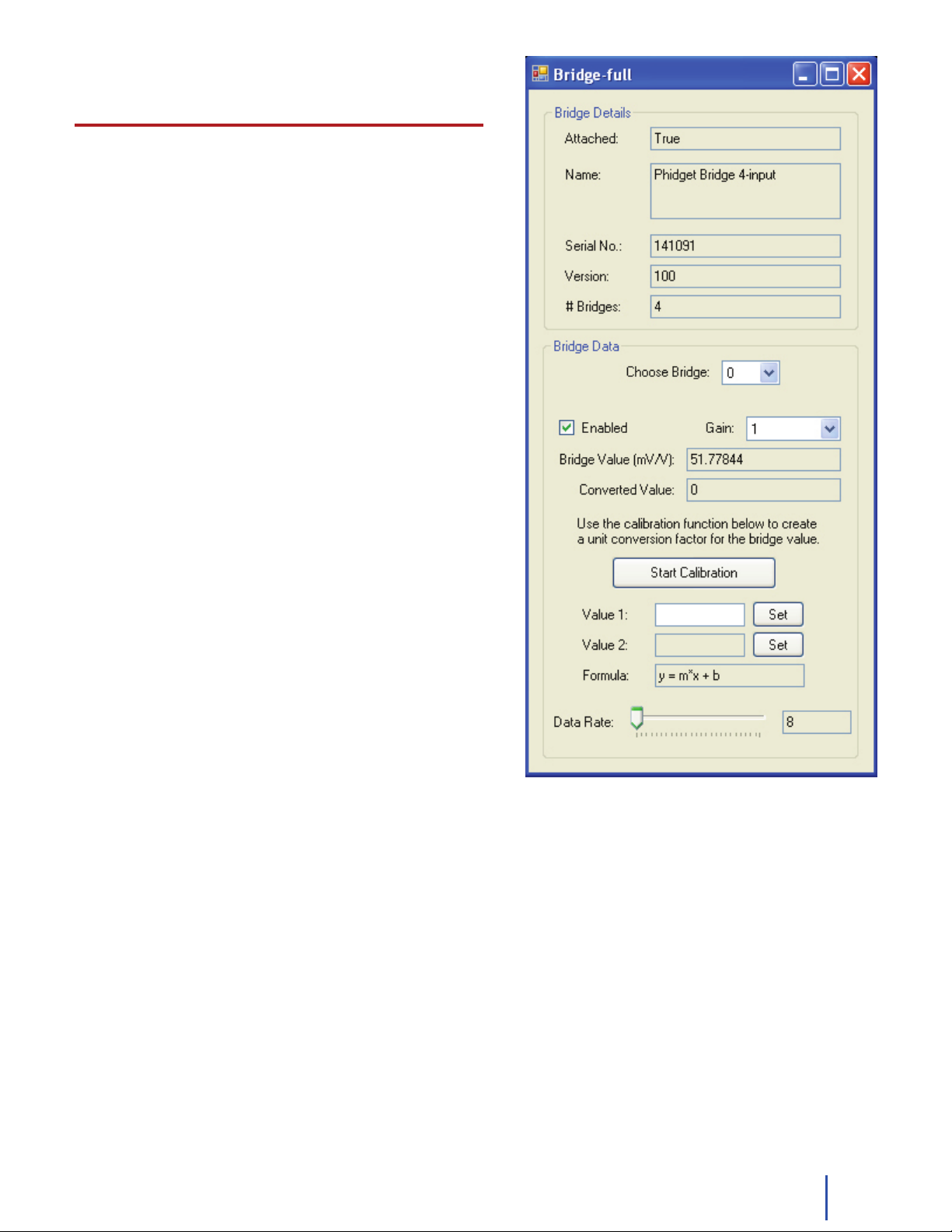
The PhidgetBridge Bridge-full application will allow you to
verify that your PhidgetBridge is working, and that your
wiring is functional. Please check the 1046 manual for
instructions on launching the application.
The PhidgetBridge has the ability to amplify the
measured signal - it was built to measure extremely small
signals. Amplication is not necessary with RTDs, so we
recommend leaving the gain set to 1. If you do decide to
amplify, please study the limitations of amplication on
the 1046, to ensure that the most extreme temperatures
encountered do not cause the amplier to reach its limit
during operation, blinding your application from further
changes coming from the RTD. If amplier is in danger of
saturating (reaching the limit), an Overrange error will be
thrown.
When using the Bridge-full application, remember to
check the Enabled box, to power up the bridge and start
measurements.
3175_0_Product_Manual - December 14, 2011
4
Page 5

Applying the Formula
( )
B
B
RTD
V
V
R
−
⋅=
1
2000
RTD
RTD
RTD
R
R
Power ⋅
+
=
2
2000
5
615.242
1000
0 16156.4
1000
0 17503.4
0
5
2
2
0
7
−
−
⋅
×
+
−
⋅
×
=
B
B
B
B
tP
V
V
RV
V
R
T
There are several standards for RTDs. Common RTDs are built from platinum, the most common models being
Pt100 and Pt1000. The 100 or 1000 refers to the resistance of the RTD and 0 Celsius.
We have calculated formulas for the PT100 and PT1000 standards to convert the Bridge Value in (mv/V) directly into
a temperature.
where VB is the BridgeValue given by the PhidgetBridge (in mV/V), and
R
is the resisitance of the RTD at 0°C (100 for Pt100 and 1000 for Pt1000)
0
Using the Resistor Kit with non-standard RTDs and thermistors
Some RTDs are not standardized, so we cannot provide a formula to convert the Bridge Value to temperature. The
following formula will calculate the resistance of the RTD or thermistor from the bridge voltage - a good start for
computing the temperature.
To calculate temperature, check the manufacturer’s data sheet for formulas or tables for converting resistance to
temperature.
Self heating of RTDs
By passing current through the RTD, it will heat up, distorting your temperature measurement. To determine the
power dissipated as heat in the RTD use the following formula,
where R
The RTD manufacturer will often specify the temperature increase of the RTD as a function of power (watts). This
power was calculated in the previous equation. This temperature increase will depend on if it is attached to a larger
object that will sink the heat away, or if there is air movement over the RTD.
A simple way to reduce the effects of self-heating is to enable the bridge in software during the measurement
period, and disable the bridge until the next measurement.
3175_0_Product_Manual - December 14, 2011
is the resistance of your RTD.
RTD
5
Page 6

Product History
Date Board Revision Comment
December 2011 0 Product Release
Support
Call the support desk at 1.403.282.7335 9:00 AM to 5:00 PM Mountain Time (US & Canada) - GMT-07:00
or
E-mail us at: [email protected]
3175_0_Product_Manual - December 14, 2011
6
 Loading...