

Page 1
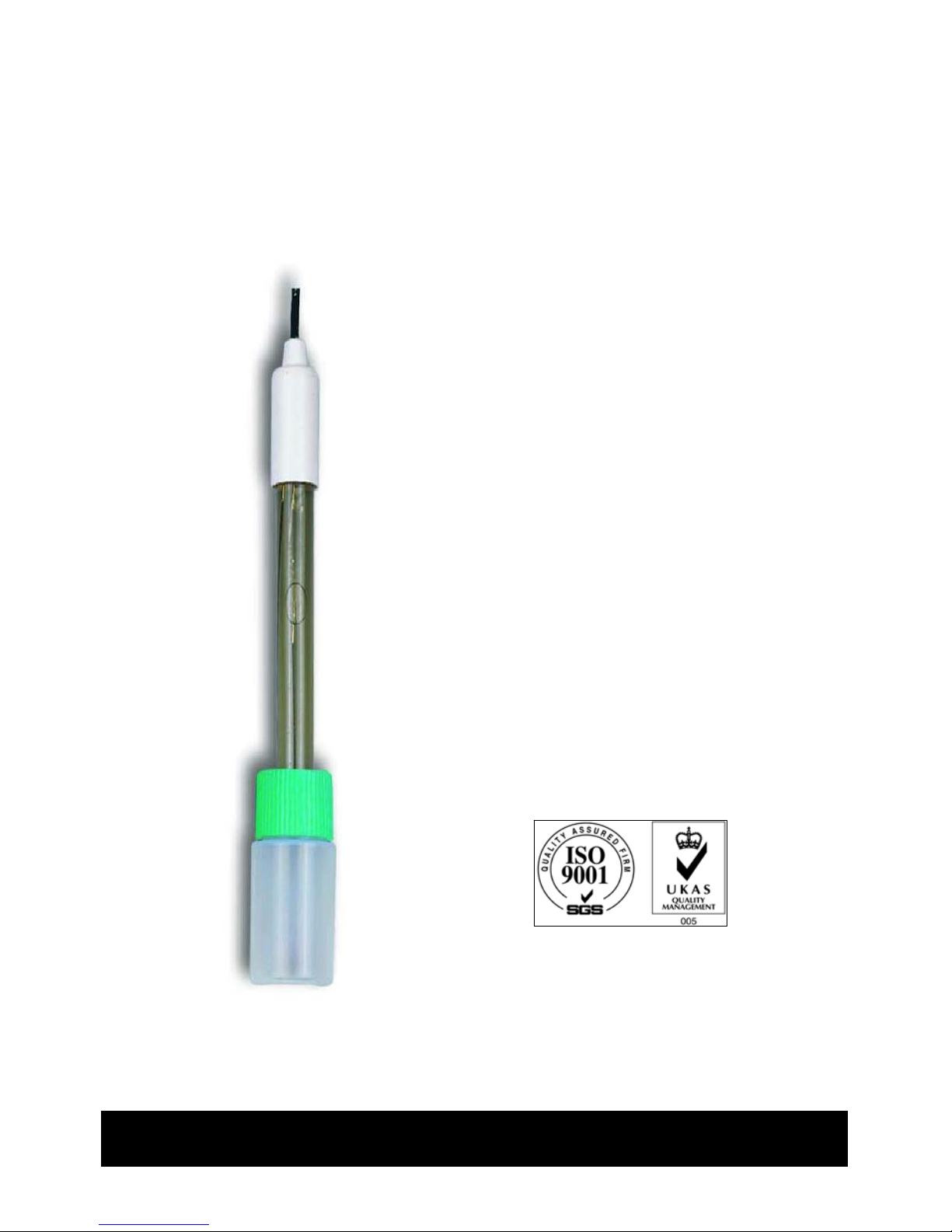
pH ELECTRODE
Model : PE-03
Your purchase of this pH
ELECTRODE marks a step
forward for you into the
field of precision
measurement. Althou
g
h
this pH ELECTRODE is a
complex and delicate
instrument, its durable
structure will allow many
years of use if proper
operatin
g
techniques are
developed. Please read the
followin
g
instructions
carefully and always keep
this manual within easy
reach.
OPERATION MANUAL
Page 2

TABLE OF CONTENTS
1. SPECIFICATIONS.........................................1
2. HELPFUL OPERATING TECHNIQUES.............
.
2
3. CALIBRATION AND MEASUREMENTS............3
4. ELECTRODE STORAGE.................................4
5. ELECTRODE CLEANING................................4
6. RECONDITIONING.......................................5
Page 3

1. SPECIFICATIONS
Features General purpose, laboratory & field
usage.
Measuring Range 1 to 13 pH.
Operation 5 to 60 ( 41 to 140 ).℃℉
Temperature
Electrode Combination type.
Structure
Zero Potential 7± 1 pH.
for pH Value
Body Material Epoxy.
Connector BNC.
Mechanical With protection bottle on the electrode
Protection head.
Dimensions Body length 160 mm
Body Dia. 12 mm
Cable length 1000 mm
Applications Food processing, Water conditioning,
aquariums, beverage, fish photography,
laboratory, paper industry, plating
industry, quality control, school &
college, water conditioning.
1
Page 4

2. HELPFUL OPERATING TECHNIQUES
1)The electrode is shipped in a plastic bottle containing a
solution of pH 4 buffer and potassium chloride. The
electrode should remain in the bottle until it is used. If
the electrode is used infrequently the bottle and its
solution should be saved and the electrode stored in it
(see the Electrode Storage Section).
2)During shipment the air bubble in the electrode's stem
may move into the bulb area. If bubbles are seen in the
bulb area, hold the electrode by its top cap and shake
downwards as is done with a clinical thermometer.
3)Vigorously stir the electrode in the sample, buffer or rinse
solution. This action will bring solution to the electrode's
surface more quickly and improve speed of response.
4)After exposure to a sample, buffer or rinse solution,
shake the electrode with a snap motion to remove
residual drops of solution. This action will minimize
contamination from carryover.
5)As a rinse solution, use a part of the next sample or buffer
which is to be measured. This action also will minimize
contamination from carryover.
6)When calibrating, use a buffer close in value to that
expected from the sample. This action will minimize span
errors.
7)Keep buffers and samples at the same temperature. This
action will eliminate the need to correct values for
temperature effects.
2
Page 5

8)pH readings stabilize faster in some solutions than others;
allow time for the reading to stabilize. In general, buffers
provide stable readings in several seconds (tris buffers
take somewhat longer) while samples usually take longer
times.
9)Keep in mind that all pH electrodes age with time. Aging
is characterized by shortened span and slower speed of
response. If the meter has a manual or microprocessor
slope (span) control, the control can be adjusted to
compensate for electrode span errors ( but will not effect
the speed of response ). Aging is best detected by
calibrating the electrode in, for example, 7 buffer, then
rinsing and placing the electrode in 4 buffer. As a rule, if
the span is 10 % or more in error (a reading of 4.3 or
higher for this example) the electrode should be cleaned and
retested (see the Electrode Cleaning Section) or
reconditioned ( see the Reconditioning Section ).
If performance is not restored the electrode should be
replaced.
3. CALIBRATION AND MEASUREMENTS
As a rule, follow the procedures recommended by the pH
Meter manufacturer keeping in mind the Helpful Operating
Techniques given above. The frequency of calibration is a
function of the electrode, the pH meter and the solutions
the electro measurements :
1)Remove the electrode form its soaker bottle and save the
bottle.
2)Vigorously stir the electrode in a rinse solution.
3)Shake the electrode with a snap action to remove residual
drops of solution.
4)Vigorously stir the electrode in the buffer or sample and
allow the electrode to rest against the beaker's wall.
3
Page 6

5)Allow the reading to stabilize and then take the reading.
6)Repeat these steps for each sample or buffer determination.
7)Between readings place the electrode In a beaker
containing about 2 cm (1 inch) of, preferably, pH 4 buffer or
distilled water.
4. ELECTRODE STORAGE
When pH readings are made infrequently, for example,
several days or weeks apart, the electrode can be stored
simply by replacing it in its soaker bottle. First, slide the cap
onto the electrode, then the o-ring, then insert the
electrode into the bottle and firmly tighten the cap. If the
solution in the soaker bottle is missing, fill the bottle with
pH 4 buffer.
5. ELECTRODE CLEANING
Coating of the pH bulb can lead to erroneous readings
including shortened span. The type of coating will determine
the cleaning technique. Soft coatings can be removed by
vigorous stirring or by use of a squirt bottle. Organic
chemical or hard coatings should be chemically removed.
Only in extreme cases should the bulb me mechanically
cleaned as abrasion can lead to permanent damage. If
cleaning does not restore performance, reconditioning may
be tried.
4
Page 7

6. RECONDITIONING
When reconditioning is required due to electrode aging (see
Helpful Operating Techniques, Part 9), the following
chemical treatments can be tried. They are presented in the
order of the severity of their attack on the pH glass and may
not improve ( and in some case actually further deteriorate )
electrode performance.
Note :
Use proper precautions when handling these
hazardous chemicals. Ammonium bifluoride and HF
(hydrofluoric acid) are extremely hazardous and
should only be used by qualified personnel.
1)Immerse the electrode tip in 0.1N HCL for 15 seconds,
rinse in tap water and then immerse tip in 0.1N NaOH
for is seconds and rinse in tap water. Repeat this
sequence three times and then recheck the electrode
performance. If performance has not been restored, try
Step 2.
2)Immerse the tip in a 20% solution of NH4F.HF
(ammonium bifluoride) for 2 or 3 minutes, rinse in tap
water and recheck performance. If performance has not
been restored, try Step 3.
3)Immerse electrode tip in 5% HF for 10 to 15 seconds,
rinse well in tap water, quickly rinse in 5N HCL, rinse well
in tap water and recheck performance. If performance
has not been restored it is time to get another epoxy
body, sealed reference combination pH electrode.
5
0804-PE03
 Loading...