

Page 1
MTS is now part of Eurofins.
Tirupur
TEST REPORT
LAB LOCATION: DONG GUAN ISSUE DATE:
MAR 02, 2022
REPORT NUMBER: 63322-010047 PAGE: Page 1 of 25
Applicant :
Personalizationmall.com
Address : 51 Shore Drive, Burr Ridge II 60561
Contact Person : Neil Wallace
Sample Information
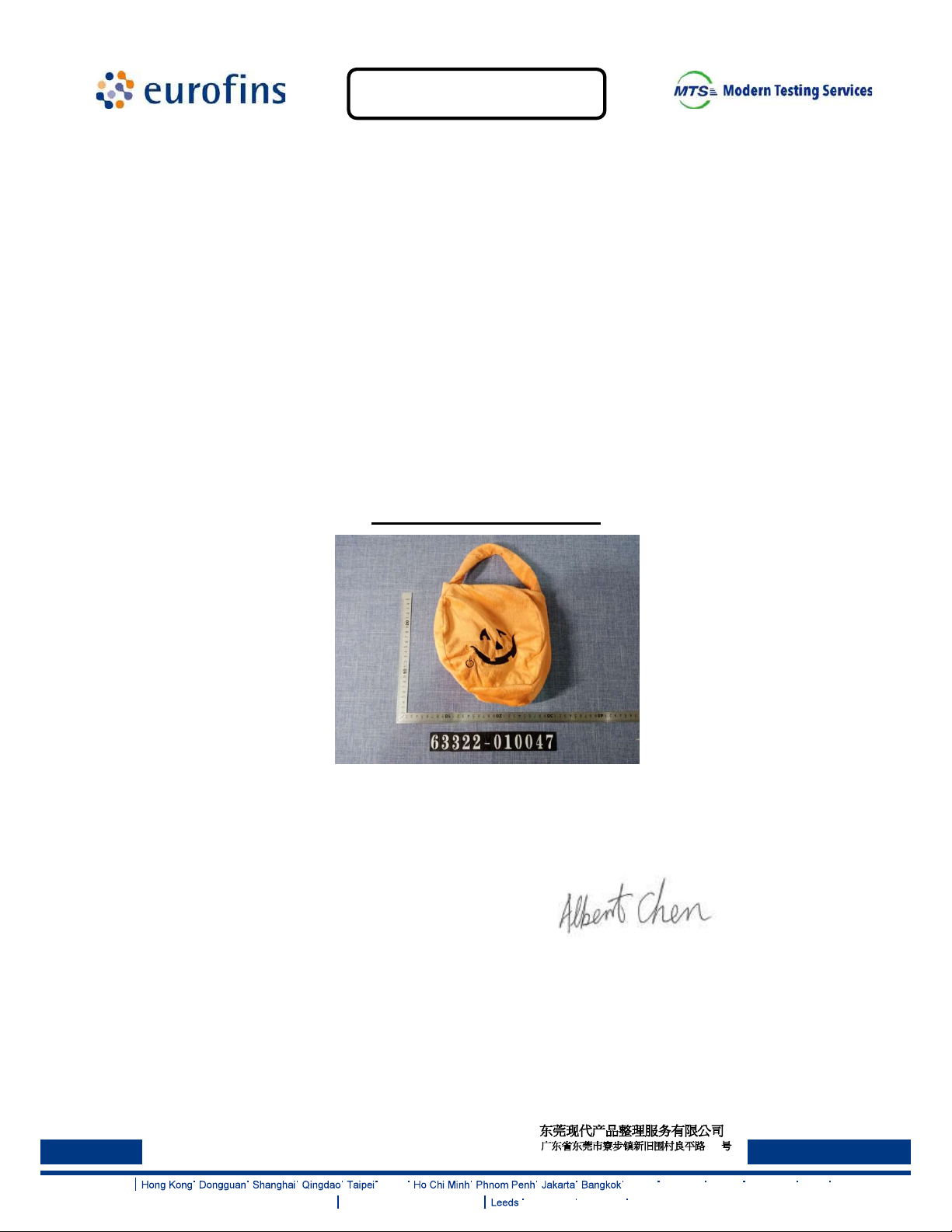
Sample Description :
Light up treat bag
Item/ Style # : C11422
Purchase Order (PO)# : 56626 Buyer : Kim Dvorak
Country of Origin :
China
Country of Destination : USA
Date of Submission : JAN 06, 2022
Quantity :
Test Performance
Dates
6
JAN 06, 2022 to MAR 02, 2022
:
Photo of Submitted Sample
Modern Testing Services (Dongguan) Limited
No.76, Liang Ping Lu, Xin Jiu Wei Cun, Liaobu, Dongguan, Guangdong, China 76
Tel: (86) 769 8112 0818 Fax: (86) 769 8112 0815 Email: [email protected] Website: www.mts-global.com
ASIA Seoul Dhaka Colombo Lahore Bangalore Noida
For and on behalf of
Modern Testing Services (Dongguan) Limited
Chen Qingyan, Albert
Manager – Toys, Arts and Crafts Division
AMERICA Norwood (MA) EUROPE Augsburg Hamburg Istanbul
Page 2
MTS is now part of Eurofins.
Tirupur
TEST REPORT
REPORT NUMBER: 63322-010047 PAGE: Page 2 of 25
TEST RESULT SUMMARY
Test Requested Conclusion
ASTM F963-17 Standard Consumer Safety Specification for Toy Safety, Physical and Mechanical
Tests
PASS
Federal Hazardous Substances Act Regulations, 16 CFR 1500.3 (c)(6)(vi) Flammable Solid PASS
Physical and Mechanical Hazards, Toys Regulations SOR/2011-17, Canada Consumer Product
Safety Act
Physical and Mechanical Hazards, Canada Consumer Product Safety Act (S.C. 2010, c.21),
Schedule 2
PASS
PASS
Flammability Test ( SOR -2011-22) PASS
Total Lead Content – U.S. Consumer Product Safety Improvement Act of 2008 (CPSIA), Title I,
Section 101
PASS
Total Lead Content in Toys and Child Care Articles – Client’s Request to Test According to the
Reformulation Level(s) Set forth in the Consent Decrees of Similar Products (Court Case No.:
PASS
Alameda Superior Court RG08378050 / San Francisco Superior Court 07-462991)
Total Heavy Metal Screening in Similar Surface Coating Materials and Toys Substrate Materials –
ASTM F963-17 Section 4.3.5.1(2) & 4.3.5.2(2)(b) / Section A12.7
Soluble Heavy Metals Content in Similar Surface Coating Materials and Toys Substrate Materials
– ASTM F963-17 Section 4.3.5.1(2) & 4.3.5.2(2)(b)
Phthalates Content – 16CFR part 1307, amended U.S. Consumer Product Safety Improvement
Act of 2008 (CPSIA), Title I, Section 108
PASS
PASS
PASS
Phthalates Content – California Assembly Bill Law No. 1108 PASS
Phthalates Content in Toys and Childcare Articles – Client’s Request to Test According to the
Reformulation Level(s) Set forth in the Consent Decrees of Similar Products (Court Case No.:
Sacramento Superior Court 07AS04683 / Alameda Superior Court BG07350969 / RG08367601 /
RG07351032 / RG08378050)
Heavy Metals Content – Canada Consumer Product Safety Act – Toys Regulations, SOR/201117 with Amendment SOR/2016-195, Item 23
Total Lead Content – Canada Consumer Product Safety Act – Surface Coating Materials
Regulation (SOR/2016-193)
Total Lead Content – Canada Consumer Product Safety Act – Consumer Products Containing
Lead Regulations (SOR/2018-83)
Phthalates Content – Canada Consumer Product Safety Act – Phthalates Regulations,
SOR/2016-188
Total Lead Content in Halloween Costume, Halloween Costume accessories, Halloween Games
and Decoration – Client’s Request to Test According to the Reformulation Level(s) Set forth in the
Consent Decrees of Similar Products (Court Case No.: Alameda Superior Court HG12633575)
Cadmium Content in Halloween Costume, Halloween Costume accessories, Halloween Games
and Decoration – Client’s Request to Test According to the Reformulation Level(s) Set forth in the
Consent Decrees of Similar Products (Court Case No.: Alameda Superior Court HG12633575)
Total Arsenic Content in Halloween Costume, Halloween Costume Accessories, Halloween
Games and Decoration – Client’s Request to Test According to the Reformulation Level(s) Set
forth in the Consent Decrees of Similar Products (Court Case No.: Alameda Superior Court
Modern Testing Services (Dongguan) Limited
No.76, Liang Ping Lu, Xin Jiu Wei Cun, Liaobu, Dongguan, Guangdong, China 76
Tel: (86) 769 8112 0818 Fax: (86) 769 8112 0815 Email: [email protected] Website: www.mts-global.com
ASIA Seoul Colombo Lahore Bangalore Noida
PASS
PASS
PASS
PASS
NOT
APPLICABLE
PASS
PASS
PASS
AMERICA Norwood (MA) EUROPE Augsburg Hamburg Istanbul
Page 3
MTS is now part of Eurofins.
Tirupur
TEST REPORT
REPORT NUMBER: 63322-010047 PAGE: Page 3 of 25
HG12633575)
Phthalate Content in Halloween Costume, Halloween Costume accessories, Halloween Games
and Decoration – Client’s Request to Test According to the Reformulation Level(s) Set forth in the
Consent Decrees of Similar Products (Court Case no.:Alameda Superior Court HG12633575)
Formaldehyde Content in Halloween Costume, Halloween Costume accessories, Halloween
Games and Decoration – Client’s Request to Test According to the Reformulation Level(s) Set
forth in the Consent Decrees of Similar Products (Court Case No.: Alameda Superior Court
HG12633575)
Remark:
1. As no final packaging was submitted, the labeling review was not conducted in this report.
PASS
PASS
Modern Testing Services (Dongguan) Limited
No.76, Liang Ping Lu, Xin Jiu Wei Cun, Liaobu, Dongguan, Guangdong, China 76
Tel: (86) 769 8112 0818 Fax: (86) 769 8112 0815 Email: [email protected] Website: www.mts-global.com
ASIA Seoul Colombo Lahore Bangalore Noida
AMERICA Norwood (MA) EUROPE Augsburg Hamburg Istanbul
Page 4
MTS is now part of Eurofins.
Tirupur
TEST REPORT
REPORT NUMBER: 63322-010047 PAGE: Page 4 of 25
TEST RESULT:
1. ASTM F963-17 Standard Consumer Safety Specification for Toy Safety, Physical and
Mechanical Tests
AGE GRADE EVALUATION:
Client requested age grade: Ages Over 3 years
Labeled age grade: Ages Over 3 years
Appropriate age grade: Not Requested
Age grade for testing: Ages Over 3 years
SUBCLAUSE REQUIREMENT RESULT
4.1 Material Quality P
4.3.7 Stuffing materials – Visual NA
4.5 Sound-Producing Toys NA
4.6 Small Objects NA
4.7 Accessible Edges P
4.8 Projections NA
4.9 Accessible Points P
4.10 Wires or rods NA
4.11 Nails and Fasteners P
4.12 Plastic Film NA
4.13 Folding Mechanisms and Hinges NA
4.14 Cords, Straps and Elastics NA
4.15 Stability and Over-Load Requirements NA
4.16 Confined Spaces NA
4.17 Wheels, Tires, and Axles NA
4.18 Holes, Clearance, and Accessibility of Mechanisms NA
4.19 Simulated Protective Devices NA
4.20 Pacifiers NA
4.21 Projectile Toys NA
4.22 Teethers and Teething Toys NA
4.23 Rattles NA
4.24 Squeeze Toys NA
Modern Testing Services (Dongguan) Limited
No.76, Liang Ping Lu, Xin Jiu Wei Cun, Liaobu, Dongguan, Guangdong, China 76
Tel: (86) 769 8112 0818 Fax: (86) 769 8112 0815 Email: [email protected] Website: www.mts-global.com
ASIA Seoul Colombo Lahore Bangalore Noida
AMERICA Norwood (MA) EUROPE Augsburg Hamburg Istanbul
Page 5
MTS is now part of Eurofins.
Tirupur
TEST REPORT
REPORT NUMBER: 63322-010047 PAGE: Page 5 of 25
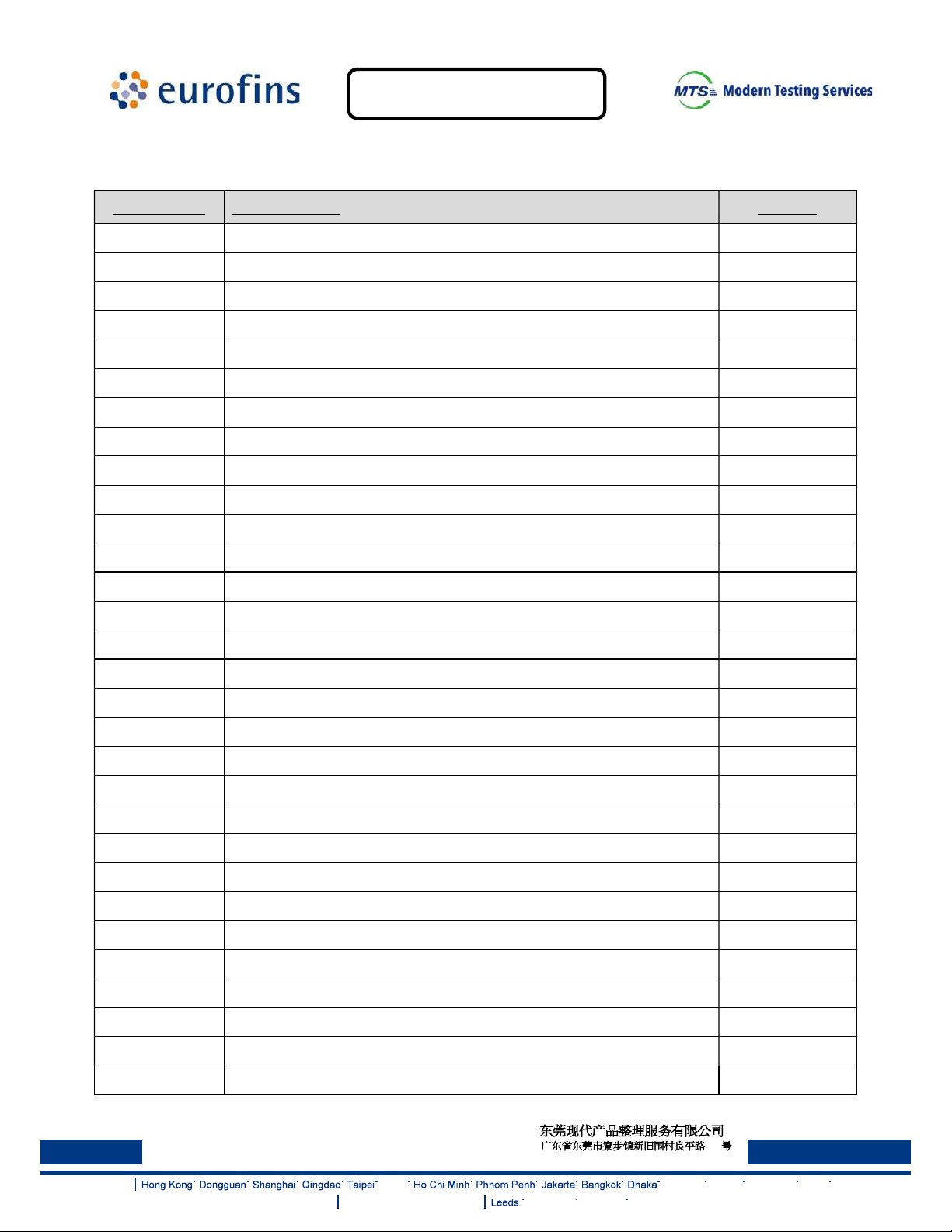
SUBCLAUSE REQUIREMENT RESULT
4.25 Battery-Operated Toys P
4.26 Toys Intended to be Attached to a Crib or Playpen NA
4.27 Stuffed and Beanbag Type Toys P
4.28 Stroller and Carriage Toys NA
4.30 Toy Gun Marking NA
4.31 Balloons NA
4.32 Certain Toys with Nearly Spherical Ends NA
4.33 Marbles NA
4.34 Balls NA
4.35 Pompoms NA
4.36 Hemispheric – Shaped Objects NA
4.37 Yo Yo Elastic Tether Toys NA
4.38 Magnets NA
4.39 Jaw Entrapment in Handles and Steering Wheels NA
4.40 Expanding Materials NA
4.41 Toy Chests NA
5.3 Safety labeling Requirements NR
5.4 Aquatic Toys NR
5.5 Crib and Playpen Toys NR
5.6 Mobiles NR
5.7 Stroller and Carriage Toys NR
5.8 Toys Intended to be Assembled by an Adult NR
5.9 Simulated Protective Devices NR
5.10 Toys with Functional Sharp Edges or Points NR
5.11 Small Objects, Small Balls, Marbles, and Balloons NR
5.12 Toys Caps NR
5.13 Art Materials NR
5.15 Battery Operated Toys NR
5.16 Promotional Materials NR
5.17 Magnets NR
Modern Testing Services (Dongguan) Limited
No.76, Liang Ping Lu, Xin Jiu Wei Cun, Liaobu, Dongguan, Guangdong, China 76
Tel: (86) 769 8112 0818 Fax: (86) 769 8112 0815 Email: [email protected] Website: www.mts-global.com
ASIA Seoul Colombo Lahore Bangalore Noida
AMERICA Norwood (MA) EUROPE Augsburg Hamburg Istanbul
Page 6
MTS is now part of Eurofins.
Tirupur
TEST REPORT
REPORT NUMBER: 63322-010047 PAGE: Page 6 of 25
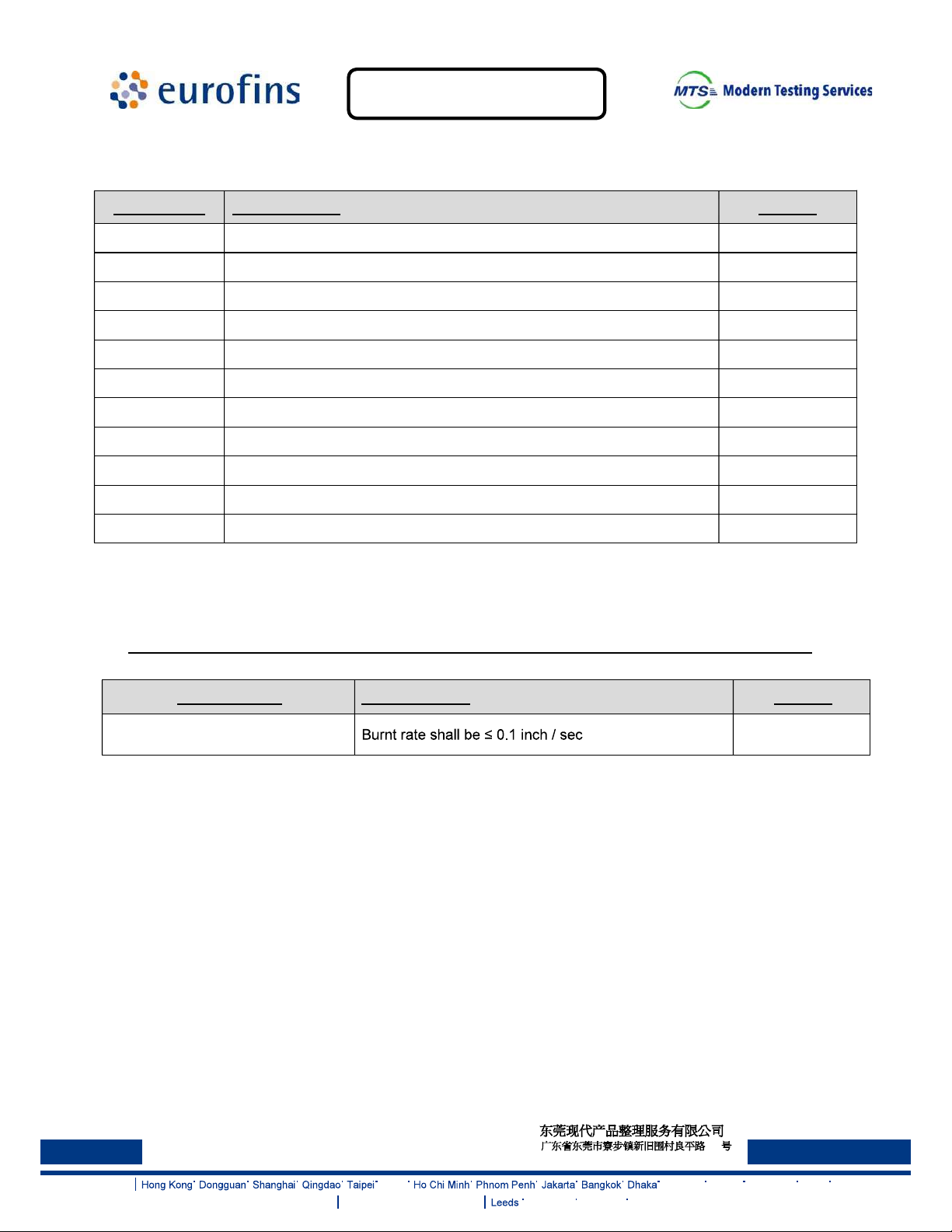
SUBCLAUSE REQUIREMENT RESULT
6.1 Definition and Description NR
6.2 Crib and Playpen Toys NR
6.3 Mobiles NR
6.4 Toy intended to be Assembled by an Adult NR
6.5 Battery Operated Toys NR
6.6 Battery Operated Ride-on Toys NR
6.7 Toys in Contact with Food NR
6.8 Toy Chests NR
7.1 Producer’s Markings NR
7.2 Battery-Powered Ride-On Toys NR
7.3 Toy Chests NR
Note: P = Pass F = Fail NA = Not applicable NR = Not Requested
2. Federal Hazardous Substances Act Regulations, 16 CFR 1500.3 (c)(6)(vi) Flammable Solid
TEST METHOD REQUIREMENT RESULT
16 CFR 1500.44 Flammable solid
ASTM F963-17 Annex A5
Note: P = Pass F = Fail NA = Not applicable NR = Not Requested
P
Modern Testing Services (Dongguan) Limited
No.76, Liang Ping Lu, Xin Jiu Wei Cun, Liaobu, Dongguan, Guangdong, China 76
Tel: (86) 769 8112 0818 Fax: (86) 769 8112 0815 Email: [email protected] Website: www.mts-global.com
ASIA Seoul Colombo Lahore Bangalore Noida
AMERICA Norwood (MA) EUROPE Augsburg Hamburg Istanbul
Page 7
MTS is now part of Eurofins.
Tirupur
TEST REPORT
REPORT NUMBER: 63322-010047 PAGE: Page 7 of 25
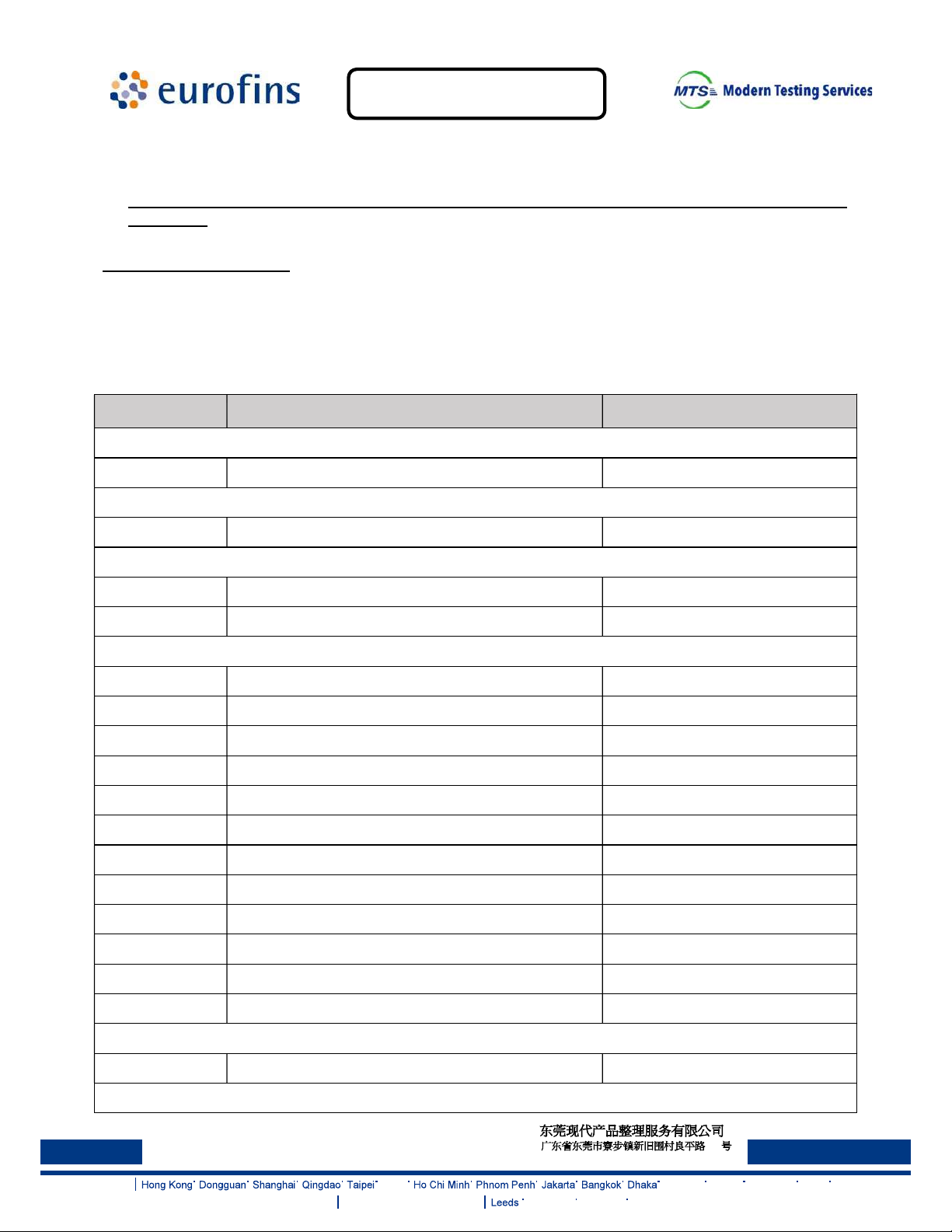
3. Physical and Mechanical Hazards, Toys Regulations SOR/2011-17, Canada Consumer Product
Safety Act
AGE GRADE EVALUATION:
Client requested age grade: Ages Over 3 years
Labeled age grade: Ages Over 3 years
Appropriate age grade: Not Requested
Age grade for testing: Ages Over 3 years
ITEM REQUIREMENTS RESULT
General
3 Official languages NA
Packaging
4 Flexible film bags NA
Electrical Hazards
5 Electrically operated toys NA
6 Electrically heated toys NA
Mechanical Hazards
7 Small parts NA
8 Metal edges P
9 Wire frames NA
10 Plastic edges P
11 Wood NA
12 Glass NA
13 Fasteners P
14 Safety stops or locking devices NA
15 Spring-wound driving mechanisms NA
16 Projectile components NA
17 Enclosures NA
18 Stability NA
Auditory Hazards
19 Decibel limit NA
Thermal and Flammability Hazards
Modern Testing Services (Dongguan) Limited
No.76, Liang Ping Lu, Xin Jiu Wei Cun, Liaobu, Dongguan, Guangdong, China 76
Tel: (86) 769 8112 0818 Fax: (86) 769 8112 0815 Email: [email protected] Website: www.mts-global.com
ASIA Seoul Colombo Lahore Bangalore Noida
AMERICA Norwood (MA) EUROPE Augsburg Hamburg Istanbul
Page 8
MTS is now part of Eurofins.
Tirupur
TEST REPORT
REPORT NUMBER: 63322-010047 PAGE: Page 8 of 25
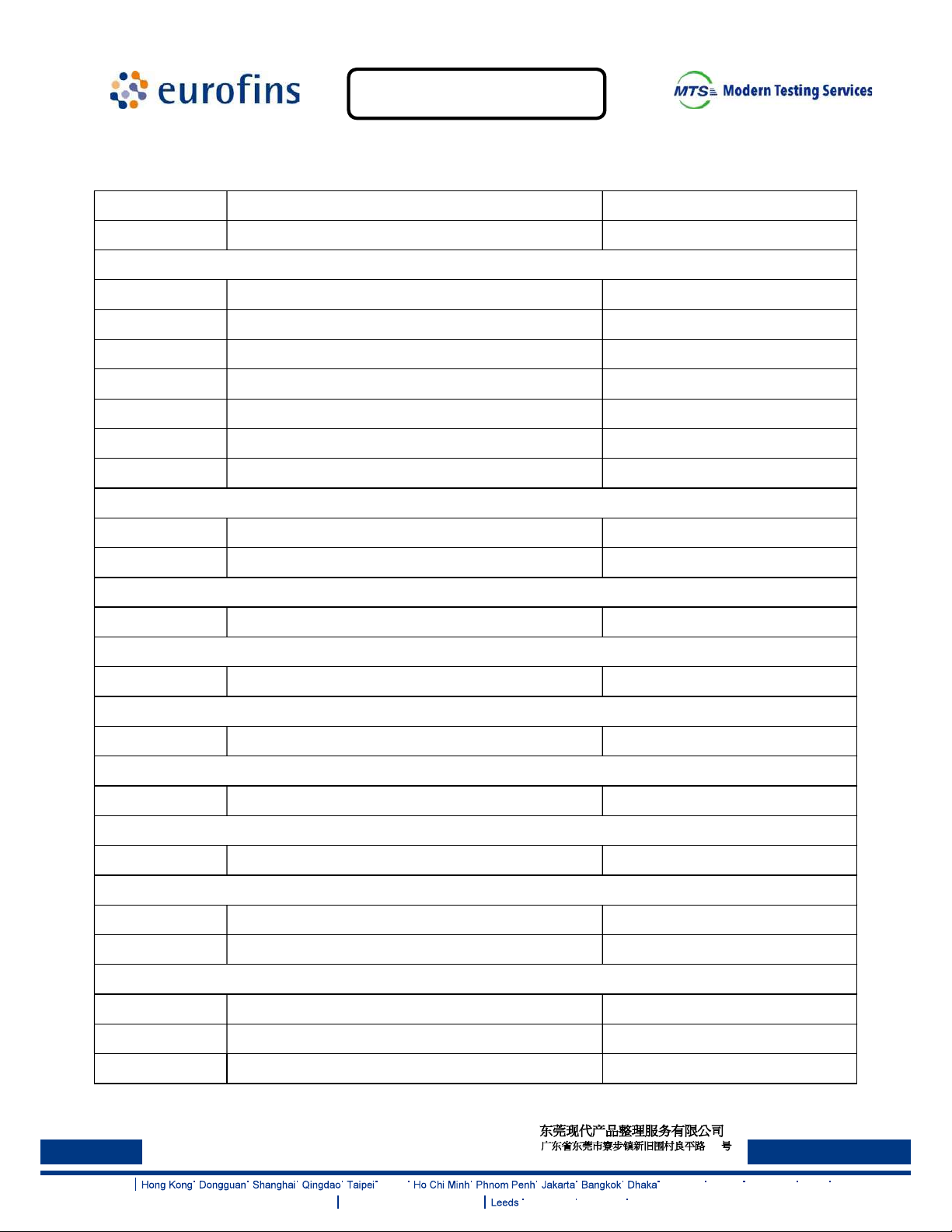
20 Heated surfaces, parts or substances P
21 Celluloid or cellulose nitrate P
Specific Products – Dolls, Plush Toys and Soft Toys
28 Fastenings NA
29 Stuffing P
30 Small parts NA
31 Eyes and noses NA
32 Flammability of outer covering P
33 Flammability of yarn NA
34 Flammability of hair or mane NA
Specific Products – Plant Seeds
35 Plant seeds – noise NA
36 Plant seeds – stuffing material P
Specific Products –Pull and push toys
37 Shaft-like handles NA
Specific Products – Toy steam engines
38 Boilers – safety valves NA
Specific Products – Finger paints
39 Water based paints NA
Specific Products – Rattles
40 Construction NA
Specific Products – Elastic
41 Length or extensibility NA
Specific Products – Yo Yo Type Balls
42 (1) Stretchable cords NA
42 (2) Similar product NA
Specific Products – Magnetic Toys
43 Magnetic force NA
44 (1) Exceptions NA
44 (2) Warning — container and instructions for use NA
Modern Testing Services (Dongguan) Limited
No.76, Liang Ping Lu, Xin Jiu Wei Cun, Liaobu, Dongguan, Guangdong, China 76
Tel: (86) 769 8112 0818 Fax: (86) 769 8112 0815 Email: [email protected] Website: www.mts-global.com
ASIA Seoul Colombo Lahore Bangalore Noida
AMERICA Norwood (MA) EUROPE Augsburg Hamburg Istanbul
Page 9
MTS is now part of Eurofins.
Tirupur
TEST REPORT
Structural devices that position feeding bottles to allow babies to feed
REPORT NUMBER: 63322-010047 PAGE: Page 9 of 25
Note: P = Pass F = Fail NA = Not applicable NR = Not Requested
4. Physical and Mechanical Hazards, Canada Consumer Product Safety Act (S.C. 2010, c.21),
Schedule 2
ITEM REQUIREMENTS RESULT
1 Jequirity beans P
2 Spectacle frames contain cellulose nitrate NA
3 Baby walkers NA
5
themselves from the bottle while unattended
8 and 9 Kites and kite strings NA
14 Lawn darts with elongated tips NA
Note: P = Pass F = Fail NA = Not applicable NR = Not Requested
NA
Modern Testing Services (Dongguan) Limited
No.76, Liang Ping Lu, Xin Jiu Wei Cun, Liaobu, Dongguan, Guangdong, China 76
Tel: (86) 769 8112 0818 Fax: (86) 769 8112 0815 Email: [email protected] Website: www.mts-global.com
ASIA Seoul Colombo Lahore Bangalore Noida
AMERICA Norwood (MA) EUROPE Augsburg Hamburg Istanbul
Page 10
MTS is now part of Eurofins.
Tirupur
TEST REPORT
PASS
Time (Sec), Surface Flash Base Burn Starting At Places Other Than The Point Of Impingement As A
REPORT NUMBER: 63322-010047 PAGE: Page 10 of 25
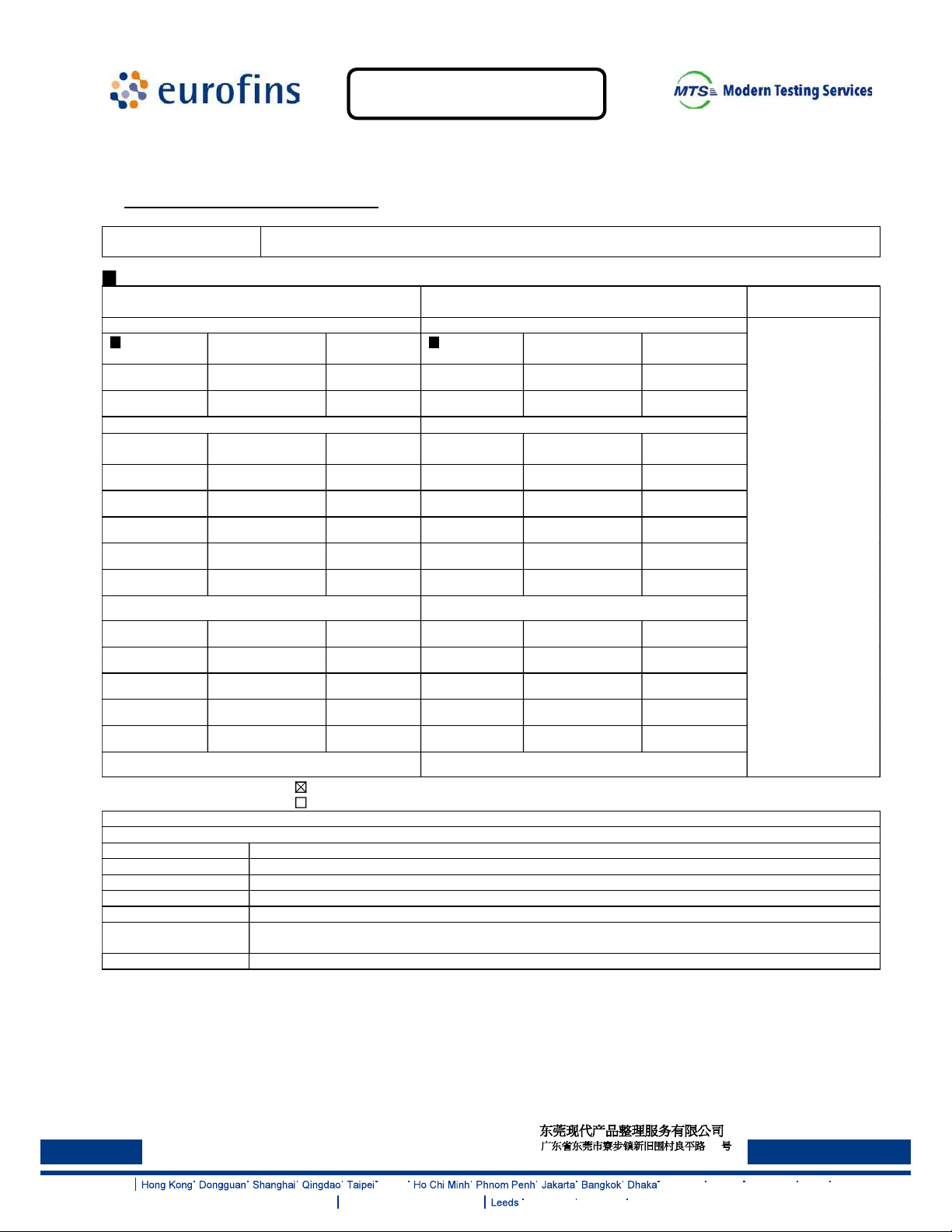
5. Flammability Test ( SOR -2011-22)
Sample Description: Orange non-woven Fabric
Raised surface
Preliminary Trial - Raised Fiber Surface Side Preliminary Trail - Raised Fiber Surface Side
Length
Against
Nap
With Nap: /
Sequence Test After Preliminary Trial Sequence Test After Preliminary Trial
No. Burning Time
1.
2.
3.
4.
5.
Avg: sec. with specimen(s) Avg: sec. with specimen(s)
6
7.
8.
9.
10.
Avg: sec. with specimen(s) Avg: sec. with specimen(s)
Original State
:
Burning Time
(sec.)
/
(sec.)
/
/
/
/
/
/ /
/ /
/ /
/ /
/ /
Burn Code
SF poi#
SF poi
Burn Code No. Burning Time
SF poi 1.
SF poi 2.
SF poi 3.
SF poi 4.
SF poi 5.
Refurbishment State
(After One Laundering)
Length
Against
Nap
Burning Time
(sec.)
:
With Nap: /
(sec.)
6
7.
8.
9.
10.
Burn Code
/
/
/
/
/
/
SF poi#
SF poi
Burn Code
SF poi
SF poi
SF poi
SF poi
SF poi
/ /
/ /
/ /
/ /
/ /
REQUIREMENT
(1) The flame spread
time for textile
products with a
raised fibre surface
that exhibits ignition
or fusion of its base
fibres must be
greater than 4
seconds.
(2) The flame
spread time for
bedding without a
raised fiber surface,
or bedding with a
raised fibre surface
that exhibits ignition
or fusion of its base
fibres, must be
greater than 7
seconds.
FAIL
Explanation Of Flammability Results:
Raised Fiber Fabric
SF uc Surface Flash, Under Stop Thread, But Does Not Break Thread (No Time)
SF pw Surface Flash, Part Way. Does Not Break Thread (No Time)
SF poi Surface Flash, At Point Of Impingement Only (No Time); Equivalent To “DNI” For Plain Surface Fabrics.)
0.0 Sec (BB) Actual Burn Time Measured and Recorded By The Timing Device in 0.0 seconds
0.0 SF Time (Sec), Surface Flash Only. No Damage To The Base Fabric.
0.0 SFBB
0.0 SFBBpoi Time (Sec), Surface Flash Base Burn Starting At The Point Of Impingement.
# The burning direction in sequence test is reference to the fastest burning direction found in preliminary trial test.
Modern Testing Services (Dongguan) Limited
No.76, Liang Ping Lu, Xin Jiu Wei Cun, Liaobu, Dongguan, Guangdong, China 76
Tel: (86) 769 8112 0818 Fax: (86) 769 8112 0815 Email: [email protected] Website: www.mts-global.com
ASIA Seoul Colombo Lahore Bangalore Noida
Result Of Surface Flash
AMERICA Norwood (MA) EUROPE Augsburg Hamburg Istanbul
Page 11
MTS is now part of Eurofins.
Tirupur
TEST REPORT
PASS
Time (Sec), Surface Flash Base Burn Starting At Places Other Than The Point Of Impingement As A
REPORT NUMBER: 63322-010047 PAGE: Page 11 of 25
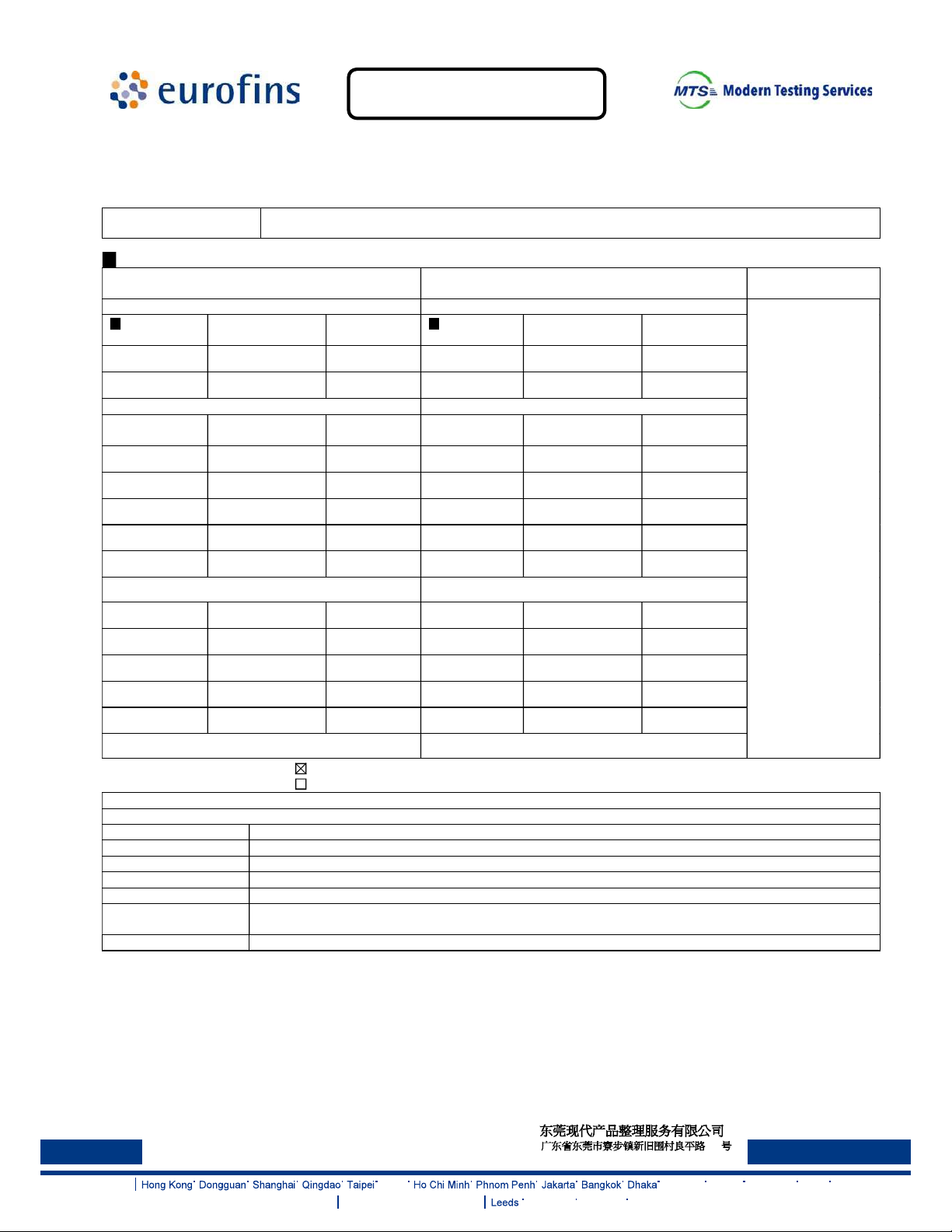
Sample Description: Orange velvet
Raised surface
Preliminary Trial - Raised Fiber Surface Side Preliminary Trail - Raised Fiber Surface Side
Length Burning Time
Against
Nap
With Nap: /
Sequence Test After Preliminary Trial Sequence Test After Preliminary Trial
No. Burning Time
1.
2.
3.
4.
5.
Avg: sec. with specimen(s) Avg: sec. with specimen(s)
6
7.
8.
9.
10.
Avg: sec. with specimen(s) Avg: sec. with specimen(s)
Original State
(sec.)
:
/
(sec.)
/
/
/
/
/
/ /
/ /
/ /
/ /
/ /
Burn Code Length Burning Time
Burn Code No. Burning Time
SF poi#
SF poi
SF poi 1.
SF poi 2.
SF poi 3.
SF poi 4.
SF poi 5.
Against
With Nap: /
6
7.
8.
9.
10.
Nap
Refurbishment State
(After One Laundering)
(sec.)
:
/
(sec.)
/
/
/
/
/
/ /
/ /
/ /
/ /
/ /
Burn Code
SF poi#
SF poi
Burn Code
SF poi
SF poi
SF poi
SF poi
SF poi
REQUIREMENT
(1) The flame spread
time for textile
products with a
raised fibre surface
that exhibits ignition
or fusion of its base
fibres must be
greater than 4
seconds.
(2) The flame
spread time for
bedding without a
raised fiber surface,
or bedding with a
raised fibre surface
that exhibits ignition
or fusion of its base
fibres, must be
greater than 7
seconds.
FAIL
Explanation Of Flammability Results:
Raised Fiber Fabric
SF uc Surface Flash, Under Stop Thread, But Does Not Break Thread (No Time)
SF pw Surface Flash, Part Way. Does Not Break Thread (No Time)
SF poi Surface Flash, At Point Of Impingement Only (No Time); Equivalent To “DNI” For Plain Surface Fabrics.)
0.0 Sec (BB) Actual Burn Time Measured and Recorded By The Timing Device in 0.0 seconds
0.0 SF Time (Sec), Surface Flash Only. No Damage To The Base Fabric.
0.0 SFBB
0.0 SFBBpoi Time (Sec), Surface Flash Base Burn Starting At The Point Of Impingement.
# The burning direction in sequence test is reference to the fastest burning direction found in preliminary trial test.
Modern Testing Services (Dongguan) Limited
No.76, Liang Ping Lu, Xin Jiu Wei Cun, Liaobu, Dongguan, Guangdong, China 76
Tel: (86) 769 8112 0818 Fax: (86) 769 8112 0815 Email: [email protected] Website: www.mts-global.com
ASIA Seoul Colombo Lahore Bangalore Noida
Result Of Surface Flash
AMERICA Norwood (MA) EUROPE Augsburg Hamburg Istanbul
Page 12
MTS is now part of Eurofins.
Tirupur
TEST REPORT
A
Light up treat bag
REPORT NUMBER: 63322-010047 PAGE: Page 12 of 25
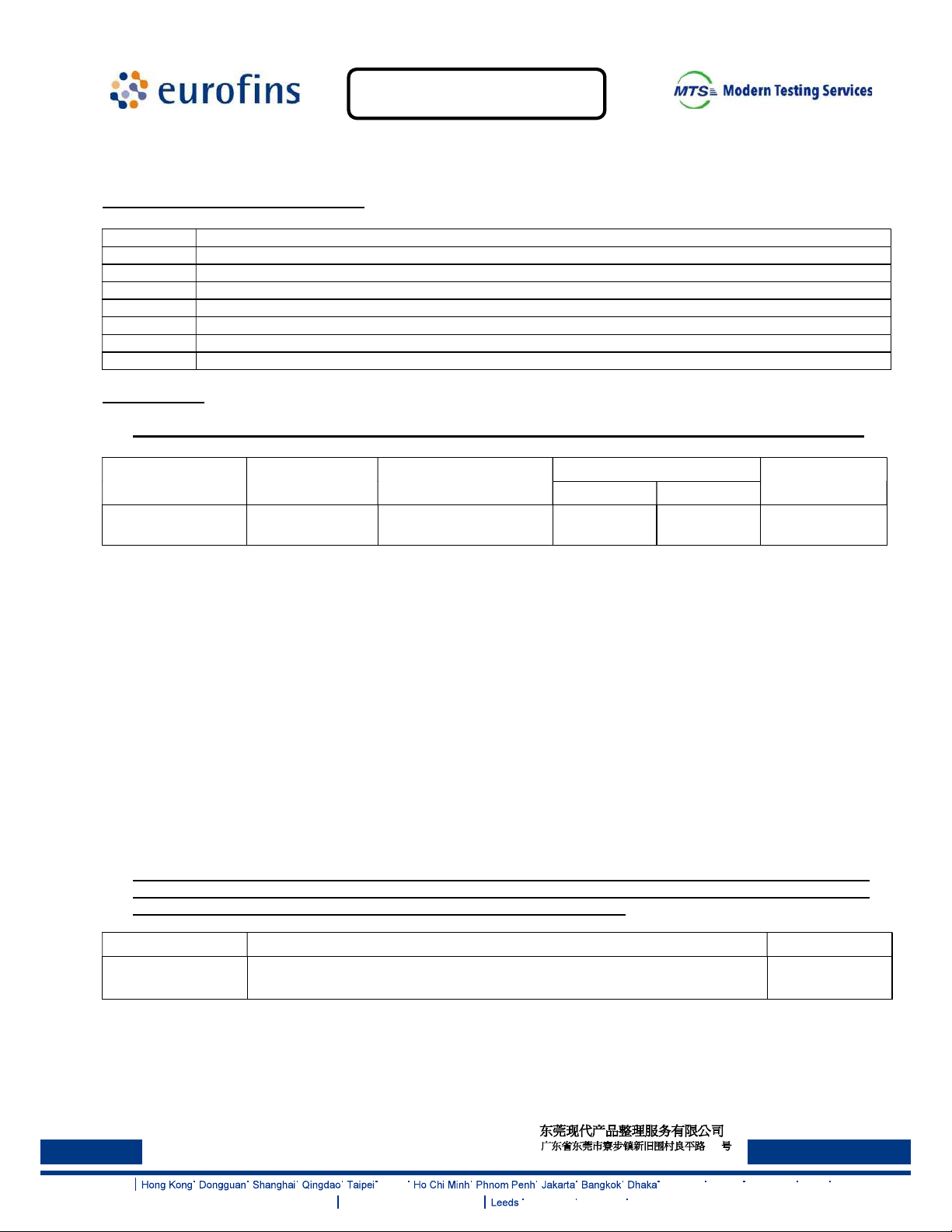
COMPONENT BREAKDOWN LIST:
Test Item Component Description
A1 Black coating ( On label )
A2 White fabric ( Excluding coating ) ( Label )
A3 Orange fabric ( Body )
A4 Black / white embroidery ( Body )
A5 Orange embroidery ( Body )
A6 Orange fabric with black / white / orange embroidery ( Body )
TEST RESULT:
6. Total Lead Content – U.S. Consumer Product Safety Improvement Act of 2008 (CPSIA), Title I, Section 101
Test Item
A1
Accessibility
(Remark 1)
Accessible as
received
Classification
Paint or similar surface
coating
Total Lead (Pb) (ppm)
Result Limit
Conclusion
<10 90 PASS
Method:
1) Lead in paint and other similar surface coatings:
The test is conducted according to the US CPSC Standard Operating Procedure for Determining Lead (Pb) in
Paint and Other Similar Surface Coatings, February 25, 2011 (CPSC-CH-E1003-09.1)
2) Lead in metals:
The test is conducted according to the US CPSC Standard Operating Procedure for Determining Total Lead (Pb)
in Children’s Metal Products (Including Children’s Metal Jewelry), November 15, 2012 (CPSC-CH-E1001-08.3)
3) Lead in other non-metal materials including plastics, glass and leather material:
The test is conducted according to the US CPSC Standard Operating Procedure for Determining Total Lead (Pb)
in Non-Metal Children’s Products, November 15, 2012 (CPSC-CH-E1002-08.3)
Remark:
1. The accessibility of the submitted sample is verified according to 16 CFR 1500.87 (e) before and after abuse.
Note: ppm = part per million = mg/kg (milligram per kilogram)
“<” = less than
7. Total Lead Content in Toys and Child Care Articles – Client’s Request to Test According to the
Reformulation Level(s) Set forth in the Consent Decrees of Similar Products (Court Case No.: Alameda
Superior Court RG08378050 / San Francisco Superior Court 07-462991)
Test Item Result - Total Lead (Pb) (ppm) Conclusion
A1 <10
Method: Sample was digested with reference to EPA 3052. The lead content was analyzed by Atomic Absorption
Spectrophotometer / Inductively Coupled Argon Plasma Spectrometer / Inductively Coupled Plasma Mass
Spectrometer.
Remark: Proposition 65 requires businesses to warn Californians about exposures to certain listed chemicals
known to cause cancer, birth defects, or other reproductive harm. If a business exposes a Californian to a
Modern Testing Services (Dongguan) Limited
No.76, Liang Ping Lu, Xin Jiu Wei Cun, Liaobu, Dongguan, Guangdong, China 76
Tel: (86) 769 8112 0818 Fax: (86) 769 8112 0815 Email: [email protected] Website: www.mts-global.com
ASIA Seoul Colombo Lahore Bangalore Noida
PASS
(See Remark)
AMERICA Norwood (MA) EUROPE Augsburg Hamburg Istanbul
Page 13
MTS is now part of Eurofins.
Tirupur
TEST REPORT
REPORT NUMBER: 63322-010047 PAGE: Page 13 of 25
listed chemical without providing a warning, then the business may be sued for the possible violation of
Proposition 65. The business will then have the burden of proving that the listed chemical in the product is
under the safe harbor limit or that the anticipated exposure level will not pose a significant risk of cancer or
reproductive harm.
The reformulation levels set forth in the Consent Decrees of similar products to the Sample are 90 ppm
(Accessible surface coating) / 100 ppm (Accessible substrate) / 200 ppm (Baby bibs). The
reformulation levels set forth in the various Consent Decrees are only the binding requirements for the
defendants named in the case, and by complying with the reformulation requirements, the defendants are
protected from further Proposition 65 violations for the products that are covered in the case. However, the
reformulation levels set forth in the various Consent Decrees are not necessarily the safe harbor limits.
The reformulation levels set in the Consent Decrees are usually expressed in relative concentration levels
(i.e., mg/kg, ppm) while the safe harbor limits identify a level of exposure to a listed chemical in
micrograms per day. Therefore, for businesses that are not named in the Consent Decrees as defendants,
complying with the reformulation levels of Consent Decrees does not fully protect the businesses from
being sued for the possible violation of Proposition 65. These businesses may still be sued for the
possible violation of Proposition 65 and will have the burden of proving that the listed chemical in their
products are under the safe harbor level or that the anticipated exposure level will not pose a significant
risk of cancer or reproductive harm.
If your product contains any amount of a listed chemical, the only way to fully avoid the possibility of the
burden of proving that the listed chemical in your product is under the safe harbor limit or that the
anticipated exposure level will not pose a significant risk of cancer or reproductive harm is to provide a
warning about the exposures to the listed chemical known to cause cancer, birth defects, or other
reproductive harm. Please consult MTS for more details regarding the different options of labeling and the
mechanics of labeling.
Note: ppm = part per million
“<” = less than
“>” = more than
NA = Not applicable
8. Total Heavy Metal Screening in Similar Surface Coating Materials and Toys Substrate Materials – ASTM
F963-17 Section 4.3.5.1(2) & 4.3.5.2(2)(b) / Section A12.7
Test Item
Sb As Ba Cd Cr Pb Hg Se
Result – Total Heavy Metals (mg/kg)
Conclusion
A1 <10 <5 <10 <10 <10 <10 <10 <10 PASS
Limit for Surface
Coatings and
Substrates Other Than
60 25 1000 75 60 90 60 500 -
Modeling Clay
Limit for Modeling Clays 60 25 250 50 25 90 25 500 -
Sb = Antimony, As = Arsenic, Ba = Barium, Cd = Cadmium, Cr = Chromium, Pb = Lead, Hg = Mercury, Se = Selenium
Method: ASTM F963-17 Section 8.3.1, sample was digested with acid mixture and analyzed by Inductively Coupled
Argon Plasma Spectrometer / Inductively Coupled Plasma Mass Spectrometer / ASTM F963-17 Section
A12.7, sample was analyzed by X-ray Fluorescence Spectrometry.
Note: mg/kg = milligram per kilogram
mg = milligram
“<” = less than
Modern Testing Services (Dongguan) Limited
No.76, Liang Ping Lu, Xin Jiu Wei Cun, Liaobu, Dongguan, Guangdong, China 76
Tel: (86) 769 8112 0818 Fax: (86) 769 8112 0815 Email: [email protected] Website: www.mts-global.com
ASIA Seoul Colombo Lahore Bangalore Noida
AMERICA Norwood (MA) EUROPE Augsburg Hamburg Istanbul
Page 14
MTS is now part of Eurofins.
Tirupur
TEST REPORT
REPORT NUMBER: 63322-010047 PAGE: Page 14 of 25
9. Soluble Heavy Metals Content in Similar Surface Coating Materials and Toys Substrate Materials – ASTM
F963-17 Section 4.3.5.1(2) & 4.3.5.2(2)(b)
Test Item
Mass of Trace
Amount (mg)
Sb As Ba Cd Cr Pb Hg Se
Result – Soluble Heavy Metals (mg/kg)
Conclusion
A2 NA <10 <10 <10 <10 <10 <10 <10 <10 PASS
A3 NA <10 <10 <10 <10 <10 <10 <10 <10 PASS
A4 NA <10 <10 10 <10 <10 <10 <10 <10 PASS
A5 46.7 <10 <10 10 <10 <10 <10 <10 <10 PASS
Limit for Surface Coatings
and Substrates Other Than
60 25 1000 75 60 90 60 500 -
Modeling Clay
Sb = Antimony, As = Arsenic, Ba = Barium, Cd = Cadmium, Cr = Chromium, Pb = Lead, Hg = Mercury, Se = Selenium
Method: ASTM F963-17 Section 8.3.2 (surface coatings) / ASTM F963-17 Section 8.3.5 (substrate material). The
heavy metals content was determined by Inductively Coupled Argon Plasma Spectrometer / Inductively
Coupled Plasma Mass Spectrometer.
Remark: 1. All the reported results are adjusted analytical results with the analytical correction shown in the
following
table.
Element Sb As Ba Cd Cr Pb Hg Se
Analytical correction (%) 60 60 30 30 30 30 50 60
2. The accessibility of the submitted sample is verified according to ASTM F963-17 before and after abuse.
3. The received sample(s) contained component(s) of less than 10mg on one single sample, therefore
such component(s) was not tested for soluble heavy metals content as specified in clause 8.3.3.6 (2) /
8.3.5.3 (2) of this standard.
Note: mg/kg = milligram per kilogram
mg = milligram
“<” = less than
10. Phthalates Content – 16CFR part 1307, amended U.S. Consumer Product Safety Improvement Act of 2008
(CPSIA), Title I, Section 108
Test Item
DBP BBP DEHP DIBP DCHP DINP
A1 <0.005 <0.005 <0.005 <0.005 <0.005 <0.005 <0.005 <0.005 PASS
Limit 0.1 0.1 0.1 0.1 0.1 0.1 0.1 0.1 -
Modern Testing Services (Dongguan) Limited
No.76, Liang Ping Lu, Xin Jiu Wei Cun, Liaobu, Dongguan, Guangdong, China 76
Tel: (86) 769 8112 0818 Fax: (86) 769 8112 0815 Email: [email protected] Website: www.mts-global.com
ASIA Seoul Colombo Lahore Bangalore Noida
Result – Phthalates Content (%)
DnHP/
DHEXP
AMERICA Norwood (MA) EUROPE Augsburg Hamburg Istanbul
DPP/
DPENP
Conclusion
Page 15
MTS is now part of Eurofins.
Tirupur
TEST REPORT
REPORT NUMBER: 63322-010047 PAGE: Page 15 of 25
List of Phthalates:
Chemical Name CAS No. Chemical Name CAS No.
Dibutyl phthalate (DBP) 84-74-2 Dicyclohexyl phthalate (DCHP) 84-61-7
Butyl benzyl phthalate (BBP) 85-68-7 Di-iso-nonyl phthalate (DINP)
28553-12-0/
68515-48-0
Di-2-ethylhexyl phthalate (DEHP) 117-81-7 Di-n-hexyl phthalate (DnHP/DHEXP) 84-75-3
Di-iso-butyl phthalate (DIBP)
84-69-5
Dipentyl phthalate (DPP/DPENP) 131-18-0
Method: The test is conducted according to the US CPSC Standard Operation Procedure for Determination of
Phthalates, January 17, 2018 (CPSC-CH-C1001-09.4)
Remark: 1. Phthalates were not tested for this material as the material is claimed by applicant to be PP, PE, HIPS,
ABS, GPPS, MIPS or SHIPS. These types of materials are exempted by CPSC for Phthalates test.
Note: % = percentage
“<” = less than
“>” = more than
11. Phthalates Content – California Assembly Bill Law No. 1108
Result (%) (Remark)
Test Item
ConclusionPart A Part B
DBP BBP DEHP DNOP DIDP DINP
A1 <0.005 <0.005 <0.005 <0.005 <0.005 <0.005 PASS
Limit 0.1 0.1 0.1 0.1 0.1 0.1 -
List of Phthalates:
Chemical Name CAS No. Chemical Name CAS No.
Dibutyl phthalate (DBP) 84-74-2 Di-n-octyl phthalate (DNOP) 117-84-0
Butyl benzyl phthalate (BBP) 85-68-7 Di-iso-decyl phthalate (DIDP)
Di-2-ethylhexyl phthalate (DEHP) 117-81-7 Di-iso-nonyl phthalate (DINP)
26761-40-0/
68515-49-1
28553-12-0/
68515-48-0
Method: The test is conducted according to the US CPSC Standard Operation Procedure for Determination of
Phthalates, January 17, 2018 (CPSC-CH-C1001-09.4)
Remark: Toys and childcare articles shall meet the requirement of Part A. Toys or childcare articles intended for
use by a child under three years of age if that product can be placed in the child's mouth shall meet the
requirements of both Part A and B.
Note: % = percentage
“<” = less than
Modern Testing Services (Dongguan) Limited
No.76, Liang Ping Lu, Xin Jiu Wei Cun, Liaobu, Dongguan, Guangdong, China 76
Tel: (86) 769 8112 0818 Fax: (86) 769 8112 0815 Email: [email protected] Website: www.mts-global.com
ASIA Seoul Colombo Lahore Bangalore Noida
AMERICA Norwood (MA) EUROPE Augsburg Hamburg Istanbul
Page 16
MTS is now part of Eurofins.
Tirupur
TEST REPORT
REPORT NUMBER: 63322-010047 PAGE: Page 16 of 25
12. Phthalates Content in Toys and Childcare Articles – Client’s Request to Test According to the
Reformulation Level(s) Set forth in the Consent Decrees of Similar Products (Court Case No.: Sacramento
Superior Court 07AS04683 / Alameda Superior Court BG07350969 / RG08367601 / RG07351032 /
RG08378050)
Test Item
DBP BBP DEHP DIDP DnHP
A1 <0.005 <0.005 <0.005 <0.005 <0.005
Result (%)
Conclusion
PASS
(See Remark)
List of Phthalates:
Chemical Name CAS No. Chemical Name CAS No.
Dibutyl phthalate (DBP) 84-74-2 Di-iso-decyl phthalate (DIDP)
26761-40-
0/68515-49-1
Butyl benzyl phthalate (BBP) 85-68-7 Di-n-hexyl phthalate (DnHP) 84-75-3
Di-2-ethylhexyl phthalate (DEHP) 117-81-7 - -
Method: The test is conducted according to the US CPSC Standard Operation Procedure for Determination of
Phthalates, January 17, 2018 (CPSC-CH-C1001-09.4)
Remark: Proposition 65 requires businesses to warn Californians about exposures to certain listed chemicals
known to cause cancer, birth defects, or other reproductive harm. If a business exposes a Californian to a
listed chemical without providing a warning, then the business may be sued for the possible violation of
Proposition 65. The business will then have the burden of proving that the listed chemical in the product is
under the safe harbor limit or that the anticipated exposure level will not pose a significant risk of cancer or
reproductive harm.
The reformulation level set forth in the Consent Decrees of similar products to the Sample is 0.1% (each).
The reformulation levels set forth in the various Consent Decrees are only the binding requirements for the
defendants named in the case, and by complying with the reformulation requirements, the defendants are
protected from further Proposition 65 violations for the products that are covered in the case. However, the
reformulation levels set forth in the various Consent Decrees are not necessarily the safe harbor limits.
The reformulation levels set in the Consent Decrees are usually expressed in relative concentration levels
(i.e., mg/kg, ppm) while the safe harbor limits identify a level of exposure to a listed chemical in
micrograms per day. Therefore, for businesses that are not named in the Consent Decrees as defendants,
complying with the reformulation levels of Consent Decrees does not fully protect the businesses from
being sued for the possible violation of Proposition 65. These businesses may still be sued for the
possible violation of Proposition 65 and will have the burden of proving that the listed chemical in their
products are under the safe harbor level or that the anticipated exposure level will not pose a significant
risk of cancer or reproductive harm.
If your product contains any amount of a listed chemical, the only way to fully avoid the possibility of the
burden of proving that the listed chemical in your product is under the safe harbor limit or that the
anticipated exposure level will not pose a significant risk of cancer or reproductive harm is to provide a
warning about the exposures to the listed chemical known to cause cancer, birth defects, or other
reproductive harm. Please consult MTS for more details regarding the different options of labeling and the
mechanics of labeling.
Note: % = percentage
“<” = less than
“>” = more than
NA = Not applicable
Modern Testing Services (Dongguan) Limited
No.76, Liang Ping Lu, Xin Jiu Wei Cun, Liaobu, Dongguan, Guangdong, China 76
Tel: (86) 769 8112 0818 Fax: (86) 769 8112 0815 Email: [email protected] Website: www.mts-global.com
ASIA Seoul Colombo Lahore Bangalore Noida
AMERICA Norwood (MA) EUROPE Augsburg Hamburg Istanbul
Page 17
MTS is now part of Eurofins.
Tirupur
TEST REPORT
REPORT NUMBER: 63322-010047 PAGE: Page 17 of 25
13. Heavy Metals Content – Canada Consumer Product Safety Act – Toys Regulations, SOR/2011-17 with
Amendment SOR/2016-195, Item 23
Result
Test Items
Total Content (mg/kg) Soluble Content (%)
Conclusion
Pb Hg Ba Cd As Sb Se
A1 <10 <10 0.001 <0.001 <0.001 <0.001 <0.001 PASS
Limit 90
No
introduced
0.1 0.1 0.1 0.1 0.1 -
Pb = Lead, Hg = Mercury, Ba = Barium, Cd = Cadmium, As = Arsenic, Sb = Antimony, Se = Selenium
Method: Sample was digested with nitric acid for total lead and mercury content.
Sample was extracted with 5% hydrochloric acid for 10 minutes at 20oC according to Canada Consumer
Product Safety Act – Toys Regulations, SOR/2011-17, Item 23(b) for soluble heavy metals content.
The heavy metals content were analyzed by Atomic Absorption Spectrophotometer / Inductively Coupled
Argon Plasma Spectrometer / Inductively Coupled Plasma Mass Spectrometer.
Note: mg/kg = milligram per kilogram
% = percentage
“<” = less than
14. Total Lead Content – Canada Consumer Product Safety Act – Surface Coating Materials Regulation
(SOR/2016-193)
Total Lead (Pb) (mg/kg)
Test Item
Conclusion
Result Limit
A1 <10 90 PASS
Method: Sample was digested with nitric acid and analyzed by Atomic Absorption Spectrophotometer / Inductively
Coupled Argon Plasma Spectrometer / Inductively Coupled Plasma Mass Spectrometer.
Note: mg/kg = milligram per kilogram
“<” = less than
15. Total Lead Content – Canada Consumer Product Safety Act – Consumer Products Containing Lead
Regulations (SOR/2018-83)
Test Item
A1 <10
A2+A3 <10
A4+A5 <10
Modern Testing Services (Dongguan) Limited
No.76, Liang Ping Lu, Xin Jiu Wei Cun, Liaobu, Dongguan, Guangdong, China 76
Tel: (86) 769 8112 0818 Fax: (86) 769 8112 0815 Email: [email protected] Website: www.mts-global.com
ASIA Seoul Colombo Lahore Bangalore Noida
Total Lead (Pb) (mg/kg)
Result Limit
90
90
90
AMERICA Norwood (MA) EUROPE Augsburg Hamburg Istanbul
Conclusion
PASS
PASS
PASS
Page 18
MTS is now part of Eurofins.
Tirupur
TEST REPORT
REPORT NUMBER: 63322-010047 PAGE: Page 18 of 25
Method: Sample was digested with nitric acid and analyzed by Atomic Absorption Spectrophotometer / Inductively
Coupled Plasma Mass Spectrometer.
Note: mg/kg = milligram per kilogram
“<” = less than
16. Phthalates Content – Canada Consumer Product Safety Act – Phthalates Regulations, SOR/2016-188
Remark: Not applicable for the submitted sample. No PVC was found on the submitted sample.
17. Total Lead Content in Halloween Costume, Halloween Costume accessories, Halloween Games and
Decoration – Client’s Request to Test According to the Reformulation Level(s) Set forth in the Consent
Decrees of Similar Products (Court Case No.: Alameda Superior Court HG12633575)
Test Item Result - Total Lead (Pb) (ppm) Conclusion
A1 <10
PASS
(See Remark)
Method: Sample was digested with reference to EPA 3052. The lead content was analyzed by Atomic Absorption
Spectrophotometer / Inductively Coupled Argon Plasma Spectrometer / Inductively Coupled Plasma Mass
Spectrometer.
Remark: Proposition 65 requires businesses to warn Californians about exposures to certain listed chemicals
known to cause cancer, birth defects, or other reproductive harm. If a business exposes a Californian to a
listed chemical without providing a warning, then the business may be sued for the possible violation of
Proposition 65. The business will then have the burden of proving that the listed chemical in the product is
under the safe harbor limit or that the anticipated exposure level will not pose a significant risk of cancer or
reproductive harm.
The reformulation levels set forth in the Consent Decrees of similar products to the Sample are 90 ppm
(Surface coating) / 100 ppm (Children’s Substrate) / 300 ppm (Adult’s Substrate). The reformulation
levels set forth in the various Consent Decrees are only the binding requirements for the defendants
named in the case, and by complying with the reformulation requirements, the defendants are protected
from further Proposition 65 violations for the products that are covered in the case. However, the
reformulation levels set forth in the various Consent Decrees are not necessarily the safe harbor limits.
The reformulation levels set in the Consent Decrees are usually expressed in relative concentration levels
(i.e., mg/kg, ppm) while the safe harbor limits identify a level of exposure to a listed chemical in
micrograms per day. Therefore, for businesses that are not named in the Consent Decrees as defendants,
complying with the reformulation levels of Consent Decrees does not fully protect the businesses from
being sued for the possible violation of Proposition 65. These businesses may still be sued for the
possible violation of Proposition 65 and will have the burden of proving that the listed chemical in their
products are under the safe harbor level or that the anticipated exposure level will not pose a significant
risk of cancer or reproductive harm.
If your product contains any amount of a listed chemical, the only way to fully avoid the possibility of the
burden of proving that the listed chemical in your product is under the safe harbor limit or that the
anticipated exposure level will not pose a significant risk of cancer or reproductive harm is to provide a
warning about the exposures to the listed chemical known to cause cancer, birth defects, or other
reproductive harm. Please consult MTS for more details regarding the different options of labeling and the
mechanics of labeling.
Note: ppm = part per million
“<” = less than
Modern Testing Services (Dongguan) Limited
No.76, Liang Ping Lu, Xin Jiu Wei Cun, Liaobu, Dongguan, Guangdong, China 76
Tel: (86) 769 8112 0818 Fax: (86) 769 8112 0815 Email: [email protected] Website: www.mts-global.com
ASIA Seoul Colombo Lahore Bangalore Noida
AMERICA Norwood (MA) EUROPE Augsburg Hamburg Istanbul
Page 19
MTS is now part of Eurofins.
Tirupur
TEST REPORT
REPORT NUMBER: 63322-010047 PAGE: Page 19 of 25
“>” = more than
NA = Not applicable
18. Cadmium Content in Halloween Costume, Halloween Costume accessories, Halloween Games and
Decoration – Client’s Request to Test According to the Reformulation Level(s) Set forth in the Consent
Decrees of Similar Products (Court Case No.: Alameda Superior Court HG12633575)
Test Item Classification
A1 Accessible component <10 NT
A2 Accessible component NT <10
A3 Accessible component NT <10
A4 Accessible component NT <10
A5 Accessible component NT <10
Result – Cadmium (Cd) (mg/kg)
Total Extractable
Conclusion
PASS
(See Remark)
PASS
(See Remark)
PASS
(See Remark)
PASS
(See Remark)
PASS
(See Remark)
Method: 1) Total Cadmium:
Sample was digested with reference to EPA 3052. The cadmium content was analyzed by Atomic
Absorption Spectrophotometer / Inductively Coupled Argon Plasma Spectrometer / Inductively
Coupled Plasma Mass Spectrometer.
2) Extractable Cadmium:
ASTM F963-17 Section 8.3.2 (surface coatings) / ASTM F963-17 Section 8.3.5 (substrate material).
Cadmium content was analyzed by Atomic Absorption Spectrophotometer / Inductively Coupled Argon
Plasma Spectrometer / Inductively Coupled Plasma Mass Spectrometer.
Remark: Proposition 65 requires businesses to warn Californians about exposures to certain listed chemicals
known to cause cancer, birth defects, or other reproductive harm. If a business exposes a Californian to a
listed chemical without providing a warning, then the business may be sued for the possible violation of
Proposition 65. The business will then have the burden of proving that the listed chemical in the product is
under the safe harbor limit or that the anticipated exposure level will not pose a significant risk of cancer or
reproductive harm.
The reformulation levels set forth in the Consent Decrees of similar products to the Sample are 300 ppm
(Mounthable component by Digestion method) / 75 ppm (Accessible component by Extractable
method excluding mouthable parts). The reformulation levels set forth in the various Consent Decrees
are only the binding requirements for the defendants named in the case, and by complying with the
reformulation requirements, the defendants are protected from further Proposition 65 violations for the
products that are covered in the case. However, the reformulation levels set forth in the various Consent
Decrees are not necessarily the safe harbor limits. The reformulation levels set in the Consent Decrees
are usually expressed in relative concentration levels (i.e., mg/kg, ppm) while the safe harbor limits identify
a level of exposure to a listed chemical in micrograms per day. Therefore, for businesses that are not
named in the Consent Decrees as defendants, complying with the reformulation levels of Consent
Decrees does not fully protect the businesses from being sued for the possible violation of Proposition 65.
These businesses may still be sued for the possible violation of Proposition 65 and will have the burden of
proving that the listed chemical in their products are under the safe harbor level or that the anticipated
exposure level will not pose a significant risk of cancer or reproductive harm.
Modern Testing Services (Dongguan) Limited
No.76, Liang Ping Lu, Xin Jiu Wei Cun, Liaobu, Dongguan, Guangdong, China 76
Tel: (86) 769 8112 0818 Fax: (86) 769 8112 0815 Email: [email protected] Website: www.mts-global.com
ASIA Seoul Colombo Lahore Bangalore Noida
AMERICA Norwood (MA) EUROPE Augsburg Hamburg Istanbul
Page 20
MTS is now part of Eurofins.
Tirupur
TEST REPORT
REPORT NUMBER: 63322-010047 PAGE: Page 20 of 25
If your product contains any amount of a listed chemical, the only way to fully avoid the possibility of the
burden of proving that the listed chemical in your product is under the safe harbor limit or that the
anticipated exposure level will not pose a significant risk of cancer or reproductive harm is to provide a
warning about the exposures to the listed chemical known to cause cancer, birth defects, or other
reproductive harm. Please consult MTS for more details regarding the different options of labeling and the
mechanics of labeling.
Note: mg/kg = milligram per kilogram
“<” = less than
19. Total Arsenic Content in Halloween Costume, Halloween Costume Accessories, Halloween Games and
Decoration – Client’s Request to Test According to the Reformulation Level(s) Set forth in the Consent
Decrees of Similar Products (Court Case No.: Alameda Superior Court HG12633575)
Test Item
A1 <5 NT
A2 NT <5
A3 NT <5
A4 NT <5
A5 NT <5
Method: 1) Total Arsenic:
Sample was digested with reference to EPA 3050B, EPA 3051 or EPA 3052. The arsenic content was
analyzed by Atomic Absorption Spectrophotometer / Inductively Coupled Argon Plasma Spectrometer /
Inductively Coupled Plasma Mass Spectrometer.
2) Extractable Arsenic:
ASTM F963-17 Section 8.3.2 (surface coatings) / ASTM F963-17 Section 8.3.5 (substrate material).
Arsenic content was analyzed by Atomic Absorption Spectrophotometer / Inductively Coupled Argon
Plasma Spectrometer / Inductively Coupled Plasma Mass Spectrometer.
Remark: Proposition 65 requires businesses to warn Californians about exposures to certain listed chemicals
known to cause cancer, birth defects, or other reproductive harm. If a business exposes a Californian to a
listed chemical without providing a warning, then the business may be sued for the possible violation of
Proposition 65. The business will then have the burden of proving that the listed chemical in the product is
under the safe harbor limit or that the anticipated exposure level will not pose a significant risk of cancer or
reproductive harm.
The reformulation level set forth in the Consent Decrees of similar products to the Sample is 25 ppm. The
reformulation levels set forth in the various Consent Decrees are only the binding requirements for the
defendants named in the case, and by complying with the reformulation requirements, the defendants are
protected from further Proposition 65 violations for the products that are covered in the case. However, the
reformulation levels set forth in the various Consent Decrees are not necessarily the safe harbor limits.
The reformulation levels set in the Consent Decrees are usually expressed in relative concentration levels
(i.e., mg/kg, ppm) while the safe harbor limits identify a level of exposure to a listed chemical in
micrograms per day. Therefore, for businesses that are not named in the Consent Decrees as defendants,
Modern Testing Services (Dongguan) Limited
No.76, Liang Ping Lu, Xin Jiu Wei Cun, Liaobu, Dongguan, Guangdong, China 76
Tel: (86) 769 8112 0818 Fax: (86) 769 8112 0815 Email: [email protected] Website: www.mts-global.com
ASIA Seoul Colombo Lahore Bangalore Noida
Result (ppm)
Total Arsenic (As) Extractable Arsenic (As)
AMERICA Norwood (MA) EUROPE Augsburg Hamburg Istanbul
Conclusion
PASS
(See Remark)
PASS
(See Remark)
PASS
(See Remark)
PASS
(See Remark)
PASS
(See Remark)
Page 21
MTS is now part of Eurofins.
Tirupur
TEST REPORT
REPORT NUMBER: 63322-010047 PAGE: Page 21 of 25
complying with the reformulation levels of Consent Decrees does not fully protect the businesses from
being sued for the possible violation of Proposition 65. These businesses may still be sued for the
possible violation of Proposition 65 and will have the burden of proving that the listed chemical in their
products are under the safe harbor level or that the anticipated exposure level will not pose a significant
risk of cancer or reproductive harm.
If your product contains any amount of a listed chemical, the only way to fully avoid the possibility of the
burden of proving that the listed chemical in your product is under the safe harbor limit or that the
anticipated exposure level will not pose a significant risk of cancer or reproductive harm is to provide a
warning about the exposures to the listed chemical known to cause cancer, birth defects, or other
reproductive harm. Please consult MTS for more details regarding the different options of labeling and the
mechanics of labeling.
Note: ppm = part per million
“<” = less than
“>” = more than
20. Phthalate Content in Halloween Costume, Halloween Costume accessories, Halloween Games and
Decoration – Client’s Request to Test According to the Reformulation Level(s) Set forth in the Consent
Decrees of Similar Products (Court Case no.:Alameda Superior Court HG12633575)
Test Item
A1
List of Phthalates:
Chemical Name CAS No. Chemical Name CAS No.
Dibutyl phthalate (DBP) 84-74-2 Di-2-ethylhexyl phthalate (DEHP) 117-81-7
Butyl benzyl phthalate (BBP) 85-68-7 - -
Method: Sample was extracted with organic solvent and analyzed by Gas Chromatograph Mass Spectrometer /
Liquid Chromatograph Mass Spectrometer.
Remark: Proposition 65 requires businesses to warn Californians about exposures to certain listed chemicals
known to cause cancer, birth defects, or other reproductive harm. If a business exposes a Californian to a
listed chemical without providing a warning, then the business may be sued for the possible violation of
Proposition 65. The business will then have the burden of proving that the listed chemical in the product is
under the safe harbor limit or that the anticipated exposure level will not pose a significant risk of cancer or
reproductive harm.
The reformulation level set forth in the Consent Decrees of similar products to the Sample is 0.1% (each).
The reformulation levels set forth in the various Consent Decrees are only the binding requirements for the
defendants named in the case, and by complying with the reformulation requirements, the defendants are
protected from further Proposition 65 violations for the products that are covered in the case. However, the
reformulation levels set forth in the various Consent Decrees are not necessarily the safe harbor limits.
The reformulation levels set in the Consent Decrees are usually expressed in relative concentration levels
(i.e., mg/kg, ppm) while the safe harbor limits identify a level of exposure to a listed chemical in
micrograms per day. Therefore, for businesses that are not named in the Consent Decrees as defendants,
complying with the reformulation levels of Consent Decrees does not fully protect the businesses from
being sued for the possible violation of Proposition 65. These businesses may still be sued for the
possible violation of Proposition 65 and will have the burden of proving that the listed chemical in their
products are under the safe harbor level or that the anticipated exposure level will not pose a significant
Modern Testing Services (Dongguan) Limited
No.76, Liang Ping Lu, Xin Jiu Wei Cun, Liaobu, Dongguan, Guangdong, China 76
Tel: (86) 769 8112 0818 Fax: (86) 769 8112 0815 Email: [email protected] Website: www.mts-global.com
ASIA Seoul Colombo Lahore Bangalore Noida
Result (%)
DBP BBP DEHP
<0.005 <0.005 <0.005 PASS
AMERICA Norwood (MA) EUROPE Augsburg Hamburg Istanbul
Conclusion
Page 22
MTS is now part of Eurofins.
Tirupur
TEST REPORT
REPORT NUMBER: 63322-010047 PAGE: Page 22 of 25
risk of cancer or reproductive harm.
If your product contains any amount of a listed chemical, the only way to fully avoid the possibility of the
burden of proving that the listed chemical in your product is under the safe harbor limit or that the
anticipated exposure level will not pose a significant risk of cancer or reproductive harm is to provide a
warning about the exposures to the listed chemical known to cause cancer, birth defects, or other
reproductive harm. Please consult MTS for more details regarding the different options of labeling and the
mechanics of labeling.
Note: % = percentage
“<” = less than
NA = Not applicable
21. Formaldehyde Content in Halloween Costume, Halloween Costume accessories, Halloween Games and
Decoration – Client’s Request to Test According to the Reformulation Level(s) Set forth in the Consent
Decrees of Similar Products (Court Case No.: Alameda Superior Court HG12633575)
A. Free and Hydrolyzed Formaldehyde in Textiles
Test Item
A2+A3 <16
A6 <16
Formaldehyde (mg/kg)
Result
Conclusion
PASS
(See Remark)
PASS
(See Remark)
Method: ISO 14184-1:2011
Note: 1. Further quantitative analysis of formaldehyde is recommended when either positive or inconclusive
result is reported by screening test.
2. The requirement of formaldehyde is summarized as below:
I) Accessible fabric of covered product for children under 3 years old shall not more than 20mg/kg.
II) Accessible fabric of covered product for children 3 years old and up, and/or adult shall not more than
75mg/kg
Remark: Proposition 65 requires businesses to warn Californians about exposures to certain listed chemicals
known to cause cancer, birth defects, or other reproductive harm. If a business exposes a Californian to a
listed chemical without providing a warning, then the business may be sued for the possible violation of
Proposition 65. The business will then have the burden of proving that the listed chemical in the product is
under the safe harbor limit or that the anticipated exposure level will not pose a significant risk of cancer or
reproductive harm.
The reformulation levels set forth in the Consent Decrees of similar products to the Sample are:
I) Accessible fabric of covered product for children under 3 years old shall not more than 20mg/kg;
or II) Accessible fabric of covered product for children 3 years old and up, and/or adult shall not
more
than 75mg/kg
The reformulation levels set forth in the various Consent Decrees are only the binding requirements for the
defendants named in the case, and by complying with the reformulation requirements, the defendants are
protected from further Proposition 65 violations for the products that are covered in the case. However, the
Modern Testing Services (Dongguan) Limited
No.76, Liang Ping Lu, Xin Jiu Wei Cun, Liaobu, Dongguan, Guangdong, China 76
Tel: (86) 769 8112 0818 Fax: (86) 769 8112 0815 Email: [email protected] Website: www.mts-global.com
ASIA Seoul Colombo Lahore Bangalore Noida
AMERICA Norwood (MA) EUROPE Augsburg Hamburg Istanbul
Page 23
MTS is now part of Eurofins.
Tirupur
TEST REPORT
REPORT NUMBER: 63322-010047 PAGE: Page 23 of 25
reformulation levels set forth in the various Consent Decrees are not necessarily the safe harbor limits.
The reformulation levels set in the Consent Decrees are usually expressed in relative concentration levels
(i.e., mg/kg, ppm) while the safe harbor limits identify a level of exposure to a listed chemical in
micrograms per day. Therefore, for businesses that are not named in the Consent Decrees as defendants,
complying with the reformulation levels of Consent Decrees does not fully protect the businesses from
being sued for the possible violation of Proposition 65. These businesses may still be sued for the
possible violation of Proposition 65 and will have the burden of proving that the listed chemical in their
products are under the safe harbor level or that the anticipated exposure level will not pose a significant
risk of cancer or reproductive harm.
If your product contains any amount of a listed chemical, the only way to fully avoid the possibility of the
burden of proving that the listed chemical in your product is under the safe harbor limit or that the
anticipated exposure level will not pose a significant risk of cancer or reproductive harm is to provide a
warning about the exposures to the listed chemical known to cause cancer, birth defects, or other
reproductive harm. Please consult MTS for more details regarding the different options of labeling and the
mechanics of labeling.
Note: mg/kg = milligram per kilogram
“<” = less than
Modern Testing Services (Dongguan) Limited
No.76, Liang Ping Lu, Xin Jiu Wei Cun, Liaobu, Dongguan, Guangdong, China 76
Tel: (86) 769 8112 0818 Fax: (86) 769 8112 0815 Email: [email protected] Website: www.mts-global.com
ASIA Seoul Colombo Lahore Bangalore Noida
AMERICA Norwood (MA) EUROPE Augsburg Hamburg Istanbul
Page 24
MTS is now part of Eurofins.
Tirupur
TEST REPORT
REPORT NUMBER: 63322-010047 PAGE: Page 24 of 25
****End of Test Report****
NOTE:
Test uncertainties not reported are at client’s disposal, for those in which it is possible to evaluate or estimate the test uncertainty.
The statement of conformity is based on a 95% coverage probability for the expanded uncertainty of the measured result (guard
band):
Rule 1:
For any requirement state to be “Maximum”
PASS - The measured result is below a specification limit minus guard band.
INCONCLUSIVE - The measured result is inside the guard band and below the specification limit and the measured result is above
the specification limit but below the specification limit added to the guard band.
FAIL - The measured result is above a specification limit added to the guard band.
DATA – There is no specification limit required which is not possible to state the conformity.
Rule 2:
For any requirement state to be “Minimum”
PASS - The measured result is above a specification limit plus guard band.
INCONCLUSIVE- The measured result is inside the guard band and above the specification limit and the measured result is below
the specification limit but above the specification limit added to the guard band.
FAIL - The measured result is below a specification limit minus guard band.
DATA – There is no specification limit required which is not possible to state the conformity.
Rule 3:
For any requirement state to be “a range (Between Upper to Lower specification limit)
PASS - The measured result is within a range of upper and lower acceptance limit.
INCONCLUSIVE- The measured result is inside the guard band at either side of specification limits
FAIL - The measured result is outside a specification limit minus/added to the guard band.
DATA – There is no specification limit required which is not possible to state the conformity.
Rule 4:
For any test based on subjective grading of results by using 9-point scale
PASS - The measured result is above specification limit.
FAIL - The measured result is below a specification limit.
DATA – There is no specification limit required which is not possible to state the conformity.
Modern Testing Services (Dongguan) Limited
No.76, Liang Ping Lu, Xin Jiu Wei Cun, Liaobu, Dongguan, Guangdong, China 76
Tel: (86) 769 8112 0818 Fax: (86) 769 8112 0815 Email: [email protected] Website: www.mts-global.com
ASIA Seoul Colombo Lahore Bangalore Noida
AMERICA Norwood (MA) EUROPE Augsburg Hamburg Istanbul
Page 25
MTS is now part of Eurofins.
Tirupur
TEST REPORT
REPORT NUMBER: 63322-010047 PAGE: Page 25 of 25
If there is question or concern regarding the above results, please contact the appropriate lab person below:
General question & concern: Roro Xie
Customer Service Coordinator
(86)769 8112 0818 Ext. 814
Technical question & concern: Chen Qingyan, Albert
Manager – Toys, Arts and Crafts Division
(86)769 81120818 Ext. 832
This test report is governed by the Terms and Conditions, available on request or accessible at https://www.mts-
global.com/en/terms.html.Attention is especially drawn to the limitations of liability, indemnification and jurisdictional provisions
defined therein. This report is issued strictly based on the testing of the samples, products, materials submitted by you to the
laboratory, as described in the “Sample Description” section and tested in the conditions shown in the present report. The test results
in this report refer only to the sample(s) actually tested and do not refer or be deemed to refer to any bulk production from which such
sample(s) may be said to have been obtained. In the event that MTS was requested to survey and test any bulk production quantity of
samples, MTS, in the absence of any contrary written instructions, performed random sampling of bulk production for testing
purposes. Variations in the conditions under which samples are stored, transported, etc., may lead to variations in the test results.
MTS cannot anticipate and shall not be held responsible for variations in test results that may be due to factors beyond MTS’ control,
such as, sample cross-contamination, evaporation of volatile substances due to storage temperature, humidity, etc. This report does
not constitute a recommendation, actual or implied, for any specific course of action. Other than the expressed warranties made in the
Terms and Conditions of the MTS Test Request Form, MTS makes no warranties or representations either express or implied with
respect to this report. In no circumstances whatsoever shall MTS be liable for any consequential, special or incidental damages
arising out of, or in connection with, this report. This document shall not be reproduced unless prior written authorization from MTS
has been attained. Printed copies of this document shall be considered as a copy.
Modern Testing Services (Dongguan) Limited
No.76, Liang Ping Lu, Xin Jiu Wei Cun, Liaobu, Dongguan, Guangdong, China 76
Tel: (86) 769 8112 0818 Fax: (86) 769 8112 0815 Email: [email protected] Website: www.mts-global.com
ASIA Seoul Colombo Lahore Bangalore Noida
AMERICA Norwood (MA) EUROPE Augsburg Hamburg Istanbul
 Loading...