

Page 1
Last updated: 23/08/2018 5:23 pm
SAE Viscosity
What is an SAE Viscosity?
SAE stands for Society of Automotive Engineers. The SAE developed a classification system to define the viscosity
or thickness of oil. This system has been progressively modified over the years. It defines “operating temperature”
engine oil viscosities for different grades and contains specifications for “cranking” viscosity and pumpability at start
up, the “W” grades or winter. A multigrade oil is one that meets both a “W” low temperature viscosity requirement
and a 100°C “operating temperature” requirement.
For engine oils there is a specification that must be met at 150°C, known as a High Temperature/High Shear
(HT/HS) viscosity. HT/HS simulates what happens in high stress areas of the engine e.g. bearings, cams, etc. It
measures the viscosity and indicates the oil film thickness under severe high-speed conditions. An oil that is too thin
under these conditions may not provide the required protection to prevent significant wear in these critical engine
parts.
In addition, gear oils require a KRL test. This is a severe
oil shear test, and the oil must stay in grade or within a nominated range after shear. Its severity is the mainreason
why 75W-x gear oils are expensive as these are
difficult to make.
Centipoise (cP) and Centistokes (cSt) are the units viscosity is measured in.
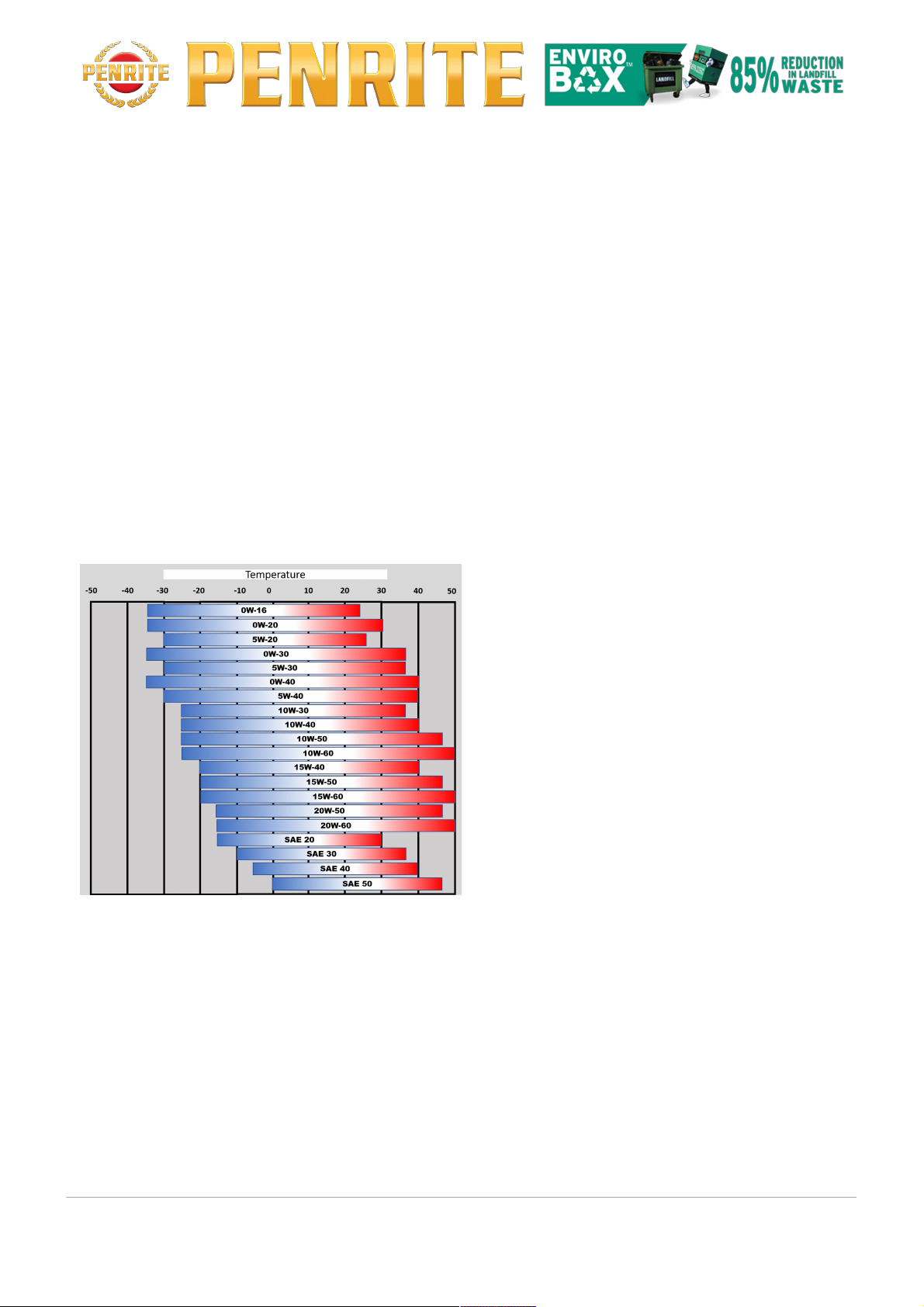
The following chart shows a comparison of different viscosity grades versus temperature range
Understanding Viscosities
The number in front of the “W” signifies the viscosity of the oil at cold/start up temperature (tested at -10 to -35°C
depending on the grade. Please refer to the SAE J300 - Engine Oils Chart opposite). The lower the first number,
the faster the oil flows (pumpability) when the engine is cold.
The second number represents the oil’s thickness at operating temperature (100°C). All oils thin out as they get
hotter.
So, the higher the second number, the less the oil will thin out as it heats up, compared to an oil with a lower
second number.
Normally, multigrade viscosities are measured on a curve.
PENRITE OIL COMPANY PTY LTD ABN 25 005 001 525
110 Greens Rd, Dandenong South, Victoria 3175 Australia
Phone: 1300-PENRITE (1300 736 748)
Fax: 1800-PENRITE (1800 736 748)
International Ph: +61 3 9801 0877, Fax: +61 3 9801 0977
New Zealand Ph:0800 533 698, Fax: 0508 736 748
Website: www.penriteoil.com.au
Email: [email protected]
Page 2
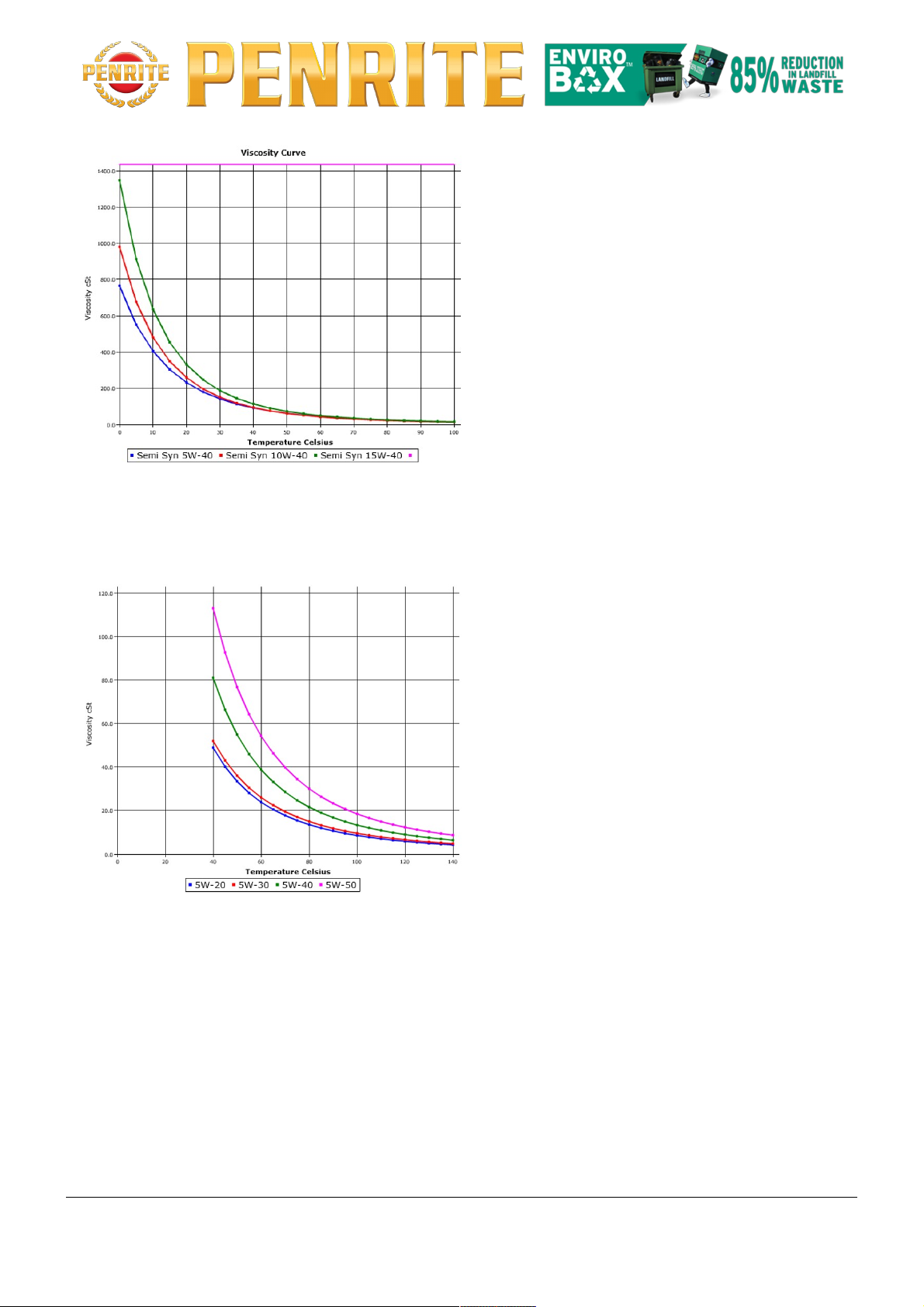
In the example above, all three oils have the same operating temperature vicosity but different cold temperature
viscosities.
All three will be similar viscosities when at operating temperature, measured at 100°C
In the example below, all 4 oils jave the same cold temperature viscosity, but different operating temperature
viscosities
The next graph shows the differences between three different multigrade oils
PENRITE OIL COMPANY PTY LTD ABN 25 005 001 525
110 Greens Rd, Dandenong South, Victoria 3175 Australia
Phone: 1300-PENRITE (1300 736 748)
Fax: 1800-PENRITE (1800 736 748)
International Ph: +61 3 9801 0877, Fax: +61 3 9801 0977
New Zealand Ph:0800 533 698, Fax: 0508 736 748
Website: www.penriteoil.com.au
Email: [email protected]
Page 3
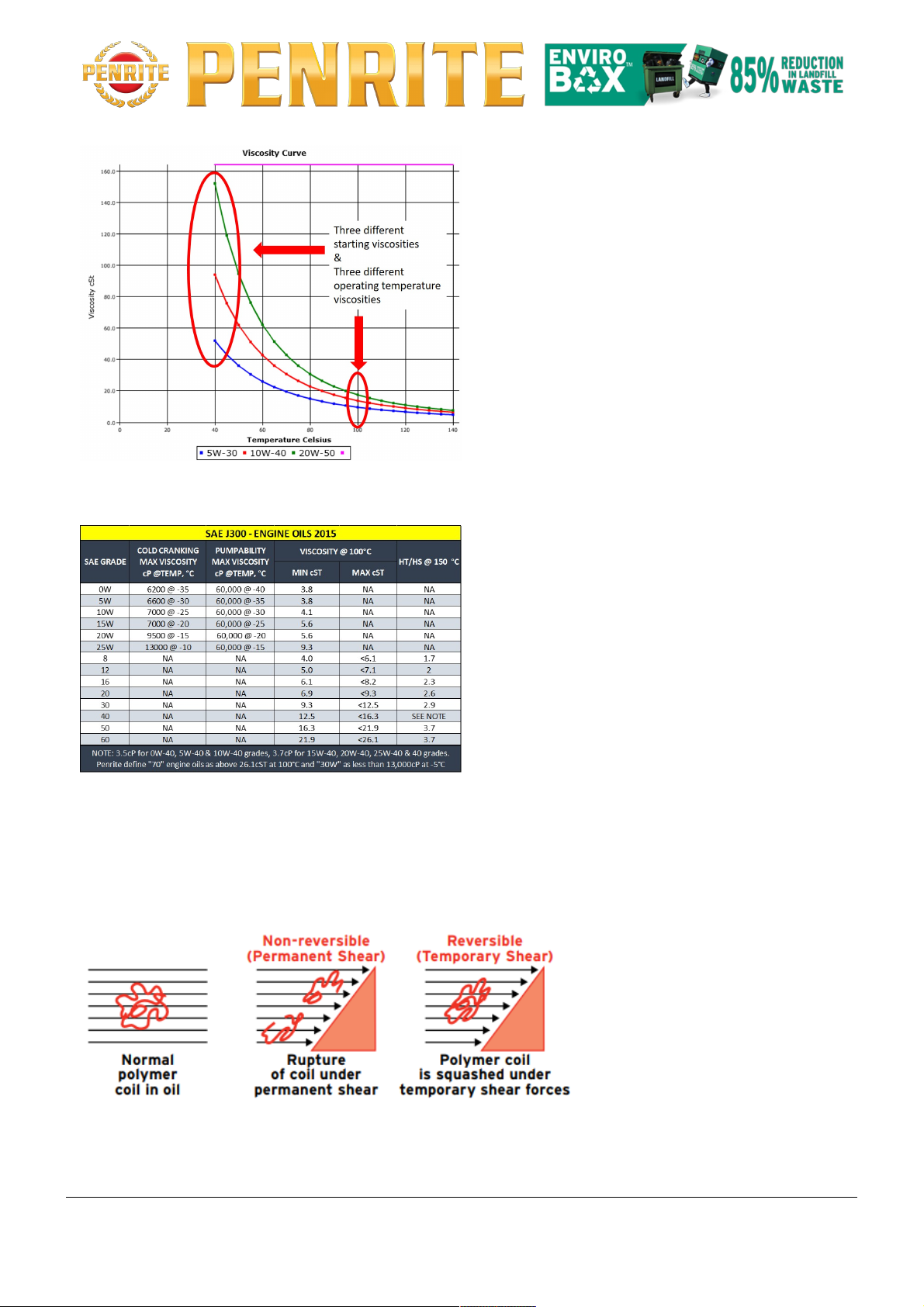
The Society of Automotive Engineers (SAE) set parameters for multigrade oils and viscosities base upon cold
cranking viscosity, pumpability and cST measured at operating temperature. The table below shows these
requirements.
Permanent Vs Temporary Shear
The below diagrams show the two types of shear that can occur with viscosity index improvers (VII). Permanent
Shear is defined as the physical breaking apart of the polymer (VI Improver) into smaller pieces and hence the oil
suffers from a permanent loss of viscosity. Temporary Shear occurs when the polymer is squashed but does not
break apart and hence “springs back” to its original size after going through the area of high stress.
The shearing effect occurs when the oil is forced through areas of tight clearances or is “squashed” (e.g. cam lobe
to follower) and if the gap is too small, then the polymer will rupture.
PENRITE OIL COMPANY PTY LTD ABN 25 005 001 525
110 Greens Rd, Dandenong South, Victoria 3175 Australia
Phone: 1300-PENRITE (1300 736 748)
Fax: 1800-PENRITE (1800 736 748)
International Ph: +61 3 9801 0877, Fax: +61 3 9801 0977
New Zealand Ph:0800 533 698, Fax: 0508 736 748
Website: www.penriteoil.com.au
Email: [email protected]
Page 4
Penrite 10 Tenths Racing engine oils are formulated to be “SHEAR FREE” and do not use any polymers. A special
base oil combination is used to achieve the desired viscosity grades. As such, there are no components in the oil
that can suffer from Permanent Shear so the oil holds its original viscosity for the life of the oil drain.
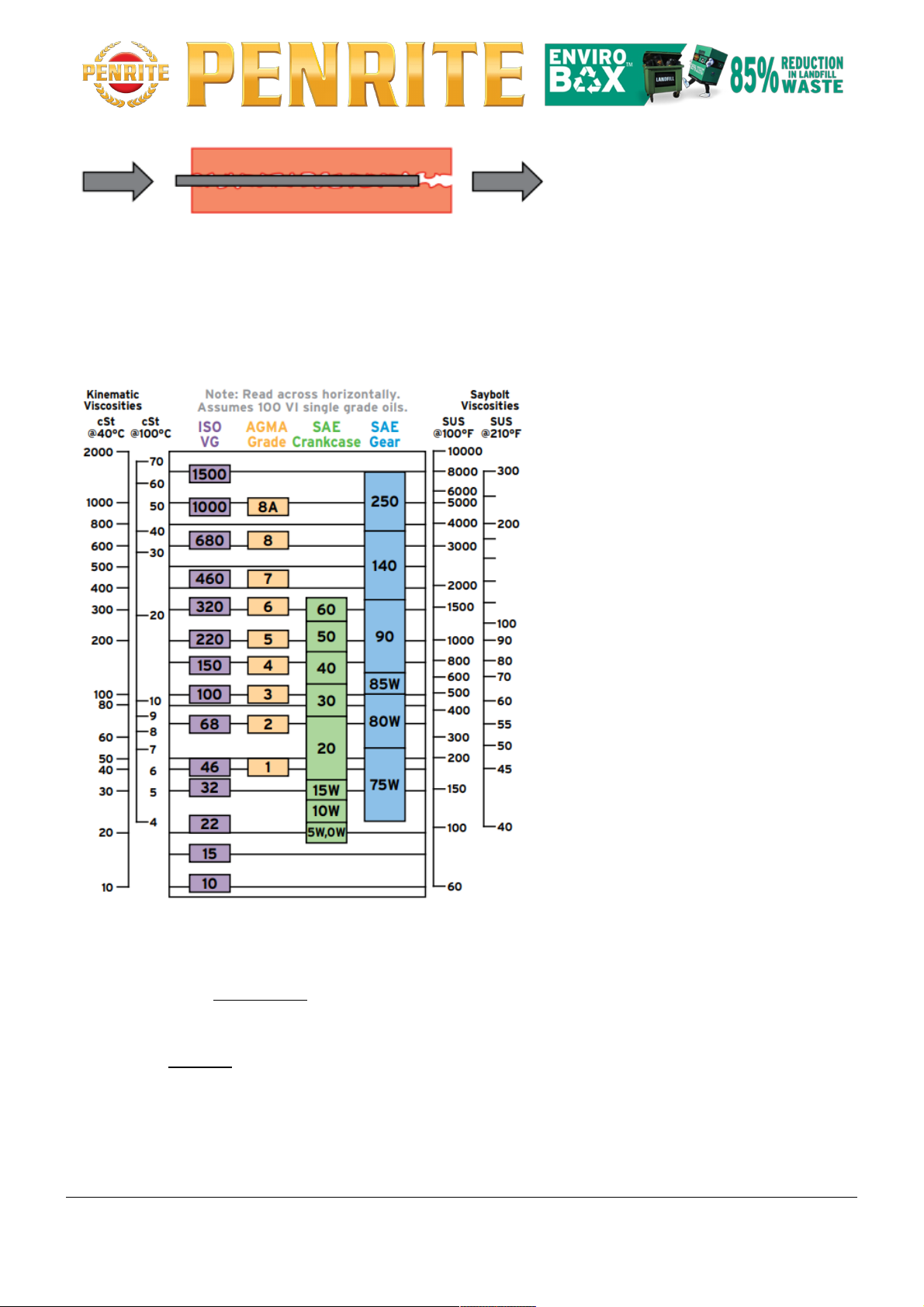
Comparative Viscosity Classifications
Hydrodynamic and Boundary Lubrication
Under normal conditions of speed and load two metal surfaces are effectively separated by lubricant film, a
condition known as hydrodynamic, or thick‑film, lubrication. An increase in load or an increase in speed promotes
metal‑to metal contact. This causes a rise in temperature in the contact zone, which is due to frictional heat. The
consequence is lubricant viscosity loss, which decreases the film‑forming ability of the lubricant and the ability to
minimize metal to‑metal contact. Under these conditions, the nature of lubrication changes from hydrodynamic to
mixed‑film to boundary, or thin‑film, lubrication.
PENRITE OIL COMPANY PTY LTD ABN 25 005 001 525
110 Greens Rd, Dandenong South, Victoria 3175 Australia
Phone: 1300-PENRITE (1300 736 748)
Fax: 1800-PENRITE (1800 736 748)
International Ph: +61 3 9801 0877, Fax: +61 3 9801 0977
New Zealand Ph:0800 533 698, Fax: 0508 736 748
Website: www.penriteoil.com.au
Email: [email protected]
Page 5

PENRITE OIL COMPANY PTY LTD ABN 25 005 001 525
110 Greens Rd, Dandenong South, Victoria 3175 Australia
Phone: 1300-PENRITE (1300 736 748)
Fax: 1800-PENRITE (1800 736 748)
International Ph: +61 3 9801 0877, Fax: +61 3 9801 0977
New Zealand Ph:0800 533 698, Fax: 0508 736 748
Website: www.penriteoil.com.au
Email: [email protected]
 Loading...