

Page 1
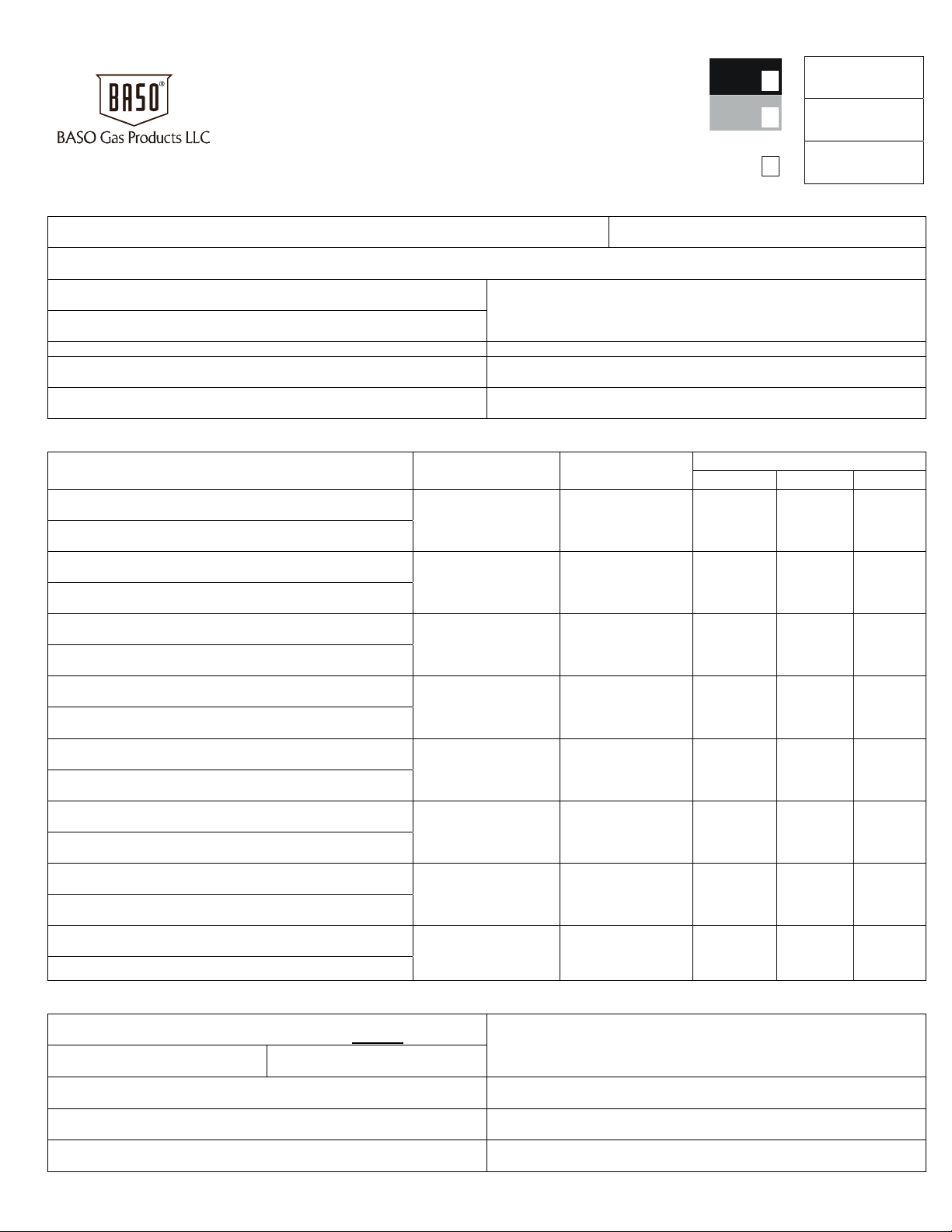
MATERIAL SAFETY DATA SHEET
I. Product Identification
Chemical/Trade Name (identity used on label)
BASO Y70AA Gas Valve Grease
Synonyms/Common Name
Grease
Company Name
BASO Gas Products LLC
Division or Department
Questions Concerning MSDS
Transportation Emergencies
Systems Products
CONTACT TELEPHONE NUMBER
BASO Gas Products LLC
CHEMTREC
II. Hazardous Ingredients
Material
Specific Chemical Identity
Zinc Oxide
Common Name
Specific Chemical Identity
Parapol 1300
Common Name
Specific Chemical Identity
Lube Oil Additive
Molybdenum Disulfide
Common Name
Specific Chemical Identity
Mineral Oil
Common Name
Specific Chemical Identity
Aluminum Complex Soap
Common Name
Specific Chemical Identity
Additives
Common Name
Specific Chemical Identity
Inorganic Thickener
Common Name
Specific Chemical Identity
Bentone No. 34
Common Name
III. Physical Data
Material is (at normal temperatures)
Boiling Point (at 760 mm Hg)
Solid Liquid Gas Other Grease
Melting Point
> 500°F
Specific Gravity (H
O = 1)
2
1.6
Vapor Density (AIR = 1)
5.0
% Volatiles By Weight
Non volatile
Form 11108 (10/03)
H
HEALTH
F
FLAMMABILITY
R
REACTIVITY
PERSONAL
PROTECTION
NC-L503R © 1961 NPCA
Chemical Family/Classification
1
1
0
B
MSDS No.
W00001
Date Issued
4/6/87
Date Revised
03/24/11
Grease
Address
1007 South 12th Street
Watertown, WI 53094
(920) 261-2302
(800) 424-9300
% by Weight or
Volume
CAS
Number
Exposure Limits
OSHA ACGIH Other
25 1314-13-2 15 10
25 9003-29-6 5 5
25 1317-33-5 15 5
13-14 64742-62-7 5 5
2-3 68815-27-0
< 1%
< 1%
136-32-2
64742-52-5
< 1% 71011-25-1
⎯ ⎯ ⎯
⎯
⎯
⎯
⎯
⎯ ⎯ ⎯
1 15 10
Appearance and Odor
Dark, heavy grease with a mineral oil odor
Vapor Pressure (mm Hg at 20°C) (PSIG)
Negligible
Solubility in H
0
2
Insoluble
Evaporation Rate (Butyl Acetate = 1)
Non volatile
⎯
⎯
⎯
⎯
⎯
⎯
⎯
Page 2
IV Health Hazard Information
ROUTES AND METHODS OF ENTRY
Inhalation
Vapor pressure is very low. Inhalation at room temperature is not a problem.
Skin Contact
Prolonged or repeated skin contact may cause skin irritation.
Skin Absorption
Skin absorption is not a problem.
Eye Contact
Eye contact may cause eye irritation.
Ingestion
Ingestion may have a mild laxative effect. It may cause stomach irritation.
SIGNS AND SYMPTOMS OF OVEREXPOSURE
Acute Effects
Eye or skin irritation may be a symptom of acute overexposure.
Chronic Effects
Skin irritation may be a symptom of chronic overexposure.
POTENTIAL TO CAUSE CANCER
This material or its components have have not been tested for ability to cause cancer. The results of
such testing have been listed by NTP IARC OSHA.
The testing showed
EMERGENCY AND FIRST AID PROCEDURES
Inhalation
If overcome by vapor from hot product, immediately remove from exposure and call a physician.
Skin
Remove any contaminated clothing and wash with soap and warm water, if injected under skin, contact a physicia n
immediately. Delay may cause loss of affected part of body.
Eyes
Flush with clear water for 15 minutes or until irritation subsides. If irritation persists, consult a physi cian.
Ingestion
If ingested, call a physician immediately. Do not induce vomiting.
MEDICAL CONDITIONS WHICH CAN BE AGGRAVATED BY EXPOSURE
Unknown.
V. Fire and Explosion Data
> 415°F open cup
Extinguishing Media
Autoignition Temperature
Unknown
Lower
Flammable Limits in Air, % by Volume Flash Point (test method)
N/A
Carbon dioxide, dry chemical, or foam.
Special Fire Fighting Procedures
Do not use solid stream of water because the stream may scatter and spread the fire.
Unusual Fire and Explosion Hazard
Unknown
VI. Reactivity Data
Stability
Incompatibility (material to avoid)
Unstable Stable
Conditions to avoid
Strong oxidizers may cause fire or explosions.
Hazardous Decomposition Products
Thermal decomposition or burning may produce carbon monoxide or sulfur dioxi de or both.
Hazardous Polymerization
May Occur Will Not Occur
Conditions to avoid
Upper
N/A
Page 3

VII. Control Measures
Engineering Controls
Engineering controls are not necessary under normal use conditions. Local exhaust ventilation should be used if
airborne concentrations exceed 5 mg/M
Work Practices
3
. Enclosures or barriers should be used if splashing is possible.
Work practices should be devised to minimize skin and eye contact.
PERSONAL PROTECTIVE EQUIPMENT
Respiratory Protection
NIOSH approved organic vapor respirators with dust prefilters should be used if airborne concentrations exceed
5 mg/M
Eyes and Face
3
.
Eye and face protection should be used if eye contact is likely.
Hands, Arms, Body
Protective gloves may be used to prevent hand contact.
Other Special Clothing and Equipment
Unknown.
VIII. Safe Handling Precautions
Hygiene Practices
Wash hands with soap and warm water after handling the grease.
Protective measures to be taken during non-routine tasks including equipment maintenance.
Avoid skin and eye contact.
SPILL OR LEAK PROCEDURES
Protective measures to be taken if material is released or spilled.
Persons not wearing protective equipment and clothing should stay out of the spill area. Remove ignition sources
and ventilate area. Small quantities may be absorbed on paper towels. Larger quantities can be shovele d into a
container. Do not allow spill to enter waterways or sewers.
Waste Disposal Method
Dispose in accordance with federal, state, and local laws and regulations.
OTHER HANDLING AND STORAGE PRECAUTIONS
Keep containers closed.
 Loading...